A Daily History of Holes, Dots, Lines, Science, History, Math, Physics, Art, the Unintentional Absurd, Architecture, Maps, Data Visualization, Blank and Missing Things, and so on. |1.6 million words, 7500 images, 4.9 million hits| Press & appearances in The Times, Le Figaro, Mensa, The Economist, The Guardian, Discovery News, Slate, Le Monde, Sci American Blogs, Le Pont, and many other places… 5000+ total posts since 2008.

Category: Technology, History of

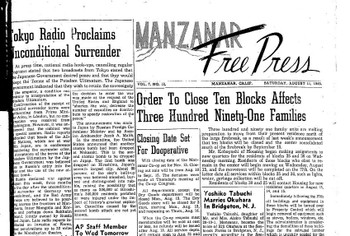
  • Atomic Bomb: Reporting on the Nagasaki Bomb in the “Manzanar Free Press”, 11 August 1945

    JF Ptak Science Books LLC Post 192
    Atomic_bomb_manzanar_2

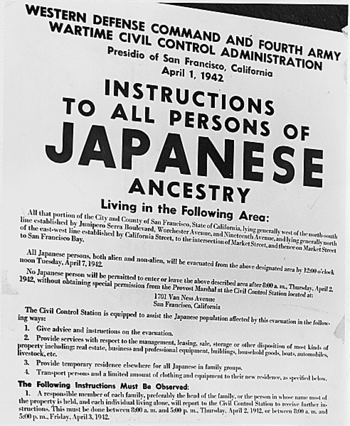
    For another project I’ve been reading through the Manzanar Free Press Newspaper (volume 7, no. 12) and came upon this slight coverage of the bombing of Nagasaki, printed 11 August 1945.  What’s unusual here is that this newspaper was published by the “internees” at the Japanese Relocation Center (officially “The Manzanar War relocation Center” and also called a  “relocation camp,” “relocation center,” “internment camp,” and “concentration camp,)  at Manzanar, California.   110,000 people of  Japanese origin (including a large percentage of American citizens) were forcibly removed and imprisoned via the U.S. Executive Order 9066, issued by President Franklin Roosevelt on 19 February 1942.   Manzanar was a semi-dead town 220 miles NE of Los Angeles, located in high desert with huge swings of temperature and unrelenting and challenging weather—semi-killed by the city of Los Angeles, which purchased the water rights to the region in 1929, forcing out the remaining inhabitants.  Manzanar had a peak population of about 11,000 before the Japanese were returned to what remained of their previous lives.

    Manzanarattention_2

    In this quick coverage, a report is made on the Japanese accepting the terms of the Potsdam “Ultimatum”, putting an end to the war.  The next part is of the reporting is very subdued, announcing the dropping of the second bomb,  theorizing that as many as 200,000-300,000 people may have perished in the bombing of Japan’s seventh largest city.  And not much more than that.  Two hundred words were I’m guessing all that was allowed by the powers-that-be at Manzanar.

    Elsewhere in this same issue is a report on the meeting of the Manzanar Boy Scout troop.  And something on the graduating class of the Manzanar High School (the high school yearbook for 1945, the last class at Manzanar, was called “Valediction”).  Familiar trappings in an unfamiliar trap.

    Manzanar is located near Lone Pine in the Owens Valley, which today suffers terrible environmental problems brought on by water-dependent LA sucking out all of the water in the region.


  • The Birth of the “Internet” at the End of WWII: Vannevar Bush & the MEMEX, July 1945

    JF Ptak Science Books LLC  Post 190

    Dsc00022 In the midst of running the American scientific war effort (As Director
    of the Office of Scientific Research in charge of some 6000 scientists)
    and in the middle of trying to figure out the best way of dealing with
    the coming proliferation of atomic weapons, Vannevar Bush somehow found
    the time to write what many consider to be the first scientific paper
    on what would become the internet. The paper,   “As We May Think”;  was
    published in the Atlantic Monthly in July 1945.

    (It might be odd to look at it this way, but if you were a Nazi time traveler able to assassinate three people in the U.S. that would change the direction of the American effort in WWII, one would certainly be Roosevelt (who rose to the tasks of the Depression and the War  with Lincolnian sustainability), and I’m not unconvinced that one f the other two might very well be Bush–he kept the scientific agenda on course, direct, and to the point, saving time, effort and lives.  Its an interesting bit to think about….)

    Bush was doing A LOT of thinking on the organization of thought in that year.  I suspect that in trying to deal with the problems of the coming atomic arms race (beginning in the year before Trinity) and in trying to figure out how to distribute the knowledge-base that lead to the building of the bomb, that the idea of the MEMEX may very well have been the future consequence formed by his immediate concerns.

    The MEMEX (Mechanical Aid to Memory) was Bush’s breathtaking idea for a design for the organization of associative thought and memory.  It was a mechanical “aid” to memory, building “trails” of associations of ideas.  The MEMEX was another in the long line of art-of-memory attempts, from the ancients to the memory palaces and theaters of Raymond Lull and Francis Bacon and Athanasius Kircher and Giulio Camillo. What made this so appealing to the next generation of thinker on the distribution of information in the computer age was its ideas on making massive amounts of information obtainable; it was more about *thinking* about order and ability and access to information (in quantities unthinkable and by means unknowable) in 1945. 

    Looking at the future square in the face, Bush writes (on page eight of his short paper) with extraordinary perception: 

    “Wholly new forms of encyclopedias will appear, ready-made with a
    mesh of associative trails running through them, ready to be dropped
    into the memex and there amplified. The lawyer has at his touch the
    associated opinions and decisions of his whole experience, and of the
    experience of friends and authorities. The patent attorney has on call
    the millions of issued patents, with familiar trails to every point of
    his client’s interest. The physician, puzzled by its patient’s
    reactions, strikes the trail established in studying an earlier similar
    case, and runs rapidly through analogous case histories, with side
    references to the classics for the pertinent anatomy and histology. The
    chemist, struggling with the synthesis of an organic compound, has all
    the chemical literature before him in his laboratory, with trails
    following the analogies of compounds, and side trails to their physical
    and chemical behavior.

    “The historian, with a vast chronological account of a people,
    parallels it with a skip trail which stops only at the salient items,
    and can follow at any time contemporary trails which lead him all over
    civilization at a particular epoch. There is a new profession of trail
    blazers, those who find delight in the task of establishing useful
    trails through the enormous mass of the common record. The inheritance
    from the master becomes, not only his additions to the world’s record,
    but for his disciples the entire scaffolding by which they were erected.”

    Sounds pretty familiar, yes? 

    Some of the great internet developers who have recognized the
    importance of this paper by Bush include Doug Englebart, (who would
    write to Bush acknowledging the influence Bush’s article had had on his
    own work. (Zachary, 267).);  J.C.R. Liklider  (Waldrop, 2000): and Ted
    Nelson (Internet pioneer and coiner of the term hypertext and know as
    “one of the most influential contrarians in the history of the
    information age.” (Edwards, 1997)).  And of course many, many others. 

    The full text of the paper “As We May Think” is below.


  • Chemical Warfare Architecture: Dugway Proving Ground’s German and Japanese Villages

    JF Ptak Science Books  Post 223

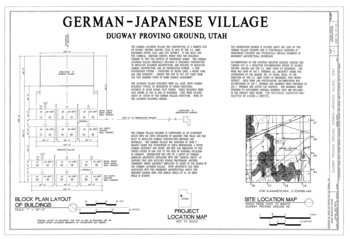
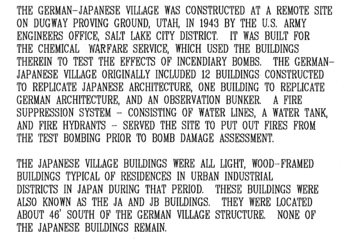
    Dugway Provong Grounds (DPG) was selected in 1943 to test all manner of toxic agents and their antidotes, chemical dispersal systems and the nasty chemical that they would spray, the horrendous and effective (and new-ish) flamethrower and other allied bits. It was established way up in the northwest corner of Utah, in the Great Desert Basin and part of the Bonneville Salt Flats—a very tough, isolated, severe environment for being in the continental U.S., sitting where the waters of the freshwater  Pleistocene  Lake Bonneville used to lap up.  It was at Granite Peak in  DPG that biological warfare weapons were tested until that aspect of research was phased out at the end of the war in August 1946, which is the origin for these architectural plans for test combatant towns.  It seems to me that these buildings were built for offensive purposes for the chemical warfare division, and primarily (?) concerned with the effects of different sorts of incendiaries against typical German and Japanese structures.  i’m not sure that I’ve seen these images before. 

    DPG continues today to research chemical dispersal and micro environments, as well as toxins, pathogens and chemical agents; it also tests the reliability and survivability of military hardware subjected to biological and chemical attack—it is still a major facility and still does very major stuff.  DPG is also a bizarre grail of some sort for the UFO people. 

    Atomic_bomb_german_jap_text


    Atomic_bomb_german_jap_text2

    ·Posted by :

    ·in:

    —

  • “Irreplaceables” of Industry: the Grindstone, 1866

    JF Ptak Science Books LLC Post 218

    When we think today of irreplaceable aspects of technical society
    electricity and petroleum loom large as the juice of progress.  These
    “irreplaceables” have hanged greatly over time, with perhaps one of the
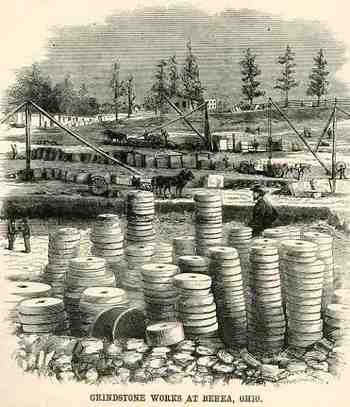
    most benign being the simple grindstone.  These images (below) from The Scientific American of 7 April 1866 show
    work at the quarry of F.M. Stearns & Co. of Cuyahuga County, Ohio
    (near Cleveland), and located n the Cleveland, Columbus &
    Cincinnati Railroad.  These round disks were cut out of the earth here
    in 2 foot and 200 foot (long) sections which were 6 inches and 6 feet
    thick.  The grindstone was an absolute necessity in just about every
    corner of commerce, almost all of which is gone or replaced, today.
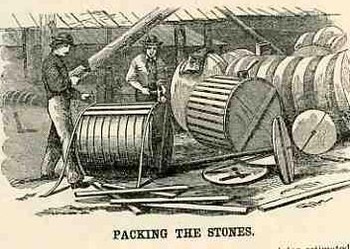
    What really gave me pause wasn’t the image of the quarrying of the
    stones or the cutting of their eyes or their shaping–it was the
    packaging.  How awesome is it to think of packing up ten 400-pounders into a wooden barrel?  A barrel full of grindstones, one after the other, filling a railway car, with car after call of them, sending them out into the country in their dense inertness. I can just about smell the Progress in those cars.
    fBlogaugust_25_grindstone448                                                                                                                     

    Blogaugust_25_grindstone_packing449

    ·Posted by :

    ·in:


  • The Underground: Coal Miners, Trench bombers, George Orwell, & Tom Waits

    JF Ptak Science Books 

    Underground working steep102


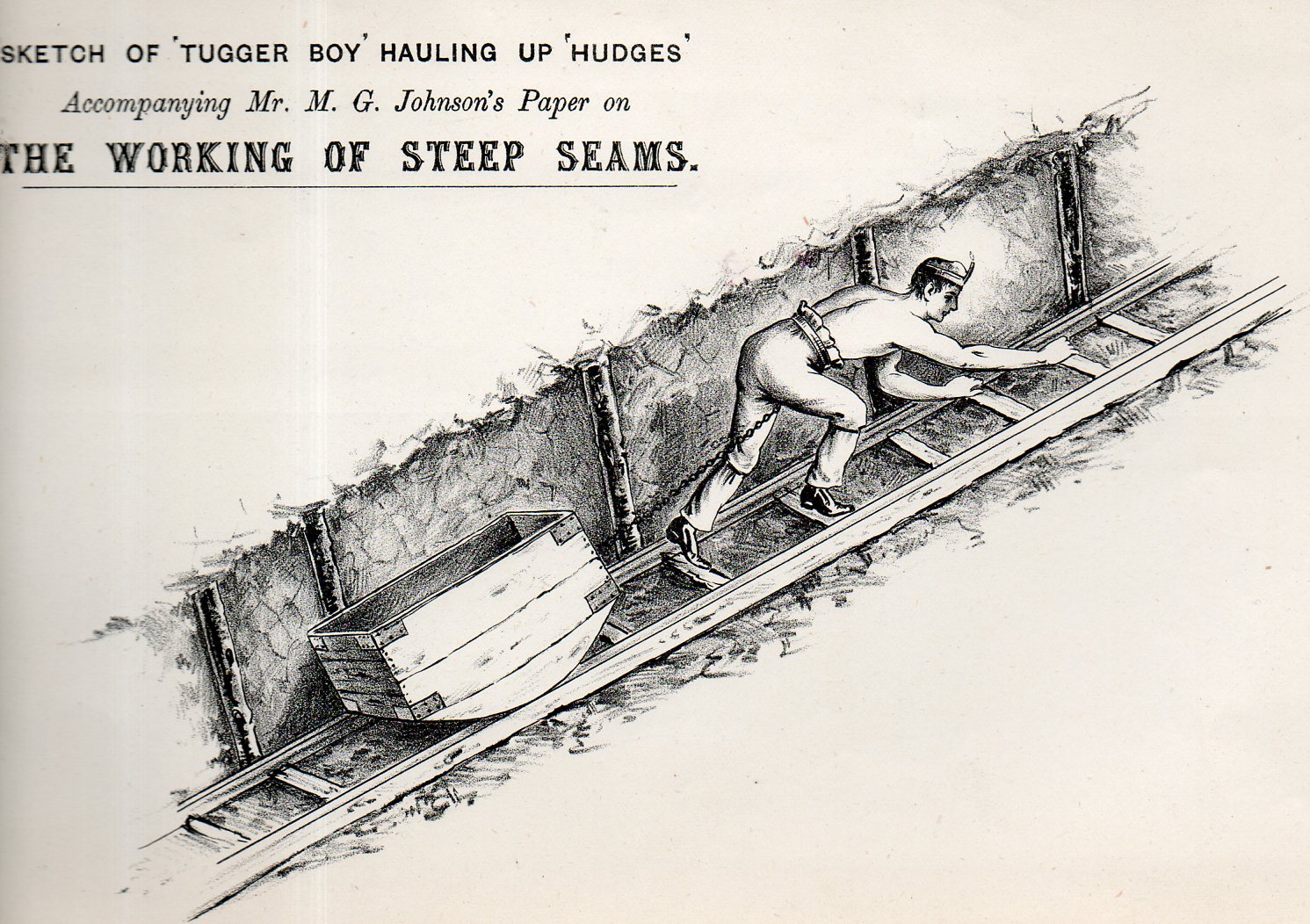
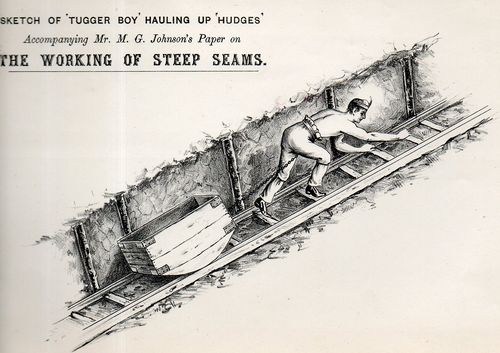
    Looking at these two images of the shirtless miner laying down and working on his side in the semi-dark way underground in what looks to be a tunnel about twice the width of his shoulders makes you wonder about how in the name of great bog could people have done this, day in and day out.  The fact that the appearance of these images were both essential and mundane further tells us—as we sit here in a comfortable chair in the print’s future—that this is, simply, what people did, and what they had to do.
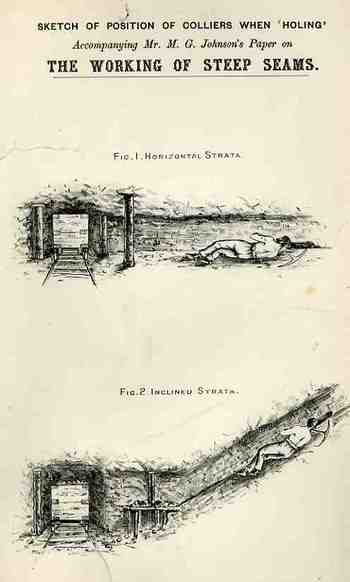
    Blogjuly_17_work334

    This was “holing”, as in working in a hole, and served to illustrate a point in Mr. M.G. Johnson’s paper “The Working of Steep Seams”, which I think appeared in a West Australian mining journal around 1900.  It seems that the miner in the picture would spend his day chunking coal from a hard vein, laying down, scrapping (I think) away at the coal in a too-tight tunnel.  Did he do this for hours?  Days?  Weeks?  I guess the bad answer is that he did this as long as the coal could be followed, though I suspect that the miners must’ve traded out positions to prevent any one man from doing this sort of extremely difficult work for too long, sharing the responsibility of The Bad Job.  (Also, it looks as though that the major tunnel in which the coal car is located may be 4 or 5 shoulders high—certainly not tall enough to walk in, which means that this guy could’ve crab-walked to this position for a half mile or more, just to get to work.  The tenacity of this worker to do his work and collect his pay to feed his family was just incredible. 

    The first image really doesn’t need much commentary, though calling the worker a “tugger boy” pulling up a “hudge” was probably a bit of sardonic camaraderie–except that the doing of the job would distance you from its folksy name.

    • “Tugger boy (Brist). One who draws small tubs or sleds underground by means of a tugger. Called Tugger-work. (Gresley), 1883. 

    The depiction of what seems to be a mature man in the image might be a piece of propaganda. In any event,  the Tugger Boy carries his own flame on the top of his headgear, and the chain that attaches him to the heavy coal bucket runs from his waste down the front of his body and through his legs.  

    George Orwell wrote perhaps one of the most brilliant descriptions of the mining environment in his superb The Road to Wigan Pier. (It is well worth reading all of Orwell’s books at this point—his insights almost never looked so fresh.)

    He  describes the crab-walk from the elevator to the place of work, telling how difficult and exhausting the process was of just getting to the place where you would then begin your difficult workday.  Of the miners he says at one point:  “Watching coal-miners at work, you realize momentarily what different universes people inhabit. Down there where coal is dug is a sort of world apart which one can quite easily go through life without ever hearing about. Probably majority of people would even prefer not to hear about it. Yet it is the absolutely necessary counterpart of our world above.”  (Read more here.)

    The next series of images come from the pen of W. Heath Robinson (1872-1944) who was a lovely, quirky, charming, skewed, dark, stiff-bouncing and creative illustrator capable of considerable whimsy (light and complex) and deep skepticism.  The images I’ve selected are from one of his three WWI books, Hunlikely, published in 1916 (Some “Frightful” War Pictures (1915), and Flypapers (1919), were the other two) and depict scenes from the intra-trench tunnel wars, which were battles fought in the midst (or, actually, beneath) other battles.  This was a savage, grueling, post-adjectival affair—exceedingly dangerous, difficult, awful.  And it happened a lot during the war, given the experience of stalemates between vast armies sunk into mole city trenches, with no one going anywhere for long periods because there was nothing in between the two impervious lines but a death vacuum. 
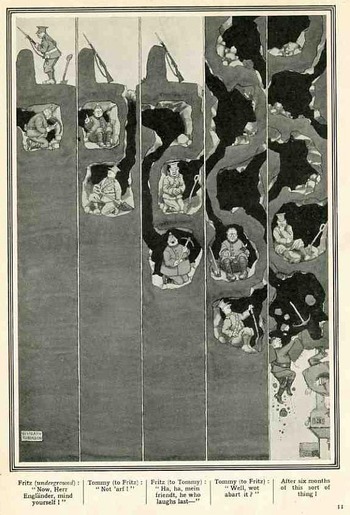
    Blogjuly_18_mining_robinson338

    So one of the solutions was to try and tunnel underneath the opposing army’s defenses, fill the far end with high explosives, and blow them up.  The other side was doing it too, and in the middle of it all was the incorporation of newer/better listening devices to detect forces rummaging around underneath your position dozens of feet into the ground.  It was a bad business. (One of the other means of breaching the trench lines was aerial combat, but bombers carrying tons of HE were still yet to be invented; poison gas was another.  Most of the time the armies would just meet in the middle  in wide plains of nothingness in a sea of hot, expanding metal,  where to this day in many of those places nothing can live).

    Robinson’s illustrations are odd, and oddly funny, the dark humor coming at the expense of both sides of the conflict, piercing each.   
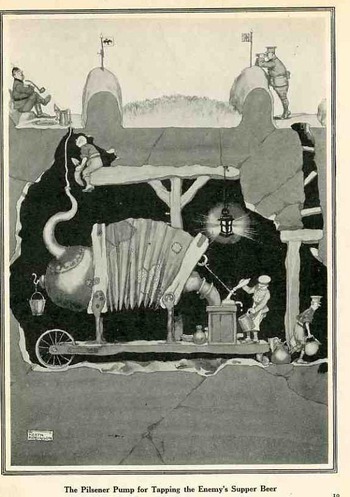
    Blogjuly_18_tunnel_2_robinson340

    This all puts me in mind of Tom Waits’ concrete-toothed “There’s A world Going On Underground” song from the Swordfishtrombones album: 

    Rattle big black bones in the danger zone
    There’s a rumblin’ groan down below
    There’s a big dark town, it’s a place I’ve found
    There’s a world going on underground
                
    They’re alive, they’re awake
    While the rest of the world is asleep
    Below the mine shaft roads, it will all unfold
    There’s a world going on underground
                
    All the roots hang down, swing from town to town
    They are marching around down under your boots
    All the trucks unload beyond the gopher holes
    There’s a world going on underground
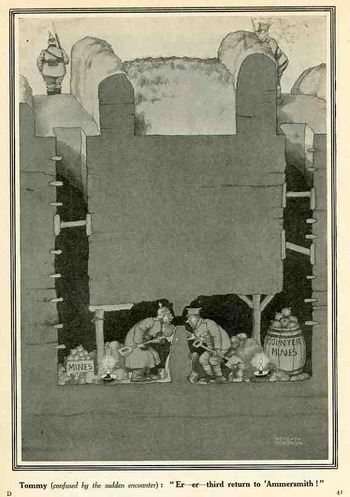
    Blogjuly_18_tunnel_3_2_robinson341

    ·Posted by :

    ·in:


  • The Big Question: How Long Will Oil Last? (1919)

    JF Ptak Science Books LLC   Post 167
    Blogoil326
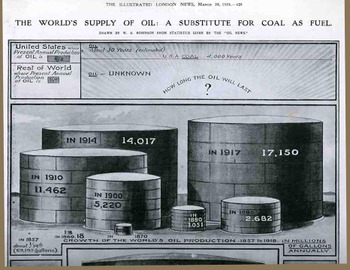
    In 1919, at the end of WWI, The Illustrated London News asked (and answered) the vital question of the day in the coal v. oil dispute and the feeding of its navy:  which power source will last longer?  The graphic designer displayed the answer right there at the top:  American oil would last about 30 years, while its coal reserves would go for another 4,000 years.  The bigger question though was about the oil production and futures for the rest of the world, which was left unanswered (and unanswerable, smartly).  Its easy to second guess these guys and have a stab and a poke at their predictive power, but we’ve been getting the answers to these questions wrong every decade since then.  Suffice to say that the Brits were doing some strategic thinking on the issue of power supply, which of course is probably the greatest issue in fielding an army of navy (just ask Rommel).
    Blogoil_btm327

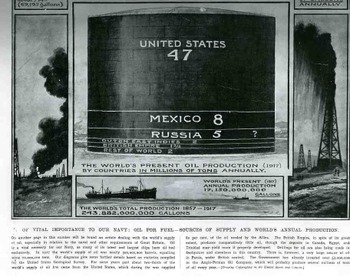
    It is interesting to note that the British government was busily looking for oil in Derbyshire (oops) and other places. And as an end-note it is stated that the government had already invested about 2 million pounds in the Anglo-Persian Oil Company (which would become British Petroleum in 1957, known today as BP),  which, beginning around 1908, was the first time that a company harvested the oil reserves of the Middle East.  All of it was nationalized during the Iranian coup d’etat in 1953

    .


  • Food Packaging, Plastics and the New Desire: the du Pont Company, WWII.

    JF Ptak Science Books LLC Post 159
    Blogcandy282

    I was initially drawn to this small collection of pamphlets because of the very provocative assertion that candy is food (but is food candy?) which, I guess, it is, technically speaking.  (Maybe we should determine what food is on a sliding scale of what we would take to a deserted island somewhere and have to depend on those foods for survival.  I don’t think that I’d have a trunk full of Mounds bars with me.  Evidently if you had to choose one food product (and one product only) to survive on for a year it looks like the best thing to select is dry dog food.)

    The Candy is Delicious Food pamphlet was published in 1939 with the intent of instructing the grocer how to better sell candyFood—expressing the ease, storage and profit margin.  Curiously, the thing was published in September  1939, a few months into the war—I wonder if the publisher (saved for naming below to more effect) was prescient in determining the coming problems with food, and that candy would certainly not have those issues during a global conflict? 

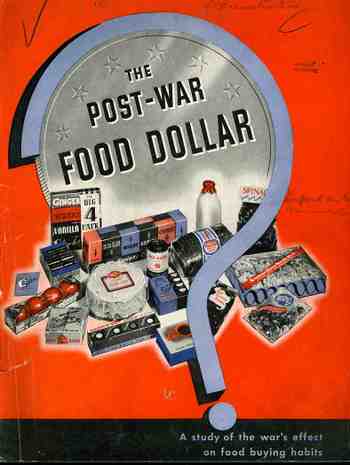
    The Post-War Food Dollar was also the product of the same publisher.  Published in 1943, this pamphlet exhorted the grocer to prepare for the coming peace, explaining where the new dollars might be spent once the war (and the supply and ration problems) was won.  Blogcandy_post_war287

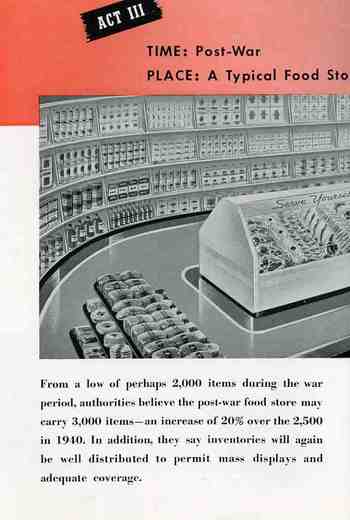
    As it turns out these pamphlets were mostly about display and merchandising, and finding the goods that looked best on the shelves—and evidently that which looked best was that which the product could be seen.  And the way that the product could be seen was with the use of the “new”packaging filament, cellophane, produced in the United States (almost exclusively) by du Pont (E.I. du Pont de Nempours & Co. with  their chemist William Hale Charch figuring out how to make cellophane moisture –proof, which led to very large-scale good packaging using the product.)   Another very big bit which turns up unmentioned but illustrated in this pamhlet is seen in this The Future is Now! scene of a modern supermarket–the “SERVE YOURSELF” butcher/meat section, which was a new idea in the early 1940’s, and one that was not at all common in the consuming world.  This idea wasn’t as big a deal as the invention of mass produced sliced bread (or, as Squidward Tentacles encountered in one episode of SpongeBob, “Bread in a Can–the best Thing Since Sliced Bread”), but it was a very important de3velopm,ent in marketing–and also another gargantuanly consumptive venue for the sale of the packaging element, cellophane.

    It was DuPont who published this series of pamphlets for the sole purpose of marketing foods and ideas to grocers that were almost entirely dependent upon cellophane, and DuPont manufactured 75% of all cellophane made in the U.S.  So, to me, it seems as thought all of this business about Food being Candy and the Post-War food spending dollar was really just about selling cellophane—the food was incidental, which is why the cellophane-encased candy was called “food” to begin with.  (It was Whitman Candies who first used cellophane in the U.S. , in  1912, to package their goods for retail.)
    Blogcandy_post_war285_2
    As an aside it is interesting to note that du Pont was brought to court in 1947 over their alleged monopolization of cellophane manufacturing in the United States.  Thus was the U. S. v. DUPONT (THE CELLOPHANE CASE)  filed December 13, 1947, which “charged Du Pont with monopolizing, attempting to monopolize and conspiracy to monopolize interstate commerce in cellophane and cellulosic caps and bands in violation of Section 2 of the Sherman Act”.   DuPont successfully defended themselves in this case.

    The other, minor, thing here that really caught my attention was on page 10 of the Candy is Delicious Food pamphlet—an innocent picture of the grocer tallying up the customer’s purchases, sure enough, but if you look at the detail you can see the grocer writing it all down on the bag that he’d use bag up the purchases.  I have a dim memory of seeing this done in the across-the-street-from-the-A&P Mom & Pop grocery sawdust-strewn store (on Main Street, of course) in Great Barrington, Massachusetts, when I was a kid in the early 1960’s.  I
     
    don’t recall this being done after that, what with real cash registers and then, much later on, with more sophisticated inventory control hardware.  I’m sure that I recall this being done in hardware shops (almost all gone), and my Mother recalls this more recently—in the 1970’s—in butcher shops, but I think this recording practice was pretty much extinct by the mid  1960’s.  I know that this means nothing, but the picture of this guy writing on the bag was so sharp in my memory that I needed to record the emotion.
      Blogcandy_bag283Blogcandy_bag284


  • Simple Sublimity: Images of Disappeared Common Objects. Traffic Lights, 1936

    JF Ptak Science Books LLC  Post 154
    Blogtraffic262

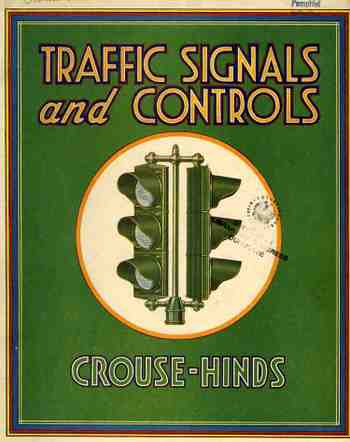
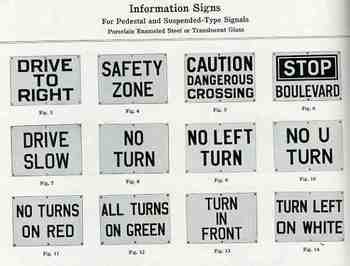
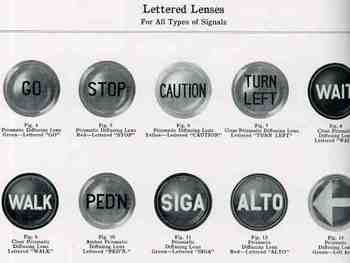
    These images are about as basic as it gets for the common, everyday, overlooked objects from the disappeared past.  They come from the Course-Linds manufacturer’s catalog for traffic lights and other control systems called, yes, Traffic Signals and Controls, published in Syracuse (NY) in 1936. It is a beautifully designed catalog—excellent illustrations laid out perfectly on their pages, with all of the data you’d ever need to order these things for your municipality. 
    Blogtraffic263

    What I find so fascinating about the images here is that they depict ubiquitous objects that today would today—given their ephemeral nature—be exceptionally difficult to find. 
    Given this catalog, today they are not.


    Blogtraffic260

    Blogtraffic259_2


  • Statistical Fossils 2: Found Stats On International Mail Delivery Times, 1900.

    JF Ptak Science Books LLC  Post #121

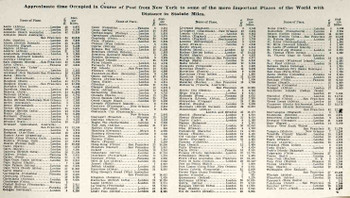
    Continuing to leaf through the George Cram Family Atlas of 1903 I came across another small fossilized statistical nugget that I know would be of value to some poor person out there:  this one is  a half-page of mail delivery times to about 200 places world-wide.  (I know that this would be helpful to some historian, as I just went through a similar process for some data that I actually needed,  finding a series of representational maps showing the frontiers of travel time for different modes of transport over different periods of time leaving from New York, and representing several decades’ differences—these were an enormous help to me, and I was unaware that such data had been compressed so elegantly; trying to piece this information together piecemeal would have been a very time consuming effort.) (This image is clickable for a magnified view.)
    Statistics_found_mail_times166_2

    So in keeping with some of the other data-posting tactics of this site (for example the atomic bomb chronology and the bibliographies of various scientists as found in these pages) as well as on my business site  I‘ll continue to make posts for some of the particularly scrumptious bits that I find during the day.

    And just for the record, the longest in-transit period for mail that I have seen thus far in this table is for New York to “Gabun” (Gabon), Africa, coming in at 47 days; Saigon came in a close second with 44 days, and Hong Kong, 43.  It still took 8 days to get a letter from NYC to London in 1899.  The record for an east bound crossing of the Atlantic in 1958 was still three days, twenty hours, set by the Queen Mary in 1938, so getting a letter delivered in London after only nine days (including the passage plus processing and foot delivery) was pretty fast there at the turn of the century.  Speed is a simple matter of relativity and perspective–and starting with a given known. 


  • Statistical Fossils 1: Found Stats Concerning the Rifles of the World, 1899

    JF Ptak Science Books LLC Post  Post #120

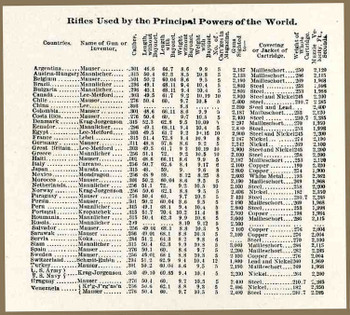
    Leafing through back-page minutiae of the George Cram Family Atlas of 1903 (a modest but full work on the level of something like the World Book Encyclopedia of the 1970’s) I stumbled upon a wonderful table entitled “Rifles Used by the Principal Powers of the World” (and by “world” it meant 43 countries). (You can CLICK on the image below for a more readable, magnified version.)   
    Statistics_found_rifles165

    The 3×4-inch table was packed with some unusual data, and even though I just jested with its 47-country “world” that is actually a fair representation of the gun-consuming nations of the time.  The table lists the name of the gun or inventor, followed by its calibre, length (with and without bayonet), weight (with and without the bayonet), number of cartridges in magazine,, the distance at which the gun is sighted, the “conveyor or jacket of cartridges”, and the muzzle velocity (in feet per seconds).  That’s really quite a lot of obscure data packed into such a small part of page 321 in this book.