A Daily History of Holes, Dots, Lines, Science, History, Math, Physics, Art, the Unintentional Absurd, Architecture, Maps, Data Visualization, Blank and Missing Things, and so on. |1.6 million words, 7500 images, 4.9 million hits| Press & appearances in The Times, Le Figaro, Mensa, The Economist, The Guardian, Discovery News, Slate, Le Monde, Sci American Blogs, Le Pont, and many other places… 5000+ total posts since 2008.

Category: Technology, History of

  • Harvard’s Giant Brain; the ASCC Mark I Computer

    JF Ptak Science Books LLC  Post #125
    Blogharvardbrain
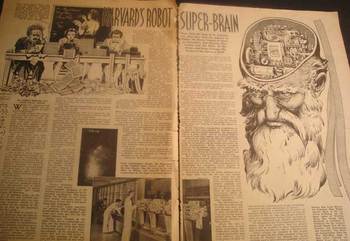
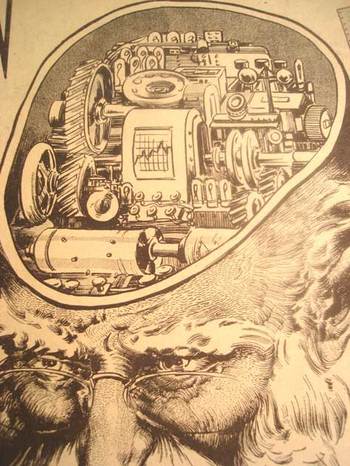
    This may well be the first public, popular, report on the Harvard Automatic Sequence Controlled Calculator (ASCC) (appearing in the American Weekly, 15 October 1944), the first automatic, general-purpose, digital calculator.  Known as the MARK 1, it was the brainchild of Howard Aiken (1900-1973), a graduate student at Harvard, who started it all in 1937 by proposing a series of coordinated Monroe calculators to function as a unified whole  that would cross the threshold of the physically-impossible calculation (though theoretically possible) to the eminently doable.  The project was immeasurably aided by the input of Harvard astronomer Harlow Shapley (who had earlier dealt with the enormously problematic aspects of the scale of the universe) who put Aiken in the hands of IBM at Endicott (NY).  From there the building of the computer came under the supervision of Clair D. Lake, with the engineering and theoretical team of Francis Hamilton, Ben Durfee and Howard Aiken. \
    Blogharvardbraindetail

    The machine was basically completed in 1943 and tested in Endicott for the better part of the year before it was shipped of to Harvard in February 1944, where it was put almost instantly to work on ballistic calculations (like its cousin ENIAC at the Moore School at U Penn), as well as naval engineering and design issues. 

    The author of this article, Gordind Bhari Lal (“noted science analyst”), actually does a pretty decent job describing the machine and its (1940’s) possibilities, noting at the end that “it may even unleash for Man’s Use the long-dreamed-of energy of the atom”.  This part did come true, especially post-war, when the machine was put to fair use by the US Atomic Energy Commission. 

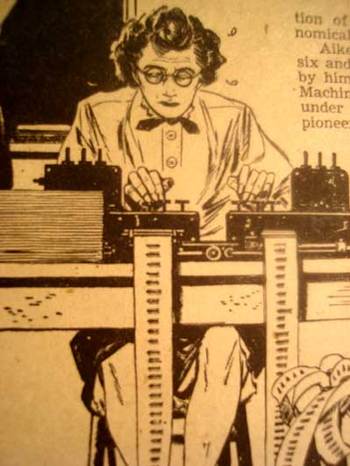
    The part I really don’t understand in this article is comparing the speed and function of the ASCC to two women working on calculators and Albert Einstein, working with a pencil, paper and pipe, none of whom look comfortable or happy.  (Actually the dresses on the women look a little hiked-up to me, just a little too high.)  Lal does make a decent comparative point (of uncertain veracity) about four generations of humans (the three above-mentioned calculators?) doing calculations that the ASCC could do in seconds.  Right or wrong, it gave the crowds in 1944 a real something to think about.
    Blogharvardbraingirl

    ·Posted by :

    ·in:

    —

  • Bombing Manhattan, 1943: the Nazi “Amerika Bomber” by Eugen Sanger

    JF Ptak Science Books    Post #124 (with additions 25 October 2011)
    Manhattan_bombed_4
    That devlish working-for-the-Nazis scamp Eugen Sanger (dead before he was fifty, 1905-1964), a rocket designer and engineer (and developer of ramjet tech)  for the NSDAP, went to work for the French Air Ministry following the end of World War Two after doing his all and thankfully falling short for  the Reichsluftfahrtministerium (RLM, or “Reich Aviation Ministry”).  He worked without rancor there until he was nearly kidnapped1 by Joe Stalin—for the purpose I suppose of continuing work on what may have been his greatest effort, unfulfilled during the war years—the Amerika Bomber.  The Soviets evidently thought that this might come in handy in the late 1940’s.

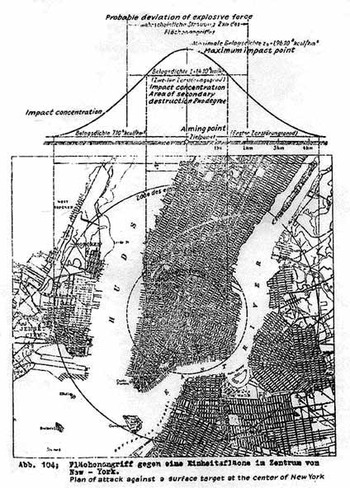
    The Sänger Amerika Bomber (or Orbital Bomber, Antipodal Bomber or Atmosphere Skipper, and also known as the Silbervogel) was designed for supersonic, stratospheric flight, and had much more bang for the buck than the V2 (10,000 feet/second exhaust velocity, as compared to the later V-2 rocket’s 2000 meters/second, 6560 feet/second) and since it was stratospheric had a far greater range, coming in at better than 14,000 miles.  The 22,000-pound weapon carried one large 8000-pound free-falling bomb.

    Sanger’s idea in the early 1940’s was to get this bomb to around Times Square. And since the Amerika Bomber was a relatively inexpensive weapon compared to the damage it could cause, there was room for producing a lot of them.

    Seeing Manhattan in the cross hairs like this is quite sobering, and it is an image that is rarely made.

    Manhattan_bombed_bomber    


    Notes:

    1.  Maybe, maybe not.  Stalin did at least send his representatives–including his own son–to tr and convince Sanger to work for the USSR. THis attempt failed. It has been said that the NKVD was sent to kidnap him, and failed.


  • Statistical Fossils 2: Found Stats On International Mail Delivery Times, 1900.

    JF Ptak Science Books LLC  Post #121

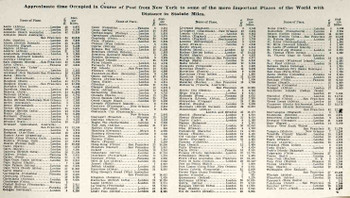
    Continuing to leaf through the George Cram Family Atlas of 1903 I came across another small fossilized statistical nugget that I know would be of value to some poor person out there:  this one is  a half-page of mail delivery times to about 200 places world-wide.  (I know that this would be helpful to some historian, as I just went through a similar process for some data that I actually needed,  finding a series of representational maps showing the frontiers of travel time for different modes of transport over different periods of time leaving from New York, and representing several decades’ differences—these were an enormous help to me, and I was unaware that such data had been compressed so elegantly; trying to piece this information together piecemeal would have been a very time consuming effort.) (This image is clickable for a magnified view.)
    Statistics_found_mail_times166_2

    So in keeping with some of the other data-posting tactics of this site (for example the atomic bomb chronology and the bibliographies of various scientists as found in these pages) as well as on my business site  I‘ll continue to make posts for some of the particularly scrumptious bits that I find during the day.

    And just for the record, the longest in-transit period for mail that I have seen thus far in this table is for New York to “Gabun” (Gabon), Africa, coming in at 47 days; Saigon came in a close second with 44 days, and Hong Kong, 43.  It still took 8 days to get a letter from NYC to London in 1899.  The record for an east bound crossing of the Atlantic in 1958 was still three days, twenty hours, set by the Queen Mary in 1938, so getting a letter delivered in London after only nine days (including the passage plus processing and foot delivery) was pretty fast there at the turn of the century.  Speed is a simple matter of relativity and perspective–and starting with a given known. 


  • Statistical Fossils 1: Found Stats Concerning the Rifles of the World, 1899

    JF Ptak Science Books LLC Post  Post #120

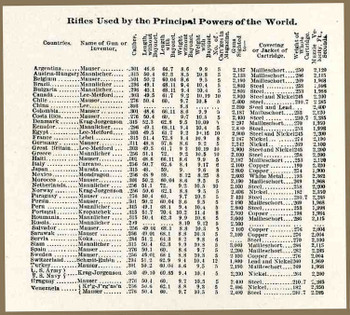
    Leafing through back-page minutiae of the George Cram Family Atlas of 1903 (a modest but full work on the level of something like the World Book Encyclopedia of the 1970’s) I stumbled upon a wonderful table entitled “Rifles Used by the Principal Powers of the World” (and by “world” it meant 43 countries). (You can CLICK on the image below for a more readable, magnified version.)   
    Statistics_found_rifles165

    The 3×4-inch table was packed with some unusual data, and even though I just jested with its 47-country “world” that is actually a fair representation of the gun-consuming nations of the time.  The table lists the name of the gun or inventor, followed by its calibre, length (with and without bayonet), weight (with and without the bayonet), number of cartridges in magazine,, the distance at which the gun is sighted, the “conveyor or jacket of cartridges”, and the muzzle velocity (in feet per seconds).  That’s really quite a lot of obscure data packed into such a small part of page 321 in this book. 


  • Atomic Weapons, Eniwetok Atoll, and the Most Obscure Reference to America’s Entrance into Vietnam

    JF Ptak Science Books Post #117

    Atomic_times_detail_masthead159

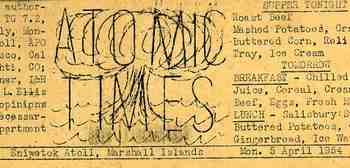
    This issue of the Atomic Times was issued Monday through Friday by the U.S. Army on a mimeographed, single-sheet page, and published at the tip, or bottom, of a very skinny piece of nearly-circular land far out in the Pacific Ocean at Einwetok Atoll, 5 April 1954.  The Marines fought a battle and beat the Japanese Army for possession of the atoll in 1944, and the U.S. government stayed. In 1954 most of it was controlled by the U.S. Army, and the place was being used as a nuclear bomb testing zone for a decade, experiencing 43 tests from 1948 to 1958. The most famous of these test shots was “Mike”, part of Operation Ivy, which was the first detonation of a hydrogen bomb, in 1952. There would be subsequent tests there that, by themselves, represented in a single instance all of the chemical fury unleashed in all Allied bombing in Europe for the entire course of World War Two.

    Atomic_times157

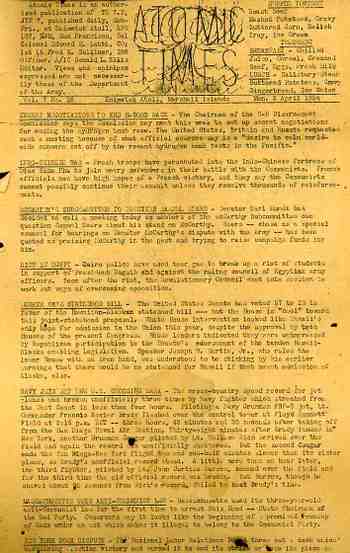
    “The Atomic Times” was a sheet of the daily grind at this remote, if not bustling, outpost of nuclear prolificacy. “Supper Tonight” was announced in the upper right corner (roast beef, mashed potatoes, gravy, buttered corn, relish tray, ice cream”), plus “tomorrow’s breakfast and lunch”; there was a fair amount of reporting on local softball, boxing, swimming and basketball, pus some major league baseball scores. On the front side was the news, with what may well be the loneliest announcement of the coming of America’s involvement in Vietnam. This was the second entry in the news, “Indo-Chinese War”: “French troops have been parachuted into the Indo-Chinese fortress of Dien Bien Phu to join weary defenders in their battle with the Communists. French officials now have a high hope pf a French victory, and they say the Communists cannot possibly continue their assault unless they receive thousands of reinforcements”

    And so it ended, and so it began.

    The siege of   Dien Bien Phu started just a week later or so, on the 13th of March, and lasted 57 days, ‘till May 7th, 1954. The commanding general of the Viet Minh forces, Vo Nguy Giap, achieved an enormous victory over the French—the first time a guerrilla force readjusted itself into a conventional force to defeat a Western army. It was the end of the line for the French, and it just so happened to be the beginning of American involvement

    Dien bien phu

    Just a week after this notice appeared, Dwight Eisenhower made his domino speech:

    “Finally, you have broader considerations that might follow what you would call the “falling domino” principle. You have a row of dominoes set up, you knock over the first one, and what will happen to the last one is the certainty that it will go over very quickly. So you could have a beginning of a disintegration that would have the most profound influences.conference…”


  • Gigantic and Unbuildable Architecture: Philip Johnson and the Walled “Third City”

    JF Ptak Science Books LLC   Post #116
    Big_arch_city_johnson137

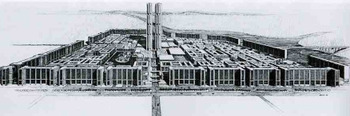
    Philip Johnson, the enormously influential, selfish and neo-fascist architect once remarked of his profession that “architecture was too important to be left to the architects”, and I agree, especially if it was Johnson who was signing off as architect.  Johnson was more interested In building great rooms; some people see Johnson’s greatest room as the Crystal Cathedral that he designed for the television minister Robert Shuller (Garden Grove, California), a very shiny one-acre metal/mirror tent-like structure that from the inside looks like, well, a tent; from the outside it looks pointy and block-like.  (I’ve never understood the fascination with the work of Johnson.)
    Johnasonkowloon_ii

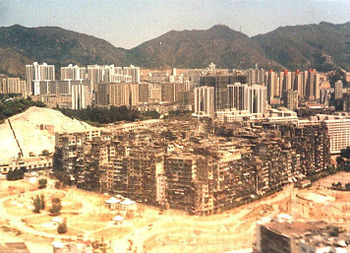
    But some of the ideas of Johnson’s that I’ve least understood are his big ones—city design and planning, the oddest of which (pictured here) is the design for Third City (1966).  This essentially was a city re-design, constructing something else over/within the existing street grid and transportation systems, and adding a surrounding layer of “low” and middle-income housing, and which included at its nexus a giant skyscraper.  Aside from a decidedly cellular appearance, this work by Johnson also reminds me of classic medieval walled  cities, though not those with crenulated fortifications, like Basel, but rather more like the truly ancient cities like the Sumer Uruk, or Lahore, or Starard Szczecinski.   In Johnson’s design the defensive perimeter is a chain-like linkage of apartment blocks filled with families of modest means, and the thing really most reminds me of the infamously spectacular walled city of Kowloon (Hong Kong), a high-rise slum that was formed of concentric blocks of itself.

    Johnson’s stylistic references have almost always felt “mean”, to me, and Third City is no exception.


  • Beautiful Technical Illustration: Heck’s “Iconographic Encyclopedia”, 1851

    JF Ptak Science Books   Post 151

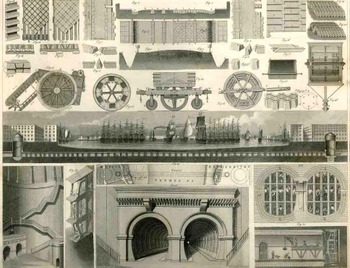
    J.G. Heck wrote and compiled a fascinating and complex work entitled The Iconographic Encyclopedia of Science, Literature and Art, and was published in America for the first time in 1851 following Spencer Baird’s translation from its original German.

    Blogtunnel_full239

    The key to his work is the amount of data displayed on each of the 500 engraved plates illustrating this work and the way in which it is arranged.  The design and layout of the 30,000 items on these 500 plates was a work of genius, and for my money it is easily the best-presented complex means of the display of data and objects that was published in the 19th century.   

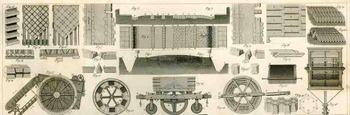
    Take for example this illustration in the technology section (a subdivision of the applied arts which is a sub division of the plastic arts) and, continuing in this complicated scheme, was Plate 1 from Section X Number A1 with a description found in the text on a dozen pages in Section 2 of Volume 2 on section pages 134-150 and overall page numbers 835-851 (!).  The plate contains 35 figures, very finely executed and rendered (many of the other of the 500 plates have 100 or more figures), and is in general related to the construction of roads and tunnels (and further, part of the “communications” section).

    This of course would be a perfect Hypertext candidate.

    Blogtunnel_top240

    The illustration itself contains an enormous amount of information.  The row along the top third or so is dedicated to street construction and paving stone, showing stones in plan and profile, as well as a cross section and ground plan of a “typical” street (including sidewalks).  It is interesting to note the detail of the cross section and the stonework that is placed beneath the horse and wagon section of the street.  There are some other beauties here as well–details of wooden paving blocks, the plan for a Laves of Hanover road, different ways of cutting stone blocks—but we won’t deal with those right now, except to point out that there are several renderings of street cleaners and road rollers (of Shettenmann and another of Schaefer) used to border the street section from the tunnel section. 

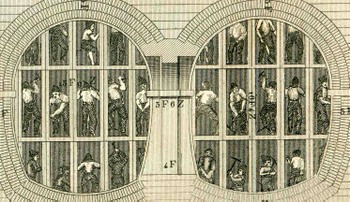
    Blogtunnel_middle241 The middle section of the engraving is of course a cross section of the Thames tunnel of the beautifully-named Isambard Kingdom Brunel (begun in 1825 and completed 1843, the tunnel 35 feet wide (11 m), 20 feet (6 m) high and 1,300 feet (396 m) long, running between Wapping and Rotherhithe at a depth of 75 feet (23 m)).  The representation here is only one inch high and ten inches long but is loaded with just fabulous detail, no the least of which are the (less than) 1mm tall workmen that can still be seen in the tunnel.

    Blogtunnelbig_detailig247
     
    The enlarged detail shows a section of the tunnel being built according to Brunel’s new specifications:  a larger, shielded tunnel being constructed around the interior construction of 12 individual tunnels (each about tall enough to allow a (short) man to stand erect. 

    In short, the engraving is a superb example of *correct* design of great artistic  ability, all accomplished while displayed heaps and gobs of interconnected, complex information. 


  • Nails and Screws: Beautiful and Well-Designed Simplicity

    JF Ptak Science Books  Post #148

    Here we have two glorious, lovely examples of craftsmanship of simple things. The first is The Republic Steel Corporation (Chicago) manufacturer’s catalog for their production of nails and other wire goods.  It is about fifty pages long, and a third or so of it is devoted to the history of nail and nail-making as well as the history of the company.  The rest is all about the product.  And mostly about nails.  All sorts.  It is just fantastic!  I must say in all the years of my own nail consumption I didn’t know that there were so many different sorts of nail POINTS (diamond, blunt, chisel, needle, duck bill, side, and so on) ion addition to the various widths and lengths and special uses.  The points just never entered into the equation to me, but, of course, it is very important. 

    Blognails_cover225

    And speaking of special uses, there are a number of interesting specified nails in this catalog that, I think, are long gone from modern hardware store  shelves, as the needs they addressed are gone:  beer case strap nails (oh my god I love the sound of that) AND beer case hinge/lock/latch nails AND beer case cleat nails, basket nails, shade roller pins, pole marking and dating (!) nails, barbed berry box nails, and egg case fasteners are among what I imagine to be extinct nails. 

    Blognails_barre227

    Then there’s the beautifully designed Southington Hardware Manufacturing Company’s screw catalog, called, wonderfully, Screws, (Wood, Sheet Metal, Phillips Head, Slotted Head), catalog 41 (with prices) for 1935.  There’s page after page (actually, forty-five pages) of very detailed specifications (dimensions of heads, diameter, thread and tolerance, each description accompanied by two (or more) engineering drawings of the screw itself. 
    Now THIS is a way to describe a product.

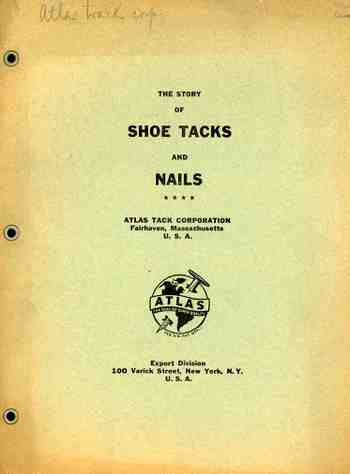
    This is followed up by a concise, nine-page (3,500 word) pamphlet published by the Atlas Tack Company (Varick St, NYC) on the history of shoe tacks and nails, bound, I’m happy to say, with metallic eyelets.  It contains pretty much all you need to  know on the history of shoe tacks, and I’m 100% behind the publication of odd-obscure histories such as this.  (I own perhaps a hundred “different” histories like this, including the massive non-classic “The History of Refrigerated Nuts”.) 

    Blognails_screws231


  • Fantastic and Unbuildable Architecture #6: the Pyramids of Gizeh in Detroit (Michigan), 1908

    JF Ptak Science Books  Post 137

    Because strait is the gate, and narrow
    is the way which leadeth vnto life,
    and few there be that finde it.

    –Matthew 7:14

    Blogprymmidelevtion216

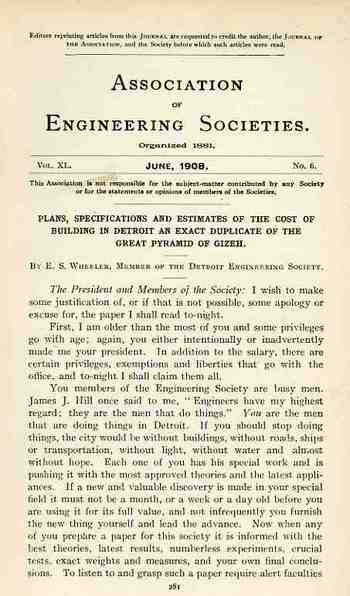
    And so it came, somehow, to be that E.S. Wheeler, president of the austere and august Association of Engineering Societies, presented a paper at its annual meeting in June 1908, on building an exact replica of the great pyramid of Gizeh.  I suspected that because of the intentionally fantastoid title that Mr. Wheeler intended the paper as a show, exhibition, to the younger engineers in the audience about how one might approach an unusual engineering problem, as an imaginative course of instruction.  That would be quite nice. 

    Except though that Wheeler presented the paper as though he was serious.  He delivered  it evidently with a high dryness, and people took him seriously.
    Blogprymmidpln215

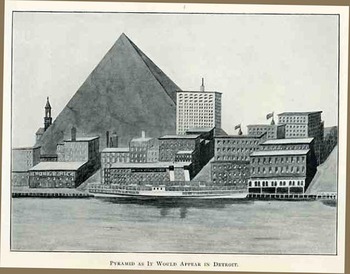
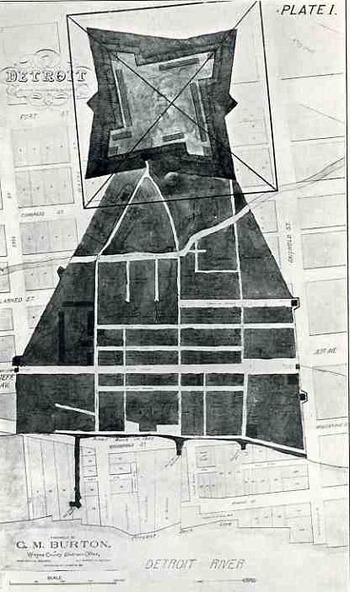
    The pyramid was to be built on the site of the village of Cadillac (of 1701), in central Detroit, occupying that site and then some, covering it with 13 square acres of stone.  Oh, yes, and it was also to be excavated, scooped first into a shockingly cavernous prism 759’ on each side and 120’ deep, or about 2.6 million cubic yards of stuff.

    The pyramid itself was to be built almost entirely of limestone, 760’ on each side, and 485’ high, set on the 13 acre base—where those 13 acres in the center of Detroit was left open to debate. Wheeler also intended to reproduce the interior of the pyramid as well (so far as it was known in 1908), and had a set of plans to accomplish that goal. 

    Wheeler figured that the material cost (exclusive of the base), would be $36,000,000 1908 dollars, which he considered a fair price.  The conclusion of his paper was a superb slash of logic and possibilities—he calculated that if each person in the United States contributed the equivalent of a day’s labor on the building of the pyramid, that the great structure could be built in a day and a half.  Wheeler closes with this superior gem, a sentence unlikely to be repeated in any subsequent technical journal”  “If the United States should stop all other work and devote itself entirely to building pyramids, as was probably the case in Egypt, it would, after it got fairly running, be able to turn out two every three days.
    Blogprymmidtp214    


  • Unusual Questions 1: Are the London Bridges Too Far Apart? 1904

    JF Ptak Science Books LLC   Post 136

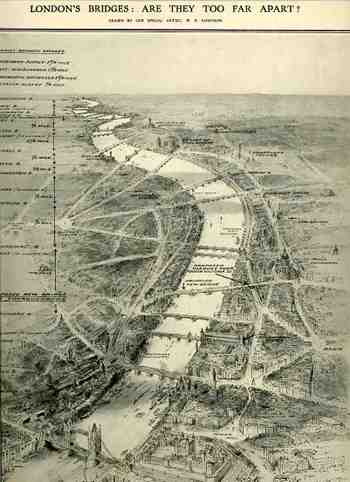
    This image (from the Illustrated London News of 10 July, 1909) asks an unlikely question, and one that I’ve never heard asked before of London:  are the London bridges too far apart?  The “new bridge” which was to be built was scheduled to be located between Southwark and Blackfriars bridges (for what looks like today to be a fabulous deal of 1.5 million pounds, or about 6 million USD, or about 95 millions dollars today), and would’ve been about where the Millenium Bridge is now. The bridge would be 80 feet wide and carry a double deck of trams, running on a diagonal  with the access nearly at Blackfirars.  I’m not terribly sure how to interpret the question, because the answer seems a little obvious to me, what with 14 bridges on just one side of the Tower Bridge in just a few miles.

    Bloglondon_bridges208


    [Image greatly expandable.]

    I’m not so sure what the engineers were expected to do, short of tunneling a great length of river and delivering land on top of it.

    This reminds me somewhat of a report that I saw some years ago about the plans for Rock Creek Park and Parkway in Washington, D.C. The park runs roughly north-south in the top center half of the city, and around 1890 the Federal government was trying to figure out how to best multi-task the area for parkland and roadway.  One (incredible) plan called for the creek, which in many places is bounded by some pretty steep embankments (25-75 feet or so) and extends about 8 miles north of downtown, to be filled in, leveled off, and paved over.  Now that, dear readers, would’ve been a lot of dirt.  The final plan was perfectly fine and had a series of small roads snaking their way through the park, making it one of the nicest rides (Central Park-like) of any major metropolitan cities in North America.