A Daily History of Holes, Dots, Lines, Science, History, Math, Physics, Art, the Unintentional Absurd, Architecture, Maps, Data Visualization, Blank and Missing Things, and so on. |1.6 million words, 7500 images, 4.9 million hits| Press & appearances in The Times, Le Figaro, Mensa, The Economist, The Guardian, Discovery News, Slate, Le Monde, Sci American Blogs, Le Pont, and many other places… 5000+ total posts since 2008.

Category: Technology, History of

  • (Literal) Bits of History–the Softly Pedestrian Beginning of the Atomic Bomb

    JF Ptak Science Books LLC Dsc00015_detail
    My  rare/significant/non-existent scientific bookstore was in Georgetown for many years.  It was a few doors down from Alger Hiss’ house, a few less from Warren Christopher’s house, a few more further from Alex G. Bell’s house, diagonally away from a George Washington ____ here tavern,  just across the street from a children’s park built on top of a Revolutionary War cemetery, and just generally in the misty mist of interesting stuff. It was by virtue of my location (it took 15 years for me to actually get a sign for the store, and only then because my glorious wife, Patti Digh, bought it for me) that I was able to met a wide range of interesting folks–and this is how I came to meet Robert L. Walker.  Dr. Walker was retired and living in the desert near Santa Fe at that point, and had just happened to pop into the store because he was visiting a neighbor who shared his hobby of harpsichord building. 
    Blogwalkerfermi

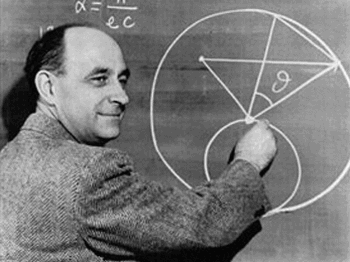
    Since he was a physicist and of a certain age, it was my custom to find out what this class of human was doing, oh, 55 years earlier.  Dr. Walker, as it turned out, was a graduate student at Cornell who was recruited to work at the Metallurgical Lab at U Chicago, beginning in 1941. 
    Dsc00015

    This of course was an incredibly interesting time to be where he was. Steps towards the realization of nuclear energy were being taken under the grandstands of Soldier’s Field (the “West Stands Laboratory”), with Enrico Fermi in charge–the atomic pile (code for a nuclear reactor) being constructed during the months of October and November 1942 and then becoming “operational” (becoming a self sustaining chain reaction initiating the controlled release of nuclear energy, as they say) for the first time (in human history) on December 2, 1942.

    Now what really captured me in all of this was Dr. Walker’s story of how he came to go from Chicago to Los Alamos—it is to me a magnificent story of collected smallnesses in a very, decidedly, not-small environment.

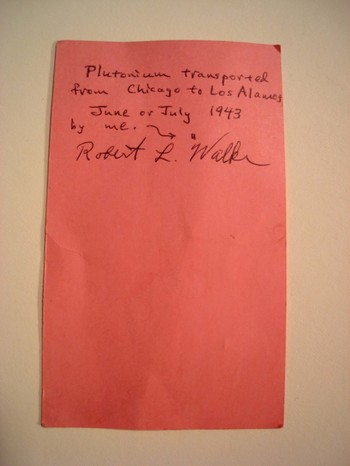
    Listen:  Dr. Walker said that he was tasked “in June or July 1943” with taking a bit of plutonium from the Chicago reactor to Los Alamos. Los Alamos was just being completed at the time.  The production of plutonium was very slow and produced minute amounts. It could well be that this was the first plutonium that was received at Los Alamos.

    Dr. Walker had the plutonium in a small glass vial in his pocket.  He traveled alone.

    He got on a commercial flight and had  several stops en route to the desert.

    Once he reached Santa Fe he waited for a JEEP; once it arrived, he hopped in and he and the driver trundled off to the brand new top secret facility in Oppenheimer’s nowhere.

    The plutonium was delivered.

    The story is just so incredibly sotto voce, so offhand and chance-filled, to transport such an incredibly rare and valuable commodity in someone’s pocket, without a guard, as to be unimaginable, at least in my mind.

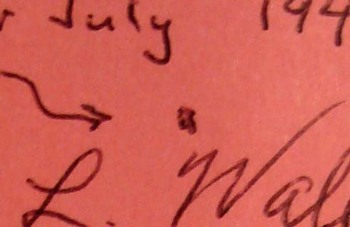
    I asked Dr. Walker to draw on a 3×5 card the size of the plutonium bit—the results are above.  The speck was a research speck to be used to determine fission quality and other preparatory tests—this was all pre –Hanford, when plutonium production really kicked in in 1944/5.  But in 1943, the speck was pretty much what we had.  And it was in Walker’s pants.

    I misplaced this card for years, and it surfaced again just today.  So, before I could send it off again to its Secret Place, I decided to write a bit about it and post its image here, just so that there is some record of this first momentous and bumpy trip.

    Earlier today I called the Los Alamos National Lab and talked history with Gordon McDonough just to make sure I wasn’t overlooking something big in the story, something that would make it more understandable for this plutonium speck to make the trip in someone’s pants.

    McDonough supported the rare nature of this trip, saying that the plutonium was very seldom transported, and that although Dr. Walker was noted in the official LANL history, there was no mention of this trip, nor it seemed was there any mention of the first plutonium received by the lab.

    I knew that there was no danger in carrying the plutonium in a glass vial in your pants, and Gordon—an animated and charming speaker—perked up further, mentioning that Glenn Seaborg quite often carried his plutonium around in an envelope in his pocket.  I really don’t know what to say.

    Seems to me that the first bits of the bomb would be moved around with a little more élan—though I am proven wrong.  Now I’m forced to try and think about a category of essay in a new and perhaps untouched genre:  great things of enormous importance that people carried in their pockets.

    Dr. Walker went on to a brilliant career and was a much-loved and highly respected, and generous, teacher and colleague.  The way in which he told his story of transporting what may have been the first plutonium to reach Los Alamos for the build of the atomic bomb will never leave me—the quiet, ultimate understatement of a man completing a task. 
    ·Posted by :

    ·in:

    —

  • The Beauty of Repair—Moving Heavy Stuff and Fixing the Impossible: Zabaglia and Fontana

    JF Ptak Science Books

    Blogzabaggi043web

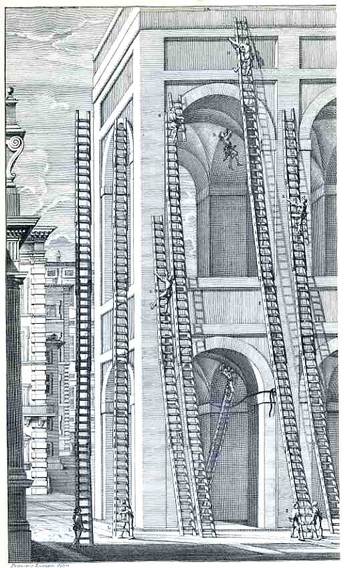
    This gorgeous, near-dadist image belongs to Niccola Zabaglia, who published it in his book Castelli, e ponti di maestro Niccola Zabaglia con alcune ingegnose practice, e con la descriziojne del trasporto dell’obelsico Vaticano, e di altri del cav. Domenico Fontana, in Rome, in 1743.  This is the literal and absolute height of pre-modern, pre-mechanized building construction in the soaring Roman Baroque, ordained by “maestro”, the master, Zabaglia (1664-1750), a spectacular (and necessary) proponent of practical mechanics as applied to the building trades.  Among the “Castles” and churches and bridges alluded to in the title of his book, Zabaglia was responsible for affecting the maintenance and repair of St. Peter’s (more particularly to the basilica and the vault)—specifically, he had to figure out how to get the workmen and materials into place, and into very difficult and very high places, without damaging or destroying any of the existing decoration, artwork, sculpture, frescoes, and so on.  This was no easy feat to perform back there in the dim, 265+ years-ago pre-electric pre-power past, with enormous technical and operational difficulties, and Zabaglia accomplished this was superior affect, devising complex and elegant moving and stationary scaffolds, hoisting and holding mechanisms for the ladders, and much else.  He did just beautiful work, and he is a patron saint in the history of repair. 

    Ladders and scaffolds were important of course but were among the least of Zabaglia’s numerous accomplishments and inventions—they were so plentiful and useful that two Pope Benedicts ago (Pope Benedict the 14th) ordered their publication with actual teams of artists and engravers performing specific tasks.

    Blogfontana045web

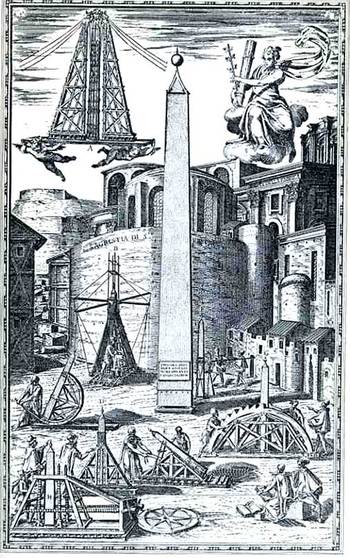
    This second image pertains to the tail-end of the Zabaglia title-page—the moving of the 500,000-pound Egyptian (carved during the reign of Nebkaure Amenemhet II, 1992-1985 BCE, and originally standing in the Temple of the Sun at Heliopolis) obelisk in 1586 by Domenico Fontana, which was one of the greatest engineering feats of the Renaissance.  Moving this enormous and relatively delicate object (from the Circus Nero, where it was placed by the emperor Caligula in 37 ACE,  to St. Peter’s Piazza del Popolo, 50 years or so before it would be more enveloped by Bernini’s flying wings) took years of (very) careful planning and months of motion and movement, not to mention an extra month to get everything into place and slowly raise the obelisk into its final position.  Fontana had to be cautious and correct, and he was, performing a not-so-minor miracle of pre-industrial magic to move the priceless 250-ton iconic relic and place it perfectly down in the center of Christianity.  now that must have been one hot Roman summer, especially for Fontana. 

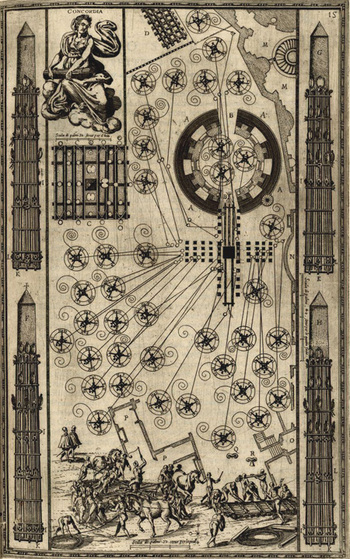
    This image comes from Domenico Fontana’s Della trasporatione dell’obelisco Vaticano…(published in Rome by Bassa in 1590), and shows some seven scale models for the armature of movement (in the foreground) of the great obelisk  An even more famous and luscious image is the plan of the moving implements as seen here, below:

    Blogfontana_moving

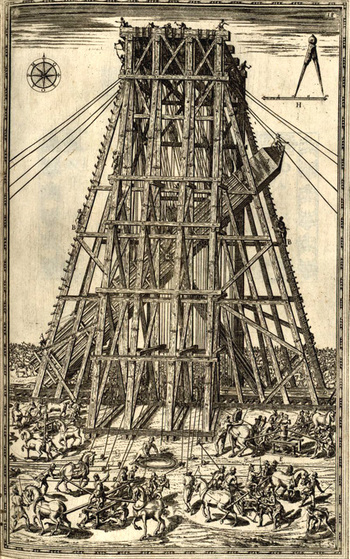
    And again, another beautiful engraving showing the placement of the obelisk:

    Blogfontana_placing


  • Typewriter and Anti-typewriter: Writing Systems of von Knauss, della Porta, Trithemius, Schotti

    JF Ptak Science Books Post #53

    Blogtypewriter_unwriter_2035

    Sometimes order brings disorder; and disorder, order, as in the following two examples of early versions of modern technology.    Take the typewriter—it has a curious display of the alphabet, designed to impede, while numbers are displayed along the tip, in order.  (The qwerty system may well have been put into place as the earliest typewriters, beginning even with Glidden and Sholes machine, could not absorb very fast typing due to their technical limitations, and so came the qwerty arrangement.)  So from this non-random arrangement we are able to direct all of our thoughts and intentions.

    Blogtypewriter_unwriter033_3

    (An interesting aside is this magnificent non-qwerty machine, found in F. von Knauss’ Selbstschreibende Wundermaschinen… (1780), a magnificent work on “wonder machines”, and which is recognized as the first “typewriter”.)

    The other elegant machine is the cipher. In the beginning of its use the alphabet is usually properly arranged, and placement of letters and numerals is very clear and precise.  The result however is anything but—the product being a beautiful randomness and a secure, secret language.   

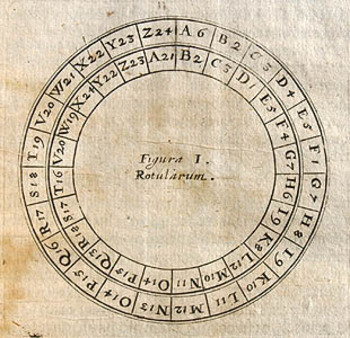
    Cryptodiskscholarotularum

    This illustration features a lovely volvelle (two or more pieces of paper arranged so that they may be turned one on top of the other) from Giambattista Della Porta’s De furitvis literarum notis vulgo…, printed in Naples in 1591.  The volvelle was one part of the book which explained the art of steganogrpahy—the art of writing incomprehensibly except to those who possess the key—and was one of the most important works on the subject after the Polygraphia of Johannes Trithemius (This book was written in 1599, published in 1606 and condemned in 1609—ostensibly because the book was thought to be about the dark arts and black magic, though the offending volume, the third and last,  was really a deeper work continuing on cryptography.)   

    This is another interesting paper volvelle device, called a rotularum, and can be found in P. Gasparis Schotti’s Schola Steganographia, and printed in 1680.

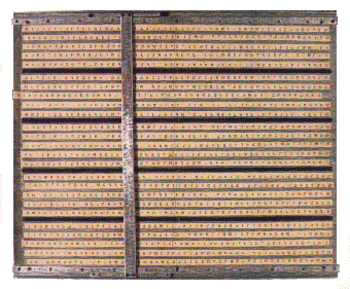
    Strip_cipher


    Closer yet to the order/disorder idea is the strip cipher, which begins the process of encoding with numerous aligned alphabets which are then put out-of-order to secure a deeper discontinuity between the original message and its encoded version. 

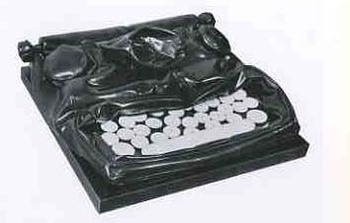
    A modern and imaginative version of a typewriter version of a cipher may be seen in Claes Oldenburg’s 1963 “Soft typewriter”–well, not really, but this may be the only time that I have a chance to use this illustration.

    Blogtypewriter_nwrriter_soft036_2  


  • The History of the Future 2: Henard touches on the Future’s Future Plan, 1911

    Bloghenard029JF Ptak Science Books LLC  Post #51

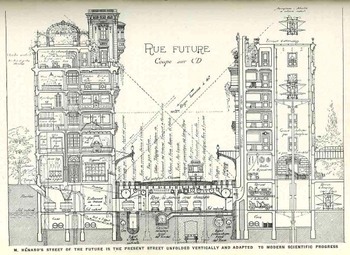
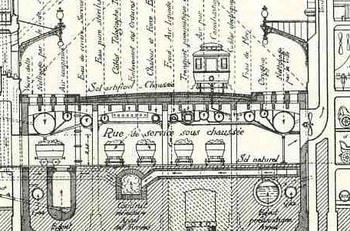
    This  cross section illustration (“Rue Future”/Future Street) is from E. Henard’s (1849-1923) article, “The Cities of the Future”,
    from American City, Volume 4, January, 1911. In this article Henard (architect of the city of Paris and from 1880 a life-long employee and advocate of public works in that city) looks into the future
    and sees the movement towards underground (or enclosed) vehicular traffic,
    “smart” buildings, pneumatic tubing for vacuum cleaners (“almost
    sure to come into general use”), an improvement in the system for water
    delivery and removal, replacing coal with natural gas, and more. He lays out a
    plan to implement his idea that, if implemented int he city of

    Bloghenard029_detail

    Paris, would cost $420,000,000 (or
    approximately $15 billion in 2006 money) over 100 years. [This part seems a
    little off given that the area for public roads alone in Paris at this time was 3,700 acres–nevertheless this was an interesting appearing plan, a significant
    portion of which has found its way into building and community planning albeit
    on a far smaller scale].

    Henard was also acutely interested in the future traffic problems of Paris and other major cities, proposing revolutionary radial traffic patterns for moving cars around major metropolitan areas–which was really quite visionary as the mass production of automobiles had not yet really taken place–certainly automobiles were far more common by 1911 than 1905, but their numbers would be vaulted higher int he next decade with the first true approach to assembly line production of automobiles, making them affordable to the millions.  His plan for a ring-lime system around the city of Paris was influential to some of the ideas in the early
    American planning reports for San Francisco and Chicago by the great Daniel Burnham.

    What is particularly interesting for me in the Henerad plan is the room that he left for his future’s future–he attempted to make his plan adaptable for the time when the future he was writing about was becoming the past.  And so he was leaving room in his underground plans (in particular) to accommodate some of what the future might hold in store for his city, leaving unused spaces and tunnels, so that the city planners in the future would not have to go through the enormous expense of putting these things in for themselves.  Now that is future-forward thinking. 


    For a good, long article on the plan see http://www.library.cornell.edu/Reps/DOCS/henard.htm


  • History of the Future 1: Caricature of the Future, J.J. Grandville and the Bridge Across Saturn, 1844

    BlogfuturegrandvilleJF Ptak Science Books LLC  Post #52

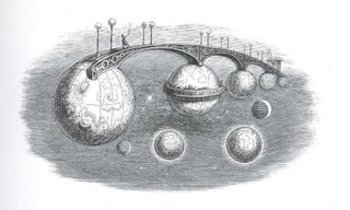
    Admittedly, J.I.I Grandville (1803-1847) didn’t conceive of this series of bridges as a plausible means of interplanetary travel and is in all probability an allegorical creation, but the image does–in an odd way–allow a dialogue on the idea of moving from planet to planet, which was still pretty solitary thinking in the mid-19th century. Although this didn’t have a direct effect on the perception of man’s place in the solar system, it did have a great and direct impact upon a vast number of illustrators and cartoonists who followed in his considerable wake.
    This image comes from Grandville’s Un Autre Monde, published in 1844.

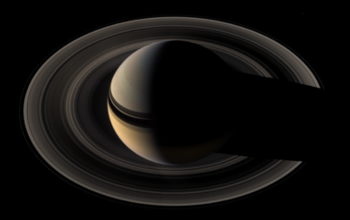
    In addition to an interplanetary bridge that there is another singular creation here in Grandville’s cosmos–a balcony constructed of the rings of Saturn (if indeed this was supposed to be Saturn–it is as advantageous as not to think of it in this way) and if we think of a balcony being a place to watch and observe, then we are brought instantly to W.G. Sebald’s Rings of Saturn, which is a textural masterpiece, and mostly I guess a novel about everything that Sebald observed in his walk through Suffolk.  (Another Saturn-related work of fiction is Sirens of Titan, by Kurt Vonnegut,  a very mature and insightful 1959 novel which really has nothing to do with anything here; I just needed to throw that in, what with him being a master storyteller, crank and human-caricaturist-observer and all…)  And so by 1844 it comes to pass that one French caricaturist/imaginist comes to draw an extraordinary and impossible land/space bridge between the planets only 234 years after Galileo Blogsaturn first glimpsed Saturn’s “handles”.  It would take another 65 years and accumulations of observations by some of the greatest names in the history of astronomy (Galileo, Casini, Hevelius, Huygens) to show that the disk (singular) on Saturn was actually a series of tings The first photograph of Saturn’s rings is not made until 1883.
    Grandville (Grandville ‘Gerard, Jean Ignace Isidore, born in Nancy, 1803 -1847) I see as more like a caricaturist of the future, seeing what might be possible, plausible, imaginable, and also see the grotesque royalness of it all as well.  In as much as thinking of such an image as interplanetary land bridges might seem, Grandville shows at the same time their innocent, clinging wrongness. 


  • Underground Horses, 1875

    JF Ptak Science Books   Post 22

    Unusual cross sections have always fascinated me–they are an X-ray of the techy-inards of the physical world , showing you a slice (literally) of the Unseen and Unapproachable. 

    Mine_height_2

    The first engraving here is of an (unidentified) Western-U.S. mine, printed 1869, and shows the comparative depth of an un-effacing mining operation in terms of height, nestling it in against Trinity Church (NYC).  The “21 stories” depth  of this mine would have been astonishing to the 1869 mind thinking of it in terms of height. Few office buildings in NYC for example exceeded 5 or 6 stories at that time. [It was in 1872 that the tall buildings’ fortune turned, as C.W. Baldwin (working for the Otis Company) invented the geared hydraulic elevator, meaning that buildings could now be taller than the strength and endurance of its occupants’ legs.  (Actually, to my mind it is the invention of the elevator safety brake that clinched the deal, making it safe to enter an elevator and expect to survive the experience.  There’s a lot of other stuff that comes into play, not the least of which is steel framing, lightening the buildings weight and displacing the weight from its’ normal receptacle of the foundation, but I digress.) ] So trying to imagine something that was 15 time the height of the spire of Trinity Church was doing some pretty large-scale imagining. 

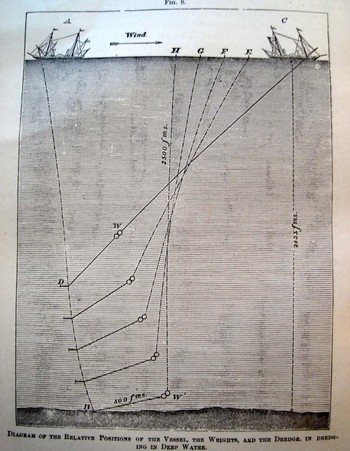
    A corollary the the height of the mine is, perhaps, a cross section of the depths of waters. Here we see an 1877 illustration from an article on new methods of determining the depths of ocean waters, giving a very clear indication of the enormous “height” of the ocean even in its most measurable (and not-so-deep) section.

    Depth_sounding 

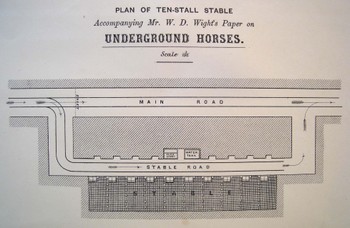
    I simply could not resist this 1875 engineer’s drawing (“Plan of Ten-Stall Stable….for W.D. Wight’s Paper on Underground Horses”)–and yes indeed these were horses kept underground, used for hauling the heavier wagons (on tracks) of whatever, brought out to these larger chambers by men doing the same work with lighter loads in smaller areas.  (For perhaps the best description ever of men at work in a coal mine, see the gorgeous George Orwell’s Down and Out in Paris and London)Underground_horses

    This is one of those images I think that will elicit a pretty light-hearted reaction until your brain catches up to the reality of what the print is really depicting.

    Coal_mine_black_3


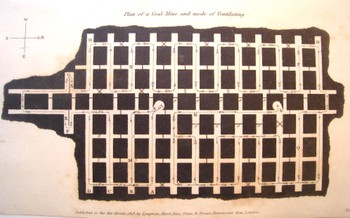
    This  image is actually much rarer than a mining cross section–it is a plan (looking from the top and down) of a mine showing the mode and direction of ventilating the whole bit, printed in 1818.  (As it turns out it is rarer still to see a plan depicting a mine’s numerous layers–I’ve honestly not seen another one of these done before 1900.)  What an incredible image this must have been to the early 18th-century eye, seeing such a novel, and rare, depiction of (important!) data.

    Mine_cross_mosaic

    In the Victorian panoply, the technological temple ma have had an entryway mosaic constructed from the idea of the mine cross section or plan–it is a structural, semi-architectural bit after all, made to withstand advanced weight and pressure.  Or how about a mine cross section template for a stained glass window?  I can imagine the Temple of Technology boasting a design schema of nothing but elements like these–those people trusted, perhaps even worshiped, the small and great mechanical machines and contrivances of their era.  All you have to do is look at the housings for even some of the simplest objects and you’ll find a metallic skin of awe and beauty, a symbol of admiration and respect for analog creativity.


    Mine_stained_glass


  • An Analog(ous) Victorian youtube: the Eccentric vs. the Insane in Victorian England

    Insane_darwin_electricalJF Ptak Science Books LLC  Post 21

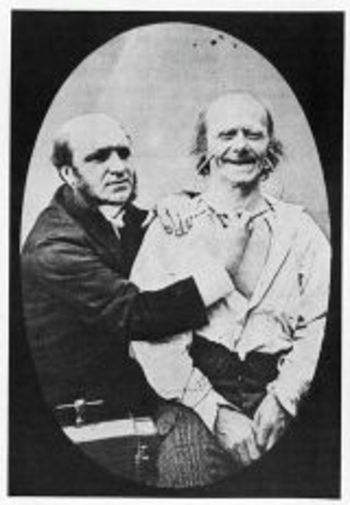
    The “eccentric” versus the “insane” in Victorian England may well have been identified by the amount of available disposable income–if you could afford your whimsy and misery, then you were “eccentric”; if not, then you  were “insane”, which also meant that you were culpable of being scooped up by The Authorities and interned if you turned out to be a larger/smellier/more obnoxious nuisance than a simple dot of the street.   That or you may have wound up as an electrically-prodded subject in an experiment by Charles Darwin (Expression of Emotions….).   In this way the past telescopes nicely into the present, less the electrical stimulation bit. 

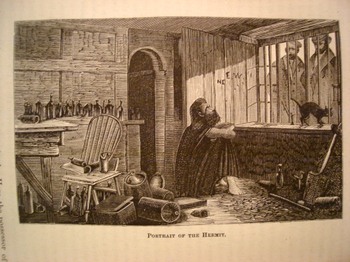
    The image shown here is that of Mr. James Lucas, “the Hermit of Red-Coat’s Green, (near Hitchens)”, living his life inDsc04646_3
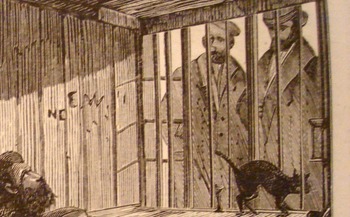
    a most uncommon hermit-like fashion, even for a hermit.  Seems to me that a hermit would be removed from society and be away from people; Mr. Lucas may be of a singular caste of that genre, living his life alone in the very midst of society–he lived in the kitchen of his townhouse, in a single room with a window to the street.  There he lived out his life in full and constant view of the passersby on the busy sidewalk.  Crowds would come by and stare, and Mr. Lucas would stare back–he would rarely, if ever, communicate, though he would (“he was not miserly”) give out “farthings and gin” to “swarms of tramps”, no to mention sweetmeats to children.   He’d watch people watching him.

    He also didn’t write (except we are told “upon a check”), and made no physical effort to retain anything that he thought about; nor was the reason for his uncommon lifestyle made known.

    He was one son of “an opulent London merchant”, and in time proved to be an incorrigible and strong-willed non-conformist (with the funds to do so in some comfort).  He evidently went completely over the edge when his mother died, and after a year of keeping her body in the house removed to the kitchen, where he spent the rest of his days (living there from 1850 to 1874).

    Detail
    After he died and his room cleaned out for the sale of the family’s property, it was discovered that the floor was covered in two feet of ashes and soot from the kitchen fireplace.  Without the family money Mr. Lucas surely would’ve wound up on a cadaver table long before his seventieth year, suffering real social Dickensian travail rather than that which existed just in his mind.


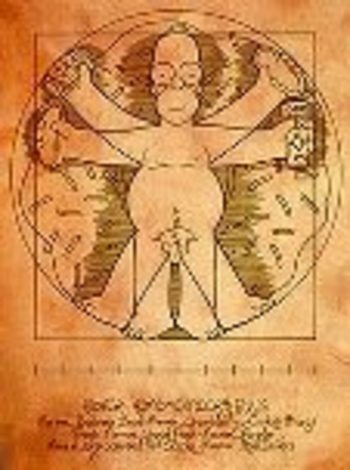
  • Homer Simpson on Perspective: the Rare Antique Image Looking Straight Down from a Height

    Blogstraight_homerJF Ptak Science Books LLC  Post 20

    I welcome the chance today to use our non-classical Homer instead of the beautiful Paolo Uccello to look at an issue of imaging a certain form of perspective drawing.  I’ve always been intrigued by antiquarian images that looked straight down, or up, at things–90 degree, perpendicular, real straight-on stuff, giving a feel for depth (or height) and perspective.  Funny thing is that in the wide world of scientific images, they really don’t show up very often.

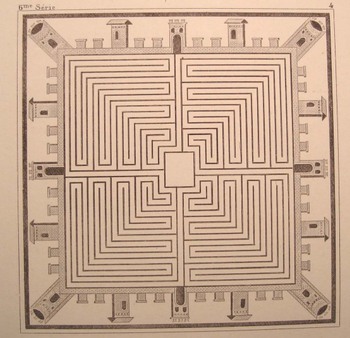
    A Mock-straight-down is found in this prettily-designed example (French, ca. 1860)–it seems to be view form a height of 250 feet or so down on the square of a low- (Western) renaissance town. That’s partly true, except that it is a mosaic from Pompeii (or Herculaneum), found imbedded in the floor of one of those mummified houses.  Dsc04640

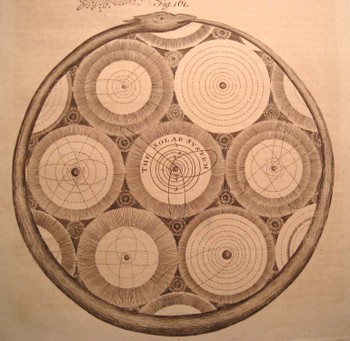
    Another pretender is this god’s-eye view (from Abraham Rees’ mammoth encyclopedia of 1800-1820) of the universe, centered upon our own helio-centric Solar System, which is centered, nested, amidst a whorl of other (contiguous and touching but not overlapping) solar systems, all of which is held in the Dsc04642
    infinite but knowable confines of an ourobus.   This
    again qualifies as a straight-down/up if and only if (iff) you squint real hard and imagine you’re seeing the scene through your CreatorView (TM!) glasses.  (The Creator needs glasses?)

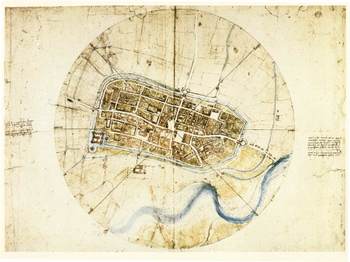
    The drawing by Leonardo of the town of Imola (currently resident with the Windsors) does come quite close to the concept–it has more artistic features than the common city plan , and is definitely at a perpendicular to its subject.Blogstraight_imola

    But it is this that is so terribly interesting to me–a small part of a
    little print from an unidentified encyclopedia from the turn of the
    19th c. It shows a picture of the earth looking straight down from a
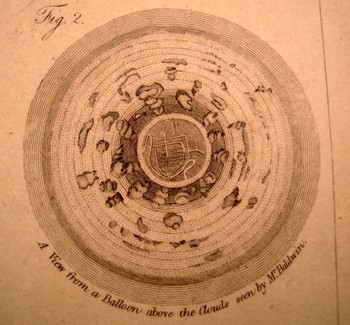
    balloon, looking through an opening in the cloud cover, down to a small
    town. There is an iconic work on the representation of the world as known to succeeding generations where the picture of the world is seen through a succession of gradually diminishing clouds (being opened like drapes over time), but I honestly cannot think of an early image of looking at clouds from above and straight down.  My sense is that this image would have caused as much Dsc04639_2
    interest and wonder as the first (Soviet) images of the other side of the Moon (back in 1959). 

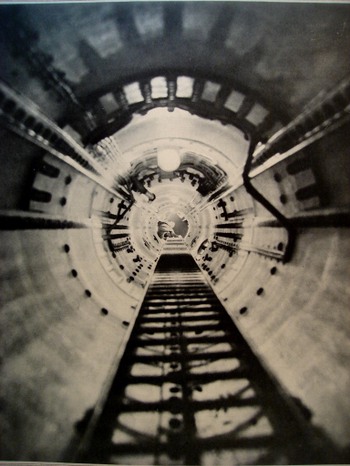
    Even when moving into the pre-satellite 20th century image, the straight-down picture is a rarity. In the last few years after having looked at dozens of thousands of popularly-published images (for another project), the straight-down/up were a scant tenth or perhaps hundredth of a percent of the total. There were a number of photographs made looking straight up (as in the two examples here, looking up the main mast into the crow’s nest of the Queen Mary, and the other with the same view, only in the Bremen. 

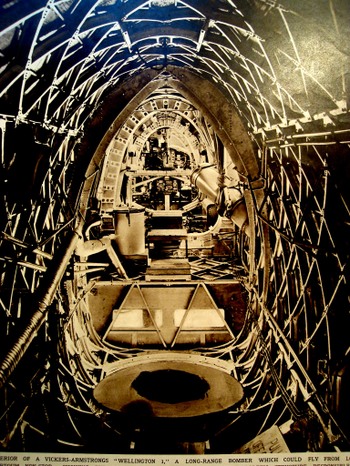
    Occasionally the view like this will show up (looking laterally through the Vickers-Armstrong “Wellington I” bomber aircraft (June 1939)

    I can’t leave this topic without mentioning two recent additions to this genre–the first is the Eames’ wonderful PowerDsc04643_2
    of Ten movie (go to youtube HERE, where in 40 steps we look at existence from quark to quasar. 

    The second is a little goofy but I like it nonetheless–the introduction to the Jodie Foster movie Contact (go to youtube HERE)  built on the bones of the Carl Sagan book. Here we swing out from the Earth and into space, following a broadcast-audio trail of humanity into the not-too-distant time/space (ignoring the signal degradation bit but so it goes), and then leaving that quickly behind, hurling itself backwards, to the outer reaches of the universe, until (and we don’t see this in the youtube clip) we wind up back in the iris of the heroine (and a bit too much like the Dave Bowman trip in “2001 a Space Odyssey”).  Dsc04644

    But we don’t see stuff like this very often, and I’m happy to go along for the ride. It really is just about seeing something new, after all.

    Perhaps the lack of this perspective is summed up by our old friend Homer J. Simpson. In one episode of the Simpsons (long ago and far away…or last week) Homer explains (to Lisa?) why cartoon characters’ faces are always oblique in profile. Homer turns and looks directly into the
    camera,” and his face gets all pancakey. It’s just not done “because it’s goofy” he says. And at least in Homer’s case, the proof is definitely in the puddin’.
    Dsc04645


  • Blowing Up Hell(gate), 1876

    JF Ptak Science Books  Post 19

    • “A Sharp, but Not Loud Retort”—the cross section of the detonation chamber of the largest pre-Alamogordo man-made explosion, 1876
      Explosion
      Cruising through a box-full (okay, four boxes full) of  the Popular Science Monthly, I came upon the lovely volume for 1876. The November issue (the November 1876 American presidential election bears a very, very close resemblance to the 2000 election) unleashed a bevy of odd, tantalizing articles, demanding their quiet attention:  “the Early History of Fire”, “Prenatal and Infantile Culture”, “Is the Development Hypothesis Sufficient?”, “the Nature of the Invertebrate Brain”, and others).  Just barely bobbing to the surface, riding the velvet coattails of longer articles was as a note in the “editor’s table”: “The Hell-Gate Explosion.”

    Dsc04637

    Aha!
    Hell’s Gate in America (there are bunches evidently in the Netherlands, where term prior to corruption was Hellegat, meaning, well, “Hell Gate”) refers to a body of water high up on the East River in NYC.  It had, before 1876, been a very contentious bit, with a reef at Hallett’s Point that caused all manner of problems for ships and shipping, helping sink perhaps hundreds of ships over the years since the strait was navigated in the early 17th century. 

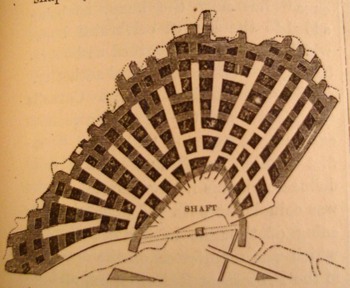
    It came to pass that the Deciding Forces determined that the reef must go.  (RIGHT: the 1-inch square image cross section of the tunnels beneath the ship-catcher.)

    General John Newton (1823-1895, Civil War brevetted Major General)  was placed in charge of removing the mess, a large, 700-foot long ship-sinking croissant, extending 300 feet into the channel, with an area of about 3 acres.  Newton worked on the idea for several years and—to the great trepidation and pre-millenial fears of many—decided to blow it up. Actually, he decided to blow it down—he engineered a submerged explosion such that the charges placed in the numerous and long mine shafts drilled and cut the length and breadth of the reef would effectively sink the reef. With some smart thinking and some 50,000 pounds of explosives, he did just that. 

    Listen to the particulars (and remember, this is 1876, and the waters were treacherous, with ripping currents):  after building a coffer dam a shaft was sunk 33 feet below the surface of the water, from which 10 tunnels were opened, having lengths of 21 to 126 feet. The tunnels radiating from the shaft varied from 9 to 22 feet in height, and 9 to 12 feet wide, with 172 supporting pillars, the total length of the tunnels being 4,857 feet plus another 2,568 feet of offshooting galleries—the entire 7,425 feet of tunnel was drilled with 4,427 blasting holes, the explosive agents being connected to 96 galvanic firing batteries by 220,000 feet of wire. The 160 fuses were simultaneously ignited by 23 groups of batteries.

    Dsc04637fancy

    The main plunger was depressed by General Newton’s 2 year old daughter, who was not named.

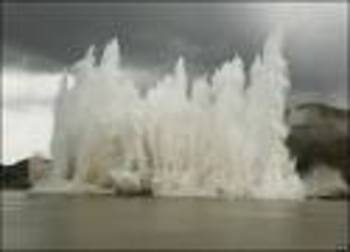
    The action was a success, the honeycombed explosion chambers sort of sinking the 51,000 cubic yards of ship-killer under a low, sulfurous fog.  Actually the reef-turned-gravel pit was removed by grapplers, part of the Hell of Hellgate carried away. 

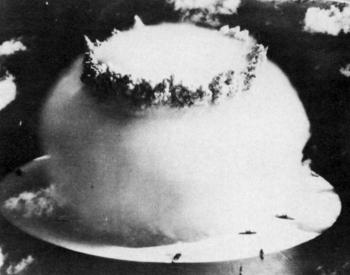
    All things considered, this little cross-section (about an inch square) doesn’t say much about the biggest man-made explosion south the atomic bomb . 

    Explosion_atomic

    Endnote:

    The New York Times screamed the results in a Victorian tremalotto on their front page for 25 September 1876:

    “RENDING HELL-GATE ROCKS; THE SUBMARINE MINE EXPLODED. A COMPLETE SCIENTIFIC SUCCESS. THE TERRIFIC RENDING FORCE LIBERATED BY THE FINGER OF A CHILD–A JARRING TREMOR OF THE EARTH, AND A SHARP, BUT NOT LOUD REPORT–IMMENSE GEYSERS OF WATER THROWN UP–THE FORCE EXPENDED MAINLY IN THE WORK OF BURSTING THE REEF–CONFIRMATION OF GEN. NEWTON’S THEORY OF THE EFFECTS OF THE DISCHARGE–THE RUSH OF THE CURIOUS CROWDS–INCIDENTS OF THE DAY THROUGHOUT THE CITY. BEFORE THE EXPLOSION. THE EXPLOSION. AFTER THE EXPLOSION.”, The New York Times. September 25, 1876. p. 1

    ·Posted by :

    ·in:


  • The Spine of Society and the Beginning of the Grid

    RobidaJF Ptak Science Books LLC  Post 12

    I’m interested to know what anyone might know about the use of
    metaphors relating large-scale societal techno advances and biological
    functions?  I have no doubt that they go back to modern-ancient times
    (say to William Gilbert (1544-1603)  and his vis electrica)—but I’m
    stopped today by seeing this paper by J. Norman Lockyer called “Social
    Electrical Nerves” (in two issues of  Nature for 14 and 28 February
    1878).  In this paper the great astronomer looks at elements of the
    “grid” as it was and seeing how the new networks of police and fire
    communications via telegraph  interacts with the existing electrical
    systems.  It seems to me an early use of  nervous system/electrical
    grid, in spite of the fact the first “electrical highways” (as Lockyer
    puts it 120 years before our own “information superhighway”) appeared
    in England 32 years earlier though apparently without these biological
    metaphors. 

    Robidatelephone_lines

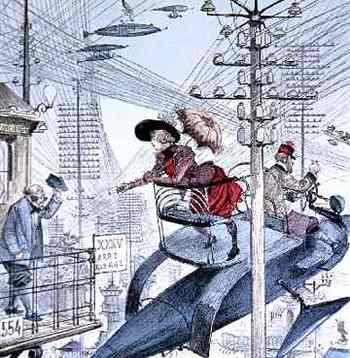
    The work pictured above is the electrically-draped world of the future,
    at least according to the vision of the wonderful Albert Robida, who
    was actually at work on these visions just at the time of the
    publication of the Lockyear paper . (Robida produced at least a trio of
    interesting and lovely and occasionally prescient works:  Le Vingtième
    Siècle
    (1883);  La Guerre au vingtième siècle (1887); and Le Vingtième
    siècle– La vie électrique
    (1890)).   Many of Robida’s visions of
    electrical connectivity seem to me to move beyond the nervous system
    metaphor and become a kind of societal “skin”—which is not terribly far
    from the truth, especially when looking at images of congested
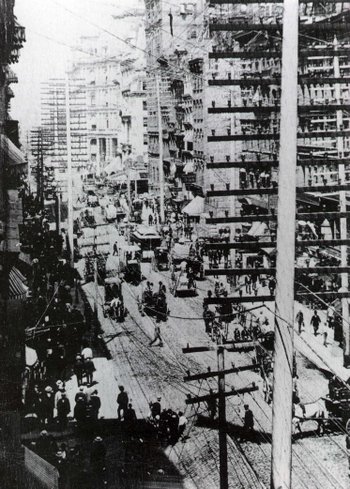
    metropolitan centers ca. 1910, when utility poles fairly well sagged
    under 20 (!) horizontal crossbars carrying a dozen lines apiece.   At
    the very least, you knew that something or other was happening (fast
    forward to the massive ductworks of Terry Gilliam’s masterpiece,
    Brazil.  Check this out  for a
    wonderful cameo by De Niro coming to fix the neuronal duct-muck.) 

    And now that the wireless age is starting to get ridges in its
    fingernails (the “wireless” age being at least 115 years old,
    beautifully borne by Heinrich Hertz and Marconi), are our bio-electrical  metaphors giving way?