A Daily History of Holes, Dots, Lines, Science, History, Math, Physics, Art, the Unintentional Absurd, Architecture, Maps, Data Visualization, Blank and Missing Things, and so on. |1.6 million words, 7500 images, 4.9 million hits| Press & appearances in The Times, Le Figaro, Mensa, The Economist, The Guardian, Discovery News, Slate, Le Monde, Sci American Blogs, Le Pont, and many other places… 5000+ total posts since 2008.

Category: Technology, History of

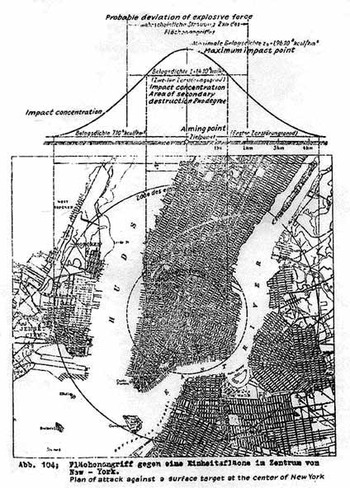
  • Bombing Manhattan, 1943: the Nazi “Amerika Bomber” by Eugen Sanger

    JF Ptak Science Books    Post #124 (with additions 25 October 2011)
    Manhattan_bombed_4
    That devlish working-for-the-Nazis scamp Eugen Sanger (dead before he was fifty, 1905-1964), a rocket designer and engineer (and developer of ramjet tech)  for the NSDAP, went to work for the French Air Ministry following the end of World War Two after doing his all and thankfully falling short for  the Reichsluftfahrtministerium (RLM, or “Reich Aviation Ministry”).  He worked without rancor there until he was nearly kidnapped1 by Joe Stalin—for the purpose I suppose of continuing work on what may have been his greatest effort, unfulfilled during the war years—the Amerika Bomber.  The Soviets evidently thought that this might come in handy in the late 1940’s.

    The Sänger Amerika Bomber (or Orbital Bomber, Antipodal Bomber or Atmosphere Skipper, and also known as the Silbervogel) was designed for supersonic, stratospheric flight, and had much more bang for the buck than the V2 (10,000 feet/second exhaust velocity, as compared to the later V-2 rocket’s 2000 meters/second, 6560 feet/second) and since it was stratospheric had a far greater range, coming in at better than 14,000 miles.  The 22,000-pound weapon carried one large 8000-pound free-falling bomb.

    Sanger’s idea in the early 1940’s was to get this bomb to around Times Square. And since the Amerika Bomber was a relatively inexpensive weapon compared to the damage it could cause, there was room for producing a lot of them.

    Seeing Manhattan in the cross hairs like this is quite sobering, and it is an image that is rarely made.

    Manhattan_bombed_bomber    


    Notes:

    1.  Maybe, maybe not.  Stalin did at least send his representatives–including his own son–to tr and convince Sanger to work for the USSR. THis attempt failed. It has been said that the NKVD was sent to kidnap him, and failed.


  • Different Forms of Writing 1: Big Writing With Light—Nollet, Citroen, Barnum and Packard

    JF Ptak Science Books  Post #97

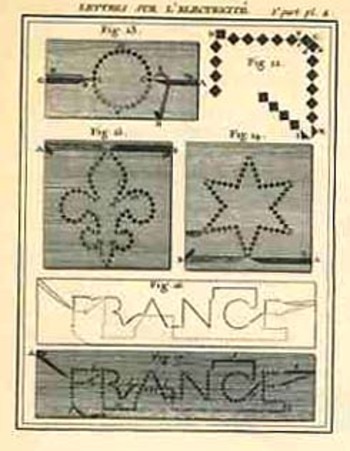
    The fabulously over-usage of light-polluting electricity in advertising finds its beginning 220 years ago with the work of a modest, family-friendly French country priest.  The image to the left is  the first example of writing via electricity—basically, the basis for the earliest electric signs, more than 110 years before Edison’s (et alia ) electric incandescent bulb, and about twenty years before the presumptive “first” electrical experiments of Sir Humphrey Davy) on the first arc/carbon filament electrical light in 1809).   \

    Bloglighting_nollet_2

    They were the product of the electrical mind of Jean-Antoine Nollet (1700-1770), a peasant boy who was educated for the priesthood (becoming Abbe), whose extensive curiosity soon led him to physics and then to electricity—he was well educated and taught at numerous prestigious schools, admitted to the Academy of Sciences as a member in 1742,  finally winding up in 1740 tutoring the dauphin at Versailles.  He published widely, was the first person to experiment with the Leyden jar in France, and made wide contributions in the conduction of electricity through different media. (He also had numerous public disagreements, some of which stood with Benjamin Franklin, whose theories Nollet referred to  as “les pretenetions de l’ecole de Philadelphie”.)  The image above was published in Lettres sur l’electricite, (part II), published in Paris in 17601 (with part I located at Gallica, here);  see the interesting Le Blog du Bibliophile, des Bibliophiles, de la Bibliophilie et des Livres Anciens, here, hosting some useful information and images relating to Nollet.  [Thanks to Jaime Day for pointing out the misattribution of the plate.]

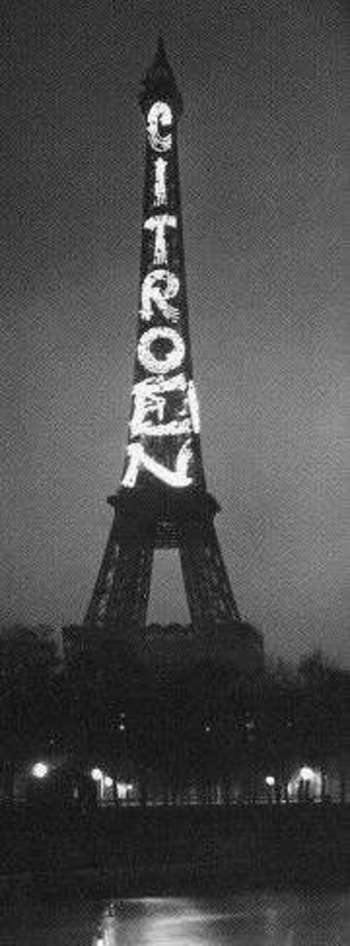
    The, um, adventurous PT Barnum contracted  the  first electric bulb writing (utilizing the Edison invention) in Manhattan in 1892 to envious attention, resulting in less than 15 years with the Great White Way.  The world’s largest electric bulb writing was on the Eiffel Tower, with Andre Citroen agreeing to light the outline of the tower if he could put his name on the rest of it.  I’m not sure how this was seen as a good idea, but the sides of the tower were used for this purposes until somebody wised up and put an end to it all in 1937.

    Bloglightingcitroen_2

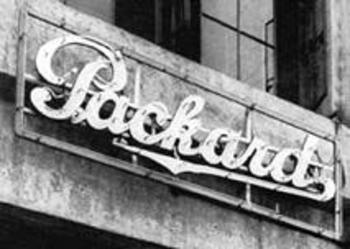
    But as white and as bright as the light bulb was in advertising, it was completely overwhelmed by the invention of the bold, brassy (and with a high potential “trashy” factor) neon sign, which was first used in the United States by Earle Anthony’s Packard dealership in Los Angeles in 1924.

    Bloglightingpackard_2
    (Mr. Anthony paid $24,000 1924 dollars for the two “Packard” signs, which in today’s dollars, employing the kindest inflation factor in the comparative CPI, would be about $3,000,000.  Mr. Anthony could afford it, and the signs were a sensation.

    Notes

    1.  The full title:   Lettres sur LÉlectricité. Dans lesquelles on examine les dernieres Découvertes qui ont été faites sur cette Matiere, & les conséquences que l’on en peut tirer (part I), 1753; and Lettre sur L’electricité; Dans laquelle en soutient le principe des Effluences & Affluences simultanées contre la doctrine de M. Franklin, & contre les nouvelles prétentions de ses partisans. Avec Figures en Taille-douce. Seconde Partie, published in 1760. 


  • Electrocution, the Electric Chair, and the Evil, Spiteful Genius of Thomas Edison

    JF Ptak Science Books LLC    Post #94
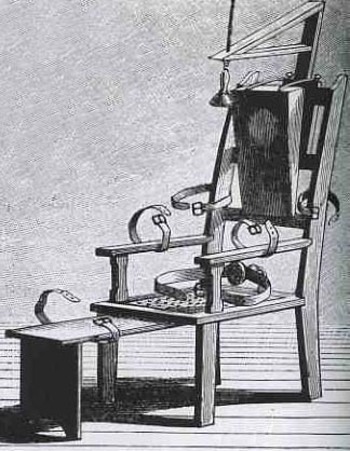
    Blogelectrocution_chair_empty
    It is ironic that the spiritual investment necessary for the electric chair—the ultimate legal act of revenge—was itself the product of an act of vengeance. In 1888 Thomas Edison, innovative and creative genius and social miscreant (and deep old friend and camping buddy of a howling intellectual horror, the anti-Semitic and fascist appeaser Henry Ford) brought his enormous weight to bear to wrestle public opinion in favor of his (that is the Edison General Electric Company) mode of power distribution (direct current or DC) versus that of his direct competitor, George Westinghouse (alternating current, or AC). 

    Things were not going well for Thomas Alva.

    At nearly the same time the New York State legislature, under a mandate of 1886 and a law of 4 January 1888, was seeking new ways to kill prisoners, it having been determined that hanging people caused too much suffering (to the hanged).  It was determined that death be best and less painfully delivered via electrocuting them.  (Actually the procedures of the day for electrocution were less “sophisticated” than they would be by the turn of the century; the people killed in this manner in the first two decades of use of the electric chair were basically cooked from the inside out.)  The dangling issue was the technology top be used to deliver the electricity.
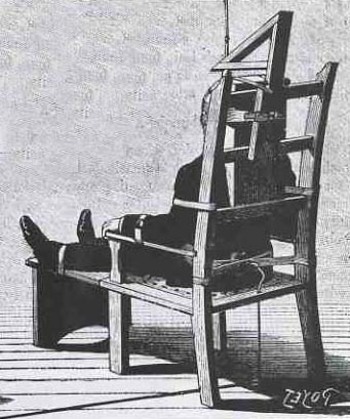
    Blogelectrocution_chair_filled

    And this is where Edison gets brilliantly, terrifically, ugly.  He proposed that the state use Westinghouse’s AC system for electrocutions, and set up tests with the AC system to prove its superior qualities in providing power to the electric chair over the C technology.  He did this so that the gross population would equate the Westinghouse system with electrocution, which Edison referred to as being “Westinghoused”, and choose Edison’s own DC technology, which wouldn’t theoretically kill the consumer in their own house.  The state chose the AC system; Westinghouse refused the state’s orders for his production; and then Edison stepped in and manufactured the AC system for the state’s use in electrocution over Westinghouse’s loud complaints.  Evil genius.

    This was also the start of Edison’s rather bizarre experience with filming electrocutions.  He made several films for the New York state officials showing how well the AC system worked—he did this by showing how well the Westinghouse system electrocuted the animals that he dropped on the electrified plate fed by the AC current.  Over and over again.  Edison also made a film of McKinley’s assassin, Czolgosz, being put to death by electrocution, in an early docudrama session, showing the condemned man fidgeting a little before coming to death.  Edison’s crowning achievement in electrocution films was his disgusting film of a circus elephant being put to death—I will not describe the film, and  say that only a monster would do and make such a thing.  Even in the present when we can see just about anything on the internet, watching this film is just impossible, it is just so horrific. (I do NOT recommend watching this,  not at all.  You will not be able to forget, try as you might and must.)
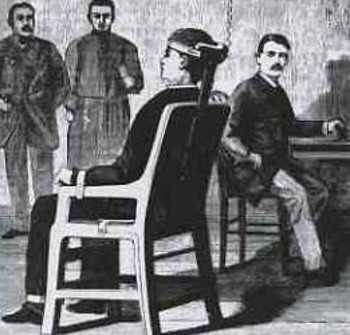
    Blogelectrocution_filled_another

    And if you couldn’t stand to watch something like this be done to an animal, why would it make sense to do this to a human?

    There is no doubt that some of the electrocutions of human beings removed the person relatively instantly and painlessly.  It would seem that this would be a minority.  When I was researching a piece about the Rosenbergs (yes they were guilty) in 1985 I happened to talk with the maintenance guy at Ossining State Prison who “cleaned up” after Julius was removed from the electric chair.  Quickly and quietly summarized, he said that his work with Julius’ remains were as gruesome as the execution.  “Was this, was Julius Rosenberg, a special case, was he treated differently?” I asked, a little naively.  “No”, he responded, “they were all like that”.

    And while we’re at it, let’s consider the work of Dr. Varlot (of the Paris Hospital) in electrocuting the dead.  Actually, what he proposed was another pretty gruesome use of electricity, only this time no one was hurt, as the receiver was already dead.  Varlot proposed to “metalize” the dead (as we see in this unsettling image of a child being electroplated) for, well, some purpose.  It just seems and seemed like a bad idea, al the way around.  The medical uses of an electroplated baby seem very limited, and I can’t imagine anyone wanting to do such a thing to a dead child of their own.  It is wrong on every level.
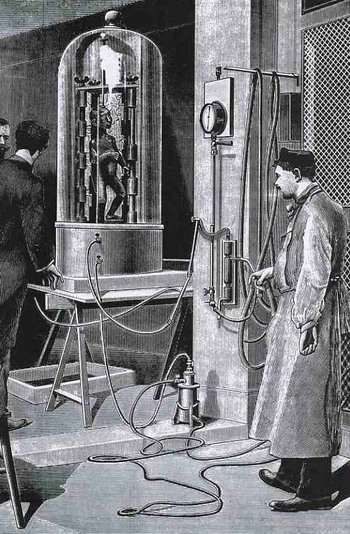
    Blogelectrocution103
     
    I know that electrocution is done and gone.  It replaced hanging, and hanging replaced beheading, and so on; but the effect is providing an incrementally less gruesome way of revenge—the point being that even though the next newest method is less grotesque, it is still, at base, grotesque.  Just less so. 
    ·Posted by :

    ·in:

    —

  • The History of Stopping Time #1: A.M. Worthington, Ernst Mach and Doc Edgerton

    JF Ptak Science Books LLC Post #88
    Blogstopping_thing_splash087
    This will be the first out-of-sequence post looking at the intervals of stopped time (random or not), and how people and cultures were able to stop or save time, and how they could arrange to segment and store time over thousands of years.

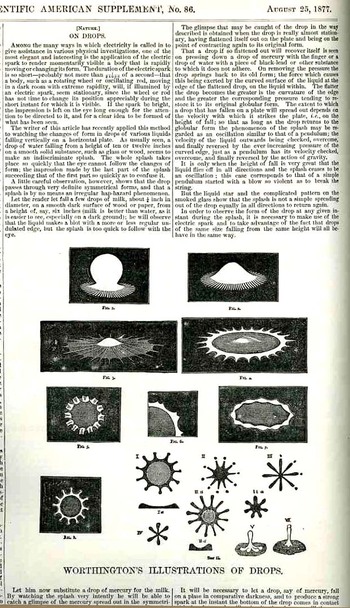
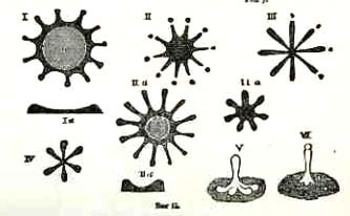
    The first entry is from the Scientific American from August 25, 1877 and records the experiments of A.M. Worthington. They are perhaps one of the first revelations on the quiet residence of energy in something as simple as a drop of water or mercury.  Much in the same way Robert Hooke revealed the microscopic universe to unsuspecting readers, so too did Worthington, in his way, reveal the explosive world of small, fast, and lost events. Worthington’s style is of course exceptionally restrained and free of exclamation, even while describing the first time any human has witnessed these events, like so: “…watching the changes of form of drops of various liquids falling vertically on a horizontal plane…the whole splash takes place so quickly that the eye cannot follow the changes of form…”   This report, “On Drops” follows Worthington’s own earlier effort of 1876 and 1877 “A Second Paper on The Forms Assumed by Drops of Liquids falling vertically on a Horizontal Plate” (Proceedings of the Royal Society, 174 and 177), chronicles his brilliant adventure in the newly discovered world of fast time—a world he was pretty much creating as he moved along.  (A particularly good description of the experiment as well as an image of the apparatus can be found on Martin Waugh’s lovely and arresting site—he is one of the leading modern practitioners making art in
    Blogstopping_thing_splash087_detail

    this genre of high-speed photography:  liquid sculpture calls it.)  )   It is particularly powerful to note that the illustrations here are drawings of the phenomena of his study of splashes—drawings, not photographs.  The photos by Worthington (On A Splash from a Drop of Milk) would not appear until 1894. (An entire book is dedicated to this subject by Worthington, who published, in 1904, the wonderful A study of Splashes.)  This means, I guess, like the heroic chroniclers of snowflake forms and such that he ran many, many experiments and painstakingly observe red different parts of the splashes and recorded them by hand.  Worthington wouldn’t be able to photographically record the images of his splashes until later after the application of inventions and advances by C.V. Boys and Lord Rayleigh.  Until that time his audience would have to depend upon his tenacious observational powers—or try the experiment themselves and make their own observations, as Worthington provided all the necessary data for his experiments to be replicated, of course.
    Blogstopping_thing_bullet_2gs086
     

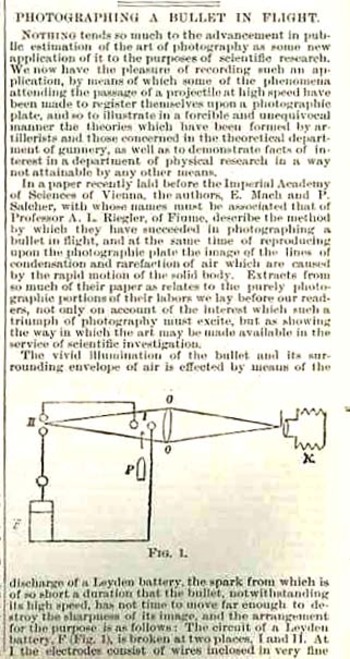
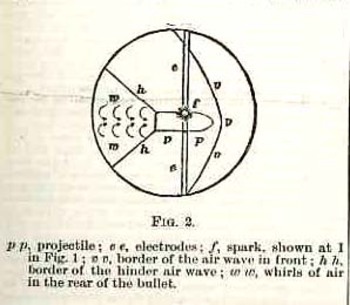
    The next paper relates the success of Ernst Mach and P. Salcher in creating an apparatus to illuminate and photograph a bullet in flight—this was again found in the Scientific American, but for 24 September 1887 (supplement 612).  Unfortunately, their results are rendered only by a drawing, even though the half-tone was available by this point to provide a high-quality reprint of a photograph, it took Scientific American another few years to start employing that breakthrough method.  (I’m not sure why this was so.)
    Blogstopping_things085_blluet_det_2

    The results were made available in the original Austria edition of his publication from which this article is drawn.  This paper “Photographische Fixierung der durch Projektile in der Luft eingeleiten Vorgange” presented to the Academy of Sciences in Vienna in 1887, was revolutionary in more ways than one, as it was really about the visualization of flow over objects, and in particular, the movement of media as a bullet traveled at supersonic speeds—and to which Mach would donate his name for the description of units of supersonic speed.  (The term was first publicized in 1929 when Swiss engineer Jakob Ackeret used Mach’s name for the first time in the description of these speeds.)
    Sudden_mach

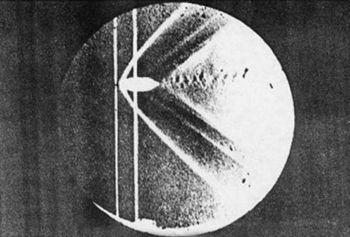
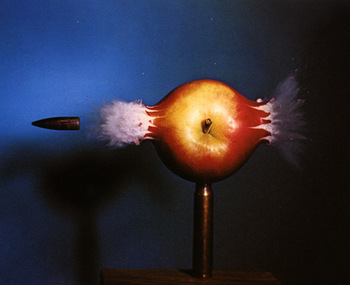
    This last photo is included just because of its sheer beauty—it is far in advance and way out of the continuum for a discussion like this, but this effort, produced by Harold Edgerton, just must stay.  This is the titanic blast of ingenuity that was the intellectual successor to the earlier works listed above, but the technical advancement is just so fabulously great that the earlier scientists could simply not imagine them.  This image was as much science fiction to them as their images were to scientists considering these ideas right there at the birth of photography in 1839.) Harold “Doc” Edgerton, 1893-1990, who would form EG&G and serve MIT for many years owned this field of photography for many years—time stopped for the venerable Edgerton right after he paid for his lunch at the faculty club at MIT. Failing life with a heart attack at  87.)
    Suddennessedgerton

    For an interesting look at videos of various sorts of splashes see the North Carolina School of Science and Math HERE.


  • Blank & Missing People—Pelerin, Schoen and Marey and Picturing Absent and Empty People for the Study of Perspective.

    JF Ptak Science Books  Post #85
    Blogmissing_people076

    In some of the elementary thinking on perspective in the history of art and science there is a certain amount of subtraction that must occur before addition and advancement can be made—these experiments have resulted in some very unusual-singular even—images, which when viewed apart from their proper context and considering the times in which the images were made make them seem revolutionarily modern. 
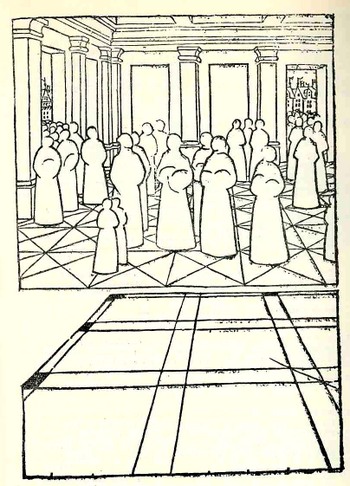
        Take for example the extraordinary work of Jean Pelerin (also called “Viator”) in his De artificiali perpectiva, a very rare woodcut-illustrated book printed n Nurenberg in 1509. In illustrating what he referred to as his “three point perspective” Pelerin removed much of the gothic-tradition bric-a-brac that is so heavily favored in these early books and replaced them with outlines from his rather astonishingly expressive notebooks, and replacing people, individual humans, with what may be the first “almost-entirely-absent” human forms. These roundish, ghost-like figures are just meant to hold the outlines of space, meant to function in the role of a simple comparative unit. This works quite well as an artistic technique—a solicitation tool which I think gives his reduced, “empty” humans an incredible, ethereal look unlike any other in the history of the first 60 or so years of printing.  It is difficult to imagine what the observer of these images back there in 1509 was thinking when they looked at these figures, and perhaps removed them from their textural context—it  would have been a unique visual experience for them
    .Blogmissing_peopl_2e077_2

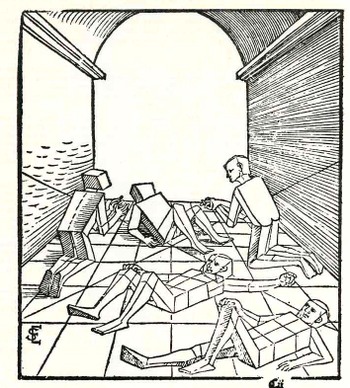
    Just a little while latter Erhard Schoen, in his Unnderweissung der proportzion und stellung der posssen liegent und dtehent, printed in Nurenberg (as well!) in 1538, presented another unique way of representing the human form in model for the sack f studying perspective.  He used simplified geometric form to stand in for the curvy humans, replacing them with proportional stacks of boxes which would more easily explain to the younger reader how to represent the human body n space and in proportion to other things.  Again like the Pelerin, I think that these were monumentally combative images showing humans in a radical, previously unknown way. 

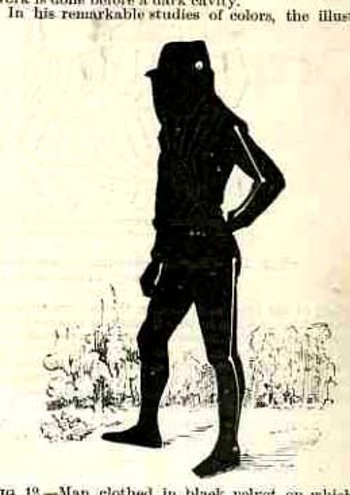
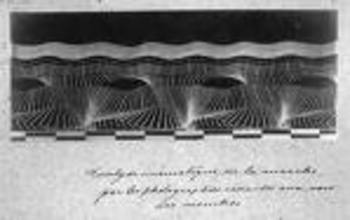
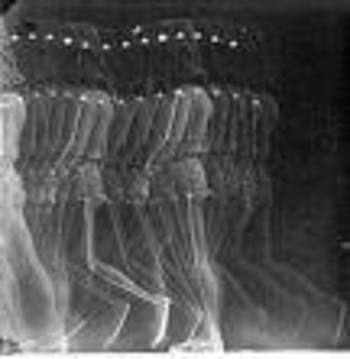
    Dashing into the 19th century we find another superb image of the empty man from Etienne Marey in his photographic and moving-photographic studies of motion.  This is actually a little odder, as the man in this image can be either completely empty or the convex, being completely filled up.

    Blogmissing_menmarey084
     

    Blogmssing_marey_2

    Marey would fit sensors at moving/jointed parts of the human body, affixed to a black-cloth-wearing experimental helper.  The point was to collect simply *movement* images and not necessarily-at this point at least—the parts of the body responsible for the movement.  At this time Marey was interested in the effects of motion, and used his empty man to do just that.

    Blogmissingmarey_one


  • Human Power—Raw Images of the Middle Passage, the American Stain of Slavery. Wadstrom and the Slave Ship “Brookes”.

    JF Ptak Science Books   Post #84

    Blogslaverybrookes_full

    Having just finished a short post on human-powered machines (Georg Bockler in the mid 17th century) and with Juneteenth fast approaching, I thought about another sort of human power—slaves.  I wanted to make a short post on the conditions in which Africans were taken (sold and stolen) from their home continent to North America (and later just to the United States). 

    Slavery as an institution in the U.S. existed from 1619-1865, failing, ultimately, with the ratification of the 13th Amendment (the first proposed in 60 years) to the Constitution by the end of 1865. (The African slave trade—though not slavery itself—was outlawed in 1807, by a law passed jointly in the United States of America and the United Kingdom, with the  US law taking  effect on January 1, 1808.)  The amendment was ratified relatively quickly by the legislatures of the  necessary three-quarters (27) of the original 36 states in 1865—Mississippi, the last of the original states to ratify the amendment, did so in 1995, 135 years following its initial rejection. Though almost all of the states had ratified the amendment in January and February, it took until December 4th and 6th—months after the crushing failure of the Confederacy—for North Carolina and Georgia to vote for it.  (The remaining 9 states voted for the amendment as follows:  Oregon California and Florida in 1865; Iowa and New Jersey (which had initially rejected the matter in 1865) in 1866;   Texas in 1870; Delaware, the First State, in 1901; Kentucky in 1976; and Mississippi, somehow, in 1995
    Blogslaverycross_section
    .

    The Emancipation Proclamation was issued September 22, 1862, with a three-month long pillow until it took effect on  January 1, 1863 .  Juneteenth refers to the freeing of the slaves in Texas (at Galveston) with the reading of General Order No. 3, on 19th June 1865.  Texas was the last refuge of Southern Slavery, and it all ended on that day. 

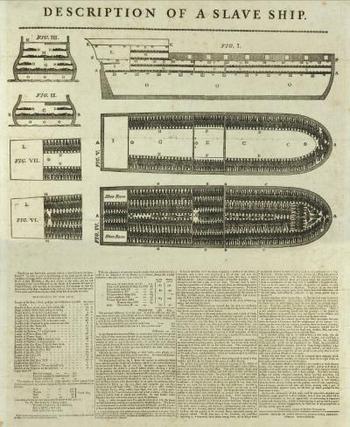
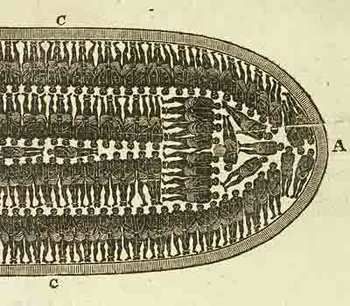
    The famous image above (of the British slave ship Brooke)  is taken from An Essay on Colonization, particularly applied to the Western Coast of Africa….by Carl Bernhard Wadstrom, printed in London in 1794.  Wadstrom (1746-1799) was devoted abolitionist and Swedenbourgian who planned, advocated and practiced (via his relationship with the Nordenskold brothers and the Philanthhropic Society a working agricultural colony on the West coast of Africa) the end of slavery and the return of removed slaves to Africa.
    Blogslavery_brookes1

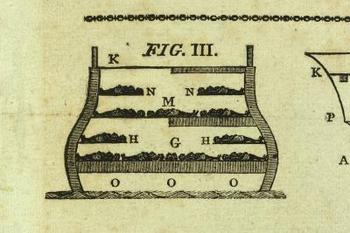
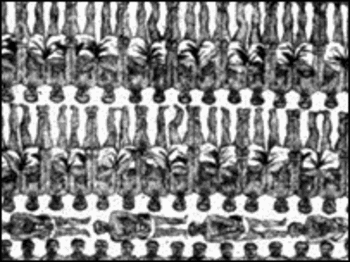
    The images pretty much speak for themselves. Though it should be pointed out that this engraving depicts about 480 slaves packed into the modified hold of the Brooke; in reality the Brooke carried between 500 and 650 slaves to America (meaning the conditions were even more crowded than depicted here), losing on average about 125 people to the insufferable and depraved conditions (dysentery, heat, malnutrition, lack of water, scurvy and so on).

    Blogslavery_brookes_2


  • Human Powered Machines–Bockler’s Theatrum Novum, 1661

    JF Ptak Science Books   Post #83

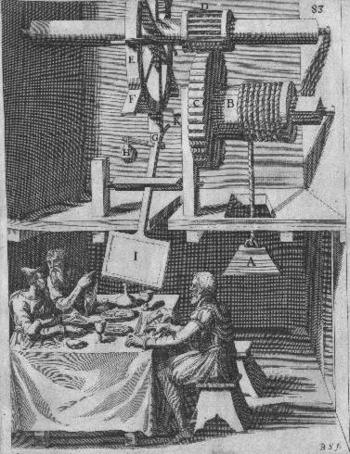
    This post started with this image from Georg Andreas Bockler Theatrum Machinarum Novum (published by Paulus Fuersen and printed by Christoff Gerhard in Nurenberg in 1661) showing to what our eyes in 2008 see as an extraordinary device to power a fan for a dining table.

    Blogbocklerfan

    The gears running what seems to be an escapement-like (clock) device are enormous, and the weight for the weight-driven power source must have been considerable. The result of all of this is that the housing for machine powering the fan necessitate lowering the ceiling in the dining chamber to less than five feet (as there is just enough headroom to get into and out of seat, with the bulk of the cubic space of the room dedicated to the cooling device, which ran like a pendulum, and which also demanded what looks to be like a 10-foot x 1 foot long opening in the ceiling. But if it was a hot humid day in Nurnberg in the summer of 1666, then that fan would feel pretty bloody good to you, as there would have been nothing like it in the city (save for a servant fanning you from not such a discrete distance).

     Bockler as it turns out was an extraordinary talent and very gifted thinker and engineer, designing all manner of instruments and machines over a wide range of fields. His principle interest though was hydraulics, as exhibited in his very popular Architectura Curiosa Nova (1664), which was a practical application of his knowledge of hydrodynamics and mechanics (in general), showing how to construct fountains for the garden and for public city life.

    Blogbocklerhuman_power
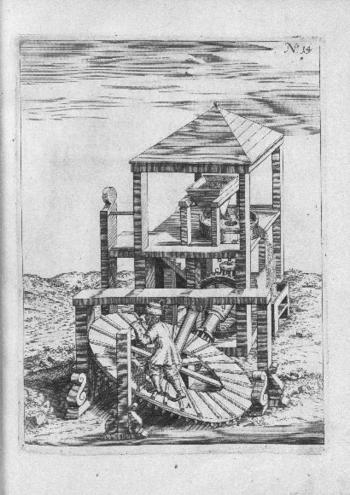
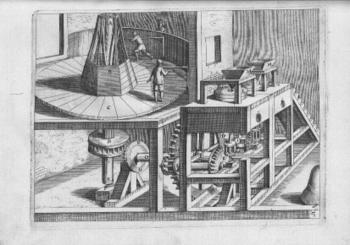
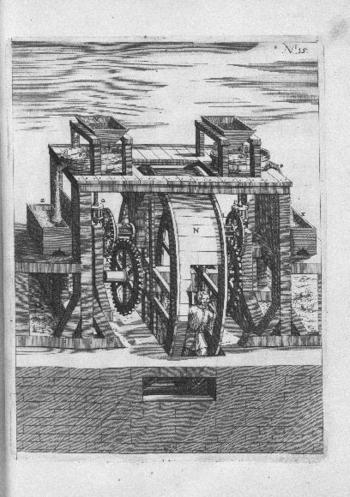
    Looking deeper into the beautifully illustrated Theatrum Machinarum though I was struck by how many of these big machines were powered by humans. And as it turns out Bockler was responding with smaller, more elegant human-power designs because of a problem in supply for the other power sources. The problem with running a furnace to power these machines was the fuel—wood and coal had become problematic on the continent and in Britain in the mid-17th century. The trees that would’ve supplied the wood for the furnaces were disappearing with the rapidly depleted forests. Coal was even a problem with the relatively shallow veins of the deposit giving out. In the meantime of the stagnant power supplies Bockler offered his readers (and parishioners) designs for machines that if all else failed could be powered by humans. Humans on treadmills, humans turning lathes, and so on.

    Blogbocklerhuman_power_3

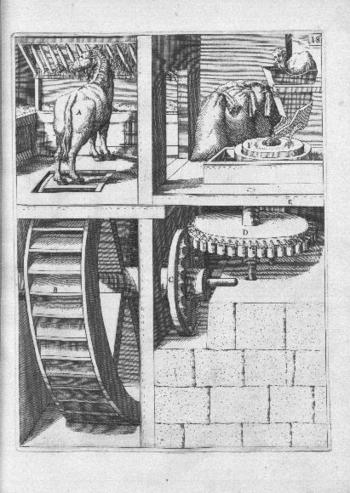
    I’ve included this last part for a horse-driven machine because of the very small window of exposure for the horse to the wheel it would turn. It looks as though it was elegant but I haven’t much of an idea if horses could get used to moving their hind legs without moving their front legs.

    Blogbocklerhorse

    You can see the entire Theatrum courtesy of Cornell University right HERE.


    Blogboclkerhuman_power  

    ·Posted by :

    ·in:


  • 18th Century Calculator for the Blind–Nicholas Saunderson, Mathematician

    JF Ptak Science Books LLC   Post #76
    Blogblindsaunderson_calc
    Nicholas Saunderson (1682-1739)  was an extraordinary mathematical talent—he was also blind (from about the age of one), and invented, principally for his own uses, what I think is the first mathematical calculator designed specifically for the use of the blind.  He was supremely gifted and creative, and rose to become the fourth Lucasian professor at Cambridge, succeeding the expelled William Whiston, who had in turn succeeded Isaac Newton—Saunderson also held the post for one of the longest periods of time, 1711-1739.  HE was friend and associate to Newton, Whiston, Roger Cotes, Halley, De Moivre and others during a particularly rich intellectual period in the history of physics and the maths. 

    Blogblindsaunderson_geo

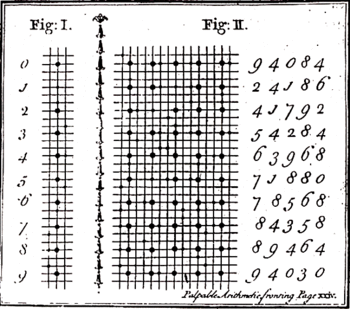
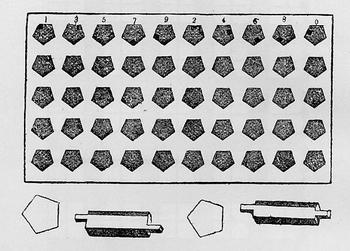
    His calculator was smart and simple, based on a cribbage-board –like device, that was able to perform arithmetical and algebraic functions—it consisted of nine rows and was worked with two pins, the positioning of the pins on the engraved board telling the user their value. (There was another calculator for the blind constructed by Meyer (below, left)  using a sort of reverse principle to the Saunderson model where it was the shape and placement (leaning or not, for example) of the pegs in the hole that annotated value rather than their placement on the board.
    Blogblindparis

    The Saunderson computer was described in his The Elements of Algebra…, published at Cambridge in the first edition just after the author’s death, in 1740.  The device was described in the book by John Colson (who succeeded Saunderson to the Lucasian chair), who commented that it was via the use of the device that
    Saunderson could compose his treatise on algebra. (At right is another Saunderson-based calculator allowing for the construction and study of geometrical figures).  

    ·Posted by :

    ·in:


  • Great Cases of Understatement in Scientific Discoveries—Lister, Bell, the Wrights and Philo Farnsworth.

    JF Ptak Science Books LLC  Post #75

    Some of the fundamental discoveries and their announcements in the history of science have come with great fanfare—and some have come with barely a notice.  Granted their impact would not be felt for some time to come, but, still, there are some fabulous champions of understatement.
    Lancet

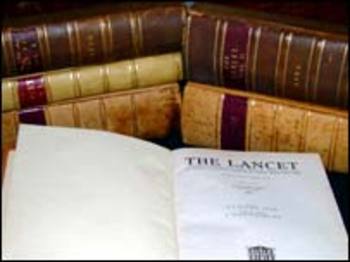
    Joseph Lister (1827-1912) came quite close in 1871 to the discovery of penicillin—as had Louis Pasteur (1822-1895), Jules Francois Joubert (1834-1910) and William Roberts (1830-1899)—but his research in this area was abandoned when he wasn’t able to identify the agent in the mold he found in urine which inhibited further growth of bacteria; he then proceeded with  his discoveries in the antiseptic procedure in the operating room (sanitizing the instrument and the surgeons) instead  Lister’s great work seems exceptionally simple and obvious to us here in the present, but it wasn’t back then, which is why he was the first to do it, saving the lives of thousands of people by increasing their chances of serving surgery by reducing the chances of infection (caused by the surgical procedure itself).  Yet his initial announcements, couched in reflective Victorian drama less scientific prose, never really hinted at the greatness which lurked just below the surface of his announcement, “Antiseptic Principle of the Practice of Surgery” in Volume 90, Issue 2299 of The Lancet published on 21 September 1867.  It actually took a number of years for physicians to react positively to Lister’s phenomenal discovery, called by Dr. Henry Morris, ‘probably second only to Pasteur’s contribution to the saving of human lives’.
    Blogunderstatebell_2

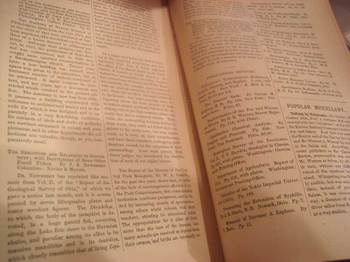
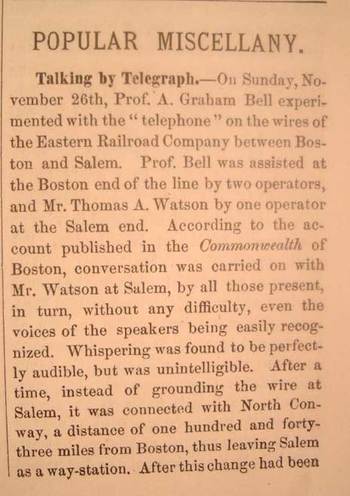
    One of the earliest mass popular announcements of Alexander Graham Bell’s invention of the telephone is in The Popular Science Monthly for February 1877—though you’d be a little hard pressed to find it off-hand in this 130pp issue.  Following twelve articles (including George Beard on “The Physiology of Mind Reading” and Chamberlain’s “Nature and Life in Lapland”), and following seven pages of literary notices, and following another five pages of “Popular Miscellany”, one may find the slight reference to the telephone.  (Pictured here is the two-page spread in which the Bell story is announced—don’t be careless, or you’ll miss it.)
    Blogunderstatebelldetai

    The article, or notice, is called “Talking by Telegraph”, and recalls the Sunday of 26 November in 1876 when Bell’s invention is first revealed, using parenthesis (“telephone”) when referring to the instrument.  The story is less than 200 words long and is tucked away in almost total obscurity.  There is no mention of its possible use or importance. 

    Such was also the case with the announcement of the Wright Brothers’ first successful powered flight in 1903.  The announcement in Scientific American was far less than auspicious, given two paragraphs almost at the end of the weekly issue in the automotive and aviation section.  Actually their earlier successes in unpowered gliding flight in 1901 were treated with similar nonchalance in the Scientific American as well as other popular magazines (of LIFE-like stature in those times), including a fleeting reference in the Illustrated London News and the Illustrierte Zeitung (Leipzig).  It took almost no time at all following the Scientific American publication for the rest of the thinking world to react with proper enthusiasm to their spectacular accomplishment. 

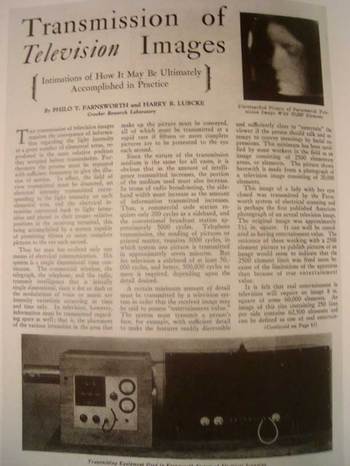
    Our last example here is that of Philo T. Farnsworth (1906-1971), inventor of the first all-electronic television, owner of a spectacularly geeky first name, and one of Time Magazine’s 100 Most Influential Americans of the 20th century
    Blogunderstatephilo

    Perhaps some of the downplay of Farnsworth’s annoncuement and achievement was diluted by the longish list of precursors to his invention—the electro-mechanical television for example was the object of the work of Alexander Bain, Paul Nipkow, Aleksandr Stoletov, Karl Ferdinand Braun, Boris Rosing, Herbert E. Ives, and John Logie Baird, while even the electronic television was nearly completed by Boris Rosing, Alan Archibald Campbell-Swinton, Kalman Tihanyi, Vladimir Zworykin and Kenjiro Takayanagi.  Nevertheless the achievement of the 23-year old boy wonder still found an enormous pinnacle of understatement, all things being equal.  In the article by Fasrnsworth and Harry R. Lubke, “Transmission of Television Images”, in Radio, December 1929, the authors describe their breakthroughs, particularly with what they called their “image dissector”, which differentiated them from the major aspects of the Zworykin invention.   With photographs of the invention as well as the successful televised transmission, the authors go on to say that the transmission of moving pictures “could well be considered as having entertainment value”.  Indeed.  There was some patent litigation ahead, particularly involving Zworykin and RCA, but by 1935 Farnsworth prevailed, though somehow not economically.


  • Sensitive Flames, 1874

    JF Ptak Science Books  Post #74
    Sensitive_flame

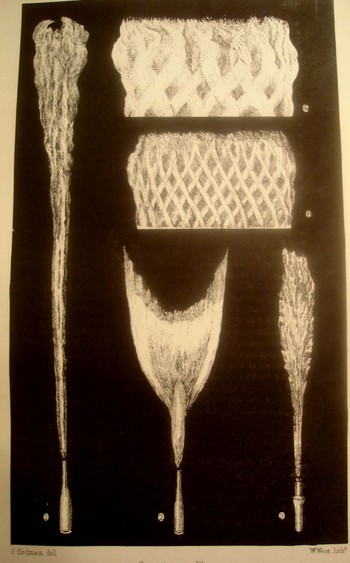
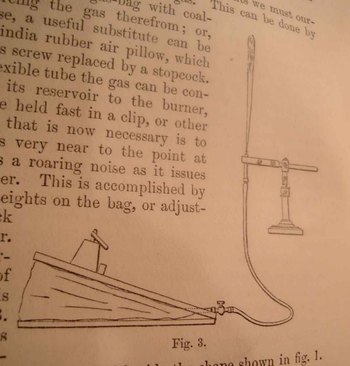
    I was drawn (like a moth to a …) to these images that appeared in the journal Popular Science (New York), 1874, in an article by W.F. Barrett entitled “Sensitive Flames”.  Actually I was more drawn to the title than the images, trying to conjure the differences between the other sorts of vaguely ethereal antiquarian flames that I imagined I was familiar with:  quiet flames, singing flames, and the present sensitive flames.  More or less “discovered” in 1857 by Joseph Le Conte (and then hammered in close comforting years soon after by Govi, Tyndall, Barry and Geyer), sensitive flames were noticed because they reacted to acoustic variations.  These gas flames changed their shape according to the sorts of sounds and music that they were subjected to.  (There are other factors involved here too of course, like the amount of gas used and the way in which the gas is released and so on—basically though they were the subject of change depending of their sensitivity to different sounds.)
    Sensitive_flame_appar
    Sensitive flames fall into a special category of  reactive agents like Kundt’s dust figures and Cholodni’s watery acoustic images (and maybe even the wonderful dances of Brown’s dust particles and Einstein’s Brownian motions—unexpected, interesting and arresting images to watch produced by sound in an unexpected medium).


    Early notices on the subject of “sensitive flames” appearing in the London-based journal Nature
    :

    (1)  Letters to Editor, Nature (03 December 1874)

    Sounding and Sensitive Flames by A. S. HERSCHEL  (Abstract)

    IN a letter which I have just received from Dr. A. K. Irvine, of Glasgow, my
    attention is drawn to a short abstract of some of his experiments with Barry’s
    sensitive flame, which appeared in the English Mechanic of Dec. 15, 1871, a few
    months previously to the appearance in the Journal of the Franklin Institute, and in
    the American Journal of Science, of the description, referred to briefly in my last
    letter (NATURE, vol. xi. pp. 6 to 8), of Mr. Geyer’s researches on the acoustic
    properties of the same flame, some particulars of which Dr. Irvine appears also to
    have noticed independently. The few lines in which his observations are recorded
    corroborate so fully the character and mode of action of the flame as now pretty
    perfectly established, that a short extract from them will scarcely be without
    interest, from the satisfactory support which it offers to the accounts and
    explanations that other investigators of this flame have elsewhere given ii graphic
    terms of its appearance.

    (2)  Letters to Editor, Nature 11, 45-47 19 November 1874) Sounding and Sensitive Flames, II
    (Abstract)

    ANOTHER example of a highly sensitive flame was recently described to me which seems to show that air-currents flowing through gauze at a proper speed are sensitive
    without the intervention or simultaneous superaddition of a flame. A special kind of Bunsen burner was made with a spiral mixing tube coiled in an inverted cup, at the
    centre of which is a small chamber covered with wire-gauze at the foot of a short
    tube or flame-pipe. The gas is admitted by a single jet passing through a cap of
    wire-gauze covering the conical opening of the spiral tube, the object of this cap
    of gauze being to distribute the air in its approach, and to protect the gas-jet
    from ignition. The gas-flame burns with a small bright green cone, surmounted by a
    larger envelope of pale reddish flame, and it is intensely hot. The green cone
    indicates combustion of the most complete explosive mixture of air and coal-gas, and
    when the burner is properly adjusted it can only burn on the top of the flame-tube,
    where it finds the additional required supply of oxygen; but it descends to the
    wire-gauze at the foot of the tube if the air-supply exceeds, or the gas supply
    falls short of the right proportion. In some of these burners the slightest noise of
    the kind that commonly affects sensitive flames causes the cone of green flame to
    retreat into the tube and settle on the wire-gauze at its foot, whence it rises
    again immediately to the top of the tube, when the sound ceases. The explanation
    seems to be that the air-current entering the mixing-tube through the outer gauze
    cap is in a sensitive condition, and that when thrown into disturbance by the
    external sounds, it is more quickly seized and is drawn into the mixing tube more
    rapidly by the gas-jet than when it is flowing over the jet in a tranquil state. The
    inventor of these burners, Mr. Wallace, assures me that some of them exhibit the
    most sensitive of sensitive flames, and that he has more than once thought of
    sending one of them as a most singularly effective illustration of such flames to
    Prof. Tyndall.


    ·Posted by :

    ·in: