A Daily History of Holes, Dots, Lines, Science, History, Math, Physics, Art, the Unintentional Absurd, Architecture, Maps, Data Visualization, Blank and Missing Things, and so on. |1.6 million words, 7500 images, 4.9 million hits| Press & appearances in The Times, Le Figaro, Mensa, The Economist, The Guardian, Discovery News, Slate, Le Monde, Sci American Blogs, Le Pont, and many other places… 5000+ total posts since 2008.

Category: Technology, History of

  • A Map of The Office, 1942 -&- On the Cusp of Color: Bringing Color to Packaging

    JF Ptak Science Books LLC  Post 564
    Color 001


    An Occasion An Appreciation,
    a badly-titled but butterly-produced and broadly-illustrated work is a shiny, slippery and slick celebration of gummed paper.  It may well be the Gutenberg Bible of gummed paper celebration books. 

    The book is a silver anniversary (1917-1942) of the Mid-States Gummed Paper Company of Chicago, makers of gummed,.flat, non-curling special gum gummed papers.  It was a company started by box makers, the logical extension of that business. (“Gummed cloth tapes completed the manufactured joint of corrugated boxes, and gummed kraft sealing tape close the box,” Indeed. Also its a nicely-written Color 003
    sentence, and a well-written book.)  There is a continuous reference throughout the book to “flat, really flat” gummed tape, something that is lost on me if I don’t think about it–the use of splashy color throughout the work, though, isn’t. 

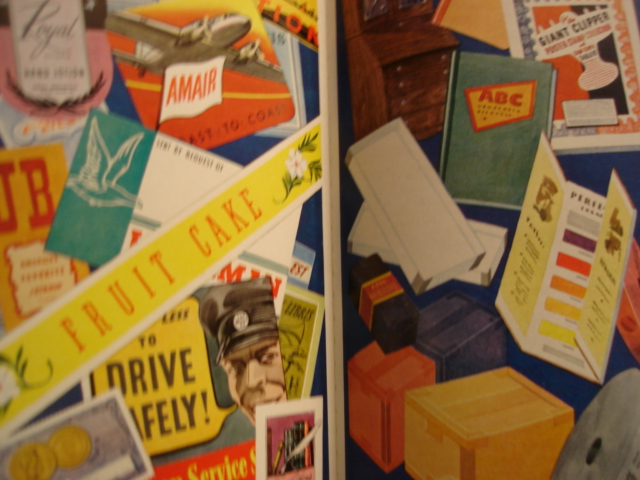
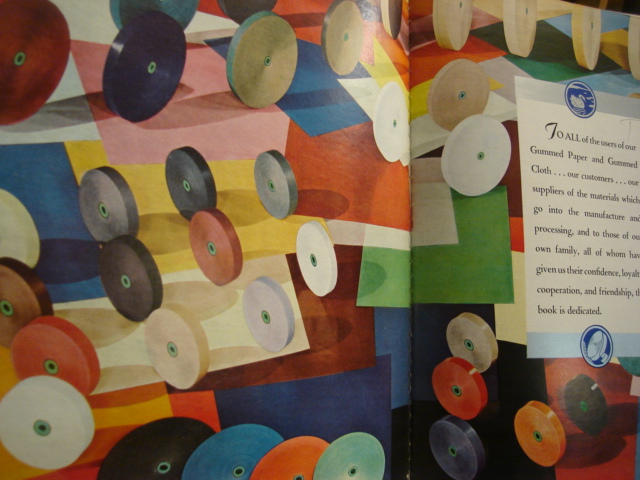
    The company’s color tapes washed over a wide spectrum, adding an artistic touch to a packaging world which was largely black and white. It also produced color gummed labels for  packaging and advertising, which made all the difference. (To appreciate this all you have to do is wind your way through a year or two of LIFE magazine from 1939/1940 and see the vanilla- and blandly-colored boxes of cereals and cans of  such and so spread across the issues.  People Color 004are much more convinced to buy something that has a colorful, pictorial image on the box than one that is a white box with black lettering. )*
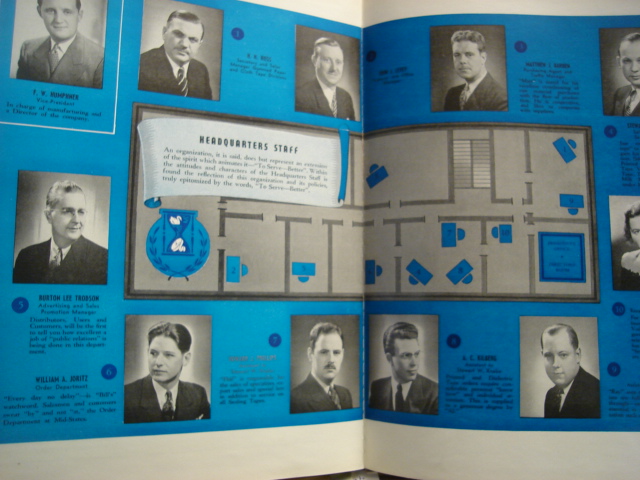
    Another very interesting bit about this book is that it published an indexed map of the offices of the headquarters staff–which is a very unusual map to my experience, very.  I’ve got a small collection of office layouts/maps from the 1900-1940 period, mainly because it belongs to a period long ago and far away, even though the tail end of office design like this creeps its way into my own life, showing up at places like “computer headquarters” in tv shows like the Rockford Files in 1980. It is a wonderful insight into the way business was done, and I can just about see the polished red linoleum floors, open Color 002transoms and abundant oak everything, all swirling in cigarette smoke, populated with people wearing real clothing.
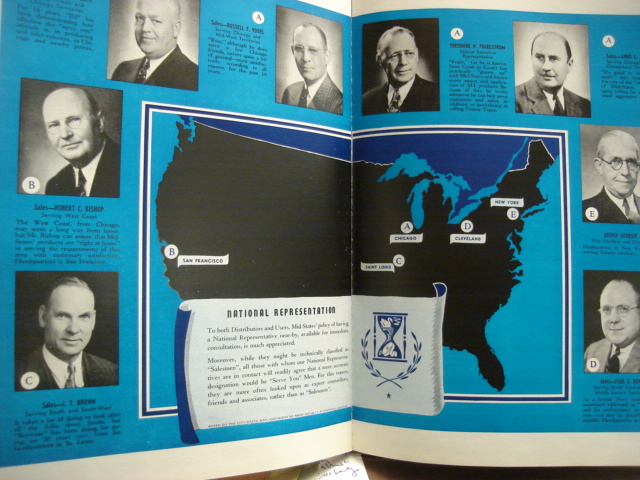
    Yet another oddity is the map of the locations of the company–it definitely belongs to the Blank and Empty Things category of this blog–showing the five cities where it  had offices.  The resulting map though is quite unusual, as it shows just the five point and leaves the rest of the country jet black in a deep blue background, everything else missing. 

    I know I’ve had some fun with this book, but I’ve got to say that it was very well done, very well written, and about as interesting as its topic could allow. 

    * I believe that the first mass-produced book illustrated with color photos was by Leica for its labs, published in Berlin in 1938 (?).  color printing in photography had been around by a laborious process since at least the 1890’s, but that’s a different story

  • History of Dots 7: Dots versus Lines, Engravings versus Half-tones

    JF Ptak Science Books LLC  Post 558

    Engraving_example
    The history of illustration has some distinct phases:  from woodcut to wood engraving to engravings on metal to lithography to printing in colors to chromolithography…and then on to a process that would begin to do away with all of those processes, the half-tone.  This was a process whose foundation was laid in the 1850’s by William Fox Talbot and brought to life in 1873 by Stephen Henry Horgan, though  it really wasn’t commercially viable until  Frederick Ives  further deepened the process in 1881, finally becoming a staple in the printing industry in the mid 1890’s.  The half-tone process would basically due away with the line-centric engraving process, as it was much quicker and easier to use, making images much more readily available to daily-printed media like newspapers.  Images that were drawn could be rendered without being engraved; also, one of its greatest advantages was being able to reproduce photographs, which was an enormous breakthrough, as a photograph automatically increased the veracity of the image. (During the U.S. Civil War, reader’s of the illustrated

    Stieglitz-gossip-1905

    weekly journal Harper’s Weekly trusted battlefield images more if the wood engraving appearing in the magazine was copied from a photograph rather than being from the sketchbook of the

    correspondent on the scene.  The photograph would capture a particular point in time (nearly) instantaneously, whereas the war correspondent artist captured bits and pieces of an instant flavored with memory and subsequent action.  The phrase in the credit line. “Drawn from a photograph”, had real value.)

    MorseCodeForever
    And so it came to pass that the happy lives of dots and lines–so important and intertwined in such things as the Morse Code–made a particular and dramatic break with the triumph of the half-tone over the engraving in illustrating popular publications (from the 1890’s to the 1980’s). 

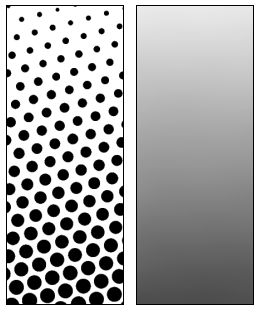
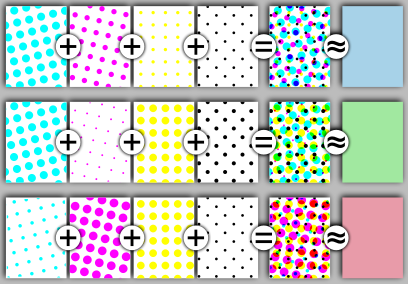
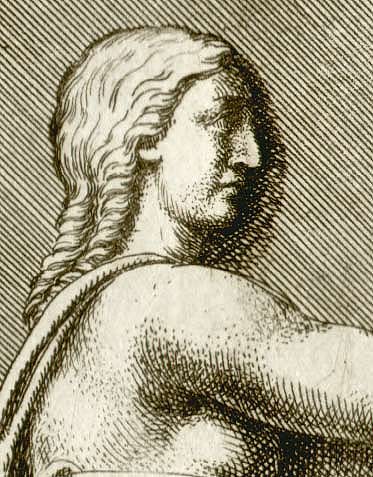
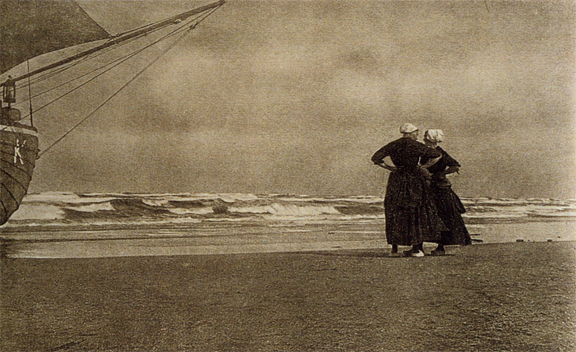
    The image above at left is a magnification of an engraving from 1760;above right is a half-tone image of a 1905 Alfred Stieglitz photo; below left is a magnified sample of what the Stieglitz was composed of; and bottom right finds an illustration of the different combinations in size and color that would effect the composed final image in the final column. 

    Halftoning_introduction

    408px-Halftoningcolor.svg


  • Pre-modern Advanced Technologies and Looking at the History of the Future

    JF Ptak Science Books LLC  Post 541


    Future (Definition)  That period of time in which our affairs prosper,
     our friends are true and our happiness is assured.  
    Ambrose Bierce, Devil’s Dicitonary
    “It is by no means an irrational fancy that, in a future existence, we shall look upon what we think our present existence, as a dream.”  E.A. Poe

    Looking “into” what the future might hold  is a nasty business suited for hairshirts, geniuses and fools–except of course to say that there will be what would seem to us to be shock and awesome display that will wash over future generations like the shock of Darwin washing over those in the 1870’s.*  Looking into the past of looking into the future is far more approachable but not necessarily “easy”.  The major difficulty in finding the future amidst all the historical majors and minors is that given the optical distortions in the broadening of our depth of field to our WayBack Vision.  It is harder to see things that are out-of-place to a given tBlog--jameson satelliteime given our familiarity with it.

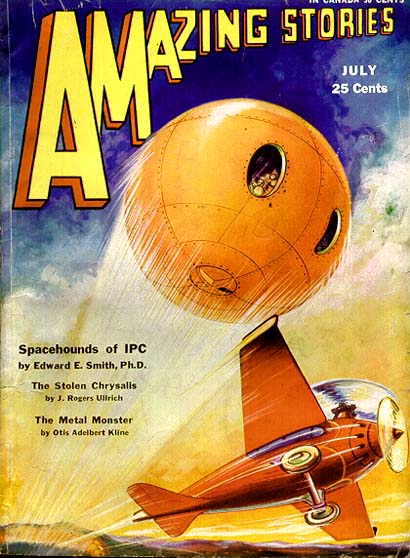
    (Neil R. Jones (1909-1988), a relatively obscure scifi writer, seems to be the first to introduce the concept of a history of the future in his Amazing Stories article of July 1930 called “The Jameson Satellite”.  (It is interesting to note that at about the same time he also introduced the word “astronaut”, and, further into the decade introduced some of the first appearances of cyborg/robotic story characters.))

          blog mar 10 future676

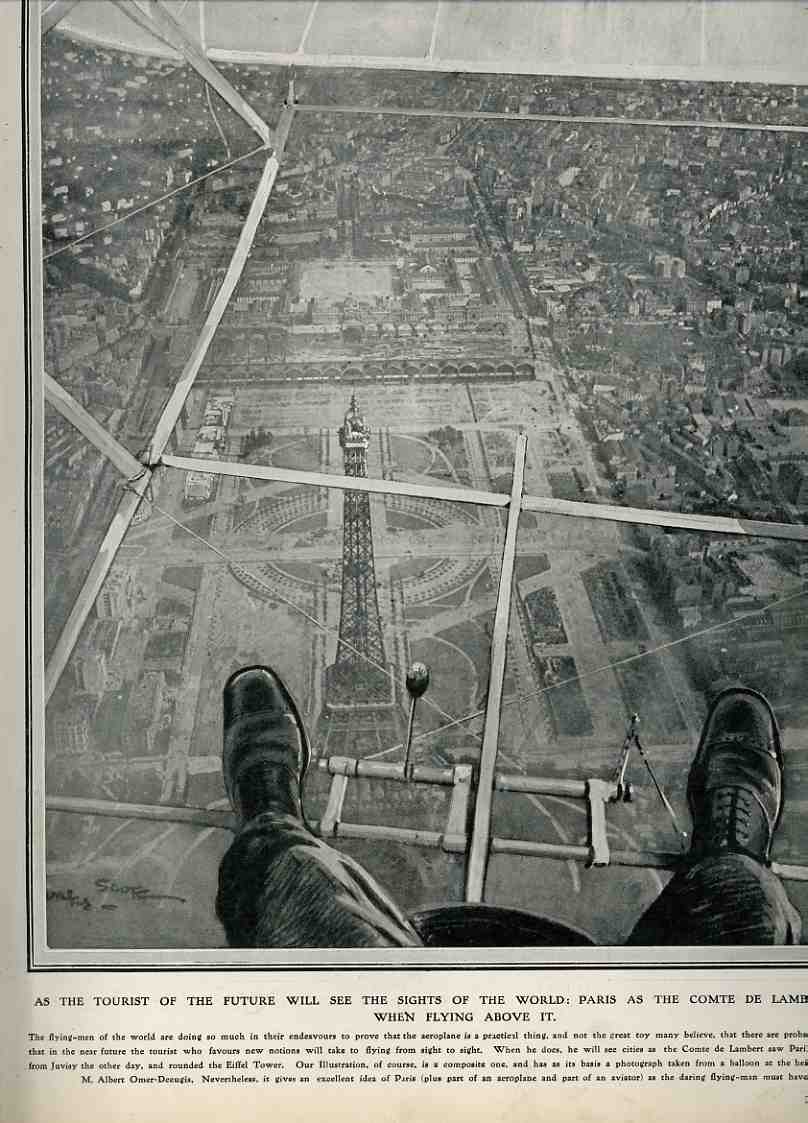
    The idea of identifying these parts of future history is certainly easier when they identify themselves so, as seen in the caption of this wonderful you-are-there image of a person flying in an aeroplane over the Eiffel tower, and printed in the redoubtable Illustrated London News for 1909.  The writer leaves himself plenty of wiggle room, though still firmly convinced that even though flying was still in its relative infancy in Europe, the time would certainly come when people would flit about it planes simply to see great wonders. 

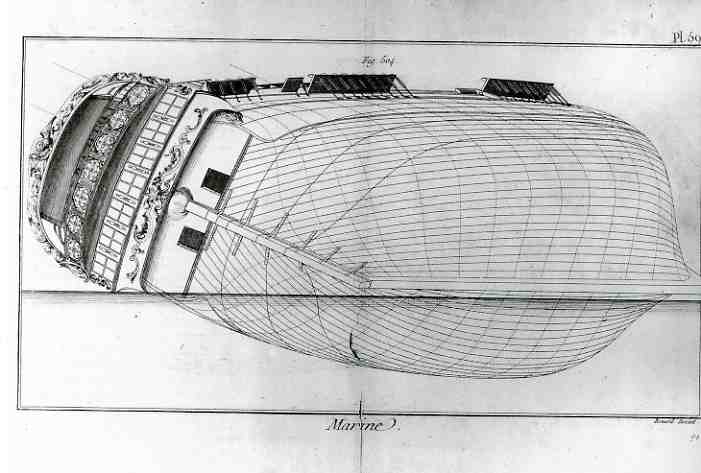
     Images of at the edges of contemporary technical capabilities and whose skill hints at bigger things to come are trickier to see. Take for example the following engraving found in the Encyclpoedie methodique*, published  in Paris from 1782 to 1830.  This engraving depicts a ship of the line in an unusual perspective, best suited I think to show th eshape of the hulol, and looking to me extremely similar to a computer-generated graphic. 

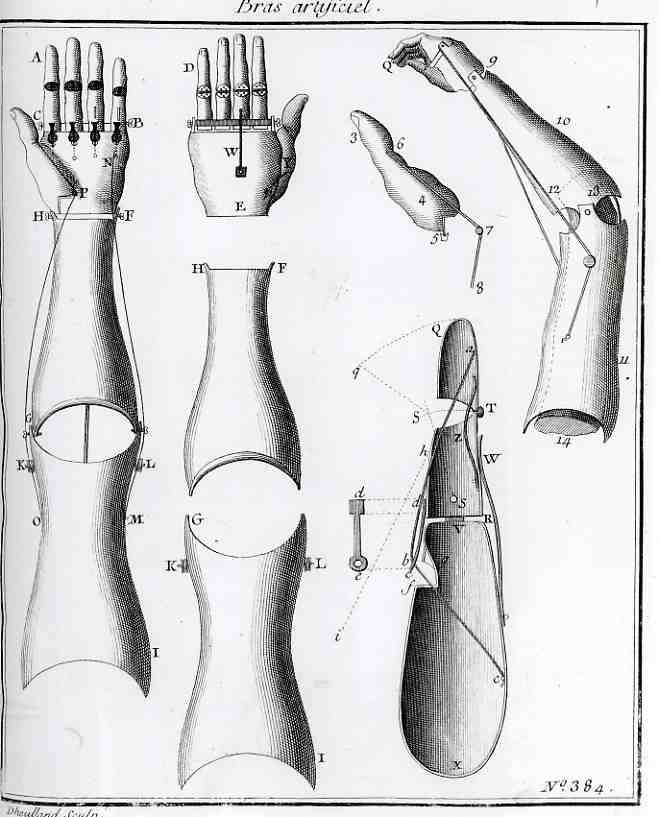
    Also, the fantasitic ebay mar 10 republican674ally articulated and probably unworkable set of metalic artificial limbs was another peep into the future–I think that the technology necessary for these limbs to be anything close to operational just escaped its manufacturer when they were designed in the 1760’s.   ebay mar 10 republican675

    In any event the exercise of finding the future in contmeporary writings of the past is interesting and fruitful, and really does make you pay attention to your sense of history and what modern prejudices one brings to it. 

    *”We may expect that a series of shocks of the type of Darwinism will
    be given to established opinions on all sorts of subjects. One cannot
    suggest in detail what these shocks will be, but since the opinions on
    which they will impinge are deep-seated and irrational, they will come
    upon us and our descendants with the same air of presumption and
    indecency with which the view that we are descended from monkeys came
    to our grandfathers. ..
    JBS Haldane, “Daedalus, or Science and the Future

    ** The L’Encyclopédie méthodique ou par ordre de matières par une société
    de gens de lettres, de savants et d’artistes; précédée d’un Vocabulaire
    universel, servant de Table pour tout l’Ouvrage, ornée des Portraits de
    MM. Diderot et d’Alembert, premiers Éditeurs de l’Encyclopédie
    appeared in over 200 volumes, and was a version of the famous Diderot encyclopedia,m though expanded, and ordering its iformation according to subject area rather than alphabetically.  


  • The Discovery of Nothing: Things out of Place Deparment #4 AND a History of Blank and Empty Things #32

    JF Ptak Science Books LLC  Post 513

    0 blog feb 11things out569

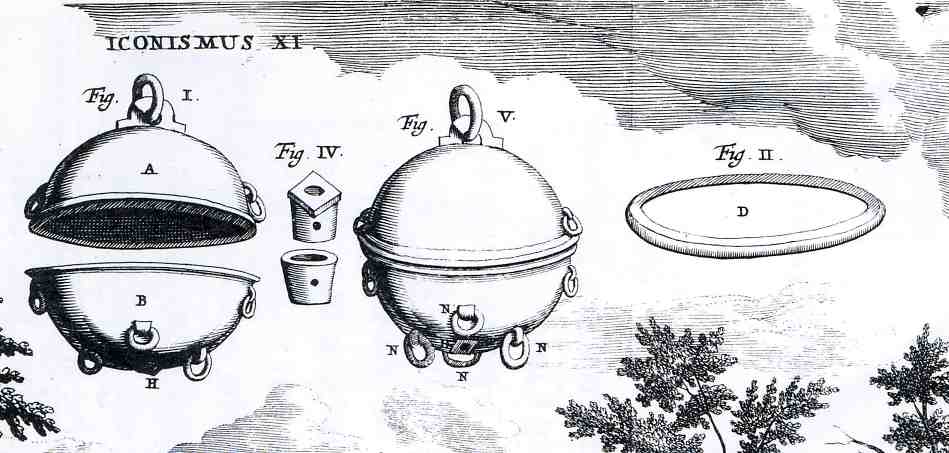
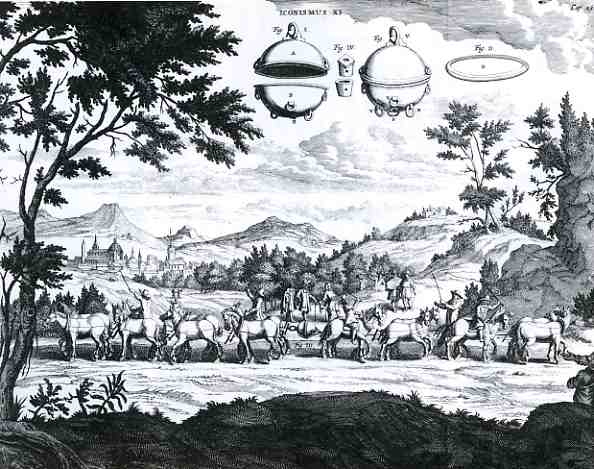
    This is really just another bit of fun–the four objects in the sky weren’t unrelated to the scene, not at all, though if you wanted you could certainly create a fantastically rigorous and bizarre story for them; they certainly did define the concept of “nothing” for the Blank & Empty Things thread of this blog.  here is no doubt that the image has a very quiet, possibly Dadist origin.  In fact, this is one illustration from one of the greatest experimental physics books of the 17th century, coming as it does from Otto von Guericke’s  Experiemnta nova (ut vocantur) Magdeburgica de vacuo spatio (Amsterdam, 1672).  In another minute department, this one is also I guess the greatest book ever written by a Mayor of anywhere (as von Guericke (1602-1886) was mayor of

    0 blog feb 11things out568 Magedeburg for 33 years).  The image shows the greatest of von
    Guericke’s efforts, and one of the greatest (or most important)
    experiments in experimental science–the dramatic demonstration of the
    vacuum, showing here that teams of horses could not pull apart two
    halves of an evacuated sphere, and of course the efficacy of air
    pressure operating against it (um, the vacuum). The “floating” bits in the sky were an exploded view of the sphere that was the subject of the experiment. 

    What was more important though, and what the general reader today might easily miss, was that von Guericke created something that many scientists and philosophers said didn’t, and couldn’t, exist:  the vacuum.  In modern times, Copernicus depicted the universe as a vast void; Descartes came in the back door (following the ancient and interesting though incorrect theory of Aristotle*), not liking the idea very much, and claiming that such empty space couldn’t exist.  Von Guericke provided the proof that the vacuum, that nothing, did exist. 

    _______

    *Aristotle (384-322 BCE) theorized that as air became thinner objects moving through it would move faster, which is true; he further speculated that if there was no air at all, that if vacuums did exist, then objects would move infinitely fast, which he correctly assumed was not possible, and thus the vacuum could not exist. 


  • Inside-Out Privacy: Hermits, St. Simeon, and Cellular Phones

    JF Ptak Science Books LLC  Post 528

    0 blog feb 18 hermit600

    “Language is just no damned good.”–Marcel Duchamp


    0 blog feb 18 hermit601 It seems to me that when cellular telephones first appeared, they were to deliver a certain amount of privilege, a promise of speed in communication that would allow for more personal time and privacy.  But that was many years ago, back when paying for cable television meant no commercials.  The promise, or possibility, of privacy as a result of using this Ponzi scheme of constant data streaming is a demolished and smoldering pile, missing the smolder and the pile.  There’s just nothing in that smoking promise-hole:  no smoke, and not even a hole. 

    What it is, I think, is privacy turned inside out:  everything on the inside is now on the outside, a great big visible and vocal outside. 

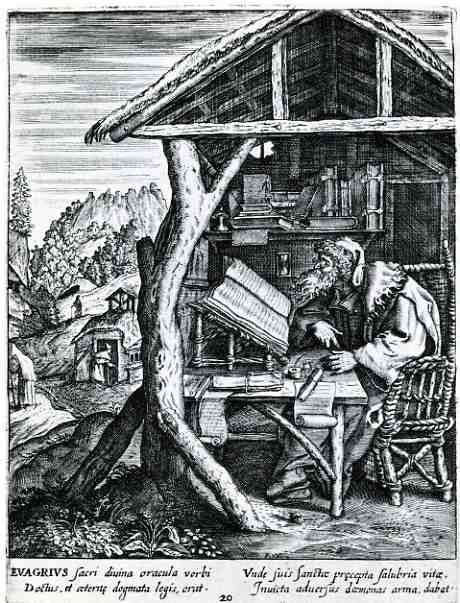
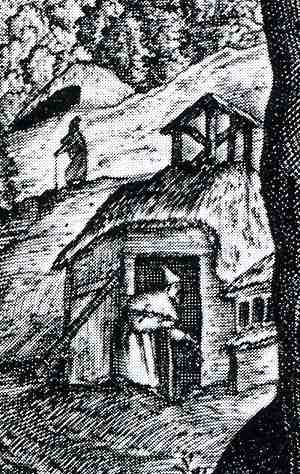
    Privacy, which means to me the promise of some time in which to do a little thinking, is much more in line, say, with the pursuit of a personal space:  not necessarily like that of the beautiful hermit in the image to the left here, but it at least represents the possibility of quiet, which represents a possibility of order and image-making, which in turn represents dreaming or thought or perhaps nothing at all.  It does mean something to the lead monk in this engraving, which belongs to the beautiful Illustrium Anachoretarum Elogia sive religiosi Viri Musaeum (“The Museum of Hermits”) of Giacomo Cavaccio (published in Venice in 1625).  This is a beautiful and remarkable book, with 32 full-page engravings punctuating 150 pages of text  surveying the literature and imagery of, yes, hermits.  Although living very simply, these hermits were all in order, living cleanly, with an impressive two-dozen or more books in their little huts.  St. Anthony, another very quiet thinker, lived in a similar fashion but without books and whose story was unknown until it came (post mortem by thirty years) to St. Augustine, appearing in his Confessions.

    On the other hand, in the history of quiet asceticism (athletae Dei, “athlete of god”),a hermit without the need of a hermitage, or quiet, or aloneness, a hermit who turned the concept of private thought inside out, was St. Simeon Stylites.  I’m sorry to say that he sounded to me like a person in desperate need to be seen being thoughtful and to display his quiet and dedication loudly.  Chained to an ever-heightening pillar, doing sit ups and reciting his conversations with the creator of the universe, Simeon made it into heaven as a saint after treading the earth as one.  Still he seems to have been the opposite of the expected.

    I wonder about this legacy of the invasion of the cell phone; I have little doubt that it is just the barest blink of future invasions of privacy to come, unstoppable and ultimately unwantable. M. Duchamp did say this about words–though he was talking about written and spoken, words–once they left the privacy of the brain, their meanings got all messed up. The interruption of privacy was what corrupted them and their meaning. (“I use it  (language) because I have to” Duchamp said.)  

    I can’t help but think about the speed of deliverables in the Brave New World.  It reminds me of an observation made by Mikhail Matyushin, in 1915: “Only motion cystallizes outward appearance into a single whole…a speeding train fuses the separatness of the cars into a compact mass…”  He goes on to say that “when at last we shall rush rapidly past objectness we shall probably see the totality of the whole world”, though I think that he got that part of it backwards, or perhaps inside out. 


  • Confusing Iconography from Out of Place Things in the Sky: Television, the Atom and post War America, 1946

    JF Ptak Science Books LLC  Post 517

    0 abay feb 16 allied radio594

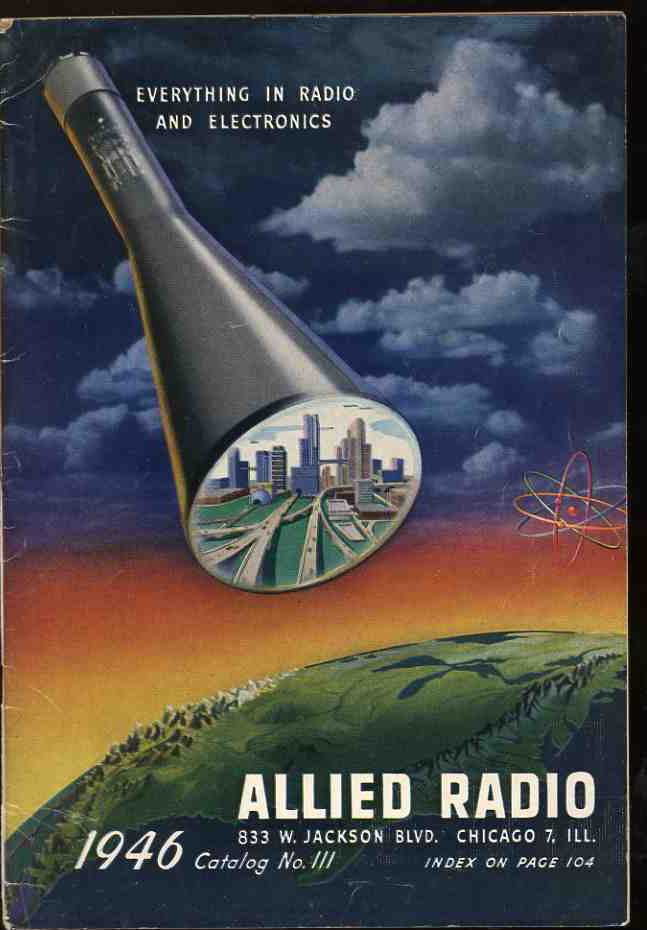
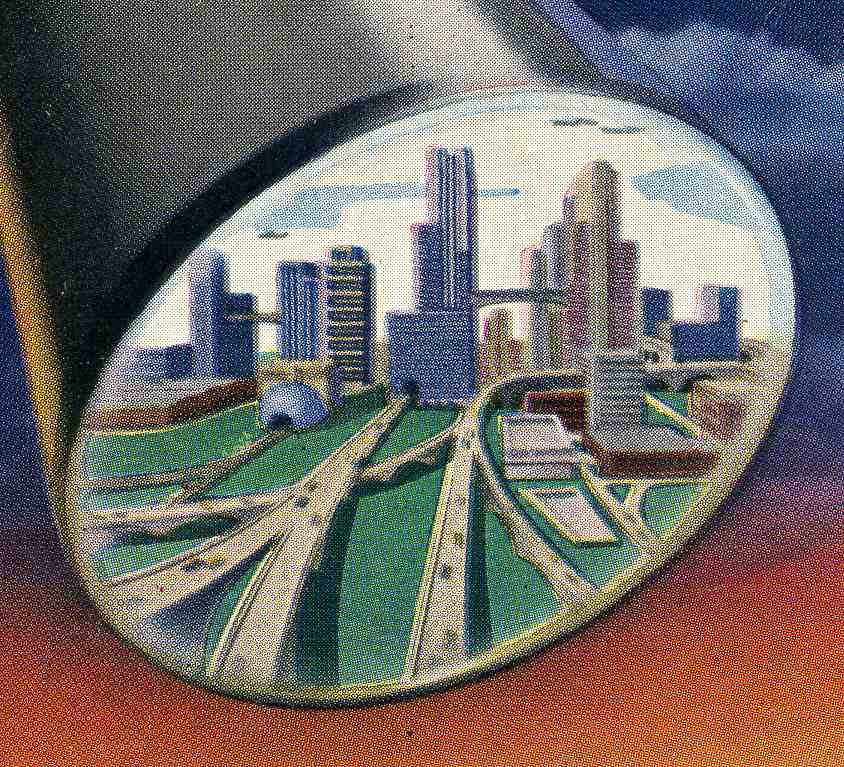
    The war was over for a year, the soldiers were pretty much home, the atomic bomb had been used (three times) to morph the coming future–a future that a quick-artist tried to show in this catalog cover for Allied Radio in 1946.  Probably the artist was just grinding out some more piece work when he did this cover, probably–though he did come up with something pretty interesting, whether he knew it or not.  He did get a good strong sniff of the Something that was coming, and that was the reflection, or capture, or incubation, of the city in the iconoscope tube as it hovered over a verdant America.  The tube was for the next generation of televisions in the post-War forties; by the 1950’s, the television had actually captured most of the United States.  The tube also looked a lot like the Mercury space capsule, but that I think doesn’t mean anything. 

    The growth of the television world in the U.S. was extraordinary:  from 6,000 sets in 1946 came the following growth:

    1947: 142,000
    1948: 977,000
     1949: 3.6 mil
    1950: 9.7 mil
    1951: 15.6 mil
    1952: 21.7 mil
    1953: 25.2 mil

    and by 1962, television set ownership reached 90% of the American population, or about 160 million sets. 
    So, the artist did capture something, though it wasn’t the slightly science fiction-y image of the city in the tube; it was the city in the tube, that t he tube wasn’t actually reflecting anything, but absorbing it. 

    In the 1950s there were at least 102 TV manufacturers in the U.S., which in light of what is going on in today’s world, is epic.  For example, I’ve included those companies beginning with ABC and S,T,U,W,Z to give you an idea of the scope of these companies:

    0 abay feb 16 allied detail595
    Admiral,  Aircastle,  Air King, Airline,AMC,American Television, Andrea
    , Ansley, Arvin, ATR, Automatic Radio Manufacturing, Base Television
    Corp, Bell Television, Bendix Brunswick, Capehart-Farnsworth,
    CBS-Columbia (Air King), Certified Radio Labs, Conrac, Cornell, Crosley

    AND

    Scott, Sentinel.Setchell Carlson, Shaw Television. Shevers, Harold,
    Gotham Television Corp., Silvertone (Sears), Singer, Snaider,Sonora,
    Sparton, Starrett, Stewart-Warner,Stromberg-Carlson, Sylvania,
    Tech-Master, Tele-King, Tele-Tone,Telequip, Television, Inc., Televista
    Corp. of America (TECO), Templetone Mfg. Co., Trad, Transvision,
    Trans-Vue, Truetone – Western Auto, TraV-ler, UST (United States
    Television), Vidcraft Television Corp., Video Corp. of America –
    Cornell Television Inc., Video Products Corp. – Sheraton Television,
    Warwick, Wells-Gardner, Western Auto – Truetone, Westinghouse,  and
    Zenith.

    It is just phenomenal.  This list is lifted from a wonderful site that provide PICTURES of all of these sets, at tvhistory.tv.


  • Looking Straight-On at Things in Antique Prints, Part 2

    JF Ptak Science Books LLC  Post 483 (continuing Post 20)

    0 blog jan 23 vickers411
    In one of my earliest posts on this blog I wrote: I’ve always been intrigued by antiquarian images
    that looked straight down, or up, at things–90 degree, perpendicular, real
    straight-on stuff, giving a feel for depth (or height) and perspective. 
    Funny thing is that in the wide world of scientific images, they really don’t
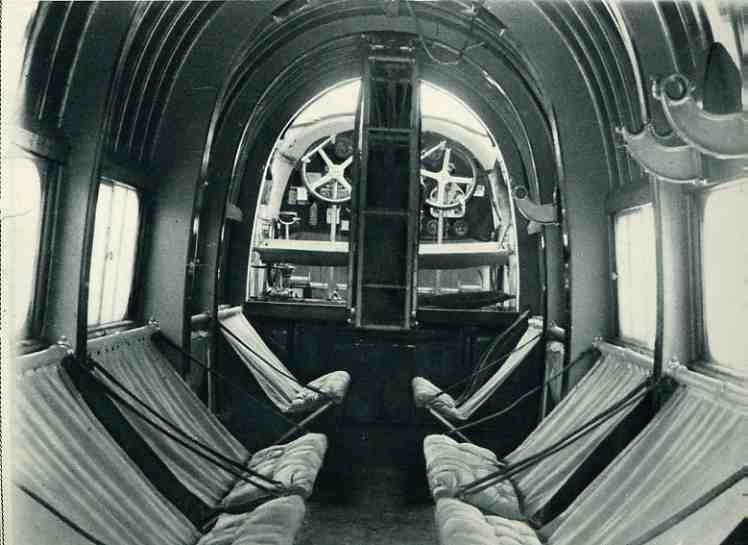
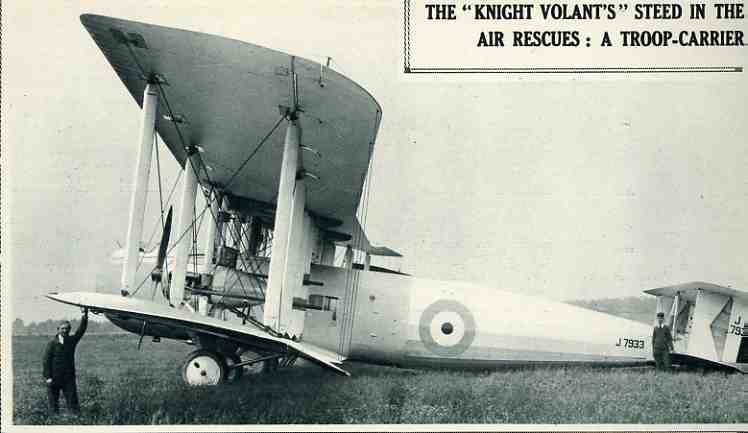
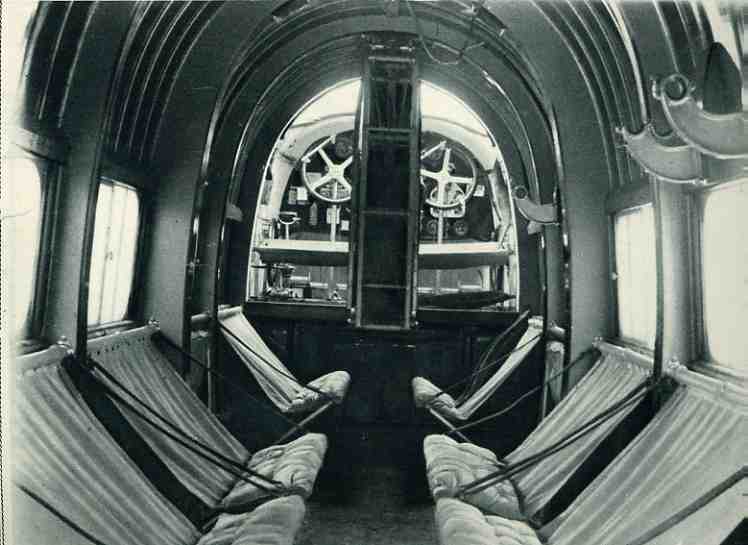
    show up very often.”  Still rue.  I really haven’t noticed that many straight-on images–perhaps the paucity of these things is as simple as them not being “as pretty” as other views.  I have found another, today, showing the interior of the “spacious RAF” Vickers “Victoria” troop carrier aircraft for (January 5) 1929.  It was indeed spacious for the time, and was one of the largest planes in the air. 

    The Vickers Victoria first flew in 1922—this 1929 monster
    was powered by two 570hp engines which allowed it to cruise at a modest 110 mph,
    taking it 11 minutes to climb to 4900 feet. 
    It had a crew of two and carried 22 troops—it looked as though it might
    do more than that, but this was quite a load given the time and the altitude at
    which the plane would function.  As you
    can see by the fellow standing in the foreground, it was a very tall plane—17 feet tall, with a 59’ long body on a massive  87’ wingspan (that made even more impressive
    by the wings’ 2,178 square foot surface). 


    0 blog jan 23 vickers410


    The view here is from the rear of the aircraft looking
    straight forward, and I notice that the pilots didn’t have any backrest for
    their seats.  The interior, even though
    fairly threadbare and essential, did have upholstered seats for the folding
    chairs. 


  • The Car as the Dominating “Life” Form in the U.S.: Finding Places to Rest the Populating Automobile, 1930

    JF Ptak Science Books LLC  Post 481

    0 blog jan 07 car future364

    If I was an alien (of the outer-space variety) looking at the United
    States, I’d find it difficult not to assume
    that the biological units scurrying around the place were not put there to
    service the automobile.  Cars get born,
    then put on display, then selected and driven to their new home.  They get washed, and fed, and sometimes have
    their own places to sleep at night in their very own structure with their
    caretakers housed nearby.  They get taken
    out for airs in the morning and evening, resting while the humans labor all day
    to make enough money for their care and maintenance and feeding.  In the evening, they get brought back home
    and allowed to rest further.  They
    respond directly to inputs only and give no unsolicited response:  sort of like cats.  Fantastically large allowances are made for
    cars, humans going so far as to remove life- and atmospheric-sustaining biological
    units such as trees and good dirt so that the car can be taken virtually
    anywhere in the country on a path made specifically for them.  These pathways, which are padded and smooth,
    have ancillary bits attached to them so that the humans may walk beside them—houses
    and such are all connected to these paths to more easily enable the people to
    have access and maintain the car.  And,
    at the end of the day, humans breathe in the very excrement and excretia
    produced by the cars.  Placed under a
    microscope, the whole thing might resemble a biological unit, the cars being
    its very blood, everything else present to contain and move it.


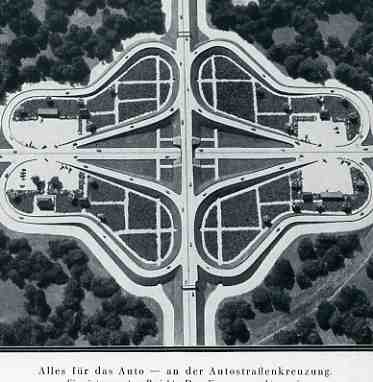
    0 blog jan 222 car bfuture398

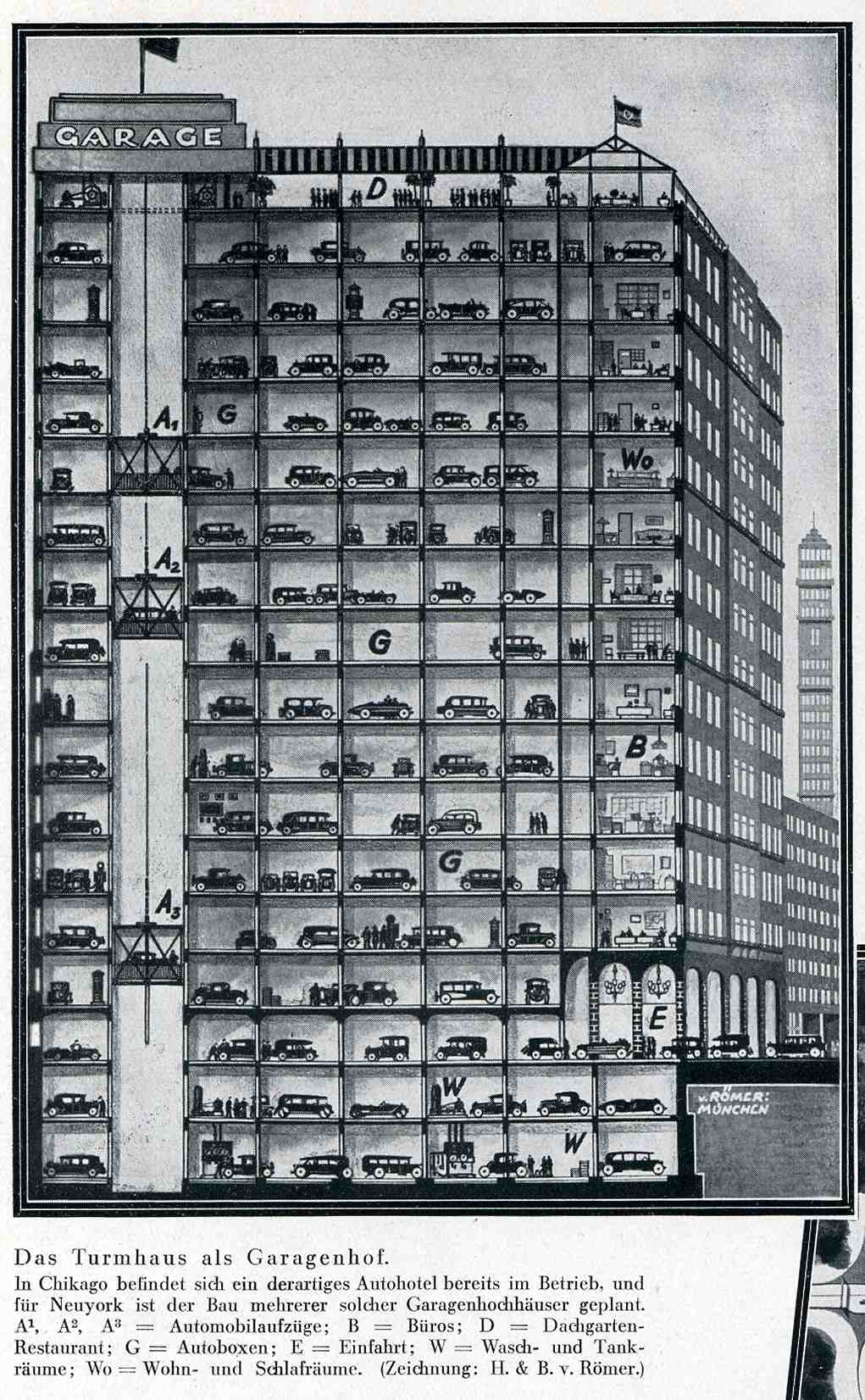
    These images from the Illustriete Zeitung (Leipzig, issue
    4484, pp 239-240) for November 1930 speak to the exact issue of how to care for
    the now ever-present automobile. 
    Entitled “Wie Bringe Ich Meinen Kraftwagen Unter?”, the short article
    (by the engineer Botho von Romer of Munchen) addresses the need of what to do
    with cars at bedtime—where do we put them? 
    One answer was this spectacular carpark (“Garagenhof”) high rise—seventeen
    floors of parking (with two more underground), serviced by a variety of
    elevators, pointing out that varieties of this structure already existed in Chicago and New York

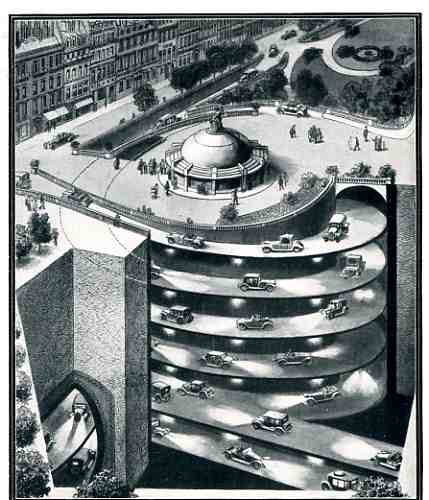
    There was also the possibility of vast masses of sunken
    garages, their entrance way screwed into the earth leading to tunnels and
    networked warehouses where the cars could be safely deposited and removed from
    city streets.  There were also these two
    versions of the simple above-ground garages and parking lots:  the apartment block gives over the entire
    interior area to individual parking and garages (doing away with any
    greenspace), while the massive semi-cloverleaf design is made for nothing else
    in mind than to park the cars in the four semi-centers.


    0 blog jan 222 car bfuture399

    By 1930 the production of the automobile had been revolutionized
    to such an extent that virtually anyone with a job and less than five kids
    could actually afford a car.  It is
    interesting to note that at the average price of say 30 cents a gallon for
    gasoline (in the U.S.A.)
    that folks 80 years ago were paying pretty more per gallon (adjusted via CPI)
    than we are paying now at $1.87/gallon (in my mountain city at the far end of
    the pipeline). 


  • The 18th Century Bible on Dutch Canal and Dam Construction: Tileman Horst Theatrum Machinarum, 1737

    JF Ptak Science Books LLC  Post 461

    0 blog jan 08 horst368

    Tileman van der Horst and Jan Schenk produced the Theatrum Machinarium
    Univesale
    *, one of the most celebrated works on the construction of all those
    elements so necessary to keeping life dry in Amsterdam 9the place of the book’s
    publication).  It was perhaps the most
    important work then produced on dikes, sluices, dams, weirs, canals and
    swing-bridges, the very elements of existence in Holland.  Jan Schenck was the engraver of this work,
    which may also be the most accurate and the most sumptuously illustrated book
    of its type in Holland in the 18th century—the technical aspects of the
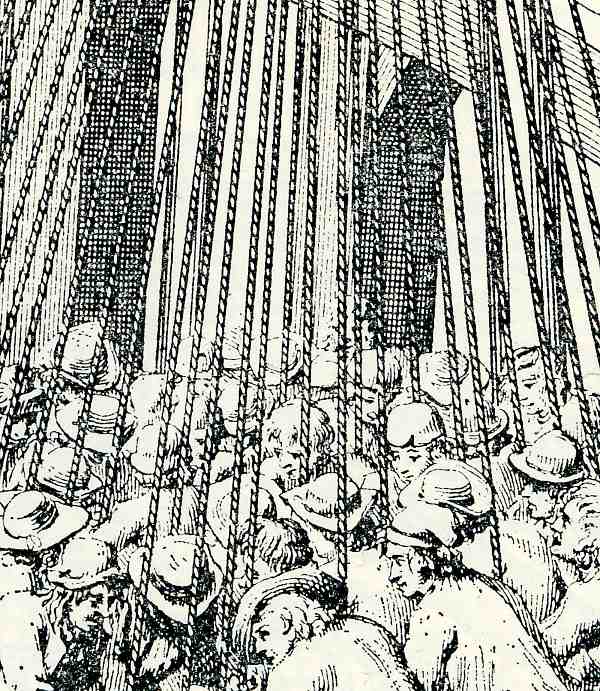
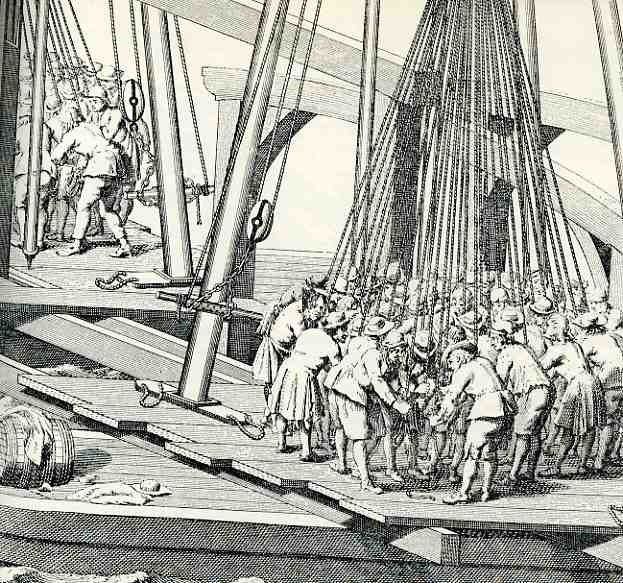
    rendering was just superb. In the image (which is a detail of a detail of a
    larger folding plate) I reproduced at left and below we see that Schenk and Horst weren’t kidding around in their treatise:  what we see here is the elevation for a plan
    showing the laying-in of pilings for a larger structure.  This is still tricky business today in Amsterdam, given the soil
    structures on which the city is built, some of these pilings go down hundreds
    of feet.  This group of about fifty men
    is certainly struggling with something big; but just how big it is I do not
    know.  (They do look rather well-dressed
    for being about to muck around in the foundation area of a structure.) And this
    draws my attention to the planks on which they all stand; the boards seem just
    enormous, looking to be two feet wide and several inches thick, and long.  I’d be very curious to know where this lumber
    was coming from, as I feel it certainly wasn’t local.

    0 blog jan 08 horst367
    *Theatrum Machinarum Universale.. of
    Keurige Verzameling van .. Waterwerken, Schutsluizen, waterkeringen, ophaal- en
    draaibruggen
    . Printed in Amsterdam., by Petrus Schenk en Zoon, 1757-74.  Illustrated with 50 engravings on 47 partly folding plates.


  • Unusual and Proto-Useless Statistics Dept: Travel Deaths, 1880 vs. 2006. An Orders of Magnitude(s) Story

    JF Ptak Science Books LLC  Post 415

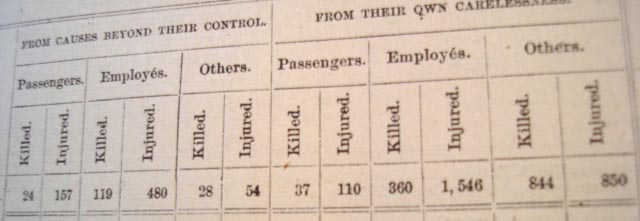
    Searching for something entirely unrelated to what I found (trying to answer how straight railway tracks were  in Texas in 1880*) but happy with the stumbling is this header for a long list of railway deaths on American railroads in the year 1880.  It appears in on page 280, part VIII, volume 13, part 4 of the U.S. House Miscellaneous Documents No. 42, part 4, volume 2132 of the publications of the U.S. House of Representatives.  Lots of numbers, yes?  Actually it is just vol 13 of the U.S. census report for 1880, the Statistical Report of the Railroads in the United States, by Armin E. Shuman (“Expert”).  It si a big books in a series of big books, running 862 pages and is mostly just (beautiful) numbers.  It is remarkable, really, that these folks had such extraordinary control over this amount of data–not only were they collecting it, but analyzing it as well, and doing it before the big breakthroughs that would come in the next census with the Hollerith machines. 

    Ballistics 348 The table is a summary of accidents reported by all railroads in the United States for the year 1880.  For *one* year, not the decade of the 1870’s.  The short story is that 2,541 people were killed in/on/by trains, with 5,674 injured.  Of the “killed” number, 61 were passengers who were killed “from causes beyond their control”, and 62 were killed “from their own carelessness”.  The numbers get much bigger because of the number of employees killed on  the job, more than 900 in the one year alone.  The total number of passengers carried for the year was 269,000,000.  I cannot find the number o total miles traveled.

    I made a quick check on the Bureau of transportation Statistics website just to see what kind of similarities there might be in these numbers. It turns out that the gross numbers were sort of similar–there were 658,000,.000 passengers carried domestically by American carriers in 2006.  There was a tremendous difference in deaths, though: 47 people were killed as a result of air travel that year, compared with the 2,541 by trains in 1880.  Two orders of magnitude, about, with each person traveling a great distance in the air (averaging about 1000 miles) than by rail (whose numbers I could not find quickly).  It is kind of interesting, though, that when you consider passengers as a lone stat in 1880 that the numbers get very close to 2006. 

    Working on the railroads in 1880 was tough and dangerous–more dangerous than I had known.  And I can pretty well  guess that there were no Thanksgiving turkeys being delivered to anyone’s family if Father happened to get cut in half by the South Manchester Railroad Company.  Certainly no turkey would come the year after.