A Daily History of Holes, Dots, Lines, Science, History, Math, Physics, Art, the Unintentional Absurd, Architecture, Maps, Data Visualization, Blank and Missing Things, and so on. |1.6 million words, 7500 images, 4.9 million hits| Press & appearances in The Times, Le Figaro, Mensa, The Economist, The Guardian, Discovery News, Slate, Le Monde, Sci American Blogs, Le Pont, and many other places… 5000+ total posts since 2008.

Category: Technology, History of

  • The Indredible and Useless Dog Engines of 1895 and 1939

    JF Ptak Science Books   Post 797 (Sept 2009) Extended. 
     

    ++00++ 9.22 dog det


    In 1702, at the beginnings of the Industrial Revolution, Thomas Savery (c.1650 – 1715) began the idea of calculating the work done by steam engines over that done by horses, writing in his book, The Miner’s Friend:

    “So that an engine which will raise as much water as two horses, working together at one time in such a work, can do, and for which there must be constantly kept ten or twelve horses for doing the same. Then I say, such an engine may be made large enough to do the work required in employing eight, ten, fifteen, or twenty horses to be constantly maintained and kept for doing such a work…”   But it was James Watt who first introduced the term ”horsepower” while trying to advertise and place forever the idea of his steam engine over than of the earlier Newcombe engine and, of course, horses.”
    ++00++ 9.22 dog


    James Watt (1736-1819), Scottish inventor and “re-inventor” of the steam engine, the man who put the ‘power” into “horsepower”, determined that a horse could turn a mill wheel (of a 12-foot radius) about 144 times in an hour (about 2 ½ times a minute), traveling 2.5x2pix12 per minute.  It has been shown though that on average a horse will work at about 1.5 horsepower like this for an hour on and off; and less than 1 horse in other times; a man could work at 1.5-2.5 horsepower for a short time, but generally would pull about a tenth of that for an extended time.


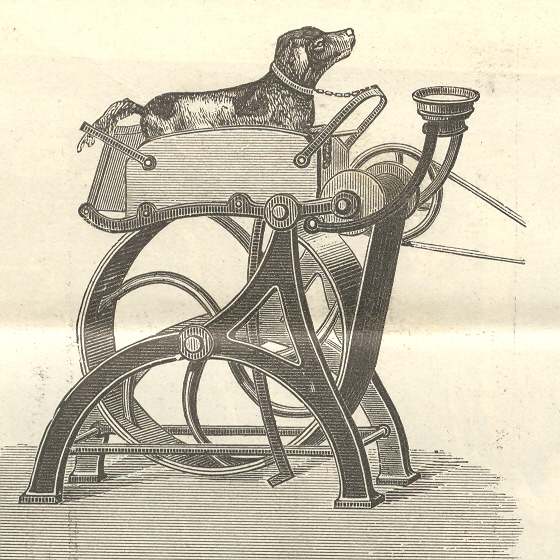
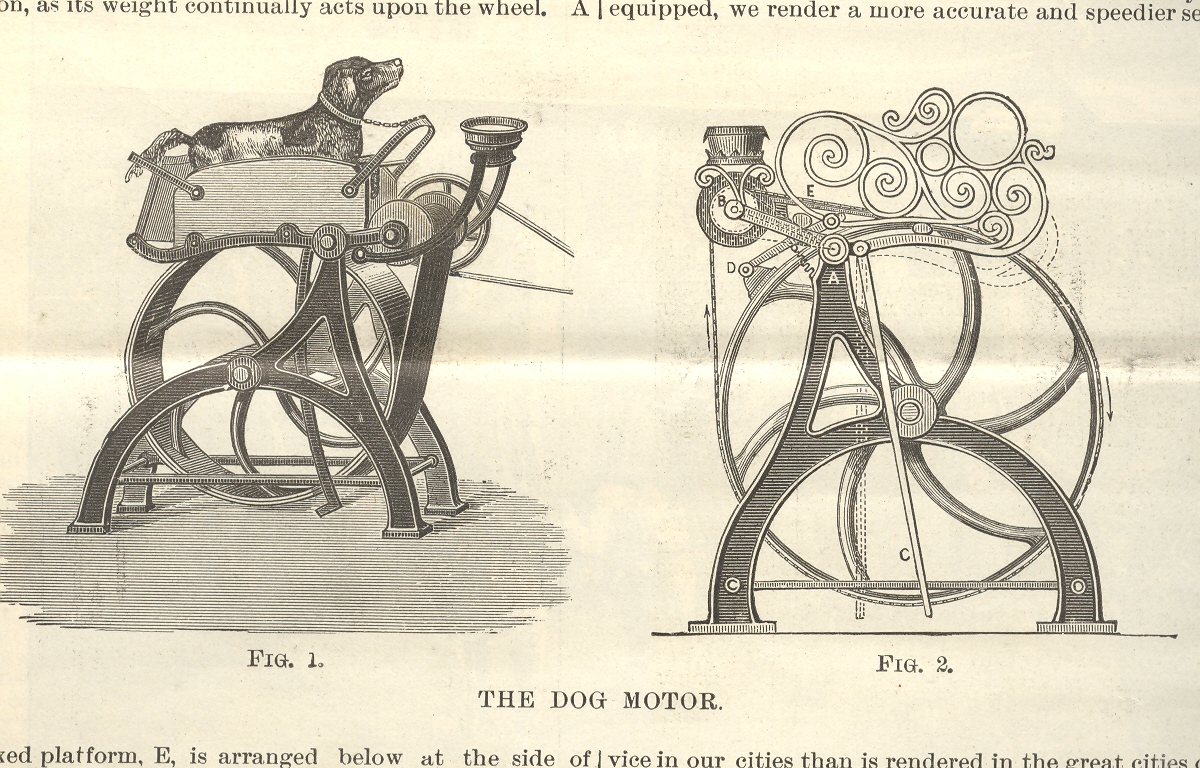
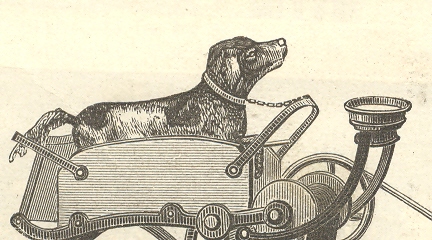
    And so we come to the crux of the biscuit of this post:  a dog motor.  This entirely, utterly, unconvincing and thoroughly bad idea was fully fleshed out by a M. Richard (naturally of Paris) for the Agricultural Exhibition and re-published from La Nature in the Scientific American Supplement  on 10 August 1895.  It is slightly lovely in its high Victorian way, or at least so until you consider that an animal goes in side the thing, working its way along an infinite belt, a cup of water just within reach.  The dog would power the large wheel, which would turn a smaller wheel and belt, which in turn would be connected to smaller, and so on, until it reached whatever it was it was powering, which is left entirely to our imagination.  Even when I squeeze my eyes in a telescoping effort, I cannot see what it is that this poor doggie might power.  Given the descending orders of radii of the wheelworks, perhaps the tenth-horsepower dog engine ran a fan, or something, something remarkably insignificant.  It does tell us something about over-design, like buying a ten dollar bill with a twenty. 
     

    ++00++ 9.22 dog det 2


    Another, more recent but less serious attempt at utilizing canine power was found in Popular Science for 1939:


    The thing that really bothers me is that both of these really bad ideas occurred in years where there were fantastic ideas in the history of physics–1895 being the home to the discovery of the atomic world in the work of Wilhelm Roentgen, and 1939, well, more of the same plus making the atomic world go “boom”.

    In this same vein, and keeping with the highlight-year-for-physics theme, is this thing, created in the 1880’s but published in Popular Science in 1933:

    With the help of Laura Massey (Bookn3rd !), from the wonderful bookseller blog, The Cataloguer’s Desk at the great Peter Harrington Rare Book Shop (London), I’m including an 18th century version of sweating dogpower called the Turnspit:

    File:Turnspit Dog Working.jpg

    I’m not sure what it is that would keep the dog running after it realized in the first half-minute that it will never be able to retrieve that hanging thing set out in front of him/her–maybe things got poke-y. 

  • A Big Sea of Planes: Quantitative Display of World War II Bombers

    JF Ptak Science Books  Post 748  Blog Bookstore

    (See also the new post on picturing massive numbers here.)

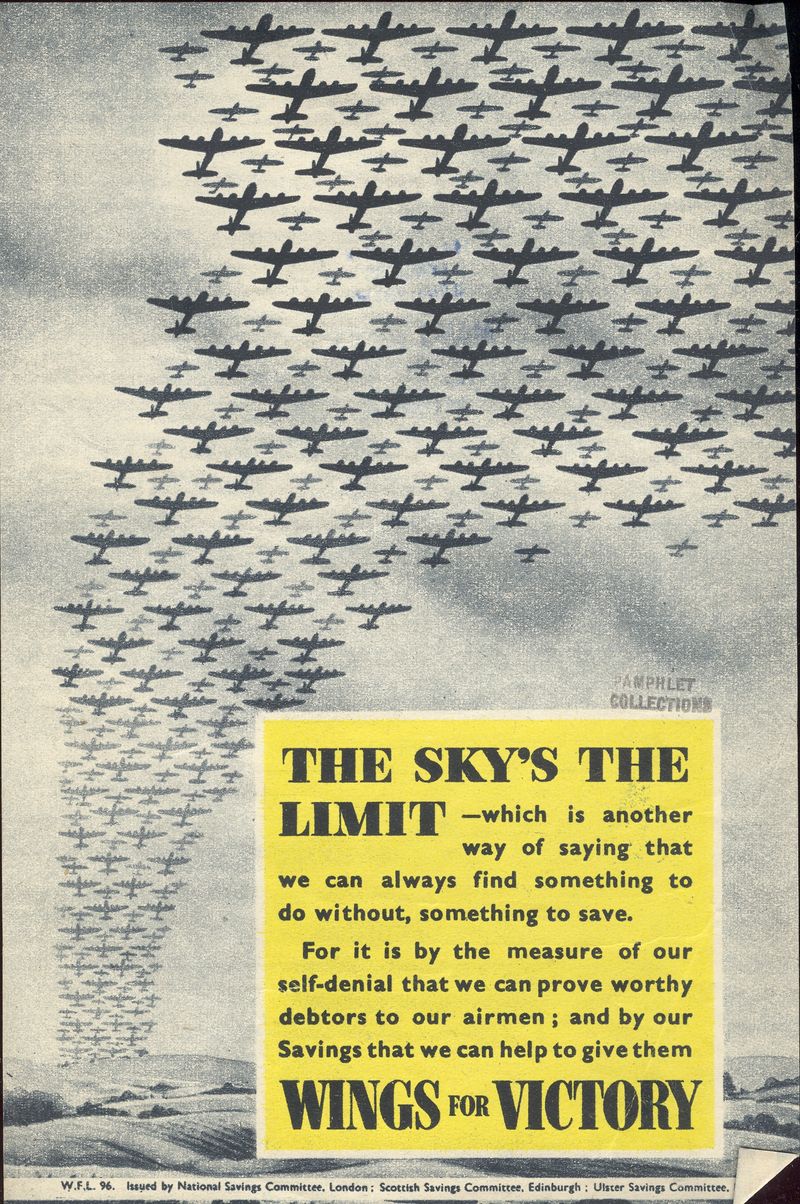
    I’ve written four or five posts on glorious quantitative visual displays of massive amounts of WWII bombers, most of which I’ve gathered together below. This subject came up today when I found another of these images in a small hand-out broadside published by the National Savings Committee of Great Britain, urging people to save money and be thrifty, keeping money in the banks, in an effort to control prices and have money available to the government for war production.  The legend states: “For it is by the measure of our self-denial that we can prove worthy debtors to our airmen; and by our Savings that we can help to give them wings for victory”.  The point is driven home by a now-familiar representation of hundreds of bombers rising from the horizon–a remarkable vision, especially if you tried to visualize the real thing. 

    +_+ planes WWII


    Here are a few other similar images:

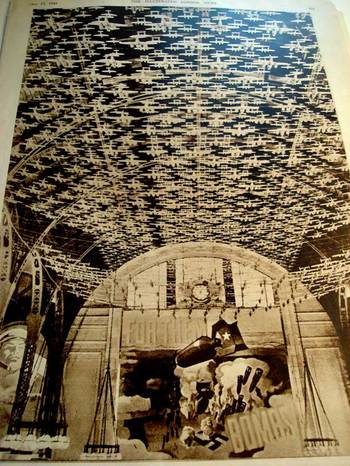
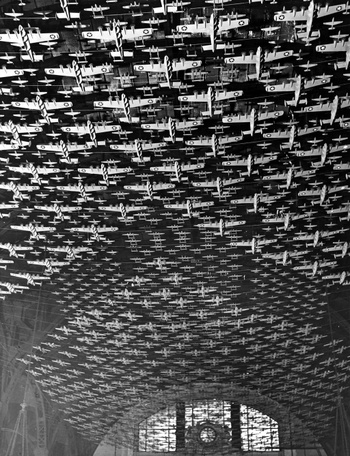
    (A) This widely circulated and published photo appeared in 1942 (particularly in LIFE Magazine in 17 September 1942 and the Illustrated London News in the next month), and showed 4,500 aircraft models suspended from the ceiling of Chicago’s Union Station   It is the result of an inspiration derived from President Franklin Roosevelt’s assertion that America would produce 185,000 war-focused aircraft in 1942 and 1943. 

    Blogwwiiplanes

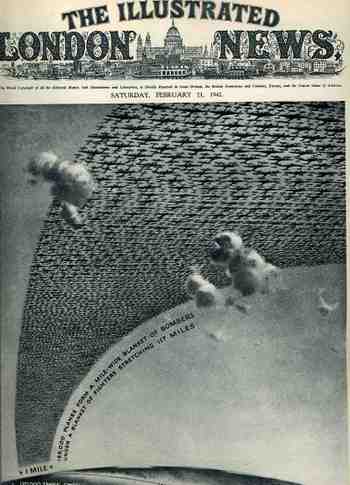
    The planes in this photo were hanging 60-feet above the floor of the station, with wing spans between one foot and four feet (for the bombers).  It was a fantastic, blustery, iconic effort to show what it meant to look at 4500 planes—and these paled in comparison to a drawing (which I unfortunately do not have) that appeared in the Illustrated London News on 21 February 1941, showing the entire production fleet of 185,000 aircraft—a column of planes one mile wide and 117 miles long.

    1ebay_sept_30185000_planes695

    Blogworld_war_ii_airplanes_delano

    Using this photo then to interpolate that full production figure of 185k, you’d have to piece 48 of these photos together to show full production, or a version of this photo that was 8 inches wide and 32 feet long.  (The second image of Union Station and the planes is by FSA photographer Jack Delano.)

    1ebay_sept_30185000_planes_detail69

    (B) This arresting cover image for The Illustrated London News of 21 February 1942 illustrates the (new) American production program for planes and tanks for 1942 and 1943 (It reminds me too of an earlier post I did with a similar cover for LIFE magazine here.) The caption reads: “185,000 planes form a mile-wide blanket of bombers under a blanket of fighters stretching 117 miles” which is actually a double blanket of planes–if they were thinned out to form one layer it would stretch one mile wide from Washington D.C. to New York City, which is quite an unimaginable ribbon.


    The reality of the situation was greater than this:  by 1945 over 300,000 planes were produced, 275,000 of them after Pearl Harbor.  And this from a combined aviation industry which before 1939 had produced fewer than 6,000 planes a year.  The war effort increased this by orders of magnitude, and by war’s end there were 81 production facilities with a combined area of 175 million feet, all bumped up within four years.   I’ve never read about it, but I have no doubt that one of the key ingredients to this sort of hyper-successful undertaking was organization–the oversight and control for this process must’ve been fast and decisive, with little room for mid-level anything.  I think that this is the only way the whole thing could’ve worked so well.

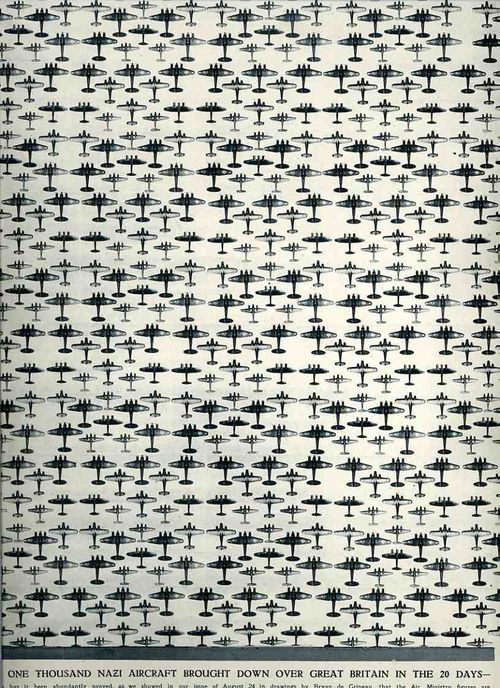
    (C)  This tremendous display is half of a double-page spread that appeared in The Illustrated London News for 7 September 1940.  It was meant to bolster the civilian population of Britain during the time of the German attacks, shoping that “Over one thousand Nazi aircraft (were) brought down over Great Britain in …20 Days…” The artwork, drawn by Bryan de Grineau, actually depicts 1000 planes, and accurately depicted ones at that.   What the graphic doesn’t tally though are the airmen losses, which would be considerably more thanb the 1000 aircraft:  for example, of the aircraft involved in the sustain air-invasion of England, the  Dornier 215’s had a crew of four, Dornier 17’s three, Heinkel 111’s four, Messerschmitt 110’s two, and Junkers 88’s three.  Thus  there were thousands more airmen lost, a commodity that the Nazis could little afford. 

      (This continues a thread on The Battle of Britain and also a post on “What 185,000 Planes Looks Like”).
     The results of the battle (and if you take a look at this earlier post for the full narrative), in terms of aircraft and humans,
    were,  for England: 1,023 fighters: 376 bombers, 148 coastal command aircraft  for a total of 1,547 aircraft and  544 pilots and aircrew killed.  There were also 27,450
    civilians killed and 32,138 wounded.  The Germans lost 873 fighters and 1,014
    bombers for a total of 1,887 aircraft and  2,500 pilots

    I find this visual display of quantitative data beautiful and compelling–and overwhelming in its way.

    The Battle of Britain was fought primarily from 10 July to 31 October 1940, so by the time this image was published the Brits had been able to turn the tide of Hitler’s plan.  (The air strikes wouldn’t really end until the Nazis turned their attention to the Soviet Union in Operation Barbarossa in May 1941.)  And that plan, named Luftschlacht um England, was to overtake and destroy the British capacity in the air, for as long as the English had command of the airspace there would be no way that the Nazis could force an invasion by land/sea (at least in the minds of the Oberkommando der Wehrmacht  and Hitler).  And so the Nazis failed–it was their first major defeat, and, especially, with the turning of attention east, it was a pivotal point of the war. 

    00-blog--Oct 29 battle britain Nazi planes952

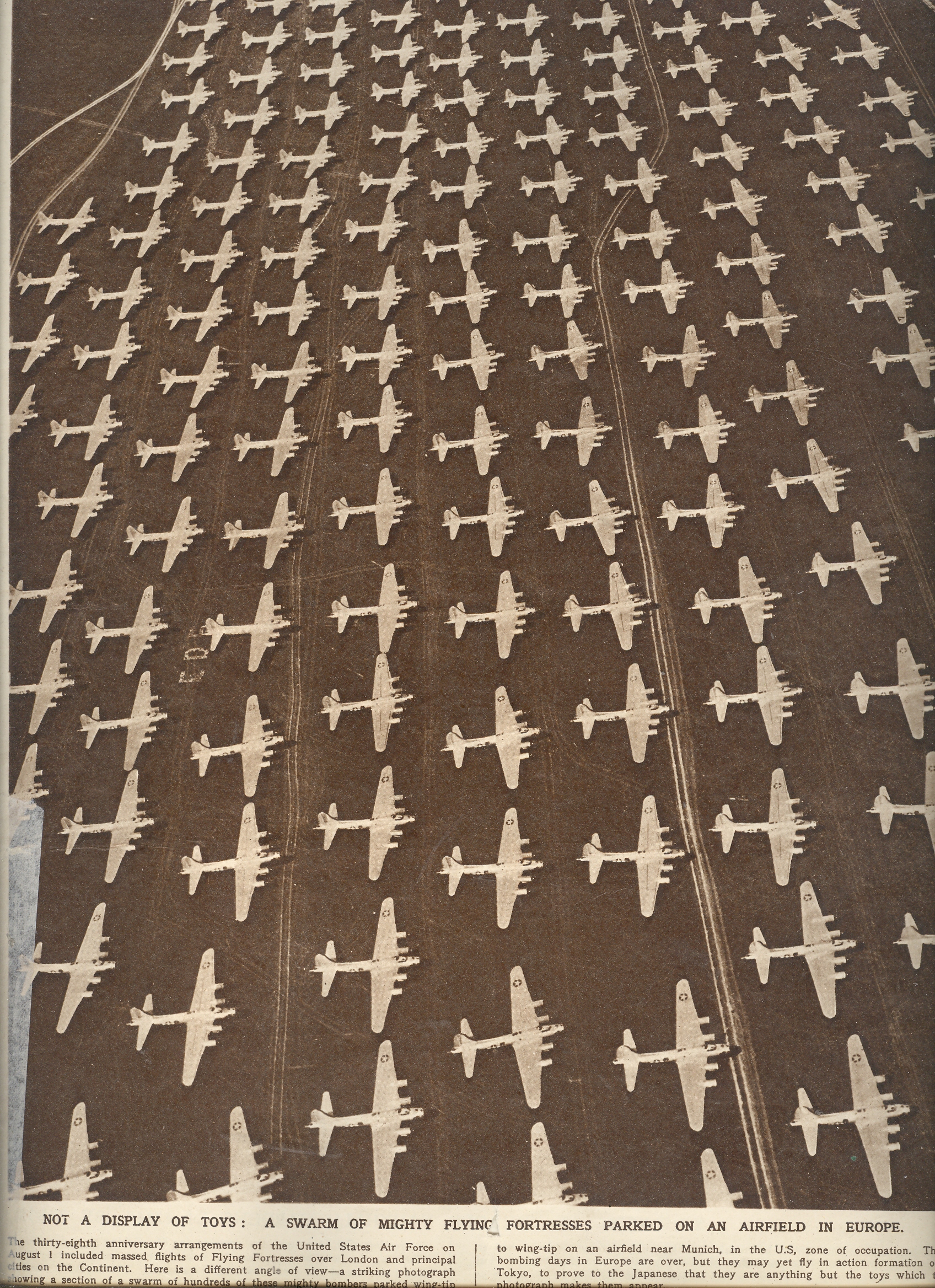
    (D) This last image is a “Not a Display of Toys”, shows only one section of a large airfield “in Europe” (actually in U.S.-administered Munich).  There’s about 300 B-17’s (e?) parked wingtip to wingtip, off duty now from the fight in Europe, but (as the caption says) prepared for a fight in Japan.  I don’t think anyone in high command had any doubt that these planes had seen their last action.  The atom bomb worked, and would work again (and again, and more so if necessary), and the fear that these planes would make their way East was not a real concern. This photo represents about 7% of the highest number of B-17’s in service in Europe at any given time.


    Blog--may 8--vrowds


  • History of the Future: Farming and Vertical Integration, 1940

    JF Ptak Science Books LLC  Post 745  Blog Bookstore

    This 1940 pamphlet, published by the Texas State Research
    Foundation, is a relatively young, paleo-futuristic view of the coming of the
    vertically integrated food production business in the United States .
    Its title (Building an Agricultural and Industrial Empire through Research)
    directly relates the idea of a grand agricultural/industrial alliance, with the
    contents pointing the way to far more than simple “research”, as the cover
    intimates.  There is a giant series of
    silos, and even a barn (in the top right corner), but the image

    ===farming here is pure smokestack-encrusted
    agribusiness.  The simple farmer on his
    tractor makes his slow way through his high-bound and gross techno skyline—of course
    the visual message implies that the family farm would be aided by “research”,
    but it also opens the door wide into the future to what the American farm would
    become.  The family farm would be
    absorbed by the skyline of major business: 
    at the time when this pamphlet was published some 22% of the American population
    was directly involved in farming; by 2002 that figure had genocidally dropped
    to about 1.5%.  The small, independent farms
    had been replaced by global conglomerates who are centralizing food production,
    controlling the distribution of fertilizer and seeds, causing massive soil
    erosion, destroying aquifers, depleting the soil, polluting with toxic
    chemicals, and on and on.

     So the image of this puffy pamphlet’s cover turns out to be
    prescient after all, and pretty much true: 
    except for the farmer-on-the-tractor part, as that guy got pretty much
    absorbed into a corporate Farmer Entity.


  • A Not-Obvious Gross Understatement: Bomb + Plane = Drop, 1915.

     JF Ptak Science Books LLC  Post 737 Blog Bookstore

    ===blog==aug 30==bomb overview

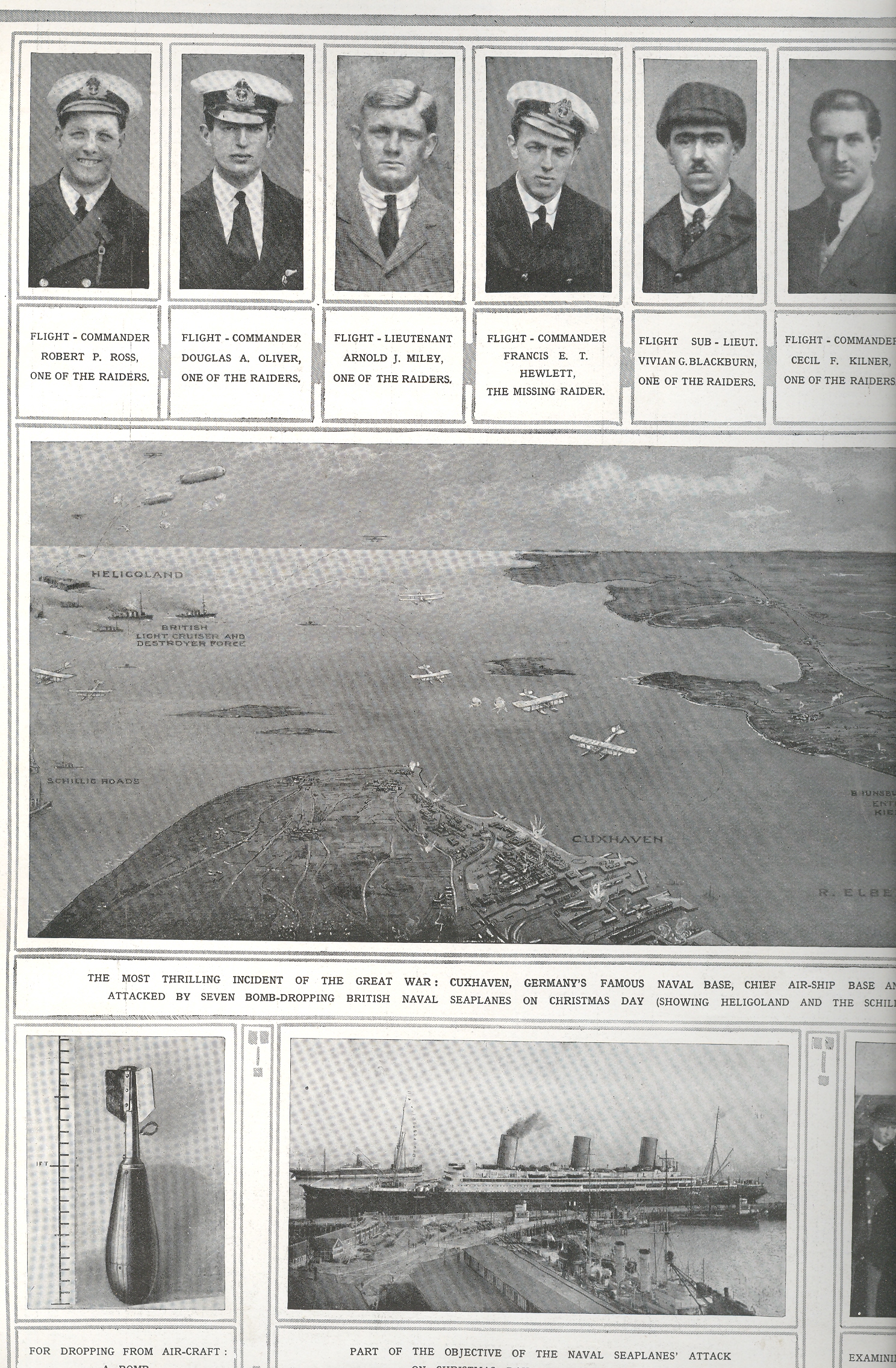
    In the young history of the beginning of the Twentieth Century’s Thirty-One
    Year War, in the very young history of bombing1, came this adventurous “first”
    in warfare:  the attack of a target from
    the air, sea and under the sea. The British launched an assault against the German
    installation at Cuxhaven,
    trying to get at its Zeppelins and navy, sending a task force of destroyers,
    subs and cruisers in support of eight search and destroy seaplanes. The
    tactical results were mixed (there are many places to check out this part of
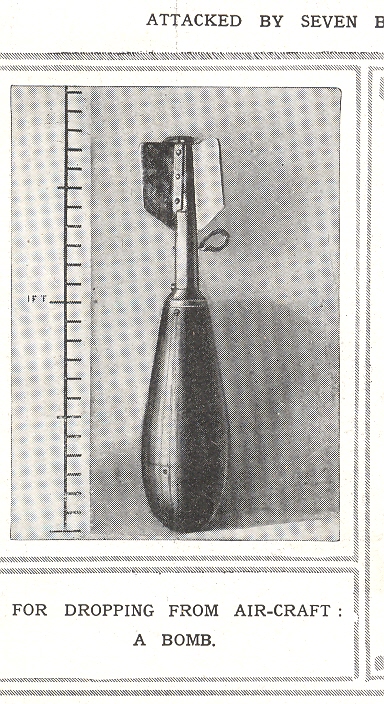
    the war) but the strategic outcome was enormous:  it was a new approach to warfare.  The technical aspect of bombing was so new,
    really, that the picture of the bomb at lower left had to be identified as
    such, and===blog==aug 30==bomb det that it could be used as an offensive weapon dropped from a plane (“for
    Dropping from Air-Craft: a Bomb”). 

    1. It was the Italians who conducted the first aerial bombardment, against a
    very creatively-named military “target”– consisting primarily of civilians–outside
    of Tripoli in October
    1911.

    From the Flight/global Archive:

    “The Cuxhaven raid marks the first employment of the seaplanes of the Naval Air Service (sic)
    in an attack on the enemy’s harbours from the sea, and, apart altogether from
    the results achieved, is an occasion of historical moment. Not only so, but for
    the first time in history a naval attack has been delivered simultaneously
    above, on, and from below the surface of the water.”— United Kingdom Flight
    Magazine: the “Official Organ of the Royal Aero Club of the “, 
    Flight
    Magazine Global Archive: Aircraft
    in Warfare
    , 1 January 1915.

    Notes:

    A lovely site with many links for early aviation: Airminded; and an unusual and wonderful book on the history of bombing in general, called, of course, A History of Bombing, by Sven Lindqvist.


  • History of Dis-Inventing Sex, 1: 1930’s American Radio

    JF Ptak Science Books LLC  Post 775 Blog Bookstore

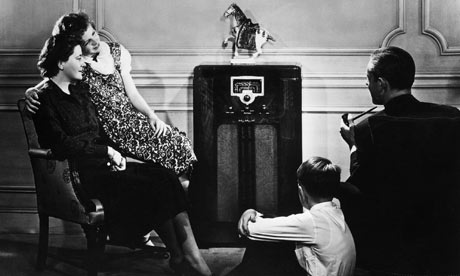
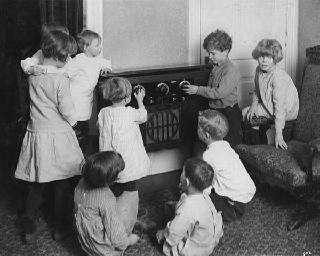
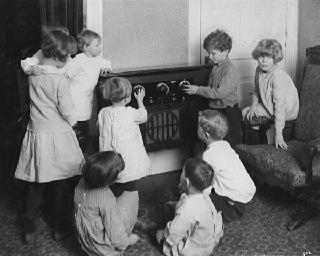
    Radio--family listening

    (Also part of the Blank and Missing Things series: Sex)

    The classes in the Western world for the most part enjoyed
    their own social amusements:  the rich
    had opera, theater, concert halls; the working poor and associated classes had
    burlesque, minstrel and variety shows.  The
    invention of the motion picture began to draw a common thread between these two
    classes, a place where anyone from anywhere could enjoy themselves for a nickel
    (or whatever).  Commercial radio came
    into being in the late 1920’s, growing enormously in the 1930’s and ‘40’s
    before encountering its mortal enemy of television in the early 1950’s.  Since radio was free (minus the cost of brain
    rot from listening to the underwriters who commercials were interrupted by the
    stuff people wanted to listen to) it became for those decades a superb democratizer
    of American entertainment and (to some degree) culture. 


    Radio_kids

    Opera, vaudeville, minstrel shows, theater and so on enjoyed
    their own segments of saucy visions and rakish stories, with sex certainly not being
    necessarily prohibited.  This was absolutely
    not the case with radio, which in the 1930’s and ‘40’s held strict standards
    against suggestive behavior that might hint of sexual meanings.  There was plenty of sotto voce sexual innuendo to be found, but you really had to look
    for it and pay attention.  The feeling
    among the broadcasters was that since radio was being invited into the very
    homes of its listeners that there was a deeper responsibility to keep the shows
    clean and relatively wholesome. And so sex took a holiday.

    Its not that movies and television in the 1950’s were
    rampant Decameron (with all of its semi-comic/tragic half eroticism)  or Caligula spas, but
    they certainly “showed” more skin than radio from that period ever talked about
    or alluded to, even if the first TV married couples beds weren’t pushed
    together until  the Munsters shared a big double in the 1960’s.

    (No,
    the Ricardo’s never did push their twin beds together; it really was  the mores-bending Munsters, who are  pictured below. Perhaps the great “first” of a couple sharing the same bed needed to remove the human aspect of the reaching act, placing the responsibility in the attached-hands of a Frankenstein’s monster-like character and his bride.  This happened too with tv’s first interracial kiss–between Capt. Kirk and his communications officer, can’t remember her name–making the encounter between humans of incredible accomplishment and remove, and of course set centuries in the future.)

    Munsters

    Be that as it may, Lee DeForest (1873-1961), the inventor of the audion
    which made the whole industry possible (after Hertz and Marconi) complained in
    1947 of the enormous silliness and suggestive nature of the new medium.  He loftily wrote about what could’ve been “a potent instrumentality for culture, fine music, and the uplifting of American mass inteliigence” but instead was a ‘laughing stock”, the medium addressed to what he thought was the average national intelligence of a thirteen year old.  Maybe he was right, and the man simply couldn’t stand it.  61 additional years would’ve made the De Forest explode–but then again, he was already close to that hearing saxophone players; who knows what the man would’ve thought of cable television.  But the one thing he really couldn’t compalin about with radio was eroticism or sexual conduct, because that really wasn’t there. 


  • The Loneliness of Being Wright(s): not Reporting the First Flight.

    JF Ptak Science Books LLC  Post 774  Blog Bookstore

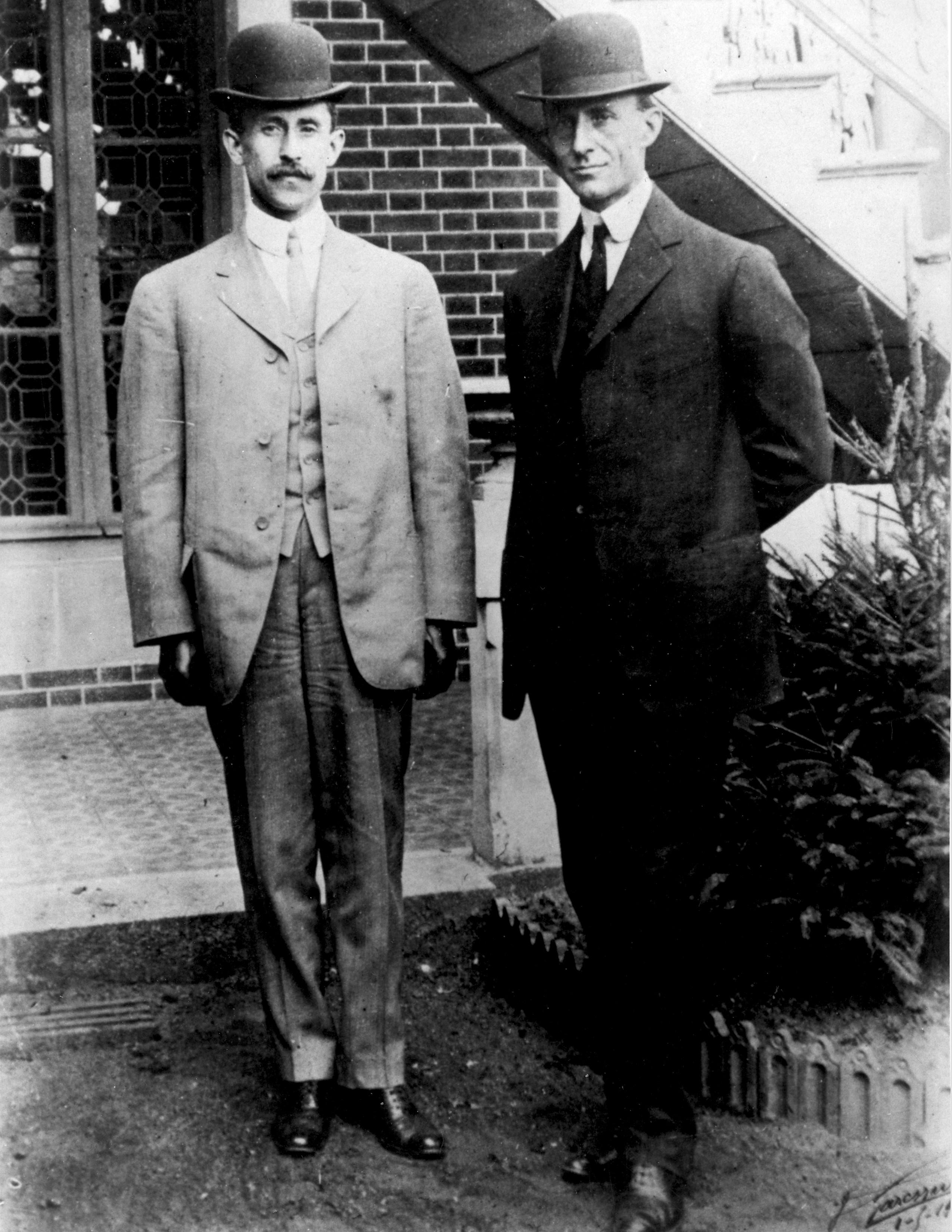
    Wright_brothers_orville_wilbur

    Reading through the 1903/04 volumes of the NYC-based Popular Science Monthly I was
    struck, again*, by the lack of reporting (and the oddness of reporting when
    done) on the Wright Brothers’ first powered flight in December 1903.  The editors gave a page of coverage to the
    Samuel P. Langley failed aerodrome flight of November in the December
    issue. 

    Langley at the time was the secretary of the Smithsonian Institution, and one of America’s
    leading scientists who had a strong side interest in aerodynamics if not
    aviation.  Swimming in private funds,
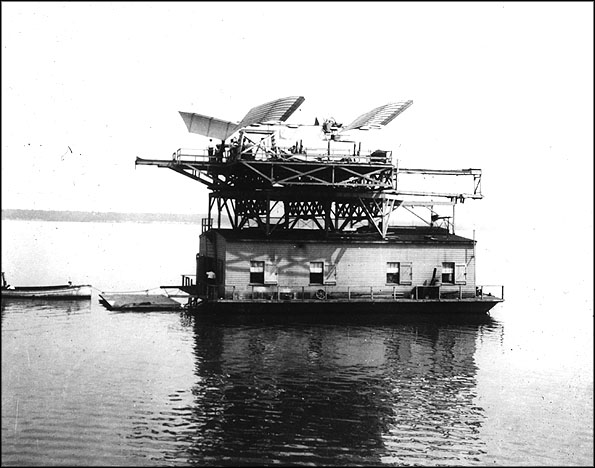
    some money from the Smithsonian and $50k from the War Department, Langley set out trying to produce a flyer which—in its two
    attempts at flight from a raft in the Potomac in
    November—wound up broken and soggy in the river, following a “flight” straight
    from its launcher into the water.  The
    article actually took Langley to task on two fronts:  first, it made
    absolutely certain that readers understood that his powered plane didn’t fly;
    and second, that he might well prove to be a damaging embarrassment to the
    Smithsonian and American science by proceeding with his experiments. (The Langley aerodrome is pictured just below.)

    Langley aerodrom

    The Wright’s first powered flight took place at Kill Devil
    Hills along the North Carolina coast in
    December, 1903, just weeks after the appearance of the Langley article.  They were somewhat reticent and droll in reporting
    their accomplishment; more so, people seemed simply not to believe them (see
    below for some further reading).  Still,
    though, there was no real mention of the Wright’s flight in Popular Science
    Monthly
    through April.  Oddly, the Smithsonian’s
    website reports that one of the first mentions of the flight was in the March
    (1904) issue of this journal, but they are mostly mistaken.  There is an article in that number by the
    Octave Chanute, a great figure in the history of early aviation, who writes in
    general about the progress of flight.  In
    the section on ‘flying machines” Chanute devotes one paragraph of his eight
    page article to the Wrights, and the main emphasis here is that other aviators
    should follow the Wrights’ example of careful preparation before actually
    hoping aboard a plane to fly:  its was
    the training that was emphasized. There isn’t actually any mention whatsoever regarding
    their powered flight, although engines and propellers are discussed somewhat. Of
    the 480 pages remaining in the journal after the December issue, this one
    paragraph was the only room that could be found for talking about the Wrights,
    and then not talking about their great achievement.


    Of course there were many people who didn’t believe the
    Wright story—there was scant photographic evidence and only five eyewitnesses,
    and for years afterwards the Wright had a problem with officially authenticating
    their flight as the great First Flight. 
    But I’m a little puzzled by the Chanute coverage, as he was a pretty
    diplomatic and sharing person, and proved to be particularly supportive of the
    Wrights in general (visiting them at Kill Devil at certain points in 1901,1902
    and 1903).  The brothers understood
    intellectual propriety and credited Chanute when credit was due (particularly
    in the cases of truss design and stacked wings).  So it is puzzling to me when it seems as
    though Chanute may have gone out of his way to not mention the flight.  This is especially true if you read between
    the lines of the next paragraph. Chanute writes: “Now that an initial success
    has been achieved with a flying machine, we can discern the use of such an
    apparatus, and also some of its limitations”. 
    To me, after having written seven pages on flying history, to refer to a
    singular “initial success” makes sense only if he was referring to the Wrights’
    December flight. (I don’t think that he could’ve been referring to the Langley test, as the aerodrome simply fell into the Potomac, the structure of the plane overwhelmed by the thrust,
    the power of the engine, and movement in general—the plane just broke up and
    was flung into the water.)  To me, the
    invisibility of the unmentioned flight is glaringly visible.  But this was pretty much in the realm of
    standard reception for the Wrights for most of the rest of the decade—I am
    still struck though with the rush away from announcing the flight that almost
    everyone seemed to take in 1904. 


    (It is interesting to note Chanute’s vision for the airplane
    in his closing paragraph, where he envisions military uses for aircraft, though
    these were limited to scouting and observation with not a whiff of tactical
    employment.  Also there is the
    possibility of mail delivery (“in some cases”) and the rescue of people in
    trouble in restricted-access areas.  On
    the other hand, the just-failed Langley had a much broader and deeper
    appreciation for what he saw as the impending future of the airplane, saying ‘the
    great universal highway overhead is soon to be opened”, which was directly
    contrary to Chanute, who couldn’t see aircraft being used for simple
    transportation.  Actually Langley’s vision was
    taken to task in that earlier article in the Popular Science Monthly, the editor writing that “Dr. Langley seems
    to claim too much” in regards to the future of flight, and that “he should be
    careful not to do anything that could lend itself to an interpretation that will
    bring injury to the scientific work of the government or country”.  It is certain that with at least this one
    (very popular, widely circulated) science magazine, one couldn’t be too
    stinking careful about what one did or thought or said regarding flight—and in
    the case of the Wrights, one could say hardly anything at all. 


    * For three other of my posts
    on this issue of publicity and the Wrights, see:

    –The Unbearable Wrightness of Being:  the Wright Brothers Introduce Europe to FlyingThe Casual Treatment of the Wright Brothers

    –The Department of Great Understatement:  the Wright Brothers, 1903.

    —The Casual Treatment of the Wright Brothers in the Scientific American


    For the interesting conclusion (and summary) of Chanute’s
    Progress in Flying Machines of see here.


  • Dreaming of the 10-Ton Eiffel Tower Bullet, 1891

    JF Ptak Science Books  Post 736

    ===blog==aug 30--eiffel People find inspiration everywhere, insight to creativity in the obvious and not so.  Great statues have been envisioned in the depths of slabs of marble, solutions to mathematical problems in the step of a bus, the beginning of a new physics in the rolling ball in a wagon.  Its an old and very warn cliché, but the world can be seen in a grain of sand if you could just pieces together the bits of glass:  just as pointillism was seen in the not-simple intercession of two colors and cinematography in the latent image and the structure of the universe in a patch of dancing dust.

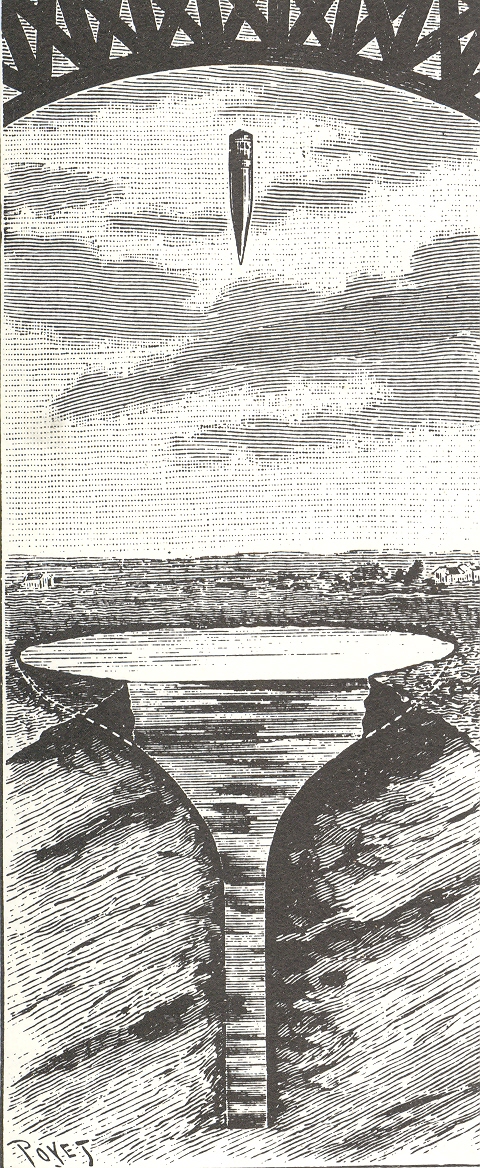
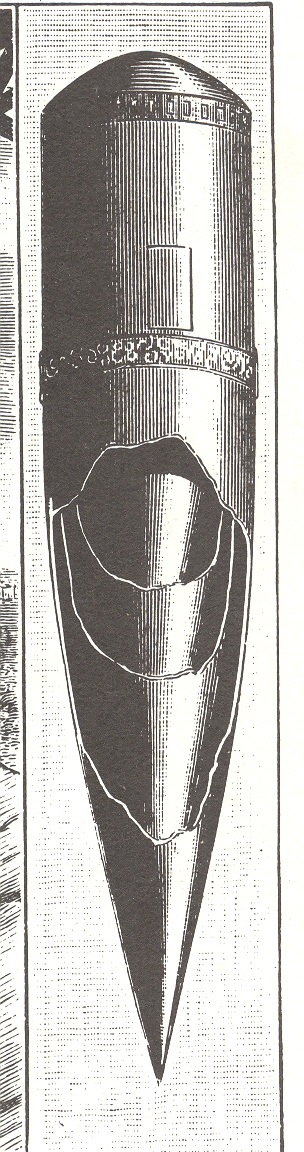
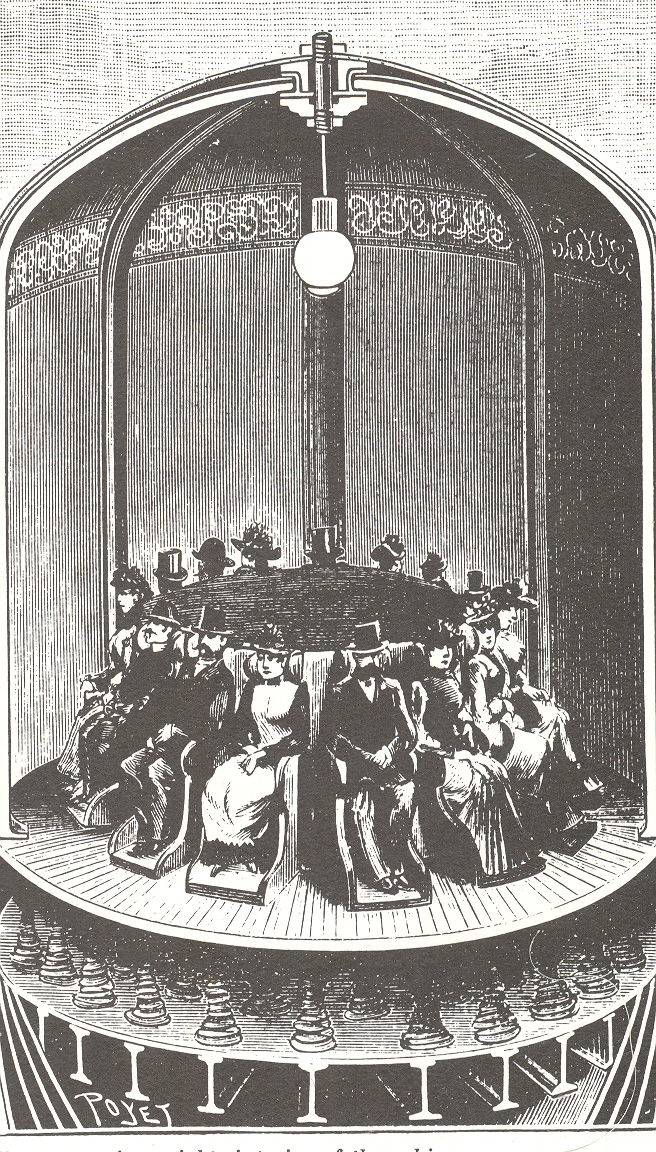
    The Eiffel Tower has had its own way with the visions of people, from it representing the birth of The Modern, to an icon of passion, to architecture and engineering innovation, and to general  adventure and the call of possibility.  It has moved other people to think “special” thoughts:  like, for example, what a lovely canvas it would be to place a 700’-tall electrified sign.*  And to M. Carron of Grenoble, who may have the most unusual inspirations from M. Eiffel, the tower was the perfect place to drop a 40-foot tall, 20,000-pound bullet filled with 20 people in leather armchairs into a 200-foot deep champagne-glass pool.

    ===blog==aug 30--eiffelbullet

    This is certainly a singular insight.  But in 1891 it represented something a little more than just giving people a thrill ride.  Physics of impact aside for the moment, M.Carron’s bullet capsule would be released from the top of the interior of the Tower, about 1000 feet high, and released to fall into an excavated pool 150’ across and 200’ deep.  The idea was that in addition to the springs inside the capsule, the water would act as a “shock absorber”, and so “the shock felt by the occupants on landing will be in no way unpleasant”.  

    [Okay, so the thing would hit at 178mph or so, and, assuming that the whole thing didn’t get completely crushed on impact, I’m not so sure that 200’ of depth is very much wiggle room for the thing to come to a halt (if it didn’t deform).  I Also it would have to not have any wind deflection so as to not veer off its perfect entry into the water.  And so on.  Calculating the force of impact is difficult without knowing how far down the bullet would go, but hitting the water at 80 m/s and stopping at 30 meters would yield something like 28,600,000 KE and 1,274,000 N. There are lots of problems….]

    ===blog==aug 30--eiffelinside

    The thing is, though, the thing that made this so appealing, is that for the 20-francs that get a person a seat in the bullet, that they would each get to go twice as fast as any human had ever traveled before ( 65 miles per hour was about the speed of the fastest train constructed).  So it was an extraordinary claim, an done that doesn’t get made all that often in the history of locomotion.

    And so this wasn’t a practicable or workable idea; but, well, so what?  It was an unusual idea, inspired by some sort of different thinking, which are both good places to be in according to the Gazetteer & Atlas of Ideas.  Sometimes thinking like this is just prelude to something else, thought avenues that had to be explored before the real thinking could get done, introducing you to a new geography of thought.  That’s what M. Carron had going for him; the newness of his thinking was much more important than the wrongness of it.

    *This story comes at the end of a post called Bad Ideas Department:  the First Image of a Hypnotized Chicken, so in spite of the title you’ll wind up in Paris.


  • Trikewriter: 19th C Bicycle as Outdoor Printing Press

      JF Ptak Science Books  Post 735 Blog Bookstore

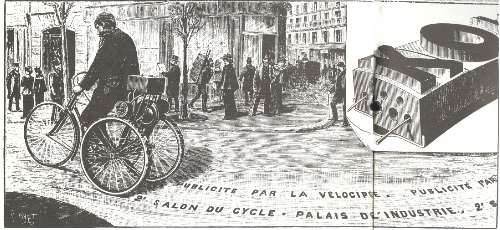
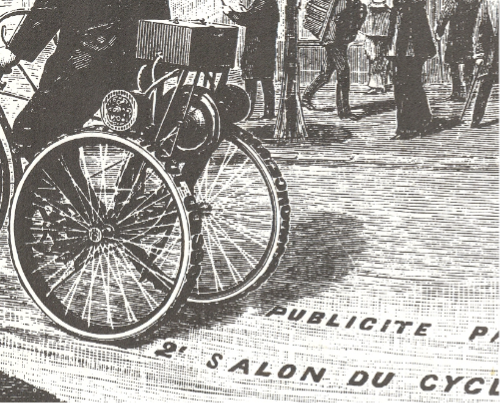
    Yesterday I posted a short note on the History of Extreme Writing with the example of cloud writing.  From clouds above to the mud below comes this second, very peculiar example of this exclusive genre:  tricycle writing.  This may actually come “on he heals” (so to speak) of another ancient form of writing coming from ancient Greece, where prostitutes would mirror-write ‘follow me” on their footwear so that prospective clients would follow their message writ in the dust to their home. This present shows the invention at work in the streets of Paris: as you can see it really was a printing press, applying the messages that were attached to the two rear tires in a way similar to that which prints lines in the street. 

    ===blog==aug 30==bike writer


    The wheels actually could be fitted with movable type, making the message changeable. I imagine too that the messages could be written with water-soluble ink or whatever so that the advertiser could be paid again and again, and that the street canvas would be refreshed constantly.   I hate to say it–what with the possible destruction of public property aspect of it–but it looks to me as though this sort of thing would be very successful in getting a message across. At least the first time–it is easy to imagine hundreds of these buggers crisscrossing a city, messages on the ground everywhere, the streets confusions of sentiments and exclamation.  We have that now with billboards and other fixed advertising; so I imagine the only thing preventing ads from appearing on the roads are public safety issues. 

                                                                                                                                                                       
                                                        ===blog==aug 30==bike writer


    ·Posted by :

    ·in:

    —

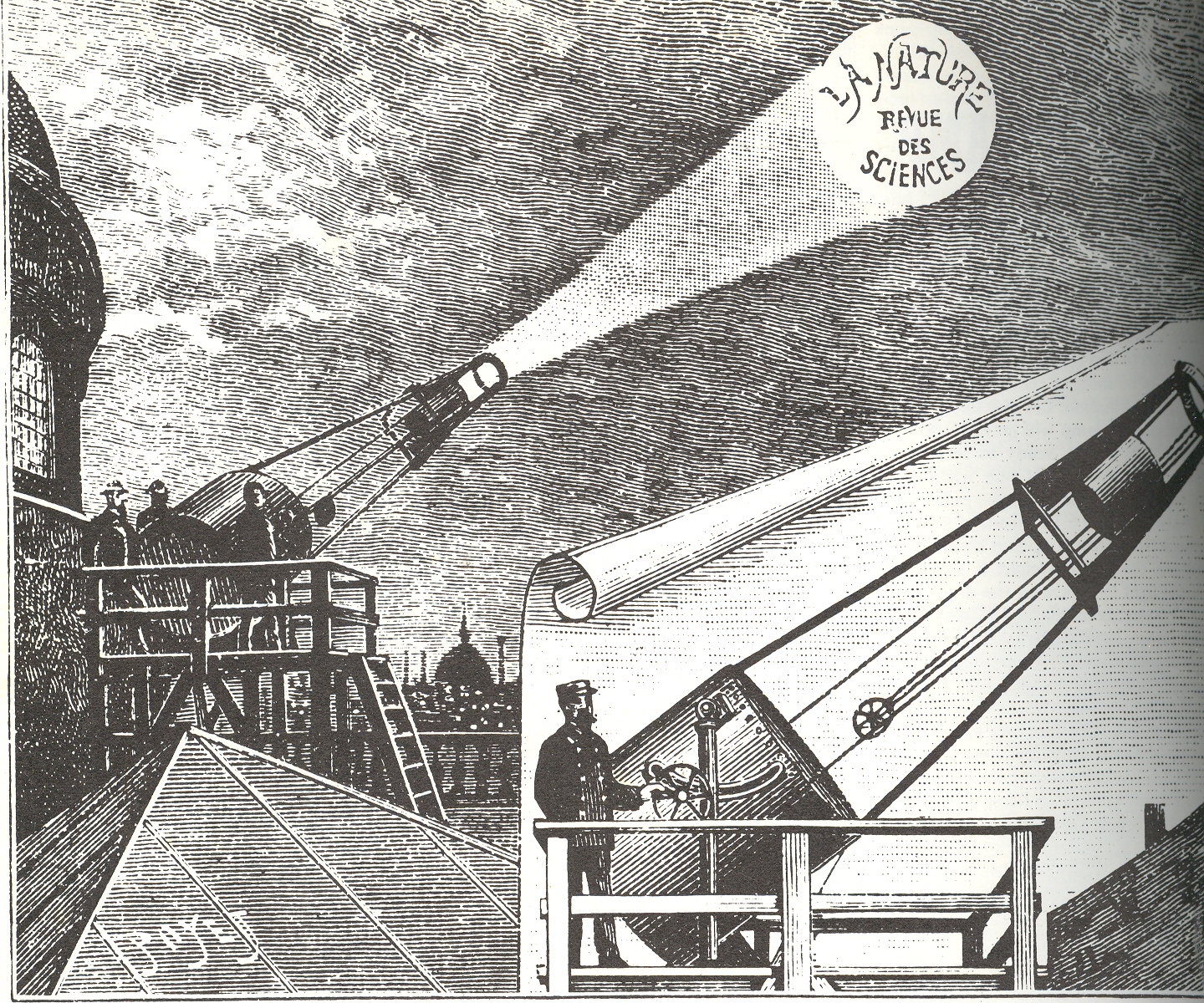
  • Cloud Writing

    JF Ptak Science Books LLC  Post 734  Blog Bookstore

    The History of Extreme
    Writing (for communicating across an uncommon distance) is relatively recent,
    given the thousands of years that humans have been communicating.  The 17th century semaphore system
    for relaying telegraphic messages might be one, if you consider the semaphore’s
    decoration of a

    ===blog==aug 29=cloud writing 001

    building- or hill-top to be a piece of writing. Smoke signals
    and forms of communication relying on interrupted transmission of a powerful
    light source might look to be part of the environment, epically in regards to
    smoke, it message bright and visceral, and somewhat lasting, as it message
    moves and grows and dissipates (depending on the area’s climatic conditions for
    the hour).Church bells might apply (reminding the faithful and the fearful to
    consecrate  hope and fear), as might the
    Mullah’s voice, or the sound of a ram’s horn. Outside of things like mail, or
    the very short-lived super-mail Pony Express system, there was precious little
    that could be seen as a pre-electrical telegraphic regional internet. 


    Perhaps the greatest example
    of Extreme Writing came this French effort to advertise on clouds.  Electrical advertising in general came a
    little slowly following the invention of commercial electricity.
    The,
    um, adventurous PT Barnum contracted the first electric bulb writing (utilizing
    the Edison invention) in Manhattan
    in 1892 to envious attention, resulting in less than 15 years with the Great White Way. 
    The world’s largest electric bulb writing was on the Eiffel Tower ,
    with Andre Citroen agreeing to light the outline of the tower if he could put
    his name on the rest of it.  I’m not sure how this was seen as a good
    idea, but the sides of the tower were used for this purposes until somebody
    wised up and put an end to it all in 1937. 
    But the writing-on-clouds- bit was enormous and terribly disrespectful,
    and never really took any sort of hold in Europe, though it did get some amount
    of play in the U.S.
    from time to time.  Mostly, cloud writing
    worked best in fiction, and for one particular person—and there it worked
    rather well.  Batman

    ·Posted by :

    ·in:

    —

  • Mechanical Calculating Pencil, 1876

    JF Ptak Science Books LLC  Post 703  Blog Bookstore

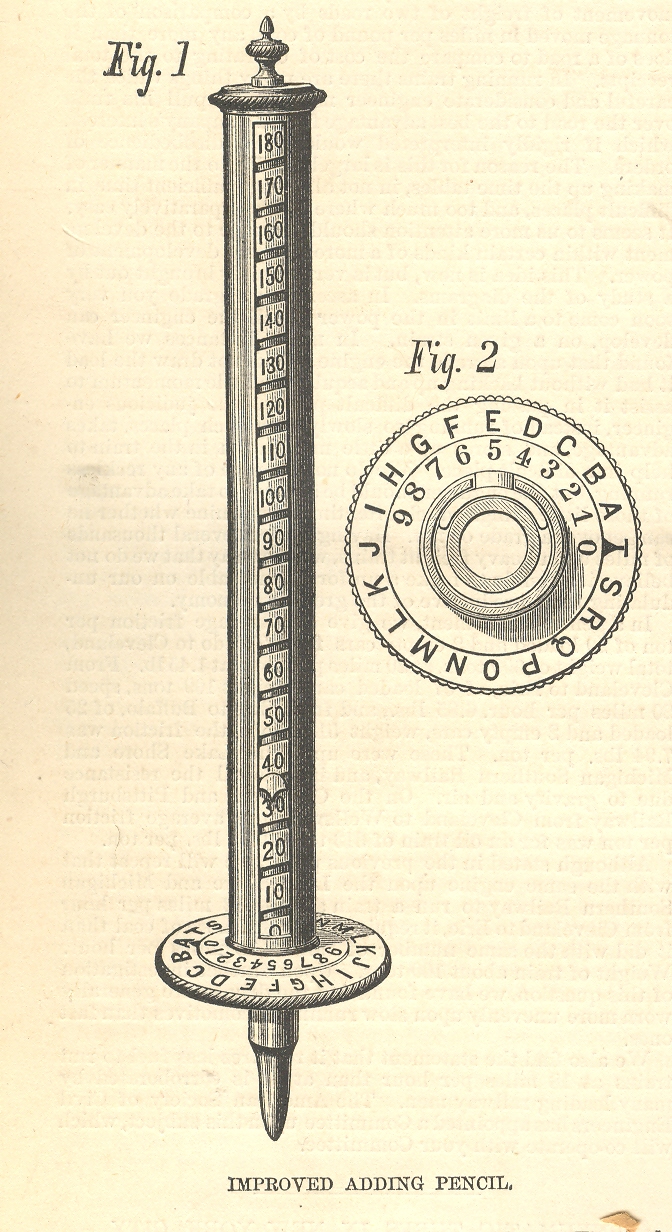
    ==Blog July 27=calculating pencil I’ve seen a number of unusual calculating machines, but this one–patented by Marshall Smith in 1876) seems one of the smallest, and efficient–if not limited–varities.  It is the second edition so-to-speak of a  mechanical, graphite pencil, operating this time without rotors or any other internal mechanical devices.  It was evidently a big seller–hosted in part, so it seems, by The Scientific American itself–having sold some 5,000 units.

    ·Posted by :

    ·in: