A Daily History of Holes, Dots, Lines, Science, History, Math, Physics, Art, the Unintentional Absurd, Architecture, Maps, Data Visualization, Blank and Missing Things, and so on. |1.6 million words, 7500 images, 4.9 million hits| Press & appearances in The Times, Le Figaro, Mensa, The Economist, The Guardian, Discovery News, Slate, Le Monde, Sci American Blogs, Le Pont, and many other places… 5000+ total posts since 2008.

Category: Technology, History of

  • Telegraph “Fax”, 1895. Transmitting Images by Wire & 120-Year-Old Emoticons

    JF Ptak Science Books  Post 701     Blog Bookstore

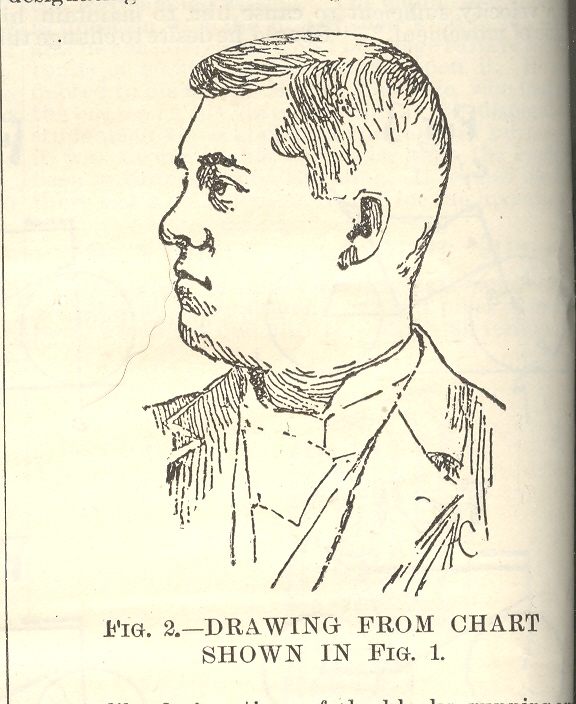
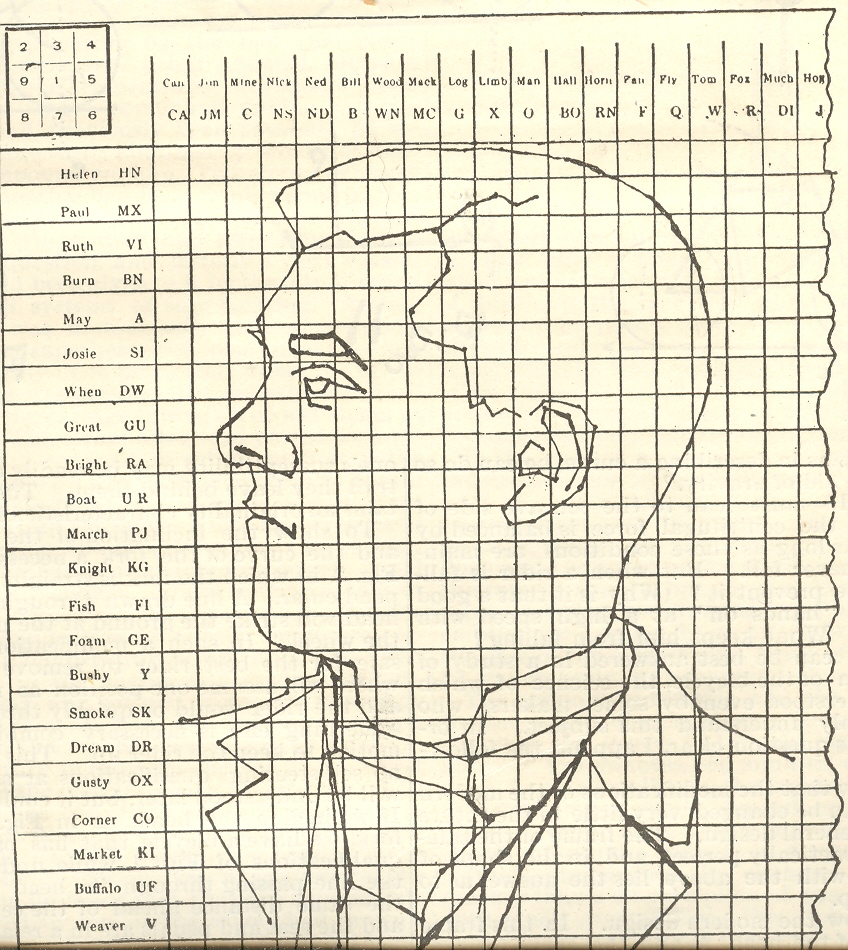
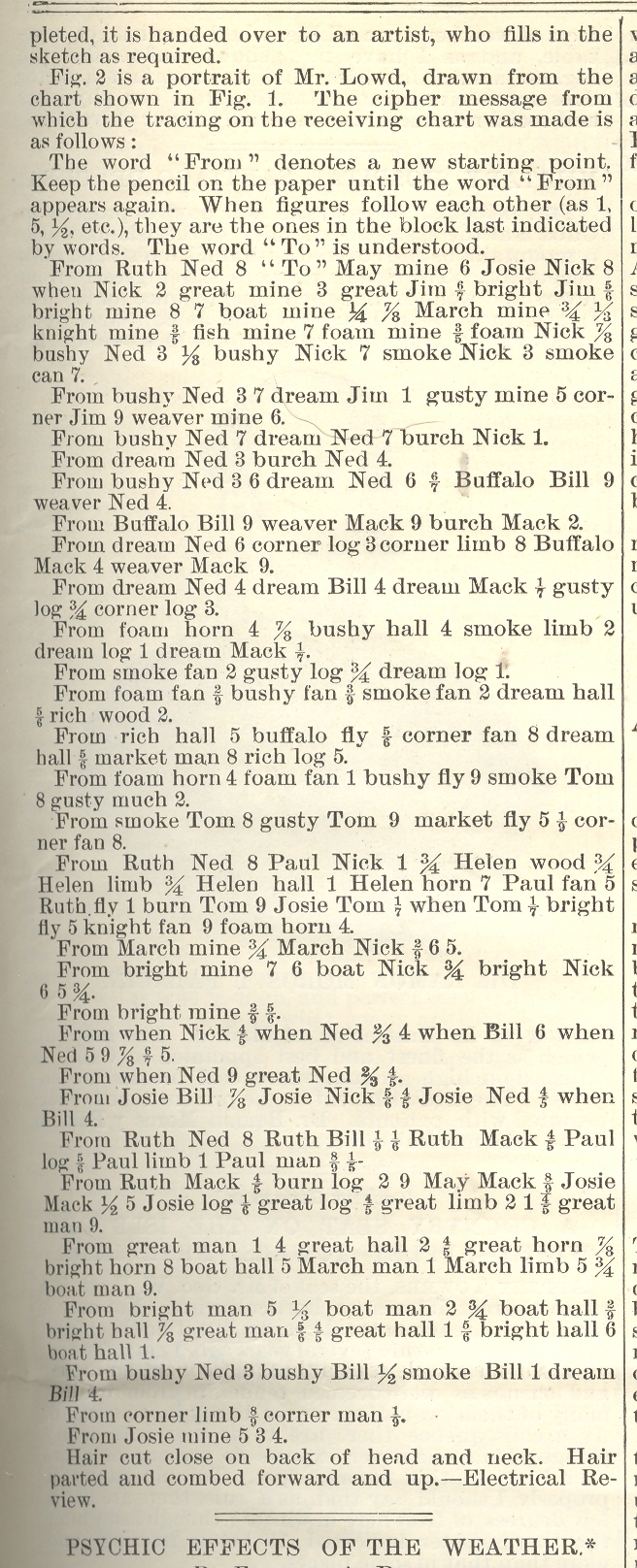
    ==Blog July 28=tele port 1This Scientific American article on the smart/odd/analog transmission of pictures via telegraph (14 September 1895) by W.H. Lowd, can make you say “ohhh, of course” out loud.  Mr. Lowd’s insight came fifty years after the Morse telegraph came into being, thirty years after it becomes the greatest means of communication, twenty after the first multiplex telegraph, and in the same year as Marconi’s first successful wireless transmission.   It was though an ingenious inspiration whose utility lasted for about 60 seconds—which is about how long it took to develop a smarter way of transmitting an image in its entirety.

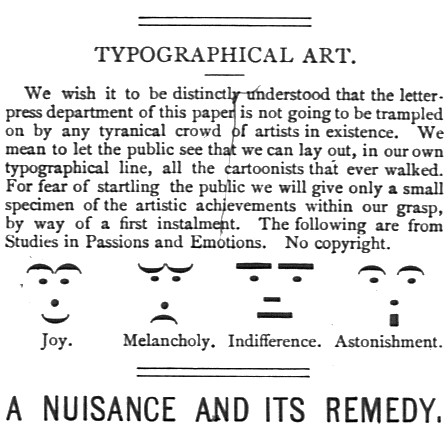
    Mr. Lowd recognized that he could transmit the outline of a picture by placing on opaque tracing of the picture on top of a telegraphic ciphering sheet and then transmitting the coordinates, which when received on the other end could be connected by short lines into the picture that was being transmitted from the sending end. ==Blog July 28=tele port 2 Images constructed of numbers and letters and such had been made for centuries before this; this however is a very early use of this idea that was employed to human-representational transmit the object electrically over distances by wire.  Emoticons—a more abstract version of this idea–such as we know them today are actually better than 150 years old.  They appear as early as 1857 in the telegraphers’ world, and somewhat earlier in the typesetter’s arsenal. (For example, a later attempt, taken from Puck Magazine No. 212, page 65, 30 March 1881, shows us something that we took to be “new” in the 1980’s as having roots that spread downwards into history by another 120 years.)

    ==blog==july 29=Puck

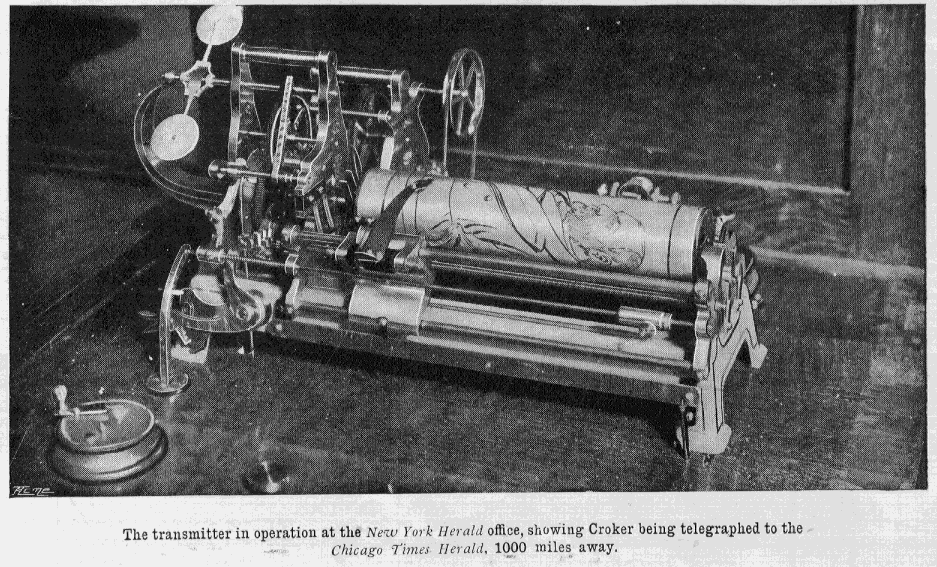
    But Mr. Loud’s idea was pretty, I must admit, even though it was far from being the answer to the question it addressed, with a more pleasing, technology-based solution appearing by 1899. 

    (A successful apparatus for the true transmission of an image by wire is seen here, below, and was produced in 1899/1900.) ==blog==july 28==pics by wire

    The other bit that is interesting is that this transmission of an image necessitated an early Surrealist-like poem, dictated by the cipher/codes that were use by necessity to send the picture. 

    ==Blog July 28=tele port 3


  • Space 1898: Pre-Modern Space Flight

    JF Ptak Science Books LLC  Post 693  Blog Bookstore

    Also have a peek at my post on pre-historic space flight: de Bergerac, Leonardo & Co.

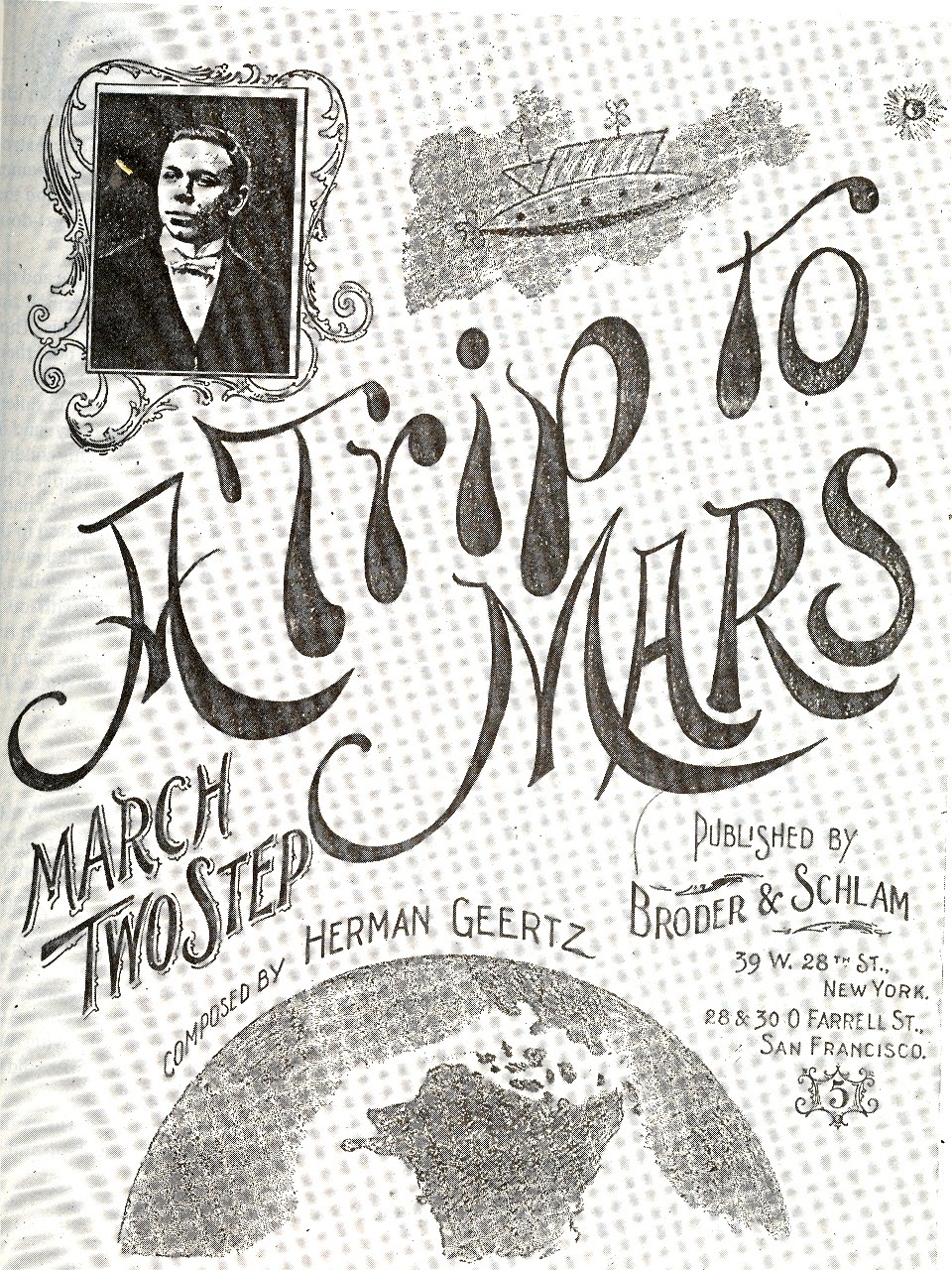
    Herman Geertz, a mysterious, unknown quality of a person to me, made a major contribution to the history of American spaceflight, albeit an unusual, ephemeral one.  In 1898 he published a song—with the firm of Broder & Schlam of San Francisco—called “A Trip to Mars (a March Two Step)”, and is perhaps the first piece of music ever published in the United States about interplanetary spaceflight. 
    ==Blog July 21=mars
    The musician–whose portrait appears in a frame at the upper left—also includes an odd view of the planet Mars, and, most important, an image of a space ship.  It actually took about 20 years for this sort of popularization of Mars to grab a hook in song, even though the interest in the planet and the possibility of life there had been bubbling since Schiapparelli’s  (misunderstood) work on the planet  in which he famously identified its “canalli” (and which was infamously and wrongly translated as “canals”.  Much of this great misunderstanding was rooted in Percival Lowell’s book Mars in which he takes the canalli idea and runs with it to the goal line of Martian civilization).

    One year later, in 1898, Kurd Lasswitz—a professor of math and physics, a Kant expert and philosophe, and an historian of science—published what was to make him the equivalent of Germany’s Jules Verne/H.G. Wells (in importance if not in quantity).  Auf  Zwei Planeten (first published in Leipzig in 1898) was an immediate best seller, as it was Germany’s first work of science fiction, and it made its scientist/historian an instant sensation.  It was an interesting, high-tech-utopian story that describes humans finding and dealing with an isolated Martian colony existing at the North Pole; humanity has its ups and downs, as do the Martians, the species trading moral highgrounds and such, until a peaceful co-existence comes into play between the two planets.  It was pretty heady stuff for the time.  Lasswitz saw into the future in this book, bits here and bits there:  space travel is rather accurately summarized as is a sort of television (that was actually a Martian tele-telescope) and synthetic fuels and foods. 

    This period right before the turn of the century was particularly progressive for the sciences and for science fiction.  In the world of science fiction, for example, in 1895 there was Lowell’s Mars, Williams Morris’ The Wood Beyond the World; for 1896 there was Morris’ The Well at the World’s End, H. G. Wells The Island of Dr. Moreau and The Invisible Man, and Louis Tracy’s The Final War.  1897 saw Lasswitz’ Two planets, Bram Stoker’s Dracula and William Le Queux The Great War in England in 1897.  1898 rounded things out very nicely with Well’s War of the Worlds.

     Frankly though science outstripped the fiction part of the creativity index:   the end of 1895 saw an entirely new world intruded by Roentgen’s X-Rays; 1896 saw Becquerel’s discovery of radioactivity and Langely’s aerodrome; 1897 Thomson’s discovery of the electron; 1898, the discovery of radium by the Curies; 1899, Collin’s invention of the wireless telephone, 1899/1900 the introduction of the quantum theory by Max Planck and also the rediscovery of Mendel’s work by Correns.    It was, in short, a remarkable and remarkably-intense period whose outward reach seemed to be more dominated by the fiction aspect of science (with spaceflight and invading aliens) while the vast  new interior worlds of the previously unseen were totally dominated by the sciences, which was of course the stuff that would stick,  If you stretched this period by just another five years, the Einstein annus mirablis would be included, further deepening this unbelievable period of achievement.  Then again, nearly the whole of modernity is invented during this time:  from 1875-1915 or so nearly every genre of human pursuit entered the modern period.  New methods of writing in literature and for the stage, new ways of painting (from impressionism to non-representational art), through music and the sciences, biology and geology.  Everything changes, except for one field:  political science.  Actually, if you included the invention of the concentration camp during the Boer War(S) then I guess you could throw polysci into this group, though but by screaming and kicking. 


  • Connections: from Plugging Gibraltar to Shakespeare’s Memories in One Step

    JF Ptak Science Books LLC  Post 691  Blog Bookstore

    “Simply the thing I am shall make me live.”

    –from Jorge Luis Borges, “Shakespeare’s Memory”


    ==Blog July 21==shakespeares memorie It is interesting to pursue a loose thought to its not-necessarily
    logical end.  Such is the case with the
    Paneuropic ideas of Hermann Soergel (1885-1952). Soergel was a Bauhaus
    architect and author of a number of works on design and far more ethereal,
    floating-castle ideas. His most spectacular contribution—incubated in the
    mid-1920’s and still clinging by its fingertips as an idea among some current
    thinkers—was to put a dam across the straights of Gibraltar.  The dam would generate electricity of course,
    but most importantly to Soergel, it would also empty an enormous amount of
    water from the Mediterranean leaving vast new
    expanses of land to be developed and colonized over generations into the
    future.  The master plan at work was that
    the world would be divided into three economic spheres in the future, all
    beginning with the letter “A”:  American,
    Asia, and the new land to be created by Soergel, “Atlantropa”, which was the
    former Europe expanded into the new dry beds of the Mediterranean and North Africa.  And also
    of course Egypt,
    which would be covered with canals and semi-submerged by the new borders of the
    meandering sea.  This would be the way
    for Europa to compete with the rest of the world in the future. 


    Perhaps it is actually three steps to get from the idea of
    damming up the straits of Gibraltar to the osmosis of Shakepeare’s memories into
    someone else’s brain—a squinting acquiescence of the middle touch being the
    brilliant Jorge Luis Borges.  You see it
    was in the Argentine master’s last published story, “Shakespeare’s Memory”, that
    we meet Herr Soergel (as Hermann Sorgel) again. 
    But so far as I can remember Soergel exists only as a fictional
    character, with no reference to his real-life self.  In this wonderful story, Soergel inherits the
    memories of William Shakespeare—these bits come to him slowly but surely, until
    they start to conflict with his own memory, and things get difficult.  The man with Shakespeare’s memories winds up
    phoning strangers on the telephone, giving them away at random, until Soergel
    is left with his own mind again. 
    Superior as Bill’s memories were, they still weren’t Hermann’s, who
    wanted his own life back in the end. 


    And so from the titanic, pan-europic technodream of
    Bauhausian Hermann Soergel to the dead brains and living memories of William
    Shakespeare, all through the fingers of the beautiful Jorge Luis Borges.  

    I should point out that the image above comes from the Illustrierte Zeitung (Leipzig) for August 1931, and is a drawing by an artist named “AS. Christ” after Soergel’s Panropa’s ideas.


  • Vision: Looking Straight Up, Down, Across and Through–1525-1905

    JF Ptak Science Books LLC  Post 679  Blog Bookstore

    “Vision:  a device that belongs to those who have it. Far-reaching and fore-shortened, it is something that works best when used closely, loosely, finely and not at all. A gift-and-a-half and a half-a-bother.”  
    The imagined Devil’s Dictionary of Ambrose Bierce

    [See also my post Perspectives: Inside Looking Out, Outside Looking In]

     
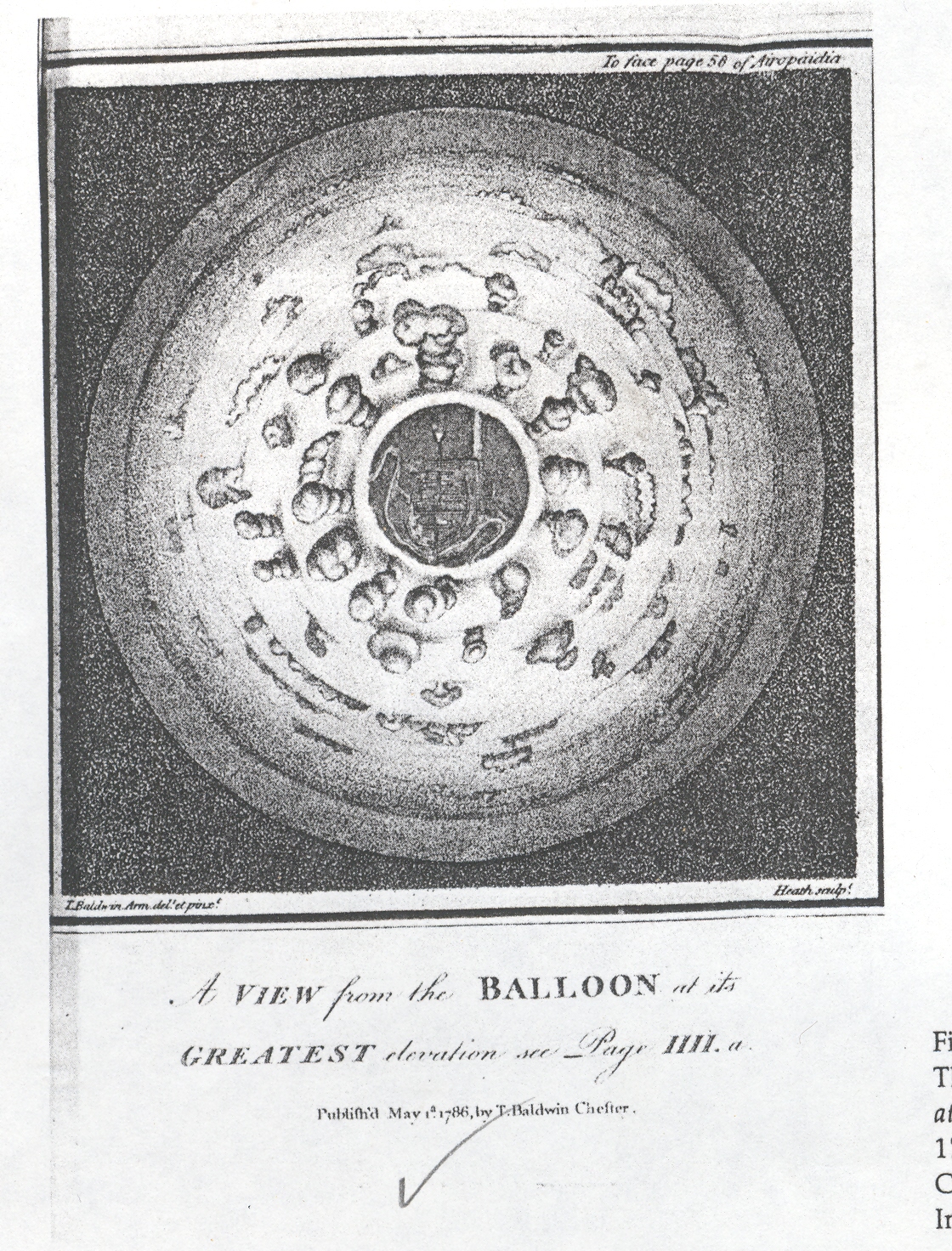
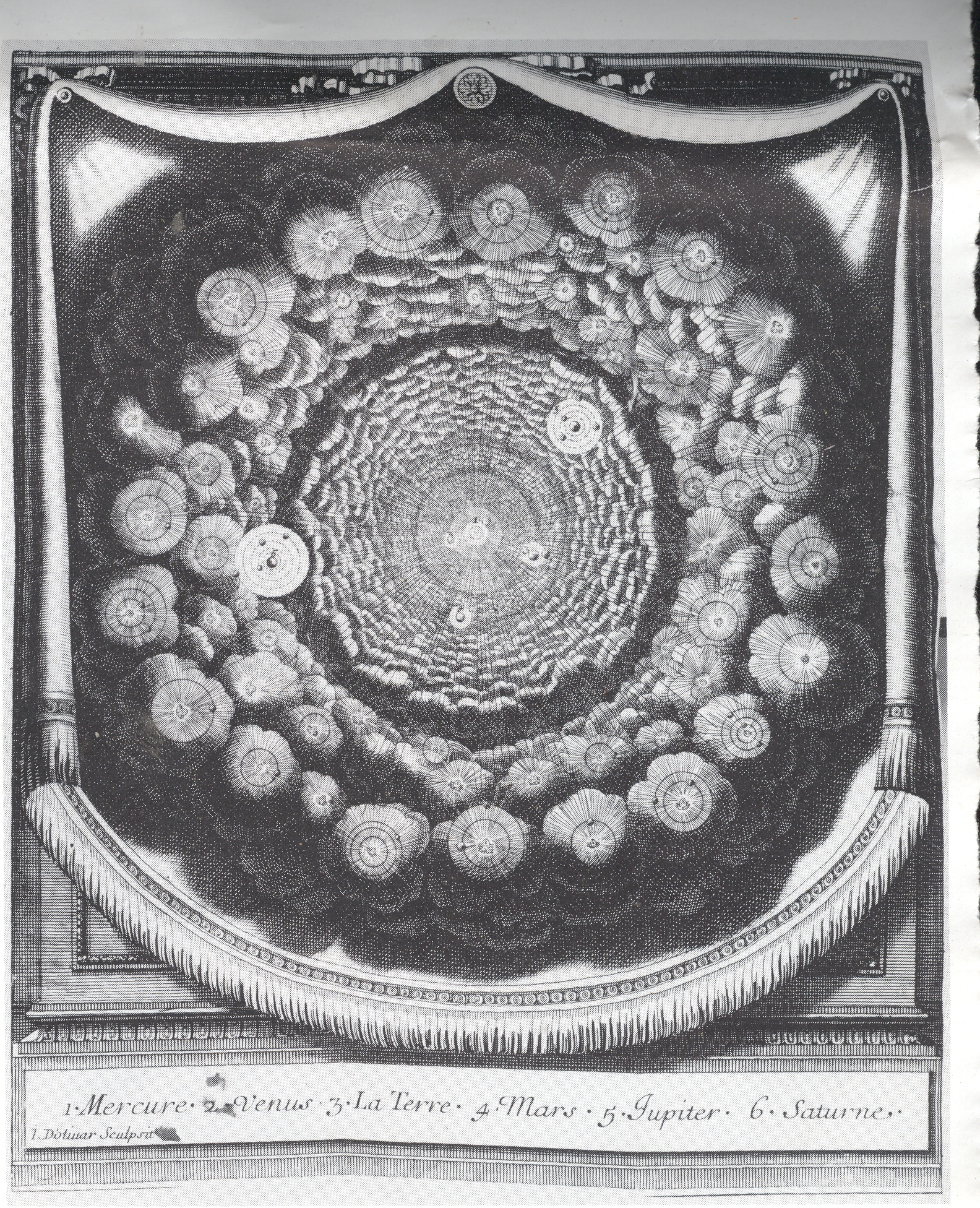
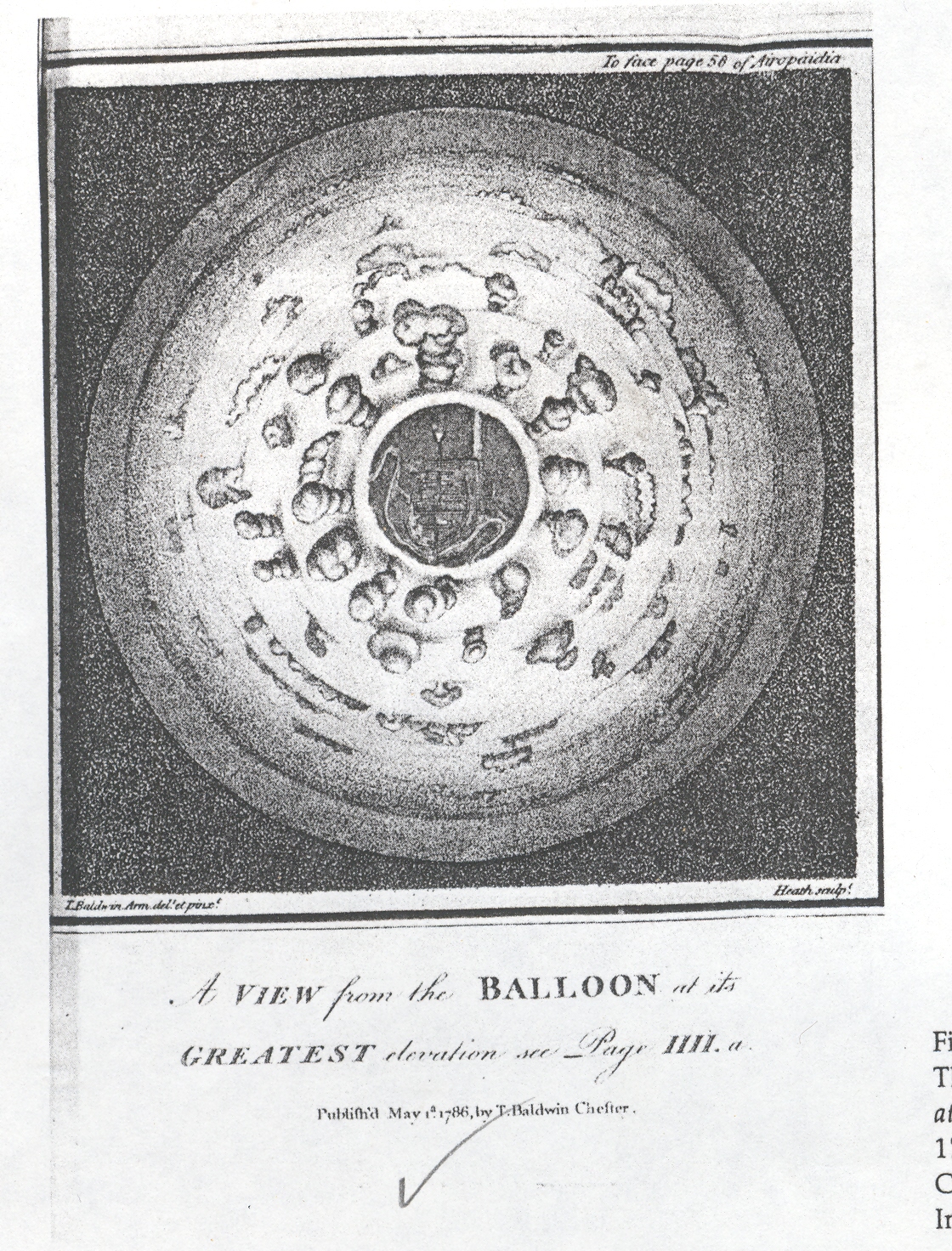
     There is a BLOG==july 9--perspective Downsmall series of posts on this blog that deal with the perspective of lookinBLOG==july 9--perspective upg at things straight-on:  straight up, straight down, straight across.  As it turns out, in my many years of looking at prints and images, view that look directly up and down are pretty uncommon.  Some of the earliest straight-on images actually offered a new vision to people who were so long accustomed to not looking at things in this way.

    BLOG==july 9--perspective Down

    And for a long time it was just not possible, not really, to look straight down at something from a height, or at least until the invention of flight at the hands of the Montgolfier brothers in 1783.  This first image offers a view looking straight down from a balloon through a bank of clouds and onto a town, and was drawn and published in 1786.  It must have been shocking to see this for the first time in that year, the image so unexpected and mostly not imaginable.  One of the other aspects here is that the viewer is looking obliquely down from the tops of clouds, the first time that this was ever done—so far as I can determine—with a scientific vantage point. 

    BLOG==july 9--perspective up

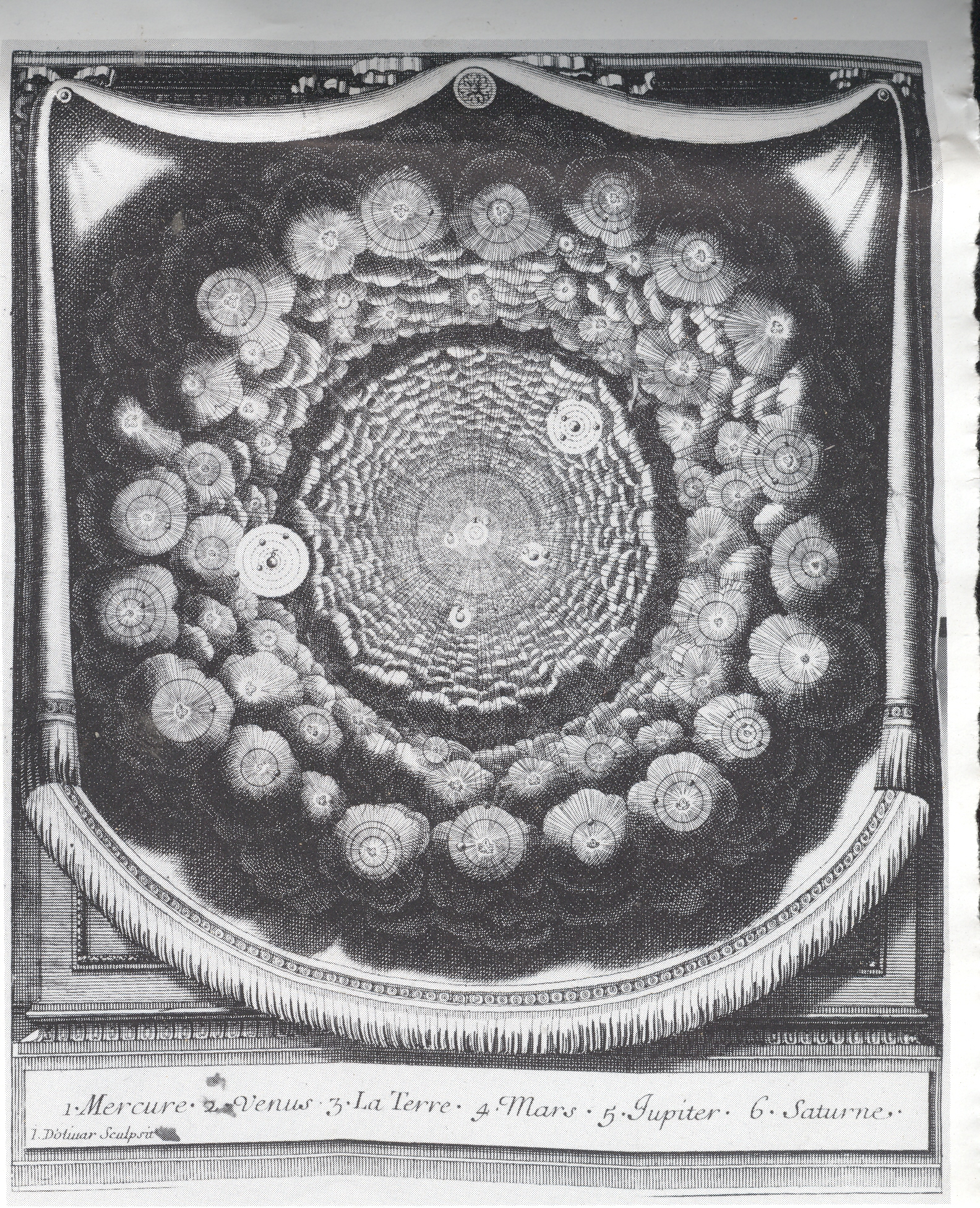
    The seeming complement to this image is from Entretiens sur la Pluralitie de Mondes (Conversations on the Plurality of Worlds), written by the great French philosophe Bernard le Bouvier de Fontenelle in 1686 (just a year before publication of perhaps the greatest work in the history of science, Newton’s Principia Mathematica). The Plurality was a best-seller by the best-selling Fontenelle. An excellent attempt by a rather restricted writer to engage the population-at-large, writing a high-pop book on what was basically the history of astronomy and cosmology of the preceding century. Copernicus was a major feature of his imaginary conversations with a muse as he wandered through a metaphorical garden of questions, with the observations of Galileo and Cassini also very prominently featured. But what interests me here is the great similarity between the two, the view from the balloon looking down, and the Fontenelle, looking up.  (Or what would pass for “up” in space.)  Except that the cloud-y looking things in Fonetenelle aren’t clouds at all, but solar systems.  This was a radical, church-pounding idea at the tiem, displacing the unique centrality of the human condition, offering the possibilities of other lives on other solar systems and other planets

    BLOG==july 9--perspective across . 

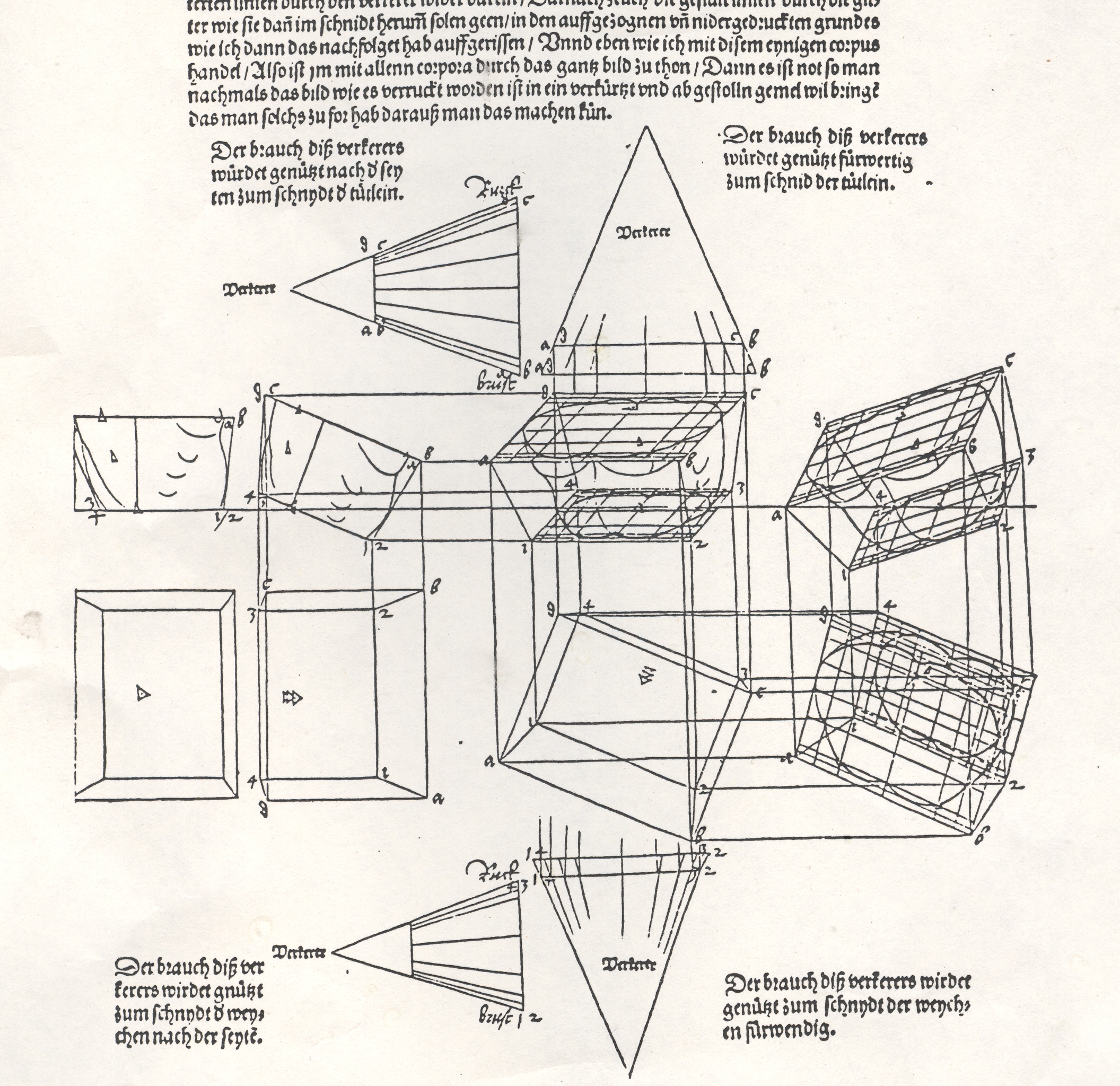
    Albrecht Durer’s (1471-1528) drawing of a geometrical man was an amazing–startling, even–object to the early 16th century consciousness. His Underwysung der Messung (“Treatise on Measuring”) written about 500 years ago (in 1525) set the stage for this next work–it is here that we find some of the most recognizable of Durer’s illustrations of the instruments that he employed to do his perspective work:   his …Symmetria partium…humanorum corporum (1537) was a masterpiece, and a key piece of revolutionary visionary thinking.  Durer–so far as I can tell–created an orthographically rotating human figures in three-dimensional trapezoids, creating incredibly human-like non-human forms.  Supra-human, perhaps; mechanized, calculated, structural. His use of stereometry, the science of measuring volume, was adapted to this study of human form and the relationship between that and movement.

    By doing this one could rotate the figures, pinch them, stretch them, and the proportions would remain exactly the same.

    They were in a sense a CAT scan.  And in this way the person in 1525, seeing this for the first time, would be experiencing something like the sensation of seeing an X-Ray for the first time in 1895 or a magnified flea in 1626.  It was a spectacular effort an a major key to understanding movement, and anatomy, and of course map making.

    This was a new way of thinking about the body, challenging the god-grace and ubiquitous church-inspired revelation of the body and how it worked.  This was not a necessarily easy time in which to picture humans in such a scientific way.  (In 1553 the physician and theological scholar Michael Severtus would be burned at the stake by John Calvin for his views on the Trinity, Nicean Creed and other related things, though his undeniably revolutionary idea of cardiopulmonary circulation was in itself a direct challenge to church teachings).

    Durer’s innovation accommodated empirical observation and allowed for proportional change.  Its importance in relational drawing, anatomical and  technical, cannot be understated, which I think trumped it as a subversive agent to orthodoxy.

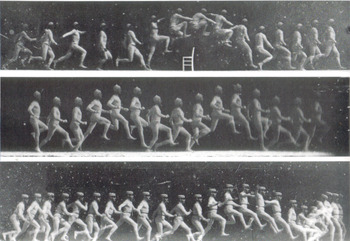
    Blog--july 9--marey Fast forwarding a bit there are the images of arrested time by Etienne Marey (who was a technoid and physician) and  who was able to capture motion of all sorts–he was able to develop a picture so to speak of the movement of blood in the body via his instrument to calculate blood pressure, and he also created a shotgun-style camera that made the world’s first high-speed photographs of movement.  And so it cane to pass that in the late 1870’s and early 1880’s people were instantly able to see what a horse looked like when it galloped or what the body did *exactly* when jumping over a chair.  When you couple this with fourth-dimension material one wonders why it took several more decades to bump into these images in the art world of the earliest part of the twentieth century.

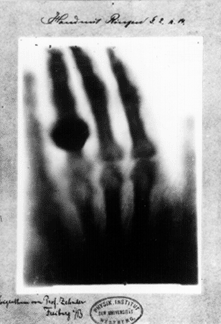
    Blog--july 9--roentgen In 1895 50-year-old Wilhelm Conrad Röntgen’s ephochal discovery was announced (“Ueber eine neue Art von Strahlen”. “On a New Type of Ray”), built upon the work of J. Plucker (1801-1868), J. W. Hittorf (1824-1914), C. F. Varley (1828-1883), E. Goldstein (1850-1931), Sir William Crookes (1832-1919), H. Hertz (1857-1894) and the horribly odious Phil Lenard (1862-1947 and who didn’t die soon enough). The experiment revealed as much to humans as did the experiments and inventions of Hooke and Leeuwenhoek on the invisible worlds revealed by their microscopes. Bertha, Roentgen’s wife, sat for 15 minutes while her husband passed his rays through her hand; she ran from the room once she saw the results, revealing her very bones and no doubt a strong sense of the fragility of life, and the strong presence of death.  Many had the a similar reaction to the Kandinsky’s shapes and Malevich’s white circles and red rectangles and Ibsen’s drama and Einstein’s dancing dust and the rogue syncopation of jazz—these newnesses were threatening to all of the established ways of looking at physics, and art, and theatre, and listening to jazz.  It was a new perspective which challenged the firmly established vision of these things, upsetting the nature of comfort and acceptance.    It is probably a very natural reaction to try and protect established memory—but memory is made all of the time, and so should be relatively flexible…at least it is mechanically healthier to allow a little bending than to be rigid and brittle. 


  • The World’s “Best” Address? POB 1663, Santa Fe. Home of the Atomic Bomb.

    JF Ptak Science Books LLC  Post 676  Blog Bookstore

    This is a continuation of a series of posts relating to the development of the atomic bomb.

    Park Avenue.  1600 Pennsylvania Avenue.
    10 Downing.  112 Mercer. Institute for
    Advanced Studies. The Cavendish Lab.  All pretty good addresses. 
    I have a hard time though coming up with a single best address that
    beats POB 1663, Santa Fe, New Mexico. 
    For the sheer breadth of those represented by this simple location, I
    just can’t think of anything more specific or more inclusive.

    Oppenheimer lived there. 
    So did Fermi. And Feynman. And Teller. And Bohr. And thousands of
    others. 

    Post Office Box
    1663, Santa Fe hid
    something very important—at the time, it was so important that the place that
    it was hiding didn’t even have a real name, just a moniker: Site Y.

     ==blog==juily 6==atomc bomb 1Many of the people who lived there didn’t have the use of
    their real names outside of Site Y. 
    Driver’s licenses were issued with numbers, and people paid taxes
    according to code numbers and weren’t allowed to vote.  They were as invisible as their address, or
    as invisible as thousands of people could be in 1942.  Being a place filled with mostly quite-young men
    and women, there were natural tendencies followed leading to a spike in birth
    rates, responded to famously by the facility’s chief to direct that actions be
    taken to stem the flow. Or perhaps not*. A radio station popped up featuring
    live performers, everyone identified by given name only. And to confound things
    further it was nestled within the range of the Blood of Christ (the Sangre de
    Christo)   Mountains, all the while working with matter that was literally
    hotter than hell. That was plutonium, and the “hot” was radioactivity. 

    Site Y (begun in June 1942) was of course the location of Los Alamos, a major cog in the machine of the Manhattan
    Project, a gigantic, secret project that actually stayed secret, which was
    remarkable given the wide swath and numbers of people involved and the
    relatively simple security. But it was really important stuff (as Richard
    Feynman would say),
    and there was a life-and-death war on, a fight to the finish1, a death
    struggle, so the importance of security—given the staggering consequences of
    its breach—was paramount.2.

    ==blog==july 6==lettre 2

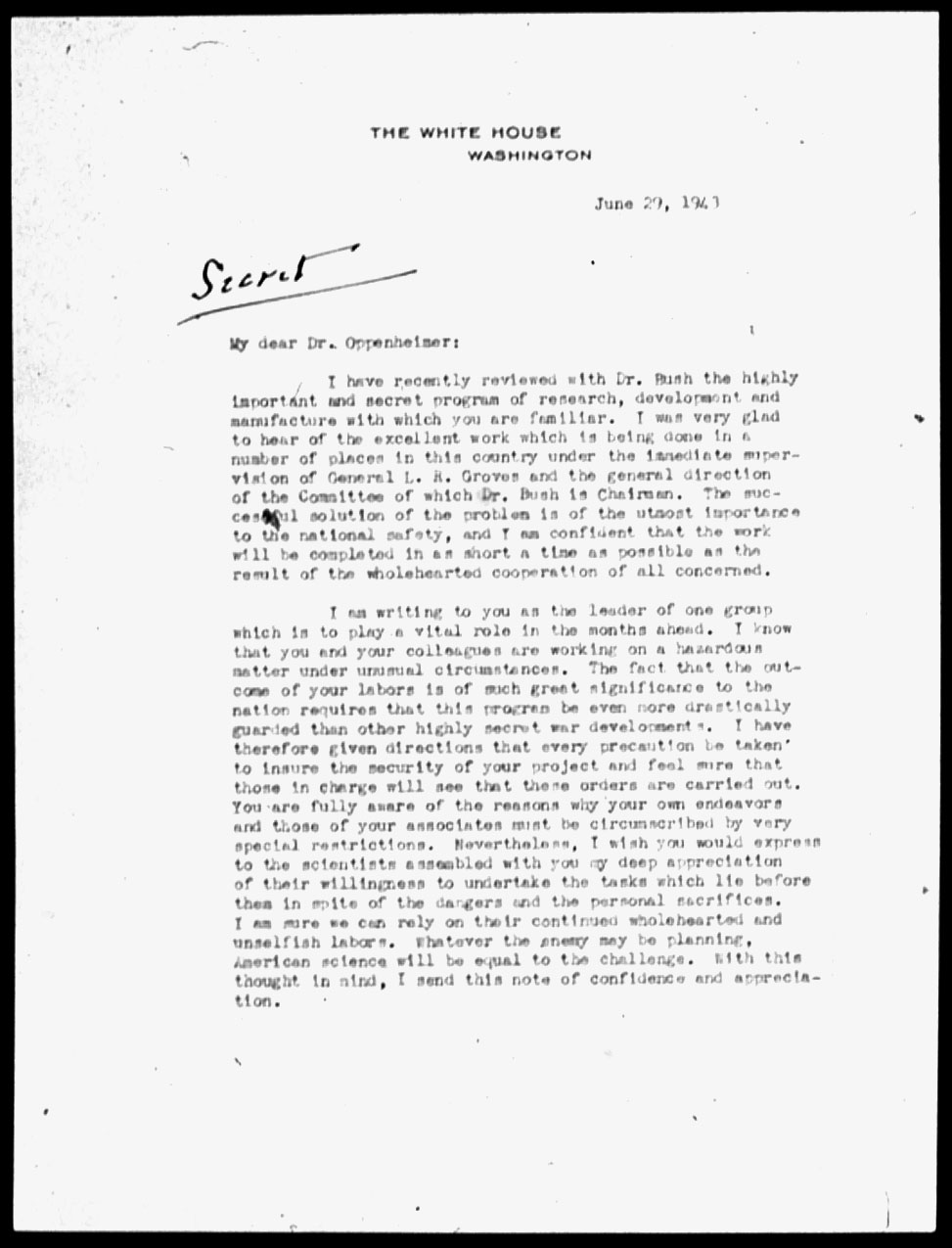
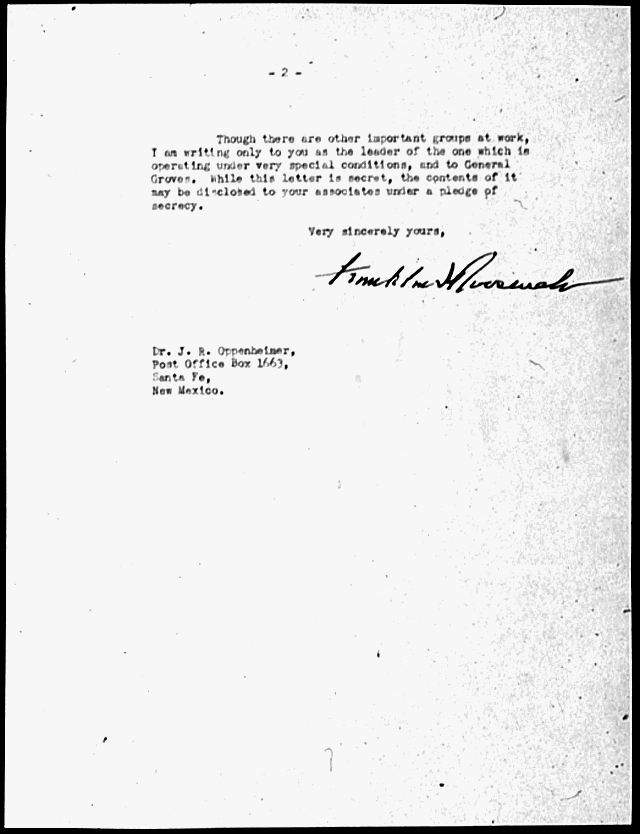
    This letter of congratulation and support was written by
    President Franklin Roosevelt to J. Robert Oppenheimer, and sent to The Address
    of POB 1663.  It is an odd letter full of
    sleight, though it is obvious that Roosevelt
    knows exactly what is going on, and is just not acknowledging the elephant in
    the room.  And that “room” was at Oppenheimer
    & Co., Santa Fe,
    Box1663.  No scientific project had ever been bigger,
    then or (perhaps) since.  That’s a lot to
    cram into one post office box. 

    ______

    1. By the way, in describing this item from their collection the
    Library of Congress website understates WWII in a way that I don’t think I had
    ever seen before: 

    “In the midst of World War II when the United States was engaged abroad in a major
    conflict with Germany and Japan, it was also working furiously at home
    toward the completion of the Manhattan
    Project..” A “major conflict”? I should say so, though “major conflict
    just doesn’t quite cover it, doesn’t nearly come close to describing what kind
    of “conflict” was going on.  Odd.  A very odd description. 

    ==blog==july 6=liscnece drivers

    2. Given the vast, extraordinary amount of the resources
    consumed by this effort, I don’t think that the atomic bomb could’ve been
    produced by any other country at this time—I think that, materially speaking,
    it was an impossibility. 

    *The fact was though that the place did seem to be a
    baby-maker, surpassing national averages, with roughly a fifth of all the married
    women on the base being pregnant in 1944. 
    See John Hunner’s Inventing Los
    Alamos
    for an interesting discussion of the baby topic. Babies and bombs and radioactive hell-mush in the foothills of the Sangre de Christo. 


  • Thomas Edison’s Dreams and Why You Can’t Always Be Right: Television, 1880

    JF Ptak Science Books LLC   Post 671

       “Seeing
    by telephone or by telegraph may be within the range of the possible. I say
    that because nothing is impossible until it has been demonstrated so to be.
    Seeing by either of these instrumentalities, however, is, as I look upon it, so
    far removed from the field of probability that I should treat any report of
    this character as an absurdity.”
    T. Edison


    I wonder what it was that Thomas Edison dreamt about—I
    suspect that like most folks he dreamt about himself, though perhaps everyone
    else in his dreams were him, too.  Mr.
    Edison was a fabulous inventor and thinker—he wasn’t the best person he
    could’ve been, and even though he had an enormous grasp on the whole of things
    and ideas about him, he also seemed to grab a little bit more, and a little too
    much.  Which sounds like gluttony. 

    Television

    I’m not so sure why Edison was given to such overstatement on “television”—he just about contradicts his
    own rule of thumb in doing so, as though he was going far out of his way to say
    something anti-prophetic.  Perhaps it was
    because “seeing by wire” at this point did not belong to him, like so much
    else—which is possible, because Edison did not
    play well with others, at all. 

    The possibility of interesting dreams swimming around Mr.
    Edison’s sleeping head was very high, though he may have been one of those poor
    unfortunates who dream about watching someone else sit in a chair and for hours
    on end stare at a wall—sounding more like a nightmare than a dream to me. 


    Good dreams, bad dreams. 
    History is certainly ankle-deep in literature about the dream, and the
    anthropology of dream states must be wide and deep.  Dreams don’t show up all that much in the
    Bible, though, which seems odd to me—there are 40-odd references to dreams in
    the Old Testament, and only nine in the New. 
    And in the NT five of the dreams come in Matthew (with four of those
    referencing the birth of Christ), and another four coming in the Acts of the
    Apostles, all of which relate to St.
    Paul.  The most
    interesting of the NT dreams sounds like that of Claudia, the wife of Pontius
    Pilate, who warned her husband that Christ was probably not the person that he
    should be messing with. That is I think her entire existence in the Bible, the
    dream, and the warning to her husband.  What
    seems to happen though is that dreams in the Old Testament seem to be rather
    benign entities, while in the New things happen that turn the dreamscape into a
    possible entrance way to Hell, the unconscious thought world becoming the
    property of the Church. And speaking of Hell and dreams, I believe that it was
    the dream sequence in the Aeneid where
    the truth and falsity of dreams were put to the test—or at least the dual
    possibilities of the divergent nature of dreams—imaging dreams emerging from
    the Ivory Portal in Hades to be false dreams while those issuing from the Pearl
    portal were good.  Problem is here that
    with all of that smoke and bother in the Underworld, wouldn’t Ivory and Pearl look pretty much the
    same?  Among the ancients it was
    Aristotle who was among the first to dispense with the soft/spiritualistic/astrobabble
    interpretation of the dream, approaching the issue with rationality.  Hippocrates also tried to lift the idea of
    the dream up and away from those (Like Hesiod, for example) who would see them
    as ritualistic and meaningful indicators of endless bric-a-brac.  But the ancients didn’t do a great job of it
    given the vast limitations, nor did the moderns (as Dr. Freud certainly still
    has major game in this post-ironic department).


    Back to the TV:   the truth of the matter is that in spite of
    the Edisonian condemnation there was real discussions and experiments regarding
    mechanical (not electronic) television in the late 19th century, and
    they went a pretty long way towards achieving images by wire. Alexander Bell
    nearly brought about an image-sending device based on his successful photophone
    (in 1880), and in that same year George Carey built a primitive sort-of system
    with light-sensitive cells.  Paul Nipkow
    came the closest of these early pioneers in 1884 with a techy rotating-disk apparatus
    that successfully achieved an 18-line visual image. 


    I’m just saying that Mr. Edison had to have been dreaming of
    other things that he had more control over. 
    From where I sit, it seems to me that opportunities for the electrical
    transmission of images were quite ripe by the 1890’s.  It took another 25 years or so to bring it
    all to fulfillment, with a cascade of very successful developments occurring in
    1927/8/9.  It is a little mysterious to
    me why he had such a low opinion of the possibility of television given the electrical
    environment of his day. 

    ·Posted by :

    ·in:

    —

  • Sound Machines and Acoustic Memory: Ephemeral Sound Landscapes

    JF Ptak Science Books LLC  663

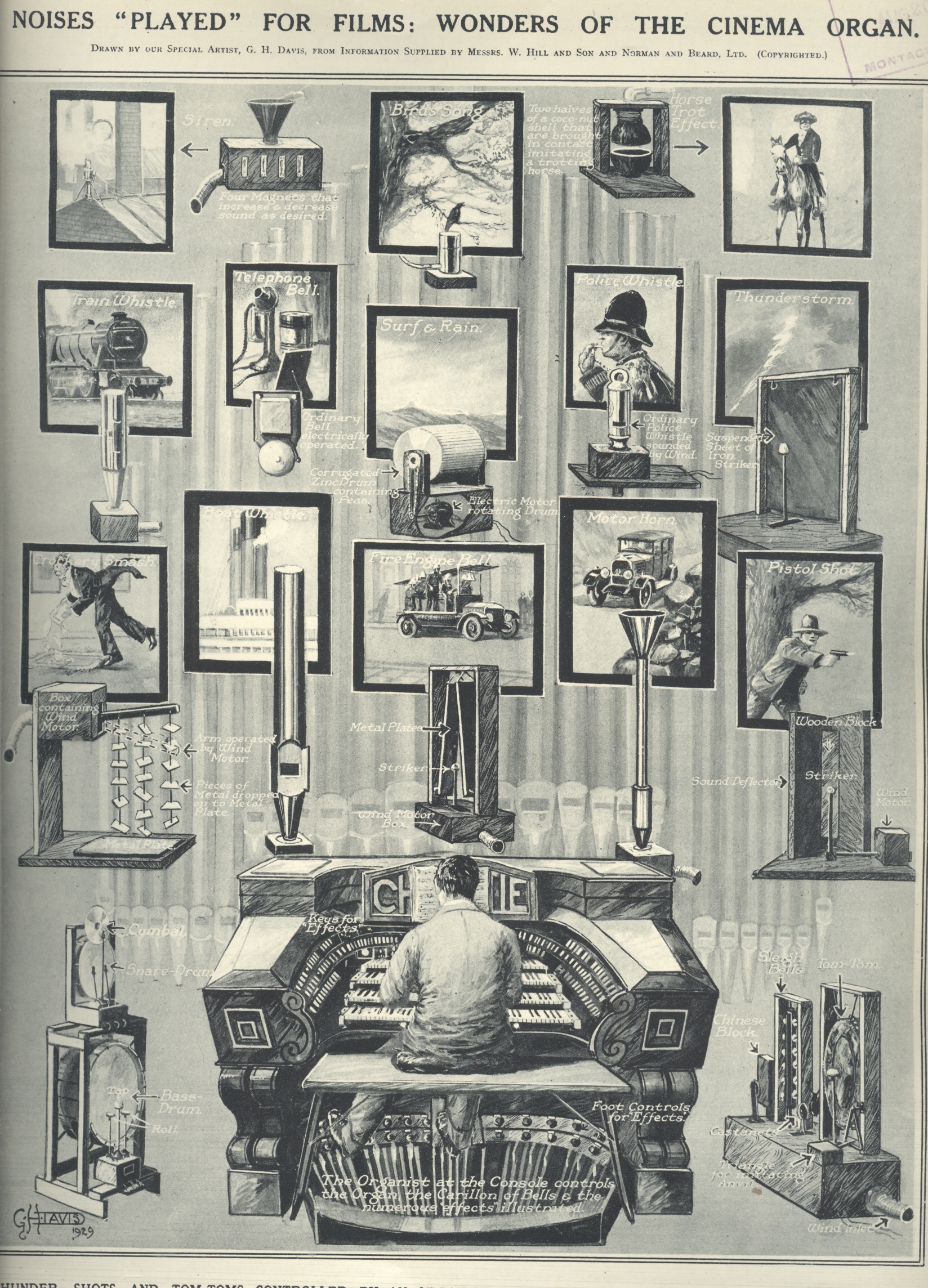
    Blog==june 25 sound machine Making solid the concrete part of musique concrete has
    never looked quite so orderly as in this image, found in the wonderful The
    Illustrated London News
    for 10 August 1929, and depicting a device that would provide “sound effects” for silent motion pictures. 
    The electroacoustic organ was constructed at the very tail end of the
    Silent Film Era, with simultaneous sound-on-film just having been invented (in
    1925), and popular films just starting to be made  employing it. 
    The control over the range of incidental, everyday and forgotten sounds
    seems to be extraordinary, and extraordinarily presented on that fantastic
    organ, providing an acoustic landscape against which move-goers could watch
    their film. 

    It seems like a lot of technology to bring to bear to
    enhance silent pictures with the sound of wind or the clopping of a horse’s
    hooves.  But not so, really—accompaniment
    to silent films was usually and simply musical, with the occasional actors
    employed to speak lines ere and there. 
    The introduction of incidental sound was something new—and it was almost
    immediately something old with the introduction of the talkies,  like a new dimension of achromatic
    experience.Blog==june 25, klee

    What would be very interesting would be to hear a library of
    such effects from so long ago, with noises produced by the stuff that has
    slipped into the past and, sometimes, right out of memory.  The sound of the milkman’s bottles; the
    clatter of the ticker tape; a standard gauge locomotive slowing

    down; the
    iceman’s truck; the P.A. system at Griffith’s
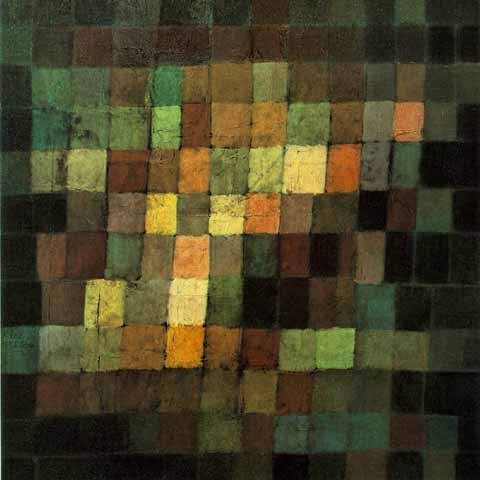
    Field. Sometimes long un-reproduced sounds like these produce visual memories as well (as with the Paul Klee here at right, a painting called “Ancient Sound”, 1925.) There are hudreds of thousands of recordings done in the field as part of ethnomusical or anthropological research, but what I’m talking about is found ephemeral sound. 

    Antiquarian sound is interesting, whether it is the actual early recordings
    of events or objects long passed, or recording made recently of antique objects
    making their modern antiquarian sounds.  Found
    sound is good too—the ordinary, forgotten stuff that blends into the acoustic
    fabric of the day, undifferentiated because of heir common nature.  There are a number of interesting Sound Zoos/Sound
    Museums available online, one being the wonderful London
    Sound Survey
    http://www.soundsurvey.org.uk/index.php/survey/
    (found by benefit of Metafilter) –an excellent and deep site that allows you to
    browse for sounds by era. The Sounds of New York provides a similar service at http://www.soundsofnewyork.com/.

    There is also the very interesting Documentary Sound site, which is an index
    and pointer for other sites. http://wlt4.home.mindspring.com/adventures/documentary.htm
    For example, the owner of the site lists the following fantastic-sounding title
    from the documentary sound releases by Smithsonian’s Folkways series:  Voices of the Sky: Propellers and Jets (1957)  Sounds of the American Southwest (1954)
    Sounds of Animals (1954); Sounds of the Annual International Sports
    Car Grand Prix of Watkins Glen, N.Y.
    (1956); Cable Car Soundscapes
    (1982) F-6129; Here at the Water’s Edge: A Voyage in Sound-NY Harbor
    Documentary
    (1962) F-6161; Sound Effects, Vol. 1: City Sounds
    recorded by Tony Schwartz (1958) F-6170; The Sounds of London (1961)
    F-5901 ; Documentary Sounds (1962) F-618 ; Speech after the Removal
    of the Larynx
    (1964) F-6134; Sounds of Insects (1960) F-6178; Ionosphere
    (High Altitude Sounds)
    (1955) C-501 ; Sounds of the Junk Yard (1964)
    F-6143; Sounds of Medicine (1955) F-6127; Sounds of the Office
    (1964) F-6142; Sounds and Ultra-Sounds of the Bottle-Nose Dolphin (1973)
    F-6132; Sounds of Sea Animals (1955) F-6125; Sounds of the Sea, Vol.
    1
    (1952) F-6121; The Voice of the Sea (1954) C-5011; Sounds of a
    South African Homestead
    (1956) F-6151; Voices of the Storm (1957-58)
    C-1077; The Sounds of Camp: A Documentary Study of a Children’s Camp
    (1959) F-6105; Sounds of a Tropical Rain Forest in America (1952) F-6120;
    The Complete In Fidelytie: Sounds Natural and Un-Natural (1956) C-1044; Sound
    Patterns (Natural, Musical, Human)
    (1953) F-6130.

    A darker, disturbing and tough place
    to visit is
    http://soundportraits.org/on-air/execution_tapes/,
    which houses execution tapes and recording of the last statements of condemned
    men. The tapes are from the mid-1980’s, and have a very grainy, ethereal quality to them–interviews take place with the condemned men in their cells, making their last public statements; there are also recordings of the actions in the command center as the execution area is readied, and also, lastky, in the death chamber itself, when the final designations are read to the condemned.  (There is no actual recording of the death sequence.)

    ·Posted by :

    ·in:


  • Curious, Impracticable and Useless Inventions: Gun Hats and Steel Fish, 1920

    JF Ptak Science Books LLC  Post 655

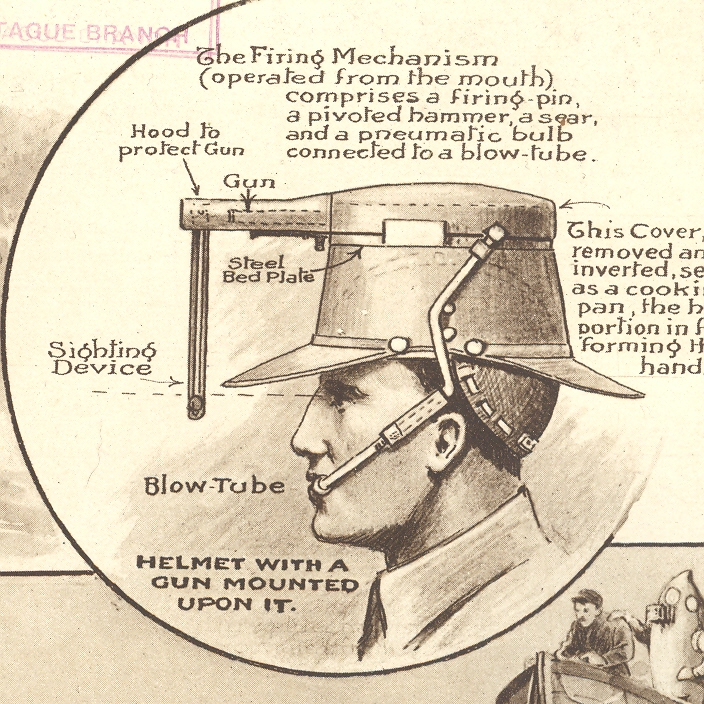
    Blo--june 17--hat gun I had started out to write this post about the Sham Paris,
    the False Paris, that was being built outside Paris to deceive German bombers in WWI.  Now, that wasn’t a particularly bad
    invention, per se—a bit like the
    Maginot Line in is way—just too much, over-the-top, short-distanced and muddied
    sight. 


    But on the way to the images of non-Paris I came across
    these few inventions as reported in The
    Illustrated London News
    of Christmas Day, 1920.  These innovations look older than 1920, to
    tell the truth, but here they are. 

     First is the hat gun—or, rather, the helmet gun.  It look as though the whole affair would be aimed
    and fired hands-free.  By the look of the
    barrel, the thing in the helmet looks like 50-calibre, which might have an ill
    effect on the neck of the shooter.

    Blo--june 17--stubby

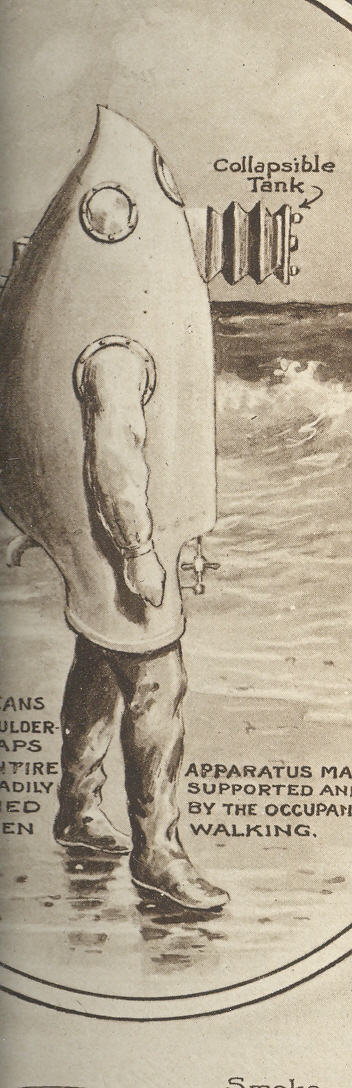
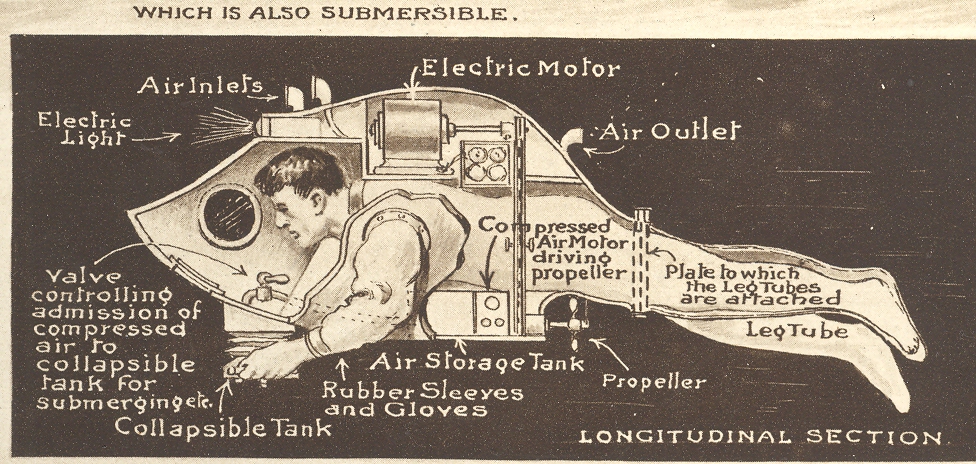
    The next few images illustrate an improbable, cartoon-like
    device for swimming in the high seas.  It
    is a ticklish-looking thing, with air outlets and propellers and such being in
    the rather tender areas of the internalized man. 

    Blo--june 17--horizontal


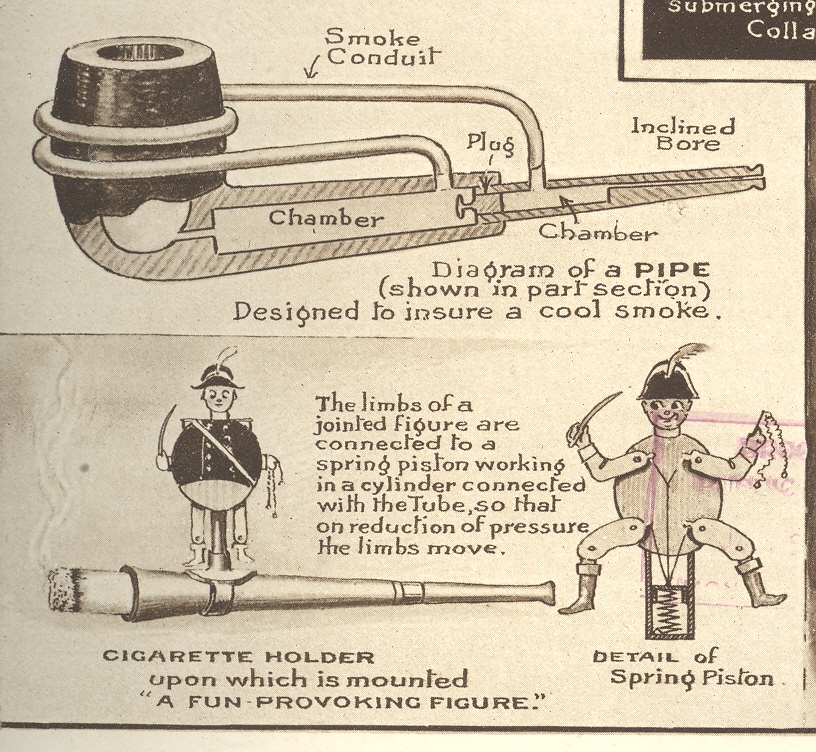
    Lastly we come to a pipe designed with too much duct work (a
    la the movie Brazil)
    to deliver a cool smoke from a hot bowl. 
    The device below that tries to bypass the entire hot smoke issue by
    distracting the smoker with a movable whirligig. I’m not so sure that Bogart
    would’ve been taken very seriously as Phi Marlowe had he been (a) smoking a
    ciggy with a holder, and (b) if that cig holder had a movable figure on it
    that raided a sword every time he drew smoke. 

    Blo--june 17--smoling


    ·Posted by :

    ·in:

    —

  • Zeppelin Paper Model, 1924

    JF Ptak Science Books Post 621  Blog Bookstore

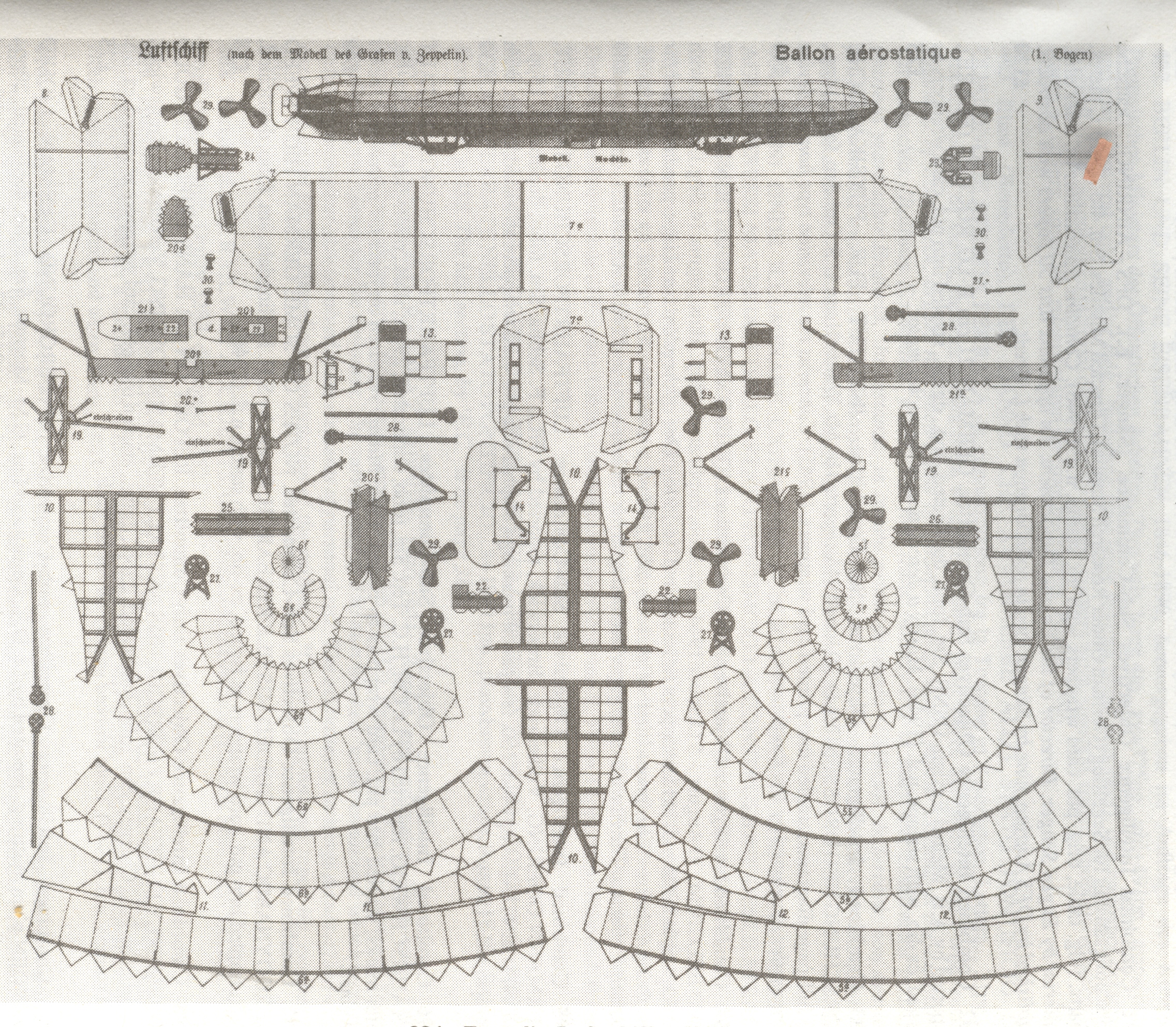
    This is a downloadable, clickable image of the makings for a zeppelin paper model–it is a lovely thing, and I just needed to share with anyone with a sharp exacto or a real pair of scissors. Pieces of the image should be printed so that the zep could be 18 inches long; or, of course, if you had a good steady hand, you could make a mini version, at this size.  The model itself is entitled Technisches Modell, Das Zeppelin Luftschiff (Modellierbogen Nr. 531, 532) and was printed and glued to cardboard by Esselingen at Munich ca. 1924.  The size of the original is 36 x 86 cm.

    Blog--May 20-zep

    Zeppelin2

    ·Posted by :

    ·in:


  • The Most Important Menu in the History of Computing–the NORC, John von Neumann, & the Weather

    JF Ptak Science Books LLC  Post 576

    “There is no mystery about these machines[computers]. The mystery is how the human brain has been able to develop them. These devices are merely small tools which men have devised to help them do a better job.”–Thomas J. Watson, chairman of the board of IBM, 1954

    [I need to thank my friend P.J. Mode for pointing this connection out to me years ago!]
    Norc--von n group
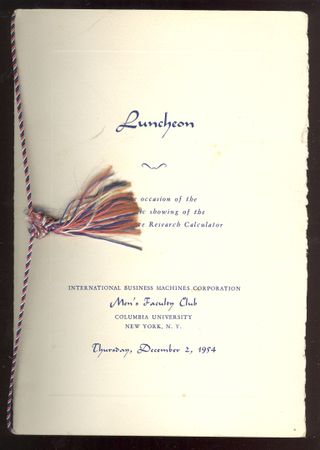
    Here is something that one doesn’t get to say very often:  this is perhaps the most important memory in the history of computing. 

    This is the luncheon menu for the dedication of the NORC “Calculator” (the Naval Ordnance Research Calculator) a computer which was constructed principally with IBM parts and built at the Watson Scientific Computing Laboratory at Columbia.  The NORC was the world’s first supercomputer, and the most powerful computer on the planet for about ten years (from 1954 to 1963, until it was surpassed by Seymour Cray’s CDC 6600 in 1964). 

    The NORC was an astonishing accomplishment, difficult to summarize simply, really, though a very good example is that provided by Dr. Paul Herget, the director of the Cincinnati Observatory.  Dr,. Herget used the NORC in 1956 to make precise calculations of the earths orbit for the 1920-2000 period.  Dr. Herget said: “We used nine hours of running time and completed more computations than had ever before been done at one time in the history of astronomy.’”

    Outside of celebrating the accomplishment of the NORC, the luncheon was also  important for the remarks of the principal speaker, John von Neumann.  Von Neumann of course was perhaps the most expansive mind of the century–a thinker of phenomenal proportions and the father of the modern computer.  His brain was impossibly big.  Impossible. 

    During the luncheon von Neumann made prescient and extraordinarily wide remarks on the future utility of the computer.  Some of the highlights (from the entire address, included below):

    –it is now “practical and feasible” to forecast, with the NORC, the weather for an entire hemisphere thirty or sixty days ahead

    –calculation of the tidal motions of all the oceans, the marginal movements near the continents as well as the main motions of the oceans

    –the hydrodynamics of the earth’s fluid core

    –“In the statistical field, dealing with matters which are not wholly mechanical, such as troop operations and logistic operations which involve purely accidental factors like the prevailing weather during the operation, command decisions which have not yet been officially made can be stipulated and various solutions for various alternatives calculated. This has been done before on a minor scale but it takes too long to do on a large scale. “In this field the importance of NORC is enormous…”

    –in the first four hours of operations the NORC  performed more work than any calculator of ten years ago has performed in its entire lifetime. He termed this performance “completely fantastic; I doubt if it has ever been done before.”

    Norc--von n group menu

    The last section of von Neumann’s comments:

    “The last thing, which is very important, is said in fewer words, but I think that it is none the less important. And it is this: In planning new computing machines, in fact, in planning anything new, in trying to enlarge the domain of parameters with which one can work, it is of course customary and very proper that one should consider what the demand is, what the price is, whether it will be more profitable to do it in a bold way than in a cautious way, and so on. This type of consideration is necessary — the world would very quickly go to pieces if these rules were not observed in 99 cases out of a hundred.

    “It is terribly important that there should however be one piece in a hundred where it is done differently.

    “And that one uses the definition which Dr. Haven (?) pointed out 20 minutes ago, namely to occasionally do what the U. S. Navy did in this case and what IBM accepted in this case: to write a specification essentially to build the most powerful machine that is possible in this day with the present state of the art. I just hope that this will be repeated very soon and will never be forgotten.    http://ftp.arl.mil/~mike/comphist/54nord/

    It may be the last statement that is the most important–pressing those of the present and future to perform
    Norcd

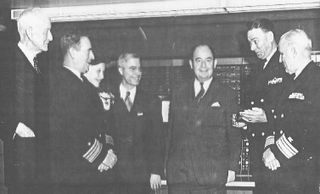
    The NORC group caption from the IBM Archive website:
    “At the NORC dedication in Watson Lab, 2 December 1954: IBM Chairman Thomas J. Watson, Rear Admiral E.A. Solomons (Executive Office, Secretary of the Navy), Jeannette Watson (Mrs. Watson Senior), Columbia Professor Wallace Eckert, John von Neumann, Captain C.K. Bergin (Director, R&D, Bureau of Ordnance, Dept of the Navy), Rear Admiral C.G. Warfield (Executive Office, Secretary of the Navy).”  The Navy is happy here because they wound up with the computer at Dahlgren.  Von Neumann was happy because he got to play von Neumann his whole life long. 

    The IBM press release for the NORC included the following summary of the event and the von Neumann address:

    NORC Press release//The following is the text of a December 2, 1954 IBM press release regarding the first public demonstration of NORC and its official “delivery” to the U.S. Navy.

    The first public demonstration of NORC (Naval Ordnance Research Calculator), fastest and largest capacity electronic calculator in existence, which has been built by International Business Machines Corporation for the Bureau of Ordnance, U.S. Navy, was conducted today at the Watson Scientific Computing Laboratory at Columbia University in the presence of approximately 150 representatives of the U.S. Navy and other Government departments, education and scientific research institutions and industrial companies. The machine was accepted on behalf of the Bureau of Ordnance by Captain C. K. Bergin, USN, Assistant Chief of research and development of the Bureau, from Thomas J. Watson, Jr., president of IBM.

    At a luncheon following the demonstration, Professor John Von Neumann, of the Institute for Advanced Study, Princeton University, and an appointee to the Atomic Energy Commission, discussed possible uses for the NORC other than for the immediate problems of the Bureau of Ordnance, instancing the field of geophysics as having great possibilities.

    It is now “practical and feasible” to forecast, with the NORC, the weather for an entire hemisphere thirty or sixty days ahead, by calculations occupying perhaps 24 hours, with results about as good as those obtained by an experienced subjective weather forecaster, “which are very good.” Calculations similar to those now made, forecasting weather over the area of the United States for 24 hours in advance, could be made on the NORC in perhaps half a minute, he stated.

    Complete calculation of the tidal motions of all the oceans, the marginal movements near the continents as well as the main motions of the oceans, is now, with the NORC, a matter of days and therefore feasible. He also declared that calculation of the hydrodynamics of the earth’s fluid core, the movements of which are responsible for the main phenomena of terrestrial magnetism, “becomes probably accessible for the first time.”

    In the statistical field, dealing with matters which are not wholly mechanical, such as troop operations and logistic operations which involve purely accidental factors like the prevailing weather during the operation, command decisions which have not yet been officially made can be stipulated and various solutions for various alternatives calculated. This has been done before on a minor scale but it takes too long to do on a large scale. “In this field the importance of NORC is enormous,” Dr. Von Neumann said.

    He concluded by pointing out that the NORC was assembled less than two months ago and put on test less than two weeks ago, yet in a test yesterday (Wednesday. Dec. 1) it ran for four hours without an error, doing in this period more work than any calculator of ten years ago has performed in its entire lifetime. He termed this performance “completely fantastic; I doubt if it has ever been done before.”

    Dr. Grayson L. Kirk, president of Columbia University, stated that during the test period the NORC will be available to the University for important research projects, particularly in the field of nuclear physics, before it is shipped to the Naval Proving Ground, Dahlgren, Va. to be installed in the Computation Laboratory already established there.