A Daily History of Holes, Dots, Lines, Science, History, Math, Physics, Art, the Unintentional Absurd, Architecture, Maps, Data Visualization, Blank and Missing Things, and so on. |1.6 million words, 7500 images, 4.9 million hits| Press & appearances in The Times, Le Figaro, Mensa, The Economist, The Guardian, Discovery News, Slate, Le Monde, Sci American Blogs, Le Pont, and many other places… 5000+ total posts since 2008.

Category: Technology, History of

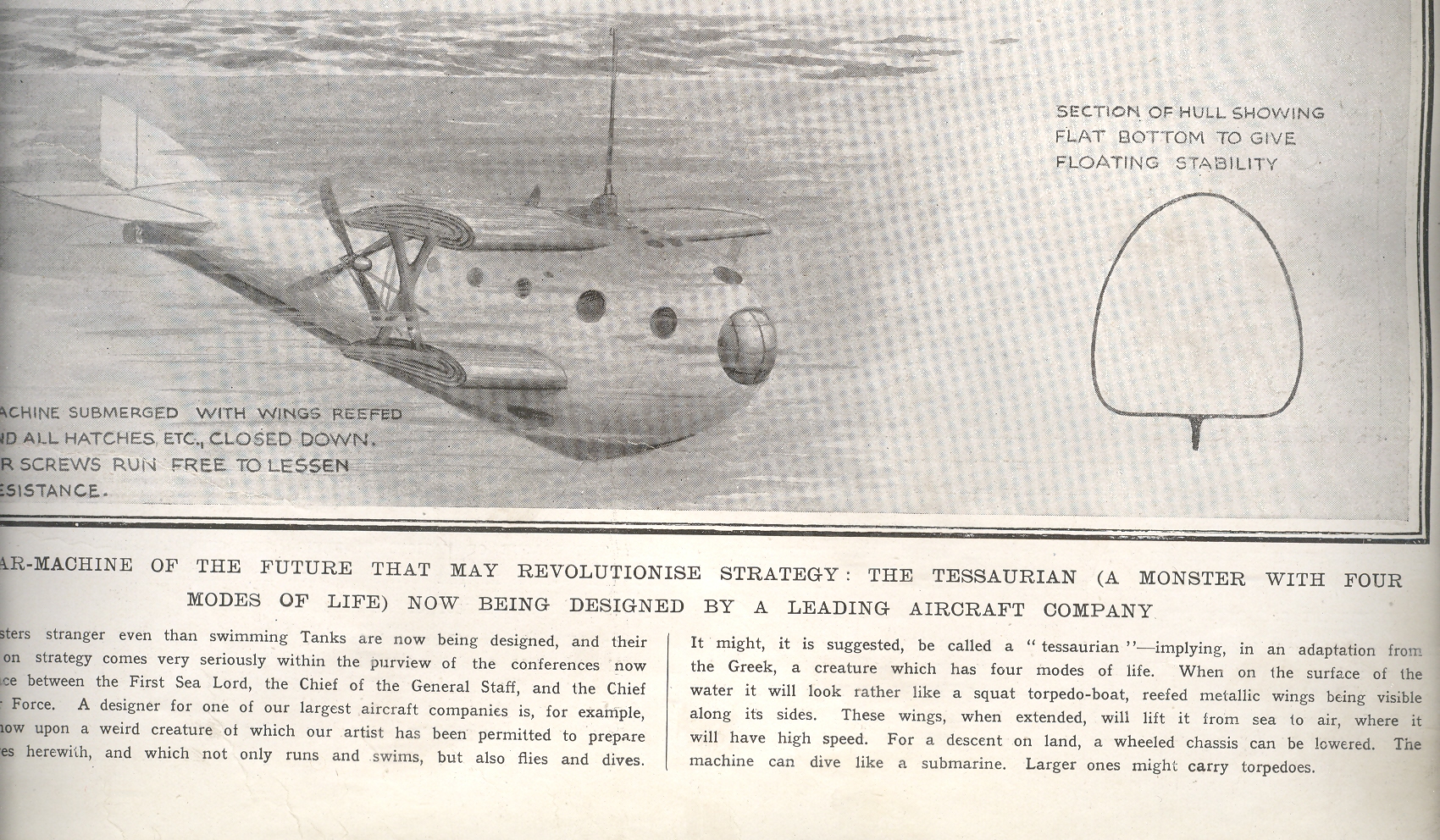
  • A War-ready Submersible Aircraft, 1920: the Tessaurian

    JF Ptak Science Books LLC  Post 892

    DARPA
    has had a long-standing Christmas wish—a high-speed, durable, fast, agile tacticly-beautiful
    submersible aircraft.  Such a thing has
    evidently been on the wish list of many agencies in many countries for many
    years. 

    I
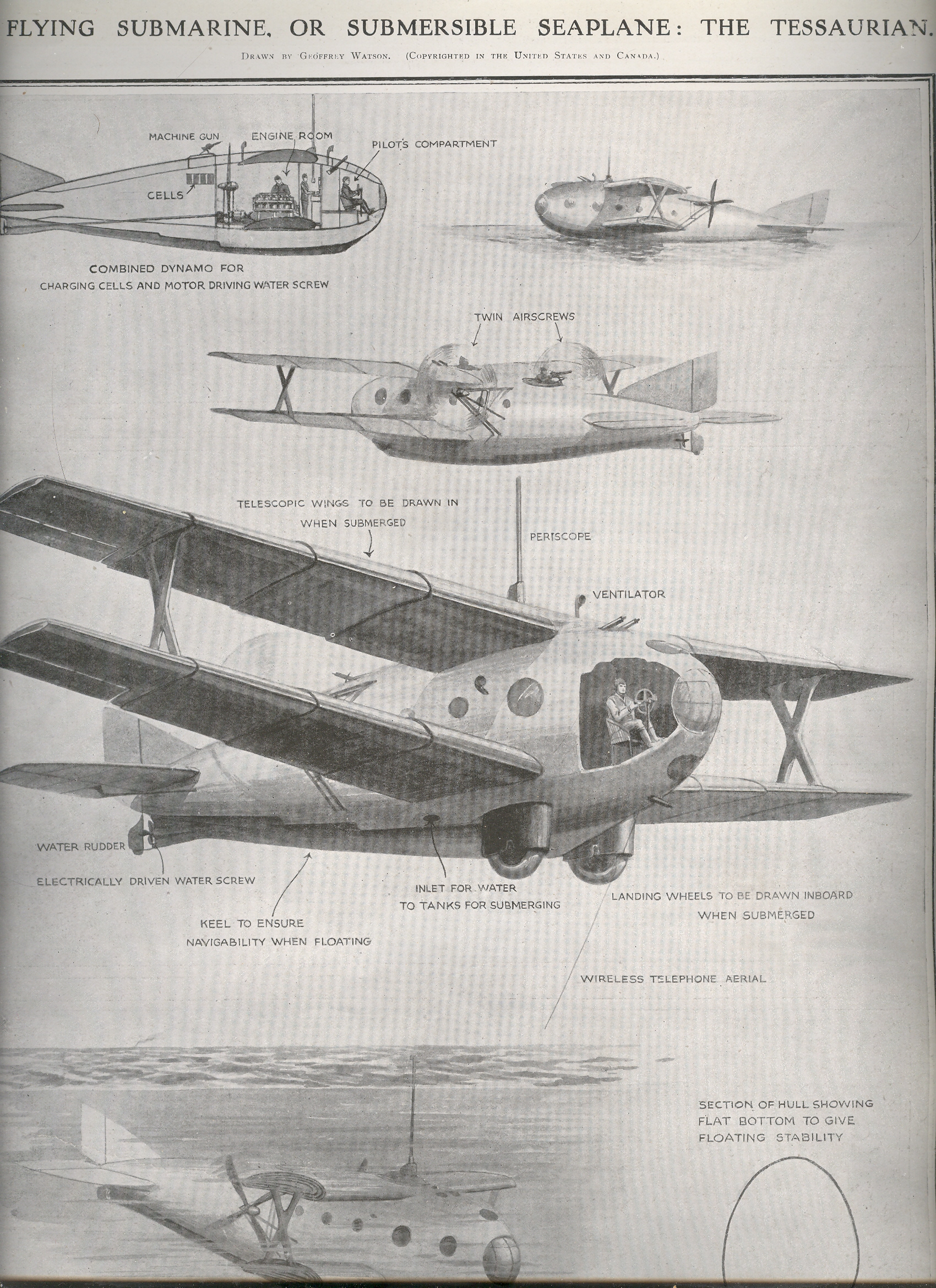
    found the Royal Navy’s version of the DARPA wish in the 24 January 1920 issue
    of The Illustrated London News—the Tessaurian, a dreamable plane capable of
    long flight and long trips under the sea, as well as being able to float on the
    water and land on dry earth.

    Blog dec 30 subplane

    Even the modern Tessaurian has been evasive—certainly
    this 1920 version is nothing short of nothing. 
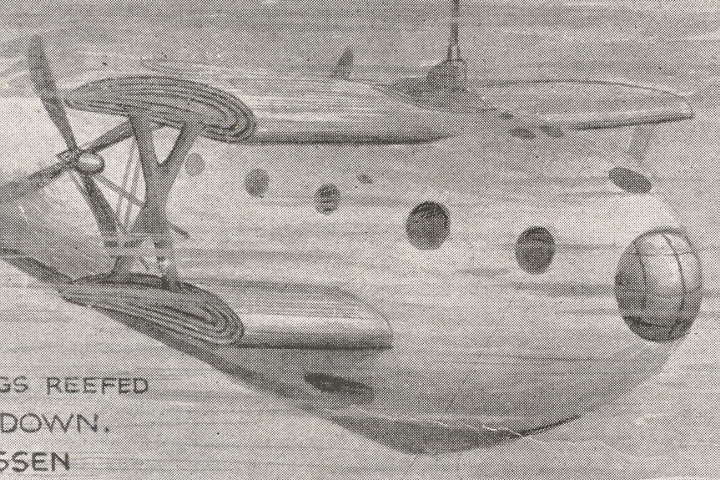
    The craft just looks too bumpy to do well in any sort of fluid environment,
    air or liquid, the thickness of its skin (necessary for the heavy undersea
    pressures) looking just too heavy to lift off the ground.  Of course the powertrain is suspect, and the
    retracted wings don’t look like they would do anything to glide the beast
    further underwater, assuming it got there (on purpose) to begin with.  Even though I doubt that it could fly, it may
    be able to float a bit—I do think that it could sink like a champ.  

    And
    so I reproduce these heady, unacknowledged and unclaimed drawings (“designed by
    a leading aircraft company”), as I can’t find anything offhand online that
    comes remotely close to its age and concept. 

    Blog dec 30 subplane det

    An
    undergraduate (!) team (headed by Daniel B. Coltey et alia )at Auburn came up with
    the following research paper earlier this year: “Conceptual Design of a
    Submersible Tactical Insertion Aircraft” “This…senior design program…the
    creation of a conceptual design for a submersible airplane is being undertaken
    as a response in part to a challenge by the Defense Advanced Research Projects
    Agency (DARPA).” The authors then state the checklist of DARPA’s needs:  “The design is expected to be a clandestine,
    coastal insertion vehicle with specific abilities of an airplane, surface ship,
    and submarine vessel, which would greatly increase the tactical ability of the United States. The
    aircraft is expected to accommodate eight passengers, including any necessary
    equipment and operators, and an additional 2,000 pounds of cargo, and also to
    have an unrefueled range of 1,000 nautical miles in cruise flight, 200 nautical
    miles surface transit or very low altitude flight, and 24 nautical miles of submerged
    travel. The aircraft requirements also include the ability to complete one
    tactical transit (1,000 nautical miles airborne, 100 nautical miles surface,
    and 12 nautical miles subsurface movement) in a time limit of eight hours. This
    concept also addresses challenges in the areas of structural design, effective
    propulsion in dual fluid flow regimes, and control surface duality…”  I’d want one, too. 

    Blog dec 30 subplane det 001

    SOURCE


  • Bad Ideas Department: Futurized Obsolescence of an Airport ABOVE the River Thames

    JF Ptak Science Books LLC  Post 879  Blog Bookstore

    Its funny how one can live the future in the present but not
    see any part of that future’s future.  Evidently
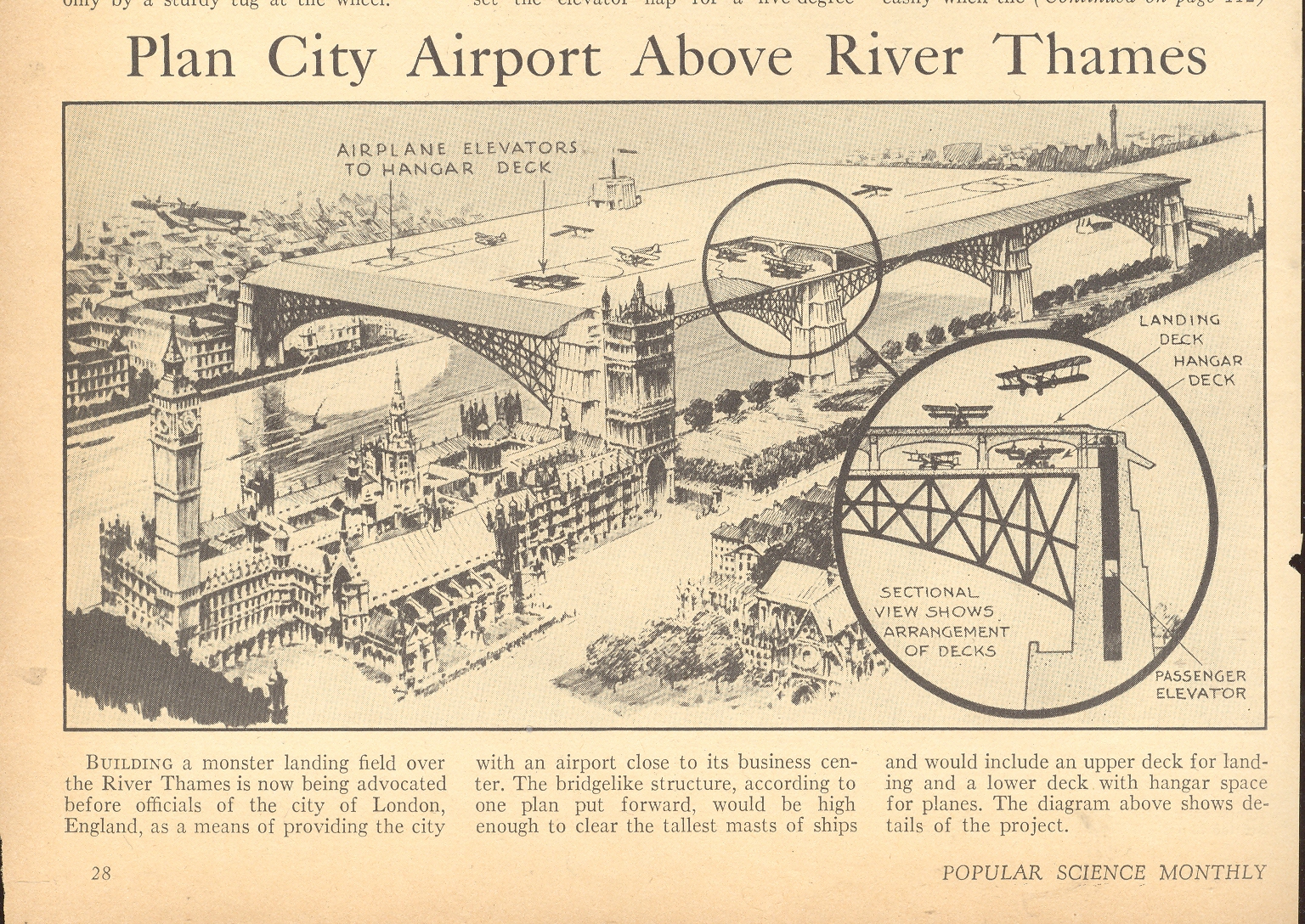
    completely enveloped in the flying frenzy of the 1930’s, planners in London considered constructing
    an airport above the River Thames.  This
    rendition from Popular Science Monthly  (January 1934) shows the beast laid out from
    just above Westminster Bridge to the (newly opened) Lambeth Bridge, covering the
    entire width of the river, with the runways running almost directly into the Victoria
    Tower of Westminster Palace.  

    Blog Dec 17 thames airport

    The
    structure had almost everything going for it to be built in the bad category department:  it was big, ugly, unnecessary, dangerous, a
    hideous eyesore and an architectural atom bomb. 
    It also would have been almost antiquated by the time it was built,
    serving as it did nothing but very small single-prop biplanes, virtually
    useless by the time larger multi-engine propeller planes and jet aircraft would
    appear just a decade and a half into the future. The thing was built high
    enough (the top looking to be at least 300’ high, comparing it to the Victoria Tower) by the forward-thinking planners
    to accommodate “the tallest masts of ships”. 
    No one seemed to take any piece of the future into consideration in planning
    this monster—the planning seemed to take place as a retro event, as though the
    thinking was being done in 1910 rather than 1934. 

    This was a piece of engineering so devoid of the
    possibilities of future development that just as a crew on one end of the airport
    was finishing, it would’ve been just about time for a crew on the first-finished
    end to start demolishing it, an exercise in futurizing obsolescence.  I’d say
    that if you could both build something and take it down in one continuous
    movement, the thing should probably not be built


  • Return to Land Ships–Really Big, Really Bad Ideas: the 1,500 Ton Truck

    JF Ptak Science Books LLC  Post 856

    Ship--kinski

    Nothing
    quite gives me the rumbles as seeing pictures of Great
    Heavy Land Things on the move.  The NASA launch crawler is one of the biggest,
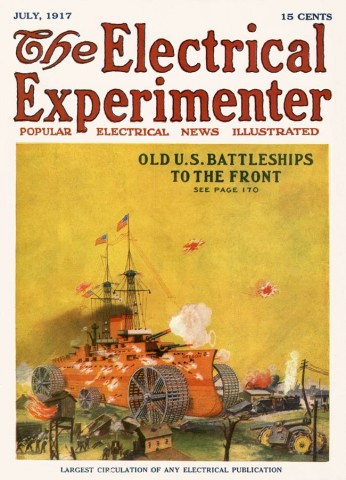
    though it doesn’t come close to this impossible LandClad pictured in Brett
    Holman’s excellent AirMinded blog:  the
    terrestrially-motorized and tankified version Dreadnought of obsolete ironclad (and I guess
    pre-Dreadnought) battleships.  I doubt
    that there would be more things more fearful than seeing something like this
    coming over the rise, Martian tripod death machines notwithstanding. The
    ironclad/pre-dreadnought would certainly have some problems moving around on
    the land, considering the huge power sources needed to move them while they
    were floating in water.  The giant tank also
    looks pretty pervious, all things considered, and (among many other things)
    looks as though it probably wouldn’t do so well in rainy weather—it looks like
    it would generate its own Operation Barbarossa
    mud wherever it went.  My guess too is
    that if got stuck, it was, well, stuck.Ship--teheuntatpec  

    The
    pursuit of sea-land machines has always had a huge ‘wow” factor, if for no
    other reason than it was just out-of-place and big.   I’ve written earlier here on
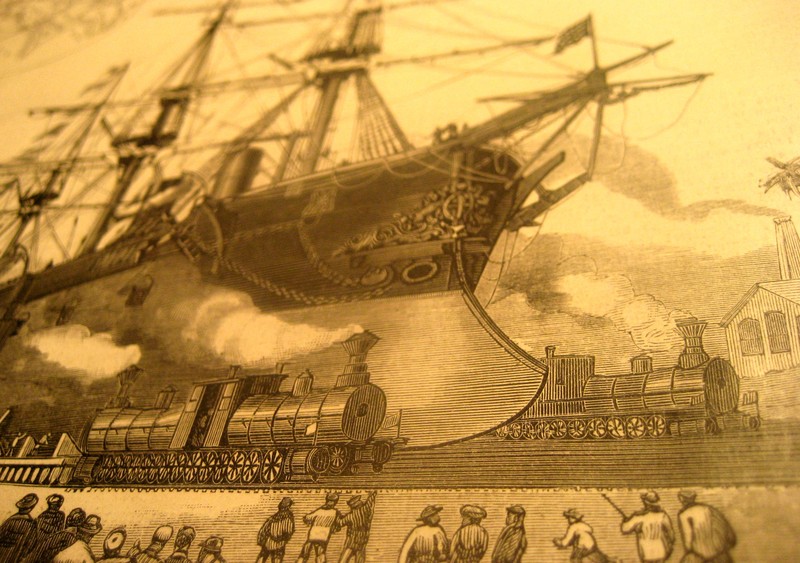
    Elmer
    Cotherell and James Eads proposal to build a combination railroad ship canal
    across the Tehuantepec isthmus in Nicaragua, hauling ships up and out of the
    water and transporting them across land on six railroad tracks pulled by juggernaught
    teams of locomotives.  In the
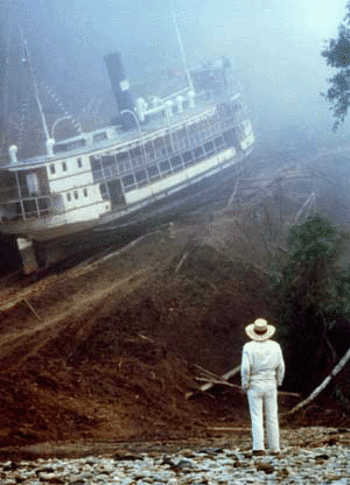
    fiction-made-fact world, Werner Herzog hauled a real steamship up and over a mountain for
    the filming of his quixotic Fitzcaraldo,
    which was simply a fabulous thing to see. (The film is a glory as is the film made on the making of the film.)


    Truck

    Getting
    back to Holman’s landship—I remembered something similar to this, and actually
    found a picture of it right here in my bizarre-archive.  Popular
    Science
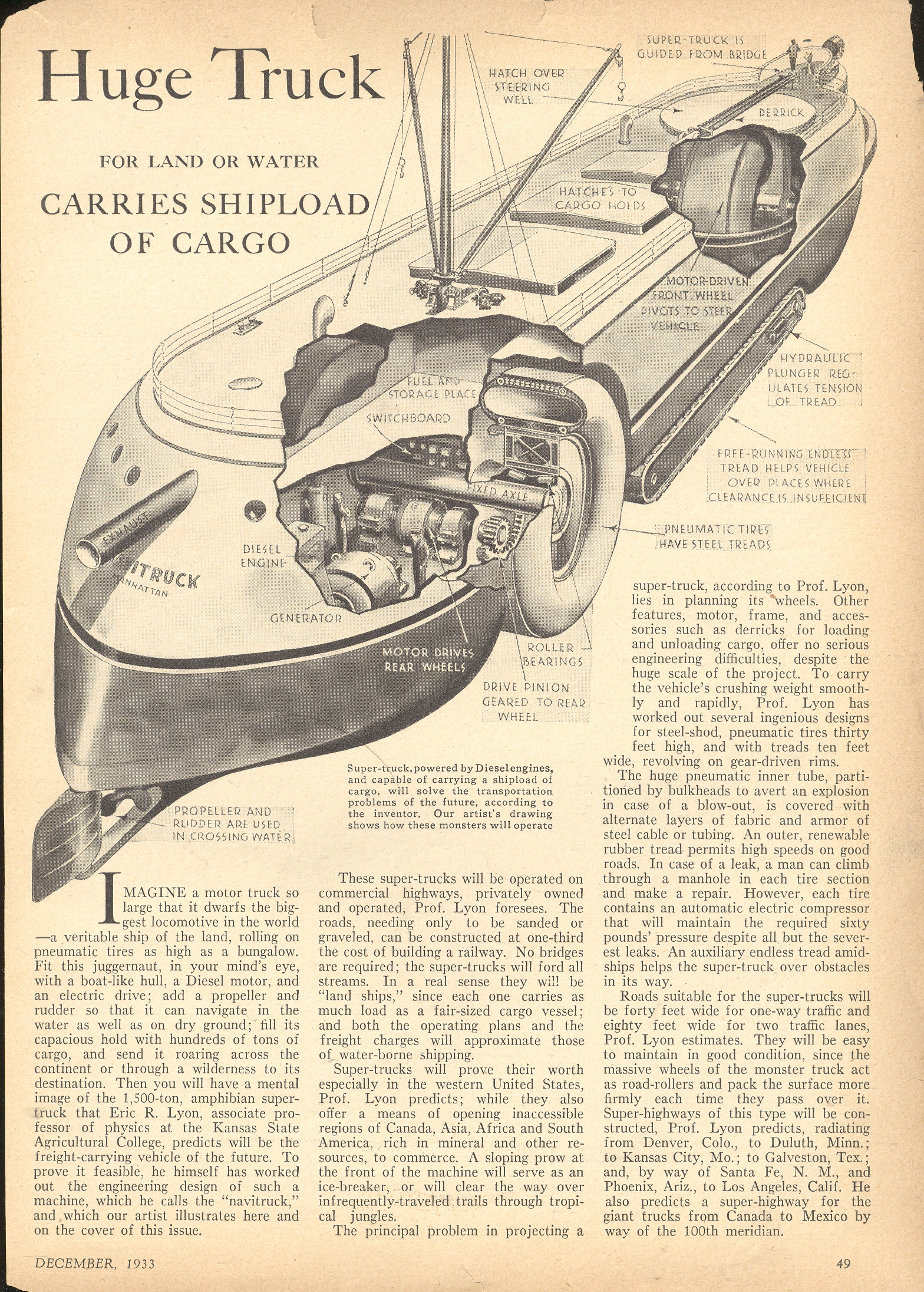
    (December 1933) published this account of professor Eric R. Lyon’s1
    conception of the Diesel-powered “Navitruck” (its name looking like quite
    something different and not so pretty at the thing’s stern), a 1,500-ton
    amphibious truck with (what Lyon states to be ) 30’-tall (and 10’-wide) tires. Given
    this I approximate the monster would be 40’ wide and 100+’ long, and I guess at
    least 35’ tall.  A flattening tire on
    land would be a problem; I guess a blowout would be catastrophic. 

    Did I
    mention that this thing could float?

    Anyway
    Prof. Lyon envisioned a veritable Western ribbon of these things radiating from
    Denver to Duluth,
    to Kansas City (MO) and Galveston, and to Phoenix and on to Los
    Angeles
    .  Special
    gravel roads would be built for his trucks (cutting down on construction costs
    for more permanent roadways), and in the case of no roads, Lyon saw that the
    bow of his ship could both cut through impenetrable South American jungles as
    well as break ice in frozen Arctic waters. 
    Somehow the roads are seen as being 40’ wide for single lane traffic,
    and 80’ for double lanes, which doesn’t leave much room for error.

    There are
    some real mammoth trucks rumbling around
    mining operations, the Caterpillar 797e and Terex trucks, being two of the world’s
    biggest.  They are 22’ and 24’ high and
    300 and 280 ton machines, respectively, and although they begin to approximate
    the brutishness of the Lyon machine, it would still take five (or ten) of these
    beasts to fill the shoes of the “Navitruck”.   Also, a big point which isn’t addressed with the Lyon’s machine is fuel.  The thing would have to have something like a 10,000-gallon fuel tank–which means the fuel alone would weigh 60 or 80 tons–to avoid having fuel stations spread like flies along the landship byways.  Fuel consumption wouldn’t be measured by the gallons/mile with something as monumentally heavy as this–it would be measured by the gallons/minute.  Since the Caterpillar 797e drinks about a gallon a minute with a modern efficient engine, I’ll make the wild iterative guess that the Navitruck would gulp 20/gallons a minute (?!), which would be a very hard rate of pumping at the gas station this afternoon.  That means that this trucks would be filling-up twice a day after getting 225 miles/tank.  At 15 cents a gallon (in 1933) that would make a $3,000 fill-up, which means it would cost about six thousand 1933 dollars to make it from Denver to L.A. Provided it didn’t break down.  [The wheels were on a fixed axle.  Yikes.] The average salary in 1933 was a little more than half the cost of this fill-up, or about $72,000 in 2009 dollars.  On the other hand, if these things hauled 3 million pounds the fuel costs for moving each pound would be about 2 (2009) cents. Or maybe not.  (All of this scratch-pad reasoning might be wrong, but not horribly so, I don’t think.)

    There were definitely more convenient and already-exiting ways of hauling freight at this time, and the system had  a much more robust delivery system and reach.  That system was called “railroads”.

    All in
    all, I’ve come to the conclusion that ship should stay in the water.

    Note:

    1.  Professor Lyons (Kansas State
    University
    physics
    department), was no stranger to big ideas, appearing frequently in popular magazines
    like this and the Electrical Experimenter,
    among others.  


    ·Posted by :

    ·in:

    —

  • AirplaneTrainer: Sailors in the Air, 1911

    JF Ptak Science Books LLC  Post 843

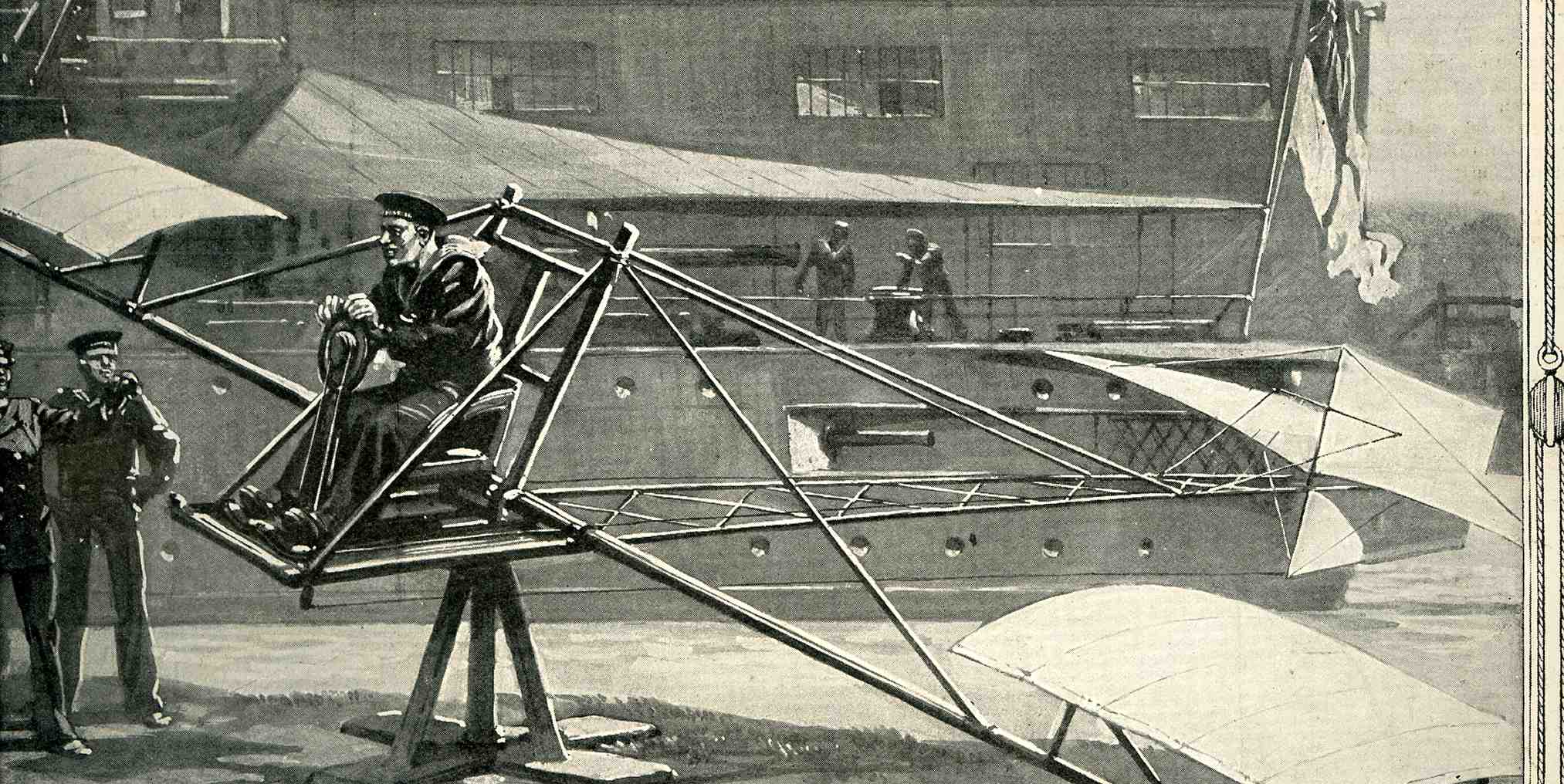
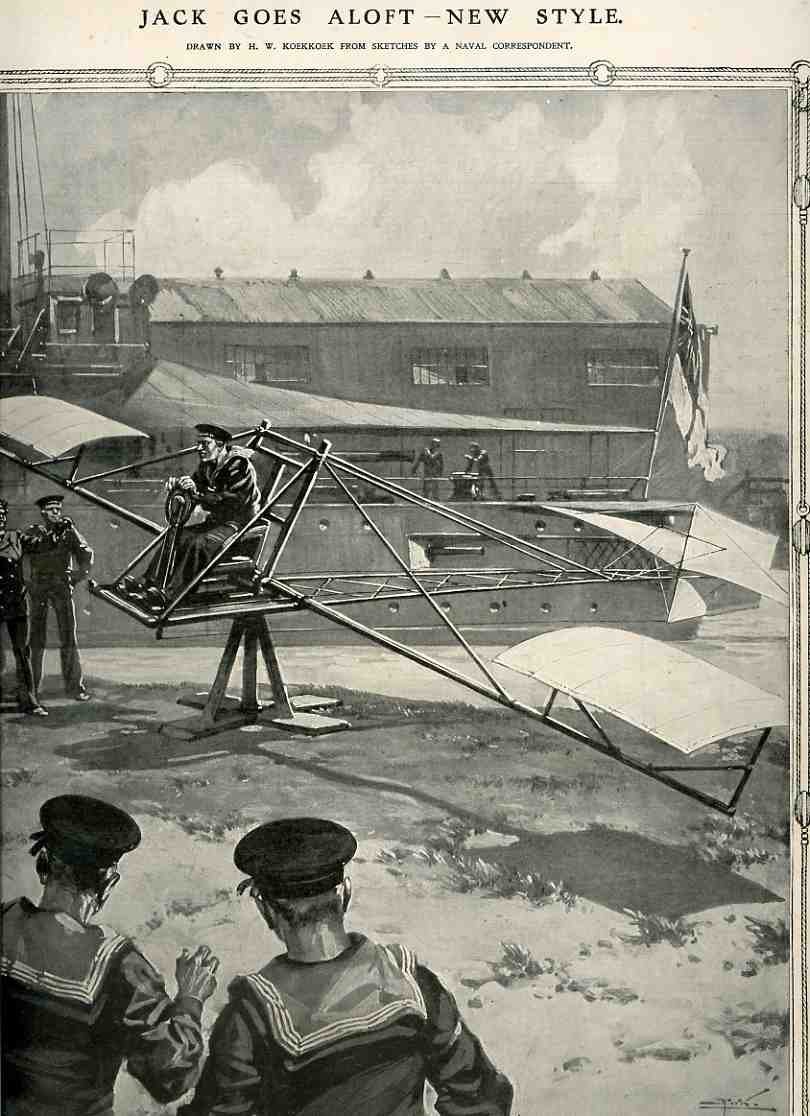
    Just three years after the Wright Brothers arrived in Europe to revolutionize European flying, and following an order of magnitude series of advancement and achievement, the British Navy was already beginning to train classes of sailors as aviators in  dynamic flight-free devices. This idea of simulating flight enabled the training (and more importantly, the selection) of aviators before anybody actually got into a plane, speeding the process of determining who was fit for flight and who was not, quickening the British pace to form a fighting force in the air.
    00-blog--Oct 28 sea plane trainer951

    This interesting graphic appeared in The Illustrated London News for 29 July 1911, and was entitled “Jack Goes Aloft–New Style…Trying to Keep a Stationary Machine Steady in a Wind; Sailors Practicing with a Dummy Aeroplane”.  This was five months before the establishment of the Royal Naval Flight School, but more importantly, just a few months after the historic flight of Eugene Ely, who took off in his aircraft from the deck of the USS Pennsylvania in the Mare Island Navy Yard–of more profound interest perhaps is the fact that Ely landed his plane on the same restricted deck space. (In a way the primitve stopping mechanisms use by Ely are sort of in use today. ) I am sure that few naval people missed the significance of this event–I know that across the ocean Winston Churchill was instantly at work on the idea of using aircraft on ships. But it seems that after all of the initial successes in the U.S. that when everything was said and done, the Brits took the lead in modernizing their navy to include aircraft. 

    00-blog--Oct 28 sea plane trainer950


  • Poe and the Internet, 1845

    JF Ptak Science Books LLC  Post 841  Blog Bookstore

    In one of his essays1 Edgar Poe wrote about the power of
    writing for what he saw as a revolutionary form of information distribution—anastatic
    printing.  He was wrong about its instant
    application in releasing the writer from the habits, time, expense and editing
    of the printing process; he was wrong that it was the greatest achievement
    since Gutenberg; and he was wrong about most everything else about the (real)
    process.  He was right though in his vision
    for the distribution of information.  I’m
    participating in this vision right now, except there was no way that even the
    supremely gifted Poe could have envisioned the way in which information was
    being shared on 20th November 2009. 

    Anastatic printing was a simple way of reproducing
    handwritten documents for a mass audience. 
    The problem was though that the process tended to destroy the
    original.  Highly problematic.  But Poe wasn’t interested in those aspects of
    the technical problems of the process—it was the possibility of relatively
    immediate distribution of the written word that had his attention.  He wrote:

    “The tendency of all this to cheapen information, to
    diffuse knowledge and amusement, and to bring before the public the very class
    of works which are most valuable, but least in circulation on account of
    unsaleability — is what need scarcely be suggested to any one. But benefits
    such as these are merely the immediate and most obvious — by no means the most
    important.”

    And so materials saleable and unsalable would have equal
    access to a reading public, which is an enormous concept, to think that all
    sorts of information could be made accessible regardless of the tastes of the
    buying public.  Exceptionally low
    production costs would also make dissemination feasible for and to a wider
    range of people—since the cost of production would be lower the cost of the final
    product could/would be as well, making things within the reach of the working
    poor (perhaps).  This also means that
    anastatic printing could also give voice to the working poor as well—a class of
    writer little know before the time of Dickens. 

    Better yet if the manuscript was actually legible.  In Poe’s mind, the importance of legibility
    and prettiness was of a high order since your manuscript was the final product.
     Poe writes:

    “This consideration will lead to the cultivation of a neat
    and distinct style of handwriting — for authors will perceive the immense
    advantage of giving their own manuscripts directly to the public without the
    expensive interference of the type-setter, and the often ruinous intervention
    of the publisher. All that a man of letters need do, will be to pay some
    attention to legibility of MS., arrange his pages to suit himself, and
    stereotype them instantaneously, as arranged. He may intersperse them with his
    own drawings, or with anything to please his own fancy, in the certainty of
    being fairly brought before his readers, with all the freshness of his original
    conception about him.”

    Again, Poe was wrong about the medium but would be right
    about the message.  Perhaps his mind was
    filled then with the very-new telegraph, imagining instantaneous communication
    over distances and carrying that development sci-fi-forward.  The telegraph (1837-1845) followed by the
    telephone (1876) and then wireless telegraphy (1898) and television (1905-1927)
    all would have enormous impact on our description of reality.  But no technological change would encompass
    Poe’s vision until 1979 (+) with the development of the internet.  Poe’s technology was wrong, but his thought-prognosis
    was pretty spot-on.

    1.  “Anastatic Printing”, in the Broadway Journal, April 12, 1845.


  • A Note on Poe, Babbage and Thinking Machines, 1836

    JF Ptak Science Books LLC  Post 838  Blog Bookstore

    This is part of a longer piece I’m doing on Man in the Machine—Early Days of  Man-Machine Singularity

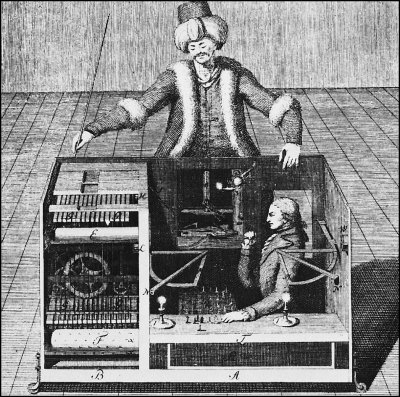
    Continuing from yesterday on Poe’s untitled books in “The Raven”, and making my way backwards through his Collected Works (from his criticism in volume XI to his short essays in volume X), I found an extraordinary piece on computers and a chess-playing machine.  Poe addresses a touring wonder called the Maelzel Chess-Playing Machine, which theoretically was a stand-alone device which thought and played the game, beating all-comers. (The version of the works that I own was published by Harper’s around the turn of the century—they didn’t bother to date their own work or give any references to the origins of Poe’s, which is awful  The essay1 though originally appeared as Edgar Allan Poe, “Maelzel’s Chess-Player” in the  Southern Literary Messenger, April 1836, 2:318-326.)  
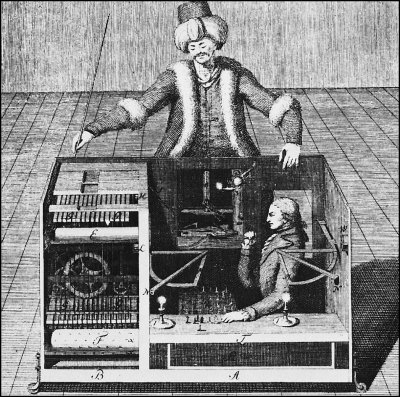
    Kempelen The machine was actually in its 65th year or so on tour, starting out life with Baron Kempelen, the original inventor of the device in 1769.   Maelzel was a shuckster who happened to be one of the machine’s final owners–touring with it in America in the 1830’s–before the thing burned to bits in 1854.

    But before he deals with the innards of the automaton, Poe writes on its history, and touches on some very deep understanding of the Babbage Difference Engine, “computers”, and thinking machines.  This is especially interesting because the Babbage machines hadn’t yet been given wide public conversation—that would come in 1843 with Babbage’s somewhat unlikely bulldog, Lady Ada Lovelace, who published an account of his work in Taylor’s Scientific Memoirs.  Poe’s work predates this by seven years, though

    Kempelen4 Lovelace’s commentary is far more robust, more mathematical, and longer and deeper2. Beautiful, even. (For example: “We may say most aptly that the Analytical Engine weaves algebraical patterns just as the Jacquard-loom weaves flowers and leaves.”)

     Poe states the difference between Babbage’s machine and a thinking machine.  First up, his paragraph on Babbage’s engine, rearranged for easier consumption:

    (1)   “Arithmetical or algebraical calculations are, from their very nature, fixed and determinate.

    (2)   Certain data being given, certain results necessarily and inevitably follow.

    (3)   These results have dependence upon nothing, and are influenced by nothing but the data originally given.

    (4)   And the question to be solved proceeds, or should proceed, to its final determination, by a succession of unerring steps liable to no change, and subject to no modification.”

     The thinking machine (chess-player) occurs later in the same paragraph:

    (1)   “But from the first move in the game of chess no especial second move follows of necessity. In the algebraical question, as it proceeds towards solution, the certainty of its operations remains altogether unimpaired. The second step having been a consequence of the data, the third step is equally a consequence of the second, the fourth of the third, the fifth of the fourth, and so on, and not possibly otherwise, to the end.

    (2)   But in proportion to the progress made in a game of chess, is the uncertainty of each ensuing move. A few moves having been made, no step is certain.

    (3)   Different spectators of the game would advise different moves. All is then dependent upon the variable judgment of the players.

    (4)   Now even granting (what should not be granted) that the movements of the Automaton Chess-Player were in themselves determinate, they would be necessarily interrupted and disarranged by the indeterminate will of his antagonist.

    (5)   There is then no analogy whatever between the operations of the Chess-Player, and those of the calculating machine of Mr. Babbage…”

    [The full quote is below as well as the link for the entire piece.]

    This is an interesting and fundamental understanding of the differences between a calculating device and a computer capable of iterative deduction.  I think also that both he and Lady Lovelace thought of the Babbage machine in terms of an added, extra intelligence for the human brain.

    After dealing with the machine’s history, and after looking at other explanations on how the thing could work, Poe delivers his conclusion:  that the machine wasn’t a machine after all, and that it could not function in this way unless it was being guided by a human inside the machine, which in fact, of course, it was.  Even after displaying the internal clockworks of the device, whoever it was exhibiting the machine would open and close the three doors covering the machine’s inner workings would do so in such a way that a small person could scoot back and forth to avoid detection, all of the exhibition being done at a safe distance  After that, the confederate would follow the game on his own board after hearing the moves announced by the showman, and then move the arm of the automaton via levers and such to produce his move, the taking of pieces done by Maelzel. (How this went undetected for so long is a sacred mystery.  It would seem as though someone at some point would’ve seen a faint light of a candle coming form inside the box, or smoke, or something.) The machine was originally designed for a brilliant Polish cavalryman who lost both legs in combat and was not above this deception.  Poe’s unraveling of the story and display of reasoning and getting to this conclusion is a pretty powerful display.

    It is interesting to note here that, without going all-academic about it, it seems to me that Babbage’s work on the computer passed without mention in the experiences of the earliest computer pioneers of the 1930’s-1950’s.  At least I don’t think I’ve ever seen mention of Babbage in any way, at least through the construction of UNIVAC II.  And so we have an instance of someone being recognized as the founding father of something without actually exerting any influence on anyone else working in that that field’s early future.  This is not the case with another person who actually did have an influence on those who followed him but has never received full public recognition for his efforts—that would be Vannevar Bush and his MEMEX as the precursor to the internet.  I’ve never looked for Poe’s name in conjunction with modern computing history (outside of cryptology), though I have a sneaking suspicion that if Babbage wasn’t there then neither would Poe.

    NOTES

    1. The paragraph in its entirety:

    But if these machines were ingenious, what shall we think of the calculating machine of Mr. Babbage? What shall we think of an engine of wood and metal which can not only compute astronomical and navigation tables to any given extent, but render the exactitude of its operations mathematically certain through its power of correcting its possible errors? What shall we think of a machine which can not only accomplish all this, but actually print off its elaborate results, when obtained, without the slightest intervention of the intellect of man? It will, perhaps, be said, in reply, that a machine such as we have described is altogether above comparison with the Chess-Player of Maelzel. By no means — it is altogether beneath it — that is to say provided we assume (what should never for a moment be assumed) that the Chess-Player is a pure machine, and performs its operations without any immediate human agency. Arithmetical or algebraical calculations are, from their very nature, fixed and determinate. Certain data being given, certain results necessarily and inevitably follow. These results have dependence upon nothing, and are influenced by nothing but the data originally given. And the question to be solved proceeds, or should proceed, to its final determination, by a succession of unerring steps liable to no change, and subject to no modification. This being the case, we can without difficulty conceive the possibility of so arranging a piece of mechanism, that upon starting it in accordance with the data of the question to be solved, it should continue its movements regularly, progressively, and undeviatingly towards the required solution, since these movements, however complex, are never imagined to be otherwise than finite and determinate. But the case is widely different with the Chess-Player. With him there is no determinate progression. No one move in chess necessarily follows upon any one other. From no particular disposition of the men at one period of a game can we predicate their disposition at a different period. Let us place the first move in a game of chess, in juxtaposition with the data of an algebraical question, and their great difference will be immediately perceived. From the latter — from the data — the second step of the question, dependent thereupon, inevitably follows. It is modeled by the data. It must be thus and not otherwise. But from the first move in the game of chess no especial second move follows of necessity. In the algebraical question, as it proceeds towards solution, the certainty of its operations remains altogether unimpaired. The second step having been a consequence of the data, the third step is equally a consequence of the second, the fourth of the third, the fifth of the fourth, and so on, and not possibly otherwise, to the end. But in proportion to the progress made in a game of chess, is the uncertainty of each ensuing move. A few moves having been made, no step is certain. Different spectators of the game would advise different moves. All is then dependent upon the variable judgment of the players. Now even granting (what should not be granted) that the movements of the Automaton Chess-Player were in themselves determinate, they would be necessarily interrupted and disarranged by the indeterminate will of his antagonist. There is then no analogy whatever between the operations of the Chess-Player, and those of the calculating machine of Mr. Babbage, and if we choose to call the former a pure machine we must be prepared to admit that it is, beyond all comparison, the most wonderful of the inventions of mankind. Its original projector, however, Baron Kempelen, had no scruple in declaring it to be a “very ordinary piece of mechanism — a bagatelle whose effects appeared so marvellous only from the boldness of the conception, and the fortunate choice of the methods adopted for promoting the illusion.” But it is needless to dwell upon this point. It is quite certain that the operations of the Automaton are regulated by mind, and by nothing else. Indeed this matter is susceptible of a mathematical demonstration, a priori. The only question then is of the manner in which human agency is brought to bear. Before entering upon this subject it would be as well to give a brief history and description of the Chess-Player for the benefit of such of our readers as may never have had an opportunity of witnessing Mr. Maelzel’s exhibition

     –The Maelzel essay:

    –And here as well. 

    2) Ada Lovelace writing on the computer “program” from her extensive “Notes” section in her translation of Menabrea’s work on Babbage, appearing in Scientific Memoirs, Selections from The Transactions of Foreign Academies and Learned Societies and from Foreign Journals, edited by Richard Taylor, F.S.A.,Vol III London: 1843, Article XXIX. “Sketch of the Analytical Engine invented by Charles Babbage Esq.”

    “The distinctive characteristic of the Analytical Engine, and that which has rendered it possible to endow mechanism with such extensive faculties as bid fair to make this engine the executive right-hand of abstract algebra, is the introduction into it of the principle which Jacquard devised for regulating, by means of punched cards, the most complicated patterns in the fabrication of brocaded stuffs. It is in this that the distinction between the two engines lies. Nothing of the sort exists in the Difference Engine. We may say most aptly that the Analytical Engine weaves algebraical patterns just as the Jacquard-loom weaves flowers and leaves.”
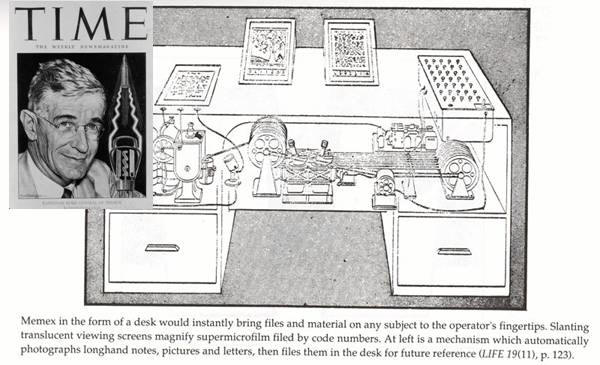
  • The History of the Internet: Remembering Vannevar Bush and the Memex (1945)

    JF Ptak Science Books LLC  Post 812  Blog Bookstore

    On this day, which may or not be the 40th anniversary of the
    first use of the internet (and the 80th anniversary of the collapse
    of the stock market of ’29, and Lucy A’s anniversary of her birth) it might be
    good to remember an earlier version of the internet and the semi-invention of
    the concept of hypertext: the MEMEX machine of the under-remembered Vannevar Bush. 

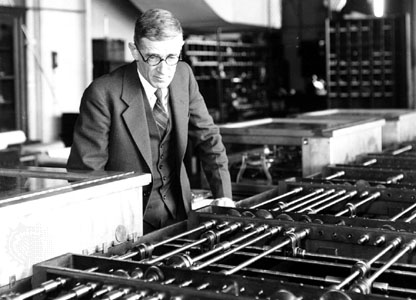
    Bush

    Vannevar (pronounced “van ee var”) was a flinty no-nonsense New Englander
    who was an organizational and mechanical genius who as a professor at MIT
    developed a remarkable analog computer that greatly advance computation
    capacities for solving differential equations. 
    This was in the 1930’s, and even after creating an improved
    electromechanical version of the machine still chose the wrong way to go in the
    soon-to-materialize digital computer revolution.  During WWII Bush was one of the most
    important Americans in the war effort, overseeing the entire scientific effort
    of the U.S.—an
    enormous effort dispatched beautifully (and successfully).  His importance in this regard is difficult to
    overstate.

    But right there at the end of the war, when he was organizing a still-secret
    effort of controlling the spread of atomic weapons (before Hiroshima), Bush was also thinking about the
    future of the organization of human knowledge and memory.  And published it, too, in the popular Atlantic magazine in July 1945. (It was
    republished in a shortened version a few months later in September—it remains
    to this day, according to an editor at Atlantic, one of the most
    often-requested reprints) where it reached a reading audience of millions.  The article, “As We May Think”, outlined his
    idea for a device he called the MEMEX1 (“memory” and  “index”), which compressed and organized all
    that its user could remember and whatever information would be obtained in the
    future via electromechanical apparatuses, and available with associative tracking
    between the microtext frames.  So all
    manner of book and papers and reports and newspapers and images would be
    microphotographed and stored in a beautifully-indexed mechanical retrieval
    system where it would live with the information of others.  There was also the possibility of real-time
    textual additions to whatever it was that was retrieved, the genetic precursor
    of hypertext.  Bush’s thinking has been deeply
    recognized (and also by the creators of the internet) as the intellectual
    grandparent of the modern internet. 

    Bush Memex

    I just thought on this day that the man who saw more clearly into the future
    on advanced global communication and societal memory should be remembered on a
    day when his grandchild came into being.

    Notes:

    1. According to Bush, “the MEMEX is a sort of mechanized private file and
    library…. It uses methods such as microfilm storage, dry photography, and
    analog computing to give postwar scholars access to a huge, indexed repository
    of knowledge-any section of which can be called up with a few keystrokes.”
     Wardrip-Fruin, Noah and Nick Montfort,
    ed (2003). The New Media Reader. p. 35. The MIT Press

    The physical plant of the MEMEX:  “A
    memex consists of a desk, where on top are slating translucent screens on which
    material can be projected for convenient reading. Within the desk were
    mechanisms that stored information through microphotography. Most of the memex
    contents are purchased on microfilm ready for insertion. On the top of the
    memex is a transparent platen. When a longhand note, photograph, memoranda, and
    other things are in place, the depression of a lever causes it to be
    photographed onto the next blank space in a section of the memex film, dry
    photography being employed.”  Manovich, Lev. “As We May
    Think”, The New Media Reader and
    wiki on The Memex. 


  • History of the Future: Radio in the Classroom, 1945

    JF Ptak Science Books LLC   Post 786   Blog Bookstore

    + classroom KDKA in Pittsburgh
    was one of the first radio stations to broadcast in the USA in 1920—two
    years later found another 500 licensed stations. By the time this pamphlet was
    published nearly 95% of all homes in America were equipped with a radio,
    the near high end of the Golden Era of the medium. (Perhaps there is no
    greater, faster change in any sort of revolutionary change than there was from
    radio to television.  TV was basically an
    insignificant spot on the radio horizon in 1945, and then in ten short years it
    became radio’s great black sun, obliterating it as a competitor for
    entertainment.)   It is no wonder that radio was seen as a
    potential colossus for an information delivery system, with schools making use
    of whatever it was that they could squeeze from it. 

    This history of the future picture on the front
    cover of this (1945) publication reminds me of the anxious moments in the opening
    moments of 8th grade when one of the teachers brought a television
    to school (being in NYC) for us to watch the Mets in the 1969 World Series,
    nearly 40 years ago next week. (There were series games played in sunlight
    then.)  Radio had great potential and
    promise, and the kids crowded around this receiver/turntable tech center would’ve
    been like kids 10 years ago crowding around a monitor to see their first
    glimpses of the internet. 

    Radio didn’t make it.

    There’s some interesting detail in this
    photo.  The programming on the blackboard
    in the rear directed the children to classrooms for the different radio
    lessons:  “New Horizons”, “World of Wings”,
    “Science at Work”. “By Freedom’s Light”, and a few others that I can’t make
    out.  All were CBS productions, which
    evidently had nothing to do with the publisher of this pamphlet, Newsweek.  The shows were being broadcast by WBEZ,
    Chicago, which was actually a Chicago Public Schools station and intended for just
    this purpose—real public broadcasting.

    The girls in the front are looking at a user’s
    guide for “CBS American School
    of the Air”, which seems to have had some legs as an idea, or at least its
    legacy looks really interesting. In the 1939/40 season of this “program” the
    great music and sound geologist and proto-multiculturalist Alan Lomax1 (1915-2002) wrote and directed “American Folk Songs”, “
    featuring Woody Guthrie, Lead Belly, the Golden Gate Quartet,
    Burl Ives, Aunt Molly Jackson, and field recordings of square dancing,
    French-Canadian, and lumberjack songs”. 
    Which means I guess that school kids were being exposed to impressively different
    sorts of American music that they probably would not have hears anywhere else
    as incidental sound. 

    But as I said, radio was swept away by the great leavener of
    television.  It looks like Alan Lomax
    never did do anything for the TV, and its educational aspect (so far as
    school-use goes) never really did get off the ground.  Overall, it seems to me that TV never did get as smart as radio.

    Notes

    1. It is interesting to note that because of Lomax’s one-world Lefty approach to the
    appreciation of music–world music today, multiculturalism in another form—he came
    to the squinty-eyed attention of the challenged J.Edgar Hoover, the FBI
    managing to produce an 800-page file on the ethnomusicologist, all without a
    single anti-American blot.  Lomax’s total
    body of work is astonishing, and we all owe the man a strong salute.


  • Virtual Filmstrip of Italian Defenses Against Bombing and Gas, 1944

    JF Ptak Science Books LLC  Post 779  Blog Bookstore

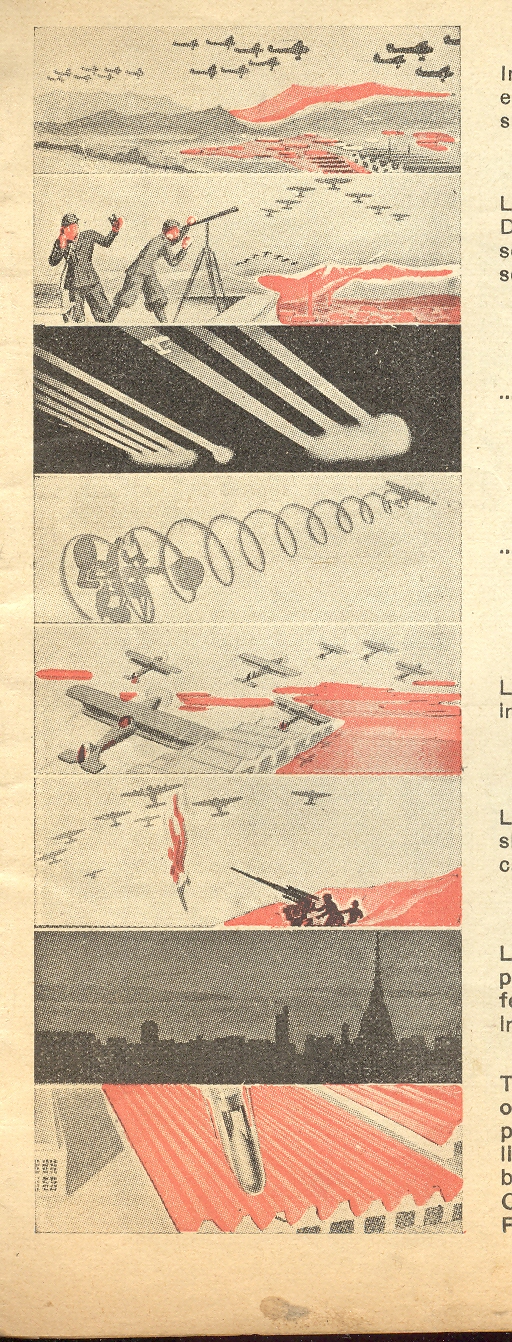
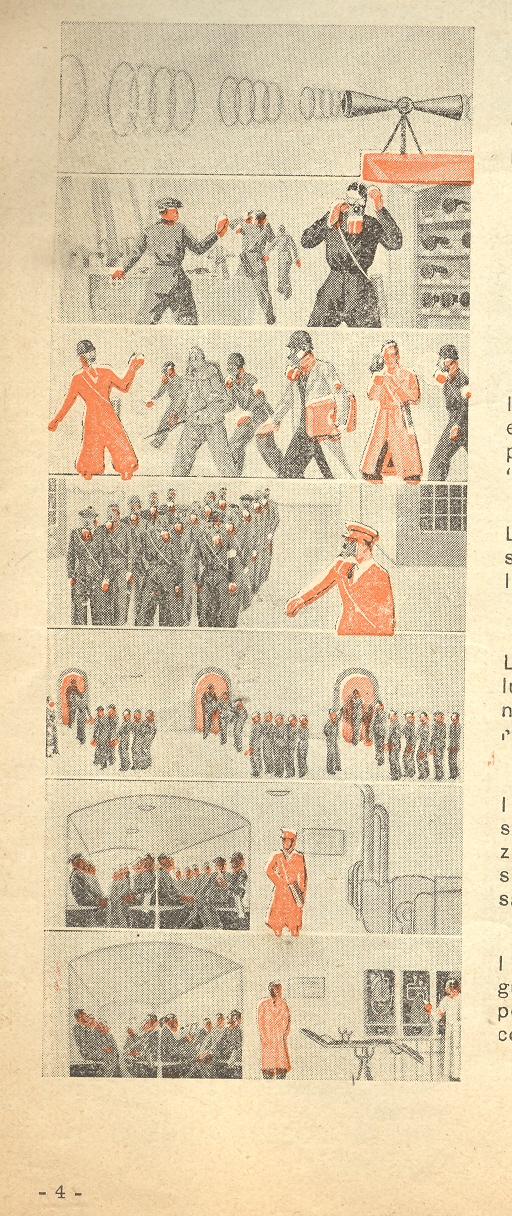
    In my collection of WWII propaganda and civil defense pamphlets I found this extraordinary Italian publication, Se un’Accressione viene dal Cielo…che Cosa fa l’Operaio (1944, which translates loosely as “When the Aggression/Bombing Comes from the Sky, What Happens to the Workers?”).  As we can see from the cover illustration, the (Italian) workers are being guided/marched from their factory by their Nazi overseer, dressed for a gas attack, just as the attacking planes were coming overhead.  Inside we find a briefly-worded, explicit guide for the factory worker, and target of Allied attack, about what to do when the bombs started to fall.
    + italian bombing cvr

    The 104 illustrations, taken one after the other, form a sort of filmstrip, and could well function as a guide for those who couldn’t read.  I also find them unsettling for their composition, color , size (very small, each section being about 1/2 inch x 1 1/4 inches), proportion…just about everything about them sits badly with me.  

    Here’s an example, taken from the middle or so of the presentation:

    + italian bombing 6 detail 

    Here’s the full selection of the images (all of which are clickable for a fuller view):

    + italian bombing 1 + italian bombing 2 

    The rest of the presentation follows in “extended reading”:

    ·Posted by :

    ·in:


  • A Not-Obvious Gross Understatement: Bomb + Plane = Drop, 1915.

     JF Ptak Science Books LLC  Post 737 Blog Bookstore

    ===blog==aug 30==bomb overview

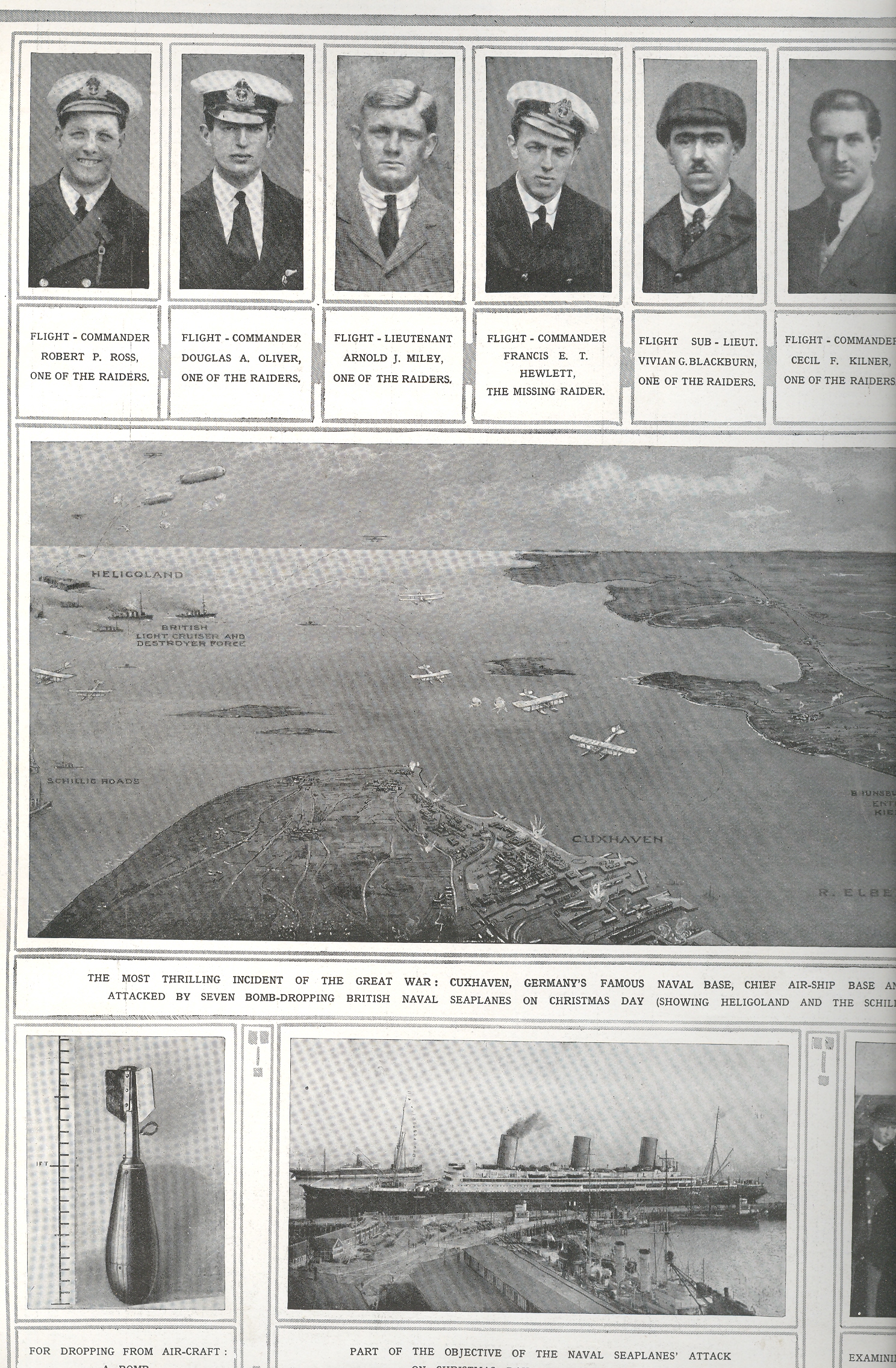
    In the young history of the beginning of the Twentieth Century’s Thirty-One
    Year War, in the very young history of bombing1, came this adventurous “first”
    in warfare:  the attack of a target from
    the air, sea and under the sea. The British launched an assault against the German
    installation at Cuxhaven,
    trying to get at its Zeppelins and navy, sending a task force of destroyers,
    subs and cruisers in support of eight search and destroy seaplanes. The
    tactical results were mixed (there are many places to check out this part of
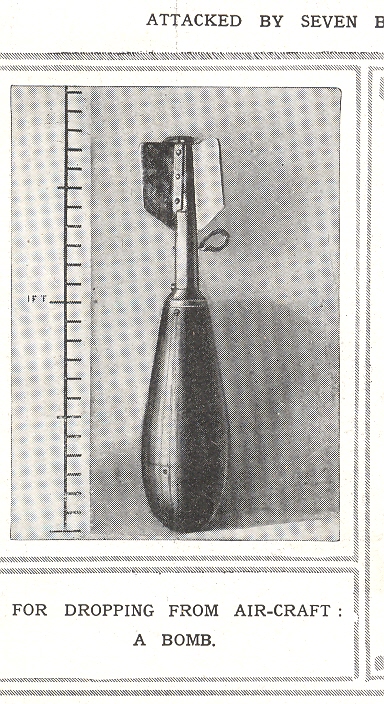
    the war) but the strategic outcome was enormous:  it was a new approach to warfare.  The technical aspect of bombing was so new,
    really, that the picture of the bomb at lower left had to be identified as
    such, and===blog==aug 30==bomb det that it could be used as an offensive weapon dropped from a plane (“for
    Dropping from Air-Craft: a Bomb”). 

    1. It was the Italians who conducted the first aerial bombardment, against a
    very creatively-named military “target”– consisting primarily of civilians–outside
    of Tripoli in October
    1911.

    From the Flight/global Archive:

    “The Cuxhaven raid marks the first employment of the seaplanes of the Naval Air Service (sic)
    in an attack on the enemy’s harbours from the sea, and, apart altogether from
    the results achieved, is an occasion of historical moment. Not only so, but for
    the first time in history a naval attack has been delivered simultaneously
    above, on, and from below the surface of the water.”— United Kingdom Flight
    Magazine: the “Official Organ of the Royal Aero Club of the “, 
    Flight
    Magazine Global Archive: Aircraft
    in Warfare
    , 1 January 1915.

    Notes:

    A lovely site with many links for early aviation: Airminded; and an unusual and wonderful book on the history of bombing in general, called, of course, A History of Bombing, by Sven Lindqvist.