A Daily History of Holes, Dots, Lines, Science, History, Math, Physics, Art, the Unintentional Absurd, Architecture, Maps, Data Visualization, Blank and Missing Things, and so on. |1.6 million words, 7500 images, 4.9 million hits| Press & appearances in The Times, Le Figaro, Mensa, The Economist, The Guardian, Discovery News, Slate, Le Monde, Sci American Blogs, Le Pont, and many other places… 5000+ total posts since 2008.

Category: Technology, History of

  • Seeing Vision: Examples of Light and Sight, Personified

    JF Ptak Science Books LLC  Post 976


    (On seeing the morning’s rising sun): “Looks like light to
    me.” SpongeBob SquarePants


    “All the fifty years of conscious brooding have brought me
    no closer to answer the question, ‘What are light quanta?’ Of course today
    every rascal thinks he knows the answer, but he is deluding himself.”  A. Einstein

    “Are not gross bodies and light convertible into one
    another, and may not bodies receive much of their activity from the particles
    of light which enter into their composition?” I. Newton, Opticks,
    1704, Query 30.

    Mar 12 #51

    Depicting the capacity of sight and nature of light has been
    both an easy and a knotty problem in the history of science. Over the
    successive theories on the basis of light the artistic presentation of the
    phenomenon has been generalized (generally) in a very simple way:  by straight lines.  There’s certainly nothing wrong with that,
    the lines are just parenthetic place-holders suggesting direction, not actual
    descriptors of what light “looks” like.

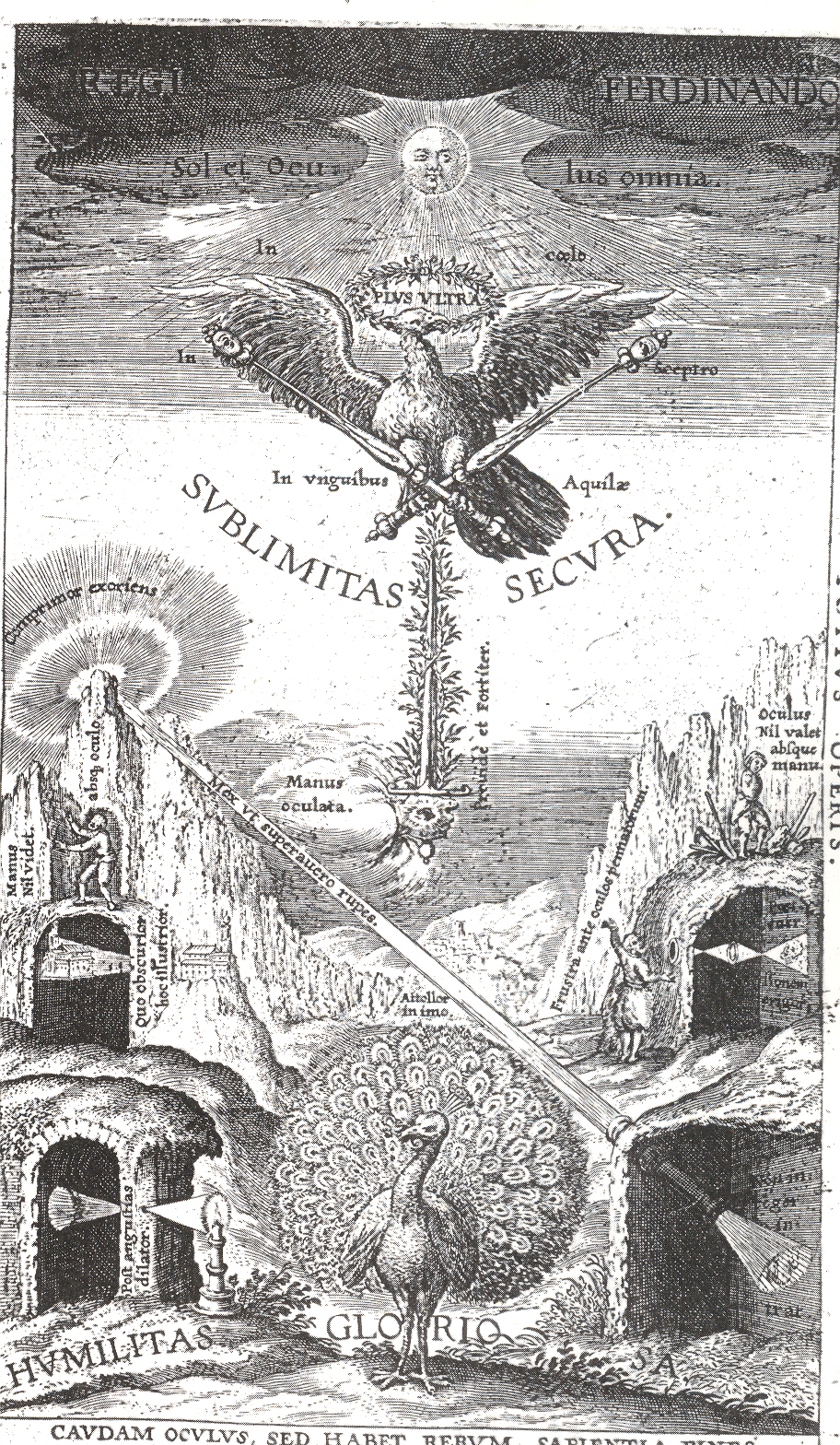
    There are literally hundreds if not thousands of images printed 1550-1850 to call upon to make this point, and I’ve selected but a few.  The first belongs to Jesuit astronomer Christoph Scheiner and which appeared in his  Oculusm hoc est: fundamentum opticum...,printed in Innsbruck in 1619. His work is an out-and-out landmark in the history of optics,  physiological optics and ophthahlmometry, and provided a springboard for two generations following him, not the least of whom was Rene Descartes. The illustration above is the book’s frontispiece, and features four camera obscuras demonstrating four principles of the eye, the middle ground of which is a beam of light 

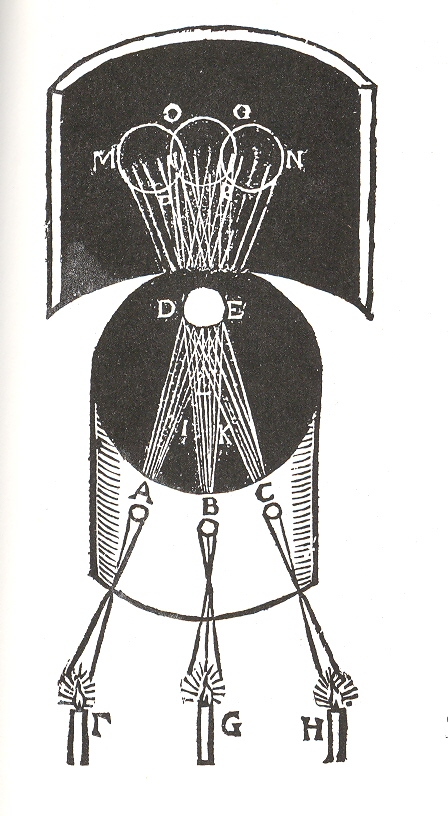
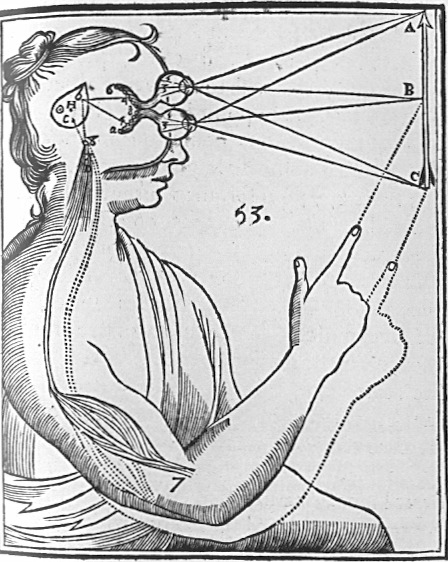
    Rene Descartes depicted the interpretation (in his  Principles of Philosophy of 1644) of light and its physiological reaction in the brain as follows:
    Cartesian_Vision

    the lines of sight depicting binocular vision, observed (and compressed) by the eye’s “particles” and processed by the pineal gland which in turn manipulate the “fluids” in the control of nerves and muscles. 

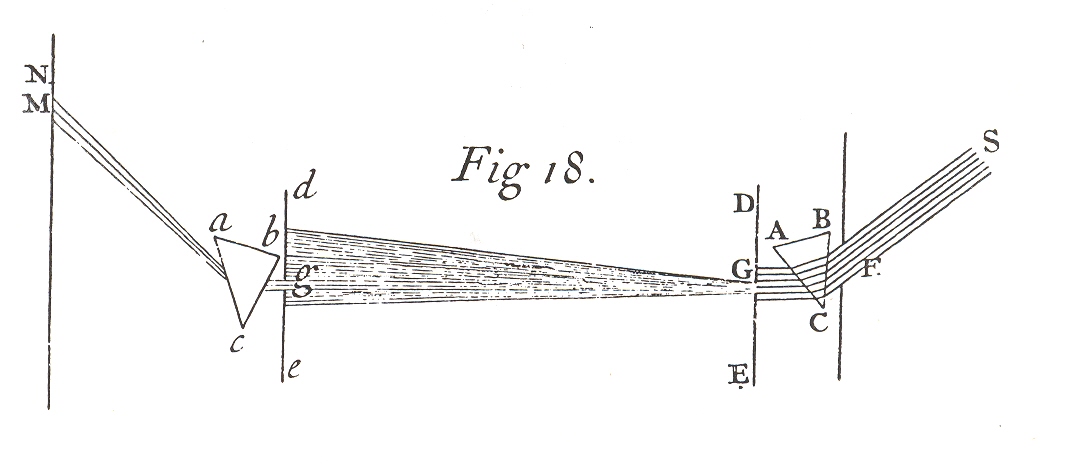
    Another example of even greater fame than the iconic image by Descartes is that of the diagram showing the connection between color and its reflective index by Isaac Newton, appearing in his Opticae of 1706.
    Mar 12 newton 

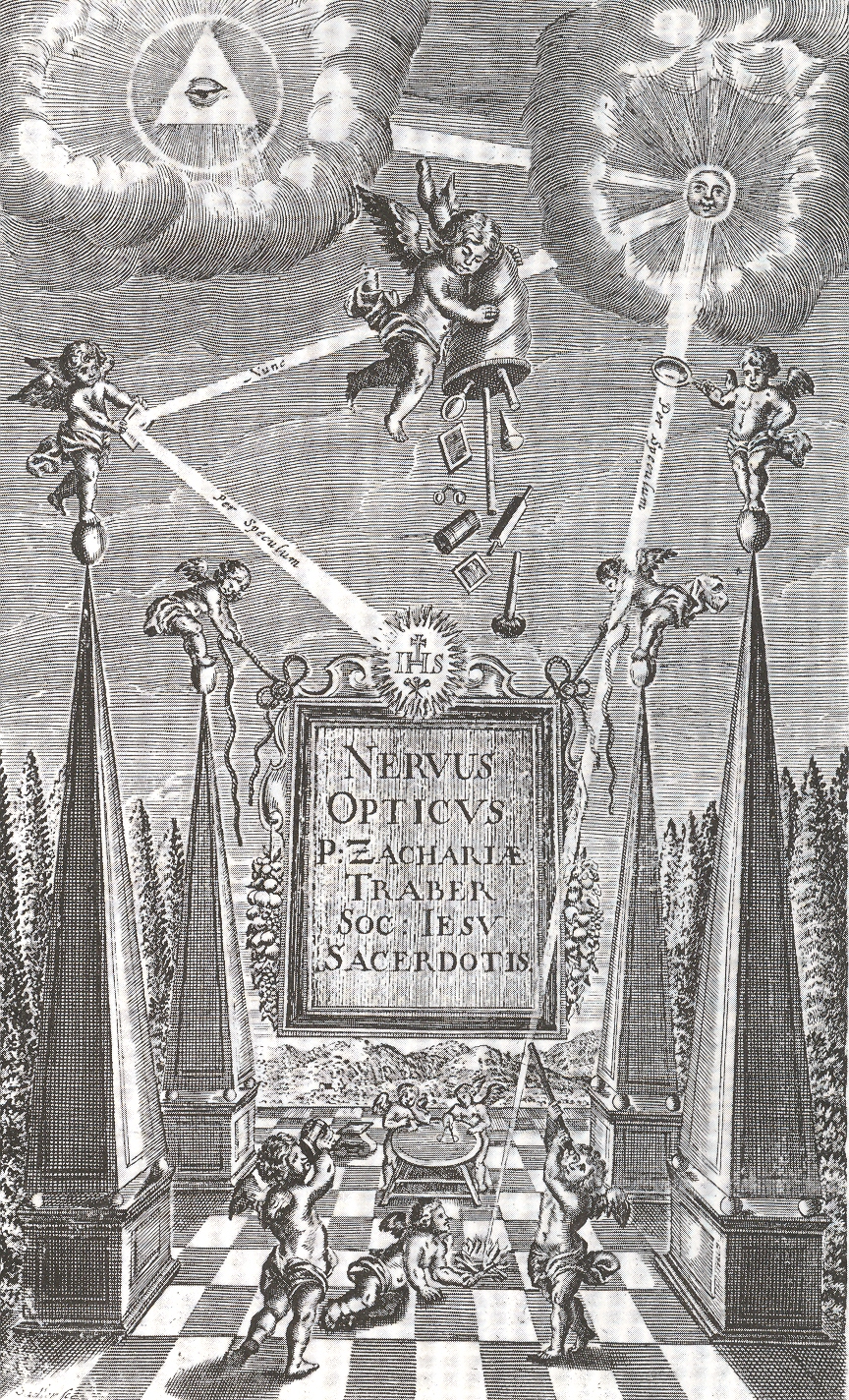
    Another fine example comes from Zacharias Traber’s (1611-1679) beautifully illustrated classic of optics (and physiological optics) , Nervus Opticus sive Tractatus Theoricus..., published in Vienna in 1690.  Traber is a great collector and synthesizer of the work done during and before his time, using the work of Descartes, Kepler, Schott, Kircher, Scheiner and Aguilon (for example), and then further implementing their ideas especially in the areas of color theory  and light refraction.  The image certainly reflects Jesuit Traber’s religious training, depicting the holy source of light (originating with the almighty force) which directs it to the sun; the light then is left to the inquisitive and playful hands of cherubs who reflect and magnify it, as well as use it to start a fire (from the condensing lens) and observe it through a telescope. The main cherub empties a sack containing a number of different optical tools, no doubt for the playful brethern beneath. 
    Mar 12 trauber 

    And then of course there is the great, unstoppable, polymathic and sometimes incorrect Jesuit Athanasius Kircher.  This image appears in his masterwork Ars Magna lucis et umbrae, printed in Amsterdam in 1671, which deals with light and shadow, optical illusions, color, refraction, projection and distortion, sundials, mirrors, as well as astronomical subjects. Most of these subjects are clearly seen in the engraved frontispiece to the work (below), the source of all of the “rays” of light coming from the godhead, relayed through a telescope, reflected from a mirror, and gathered in a camera obscura. 
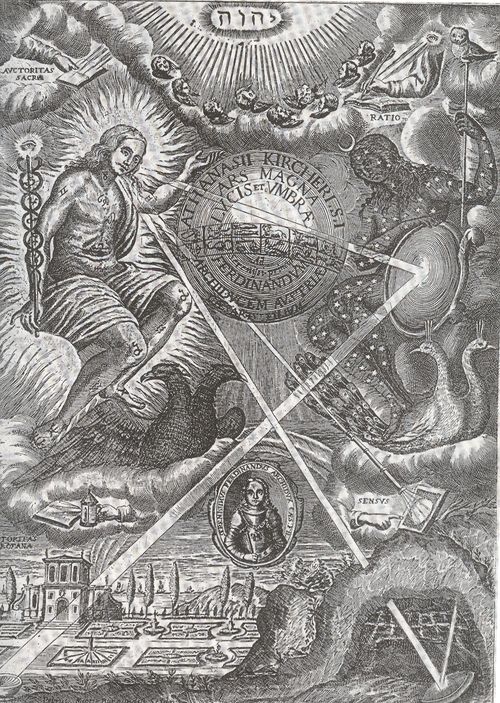
    Mar 12 kirch 

    Other interesting images from the Kircher include this spotlight.
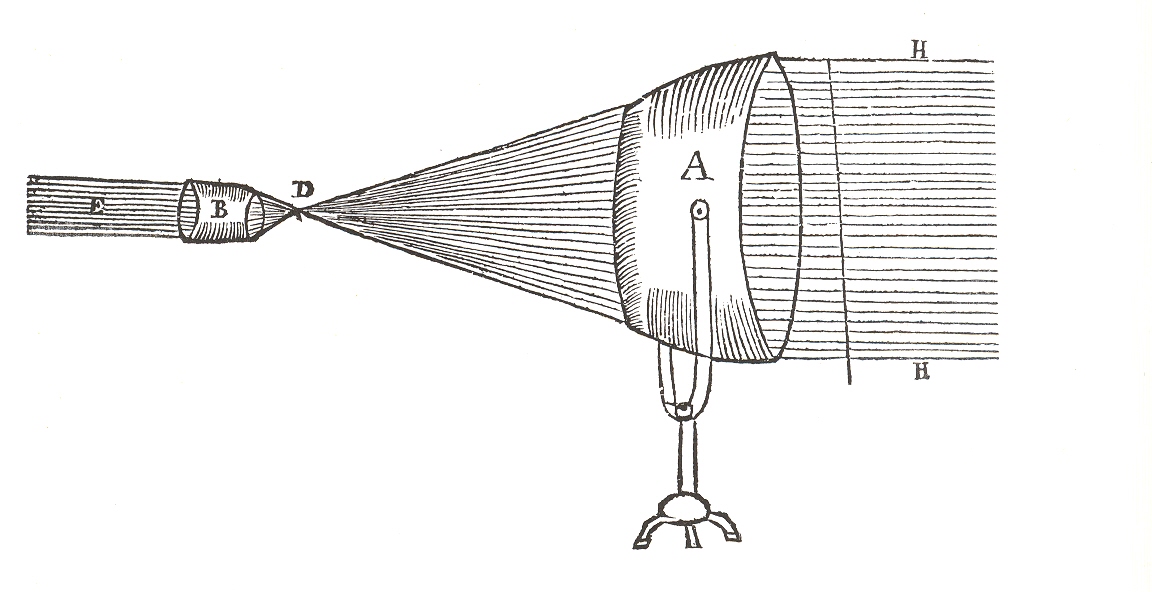
    Mar 12 krirch detail long

    Mar 12 krirch black detail


  • Bombing and the End of the World: the Physics of 1932 And All That

    JF Ptak Science Books 

    1932 in my book turns out to be one of the most collectively epochal years in the history of science.  Certainly others stand out for individual achievements, like 1905 (Einstein’s four papers over two volume of the Annalen), 1687 (Principia), but there are other yeas with fabulous achievements by numerous people.

    Mar 7 airmen det


    1543 is one.  That year witnessed the published of Copernicus’ De revolutionibus and Andreas Vesalius’ De humani corporis fabrica, two giant achievements for the outer and inner worlds, one challenging the structure of the universe and the other the Galenic tradition of physiology and anatomy. (To a lesser extent is Peter Ramus’ Animadversions on Aristotle which was a very sustained and elegant attack on the ancient-precept Aristotle an physics.)

    1859 saw the publication of On the Origin of Species…JC Maxwell’s work on the kinetic theory of gases, Riemann’s hypothesis, and the spectacular invention of the spectroscope of Kirchhoff and Bunsen (that turned much of the invisible universe visible).

    Mar 7 airmen det 2


    1939 (nuclear fission, chain reaction, neutron stars, magnetic moments, penicillin (advancement), Vit K, FM) and 1948 (nuclear structure, QED, transistor, Big Bang) also come quickly to mind.

    1932, though is really quite something, seeing a sweeping array of discoveries in the large and small.  Carl Anderson identified the positron while James Chadwick discovered the neutron; also, the Joliot-Curies’ made their monumental discoveries in radiation.1 Iwanenko described the neutron as a constituent f the nucleus, while Heisenberg described the nucleus as composed of protons and neutrons.  Knoll and Ruska built the electron microscope, allowing a vision of the interior parts of the interiors of the smallest things, offering images almost as spectacularly new as Hooke’s two centuries earlier.  Looking up and out, in the same year, Lev Landau postulated the existence of neutron stars while Karl Jansky invented radio astronomy. There was also the perfection of the “Polaroid” process by Ed Land, and the isolation of ascorbic acid (Vit C, by  Charles Glen King, and the beginning of a long war between him and Szent-Gyorgyi on priority of discovery).  (In the non-sciences, there was the addition of Franklin Roosevelt and Adolf Hitler to their national agendas. It was also a banner year for literature: Death in the Afternoon, Ernest Hemingway; Light in August, William Faulkner; 1919, John Dos Passos; The Thin Man, Dashiell Hammett; Tobacco Road, Erskine Caldwell; Young Lonigan, James Farrell; Little House in the Big Woods, Laura Ingalls Wilder; and Brave New World, by Aldous Huxley…)

    Mar 7 airmen 


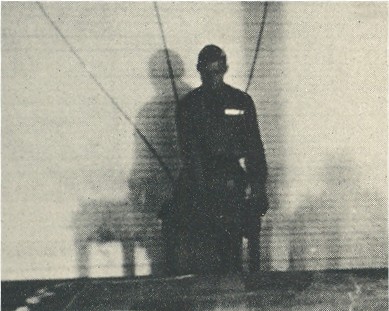
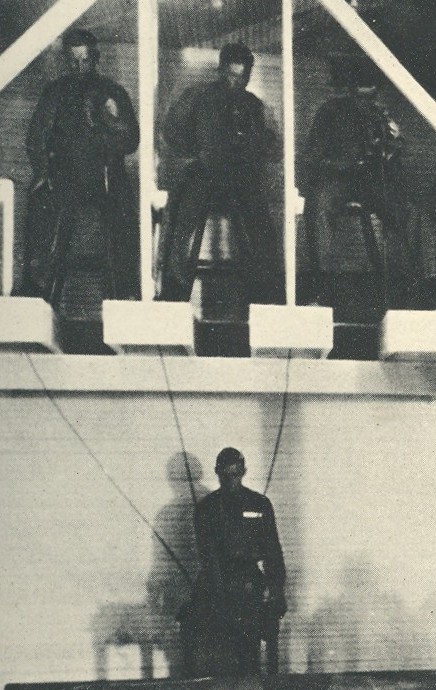
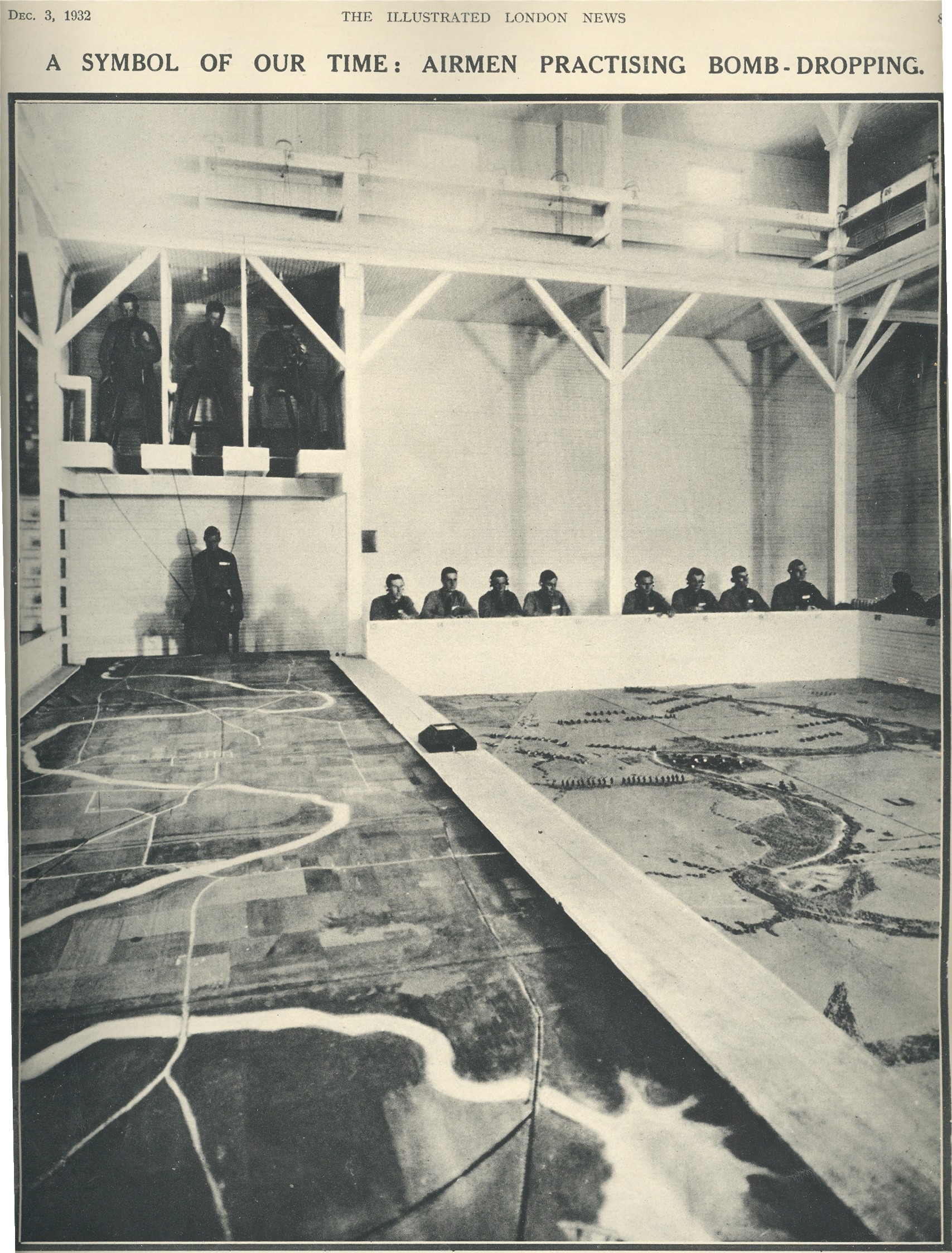
    The thread of thinking about all of this came to mind looking at this image of a bombing instruction room for aviation in England in 1932.  The image is also a great one; the aviator at far left looks like a marionette; the three men above responding to his piloting maneuvers as he concentrates on the endless panoramas of landforms that advances before him on a horizontal diorama.  It is a fabulous analog flight simulator constructed at a time of great change in aviation

    Wonder stories

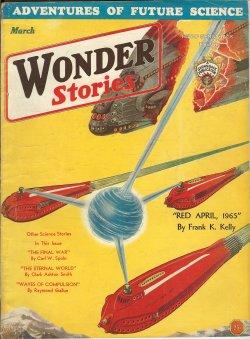
    1932 is also the year of the publication of Carl W. Spohr’s classic future-vision/speculative fiction apocalyptic-atom bomb end-of-the-world two-parter (so many hyphens!) that appeared in Wonder Stories.2 The story begins with a relatively simple series of catastrophic bombings that lead to a sort of détente, a kind of mutually assured destruction, which is then upset when the combatants discover and construct the atomic bomb.   MAD breaks down, and the ensuing massive exchanges result in a  devastated world.   Pretty prescient stuff, all-in-all, even so far as the policy goes—especially so when you wrap this sci-fi story around the elements of 1932—Chadwick, Anderson, Joliot-Curie—that made all of this stuff possible just 13 years later.

    Notes

    1 The Joliot-Curie discovery was called “one of the most important discoveries of the century… the consequences of the discovery of artificial radioactivity are immense” from Segrè, From X-rays to Quarks, 198-199).  

    2.  Part one appeared in the March issue, which also carried stories like“Red April, 1965” by Frank K. Kelly; “The Eternal World” by Clark Ashton Smith; “Waves of Compulsion” by Raymond Gallun; “Mutiny on Mercury” by Clifford D. Simak; “The Time Stream” by John Taine (Eric Temple Bell), and others.  Pretty good bumper crop of sci-fi writers in itself.


  • States of Perfection: Refrigerated Food & the Archaeology of Meat, 1954

    JF Ptak Science Books LLC  Post 965Icebox250–extended

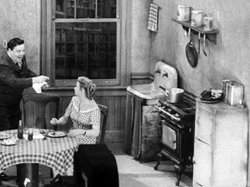
    Like Greek statues, orders of architecture, the golden ratio and Vitruvian man, these ads from LIFE Magazine in 1954 measure a sort of highest-attainable-state, though directed at middle class America.  The ads are for refrigerators, but the interest really is in what is displayed inside of them: they offer an insight into what was seen to be the greatest level of sophistication, the highest stage of want for the most important/essential daily need, and then turned into luxurious accommodation.  Far beyond rice and beans and eggs and ham, far beyond the tiny, perpetually empty icebox of the Kramdens (“The Honeymooners”, ca. 1952).

    [This continues another post, States of Perfection:Images of TV within TV Ads, 1950.]

    You will come to notice (if you look closely enough) that there are a lot of gelatin-thing plates, often located next to a meat plate, or plates.  Funny thing, that.  

    March 6 refer meat

    The top shelf is of great interest, a virtual archaeology of meat:

    March 6 refer meat det 


  • Circle Factories. A Small Chain of Being Between Guns, Sewing Machines, Bikes and Cars

    JF Ptak Science Books LLC  Post 962

    Circle 1 Circle 4

    “The
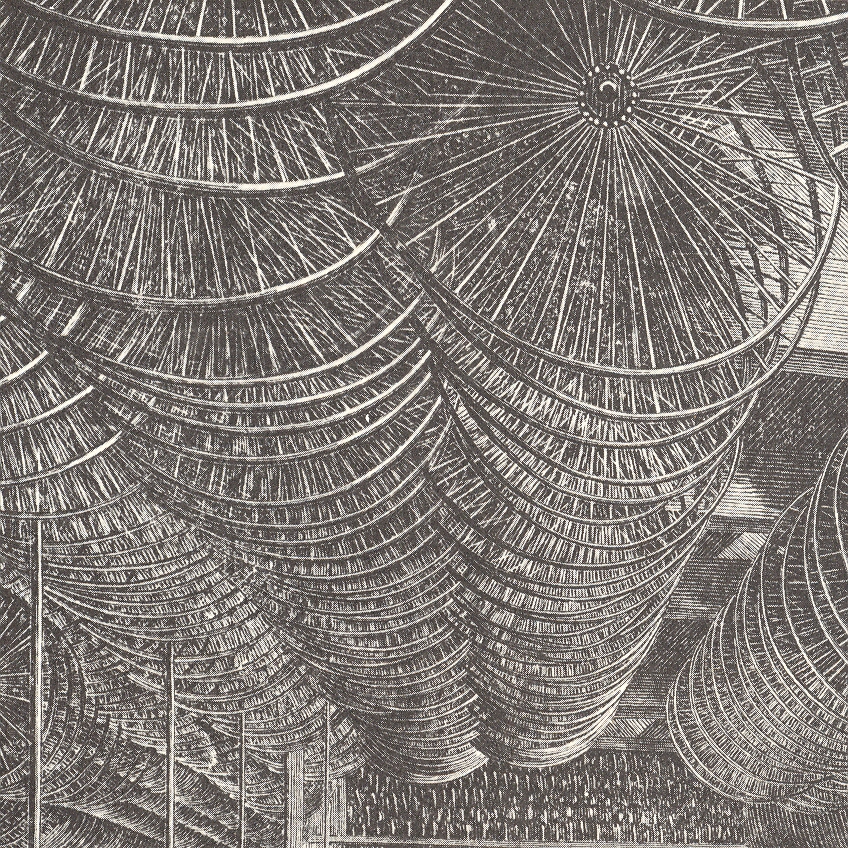
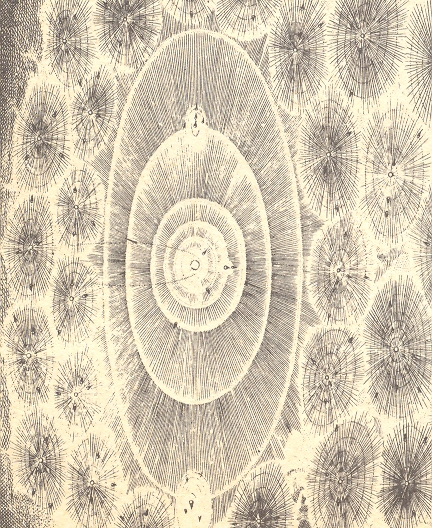
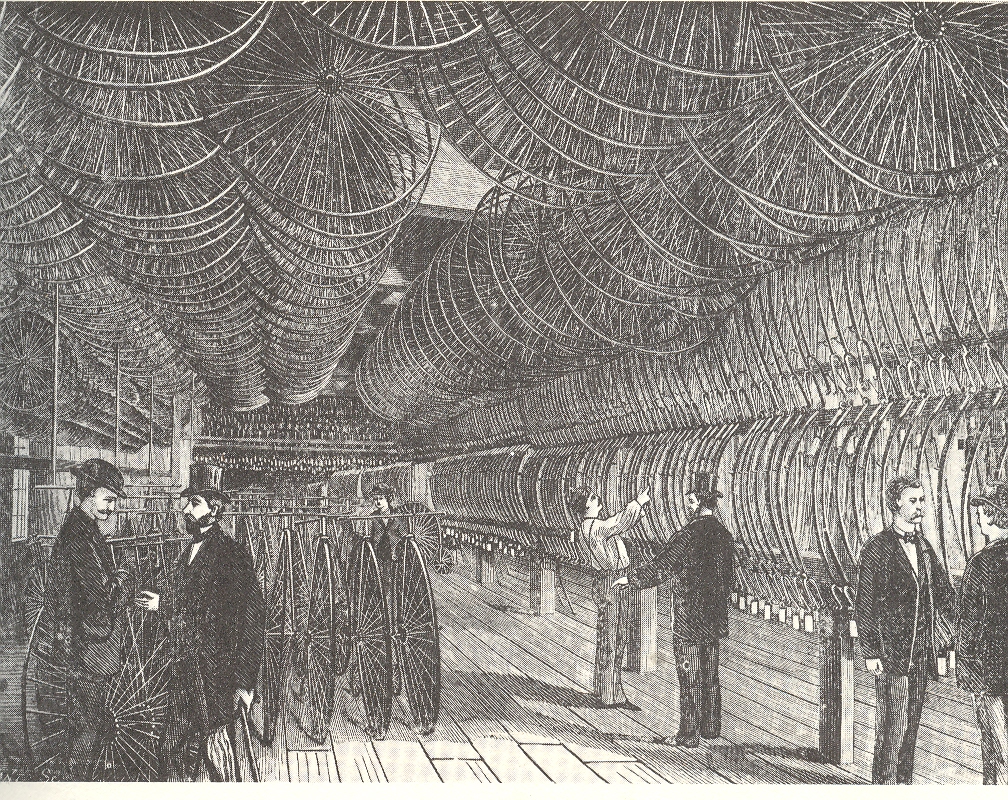
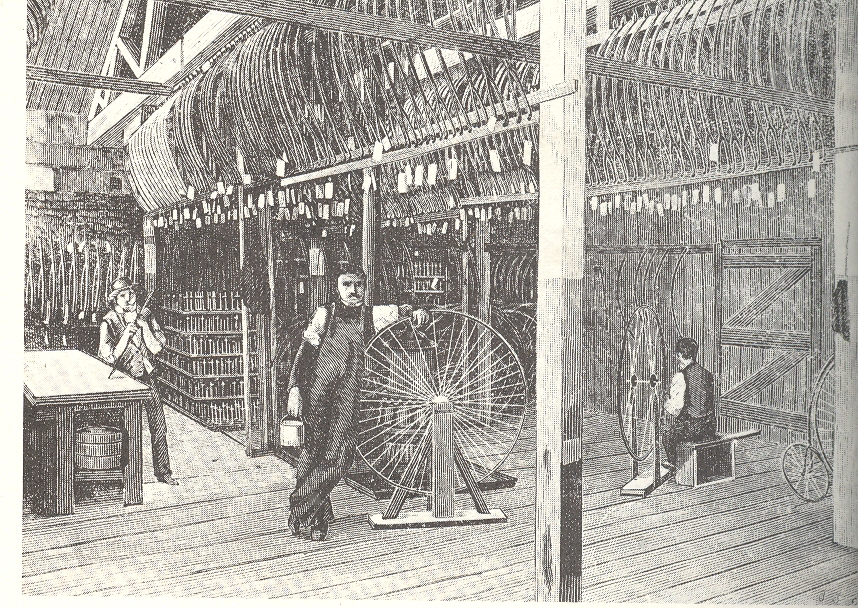
    Circle Factory.” Well, not quite.  Actually, not at all.  The first image is just a detail from the
    warehouse of the ubiquitous Columbia
    bicycle works in 1881.  The second aren’t
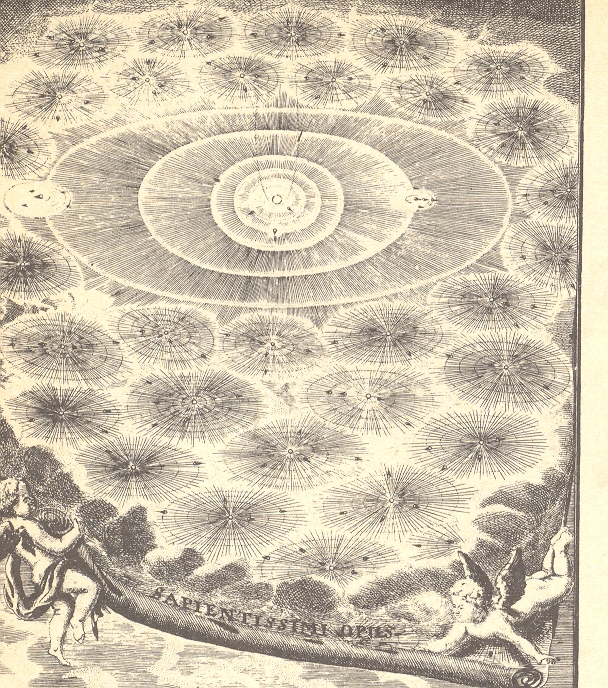
    even circles, but cosmological ovals, and is a detail of a wood engraving
    depicting planetary and  cometary  orbits in Leonhard Euler’s Theoria Motuum Planetarum et Cometarum (1631-1635). 

    The
    bicycle wheels appeared in Bicycling World (for April 1881, “A Great
    American Manufacture”), illustrating a story about the growing interest in
    bicycles in America but more specifically the success of the partnership
    between the Weed Sewing Machine factory and Albert A. Pope in the mass
    production of the bike.  It was a newish
    idea, partially borrowed from the Sharps Manufacturing

    Circle 2

    Company’s mass
    production of weapons with standardized parts, which was employed in the production
    of sewing machines by Weed, and then on to bikes by Pope.  Actually Weed took the step further than
    Sharps by producing almost all of their machines in-house, having a foundry and
    forge right there at the factory.  It was
    this step and then other innovations by Pope that produced an enormously successful
    bicycle production company, with something like a quarter million bikes made in
    the first few years of operation. 

    Circle 3

    The
    Weed-Pope domination didn’t last long though, what with the introduction of the
    remarkable safety bicycle from England
    in 1887—this is instantly recognizable as a “modern” bike, with a chain power train
    and two same-size wheels. In two years there were hundreds of companies building
    those bikes, producing a million a year.  

    By
    1895 this balloon busted, and for some reason Americans stopped buying bikes, with
    demand falling off to nearly nil, causing the vast majority of these companies to
    whither and fold, causing the whole of the bicycle interest to come first
    circle. Or cycle.

    But
    there was a huge lesson learned for future manufacturers of transportation
    devices—namely cars, and more specifically, Ford(s), drawing critical lessons
    in production from forging methods and sustainable assembly lines. 

    Circle 5 Euler
    has nothing to do with bikes or Fords, but he did have a whole heck of a lot to do with circles. (Actually, I just liked the image set against the
    big bike wheels.)


  • Fabulous/Fractured Friday: Three-Channel TV, 1951

    JF Ptak Science Books

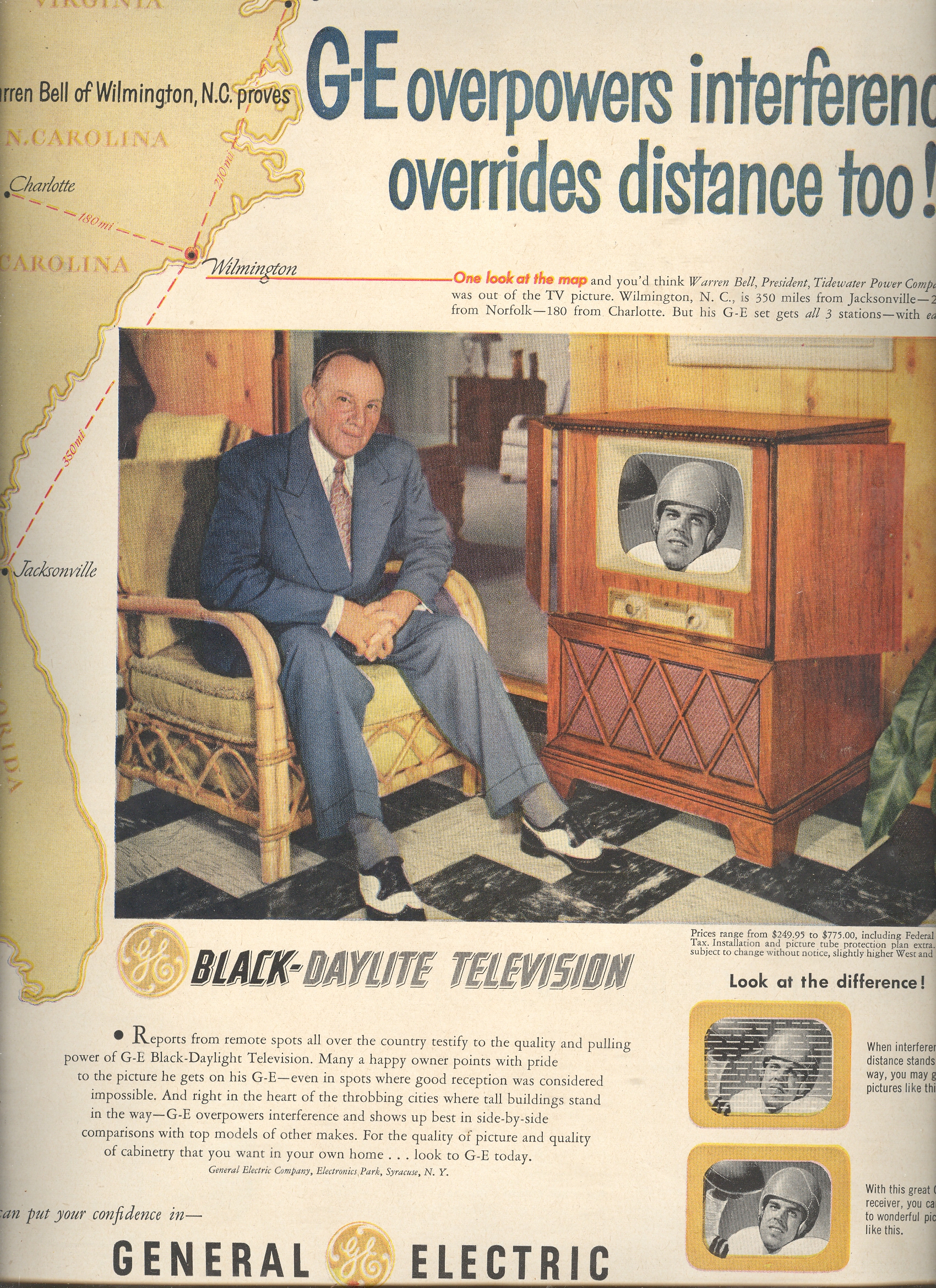
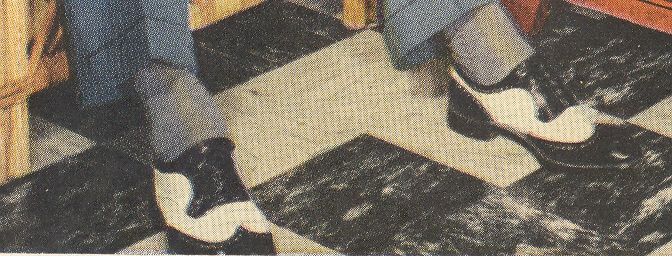
    The fabulous Black-Daylite Television, brought to the well-heeled by General Electric, boasted superior reception qualities in a 250-pound wooden cabinet with electronic tube-y warmth.  For example, the gentleman in the photo was sitting there in his living room in Wilmington, North Carolina,  confident with his fine camouflaged shoes (blending in perfectly with his floor), with the ability to choose between the programs coming from Jacksonville, Charlotte and Norfolk…getting “all 3 stations”.0--tv

    The photo is pretty deceptive:  judging by the tiles on the floor, the television set is almost as long as the lounging chair, and if Mr. Bell’s shoes are a foot long, then the picture he’s receiving is just a wee bit bigger.  The set retailed for about $700, which in today’s dollars comes out to about $9500–it was expensive, and cost as much as some modest cars. 

    0--tv det

    ·Posted by :

    ·in:


  • Bad Sounds Department: the V-1, 1944

    I remember seeing a film (with sound) many years ago, when I was little, back in the mid 1960’s, of a V-1 in flight.  The flying bomb issued a terrifically awful sound, punctuated by the silence when its engine  turned off and it fell to its target in silence. It sounds like death.
    [The V-1, or Vergeltungswaffe 1, (“retaliation”, or “vengeance” weapon), or Fieseler
    Fi 103, or Buzz Bomb, or Doodlebug, was a flying bomb (on the order of a very primitive
    cruise missile guided by a gyroscope autopilot) launched against population centers
    in England by the Nazis during the June 1944-January 1945 period.  The bomb was about 27’ long and 17’ wide,
    weighed 4,700 pounds, and reached 400 mph with an 1,800 pound warhead.  Its 8,000+ sorties killed more than 6,000
    people.]

    http://www.youtube.com/watch?v=Q1qsBGTkVSk&feature=related

    And again:

    And again, here:


  • Architectural Palindromes (or Semordnilap), Reversible Structures and Fractally Bad Ideas

    JF Ptak Science Books LLC  Post 9447--car park top

    “The Edge… there is no honest way to
    explain it because the only people who really know where it is are the ones who
    have gone over.
    “–(Dr.)Hunter S.Thompson

    Oddities
    and Curiosities and the Tryphiodorus Award

    Sometimes
    things that were just done because they could be done aren’t necessarily an
    accomplishment—they may use letters in the alphabet and make words, but the
    words really don’t seem to take us anywhere. 
    Literally.  There is a literary practice (and I mean this in a medical
    or forensic sense) in which the writer chooses to not use a particular letter
    of the alphabet, abandoning it for very private reasons into the dustbin of
    abandoned alphabet letters. (That dustbin is generally empty until one of these
    people show up with the idea of filling it, unless of course we expand the
    dustbin to include punctuation, and then it gets filled rat her quickly (though
    not in the Steinian sense).)

    The
    work which most filled the alphabet dustbin more than any in history is probably the
    Odyssey of Tryphiodorus (a Greek grammarian who flourished in Egypt ca. 4th century ACE) effort
    written in 26 parts, each segment abandoning one letter of the alphabet until
    each letter had been completely omitted from one section.. The author could
    have a lot of time by writing this 26-part cycle in all at once, in one part,
    abandoning all 26 letters at the same time—this may have produced a more
    elegant result (with the Bellman’s map coming to mind).

    7--car park mid This
    Odyssey may have produced a sort of a
    lipogramic palindrome, in a  squinty-eyed
    way. 

    Which
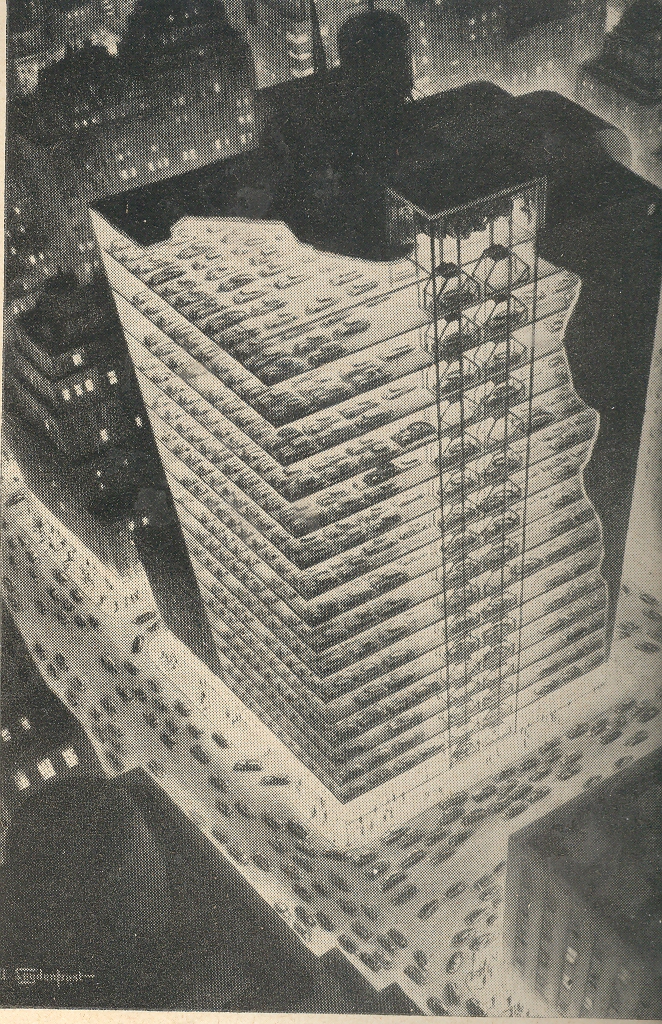
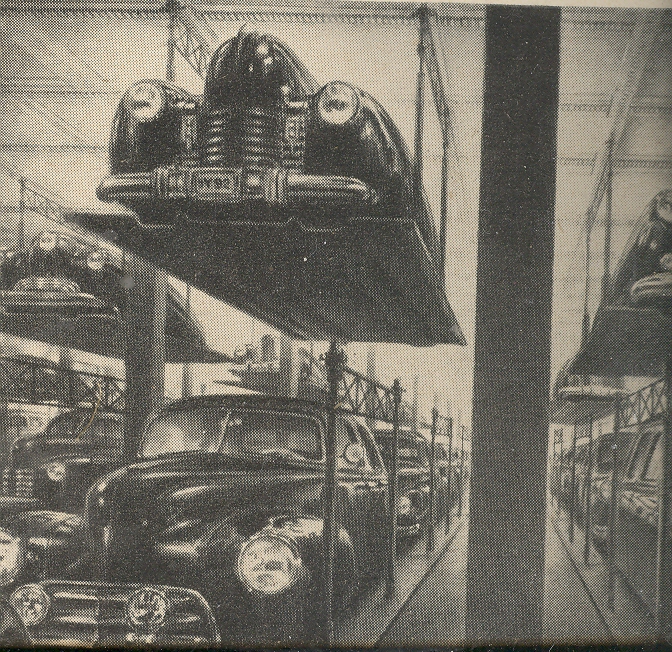
    brings me to this odd structure proposed by real estate mogul and hyper-builder  William Zeckendorf, whose vision brought to
    the pages of LIFE magazine in 1942 (?)  a 
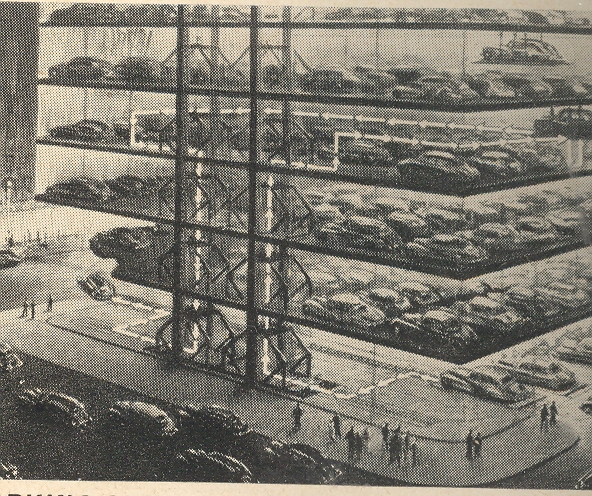
    very tall completely automated structure designed for nothing but car
    parking. People would drive to NYC in their own cars (!) and park them in this
    car hotel; the car functions would be given over completely to the building, moved
    into their spots and juggled and finessed into position by conveyors and forklifts
    and such.  7--car park bot

    Cars
    in a building, moved about free of humans, rested; humans on the street making
    their own human traffic.  The whole idea,
    the entire structure, seems backwards to me, the meaning of a building turned
    inside out, wanting the essential idea, forwards and backwards being simply a
    bad notion.

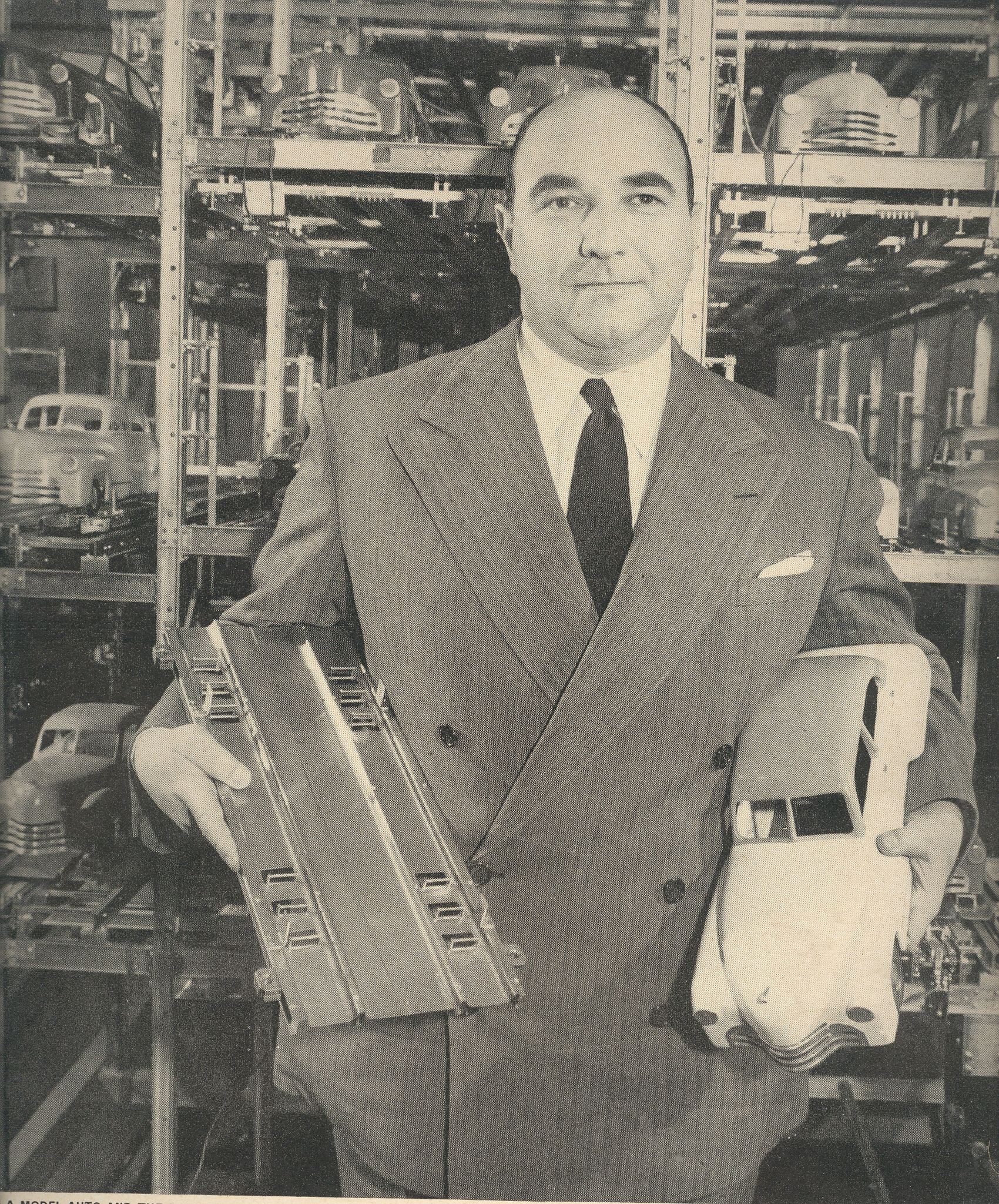
    The
    picture of Mr. Zeckendorf—who was tremendously energetic and who had very many good ideas along with these heavily
    popularized odd plans—standing in front of a lovely (scale?) model of his
    parking structure makes me want to see another, smaller version of Mr.
    Zeckendorf  and his model standing just
    behind it, and smaller one after that, and so on…a fractally bad idea deserving of the Tryphiodorus award for missing the most sense. I bow deeply to Mr. Zeckendorf for trying and for constructing this beautiful (I want it) model.

    7--car portrait


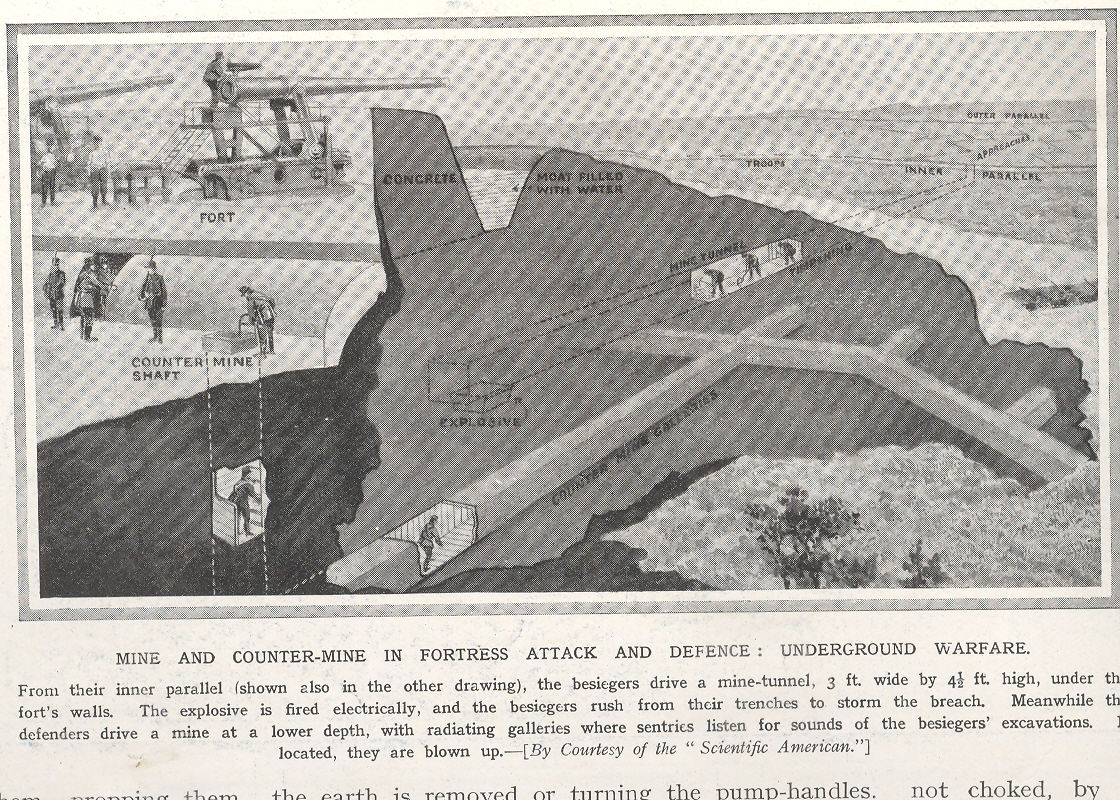
  • Bad Places to Be Dept., #1:Fighting Underground in Sub-Trench Warfare, 1915

    JF Ptak Science Books  Post 922

    “Johnny, get your gun, get your gun, get your gun.

    Take it on the run, on the run, on the run.
    Hear them calling you and me,
    Every Son of Liberty.
    Hurry right away, no delay, go today.
    Make your Daddy glad to have had such a lad.
    Tell your sweetheart not to pine,
    To be proud her boy’s in line.”
    –Opening of George M. Cohan’s “Over There”

    Blog jan 29 trench bot right det

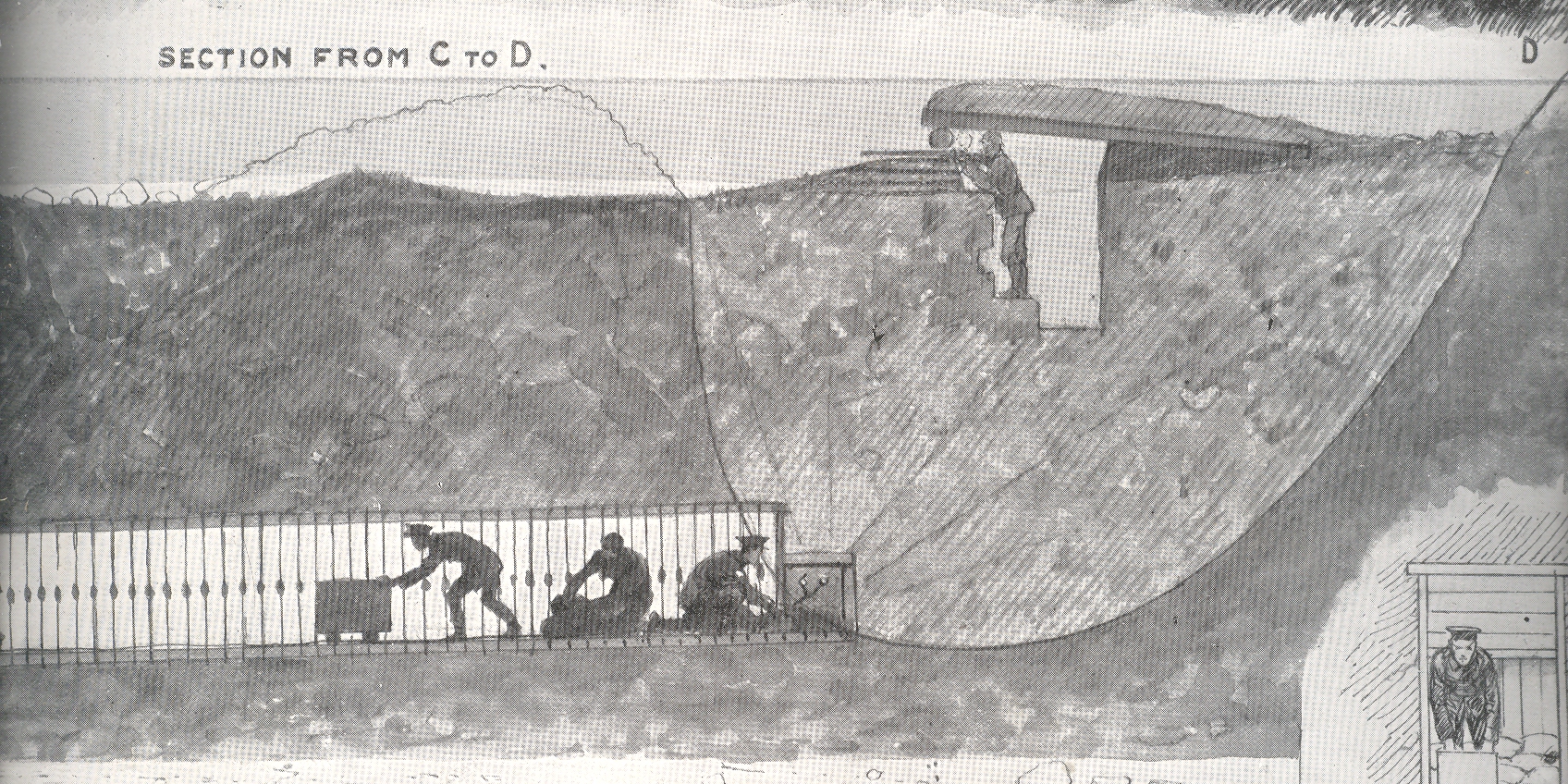
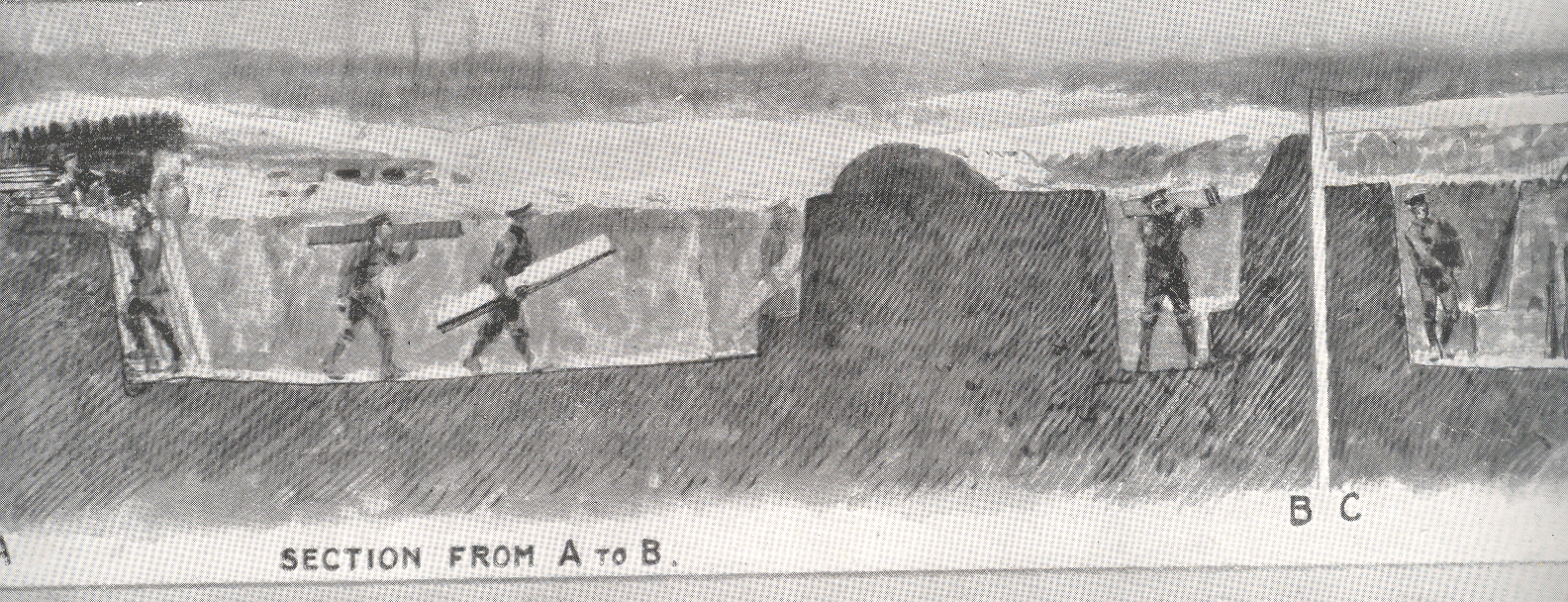
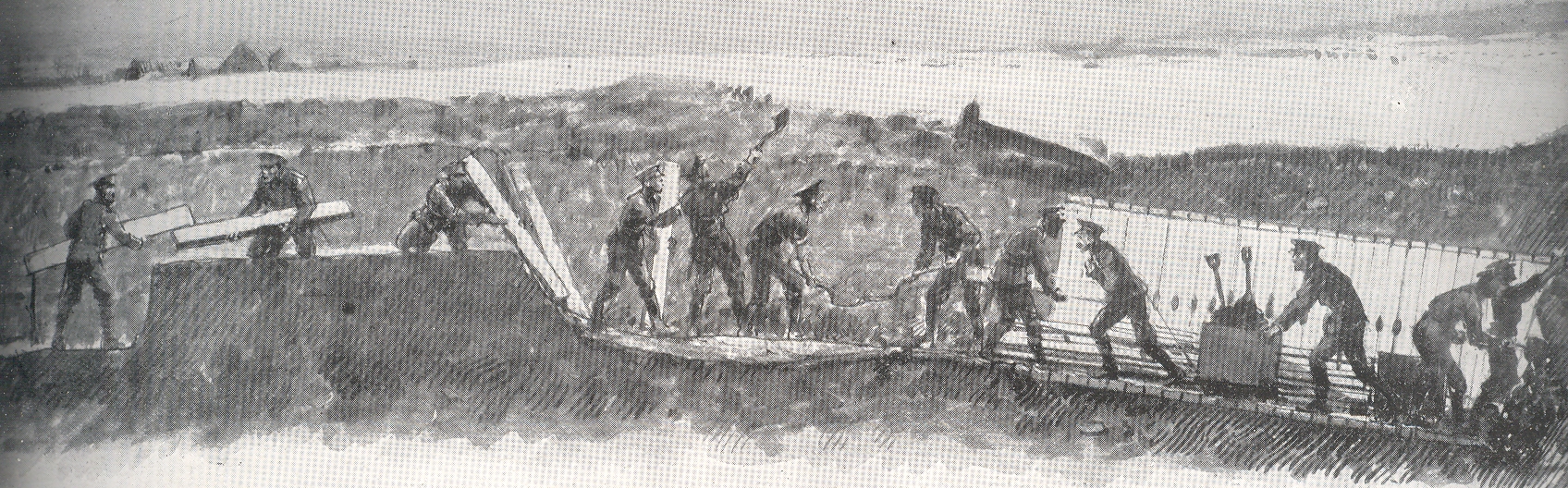
    It is difficult to think of soldiers fighting one another across hedgerows or trenches, hiding behind earth, creating a death-vacuum on the land in between–but worse yet would be fighting in these scenarios underground. 

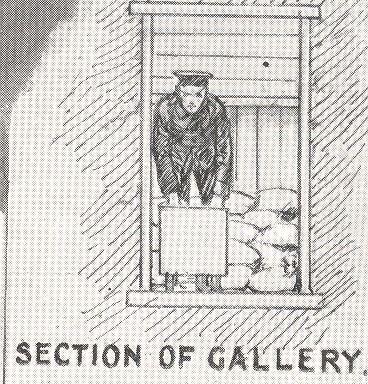
    Finding this large double-page illustration in The Illustrated London News1gave me a physical reaction like the one I get when thinking about the discarded  Dalton Trumbo’s2  anti-war novel, Johnny Got His Gun.  The novel’s main character (Joe Bonham) is virtually encased in his own mind, having lost his arms, legs and face in an explosion on a WWI battlefield—the story is told from his bedridden perspective; dark, bandaged, alone, his mind and brain functioning, and with little means of communication or control over his body. .Among other obvious things, it makes me feel a peculiar stuffy coldness.  [The two sets of four images following should be viewed as two-parts of one long image, the bottom part being on the right.]

    Blog jan 29 trench botm left


    Blog jan 29 trench bot right

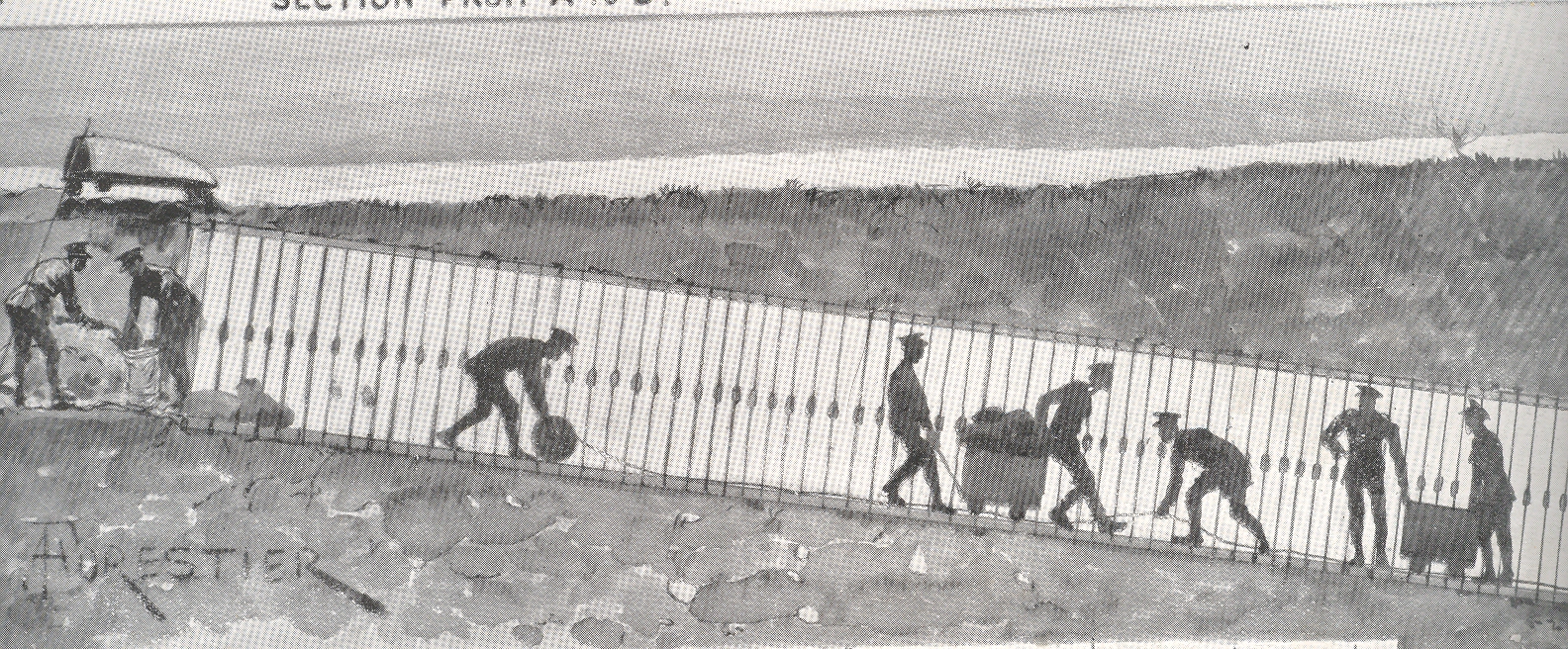
    And so too when I look at these soldiers tunneling under a dead battlefield, working their way slowly—a foot an hour—towards the enemy trenches, desperately trying to blow a hole in an immovable object resistant to infantry and artillery.  The soldiers—sappers—were sent in to do a job that could no longer be accomplished above the ground.

    This sort of warfare is extremely old, though the name is not, being about 150 years old. These soldiers were forward combat engineers, and had training across a number of different areas—they were responsible for many technical chores, like building (and blowing up) bridges, laying/clearing minefields, general demolition, defense construction, and, of course, fighting.  It could be a tremendously difficult job, unimaginable.

    Blog jan 29 trench mid left 1


    Blog jan 29 trench mid right


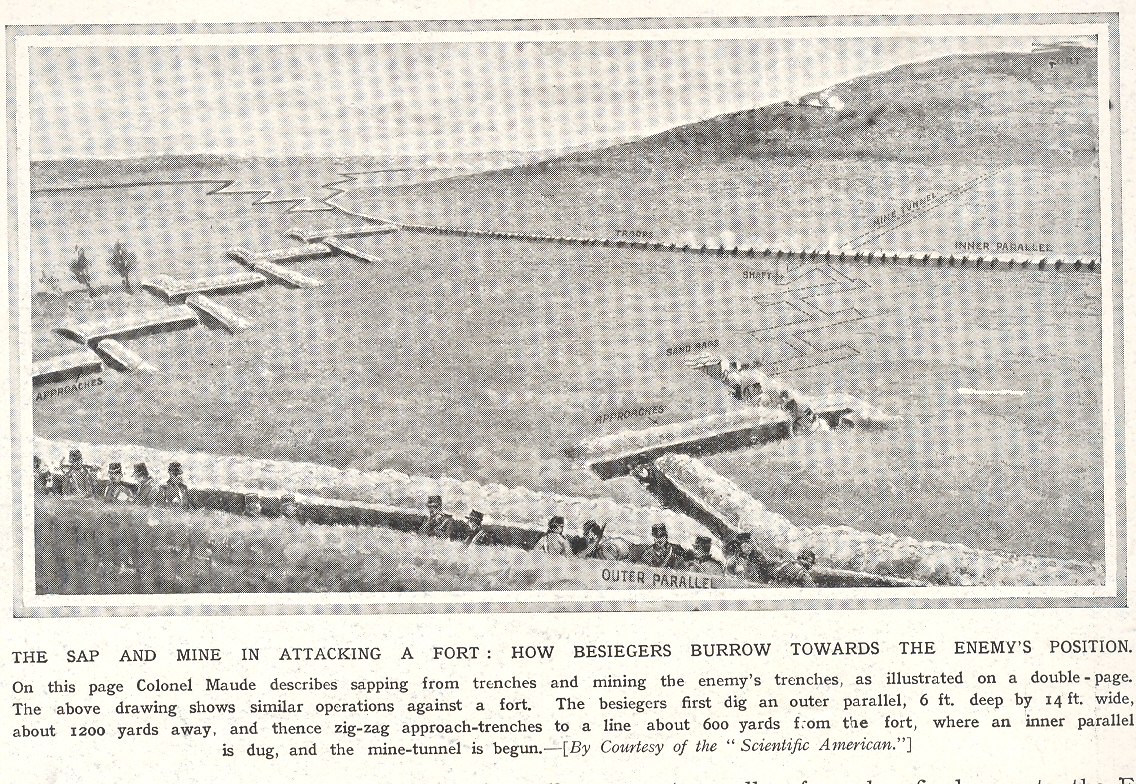
    The “sapp” part of “sapper” comes from the French “sappe”, which refers to the other main part of their job during WWI, which was digging advancing trenches, a zigzag construction of a long horizontal half-hole which allowed an infantry force to slowly advance towards an enemy’s entrenched position. Another part was to tunnel under the enemy’s lines, and then blow them to smithereeens so that a successful attack could be launched into the weakened position.


    Here’s what I think about when I think about these men doing this job:  that two teams, British and German, start to tunnel towards each other’s lines, and somehow, in the middle of the battlefield, somehow manage to dig directly towards one another, their tunnels literally colliding.  Hand-to-hand combat through the opening connecting the two sapper tunnels, then gunfire.  Alerted, the artillery from each side zero-in on what is suspected to be the opening end of the tunnels, pummel them, destroying the access.  So now, both sets in what is now virtually one tunnel, are fighting in the dark.  Even though the topside is only two feet away, any hole would open into the killing zone, making it impossible to escape that way.  It would be a bad place to be.

    Blog jan 29 trench overview sap top Blog jan 29 trench overview sap bot

    Notes

    1. The issue is 27 Feb 1915.  The illustration is entitled “They Sent us in front with a Fuse an’ a Mine’, Sapping and Mining Under the Enemy’s Trenches”. The first half of the title is from Kipling’s “Sappers”: They send us in front with a fuse an’ a mine , To blow up the gates that are rushed by the Line…

    2. Trumbo has an interesting history, to put it mildly. An old Communist, he once gave up his old associates to the FBI at the start of WWII–an act he later thought of as being stupid and wrong.  It also had the opposite effect for him–he thought he was being patriotic, but the FBI was more interested in him than his information.  He would get eaten up by McCarthyist operatives and denied HUAC any information on any of the famous “Hollywood Ten”.  He got a year in jail and was blacklisted, booted out of LA. He came back–mostly under someone else’s name (see the link above for his screenwriting credits, which are substantial)–and acknowledged shortly before he died.


  • Flying Wing Aircraft, 1930

    JF Ptak Science Books LLC  Post 919

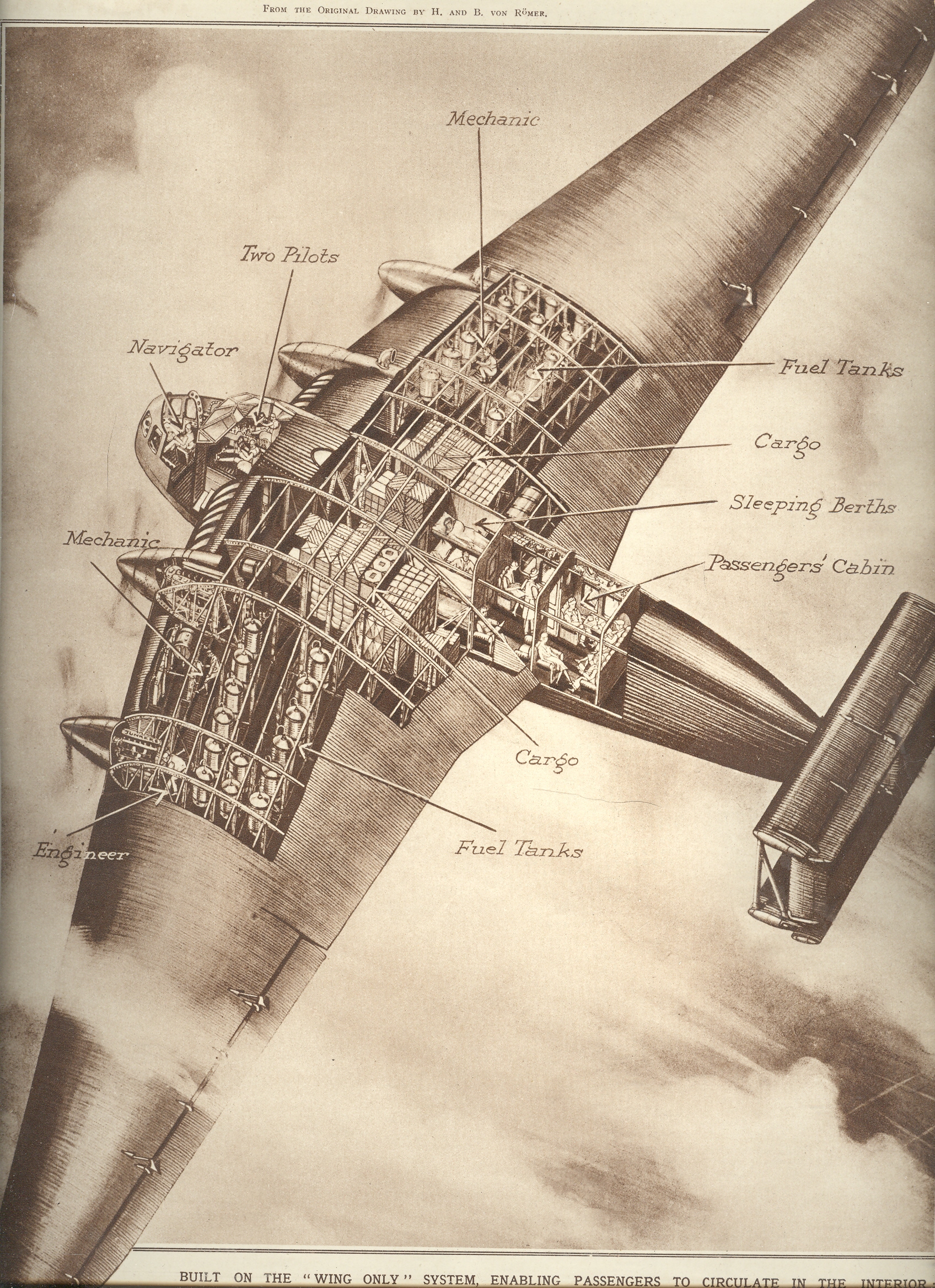
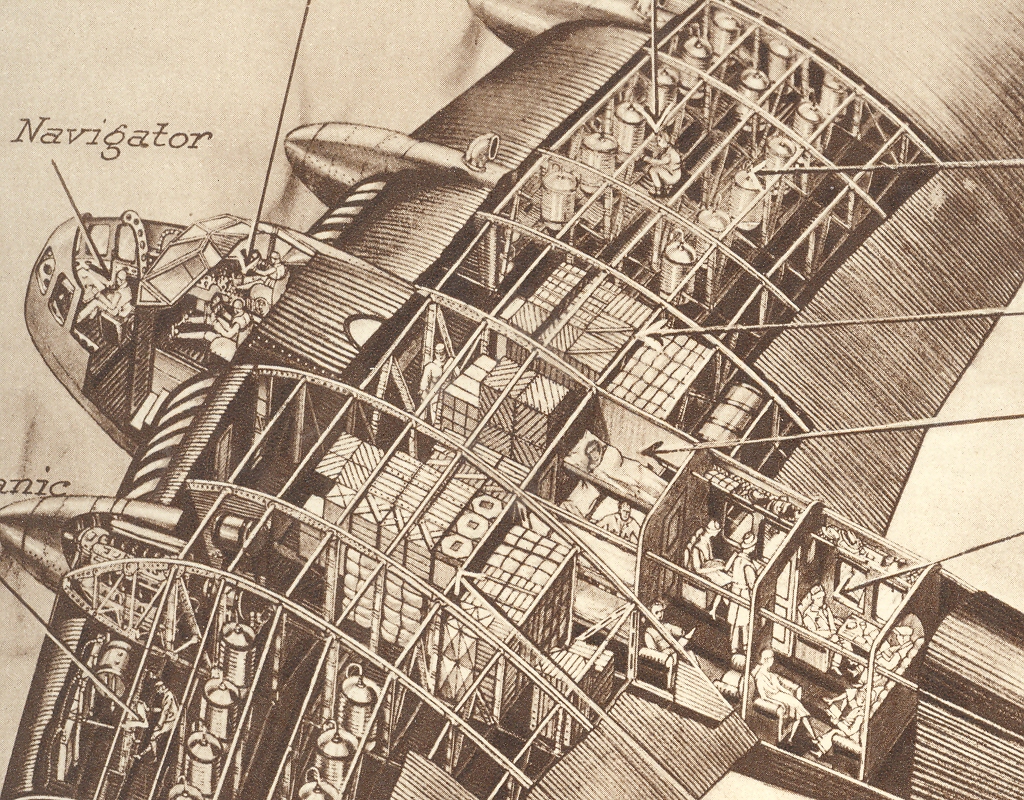
    Blog jan 24 flying wing det title What can I say?  I just like the flying wing. Also I should point out that the Illustrated London News is an excellent resource for schematic cut-aways like this–I think that I have 125 or so of them here for the 1910-1945 period.

    Junkers built this fabulous flying (“inhabited”) “wing only”
    aircraft, sending it up for commercial service in 1929 as the largest airplane
    in the world. Only two were built (though a Japanese military knock-off ran to a production quantity of six), and I imagine that it was quite expensive making the Berlin-London flight, cruising in around at 109 mph.

    Blog jan 24 flying wing

    I would like to know what the artist was thinking about when he decided to draw a standing man in the sleeping compartments. Not only that, the fellow is looking straight at the artist…perhaps it is a sly, tiny self-portrait?

    Blog jan 24 flying wing man

    Blog jan 24 flying wing det


    Notes


    1.  Plane specifications:

    Crew: Seven (including a full-time engineer who could
    service the plane’s four engines from inside the plane).

    Capacity: between 30 and 34 passengers, depending upon
    variation of the aircraft.
    Length:  75 ft

    Wingspan:
    144 ft

    Height: 23 ft

    Wing area: 3,122 sq ft

    Empty weight: 32,893 lbs

    Loaded weight: 52,900 lb

    Max takeoff weight: 46,826 lb

    Maximum speed: 140 mph

    Cruising speed: 109 mp

    Range: 2,150 miles

    Service ceiling: 12,100 ft


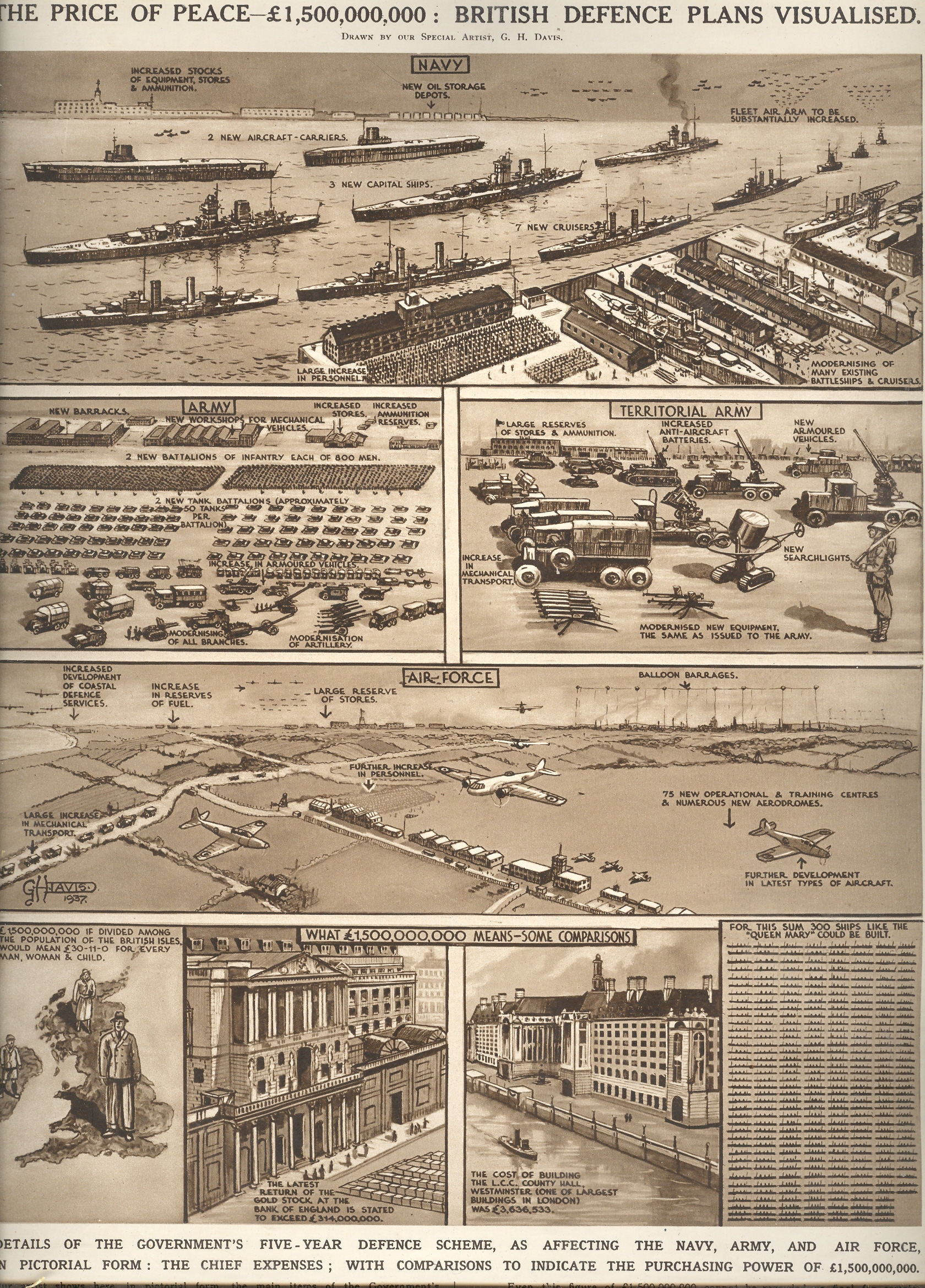
  • What 1.5 Billion Pounds Bought the Military in 1938: Finding a Gem Inside a Great Graphic

    JF Ptak Science Books LLC  Post 916Blog jan 22 Brit Mil overview

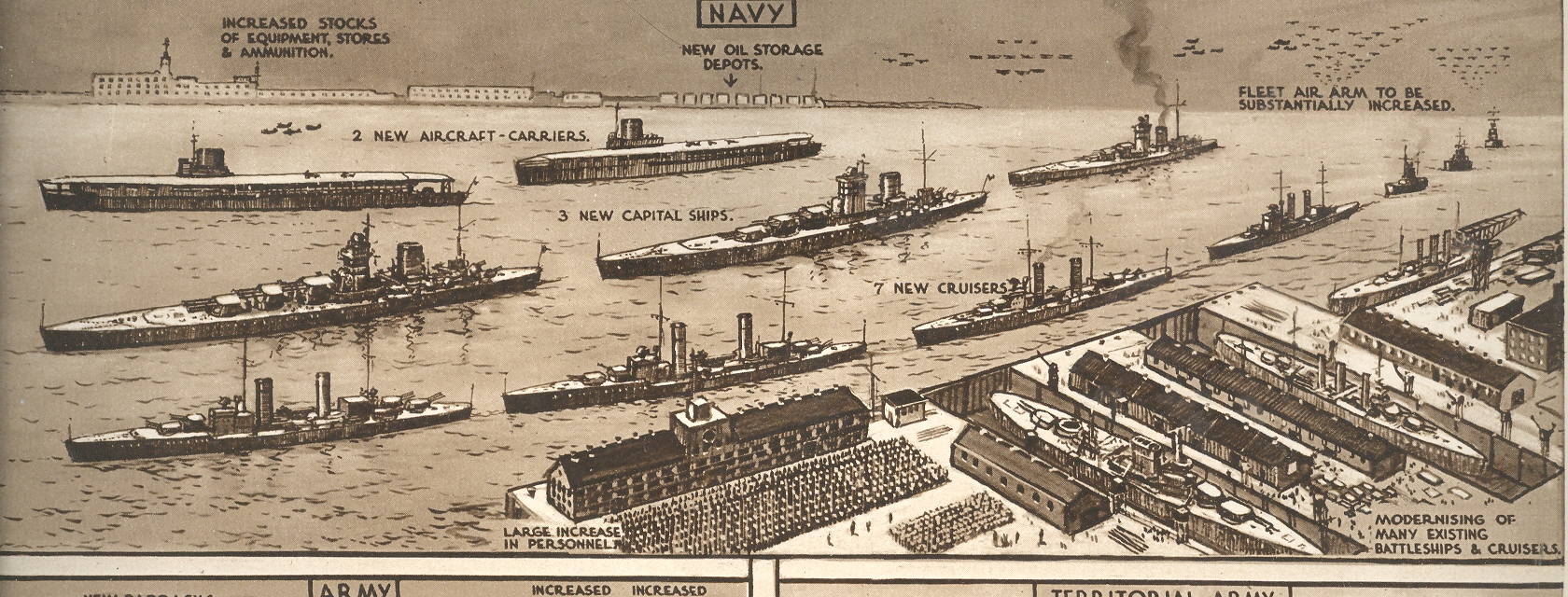
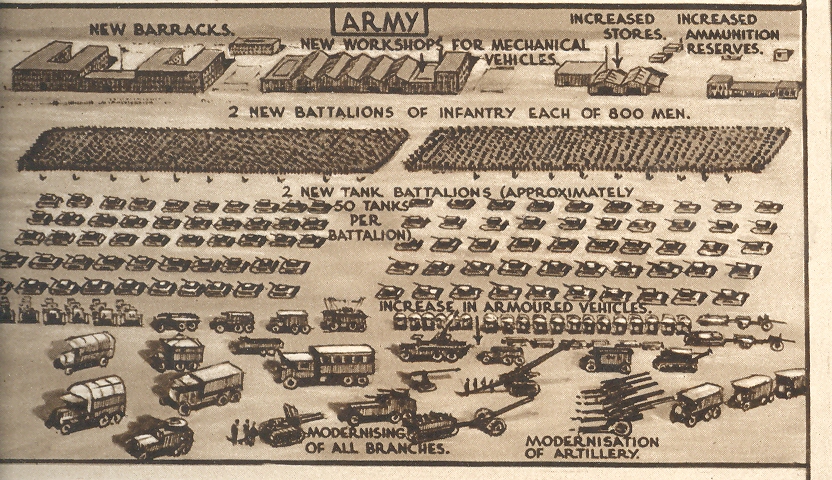
    The Illustrated London News for 27 February 1937 hosted a brilliantly designed graphic illustrating the ways in  which the British War department could/should spend 1.5 billion pounds (or about $100 billion in 2009 dollars, sort of) over a five-year period as the price of keeping the peace.  Of course they wouldn’t make it but a quarter of that distance as Austria fell to Czechoslovakia which fell to Poland and the end.  The full-page pictorial effort is to the right:

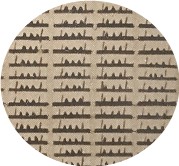
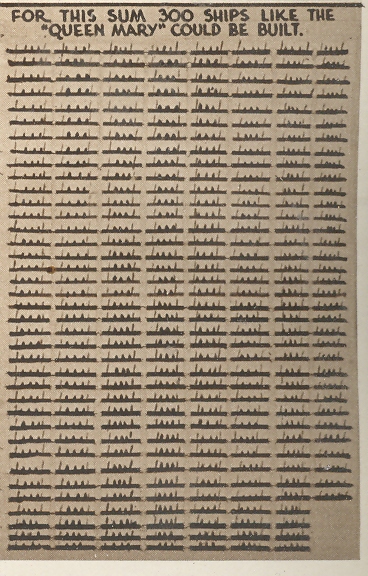
    Nestled in the corner of this page–at about 2×1 inches–is this lovely little graphic, showing that 1.5 bil could purchase 300 Queen Marys, which this delightful little design showed to great effect, and a hidden gem inside of a gem. First is a detail of this detail,

    Blog jan 22 Brit Mil bot right det 

    Followed by the full smidgen of the overall page of comparisons and analogies:

    Blog jan 22 Brit Mil bot right

    Then there’s the semi-standard presentation of what the Navy could purchase:

    Blog jan 22 Brit Mil top

    And then the Army:

    Blog jan 22 Brit Mil middle l

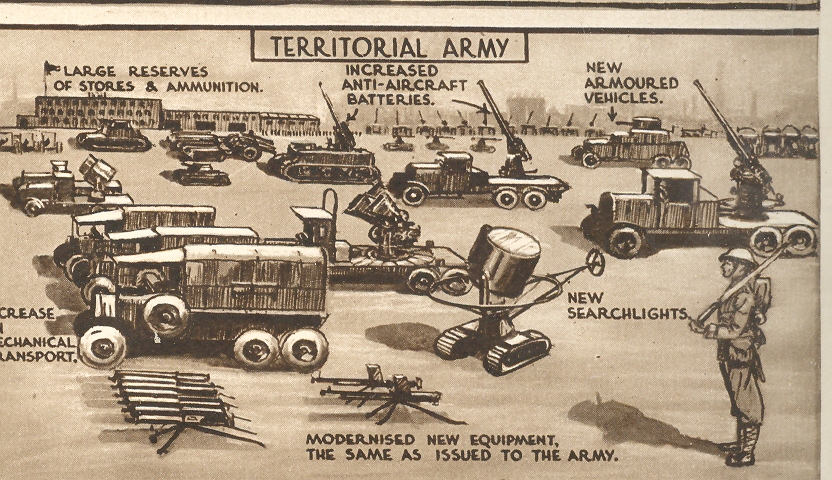
    And of course the Territorial Army:

    Blog jan 22 Brit Mil middle r

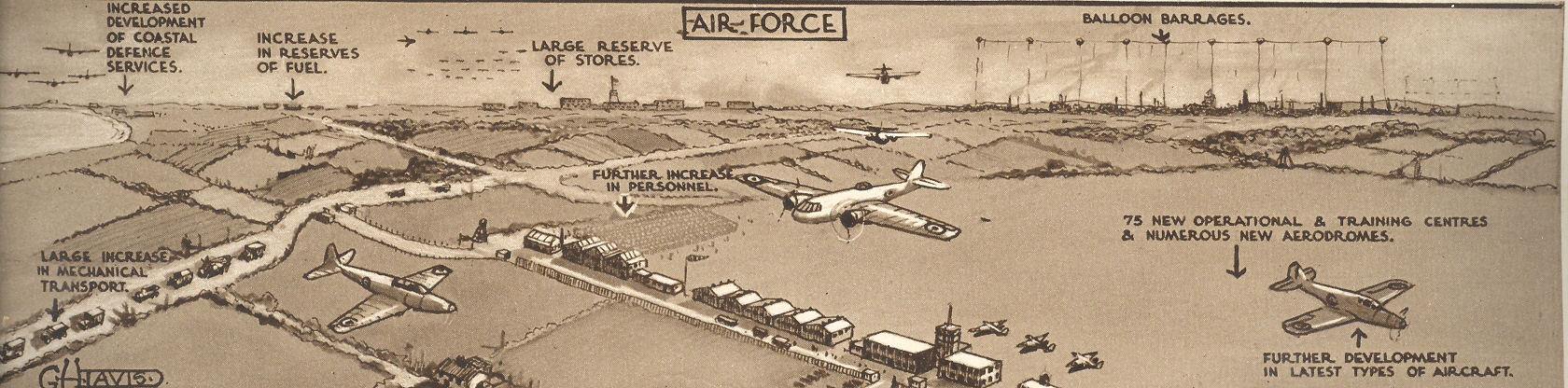
    And the Air Force (which if you look closely includes a balloon barrage  facility at upper right):

    Blog jan 22 Brit Mil middle bot

    By far the most interesting to me is the hidden gemoid of Queen Marys, all produced by the fabulous G.H. Davies, who did many hundreds of such images and sectional cutaways and plans and technical drawings for the ILN over a 25-year period.  M.r Davies may well be my favorite technical artist of this period.