A Daily History of Holes, Dots, Lines, Science, History, Math, Physics, Art, the Unintentional Absurd, Architecture, Maps, Data Visualization, Blank and Missing Things, and so on. |1.6 million words, 7500 images, 4.9 million hits| Press & appearances in The Times, Le Figaro, Mensa, The Economist, The Guardian, Discovery News, Slate, Le Monde, Sci American Blogs, Le Pont, and many other places… 5000+ total posts since 2008.

Category: Technology, History of

  • Display of Quantitative Data: What was Left of the Japanese Navy, 1945 [Short Post]

    JF Ptak Science Books    Post 1220

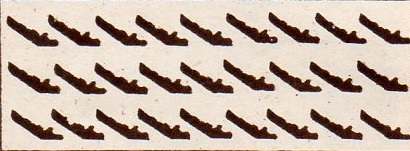
    Japanese sinking detail

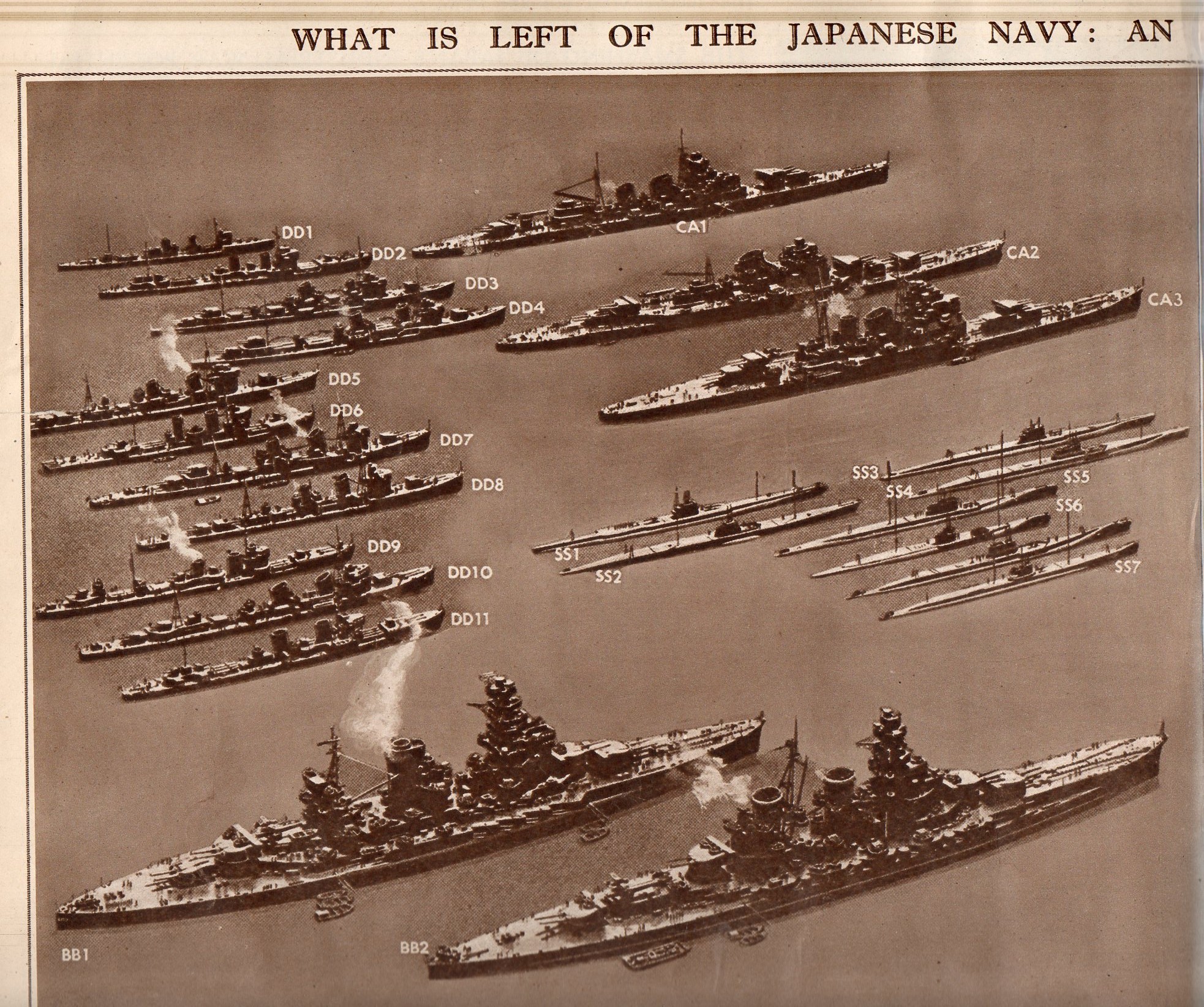
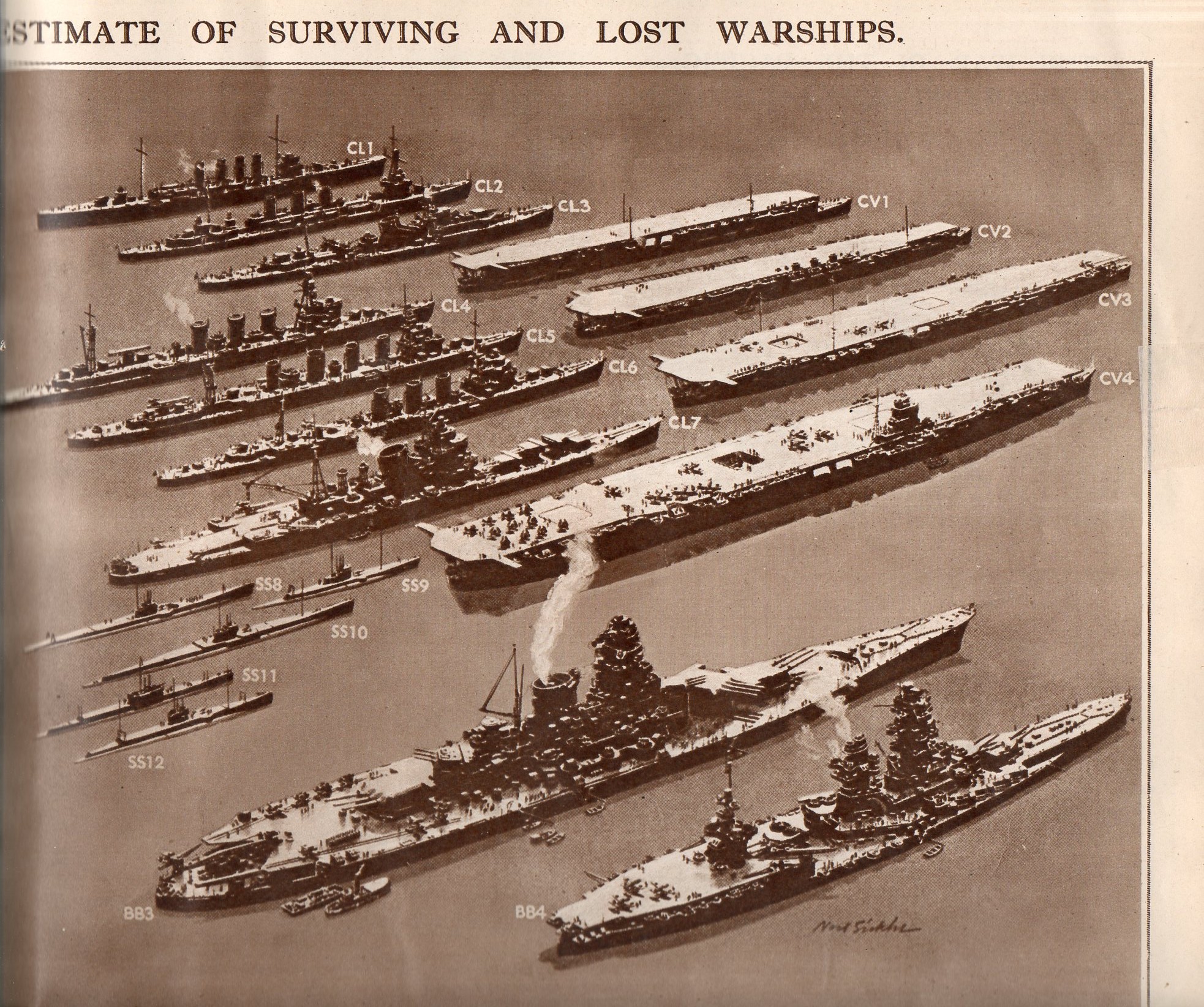
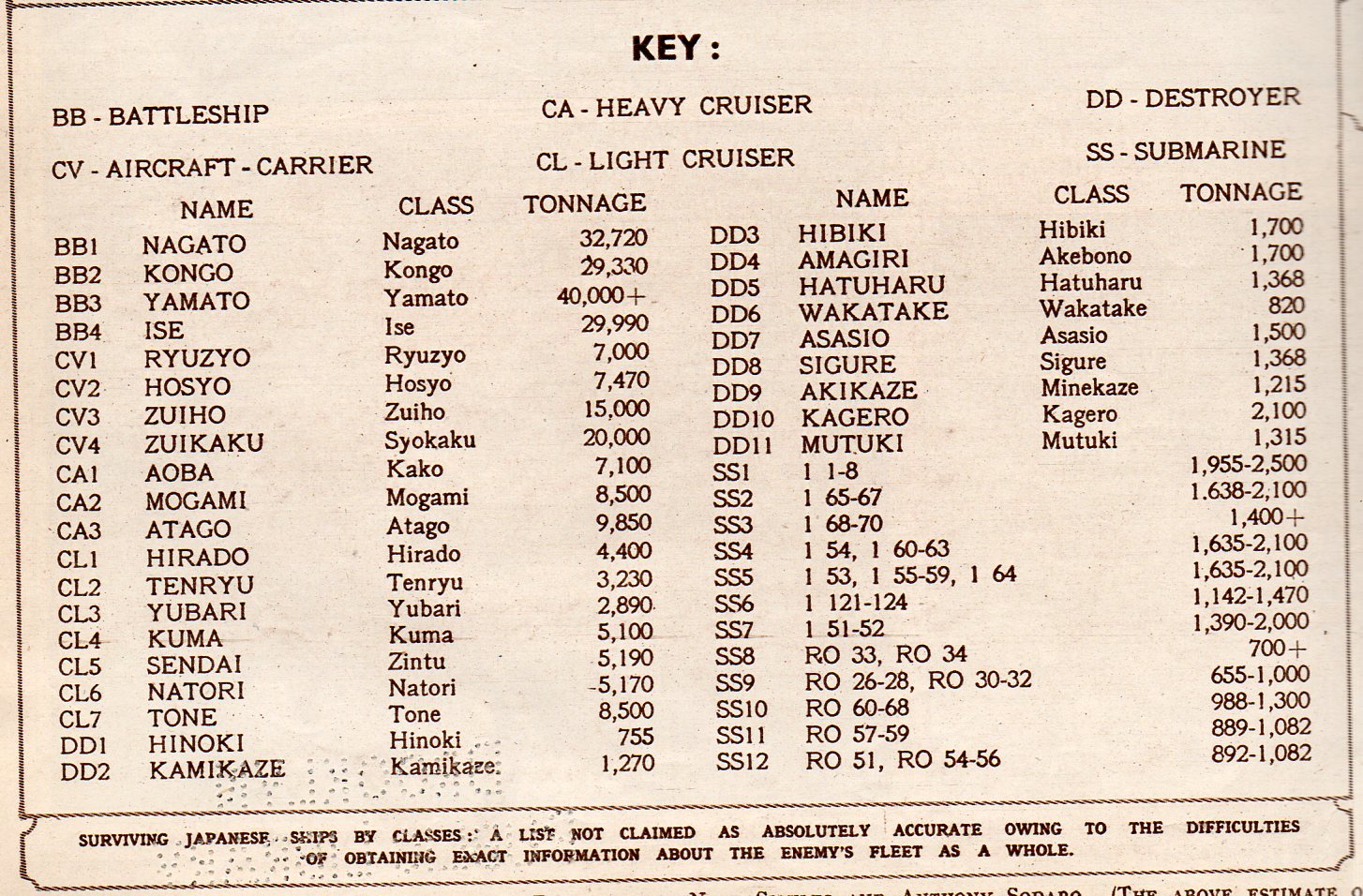
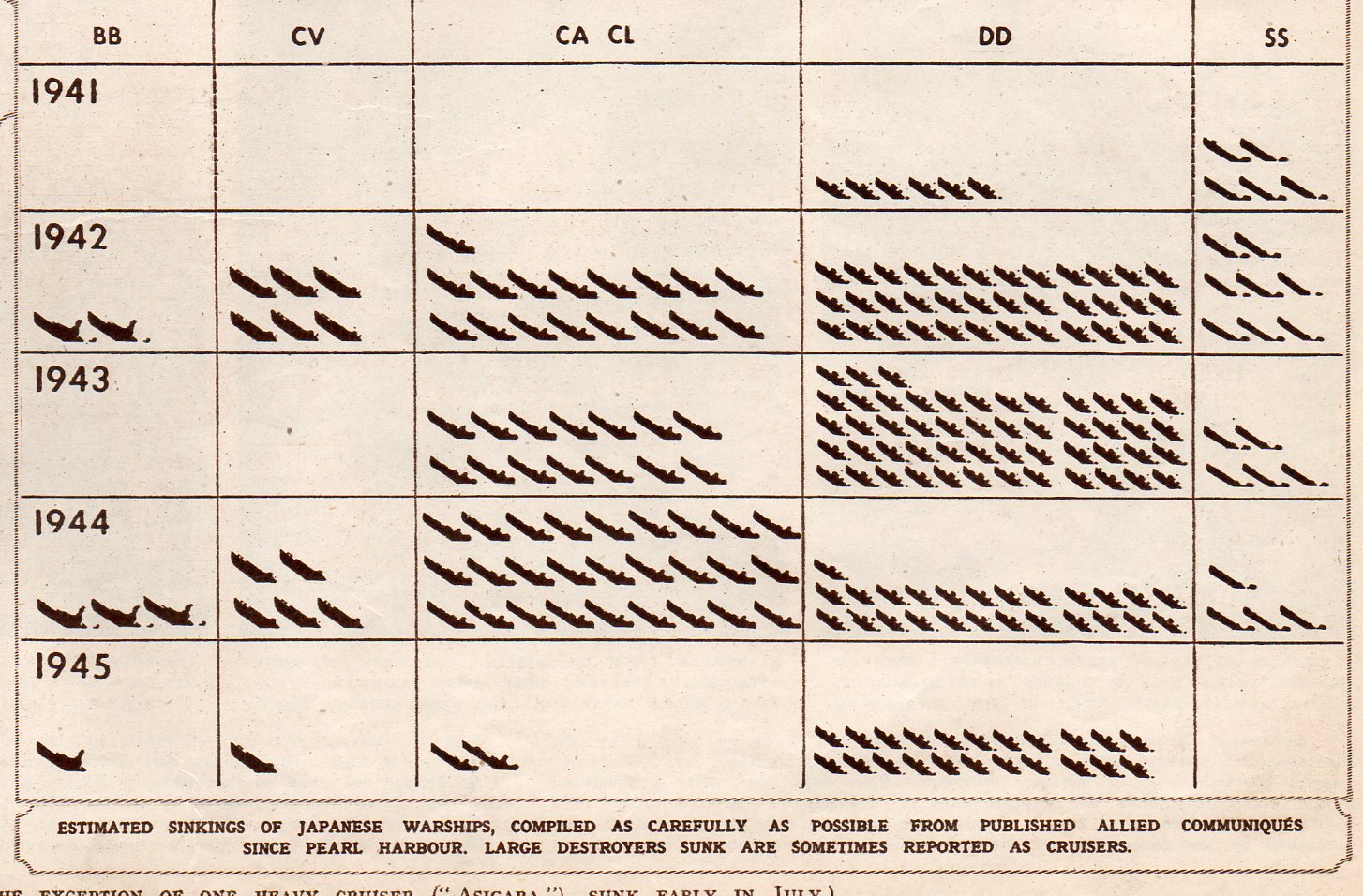
    This double-page spread in the Illustrated London News for 28 July 1945 displays what was left of the Japanese Navy.  Originally appearing in LIFE magazine a few weeks earlier, the image represents classes of Japanese naval ship, multiplied by the estimated number of ships in that class.  Even after all of the great  losses of 1942/3, the Japanese Navy was still the third largest afloat. 

    The navy consisted of an estimated 10 battleships, 6 carriers, 15-30 cruisers, 60-80 destroyers,and an not-estimated number of subs–or at least that is what was being published as the case in LIFE/ILN.

    This is an excellent display of a significant amount of historical data, made quickly understandable to even a quick reader, or even to a non-reader.  Two weeks from this date would find this information about the remaining Japanese Navy to be beside the point.

     Japanese Navy 1205 

    Japanese Navy 2206

    Japanese Navy 3207

    This chart shows the numbers of each class of vessel sunk by year:

    Japanese Navy 4208


  • Cyborgs and Robots, 1920’s: Man as Machine and Machine as Man.

    JF Ptak Science Books   Post 1217
    [Also see my post on producing the geometrical man “Durer’s Beautiful Monster”, here.]
    I’ve written earlier in this blog about the advent of robots and human machines, and I’d like to add these two images to that thread.    Both are male, which is not horribly surprising since the earliest creation of a female robot belongs to the fertile Fritz Lang, who used his creation in his extraordinary movie Metropolis in 1927.  (Male robot-like creations go back fairly deeply into the 19th century; so perhaps the creation of female robots was verbotten because of the possibilities for unacceptable sexual fantasies in the high- and post-Victorian world, struggling under the weight of many and multiply-applied public inhibitions. Perhaps it was because of the possibility of sexual relations with an inanimate object that was the cause for one-gendered robots, or perhaps it was a fear of a powerful, intelligent, unstoppable, superior creation that was also “womanly”.  I don’t know.)
    Robot human machine817

    [Both of these images are available from our blog bookstore.]
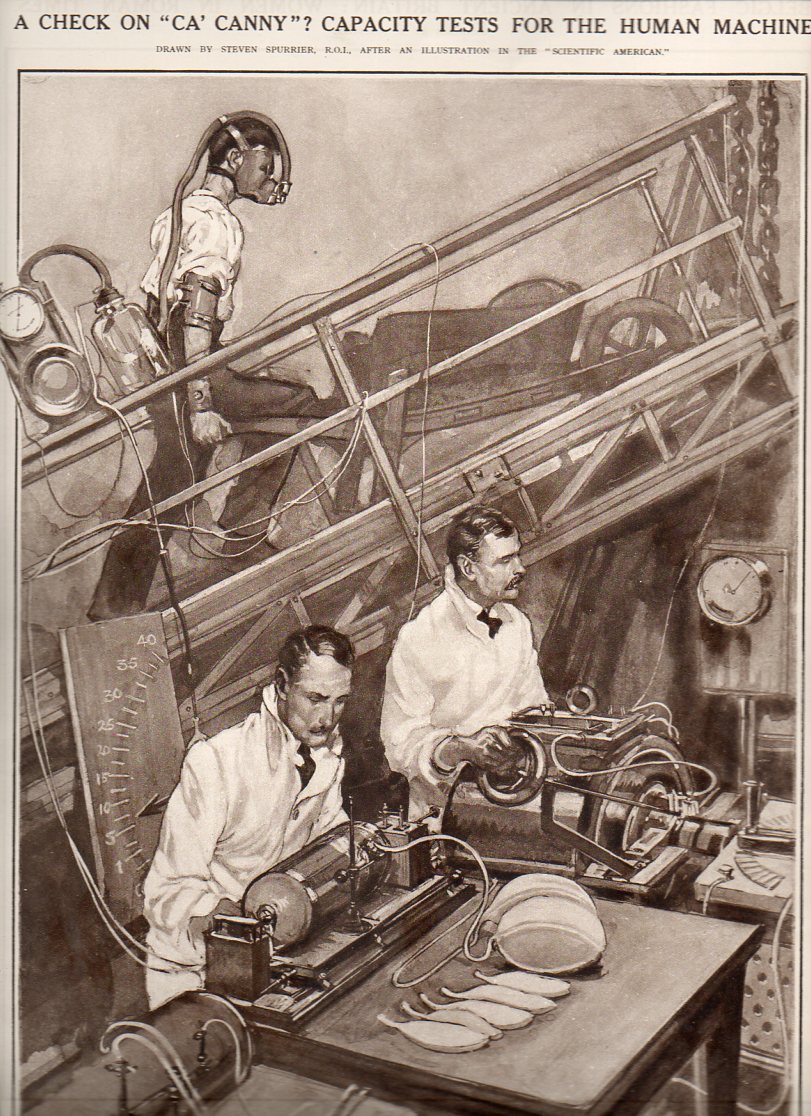
    The first is an image of the “human machine”, a cog-like adaptation of human workers in a Frederick Taylor-like The Principles of Scientific Management study, automatizing and industrializing people.  Though many people had written and worked around Taylor’s 1911 semi-revolutionary book (and not necessarily a good revolution, but one nevertheless), I’m not certain that I’ve seen the worker trussed up so before this, encumbered by so many technical testing elements as to make him look like a cyborg (though that term would still be a while coming into the vocabulary. 

    This image is actually testing a person’s energy expenditure while pushing a wheelbarrow on an incline, and utilizes the newly-created equipment of the French physiologist Langlois, which in 1921  may well have measured for the first time  the real-time changes in the rhythm of the heart and blood pressure, changes in body temperature and lung capacity of humans in an activity.  I have no doubt that the results would have been very interesting to cardiologists, and probably didn’t mean a thing to industrialists like Henry Ford, who would’ve plowed ahead with their demands on their workers regardless of what tests said, schedules being schedules and all. 

    Robot steam816

    (I’m no tsure where this experiment fits in, historically speaking, even within the context of biological advances for that very year.  Frederick Banting was able to do some pretty nasty stuff to dogs in a basement lab somewhere at the University of Toronto and come up with a successful treatment for diabetes mellitus–insulin, which would save the lives of millions and earn Banting a Nobel two years later.  In the quasi/fake biological arenas came two biggish events: Jung’s creation of the concepts of introvert and extrovert, and Hermann Rorschach’s one-way conversational device for detecting psycho-pathological conditions (in people).  I suspect that the Langlois data would fit in there somewhere along the rough edge of Jung and Rorschack, if only because the data was real.         

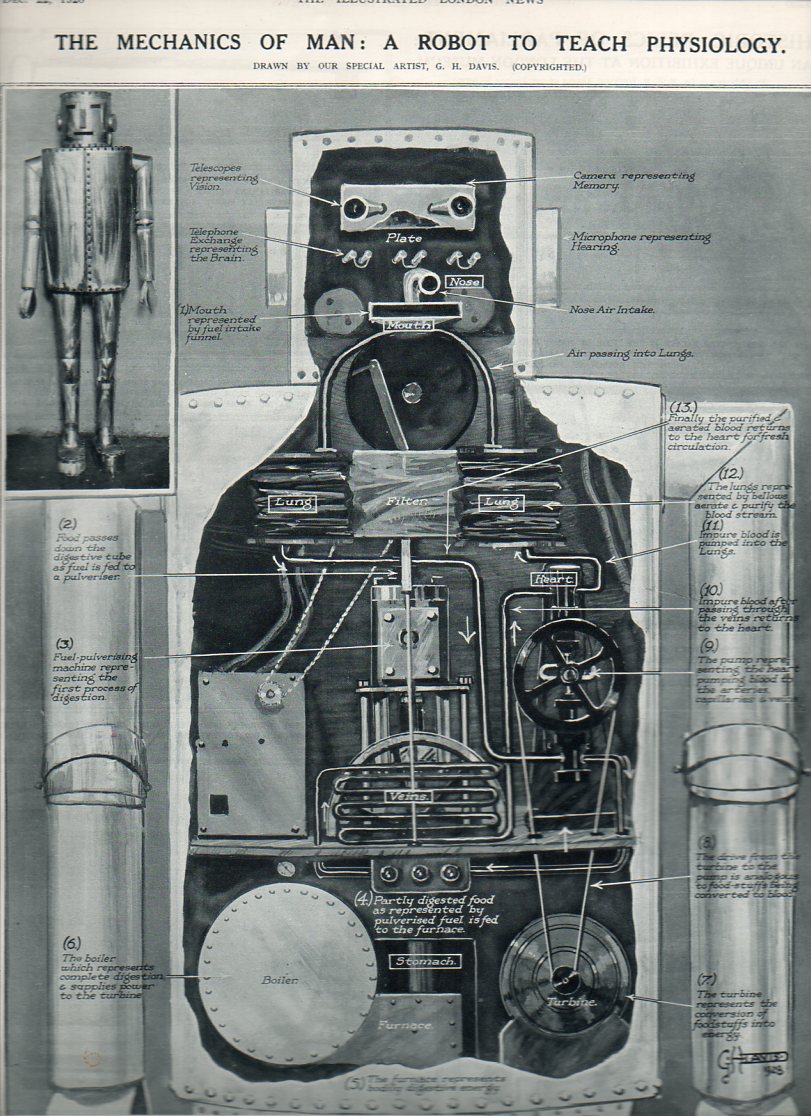
    The second image is in a way a reverse sequence of the preceding–an out-and-out robot that was being used to teach human physiology.  In this case, the robot was a steam engine, constructed for the Schoolboys’ Exhibition at the New Horticultural Hall for 1928, perhaps under the  influence of Karel Capek’s newly published drama R.U.R., which coined the term “robot”. The biological functions of humans were reinterpreted along a more user-friendly vocabulary of the steam engine, using pumps, boilers, hinges, belts, pulleys, filters, compressors and a furnace to explain the functions of respiration and circulation.   It was an interesting approach to show these functions on their most basic level–and in less than 75 years, many of these mechanically represented organs were actually replaceable by real mechanical units performing the same task as the biological (as in the heart), while others could be replaced (via transplant).

    Man as machine and machine as man.


  • A Do-It-Yourself Paper Digital Computer, 1959.

    JF Ptak Science Books    Post 1210

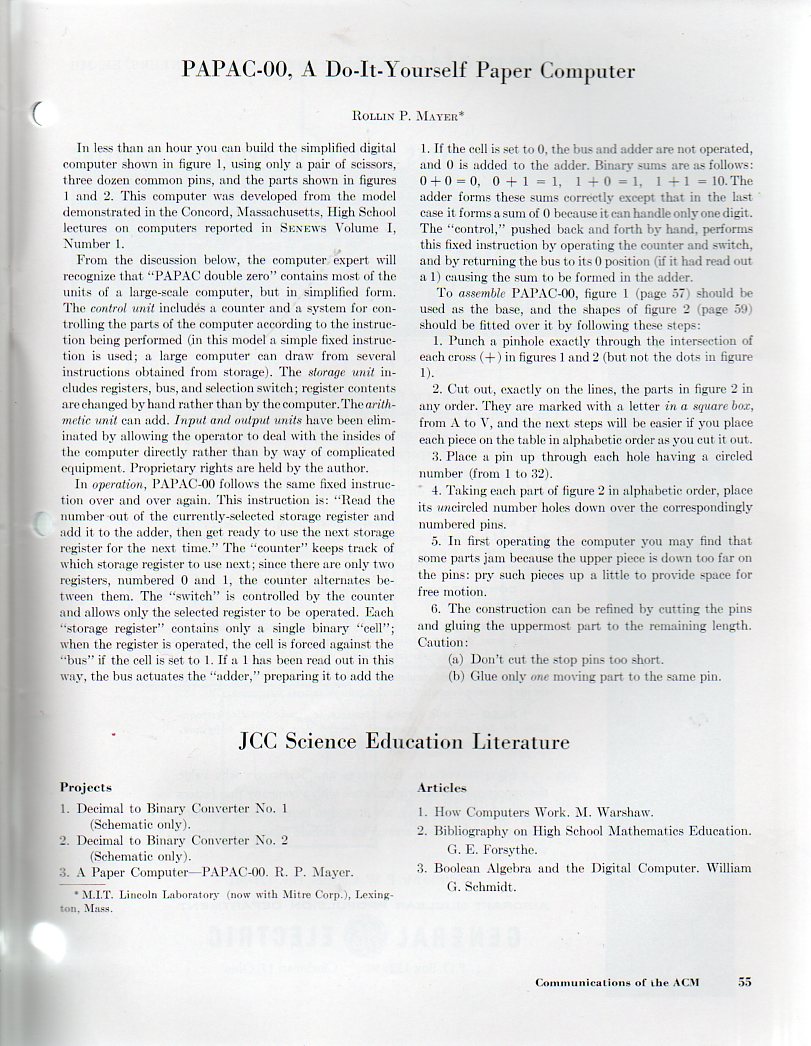
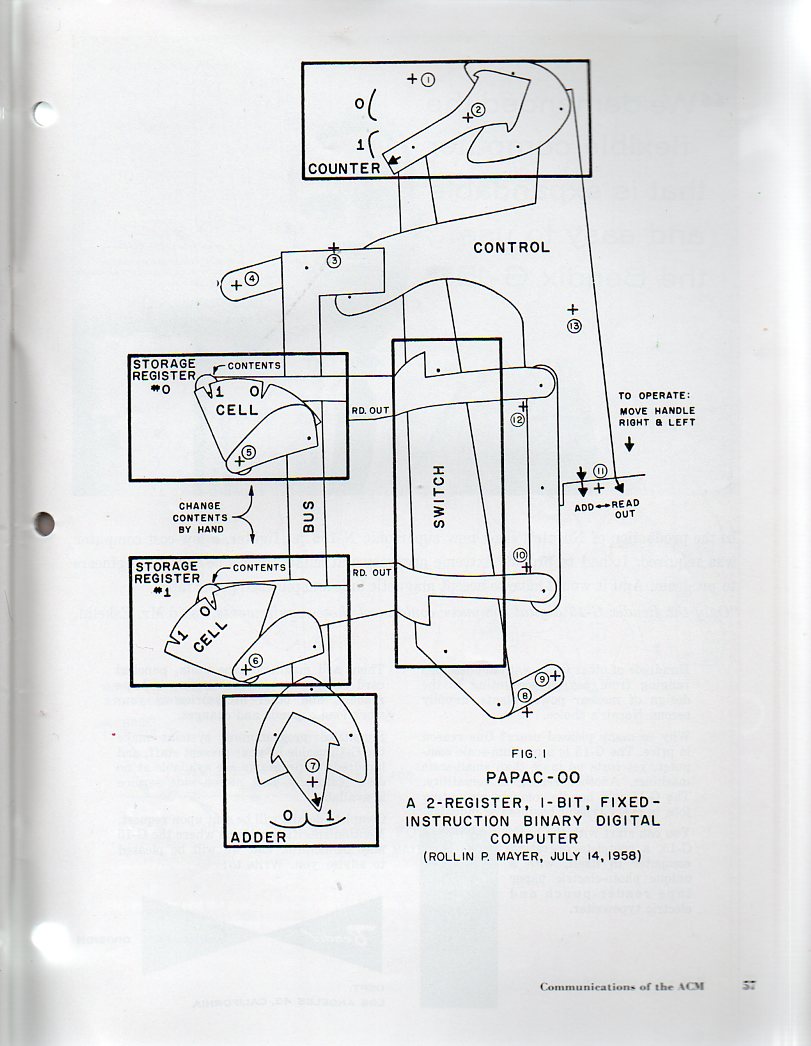
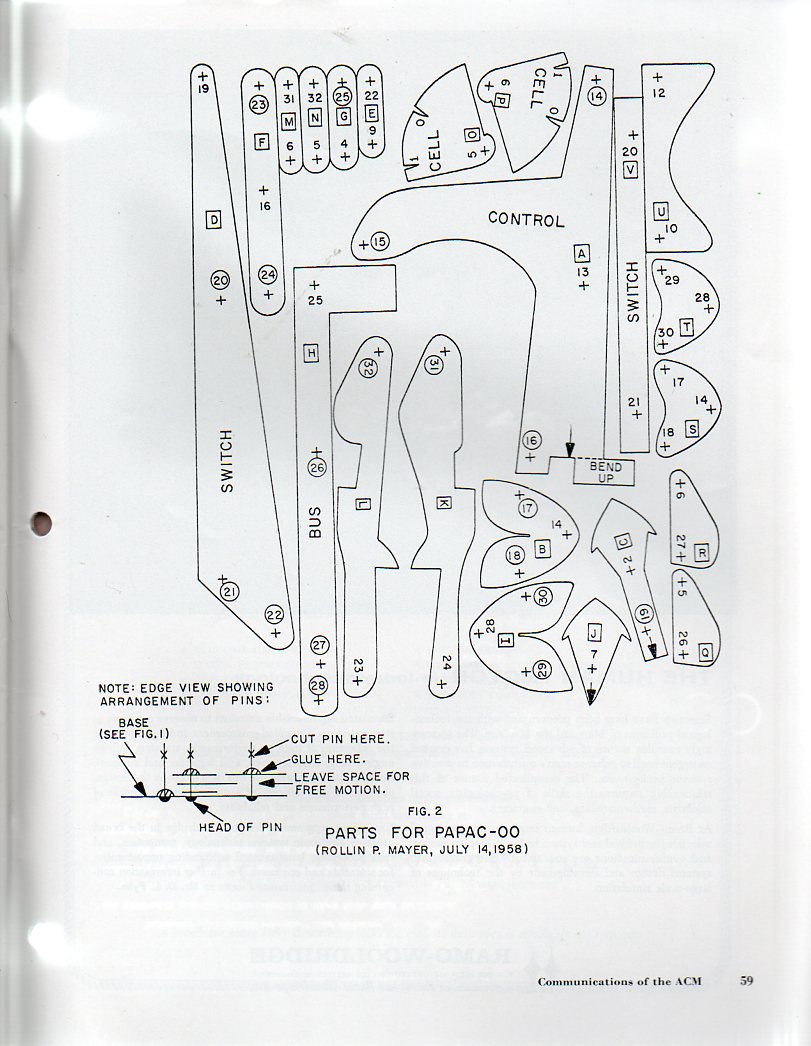
    Computer, paper832 This wonderful cut-away and paste-up template for a digital computer comes to us from the Communications of the Association for Computing Machinery, volume 2, issue 9 for September 1959.  The PAPAC-00 is a “2-register, 1-bit, fixed-instruction binary digital computer” and was submitted to the journal by Rollin P. Mayer (of the MIT Lincoln Lab).  There’s a hunk of me that wants to make this thing really big–cut out the individual pieces and then crash them out to 50″ widths, pasted on found bits of cardboard packing from the neighborhood frame shop, and then piece the thing together as the world’s largest pre-1960 1-bit paper computer.  Or maybe not.  In any event I thought to share this with readers here who might actually print out these templates and try to construct the thing themselves–warning: you’ll need t be able to cut pins in order to make the model work properly. Computer, paper833

    Mayer also wrote an interesting article on including children in the scope of the computer industry…in 1956–something I find to be a very early piece of thinking on Little Humans and Big Computing.  His abstract identifies the three main points of his paper: “(1) That the digital computing field needs, and will continue to need, not only more people who are capable of designing and programming digital computers, but more people who understand the basic limitations and potential uses of digital computers; (2) that the computer industry should take an active interest in providing a basic computer training to the largest number of people, in addition to more extensive training to those who show an interest in designing and programming computers; and (3) that the typical 12-year-old youngster has the interest, skill and basic knowledge necessary to build and understand simple working models of practically anything”. –“A proposal for training youngsters in digital computing techniques” in Proceeding ACM ’56 Proceedings of the 1956 11th Annual Meeting.

    Lastly I should also mention that in this same monthly issue (which ranged all of 52 pages) was an article by Julien Green, “Remarks on ALGOL and Symbol Manipulation”, a three-page paper that comes from the near-dawn of the ALGOL (short for ALGOrithmic Language). (It can be argued that the beginnings of ALGOL were about 1955, but for the sake of simplicity here I’ll note that the first committee appointed to study the matter for the ACM was in September, 1957, and the first group to formalize it met at the ETH Zurich in 1958, producing the language’s first version, known as ALGOL 58.  Julien Green was a member of the 13-person panel that created the ALGOL 60that met in Paris in January 1960.   And so the Green paper did appear within the first few years of institutional study in America, and it was written by one of the six American members of the ALGOL 60 team.)

    Computer, paper834


  • Death from Above–the Fear of Aerial Bombing and Gas Attacks, 1932

    JF Ptak Science Books  Post 1209

    Aerial bombing from heavier-than-aircraft comes to a big anniversary soon, on 1 November 2011, a century after the Italian Lt. Giulio Cavotti dropped the first bomb from a plane on oasis-encamped Libyan troops at Tripoli.   Of course things rapidly in the few years following that, so that by the end of WWI people got a good taste of what it meant to controlling pieces of property without actually occupying them, raining chaos and destruction from

         Air attack iillus lond cvr778

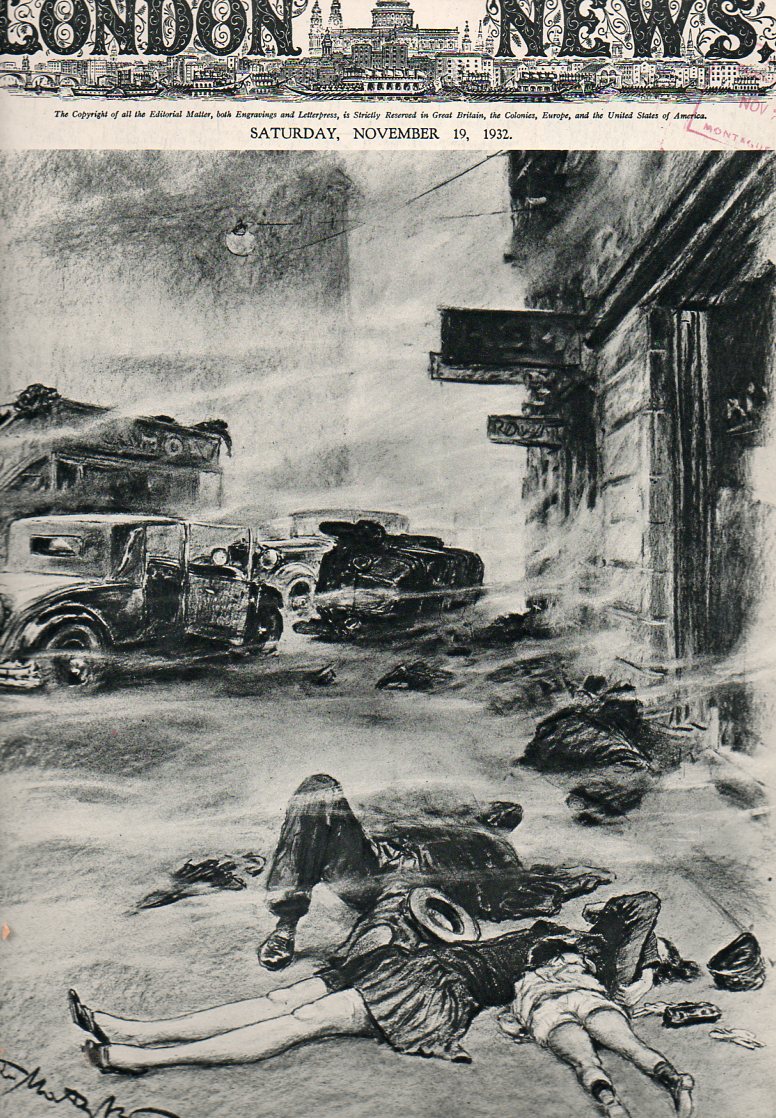
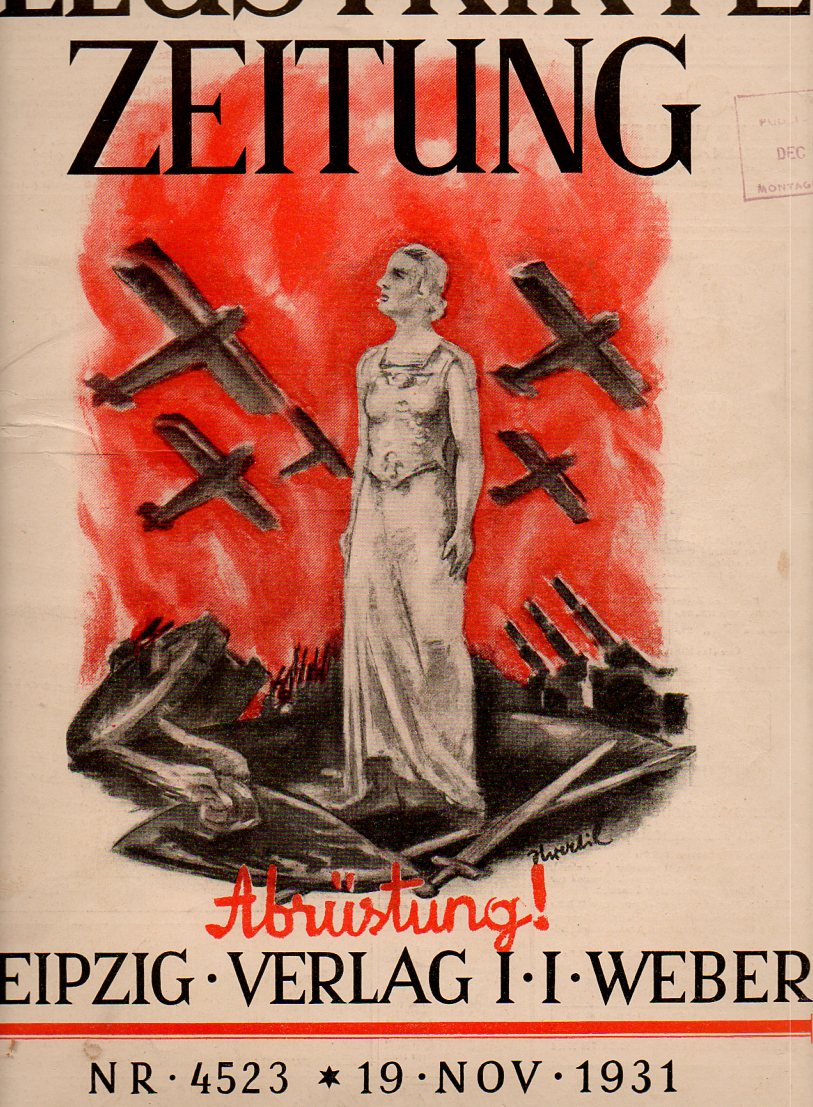
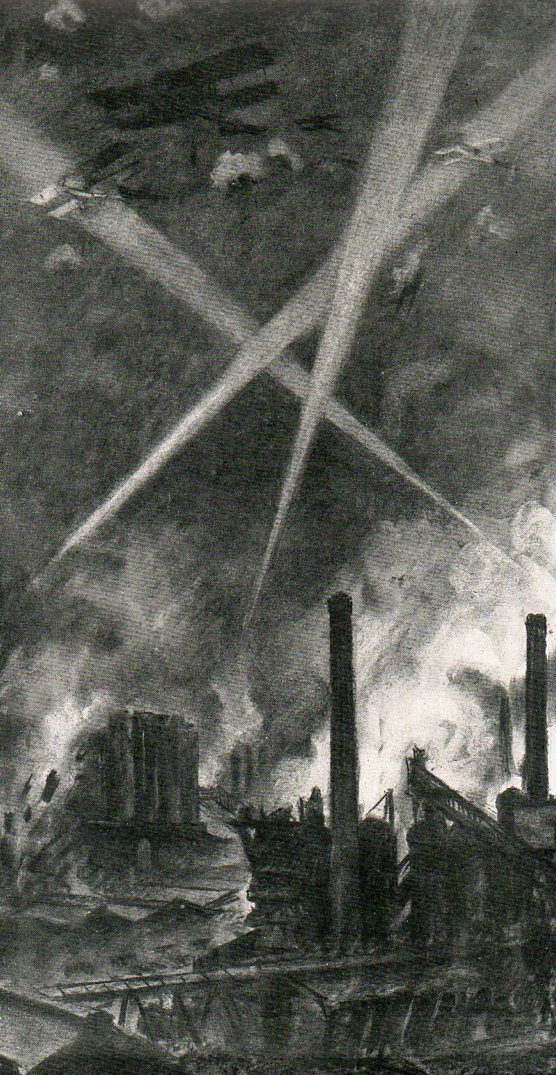
    above.  20+ years later, in the early 1930’s bombing became more sophisticated, including a new arsenal of poison gas weapons.  The threat from this weapon was agonizing and palpable–the results of gas attacks upon armed combatants in WWI and  the gassing of civilians in the 1920’s and early 1930’s  made a hard strike into the social fabric, an enormous gapping new hole to be filled in the heart of fear. [And of course this fear was felt everywhere, from London to New York to Leipzig to Moscow to Milan, as we can see in these few examples below. ALSO: these images may be purchased rfom our blog bookstore, here.]

    Air attack776
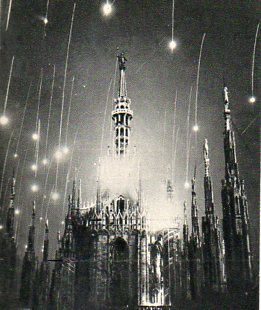
    And this interesting image of a mock (or “mimic” as it was called in the report) attack on Milan in August, 1931:

    Air attack madrid779
    There were a number of interwar aerial bombings that took place that kept the issue of mass destruction alive and well.  For example,  Britain used its air arm  very convincingly in Iraq, bombing many places including Bagdhad  in 1923; the Spanish bombed civilians into submission in Morocco, near Tetuan, in 1925, and the French crippled and destroyed  their opponents–both military and civilian, it made no difference–in Damascus, Syria, also in 1925.

    Air attack industrial777
    Fiction also harnessed the possibilities of air war, not the least of which included Armageddon-like scenarios for the semi-End of Days through the use of poison gas and “atomic” weapons.  For example, deadly gas used in Anderson Graham’s The Collapse of Homo Sapiens (1923) and Neil Bell’s Valiant Clay (where the poison gas kills 1.5 billion) and Dalton’s Black Death (1934), while Reginald Glossop’s The Orphan of Space (1926) created an alien atomic spaceship which delivered holocaustal death to Soviets and Chinese and Communists in general.  There were many more stories like this, not the least of which were the non-fiction strategy works, like Giulio Douhet, author of Dominion of the Skies (1921), legitimizer of the “strategic” bombing of civilian populations (in spite of the Hague Conference of 1907*), and  JFC Fuller’s The Reformation of War (1923) which emphsized the new importance of air war and power and which also allocated the use of gas, justifying that morality  because it could cause less harm than a conventional attack.

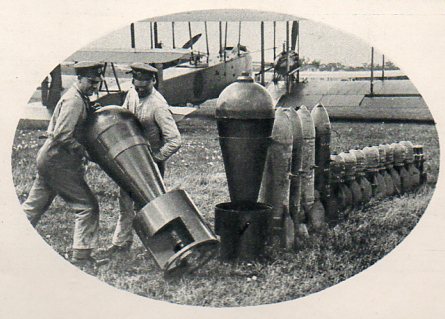
    [Image below from :Mr Baldwin on Aerial Warfare”, The Illustrated London News for 19 November 1932, illustrating the sort of aerial bombs that could threaten the population of London.]
    Air attack bomb780

    The fear was real, and the capacity to cause mass death (espcially from poison gas) was substantial, even if in a still-developing form.  Eight years hence, though, it would almost all come true (except for the poison gas part, at least for WWII), and in ways that weren’t quite imaginable in 1932–500 B-29s flying criss-cross over Tokyo would’ve seemed more fiction than science to the 1932-person, even though that technology was only a dozen or so years away. 

    Notes

    * This is where the bombing of civilian areas was specifically outlawed; what wasn’t defined, however, was what “civilian” meant–turns out that it was pretty loosely defined in the 20’s and ’30’s.


  • The Atomic Bomb Art of William Shockley, 1945.

    JF Ptak Science Books   Post 1208

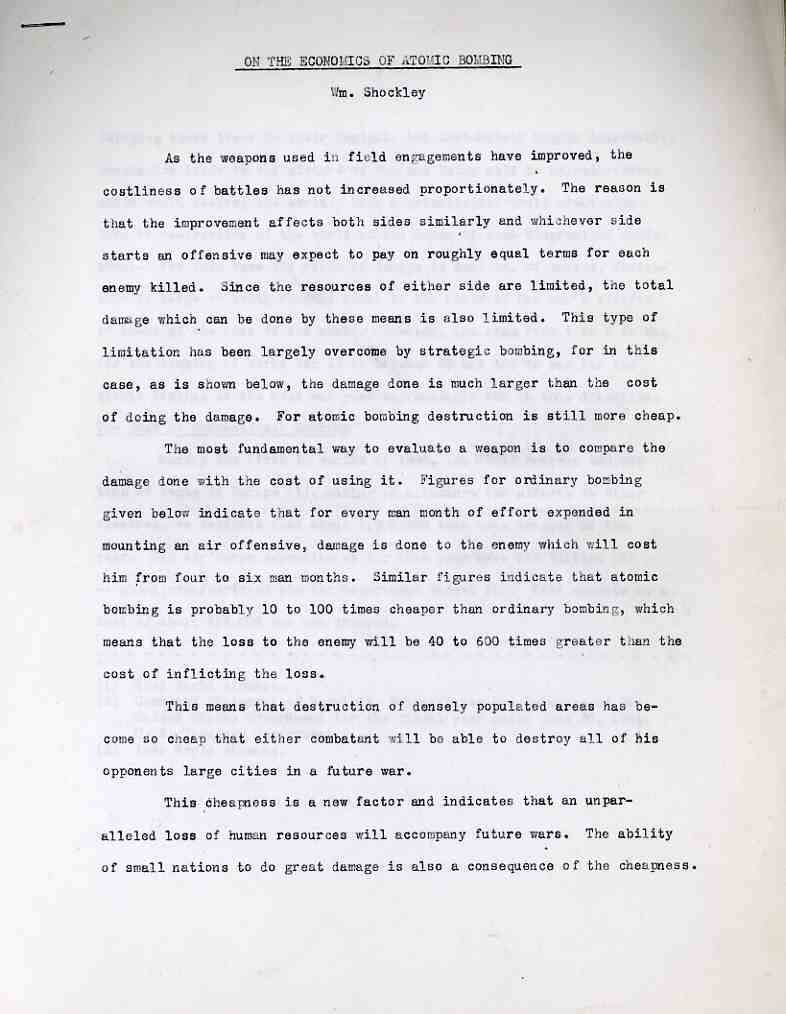
    “For atomic bombing destruction is still more cheap”–WIlliam Shockley1.
    Shockley atomic
     (Click image to enlarge; the other four pages are located in the “Continue Reading” section, below.This is also available for purchase via our blog bookstore.) 

    This paper is one a small archive of background and draft papers and proposals by the Vannevar Bush group working on the question of the control of atomic weapons and the formalization of the American position regarding the use and control of atomic weapons, October 1945-February 1946. This archive consists of 38 documents relating to the development of U.S. atomic policy, with  contributions by President Harry Truman, Secretary of State James Byrnes, Dr. Vannevar Bush, (future AEC director) Carroll Wilson, Alger Hiss, I.I. Rabi, William Shockley, Frederick Dunn, Joseph E. Johnson, Leo Pasvolsky, Philip Morrison, Col. Nichols, William McRae, Admiral W.H.P. Blandy, George L. Harrison, and others.

    I have written elsewhere on this site about Vannevar Bush and the coming atomic/nuclear arms problem–as perhaps one of the pre-eminent scientific minds in the Roosevelt/Truman administrations, Bush and others foresaw the development of the atomic arms race in 1943, and by 1945 Bush became a  fundamental thinker and advocate on the problem. The items in this archive are low-formal background papers, drafts of proposals, informal studies, as well as mature statements of thought that would become implemented in the core of U.S. policy regarding the spread and control of atomic weapons. They are generally carbon typescripts and necessarily of extremely limited distribution, generally have no letterheads, occasionally carry the authors’ full names (although sometimes only initials are used).

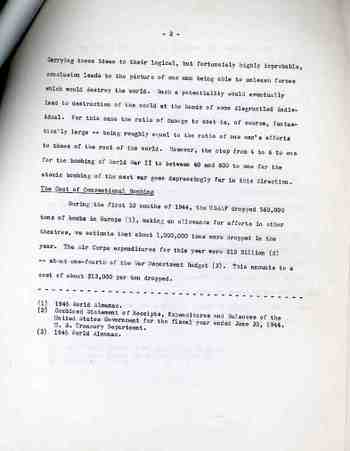
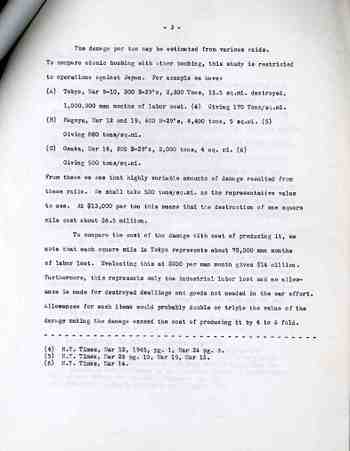
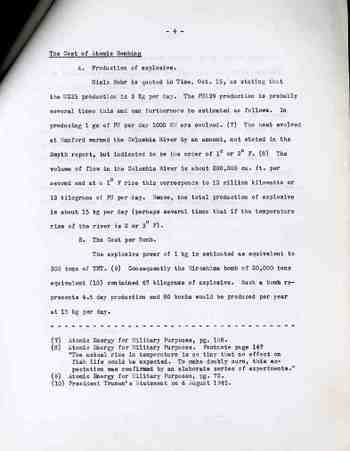
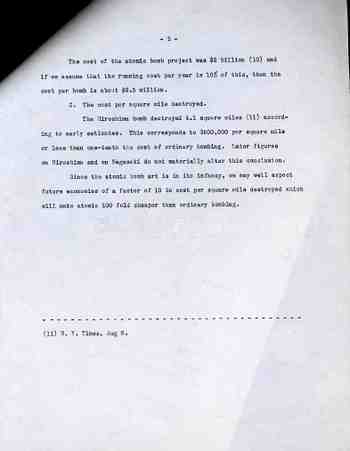
    The William Shockley paper was written towards the end of 1945 and is on five pages and runs about 1500 words, and is an extension of work he had already been doing for Henry Stimson with Quincy Wright on evaluating the combinations of casualties that would lead the Japanese to surrender3.  He begins this paper with a logical statement of the issue of the economics of conventional and atomic bombing, ending with the sentence “For atomic bombing destruction is still more cheap”.  What Shockley is getting to is the overall cost of the amount of destruction caused per square mile, and the conclusion that he draws over these five pages is the destruction caused by the atomic bomb is 1/100th the cost of conventional bombing per square mile destroyed (“atomic bombing is probably 10 to 100 times cheaper than ordinary bombing”).   

    Shockley also recognizes that the problem in the near future will be the increasing cheapness of producing atomic (and greater) weapons, and their developing accessibility to small nations.  “This cheapness is a new factor and indicates that an unparalleled loss of human resources will accompany future wars.  The ability of small nations to do great damage is also a consequence of the cheapness.”  He writes further that taking this thinking to its “logical conclusion”, that at some point in the future a single individual will be able to use this new technology to destroy the world.  The main point though that he was making in this line of thinking was the dispersion and proliferation of the new technology–that an arms race would occur, and that it would be dangerous, and that it could be very very bad.  Shockley has of course nothing to say about any of that or the implications of his finds as that was not his charge. 

    After figuring that the cost of destruction by the atomic bomb was about $600,000 per square mile (compared to $6,500,000 per square mile for conventional bombing), Shockley concludes that “since the atomic bomb art is in its infancy, we may well expect future economies of a factor of 10 in cost per square mile destroyed…”

    Shockley on the likelihood of casualties during the final invasion of Japan. 

    (The following three paragraphs are taken entirely from CASUALTY PROJECTIONS FOR THE U.S. INVASIONS OF JAPAN, 1945-1946: PLANNING AND POLICY IMPLICATIONS by D. M. Giangreco in the Journal of Military History, 61 (July 1997): 521-82 

    “As for Dr. Shockley’s initial report to Dr. Bowles, it was not submitted until after Stimson had left for Potsdam. He proposed that a study be initiated “to determine to what extent the behavior of a nation in war can be predicted from the behavior of her troops in individual battles.” Shockley utilized the analyses of Dr. DeBakey and Dr. Beebe, and discussed the matter in depth with Professor Quincy Wright from the University of Chicago, author of the highly-respected A Study of War; and Colonel James McCormack, Jr., a military intelligence officer and former Rhodes Scholar who served  in the OPD’s small but influential Strategic Policy Section with another former Rhodes Scholar, Colonel Dean Rusk.  Shockley said:

    “If the study shows that the behavior of nations in all historical cases comparable to Japan’s has in fact been invariably consistent with the behavior of the troops in battle, then it means that the Japanese dead and ineffectives at the time of the defeat will exceed the corresponding number for the Germans. In other words, we shall probably have to kill at least 5 to 10 million Japanese. This might cost us between 1.7 and 4 million casualties including [between] 400,000 and 800,000 killed.”–W. B. Shockley to Edward L. Bowles.2  .

    No accurate total of German military and civilian deaths was available at the time he prepared his report, but the number was eventually set at roughly 11,000,000. was not invaded and finished the war with just over 7,000,000 casualties, most of them from its armed services on the Asian mainland in fighting from September 1931 to September 1945.

    Notes: 

    1. The brilliant Shockley’s story is difficult and problematic: from the way in which he misused his interaction with the rest of his team at Bell Labs in the discovery of the junction transistor to his sinful racial and eugenic (and dysgenic) public persona later in life–it is a hard and long one to tell, and I’ll not try to do it here. (I should point out that his attacks started in 1966 when he “delivered the first of a series of controversial papers to the National Academy of Sciences (NAS) in which he called for a renewed focus on racial biology, synthesizing under the title of eugenics the compulsive element of population control with the targeting of the dysgenic fertility of the black population”.[From “Confronting the Stigma of Eugenics: Genetics, Demography and the Problems of Population” by : Ramsden, Edmund in Social Studies of Science, Vol: 39 Issue: 6, 12/2009 pages: 853 – 884.] Suffice to say that I’m very aware of the very long shadows, and I think that other people should at least be aware of them as well, regardless of the staggering importance of “his” (with the wonderful Walter Brattain and John Bardeen) monumental discovery. 

    2.  21 July 1945, “Proposal for Increasing the Scope of Casualties Studies,” Edward L. Bowles Papers, box 34, Library of Congress.

    3. For a detailed look at Shockley’s work in this area see Predicting the Termination of War: Battle Casualties and Population Losses, by Frank Klingberg in The Journal of Conflict Resolution, Vol. 10, No. 2 (Jun., 1966), pp. 129-171. Dr. William B. Shockley (later a joint winner of the Nobel Prize for his work in developing transistors) was an expert consultant to the Secretary of War, engaged in part in gathering and organizing information bearing on the problem of casualties in the Pacific war. He believed that historical studies of casualties might be helpful &dquo;for consideration in connection with the total casualties to be expected in the Japanese war, the rate at which land invasion should be expected in the Japanese war, the rate at which land invasion should be pushed
    ahead in Japan or held back while attrition by air and blockade proceeds, and the relativeapportionment of effort between the Army Air Forces and the Army Ground Forces…”

    The cointinuation of the Shockley paper, pp 2-5.   
    Click on any image to enlarge it.   

    Blogaug_6shockley_2362

    Blogaug_6shockley_3363

    Blogaug_6shockley_4364_2

    Blogaug_6shockley_4365_2


  • The Most Important Menu in Computing History? Johnny von Neumann, Herman Melville the NORC & the MOBIDIC

    JF Ptak Science Books  Post 1202

    “There is no mystery about these machines[computers]. The mystery is how the human brain has been able to develop them. These devices are merely small tools which men have devised to help them do a better job.“–Thomas J. Watson, chairman of the board of IBM, 1954
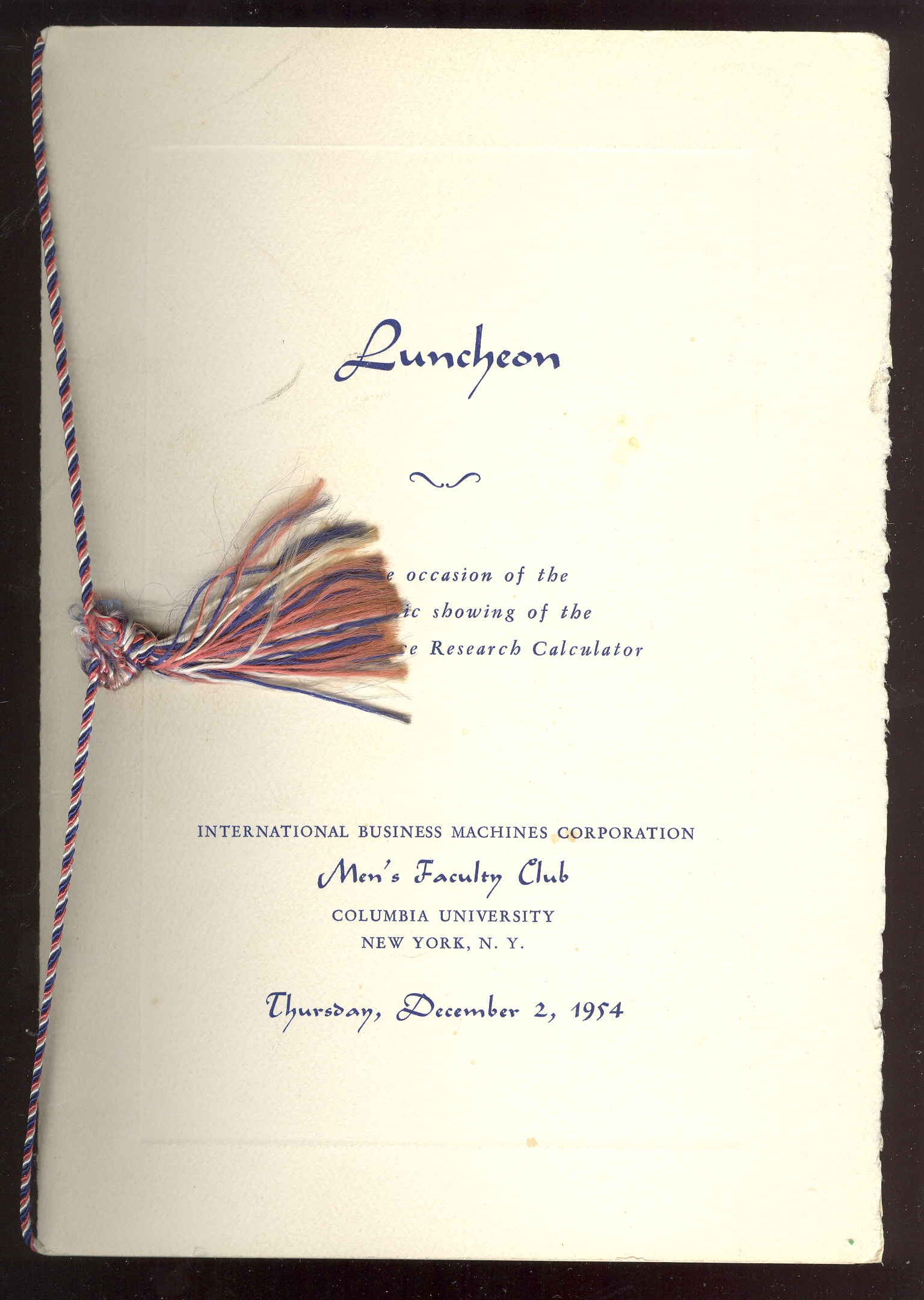
    Here is something that one doesn’t get to say very often:  this is perhaps the most important menu in the history of computing1. And if there’s another menu out there of the same or greater significance, then I offer that this is perhaps the most important menu tassle in the history of computation–that seems safer.

    In the history of odd bits of historic computeriana ephemera, this tassle joins the ranks of other one-percenters, like this:  the world’s first portable computer had a gun rack.  This was hardly a laptop though it was portable, and very well lived up to its Herman Melville-inspired acronym:  MOBIDIC.

    The Mobile Digital Computer was intended to be a transistorized van-mounted computer used to store and route data as part of the U.S. Army’s Fieldata system.  The machine was indeed built and deployed by 1959–as were the MOBIDIC A,B,C,D,E and 7a by the early 1960’s–and it was a successful component, even though the overall network was not successful.  Fieldata was supposed to integrate all manner of information and distribute it to battlefield recipients. My friend (Dr.)  Carl Hammer (1914-1904), who I knew from being in the neighborhood in Georgetown, was a delightful man who had long and significant history in the development of the modern computer.  He told me one afternoon–stopping in to visit on his constitutional–in his sly and amusing way about working on the MOBIDIC while he was at Sylvania. (He had just finished heading up Remington Rand’s UNIVAC European Division before going to Sylvania.) Anyway he started his story about the MOBIDIC by telling me that it was the world’s first portable computer (sitting in a 42-foot-long semitrailer) and that it had gun racks.  The reason for the gun racks was simple–if something was made by the U.S. Army, and it had wheels, then it had to have a gun rack.  Case closed.

    Norc--von n groupNow let’s get back to the NORC.

    [This item is available for purchase at our blog bookstore.]

    This is the luncheon menu for the dedication of the NORC “Calculator” (the Naval Ordnance Research Calculator) a computer which was constructed principally with IBM parts and built at the Watson Scientific Computing Laboratory at Columbia.  The NORC was the world’s first supercomputer, and the most powerful computer on the planet for about ten years (from 1954 to 1963, until it was surpassed by Seymour Cray’s CDC 6600 in 1964). 

    The NORC was an astonishing accomplishment, difficult to summarize simply, really, though a very good example is that provided by Dr. Paul Herget, the director of the Cincinnati Observatory.  Dr. Herget used the NORC in 1956 to make precise calculations of the earths orbit for the 1920-2000 period.  Dr. Herget said: “We used nine hours of running time and completed more computations than had ever before been done at one time in the history of astronomy.’”

    Outside of celebrating the accomplishment of the NORC, the luncheon was also  important for the remarks of the principal speaker, John von Neumann.  Von Neumann of course was perhaps the most expansive mind of the century–a thinker of phenomenal proportions and the father of the modern computer.  His brain was impossibly big.  Impossible. 

    During the luncheon von Neumann made prescient and extraordinarily wide remarks on the future utility of the computer.  Some of the highlights (from the entire address, included below):

    –it is now “practical and feasible” to forecast, with the NORC, the weather for an entire hemisphere thirty or sixty days ahead

    –calculation of the tidal motions of all the oceans, the marginal movements near the continents as well as the main motions of the oceans

    –the hydrodynamics of the earth’s fluid core

    –“In the statistical field, dealing with matters which are not wholly mechanical, such as troop operations and logistic operations which involve purely accidental factors like the prevailing weather during the operation, command decisions which have not yet been officially made can be stipulated and various solutions for various alternatives calculated. This has been done before on a minor scale but it takes too long to do on a large scale. “In this field the importance of NORC is enormous…”

    –in the first four hours of operations the NORC  performed more work than any calculator of ten years ago has performed in its entire lifetime. He termed this performance “completely fantastic; I doubt if it has ever been done before.”
    Norc--von n group menu

    The last section of von Neumann’s comments that were made at the dinner:

    “The last thing, which is very important, is said in fewer words, but I think that it is none the less important. And it is this: In planning new computing machines, in fact, in planning anything new, in trying to enlarge the domain of parameters with which one can work, it is of course customary and very proper that one should consider what the demand is, what the price is, whether it will be more profitable to do it in a bold way than in a cautious way, and so on. This type of consideration is necessary — the world would very quickly go to pieces if these rules were not observed in 99 cases out of a hundred.

    “It is terribly important that there should however be one piece in a hundred where it is done differently.

    “And that one uses the definition which Dr. Haven (?) pointed out 20 minutes ago, namely to occasionally do what the U. S. Navy did in this case and what IBM accepted in this case: to write a specification essentially to build the most powerful machine that is possible in this day with the present state of the art. I just hope that this will be repeated very soon and will never be forgotten.” Source.  

    It may be the last statement that is the most important–pressing those of the present and future to perform.

    Notes:

    1.  The importance of this menu was described to me in a lovely and painterly fashion for the first time by P.J. Mode.


  • One-Page Letter Establishing the U.S. Poison Gas Position, 1917–addendum

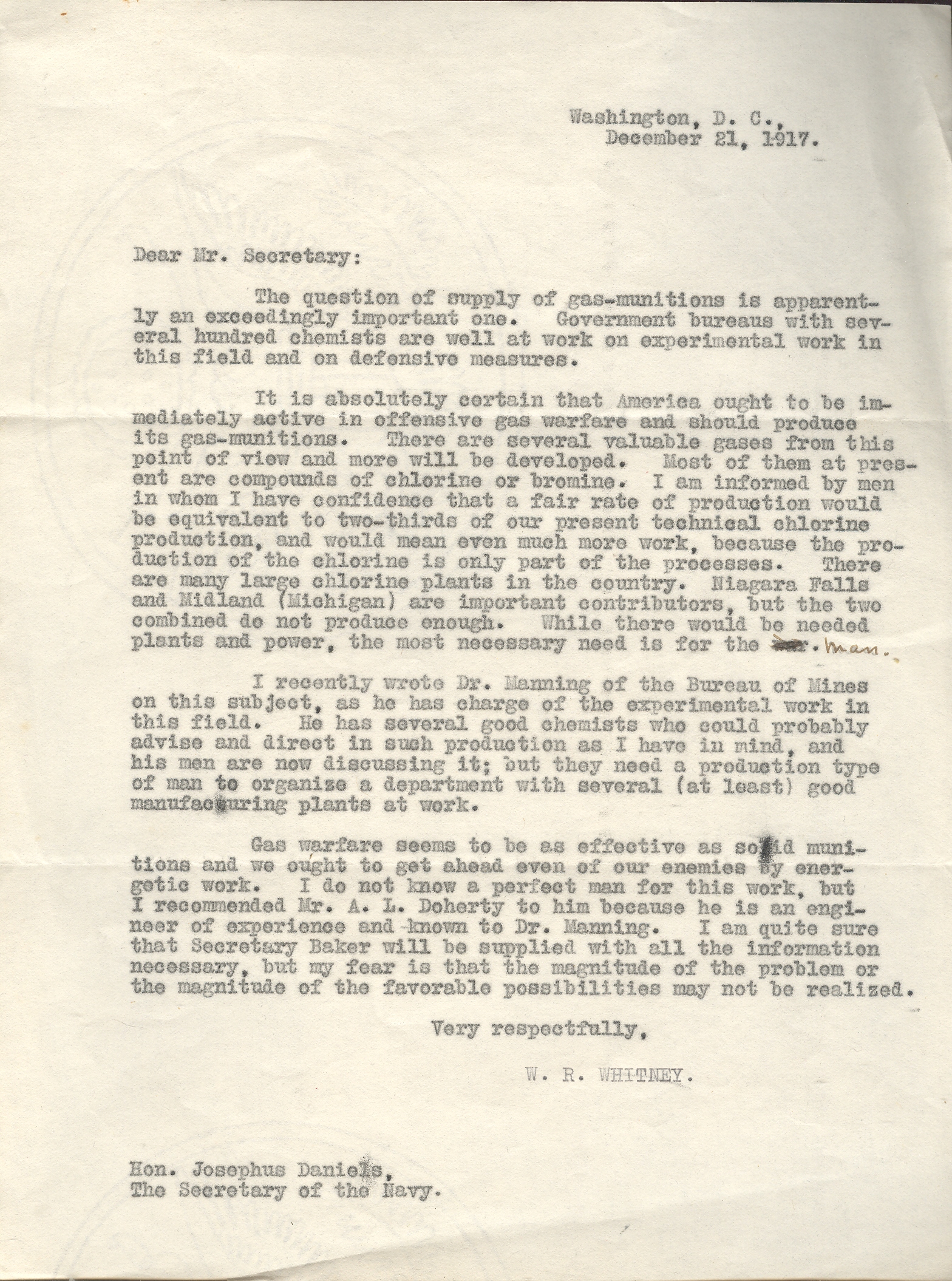
    I posted in March 2010 a short note on a one-page letter written in 1917 by Willis R. Whitney (founder of G.E. Laboritoriesand much more) to Secretary of the Navy Josephus Daniels outlining a position for the government on the production and use of poison gas in warfare.  I’ve added a little more biographical information to the original, and I’m also offering my original copy of the document for sale at the blog’s bookstore.  Enjoy.

    The full post is here.

    Mar 21 gas warfare


  • Bombing Britain, 1940–a View from the German Side

    Dsc04742_2 JF Ptak Science Books  Post 1241

    It is essential to look at objects from alternative angles, especially in science, in order to determine the correctness, or fitness, of a finding, or opinion.  Even when consolidating data or evidence regarding the confirmation of an established bit,  you may very well find other strands of loose data that could help illuminate even a well established or iconic societal “given”.

    That the war was not going well for the Allies in September 1940 is an understatement—and the chief allies at this point excluded the United States, happily now recovering from the Depression, and still a full 14 months away from entering the war. 

    Dsc04739 What is very weird to me is that after having looked at every issue of LIFE magazine at least three times  from the start to the end of World War II, that there are more advertisements using war images than there are images of the war itself.  This actually continues into the spring of 1942, when LIFE got really busy, the war got really messy, and people started really dying.  And frankly even the coverage of Pearl Harbor in no way lived up to what I thought the coverage of a photo-magazine like LIFE would be. This is not a scientific study.  It just strikes me as odd, or propagandizing, that there should be such relatively scant, or undervalued, coverage of the fighting when sanitized images of that same fighting were being used to sell socks and shaving cream and cigarettes and such.  I understand the power of hearts-and-minds campaigns, but this seemed so amateurish, boorish even, that it just didn’t approach the level of a psychological ploy to pacify an American public that had virtually no interest in attending the European Theatre. 

    This was not the case with the British equivalent of LIFE—the Illustrated London News.  Actually, I should say that LIFE is a dumbed-down version of the ILN, which was the world’s first illustrated magazine, and which began almost 100 years before LIFE was born.  The ILN covered the war like it was a war being fought in their front yards—and it was.  Dsc04741

    This was also not true of one of the principle German equivalents of these two weekly photo-imags, the Illustriete Zeitung (Leipzig).  There was a  lot of war coverage, though much more sanitized than even the very sanitary (pre-1943) versions of reality issued by LIFE and the ILN.  The Germans by and large did not use war or military images to sell common-sue, every-day consumables; it rather concentrated on the glories of battle, real and imagined, as well as using a very grandly flatulent palette to paint the image of Adolf Hitler.

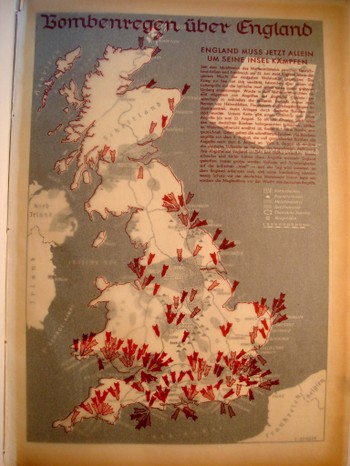
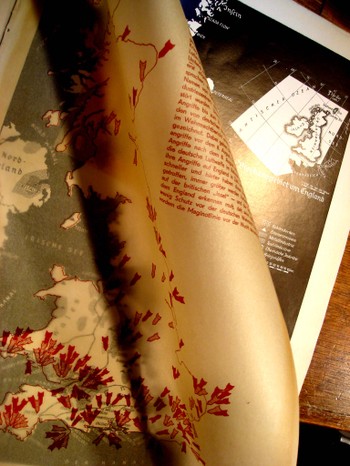
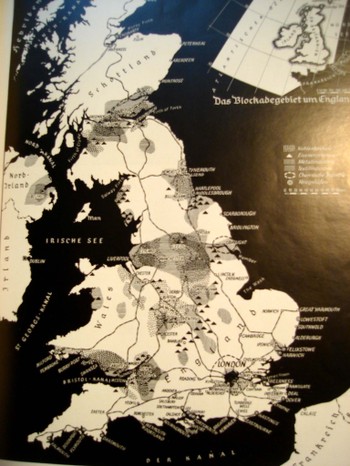
    What caught my eye was a map in the 5 September 1940 issue of the Zeitung.  (The cover woodcut illustration, by the way, is a sharpened point of the Roman standard bearer being used by the Fascist Mussolini government about to impale a running cat-thing that represented Somalia.  The Italians attrociously bombed innocent civilians in Somalia and Ethiopia with abandon and disdain.) On page 165 is a two part map, the upper part being a velum-like overlay, showing the German bombardment of England.  (“Bombenregen ueber England.  England muss jetzt allein um seine insel Kaempfen…” )  The template map is in stark black and white, showing locations of “war” industries, chemical plants, rubber works, textile plants, metal industries and gas works . The overlay shows the outline of the island with 150 or so bombs, imprinted with a color code to show what sort of industry it was intended for.  As you can see there was quite a cluster around London—I looked closely, and no one bomb was actually placed directly upon the outlined city of London. Suffice to say that no fool editor at the Zeitung was going to show their readers that German bombs were falling on a city. 

    Dsc04740 What this map shows me, outside of the propaganda aspect for its intended readers, is that the basic bits of the bombing campaign was actually true—that there was a whole crap-load of bombing going on, and going on quite well country-wide.  Certainly people in England knew this but knew it in chunks.  The Battle of England was being fought at this point, and the outcome was still undetermined—even though the Brits had the “ultra” and basically knew when the attacks were coming, and where.  But looking at this image of the bombing from a completely different, contemporary, and ENEMYsource hammered home the fact that England was being bombed, and bombed heavily, and that its future was in real doubt. 

    [This issue of the Illustriete Zeitung is is available for purchase from our blog bookstore.]


  • The Speed of History–a Note on Change in Aviation, 1905-1915

    JF Ptak Science Books   Post 1163

    Being at the airport yesterday to watch the glorious EAA B-17f take off and land (and to see our 7- year-old climb through it and the Blackhawk that suddenly appeared) put me in mind of the extraordinary advances in flying in the earliest history of heavier-than-air flight.  I picked up a volume of The Illustrated London News for 1909 to check out the popular reporting of the aeroplane and as usual got a very sharp reminder of how fast everything happened in the 1905-1915 period.
    Cody flight503

    In the earliest stages of the development of heavier-than-air flight (powered and not, 1848-1906) there were major innovations and essential experiments from a dozen countries:  England, the U.S., Poland, France, South Africa, Russia, Germany, New Zealand, Australia, Brazil, Romania, Sweden, Norway and  Denmark.  Even with all o f this directed work, the methods weren’t necessarily made public or when so were not well distributed, with many of the aviation/engineers working in obscurity and without contact with their peers.  (Examples of the major players in the history of heavier-than-air early flight include John Stringfellow, England, 1848; George Cayley, England, 1853;  Matias Perez, Cuba, 1856; Jean-Marie Le Bris, France, 1856; Jan Wnek, Poland, 1866; Goodman Household, South Africa, 1871;  Félix du Temple de la Croix, France, 1874; Victor Tatin, France, 1874; John Joseph Montgomery, US, 1883; Alexander Feodorovich Mozhaiski, Russia, 1884; Clément Ader, France,1890;  Otto Lilienthal, Germany, 1891; Lawrence Hargrave, Australia, 1894;  Hiram Stevens Maxim, United Kingdom, 1894; Shivkar Bapuji Talpade, India, 1895; Samuel Pierpont Langley, US, 1896; Octave Chanute, US, 1896; Carl Rickard Nyberg, Sweden, 1897; Gustave Whitehead, US, 1899; Percy Pilcher, U.K. 1899;  Augustus Moore Herring, US, 1899; Wilhelm Kress, 1901; Orville & Wilbur Wright, US, 1902;  Richard Pearse, New Zealand, 1903;  Karl Jatho, Germany, 1903;  Orville & Wilbur Wright, US, December 17, 1903 (finally for the first recorded controlled, powered, sustained heavier than air flight);  Orville & Wilbur Wright, US, 1904 (in the Wright II, making the first turn, and then later in September making the first circle); Horatio Phillips, UK, 1904; John Joseph Montgomery and Daniel Maloney, US 1905; Wilbur Wright, US, October 5, 1905 (circular flight of 24 miles in 39 minutes); Traian Vuia, Romania, 1906; Alberto Santos-Dumont, Brazil, 1906.)

    By 1909 there were many dozens of different aircraft flying around, just about but not quite getting to the sophisticated stage.  In just a few short years, by 1915, there would be an enormous increase in the capacity and numbers of airplanes –pushed along of course by the needs of war. Which is a little odd as some of te earliest fliers’ ideas and planes  were rejected by the military establishment.  The Wright fliers for example were not at first a welcomed idea to the U.S. Army (for numerous reasons, the Army saying “no” in 1905 but renewing their interest in 1907 and finally buying the plane in 1909) ; nor were the Brits interested in continuing funding for Samuel Cody (from Birdville, Texas) , pulling support for him just a few months after he had succeeded in flying the first British-built airplane in Great Britain (the British Army Aeroplane 1B).  That of course would all change in just a few years with the guns of August.

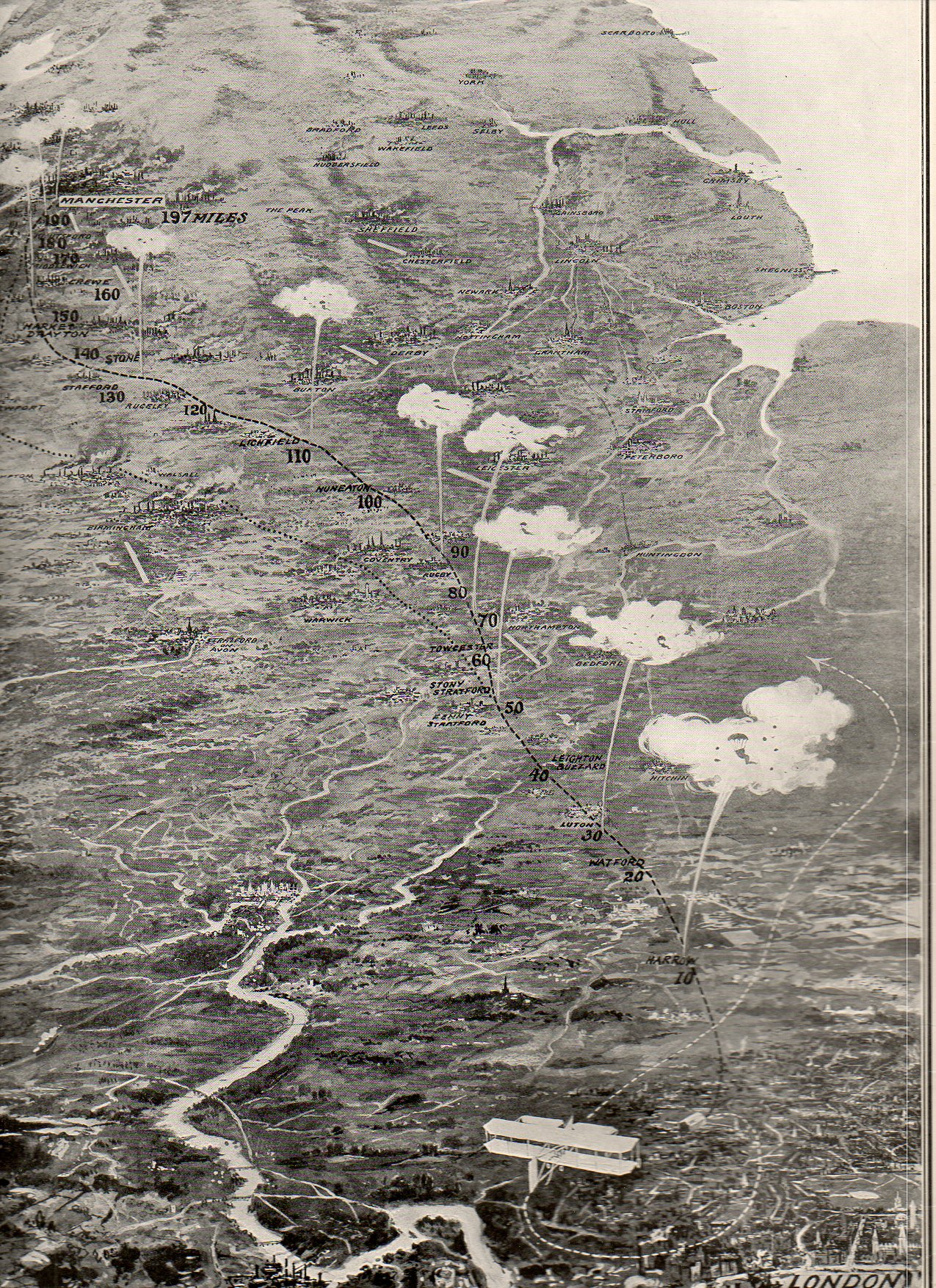
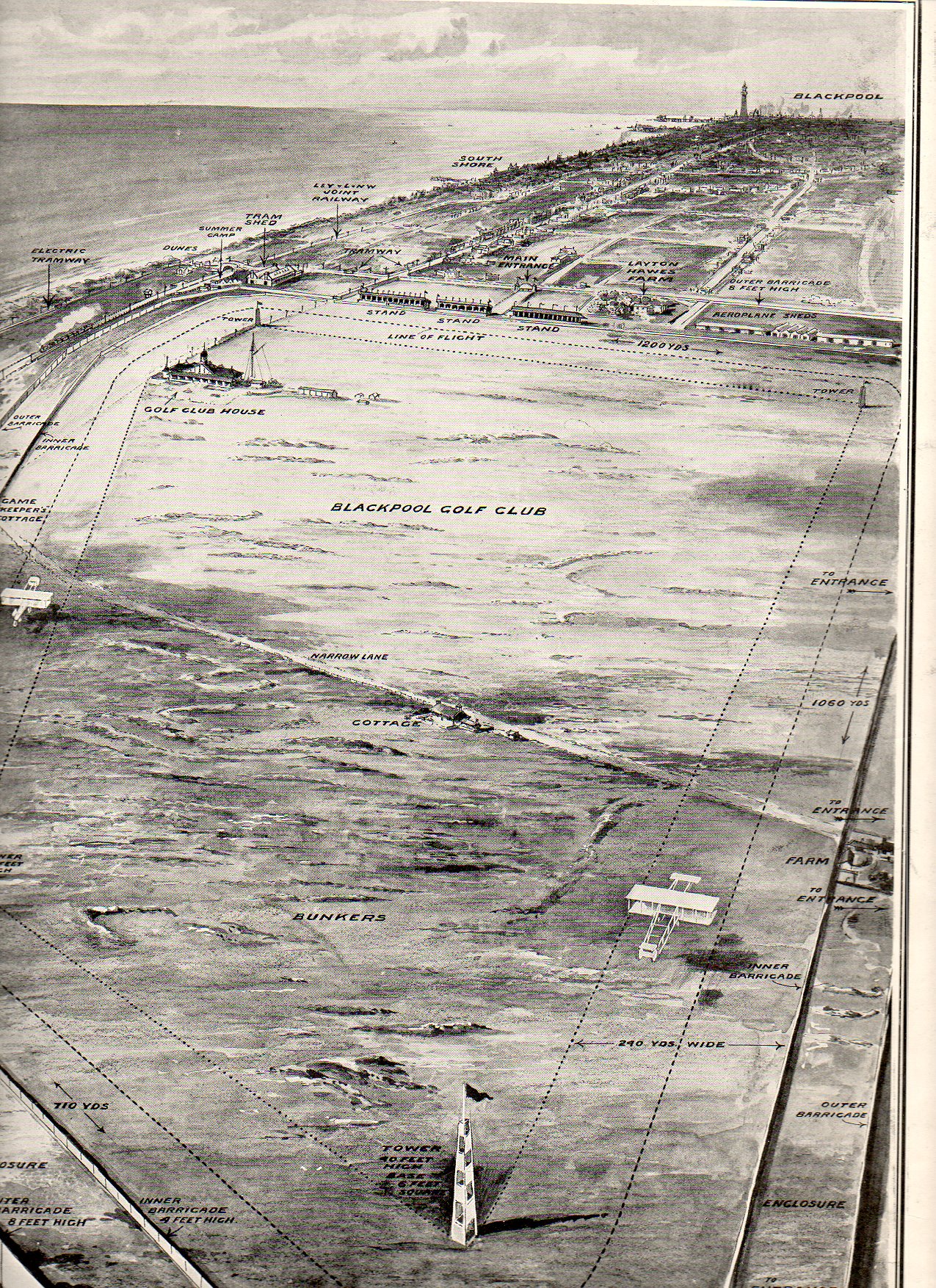
    Seeing this plan (above) for Samuel Cody’s flight from London to Manchester would’ve been a breathtaking achievement, had he made it.  The event had the trappings of An Enormous Situation, with smoke bombs and 450′-long white cloths to show him the way.  As particularly thrilling as this event was in 1909 it would be overshadowed in short order. In perspective, it was only six years earlier that the Wrights engaged in the first powered heavier than air flight.

    In 1903 the Wrights flew 121 feet; in just six years, Louis Bleriot would fly across the English Channel (on 25 July 1909); six years later Alcock and Brown would make the first transatlantic flight.  In  1911 Cal Rodger (11 De3cember1911) made the first American transconteintal flight (completed over the course of 50 days, with 3 days 10 hours in actual flying time).  11 Years later Jimmy Doolittle flew from Florida to California in just 21 (with one stop for refueling); the next year would see the record for transcontinental flight broken with a nonstop effort of 26 hours; in 1930 the time would go down to 12 hours and by 1945 the time was an extraordinary 5 hours 17 minutes.  (The retiring Blackbird flew the length of the country in 1990 in 64 minutes.)
                   
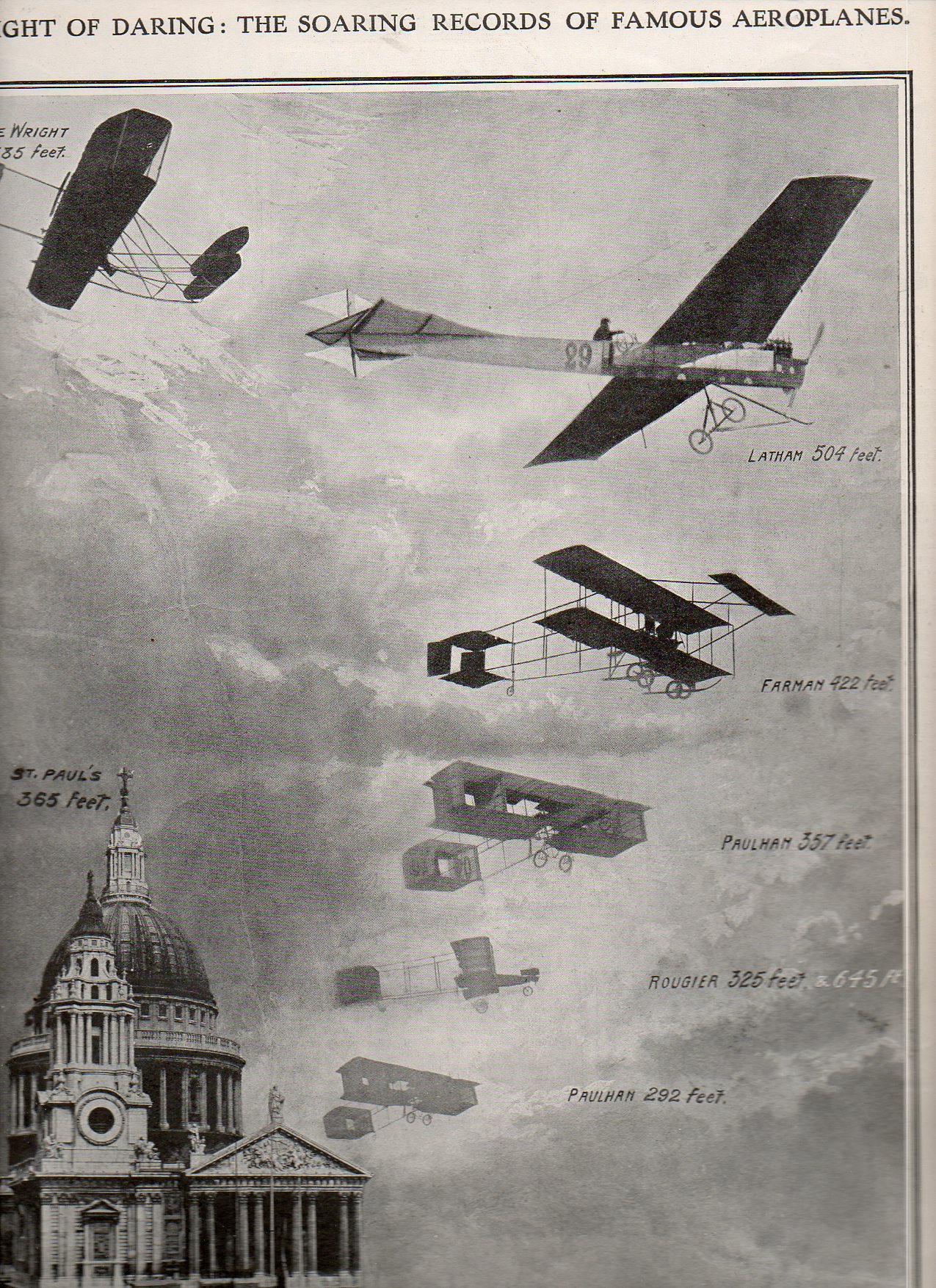
    The next image showing the altitude records for aviation in 1909 is just as phenomenal. The record at this point still stood with the Wrights at 585 feet, less than double the height of St. Paul’s.  It was a huge achievement, the other contenders coming to within hundreds of feet of their accomplishment but not quite doing enough to become the new world record holders,.  Ion just the next year improvements in the quality of aircraft and engines and control made it possible fo r Louis Paulhan to achieve 3,018 feet in January 1910,   Walter Brookins top climb to  a record of 4,603 feet (7 July 1910), and Ralph Johnsonte to 8,471 on 20 October 1910.  .  It must have bene a shocking development to have seen aeronautics to advance so quickly, breaking the old altitude record by a more than an order of magnitude in one year.  The speed record is a more difficult matter, but after recording speed records in the 30/40mp range in the 1903-1909 period, it broke to 66 mph 1910, 134 mph in 1914 and over 300 mph by 1928.  The difference in aviation in those 25 years is similar to that between the computing now and that of 1985 (and certainly 1979).
    Cody flight  Hieght sof flight aerodrome505

    I’m just saying that it is good to remember the enormity of change that took place in that early period of 1906-1919 or thereabouts–they were simply revolutionary developments that must’ve appeared  to the folks of those times.   
    Cody flight  Blackpool aerodrome504

    Notes:

    Cody was one of the most colorful figures in the history of early aviation in the U.K.  Born in 1867 and self-styled after Colonel William F. Cody, he was an inate adventurer and experiential bon vivant, who loved what he did and made sure that everyone else knew it, if nothing else. All that aside, he was a significant figure, important in the development of flight in England, and he died young for his pursuit. He appeared in the LA Times of 14 September 1907 (page 14) saying that the future of war would be in the air, and that the airship would “effect commerce as well as war”.  


  • Making Tubes of out Holes–the History of Holes, Extended

    JF Ptak Science Books  Post 1184  [Part of this blog’s History of Holes series.]

    Taking inspiration from Edwin Abbott’s Flatland1 (a superb book  excursion into perception and difficult envisioning in which a two-dimensional world tries to comprehend three-dimensional objects) I’ve decided to extend my History of Holes section with their extruded, cylinderized extension cousin–the tube.  After all, If you take a hole by its edges, shack it out, rough it up, reposition and throw some sides on it you wind up pretty much with a tube, which could be seen as elongated holes with (generally) defined beginings and endings. Sometimes.  This is a natural continuation of my series on dots, which can be regarded as holes, or points, and thus into tubes.  “Spots” on the other hand really doesn’t work into the dot/hole thing, as spots can be irregularly-shaped, and I like the dots/holes to be more rounded than the potentially jagged spot, or blotch.

    When you start thinking of tubes, though, they turn up everyhwere: from gigantic cannon, to impossible flying machines, to telescopes, pneumatic railways and delivery systems, test tubes, subways, pressurized health restorers, television screens, and so on.

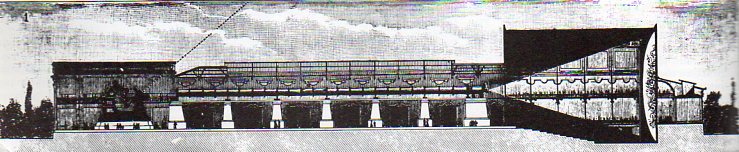
    I’m not sure where this idea came from–perhaps in the post on massive tubeless telescopes (here), reminding me of the most massive tubed telescope, the longest telescope with a tube, belonging to James Bradley, who produced a monster over 200′ long. Connecting the tubeless and tubed telescopes was the image that I had in mind; the hole following naturally from that. Anyway the Bradley  tubed construction–antithetical to the DNA/carbon/membrane nanotubes–were enormous for their time, and as moveable tubes are still very impressive.  Another massive telescope was constructed on speculation for the Paris Exposition of 1900 {the cross section of which is depicted below)–it was 187′ long, spectacularly made and exhiited, and could find not a single buyer.  Positioning the scope of course would’ve been very problemtaic. 
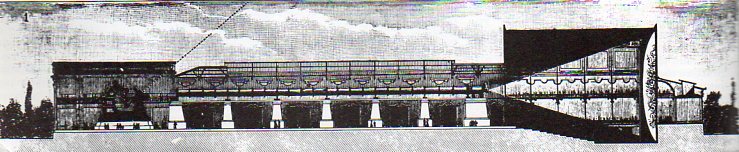
    Tube 1500 ft telescope621
    There are other, more massive and mobile tubes, like, say the smokestacks of the Titanic (which were 24×19 feet, with a fall of 150′ from the top of the smokestack’s sweep to the boilers)–these weren’t mobile in and of themselves, but they did move, if only for a short time (laterally), and then for a very short and cold time (vertically).

    http://www.titanic-titanic.com/pic/funnel_bogie.gif

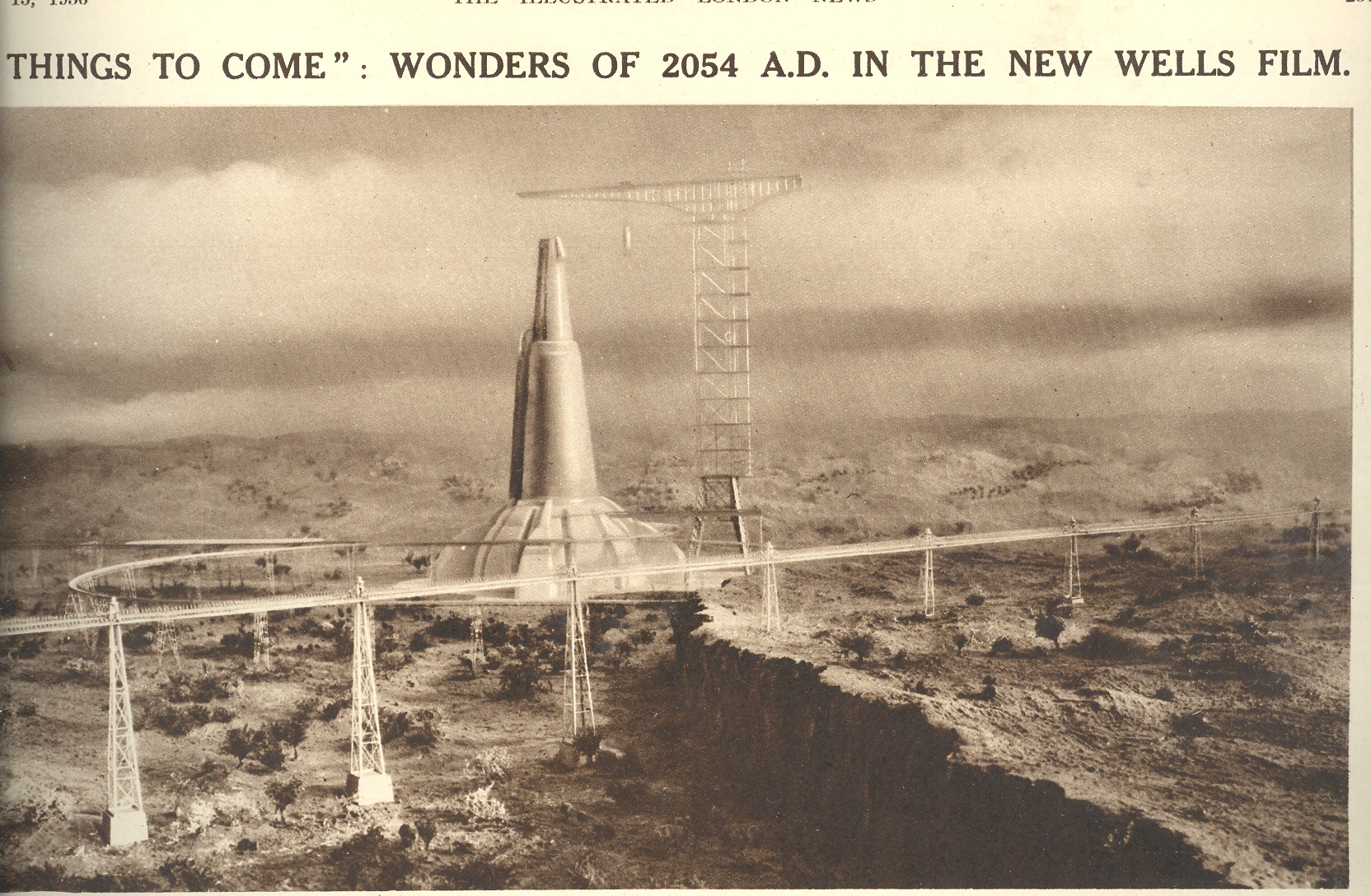
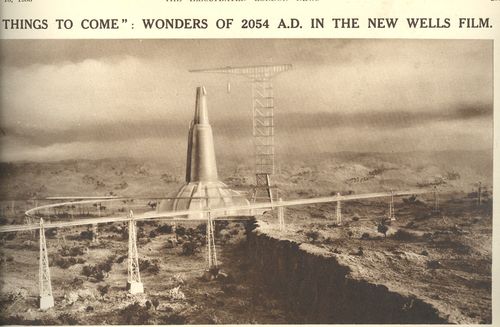
    Massive, monster canons have existed for many years in idealized and theoretical, speculative worlds, like Tom Swift and his Monster Canon.  In the history of early imaginary big gun tubes H.G. Wells’ Babel-like cannon (pictured below in a still from the movie Things to Come (1936), an adaptation his The Shape of Tings to Come (1931)) is fabulous–1500 feet tall, with I figure a  750′ base, it launched a 75′ tall capsule beyond the Earth’s
    Blog jan 6 wells

    gravitational pull with a spectacular explosiveness that would’ve made its occupants into instant jelly.  (Paul Drye points out that one of the biggest sci-fi guns comes to us via Arthur C. Clarke, who had his Lunar inhabitants fashion a gun by drilling into the Moon’s surface until they reached a depth where it would tap and “shoot” molten rock at attacking space ships.  This is more of a hole than a tube, and as such probably ranks it as the biggest hole gun ever constructed, even in science fiction. In the same veinish vein is Robert Heinlein’s railguns, seen in The Moon is a Harsh Mistress.  It has been suggested that E.E. Smith may have concocted gravitational weapons enabling planets and entire galaxies as wepaons, but I’m not sure about this, and they’re definitely not tubes.)

    Just to round out the Solar System cannonry a bit, here’s an example of a gigantic tube coming from the fabulous Frank R. Paul for Stanley D. Bell’s “Martian Guns” found in the January 1932 issue of Wonder Stories.  There’s really no way to determine how big the gun is except to say that it is probably “big”–there’s just nothing to place the thing in perspective, as the figures in the foreground, being Martian, don’t have a specific height.  They could be 6′ tall, or 60′–perhaps they’re only 1/10 of an inch tale, and the projectile they’re firing to the earth is so devastatingly powerful that size doesn’t matter.

    Strange things in sky--martian guns

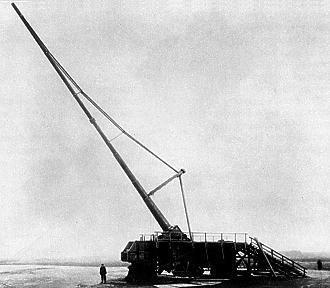
       Back here on Earth and in the real world,  the Kaiser Wilhelm gun (or “Paris Gun”, the Kaiser Wilhelm Geshutz) was
    http://farm4.static.flickr.com/3169/2951816593_c2d2e5c875_o.jpg


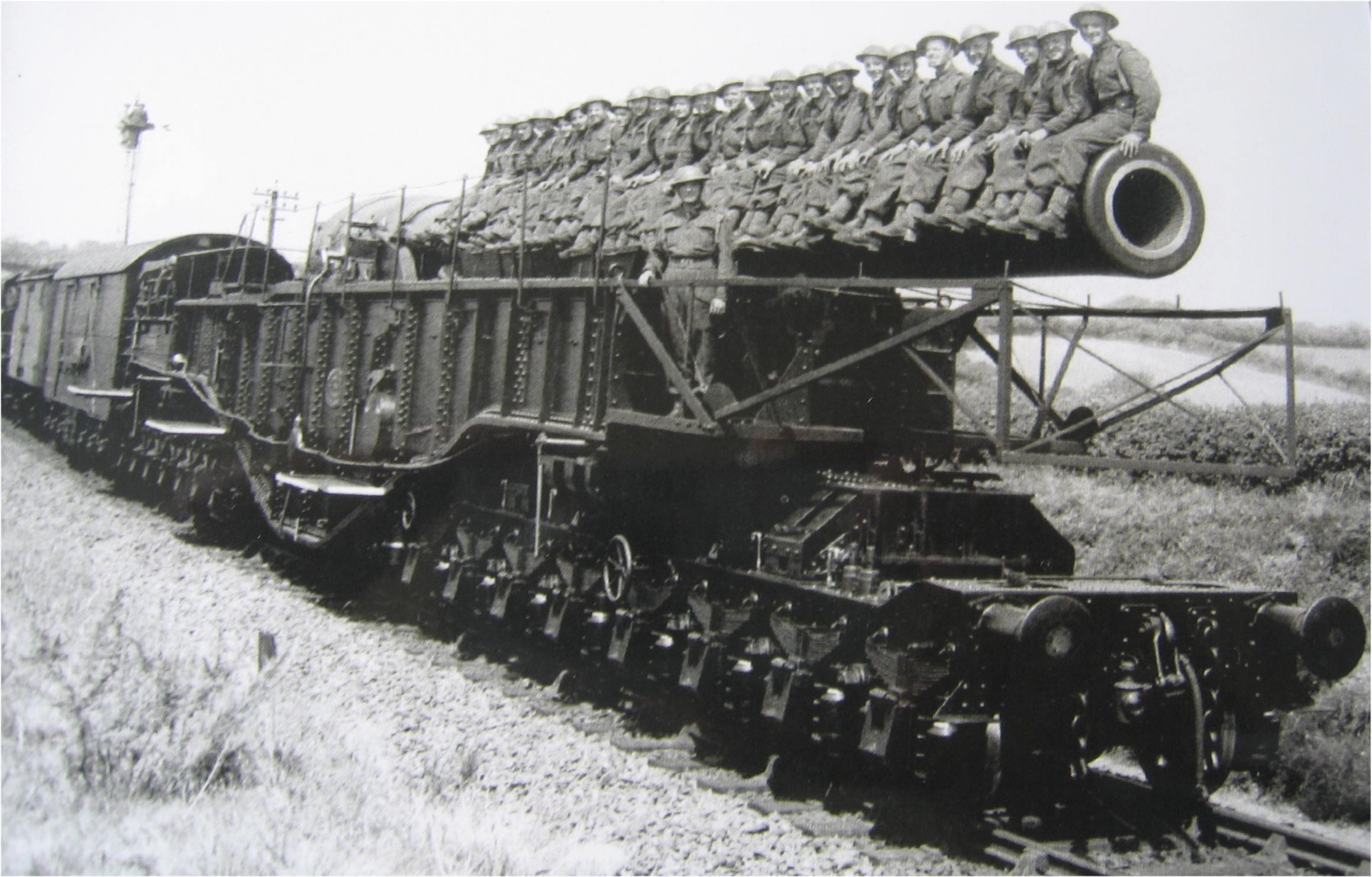
    a long-barreled, light shelled monster: its 92′ long barrel (plus a 20′ extension) launched a 94kg shell about 130 km, reaching a maximum height of 40km (about 25 miles) high. For all of its mass (the gun weighed 256 tons without the railway cars) the shell that it fired didn’t weight much at all….though the shell did reach an extreme height. (Ironically, the gun was built for attacking the deepest of the deep bunkers of the fortresses along the Maginot Line; it was never needed for that, as the Maginot Line was simply left behind in the Nazi assault on France.)  The British Ordnance BL 18 inch howitzer (below) was developedjust as WWI was enidng, but did not enter service until nearly two years after the war ended.

    File:BL 18 inch Howitzer Ashbury Station WWII.jpg

    The Schwerer Gustav was a 1350 ton beast which fired a 14,000 pound shell (!) about 20 miles. A  little later came the Nazi V-3 (the lesser known of the V-weapons), the Vergeltungsewaffe 3, a 130 metre (!) long, 150mm gun built alongthe side of a hill, launching a 140 kg shell. The Iraqi Big Babylon gun was sort of like this one, though never built–it was to have a 500′ barrel and would be supported by a hillside. Then there was the Nuclear Tube: the Atomic Annie (M65) cannon, which was another bruiser, being an enormous 85′ cannon that delivered the worst punch of all cannons, a nuclear warhead.  The weapon was test-fired in 1953 at Frenchman Flat at the Nevada Test Site and delivered a 15kt explosive device to a target seven miles away. There were 20 of these made, but given their diffiult-to-deploy-and-keep-secret status, and the nature of the shells, and the development of more sophisticated weapons, the M65 was obsolete almost as qickly as it was introduced, but was removed from the frontline only in 1963. 

    VWM240mmAtomicAnnie01.jpg

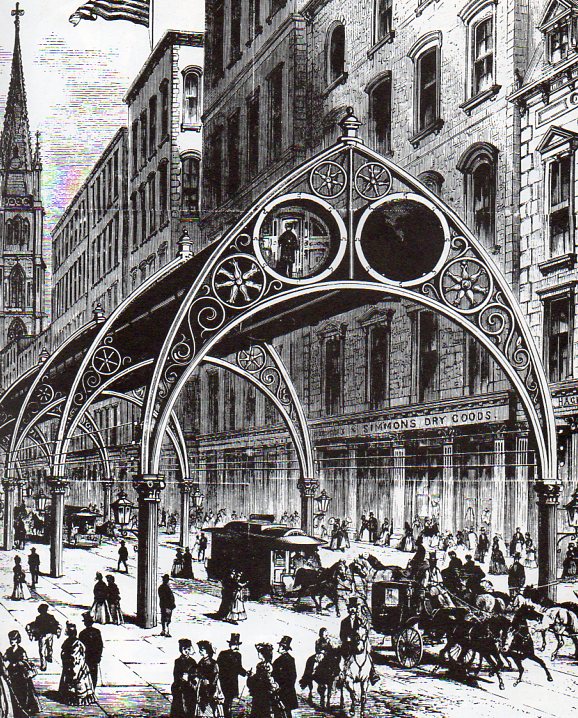
    I guess what people think of first though in regard to tubes in “The Tube” in London, though a more tubey tube was presented here in the pages of the Scientific American for the NewYork City subway:
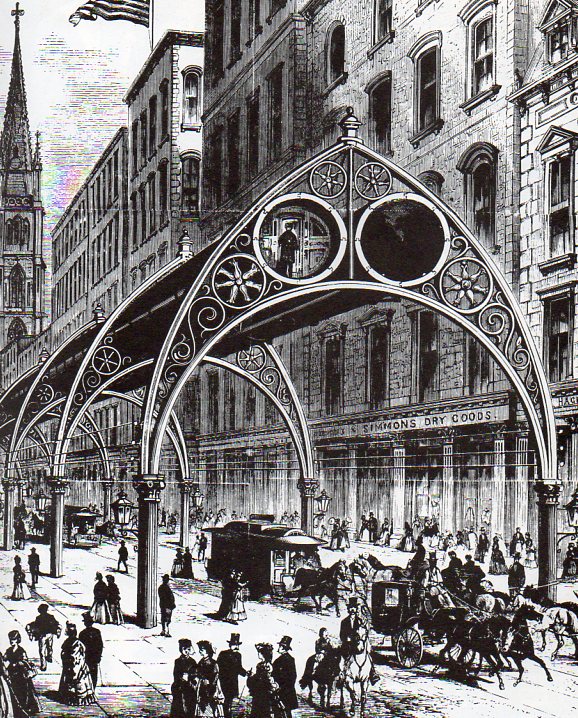
    Tube nyc623

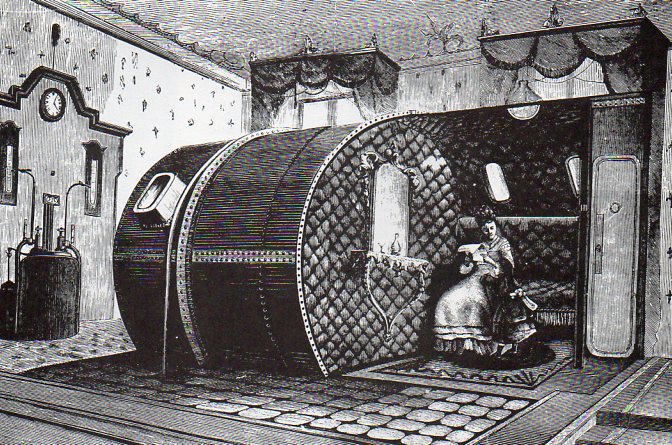
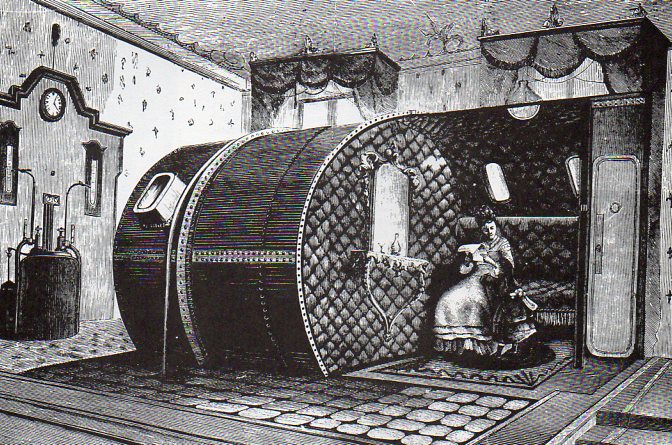
    Here’s yet another strange tube, this a tube-within-a-rectangle, an aerotheraphy device that was supposed to cure people of whatever they needed curing for, just like any other good quack device, though this may well have been the heaviest of them all.  Cushioned, well-appointed, and with a hint of luxury, this burst of fresh air was inteneded to render diseases and other complaints harmless–only for a lot more money than electro-shock or beer cures or massive purgatives or bleedings or copper amulets or whatever else you can come up with.  It does make a nice image, though:
    Tube aerotherapy625

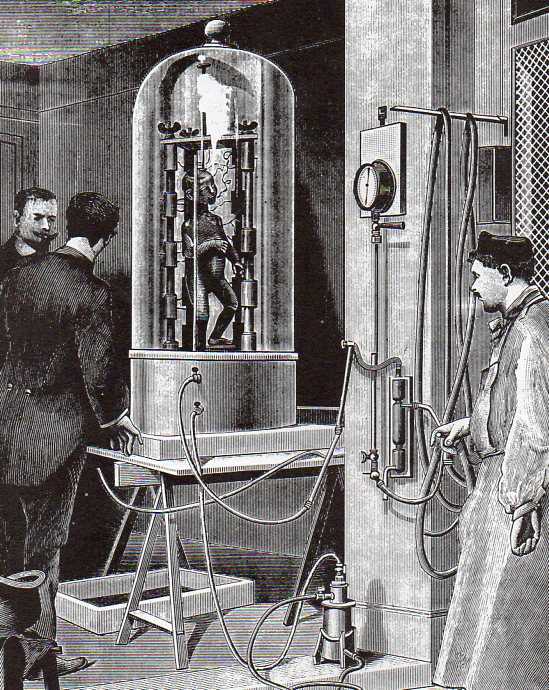
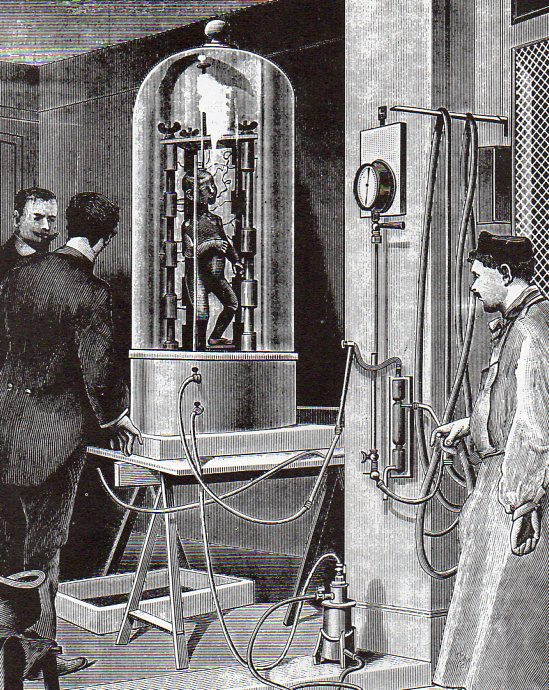
    The tube below may well have been the largest glass tube to hold the body of a dead person–and in this case, a dead child.  It was design for a practice that was evidently not practiced–electroplating the dead.  Someone thought it might make a good practice to deposit a one millimeter coating of copper on the skin of a cadaver, and published their success (and image) in the Scientific American for November, 1891.  The practice didn’t catch on.
    Tube test tube dead622

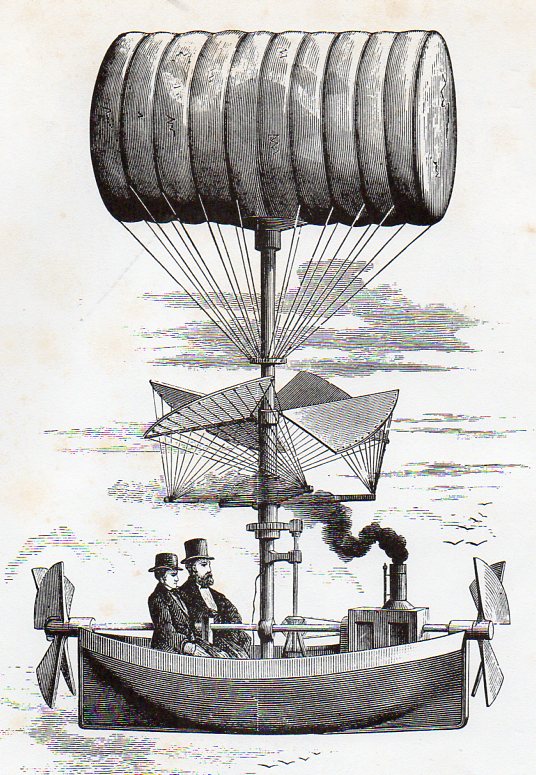
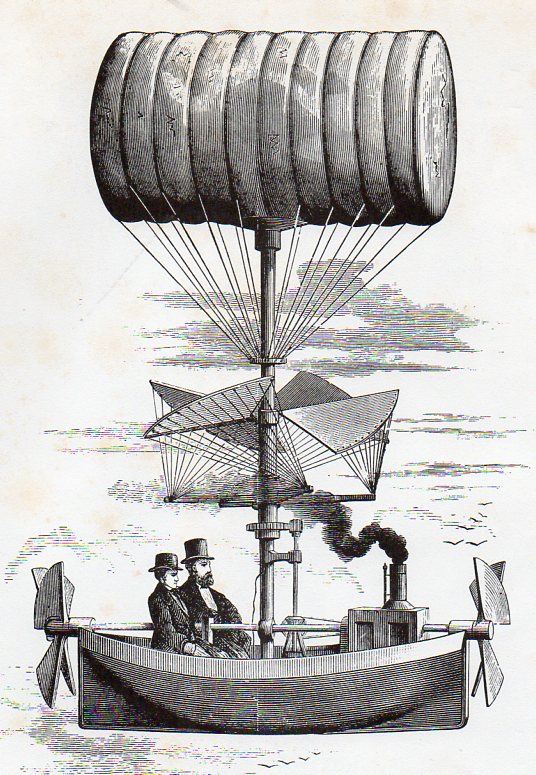
    Then of course there are submerged and flying tubes; submarines have certainly become a long-established part of the technological landscape, and the flying tubes, not. 
    Tube  flying620
    Still, the steam-driven helium-filled flying tube boat looks dignified and lovely, if impracticable.

    There were proposals in the late 19th and early 20th centuries for pneumatic railroads and pneumatic people movers (in one case in the 1930’s, for a plan to move individuals from New York to Philadelphia in chair-like objects in one of these tubes), but for all intents and purposes the closest that these plans came to fulfillment were pneumatic operations like thoe found in R.H. Macy in New York.  It was in the massive department store where you could find miles of pneumatic vacuum tubing that connected department tellers to a main counting office, where little cylinders were filled with cash and receipts and sent along for accounting.  The logical outocme of Macy’s tubular world for Terry Gilliam was seen in the director’s masterpiece dystopic flic, Brazil, where we see a world crowded with gargantuan and suffocating nothinness, filled with bazillions of miles of ductwork whose purpose is a mystery, making for a cold and disturbed world. 

    Brazil screen capture

    End part I of Making Tubes of out Holes–the History of Holes, Extended.

    Notes
    l. Edwin Abbott’s slender Flatland is perhaps one of the best books ever written on perception and dimensions, a beautifully insightful book that was quick and sharp, and in spite of all that was also a best-seller.  Written in 1884 when Abbott was 46 (Abbott would live another 46 years and enjoy the book’s popular reception), it introduces the reader to a two dimensional world with a social structure in which the more sides of your object equals power and esteem.  Thus the lowest class would be a triangle (three sides) while the highest (priestly) class would be mega-polygons whose shape would approach a circle.  Abbott’s magistry comes in explaining to the three-dimensional reader what it was like to be in a two-dimensional world.