A Daily History of Holes, Dots, Lines, Science, History, Math, Physics, Art, the Unintentional Absurd, Architecture, Maps, Data Visualization, Blank and Missing Things, and so on. |1.6 million words, 7500 images, 4.9 million hits| Press & appearances in The Times, Le Figaro, Mensa, The Economist, The Guardian, Discovery News, Slate, Le Monde, Sci American Blogs, Le Pont, and many other places… 5000+ total posts since 2008.

Author: JF Ptak

  • Found Sound: Kircher, Pythagoras, Blacksmiths & Earbones

    JF Ptak Science Books  Post 1358

    [Above:  a gorgeous display of ear bones of humans and animals: reading across the top:  man, cow, hors,e dog, leopard, cat, rat, pig and sheep, coming from Athanasius Kircher’s book on sound and acoustics, and about the first of its kind:  Musurgia Universalis, printed in Rome in 1650.  Image from Special Collections of the University of Glasgow library, and which is the bottom half of the engraving reproduced int he “notes” section1.]

    It seems that almost all of human history’s hearing has been impressionistic–a collection of aural landscapes that would disappear as soon as they were ended, unless of course someone was there to write down what was heard on papyrus or sand or mud or clay or paper.  Finding the sound was important because, well, it was a single-shot phenomenon, unless it was repeated by the presenter, or someone else copied the presentation, or wrote it down so that it could be read and interpreted later.  It was a phenomenal invention of Mr. Edison’s that brought the possibility capturing sound so that it could be played over and over again, the experience becoming a simple piece of technology available to anyone who could afford it.

     The odd thing now is that virtually everything is findable, recordable, archivable.  We can also hear just about anything from just about anywhere.  Before the telephone–invented by Mr. Bell only 135 years ago–in order to hear something from a distance beyond the normal auditory range, a person would’ve needed the assistance of objects such as these “propagation horns” from Kempsten’s Phonurgia nova (of 1673, pictured at left).  Sir Samuel Morland, a fantastic English polymath (1625-1695) also produced an instrument similar to this in his stentoro-phonica, constructed in the 1660’s  It is in a way similar to the giant listening devices devised and constructed by the Imperial Japanese Army in the earliest days of WWII, prior to their use of radar.   Or, if one was a monarch or other highly placed aristocratic or ruling class person, one could have used something like Kircher’s listening device, found again in his Musurgia Universalis of 1650 so that a little eavesdropping might go on from one far-placed room to the next. 


    Wheel-mounted acoustic locators for detecting enemy aircraft over Japan in the 1930s
    [Kircher’s device, below.]
    If one were to construct a monument to “found sound” certainly an important element of it would have to involve Pythagoras, who by virtue of walking past a group of blacksmiths heard something in their pounding that struck him deeply, exciting his foundational ideas about pitch.
    We see him featured prominently in the frontispiece to the Kircher work mentioned above–well, that and a lot of other symbolism as well.

    The blacksmiths are seen at middle bottom, and the man to their left is Pythagoras, pointing to them with a staff, seeming to lean on a marble pillar, but what that really is is a manuscript of his theorem regarding pitch.  reigning over all is a sun representing the Holy Trinity, its rays anointing the earth in the forms of light and angels, the world scene in the center, surrounded by the zodiac and hosting the seated Musica, all representing the ealier beliefs of mathematical/artistic/musical relational proportions, the music of the spheres. [There are other interesting appearances:  musical instruments at the feet of Pythagoras, Pegasus (perhaps?) at the top of the stairs at middle-right, mermaids in the distance, and of course the figure at right, surrounded by all sorts of musical instruments as well as a golden owl.  Of lesser importance but of high interest is the figure just to the right of Pythagoras’ elbow, a figure who seems to be singing, or yelling, or attempting to hear an echo,]
    Perhaps the most significant manufactured found sound–in the tradition of Swift and later that of Burroughs and Gysin–was Kircher’s absolutely fabulous  music-making machine, the arca musarythmica.  It was with a device such as this that any person of any (in)sensibility could compose a slightly pre-arrnaged piece of music, combining previously tranbscribed scores together at random to produce a wholly new musical composition. As described  on the Glasgow Library site, the instrument functioned so: 


    The arca musarythmica is a device by which a non-musician could compose a piece of four-part music using prearranged musical fragments inscribed in wands arranged in columns inside the box. Each type of wand corresponded to a particular metrical unit e.g. 4, 5, or 6 syllables, and on each wand there were examples of florid counterpoint on one side and more simple note-against-note settings on the other. Once the phrase to be set had been analyzed into its fundamental syllabic units, each of these could be set to an example taken from a wand of the appropriate type

    I don’t reckon that I’d like the music much (have there been any recordings of anything ever “composed” in this way?) but I sure would like the object. 
    Notes:

    1.

  • Baroque Weeping Baby Skeletons, the Creation of Man, Genesis and a Tiny Bit of All That.

    JF Ptak Science Books  Post 1357

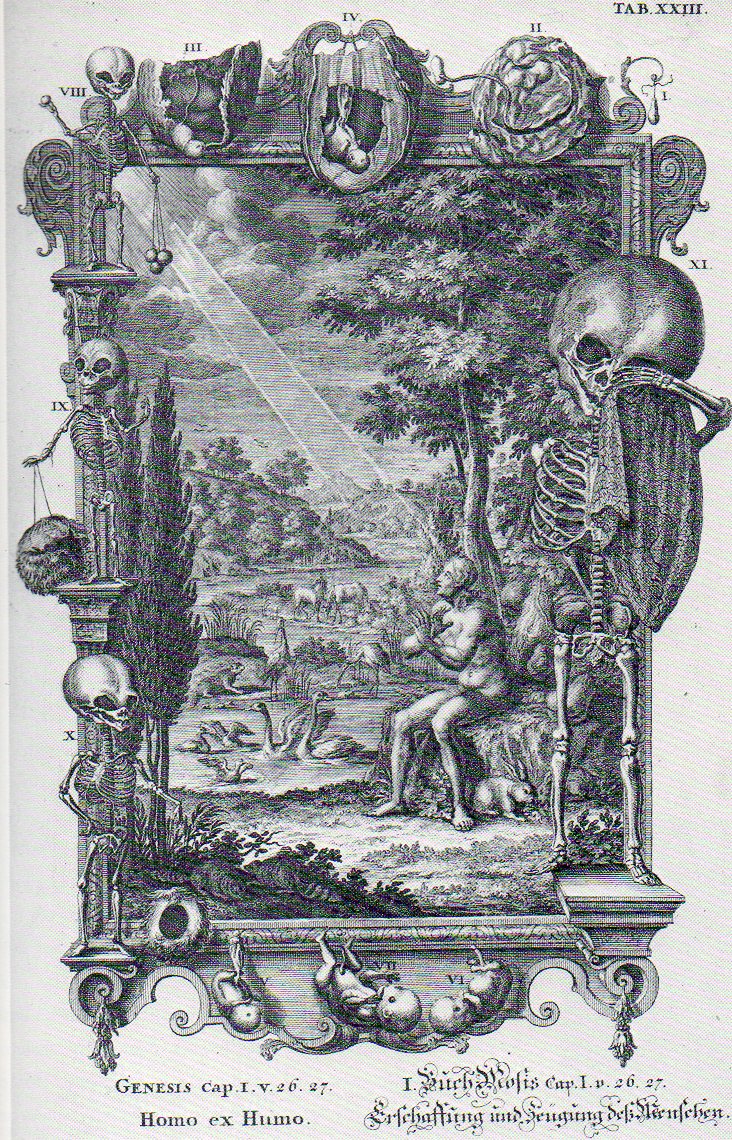
    Jean-Jacques Scheuchzer’s Physique Sacree (published 1732-1737) is an enormous, plumply illustrated thing, an extraordinarily diverse work on the Old Testament and the antique sacred and its relationship to the panoply of natural philosophy.  Its  759 illustrations are usually given overly-encrusted decorated borders by a diverse and at times bizarre selection of themes from biology, geology, astronomy, physics, chemistry, and whatever else seemed to work. It is a production of the High Baroque and high imagination, working within the very definite confines of ecclesiastical squareness and scientific roundness–and somehow the pegs all seem to fit, for Scheuchzer.

    The image that I latched onto [and which is available at 200% if you click through it]  illustrates Genesis I 26, 27:

      Baroque480

    “26: And God said, Let us make man in our image, after our likeness: and let them have dominion over the fish of the sea, and over the fowl of the air, and over the cattle, and over all the earth, and over every creeping thing that creepeth upon the earth.
    27: So God created man in his own image, in the image of God created he him; male and female created he them.”

    Indeed.  We can see the pure holly light (appreciably wide as it gets to its subject than when it started, where it is also degraded)  extending diagonally across the image to a surprised/fearful Adam, who is popped into a landscape of the newly-created.  But it is the border illustration that is most extraordinary to me–it is an 11-segment depiction of the birth process, told almost exclusively in baby skeletons.  The story begins at top-right corner, with perhaps a hint of conception, and then through  developmental stages II (embryonic) and then III/IV (taking us through the third month) and then V through VII (showing perhaps through the seventh month or so), displayed in a top- and bottom-middle display, and not in order.  I really don’t know enough of developmental anatomy to say what is depicted in images VIII through XI, except to note that–of course–they are all skeletons, and the last is weeping. 

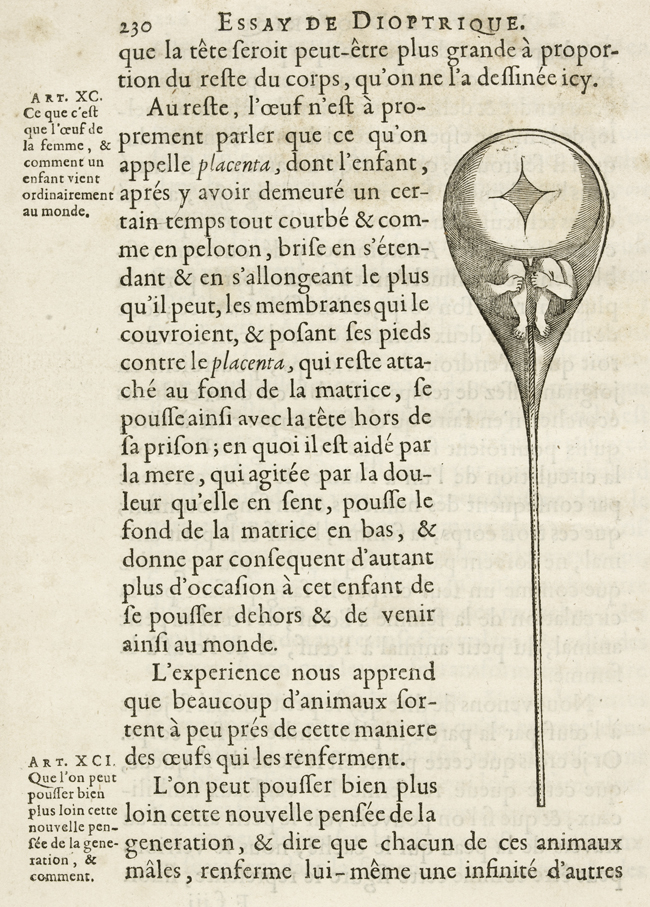
    Spermatozoa seem to be missing in images I and II, or at least Scheuchzer didn’t make an attempt to show them at work, even though he must’ve been aware of their existence, discovered  fifty years earlier (in 1677) by Leeuwenhoeck.  But this discovery certainly didn’t get in the way of maintaining the theory and belief in the homonuclus–the tiny, preformed person carried completely within the sperm and implanted in the woman who served basically as an oven, a receptacle.  Scheuzcher believed on the other hand that the homonuclus was located in the ovaries–still part of the preformationist camp, but getting closer to elevating the importance of woman in embryological development.

     [All that said I don’t know the reason for the weeping skeleton; or, for that matter, what the things are that the two skeletons at upper left are holding.]

    The homunuclus, famously illustrated in Nicolas Hartsoeker’s Essay de Dioptrique in 1694: 

    Ovary Hartsoeker


  • The Nonsense of Strategically Meaningful Phrases–Finding Pillows in the Post-Nuclear-Attack World, 1968/9

     JF Ptak Science Books  Post 1356

    Caveat: this story is of course forever and best told by Stanley Kubrick’s Dr. Strangelove.

    Researching a study on the usefulness of the actions of Adolf Hitler amd their application to the U.S. government’s planning possibilities for post-nuclear-holocaust existence (German Wartime Industrial Controls: an Analogy to Recovery from Nuclear Attack, Stanford Research Institute, 1968, review coming soon), I came across the following related studies, all of which are available at the Storming Media website, here.

    The titles are incredible, the abstracts more so–but some phrasing in the abs were absolutely, sensationally, bad. 

    I can imagine a play, a scenario leaning heavily on Samuel Beckett’s Krapp’s Last Tape, men sitting in front of reel-to-reel tape recorders, listening to themselves describing the impossible language that they were using to transmit the ideas of surviving nuclear Armageddon–brilliantly lit from single spots directly above the seated figures and with all else absolutely black, they play these snippets, and try to explain what the language actually meant. Perhaps they try to talk over the recordings, only to have the recorded audio get a little louder, and multiply, a la Steve Reich’s Come Out.

    I understand that in order to talk about a complicated and complex landscape that you need to establish certain words and phrases to mean one thing and one thing only so that information can be transmitted and analysis with common denominators can take place.  At the same time these phrases loosen the reality of what they represented, removing the implications of fighting such a war, and thereby making the button-pushing a little easier.  Perhaps the launch business becomes more automated this way, even in considering the theoretical end of the actions of nuclear war.  Like the soldiers who were endlessly trained to turn the keys and punch the buttons at this country’s x-number of launch facilities, trained countlessly and tirelessly, so that when the real call came in they could just do the job, follow the instructions as they had 2,000 times before, and launch the missiles that would kill tomorrow.

    And so in 15 minutes I found these impressive examples of polyprhases that meant both something and nothing:

    Paper 1

    “Period of fractionation”–describing the civil circumstance directly after nuclear exchange.  Found in Scenario for Postattack Social Reorganization, : Raymond D. Gastil; William Schneider Jr; HUDSON INST INC CROTON-ON-HUDSON N Y

    This paper also provides us with “historical disasters that were somewhat comparable to nuclear war” as well as “return to normalcy” as the sixth part of a six-part post-nuclear landscape.  And this is all just in the abstract. 

    “Abstract: This approach to postattack analysis was meant to explore the possible contribution that a documented scenario could make to postattack research on organizational problems. Using knowledge of historical disasters that were somewhat comparable to nuclear war, we divided the scenario into the following periods: Pre-attack, the disaster; period of fractionation; survival and reconstruction; innovation and control; and, return to normalcy. The scenario covers a period of more than two years (1970-1972), and the attack was OCD’s CIV-LOG ’65 in which 2000 megatons were used. [Emphasis mine.] Appendices explore more analytically certain issues raised by the scenario. (Author)”

    Paper 2

    “The break in traditional economic time series…”  Meaning that there were new timetables in how things got done and how we communicate, in business, following a nuclear war.  Found in: Information Needs for Postattack Recovery Management, 1968.  {Actually the entire abstract is worth a quote.]


    Abstract: “The study is concerned primarily with information needed for monitoring the effects of actions taken by governmental bodies at federal, state, and local levels in a postulated postattack period and for providing business management with the overall information it needs for making business decisions in the absence of undistorted indicators of economic developments. The break in traditional economic time series and the need for drastic reorientation of industrial efforts in ..”

     Paper 3

    “interdiction of normal business channels” Found in Institutional Factors in Total Vulnerability,  1968

    and 

    “None of the problems [in surviving nuclear attack] would pose insurmountable difficulties but all would require prompt attention and appropriate resolution within the first two months after a nuclear attack”

    Authors:  Francis W. Dresch; Hazel B. Ellis; STANFORD RESEARCH INST MENLO PARK CA

    “A systems approach was used to identify institutional problems likely to be neglected in analyses of the vulnerability of physical systems at risk from nuclear attack. This report discusses six specific problems (solvency, credit, business organization and management, interdiction of normal business channels, legislative imbalance, and disruption of election machinery) and their implications for the assessment of national vulnerability. None of the problems would pose insurmountable difficulties but all would require prompt attention and appropriate resolution within the first two months after a nuclear attack.

    Paper 4

    “nature of demands for labor in a postattack world” and of course “post-attack economy” found in Preliminary Estimates for Labor Demands in a Post Attack Economy, 1968. Authors:  Stephen Baer; INSTITUTE FOR DEFENSE ANALYSES ARLINGTON VA PROGRAM ANALYSIS DIV

    “Abstract: This is an informal exploration of ways to determine the nature of demands for labor in a postattack world. An attempt is made to determine the needs for labor and the demands of consumers after a nuclear attack based on preattack patterns, community sizes and income levels. (Author)”

    Paper 5

    “using retired boxcars for simulating urban area fires” [ignited by thousands of megatons of explosives] found in Feasbilities and Representativeness of Large-Scale Boxcar Burns, 1968

    Authors:  Frederick Salzberg; IIT RESEARCH INST CHICAGO ILL ENGINEERING MECHANICS DIV

    “Abstract: the study deals with the feasibility of using retired boxcars for simulating urban area fires. Considerations are given to the representativeness of boxcars fires, development of an experimental plan, and a cost analysis. An outline is given of experimental series designed to study various aspects of urban area fires by means of boxcar fires. Included are studies of fire spread, development of group fires, and behavior of mass fires. (Author) “

    Paper 6

    “production degradation” found in Industrial recovery Model Constraints, 1969.

    “Abstract: The vulnerability of a facility to nuclear blast damage is determined by identifying the industrial facility with a structural type and the type of processing equipment contained therein. Equations are extended to estimate production degradation. Damage repair data and analysis are reviewed and a straight-line function is suggested for relating repair effort and elapsed repair time to overpressure. The functional relationships of industrial recovery are analyzed with respect to target …”

    Paper 7

    “problems of debris removal to achieve specified objectives in urban areas” found in Debris Removal in Civil Defence Operations, 1969.  Authors:  George E. Wickham; STANFORD RESEARCH INST MENLO PARK CALIF

    “Abstract: As a part of the Five-City Study, this report examines the problems of debris removal to achieve specified objectives in urban areas. It details the necessary steps for determination, and provides a quantitative value of the total resources required to accomplish clearing operations. It illustrates the application of methodology developed in research report titled ‘Debris Removal Civil Defense Operations: Volume 1’ so as to provide realistic appraisals …”

    Paper 8

    “disorganization inevitably following a nuclear war” found in Capabilities of Fire Services to Limit Damage from Nuclear Attack. Authors:  S. B. Martin; R. W. Ramstad; URS RESEARCH CO BURLINGAME CALIF

    “Abstract: The report emphasizes the dangers to eventual reconstruction that are posed by the disorganization inevitably following a nuclear war. What can go wrong in this reorganization period is examined by the use of scenarios and analogy. It is then suggested that during the crisis period preceding a nuclear war a number of useful actions enhancing the chance of postattack recovery should be undertaken as part of an emergency mobilization for …”

    These are just eight examples–the problem here is that nearly every paper I looked at on this first page of papers from Storming Media could be used as examples of massive underspeak…the real issue being that there were another 100 pages of these things. So its not as though I even cherry-picked these things–they were all in line on the front page.  That’s the scary part–to see how deep the depth was of these things, an infinite depth of finite measurement. Something in nothing. 


  • Geronimo, Finally Defeated by Miles and the Sun

    JF Ptak Science Books  Post 1355

    The Chiricahuan Apache leader and chief, Geronimo (1829-1909), famously led a progressively diminishing band  through the  Apache Wars of the 1850’s-1880’s.  For thirty years of so he quirted the U.S. Cavalry, darting here and there in great exploits and famous escapes, evading the armies of the United States and Mexico.  In the end, by 1886, there were just dozens who were following him, including women and children, and the elderly, ragged, tired, hungry, and pretty much, finally, beaten.

    I think what finally did Geronimo in were the miles of pursuit and the sun. 

    The sun got to him via the heliographic communication network established by Major W.J. Volkman under the direction of General Nelson Miles (the other “miles” of this equation of defeat), which allowed the pursuing American army to communicate instantaneously over great distances, over hundreds of miles, without the need for runners or men or horseback or cutable telegraph wires or time  The heliograph is an ancient instrument, used for more than two thousand years–in this case, they were very highly polished mirrors that reflected brilliant signals between stations, getting their light source from the sun. It allowed the army an enormous advantage, and one that finally caught up to Geronimo.

    The “miles” were just those, the thousands of miles Geronimo was tracked and retracked over that very difficult terrain in the southeastern part of Arizona and into northern Mexico, sharp mountains, endless badlands, caves, heat, height, cold….very difficult. (I’ve been there on treks.. .its tough land.)


    The capitalized “Miles” was the surname of General Nelson A. Miles who sent out  with Lt. Col. George F. Crook to track down and capture Geronimo–and they almost did, again, in late MArch, 1886, when Geronimo presumably surrendered, but then fled to Mexico. After another five months and 1,600 miles, Miles came upon Geronimo om in Sonoran mountain camp, and induced him for the final time in September, 1886, at Skeleton Canyon, Arizona.

    The details of the capture and surrender are told in many places by many others–I just wanted to surface the role of the sun in the capture of Geronimo.

    The old man (who lived until 1909 and outlived just about everybody involved with hunting him down except for General Miles, who died in 1925) was shipped east,  never to see Arizona again. He died after being thrown from his horse and contracting pneumonia as a result of being unable to help himself to safety through a long cold night, died in a bed as a prisoner in Ft. Sill, Oklahoma.

    [The original map is available from our blog bookstore.]


  • The Tipping Point of Degeneracy: a Look Back at Robert Oppenheimer’s Black Hole that Wasn’t his Post War Existence

    JF Ptak Science Books   Post 1354

    Its easy to forget about the pre-Los Alamos Oppenheimer, especially for those who aren’t necessarily interested in the history of 20th century physics. I was preparing to write something about a very brief window that seemed to have been opened in the 72 hours or so after the second atomic bomb was dropped….or perhaps from the time of he Hiroshima bomb.  In any event, it was a short period, measurable in terms of dozens of hours, where people–even Robert Oppenheimer–had a sense of a sea-change regarding the bomb and peace, and that perhaps the thing was so terrible and so controllable that it might bring about the end of war.  But the gloom of the reality of the future of the weapon–and the future weapon systems–settled in, and that illusory window was closed, if indeed it was ever actually open, which it really wasn’t.  

    Not long after this, Oppenheimer was shuttled into the Oval Office to meet for the first time with President Truman–it must’ve been a worlds-in-collision moment, though it seems Oppenheimer was no quite himself, not quite as filled up as he should’ve been.  Depressed, I’m sure, after having just gone through a bit of rough business as to who would be controlling the future of the bomb.  Anyway, he met with Truman on 25 October 1945, in there with Truman for a 10:30 appointment, and things did not go well.  Truman “asked” (apparently rhetorically) Oppenheimer his opinion on when the Soviets would develop the bomb.  Oppenheimer simply said that he didn’t know.  Truman shot back “never”, that the Soviets would never develop the bomb.  I have no idea if Truman believed this or just was pissed with what he thought of his meeting with a “cry baby” Oppenheimer.  Truman evidently told a number of different versions of this story, but one thing was for certain:  he did say that he “never wanted to see that son of a bitch again”.

    If Oppenheimer wasn’t depressed when he went into the Oval Office at 10:30, he was when he was promptly shuttled out for Truman’s 11:00 meeting, which was with the postmaster of Joplin Missouri, Mr. Leslie Travis.  My feeling (completely unsubstantiated) was that equal weight was given by Truman to both the 10:30 and the 11:00.But the man was a definite force in the relatively short time he spent in the high community, from the late 1920’s to about 1942. 

    But just four years before, and the decade or so preceding it, Oppenheimer was a brilliant new force in the American physics community, a  remarkable, brilliant talent with a big insight.  And this is what brought m back to Oppenheimer on the first day of WWII.

    People tend to think of black holes as a Stephen Hawking-era phenomenon while the facts of the matter are that they began perhaps hundreds of year earlier, probably with Cambridge John Michell (1724-1793), back in the year of the end of the American Revolution, 1783 (and perhaps before).  His famous experiment (known as the “Cavendish Experiment”) was really only rediscovered in the 1970’s in Michell’s correspondence with Henry Cavendish.  In those pages he hypothesized that there may evolve a star so massive (which he referred to as a “dark star’ in Newtonian theory) that light itself might not be able to escape fro it, that the escape velocity for the light could never be reached, and that its phenomenal gravity would make the star impossibly dense.  This was very similar to the dark star hypothesis of Simon Pierre de Laplace in his epic Exposition du Systeme du Monde which was published in 1796. Karl Schwarzchild’s 1916 paper using Einstein’s relativity paper of the same year discussed the possibilities of singularity (the Schwazchild limit of the diameter of black holes), as did (the beautiful) Subrahmany Chandrasekhar (one of the last men able to know everything) in 1928. 

    In hunting for a number of Richard Feynman papers here at the warehouse I happened to find this extraordinary effort by J. Robert Oppenheimer and G.M. Volkhoff in the 15 February 1939 issue of America’s greatest journal contribution to physics, The Physical Review.  Here (along with a preceding paper by Richard C. Tolman, issued in the same issue just above Oppenheimer, which were the analytic analysis used by O+V to base their estimates of nuclear forces) was established the Tolman-Oppenheimer-Volkhoff limit, which stated that if the state of evolution of  neutrons forming a degenerate Fermi gas of extremely dense masses in neutron stars was more  massive than .07 solar masses that it would collapse into a black hole or exotic/quark star; if the mass was below that limit, the star would not collapse due to the degeneracy pressure of neutrons and the strong force.  The black hole part was left really to a second paper of 1 September 1939 (the day that the Nazis attacked Poland and the fighting began in World War II in Europe) when Oppenheimer teamed up with Hartland Snyder to write “On Continued Gravitational Contraction”, when the two wrote about the singularity of the event.  the paper met with little appreciation at the time, though the two papers today have lead to some of the most progressive ideas in 21st century astrophysics. (This paper is available at our blog bookstore, here.)


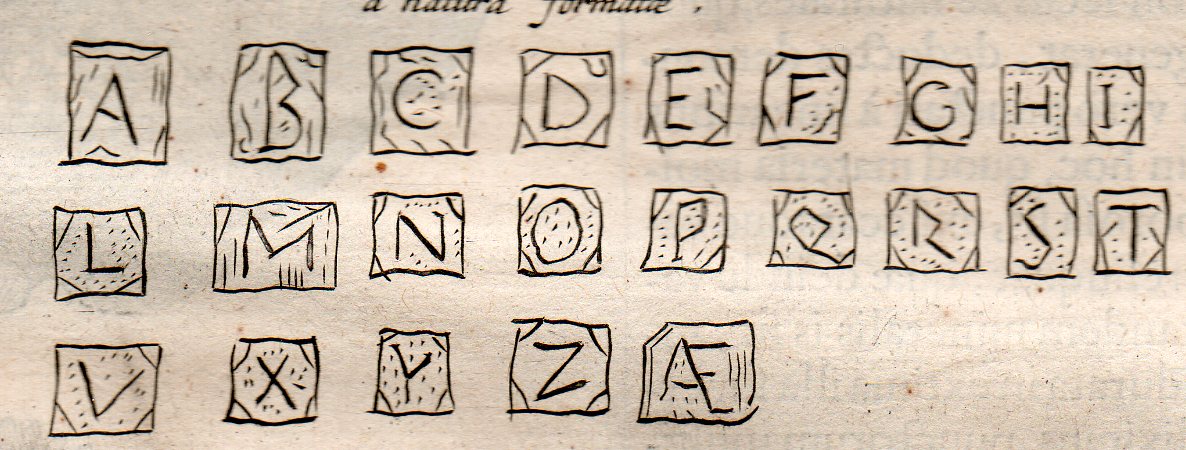
  • Found in Stone: (1) Alphabet and (2) Geometrical Forms, 1664

    JF Ptak Science Books  Post 1353

    Kircher--alpha bet477

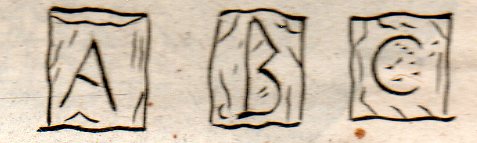
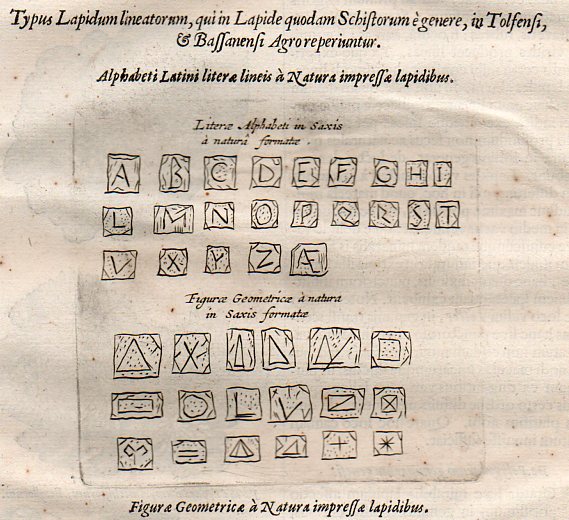
    I wrote about Athanasius Kircher’s Mundus Subterreaneus (1664) a few days ago (in “Birds With Stone Wings”, here and elsewhere), particularly staying within the first section of the eight book of Mundus, De Lapidibus, in which he investigated stones, gems, fossils and then “found figures” in agates. 

    Kircher--alpha bet476

    Kircher did not believe that finding these symbols in stone were a direct consequence of any supreme anything, recognizing that they were formed and collected by chance. He did formulate some interesting and early and sometimes-correct observations on the evolution of languages, but was entirely constrained by the authentic history as presented in the early books of the Bible.  While recognizing that languages of a certain region are or could be relational, and that the Romance languages were a corruption of Latin and that there was a  Semitic and Graeco-Latin connection, they were all necessarily descendants of Hebrew, which was the language given by the creator to man, mystical symbols handed down from Heaven to Adam.  And so it goes–I guess that you can only take so far as imposed limits like that allow.  Horizon Aeternitatis.

    [The original image is available for purchase from our blog bookstore, here.]

    And in detail:

    Kircher--alpha bet479

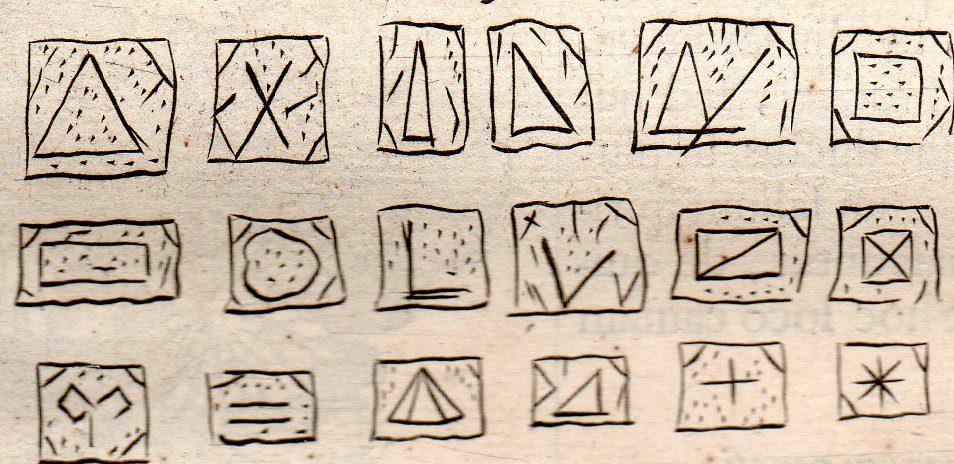
    And then of course the stone-found geometrical figures:

    Kircher--alpha bet478

      These engravings of the originals in Kircher’s cabinets of curiosities did take some sharp-eyed sleuthing and gathering. 

  • “My Zombie ‘Phone to Deadville” and Tales of the Infinite Boneyard, by Tom Edison

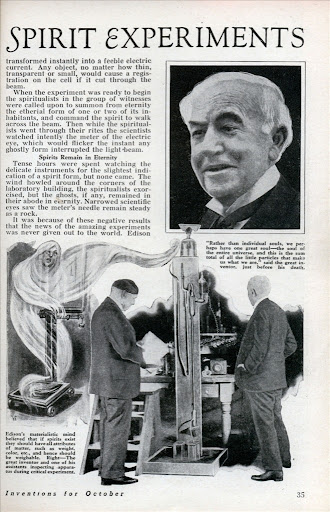
    This post unexpectedly but now not unexplainably appeared on my blog this morning.  It was written last night by Thomas Edison, and sent from 15 minutes in the past.  He wanted to lay to rest the idea that there is no such thing as the afterlife. This might seem paradoxical that a ghostspirit was writing from the near-past about the impossibility of communicating with the dead, but he makes a strong case.
    In his email Edison writes/wrote:  “It’s kinda like Olbers Paradox in a way:  how can you have a dark night sky when there are so many stars? Well, that’s because the universe is infinite and their light not; that’s what it is like with the dead. As it turns out–surprisingly!–living people are finite but the dead are infinite, because we’re dealing with the past possibilities and former universes.  So the dead are everywhere but just don’t have enough juice to be heard.  Unless of course they have access to the internet, which is sort of like heaven, and which is where I now live, and which also offers the possibility of being dead in the future while being still dead in the past. Its good being multi-dimenional electricity.”

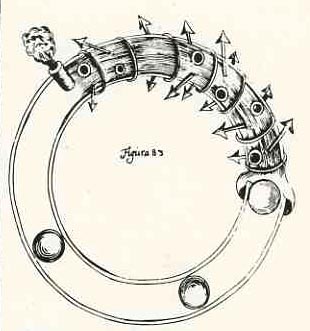
    Edison concluded with a picture: “You know what electricity looks like when you’re inside it?  Here it is1“

    https://historyofideasblog.com/a/6a00d83542d51e69e2011168689fbc970c-500wi

    Thomas Edison did–once upon a time, in a land far far away–spark a world-wide semi-frenzy when he told a reporter that he was making a device that would be capable of detecting and perhaps even communicate with the dead. 

    Edison the agnostic, Edison the non-believer, Edison the anti-spiritual, was hardly poetic on topics of the soul (once referring in 1910 to the brain as a “meat mechanism”1a) and would never have wasted his time on such a thing as a device to detect the dead–unless it was all in fun, which is what this was.  The old man was having a little wicked fun with a reporter, A.F. Forbes (later the founder of Forbes Magazine and father of the father of the  failed and forever failing presidential candidate), who dutifully reported it (“Edison Working to Communicate with the Next World”) in a 1920 issue of American Magazine. He said: “…I am inclined to believe that our personality hereafter will be able to affect matter. If this reasoning be correct, then, if we can evolve an instrument so delicate as to be affected, moved, or manipulated…by our personality as it survives in the next life, such an instrument, when made available, ought to record something.”2

    The story, as they say, had “legs”, and was re-reported many times, reaching even into the Scientific American: in 1921:  “I don’t claim anything, because I don’t know anything…. for that matter, no human being knows”  Edison said.  “But I do claim that it is possible to construct an apparatus which will be so delicate that if there are personalities in another existence who wish to get in touch with us… this apparatus will at least give them a better opportunity.”

    Indeed.

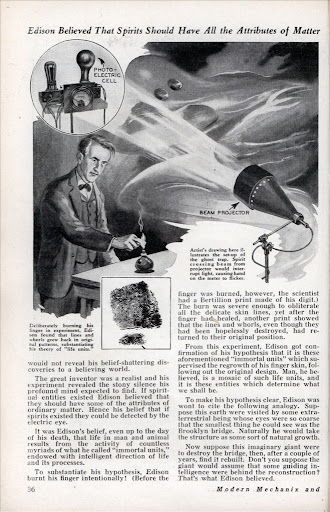
    Later in 1921, A.D. Rothman for the New York Times wrote a story that had Edison constructing a machine that was sensitive enough to detect a bit of the “one hundred trillion” “life units” that pooted away from the body on death, and which evidently were (a) detectable, (b) capturable and (c) meant anything beyond being a+b. 

    I suspect that Edison (who once remarked that he didn’t know what the word “spiritual” meant) was happy with this outcome, the world looking for him to turn the afterlife inside-out, to make it observable, feasible, concretized–to show that it existed.  And who could blame them?  Edison as an inventor and as a master of a group of 50 other inventors and advanced assistants had an enormous track record of  revolutionary successes–why not this?  Some of what he brought to bear on the world–electric lighting, the phonograph, and so on–must’ve seemed almost as deeply science-fictional as weighing the dead.  Perhaps his conceit in this whole episode might’ve been in an attempt to show how similar the belief was in his “invention” to that of any (other) religion.

    ________

    1) This illustration is actually from Praxis Artolleriae Pyrotechnicae, printed in Osnabruck by Tilman Buchholtz for Johann Georg Schwaender, is one of those beautiful books of horrible things; the “arrows” on this device of ear aren’t showing the direction of rotation; they are actually spear tips looking for some flesh to tear.

    1a) In an interview with Edward Marshall in the New York Times, 1910.

    2) Beyond knowing that this was all outside of Edison’s interests, we know it was a prank because he said so, in the New York Times, in 1926: “that man came to see me on one of the coldest days of the year…his lips were blue and his teeth were chattering…I really had nothing to tell him, but I hated to disappoint him so I thought up this story about communicating with spirits, but it was all a joke.” NYT, October 15, 1926, page 11. I’d reproduce the whole thing here but ProQuest seems to be yelling at its readers not to. 

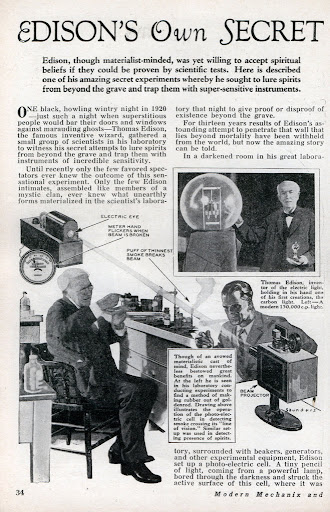
    3) Here’s a bit from Modern Mechanix (1933, two years after Edison’s death):


    ·Posted by :

    ·in:

    —

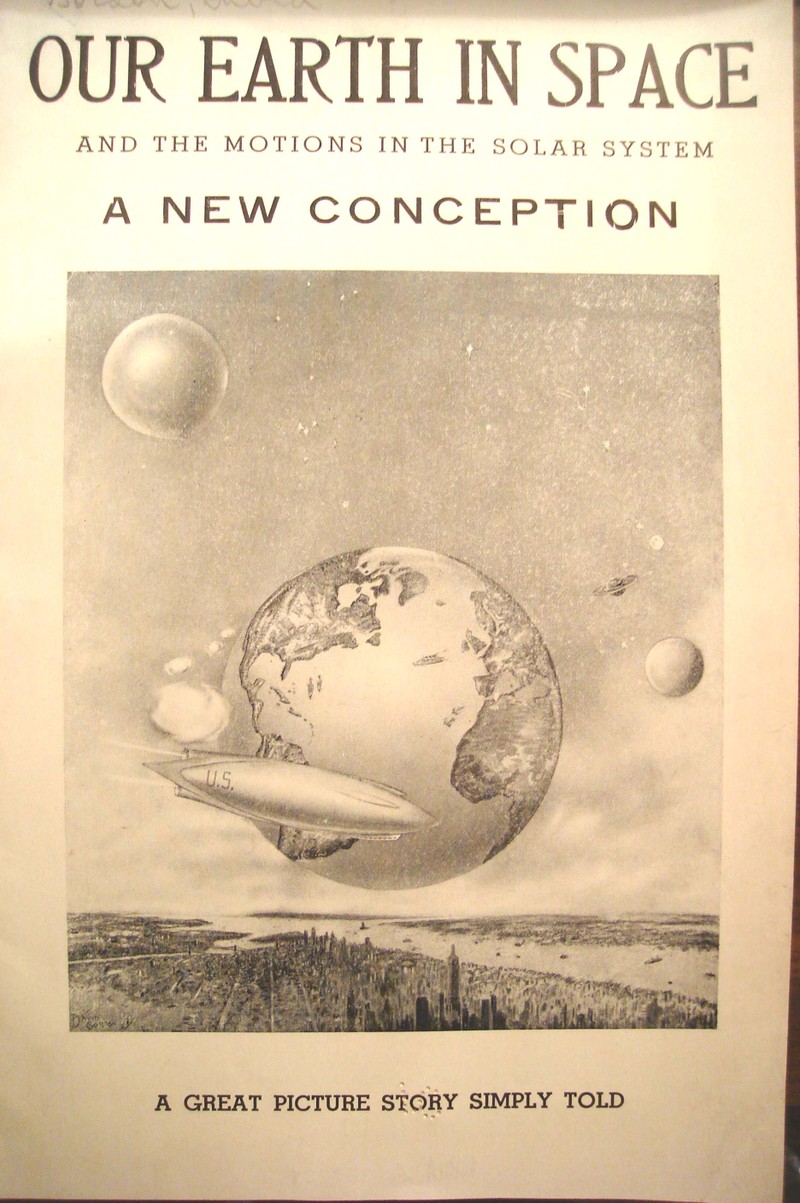
  • Extra Earths and Manhattan Under Attack–Addition, 1939

    Notice of addition

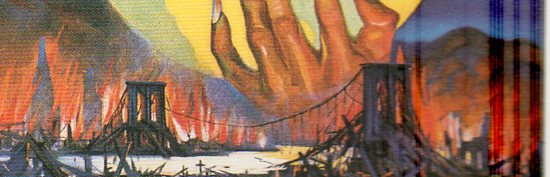
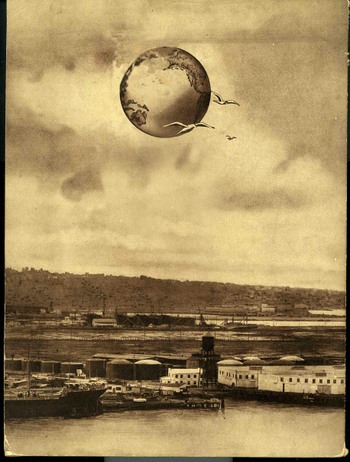
    I’ve found another excellent New York City under attack image to complement those in an earlier post here (New York City: Attacked by Tentacled Flying Saucers, Giant Flying Snakes, Glaciers, and Mining Missile Space Aliens, 1929-1941), this time by a 3-Earth-tall Gagantua. Actually this image fits into another, smaller, even more odd sub category, Extra Earths–images showing Earth-based scenes with (somehow) the Earth in the background. 

    Giants--marvel474And the detail of the Brooklyn Bridge and what was left of the Manhattan skyline:

    Giants--marvel475

    Just for the record, here are some examples of Extra Earths which I’ve written about elsehwere on this blog):

    Blog1sept_10_floating_earthclean

    Photo


    0--blog---Nov 29 into this world149


  • Picturing the Unseen World #`1–the Discovery of the Complex World of Splashes, 1877.

    JF Ptak Science Books   Post 1350

      Drops 456
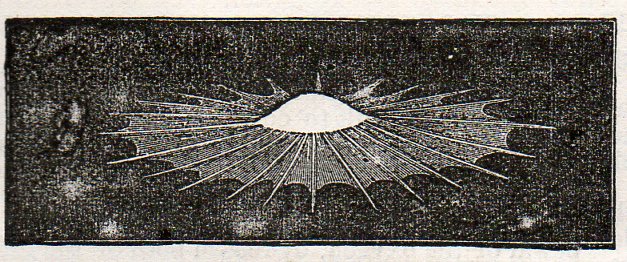
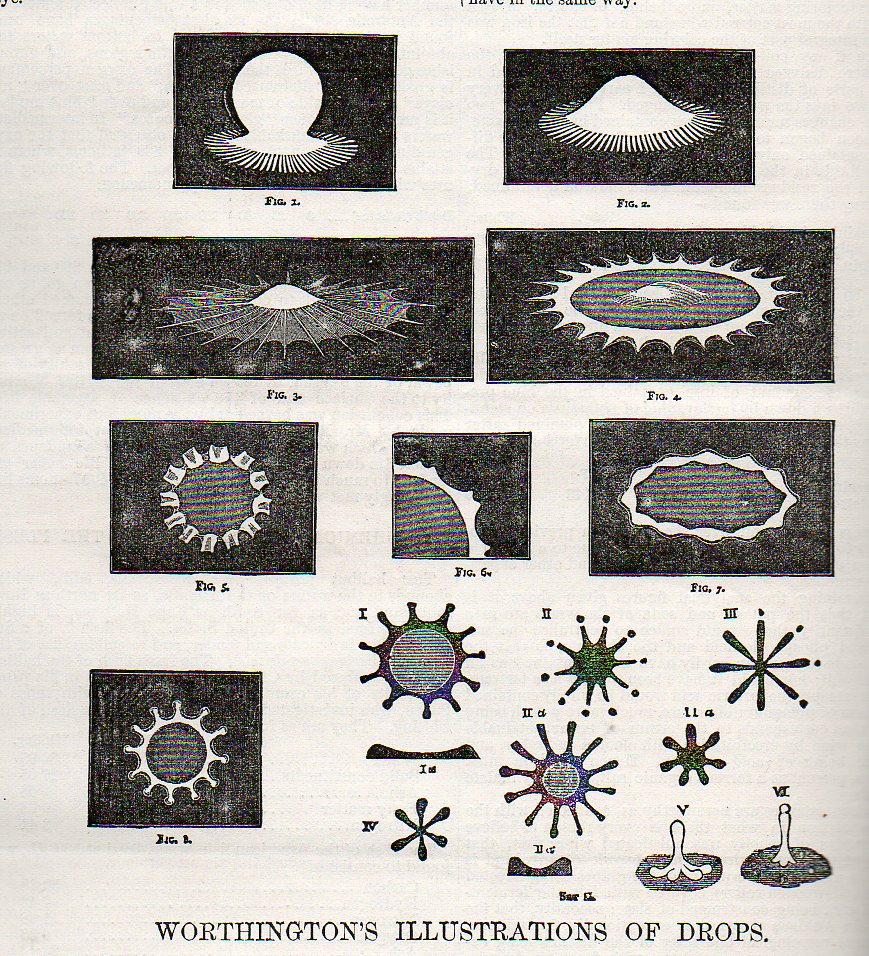
    A.M. Worthington published his extraordinary researches in capturing drops and splashes  just a year after the invention of the telephone–seeing his very quietly magnificent work would’ve been worth the phone call, even at those heady rates at the beginning of the new medium. Worthington was the first in his field, and for a short while, before he told anyone, he was the only person on the planet who had ever seen the fantastic complexity of this very common and previously-simple event.   In its own way these photographs showing the deformation of a drop of milk (and mercury) were as much a revolution as the images shown by Robert Hooke in his epochal Micrographia in which he (just about the next-best-thing to Newton) introduced the fabulous complexities of the previously microscopical world(s). 

    Worthington and Hooke are two in a long line of people who brought  unseen worlds into the visible sphere.  Isaac Newton’s (1642-1727) reflecting telescope (1672) gave a brighter vision to the observable universe; Galileo Galilei created an observable universe an order of magnitude larger than ahead ever been seen before in just one action, in one evening.  Christoph Scheiner put a face on the sun in 1611, Henry Mosely gave geometrical growth patterns to the nautilus shell in 1838, James Fraunhoefer found out the chemical constituents of the sun in 1814, Watson/Crick (and Rosalind Franklin, really) emerged the helix of DNA in 1953, Wilhelm Roentgen presented pictures of the internal structure of living humans without a single drop of blood in 1895,  and on and on, all providing us with spectacular images of what these people saw.
    Chladni’s images of the vibrations made from a bow on a violin string caught on sand-topped metal plates:

    ernst chladni cimatica onde modali
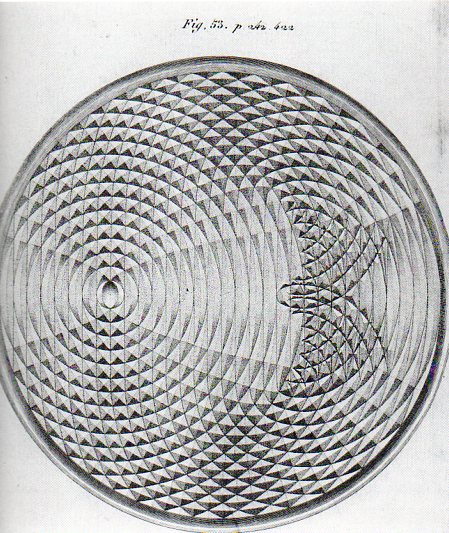
    Adding mercury to mercury: the sensational drawings by the Weber brothers as they observed the changing wave frontsmade by a drop of mercury into a pool of mercury:
     
    Weber acoustics461

    Worthington’s visions into the small, oblique world of ephemeral occurrences gave these things a wider world to themselves; seeing their structure, their complexities, and getting the viewer into their tiny worlds made everyone who could think about such things a better person for doing so.

    The series of semi-photographic images that Worthington was able to make of the drops and splashes could not be readily reproduced in his short article (“On Drops”) published in the Scientific American  (25 August 1877, and available for purchase at our blog bookstore) at this time–the half-tone was still a few years away, and the only way outside of making a drawing after the photograph in 1877 would’ve been a process (like, say, the Woodburytype) that would have been much too expensive to use in a mass-market publication like SciAm. Also, the photographic plates in 1876/7 weren’t quite up to the task of fixing an image exposed so quickly.  Even when Worthington’s book is published on this subject–a popular effort in 1895–it reproduces the photographs as halftones but there are still many interpretative drawings of those images. (The belief in the Civil War images reproduced as woodcuts in places like Harper’s Weekly and Frank Leslie’s was very high–it was enough to know the woodcut was being executed after a photograph and not from drawings made on the spot by the magazines’ field artists.)

    This was some pretty sophisticated stuff, being able to freeze the action of a drop of milk as it exploded in slow stages on a flat surface–especially, again, when you consider that photography wasn’t yet 40 years old and was really only a half-decade or so into its first major revolution since the early 1850’s. 

    Perhaps though the most spectacular thing of all about seeing this dedicated series of images of an exploding drop of milk was that you could look at the series and imagine it all taking place in reverse . 

    The drawings and photos below are taken from his 1895 work, The Splash of a Drop:

    Drops 455


  • Oddly Adjectival Opposites: Color “Plumpness” and Color-in-Black-and-White, 1941

    JF Ptak Science Books  Post 1351 (revisiting the post from 2012 with a few additions).


    Color kitchen457


    Anticipated but unexpected color expectations sometimes don’t quite make it through the ordinary vocabulary of color names and descriptors.  Such was the case for me when looking through this Armstrong Linoleum Catalog from 1941–the brightness and color range was remarkable, and, even if the color in the magazine existed only in the complicated color separation technical efforts on its pages, it still stays remarkable for the colors that they may or may not have represented. 

    • The catalogs from which these images are sampled are all available for sale at the blog’s bookstore, here. 

    The colors seem “pluump” (yes, with two “u’s”) to me, like a big man in a little man suit, suggesting a too-ripeness, the colors too much in themselves.

    Color kitchen458 Color kitchen459 Color kitchen460

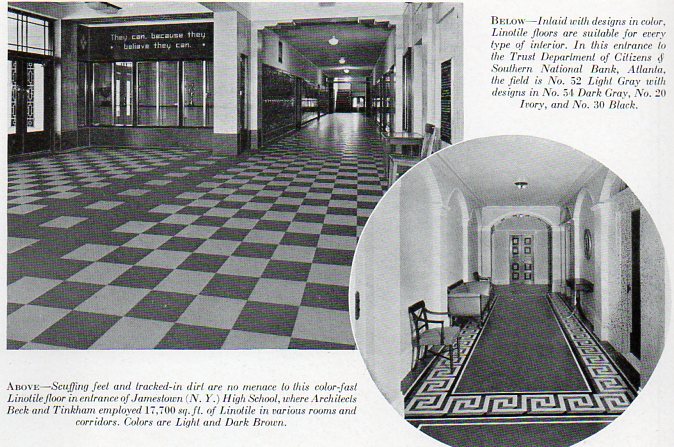
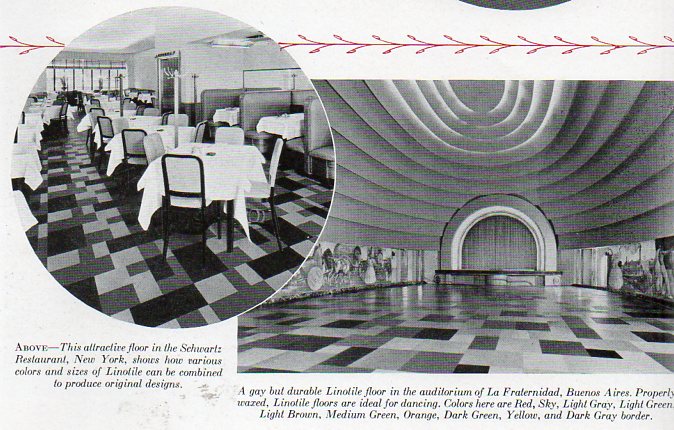
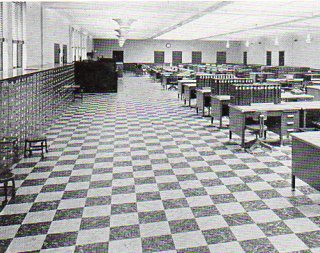
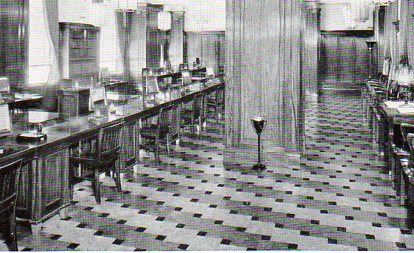
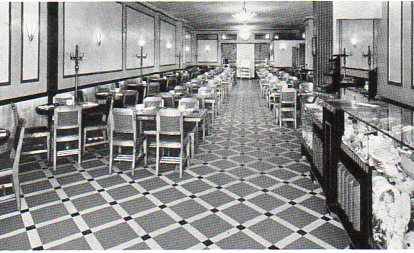
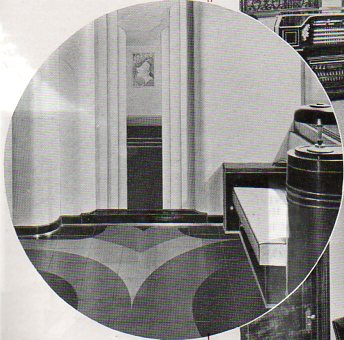
    Color in black and white470 Then, on the other end of anticipation is the Armstrong Distinctive Interior Finishes and the Individuality in Handlaid Floors of Armstrong’s Linotile catalogs of 1935 and 1937 (respectively).  They offer the hope for color but don’t illustrate it, giving their reader a color palette of the possibilities for decoration, but then providing black and white photographs for the imagination.  (I’ve seen other examples of color theory done in black and white–they are not common.)

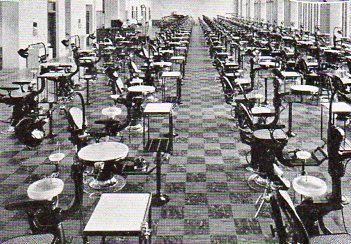
    Part of the many opportunities for Glorious Color are here at left; examples of their use (in Glorious B+W) are below, illustrating an imagination that was still in black and white in 1935.

    [The last illustration is interesting in itself, being a fading-into-the-horizon image of a lab at a dental school.]

    Color in black and white462

    Color in black and white463
    Color in black and white464

    Color in black and white465
    Color in black and white466

    Color in black and white467

    Color in black and white468
    Color in black and white469

    ·Posted by :

    ·in: