A Daily History of Holes, Dots, Lines, Science, History, Math, Physics, Art, the Unintentional Absurd, Architecture, Maps, Data Visualization, Blank and Missing Things, and so on. |1.6 million words, 7500 images, 4.9 million hits| Press & appearances in The Times, Le Figaro, Mensa, The Economist, The Guardian, Discovery News, Slate, Le Monde, Sci American Blogs, Le Pont, and many other places… 5000+ total posts since 2008.

Category: Future, History of the

  • The First American Government Publication on Gassing at Auschwitz and Its High-Ranked Google Deniers

    JF Ptak Science Books   Post 1314

    In November 1944 under the direction and auspices of the War Refugee Board the first official U.S. government acknowledgment of the gassing of Jews at Auschwitz and Birkenau was published.  German Extermination Camps-Auschwitz and Birkenau1,  received scant distribution, and despite its rather splashy appearance in the New York Times2 of 26 November 1944, it seems to have been directly, immediately relegated to various archives, a scarce thing when it was new3.  Dusty On Arrival, DOA–a disappearance that looks like a censorship.

    Auschwitz Birkenau317 Reports of mass killings were not new in 1944; indeed in Roosevelt’s only meeting of the war with Jewish leaders in late 1942 he was told in no uncertain terms that millions of Jews were being rounded up and killed. There were no other meetings.  In spite of other evidence and hundreds of newspaper articles, November ‘44 was the best that we could do in saying something about the gassing.

    When I was researching a French edition (which I have available for sale at my blog bookstore) of this publication, which was published in Paris in mid-1945, I did a quick Google search under its title, “Les Camps d’Extermination Allemands Auschwitz et Birkenau” .   I was surprised to see that about half of the hits were for references to crackpot Holocaust deniers who fancied themselves as “revisionist historians”–the sites looked “normal”, and had sort-of academic-y names with “truth” and “accuracy” in their titles.  They looked like any other web/blogsite, even calling up references from other web/blogsites, though those sites were just more of the same.  And there’s one of the major problems of info-gathering on the internet–vetting accuracy. 

    This search result is not achieved if you remove the quotation marks and search in general under the title’s words as single entities–but for the title as a  phrase in itself, the results of the search were crackpot-heavy. 

    Searching Google for “Holocaust” and “Auschwitz” and similar words buries the denier-people, though not deep enough for my taste.  Still it is very disturbing to search the title of the publication and find all of these looney people–what does that mean, exactly?  Is this result due to these sites writing more about this particular title than respectable sites?  Or–since these people regard this pamphlet as the key publication in beginning what they call the ‘myth” of the Holocaust–they have somehow constructed their use of the phrase to better appease the Google algorithm?  My guess is that the denier people have simply written more on this one title than on any other, and have written on it more than bona fide historical sites, and thus come up higher in Google findings.  But whatever they’ve done these sites have managed to occupy a hefty percentage of Google hits when searching for the title of perhaps the first prime indictment against the Nazis as extraordinarily vicious murderers with that counter claims that the publication is nothing but a fraud.  And that’s nothing but disgusting.

    ____________

    1. The original, government publication was reviewed thus at the Simon Wiesenthal site:  “THE FIRST REPORT ABOUT AUSCHWITZ by JOHN S. CONWAY. At the Nuremberg trials, one of the principal documents used was a fifty-nine-page mimeographed report published in November 1944 by the War Refugee Board in Washington, D.C.1 It consisted of two eyewitness accounts, “both received from a representative close to the scene,” the first based on the experiences of two young Slovakian Jews who escaped from Auschwitz in April 1944 (Part 1, pp. 1-33), and the second by a non- Jewish Polish major (Part II, pp. 1-19). “

    2. U.S. BOARD BARES ATROCITY DETAILS TOLD BY WITNESSES AT POLISH CAMPS, New York Times, 26 November 1944.

    3. “Copies of the English edition are to be found in Yad Vashem, Jerusalem (in Hungarian), in the files of the World Jewish Congress, Geneva (in German), and in the Roosevelt Library, Hyde Park, New York: War Refugee Board report, Box 61: General Correspondence of R. McClelland: F: Miscellaneous Documents and Reports re Extermination Camps for Jews in Poland (in German).” And not many more other places. 

    Only four copies of the French version are located on WorldCat OCLC: WAKE FOREST UNIV; France AIX-MARSEILLE1-BU LETTRES; France    BIBLIOTHEQUE NAT & UNIV STRASBOURG; France    BIBLIOTHEQUE NATIONALE DE FRANCE     
    France;  BNU STRASBOURG, RCON PROJ


  • Dividing by Zero: David Byrne and Herman (“the Fat Man”) Kahn Sing the Future Blues

    JF Ptak Science Books  Post 1312

    Earlier in this blog, about two years ago, I wrote a piece on David Byrne’s beautiful Knee Plays, which included a song “In the Future”.  The post was about Byrne’s vision of the future which was bounced off the belly of “futurist” Herman Kahn, a man who was widely influential and whose thinking (I do believe) was widely incorrect.  He was also a proponent of possible first-strike (that is, American-initiated) nuclear warfare, deeming the scenarios “winable”., a broad thinker on Thinking-the-Unthinkable, and coiner of the word “megadeath” when used in conjunction with his nuclear end-game games. A main component of the template for Dr. Strangelove in Kubrick’s movie by that name,  Kahn and the think tank he helped found (the Hudson Institute) had the ear of the Reagan administration, among others, and it shows.

    Here’s the revised post, expanded some.

    0-blog-dec 3 byrne David Byrne, former Talking Heads member, produced a series of twelve short pieces to be used in the Philip Glass (and Robert Wilson*) Opera CIVIL warS  in 1985. (“Opera” may not be the right word for this piece, as I think it was one only in so far as the composition needed an opera house to be performed in.)   The Byrne pieces, called ”Knee Plays”, were meant to fill in the spaces, the spaces in-between,  place holders, between the sections of the day-long multimedia production..  Glass had used this idea of inter-pieces to the whole earlier in 1976 in his at-the-edge Einstein on the Beach, in which the connective elements were meant to not only join the pieces of the production together, but were also meant to stand alone, as a cohesive unit, if removed from the opera.  (Glass said they were “short connecting pieces which appear throughout the work much as prelude, interludes and post-ludes. Taken together they form a play in themselves”)

    0-blog-Dec 3 David_Byrne1991

    One of the Knee Plays, “In the Future” (Knee Play Number 12) is a slippery, stacatto brass section accompanying Byrne’s 51 sophisms about life in the future.  About thirty years earlier, “futurist” and think-tank-filler (or maybe it was “Think Tub”?) Herman Kahn (1922-1983), occupying a lot of space at the RAND and Hudson Institutes  (he was also known in many circles as the “Fat Man”), diligently recorded his myopic views of the future. He is generally regarded as a systems theory and military strategy guy, and is most remembered for (as he claims, perhaps) introducing the term “Vietnamization” which described the ultra-failed de-escalation (?) process and withdrawal for the United States from Vietnam (attention Obama administration).  Superluminarily speaking though his contribution to thought on constructing and implementing thought regarding nuclear weapons exchange (pointless to refer to this as “war”) in several books, including On Thermonuclear War (1960), Thinking About the Unthinkable (1962) and, On Escalation (1965), where he famously put The Bomb on the table of use possibilities.  In addition to these books—which he is busily trying to forget out there in his afterlife, somewhere, maybe in a penitential place where you are forced to think endlessly about paths-to-bad-decisions) is that 1967 peek into the future, The Year 2000.  Petroleum and oil are not issues.  Computers are of minor societal importance.  And then other things of no importance happen.

    0-blog-dec bryne kahn When you take Byrne’s Knee Play 12 and place it next to Kahn and other mis-spent prognosticators, the musician looks positively brilliant.  Some of the stuff has come to pass, some hasn’t; some will, and some won’t.  Some are open to a little interpretation, and some, a lot.  Overall, though, if you think through these little future bullets a little carefully, David Bryne looks very good.  Byrne’s lyrics/list is below.

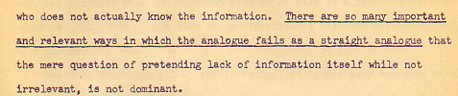
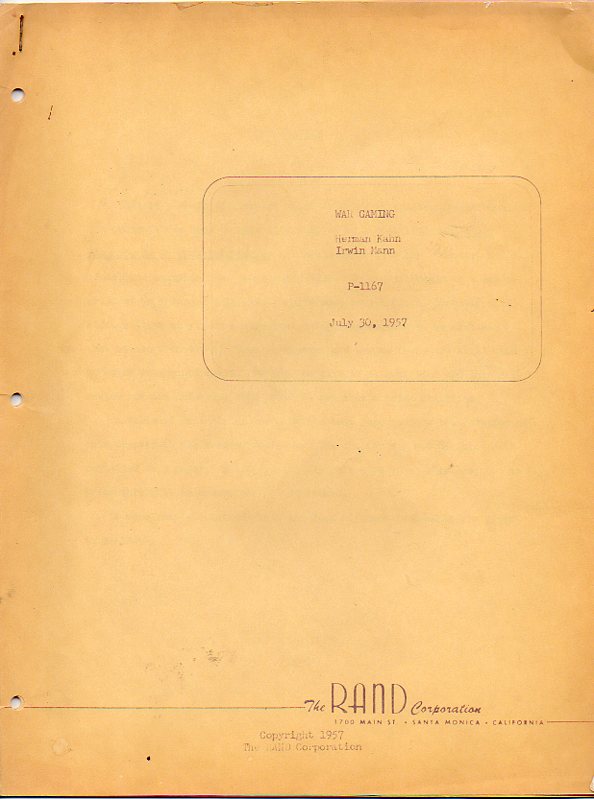
    Kahn’s writing is necessarily less elegant than Byrne’s, and probably less elegant than most other people in general including those who don’t write, though it does lower itself to some height of governmental semi-speak.  For example, from his July 1957 RAND paper “War Gaming” (available at our blog bookstore, HERE), we find this nugget:

    Kahn314

    Kahn315

    I have no doubt that Kahn looks like a warrior to many people–he no doubt was something of one, so long as that warrior could wear a white button-down shirt and not get dirty.  Simply because a person is thought of as a “warrior” doesn’t make them a ‘good” one, either, and I think that I would nominate Herman Kahn as an example of one:  in my own approximation of Kahn-speak, he would  “generate the apparent non-non appearance in definable though undefined parameters as  a non-good non-warrior in circumstances that defined or not define him/them in this semi-stable manner”.

    I think it is important to look at documents like this–documents that helped establish military policy–to see how their authors were able to convince people in government that they could divide by zero.


    *Robert Wilson is a phenomenal conceptualist and theatrical designer.  On the liner notes to CIVIL warS is found the interesting note on Wilson and Byrne:  “At first, Robert Wilson asked David to compose pieces for several sections of The CIVIL warS, but on account of David’s limited time, he composed only The Knee Plays part. The CIVIL warS was supposed to be played in its complete form at the Olympic Games in Los Angeles, but if one plays every part, it takes at least eight hours. There was also a financial problem for playing every part. So only some parts of it were staged there. David himself was very interested in composing for such a play and dance and this time again he enjoyed this work very much. Last time, for The Catherine Wheel, he used recorded tape, but this time he made musicians play on the stage.”

    (Featuring a prominent role for The Tuba)

    IN THE FUTURE (KNEE PLAY 12)

    In the future everyone will have the same haircut and the same clothes
    In the future everyone will be very fat from the starchy diet
    In the future everyone will be very thin from not having enough to eat
    In the future it will be next to impossible to tell girls from boys, even in bed


  • The pre-pre-Internet? The SAGE Defense System, 1959-1983.

    JF Ptak Science Books   Post 1341

    Quality Control of America’s Anti-Bomber Defensive “Shield”: the SAGE System, 1958

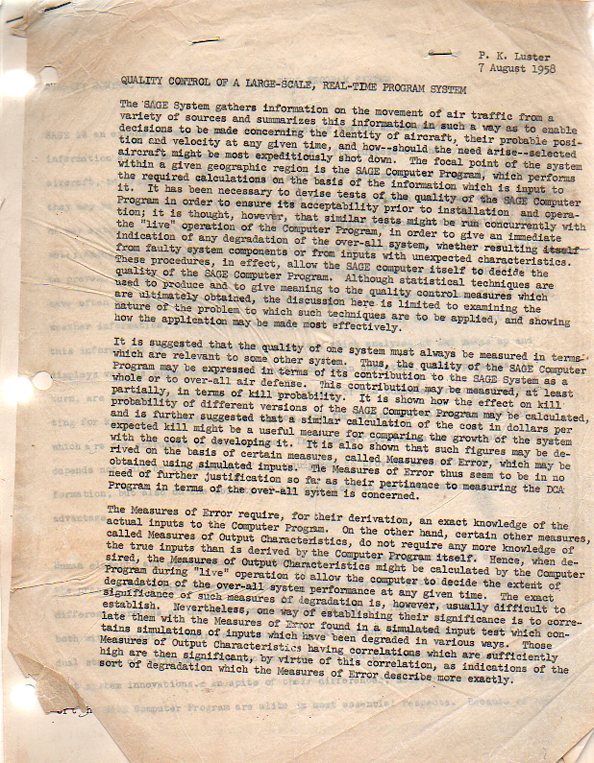
    SAGE403 The SAGE  (The Semi-Automatic Ground Environment) was an “air traffic control device”1 that was used to detect enemy aircraft, relate their position and speed to interceptors which would destroy the threat.  It was basically the air defense shield against attack of North America by Soviet bombers (in the pre-ICBM days of MAD). The MIT/IBM SAGE system was enormously important in the history of computing because of its many real-time, interactive and online aspects–it was an enormously successful and futuristic system, one of the “best” computers ever built. This paper on the computer’s ability to self-reference and check itself, by P.K. Luster, was written in 1958 and serves as an interesting insight into quality control for the world’s first nation-wide computer communication network.

    Luster (who at one time worked for a contractor in Arlington, Virginia, named the John D. Kettelle Corp) was one of hundreds of programmers who worked on the system, and in this case, for this effort of his, he looked at various ways for selecting the proper way for a SAGE to monitor itself in real time and make assessments of its own reliability.  This was a very tricky bit, of course.  SAGE was the largest computer ever built–it had 23 installations in the U.S. (And one other in Canada) each given the possibility of tracking about 400 aircraft at one time.  SAGE would track these developments, coordinate all efforts in response, and then if the flights were determined to be hostile /Soviet forces, would destroy the buggers with responses from “nuclear tipped” BOMARC and Nike missiles. (The Boeing Michigan Aeronautical Research Center and Nike missiles each carried a 1-5 kiloton warhead, enough so that if it was near its target it would be able to destroy it.The BOMARC looked like a jet aircraft; the Nike looked like a multi-finned, very sleek ultimate 1950’s imaginatively-styled rocket ship, but real.) Trying to insure that the system was accurate was a major consideration. (This document is available for purchase from our blog bookstore.)

    From Luster’s  paper:

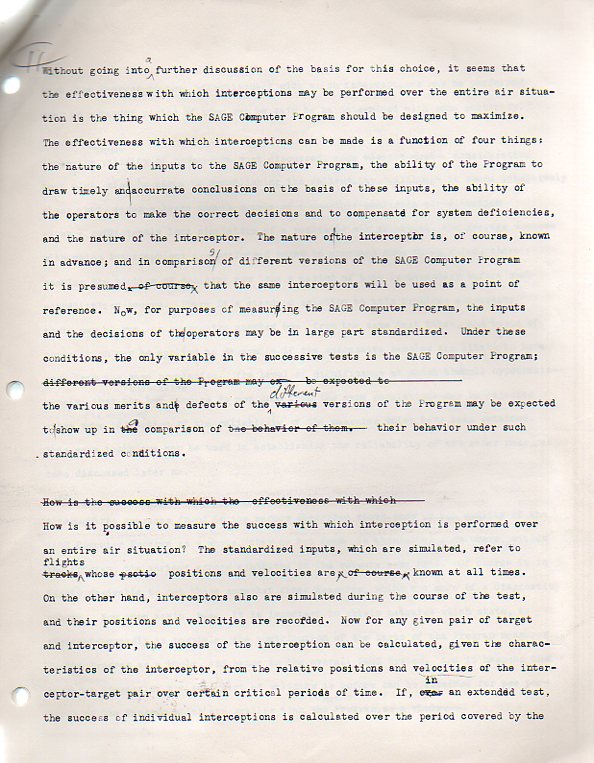
    “It has been necessary to device tests of the quality of the SAGE computer program in order to ensure its acceptability prior to installation and operation…also to run it “live” in order to give an immediate indication of any degradation of the overall system.  In effect, allow the SAGE computer itself to decide the quality of the SAGE computer program…The discussion here is limited to examining the nature of the problem to which such techniques are to be applied, and showing how the application may be made most effectively.”

    SAGE402
    The SAGE system was of course functional, highly reliable, and ws used until 1983.  IT was a kind of early version of the Star Wars defense system envisioned by President Reqgana nd Edward Teller, among others.  Except that SAGE existed and worked.

    It is interesting too to think of it in terms of a sort of pre-ARPANET pre-internet, a pre-pre-internet, in that the system has 24 remote nodes which communicated among themselves.  It doesn’t bear much resemblance to J.C.R. Licklider’s  Memorandum For Members and Affiliates of the Intergalactic Computer Network (1963)–the true first modeling suggestion for a working internet in which all of the main pieces of the internet are present, but it is at least in the neighborhood, as SAGE was the first operational nation-wide real-time computer network. ( It should also be pointed out that Licklider and other of the creators of ARPANET were programmers for SAGE.)  SAGE was in-place by 1959 and operating by 1963, but it had severe limitations as a national defense shield and was ill-equipped to counter ICBMs and SLBMs, but it was kept alive until 1983.   

    Sage network


     Notes

    1.  SAGE did become the template for SABRE as well as for the national air traffic control ssytem.


  • The Lost Memories of Things in the Way of the Horizon–Ugly Roads, 1922

    JF Ptak Science Books   Post 1303

    “There’s nothing so perfect as imperfection.”–Somebody.

    “The great unconquerables in the geography of human thoughts and ideas are the bad ones.”–Nobody.

    Bad ideas don’t so much go away as they get recycled. They can be replaced by good ideas or bad, but the ”original” bad ideas seem to linger on and on.  They are perhaps the indomitable inheritance of society, real and imagined.   

    Bad human-produced landscapes are an outgrowth of bad ideas, calamities large and small that come and go, the old replaced by something new that is good or bad or indifferent. With the landscape, the original landscape itself–apart from the idea that brought it about–is generally lost forever once it has been replaced.  There is no Bad Idea Spirit that brings it back whole again, unlike the generic Bad Idea, which can live on and on, unencumbered by history, like a Greek play or some deeper mythology.

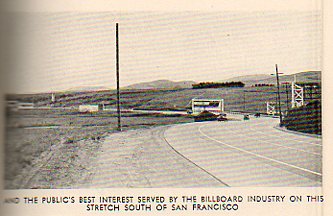
    Roadside billboards 273 Theoretically society is supposed to learn from recognized bad ideas, so as to not repeat them etc., which is one reason why we keep track of them, in the vain hope that someday someone somewhere in the history of our future will kill particular bad ideas off one by one. 

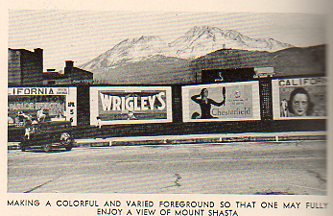
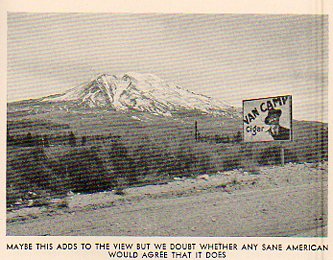
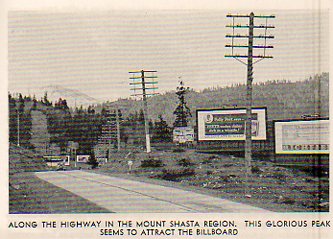
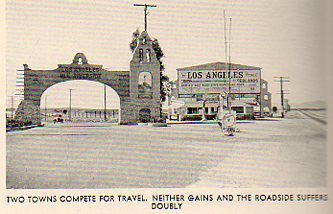
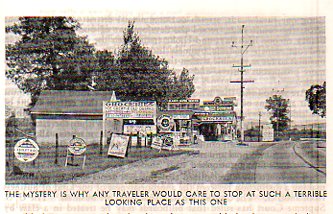
    Roadside billboards 274 In the meantime we can dwell on what we have, though with the removed bad idea landscape, it is more difficult.  That’s why it is important every now and then to familiarize ourselves with them when the opportunity arises, which is just what happened with this innocuous-sounding pamphlet, The Roadsides of California, a Survey1 (1922, and available for purchase at our blog bookstore)  Its not like it’s Pandora’s box–we can open this one and just a few, limited baddies come out, and fall limply to the floor.  But what we see is interesting, a slice of our memory of the horizon–a part of our “progress” that we’ve tried to excise–and what we can see now are the removed and forgotten things. 
    Roadside billboards 275 Roadside billboards 276

    Roadside billboards 278
    Roadside billboards 280 Roadside billboards 281 Notes

    1. This is actually an interesting pamphlet, an early attempt at removing the quickly generated ugliness that was cluttering new roads for the explosion of automobile travelers.  As quickly as cars were made in the new decade of the automobile, billboards and roadside attractions followed.  This pamphlet identified this phenomenon as a problem.


  • The Rare Antique Vision of Looking Straight Down

    JF Ptak Science Books   Post 1295

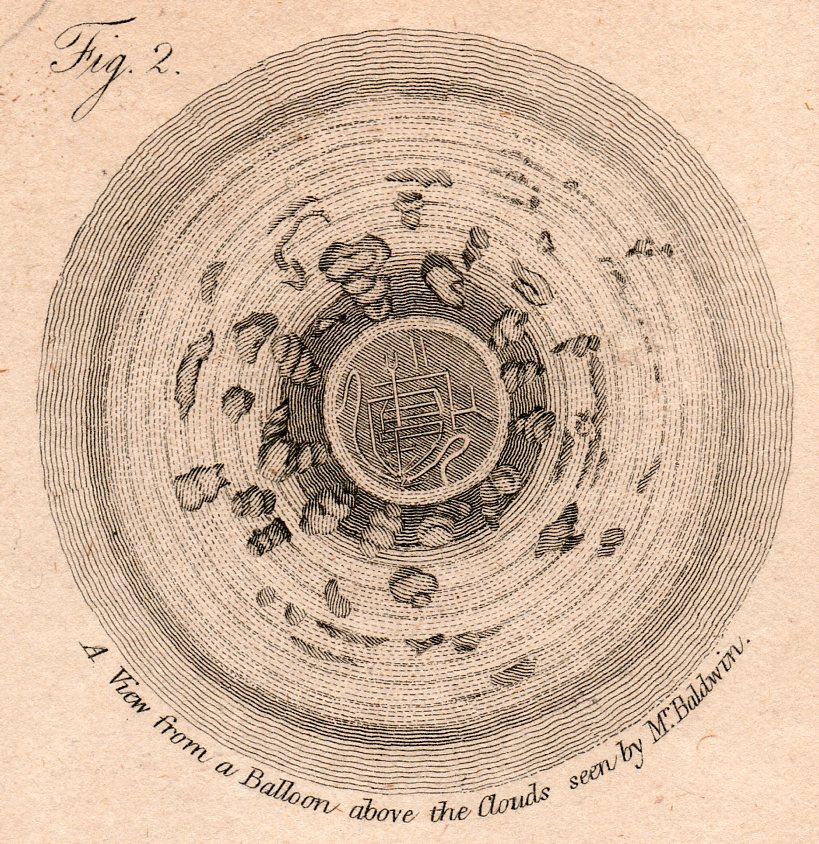
    The idea of representing a view straight down, of looking straight down from some height, is a relatively recent occurrence, this view being somewhat rare in the antiquarian world pre-balloon or pre-heavier-than-air flight.  The pre-human-flight reason for its scarcity is understandable, but even after the first Montgolfier ascension in 1787, there’s another 120+ years of scarcity yet to come before these views would start to pop up in common (and uncommon) literature..  Now I’m not talking about cartography, which is basically a straight-down view of the world—what I’m referring to is that same view but not as a map per se, but what you would see if you were dangling out of a plane or balloon.  The extraordinary map of Imola by Leonardo would certainly classify because of its you-are-there qualities:  essentially it would be like a bird’-eye or oblique view, but straight down.

    All of the images are available to purchase from our blog bookstore, here. 

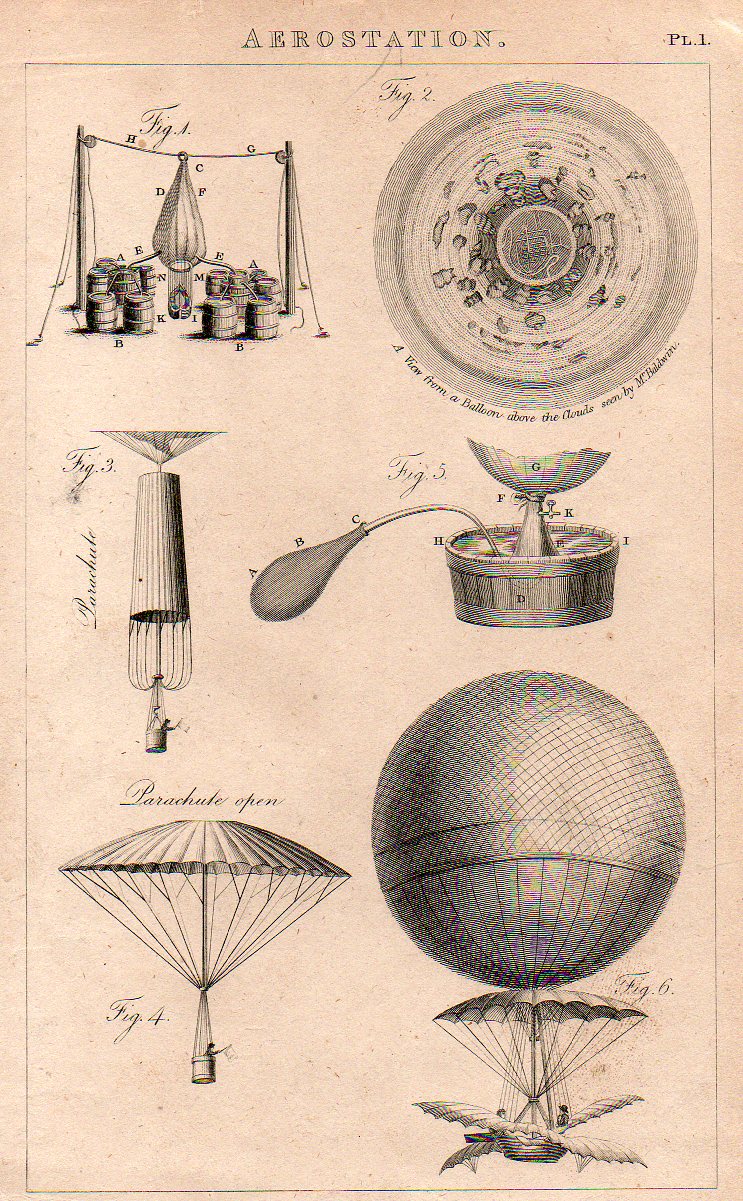
    The first image is that made from a balloon, a lighter than air affair, and engraved and printed around 1810 or so.  It has a very uncommon vertigo-ey affect, like a map of Dante’s leveled creations, though what we’re seeing is a very 

    Looking str8t Diwn-balloom det220 

    …which is a detail from this engraving, made in London around 1810. 

    Looking str8t Diwn-balloom219

    There are of course a number of other lovely design elements, not the least of which is the man in the parachute, bottom left.  (My guess is that the flag held by the man was not for patriotic reasons but rather for more practical concerns, light judging wind strength and duration.   

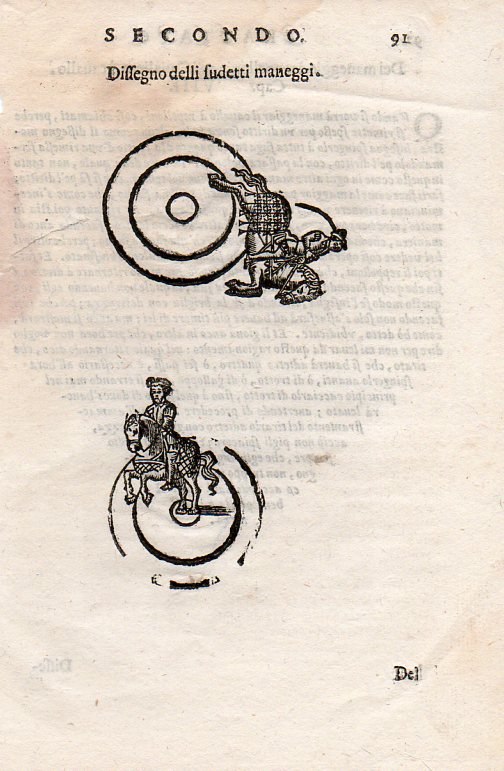
    Another interesting image is this instructional from a source printed around 1620 (I don’t know the source here, either–I purchased the print loose many years ago like many of the others here at Pageant Bookshop in NYC).  It shows a slightly oblique angle (below) and then the flat-perspective view at top: 

    Looking str8t Diwn-horse221
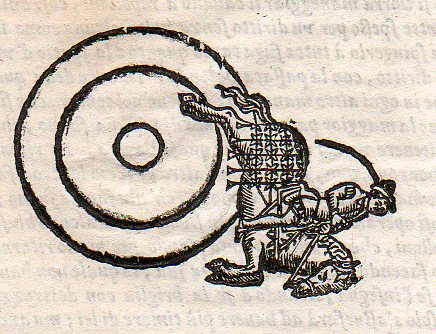
    And then the lovely detail:

    Looking str8t Diwn-horse222

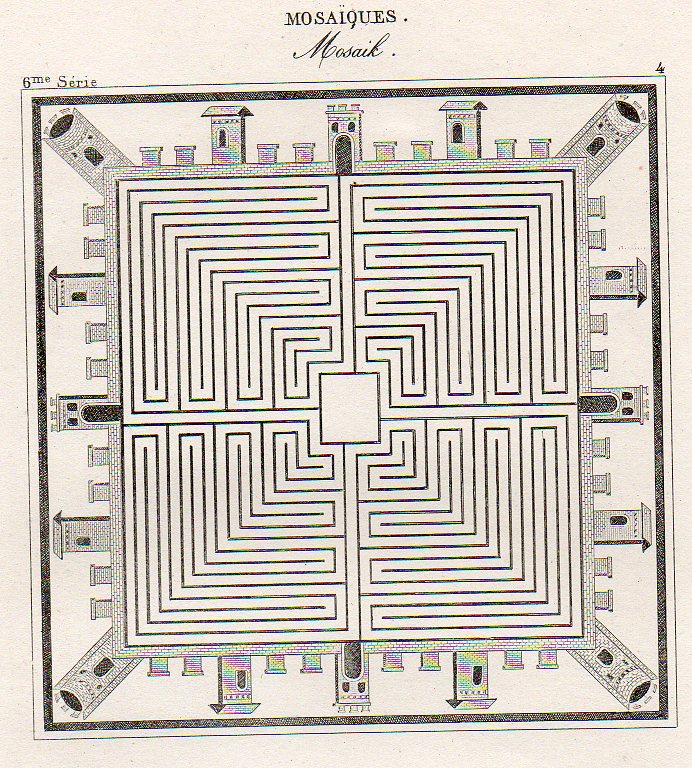
    Then there’s this beauty, showing an idealized town square, presented in mosaic as though seen from above, continuing this thread of flat-perspective–basically looking at some central part straight down, and then taking the objects surrounding the central figure and simply laying them on their backs, as so):

    Looking str8t Diwn--mosaic218

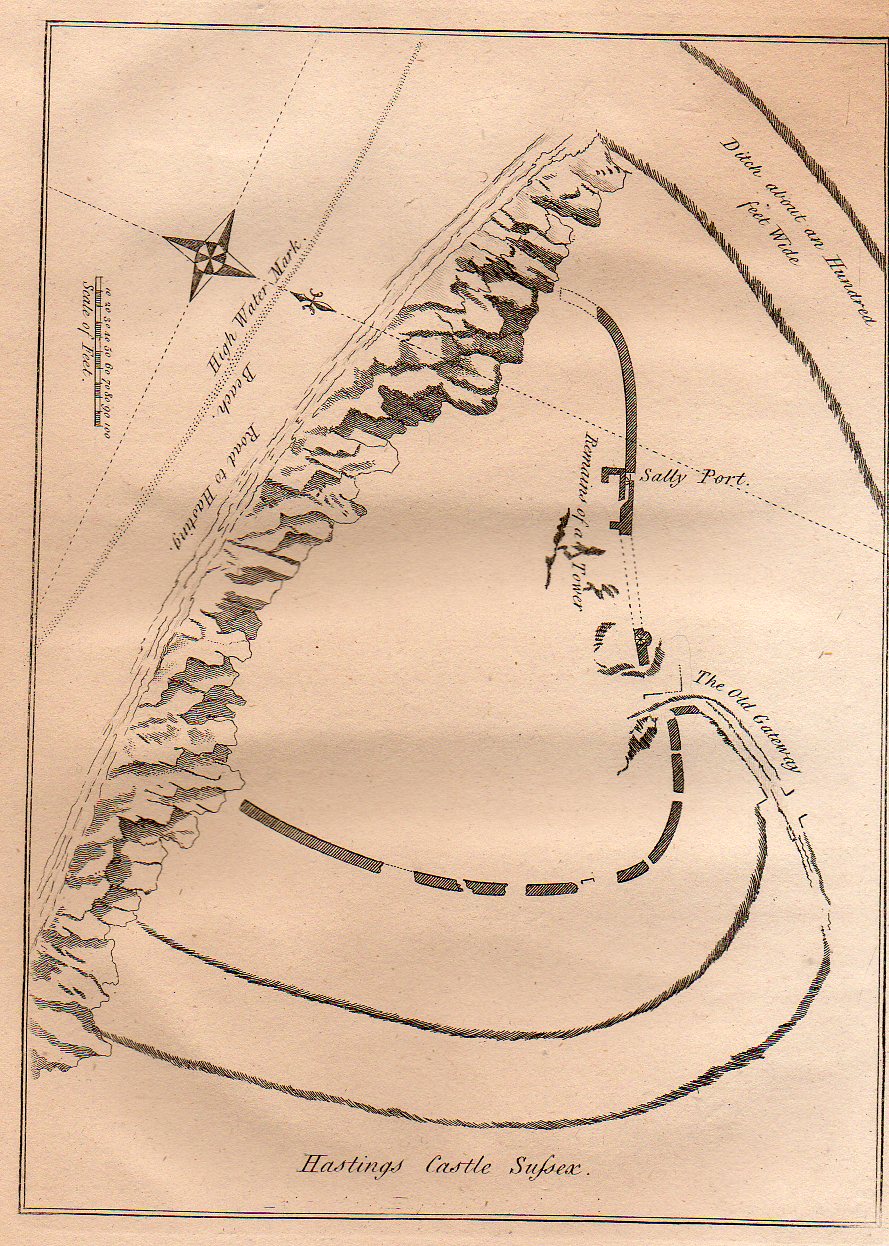
    Lastly for now is this quite flat persepective of the remains of the Hastings Castle (East Sussex), which was built right after 1066 but before the battle.  The (limestone) cliffs that did so much damage to the castle are clearly visible, though what was left of the castle is not.  The view of the area of the castle shows the grounds both in perspective and plan and also from directly above. Its a more-naive approach to imaging that was done so well (on occasion) by the U.S. Coast Survey when it rendered a coastline with an inset of what the coastline looked like from the water–both were superior efforts, but a little odd if you took the map at face value.  This map makes no pretense on perspective correctness, though it is overall a fine map, nicely displaying the necessary details accureately though not correctly (?)

    Looking str8t Diwn--hastings217


  • Protection from Aircraft, Part 3: the 1930’s and Anti-Aircraft Philosophy

    JF Ptak Science Books   Post 1281

    Bloglondonballoon

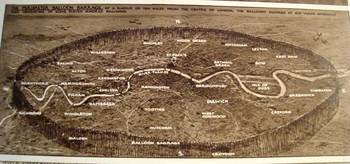
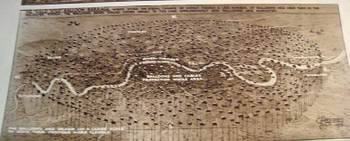
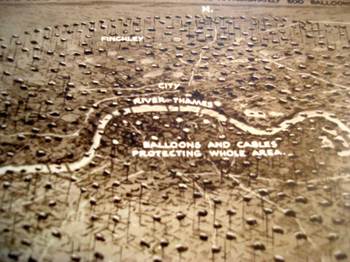
    This series of drawings, published in the Illustrated London News 16 July 1938,  by the incredibly prolific and detail-oriented G.H. Davies depicts one segment of the city defense program being formulated by the British government in the last year  or two leading up to the beginning of the European end of World War Two. (I own 150 or so of these images by Davies–he never fails to provide the detail where you need it.)   The overall plan for defending major British cities consisted of anti-aircraft guns, searchlights, R.A.F. fighter squadrons and interceptors, and the “Balloon Barrage”.  London and suburbs are featured here, all to be protected by a series of ten squadrons of fifty balloons each, handled by a crew of ten.  The thinking was that it would make low-level bombing by fighter aircraft (?!) impossible, and force any aircraft attempting such an approach to a higher altitude where they would be theoretically susceptible to the interceptor squadrons. 

    Bloglondonballoonbottom

    I’m not terribly sure why the thinking was against low altitude attack, but my best guess is that the planners were thinking about the He-111Bs and Ju52s or other such aircraft that the Nazis checked and tested out against the Spanish Republicans during the Civil War. Perhaps freshest of all memories of the German operation Feuerzauber (Magic Fire) was the Guernica raid, just a year or so before the publication of these images, where that militarily insignificant town was attacked from the air in twenty minute intervals over three hours, destroying it in a terror blitz.  If I was sitting around a big table at 10 Downing, I’d have that picture in my head.  .

    Bloglondonballoondetail

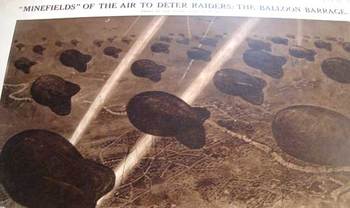
    Be that as it may, the “air mine field” looks terribly inefficient and vulnerable to me, sort of like an exposed Maginot Defense Line, but without the very deep misunderstandings that went along with the horrible French effort. 

    Explanation of the Images:

    a)    The first image shows the incredible perimeter defense network, which extended ten miles around St. Paul’s; the balloons were moored at 100 yard intervals, making for 1100 or so balloons to “fence” the perimeter.
    b) The second image shows  London center and immediate suburbs, with another 500 balloons in a smaller circle inscribed in the larger.
    c)  The third image Bloglondonballoonsbotto is a close-up of the balloons, looking down;  seems as though they were tethered at about 2000 feet or so
    d)  The last image is a close-up of London center.  .


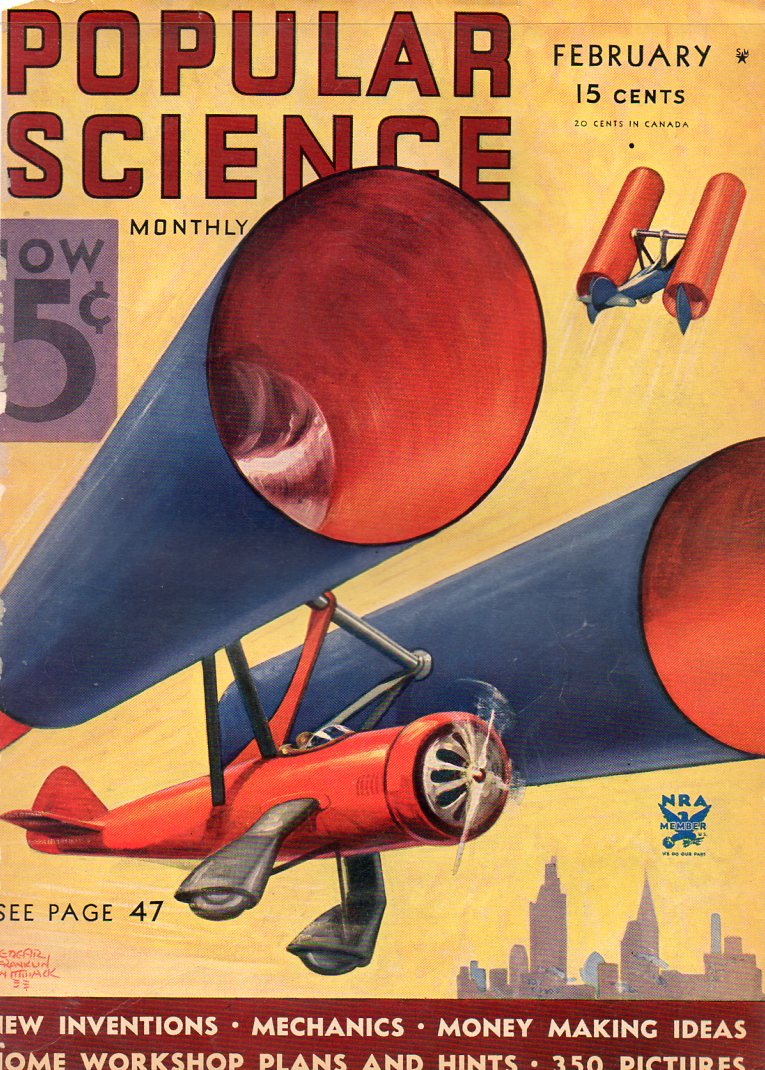
  • Future Steampunk in the Air-1930’s/1940’s Popular Science

     JF Ptak Science Books   Post 1279

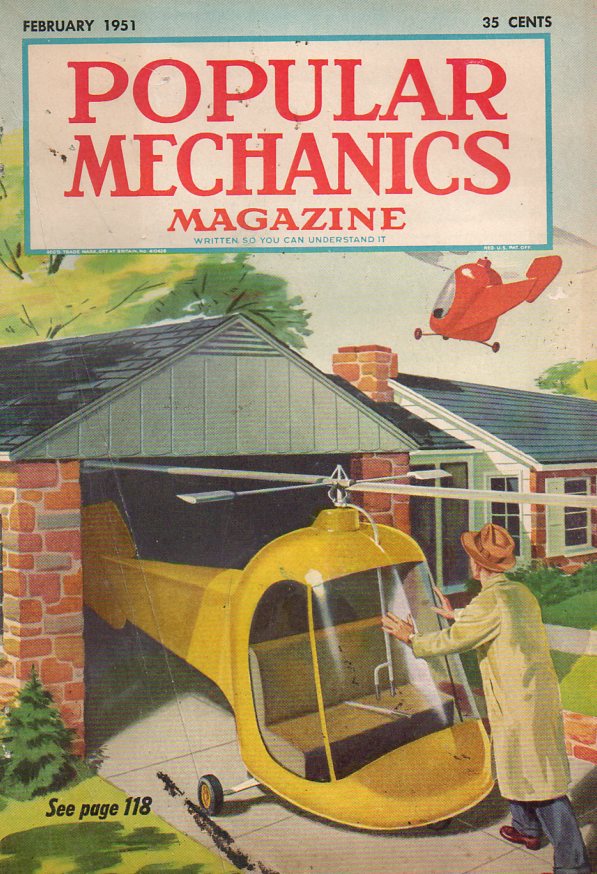
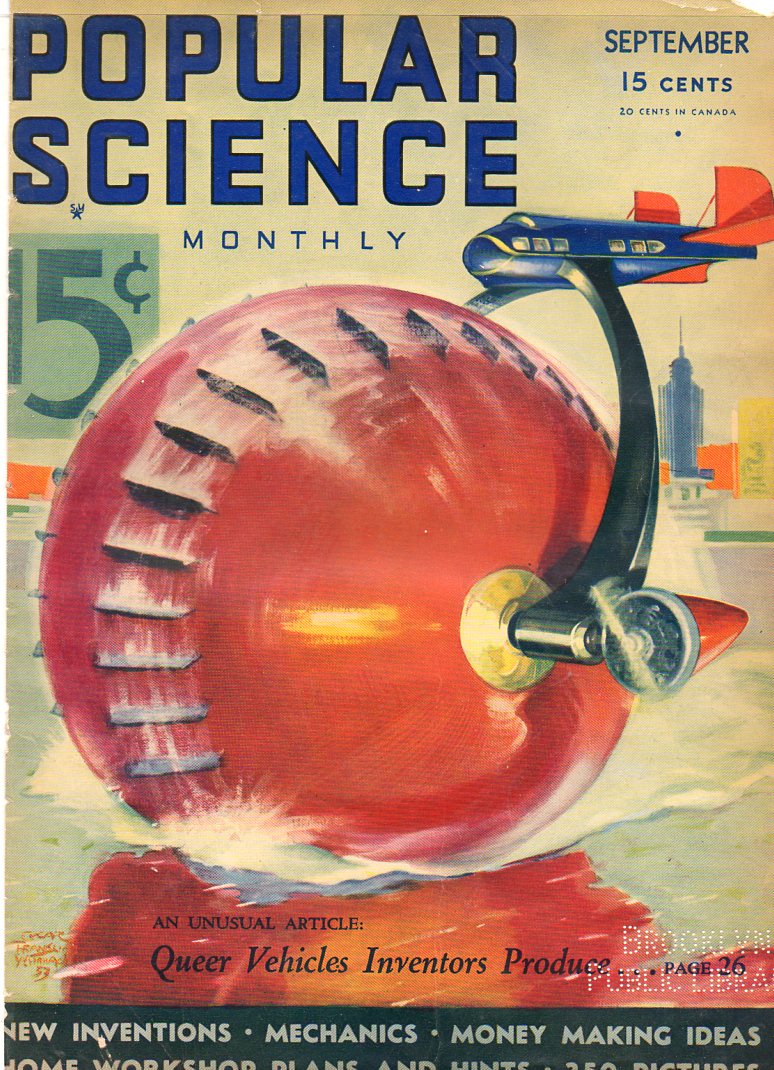
    In a continuing thread on Steampunk themes I’ve organized some of my 1930’s cover art into themes–first up were examples of waterborne-Steampunk, which is now followed by an airborne-Steampunk, and then by Steampunk Land and Steampunk WTH(?)   (All of the examples coming up are available for purchase from my blog bookstore, here.)  Steampunk as a general idea is a class of technology that is large, clanging, oily, greasy, heavy, shiny, smoky, and usually driven by steam power, (though other power sources can be applied)  Some make sense today, some don’t–most of the machines addressed for a particular use have actually been implemented here in the not-too-distant future of the 1930’s, and usually much more elegantly than could’ve been imagined then (obviously).  But I must say that given the times and the tools, these people did a great job, if not for the reason of the invention but for pushing the idea-ball forward.  

    Steampunk--air139

    Steampunk--air149


  • Future Steampunk in the Sea–1930’s Popular Science

    JF Ptak Science Books  Post 1278

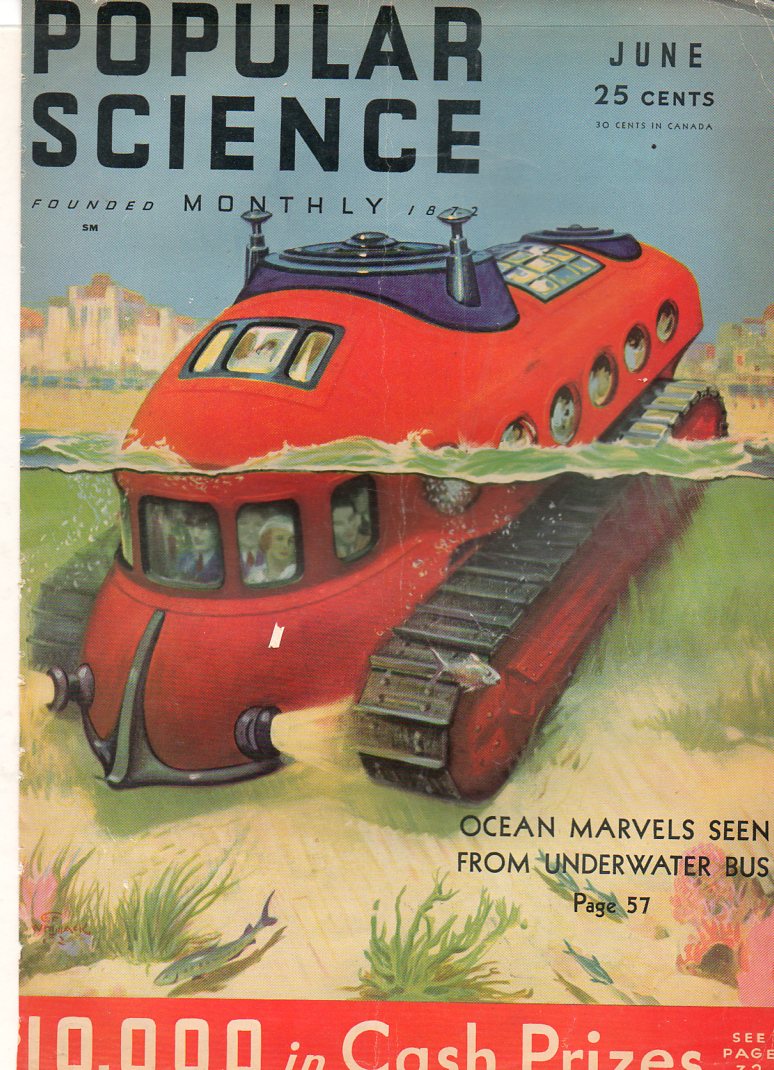
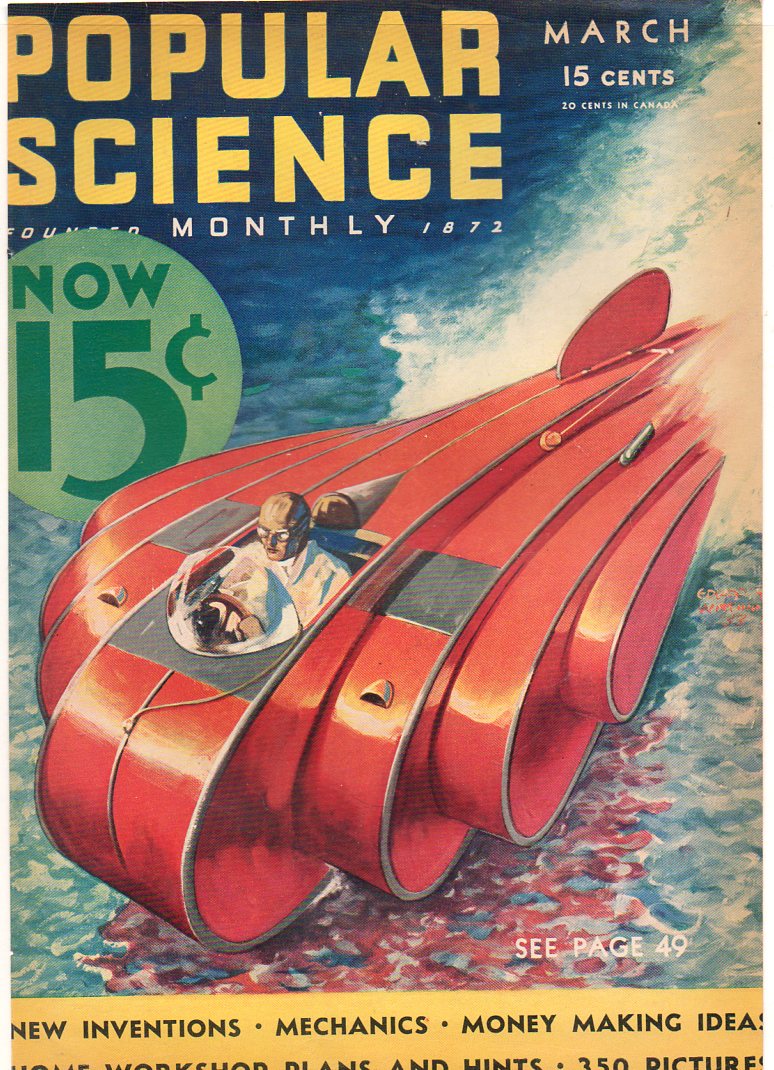
    In a continuing thread on Steampunk themes I’ve organized some of my 1930’s cover art into themes–first up, examples of waterborne-Steampunk, which will be followed by land- and then airborne-Steampunk.  (All of the examples coming up are available for purchase from my blog bookstore, here.)  Steampunk as a general idea is a class of technology that is large, clanging, oily, greasy, heavy, shiny, smoky, and usually driven by steam power, (though other power sources can be applied)  Some make sense today, some don’t–most of the machines addressed for a particular use have actually been implemented here in the not-too-distant future of the 1930’s, and usually much more elegantly than could’ve been imagined then (obviously).  But I must say that given the times and the tools, these people did a great job, if not for the reason of the invention but for pushing the idea-ball forward.  

    Steampunk--sea138
     Steampunk--sea137
    Steampunk--sea136

    More below:


  • The Origin of the Term “Intellectual Capital”, 1842

    JF Ptak Science Books   Post 1275

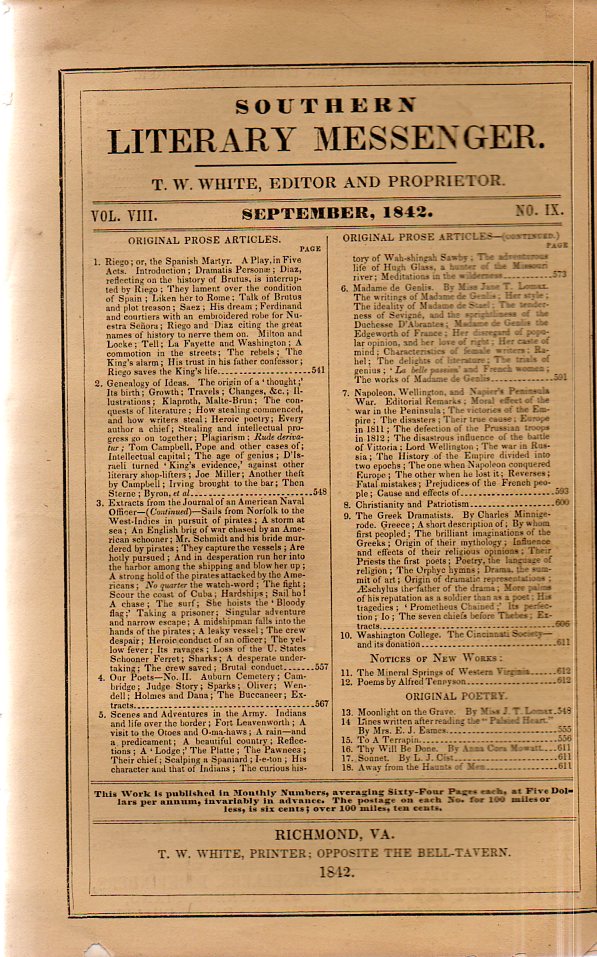
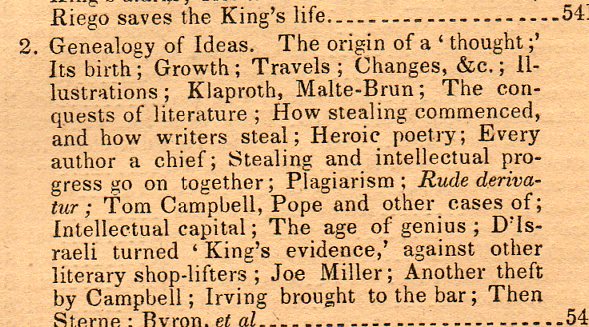
    Intel cap--cvr123   It seems that the first use of the term “intellectual capital” is seen to be with John Maynard Keynes in 1975; nice company of course, but the true first use seems to be much earlier.  It seems to appear in The Southern Literary Messenger (1834-1864) for September 1842, in an article “Geneaology of Ideas”, (pp 548-557) and written by “E.W.J.”, who turns out to be Edward William Johnston, writer/editor, born in Culpepper County in 1799 (or 1804), and brother of Confederate General Albert Sydney Johnston.  (It is also available from our blog bookstore.)

    Here it is:                   

    To resume now our historical deduction of matter Intellectual capital appears to be as capable of being amassed among a nation as materia1 wealth but by no means to follow the same laws –page 552

    If that isn’t what Keynes (and then everyone else) was talking about, I don’t know what is.

    Intel cap--cvr 2124The article is interesting for its dipping into the history of plagairism and finding it comfortably nestled somewhat undisturbed, comfortably even, in the general history of ideas:

    He who writes therefore steals as well as he can and as beggars when they can filch from no richer wardrobe purloin each others tatters so mean authors rob one another and go undetected partly because their works pass unscanned and parity because they from whom they borrow are unread So that after all the essential difference between the genius and the scribbler is not as to the fact of stealing nor even as to the quantity stolen but entirely as to the value of what they steal  (page 551)   

    Long intellectual history of borrowing and building, collection of tropes wound through entirely original work, based on some common building blocks that have been used over and over agian across the centuries.  When looking at the geneaology of ideas, the business of utter stand-alones is slim.  Shakespeare built upon Plutarch in bits and starts, for example, but everyone who knew everything at that time would’ve recognized the Plutarch shining through, Shakespeare himself finding it unnecessary to say any more about it.  Albert Einstein had not one footnote in the SRT paper of 1905, yet owed some intellectual heritage to Lorentz and Poincare.   Anyway Johnston writes about the fluid nature of the history of ideas with many fine examples (though not the two listed above), all of which can be read here in the full text of the article. 

    (This subject of plagiarism and forgery, of originality and copying, of recognizing what has come before and not, gets to be very knotty very quickly.  What is “real”, what is “original”, we are reminded, gets complicated and complex.)

    Notes:
     
    1.  The Southern Literary Messenger: Vols. I-XXXVI (August 1834 – June 1864, when it was eaten up by the war).  Even though it was an interesting journal with a good solid and long run, I guess many people will remember it for being edited for a short time by Edgar A. Poe, who also made a number of literary, critical reviews and poetical contributions to the magazine, though not in this issue for any of those three.


  • Maps of Invasions of Great Britain and the United States

    JF Ptak Science Books  Post 1274–Real and Imagined

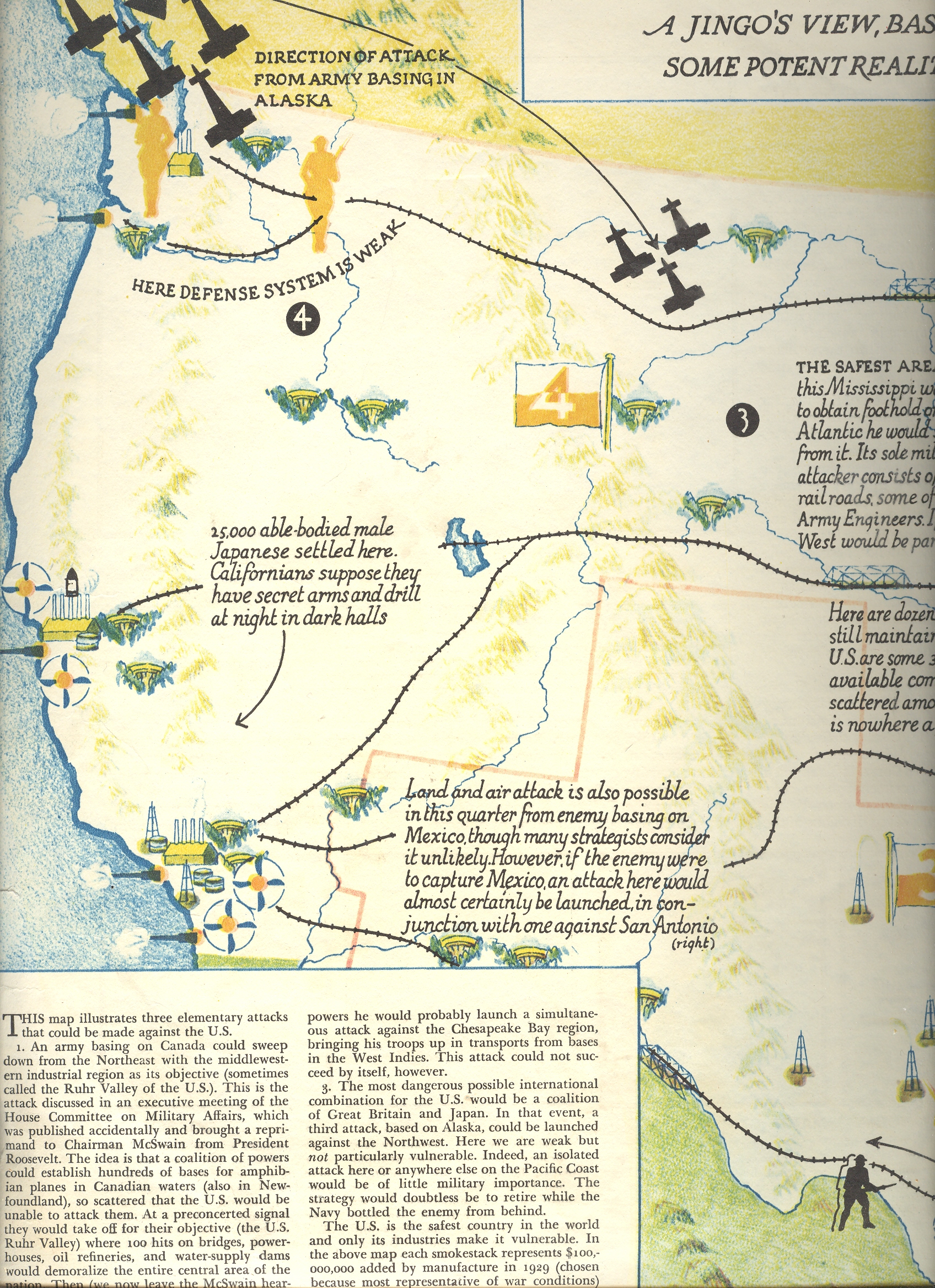
    America has almost never been invaded. I should clean that statement up a bit: the United States has almost never been invaded.  America–which included North/Central/South once upon a time long in the dim past–was constantly invaded until the invasions no longer counted themselves as such, which I guess means that the “invasion” forces became  “resupply”. (Perhaps an invasion is over once you surpass a certain ratio of houses : forts.)

    “Invasion” does not include “attacks”.  A few guys getting off a Nazi sub and wandering around until they got picked up (with some (all?) being executed) does not an invasion make.  9/11 was not an invasion, though the subsequent invention of impending and pervading fear was–that’s why we have “storm centers” rather than “weather reports” on broadcast news–but even that fear business was more home-grown than anything else.

    The Japanese Army were on two small islands in the Aleutian chain (which may have been closer to Tokyo than NYC) for a bit in WWII–also does not make for an invasion, even if they were there for a long time.  Or even if they were still there.  Nor does sending hundreds or thousands of paper incendiary balloons across the Pacific an invasion make. 

    UFOs don’t count, either.  (I still find it remarkable that such a large percentage of the hundreds of thousands of “sightings” has the UFO with landing or whatever lights on it. I figured out at one point that there has been a report on one of these critters every ____ minutes since Roswell. And in all of those hundreds of thousands or reports, if you took them all and stacked them one on top of the other, they would reach perhaps the height of a grain of sand.)  The Beatles don’t count, either.   

    What also doesn’t count (but probably should) but which is not military–not really, though it may have the impact of a military force at some time in the future–are Chinese-made imports of, well, everything.   At Thanksgiving I wondered how much of a dinner could be composed of foods that were shipped from China and to no great amazement an almost-complete table of food could be set, plus napkins, flatware, plates, candles, tablecloths, tables, chairs, paper turkey decorations, carpet, flooring, wallpaper, paint for the walls and ceiling, screws for the Chinese-made door hinges, lighbulbs, tubes for the McIntosh preamps, all of the clothing worn by the guests, and so on.  The electricity is still American-made. The fact that Mott’s Apple Juice is coming from Chinese apples is a bad sniff of the future. The country of origin is usually on juice bottle necks-check it out.)  

    Certainly something that does count is the invasion by Great Britain of the United States in the War of 1812–they invaded long and deep enough to burn the White House and cause general havoc.  We won that one.  But of course the Brits were otherwise involved on the Continent.

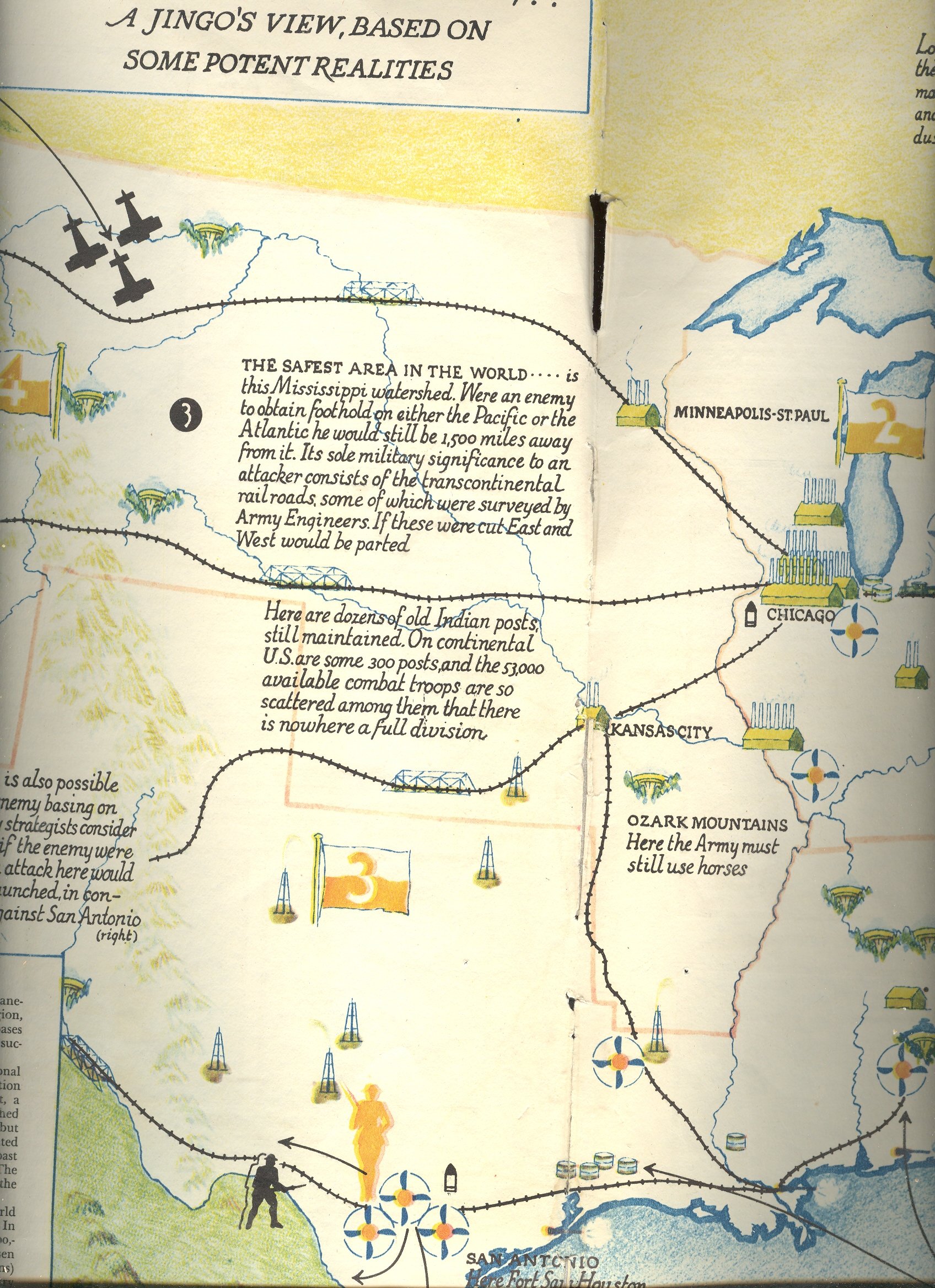
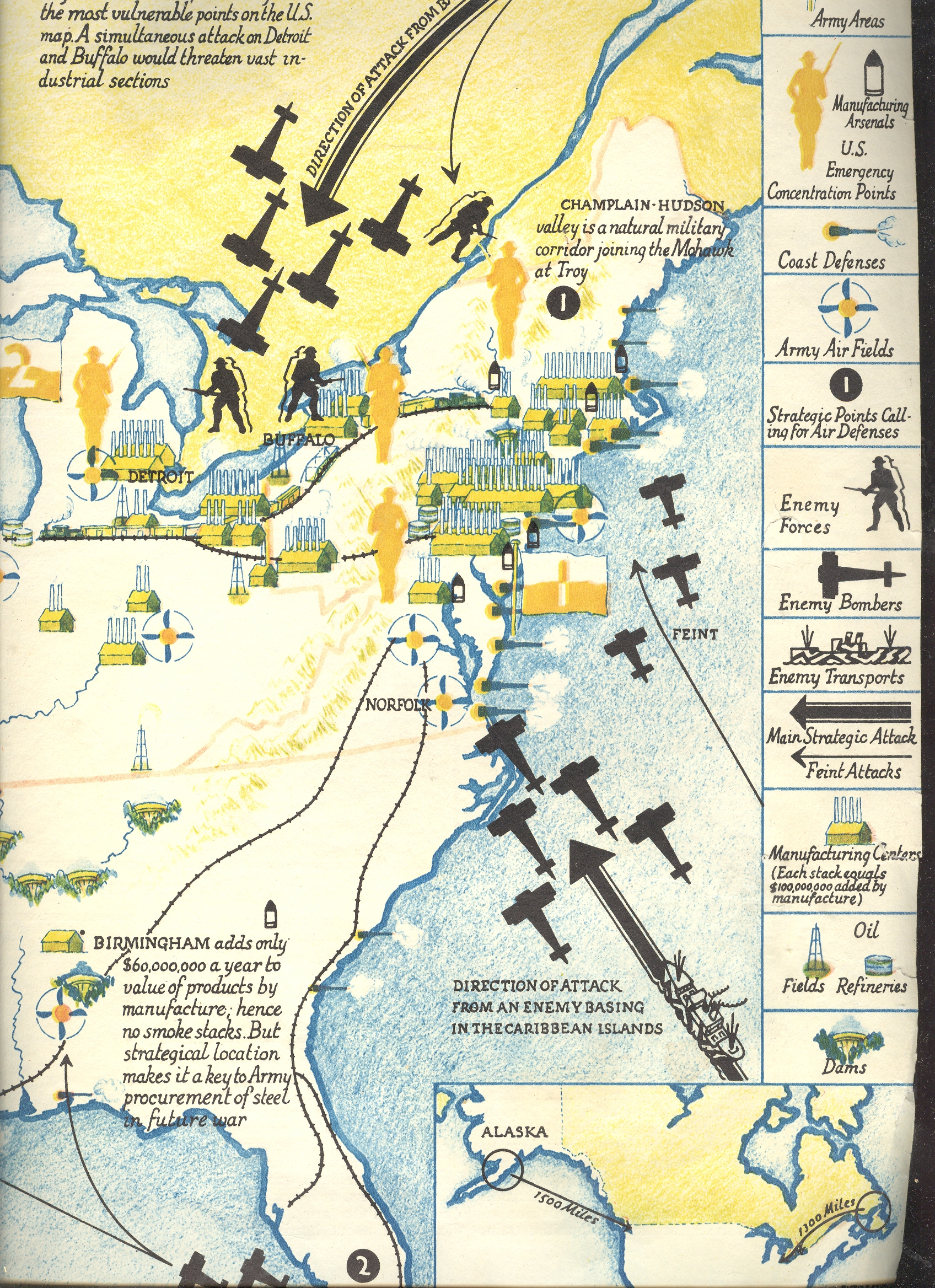
    Perhaps this non-invaded bit explains why the most-viewed post on this blog (with at last count was 400,000 views) was a LIFE magazine article from 1942 on the possible invasion routes to the U.S.  Maybe the volume was driven by war-gamers, though I suspect it was made up largely of the curious who weren’t used to seeing “Invasion of” and “America” together in a military sense.

    https://historyofideasblog.com/a/6a00d83542d51e69e20120a7a3225e970b-pi

    https://historyofideasblog.com/a/6a00d83542d51e69e2012876a5a4b4970c-pi

    https://historyofideasblog.com/a/6a00d83542d51e69e2012876a5a5e4970c-pi

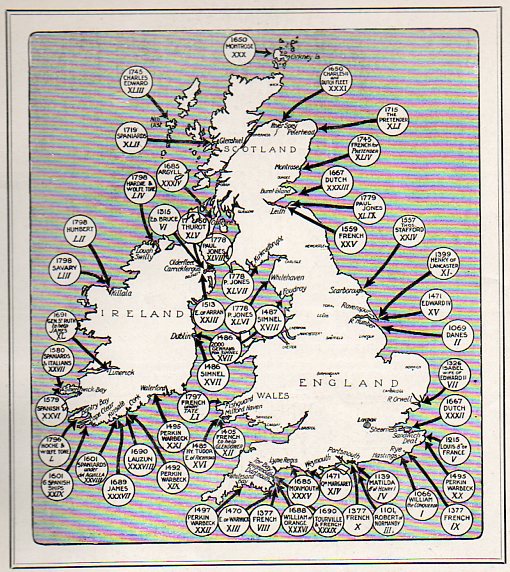
    But now for the  real stuff:  a map of the 54 invasions of Great Britain (and “the places at which foreign troops have landed on British soil since 1066 (and all that), seen in the Illustrated London News for 27 March 1909):

    Invasion--Us and England120

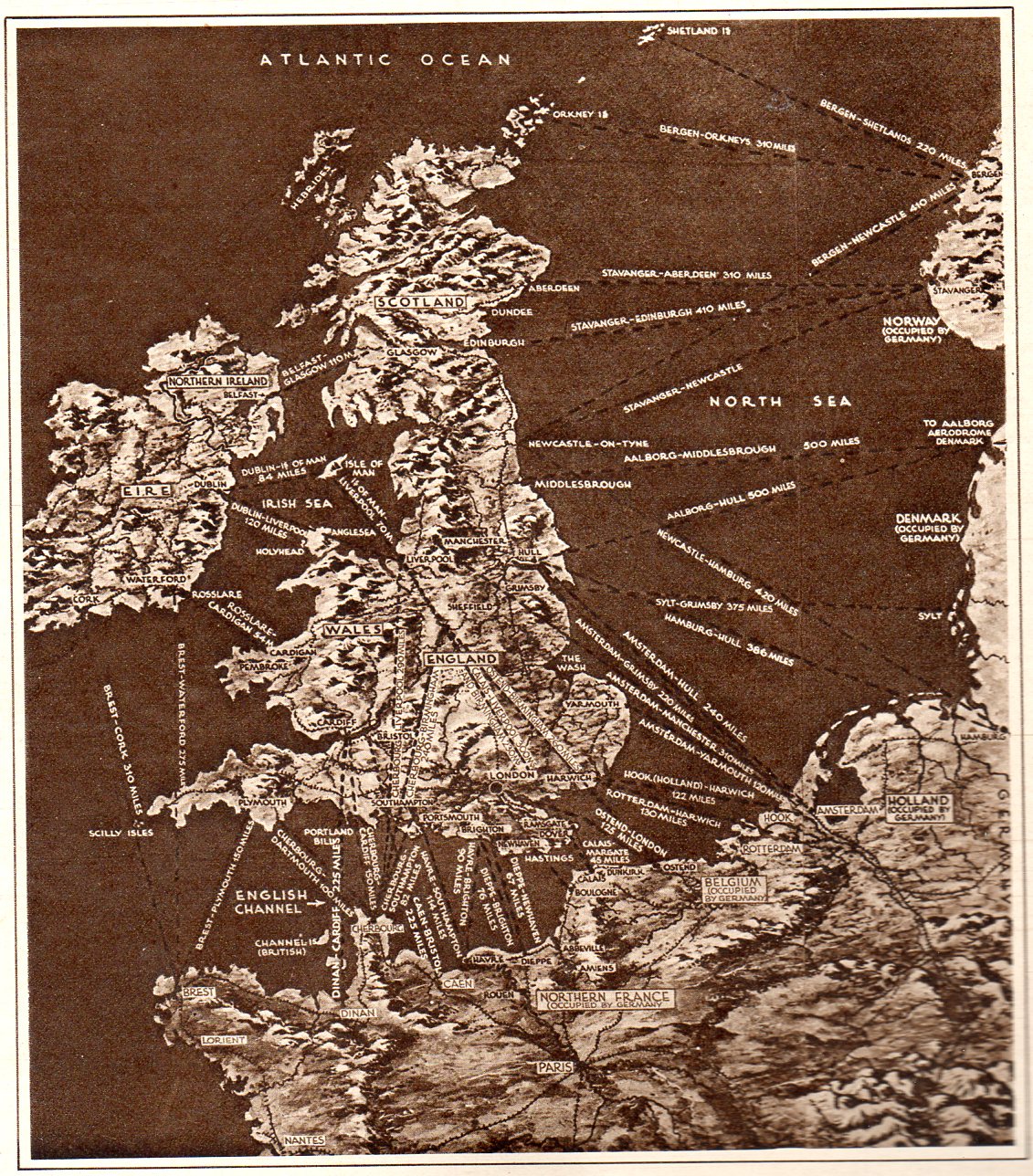
    And then this, where the WWII invasion routes were turned around: 

    Dunkerque124

    This map pretty well tells the story of the perilous situation of Europe and England at the beginning of June, 1940.  It appeared in the Illustrated London News on the heals of Churchill’s “Blood, Soil, Sweat and Tears” speech, and was a very frank presentation of the wearing of the war.  By this point in the war Nazi Germany had successfully invaded Belgium, France, Luxembourg and the Netherlands, sweeping across Europe in a broad westward movement, backing up British and French troops all the way to the sea at Dunkerque, where a monumental rescue operation (“Operation Dynamo”) saved them.  (There was an enormous amount of materiel left there on the beach, a devastating loss for the British Expeditionary Force, nearly crippling it.) This was a bad time for the Allies, this part of the war coined by Winston Churchill in 18 June 1940 in the House of Commons by:  “The Battle of France is over. I expect the Battle of Britain is about to begin”. There was very little good that came of these few months for the U.K and the Allies, though four things do stand out: (1) as I just mentioned, the saving of 300,000+ troops at Dunkerque; (2) the resignation of Neville Chamberlain, (3) the coming of Winston Churchill  as Prime Minister of the U.K., and (4) the first deciphering of the Enigma at Bletchley.  Other than that, the situation was dim, and these invasion routes (published at t he very time that Germany was studying such a feat in its “Operation Sea Lion“, or “Unternehmen Seelöwe”). The endgame at Dunkerque took place almost four years to the day of the invasion of Europe, when the intent (though not placement) all of these arrows were turned around for the Allied operation at the Normandy beaches on 6 June 1944..

    And so, there it is–a presentation of several maps showing invasions, real and imagined