A Daily History of Holes, Dots, Lines, Science, History, Math, Physics, Art, the Unintentional Absurd, Architecture, Maps, Data Visualization, Blank and Missing Things, and so on. |1.6 million words, 7500 images, 4.9 million hits| Press & appearances in The Times, Le Figaro, Mensa, The Economist, The Guardian, Discovery News, Slate, Le Monde, Sci American Blogs, Le Pont, and many other places… 5000+ total posts since 2008.

Category: Future, History of the

  • A Note on Teaching Math, Unexpected Art, and Picturing Things Differently

    JF Ptak Science Books   Post  1427
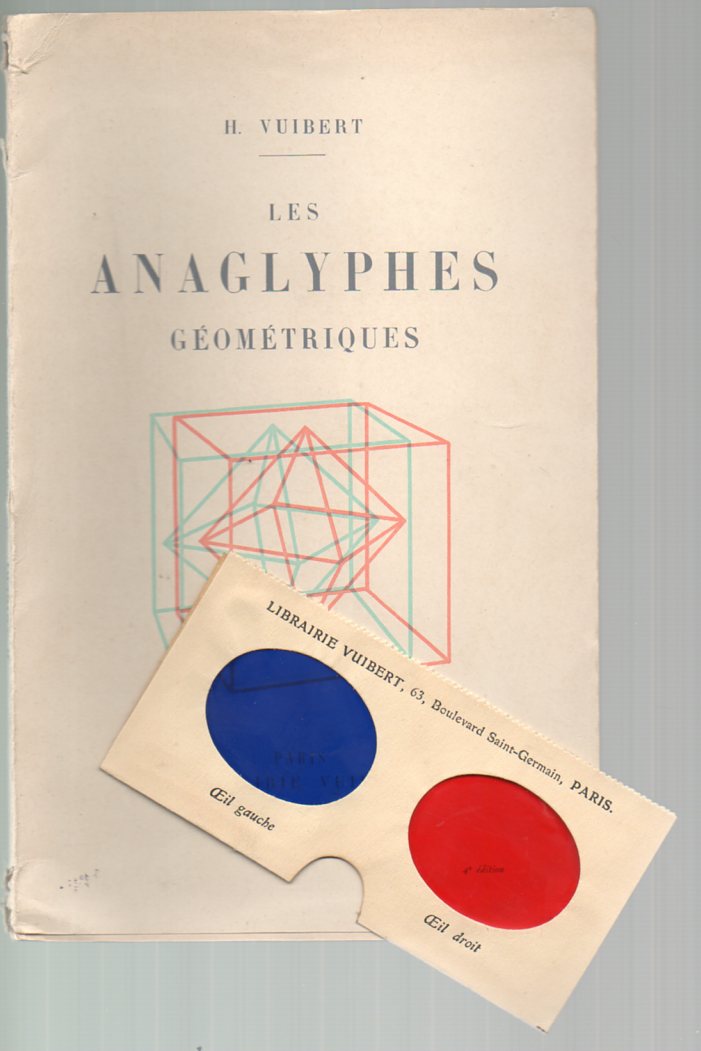
    Vuibert308 Stereo viewing geometrical figures may or may not be useful–I find it a little off-putting, creating a slight dizzying effect, though I’m sure it helps others (particularly children?) see complex geometrical figures a little more easily., especially when it comes to crystalography images. Education was certainly what Henry Vuibert , the author of Les Anaglyphes Geometriques had in mind when he published the work in 1912.  He had a long history in mathematics education, having founded the firm that bears his name back in 1877, a publishing house specializing in school texts in the maths, physics and general sciences.  (We offer the book for purchase at out blog bookstore.)

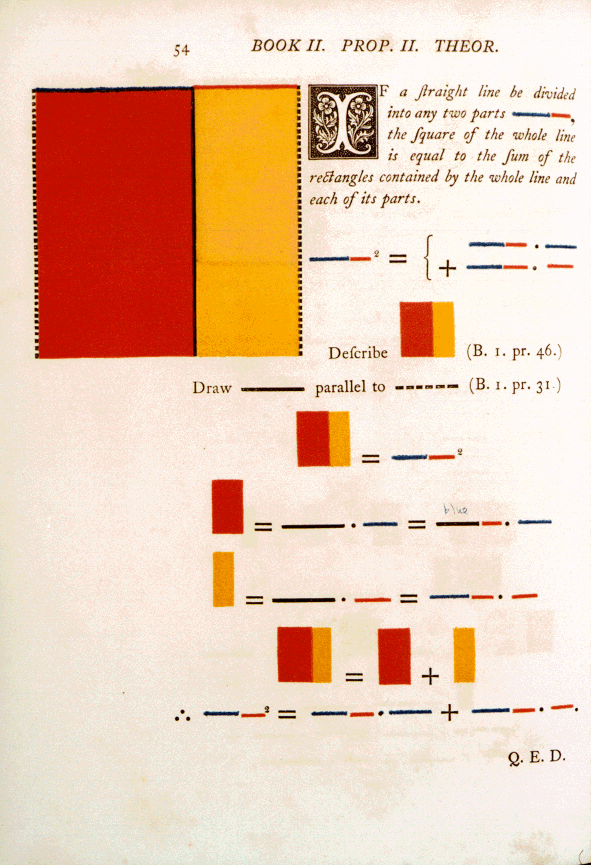
    Vuibert’s book is a very early example of the use of the anaglyphe–examples of the use of the method go back to the 1850’s, when d’Almeida used a version of the idea to punctuate lectures using a magic lantern; the (printing) process of the anaglyphe wasn’t patented until the 1890’s by L.D. DuHaron.  It does confuse me or remind me quite a bit of Oliver Byrne’s beautiful monster The First Six Books of Euclid in which coloured diagrams and symbols are used instead of letters for the greater ease of readers… printed at the Chiswick Press by C. Whittingham for William Pickering in 1847.  The book is, well, unusual and probably not at all usefu11.  Bryne replaced all of the algebraic notation, identifying letters and almost all of the descriptive text with color and color codes, leaving Euclid mysterious, hidden, awkward, impervious, and, yes, beautiful2. As a matter of opinion this work presages the cubists (and especially Piet Mondrian) by 60 years, and all by accident artwork. 
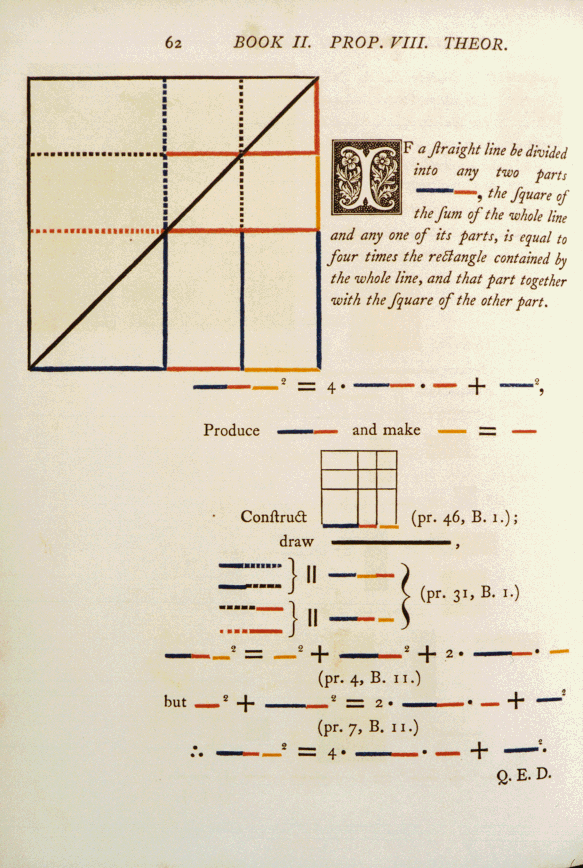
    Byrnes 11.8


    There are certainly much earlier works that tried to get at a fuller representation of geometrical objects, not the least of which was a 16th century Elements of Euclid in which the figures were cut-out paper, pasted into the book and attached to a string so that the reader could pull out the illustration and see it displayed in three dimensions. The elements of geometrie of the most auncient philosopher Euclide of Megara. Faithfully (now first translated into the Englishe toung…3, printed in London in 1570, was no doubt a great and exasperating labor of love, a complex “pop-up” book accomplished with sixteenth century technology.  (The photo below shows the Smithsonian Institution’s copy.)

    Of course there’s the very old fashioned way of representing mathematical concepts, and that’s with sticks and stones and blocks and such.  For visceral memory and practical applications, the idea is hard to beat, unless of course, you really beat it , which is difficult to do.  But to me that’s just what Major G. Mackinlay did in his Realistic Arithmetic,  for Teaching Children the Elements of Arithmetic by Means of Special Blocks4, published in London in 1900–his ideas for the use of blocks was very sound and stable; his instructions (and in particular his illustrations) for what to do with the blocks was not.  I am reminded of inscrutable, badly translated and designed instructional manuals for tech stuff that need a manual for the manual. 

    Here’s one of the folding plates describing how to assemble the blocks:
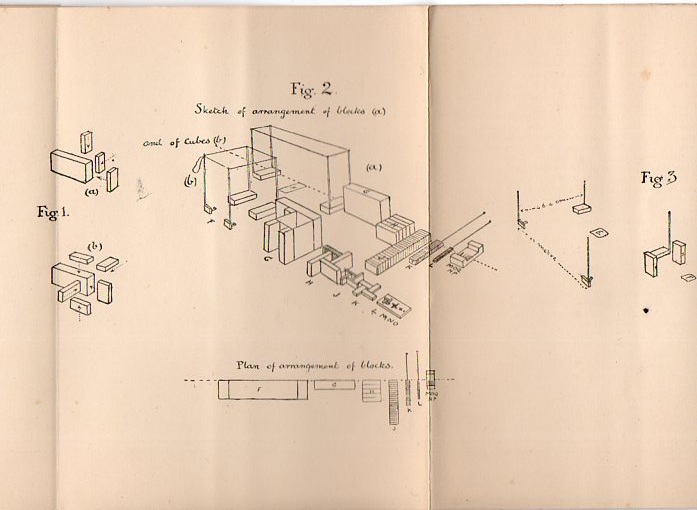
    Math blockis309

    Then there are other sorts of wooden (and etc.) three-dimensional models, such as the (600+) gorgeous geometric designs housed in the Institute Henri Poincare, transferred there from the laboratory of geometry of the Faculty of Sciences of the University of Paris in 19285.  Most of these models were constructed around the time of vast change in mathematics and art (1900-1920), which means that many of them predate the revolutionary ascensions of  Cubism and non-representational art.

    And as long as were at the point of unintentional and under-recogniozed epochal works, I think that there is a broad book that could be done on exactly this topic, calling into play such examples as Georgina Houghton, Victor Higo, Emily Vanderpoel, and many others. 

    Georgina Houghton, for example, produced this non-representational painting in 1870 (or thereabouts):

    Georgiana

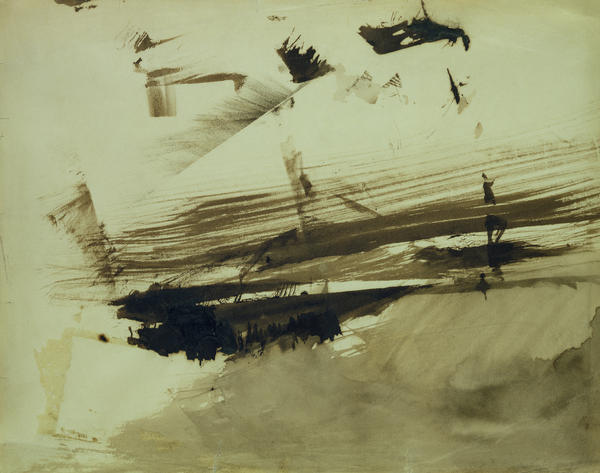
     And Victor Hugo, from the 1860’s

    Evocation of an island Painting  - Evocation of an island Fine Art Print

    And Emily Vanderpoel (1900 or so):

    Art-vanderpoel186
    In another, much earlier case of removing detail and adding abstraction for the sake of simplicity in representing an idea,  Erhard Schoen, in his Unnderweissung der proportzion und stellung der posssen liegent und dtehent, printed in Nurenberg  in 1538, presented these cubed figures (below).  He used simplified geometric form to stand in for the curvy humans, replacing them with proportional stacks of boxes which would more easily explain to the younger reader how to represent the human body in space and in proportion to other things. 
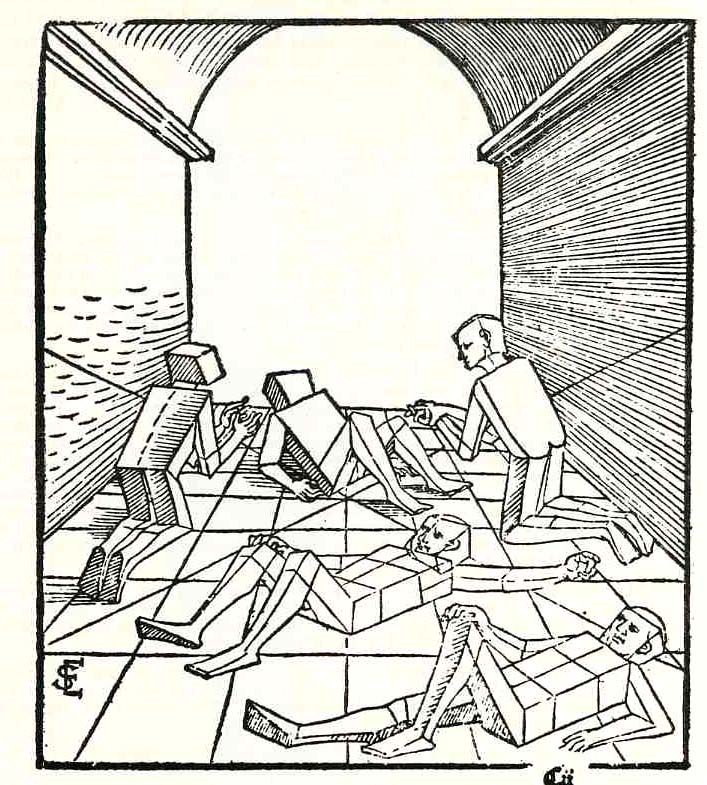
    Schoen

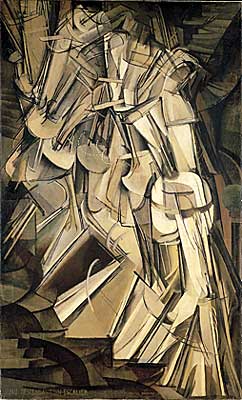
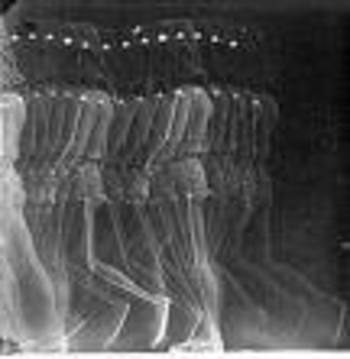
    I think that these were monumentally combative images showing humans in a radical, previously unknown way, much like the moving-through-space-and-time photographs of the somewhat forgotten Etienne Marey, who in the 1870’s created what was essentially the world’s first “slow motion” device. One iteration of Marey’s apparatus was basically a long series of ganged cameras recording a motion for a Marey12 simple task at a given time frame and presented on a continuous strip of photographic paper, sort of like a motion picture with the camera speed set at three frames per second. The resulting images were phenomenal and showed people for the first time the exactness of all manners of simple motions–motions that no longer looked so “simple” once all of its aspects could be studied from captured photographic evidence.  Even the act of hopping over a small stool or bending to pick up a bucket of water were enormously revealing in a way like Robert Hooke’s Micrographia displayed the great detail and complexity of the seemingly simple fly.  Perhaps the most famous of Marey’s series of images was that of a galloping horse, which also for the first time revealed what exactly the horse’s legs were doing and proving that almost every painter in the history of art represented the galloping horse incorrectly.  His series of photographs (as in this sample below) show a fairly close fit to the work of the futurists (like for example Duchamp) who would come into being after another four decades. 
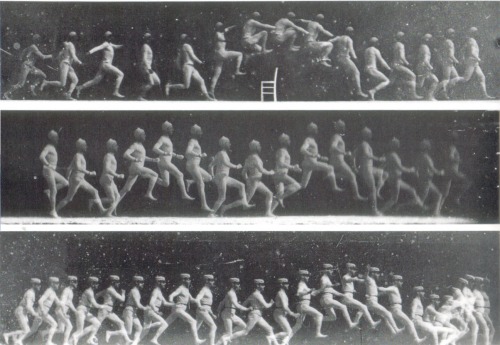
    Marey  And Duchamp’s Nude Descending (1912):

    Duchamp


    I do want to make it clear that this is just a simple note, a thinking-out-loud piece on how attempts to visualize things differently for the sake of explanation or education can come “unintentionally” close to what would become epochal works.  More later.

    Notes

    1. Augustus De Morgan, mathematician and logician, wrote a very highly critical book A Budget of Paradoxes in which he describes hubbub, fakirs, frauds, perpetual motion machines, squaring the circle efforts, millstones and other useless books in the maths, and in here he sniffily dismisses Byrne’s work. At best, to De Morgan, the Byrne book is “curious”. But useless and curious, as I have seen many thousands of times, does not mean that it can’t be attractive and beautiful, and the Byrne book is probably the leading candidate in the Bad & Beautiful category.

    2. In his Victorian Book Design McLean calls the Byrne book “…one of the oddest and most beautiful books of the whole century…a decided complication of Euclid, but a triumph for Charles Whittingham [the printer]”.

    3.  This is also the first appearance of Euclid in English.  The full title: The Elements of geometrie of the most auncient philosopher Euclide of Megara faithfully (now first) translated into the Englishe toung by H. Billingsley, citizen of London; whereunto are annexed certaine scholies, annotations, and inventions, of the best mathematiciens, both of time past and in this our age; with a very fruitfull praeface made by M.I. Dee, specifying the chief mathematicall scieces, what they are, and whereunto commodious; where, also are disclosed certaine new secrets mathematicall and mechanicall, untill these our daies, greatly missed. London, Imprinted by I. Daye, 1570.

    4.  From the Report of the Annual Meeting of the British Association for the Advancement of Science, 1906:


    5.  From the IHP website:  “Most of the models  were created by Martin Schilling in Leipzig between 1900 and 1920 and  a few of them  (in wood)  were made between 1912 and 1915 by J. Caron, Professor of Descriptive Geometry in charge of  the “graphic work” course at the ENS at the beginning of the century (between 1912 and 1915).”

    Also this:   “In the thirties, the surrealists, led by Max Ernst, were interested in these geometric objects. André Breton alludes to them in  “Crise de l’objet” , an article  in the magazine  Cahiers d’Art (May 1936, No. 1-2, p. 21-26.). Man Ray took photographs of the models, which where published in same issue. He would later use them to compose what he called  “Shakespearean Equations”. Many artists, painters, architects and sculptors drew inspiration from them.”
  • Bad Ideas Department: Restructuring the City and the “Terminal Box”, Neopolis, 1938

    JF Ptak Science Books   Post 1421

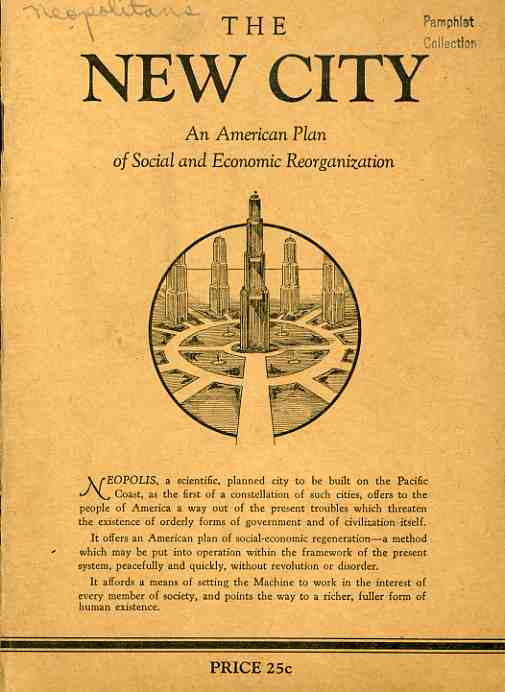
    0-blog---Nov 14 new city075 The unnamed author of The New City, an American Plan of Social and Economic Reorganization (1938), makes a hard-edged plea for the formation of a new American society—and by “new” the author really means it, advocating a different economics, social structure and even the physical development of new cities and abandonment of the old physical and philosophical structures. (The rare original of this deterministic futuristic publication is located at our blog bookstore.)

    Sprinkled among the Swiftian notions of rightness, quixotic lancings of social ills and a general bombardment of the structure of society are some interesting and isolated points: 
    “America is the supreme user of the machine…ravishing the irreplaceable wealth of one of the earth’s richest continents, tearing down forests, looting the treasures of coal and draining the reservoirs of oil and natural gas, by methods scandalously wasteful.” 

    This leads the author to the Depression, “a decade of demonstration of the profit system’s inability to deliver to the people the needs of life, a painful heartbreaking demonstration”.  0-blog---Nov 14 new city076

    It is the profit-deliverers, not the machines or people, who are to blame.  One way of addressing the distribution system, was, unfortunately, Russia—“a form if society set up to overcome this impasse of the capitalistic system of production and distribution”.  Of course the Russians–the Soviets–were just in the middle of their enforced starvation/gulag/brutalization period under Josef Stalin, the gigantic negative parts of which were still in general not known to the great unwashed. 

    The unnamed author dips lightly into Socialism, and then into Fascism and Nazism, though the only thing he/she really has to say about the later two is that “their answer [to economic woe] was in the seizure or control of the means of production by the state”, their own brutal means skipping off unnoticed into a pinkish glow, though the loss of personal freedom is “disdained”. 

    The New City is actually a new world order, a new governmental form to take advantage of technological advancements leading to “nationalized urbanization” The first city in this new order is Neopolis, and this pamphlet was a call to those who would stand as its citizens.  (There’s actually a sort of application form, though all it really is a bill-of-sale for ordering more copies of the New City pamphlet.)

    Even though the pamphlet is easily obtained, membership, the possibility of being a Neopolitan, is something entirely different.  The difference is actually exceptional, perhaps the most extraordinary thing about this whole misguided idea.  “Membership is to be carefully controlled at all times” we read. . “It is not desired to build up a huge and unwieldy membership of poorly-assimilated elements….interesting educational instruction…with tests to determine the fitness of the member for loyal, cooperative activity, leading, necessarily, to the elimination of those who may be found undesirable”. 
    That’s some pretty muscular, steroidal stuff, particularly after such a glancing blow against the Soviets and Nazis. 
    0-blog---Nov 14 new city077
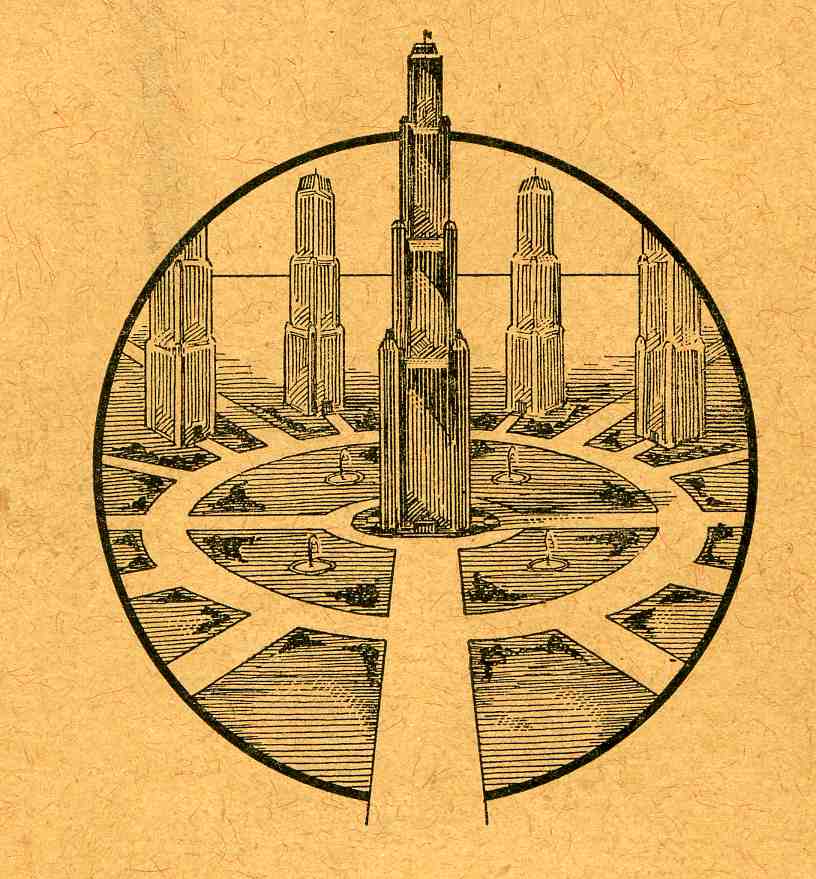
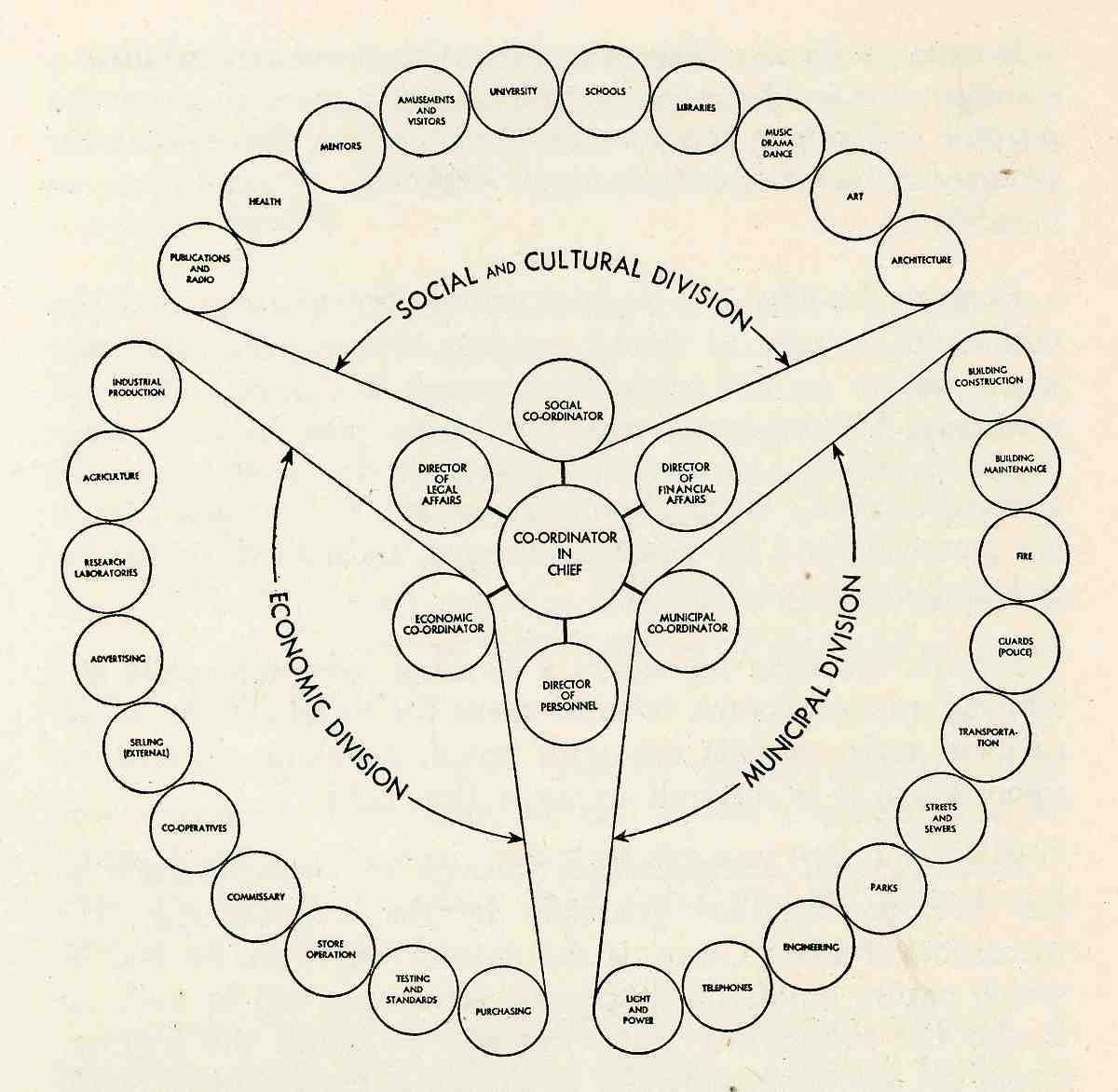
    Since this is just an “abridgment” of a soon-to-be-written 250-page explanation of the concept, the complex and concentric organization of society is left mainly to the drawing of its plan, the physical layout of the city based upon this ideal. 

    The Seattle-based author never did quite make it past page 29, never did name themselves, and never provided a concrete place where all of this heady stuff was being think out.  It is a sort of pretty design in a creepy/queasy way, there on the front cover, but that’s about as far as it goes.  If anyone actually did send any money to this quack thinker, it wound up in a nicely metaphorical place:  at “Terminal Box 3463”. 

    This may be the very best idea to come out of touching this pamphlet—a place where people can send correspondence regarding Bad and/or Dead or Dying Ideas: “Terminal Box ______”.  I guess that box number would be pretty high by now. 

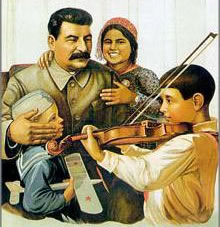
    Stalin20 (Uncle Joe, before he killed the children, and dozens of millions of others.)


  • The Almost-Tomorrow Department: Radio-Vision, 1928.

    JF Ptak Science Books  Post 1415

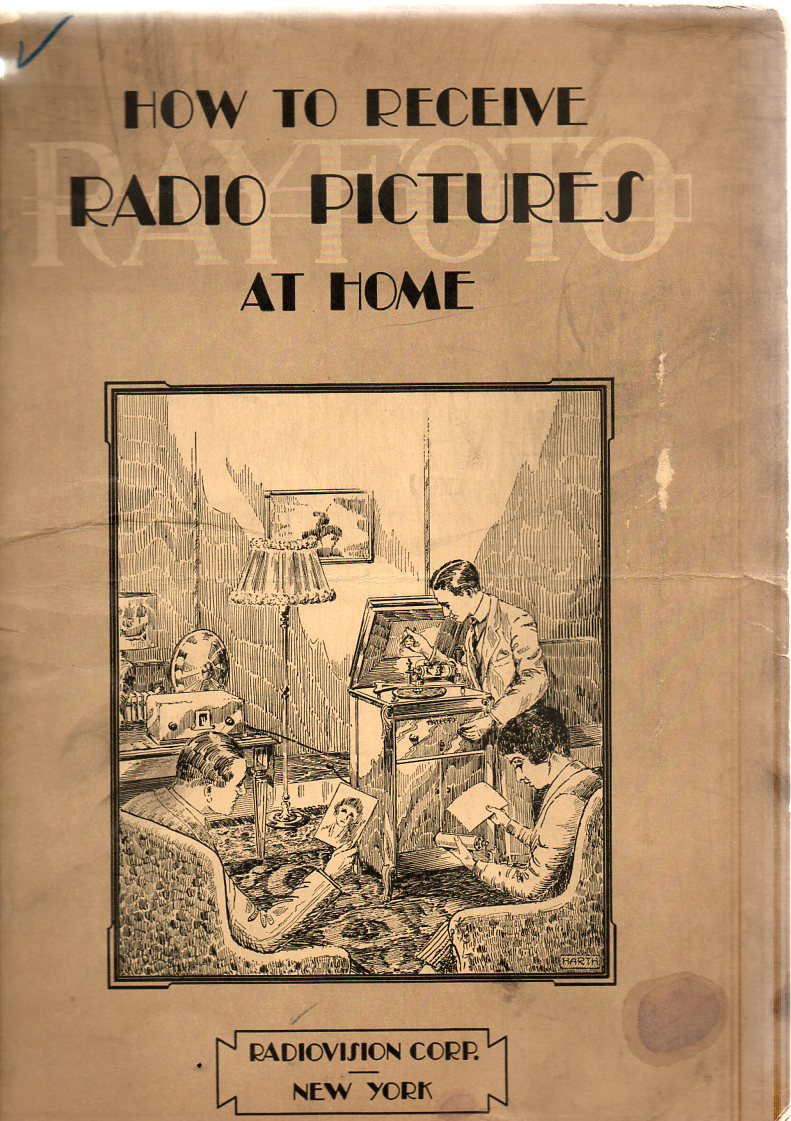
    Radio vision258 Tomorrow seemed to be almost there to readers of this pamphlet, what with the idea of looking at pictures relating to the radio broadcast you were listening to looming before a slightly disbelieving mind.  The fact of the matter though is that this breakthrough by Mr. Austin G. Cooley1–basically attaching what we would know today as a fax machine to a radio cabinet which would receive and print images relating to the show being heard–was rubbing up mightily against the real wave of the future, the television. (The original is available here at our blog bookstore.)

    Mr. Cooley’s invention of the Rayfoto just didn’t quite fit the demands that would soon be established and met by television.  The idea of practical television goes back a fair way2, at least to Arthur Korn in the late 1890’s, which much work being done on both broadcast television and facsimile transmissions.  But tv was definitely a high scent in the air when Cooley published his Rayfoto pamphlet in 1928–as a matter of fact, this was the same year in which the first television license was granted (to Charles Jenkins, W3XK).  And just two years later the BBC would begin regular television broadcasts, while also in 1930 Mr. Jenkins initiated another television-first, the t.v.commercial. 

    Radio vision259

    “No greater thrill awaits the radio experimenter than receiving his first picture through the ether…Not many months will pass before picture broadcasts will be a part of every radio broadcast”–A. Cooley, 1928

    So the time was definitely note ripe for Cooley’s idea as an image supplement to radio, though it did have other possible applications–like the “fax” delivering newspapers to your home–though they are not listed in the pamphlet. 

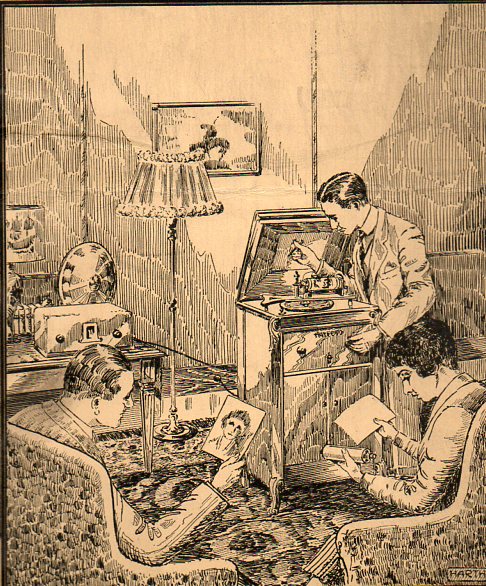
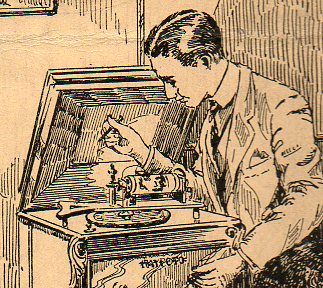
    What we see here the drum of the apparatus (we don’t see the three-tray developer/fixer wet set-up inside the apparatus), one of the listeners retrieving an  incoming vision-image, something that evidently took quite some time, depending on the image and the ways in which the developing trays have been set.  Dark images might’ve taken the entire length of a 15-minute broadcast to transmit and print; other, simpler efforts took less time.

    Radio vision260
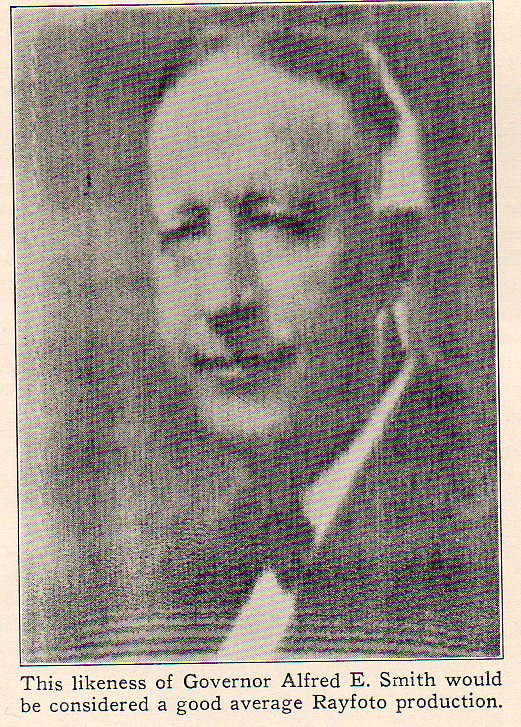
    Here’s an example of a successful, medium-quality image that one could expect using Cooley’s Rayfoto system:

    Radio vision261
    It doesn’t look like much now, and maybe it wouldn’t’ve looked like much to people familiar with the new television.  But even a grainy, static image accompanying a voice performance is a fabulous thing when compared with never having seen anything like it before, never having had such an experience, if even only as a novelty.

    _______

    Notes:

    1. Cooley,  Austin G.  How to Receive Radio Pictures at Home.  New York:  Radiovision Corp,  1928.  1st edition.  26pp, 2 folding blueprints  4to.   This unusual publication describes the construction and use of an apparatus which would receive broadcast (facsimile) images that would be used to illustrate radio transmissions/shows.  The idea (in this form of illustrating radio shows) at this date would be reduced to almost-nothingness once television entered the picture in the next year or so.  Still, it was an elegant idea to illustrate the spoken word.

    This system was offered by Austin G. Cooley (1900-1993), inventor of the Rayfoto system, “the first authentic radio picture apparatus”. This was a very early attempt at mass entertainment via a mechanical medium that proved ineffective by 1929/1931 against the advances of television. (The radiovision method was something like a facsimile device, offering a static image every now and again, and was completely outclassed by the moving image).

    2. Followed by Paul Nipkow’s rotating discs in the earliest part of the 20th c, then by Vladimir Zworkin’s iconoscope (1923), Charles Jenkins and John Baird’s television of 1924, and then of course by Philo Farnsworth’s 1928 image dissector.


  • Elegant, Lightweight Steam-Powered Vehicle, 1877

    JF Ptak Science Books  Post 1407

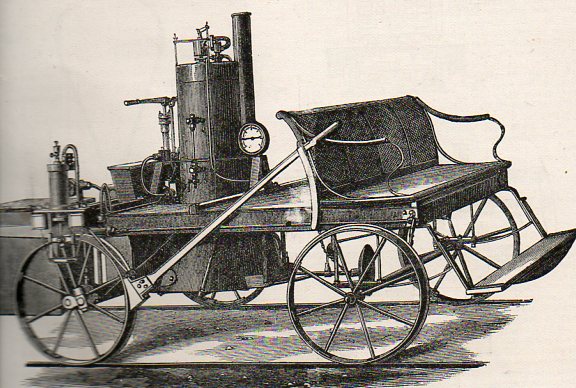
    Steam car232

    This lovely steam-powered trolley looks as though it was just <this> close to being lifted off of its tracks and placed on the street for tooling around town.  Of course part of the reason why Joseph Green Cooke’s trolley was so lightweight1 is because it was traveling on rails, which meant the surface over which it would be propelled was smooth and predictable, unlike the streets that it would have to use to makes its way through a town.  Uneven, choppy, bumpy roadways would mean that the vehicle would have to be more sturdy; more sturdy means more weight, more weight means bigger engine, and so on.  So instead of this relatively light 1,200 pound vehicle you might wind up with something at 5,000 pounds, or more–at least in 1877’s mindset. (The issue of Scientific American is available here.)

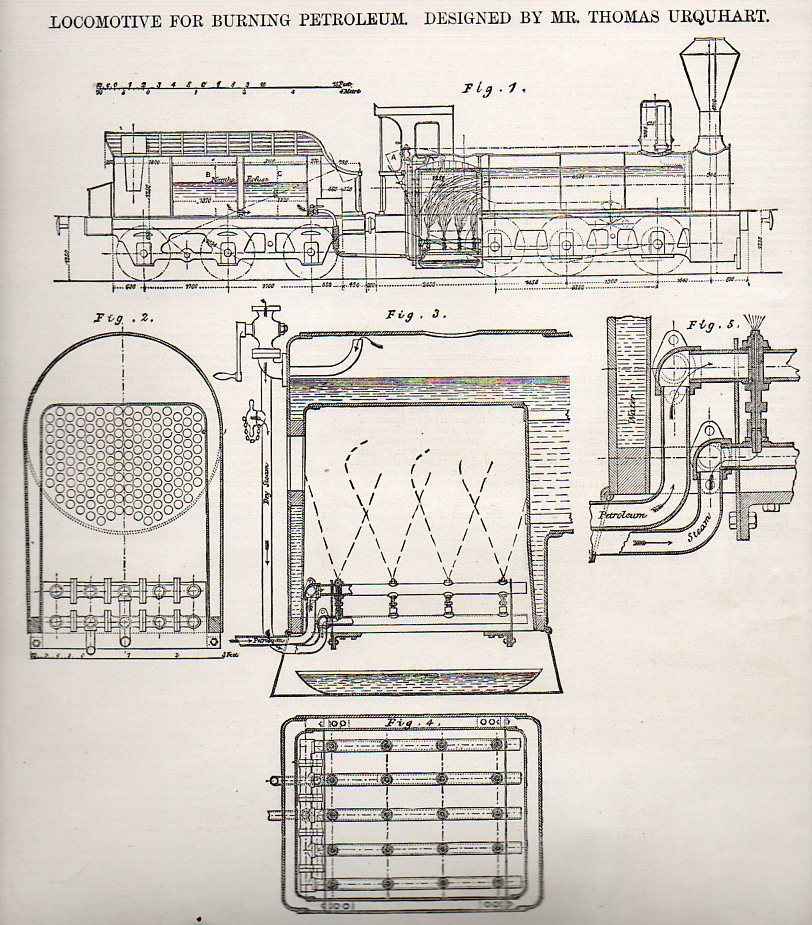
    The lighter vehicle would come before the end of the decade, but it had mostly to do with getting away from the steam engine to the lighter gasoline engine2.  It is serendipitous and perhaps ironic that the illustration facing the steam trolley is for the gasoline-burning train locomotive engine of Thomas Urquhart, who developed it for the Grazi-Tsaritsin Railway (Russia), which converted all of its 143 engines to this method by 1885.  When the pages of the magazine are closed, the two images lay one on top of the other. 

    Steam car234

    Notes:

    1. Earlier efforts at putting mobile steam-powered vehicles on the road stretches back into the very dim pre-automobile with the behemoth of Nicolas Joseph Cugnot, which strained its way along French streets as early as 1869….it also in the first recorded automobile accident, which caused enough trouble and damage and injury to scare away development money.  There were engines that were considered “portable” traction devices in the earliest part of the 19th century (by Trevithick and Tuxford, among others) , though they were not mobile–the “portable” part was that they could be moved (at all).  The movable, working traction machine (“tractor”) would begin to make its appearances in the 1860’s, though these were generally major pieces of machinery, locomotives on wheels. 

    2. Thanks to Gottlieb Daimler’s 1885 prototype, and Karl Benz’s 1886 patent for the gas-fuled car, and of course to the Charter Gasoline Engine Company of Illinois, whose work in the mid/late 1880’s brought about the production of several gas-powered traction engines in 1889.

    From the Western Review of Science and Industry, 21 December 1876: STEAM TROLLY. “Mr. Joseph Green Cooke, the locomotive and car superintendent of the  Oude and Kohilkunde Railway, has constructed a steam troll}” or carriage, the object of which is to enable resident engineers to inspect their tracks,  bridges and works with rapidity


  • A Peep into the History of the Future of Roads in Texas, 1938

    JF Ptak Science Books   Post 1396

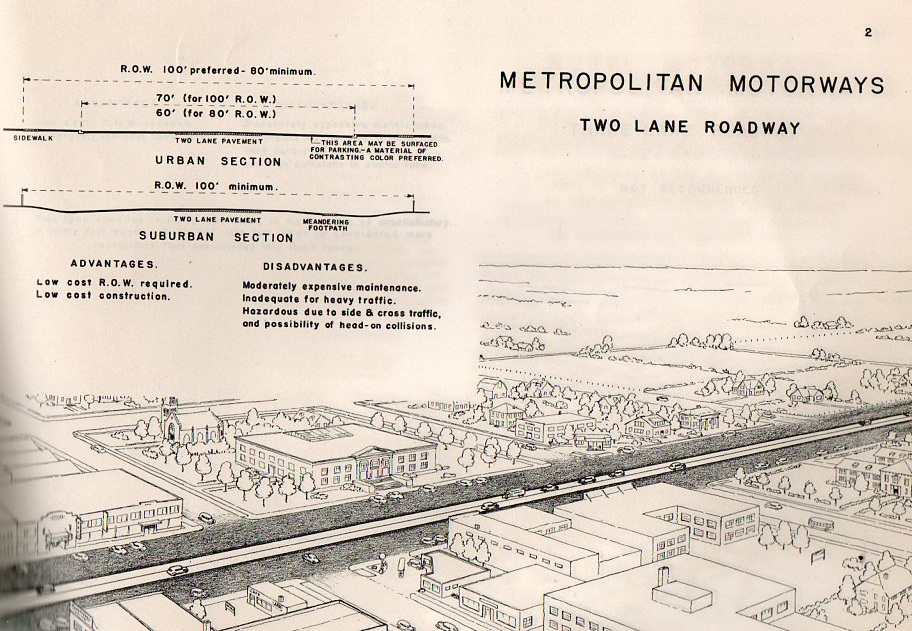
    The planners, designers, structural engineers and city planners in Texas felt the hot breath of the future on their necks in the summer of 1938, working their way to publish this futuristic emblemata book on the controlled motion of automobiles.  The Depression was coming to an end, access to money was loosening, automobiles were becoming cheaper and gasoline supplies were plentiful (even though during the crisis car sales fell though gas consumption increased), GDP was up by 1/3 from 1932, employment figures had gone up 25% since 1931, and of course there were projects of road-building got consider to put folks to work.  These figures were also a little problematic for Texas, given the huge percentages of farmers who were out of work (nationwide) and the preponderance of farming in the state of Texas. 

    But Jac L. Gubbels1, who copyrighted this work for the State Highway Department of Texas (Landscape Division) saw a prettier picture for the state in the near future, and what it had in it mainly were automobiles.  The highways proposed by Gubbels were remarkably wide given the number of lanes, particularly so for those roads that went through small towns. 

    Exas roads199 Notes

    1.  (From the Texas Centennial Archives:  “The harmonious integration of construction features and the natural environment was a popular trend during the Depression era. Called the "rustic style," this natural yet designed "rustic" landscaping of the early Texas roadside park system was largely planned by Jac L. Gubbels, landscape architect with the Texas Highway Department from 1933 to late 1930s. One of the first landscape engineers to be hired by a state highway department, Gubbels influenced the direction roadside parks were to take regarding landscaping, layout and style. His guidance set standards for construction elements and landscape design."

    8 other designs here:


  • An Episode in the History of Holes: Electricity, Punched Cards and the Computer, 1878.

    JF Ptak Science Books  Post 1382 [Part of our series in The History of Holes.]

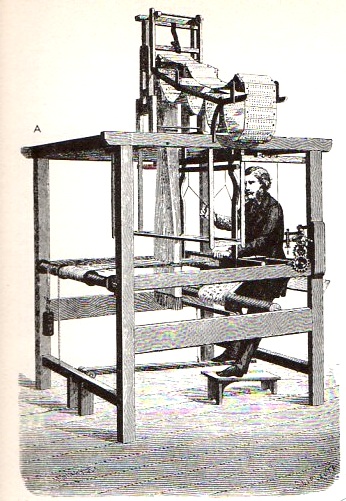
    Jacquard loom142 Kepler saw music in his study of planetary motions; Newton saw it too in relation to optics and the foundation of color–I wonder if the early people working with punched cards and tape saw a similarity between horizontal versions of their work and musical scales as well?  Did Jacquard or Hollerith see something through their holes to points beyond?  Well, I doubt the later, though there is no doubt that there are true relationships between music and the work of Kepler1 and Newton.  Perhaps one could make a score by arranging the punched holes of computer tape or a series of Jacquard loom cards, though they have less a relationship to what we identify as music than transcribing hundreds of resting pigeons as notes on a five-line utility pole.

    The idea of automatic control comes way before M. Jacquard (1752-1734) and the punched cards that he used to control his loom (which began about 1805), though I must say that Jacquard’s man-in-the-machine design does have a great, far-reaching elegance to it.  Even in his own field here were predecessors: Jacques de Vaucanson, for example, and Basile Bouchon (1725) and M.F Falcon (1728).  But it was with Jacquard that the idea of the punched card for design control took hold, and just seven years after the loom was introduced there were more the 10,000 Jacquard machines in operation in France alone. 

    Alfred Barlow2 wrote a splendid history of weaving in 1878, and in that books later pages–and I suspect much overcome with the recent developments in the electrical field (not the least of which were the newly invented light bulb and telephone)–Mr. Barlow waxes considerably on the application of electricity to the Jacquard process:

    He writes, “It is scarcely to be wondered at that men acquainted with the application of electricity to telegraphy and other purposes should have believed it equally serviceable in some of the operations of weaving.  As it might be expected, the Jacquard apparatus seemed to offer and excellent opportunity for the needles [reading the holes ion the loom punch cards] to be worked, not by the direct pressure of a card, but by the connecxion of a series of electro-magnerts.  By this means it was believed that paper may be substituted fir the cards, and the magnets might operate upon the needles through the perforations in the paper, or by passing a current of electricity through the medium of a metallic conducting surface on a sheet of paper or cloth representing the design to be woven, and thereby acting without the use or need of perforations.” (Pages 424-5)   It was certainly a capital idea.  Barlow may have been referencing the work of Alexander Bain and his punched-tape telegraph of 1841, though he does not mention him specifically.  Barlow does mention several inventors from the 1850’s who managed to make improvements with electricity in Jacquard-style machines, though none with the great effectiveness which he described here.  The real, great advancement in computation waited for quite some time, even beyond the great innovations of Hermann Hollerith (who began his tabulating successes in the 1880’s, coming into international recognition with his work on the 1890 U.S. Census.  But Barlow’s imagination here is quite full,  and just a little beyond his time. 

    [This work by Barlow is available for purchase here.]

    Notes

    1. Kepler used the ratios between the velocities of the planets at their closet and furthest distances from the sun to construct musical intervals, which do work.  What an enormously encompassing feeling this must have been to set the motions of the celestial spheres into polyphonic tones that fit right inside the octave!  Newton’s seven colors could be set side-by-side with seven notes of the octave, color in music, giving them the notes A, B, C, D, E, F and G. 

    2.  The excellent Mr. P.J. Mode first brought this reference to my attention 15 years ago.  The work:  Barlow,m Alfred:  The History and Principles of Weaving by Hand and by Power.  London; Sampson & Low, 1878, xii, 443, iv pp, illustrated throughout with text illustrations. 


  • Note on an Alphabet of Computer Names in Fiction

    JF Ptak Science Books   Post 1375

    First of all let me say that I know almost nothing about Science Fiction–this  list started out  while looking for questions asked of computers in works of fiction and movies, but the question on questions is far deeper than I can deal with in a simple sit-down, though I did collect some interesting names of fictional computers along the way.  For this very preliminary list of computers in fiction I include computers with actual names–therefore, and unfortunately, beasts like the NORC-like computer that let loose Hell’s Kitchens in Kubrick’s Dr. Strangelove…. is not included because so far as I can remember it has no actual name, and names are important when you’re creating an alphabet.  Also I tried to look for images of the computers themselves, but since I stayed mostly in the 1940’s-1960’s, there are not many of those. 

    So here this is and please take pity–again this is preliminary and I hope to start filling in what made these machines interesting quite soon. In the meantime there’s an excellent list compiled at Wikipedia, here.

    AM, from Harlan Elison’s short story I Have No Mouth, and I Must Scream (1967).  AM “speaks” via paper tape, as below, using International Telegraph Alphabet No 2 (ITA2), a (much) earlier pres-ASCII-ite language, in this case saying “I think, therefore I am”. 

    AM Talkfield #1
    ALPHA 60.   From the film Alphaville, Jean-Luc Goddard, 1960.


  • The Alpha and Omega of Computer Questions; Asimov, 1953 and 1955

    JF PTak Science Books  Post 1375

    Asimiv question087
     

    Following up on yesterday’s post on the world’s first (popularly-published) computer magazine (Computers and Automation)  is this Isaac Asimov short story on what might be the first great computer question.  The story in mind, “Question”, appeared in the March 1955 issue of this same magazine, a two-pager sandwiched between an ad for Remington Rand UNIVAC and an article on computers and weather prediction.  It is the first appearance too of Asimov’s massive computer of the future, Multivac, a giant machine with corridors and nooks where technicians could stop and have a seat to enjoy a cup of coffee.  And it seemed to at least one worker that it wasn’t quite right to be sitting inside the machine, that the billion-tube, two billion relay computer was more than just a flow of electrons. (The ENIAC, which was basically the world’s first computer, had 20,000+ tubes, so a billion as  conceived by Asimov would’ve been a very big machine indeed, a 500,000-ENIACs-sized behemoth.) And a very hot one.   The workers wondered if you could ever tell if the machine was alive, if it thought on its own, if it attacked aparat from its instructions and programs. 

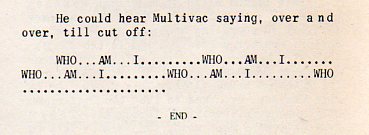
    As it turns out, the answer was positive, and not only that, but Multivac could speak.  Its answer to “the question” was “who…am…I…?”, repeated several times in the closing sentence of this rocket-fast short story.  I guess that that would give you pause, as it would anyone had the question come to them from their own computer while communicating along the spine of the great global “mind”, the Internet, and perhaps someday it will, at some time in the near-ish future when the height of our own computer-y heights looks as quaint to them as a half-million ENIAC idea of 1955’s premier scifi writer looks to us today.

    I know almost nothing about Asimov, but he seems to return to this idea of the Big Computer, Multivac, and ultimate question a few years later.  It seems as though there was an issue of serendipity involve with the structure of the “Question” story and that of another writer’s ending for a story called “Problem for Emmy” by Robert Sherman Townes. Asimov admitted the similarities but also maintained that he didn’t know of Townes and had never read his story–be that as it may, Asimov promised that he would never reprint the story, and it seems as though he never did.  But it looks as though he resurrected his idea somewhat, which is fine, because the whole idea of ultimate/penultimate questions and massive computers is a great genre. 

    Asimov wrote a story called “The Last Question” in 1956, a year later, writing about a trillion years of human history in the space of another terrifically-short short story, the short story that Asimov found to be his own favorite.  If “Question” posted the ultimate question put to the super-colossal Multivac computer,  ultimate question in “The Last Question” may well then be the ultimate answer.  You’ll have to see the ending of the story for yourself to see what it was–I can’t spoil it. 

    Notes:

    1.  I’m just a little surprised that Asimov was hung up on tubes in 1953–transistors had been in the air by 1947/8, published in 1948, and pretty-published by 1952.  I figure he should’ve been aware of them and how they would transform computer construction.  Maybe not. Perhaps he just wanted to write about a billion-tube computer. “Multivac ” stands for “muliple vacuum tubes”, and then “multiple vacuum tubes analog computer”, so using transistors might be a little at cross-odds with the name and the idea of the machine.  It woulod be interesting to put together a list of questions/answers of these early fictional machines, a longlist of which appears here.

    2. The two characters in the story by the way are named “Alexander Adell and Bertram Lupov”, both of which suggest the name Alexander Graham Bell to my head.


  • The World’s First Popularly-Published Computer Journal

    JF Ptak Science Books   Post 1374

    Computer history082

    Nothing quite gives you the taste for the ancient history of a very modern topic–like computers–than by looking through some of the earliest popular publications on the subject. This can actually be done pretty quickly if you wanted to just get a broad taste for the subject in its modern infancy–just reading the titles of the papers and taking in the advertisements might be enough. So here’s two volumes of a very scarce and interesting journal by old Edmund Berkeley that may do this job perfectly.  Berkeley was a bona fide mover and shaker in the early days of electronic computing in the United States–he had a lot on his mind, contributed many written words and ideas, and also tried to make a fair living while doing so (there was a bit of Sideshow Ed in him for some of the things he tried to sell.  

    Computers and Automation, the brainchild of the brainy not-child Edmund Berkeley, was the first popularly-published  magazine published regarding the computer, its applications, it programming, and really just about everything else.  (It appeared seven years after the Mathematical Tables and Aids to Computation  was published in 1943, almost entirely to the mathematics and engineering communities.) Computers was published by Edmund Berkeley & Associates in NYC beginning in 1952., beginning its publishing journey as The Computing Machinery Field, its name changing to Computers and Automation in February 1953 (in volume 2, number 2).   All issues have some fair space devoted to advertising, even though the issues generally ran between 32 and 40pp. Berkeley was a real-enough mathematician, engineer and computer pioneer, but he also had a pretty large taste for making these interests pay–which was essential, as the original print runs were not very large, though his advertisers were impressive. (According to the first issue, approximately 1200 people were on the mailing list for the journal, with around 2000 issues being printed each number. All told, this is not a large print run, and thus not many of the early issues have survived.)  He was not averse to being somewhat outre with his journal—in addition to having contributors like Grace Hopper and Alton Householder, he also had Fletcher Pratt and Isaac Asimov writing some pretty arresting pieces from the SciFi/Futurama point of view.

    Computer history083

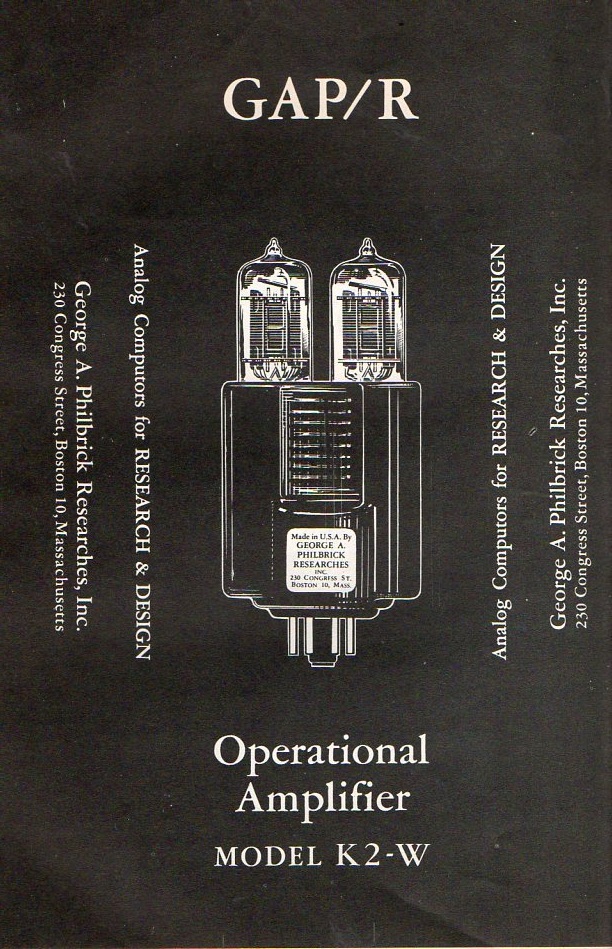
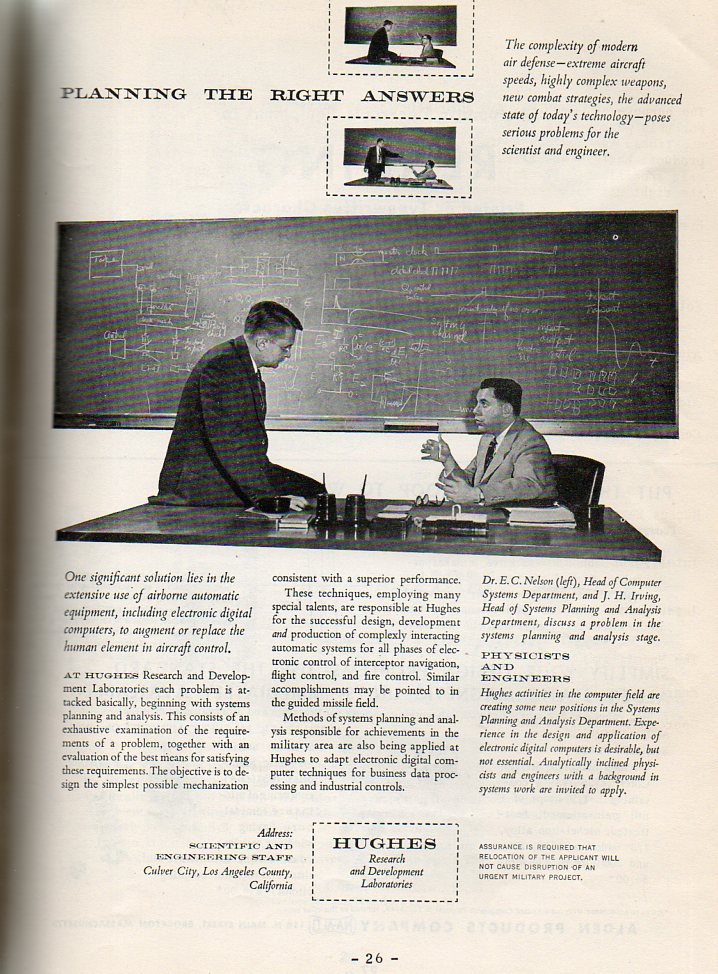
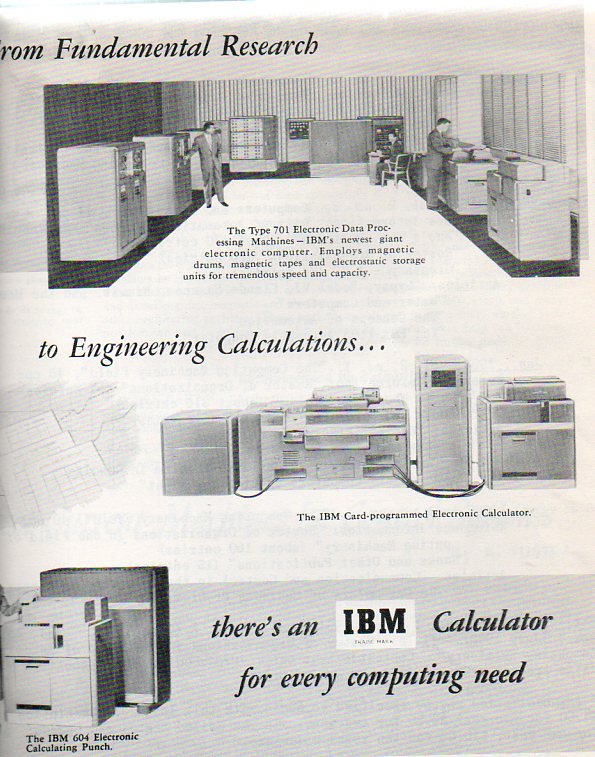
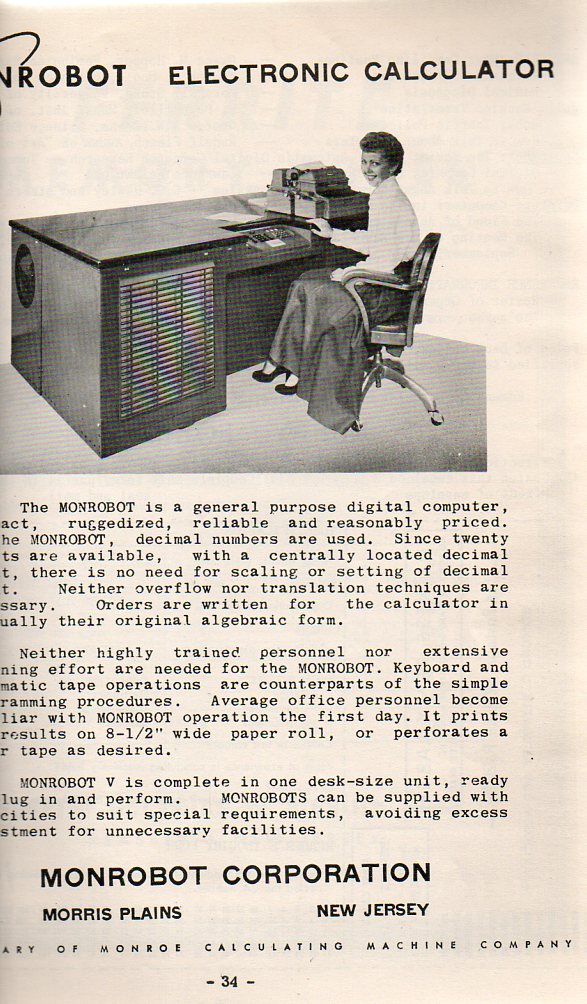
    A Note on the Advertisements: in short, they’re wonderful. For example, on the back cover of vol2/1 is Edmund Berkeley & Associates “SMALL ROBOTS”, advertising “Simon, the Mechanical Brains”, “Squee, the Robot Squirrel”, and other gadgets. To give you an example the other ads in this issue alone are for “The Circle Computer”, “General Ceramics Ferramic Cores”, “Magnetic Metals Co. Amplifier Cores”, Ross Ashby’s “Design for a Brain”, Consolidated Engineering’s SADIC System, Monroe Calculator’s Monrobot Electronic Calculator, George Philbrick’s “Computor (sic) products”, and a lovely two-page spread for Remington Rand. Further into the year are ads for Burroughs, IBM (604 ands 607), Electronic Associates Inc, Prokar capacitors, and many others.

    Some of the subjects include: The ERA 1103 computer, NIMWIT, Applications of the Computer, what the computer *is*, Admiral Grace Murray Hopper’s compiler, mechanical translation, Harper’s subroutines, the cost of coding, computer “self-repair”, automation at Ford, and so on.  Also includes perhaps the earliest announcement of the first all-transistor computer (October 1954, IBM’s “new experimental transistorized computer” , the earliest (?) printing of Asimov’s Three Laws of Robotics in a scientific journal, and more.

    Computer history086

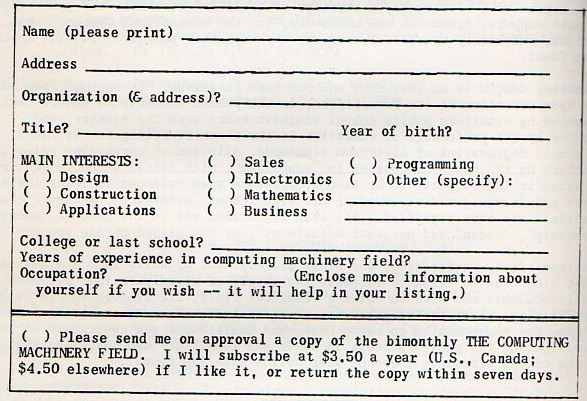
    Each section generally has three of the following categories (per issue) : computer glossary, roster of member organizations, who’s who, an annotated books and journals section, and other aligned concerns.  For example, there’s this bit, an application (cut-out) card for “Who’s Who in the Computing Field for December 1952”–utterly simple, it seems as though anyone who filled out the card was in, the “who’s who” part of this that we normally celebrate with fame or achievement really was just telling the rest of the people in the field who was exactly who.

    Computer history084

    The contents:

    Volume 2/1, January 1953. 45pp.

    Householder, A.S. Brains, Electronic and Otherwise; Williams, S.B. (President, ACM) What Computers Do; Murphy, E.F. and E.C. Berkeley. Automatic Computers on Election Night.

    Volume 2/2 , March 1953. 37pp.

    Boehm, George A.W. Gypsy, Model VI, Claude Shannon, Nimwit and the Mouse; Paynter, Henry. Water and Computers; and the editor Berkeley, The Concept of Automation, and Berkeley (with Neil Macdonald, Berkeley’s other name). The ERA 1003 Automatic Computer

    Volume 2/3, April 1953. 40pp.

    Fletcher Pratt, The Art of Solving Secret Ciphers and the Digital Computer; Berkeley, Avenues for Future Development in Computing Machinery;  Gene Hegedus, Hungarian Prelude to Automation..

    Volume 2/4. May 1953. 33pp.

    Grace Murray Hopper,  Compiling Routines; A.D. Booth, Mechanical Translation; Marshall Stone,  Medical Diagnosis.

    Volume 2/5. July 1953.

    Yehosuha Bar-Hillel (the great logician),  Machine Translation; George Boehm, Robot Traffic Policemen; Rudolf Flesch,  How to Talk to Computers.

    Volume 2/6. September 1953.

    Tommaso Fortuna,  The Soviet Union: Automatic Digital Computer Research.; Wainwright, Lawrence Wainwright,  Digital Computer Questionnaire; and a general DISCUSSION: “How to Talk About Computers”, with GG Hawley, Samuel Scharff, C.B. Crumb, and EC Berkeley.

    Volume 2/7. October 1953. 36pp.

    Brown, David W. Brown Computers in the Factory; Neil (Berkeley) Macdonald,  The Flood of Automatic Computers. 

    Volume 2/8. November 1953. 40pp.

    John W.Carr  III. Who Will Man the New Digital Computers?; E.F. Cooley,  Electronic Equipment Applied to Periodic Billing; Glenn.Hagen,  Air-Floating: a New Principle in Magnetic Recording of Information.

    Volume 2/9 December 1953. 36pp.

    Clippinger, Richard Clippinger, How a Central Computing Laboratory can Help Industry; R.T. Wiseman, “Combined” Operations in a Life Insurance Company instead of “fractured operations”.

    These are the contents for 1953; the volume for 1954 bulks up a little, but is still under an inch thick.   The MTAC journal stays quite slender throughout its pre-1960 life (it has virtually no advertisement and is entirely academic), and there are more and more computer articles appearing in old stand-by associated journals like the Proceedings of the Institute of  Radio Engineers (which by 1959 will published a massive supplemental volume called “the Computer Issue” which I’ll talk about soon.  For the time being, I just wanted to make an inroad into this journal–I’ll expand on he articles in just a bit. 

    Computer history085


  • The pre-pre-Internet? The SAGE Defense System, 1959-1983.

    JF Ptak Science Books   Post 1341

    Quality Control of America’s Anti-Bomber Defensive “Shield”: the SAGE System, 1958

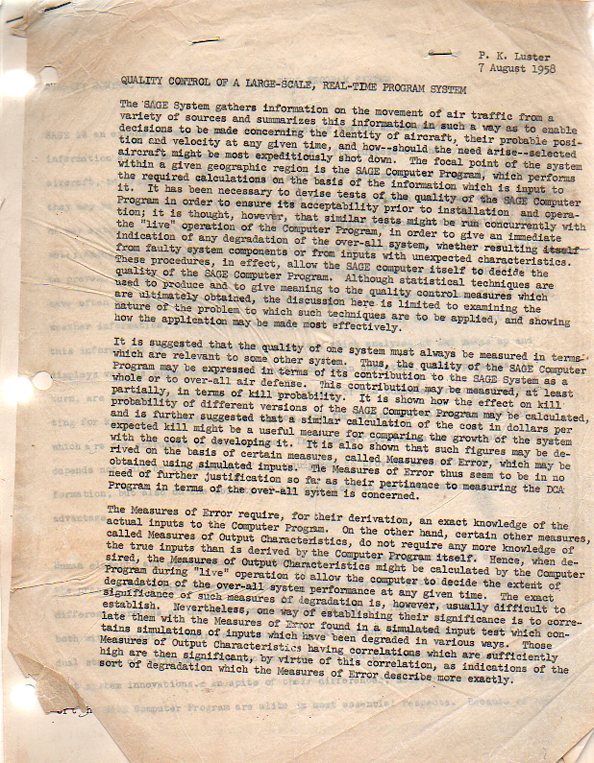
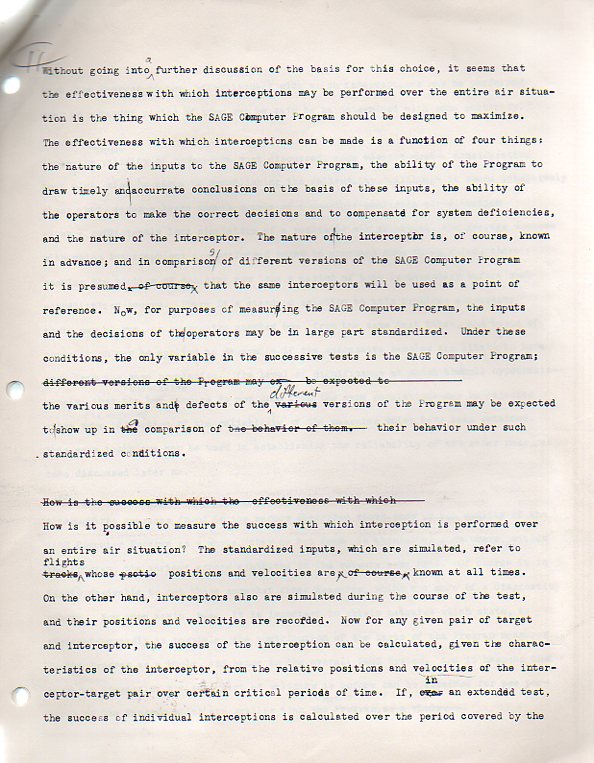
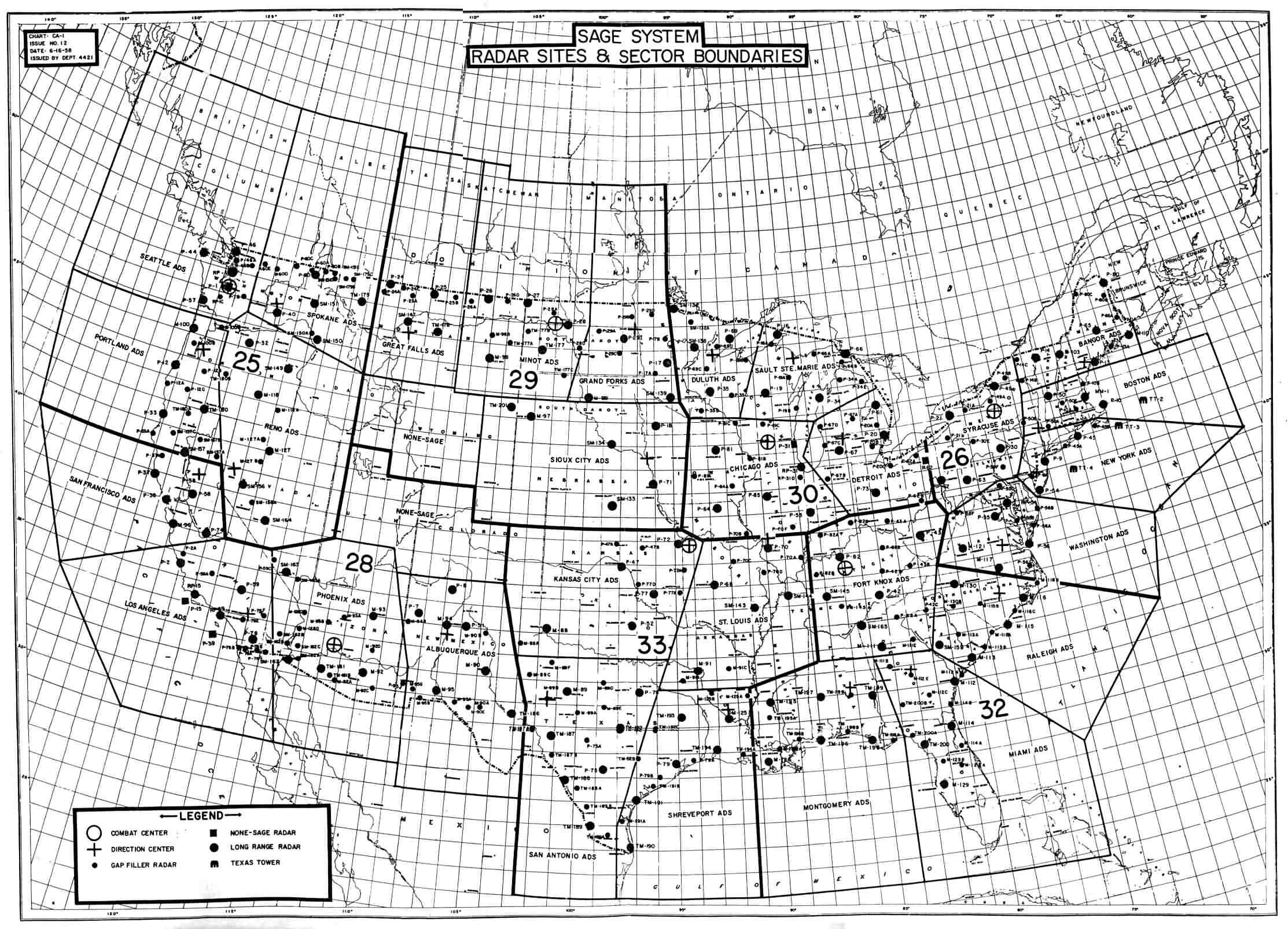
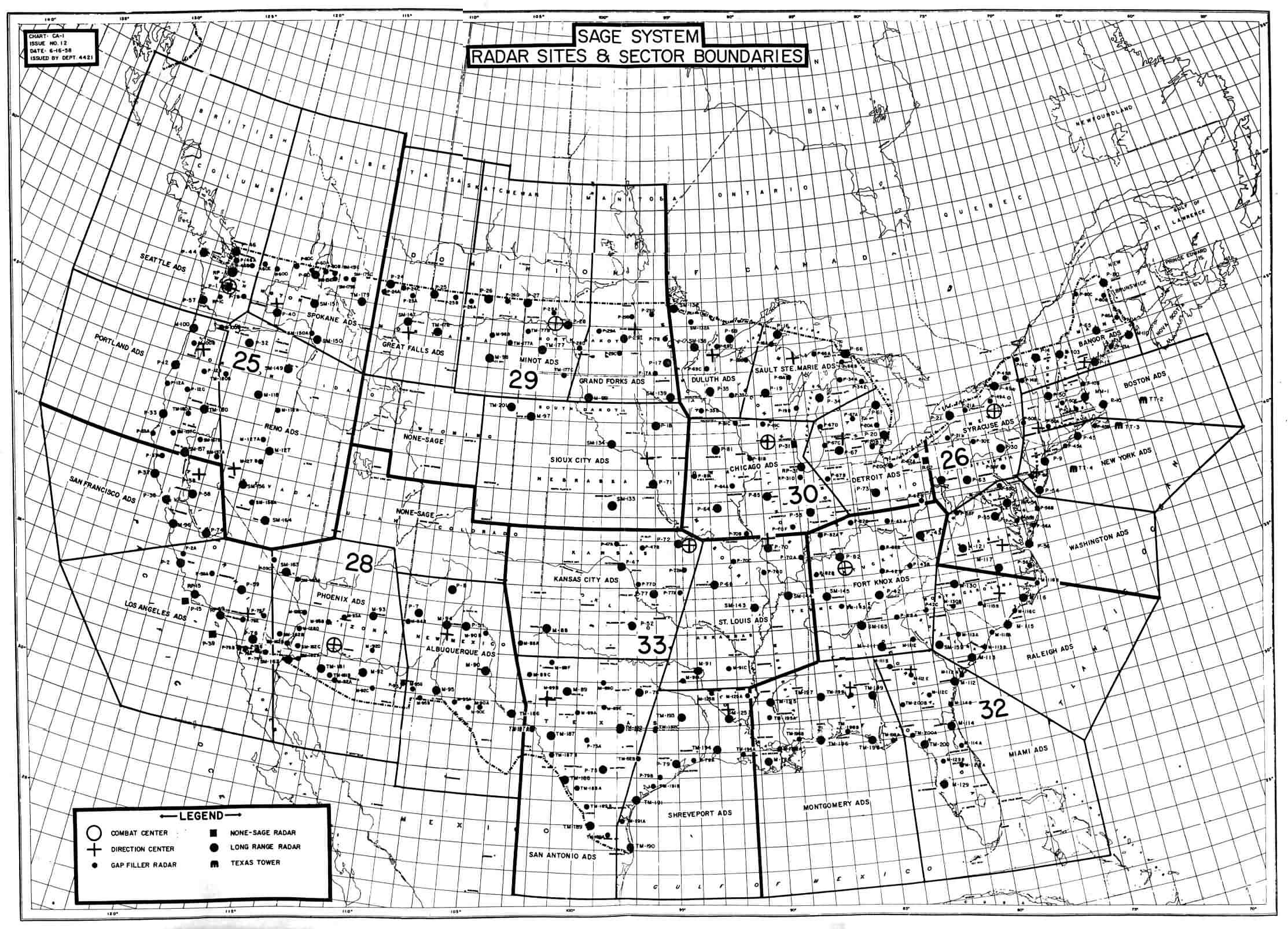
    SAGE403 The SAGE  (The Semi-Automatic Ground Environment) was an “air traffic control device”1 that was used to detect enemy aircraft, relate their position and speed to interceptors which would destroy the threat.  It was basically the air defense shield against attack of North America by Soviet bombers (in the pre-ICBM days of MAD). The MIT/IBM SAGE system was enormously important in the history of computing because of its many real-time, interactive and online aspects–it was an enormously successful and futuristic system, one of the “best” computers ever built. This paper on the computer’s ability to self-reference and check itself, by P.K. Luster, was written in 1958 and serves as an interesting insight into quality control for the world’s first nation-wide computer communication network.

    Luster (who at one time worked for a contractor in Arlington, Virginia, named the John D. Kettelle Corp) was one of hundreds of programmers who worked on the system, and in this case, for this effort of his, he looked at various ways for selecting the proper way for a SAGE to monitor itself in real time and make assessments of its own reliability.  This was a very tricky bit, of course.  SAGE was the largest computer ever built–it had 23 installations in the U.S. (And one other in Canada) each given the possibility of tracking about 400 aircraft at one time.  SAGE would track these developments, coordinate all efforts in response, and then if the flights were determined to be hostile /Soviet forces, would destroy the buggers with responses from “nuclear tipped” BOMARC and Nike missiles. (The Boeing Michigan Aeronautical Research Center and Nike missiles each carried a 1-5 kiloton warhead, enough so that if it was near its target it would be able to destroy it.The BOMARC looked like a jet aircraft; the Nike looked like a multi-finned, very sleek ultimate 1950’s imaginatively-styled rocket ship, but real.) Trying to insure that the system was accurate was a major consideration. (This document is available for purchase from our blog bookstore.)

    From Luster’s  paper:

    “It has been necessary to device tests of the quality of the SAGE computer program in order to ensure its acceptability prior to installation and operation…also to run it “live” in order to give an immediate indication of any degradation of the overall system.  In effect, allow the SAGE computer itself to decide the quality of the SAGE computer program…The discussion here is limited to examining the nature of the problem to which such techniques are to be applied, and showing how the application may be made most effectively.”

    SAGE402
    The SAGE system was of course functional, highly reliable, and ws used until 1983.  IT was a kind of early version of the Star Wars defense system envisioned by President Reqgana nd Edward Teller, among others.  Except that SAGE existed and worked.

    It is interesting too to think of it in terms of a sort of pre-ARPANET pre-internet, a pre-pre-internet, in that the system has 24 remote nodes which communicated among themselves.  It doesn’t bear much resemblance to J.C.R. Licklider’s  Memorandum For Members and Affiliates of the Intergalactic Computer Network (1963)–the true first modeling suggestion for a working internet in which all of the main pieces of the internet are present, but it is at least in the neighborhood, as SAGE was the first operational nation-wide real-time computer network. ( It should also be pointed out that Licklider and other of the creators of ARPANET were programmers for SAGE.)  SAGE was in-place by 1959 and operating by 1963, but it had severe limitations as a national defense shield and was ill-equipped to counter ICBMs and SLBMs, but it was kept alive until 1983.   

    Sage network


     Notes

    1.  SAGE did become the template for SABRE as well as for the national air traffic control ssytem.