A Daily History of Holes, Dots, Lines, Science, History, Math, Physics, Art, the Unintentional Absurd, Architecture, Maps, Data Visualization, Blank and Missing Things, and so on. |1.6 million words, 7500 images, 4.9 million hits| Press & appearances in The Times, Le Figaro, Mensa, The Economist, The Guardian, Discovery News, Slate, Le Monde, Sci American Blogs, Le Pont, and many other places… 5000+ total posts since 2008.

Category: Blank and Empty Things; A History of

  • History of Blank, Missing and Empty Things: Colorful Emptiness

    JF Ptak Science Books  Post 1111 [Part of the History of Blank, Missing and Empty Things series.]

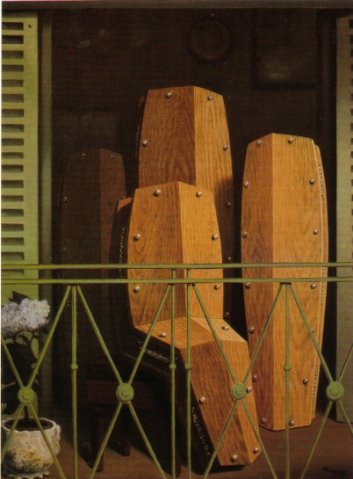
    Magritte balconyStandard introductions to Magritte miss what I most see in his work–it seems to be in a constant state of removal, of emptying, and blankness.  And this is the case even when the canvas is full of images, even when it is full of people, raining people–the underlying effect to me is still the same.  The man just painted blank spaces in full color, some of the most colorful nothingness I’ve ever seen.

    Many of Magritte’s strikingly delineated paintings suggest and portray missing things and emptiness with shadows and barren places, but even when they’re populated by human figures there’s a long memory of the same sort of thing: half torsos, bagged heads kissing, the backs of people facing a mirror in which their back is reflected, empty feet, half-humans, hidden faces, floating hats, draped bodies, the half-disappeared, and so on, all speak to the same emptiness.

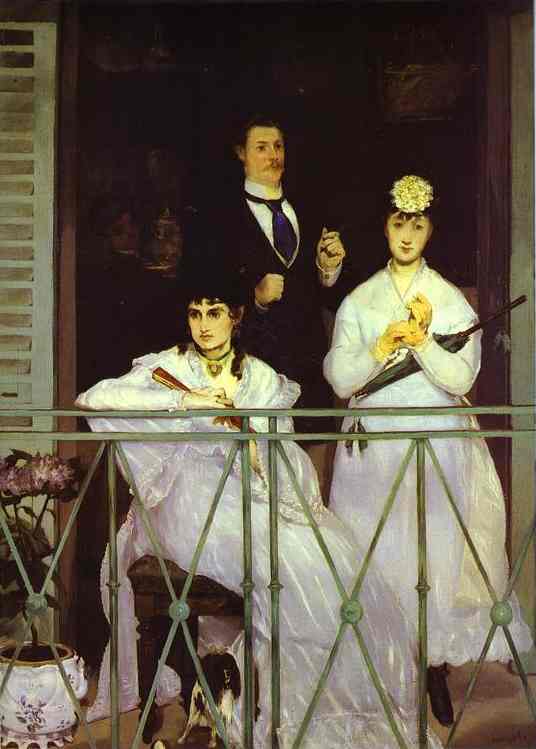
     Perhaps this sense is strongest in me when I see his Perspective: the Balcony of Manet (ca. 1945), especially side by side with the Edouard Manet The Balcony (1868).  I know its unfair to compare the two–but Magritte started it–but Manet is hardly an empty, blank painter.  Once Manet moves through the 1860’s and into real modernity, he is able to paint colossal senses in the boundaries between objects, boundaries that are really mostly suggestions than demarcations.      
    Manet_The_Balcony_1868

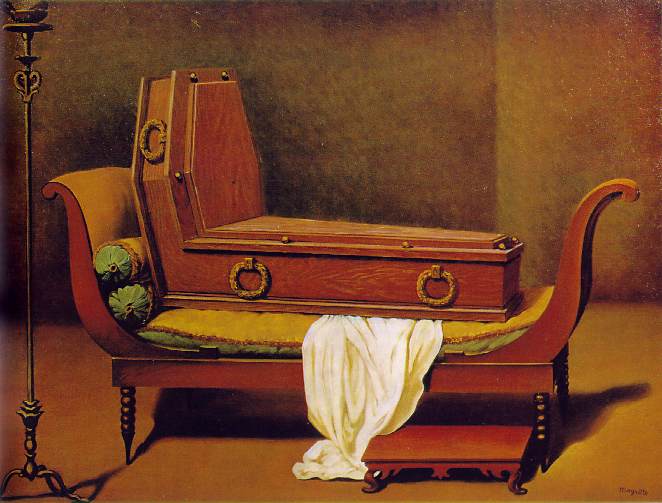
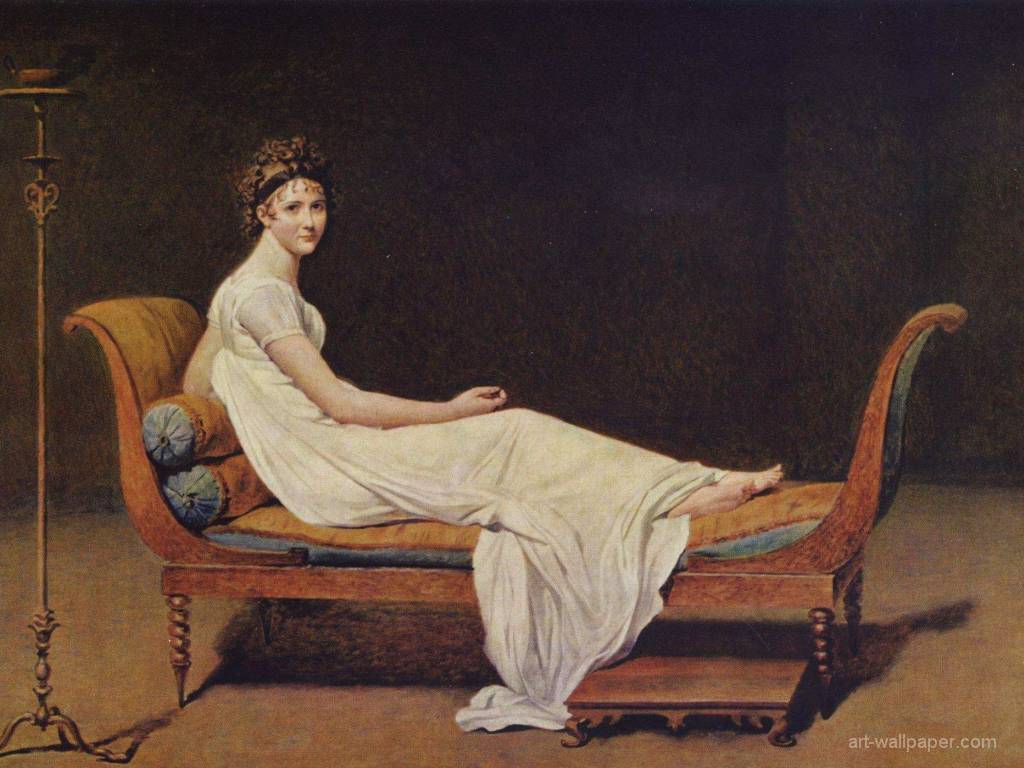
    (This Perspective is from a short series done by Magritte which replaced the subject of a great painting with a coffin.  Another example is Jacques-Louis David’s Madame Recamier and Magritte’s answer.  David’s painting may have been about as avant-garde as Magritte’s, given the time and expectations of artists.)
    Magritte david 
    David's Madame best
         

    Notes:
    From Columbia Encyclopedia online: “Magritte, René  1898–1967, Belgian surrealist painter. Strongly influenced by Chirico, Magritte developed a style in which a misleading sort of realism is combined with mocking irony. His paintings are dominated by an intense quietude and restraint, despite a startling juxtaposition of images. Characteristic works, such as The Red Model (1935; Modern Mus., Stockholm), contain elaborate fantasies constructed around commonplace situations.”


  • Ovaries and Ovens–a Chance Encounter in the History of the Subjugation of Women

    JF Ptak Science Books   Post 1109

    A friend of mine started her facebook post writing “Ovary shipped out…”, a great piece of found story-beginnings, a great opening line, especially when ovariotomically removed from the rest of the sentence.  Alex is an artist and medical/anatomical illustrator by trade, so I knew what she meant–but forgetting that made the segment even more lovely. 
    Ovary homunuclus 1
    Aside from the fiction that the three words created and the half-word that I created/butchered, I wondered about when ovaries were first surgically removed, and then about how the ovary was seen (almost forever) as the home and birthing place of the fully-formed human delivered to it by men in the act of ya’ know.  Ovarian surgery really didn’t exist until the early 19th century, when it was practiced with great success (especially for its time1) by Ephraim McDowell (1771-1830), in 1809 in Virginia–and it was also about the first great American contribution to gynaecology as well  His first patient (“Mrs. Crawford”) sang her way through an anaesthesia-less procedure, surviving her illness and the surgery at a time when non-amputational surgery was half-fatal.2 There were other, limited reports of this procedure, but for reasons not clear to me it didn’t really start appearing as a general procedural possibility until mid-century.  Anyway, before the 19th century, women with ovarian cysts were pretty much out of luck.       

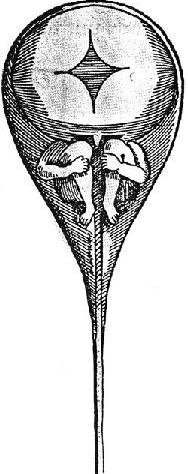
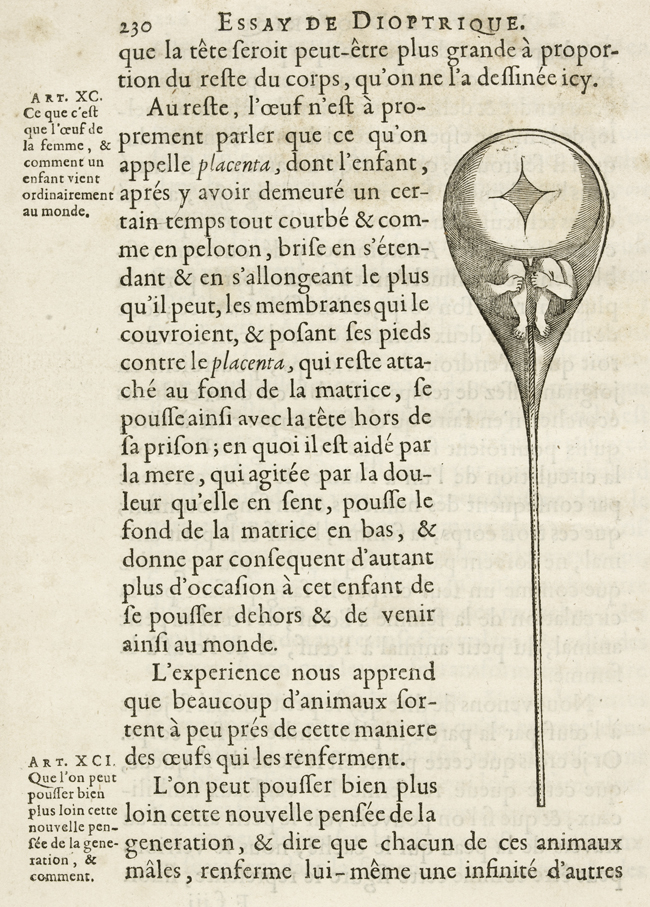
    But the issue of the ovaries as ovens–of homunuclus and palingenesis and epigenesis, the imaginary male-dominant anatomy of reproduction–was pretty much somewhat solved by the end of the 18th century.  Or at least the homunculus, the tiny but perfectly formed miniature human traveling along in sperm, was.  This character is pictured here, riding in the squinty-eyed imagination of researcher  Nicholas Hartsoeker3, who desperately wanted to see the thing, and which found itself published in his book Essai Dioptrique  in 1695. 

    The woman as a simple baker of a gift of preformed life was a medical belief that helped perpetuate the supposed inferiority of women, and that the woman’s part in the procreative process was a simple oven.  It was a difficult image/belief to resist, persisting well into the 19th century.  Anyway, this is where my thinking took me–to the anatomically-inspired subjugation of women–from Alex’s comment.
    Ovary Hartsoeker
    ____
    Notes

    1. This was still in the deep, dark time for hospitals and surgery, in general.  Remember that Joseph Lister was still a half-century in the future with his revolutionary surgical practices that were invaluable to the cause of successful surgery.  And hospitals in general were bad throughout Europe, though their story in England at this point was entirely different.  The Brits really took steps forward in the treatment of the sick, and especially in the treatment of the poor sick, thanks to being a little awash, splashing around in waves of money provided by their contributions to the industrial Revolution.  Funny how it takes major mounds of money-making to initiate good works like that, but, never mind the details–it was done, and hospitals in England during this period were comparative oases in regards to European/Continental hospitals. 

    ** McDowell’s first three cases were all successful , finally published in the Eclectic Repository for 1816.  This was the first real foray into this field by the pioneering American medical institutions; obstetrics and gynaecology before this, and particularly in the 18th century, was pretty much in the hands of the French (especially obstetrics) and the English, and to some degree the Italians (particularly with Mascagni, Santorini and Spallanzani).

    **This is probably unkind and not particularly true of Hartsoeker, who never said that he actually saw the little men of sperm, and had simply postulated them.  Maybe the squinty-eyed part was imbued in the minds of others, though it was Hartsoeker who drew the images of the homunucli to begin with.  I think that he should’ve rested in his better cups–he was a gifted mathematician and a particularly good microscopist and optical person, and probably should’ve restricted his published biological theories to his notes. 


  • History of Goodbye Series: the Latrine Sarcophagus and the Slave Hangman

    JF Ptak Science Books   Post 1101

    Hangman-games I’m not so sure that it was the cold that kept Mathieu Leveille  in hospital for all of those years–as bad as hospitals would’ve been in Quebec in 1730–but I would rather have been there than at his work.       

    Leveille (1709-1743) was a slave bought for 800 pounds by the French ministers in New France (Canada), brought to the cold north from Martinique to do the job that they could find no man to do.  Or no competent man.  The history of executioners in New France–nearly from the very beginning of hanging people there beginning in the very early 17th century1–reads like a bad Italian farce sounds, filled with nothing but drunkards and incompetents, brawlers, muggers, crooks and thieves.  And the condemned–there are several accounts of men awaiting execution who were spared because the executioner had died (some from drunkenness), and there was no one there to kill them.  And so to fill the gap, the authorities offered the condemned the chance to live if they lived so as executioners.  I haven’t read any accounts of anyone turning down the offer, but I wouldn’t be surprised if that were so.

    The executioner in that society for the 1600-1750 period or thereabouts was not happily assimilated into society.  They found themselves–and their families–pariahs, living on the outskirts, or beyond the literal confines, of the city.  They were the last step in their judicial system, the great threat, the punishment with hellfire link to fearful retribution, that no one wanted to live next door to. 

    In the decades preceding Leveille’s arrival, there was a succession of horrorshow stories of executioners of drunk and low orders, two  selected from the list of the condemned, including incompetent sons of incompetent and drunken hangman fathers, as well as periods ion which the office simply could not be filled.  One of the executioners in this long list of doomed men was a Halifax hangman named “Tomahawk”, whose own body, after death, was stolen, paraded, and then dumped into the latrine of the old blockhouse where he once worked.  According to Howard Engel, in his Lord High Executioner, an Unashamed Look at Hangman, Headsman, and their Kind (1996), Tomahawk’s “bones could be seen by curious townsfolk for the next seventy years”.  At least the latrine at that time had been abandoned.

    Leveille was the beyond-pre-Dickensian solution to the judicial managerial problems in Quebec, the bright idea in a feathered cap of Jean-Frédéric Phélypeaux, comte de Maurepas (1701 – 1781), an ascendant French statesman recovering from disgrace.  On the heals of their latest bungle–a drunk imported from France to replace a drunken dead hangman and who maintained his drunkenness and sent back to France drunk–the judicial establishment listened to de Maurepas’ suggestion, and bought and then imported a black slave from Martinique to do the job.

    And that’s when Leveille’s story–no matter how bad it was for him in Martinique–gets worse.  He arrived in Quebec in 1733, and was almost immediately sent to the Hotel-Dieu.  (As it turns out, this is the first hospital in North America north of Mexico). I don’t know if he was told what was in store for him, or what he knew of the job, or what he did in Martinique.  It is established though that Leveille was sick on and off for the next ten years, finally dying there in the hospital in 1743.  Engel correctly assumes (I assume) that Leveille probably performed his job adequately for the powers that be to have spent so much attention on him, trying to have him finally recover. They even purchased a bride for Leveille, but he died just as she arrived. 

    I could imagine wanting, or needing, to spend as much ill- and off-time as possible, even in the grips of an ancient hospital.  The memory of sea spray  hitting Leveille’s face on the trip north from the Caribbean must’ve seemed like needles.

    The slave bride to the dead hangman was renamed Angélique-Denise and sold on the heels of Leveille’s death in 1743.

    Notes:

    1.  There was evidently an earlier semi-recorded hanging of a 16 year old girl, convicted of petty theft and punished.


  • A History of Blank, Empty & Missing Things: Lost Astonishment of Astonishing Things, Part I–the Phonograph

    JF Ptak Science Books   Post 1100   [One in a series on the History of Blank and Missing Things]

    Most everything that was once revolutionary, or new, or innovative, comes to the point of being not so to most people, where the thing of marvel and wonder just becomes the thing of interest and then the thing and then, well, sort of no-thing.  The great object becomes a simple bridge to something else, whether it is to communicate massive amounts of information instantly or overcoming distance quickly or storing food for long periods of time or shaving nutmeg onto a dinner plate. 

    Astonishment phonograph248
    Astonishment wears quickly.  For example, the long line of vanished astonishment in communications shows how thin wonder becomes over the course of time, as communication is facilitated by a postal delivery system to a ground semaphore to an electric telegraph to the telephone to wireless radio to airmail to television to DARPAnet to email to texting to twitter.  The beginning of instantaneous, person-to-person communication is really only 134 years old (with Bell’s 1876 invention), and now we’re sitting in the middle of the possibility of the most fabulously instantaneous communication bog in the history of humanity, and its brilliant astonishment level has been worn to a dull copper tone. (I don’t necessarily mean “fabulous” in a good context, because all of this also presents the greatest assault on concentrated thought that has ever been known, but that’s another story.) Things just get taken for granted.  (This observation isn’t restricted to techno stuff–just ask any old person.)

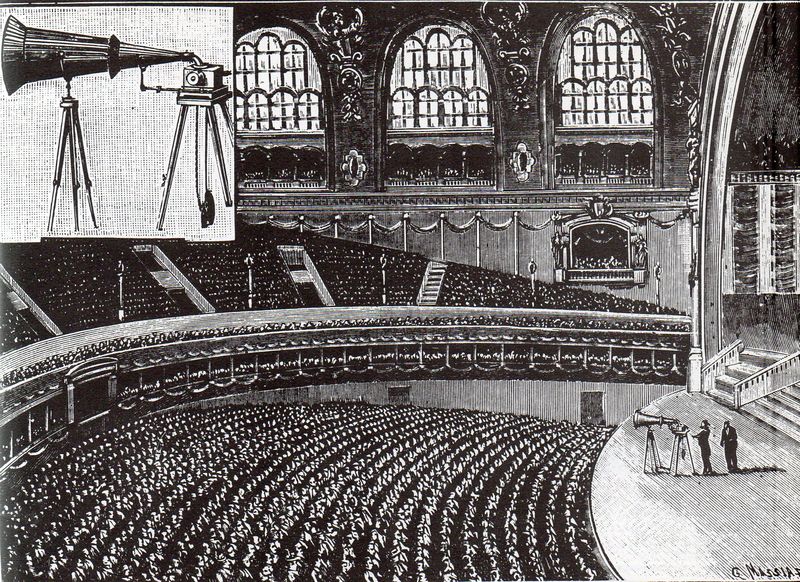
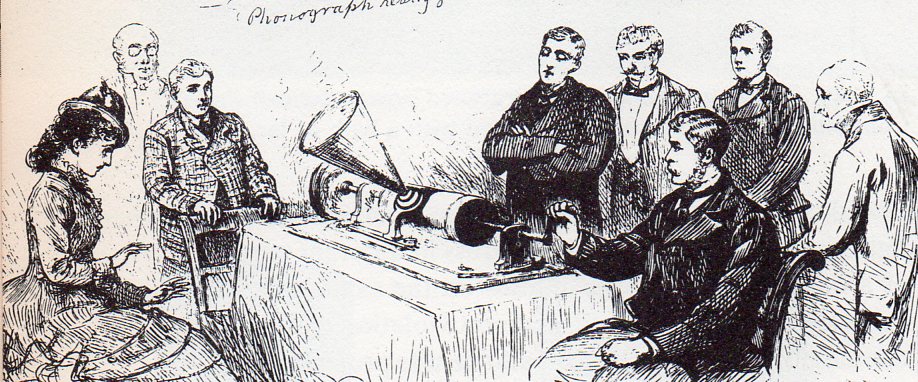
    This is an excellent image to remind us of the wonder and fascination of invention–especially for the things that we take for granted, the essentials of modern life.  This image from 1897 shows a very large audience gathered in the great Trocadero in Paris to listen to a demonstration of a phonograph.  Now the phonograph had already been reliably around since Edison’s introduction of his successful machine the year after the invention of the telephone in 1877 (though variations of the instrument had been around since the late 1850’s, though that is another story), so the general public was already well-familiar with the concept of captured sound replayed–then why such a big crowd in 1897? 

    I think the reason for the full house was partially for the fact that it was a home-town event for a national French figure–the machine was being demonstrated by Henri Jules Lioret, an inventor who for about two decades had been tinkering with improvement to the machine.  What the Trocadero crowd was listening to was the Lioretograph No. 3, a large, weight-driven phonograph with a big bellow–a machine powerful enough to be heard in a big hall, which was another point of fascination for the attraction of such a large crowd.  A  third possibility may have been with Lioret himself–perhaps the event was free, perhaps the inventor went out to fill the Trocadero via whatever means possible so that an engraving of the event would appear in newspapers and journals everywhere so that he could sell more machines.  

    The reason I mos enjoy and wish for though is that the people were simply fascinated with the bright new big machine, filling the famous musical hall with a big sound and doing it without an orchestra, or without one playing player for that matter. 

    It is also about the wonder of storing and replaying sound. 

    Loss of astonishment isn’t necessarily a complacency–perhaps it is just more of a forgetting, a loss of the stuff that has come before.  Maybe it is a function of time, or distance, between newness and necessity.

    If you can grow to feel the astonishment felt by this Trocadero audience for the phonograph, or for the astonishment in anything fantastic-if-old, then you get to see the components of today’s necessary stuff and see that it has a history and a full geology of an idea.  To me, being open to astonishment like this makes you susceptible to wonder, and from wonder comes curiosity, and from curiosity comes everything else worth thinking about. 

    Notes 1:

    Edison celebrates his phonograph in the North American Review
    (May 1878) and
    then lists what he saw as the readymade faits
    acomplis
    of the invention, the first of which was
    weirdly/spectacularly
    worded:  “1. The captivity of all manner
    of sound-waves heretofore designated as fugitive, and their permanent
    retention.”  Do you hear a soundtrack
    with that description?  I did.  He proceeded
    with less fanfare: “2. Their
    reproduction with all their original characteristics at will, without
    the
    presence or consent of the original source, and after the lapse of any
    period
    of time. 3. The transmission of such captive sounds through the ordinary
    channels of
    commercial intercourse and trade in material form, for purposes of
    communication
    or as merchantable goods. 4. Indefinite multiplication and preservation
    of
    such sounds, without regard to the existence or non-existence of the
    original source. 5. The
    captivation of sounds, with or without the knowledge or consent of the
    source
    of their origin.”


  • History of Sharing Music Without Musicians–Beginnings

    JF Ptak Science Books   Post 1098   [Part of a series on the History of Blank, Missing and Empty Things.]

    Music shared235

    This first image struck me as a sort of prototype for the shared-music experience that is common to youtube and a plethera of other online sites, showing  a humble beginning of sharing for a revolutionary idea and experience.  The idea of recording and playing back sound1, the idea of being able to save sound and listen to it later, was an astonishing realization and invention.  (There will be more on this in a post later today.)  And it struck me that being able to enjoy music without the necessity of having the musicians there to play it, live, uniquely, is a phenomenon that is recent in the history of listening to things, being less than 134 years old. 

    This is one of the earliest images of that shared experience:  the Edison phonograph, being played in company, ca. 1878. 

    Music shared 2236
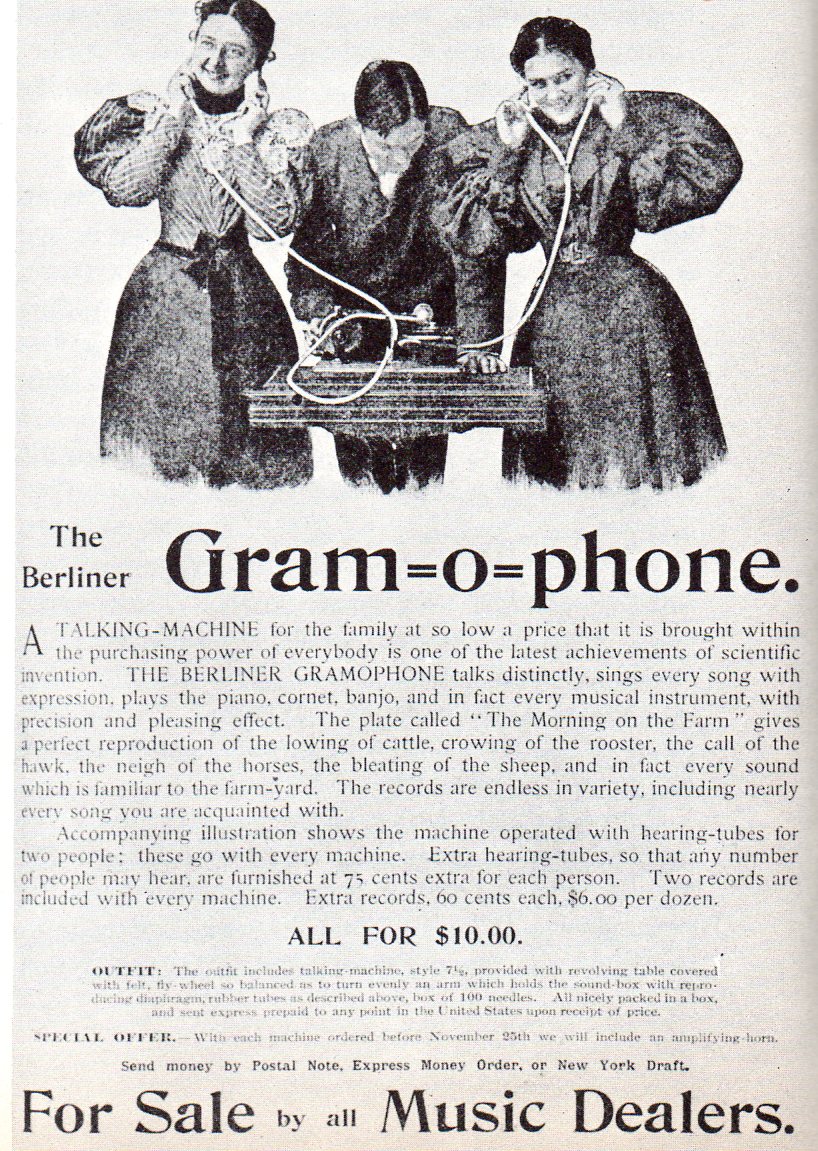
      The first image comes a little later, but I like it so because of the
    headsets–it resonates the separate/shared experience a little better.

    Notes:

    1.  The earliest “phonograph” was one which successfully recorded sound but could not play the sound back.  Or at least until recently, when these 150-year-old recordings were played back for the first time. This was the work of Edouard-Leon Scott de Martinville, (1817-1879), a French bookseller (!) who patented his phomautograph in 1857.

    These recordings can be heard HERE.


  • Picturing Almost-Nothingness–When Nothing Was Something

    JF Ptak Science Books  Post 1092

    The Great Nothing–a History of Blank, Empty and Missing Things #79

    Perhaps the biggest, blankest, most missing-est thing that we have presently is the universe, or rather the universe before the universe was created.  I can talk about the universe in that way because I’m talking about the one that is most classically conceived as such by much of the Western world:  a deep, multi-thousand-year-old belief that the universe came into being via the hand of a creator. 
    Mantegna--tarocchi_a

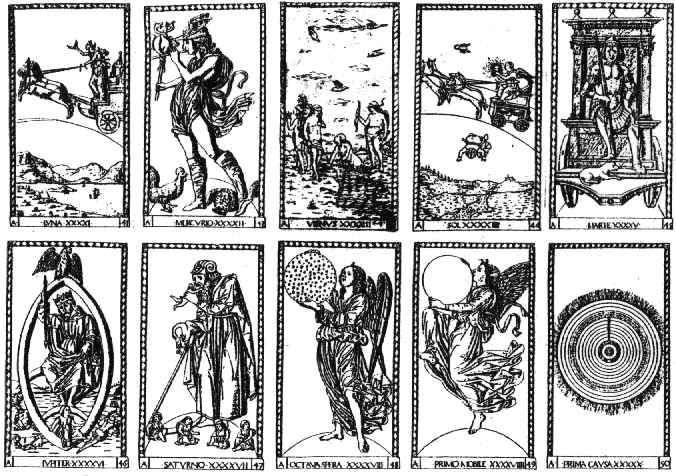
    The universe in question is the one in the hands of the Primum Mobile (pictured above, bottom row, fourth image), one of 50 images depicted in a series known as the Mantegna Tarocchi, drawn and engraved by artists unknown ca. 1465, though it was once believed to be the  work of the great master Andrea Mantegna (and later the possible work of Bacci Baldini).1


    Mantegna vacuum von guer
     From my reading of this image, the universe is held  in the hands of the primum mobile, a spherical container of not-quite-nothing, waiting for the creator to breathe life into it.  The possibility of absolutely nothing was seen as an impossibility, a perfect vacuum, a space of certain nothingness, was a violation of theological belief.  That the sphere existed was a proof that–in the 15th century–you simply couldn’t have a container of nothingness. The very presence of the sphere confirming that there was something being contained by it.

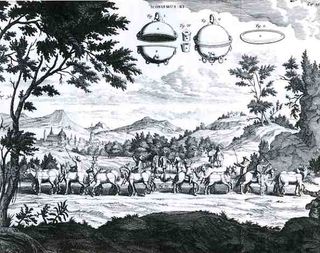
    As a matter of fact the issue of nothingness was very contentious, with the concept of its possibility and the display of a vacuum not achieved until 1672.  This beautiful illustration is from one of the greatest experimental physics books of the 17th century, coming as it does from Otto von Guericke’s  Experiemnta nova (ut vocantur) Magdeburgica de vacuo spatio (Amsterdam, 1672).  (In another minute department, this one is also I guess the greatest book ever written by a Mayor of anywhere (as von Guericke (1602-1886) was mayor of Magedeburg for 33 years).)  The image shows the greatest of von Guericke’s efforts, and one of the greatest (or most important) experiments in experimental science–the dramatic demonstration of the vacuum, showing here that teams of horses could not pull apart two halves of an evacuated sphere, and of course the efficacy of air pressure operating against it (um, the vacuum). The “floating” bits in the sky were an exploded view of the sphere that was the subject of the experiment. 
                   
    What was more important though, and what the general reader today might easily miss, was that von Guericke created something that many scientists and philosophers said didn’t, and couldn’t, exist:  the vacuum.  In modern times, Copernicus depicted the universe as a vast void; Descartes came in the back door (following the ancient and interesting though incorrect theory of Aristotle*), not liking the idea very much, and claiming that such empty space couldn’t exist.  Von Guericke provided the proof that the vacuum, that nothing, did exist.2

    Ultimately the Tarocchi was providing the Standard View of the creation, and did so before t he great assaults on the celestial kingdom got underway at the hands of Copernicus and Galileo, and of course many others–but that was all still 80 years away. 

    Notes: 
       
    1. The series as I said consists of 50 cards, all of which were teaching aids for the richer kids, dividing society, making a hierarchical display of the different levels of society. There were five series, each with ten engravings; the first series displayed the stages of social man,  beginning with the beggar and working through to the pope. [Series E* contained the Beggar, Servant (Fameio), Craftsman (Artixan), Merchant (Merchadante), Gentleman (Zintilomo), Knight (Chavalier), Doge (Doxe),King (Re), Emperor (Imperator) and finally ending with the Pope (Papa).] Series D displayed Apollo and the nine Muses; Series C was dedicated to philosophy and the sciences (showing the seven liberal arts plus astrology, philosophy and theology); Series B showed the seven virtues plus the Genius of the Sun, Time and World (Iliaco, Chronico and Cosmico, repectively).  Series A, composing the last 10 images (numbers 41-50) displayed the heavy hitters, the real weight: the Seven Spheres of the  solar system (the greatest part of the structure of the universe of te time) with the paths of the five planets plus the sun and moon, surrounded by the Octava Spera (the Eighth Sphere) and then by tghe Primum Mobile and Prima Causa (the last, card 50, being the god). 

    In the corners and bottom of the decorative borders is the classification system: the name and Roman numeral are first located along the bottom edge, with the group’s lettrer (E through A) and the group Arabic number located on the corners.

    2. Aristotle (384-322 BCE) theorized that as air became thinner objects moving through it would move faster, which is true; he further speculated that if there was no air at all, that if vacuums did exist, then objects would move infinitely fast, which he correctly assumed was not possible, and thus the vacuum could not exist.


  • Shadowlands in the History of Technology–the Sewing Machine, ca. 1838

    JF Ptak Science Books  Post 1088

    The anniversaries of two famous legal cases bumped me into thinking about the shadows of what things might be.  Aticus Finch (from To Kill a Mockingbird) and Thomas Scopes (of the “Scopes Trial”, the famous or infamous “Monkey Trial”) celebrated their 50th and 85th anniversaries (respectively) this past week.  Finch the lawyer lost his case, and Scopes, the defendant, lost his as well. 

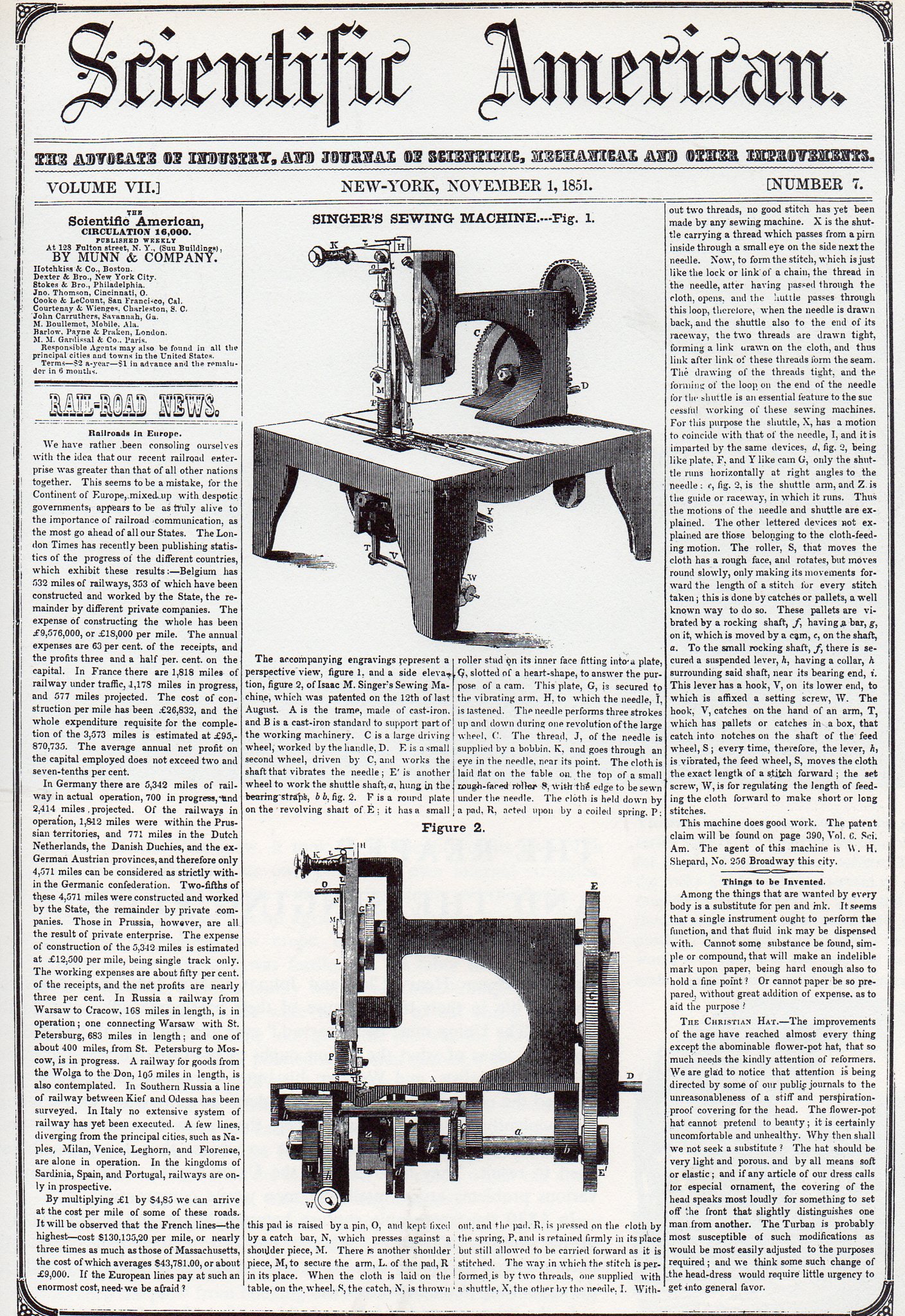
    This reminded me of the shadowland stories of roads not taken, or illustrious events whose outcomes didn’t quite coincide with the fame and interest of the way  things started out.One example from Shadowlands that springs to mind is that of the sewing machine, and the case of William Hunt.  Hunt was a remarkable person, an inventor of ingenious and remarkable things, some ubiquitous–and of these, one good example is the safety pin.  The “could’ve been” part was the sewing machine.  Eight years or so before the battle for precedence and patent began between Isaac Singer and Elias Howe began, Hunt had arrived at the principle solutions for an automatic sewing machine.  

    Sewing machine211 He decided not to seek a patent for the machine. Now, in and of itself, this is not terrifically uncommon in the history of invention.  As a matter of fact Thomas Jefferson, the inventor of the standard American moldboard plow (tinkering with it from the 1780s to the 18-teens), did not seek a patent for his invention. By 1814 he came closer to the iconic and revolutionary plow by producing his in iron.  The steel, self scouring plow would take another two decades to be introduced by John Deere. (Decades latter Abraham Lincoln would apply for and receive a patent for a boat/buoy lifting device, making him the only president to ever receive a patent.)

    The reason that Hunt didn’t pursue his sewing machine was based in deep morality–he chose not to patent the thing so that this new advancement in technology would not make seamstresses obsolete, pushing them out of work and costing them their jobs.  Of course the machine was introduced a few years later by Singer and Howe, and then the rest is history–just about every invention is going to annoy somebody.

    But the irony here is that even though Mr. Hunt chose the high road out of the sewing machine quagmire, saving the jobs of seamstresses for another few years, he didn’t have any moral hesitations about his next invention–an improvement to a steel-cased cartridge for rifles.  Evidently he was more comfortable with killing machines than he was with protecting the jobs of the working/suffering classes. 


  • History of Dots #29: Making Things Abstract and Concrete at the Same Time

    JF Ptak Science Books   Post 1078

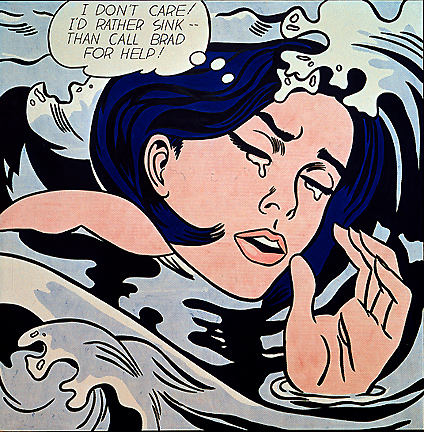
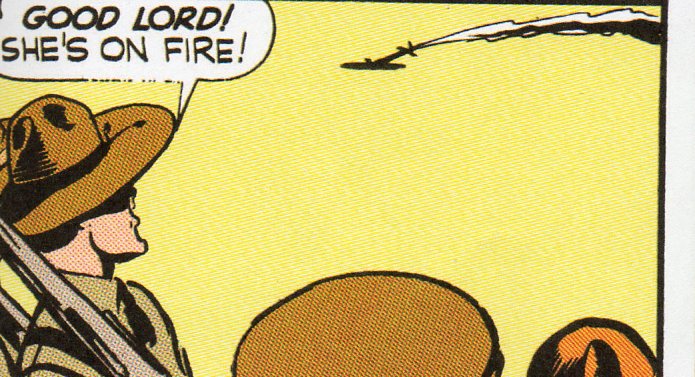
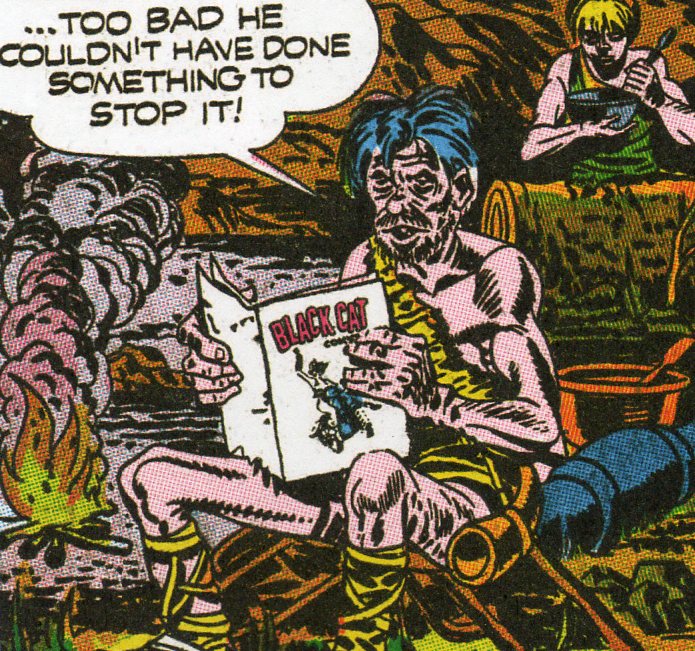
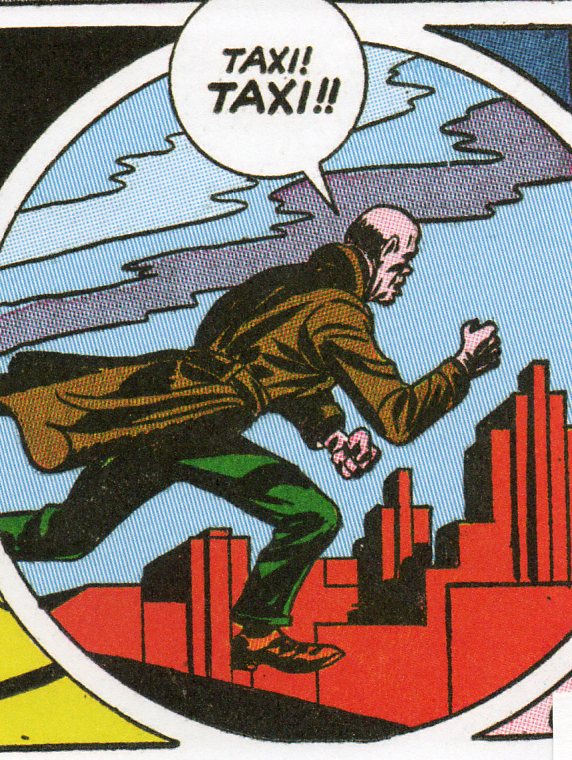
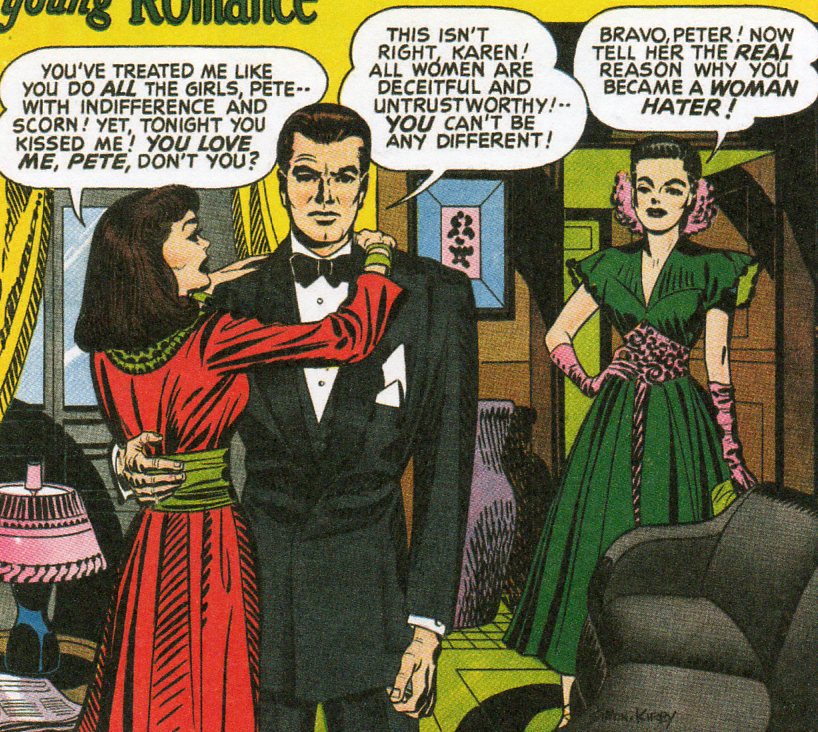
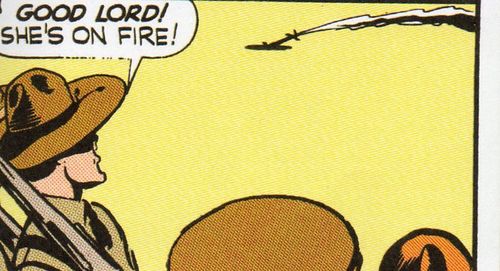
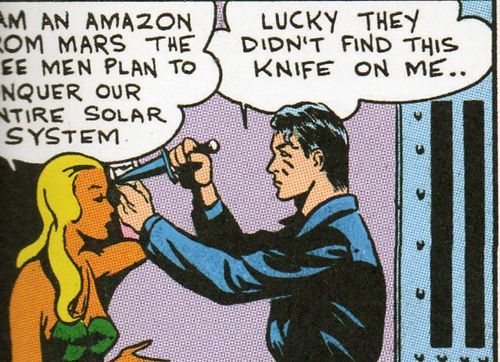
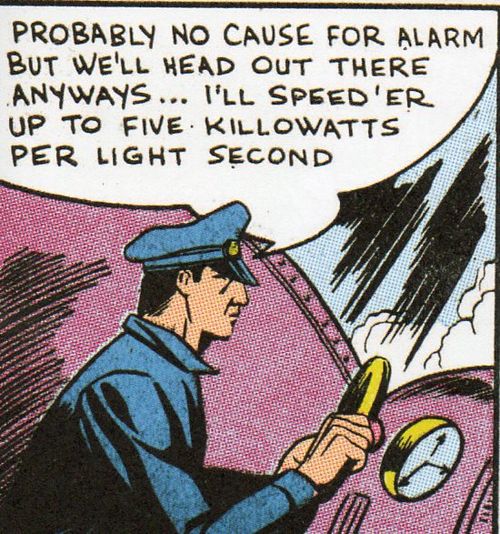
    [History of Dots series #29//Note: all images below except for Lichtenstein’s “Drowning Girl” are from Simon & Kirby comic books.]

    How are deep abstractions visualized?  Science and art were becoming
    more densely abstract at about the same time, the new modern age for
    both beginning 1905-19301 or thereabouts, when so many of the
    revolutionary advancements were made.

    Non sequitor193

     The representational world of art was slipping and disappearing (with the beginning of Cubism(s), Dadaism, De Stijl, Abstract and so on), replaced by forms and shades and colors, the subject of the art becoming less and less recognizable  as “things” until, finally, the recognition of the general stuff of nature (except for color) was gone.  Light, the interaction of molecules, the motion of atoms, were all becoming less comfortable as visual images and were being represented in terms of mathematics 

    How do we get to Roy Lichtenstein from here? I think that it is via abstraction and his connection to  the found non sequitor2 of the speech balloons in comic book images.  Lichtenstein’s style is very heavily derived from comic books and strips, except that he painted his images based on Ben-Day dots, strong lines and ultra-vibrant primary
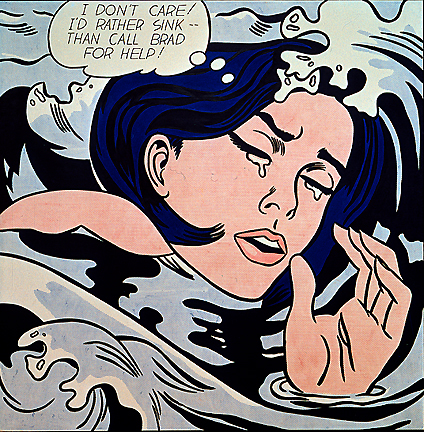
    Lichtenstein_drowning_girl colors of Golden Age era comics.  And I must say that his work–in images and in captions–seem much less non sequitor than the enormous amount of these things that you can pull out at random from the history of comic books–that is, one can still see where the frames that he was painting came from in the sequence of the comic book story.  It seems more interesting to me if the one frame being depicted could mean absolutely anything, and that the story line was completely obliterated, sop that this one frame out of context really had no context at all.

    Lichtenstein’s style came about around the time that he started teaching at Rutgers, and in short order–in less than five years–he had a solo show at Leo Castelli Gallery (1962). His work was instantly recognizable, a true Popular Art, almost everyone having some sense of recognition for the origin of his artwork.  Beyond that, and whether his art was seen as art, is another story3.
    Non sequitor191

    But what I’m trying to get at here is this: did  Roy Lichtenstein create a template of  an abstract dialogic equivalent in a concrete, non-abstract way of the non-representational creation of Kandinsky and Braque and Mondrian?  Are the Ben-day dots that are the foundations of Lichtenstein’s style–and the images that can be simply found in comics from the Golden Age–the very concrete bits that compose a very concrete, non-abstract image-with-text that is totally recognizable but without any apparent meaning?  Just decades after dots–the compositions that were normally used to visually introduce ideas in physics and astronomy and chemistry and biology–were abandoned as the visual signifiers of enigmatic and increasingly-abstract domains, they were adopted as the foundation stones for an art that moved in the opposite direction from abstraction, except that its message was anything if not abstract.    

    I think that it is in this way that images of Schroedinger’s cat should’ve been illustrated using the Ben-day dot method, plucked from the pages of a Golden Era comic, all basic red, yellow and black, the uncertain image never at rest, always with the possibility of being the same and not the same, its great and simple representation having not necessarily anything at all to do with its message, a concrete thing that is totally abstract.
    ____________

    Notes

    1. You could break this period out a bit, expanding it from, say the pre-Impressionists (1860 or so) to the period just after Abstract art and the introduction of the new quantum theory (again, say 1930). Epochal changes took place across the sciences, medicine, the arts, literature….virtually everything. I cannot think of any period in intellectual history that approaches this 70-year period. Actually, the gargantuan changes can be shaved down to the period of Einstein’s living memory beginning with the stunning discovery of Roentgen’s x-rays in 1895 to the invention of non-representational painting in 1911. But for the larger piece, the longer time reference, we have Roentgen, Poincare, Boltzmann, Planck,  Strindberg,  Schoenberg, Cezanne, Seurat, Picasso, Braque, Leger, Joyce, Woolf, Malevich, Duchamp,  Kandinsky, Klee, Bohr, Heisenberg, and. Einstein–to name just a few–of the folks making monumental changes in their field. 

    2. By “non sequitor” I simply mean to say that the image, or text, or both, when pulled out of context, when removed from the story line, are almost entirely without reference to what happened before the panel or what would happen next.

    3.  Maybe Lichtenstein is art, maybe not.  Another art, Art Spiegelman,  commented that “Lichtenstein did no more or less for comics than Andy Warhol did for soup”.  Maybe so. :ichtenstein did say this about his own art:”I think my work is different from comic strips- but I wouldn’t call it transformation; I don’t think that whatever is meant by it is important to art”.http://en.wikipedia.org/wiki/Roy_Lichtenstein#cite_note-rlf-Coplans-1

    This might all seem terribly wrong, and maybe–worse yet–it might seem like nothing at all.  Perhaps if it were nothing it would be more appropriate, in keeping with what Lichtenstein said about his own work, what seems to me to be an inscrutable nothingness: “”The closer my work is to the original, the more threatening and critical the content. However, my work is entirely transformed in that my purpose and perception are entirely different. I think my paintings are critically transformed, but it would be difficult to prove it by any rational line of argument”.
    Non sequitor192 


    Non sequitor194
    Non sequitor195

    Non sequitor196

    Non sequitor197 Non sequitor198


  • A History of Blank, Empty & Missing Things: Lipless Kissing in the Golden Age of Comics

    JF Ptak Science Books   Post 1077

    [A History of Blank, Empty & Missing Things, #78]

    Kiss 185
    The indefatigable team of Joe Simon and Jack Kirby (Joseph H. Simon, born 1913 and still going and Jacob Kurtzberg,1917-1994, respectively) produced some of the enduring heroes and ideas of the Golden Age of Comics. In capacities as comic book writers, artists, editors and publishers they knocked the bottom out of the creativity bin, affecting all manner and aspects of that industry, as well as  introducing the genres of horror and modern romance comics.

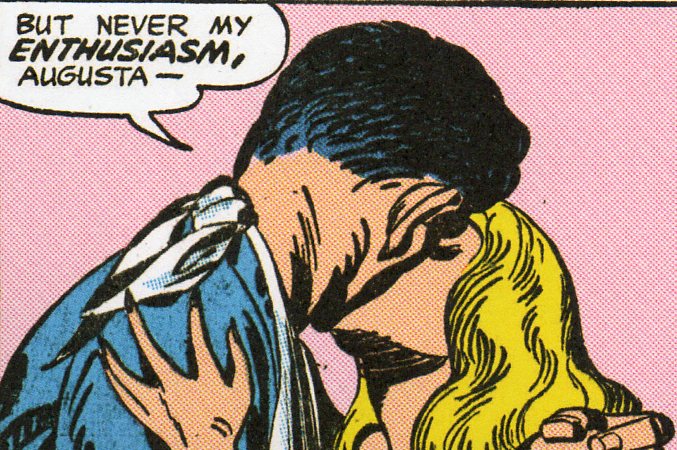
    And as necessary as it is scary, the nearly unrecognizable forensic pathology of the kiss in pink (above):

    Kiss--pink kiss det

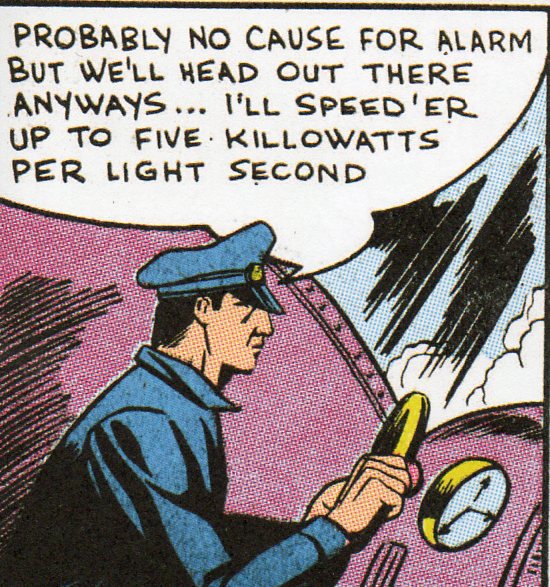
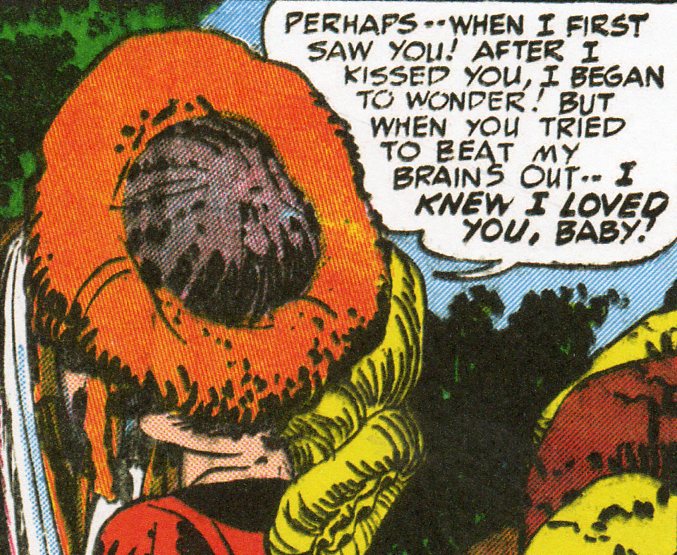
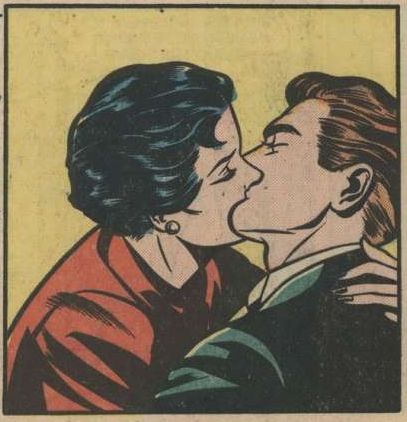
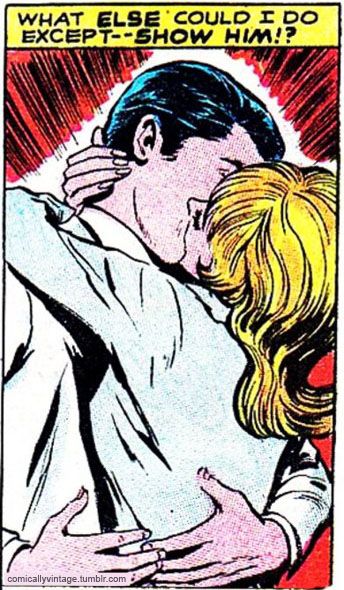
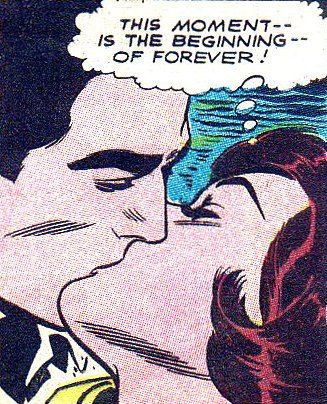
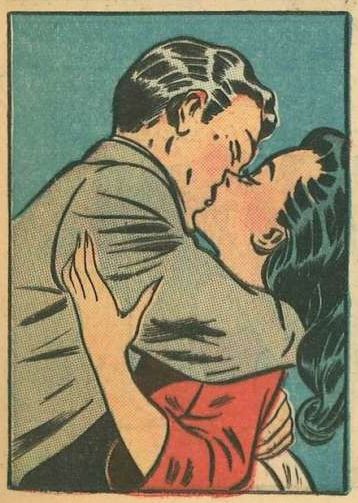
    I was initially drawn to their harsh colors,  blocky characters and un-magnificent dialog looking for wonderbits of non sequitor images and thought/word balloons populated with broken english.  They’re marvelous and easy to find, though I did get distracted by the unexpected part that I’m posting about right now–the missing, blank kiss.  Since they started the romance comics angles there’s plenty of 1940’s kisses to be found, but what I found was that although the kissing aspect wasn’t missing, the act of kissing was.  There’s plenty of heads smashed together that don’t leave a lot of room for faces, and in general it might be the sensitivities of the Golden Age’s age that cast away the kiss itself, their characters rushing face first into bad screen kisses. 

    Kiss 186

    There’s nothing wrong with this, and perhaps the kids never really noticed this, rushing to get ahead to the end of the confusing romantic interests.

    Kiss 187


    Kissing--comic book kiss

    Kissing--what else could I do

    Kissing--begining of forever

    There is a hint of a lip in this one, below, though it wasn’t supposed to be a passionate cheek kiss.

    Kissing in teal

    This one has more to do with anti-kissing than anything else; I’m sorry that I don’t know what the “real reason” was….

    Kiss 189
      

  • Power of Words: On Naming Women

    JF Ptak Science Books   Post 1066

    In the river of names, of all things, babies and wives are given their’s by fathers and husbands–and the wives are solitary cases of having a name already given them taken away to take the husband’s.   In the early- and mid-twentieth century and before, women leaving their parent’s home with a husband followed the custom of leaving at least half of their social identity behind, and in many cases, all of their name disappeared as they became “Mrs. John F. Someone”, burying women further into unrecoverable social and legal anonymity.   In earlier times this burial was literal–if you take a walk in a mid-19th century cemetery (and earlier) you will see some amount of smaller headstone(s) next to a larger simply reading “His Wife, Elizabeth” and some simply, in high tragedy, “His Wife”.  Like burying property, the woman in death remains an asset.  

    Having a woman follow a custom of taking her husband’s name in marriage is an old practice in the United States, and a successful one (for centuries) of helping to keep woman as a subjugated class, and for at least maintaining a control of sorts on women’s individuality.

    And so far as I know this practice was a custom–I’m not aware of any state laws requiring a wife to take her husband’s name. (Just in a way as “the Pirate’s Code”, as Capt Jack Sparrow pointed out, “was more a guideline than a set of rules”.)  This was one of the great unspoken non-issues of the suffragist movement in the 19th century.  I think that the idea was too dicey and radical even for the far-liberals.  But not all:  Lucy Stone kept her name in marriage, and Elizabeth Cady Stanton so elegantly wrote about in the radical feminist magazine The Revolution in 1869 (see below).   But there were few others–the convention was perhaps too difficult and deep to deal with at the same time as  addressing the less-problematic issue of women voting.  The issue was left to the late 20th century top begin to deal with in any real way. 

    So the control of an entire class of people is aided by the power of words–or a word, the husband’s name.  This sort of control happens all of the time, at every level, every day.   Take “spill” for example.  There’s nothing that I can think of in English that is suitable to describe exactly what continues to happen with every passing second with the BP Gulf Coast event horizon debacle.  I am certain that BP is relieved that we don’t have twelves different classifications for the idea of “spill” as, say, a language for a culture which lives in perpetual snow conditions would have  twenty words for different types of snow.  No matter how much someone tries to explain what 100,000,000 gallons of oil looks like, calling it a “spill” in every breath lessens the impact of the event and the data. 

    If you call something by a name right or wrong enough times, that is  what it becomes.  This is a standard advertising ploy, as the great American psychologist and inventor of behaviorism John B. Watson more or less discovered when he began work with the J. Walter Thompson agency–it didn’t matter what the cigarette tasted like (hot toxic smoke and fumes from a burning plant inhaled into the lungs), so long as people remembered that they were told it was”good”. 

    This is also the way stereotyping functions, as well as the Big Lie.  With women, the naming process helped to subvert an individuality that suffered terribly in the courts for some time–in addition to giving up her name, a married woman (in many states) gave up much else, including the right to own her own income, the right to contest a divorce, and the right to have any say in the disposition of her children in the case of a suit for divorce brought by the husband.  Naming things does have great power. 

    Notes:

    From Ann Russo and Cheris Kramarae, The Radical Women’s Press of the 1850’s (sometimes the desired quote doesn’t come up in this window; if you see just the cover of the book, advance to page 168 for the articles “Lucy Stone” and “Can a Married Woman Have a Name?“):