A Daily History of Holes, Dots, Lines, Science, History, Math, Physics, Art, the Unintentional Absurd, Architecture, Maps, Data Visualization, Blank and Missing Things, and so on. |1.6 million words, 7500 images, 4.9 million hits| Press & appearances in The Times, Le Figaro, Mensa, The Economist, The Guardian, Discovery News, Slate, Le Monde, Sci American Blogs, Le Pont, and many other places… 5000+ total posts since 2008.

Category: Blank and Empty Things; A History of

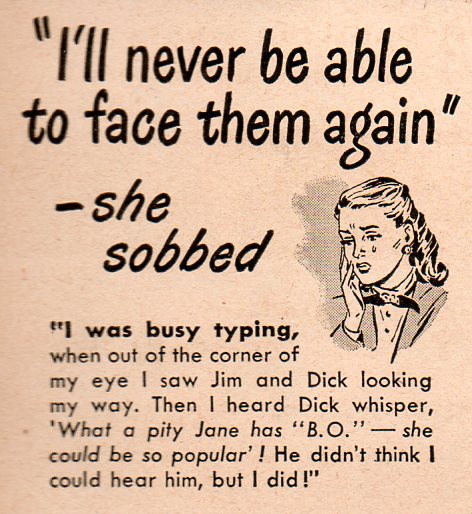
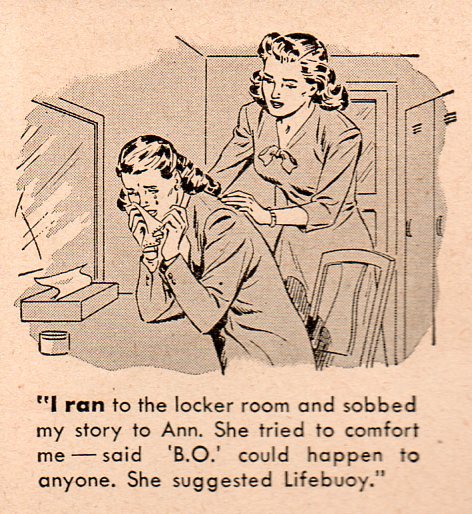
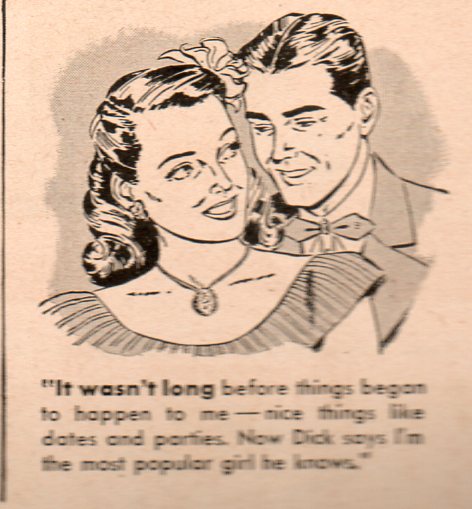
  • Found Comix: Female Trouble, 1947 (“When Tears of Shame Smell!”)

    JF Ptak Science Books Post 1062

    Female Trouble---Whispered BO 1b147

    I’ve posted a few found comix elsewhere on this blog (for example, this magnificent Italian contribution on surviving fire bombs, here), and I guess that I should have been paying more attention to these other bits of comix-driven advertisement marginalia that flits in and out of the pages of mass market weekly journals–they turn out to be pretty interesting and revealing entities.   In today’s case it is LIFE magazine for 9 June 1947, and if subtle, rueful self-awareness images like this were an automobile, this submission would be a jaguar.  It is the blatant story of a private and personal life ruined by whispers of BO, where a woman named Jane is paralyzed by the sly look and not-so-silent pronouncement of sniffy displeasure by a man named Dick.  The woman would scrub up and then somehow land that self-same Dick in the end with her newly perfumed Lifebuoy body, but only after filling bathtubs with her BO-laden tears.  But what a terrible story to tell about such a fragile existence extinguished, all to sell a bar of soap through a comic book tale on the edges of the back pages of a picture magazine.


    Female Trouble---Whispered BO 1146
    Female Trouble---Whispered BO 2148


    Female Trouble---Whispered BO 3149
    Female Trouble---Whispered BO 4150 

    Female Trouble---Whispered BO 5151
    Female Trouble---Whispered BO 5 b152


  • The Emptiness of Gun Porn: Burlesque Dancers as Game, 1947

    JF Ptak Science Books   Post 1051

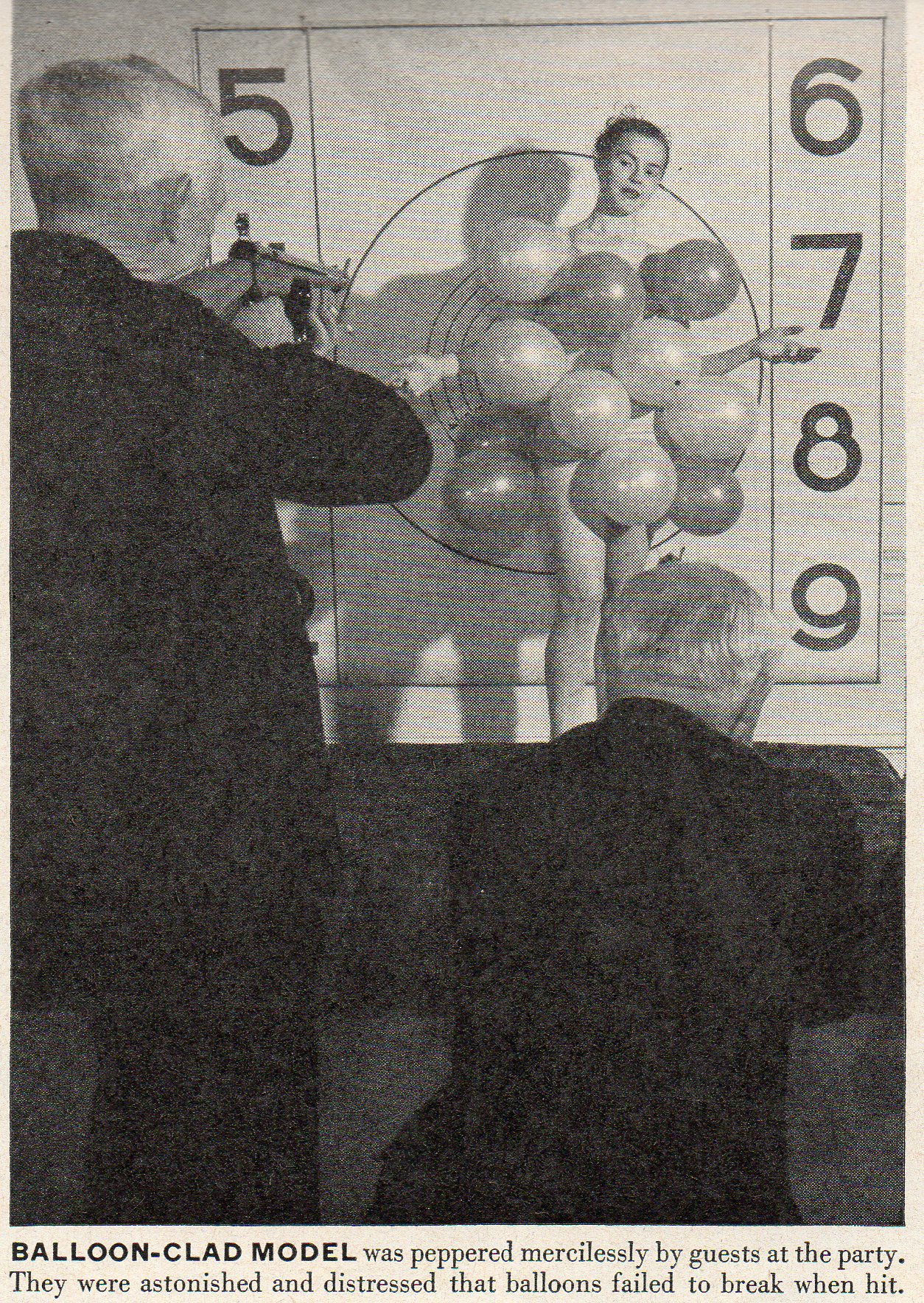
    It is unusual for me to find provocative photos that are more unusual in context rather than out.  But this is certainly the case here, with these photos of gun porn from Life magazine of 1947. This photo spread was meant to celebrate the launch of a “harmless” toy gun, the manufacturer demonstrating this point by having two dozen dinner quests shell dining room targets with imitation Tommy Gun-ish pellet guns. 
    00--shooting strip teas dinnere043

    Perhaps appropriate in more ways than one are these two older men shooting “ineffectually” at a model dressed in balloons–the point being to break the balloons to reveal her nakedness.  But the ejected pellets hit and dribble away, the rubber balloons remaining intact, with the foiled men left feeling “astonished and distressed”.  You can almost smell their impending failure in this picture (as well as the relief of the model).    
                                                   
    00--shooting strip tease042

    Then there’s the Holiness of the Gun moment, a father holding the toy gun in flattened palms., making himself a portable altar for his respectful sons, a deep reverence for the object present in the man’s face.     
     

    00--shooting strip holy grail044


  • Selling the Memory of Missing Things: Camel Cigarettes, 1947

    JF Ptak Science Books  Post 1041

    Here I think is another instance (following yesterday’s post on “The Ineffable Religiosity of American Meat Memory”) of tweeking the American consuming memory, an advertisement bringing out the recollection of past shortages to make the present consumer want the now-abundant item even more.  In this case that item is the cigarette–Camel cigarettes to be specific.  The ad correctly refers to the two-year-old memory of cig

    000 cigarettes013

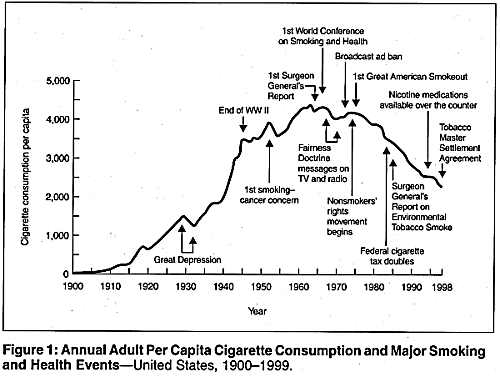
    shortage in the U.S.  Cigarettes became increasingly scarce during the war–soldiers were given smokes with their C-rations, exports increased, and so did general consumption.  At the beginning of 1940, 181 billion cigarettes were made in the U.S., with a per capita intake of 2,558 cigs a year; 1945 saw production spike to nearly double. By 1950, the production hit 370 billion, with the per capita use at 3,522 cigarettes a year, about a half-pack for everyone in the country.  In fact nearly half of the adult population smoked in 1950, making for more than a pack-a-day habit.  And it was Camels who lead the smokey way, comprising nearly 28% of all cigarette sales in the country (followed by Lucky Strikes and Chesterfields, their combined totals making another 42% of the market share).  In short, there were three giants who ruled the industry, and that for decades.  And before 1950, only 2% of all of those cigarettes had filters, so all of the harmful stuff got to the lungs cleanly.

    Back to the ad–I’m sure that these hatted folks weren’t smoking “whatever” they could get, especially with the cop standing at the front of the queue.  But in 1947 (the year this ad appeared in LIFE magazine advertising Camel cigarettes) the ciggie shortage experienced at the end of WWII was long dead and gone.  Camel just wanted to remind people of the craving for their missing cigarettes, especially the ones they enjoyed, and of course especially Camels.  The ad brought up the memory of smoking the off brands like Ramses and Pacayunes and how they tasted, and how “good” Camels were in comparison–and now one could buy Camels with reckless abandon, the freedom to consumer right to the edge of the grave. 

    The advertising message pricked the American memory of shortage; the U.K. on the other hand was experiencing the real thing, with massive amounts of shortages of nearly everything (from petrol to medicine to white linen), and queues and ration books were supplied to deal with the real problem.

    A “real” line in London, 1947, for food::

    000 winter-1948_798431c

    0000 cig consumption


  • The Ineffable Religiosity of American Meat Memory: PREM, 1947

    JF Ptak Science Books   Post 1040                                                 


    The category of the specialty meat, the meat that both is and isn’t meat, is one that holds a particularly high place in the religico-belief system of consumption in America—and particularly so in the historical American meat memory.  For it is here, in this very purply ad in LIFE magazine in July 1947 that we find a reminder for a meat product being sold as such, printed with the statement that the meat is being sold with meat in it, which is odd because it suggests the rejoinder that the opposite is true, too.

    000 meat prem014

    The ad is magnificent in its own special way, falling just short of  reading “Prem Meat: Now with MEAT!”.

    The adipose-y Prem meat-like clone sprung from the mind of Elmer Gantry-looking Joe Hormel,  who I wrote about earlier in this blog under the title “Spam, Smeat, Spic, Prem, Mor & Arf: Food by Any Other Name”.   Prem was a Spam-like product, a waste-meat issue of food that was packaged as a molded solution for the lower-middle-class American family.  The belief in Prem and such things as meatfood must’ve been strong; I doubt that anyone who had the remotest imagination would have thought of it as an adhered-jell byproduct which nearly ended its life on the slaughterhouse floor waste grate before it was thought of as something that could be scrubbed off the metal grid, loaded with other extreme leftovers, loved up with coloring, solidifiers, sugars, preservatives and flavorings and then sold as an ingestable commodity.  The romance of Prem is lost if you drain it of its belief system and expose it as the salvaged refuse bin
    material that it was. 

    000 meat red010

    As a 20-year vegetarian I’m strangely attracted to these ads, just as I would be any other piece of quackery from the sciences or medicine. These odd meat things were fortified with splashy store displays and crisp metal packaging.  It certainly looked okay in the pictures; could digestive goodness be far behind?

    The other bit that runs far and wide through LIFE that reminds Americans that the meat that they are eating is meat  , red meat, and the RED MEAT ads–these things are incredibly red, and big, and make quite the bloody splash considering that the ads were about 14 inches tall. 

    Anyway, reminding someone that they were eating more of their memory than the actual thing itself seems as though it would’ve opened more dangerous doors to unsavory discussions rather than closed them–but close them they did, as the new-old memories posted by these ads seem to have worked their sensate magics.


    000 meat red 2011


  • The Call for the Elimination and Destruction of the Beggar and Tramp Classes, 1926

    JF Ptak Science Books LLC  Post 1022

    The once-esteemed journal, The Eugenics Review (1909-1968, published in London by Macmillan & Co., with  Darwin’s son Leonard as it president and guided by a very well placed “consultative council”) is an issue-to-issue marvel of dead and repugnant ideas.  It seems more now an encyclopedia of The Great Ill Wind than anything else, and this of course ironically in spite of its own sterling pedigree.1


    Eugenics10b
    I occasionally pick up an issue an graze, and usually something strikes the sensibilities immediately.  Today it was the issue for April 1926, and the article “The Merxplas Beggar Colony”.  I had never heard of a “beggar colony” before this, today, and was surprised to learn that there were six of them in Belgium , one of which was Merx plas, with many of them established beginning in the 18th century.  Merx plas was a physical entity, a containment camp (or perhaps better a “concentration camp?”) where tramps/beggars/the habitually unemployed/thieves/pimps were sentenced to between two and seven years’ stay.  People went in, and they could not come out–so although not a prison, it seems more a communistic prison setting with an post-dated exit sign.

    The Eugenics Review took a quick view (in this four page article) of places like Merx plas Belgium) as social engineering tools, with heavy medical/biological/pathological metaphors.  The author, J.G. Pringle, quotes a “M. Le Jeune” who found the sound idea in his statement: “this (habitually unemployed) class could be eliminated by a process of segregation” leaving the real unemployed a chance to find work once removed from this “contagion”. Mr. Pringle agrees: “While segregated they would not reproduce either their species, their diseases, or their vices”.  

    Indeed.  Merx plas was also opened not only for these above-mentioned people, but was expanded to include “convicted epileptics, tuberculous persons and mentally deficient persons”.  He continues: “it would appear that this further classification of inmates will make possible the selection of individuals for whom any liberation whatsoever could be shown to be inadvisable”. 

    There were generally about 5,000 people at Merx plas–a quick look at  the stats reveals that at any given time 75% of the population had made at least one previous tour there; 25% had been there at least three times. I’m not so sure what that means in terms of anything save that the state prevented these guys from reproducing.

    In general Mr. Pringle likes what he sees and wants the communal work farms to be instituted in Great Britain.  He closes:  “The measure of success achieved at Merx plas in dealing with a type of parasite which is also a source of social contamination would form a happy precedent for a similar experiment in this country”.

    Such imaging of a class of people in terms of disease, contagion, social contamination and the “correcting” of their behavior in terms of “segregation”, virtual sterilization and “elimination” takes me immediately to the question:  what’s left?  Once they began to creep in TB persons and the “feeble-minded” and not let them out, how else best to deal with beggars and tramsp who continue to abuse the system, especially once you’ve already introduced the idea of these folks being disease/contagion and that their incarceration is a form of segregation and elimination?  I guess they could talk about not letting anyone out again, but, well, it sounds like Merx plas was already an economic drain and stain; how much could it support?  The math starts to look big and bad and bloody at this point. 

    In general though the road to a conclusion to these unhappy thoughts was sterilization (which I wrote about a little here and elsewhere on this blog)–but this is a story for another day.

    Notes

    1.  The eugenics people identified their intellectual foundations in the work of master multi-tasker and genius Sir Francis Galton, and had much help along the way with the likes of the superior R.A. Fisher, Charles Davenport, Henry F. Osborn, Bernhard Mallet, R.W. MacBride, Julian Huxley, W.P. Pycraft, Francis and Leonard Darwin, and many others.


  • Atomurbia: Responding to Atomic Threat by Moving Everyone Everywhere. 1946

    JF Ptak Science Books LLC  Post 1018

    “It is probably not worth putting (all) railways under ground.”  Ed Teller, 1947

    [See also our 50+-part Atomic & Nuclear Bomb series here]

    There is a universe of alternate universes constructed of nothing but the dim bits of bad thinking that is the very DNA of the history of bad ideas.  In those realms there are bad ideas that are bad, bad ideas that are toweringly bad, and bad ideas that are so bad that they’re not even bad as they transcend communication capacities of badness.  The idea I’m writing about today lives at that unspeakably-bad level.

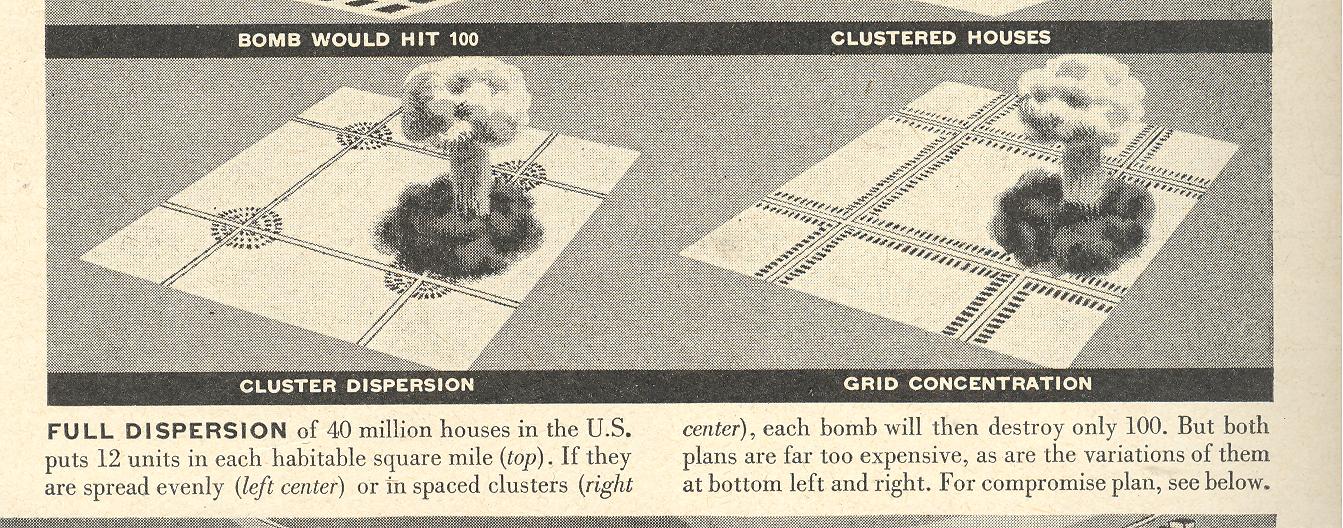
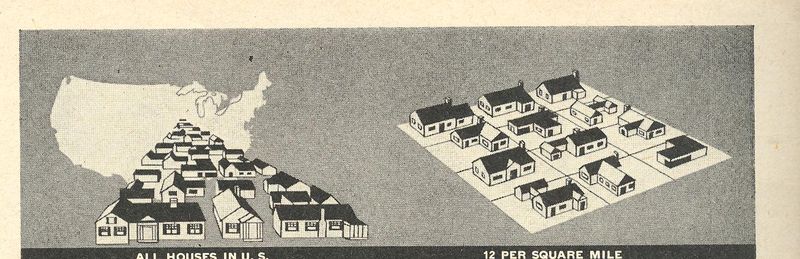
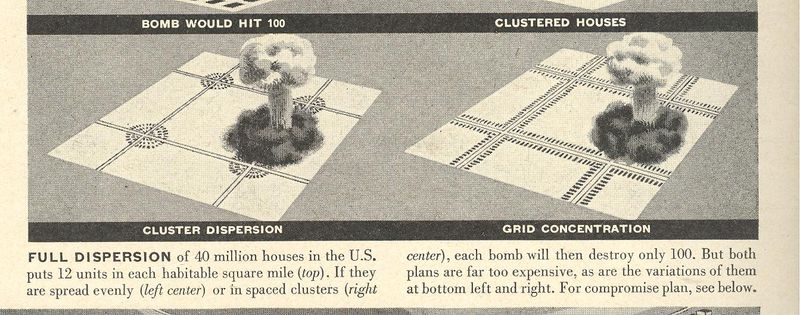
    And that bad idea is this: relocating and dispersing the entire population of the United States into a geometric grid-work covering all parts of the country, emptying all American cities into a vast nothingness of exurban Atomburbs. 
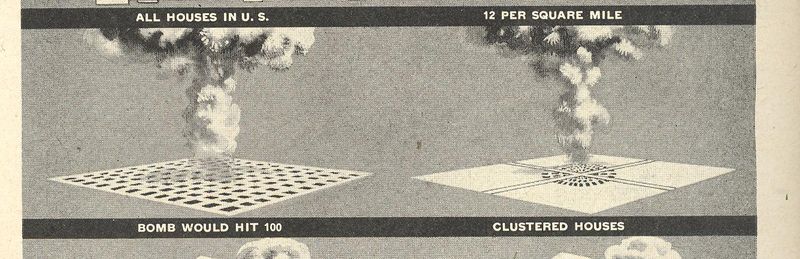
    1-may 3-atomic 2

    There.  I said it.  Unfortunately, the thoughtfully blank idea was “real” and  was worked out by three smart guys, the result published in the Bulletin of Atomic Scientists in 19461.  The kernel of the proposition was republished for the masses in LIFE magazine in (15 June) 1947, complete with maps which stand on their own as being spectacular and peculiar examples of visual propaganda.         

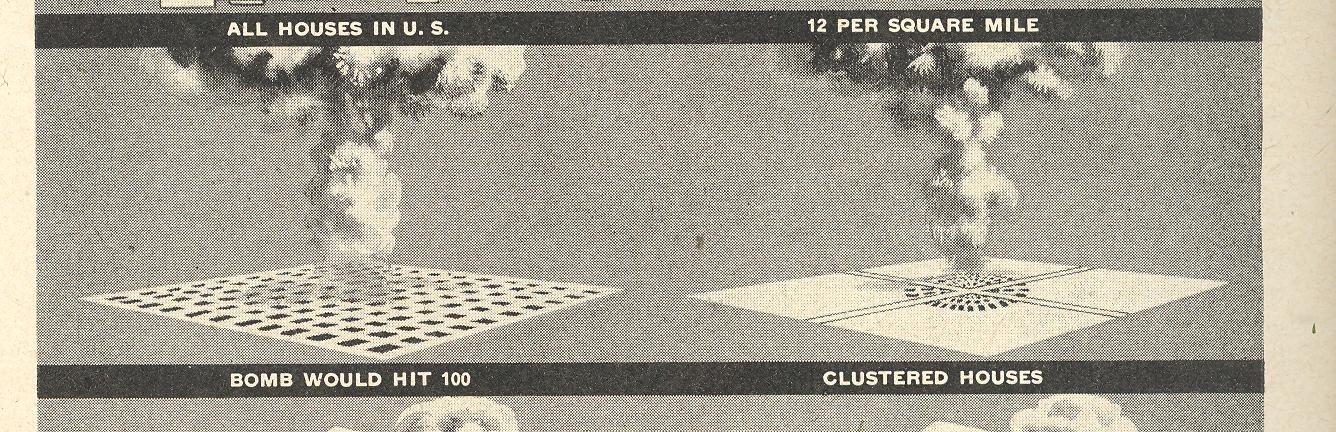
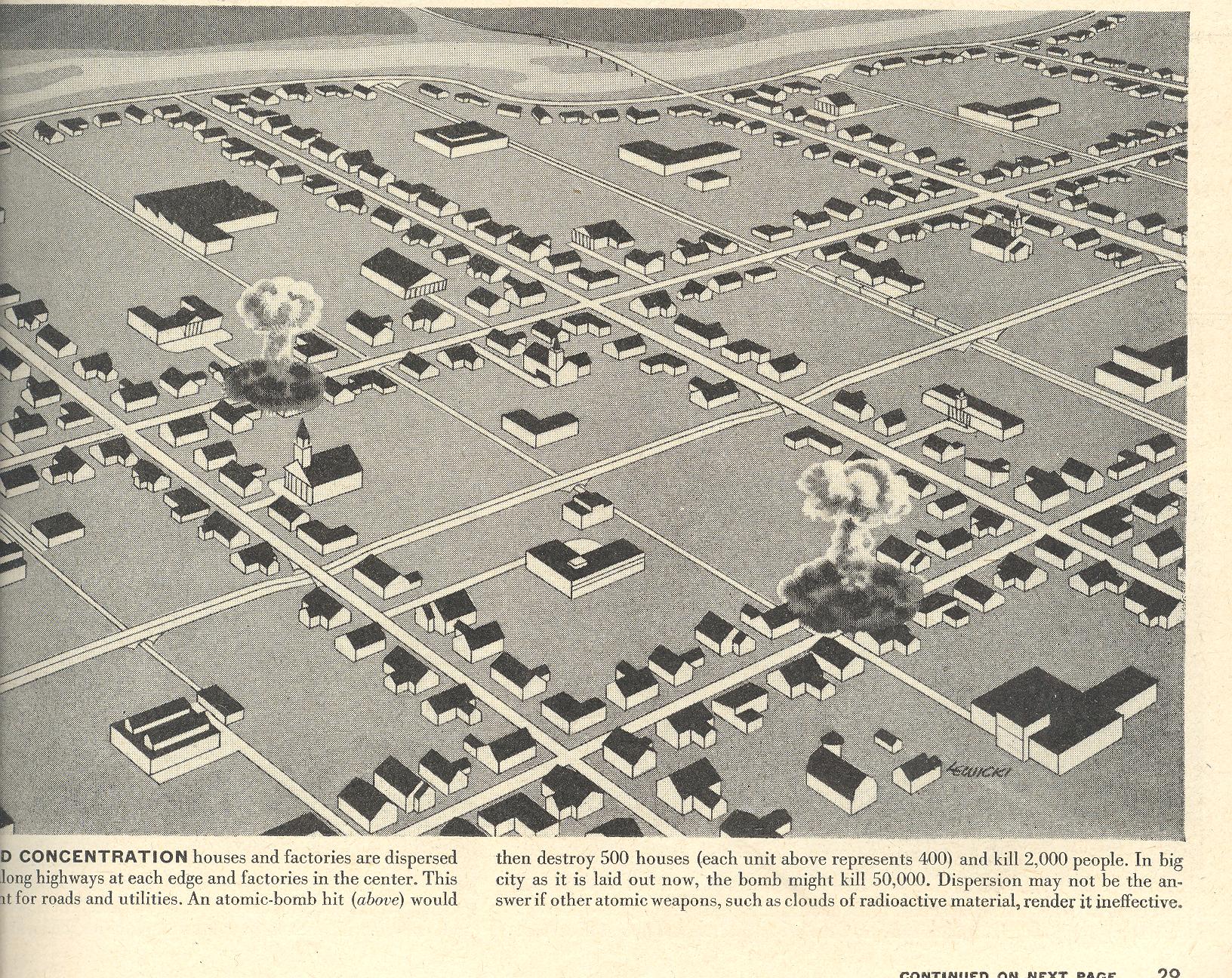
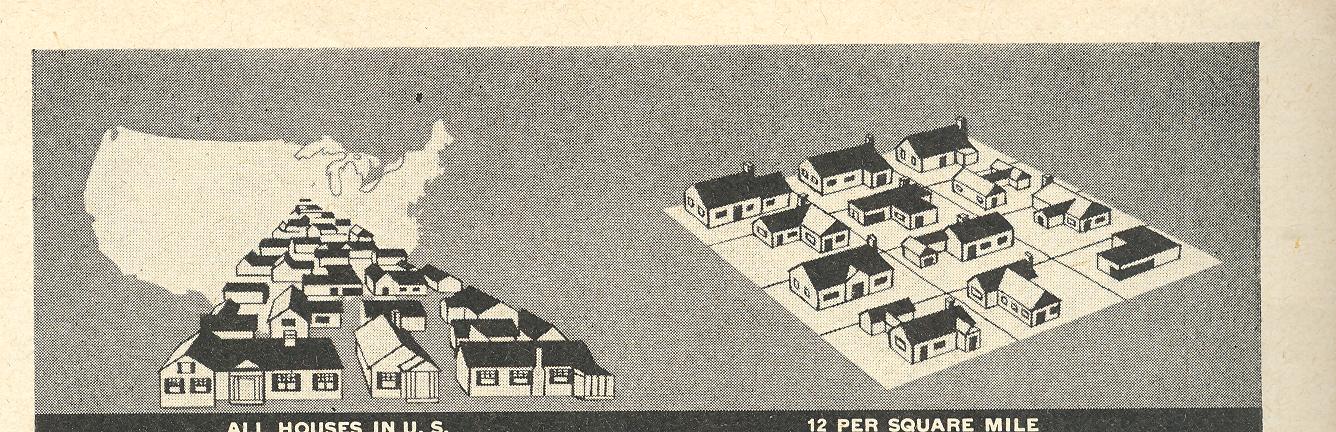
    Listen: the crux of the issue was to remove everyone from any American city with a population greater than 50,000 people and place them in newly-built communities set out across the country’s landscape (mostly) like a chess board, the towns existing on all of the connecting lines. [As weird as this sounds, the great Norbert Wiener came up with a similarly astounding, untouchable idea using circles.]. The authors proposed to build 20,000,000 new homes, relocate industry (preferably underground), reallocate and redistribute energy supplies and natural resources, and recreate the very fabric of social and economic life in America.  
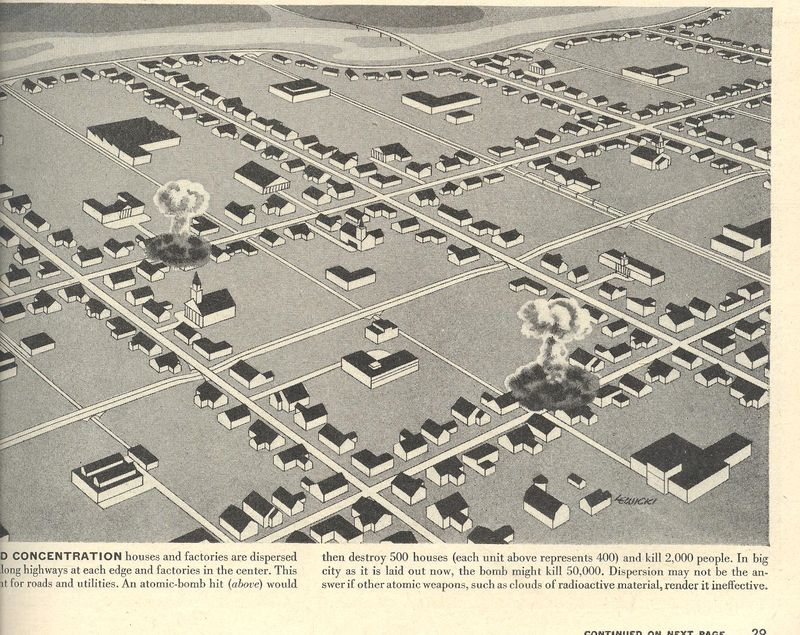
    1-may 3-atomic 4
    The governor of this thinking was the coming arms race and the American susceptibility to clouds laced with Soviet atomic weapons–and worse.[The calculations for destruction being used here were for the Hiroshima atomic bomb; in 1952 the U.S. would detonate the first hydrogen bomb, followed by the Soviets the next year.  These bombs would be measuring explosive force in terms of hundreds of thousands–and then dozens of millions–of pounds of explosives.]  How does this idea get thunk in a group and not abandoned?  And then how does it manage to be published by a a reputable organization?  These are smart men, these authors, and I just cannot think of how they could’ve come to these conclusions–though Teller, who was part of the genius flotilla of superb and essential Hungarian scientists, was undoubtedly mentally affected by his supernova hawkishness. I didn’t know this about Marshak, and I really am not very familiar with Klein.  They were all University of Chicago, and the Bulletin was originally published as the Bulletin of the Atomic Scientists of Chicago. 

    There are deeper, more disturbingly anti-spectacular ideas laced through the short article, some of which are so soaringly and diligently insane that it is difficult to address them.  For example, the authors suggest that the “ribbon cities” wouldn’t necessarily have to be “laid out in exactly straight lines” and that the lines could be adapted to the terrain.
    1-may 3-atomic 1

    Even though the authors propose moving and rehousing 20 million people (and so on), this was not what they really wanted to do.

    They wanted to put everything in lines and underground. 

    “We shall have to forgo elaborate schemes of underground cities” because of expense, they write.  And what of the cost, as long as we’re at it?  Somehow a figure of 200 billion is floated around–200b in 1947 dollars, which is 5 trillion in 2010 dollars (or so), which really doesn’t seem to be a figure that is in any way near to what an undertaking of this magnitude would cost.  (The odd thing about this figure is that $200 billion is about the same percentage for a single year of 1950 GDP as the $5 trillion is of the 2010 GDP.) [It seems unfair to take things out of context like this, but, well, it isn’t–the entire article is filled with almost nothing but these statements.  In a way I’m doing the authors a service by taking things out of context so that the entirety of their madness isn’t revealed as the ugly road-kill thinking it is.]

    Of course, g_d knows where all of this building material was going to come from.  Or the people who would actually do the work.  Were there 3 million construction/building folks in the 1950 census?  I don’t think so.

    And so in spite of the overwhelmingly underestimated cost, and the rerouting of the infrastructure of the entire country, and moving everyone in the country, and building 20 million houses, and finding the material to do so, and finding the workers to build them all and reconstruct all of the infrastructure and build all industry underground and have the tools to do it all with, the authors felt as though the whole thing could be pulled off in 10 years.

    Someone, somewhere, was certainly going to be working late.
    1-may 3-atomic 3

    And so the interesting part of this thought-tragedy for me is–what is the equivalent idea of this going on right now?  I know there is one, and there will be a new one tomorrow. 

    Notes
    1.. Jacob Marshak, Edward Teller, and Lawrence R. Klein. “Dispersal of Cities and Industries.” Bulletin of the Atomic Scientists 1, April 15, 1946, 13.

    See also:
    “Naked City.” Time. Nov. 28, 1949, 66. Also at.  Also see .The City Under the Bomb.. Time, Oct. 12, 1950

    Charles Grutzner. “City folks‘ fear of bombs aids boom in rural realty.. “ New York Times. August 27, 1950, 1.

    Michael Ray Fitzgerald.  Sitcoms and Suburbia. The Role of Network Television in the Deurbanization of the U.S., 1949-1991.
                   
    Molella, Arthur P. “The City as Communications Net: Norbert Wiener, the Atomic Bomb, and Urban Dispersal” Technology and Culture – Volume 45, Number 4, October 2004, pp. 764-777




  • A History of Blank & Empty Things #70: Thought and Fox-Tossing

    JF Ptak Science Books LLC  Post 1015

    1 april 27 fox tossing

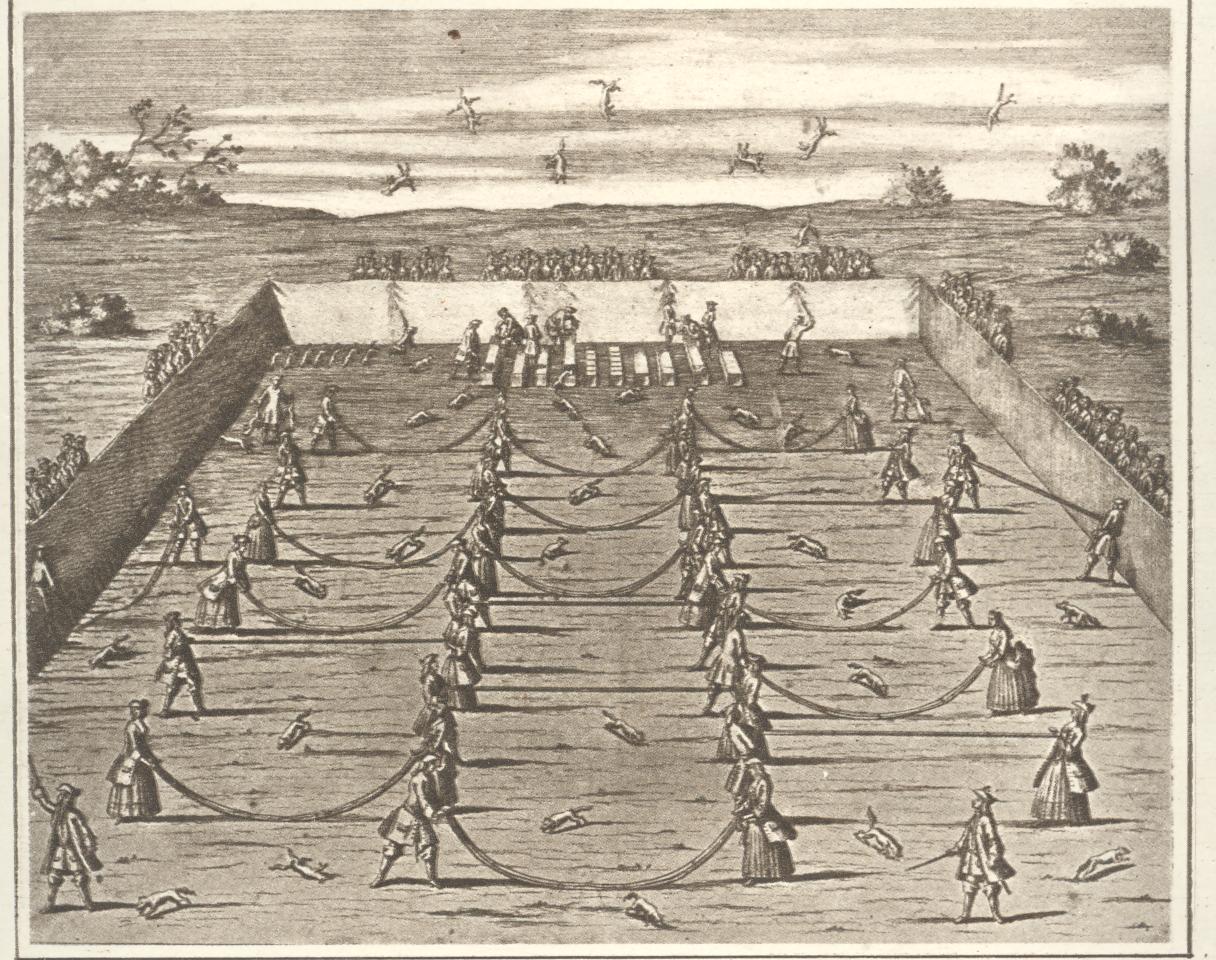
    In the ten-level history of blank thought none are more cardinally ninth-level than the abuse of animals–except of course the abuse of animals for sport. (As unspeakable as this is there is always another level of the truly unspeakable.)  In the early 17th century, at about the same time that the two Electors of Saxony were legendarily and grossly dispatching animals of all shapes and sizes (including 110,530 deer, 54,200 wild boar, 6,607 wolves, 477 bears and all manner of small “prey”) there existed a German Court sport of fox-tossing.

    What would happen is this: a coral would be made of cloth screens; court favorites would entire the enclosures with ropes while disabled foxes were also introduced; the people would pair up with a long rope between them, held slack t the ground; the animals would run in an enforced terror around and through the pairs and over the slack ropes; when the fox tried to run over the rope, the pair would yank the rope taught, launching the fox into the air.  And so on until everything was up in the air or dead.  And that’s it. 

    Fleming’s  Deutsche Jaeger  (published in 1719) produced this (above) image, and commented on it: “Skilled male tossers could toss a fox 24 ft. high…At a famous fox-tossing in Dresden there were tossed some 687 foxes, 533 hares, 34 badgers, 21 wild cats, and at the end 34 young wild boar and 3 wolves….”

    Oscar Wilde famously skewered fox hunting, which pales in comparison to this thing; I find it difficult to imagine what he might have said about fox tossing. 


  • The Fate of the Future & the Ironies of Artistic “Futurism”

    JF Ptak Science Books LLC   Post 1013

    “The oldest of us is thirty: so we have at least a decade for finishing our work. When we are forty, other younger and stronger men will probably throw us in the wastebasket like useless manuscripts—we want it to happen! They will come against us, our successors, will come from far away, from every quarter, dancing to the winged cadence of their first songs, flexing the hooked claws of predators, sniffing doglike at the academy doors the strong odor of our decaying minds, which will have already been promised to the literary catacombs.”–from the “Futurist Manifesto”, by F.T. Marinetti, 1909

    Mussolini
     

    They came for Mr. Marinetti a little earlier than that, and continued to come, though whoever it was that came couldn’t quite reach the founder of futurism, who seemed to be one invisible step ahead of oblivion.  Or perhaps it was behind?  I’m not sure.

    But futurism as a movement was more in the past than in the future, barely lasting long enough to have anything but a past.

    Not that the movement wasn’t important–it was, obviously–its importance branched out into other areas and movements, morphing into necessary branches, leaving behind a shell of the original tended by the originator.  (It can be argued that this movement helped create the environment for Dadaism and Cubism [or at least Cubist-futurism as in the Russian sense of that art].)  Marinetti had some unsavory and some jsut downright weird political and social ideas, having a long and vested interest in fascism.1  And not only the earliest part of Italian fascism –founded in 1919 with an interest in expanding the democratic process–but the later, Mussolini-controlled Italian fascism as well.  Marinetti sought the protection of Il Duce,2 and even so during the war, when he sought to protect his movement’s art from being designated as “degenerate ” and therefore unacceptable and existence-deniable by Adolf Hitler.

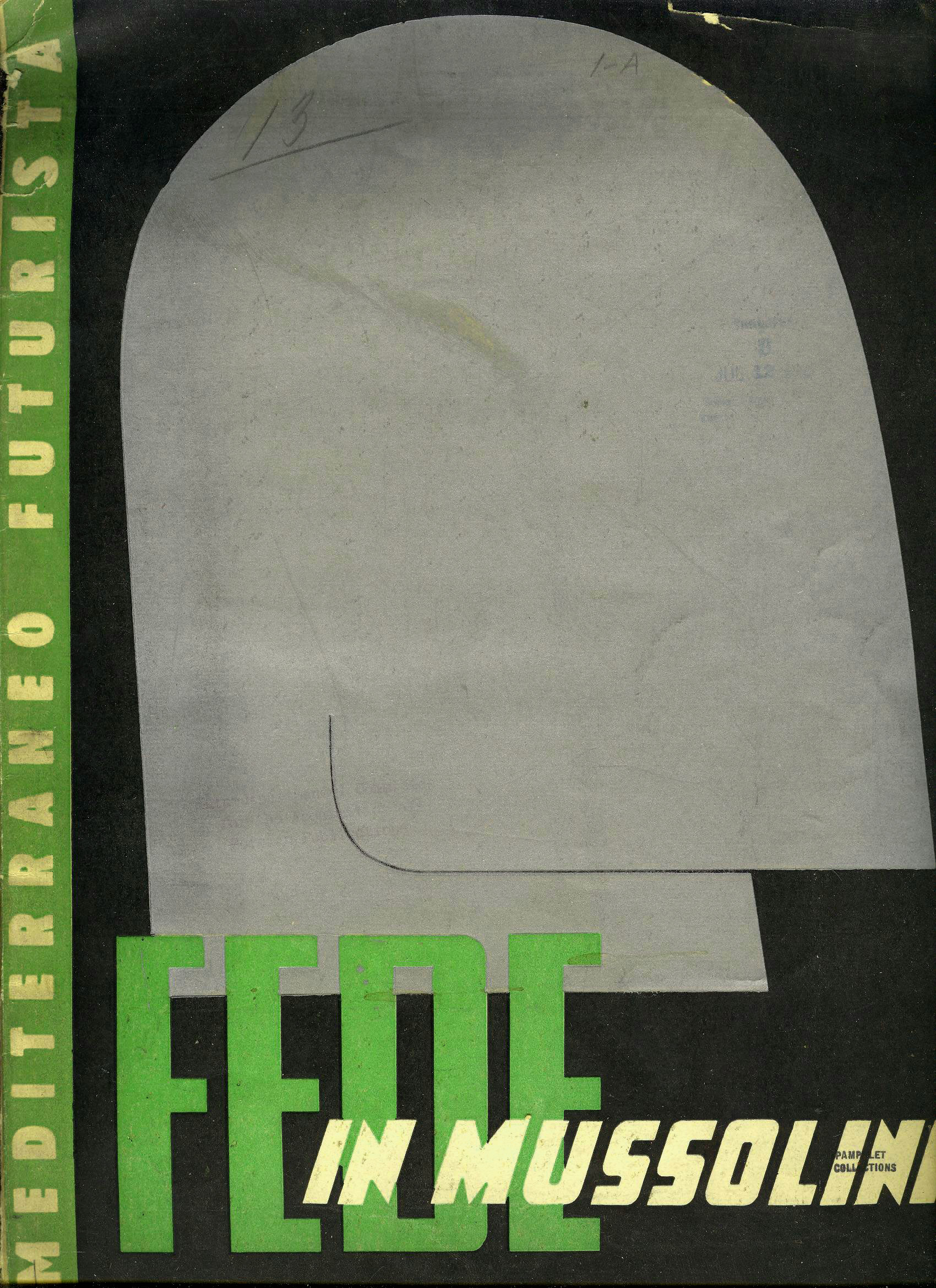
    This is the cover of a magazine edited by Marinetti and others, a hagiographic-porn hommage to the leader of the Italian fascist government, Benito Mussolini, featuring a very striking portrait of the leader on the cover. 

    And so the unlikely prolonged existence of futurism–a movement transformed far beyond itself in a matter of years, held together by pieces of fluff and dust, supported in its old age on the hopes of a noxious political system which was itself doomed to rapid failure.

    “At last they’ll find us—one winter’s night—in open country, beneath a sad roof drummed by a monotonous rain. They’ll see us crouched beside our trembling aeroplanes in the act of warming our hands at the poor little blaze that our books of today will give out when they take fire from the flight of our images.”  –F.T. Marinetti, from his “Futurist Manifesto”, 1909

    Notes

    1. Marinetti’s goal was to establish futurism as the official art movement of the government–something he specifically wrote against in earlier incarnations of himself.  He would come to loggerheads with much of his earlier social opinions, abandoning his beliefs in his never-ending quest to promote his movement.  I must say though that Marinetti did publicly speak against anti-Semitism.

    2. Marinetti sought to have the Nazi traveling exhibition of degenerate art–which included works by futurists–banned from Italy.  So even though the Nazi fascists established futurism as degenerate, Marinetti was able to enlist the aid of Mussolini to shield Italians from what the Nazis thought of the art.  But the futurist manifesto seemed comfortable with the while idea right from the start, as we can see in proposition #9 of its self-proclamation: “We will glorify war – the world’s only hygiene – militarism, the destructive gesture of freedom-bringers, beautiful ideas worth dying for and scorn of woman…”


  • Skeptical Inquirer, 1584–Magic and Superstition Revealed, Displayed, Explained and Killed

    JF Ptak Science Books LLC  Post 1011

    Reginald Scot, a wealthy and landed Brit from a good family of the 16th century,
    wrote a lovely proto-skeptical book revealing the so-called mysteries of people
    practicing witchcraft. Actually, there were all sorts of performance tricks and
    sleight-of-hand revealed in the book—cards, coins, spiritualism, juggling balls
    and such, as well as magic—and as such, in addition to the witchcraft part,
     was the first book in English to exhibit practical conjuring tricks, with all of their
    intricacies displayed.

    In short, Scot explained all sorts and manners of miracles, a 16th century
    James Randi.
    April 22 reginald scot

     
    Scot was an enlightened humanist and a judicious man. His interest in
    witchcraft
    ran contrary to the general contemporary belief that witches and
    diabolical possession and so on, was real—he
    chose to explain the end results
    of witchcraft via rational means, exposing the tricks of the trade.
    He also
    believed and tried to show that those accused of witchcraft were either engaged
     in l
    egerdemain or were mentally ill—but they were certainly not witches, as
    witches did not exist.


    I’ve reproduced seven of Scot’s explanations for miraculous tricks in part
    (A) below; part (B) contains
    just a couple of his card trick revelations. The
    whole book can be seen here

    (A) Demonstrations of Physical impossibilities all of which fake
    a great hurt.


    How to: (1) cut off your head and make yourself able to speak; (2) eat a knife
    and “fetch it out of any other place”; (3) stab yourself in the head with a knife
     without hurt; (4) put a piece of lead in your eye and take it out; (5) to cut your
    nose in half; (6) to put a ring through your eye; (7) stab and strangulate your
     bowels with a knife.


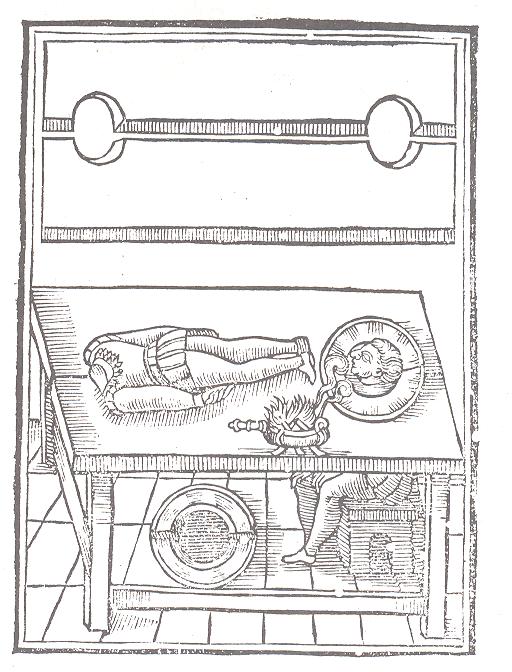
    (1) To cut off ones head, and to laie it in a platter,which the jugglers call the
    decollation of Johii Baptist,


    TO shew a most notable execution by this art, you must cause a boord, a cloth,
    and a platter to be purposelie made, and in each of them holes fit for a boies
    necke. The boord must be made of two planks, the longer and broader the
     better : there must be left within halfe a yard of the end of each planke halfe a
     hole ; so as both planks being thrust togither, there may remaine two holes,
    like to the holes in a paire of stocks : there must be made likewise a hole in
    the table- cloth or carpet. A platter also must be set directlie over or upon
     one of them, having a hole in the midle thereof, of the like quantitie, and also
    a peece cut out of the same, so big as his necke, through which his head may
    be conveied into the middest of the platter : and then sitting or kneeling under
    the boord, let the head onlie remaine upon the boord in the same.


  • History of Anticipation #2: Nothing. Moses and the Rock.

    JF Ptak Science Books

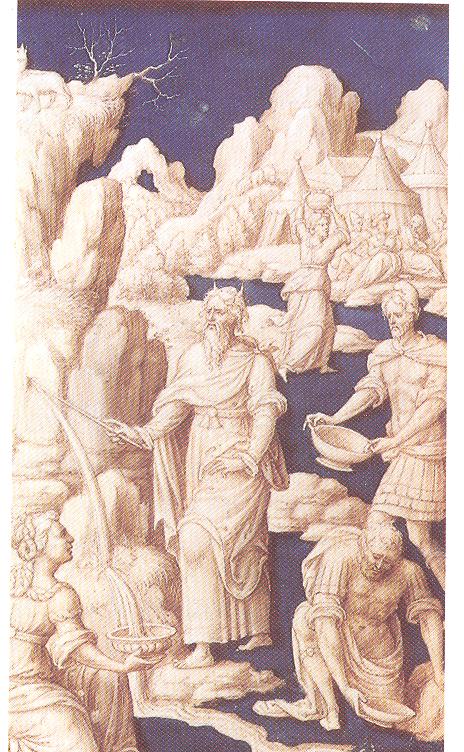
    During the Exodus Moses and the Israelites were often  in deep, mortal danger—perhaps none more
    dangerous as when they ran out of water. 
    Moses’ leadership (and safety) came under question (Exodus 17:4), with
    Moses crying out to the Creator that he needed help, and that his people were
    about ready to stone him.  The answer
    came quickly, with Moses directed to strike a rock with his staff, the
    resulting action bringing water/a stream from the rock (Exodus 17:5-6). 

     April 18 moses

    And that’s what is going on here in this little scene from a
    15th century (unfortunately unspecified) French Bible. The rare use
    of almost all white set against a blue background gives the whole a
    marble-like, lifeless effect—which seems to mirror the sense of nothingness in
    the Israelites reactions to the great miracle. 
    Their prayers were answered, but their anticipation of fulfillment and the
    act itself goes emotionally unregistered.

    Moses also looks removed, gently touching the rock with a
    rod which s very lightly controlled by a mostly-open hand—his bearing is one of
    great lightness. 

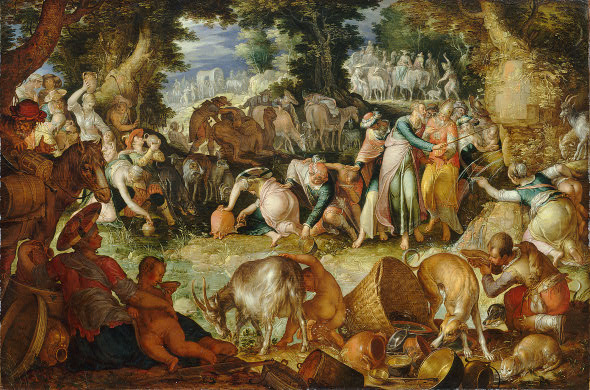
    This scene is often repeated and represented throughout the
    history of art, though usually with more (or actually, “some”) emotional
    quality.  When the scene is depicted with
    little emotion it seems usually to be a small piece of art, a touchstone,
    showing just the head of Moses/the rock/the staff, a bit of simple visual
    shorthand to remind eh viewer of the story (as in the work by Giotto in 1305).  Generally though the scene is shown in high
    drama, as with the work of Joachim Anthonisz Wtewael (1664), Abraham Blaemaert
    (1596), Nicolas Poussin (1649), and many others. Sometimes in some very early
    work the woodcutters show Moses wielding his staff over his head, getting ready
    it seems to crack the rock open. Bu not here, not in this image—the emotion of
    the scene has been literally whitewashed away…it is beautiful, but it is a cold
    beauty of nothing.

    (Wtewael, below).

    April 18 moses wtewael