A Daily History of Holes, Dots, Lines, Science, History, Math, Physics, Art, the Unintentional Absurd, Architecture, Maps, Data Visualization, Blank and Missing Things, and so on. |1.6 million words, 7500 images, 4.9 million hits| Press & appearances in The Times, Le Figaro, Mensa, The Economist, The Guardian, Discovery News, Slate, Le Monde, Sci American Blogs, Le Pont, and many other places… 5000+ total posts since 2008.

Category: Aviation & flight

  • George and Archie: Two Misty Names in Making Everything Into Nothing. Hiroshima, 1945.

    JF Ptak Science Books   Post  1523
    http://upload.wikimedia.org/wikipedia/commons/thumb/9/93/Tibbets-wave.jpg/300px-Tibbets-wave.jpg

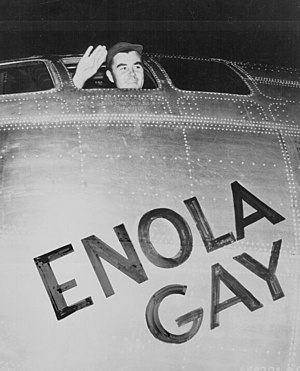
    The names of Col. Paul Tibbets and the Enola Gay are instantly recognizable, instantly placeable in the history of the twentieth century.  Fact is though that Tibbets didn’t pilot his (well, Capt. Robert A. Lewis’)1 B-29 all the way to Hiroshima and back, and wasn’t at the controls when the bomb was released.  Tibbets (also known as “Old Bull”) shared some of the tactically flawless mission with his co-pilot  Capt. Lewis, and also with George.  Well, its actually “George”,  the personified names for the autopilot of the aircraft, and I guess on the long road to splitting the atom it doesn’t matter much who did what at the final moments, especially if you were on the ground in Hiroshima. 

    It was Tibbets who flew the Enola Gay most of the way, through perfect skies, nothing to stand in the way of the aircraft and the completed mission–no Japanese fighter aircraft to haunt and hunt, and no anti-aircraft coming from the ground, at least not at their  low altitude.2 “George” was at the controls at 0815 on 6 August 1945–Tibbets would take control of the plane as the bomb fell away3, ripping the plane into a steep bank in trying to put as much distance between the aircraft and the bomb in the 43 or so seconds that they had before the explosion. Everything else about the bomb and the mission at the moment of release was controlled by a human–except for the flying of the aircraft. “

    “Archie”4 is the other name not so much remembered on this morning.  This was the name given to the apparatus (there were actually four of them on the bomb) that would initiate the final arming sequence for the MK1 bomb, “Little Boy”, one of a component of a fusing system that triggers the firing system.  It was a nicer handle I guess than its official name, which was AP-13.

    Notes:

    1.  Lewis was the original pilot of the aircraft until Tibbets was chosen to lead the mission against Hiroshima.  Tibbetts was named on 5 August and acted very quickly to get a painter to paint a name on the fuselage of B-29 82–so quickly that the guy who painted Tibbets’ mother’s name on the plane had to be pulled out of a baseball game to do the job.  When Lewis saw it, saw his plane with “Enola Gay” on it, he reacted badly, as he was mighty pissed.  He confronted Tibbets about it, but the Colonel informed the Captain that there was nothing to discuss. 

    2. Intelligence reported that the only antiaircraft resistance that could be expected were from heavier guns, which also happen to be very ineffective at the low altitude at which the Enola Gay flew.  This also benefited another aspect of the flight plan, which was fuel consumption–coming in low meant a big fuel savings, which in this case was very important because of the enormous load that the aircraft was hauling. 

    3. The Enola Gay would climb at last to 31,000 feet to release the bomb, which exploded at about 1980 feet above the ground. 

    4.  An interesting document from General Groves sums up the Archies nicely:  “Memorandum dated 24 August 1944 to Major General L. R. Groves from R. N. Brode, subject: Personnel with Radar Experience. According to the latter, the APS-13 was originally called the “Charlie” and those units to be adapted to atomic bombs were to be rigged to operate at selectable frequencies between 250 and 500 megahertz. By 1 January 1945, the “Archies,” with a “natural” range of 405 to 435 MHz, could be tuned between 325 and 485 MHz.  (“Interim Report Archie Frequency Range,” Lt. Leo Gross, 1 January 1945)–The History of U.S. Electronic Warfare, by Alfred Price, Association of Old Crows, Alexandria, Virginia, 1984, p. 232.”

    “By the spring of 1944, the APS-13 “tail warning device” was under study for use as a radar fuse. Originally designed to warn a pilot of another aircraft approaching the rear of his plane, the “Archie” had an effective range of about 2,000 to 2,500 feet.” Source: The Swords of Armageddon: U.S. Nuclear Weapons Development since 1945, Chuck Hansen, September 4, 1995, vol. VIII, pp. 3-45.

    And more:

    “Four “Archies” were used on each bomb, with a network of relays so that when any two of the units signaled, stored current was sent into the detonators (one on the MK I and 32 on the MK III). The antennas for the “Archies” were attached to the sides of the bomb casings.

    “A barometric pressure-sensing switch closed when the bomb passed 7,000 feet; the bombs were dropped from altitudes between 31,000 and 32,000 feet. A bank of clock-operated timer switches, started by arming wires pulled out when the bomb was dropped, closed 15 seconds after release to prevent the “Archies” from being triggered, in case of baroswitch short-circuit, by radar signals reflected from the delivery aircraft.

    “The arming and firing sequence for the first two atomic bombs was (1) 15 seconds after release, when the weapon had fallen 3,600 feet, the timer switches closed part of the firing circuit; (2) at an altitude of 7,000 feet, the barometric switch closed another part of the firing circuit and allowed electrical current from batteries in the bomb to charge a number of capacitors and turn on the radar fuses; (3) at an altitude of about 1,800 feet, radar signals emanating from the “Archies” and reflecting from the ground completed the last part of the firing circuit and triggered the detonation signal.”

  • The First Woman to Fly in an Airplane Was When?

    JF Ptak Science Books   Quick Post

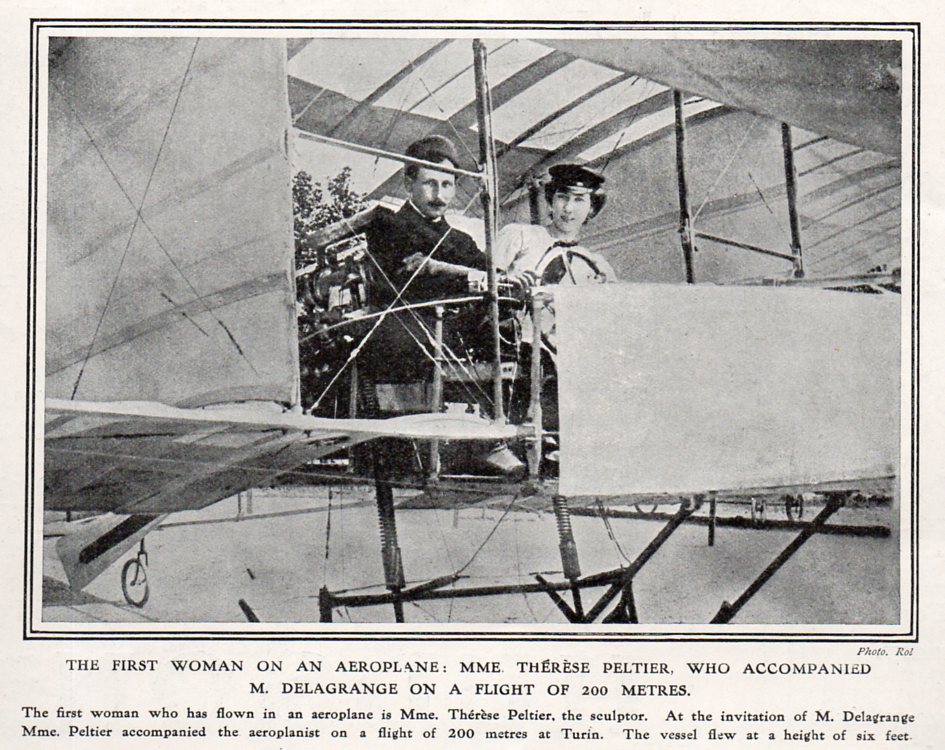
    I wondered about how long after the Wright’s first powered flight (17 December 1903) that it took for a woman fly in an airplane, either as passenger or pilot.  I was a little surprised–when I found my answer, my glasses weren’t quite up to seeing the date on the top of the page very clearly, and on closer inspection I was a little taken aback to see how wrong my assumption was.  It didn’t take five weeks or five months, but five years before this happened.

    Aviation--first woman502

    It seems as though this honor belongs to Therese Peltier, who on 8 July 1908 was a passenger in the aircraft of her significant other, Leon Delagrance, flying a distance of about 700 feet1.  An earlier great name for the history of women in aviation, E. Lillian Todd, was the first to design and build an airplane, though she was not able to fly the unflyable aircraft.  A half-dozen or so women aviators appear in 1909, and by 1910 the course for women in aviation expands dramatically. (An interesting chronology of “firsts” for women in aviation can be found here; another site, Women in Aviation Web Magazine, can be found here.)

    The image above, from the Illustrated London News for 25 July 1908 (the original issue of which is available at our blog bookstore), shows Ms. Peltier getting ready for the flight.  It is interesting to note that the picture and story occurs in a section of the magazine called “Chronicle of the Car”

    Aviation--first woman503

    which is where reporting on aeroplanes and flight occurred, the subject not quite at the point where aviation deserved its own category.  Of course the automobile was new, then, too, so it makes a little sense to have them lumped together…but not much.  The “Chronicles” part of the magazine was a half-page affair, the last page before the advertisements began, the last leaf before the rear cover. 

    Notes:

    1.  It seems as though there is debate on this, mostly over the Delagrance aircraft was indeed “modern” enough to be considered a modern heavier-than-air airplane, this over the way the control of the plane was handled.  I’d say we just left Ms. Peltier alone on this one.

    From the Smithsonian Institution, National Air and Space Museum site


  • Graphical Display of Information: Identifying Ships from the Air, 1942

    JF Ptak Science Books  Quick Post

    Aircraft regonition494

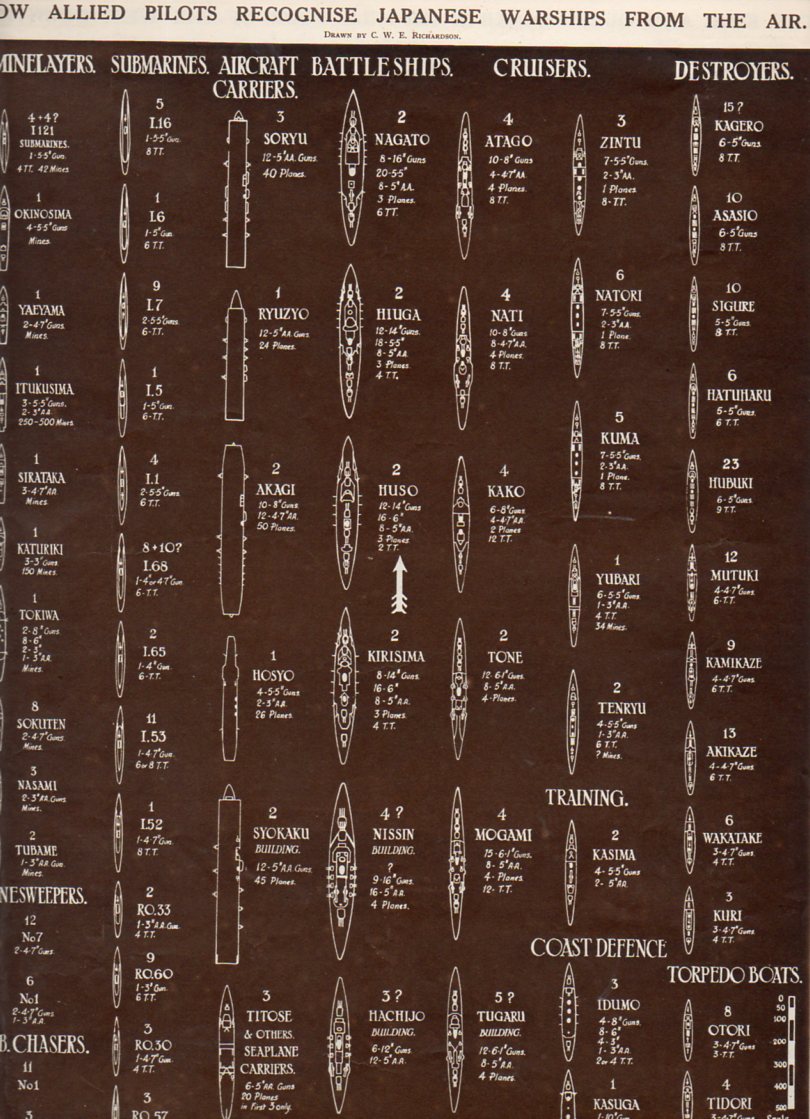
    “How Allied Pilots Recognize Japanese Warships from the Air”, a graphic that appeared in The Illustrated London News on 16 May 1942, displayed in silhouette the different sorts of Japanese warships that might be targets of allied planes.  There’s a lot of data on this one long sheet of paper, showing minelayers, submarines, aircraft carriers, battleships, cruisers, destroyers, subchasers, torpedo boats, training vessels and coastal defense ships–65 in all.  It is a great display, presenting a great amount of data in limited space, clearly and concisely, and very easy to distinguish and read. 


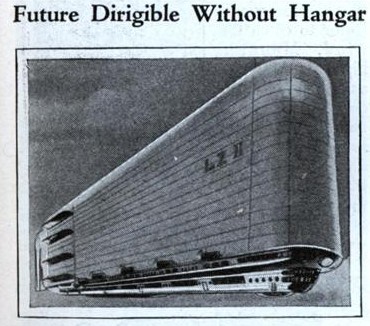
  • Atomic- , Vacuum- , & Solar-Powered Dirigibles with Built-in Airports–Bits of a Bad Historic Future

    JF Ptak Science Books   Post 1487

    A post (“Nuclear Everything”) over at Dark Roasted Blend that featured a magnificent and stodgy atomic-powered zeppelin pushed me into this short visual note on differentially-powered airships, and then in general about airships with airports on them. (There’s a whole other category for planes-of-tomorrow that were so enormous that they had landing strips on their wings, but that’s another story.)

    And they remind me of things that just aren’t “right”, because these things just weren’t.  I’m not sure why, but I’m drawn into an old story about the legendary Charlie Goodnight, Texas pioneer, one of the creators of the idea of the cattle drive (the Goodnight-Loving Trail), a man who lived an extraordinary and powerful life.  He lived for a long time, too, from 1836 to 1929 (almost to the year of the birth of Larry McMurtry, who told a version of Goodnight’s story so spectacularly well in Lonesome Dove), well into a future so far advanced from the year of his birth that he could scarcely have imagined it.  Anyway, towards the end of his life, in 1916, Goodnight had the idea of making a movie of the Old West that included a “final” Indian buffalo hunt.  I’ve seen the film, and it is a fascinating, heartbreaking, wonderful/awful thing, that somehow might appeal to almost no one.  It certainly didn’t appeal to the folks at the time looking for a cowboy film, because much like Mr. McMurtry’s cowboys, Goodnight’s reality didn’t much resemble the cowboys that the public wanted to see.  In a sense Goodnight lived beyond the history that he so much helped to create, and that his old, passed “present” was something that the people in his future really didn’t want to recognize. Then of course one of the things that made it all seem “not right” to me was seeing a vignette of Goodnight entering into one of the scenes, in  a car, making the whole thing a little spooky.

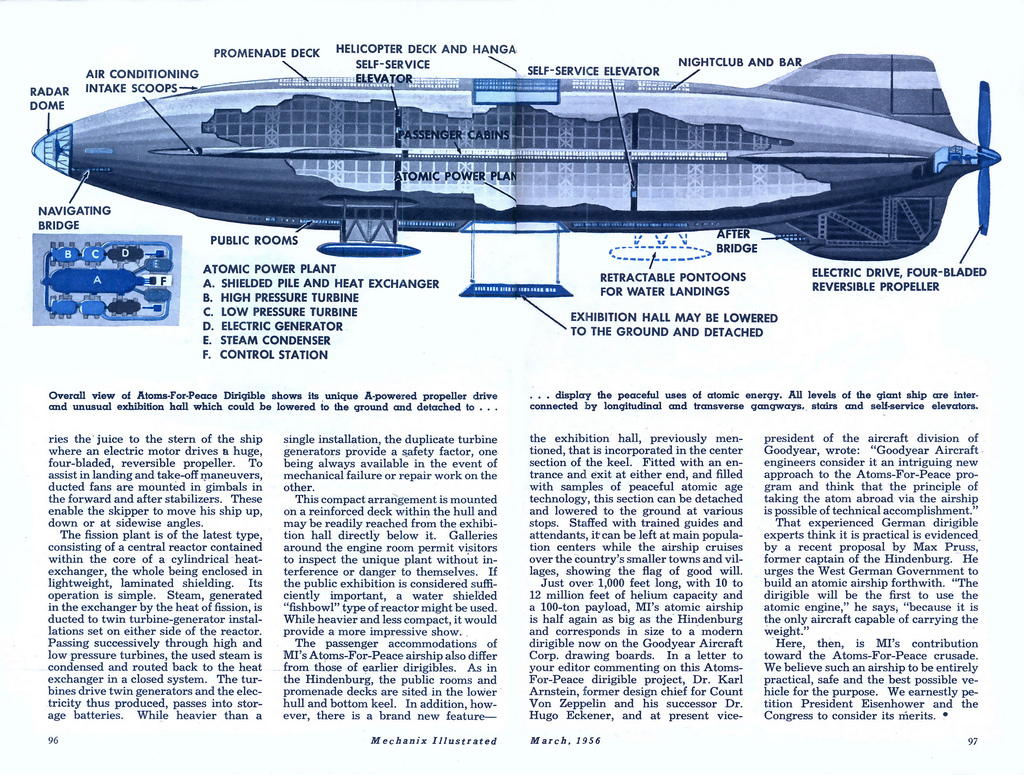
    First up is this mammoth flying advertisement to both peace and war, a nuke-powered dirigible proposed by Eisenhower in 1953 as part of the Atoms-for-Peace push, a move which by this point was already entirely too late.

    Atom everything zep for peace

    For some reason it was seen as a good idea to have a detachable convention hall built for the airship. \

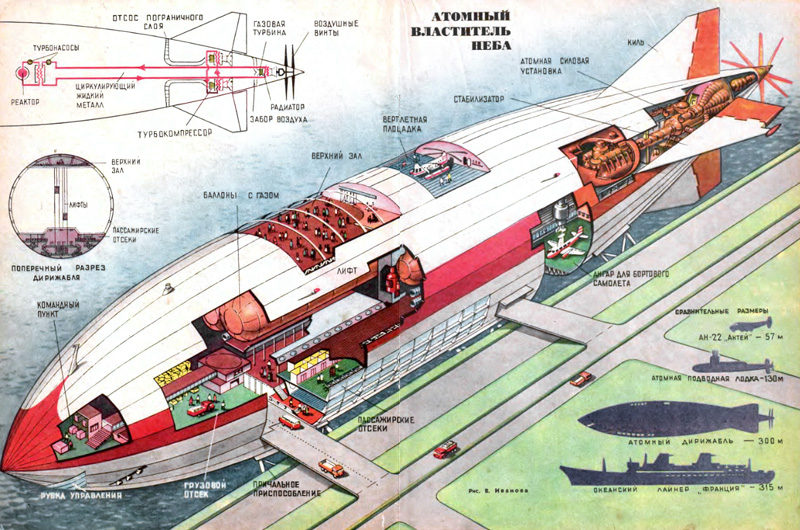
    And of course there is no greater element of a Something-for-Peace anything unless there was a competing idea, as seen in this mammoth Soviet atomic zeppelin, a ship completely absorbed in being bigger than the big thing that it already was:

    Atom everything zep

    At 300 metres this monster had room enough for virtually anything, though it didn’t have the retractable/detachable convention hall–it did however have a small airport. 

    Another dirigible approached the airport-on-board idea, but preferred solar power for its energy source.


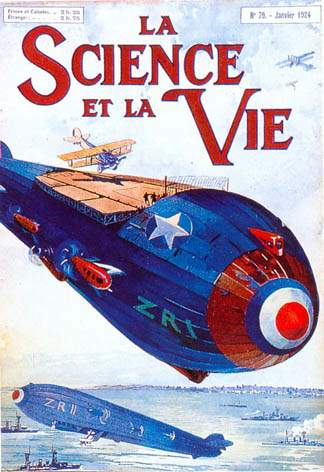
     The magnificent possible, 1924, saw another kind of airborn airport:

    https://historyofideasblog.com/a/6a00d83542d51e69e2012875ea3636970c-pi

    Guido Tallei’s 1932 Diri-Disk was a combination airplane/dirigible, and looked as though it could harbor an expansive airport on its NCC-1701-like wing, but didn’t, alas:

    Konstantin Eduardovich Tsiolkovsky (1857-1835), the Russian/Soviet space pioneer who was nearly without peer (and who somehow survived the bloodlust of Stalin which sucked up and murdered so many of his scientific colleagues),  stepped outside his spaceflight bubble to write about this monster with collapsing sheathing:

    https://historyofideasblog.com/a/6a00d83542d51e69e20128769ed30d970c-pi

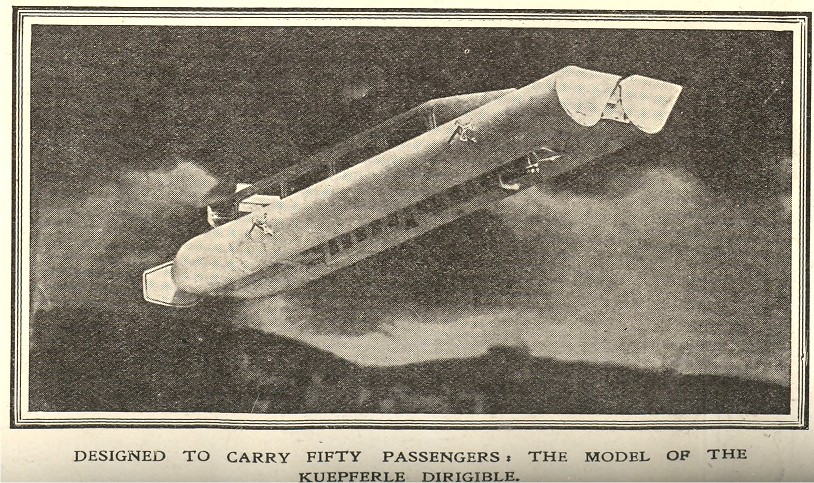
    The Kueperle dirigible, planned in 1909, was nothing if not pretty, and pretty is pretty much what the whole thing consisted of:

    https://historyofideasblog.com/a/6a00d83542d51e69e2012875ea2c87970c-pi

    And lastly, this example of the tracked airship–this must have been a popular notion because I’ve seen perhaps 15 different plans and I don’t spend much time at all reading in this area.  But harnessing the power of the balloon or dirigible or (kite!) whatever to a track system seemed to be a good idea, once upon a time:


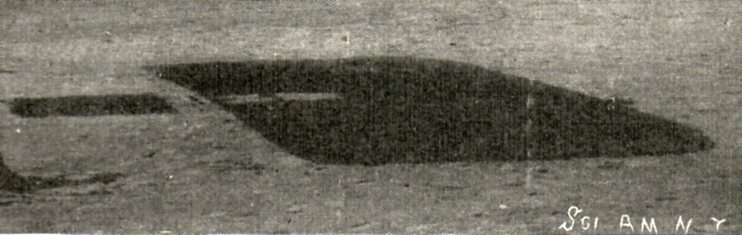
  • The History of Important Things Pictured by their Shadows: the Wrights, Kill Devil Hills, 1901

    JF Ptak Scienc Books  Post 1485

    Wright brother full 1901491

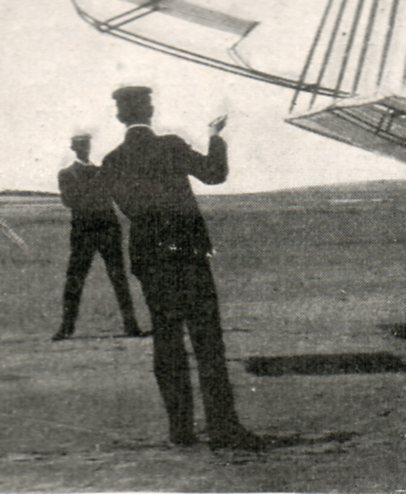
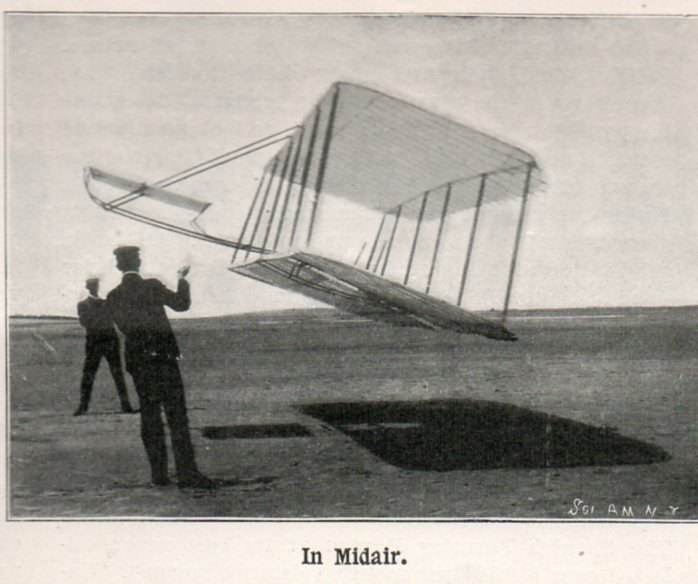
    In this history of picturing shadows this might be one of the most significant for early 20th century technology.  After all, shadows in images weren’t necessarily a desired effect, and certainly it was seldom required, but this one, captured as a result of capturing something else, has survived.

    This is one of the first popular reports on the Wright brothers’ first publication describing their experiments in flight., and it is buried in the middle of The Scientific American issue for 22 February 1902, months after the original publication. That initial report, published as “Some aeronautical experiments” published in the even-then-obscure  Journal of the Western Society of Engineers (6 (1901) 489-510) seems to be the only source for this article, the Wrights keeping information about their experiments closely held. (For example, the next publication of theirs, “Experiments and Observations in Soaring Flight” would be published in the Journal of the Western Society of Engineers ,VIII, 400-417, in 1903.)

    Wright brother full 1901490

    The editors of the Scientific American—and other magazines—were certainly skeptical when it came to claims of new sorts of flight, but the Wright case seems to have been thoroughly without question. Still the article on their article appeared in this issue of the magazine after stories on the reconstruction of the RedHeugh Bridge, reviving the Hudson River tunnel idea, steam boiler inspection, the Darien canal, variable speed gears for pumps, a new method of etching, “photographing by electric headlight”, mill flour in Sweden, domestic manufacture of Portland cement, improved rail joints, winter railroading in Alaska (and a few other bits), before we get to the article, which is just a half-page long.

    Wright brother full 1901489

    Bit it is an important half-page, which include five photos of the fliers as well as descriptions of the control apparatus, which includes an observation of an epochal improvement to their aircraft, one of the most important in the history of aviation  (if I am not mistaken):

    “…responding to the slightest motion of the rudder”

    That is to say changes were made to the rudder which paved the way to their 1902 experiments on the vertical rudder, which gave it a critical importance of keeping the aircraft aligned when coming out of a banking maneuver or climb rather and so on than for changing the direction of the aircraft; so when using the rudder in this way and wing warping for altering direction, their aircraft would became a truly flyable thing.

    Notes:

    Since this is outside my area I quote liberally from the US Commission on the Centennial of Flight for a more exact description of the difference of the gliders between 1901 and 1902:


  • Archaeology of Bombing, 1913

    JF Ptak Science Books   Post 1472

    This is another in a longish series of posts on this blog on the archaeology of bombing, aerial bombing, and today’s installment comes from its earliest period.  The first air assault belongs to the Italians, who used the weapons from the air in bombing Tripoli in 1911, which they also found to be within the defensible scope of international law, even when used against a noncombatant population (which came on the heals of the Italian army’s massacre of civilians there).  Bombing from the air had happened earlier of course, but also entirely in fiction:  for example, Jules Verne bombed civilians in The Flight of Engineer Roburs (1886), and H.G. Wells had New York City in flames in The War in the Air (1908).

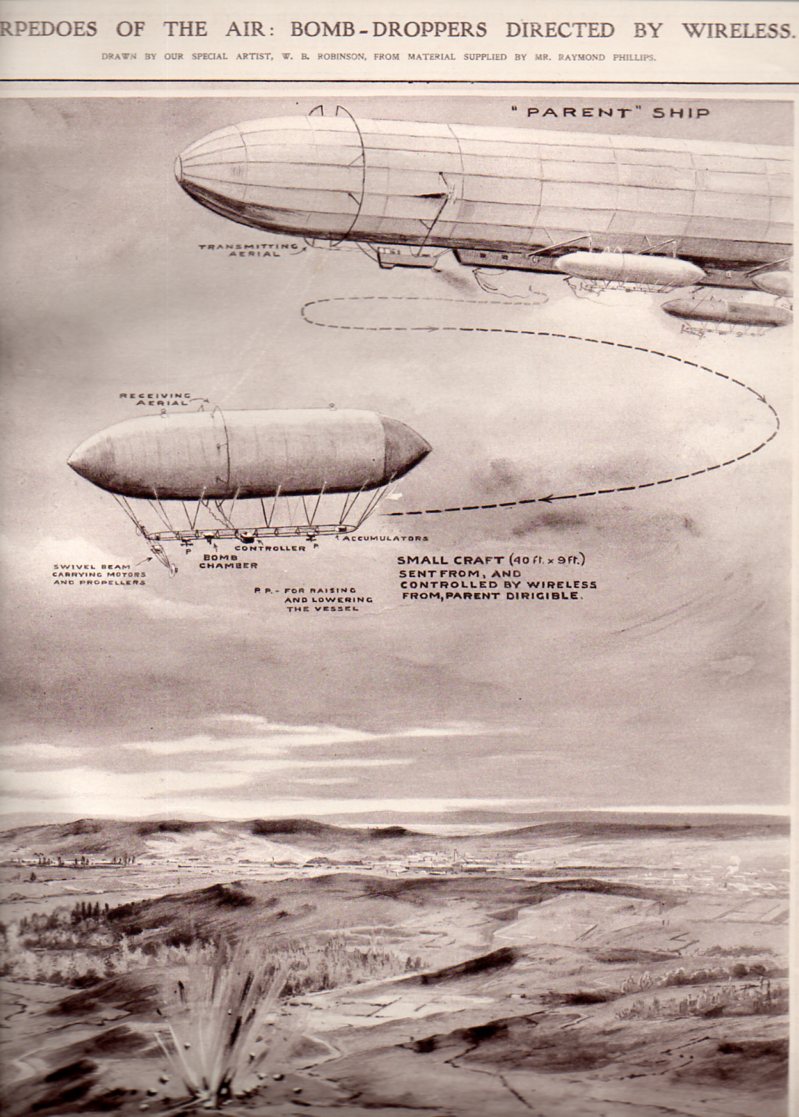
    “Torpedoes of the Air:  Bomb-Droppers Directed by Wireless”, a graphical story that appeared in The Illustrated London News on 6 September 1913, and drawn by W.B. Robinson, describes a sort of two-tier remote controlled aerial bombing arrangement of dirigibles.  The “parent” ship hosts a number of smaller dirigibles which are radio-controlled elements sent in to do the actual bombing, which allows for no human interaction with dropping the bombs and exposes only materiel to enemy fire.  (I should point out that each one of these early drones were 40′ long, making the parent dirigible something like 400′ in length if we are seeing about half of it in the illustration, and enabling the thing to carry perhaps 10 of these remote controlled units.  This dirigible would have been about as big as the monster Zeppelin LZ1.)

    Dirigibl e torpedoes481

    And this two years after this remarkable graphical display:

    Info display dreadnought237

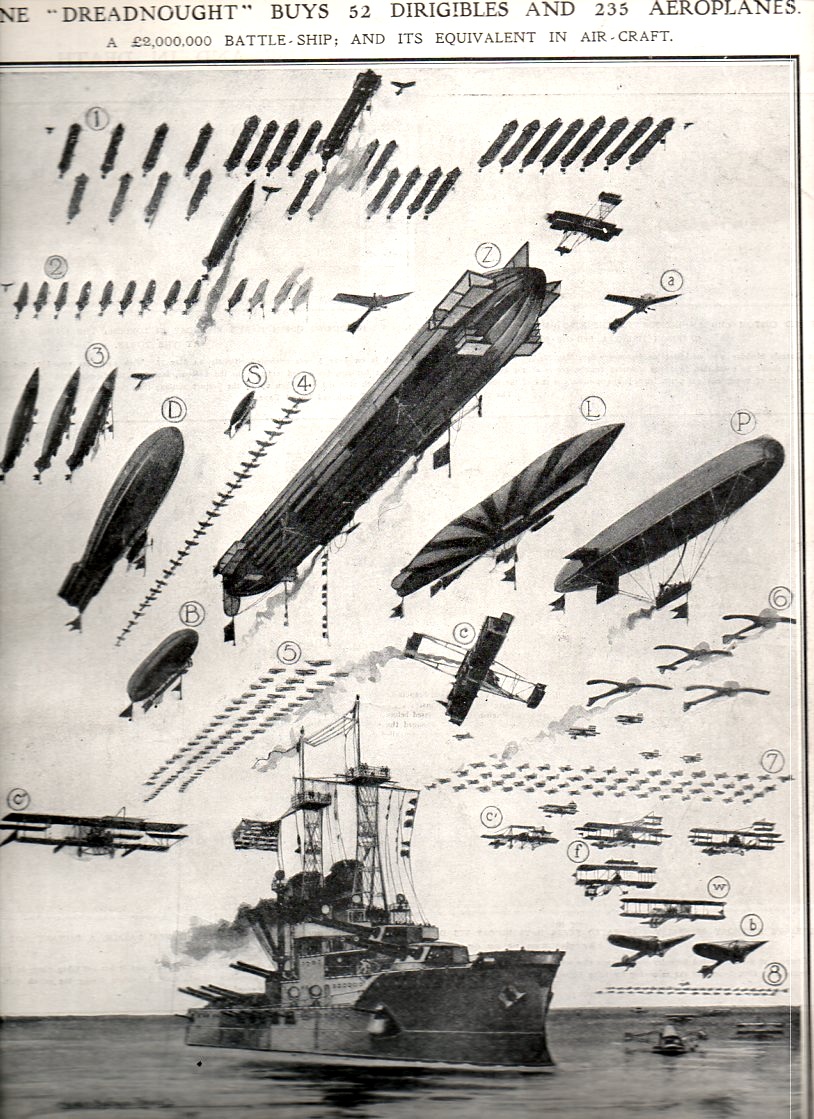
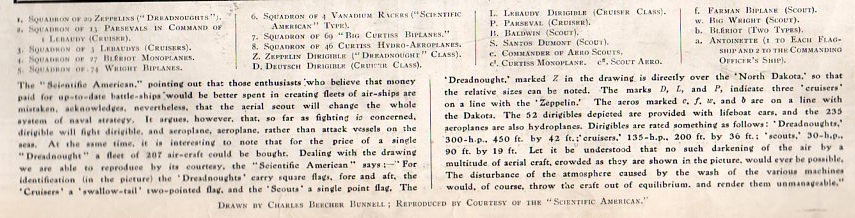
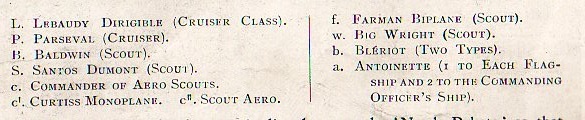
    There’s nothing quite so satisfying as seeing a representation of quantitative data like this where the graphical displays are flying.  “One Dreadnought Buys 52 Dirigibles and 235 Aeroplanes” is a full-page diagram appearing in the 3 June 1911 , making a very strong point that in the new air-age 2 million pounds for one battleship buys a lot of aircraft.  Of course this is a British journal and the ship is flying an American flag–the image originally appeared in the Scientific American just a short while before this publication, and so it also enumerates American and international aircraft, making for a lovely representation of a broad range of airplanes filling up the same sky.  (This image is available for purchase from our blog bookstore, here.)

    Info display dreadnought238
    Info display dreadnought239
    Info display dreadnought240


  • History of Falling: Parachutes as Aerial Minefields and Pilots’ Escape Vehicles

    JF Ptak Science Books  Post 1466

    Lots of these images have to do with walking and falling, walking and falling at the same time, walking and catching yourself from falling over and over again, but in general that walk is only one step, so far as parachutes go. 


    The parachute has certainly been around for a long time–from ancient times if you squint your eyes hard enough–though it appears that it was in the Renaissance that the idea was taken more seriously as a practicable thing:  at  least it was first depicted then.  Here for example is a form of falling that was seen as flying (Homo Volens or Flying Man), in this depiction of parachute-use by Fausto Veranzio  Fausto (1551–1617) in his book of technological marvels called Machinae Novae (1595).  Of course Leonardo left a footprint here as well, and before Veranzio.

    File:Homo Volans.jpg

    More convincing and potentially beneficial parachutes were constructed for balloon escapes/aviator descents in the 19th century, as seen with the work of André-Jacques Garnerin (1769-1823), who was the inventor of the frameless parachute (a framed version seen below).  

    File:First parachute2.jpg

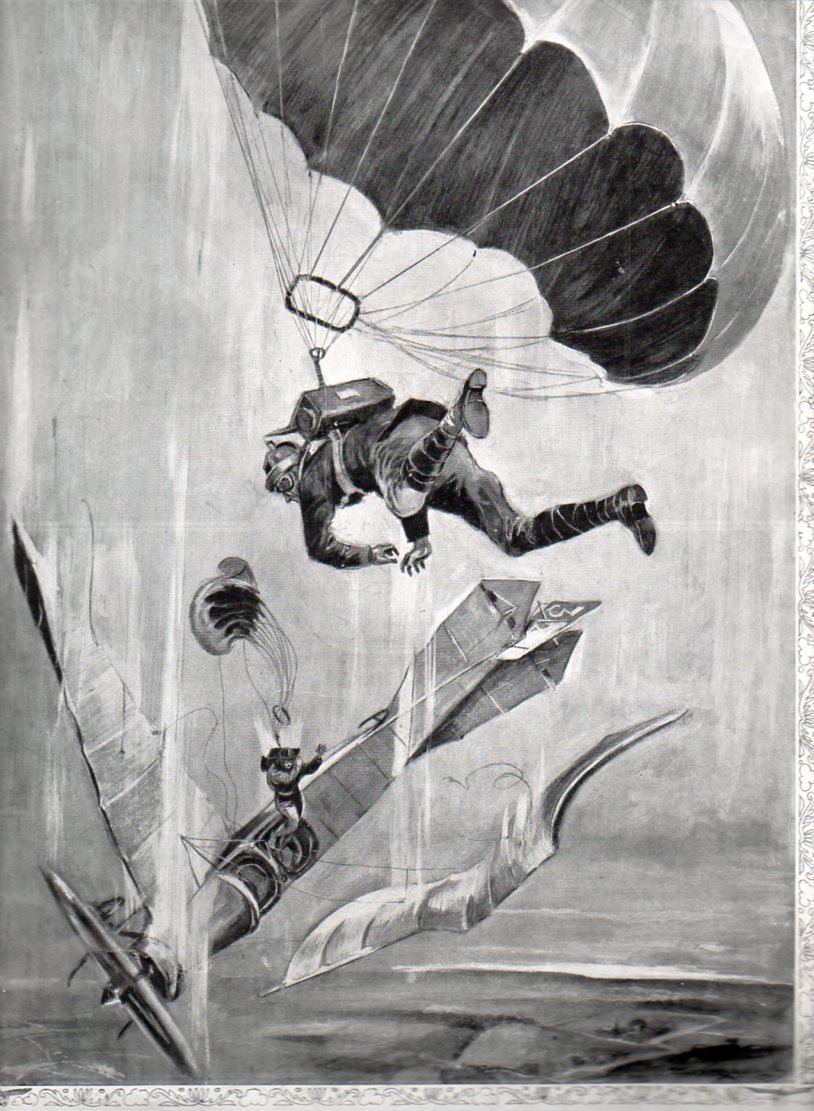
    And in all that time of development through the nineteenth century, it still took another eight or nine years or so after the Wright’s flights to have employed the idea for pilots of the modern airplane.  There was a series of varied “firsts” of leaving an aeroplane by parachute in 1911 and 1912, the earliest of which involved the pilot of an aircraft to fly with his parachute in his lap, then throwing the whole thing from the plane with the pilot following. Parachute history during this time, like 1910-1920, is a little complicated, filled with fits and starts, mostly not very successful, and most of them of a quality and dependability to make you want to land your aircraft even if you were flying only smoke and flame.

    The image below seems to depict the 1912  exploits of the American and British inventors who at about he same time developed a parachute that could be worn in a box on the aviator’s back, contained in a box with a removable panel.  It was a very heady development, and the whole idea–seen here in the pages of The Illustrated London News for 28 September 1912–must have seemed like science fiction to the casual reader, the caption beginning

    Parachute bomb454

    “…our illustration appears to be somewhat fantastic…”  The ripchord, one of the most important elements of a parachute, didn’t get introduced into the fray until about 1916, and the real utility of the parachute doesn’t seem to be developed until 1920 or so.  In the meantime, the whole business of flying was pretty much being done without a safety net, so to speak. 

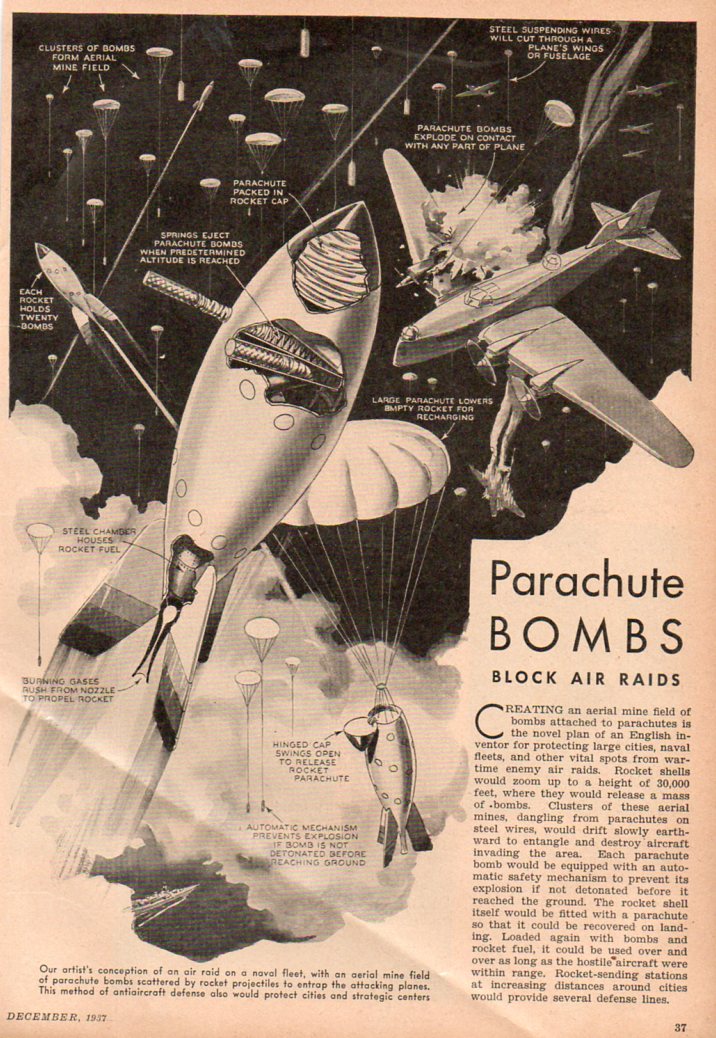
    But what I realloy wanted to get to in this post is something that did look “somewhat fantastic” to the readers of its day, as it does to me now:  parachute bombs.  As a late-night, five-martini idea it looks great, especially in 1937.  But the fact of the matter is that it does look like a bar stool plan similar to barrage balloons if barrage balloons were smaller, higher, fell and had bombs.  One element of surprise though may have been what would happen to the great percentage of these bombs that were fired above and floated back down to Earth with their warhead still attache to the parachute and unexploded.  The article states that the warhead would be disabled

    Parachute bomb453

    before it hit the ground, but then what?  I suspect that there would be thousands of these buggers littering the land/cityscape, which means that there would have to be an equivalent of an ambulance corps riding around finding, collecting and hauling these things off.  Seems like a non-started to me.  Plus there would be far more effective anti-aircraft elements developed very soon after this, not to mention the terribly significant mathematical and technical developments that would go into the fire control issue of the weaponry. ( But that’s another story, another long story, dealing with how to get aircraft out of the air–there’s some very sophisticated AA weaponry produced during WWI, s decade and a half before these parachute bombs, that would seem to make these things a bad afterthought.)


  • Stylizing a Sameness in Early Flight Images

    JF Ptak Science Books  Post 1438

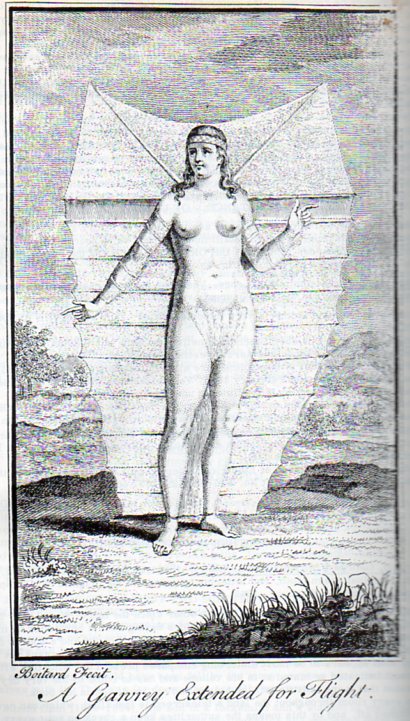
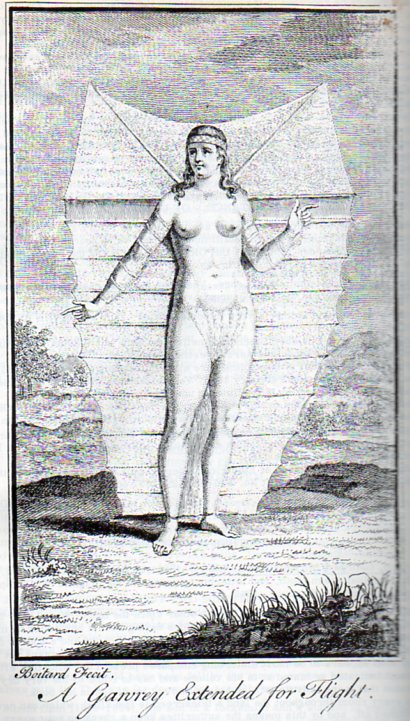
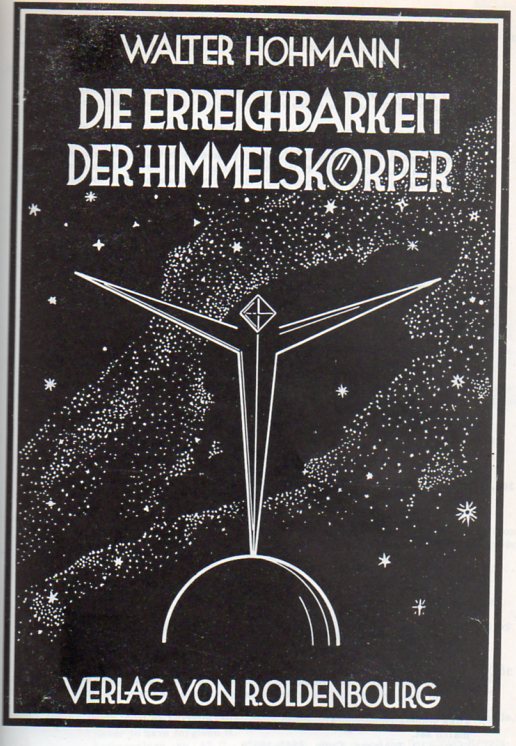
      Space flight379 Space flight378

    I found these elements of sameness in design, spanning prehistoric flight and prehistoric space flight eras, separated by 170 years or so, and they just seemed fascinating.  The first, by Boitard for Robert Paltock’s (or Pultock, 1697–1767) The Life and Adventures of Peter Wilkins, a Cornish Man, Relating Particularly, His Shipwreck near the South Pole; his Wonderful Passage thro a Subterraneous Cavern into a kind of New World, his there Meeting with a Gawry or Flying Woman, was published in London in 1751 pictures the flying woman from the title (which also pretty much sums up the Robinson Crusoe-like story.  Wilkins does become shipwrecked and then has an extraordinary adventure underground at the South Pole–which is interesting in and off itself, to set the stage at the South Pole, since the exploration of Antarctica is really a 20th century endeavor.  (The first accurate summation of Antarctica as a continent isn’t made until Charles Wilkes’ expedition in 1839/40.)

    Space flight378

    The flying woman is striking, especially for the mid 18th century:  she is quite lovely, muscular, and tall, and has her limbs attached to a flying/gliding canopy which seems as though it would be operated in a way in which the people of that time thought birds to fly. 

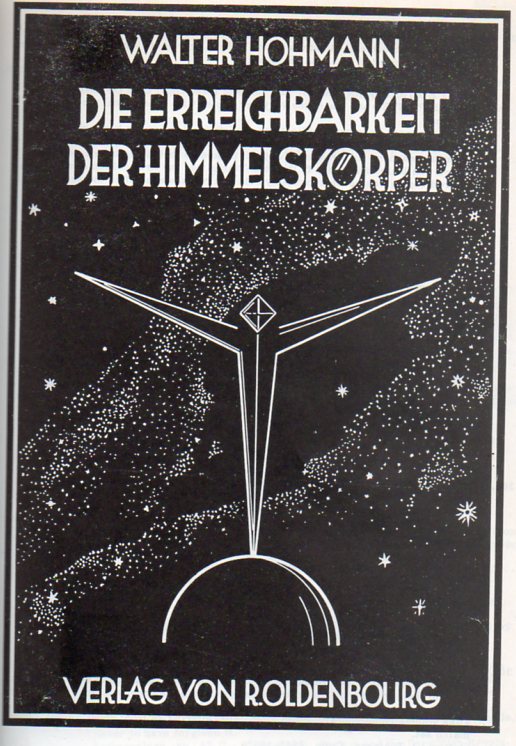
    The associated image is Walter Hohmann’s prescient work on rockets and rocket flight, Die Erreichbarkeit der Himmelskoerper, Untersuchungen ueber das Raumfahrtproblem, which was published in that great heyday of German flight engineering, in 1925.  It was published very soon after the important work of Hermann Oberth2, whose style, illustration and design are closely aligned. It is very interesting to note here that Hohmann (and Oberth) both suggested using teh Earth’s gravitational field to orbit the spacecraft and then slignshot it off into space, rather than to try to simply lift of from Earth and then go directly into space. 

    Space flight379

    Notes:

    1. Biographical Dictionary of English Literature was not impressed by it saying: “The description of Nosmnbdsgrutt, the country of the flying people, is a dull imitation of Swift, and much else in the book is tedious.

    2.  Oberth’s book, Die Rakete zu den Planetenraum was printed in 1923 by the same publisher as Hohmann, and was a cornerstone study of the issue of interplanetary space travel–the first of its kind, really, to address the full theoretical and practical aspects of rockets and space flight.  Oberth–who wrote this at age 28–could not submit the work for his thesis because of its advanced treatment of a little-known subject.


  • Horses in the Sciences: Proving Nothing and Something

    JF Ptak Science Books   Post 1419   [Dedicated to our primum mobile family horse person, Emma Digh Ptak.]

    Horsepower281

    The history of horses in the sciences is not a very wide subject area, though I’d like to look at a few instances in which they help to prove both something and nothing–particularly in the third case below, when the “nothing” was a very big “something”. 

    First, in the history of horsepower (and such an odd history it is, having somewhat and famously to do with billing issues for steam powered engines) there is a certain restricted high-percentage element that are just no-go, unworkable ideas.  Some of them served as the basis for further and deeper thinking,and some of them were simply far ahead of the technical abilities of their times. 

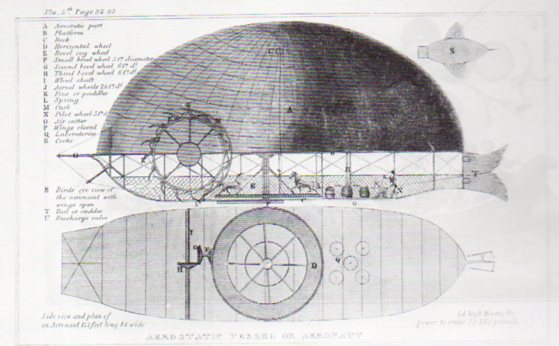
    In 1825 Edmond Genet1 published an interesting book (Memorial on the upwards forces of fluids and their applicability to several arts, sciences and public improvements) which in and of itself is a milestone in a number of different technical aspects–one part of it though sensationally and beautifully elevates itself to the Not-Quite-a-Good-Idea-at-Almost-Any-Time Department.

    Horsepower282
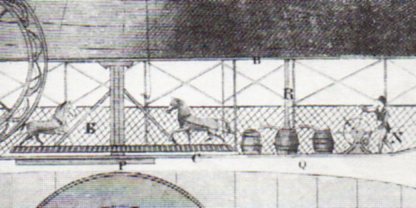
    “The actual plans of Genet’s airship called for a balloon shaped to resemble the rounded back of a large fish and containing about 1,023,000 cubic feet of hydrogen gas, with a platform or deck fastened beneath. Two horses, moving on a revolving wheel on this platform, were to provide the power for operation of a pair of large, silk-covered aerial wheels, while the rudder in imitation of a fish tail was intended “not only to steer the machine, but also to supply it with an additional force of propulsion”. –Genet in his Memorial…

    One thing that makes Genet’s work so impressive is that as a result of it he applies for and is granted the first patent made in the U.S. for a flying machine.  The flying machine he presented in his work though is a little problematic:  the canopy and the machine itself are not at all drawn to scale, and their size and breadth are lost a little in that under-representation.   I’d say that the figures in the drawing should be half of what they are, given that the flying machine was 132′ long and 46 feet wide (and 54 feet high), and the canopy was to be filled with a million cubic feet of helium.  The thing was a beast, and was supposed to be blessed with the capacity for lifting 72,000 pounds2.   The horses were along for the forward propulsion, moving two large paddle wheel-type wheels on either side of the airship.  It just doesn’t look right.

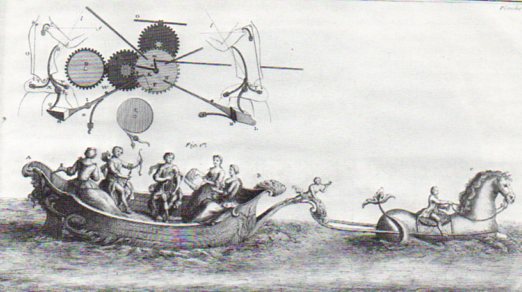
    Next is a tempting mechanism, an inset living inside a larger engraving depicting a mode of transport not-so-tempting.  It comes from Colonel Jean-Gaffin Gallon’s (1706-1775) Machines et inventgions approuvees par l’Academie Royale des Sciences....published between 1735 and 1777, and poetically covers its subject over a 111-year span from 1666 to 1777.   The massive work was illustrated with nearly 500 engravings covering all manner,shapes and description of technological invention and advancement, not the least of which was the first illustrated description of Pascal’s logic machine.  Amid all of this vast wealth of potentially revolutionary achievement,. I pluck out this equine example of possible nothingness: 

    Horsepower280

     which I am just not sure about, not having the text.  I can only hope that the horse was some sort of imaginary mechanical something, given its task and its size.  From the looks of its neck and the rider and the length of the horse, if it was a living thing it would have been gargantuan. 

    Here’s an appearance in the Gallon work (from 1735) of another, mechanical, horse that was used for stage productions, and which seemed fairly articulated:

    And thirdly, there is this, perhaps the most famous image of horses in the history of scientific illustration:

    Mantegna vacuum von guer

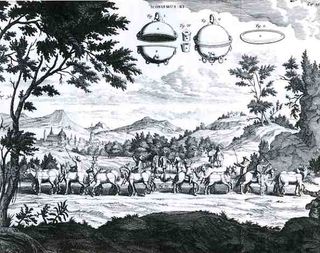
    This beautiful illustration is from one of the greatest experimental physics books of the 17th century, coming as it does from Otto von Guericke’s  Experiemnta nova (ut vocantur) Magdeburgica de vacuo spatio (Amsterdam, 1672).  (In another minute department, this one is also I guess the greatest book ever written by a Mayor of anywhere (as von Guericke (1602-1886) was mayor of Magedeburg for 33 years).)  The image shows the greatest of von Guericke’s efforts, and one of the greatest (or most important) experiments in experimental science–the dramatic demonstration of the vacuum, showing here that teams of horses could not pull apart two halves of an evacuated sphere, and of course the efficacy of air pressure operating against it (um, the vacuum). The “floating” bits in the sky were an exploded view of the sphere that was the subject of the experiment. 
                   
    What was more important though, and what the general reader today might easily miss, was that von Guericke created something that many scientists and philosophers said didn’t, and couldn’t, exist:  the vacuum.  In modern times, Copernicus depicted the universe as a vast void; Descartes came in the back door (following the ancient and interesting though incorrect theory of Aristotle), not liking the idea very much, and claiming that such empty space couldn’t exist.  Von Guericke provided the proof that the vacuum, that nothing, did exist.

    As a matter of fact the issue of nothingness was very contentious, with the concept of its possibility and the display of a vacuum not achieved until this effort by von Guericke, with his team of horses tugging away at the essence of nothing.

    NOTES

    1.  Genet is best remembered in American history as “Citizen Genet”, at least far more so than that being remembered for gentleman farming or his work in aerostatics and invention.  “Edmond Charles Genet had tried to recruit American volunteers to serve in the armies of Revolutionary France and to outfit American privateers to fight against the British. Despite President Washington’s orders for him to desist from his high-handed appeals to the American public, he continued the same practices until he was forced from office. Washington permitted him to remain in this country as a private citizen, saving him saving him from the possibility of being guillotined for his failure.” So writes the great historian of Science I Bernard Cohen.  It wasn’t altogether true though that it was Washington who saved Genet; his being allowed to remain in the U.S. was strongly pursued and lobbied by Alexander Hamilton, Genet’s greatest detractor/enemy/nemesis in Washington’s cabinet.

    2. By contrast, the Wright I Flyer (the famous first-flight airplane of 1903) had a wingspan of 40 feet, weighed 625 pounds and sported a 12 horsepower, 170 pound  engine (and which by the way was all produced for about a thousand dollars–not nothing, but not a lot).


  • Display of Information: What a Dreadnougth was Worth in Airplanes, 1911

    JF Ptak Science Books  Post 1408   [Display of Quantitative Information series]

    Info display dreadnought237

    There’s nothing quite so satisfying as seeing a representation of quantitative data like this where the graphical displays are flying.  “One Dreadnought Buys 52 Dirigibles and 235 Aeroplanes” is a full-page diagram appearing in the 3 June 1911 , making a very strong point that in the new air-age 2 million pounds for one battleship buys a lot of aircraft.  Of course this is a British journal and the ship is flying an American flag–the image originally appeared in the Scientific American just a short while before this publication, and so it also enumerates American and international aircraft, making for a lovely representation of a broad range of airplanes filling up the same sky.  (This image is available for purchase from our blog bookstore, here.)

    Info display dreadnought238
    Info display dreadnought239
    Info display dreadnought240