A Daily History of Holes, Dots, Lines, Science, History, Math, Physics, Art, the Unintentional Absurd, Architecture, Maps, Data Visualization, Blank and Missing Things, and so on. |1.6 million words, 7500 images, 4.9 million hits| Press & appearances in The Times, Le Figaro, Mensa, The Economist, The Guardian, Discovery News, Slate, Le Monde, Sci American Blogs, Le Pont, and many other places… 5000+ total posts since 2008.

Category: Aviation & flight

  • Big Numbers and WWII Aircraft–Artistic Displays of Quantitative Data

    JF Ptak Science Bools  Quick Post

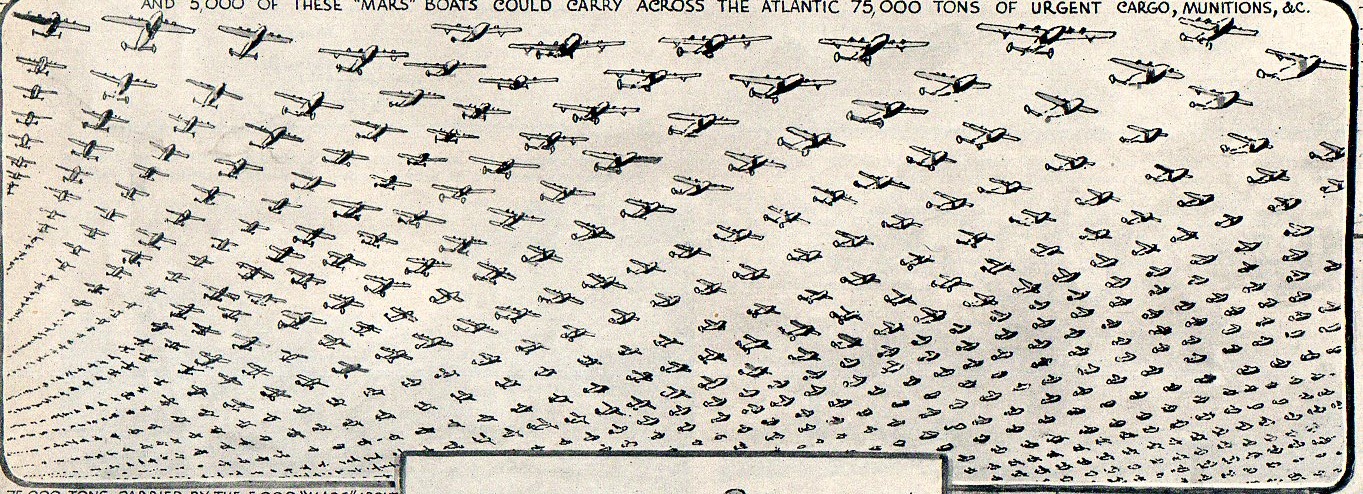
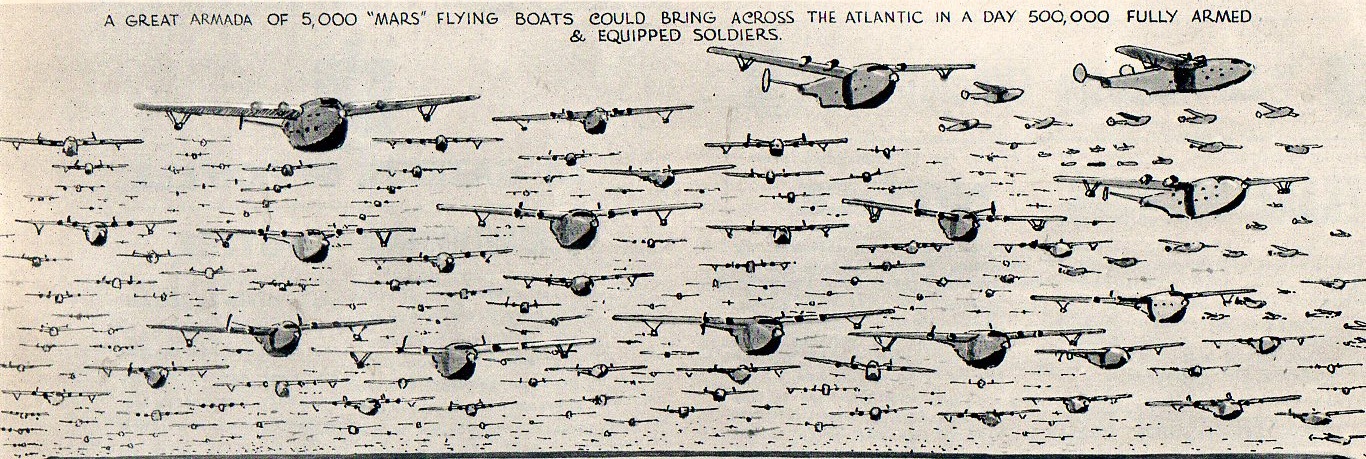
    This post continues an earlier series on the artistic display of quantitative data–putting a face on big numbers. In particular it extends a collection of images of Second World War airplanes, “A Big Sea of Planes:  Quantitative Display of World War II  Bombers. The images below appear in the 17 October 1942 issue of the Illustrated London News in an article about the possibility of replacing seaborne troop and materiel transport across the Atlantic from America with the big Martin JRM Mars aircraft, getting the troops there faster and safer and releasing at least part of the naval force for wartime activities.  The images are pretty compelling:

    Airport987

     The caption states that 5000 Mars planes could get 500,000 soldiers to Europe.

    Airport988

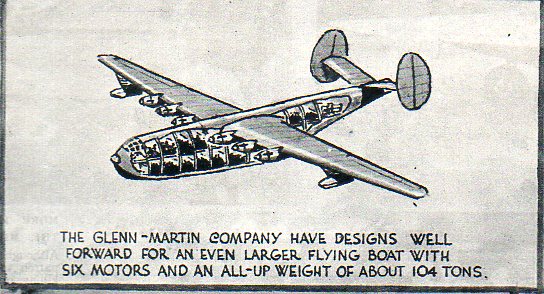
     These were big planes1 (200′ wingspan, 117′ long, 38′ high, more below) and could haul 130+ troops.  By the time though that the powers-that-be were figuring out who the main contractor would be for production (and those production numbers in early 1942 were about 500 per year, at that point, anyway) the Battle of the Atlantic was already–in 1943–fairly well decided.  The U-Boot problem was solved enough for a continuous flow of soldiers and supplies, though not without a high cost in the first half of the Atlantic campaign.  (Overall, from 1939 to 1945, some 3,500 Allied merchant ships  and 175 Allied warships were sunk, costing the lives of 72,200 Allied sailors and merchant seamen.  The Germans lost more than 780 submarines along with fully three-quarters of all sailors in the U-Boot fleet, making some 30,000 men.)

     Below, a cutaway for the Mars:

    Airport989

    Stats and Technical data on the Glenn-Martin(from Jane’s Fighting Aircraft of World War II, (1945):


  • Rooftop & Floating Airports -and!- Rooftop Airports in a Levitating NYC, 1929

    JF Ptak Science Books   Post 1652  (Part II of an earlier post on Rooftop Airports, here.)  Part of this blog’s History of the Future series.

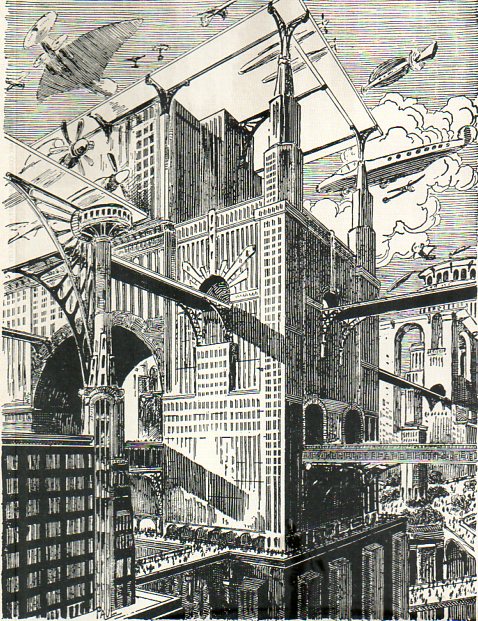
    I really just wanted to post these two images before I lost them again. I’ve written earlier here about high-rise, in-town/downtown airports settled on the tops of buildings (or loaded onto newly-constructed structures over rivers and etc.), but these two images offer a nice distinction on the height’s of elevated airports of the coming future.  The first is by the great Paul Frank, and appears in Amazing Stories for 1928:

    Airport981
    The taller of the two airports seems to be 75 stories above the ground, maybe more–its hard to tell.  It is interesting to see that there is another (of no small size) right next door, but not quite so high.  The 500′-tall elevated walkways/roads are impressive.

    In April, 1936 another artist saw an even taller airport, which caps off an enormous building that seems at least not only twice the height of the Empire State Building (just newly completed), but also far wider.  If you made the “…tropolis” airport signifier on top the midway of the landing field, I calculate the width of the building to be at least 600′, meaning it would be something like 250×600′, or about four acres (or more) per floor.  Big building, with an enormous volume. 

    [Picture source:Modern Mechanics, April 1935, as pictured in Dark Roasted Blend]


    [Picture source: Paleofuture.com]

    And here, another big rooftop creation of a 16×17 checkered grid, complete with, well, nothing at all, not even guard rails or fences–this would be rooftop-airport-landing Old School.  The runways aren’t even particularly long, though I have no doubt that the magazine’s cover space dictated most of the size, anyway. 

    Of course the idea of very-elevated high-rise airports become secondary when you introduce the idea of floating/flying airports, as we see in this fantastic idea by (again) Frank Paul in the July 1929 issue of Air Wonder Stories. (This image and next from frankwu.com website dedicated to the artwork of Frank Paul, a great and wonderful thing.)

    And of course when the idea of the flying airport fails, you can always go for the flying city, with airport:


    This is again Frank Paul, from November 1929’s Amazing Air Stories, and depicts–of course–New York City removed from the ground to levitate, above its former self. Luckily there isn’t just a hole in the ground where is used to be, the rock and bedrock picked up along with the buildings and the rest of the (non bridge) infrastructure.  It is still a busy place. I presume that given the crowding of the place that there are still high-elevation rooftop airports in the floating city. 

    There are other sorts of air-borne airports, though they are mainly built on/in large airplanes and airships, and really don’t qualify for a post on the simple rooftop airport.  Perhaps it is time now for an all-inclusive Odd Places for Airports post to appear here…

    For example:


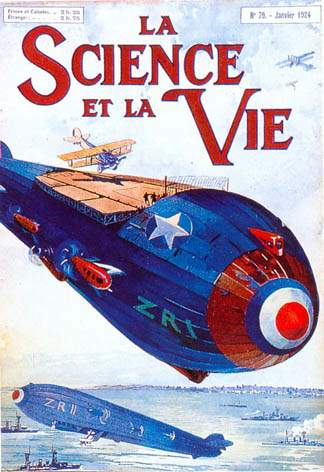
     The magnificent possible, 1924, saw another kind of airborne airport:

    https://historyofideasblog.com/a/6a00d83542d51e69e2012875ea3636970c-pi


  • History of Lines: Looking Straight Down from Straight Up, 1786

    JF Ptak Science Books   Post 1581

    Looking down656
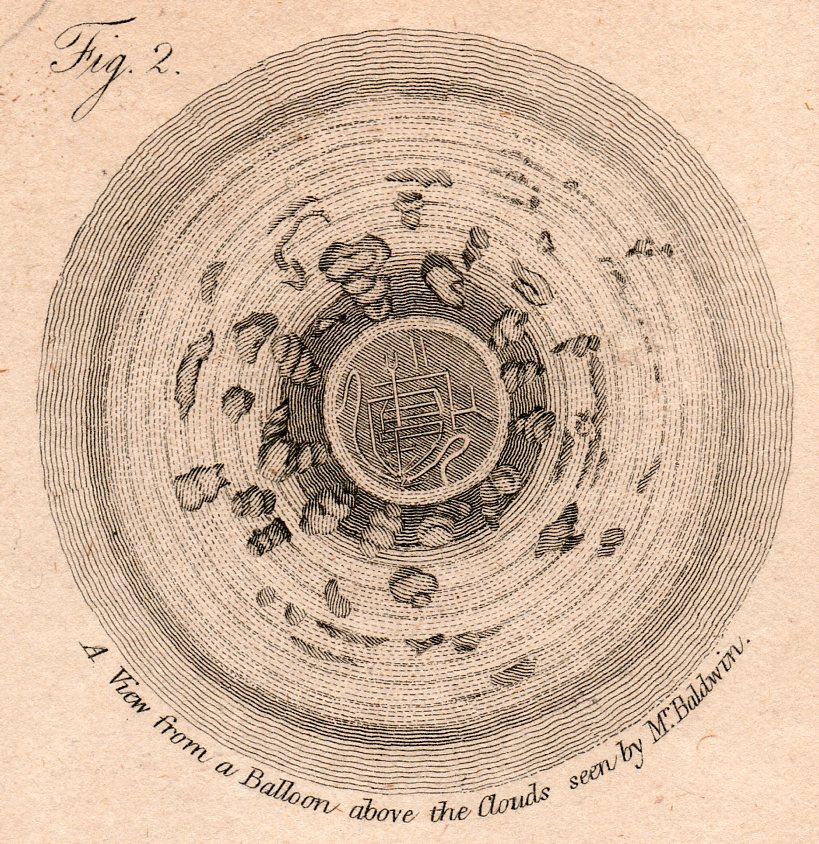
    I was struck by the mosaic possibilities of the image (below) found in Thomas Baldwin’s Airopaidia (printed in 1786) and so made it into one.  But what the engraving is,m really, is a view from a balloon, looking straight down.

    Looking down655

    We’re looking straight down, through the clouds, seeing two towns (at bottom-left and top-center)–why the rivers are red, I don’t know.

    There are other posts on this blog on looking straight down, which is an attractive subject–to me, at least. First-hand images of looking straight down fro a balloon are rare things, even through the early 19th century, and offer a prospective seldom seen in human history.

    Another view from this work attempts to show some depth:

    http://vintageprintable.com/wordpress/wp-content/uploads/2010/09/Science-Flight-View-from-Balloon-18thC.jpg

    Here’s another view of that same image from the Baldwin experience, reprinted around 1810, and left in black-and-white:”

    Looking str8t Diwn-balloom det220

     Halton Tuner makes these observations on Baldwin’s flight in his iconic Astra Castra: Experiments and adventures in the atmosphere 1(published in 1864 in London): 


  • When the “Standard” Wasn’t So–Flying Upside Down, 1913

    JF Ptak Science Books   Post 1565

    Nearly everything that we have or use or see today was at one point “new”; standard practices, commonly used implements or technologies or ideas were at some point a breakthrough, wholly uncommon, completely non-standard. This thought struck me while breezing through an issue of The Illustrated London News for September, 1913, and seeing the following headline:

    Aeroplane upside down626

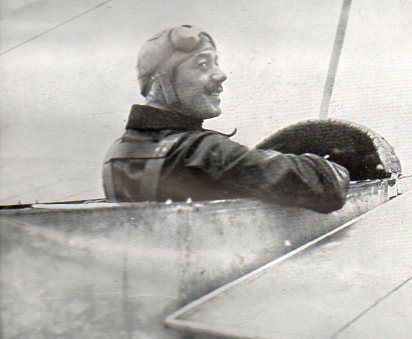
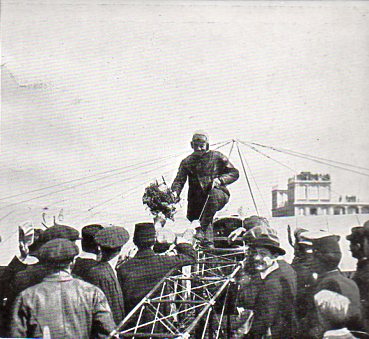
    The Wright Brothers made their powered flight in 1903, and  it is a testament to the difficulty of performing  upside-down flying that it took nearly 10 years to accomplish.  And so it happened, Adolphe Pegoud (1889-1915) accomplishing the feat 21 September 1913–he was greeted everywhere as a pioneer and a hero.  Flying upisde down, looping he loop (the distinction of “first to do this belongs to the Russian Nesterov who performed it in Kiev about a month earlier), doing the tail-slide, performing the vertical S, were all major feats, and all performed by Pegoud during this month of high activity.  But the people who seemed to take the quickest and most particular interest in these “stunts”  were the military folks, who instantly recognized the application of the maneuvers for aerial combat.  And as quickly as they saw that the maneuvers needed to learned for offensive purposes, they recognized that they must be mastered for defensive reasons, as well.  

    Aeroplane upside down625

    Aeroplane upside down624

    Aeroplane upside down623

    New York Times reported on Pegoud so:  (via The Daily Planet at the Smithsonian Air and Space):

    “Pégoud prepared a Blériot monoplane fitted with a Gnome engine and advised half a dozen friends of his plan. They did their utmost to dissuade him, but he invited them to witness the performance, and this morning at the Juvisy aerodrome he climbed into the machine and rose. At the moment of his departure he was by far the calmest person present.

    He rose to a height of 3,000 feet and then turned the nose of the machine earthward. For 200 feet it fell like a stone. It then turned inward till it was flying on its back, after which it rose perpendicularly upward. Then it completed the circle by regaining its normal flying position, having accomplished an apparent impossibility.

    The aviator came again to earth absolutely self-possessed. When he alighted from the machine his first remark was “I wished I had gone another thousand feet up. Then I could have done it twice.”

    The issue of Sciewntific American for (October, 1913)

    1913 Scientific American October 18-Pegoud;Siberian Mam
    Image Source: Pionnaire GE
    Long ago Sir Thomas Browne mused on what it was that the Sirens’ song might have been, trying to imagine and capture a source of vast imagination; it is equally complicated trying to understand how something we take so deeply for granted today was absorb when it was seen for the first time. 

  • What Was the Strategic Cost of the V-1 and V-2 to the Nazis?

    JF Ptak Science Books   Post 1551

    One of the defensive weapons in the Allies’ arsenal during WWII may have been the V-1 and V-2.  This sounds horrible to say, and I don’t mean this application intentionally, of course–but the production of the V-1 and V-2 was something that could have caused the Nazis the equivalent production of something like thousands (dozens of thousands?) of fighter aircraft–a part of the Luftwaffe that he Allies didn’t need to shoot down because they were never built.  As horrible as it sounds, the V-1 and V-2 may have been the far greater thing to choose from in the production of multiple evils.

    The Vengeance Weapon was a great-ish achievement of the Nazi regime, intended to strike enough fear and destruction in London and other cities and to render them a shambles, an effort that was thought would bring the Brits to their knees.  What happened, though, was this:  that in all of the raids and bombings at the hands of the V-weapons, much of the attack was lost to going off-course, unable to find their gigantic target.  Over time, the V-1 and V-2  terror weapons did kill 9,000 people  or so in the U.K. in their  raids from 1944 and 1945, wounding 25,000  and destroying 20,000+ houses. Over 11,000 of the V-weapons were fired by the Nazis:  more than 9,100 V-1s were fired at Britain (with 2,500+ hitting London), while 1,115 V-2s were launched.   They were terrible weapons, and they killed many people–overwhelmingly a civilian population–but they performed nowhere near their strategic intentions. 


    These totals for the entire campaigns of the V-1 and V-2 rockets  are less than those of a single large raid by Bomber Command, sometimes less than one mission, on one night.  The massive expense involved in producing the V-1 and V-2 weapons could well have been used to fabricate 5 or 10 or perhaps 25 thousand fighter planes.  Fighter planes that could have been used in the war on offensive and defensive procedures. That’s 25,000 fighter aircraft that never flew for the Luftwaffe, never terrorized anyone, never flew in defense of German cities, never had to be shot down. (Assuming of course that the Germans would have had the fuel to power them.)

    They were terrible weapons–the V-1, in particular, made a very dirty, nasty sound, that was a terrifying experience to hear.  When the sound of the engine stopped, the bomb fell.  Long, throaty, deathly gurgle,then silence, then explosion.  The V-2s came in mostly silently, a masked death, but in so doing also somewhat mollified a significant psychological terror weapon.

    Perhaps I am way off base with this, but the V-weapons seem to me to have cost the Nazis far more than they gained.  Of course if they had been able to produce an order of magnitude–or more–of the weapon and delivered it more effectively, then perhaps it becomes a different story.  It would have been a different story too if the Germans had had any reliable intelligence on the effectiveness of the weapos so that they could have adjusted their flight, and if Ultra had not existed, and so on down that ridiculous rabbit hole of speculation.  But my own idea remains that the V-weapons were not as horrific as other things could have been had those resources been allocated differently. 


  • Aerial Bombing Accuracy Calculator, WWII

    JF Ptak Science Books  Post 1545

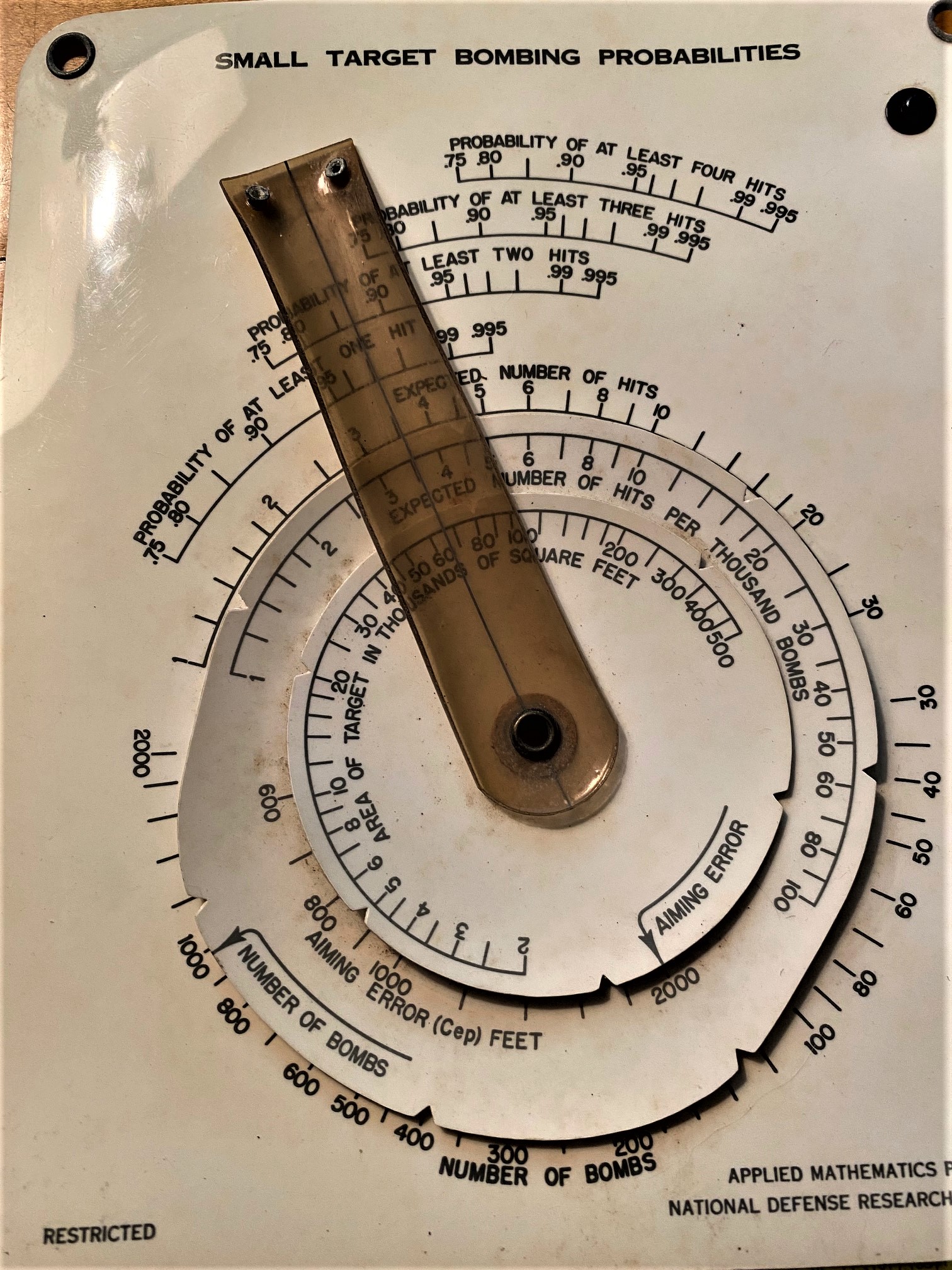
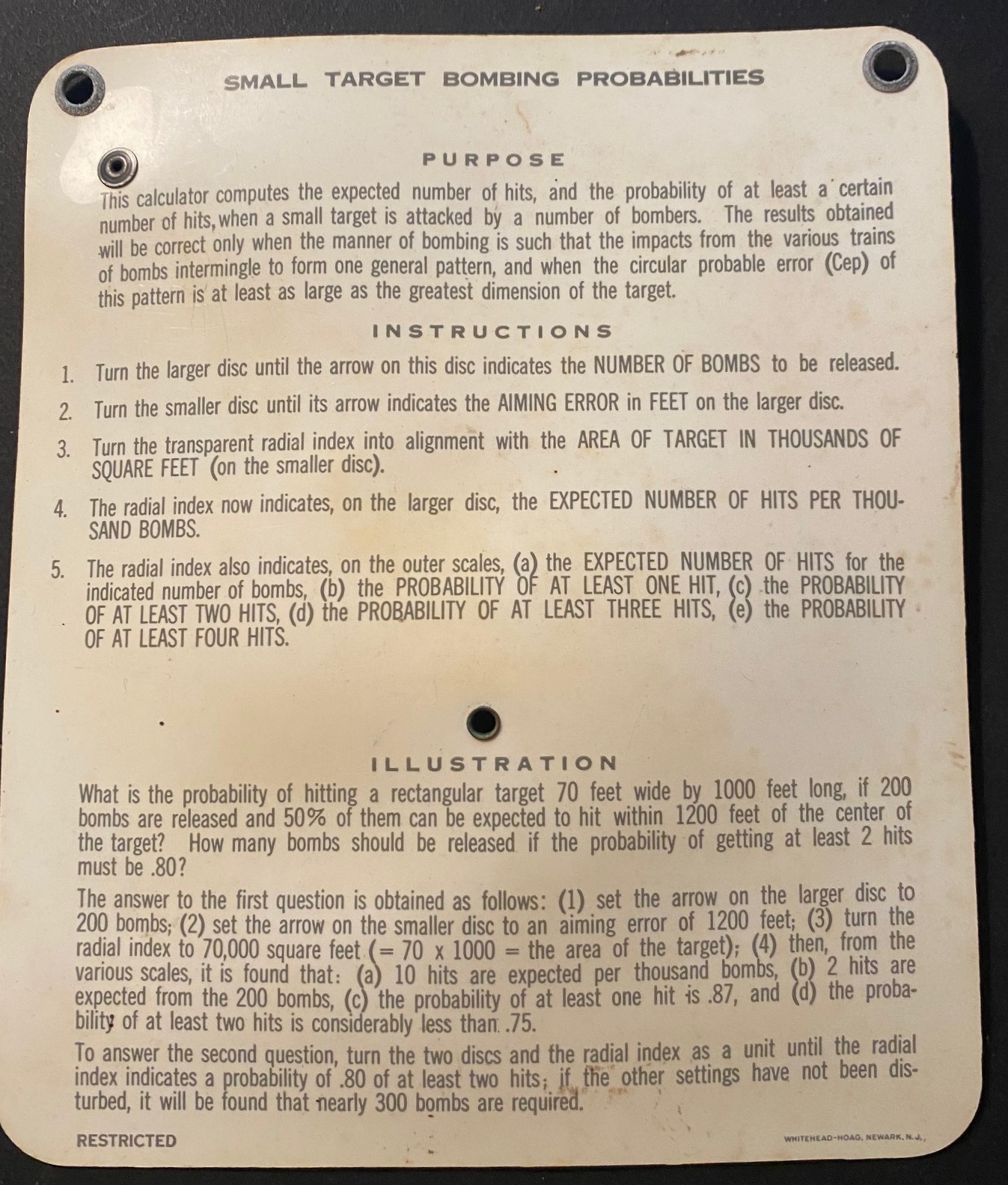
    IMG_5402I found this object in my paper-calculators box (moveable disk calculators made of paper, two going back to A. Kircher in the 1660’s)—I’m not sure why it was there as it is not paper, though it is an interesting calculator.

    [Images are greatly expanded in click mode.]

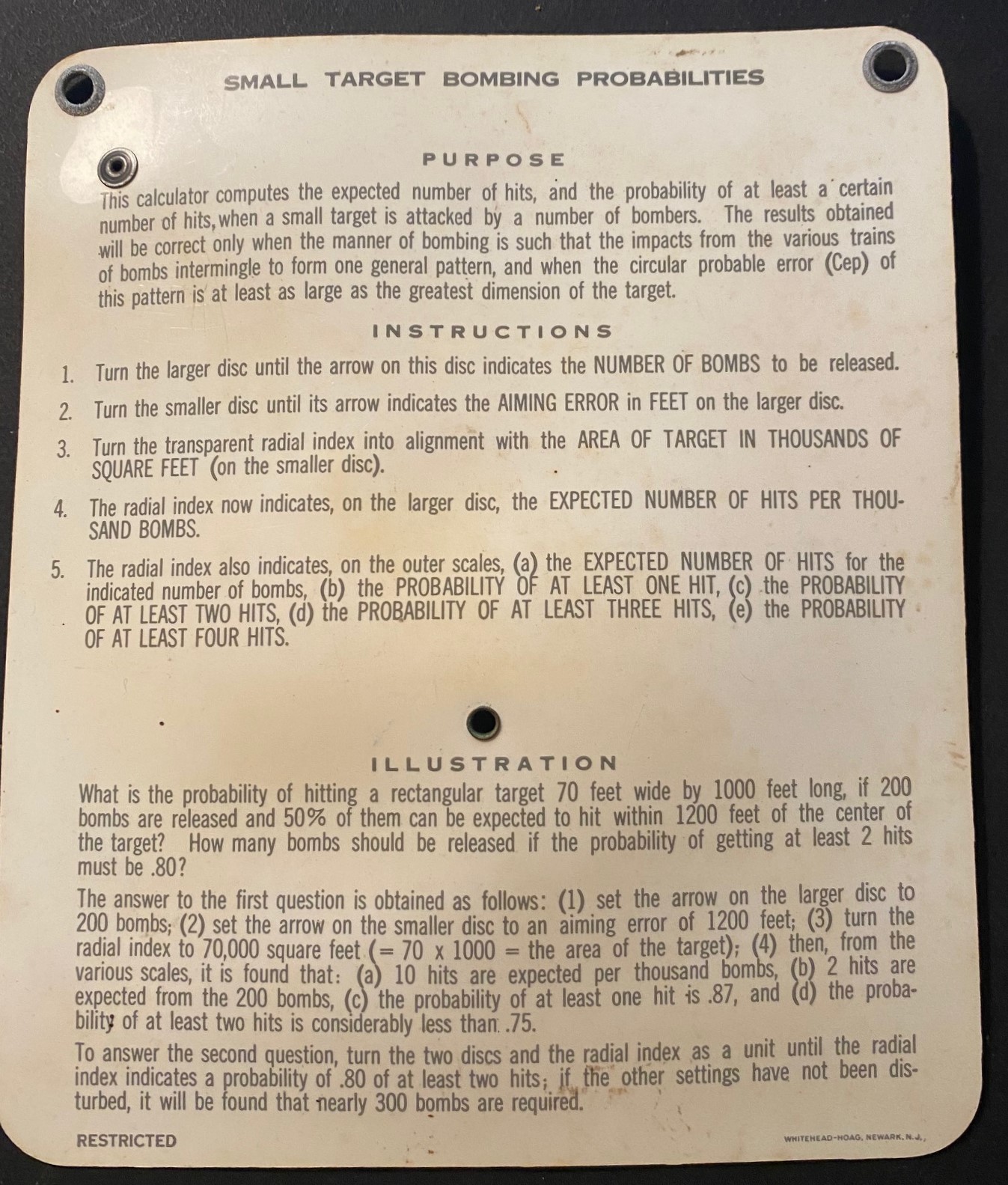
    I learned a big lesson from it.   The “Small Target Bombing Probabilities” calculator was issued by the little-known (in the popular sense) Applied Mathematics Panel of the National Defense Research Council (NDRC)1 in the early 1940’s during WWII. 


    IMG_5403Marked “Restricted”, it calculated the number of bombs that would successfully be delivered given (1) the number of bombs, (2) the “aiming error”, and (3) target size. It would then generate results for “(a) the expected number of hits for the indicated number of bombs”, (b-e) the probability of at least one hit to four hits.

    What is a little surprising to me was the number of bombs that didn’t find their target. For example, a 65,000 square foot target bombed with 1000 bombs and an aiming error factor of 2000 feet could expect to land 3-4 bombs on the target, with an 88% chance of landing at least two hits, 75% chance of landing three hits, and about 50% of landing at least four hits.  And so the necessity of large numbers of planes dropping a large number of bombs.  

    Notes

    1. The establishment of the NDRC was announced so: “It is announced by Science Service that the following committee has been appointed in the United States to correlate “scientific research on the mechanisms and devices of warfare”: — Nature 146, 191-191 (10 August 1940).

    “Members included: Dr. Vannevar Bush (chairman), president of the Carnegie Institution of Washington, formerly dean of the faculty of engineering at the Massachusetts Institute of Technology; Prof. Richard C. Tolman (vice-chairman), dean of the graduate school and professor of physical chemistry and mathematical physics at the California Institute of Technology; . Dr. Irvin Stewart (secretary), formerly Federal Commissioner for Communications and chairman of the Committee on Scientific Aids to Learning; Rear Admiral Harold G. Bowen, director of the Naval Research Laboratory, Anacostia, D.C.; Conwiy P. Coe, U.S. Commissioner of Patents; Dr. Karl T. Compton, president of the Massachusetts Institute of Technology, formerly professor of physics at Princeton University; Dr. James B. Conant, president, formerly professor of organic chemistry, Harvard University; Dr. Frank B. Jewett, president of the Bell Telephone Laboratories; Brigadier General G. V. Strong, assistant chief of staff, U.S.”


  • The “Other” Hiroshima: Hamburg, Operation Gomorrah, Summer 1943

    JF Ptak Science Books   Post  1543

    It was during the spring and summer of 1943 that the Allies came to the conclusion that the idea of strategic bombing needed to be expanded–the expansion part grown to include the total destruction of the target city. 

    The “most secret” letter1 (dated 27 May 1943)  that outlined the coming approach to aerial bombing was sent by Air Chief Marshal Arthur “Bomber” Harris  to his six group commanders and detailed the more-new strategic approach to bombing cities–the city itself would be a strategic target, with the goal in this case of destroying the entire city.

    File:Attack on Hamburg.jpg

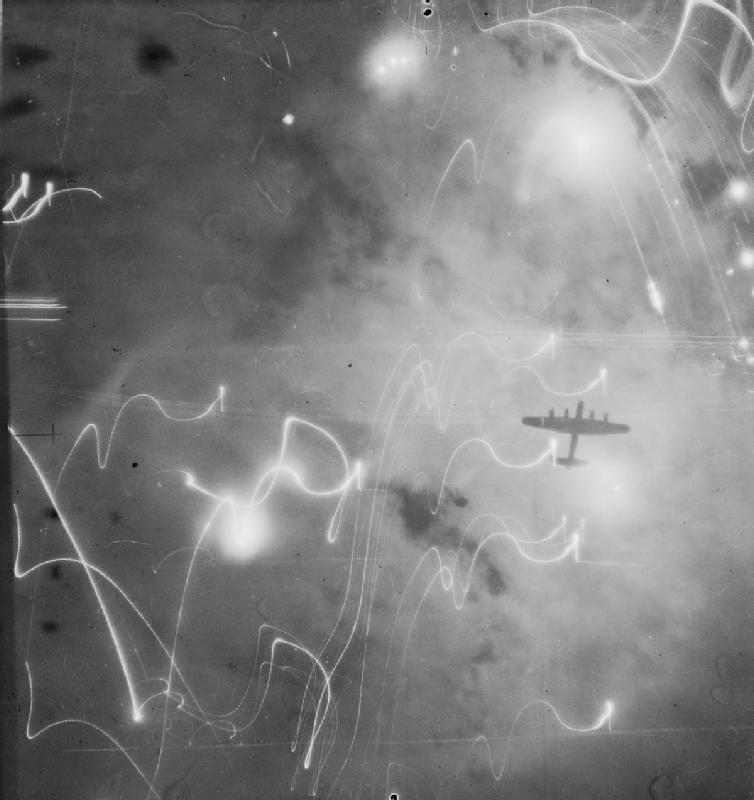
    Operation Gomorrah occupied four nights from 24-30 July, involving 791 aircraft on the 24/25th, 90-110 B-17s on the 25th, 131 B-17s on the 26th, 787 aircraft on the 27/28th,  777 on the evening of the 29/30th., and finally with 740 aircraft on the night of the last raid on 2/3 August.3,000+ aircraft were employed in the action dropping 9,000 tons of bombs.   At the end of the Gomorrah campaign, 42,600 people had been killed as well as almost 40,000 wounded, destroying about half the homes int the city and causing another million people to flee the city.  The greatest amount of damage and death occurred on the night of the 27th, when 787 British aircraft caused an enormous firestorm to be formed, at one point fueled by a 1500′-foot tall tornado of fire, which caused 150 mph fire winds, temperatures reaching so high (1800 degrees and more) that it  set the asphalt streets on fire.  Most of the dead were killed by asphyxiation, the oxygen pulled out of bomb shelters and hiding places to be used in the fires.  The infrastructure of the city had been largely destroyed before this day’s bombing, so getting firefighting crews to any of the new scenes would be impossible.  As a matter of fact, there was so much smoke generated from the previous day’s bombings that the USAAF B-17 attacks were suspended because targets could not be identified. 


    And from this point to the end of the war there were another 60+ campaigns flown at Hamburg, attacking and re-attacking oil storage facilities, shipbuilding industries, U-Boat factories, and the like.  53 missions involving several thousand aircraft, flying against the re-supplking and ruined city right to the end of the war, including 5 major actions in the last week of the war. 

    File:Hamburg after the 1943 bombing.jpg

    I don’t think that this was its own “Hiroshima” as British command thought, because, well, Hiroshima and Nagasaki have their own categories for destruction.  As does Tokyo. And Dresden.  It does though share a newness of bombing with Hiroshima in establishing the mission against Hamburg as a mission against an entire city rather than specific targets–certainly there were specific targets in mind for the hour or more worth of aircraft, but the overall effect was to support a carpet bombing plan and to initiate a fire so massive and destructive that the entire city would succumb.

    Newsreel of the bombing of Hamburg.

    Notes

    1.   The Harris ltter:

    MOST SECRET


    BOMBER COMMAND
    OPERATION ORDER NO. 173
    Copy No: 23 Date: 27th May, 1943


    INFORMATION

    The importance of H A M B U R G. the second largest city in Germany with a population of one and a half millions, is well known and needs no further emphasis. The total destruction of this city would achieve immeasurable results in reducing the industrial capacity of the enemy’s war machine. This, together with the effect on German morale, which would be felt throughout the country, would play a very important part in shortening and in winning the war.

    2. The ‘Battle of Hamburg’ cannot be won in a single night. It is estimated that at least 10,000 tons of bombs will have to be dropped to complete the process of elimination. To achieve the maximum effect of air bombardment, this city should be subjected to sustained attack.

    Forces to be Employed

    3. Bomber Command forces will consist of all available heavies in operational squadrons until sufficient hours of darkness enable the medium bombers to take part. It is hoped that the night attacks will be preceded and/or followed by heavy daylight attacks by the United States VIIlth Bomber Command.

    INTENTION

    4. To destroy HAMBURG.

    [Source]

    ·Posted by :

    ·in:

    —

  • How to Ditch a B-17, 1944

    JF Ptak Science Books   Quick Post

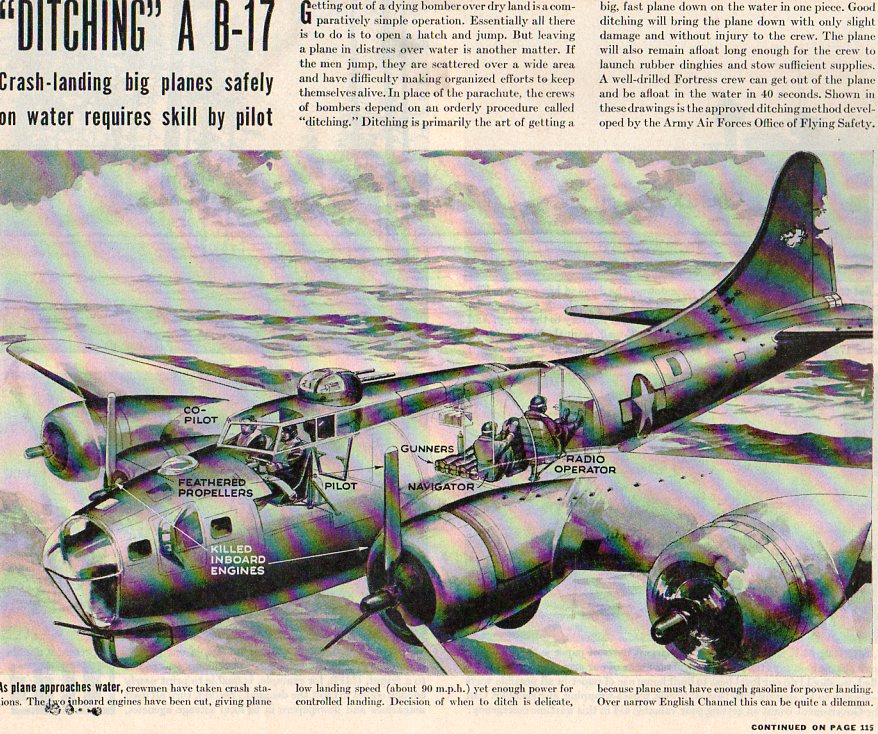
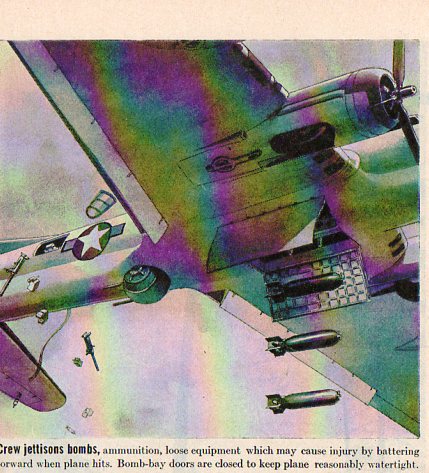
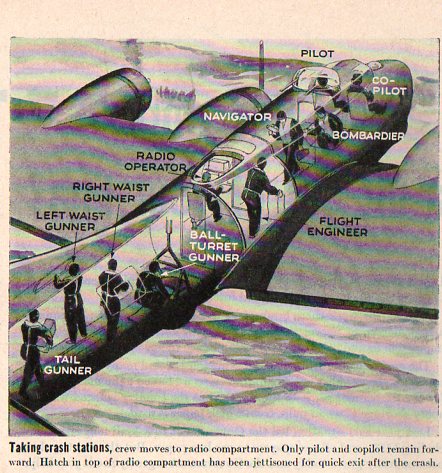
    This interesting article appeared in Life magazine on 1 May 1944 and addressed something I’ve not though about before with the magnificent Boeing B-17.

    Aviation--ditching B-17555

    Aviation--ditching B-17556

    Aviation--ditching B-17557
    Aviation--ditching B-17558

    ·Posted by :

    ·in:

    —

  • The History of Aerial Bombing, Advertising and Laxatives

    JF Ptak Science Books  Post 1534

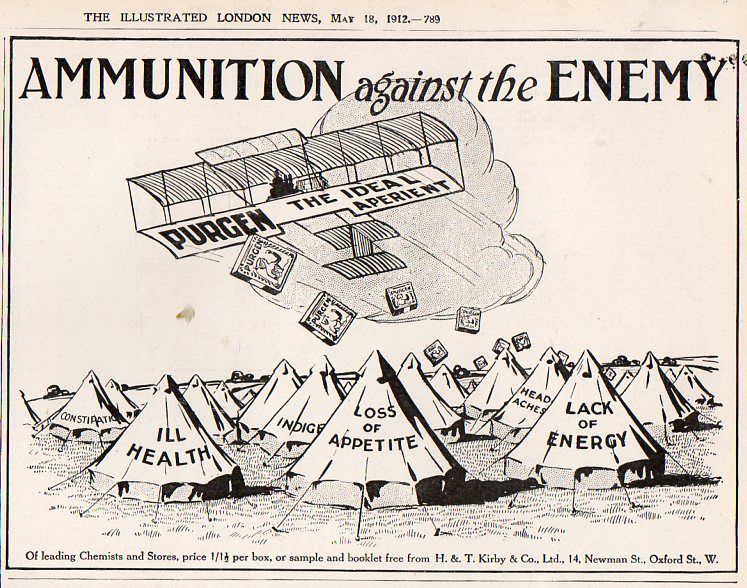
    The business of bombing people and places from airplanes/aeroplanes was fresh in the history of invention when this advertisement appeared in The Illustrated London News on 18 May 1912. 

    Bomb554
    Superweapons have been used against cities for quite some time in the new world of speculative fiction, and there had been real-life aerial bombings from hot-air balloons, but the first time that a bomb was dropped from a heavier-than-air airplane on anything happened just months earlier, on 1 November 1911, when Lt. Giulio Cavotti dropped a hand grenade from his Etrich Taube on the oasis of Tagiura, in North Africa during the Italo-Turkish War.  He dropped four parcels of hand grenades on the not-necessarily-military population at the oasis, injuring no one.  The attack was one of attempted vengeance, a payback by the Italians against the Arabs of Tripoli, in general, for having joined forces with the Turks to fight against them. 

    This air attack was fresh on the heels of a devastating slaughter of the Arabs at Tripoli on 25 October 1911–the Tripoli War would not come to an end until October of 1912. A complaint was lodged that the Italians had broken international law, as bombing from balloons had been outlawed by the Hague Conference of 1899–but the Italians argued that the spirit of the agreement did not apply to bombing from airplanes because airplanes were not balloons. The issue of the legitimacy of bombing from airplanes and then for bombing civilian populations would be a debated issue if not recognized as a restricted practice for decades to come.  As the cogs and wheels of the international court ground out its miniscule progress, people got blown up.  The people-blown-up part trumped international law almost every time. 

    In the meantime came this image of an airplane dropping boxes of Purgen, “the Ideal Aperient” on military-style tents  of “Ill Health”, “Loss of Appetite”, Lack of Energy”, and so on, all within the possibility of cure by this Purgen product.

    So, among the very first advertisements using the idea of aerial bombing as its own delivery system, was this one for Purgen.  A laxative.


  • George and Archie: Two Misty Names in Making Everything Into Nothing. Hiroshima, 1945.

    JF Ptak Science Books   Post  1523
    http://upload.wikimedia.org/wikipedia/commons/thumb/9/93/Tibbets-wave.jpg/300px-Tibbets-wave.jpg

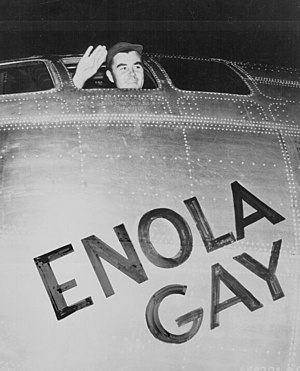
    The names of Col. Paul Tibbets and the Enola Gay are instantly recognizable, instantly placeable in the history of the twentieth century.  Fact is though that Tibbets didn’t pilot his (well, Capt. Robert A. Lewis’)1 B-29 all the way to Hiroshima and back, and wasn’t at the controls when the bomb was released.  Tibbets (also known as “Old Bull”) shared some of the tactically flawless mission with his co-pilot  Capt. Lewis, and also with George.  Well, its actually “George”,  the personified names for the autopilot of the aircraft, and I guess on the long road to splitting the atom it doesn’t matter much who did what at the final moments, especially if you were on the ground in Hiroshima. 

    It was Tibbets who flew the Enola Gay most of the way, through perfect skies, nothing to stand in the way of the aircraft and the completed mission–no Japanese fighter aircraft to haunt and hunt, and no anti-aircraft coming from the ground, at least not at their  low altitude.2 “George” was at the controls at 0815 on 6 August 1945–Tibbets would take control of the plane as the bomb fell away3, ripping the plane into a steep bank in trying to put as much distance between the aircraft and the bomb in the 43 or so seconds that they had before the explosion. Everything else about the bomb and the mission at the moment of release was controlled by a human–except for the flying of the aircraft. “

    “Archie”4 is the other name not so much remembered on this morning.  This was the name given to the apparatus (there were actually four of them on the bomb) that would initiate the final arming sequence for the MK1 bomb, “Little Boy”, one of a component of a fusing system that triggers the firing system.  It was a nicer handle I guess than its official name, which was AP-13.

    Notes:

    1.  Lewis was the original pilot of the aircraft until Tibbets was chosen to lead the mission against Hiroshima.  Tibbetts was named on 5 August and acted very quickly to get a painter to paint a name on the fuselage of B-29 82–so quickly that the guy who painted Tibbets’ mother’s name on the plane had to be pulled out of a baseball game to do the job.  When Lewis saw it, saw his plane with “Enola Gay” on it, he reacted badly, as he was mighty pissed.  He confronted Tibbets about it, but the Colonel informed the Captain that there was nothing to discuss. 

    2. Intelligence reported that the only antiaircraft resistance that could be expected were from heavier guns, which also happen to be very ineffective at the low altitude at which the Enola Gay flew.  This also benefited another aspect of the flight plan, which was fuel consumption–coming in low meant a big fuel savings, which in this case was very important because of the enormous load that the aircraft was hauling. 

    3. The Enola Gay would climb at last to 31,000 feet to release the bomb, which exploded at about 1980 feet above the ground. 

    4.  An interesting document from General Groves sums up the Archies nicely:  “Memorandum dated 24 August 1944 to Major General L. R. Groves from R. N. Brode, subject: Personnel with Radar Experience. According to the latter, the APS-13 was originally called the “Charlie” and those units to be adapted to atomic bombs were to be rigged to operate at selectable frequencies between 250 and 500 megahertz. By 1 January 1945, the “Archies,” with a “natural” range of 405 to 435 MHz, could be tuned between 325 and 485 MHz.  (“Interim Report Archie Frequency Range,” Lt. Leo Gross, 1 January 1945)–The History of U.S. Electronic Warfare, by Alfred Price, Association of Old Crows, Alexandria, Virginia, 1984, p. 232.”

    “By the spring of 1944, the APS-13 “tail warning device” was under study for use as a radar fuse. Originally designed to warn a pilot of another aircraft approaching the rear of his plane, the “Archie” had an effective range of about 2,000 to 2,500 feet.” Source: The Swords of Armageddon: U.S. Nuclear Weapons Development since 1945, Chuck Hansen, September 4, 1995, vol. VIII, pp. 3-45.

    And more:

    “Four “Archies” were used on each bomb, with a network of relays so that when any two of the units signaled, stored current was sent into the detonators (one on the MK I and 32 on the MK III). The antennas for the “Archies” were attached to the sides of the bomb casings.

    “A barometric pressure-sensing switch closed when the bomb passed 7,000 feet; the bombs were dropped from altitudes between 31,000 and 32,000 feet. A bank of clock-operated timer switches, started by arming wires pulled out when the bomb was dropped, closed 15 seconds after release to prevent the “Archies” from being triggered, in case of baroswitch short-circuit, by radar signals reflected from the delivery aircraft.

    “The arming and firing sequence for the first two atomic bombs was (1) 15 seconds after release, when the weapon had fallen 3,600 feet, the timer switches closed part of the firing circuit; (2) at an altitude of 7,000 feet, the barometric switch closed another part of the firing circuit and allowed electrical current from batteries in the bomb to charge a number of capacitors and turn on the radar fuses; (3) at an altitude of about 1,800 feet, radar signals emanating from the “Archies” and reflecting from the ground completed the last part of the firing circuit and triggered the detonation signal.”