A Daily History of Holes, Dots, Lines, Science, History, Math, Physics, Art, the Unintentional Absurd, Architecture, Maps, Data Visualization, Blank and Missing Things, and so on. |1.6 million words, 7500 images, 4.9 million hits| Press & appearances in The Times, Le Figaro, Mensa, The Economist, The Guardian, Discovery News, Slate, Le Monde, Sci American Blogs, Le Pont, and many other places… 5000+ total posts since 2008.

Category: Aviation & flight

  • Proto-Surrealist Flying Machines

    JF Ptak Science Books   Post 1790

    In what he gives to thee, this Paradise
    And thy faire Eve; Heav’n is for thee too high
    To know what passes there; be lowlie wise:
    Think onely what concernes thee and thy being;
    Dream not of other Worlds, what Creatures there [ 175 ]
    Live, in what state, condition or degree,
    Contented that thus farr hath been reveal’d
    Not of Earth onely but of highest Heav’n.

               –J Milton, Paradise Lost, Book 8 (The Argument), line 175 ff

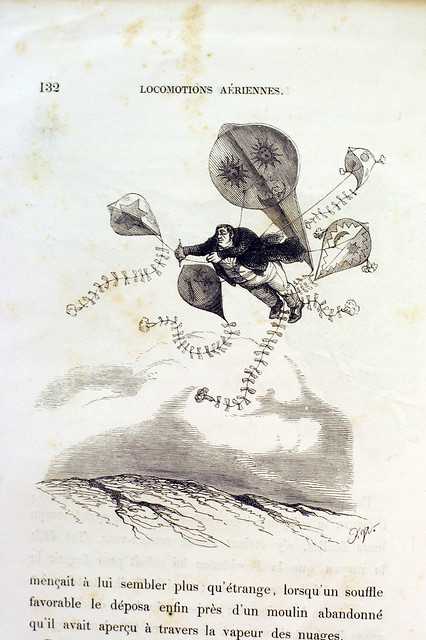
    This is another in a series of posts (starting here with an introduction) on the great J.J. Grandville, a visionary artist of high imagination with good strong claims to being an 1840’s proto-Surealist.  This small collection of flying machines appears in his Un Autre Monde, published 1844. 

    photo
    photo

  • Aviation Games, 1913-1917

    JF Ptak Science Books   Quick Post

    I was wondering how early aerial warfare was used as the basis for a child’s structured entertainment, and so passed a little time in the U.S. patent archives for a quick overview of patented games.  I was more interested in games than simple toys

    The first is an ingenious military game that included playing chits for “aerial mines”, which in 1913/1915 was a forward-thinking defensive device, though not much tested.  (The the full text and explanation of the game is  here.)

    Next is a magnetic game–which again was patented during WWI–in which aircraft were supposed to seek out and destroy forts, naval ships, and other tools of war.


  • Land Mines in the Sky, 1913-1919

    JF Ptak Science Books   Quick Post

    With the beginning of the aviation age in warfare came the anti-aircraft era.  In the first years of WWI opposing forces knew that aircraft would be coming but didn’t quite yet know how to deal with them. Some of the results of thinking about how to stop marauding aircraft can be seen below in a few examples of patents taken from the U.S. Patent and Trademark Office.  All of the following examples employed balloons–balloons that stationary and rigged in one way or another so that a passing plane that snagged this line would cause the explosive device that moored the balloon to swing up and detonate on or near the aircraft.  That means that a great many of these devices were needed to be an effective deterrent against aircraft. (I had written earlier in this blog about barrage balloons proposed for use in/around London in 1938, here.  This mode of anti-aircraft balloon was static, though, and at least in this circumstance the balloons were meant to snag and not necessarily try to blow up anything caught in its cable.)


  • Balloons I Know But Do Not Love–Deaths from Above, Ads and Bombs

    JF Ptak Science Books   Post 1771

    In the early days of aviation aerial assault must have seemed incredible–and an abomination.  Hurling stones and other offensive weapons by trebuchet and catapult is one thing, and  launching balls and shot from cannons and mortars is quite another–but actually having your weapon flown over an enemy’s position and dropped, remotely or via cable, must have been ab excruciating achievement, militarily speaking.  To be able to direct an explosive charge over a position not reachable by an infantry (say in 1915) must’ve been a short-lived comfort on the offensive end, though the user of such a technology would also have to contend with the contrary, as the enemy would be able to do the same thing themselves. 

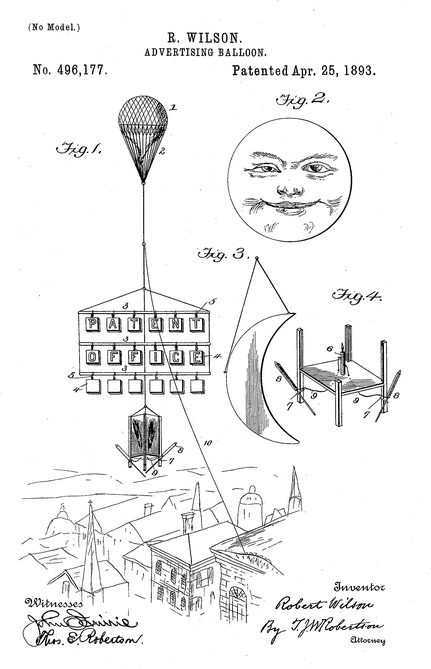
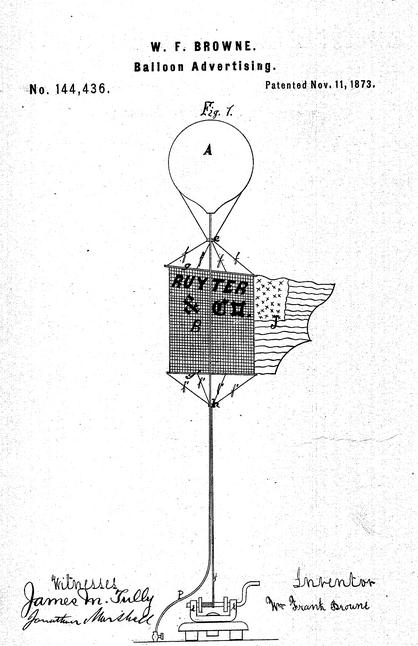
    This idea was not limited to just military purposes.  Companies could now wage an advertising war war against competitors  in a thee-sky’s-the-limit campaign, hoisting their ads on balloons anchored over a city, making it possible for the first time to have your message so universally read, a pre-intertubes version of smoke signals. 

    Patent balloon advertising 1893[Source:  Google patents, http://www.google.com/patents/US496177?dq=balloon]

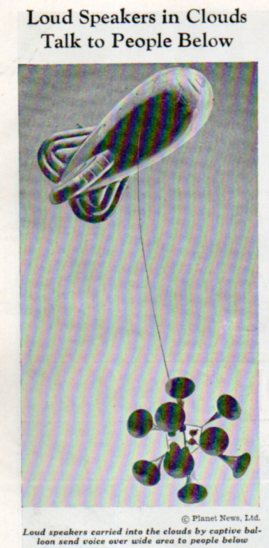
    Sky speakers413

    And this, seeming more on the Orwellian/1984 side, or perhaps more contemporary as an instrument of the Dear Leader in North Korea (left, from Popular Mechanics, July, 1939).


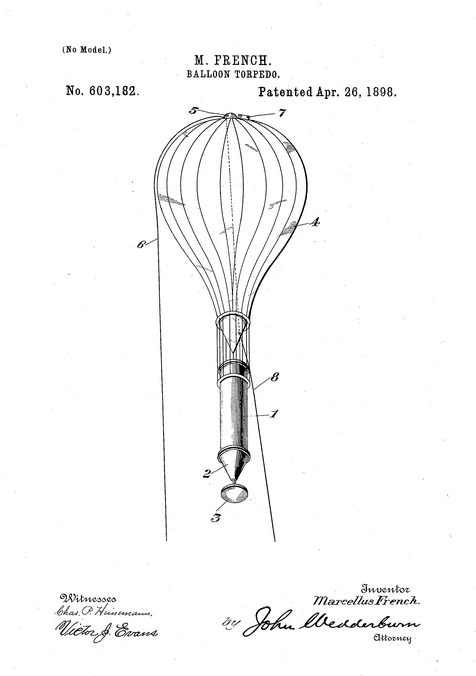
    Here’s an interesting, pre-airplane, airship-delivered explosive device: floated over an enemy’s position, the chord would be pulled at the desired time to create a tear in the balloon’s top, sending the craft down, with the bomb exploding on impact:

    Patent balloon torpedo[Source: Google patents, http://www.google.com/patents/US603182?dq=balloon]

     Another sort of slow death from above advertising scheme:

    Patent balloon 1873

    [Google patent:  http://www.google.com/patents/US144436?dq=balloon]

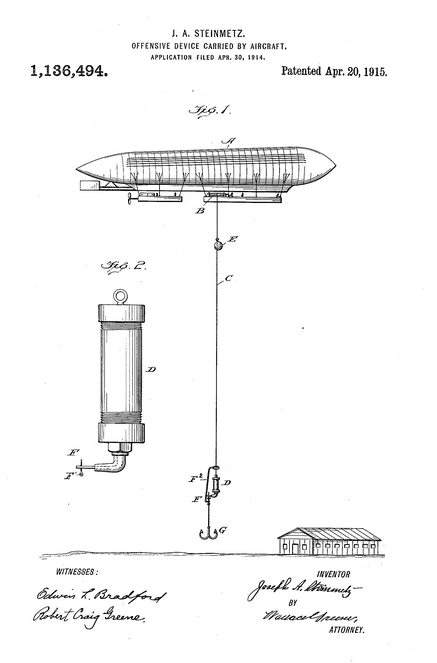
    In this device patented by Steinmetz the explosive device is still actually attached to the aircraft when exploded–not a very common way of delivering your weapon.  The airship would advance on the enemy, with the bomb  attached to a cable just above an anchor at bottom; the anchor would grapple the target, and the bomb detonated from the  gondola of the airship:

    Patent Balloon gondola


  • Disinventing Human Flight–Hiram Maxim’s Steampunk Mistake

    JF Ptak Science Books   Post 1751

    Hiram Maxim, Sir Hiram Maxim, an ex-pat Yank and a great inventor of things other  than aircraft, certainly did not do his best on his early flying machine.  He built an enormous monument to Steampunk Aerostation, and in that 8,000 pounds of steel wheels and smoke, he completely lost the idea of making a flying machine, concentrating solely on the idea of thrust and lift, consoling himself with the notion of raising a brick from the ground.

    Hiram Maxim sitting with dignatories on support rail by his crashed aircraft, Baldwyns Park, 1894

     I’m not sure that you can disinvent many physical things, although I know that there have been many attempts to do just that , though usually in the fields of human beings doing horrible things to other human beings.  The Soviets I know disinvented untold numbers of people in the plague years of the human stain, Joseph Stalin; so to with Adolf Hitler, who tried to disinvent the Jewish people and the Soviet Union. 

    Hiram Maxim (1840-1916) tried to build a monster that would leave the ground but not actually fly, and he basically did just that, very briefly with very heavy/crashy results. His flying machine was over 100′ wide, had two 17.5′ propellers, room of multiple crew members, weighed four tons, and traveled along guiding railroad tracks on steel wheels. In 1897 it powered  down 1800′ of track before accidently breaking free of its moorings and  rizing briefly above them for a distance of about 100′, which at 40mph would’ve been about 2 seconds of  foot-tall “flight”, causing the crew to shut the engines down and causing the whole thing to crash  And that was that, the end of Maxim’s adventure. It was remembered by him in strange and wonderfully terrible ways in his memoirs, where he claimed that his truly dreadful ideas were those that were used and copied by the pioneers who followed him and who actually created successful flying machines.  That he could remember things in their imagined states with such hopeful clarity is to think of him as providing precisely the wrong blueprints at the right time. 
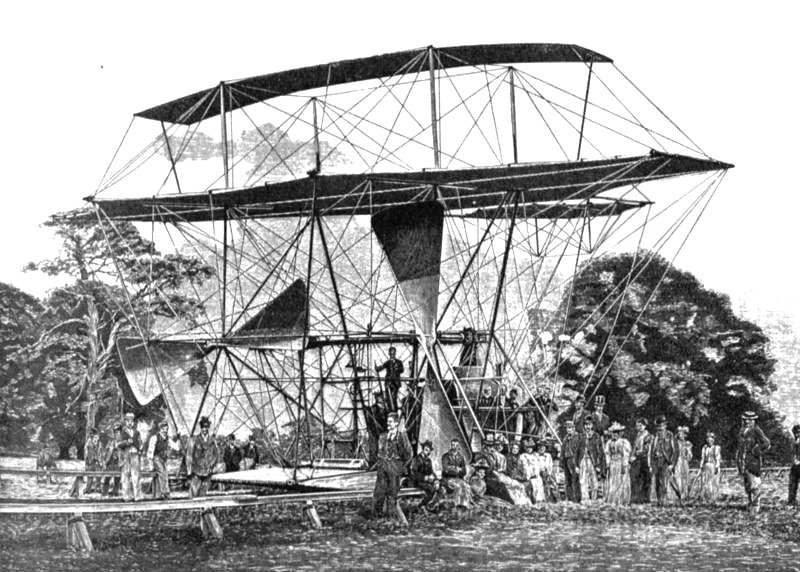
    http://www.wright-brothers.org/History_Wing/History_of_the_Airplane/Who_Was_First/Who_Was_First_Intro/Who_Was_First_Intro_images/1893_Maxim_Test_Rig.jpg

    In his book, Aviation, an Historical Survey from its Origins to the End of World War II (Science Museum, London, 1970), the insightful, opinionated and occasionally acerbic Charles H. Gibbs-Smith remarked on Maxim’s outlandish maxims on his enormous failure, quoting him so:

    “…the fact that practically no essential departure has been made from my original lines, indicates to my mind that I had reasoned out the best type of a machine even before I commenced a stroke of the work”  (Maxim, Natural and Artificial Flight, 1908)

    Gibbs-Smith writes: “it is hard to imagine anyone uttering more egregious nonsense”, and when you look at the Maxim machine and see its specs and the nil-time spent on what to do with the thing if it ever actually lifted off the ground, you’d be hard-pressed not to agree.  Had people followed his lead, Maxim would have been able to disinvent human flight.  There, I said it.  There’s wrong, and then there’s wrong–and then there is this.


  • An Early–and Patented–“Flying Saucer”, 1898

    JF Ptak Science Books   Quick Post

    This magnificent flying thing was perhaps among the earliest of its kind, at least according to shape, which as we can see really wasn’t quite a flying saucer,, though it was a flying disk.  And a big one, at that.  From the ladder that led to the major axle we can infer that the aircraft was at least 60 feet high, which made its disk apparatus a very ferris-wheel-like 40′ or 50′ in diameter.  If nothing else, the patent drawings are quite pretty.


  • A Few Examples of “Heavy Stuff”: Patent Drawings for Flying Machines, 1877-1900

    JF Ptak Science Books  Quick Post

    This is as beautiful as it is heavy; and it is in its way very beautiful, so I guess that also means that is is very heavy…

    And speaking of heavy, this balloon doesn’t seem large enough to lift the very heavy ship-like carriage:

    Another flying boat:  I don’t see a power source to drive the “fans”/propellers on this one, though there is a tail for its “kite” body:


  • Drop-Dead Gorgeous Flying Man/Ornithopter Patent Drawings, 1889

    JF Ptak Science Books    Post 1746

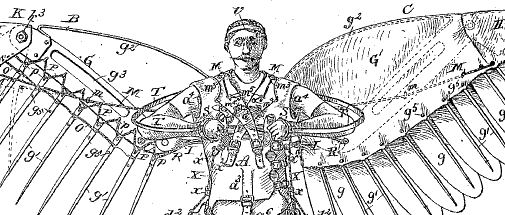
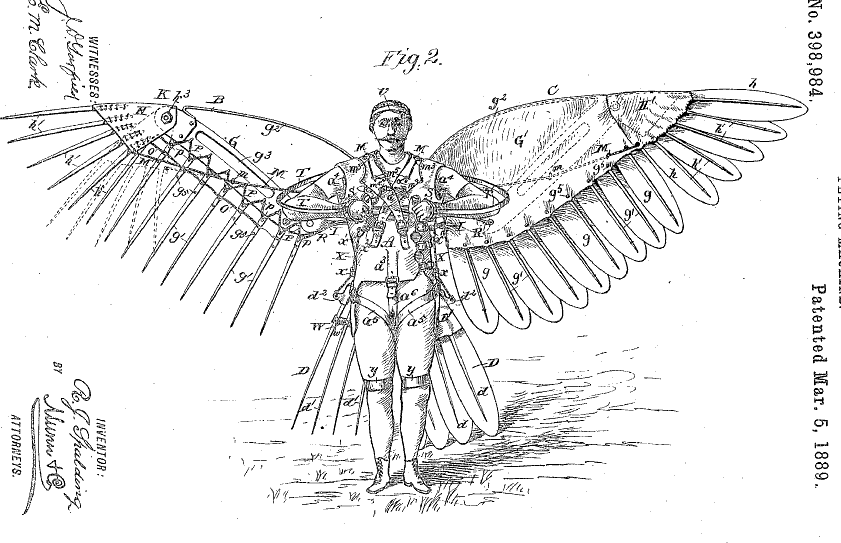
    This is one of the most appealing sets of “flying” or manned aerostation patent drawings that I have seen in the USPTO collection for the 19th century. The machine is a human-powered ornithopter, applying the structure of a human against that of a bird, and outfitting the flyer accordingly to combat their human weaknesses as adapted to bird flight.  Needless to say, and in spite of the beauty of the thought, this arrangement was destined to deep failure.  (The patentee, Reuben Jasper Spaulding, of Rosita (“Little Rose”), Colorado (south of Pueblo), may have been the same Reuben J Spaulding who made the first gold strike on the Blue River on Colorado’s Western Slope in 1859.)  Spaulding’s design is interesting also for the balloon device for getting the aero pioneer off the ground. 

    [Source:  Google Patents (and also for the extensive annotations for the images).]  I note that there was a model constructed for this patent–I’d love to see that.

    Patents--spalding flying_edited-1

    Patents--spalding flying

    And along this same vein of ornithopter-y thought is this, another American solution to the man-bird-mechanical-flight continuum, produced a dozen years earlier–it is similar, though not nearly as glorious (at least in presentation) as the later Spaulding effort: 


    The work really ins’t quite as awesome as Spalding’s beautiful Lazarusian resurrection, and not as detailed, but still quite interesting:


  • Tech-Quiz–What is It? (#7, 1893)

    JF Ptak Science Books   Quick Post   [Part of the Tech-Quiz series.]

    Generally with these questions I provide a detail of a patent drawing and from that the application is supposed to be derived.  Here, though, is the full drawing, and is seems pretty straightforward, I think, though the ultimate use of the contraption might not be so obvious.  Or perhaps it is?   What was the intended purpose of this object?


    Answer in the “extended reading” section, below:


  • Hydrogen Balloon Properller Pseudo-Steampunk Downton Abbey Airship, 1882.

    JF Ptak Science Books   Quick Post

    I think that there must have been a certain satisfaction for Mr. R.L. Downton when he had the idea for hydrogen-filled propellers–I mean, they must have made a lot of sense to him, sitting there in the Abbey, pondering the elegances of flight, while letting Maggie Smith walk away with all of the best lines.  Well, I’m kidding of course about Maggie Smith and the Downton Abbey remark, but I can well imagine Mr. Downton feeling as though he came to some sort of breakthrough by making the propellers for his flying machine its lifting device as well.  We can see in the first image that the “aerial ship” has side-by-side propellers and is driven by steam–the airship is still a little too refined and relatively light to fall into a classic “Steampunk” mold. 


    The second drawing shows a modification to the somewhat-large ship above, with the airship being a flying gondola, with the hydrogen-filled propeller being hand-cranked.  It wasn’t a great idea by any means, but it was very interesting, at least to me.