A Daily History of Holes, Dots, Lines, Science, History, Math, Physics, Art, the Unintentional Absurd, Architecture, Maps, Data Visualization, Blank and Missing Things, and so on. |1.6 million words, 7500 images, 4.9 million hits| Press & appearances in The Times, Le Figaro, Mensa, The Economist, The Guardian, Discovery News, Slate, Le Monde, Sci American Blogs, Le Pont, and many other places… 5000+ total posts since 2008.

Category: Aviation & flight

  • German Rocketry, 1920’s & 1930’s: Cover Designs

    JF Ptak Science Books   Post 1901
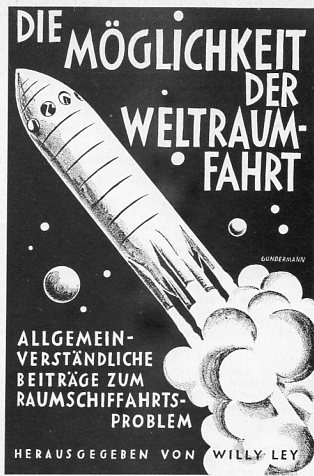
    Rockets ley794

    I’ve selected a few representatives of design for the covers of pamphlets and books published in the field of rocket development and space flight published in Germany in the 1920’s and 1930’s (with one from the 1951).  They have a certain expectant sameness them, and, as leading publications in their field, have a remarkable similarity in their (black and white) design.  The combined efforts of these works wound up in the engineering labs of Peenemuende and then int he V-1 and V-2 rockets that pulverized the United Kingdom during WWII.  Later this same expertise, and some of the same engineers, “wound up” in the United States developing the American space program.  The most famous of these Paperclipped scientists was Wernher von Braun, whose name is so intimately connected with the Vengeance Weapons as well as the Apollo space program.  It is interesting to note that for many years if twas impossible to find von Braun’s name on any exhibition description in the Air and Space Museum in D.C.–it just wasn’t there, so far as I could tell, on no displays, even though I went looking for it pretty closely.  On the 30th anniversary of the Moon landing, I went to von Braun’s grave to see if it had been remembered in any way–there wasn’t anything there, just his simple small slab, next-door to and within eyesight of a Jewish cemetery. 

    Rudolf Nebel (1894-1978), very early member of the Raketenflugplatz, assistant to Hermann Oberth and very nearly the first to successfully conduct an experiment with a liquid-fueled rocket, beaten to the finish line by a man whose work he was not familiar with, Robert Goddard.  He defined right-wing in the Weimar era, and was part of a paramilitary organization called Stralheim; Wernher von Braun seems to have succeeded in the avenue that Nebel tried to travel along.  Nebel published this work in 1932, a year before the Nazi party came into power, and before his crotchety problems with teh SA began.
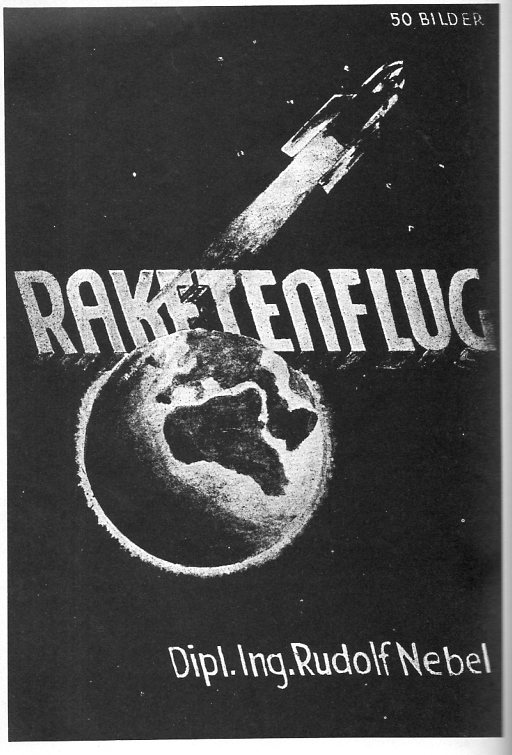
    Rocket nebel797


  • The Height of Flight: London, 2026 Future Vision

    JF Ptak Science Books   Post 1867

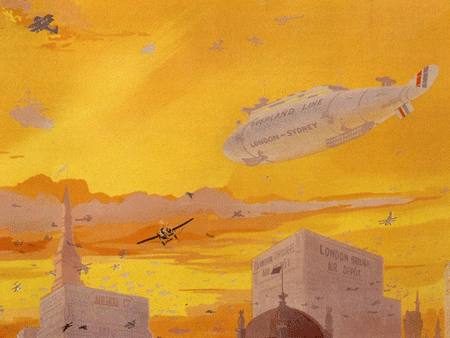
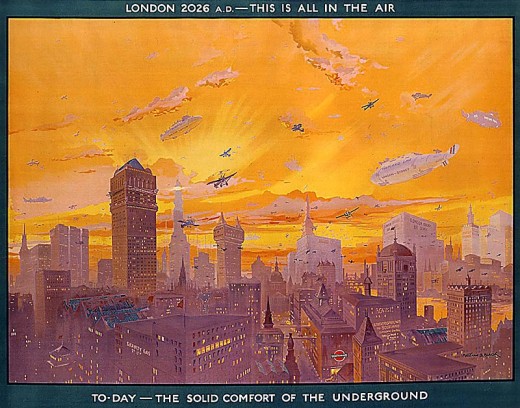
    Montague B. Black (b. 1884), an artist and illustrator, pulled the curtain back from the future back there in 1926 to what he thoiught might be the following scene of London in 2026:

    London-2026-520x408
    A detail reveals an interesting airship:

    London 2026  detail
    The airship (of an undetermined power source) has an ad on the side of it reading “Overland Line, London-Sydney”–and by “overland” the artist is not thinking of the old-time “overland” as in prairie schooners and such, but quite literally “over the land”.  We can also see an ad on the side of a building for an “Underground to Scotland, Glasgow 2hrs 45 mins”.  There are also named buildings such as the London Bridge Air Depot and the Airtaxi Ltd.  The skyscrapers really aren’t all that enormous–I see one or two perhaps in the background that might be a hundred stories or so, but the buildings in the foreground are definitely of modest expectation. 

    There are however dozens of flying machines in the sky, though with the exception of the three large airships, a hundred years has not paid too many benefits to the other aircraft. 

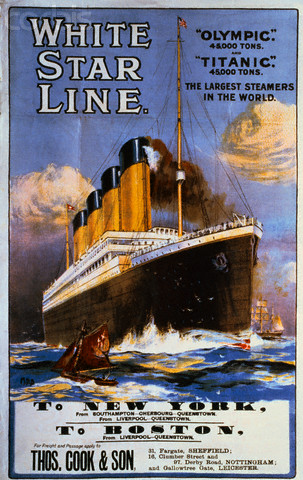
    Black did create an interesting poster for the White Star line, featuring a certain famous luxury liner–of course the man was just like anyone else, and could not see into the future for the Titanic, nor could he imagine slightly accelerated designs for aircraft.  He did manage to portray a transportation system that would be heavily dependent on air travel.  That said, he left plenty of room for speculation on the future of the Underground, as we can see in all of this future-glory that no matter the amount of accomplishments in the sky, trains would still be running underground.  Black got those two things right, at least. 

    London titanic


  • Artistic Comparative Display of Quantitative Data–Winning the Battle of the Atlantic by Flying Over It

    JF Ptak Science Books   Quick Post    

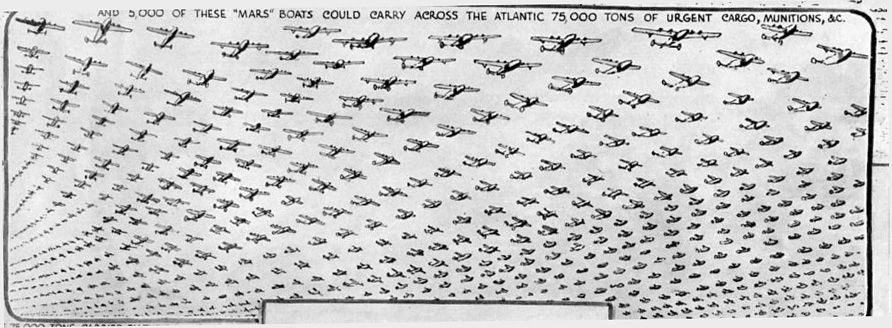
    I simply love infographics like this—especially big skies filled with airplanes.  I’ve written about other similar descriptions of sky-filled aircraft here.

    Brit troop carriers729
    In October 1942 the war was shifting to the way of the Allies–the United States had come into the fight ten months earlier, Operation Barbarossa (begun in June 1941) was at this time being recognized as a complete failure (though the operation would continue on for two more years, costing 5 million German army lives, 20 million Soviet civilian lives, and 9 million Soviet army lives and more when all was said and done), and American military production was very well underway and unbeatable, and so on. The Battle of the Atlantic however was still very much underway, with action returned their, again, during the summer and autumn of 1942. 

    Brit troop carriers728
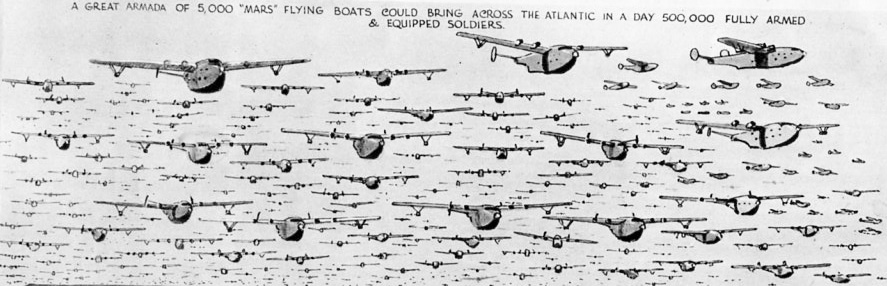
    One way of defeating the U-Boot was to not sail the Atlantic much at all, and flying troops and supplies above it.  As we can see in this compelling graphic from The Illustrated London News of 17 October 1942, the editors of that magazine made a case for the Mars flying boat.  It was a theoretical case, as the 5,000 Mars planes depicted in the graphic never materialized–actually, it seems as though only seven were made. 

    But the case looked very compelling.


  • Complete Destruction of an Entire Country: Japan, 1945

    JF Ptak Science Books   Post 1861

    Atom bomb 720
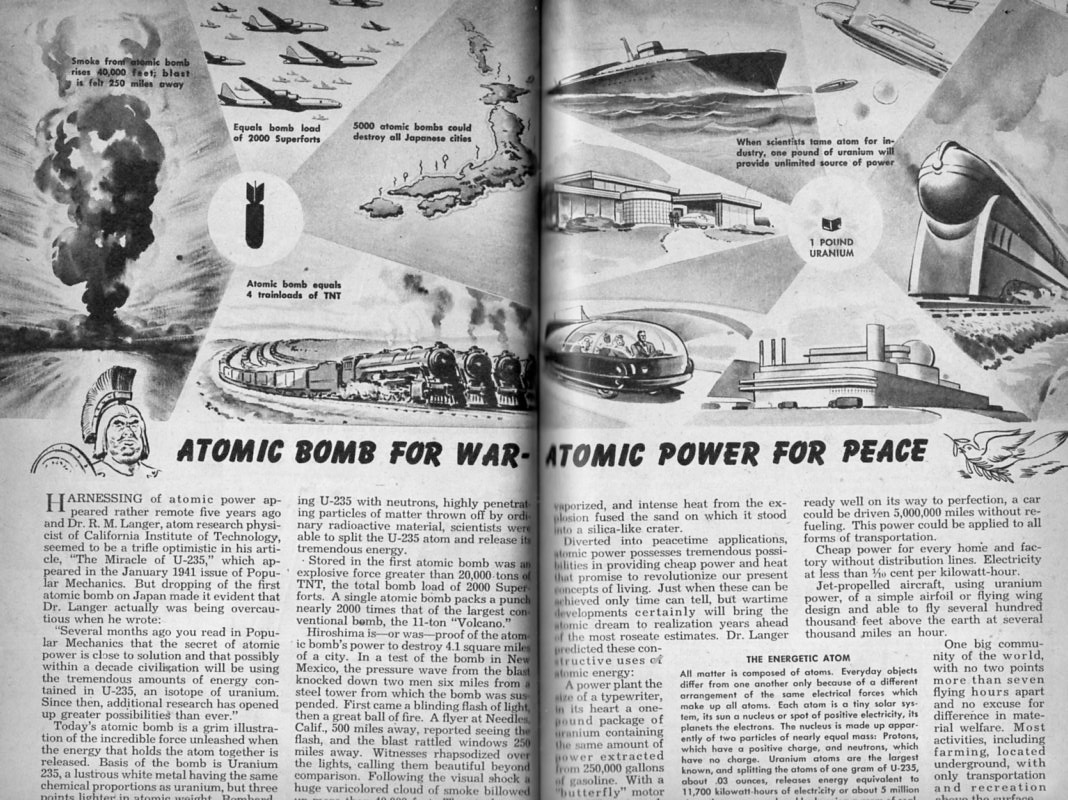
    The October 1945 issue of Popular Mechanics carried a story “Atomic Bomb for War / Atomic Bomb for Peace” as a reminder, I guess, to its readers that the vast destructive power of the atomic bomb was just one example of what nuclear power might be–and that there could be incredible and wide-reaching benefits of the process for peaceful uses. This work came about eight weeks after the bombings of Hiroshima and Nagasaki, and seems to be only the second post-use story on the weapon. 

    Atom bomb 719
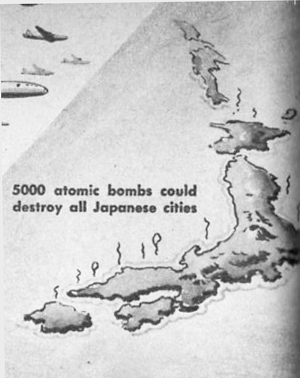
    Half of the article’s illustration is dedicated to military applications of atomic energy, and the other to the peaceful; and in the upper-middle of the military side we are told that if necessary that every city in Japan could be completely destroyed with “5,000 atomic bombs”.  The truth of the matter is that a great percentage of the major  (and minor-major and major-minor) cities had already been pretty much decommissioned. (Just weeks before the bomb came the massive firebombing of Tokyo–334 of  General Curtis LeMay B-29’s were loaded to utmost capacity with the newly-conceived M-69s bomb, an incendiary so vicious  that the fires it produced were all but inextinguishable.  The B29’s bombed Tokyo for hours, killing 100,000+ people and making over a million homeless.)  And so I’m not sure what the message was, here, except to establish that the complete destruction of a city with weapons dropped from planes was now a possibility.  It was probably right at about this point that this idea became a real possibility–and so to for its extension, that given enough of these weapons, that the entire world could be bombed out of existence.


  • Daily Dose of Dr. Odd–Future of Air Travel, ca. 1900

    JF Ptak Science Books     Daily Dose of Dr. Odd 2

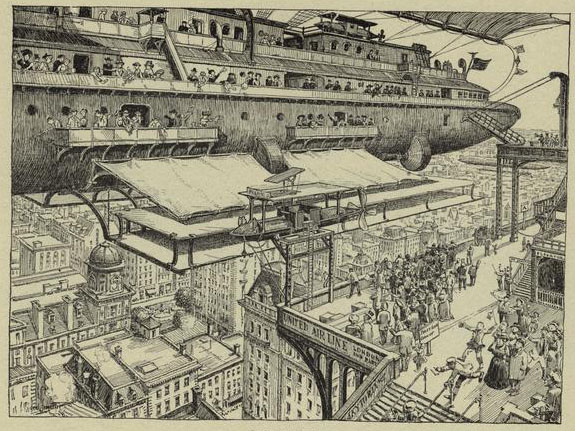
    In today’s quick dose from Dr. Odd we find the “United Air Line” (so close to the name that actually came into being), ca. 1900, featuring an enormous and extraordinarily heavily-bodied airship of a construction of pure speculation.  It is gigantic and weighty, and it seems as though the thing is powered by pulsating awning-like wings and a series of covered propellers, all under what seems to be sail. 

    The crowds bustling beneath the behemoth seem as any other crowd waiting for the subway, or third class, or, well, whatever sort of mass transport would await and was taken for granted.  There are no bands, no fireworks, no fanfare, just the arrival/departure of yet another airship leaving for London from New York City, as much a cause for attention as any airliner traveling overhead.

    Dailydose airship

    Source:  New York Public Library Digital Collections, here.

    Source:  New York City Digital Collection, here.


  • Atomic Aircraft, 1946-1961

    JF Ptak Science Books    Post 1810

    Shooting Down the Nuclear Plane,  by W. Henry Lambright, (Inter-University Case Program #104, Bobbs-Merrill Co., 1964), is an interesting and nicely-documented history of an idea whose firm grasp on reality night not be terribly firm.  Of course it would be possible to prodce such a thing (at about this same time in 1961 appeared a cover for Popular Mechanics for an atomic-powered car from which two cowboys went a-hunting) if there was the collective will to do so, and there almost was.  Let’s just say then that the atomic-poweredness of our domestic defense was limited to aircraft carriers and submarines, and the atomic-powererd aircraft were left to science fiction .

    In general though it was at this time, from  about 1946 thorugh the late 1950s’, that people were thinking of refitting standard power systems with atomic energy. 

    Here are a few ideas for alternative approaches to flight, provided by the happy folks known as Atomic Energy:

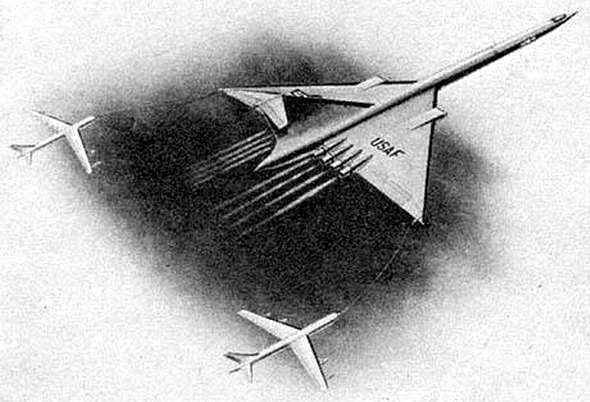
    Another possibility for a nculear powered aircraft, by Northrup:

    [Source]  Another interesting design–a nuclear-powered prop plane, X-6, “derived from the Corvair B-36”:


  • “The Enemy is Less than Ten Minutes from San Francisco”, 1942

    JF Ptak Science Books  Quick Post

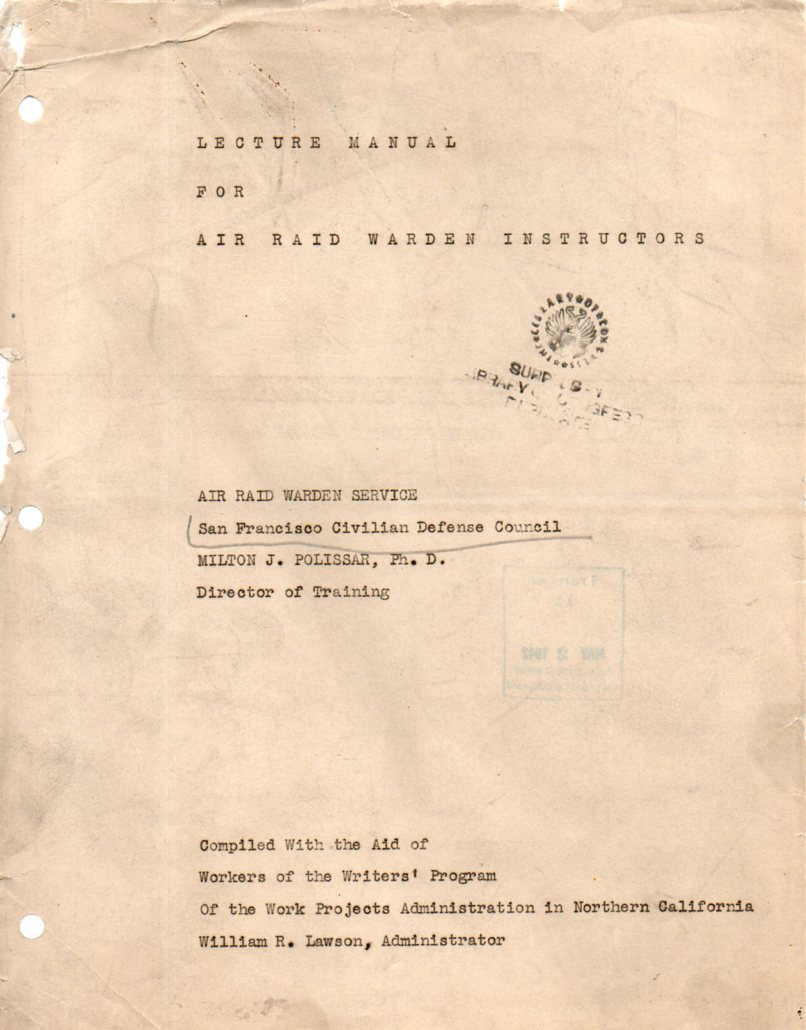
    Air warden478Lecture Manual for Air Raid Warden Instructors is in its way a remarkable document revealing some of the thinking and interpretation on the chances for the invasion of the American west coast just a few months (March 9, 1941) following Pearl Harbor.   Undertaken and published by the Workers of the Writers’ Program (‘of the Works Projects Administration in Northern California”) it was a product of one of the number of the Roosevelt administration’s social engineering programs that had a long lasting effect. 

    The first chapter, “It Can Happen Here” is more about the mechanics of responding to an enemy aerial attack than qu8estioning whether the attack might occur–the writer assumes that such an event was possible, and so precautions and preparations must be made–there is no question mark at the end of the chapter’s heading. 

    Overall I think that this was an excellent organizational effort for at least dealing with controlling the situation on the ground–providing a grid in which actions could be interpreted and responded to.  [The original is available at our blog bookstore.]


  • Addition to Inner City Rooftop Airport Design: Big, Bad, & Ugly; London, 1931

    JF Ptak Science Books    Post 1799

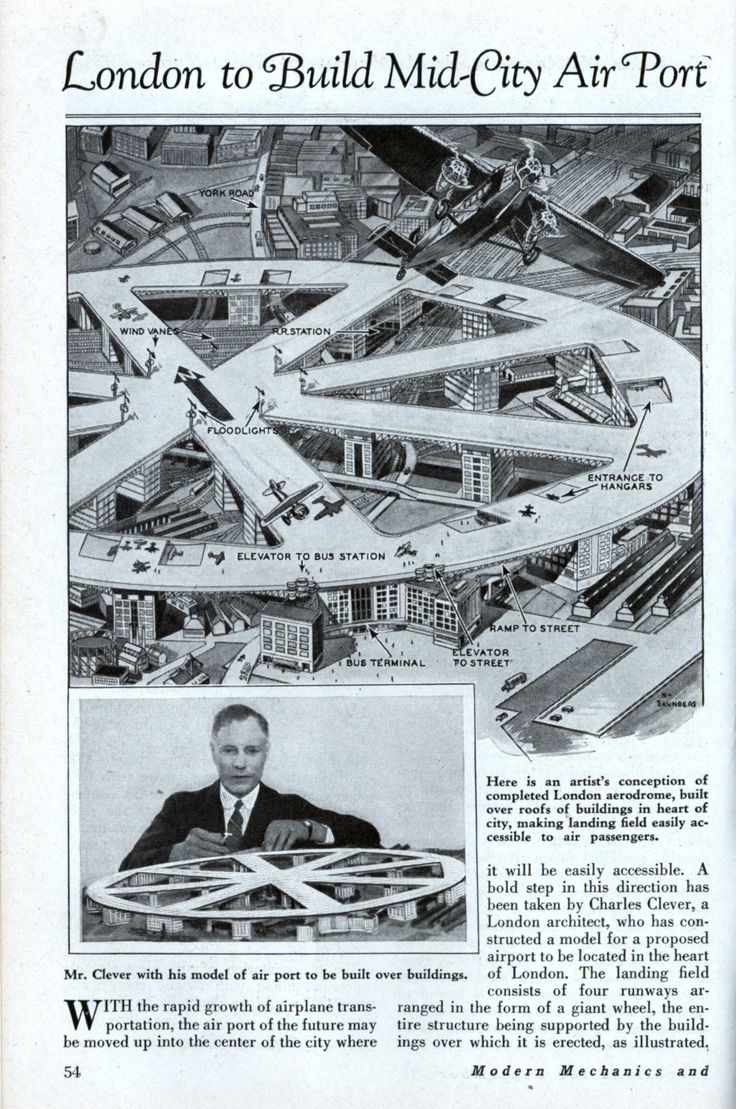
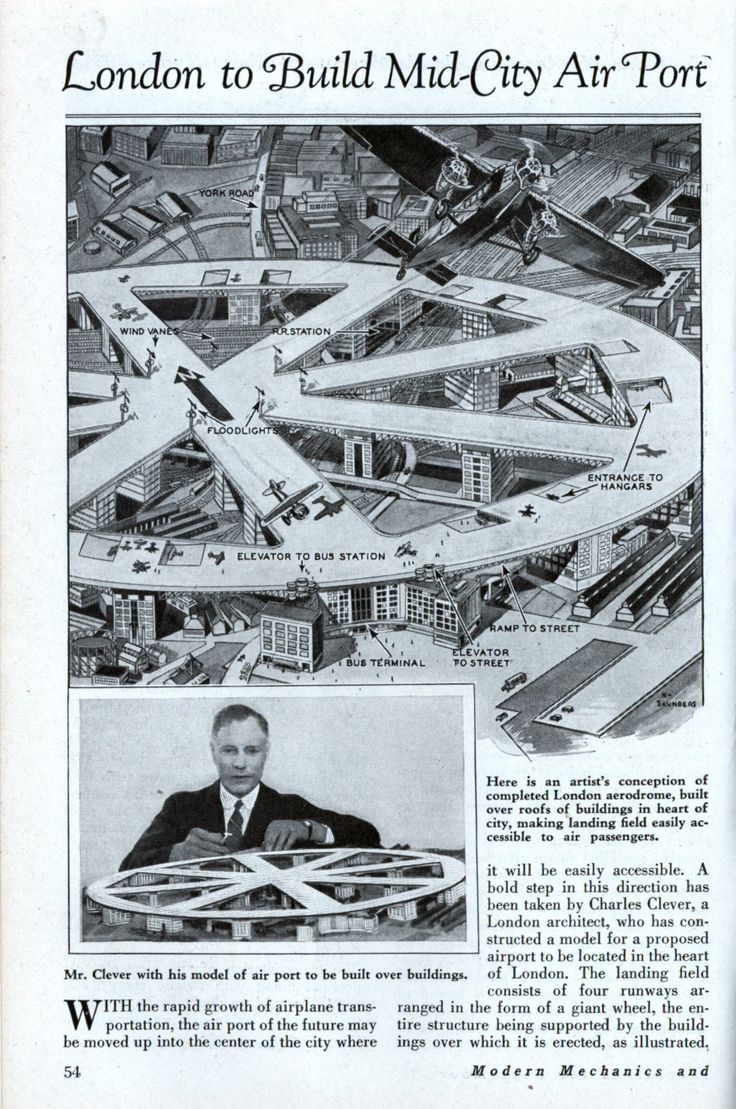
    London airport

    Airportldn rooftop472[Source: Popular Mechanics, September, 1931.]

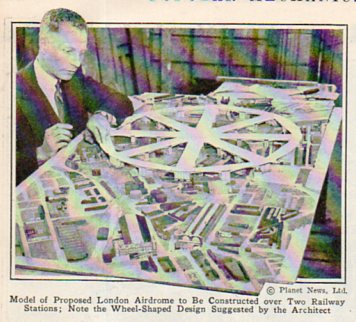
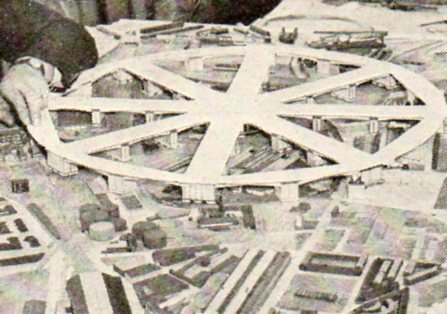
    I am not an architectural historian nor a historian of aviation, but I have looked at a lot of images relating to these fields over the past 30+ years, and so when I find something unusual it makes me pause.  One developing category in this area are rooftop/elevated inner city/downtown airports (I’ve done two earlier posts about this sort of design, including airports designed to be constructed over the Thames and Central Park NYC in Rooftop & Floating Airports -and- Rooftop Airports in a Levitating NYC, 1929  and Elevated, Rooftop Inner City Circular Airports.   I’m not at all certain about what these planners (above) were thinking except that the locations of the airports were central and would save on driving town from the hinterlands to central city–and the “central city” here was London, with the “aerodrome” hosted above King’s Cross and St. Pancras station, and might even have reached Regent’s Park, though I’m not sure.   Evidently there wasn’t much of a concern of the planes missing their runways, or coming in too low, or too fast, or just having an accident–any one of which would wind up in the lap of a busy city rather than in a field somewhere or on a large piece of ground devoid of buildings and a population (where airports are normally situated.  True, there are many airports in this country that are located in urban and suburban sprawls–there was calculated room for error and they were not located right on top of error-proof zones in the middle of a vastly populated areas. So, in the “what were they thinking” department, I clearly do not understand what they were thinking. 

    In addition to being a not-very-good-idea, it was also unwholesomely unpretty. And big.

    Airportldn rooftop473


  • Proto-Surrealist Flying Machines

    JF Ptak Science Books   Post 1790

    In what he gives to thee, this Paradise
    And thy faire Eve; Heav’n is for thee too high
    To know what passes there; be lowlie wise:
    Think onely what concernes thee and thy being;
    Dream not of other Worlds, what Creatures there [ 175 ]
    Live, in what state, condition or degree,
    Contented that thus farr hath been reveal’d
    Not of Earth onely but of highest Heav’n.

               –J Milton, Paradise Lost, Book 8 (The Argument), line 175 ff

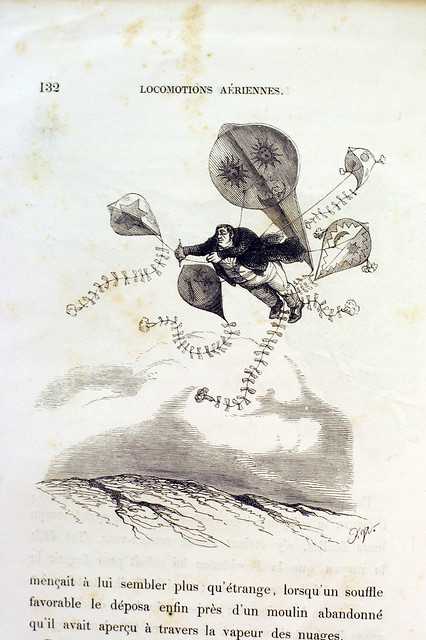
    This is another in a series of posts (starting here with an introduction) on the great J.J. Grandville, a visionary artist of high imagination with good strong claims to being an 1840’s proto-Surealist.  This small collection of flying machines appears in his Un Autre Monde, published 1844. 

    photo
    photo

  • Aviation Games, 1913-1917

    JF Ptak Science Books   Quick Post

    I was wondering how early aerial warfare was used as the basis for a child’s structured entertainment, and so passed a little time in the U.S. patent archives for a quick overview of patented games.  I was more interested in games than simple toys

    The first is an ingenious military game that included playing chits for “aerial mines”, which in 1913/1915 was a forward-thinking defensive device, though not much tested.  (The the full text and explanation of the game is  here.)

    Next is a magnetic game–which again was patented during WWI–in which aircraft were supposed to seek out and destroy forts, naval ships, and other tools of war.