A Daily History of Holes, Dots, Lines, Science, History, Math, Physics, Art, the Unintentional Absurd, Architecture, Maps, Data Visualization, Blank and Missing Things, and so on. |1.6 million words, 7500 images, 4.9 million hits| Press & appearances in The Times, Le Figaro, Mensa, The Economist, The Guardian, Discovery News, Slate, Le Monde, Sci American Blogs, Le Pont, and many other places… 5000+ total posts since 2008.

Category: Aviation & flight

  • Questionable Quidity: on Rowing Flying Boats, 1889

    JF Ptak Science Books  Quick Post

      This remarkable flying machine was patented by N.H. Borgfeldt (of Brooklyn, NYC) on 1 October 1889.  It really seems to be not that much more than the rowing-section part of a Roman galleon, except that it is in the air;  there are five “rowers” int his aircraft, plus someone to operate the rudder. And a flag.

    This certainly is not the most effective way of using human muscle, even in an odd application like this one:


  • History of Holes series: Holes in Airships (1919 and 1937)

    JF Ptak Science Books   Post 1736 [History of Holes series.]

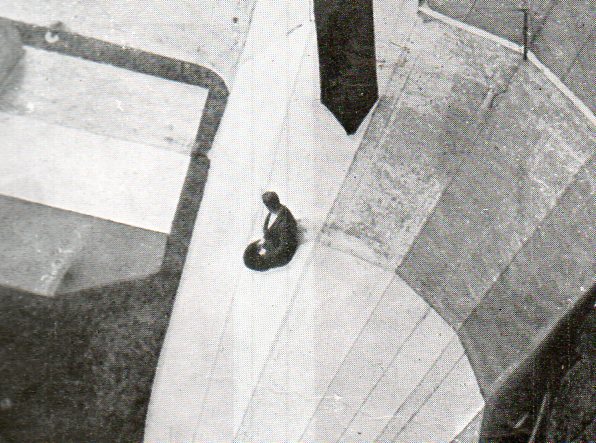
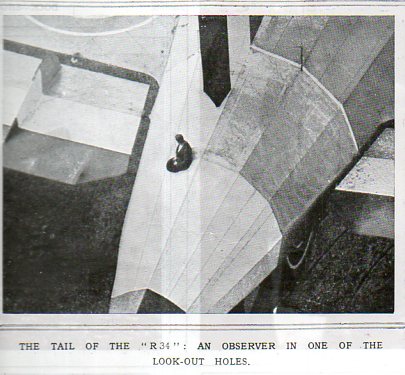
    Holes are of course everywhere–it just depends on how hard you look.  This image, though, struck me very quickly as an unexpected hole (though of course once you allow yourself a moment to think about ti the whole thing makes sense).  It is a very plain “observer’s perch” in the tail of the great British airship, the “R 34”, and appeared in the Illustrated London News in April, 1919, just before its first flight.  The aircraft was massive–643 feet long1–and on one superficial level its hard to imagine holes in its structure of any sort, let alone an unprotected observation post.  But there it is.
    Airship 297

    And this

    Airship 296

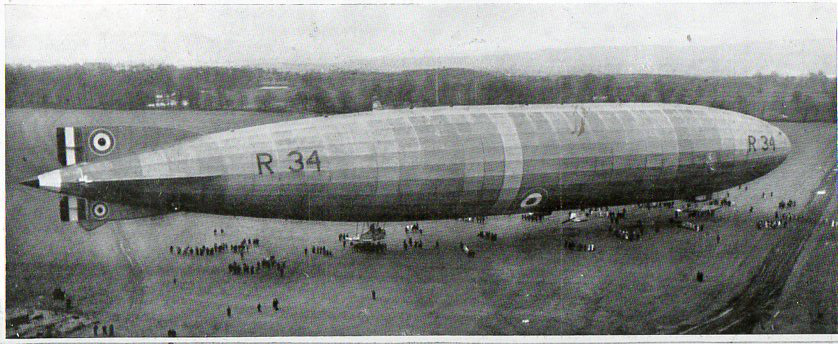
    Here’s a full view of the “R34”, successor to the “R33”:

    Airship 295
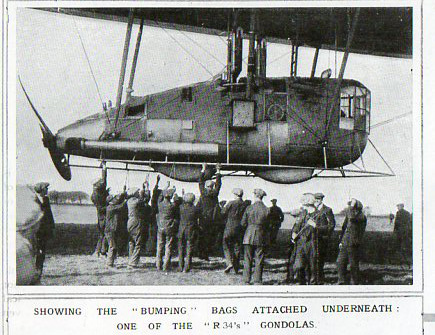
    This is an image of the (forward?) gondola of the airship, looking like it has come in for a landing, or touchdown, or whatever–there is something so very primal about this relatively small group of men reaching up for the railing on the gondola…a railing placed there specifically for that reason.  Its hard to imagine that such a seemingly small effort would be enough to control any part of the airship’s motion, though perhaps it was. 

    Airship 293And the detail, showing the man in the middle clearly off the ground–clearly he must be weighing his options:

    Airship 293_edited-1At least he seems to be wearing one glove, anyway

    Then there’s the image of the “bad” hole, the iconic image (photographic and motion picture) of the conflagration and crash of the Hindenburg, a result of a very quickly-spreading “hole” in the skin of the aircraft as it was coming in for a landing/mooring in Lakehurst, New Jersey, 1937.

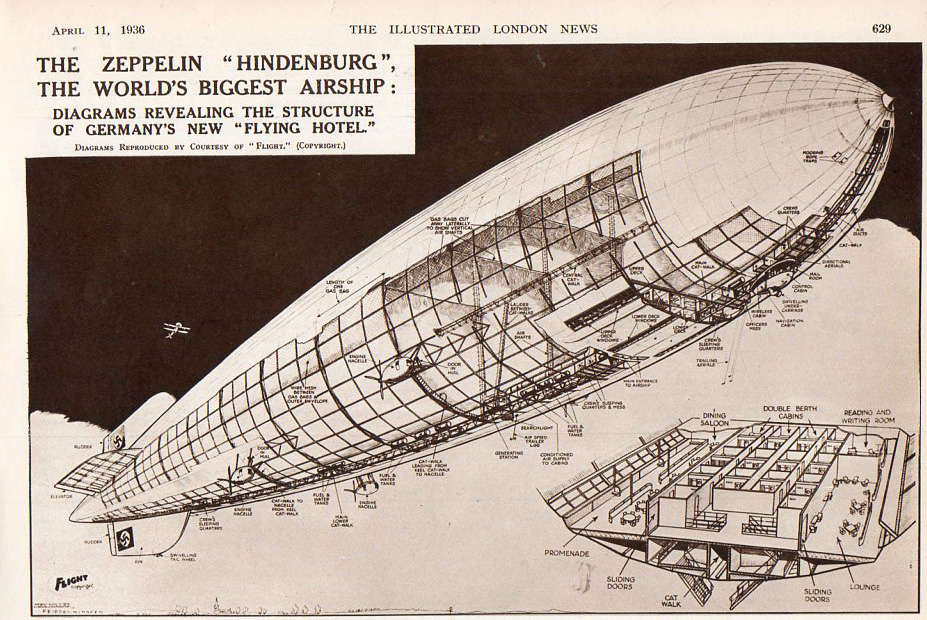
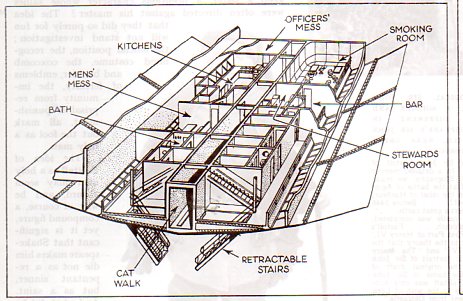
    Here’s a cross-section of the Hindenburg as it appeared in the Illustrated London News in 1936:

    Airship 289

    Airship 292

    Notes:

    Specs on the “R34”:

    • Length: 643 ft 0 in (196 m)
    • Diameter: 79 ft 0 in (24 m)
    • Volume: 1,950,000 ft3 (55,000 m3)
    • Useful lift: 58,240 lb (26,470 kg)
    • Powerplant: 5 × Sunbeam Maori, 275 hp (205 kW) each

    The Hindenburg was quite a bit larger than the R34–in fact, it was the largest thing ever to fly, at 803 feet long and 135 feet in diameter…and 200,000 m3, almost 200% larger than the mammoth R34.


  • Ultra-Massive Acceleration, Jules Verne, and Making Human Jelly. A Romance of 22,000 gs

    JF Ptak Science Books   Post 1722     

    [My apologies to my readers:  in an earlier version of this post I calculated that the Verne space module would be traveling 129,000,000 mph exiting the space cannon–that was wrong, I’m very sorry to say. The figure should have been 129,000,000 feet per hour, which would be about 25,000 mph.  Mea culpa.]

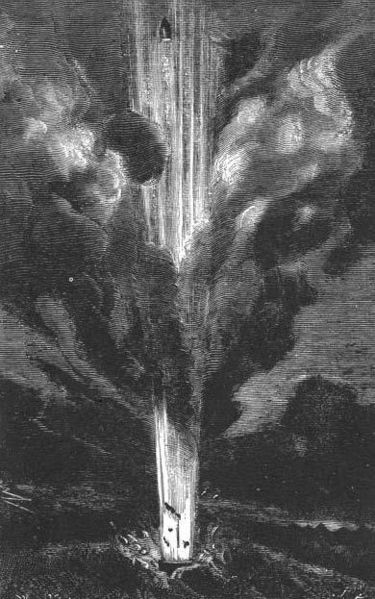
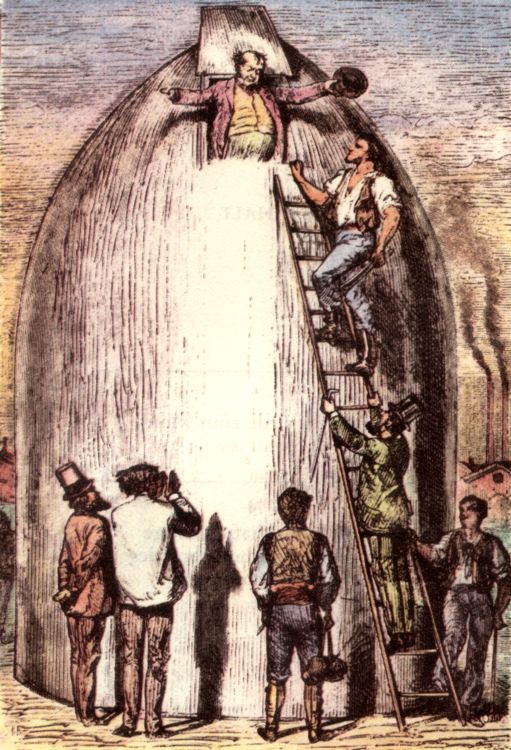
    Earlier in this blog appeared a post on the Eiffel Tower Happy Bullet.  It turned out to be a highly-circulated bit, what with the subject matter and all–describing a gigantic bullet filled with people and dropped from the interior heights of the Eiffel Tower and landing in a big watery hole at the bottom.  The effect of impact I think would have made those folks suffer Massive Internal Complications.

    Impressive as the Eiffel bullet idea was, it was absolutely nothing compared to what another Frenchman thought of at about the same exact time.  Perhaps no human could have suffered more internal disruption in any science fiction story than those who would have been subjected to Jules Verne’s (whose birthday is today, February 8, 1828 – March 24, 1905) space gun, an enormous Columbiad, the mode of propulsion for the travelers in his From the Earth the Moon/De la Terre a la Lune.

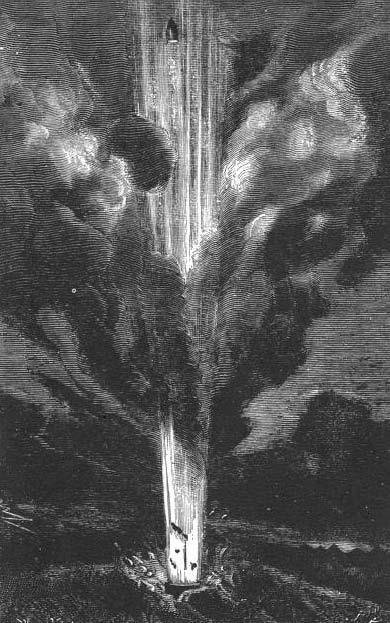
    Verne’s 20,000-lb projectile to the Moon would sit in a cannon-hole in the Earth that was 280 meters deep with a diameter of 2.7 meters, which would sit on the bottom of the hole capping off  200 feet of guncotton (!, weighing 400,000 pounds!).  Somehow this mass would be ignited, and as Verne (or his brother) calculated would produce an initial velocity of 12,000 yards per second, which is 36,000 ft sec, or about 24,000 mph, which is a big enough number to attain the (more or less correct) escape velocity Ve  of 11.2 km/sec. (Very high-velocity shells  fired by tanks fitted for kinetic energy penetrator ammo attain a muzzle velocity of 5700 ft/sec.) And somewhere in there would be a crew greeting a rather-ncredible-to-write-down 22,000 gs.  Astronauts in the Apollo program experienced something like 1g; dragster car drives who go from 0 to 100 mph in .86 seconds experience about 5.4g.  

    22,000gs is another thing entirely.
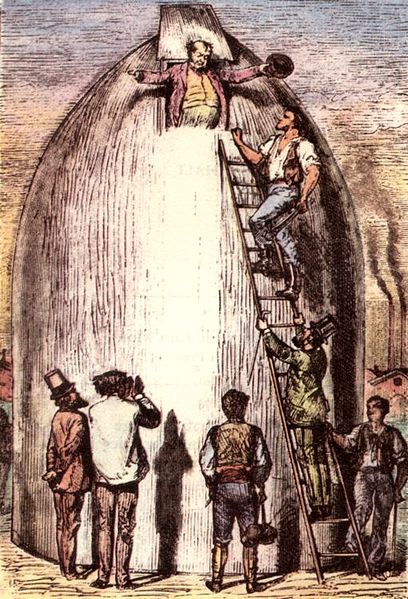
    File:'From the Earth to the Moon' by Henri de Montaut 39.jpg

    And difficult to imagine.

    File:FETMlaunch.jpg

    Jules Verne got a lot of stuff right in his long and lovely career–an there was quite a bit that he foretold correctly in this very story.  Just not the take-off. 

    The further-funny thing about this space gun is that it made another appearance in another Verne story, The Purchase of the North Pole, 1889.  During this period of human exploration there was a push to explore the Poles–in Verne’s story, an attempt is made to simply this exploration.  But not in the way you might think.  Verne was going to employ the space gun, again, but this time to alter the axis of the Earth so as to make it easier to get to the Poles and exploit their natural resources.   I must say that this answer was not at all clear to me, even with my best sci fi cap on:  but Verne saw it, saw that it would be better for all concerned to move the Poles rather than moves towards them. And that’s some pretty big thinking.
  • Anatomy of the B-17: Construction Images from Seattle, 1941/2.

    JF Ptak Science Books   Quick Post

    Tessie with planeI’ve long been an admirer of the Boeing B-17 aircraft and have posted about it on this blog a number of times.  Today I just wanted to share some images of the aircraft’s production and assembly at the Boeing Seattle works in 1942.  All photographs are from the Farm Security Administration series (Office of War Information) and can be found (with a hundred others) at the Library of Congress site, here.

    (Our younger daughter, Tess, with here antique wooden model of the B-17, with the real thing (B-17G)  in the background.)

    Farm Security Administration/Office of War Information Black-and-White Negatives:  B-17 Construction, 1942-1944

    Production. B-17F heavy bombers. A women worker, over 60 years old, does an expert riveting job on a B-17F bomber in the Long Beach, California, plant of Douglas Aircraft Company. Better known as the "Flying Fortress," the B-17F is a later model of the B-17, which distinguished itself in action in the South Pacific, over Germany and elsewhere. It is a long range, high altitude, heavy bomber with a crew of seven to nine men and with armament sufficient to defend itself on daylight missions

    “Production. B-17F heavy bombers. A women worker, over 60 years old, does an expert riveting job on a B-17F bomber in the Long Beach, California, plant of Douglas Aircraft Company. Better known as the “Flying Fortress,” the B-17F is a later model of the B-17, which distinguished itself in action in the South Pacific, over Germany and elsewhere. It is a long range, high altitude, heavy bomber with a crew of seven to nine men and with armament sufficient to defend itself on daylight missions.”


  • What was Dropped from the Skies First, the Mails or Bombs?

    JF Ptak Science Books   Post 1717

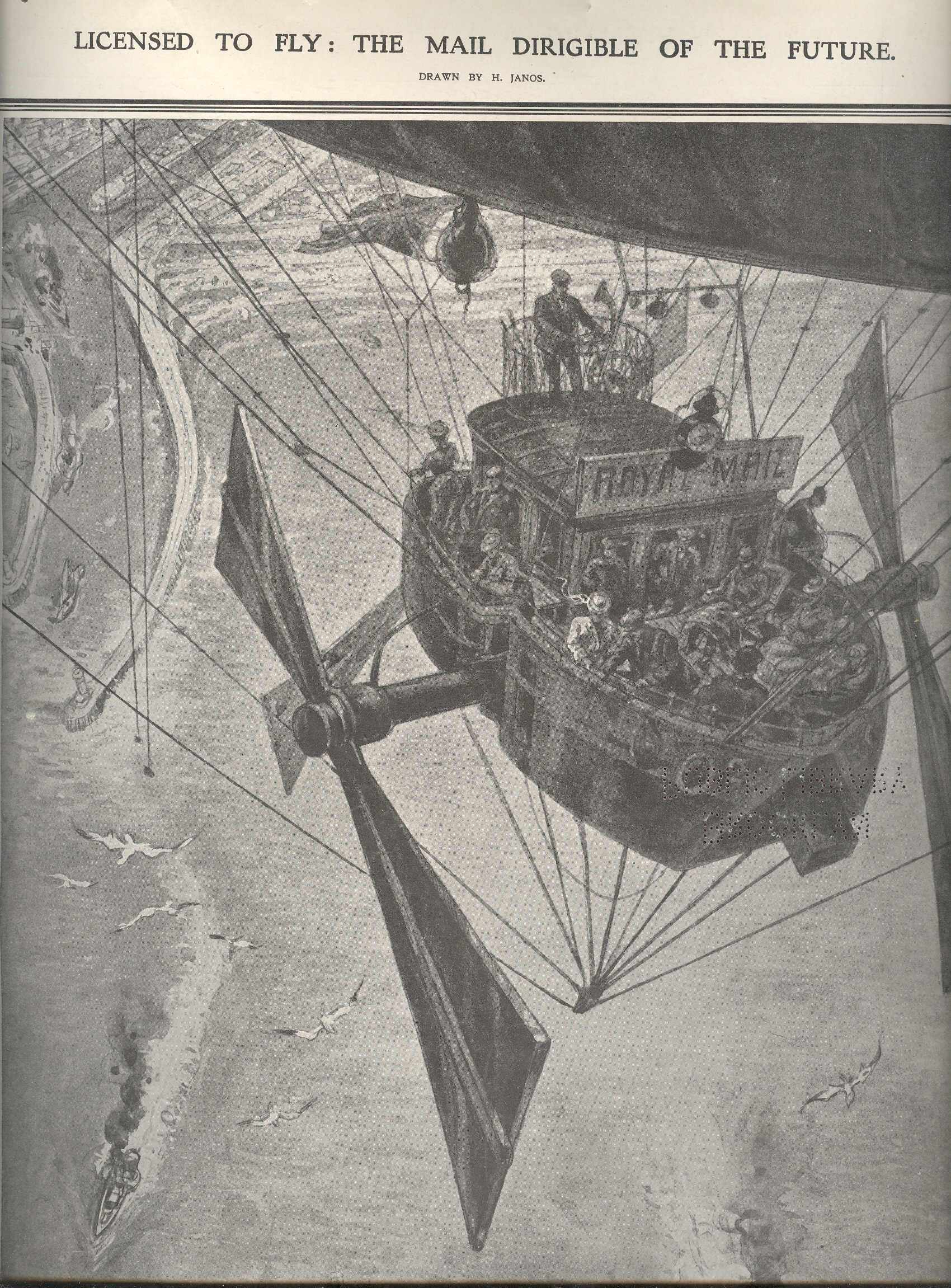
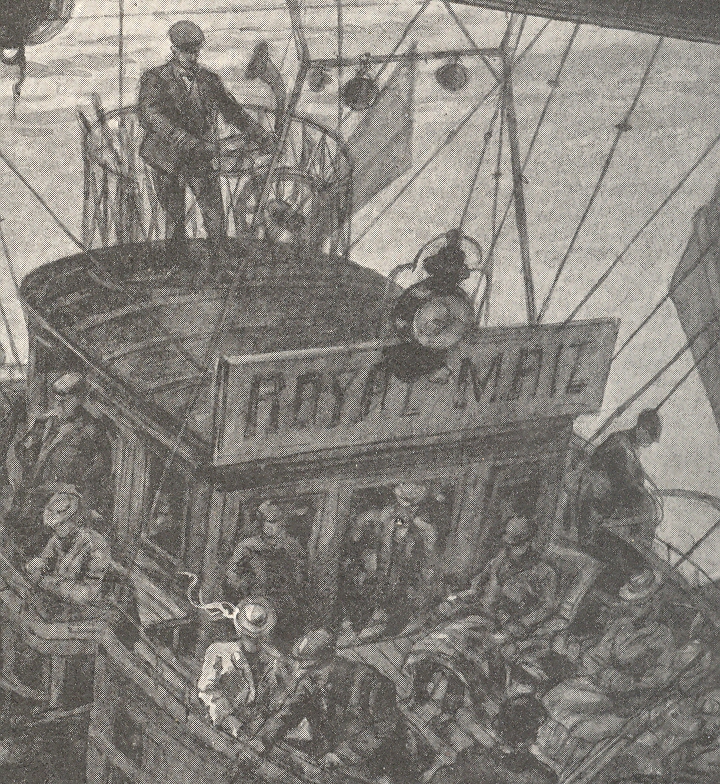
    Seeing this splendid image of the 1909 near-future forced a question into mind:  what came first, aerial delivery of mail or aerial delivery of explosives?  I suspected that “mail” would be the correct answer, but didn’t know how much deeper that went into the past than the history of aerial bombing.

    Mar 23 air mail ILN


    The first bits of mail were delivered among the first balloon flights ever made–in the U.S., the first quasi-official piece of airmail was a letter from president George Washington that went aloft in the first balloon flight (1793) in this country, deliverable to whomever it was that first came to greet the balloon in wherever it landed.  The first semi-regular delivery of mail in the U.S. was again by balloon, beginning in 1859, which still precedes the first sustained use of explosives dropped from aerial vehicles by five decades.

    Mar 23 air mail ILN det


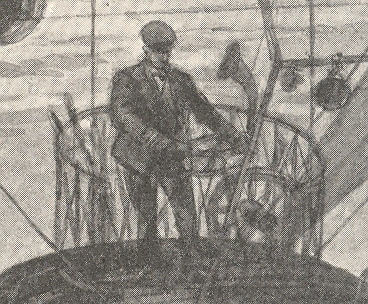
    This image was drawn by H. Janos for the Illustrated London News for 16 January 1909, and shows a futuristic balloon making its way from Dover to Calais with a cargo of mail and a dozen or two passengers (and whatever crew there was besides the captain, presumably belowdeck).  The article reads: “1910 may seem a very early date at which to fix the coming of such vessels, yet aerial navigation is progressing at such a rate that none can call the date impossible”. 

    Mar 23 air mail ILN det 2

    And so true;  it didn’t take but a few years to begin experimental air service routes for the mails by biplane, and less than a dozen to have instituted long-range flights by heavy aircraft, with the mammoth mail-delivering airships sent to the not-good ideas department. 

    In any event I just happen to like this image by Janos–for what was a not-essential piece to the weekly magazine, the man did produce an admirable work, not the least of which is his unusual airborne oblique bird’s-eye view to the shoreline. 


  • Living Aloft, 1920

    JF Ptak Science Books  Quick Post

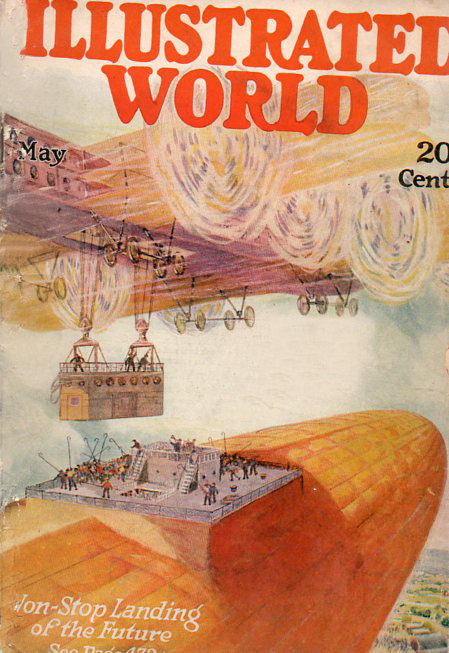
    Future flight108D.G. Lloyds certainly had an interesting–if not unique–vision of non-stop or uninterrupted cross-country aerial service, writing about Non-Stop Landing of the Future (Illustrated World, May 1920.)  And for Lloyds the future was soon, or tomorrow, because, frankly, the technology was there, if not the will.  Or the inclination.  Or the presence of a logic for creating such a service.

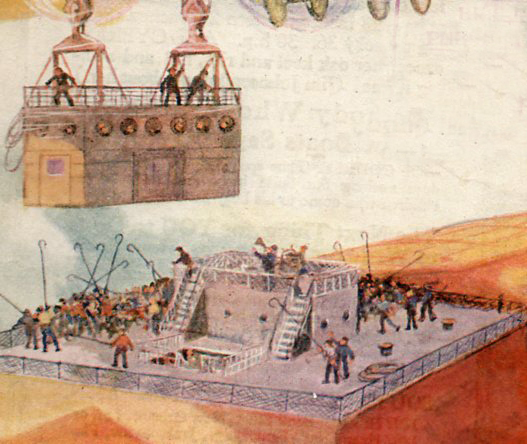
    It seems to me that after floating along for days at 75 mph (or thereabouts?) that, after finally getting across the country, a traveler might want to simply disembark.  But this behemoth envisioned by Lloyds wouldn’t have to actually stop–it was outfitted, designed to release/accept passengers while in flight.  Now of course take-offs and landings are the most dangerous parts of flying, and perhaps this is what Lloyds was trying to replace.  But to me it looks like he replaced one significant danger with, well, several other significant dangers. 

    Future flight111Look:  it just seems to me that any time you have a giant airplane synchronizing flying with an enormous dirigible to transfer exceptionally heavy cargo at an altitude of one mile that there is some substantial room for pilot(s) error.(s) and other freak whatevers.  Also, the issue of using dozens of men with shepherd hooks to grab a multi-ton object suspended from a moving platform to another moving platform seems to me, well problematic.  But it does make for a pretty picture.


  • Amelia Earhart’s Disappearing Hand and Her Not-Disappeared Greatness

    JF Ptak Science Books 

    (I just added a few things to this post from three years ago.  The image of Ms. Earhart’s hand is fantastic–read the story here in the post Amelia Earhart: Her Physical Disappearance vs. Lindbergh’s Moral Vanishing):

    Blog--earheart


  • Monsters in the Clouds–Conan Doyle and High Flight

    JF Ptak Science Books    Post 1688   (Part of the series on the History of Blank, Empty and Missing Things–Upper Atmosphere Monsters.)

    Flight soar heights105
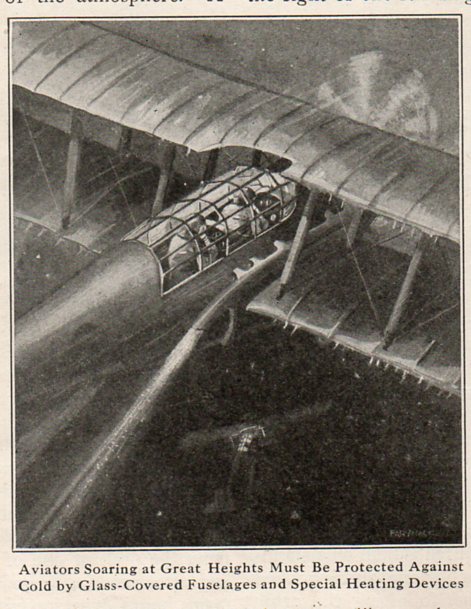
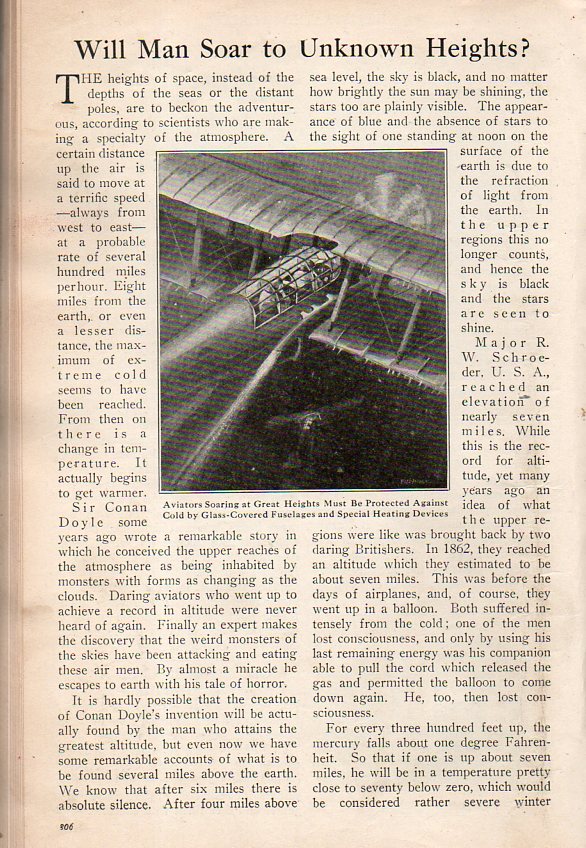
    Illustrated World for July-August 1920 asks the question “Will Man Soar to Unknown Heights” and indeed, they answered in the affirmative, saying that the “heights of space instead if the depths of the seas or the distant poles are to beckon the adventurous,  according to scientists who are making a specialty of the atmosphere”.  In what must seem to the modern reader to be an enormous and naive statement of the obvious, the future aviators would fly in “glass enclosed fuselages” in order to gain great heights.

    There would however be no monsters–except for lack of oxygen and the cold.  he editors did mention a Conan Doyle story in which monsters lived at high altitudes, monsters that were form-changers, much like the clouds they lived above.  This was his “The Horror of the Heights”(1913), a short story about a flyer named Joyce-Armstrong who longed for great heights–and for the “something else” that was up there, something dark and sinister that lived in the stuff that we breathe, as the story is told through the pages of a recovered, blood-stained notebook found in a field. We learn that Joyce-Armstrong was a dreaming pragmatist, longing for the ethereal of great heights but loathe of it also, aware of a danger so great that he carried a shotgun along with him in flight.  We read in the flight book that the aviator had an experience at 40,000 feet, meeting a new air-jungle world of semi-formed gelatinous creatures, one of which has a more solid form with tentacles and a beak, and does battle with them, surviving, returning to the ground.  He vows to go back, at which point we assume he met his doom. 

    In 1913, an altitude of 40,000 feet was extreme, the record at the time being about 9,000′, and that reached in a Wright biplane–quite an achievement I think for such an aircraft,  By the time this article appeared in 1920, the record altitude was 33,000′, which at least got a lot closer than the 9k’ of 1913. The aircraft for this record–the LUSAC-11 (Lepère United States Army Combat) was much more considerable than the Wright plane, though it seems to me a work of fantastic skill/effort/courage to take such a thing so high. Flight soar heights103


  • Aeroplanes & Airships: Artistic Displays of Quantitative Data, 1914

    JF Ptak Science Books 

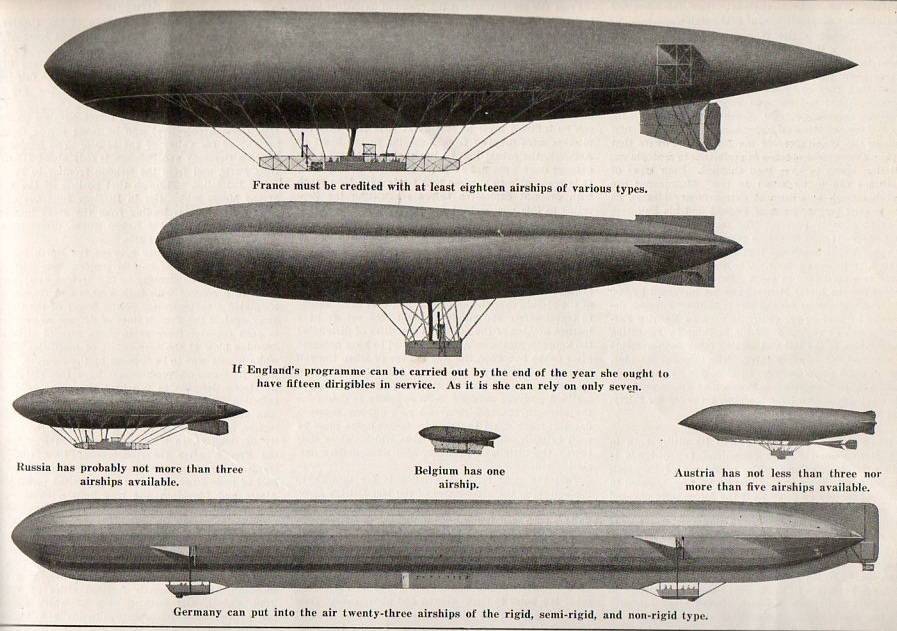
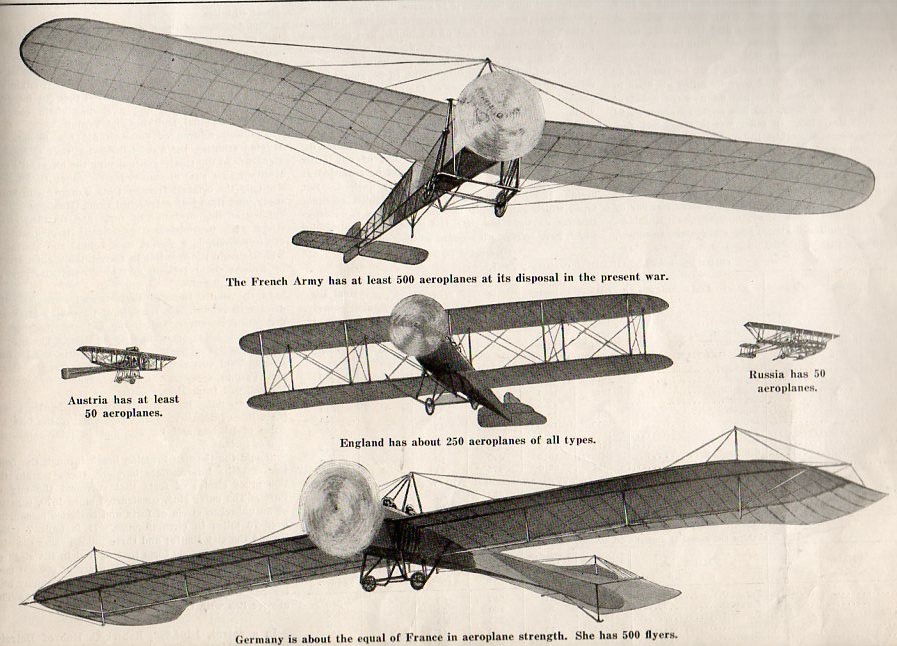
    In another adventure in infographics and the artistic display of quantitative data we find this pair of very distinctive images that seems to work, a little:

    Infographic  airship002

    Infographic  airplane003

    [Image source:  5 September 1914, vol 112, #10,  Scientific American.]

    The graphics are mostly good if not a little clunky–they can be viewed as “scary”.  Mostly, though, these images are reproduced today because I find it hard to pass up an interesting airship illustration, though they do present their case more clearly than a slightly earlier attempt at data display seen last week on this blog.

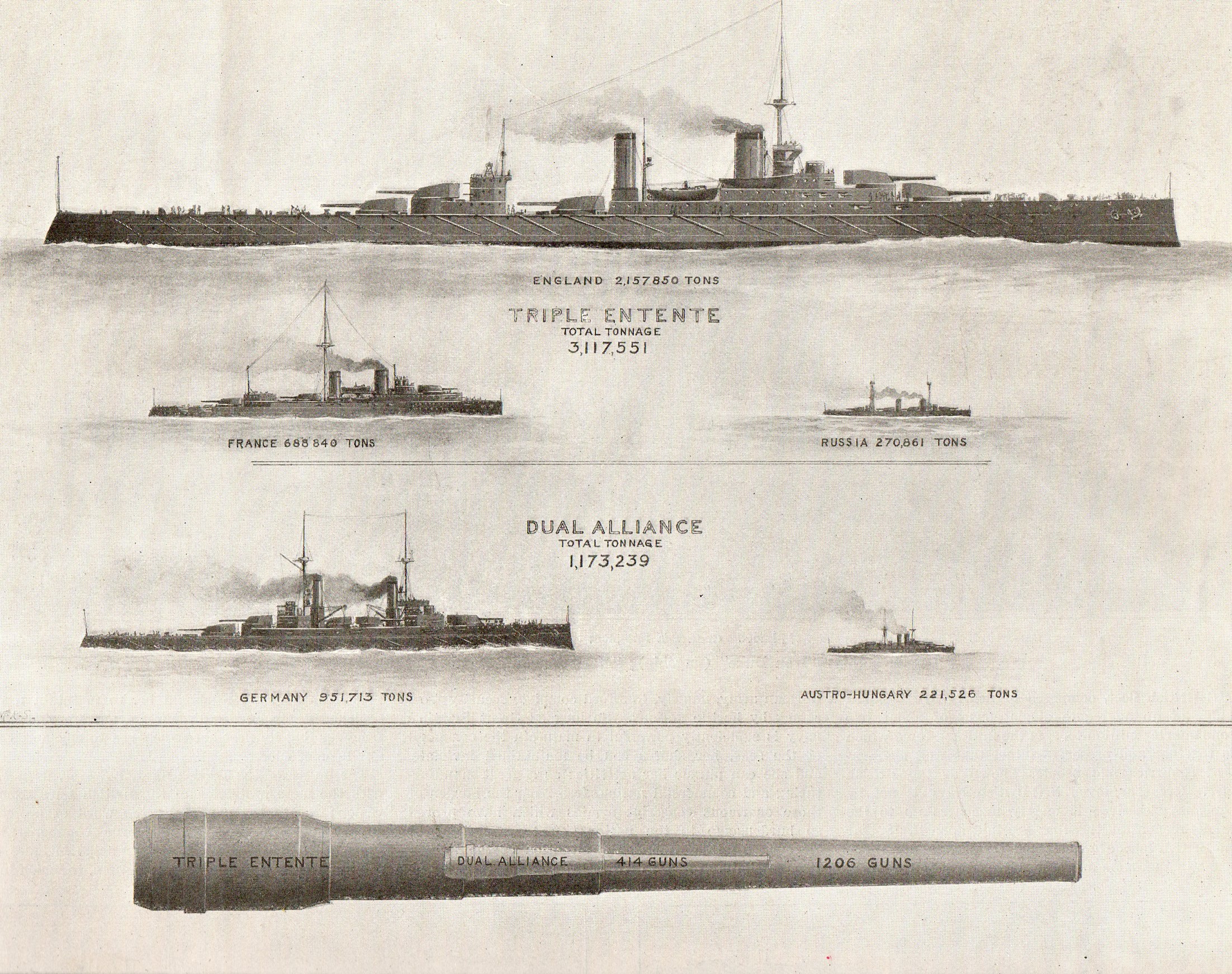
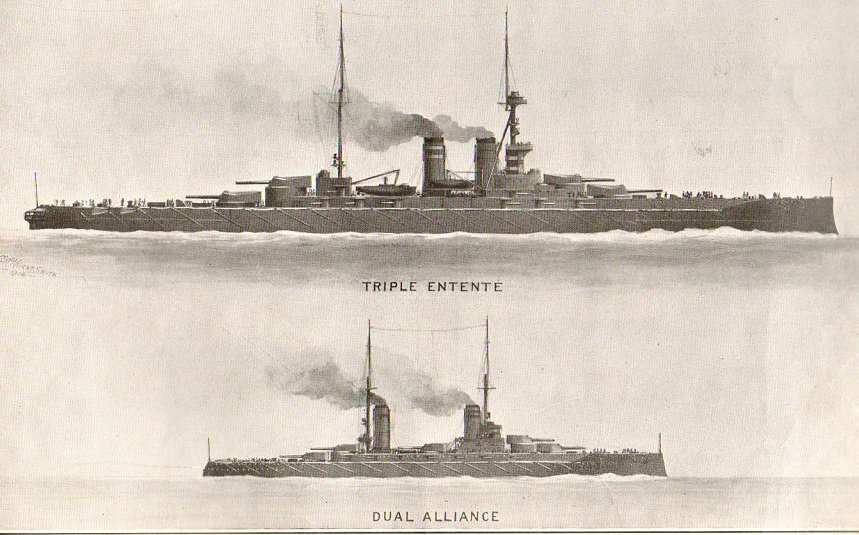
    The images for the distribution of naval power are very defined:

    Inographic ships018
    (I especially enjoyed the comparison of naval guns, with the cannon-within-a-cannon.)

    Inographic ships020


  • Rockets to Outer Space, 1923

    JF Ptak Science Books    Post 1657

    http://www.rogersrocketships.com/UserFiles/Image/RRS_New_Docking_Bay_Images/DB_002_Die_Rakete_Book.jpg

    This is some beautiful thinking and work by the rocket pioneer, Hermann Oberth (1894-1989)–the teacher of Wernher von Braun, a highly functioning leader at the Nazi V-1 and V-2 base of Peenemunde, and of course after the war working for various aeronautical/astronautical concerns in Switzerland, Italy, Germany and the United States. In America he would work for von Braun at Huntsville, Alabama from 1955-1959 on the Army’s ballistic missile program,  a late addition to the many German scientists scooped up right after the war in Project Paperclip and deposited in the Deep South. 

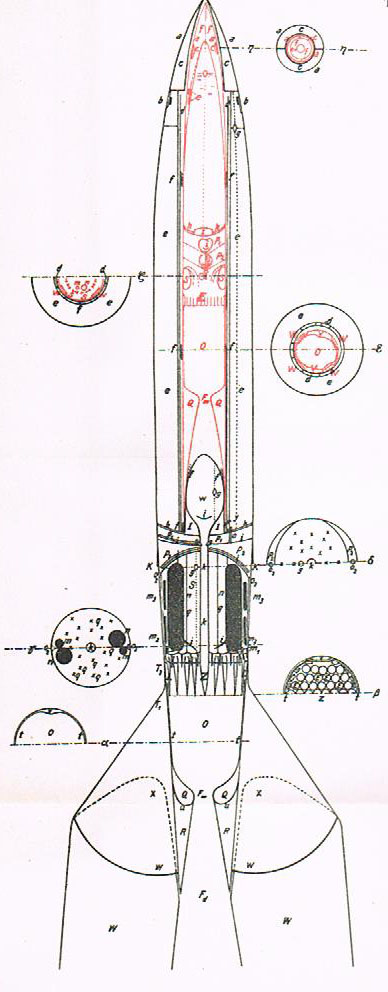
    The gorgeous design above is the front wrapper of his rejected doctoral dissertation, Die Rakete zu den Planetenbraeumen (“The Rocket Through Planetary Space” or “The Rocket to Interplanetary Space”), published in Oldenbourg in 1923.  Oberth’s work was printed in a very small edition and even at that he had to pay for part of the pamphlet’s printing–it turned out that the work was an instant success when issued, selling out quickly.  A second edition vastly expanded the original’s 92 pages into 429 in 1929. 


    Oberth
    In Old Testament vocabulary, Oberth’s work is Genesis for space travel and aeronautics–or at least he is one of two or three authors of Genesis, along with Goddard and Hohmann.

     
    The Modell B from The Rocket through Interplanetary Space -H. Oberth 1923

    As it turns out, in his extra moments, Oberth served as a technical advisor to Fritz Lang on his film, Frau im Mond, and his influence shows, even from cursory examination.

    Image