A Daily History of Holes, Dots, Lines, Science, History, Math, Physics, Art, the Unintentional Absurd, Architecture, Maps, Data Visualization, Blank and Missing Things, and so on. |1.6 million words, 7500 images, 4.9 million hits| Press & appearances in The Times, Le Figaro, Mensa, The Economist, The Guardian, Discovery News, Slate, Le Monde, Sci American Blogs, Le Pont, and many other places… 5000+ total posts since 2008.

Category: Aviation & flight

  • Daily Dose from Dr. Odd: Landing an Airplane by Backing Up

    JF Ptak Science Books  Quick Post   Daily Dose from Dr. Odd series


    Follow Me on Pinterest

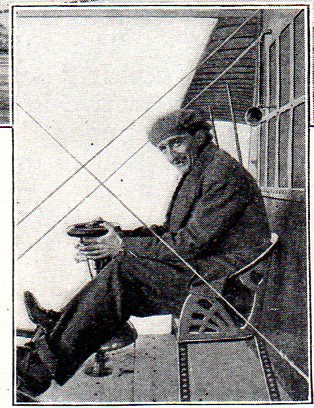
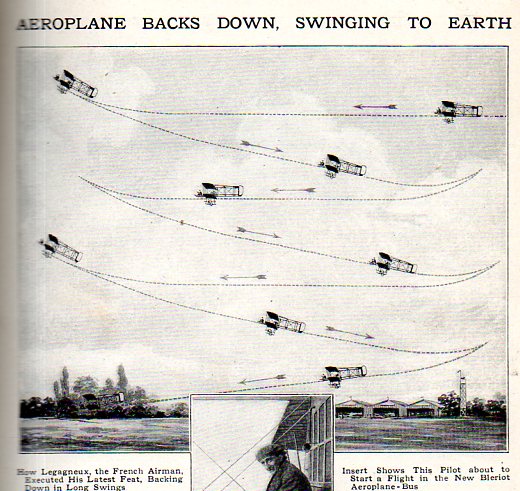
     There is no official “Well, I’ll be Damned Department” on this blog but if there was one this small discovery would certainly be an excellent candidate.  I don’t know enough about the aerodynamics of first-decade powered flight aircraft, but it seems as though this could be an alternative way of landing.  It seems not to be the desired way to bring in your plane, though, looking way more problematic than is necessary.  That said, I’ve never seen flight instructions like this before. 

    Aeroplane backup356
    [Source:  the ever-fascinating Popular Mechanics, February 1912, page 373.]

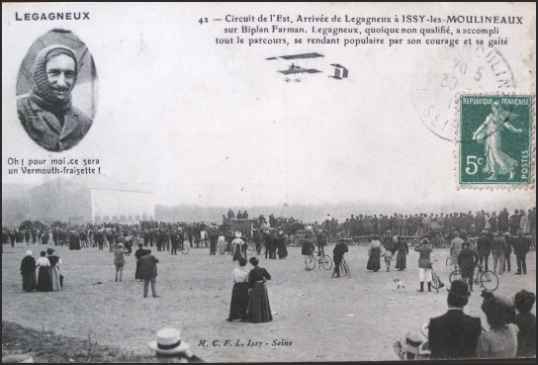
    Aeroplane backup357This is the pilot, Georges Legagneux (1882-1914), happily at the minimal controls.  Another image, courtesy of Early Aviators, of the pilot in action: 

    Aeroplane legagneux
    Legagneux would die pursuing his passion in 1912. 


  • Recognizing the Agony of the Absurd–Aircraft, 1912

    JF Ptak Science Books   Post 2035  

    Follow Me on Pinterest


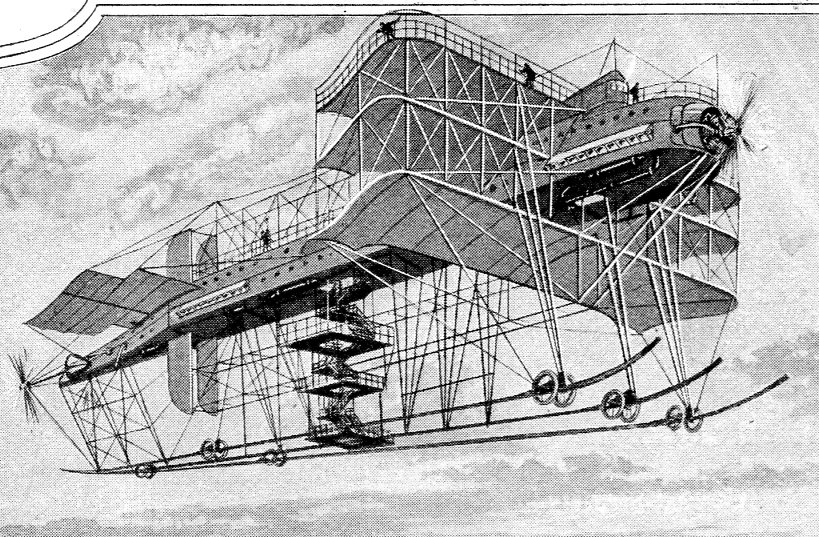
    Airplane futuro335
    Nothing exceeds like excess, and the excessful is not often successful.  Victor Lougheed saw this in the first decade of powered heavier-than-air flight in a homey and sensible article in Popular Mechanics in 1912.  He had a nice touch in trying to reign-in the impossible stuff that was happening in imagining flight, saying “it is safe to give to fancy only when fact is far away”–and that imagination is perfectly fine, but now that “human flight is a thing accomplished” that the issue of future aircraft should be one of engineering. Thinking big is fine just so long as you have those tools in the box.

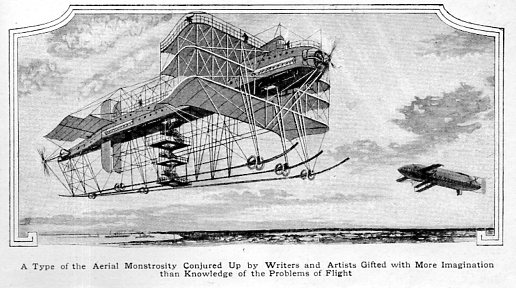
    Lougheed offers the above illustration as an example of big-and-bad thinking, though he unfortunately does not credit the thinker or the artist.  Too bad–it would have made a nice follow-up.  That said, as a casual reader in early flight I have rarely seen someone taking on what are clear excesses of expectation–Lougheed is an interesting exception. 

    Airplane futuro336

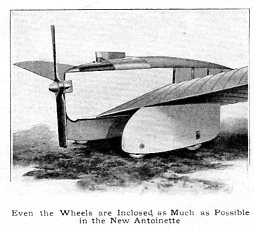
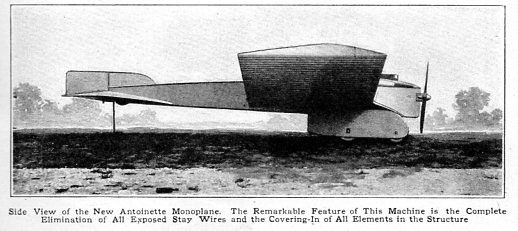
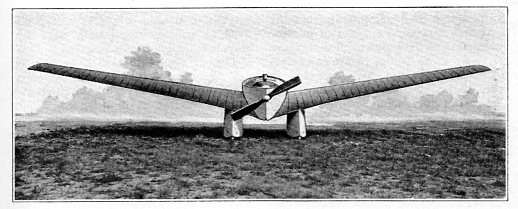
    He does go on to give an example of possibly-flyable future aircraft and presents the remarkable New Antoinette–a fantastic and prescient design for a plane only nine years removed from the Wrights’ flight, a streamlined monoplane that seems to come from reasonable future, which it sort-of does.  This plane evidently was too heavy for the 100-h.p.engine, but the engineering was at least definitely “there”.

    The Antoinette:

    Antoinette342
    Antoinette341
    Antoinette340
    Here’s a very long and very illustrated thumbnail site for French pre-WWI aircraft: http://flyingmachines.ru/Site2/Arts/Art4743.htm


  • SteamMegaPunk Flyer, 1868

    JF Ptak Science Books   Post 2025

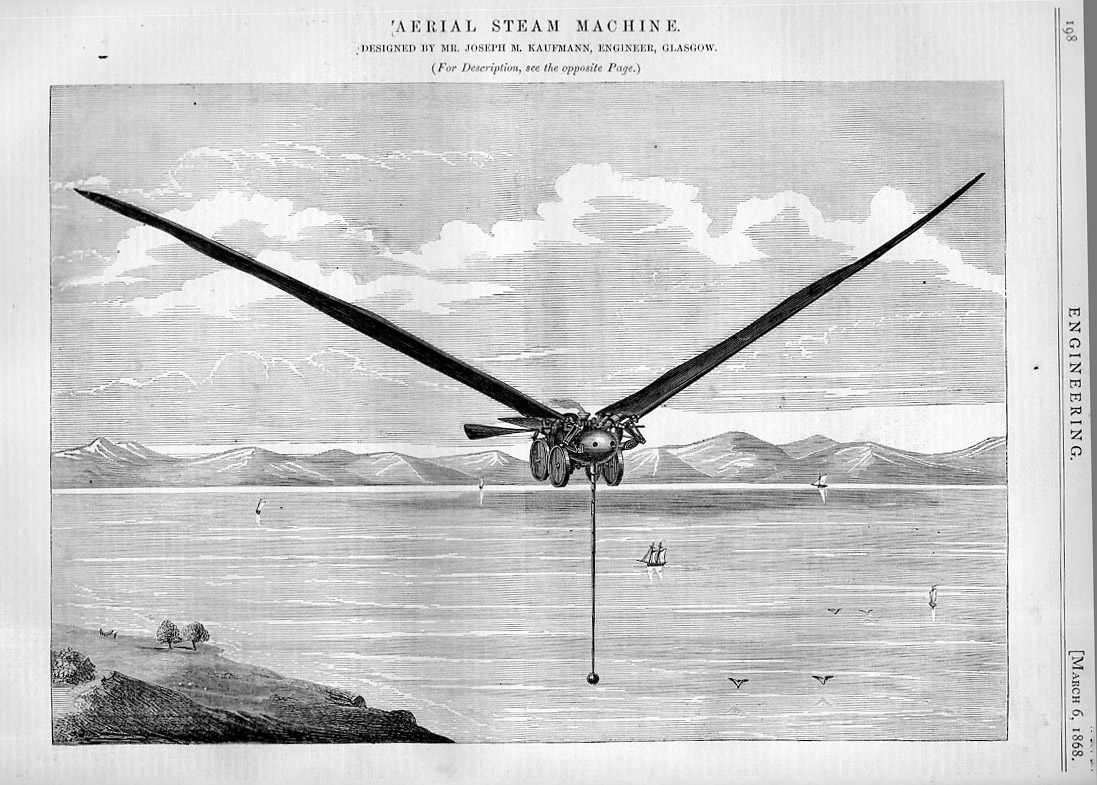
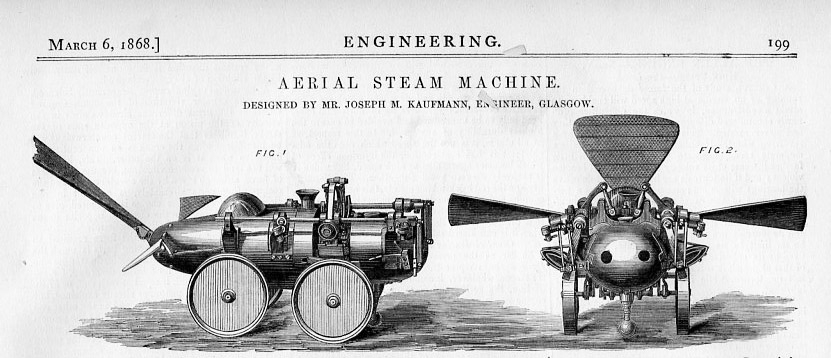
    This magnificent and mega-heavy beast-aeroplane (a “steam aeromotive machine”) appears in the pages of Engineering, and is the creation of Joseph M. Kaufmann of Glagow, and makes a splashy show of itself back there in 1868 when not-too-many airplanes were gracing the pages of technical journals.  But here it is, a very heavy dream of a Scottish engineer, a massive and underpowered vehicle of questionable design and imponderable consequence.  One thing is for sure–it certainly looks pretty.

     
    Aeroplane 1868300

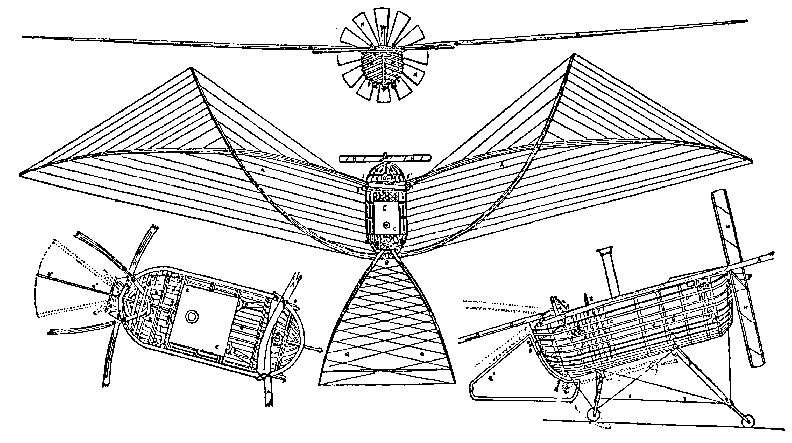
    The plan for the aircraft measured 12′ from stem to stern (plus another few feet including the tail), with the body about 5’x6′, and with wings that spread out 35′–each. The aircraft weighed in at an extraordinary 7,000 pounds and was supposed to be powered by a 40 horsepower steam engine that looked like a locomotive boiler that in theory would keep The Beast afloat at 40 mph for an extraordinary four hours. 

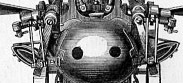
    As surprising as these images look from the modern perspective, perhaps the most unexpected aspect can be seen in the detail under the wing in the drawing on the right (below)–it seems that the motive power was that the wings “flapped”, like a bird’s.  This was asking a lot from those wings.  And that engine.

    Aeroplane 1868b301There was a lot of “flapping” going on in the experimental thinking for flight at this period, though many of these designs were human-powered ornithopters (like those of Bourcart in 1863, Trouve in 1870, and Wenham from 1858), and which in general didn’t last much past the 1870’s.  There was another class of proposed flying vehicle that adopted bird-wing qualities though the wings didn’t flap, like the Le Bris glider of 1868 and the beautiful and graceful patent of the Du Temple monoplane. These designs seemed to last much longer, perhaps most famously in the designs of Otto Lillienthal’s gliders of the 1890’s and the Vuia machine of 1906.

    Airplane du temple
    [The du Temple aeroplane, via Wright Brothers.org.]

    What the Kaufmann aircraft had that these others didn’t was its guiding principle of stability,  a 40-foot cable with an 85-pound weight on the end of it–a “pendule” of motion and stability.

    Aeroplane 1868b301_edited-1
    Mr. Kaufmann built a 42-pound model of the aircraft–things did not go well in the experimental firing, with the boiler failing right away, but not before the wings fell off.


  • Atomic- , Solar- and Vacuum-Powered Airport-Laden Dirigibles and Other Wide Ideas of Future Flight

    JF Ptak Science Books  

    Follow Me on Pinterest

    A post (“Nuclear Everything”) over at Dark Roasted Blend that featured a magnificent and stodgy atomic-powered zeppelin pushed me into this short visual note on differentially-powered airships, and then in general about airships with airports on them. (There’s a whole other category for planes-of-tomorrow that were so enormous that they had landing strips on their wings, but that’s another story.)

    And they remind me of things that just aren’t “right”, because these things just weren’t.  I’m not sure why, but I’m drawn into an old story about the legendary Charlie Goodnight, Texas pioneer, one of the creators of the idea of the cattle drive (the Goodnight-Loving Trail), a man who lived an extraordinary and powerful life.  He lived for a long time, too, from 1836 to 1929 (almost to the year of the birth of Larry McMurtry, who told a version of Goodnight’s story so spectacularly well in Lonesome Dove), well into a future so far advanced from the year of his birth that he could scarcely have imagined it.  Anyway, towards the end of his life, in 1916, Goodnight had the idea of making a movie of the Old West that included a “final” Indian buffalo hunt.  I’ve seen the film, and it is a fascinating, heartbreaking, wonderful/awful thing, that somehow might appeal to almost no one.  It certainly didn’t appeal to the folks at the time looking for a cowboy film, because much like Mr. McMurtry’s cowboys, Goodnight’s reality didn’t much resemble the cowboys that the public wanted to see.  In a sense Goodnight lived beyond the history that he so much helped to create, and that his old, passed “present” was something that the people in his future really didn’t want to recognize. Then of course one of the things that made it all seem “not right” to me was seeing a vignette of Goodnight entering into one of the scenes, in  a car, making the whole thing a little spooky.

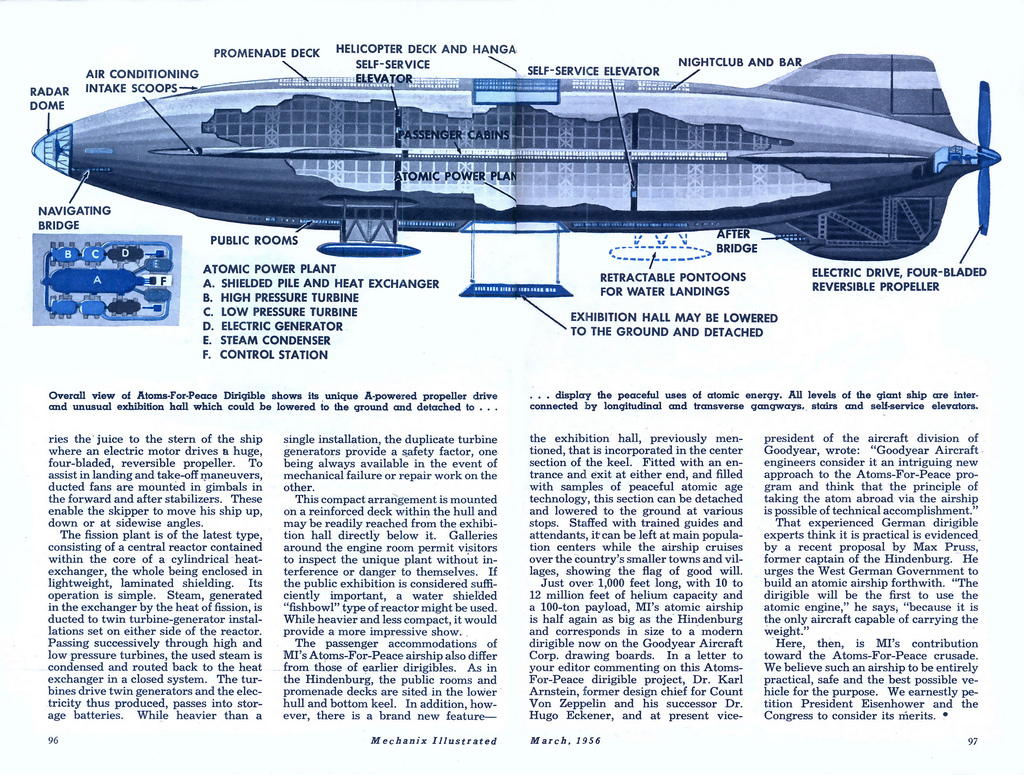
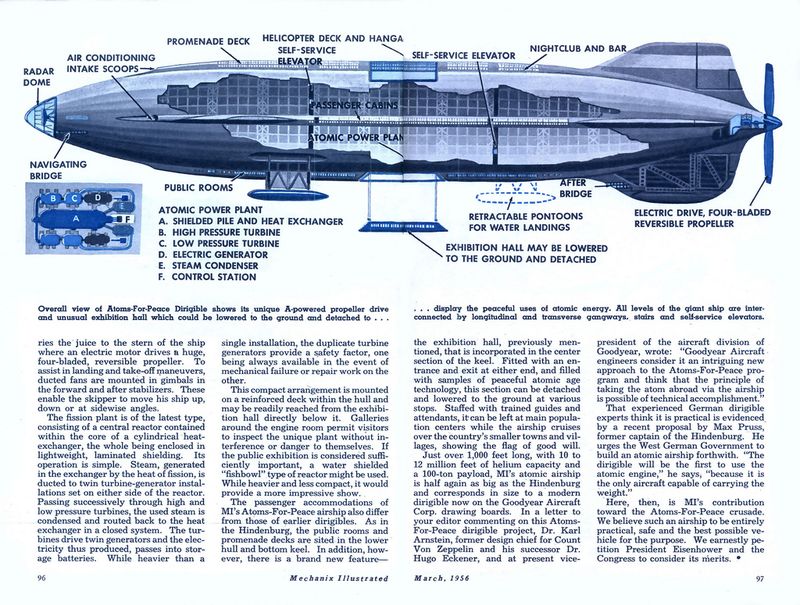
    First up is this mammoth flying advertisement to both peace and war, a nuke-powered dirigible proposed by Eisenhower in 1953 as part of the Atoms-for-Peace push, a move which by this point was already entirely too late.
    Atom everything zep for peace

    For some reason it was seen as a good idea to have a detachable convention hall built for the airship. \

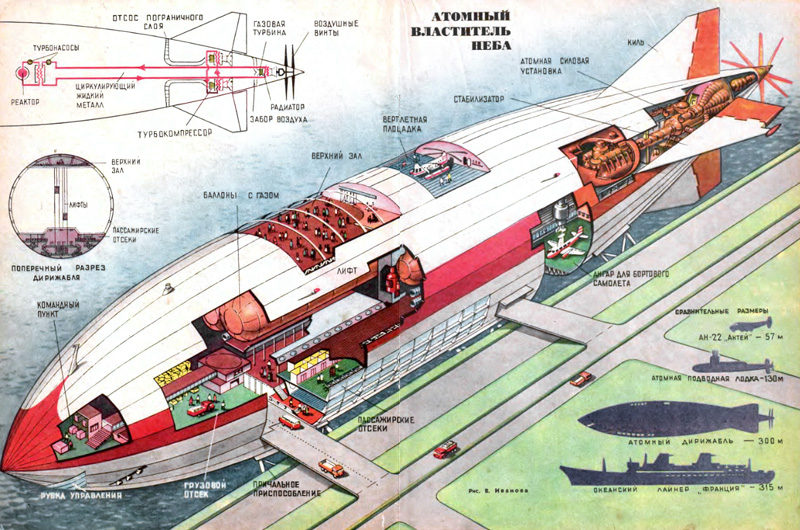
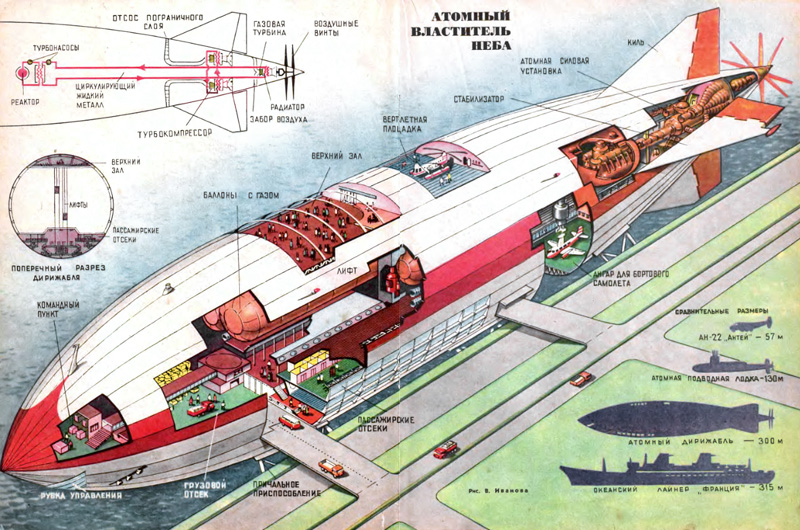
    And of course there is no greater element of a Something-for-Peace anything unless there was a competing idea, as seen in this mammoth Soviet atomic zeppelin, a ship completely absorbed in being bigger than the big thing that it already was:
    Atom everything zep

    At 300 metres this monster had room enough for virtually anything, though it didn’t have the retractable/detachable convention hall–it did however have a small airport. 

    Another dirigible approached the airport-on-board idea, but preferred solar power for its energy source.


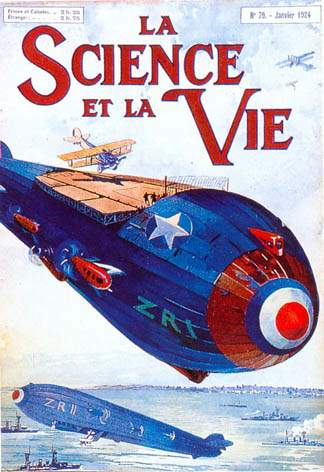
     The magnificent possible, 1924, saw another kind of airborn airport:
    https://historyofideasblog.com/a/6a00d83542d51e69e2012875ea3636970c-pi

    Guido Tallei’s 1932 Diri-Disk was a combination airplane/dirigible, and looked as though it could harbor an expansive airport on its NCC-1701-like wing, but didn’t, alas:

    Konstantin Eduardovich Tsiolkovsky (1857-1835), the Russian/Soviet space pioneer who was nearly without peer (and who somehow survived the bloodlust of Stalin which sucked up and murdered so many of his scientific colleagues),  stepped outside his spaceflight bubble to write about this monster with collapsing sheathing:
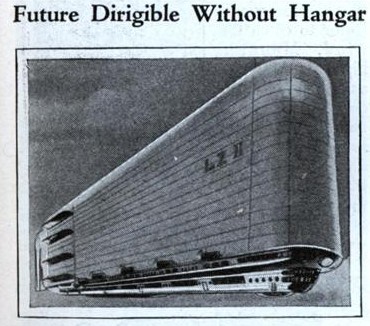
    https://historyofideasblog.com/a/6a00d83542d51e69e20128769ed30d970c-pi

    The Kueperle dirigible, planned in 1909, was nothing if not pretty, and pretty is pretty much what the whole thing consisted of:
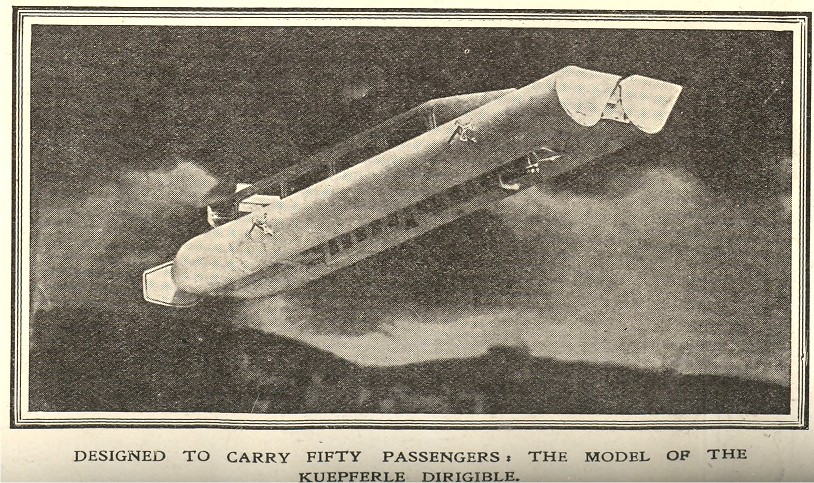
    https://historyofideasblog.com/a/6a00d83542d51e69e2012875ea2c87970c-pi

    And lastly, this example of the tracked airship–this must have been a popular notion because I’ve seen perhaps 15 different plans and I don’t spend much time at all reading in this area.  But harnessing the power of the balloon or dirigible or (kite!) whatever to a track system seemed to be a good idea, once upon a time:



  • Suggestions of Magnificence: Bloated and Bumpy SteamPunk Aviation, 1830’s.

    JF Ptak Science Books      Post 2004

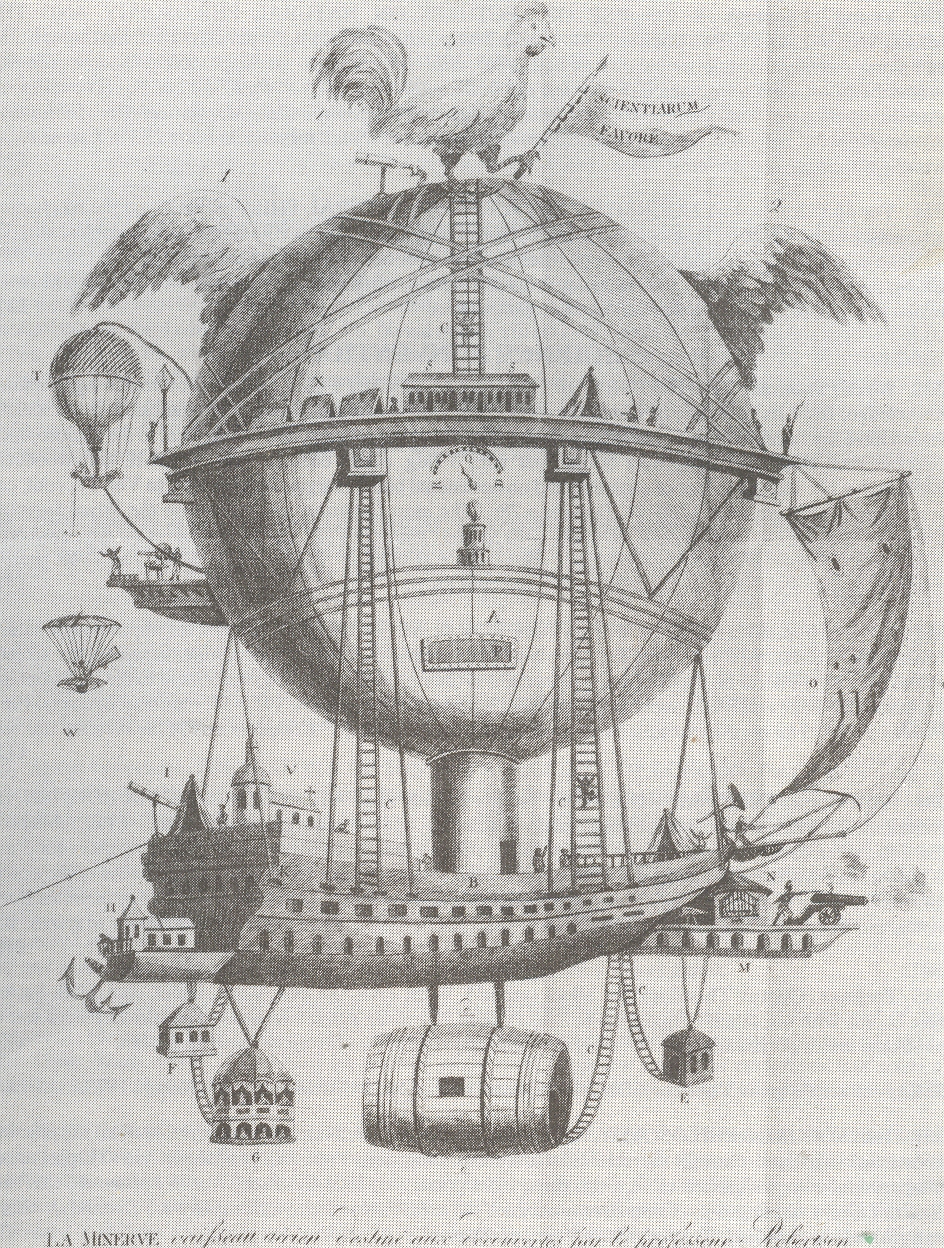
    Question: What is 150’ in diameter, weights 80 tons, carries 60 scientists,
    a cannon, a big rooster, an escape pod for women, and makes transcontinental
    flights? 

    Answer:  nothing.  

    And so: what is ten times bigger, and carries ten times more people? Bigger but still the same nothing–though a more-magnificent nothingness. 

    Blog--May 20--minerveA The first example  did however live in print as the great balloon La Minerve, the  prankish gesture of the Belgian optico-magician,
    physics experimenter/exhibitionist  and
    general experimenter  (and probable
    crumbun)  “Dr. Roberston”, who was
    actually Étienne-Gaspard Robert (1763-1837). 
    Robert did have vast experience with balloons—he was Commandant des
    Aerostiers during the war, serving under General Jourdain in Belgium and Holland
    in 1803/4, providing valuable observations on the enemy troops and movements
    from tethered (and not) balloon observing stations;  he is also regarded by some as the inventor of
    the parachute.  He had a wide interested
    in optics and toys, making a very profitable tour with Brewster mirrors,
    demonstrating all manner of specters and floating bodies and such for a paying
    audience.

    Blog--May 20--minerveB

     He came up with this sci-fi-ish idea
    in the early 19th century, and published his dream broadsided swipe
    at other aeronauts in 1820 under the title of La Minerve, vaisseau aérien, destiné aux découvertes et
    proposé à toutes les Académies de l’Europe par le physicien Robertson. 
    There was nothing about this balloon that
    would’ve worked, and Robertson knew it, intending his pamphlet to be more of
    caricature of existing attempts in flight than as a science fiction
    creation.  (The pamphlet reads a little
    mean-spirited to me regarding the Minerve; other sections, which dealt with
    single-occupant air-transport devices of imaginative construction, seem less
    so.)

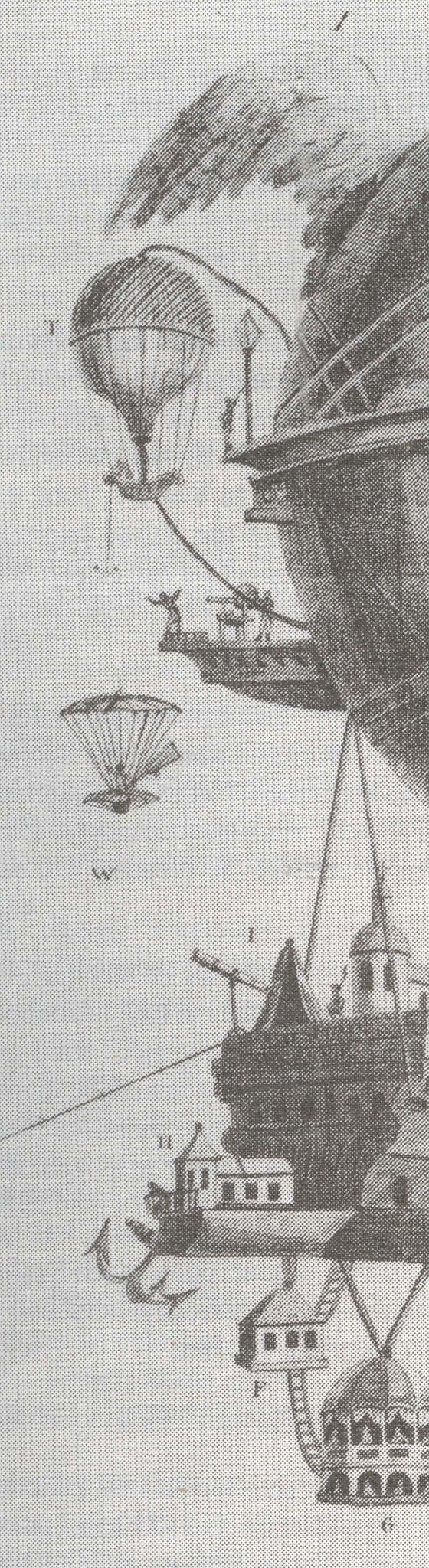
    In any event, Roberston provided large creature comforts for his travelers,
    not the least of which was a ship (which seems to be 175 feet long) holding 60
    scientists and providing enough space for long-distance sleeping arrangements,
    laboratories, observation decks, a kitchen, food supplies, water and the
    like.  There is a (large!) cannon in the
    bow of the Minerve, which is also topped by an enormous cock (I figure it to be
    50 feet from tail to beak), a gigantic and heavy symbol for vigilance (at what
    price?) .  There are several small out buildings,
    as well as a smaller balloon that housed the women who accompanied the all-male
    crew on these long distance jaunts.

    There is an enormous anchor where the power source for forward motion should
    be.  Alas!  Roberston has provided no means of thrust,
    trusting the winds to take the massive balloon to-and-fro.

    (“Minerva” is the Roman goddess of poetry, medicine, wisdom, commerce and crafts,
    as well as the goddess of warriors.  She also
    invented music.)  

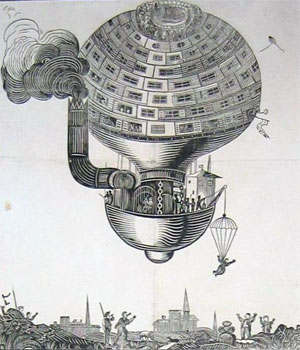
    And the next example of the magnificent nothing, the Great Monster, appeared in 1837.  It was supposed to support 80 houses, steam powered with a large coalhouse and raintanks; it supported gardens and other ammenities, and was to support upwards of 1,000 people–it would be crowded, though, even though the thing was supposed to be 14,000 feet in diameter and 682′ high.  It was huge, tall, and travelled at 100 mph

    Even though the Minerve was a smaller undertaking, its 19th-century Baroque crenulations and insistence upon levels of dangling laddered bits make it a peculiar favorite in spite of the 2.5-mile diameter of the monsterosu Great Monster.Ballon-monstre-1837-f2


  • Von Braun on German Liquid Rocket Development, 1945

    JF Ptak Science Books Post 1994

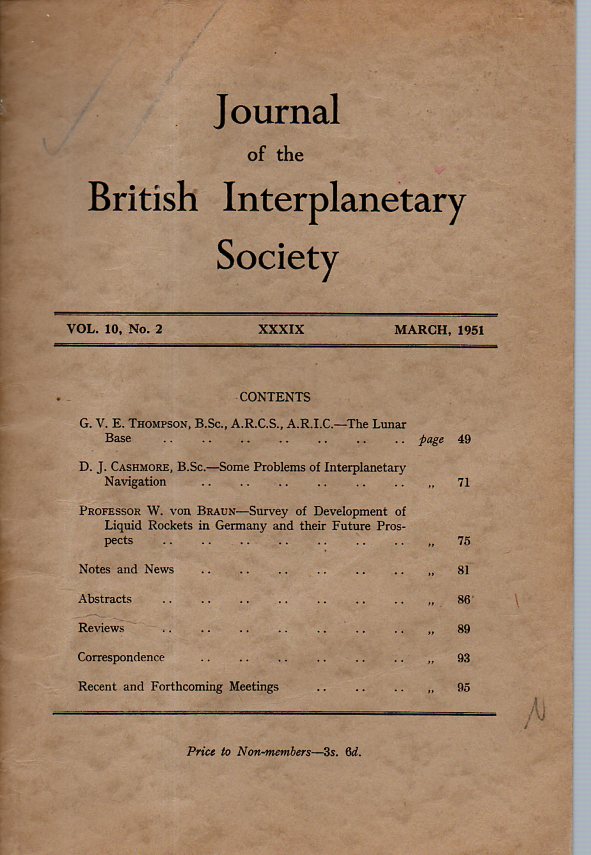
    Von braun title157I was prepared to just list this for sale in the books for sale section of this blog and be done with it–until I semi-realized that this famous (or at least significant) report is not to be found available online. Von Braun is far from being of interest to me–I don’t need to know his part of the space program from 1946-1977, though I am interested in his what he was doing from 1936-1945 when he was trying to kill London.

    Again, I’m no expert on this man, but reading between the lines of his politically whitewashed account of German/Nazi flying bomb program makes me wonder about his enforced/codified forgetfulness and suggestive memory.

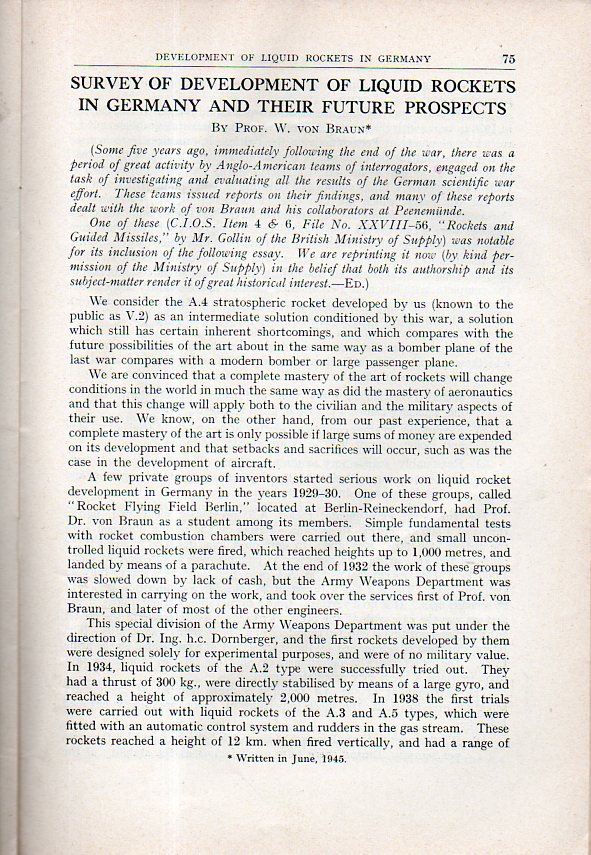
    The paper in hand is his “Survey of Development of Liquid Rockets in Germany and their Future Prospects”, a six-page effort that appeared in the Journal of the British Interplanetary Society on March, 1951. It is a reprint of a reprint of a report that he wrote for his Anglo-American interrogators in the summer of 1945, when he and the Allies were scurrying around and trying to figure out what to make of the post-war world with all of that valuable German technology-ops out there in the wind.

    In any event, von Braun wrote out this history and prognostication (as there is a big chunk of the paper devoted to future space travel and such) for them in 1945 which then found itself in print by at least 1946. There are many glosses. For example, his use of the A.-prefix determination throughout the course of the document to refer to the V-weapons though it is noted in the first sentence of the report (and no doubt by an editor), that the A.4 “is known to the public as the V.2”. (Perhaps that has the scent of freshness to it, to rid the report of a small part of its scrubbiness…or not.)

    He writes occasionally in the third person, and also makes the case that the development of the rocket complex at Peenenemunde was for research in high-flight/super-fast travel, when the place had always been intended for military applications. He does mention that the A.4 had severe problems with the guidance system, but that was acceptable since they were given large-target areas to bomb–such as “London”.

    It is an interesting read for what it says about the future of vast fast travel, as well as for what it does not say about defeat and responsibility and the use of slave labor and bombing large civilian areas. But that’s not what he was talking about, here.  Or basically ever.


    Von braun 1151


  • Making “Flying” a “Proper Subject of Investigation”, 1866

    JF Ptak Science Books  Quick Post

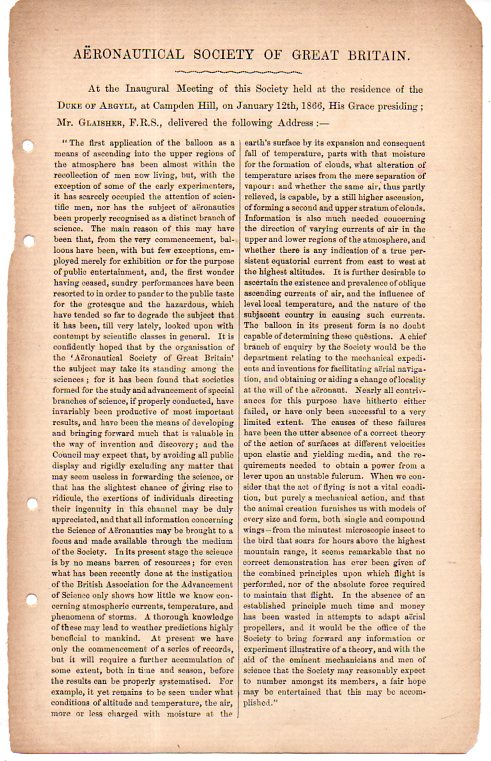
    I came upon this small, rare item in the early aviation box here.  Its the inaugural address establishing the Aeronuatical Society of Great Britain, the even held at the residence of the Duke of Argyll (Campden Hill) on 12 January 1866.  The text is by James Glaisher, who was a significant experimentalist/balloonist in addition to running the Department of Meteorology and Magnetism at the Royal Greenwich Observatories for 34 years. The document is only 7×4 inches, but it winds up being quite dense (literalyl and figuratively), with about 800 words packed onto one side of this double-column sheet.   

    Gibbs-Smith, in his interesting and very useful Aviation, an Historical Survey states:

    “One of the most important dates in flying history is the year 1866, when there was founded in London the Aeronautical Society (now Royal) of Great Britain.  Although not the earliest society devoted to flying it
    was by far the most important and. influential .  It soon attracted men  who realized that mechanical flight was ultimately possible, and who were determined to study and solve its problems..  From then on the main
    development of aviation was to lie in the hands of scientifically or technologically trained men.  The subject if flying…now took on a new seriousness…it now become a proper subject of investigation…”– p. 41. 

    The object itself does not appear in the OCLC/WorldCat, and so is extremely uncommon in this format, so I thought it would be useful to report on it and reprint it here.  The original is also available for purchase onthe store’s blog.


    Aeronautical society150

    ·Posted by :

    ·in:


  • The Moon as an Aeroplane, 1914

    JF Ptak Science Books  Quick Post 

    Follow Me on Pinterest


    Moon is still champion


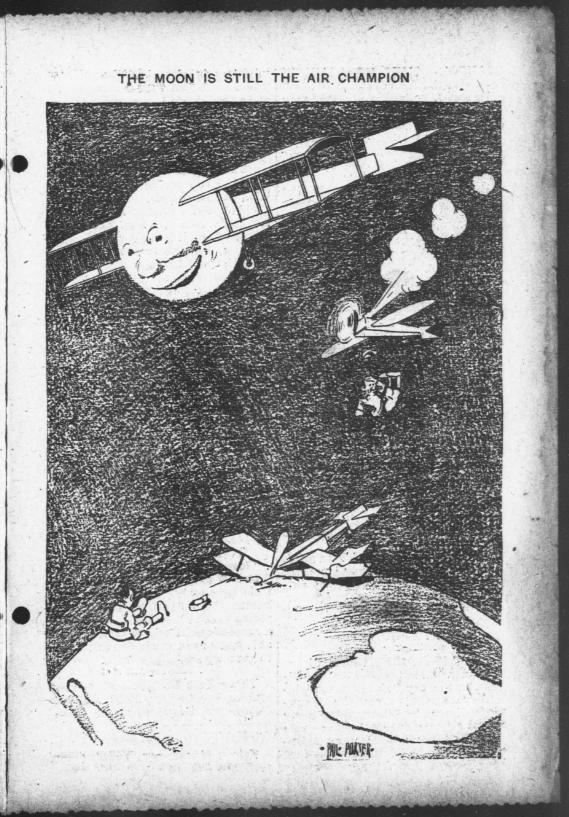
    The iconography of the Moon is certainly wide and vast, but I’m thinking that this may be a very good candidate for the first time that the Moon appears as an airplane. I found this lovely image depicting the champion of the air, the great and all-knowing height-highness, the Moon. In 1914, eleven years after the first powered heavier than air flight of the Wright brothers, the development of more sophisticated was appreciating at a high rate, and there were newer higher records for (fixed wing) altitudes. (In 1908 the altitude record was about 360′; in 1910, it stood at 8,000′–balloons had achieved loftier records, around 40,000′ in 1912.)  This was a sly way of pointing out that try as they may and try as they might, the inhabitants of Earth wouldn’t come quite so close to the Moon as they would dream.  And that was true until Apollo 8 found itself on the far side of the Moon, only 56 years later.   [Source: The Day Book, Chicago, March 24, 1914. Image provided by University of Illinois at Urbana-Champaign Library, Urbana, IL. Persistent link: http://chroniclingamerica.loc.gov/lccn/sn83045487/1914-03-24/ed-1/seq-31/]

    ·Posted by :

    ·in:

    —

  • Future of Flight, 1836

    JF Ptak Science Books   Quick Post 
    Follow Me on Pinterest


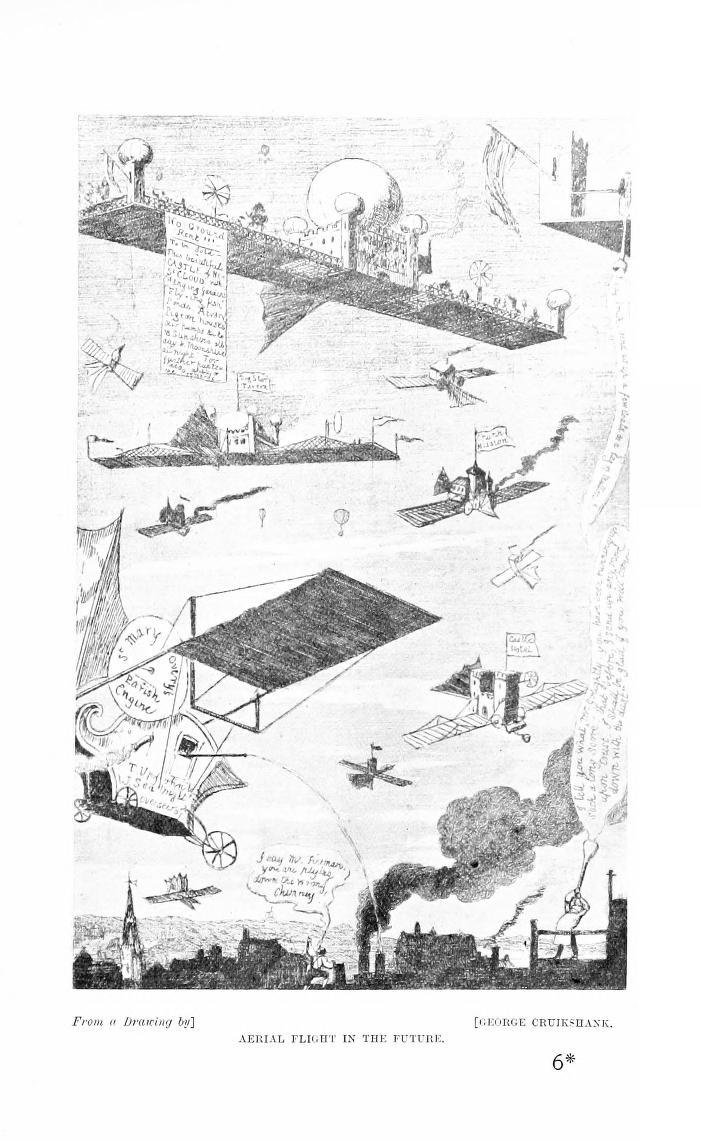
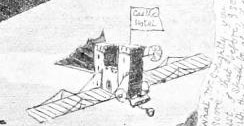
    This lovely image of the possibilities of future aerial flight was made by the celebrated caricaturist and illustrator George Cruikshank, and was printed in 1836.  The aircraft at top is a massive affair (the selling of the “beautiful Castle in St. Cloud”) offered great possibilities along with “no ground rent”.  It is absolutely a castle int he sky, literally and figuratively, and must’ve seemed to be something of a possibility to Cruikshank in the fifth decade following the first balloon ascension.  Of course he was having a turn at aviation, but I think he also saw the bits of the feasible within his hopeful caricatures. 

    Aviation of the future[Source:  E. Seton Valentine, Travels in Space, a History of Aerial Navigation, 1902.  Here.]
    Details below:Aviation of the future--house in sky


  • Acoustic Weapon “Performance Degrader”, 1933

    JF Ptak Science Books  Post 1926

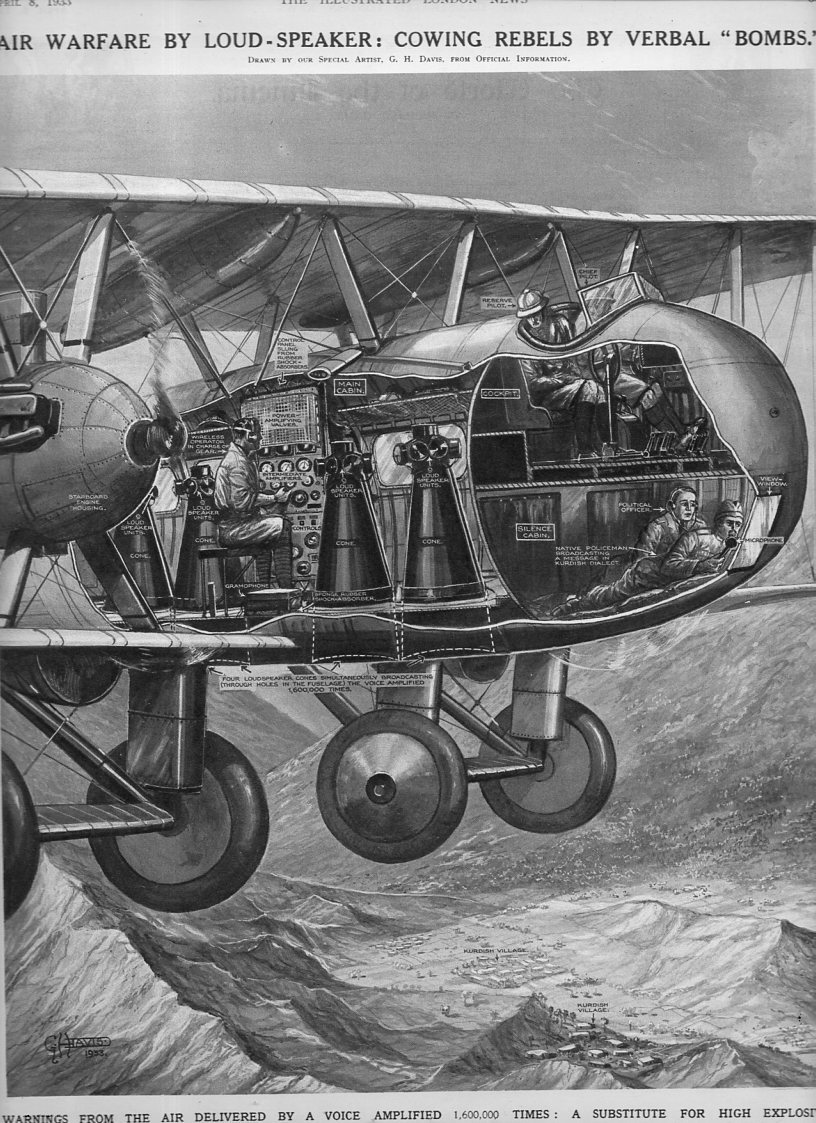
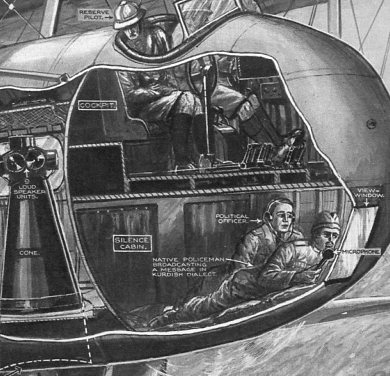
    From the looks of it, this image from an 8 April 1933 issue of the Illustrated London News is not quite a “verbal bomb” as we might think of such a thing today.  The cutaway drawing (by the sensational G.H. Davies, who produced hundreds of these images for the magazine over four decades)shows an acoustic device housed in a Vickers Victoria aircraft. As described in the descriptive text to the image, Sir Philip Sassoon (“speaking in the House of Commons on the Air Estimates last month”) mentioned in May 1933 an attempt to induce forces hostile to the U.K. in Northern Kurdistan by flying over rebel strongholds and threatening an air attack if no surrender was forthcoming.

    Verbal bombs877

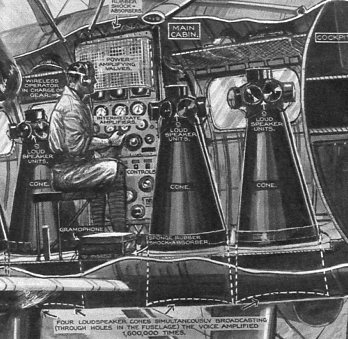
    Evidently a translator would address the town at 2-4,000′ elevation through an audio system that amplified the voice”1,600,000 times”. An address was made to the leaders of the tribesmnen to surrender their position, else an air attack would occur after three days. Even though described in the title of the image as a “verbal bomb”, it isn’t anything like the directed energy/sonic/acoustic/infrasonics/pulse weapon performance degraders that are currently available.  What was happening here was simply (or not so) an attempt to get an enemy to relieve their position via tangible threat, sort of an acoustic leaflet bombing prior to the real thing. Of course this was backed up by actual bombing, which was still a relatively new weapon for armies–several nations which possessed this newish facility of war practiced bombing civilian/military targets alike in extra-territorial possessions. (There was a hot debate over what constituted fair use of aerial bombs beginning in earnest in the 1920’s, but much of that soon devolved into debates on what constituted “civilian populations”, and there the definitions were wide and sloppy.)  In any event, the loudspeakers did not emit high-powered sound that would disturb/puncture eardrums or cause dizziness or problems with eyesight by making the eyeballs vibrate–they were just loud conveyers of Bad Things to Come.

    Verbal bombs det 2879
    Verbal bombs det878