A Daily History of Holes, Dots, Lines, Science, History, Math, Physics, Art, the Unintentional Absurd, Architecture, Maps, Data Visualization, Blank and Missing Things, and so on. |1.6 million words, 7500 images, 4.9 million hits| Press & appearances in The Times, Le Figaro, Mensa, The Economist, The Guardian, Discovery News, Slate, Le Monde, Sci American Blogs, Le Pont, and many other places… 5000+ total posts since 2008.
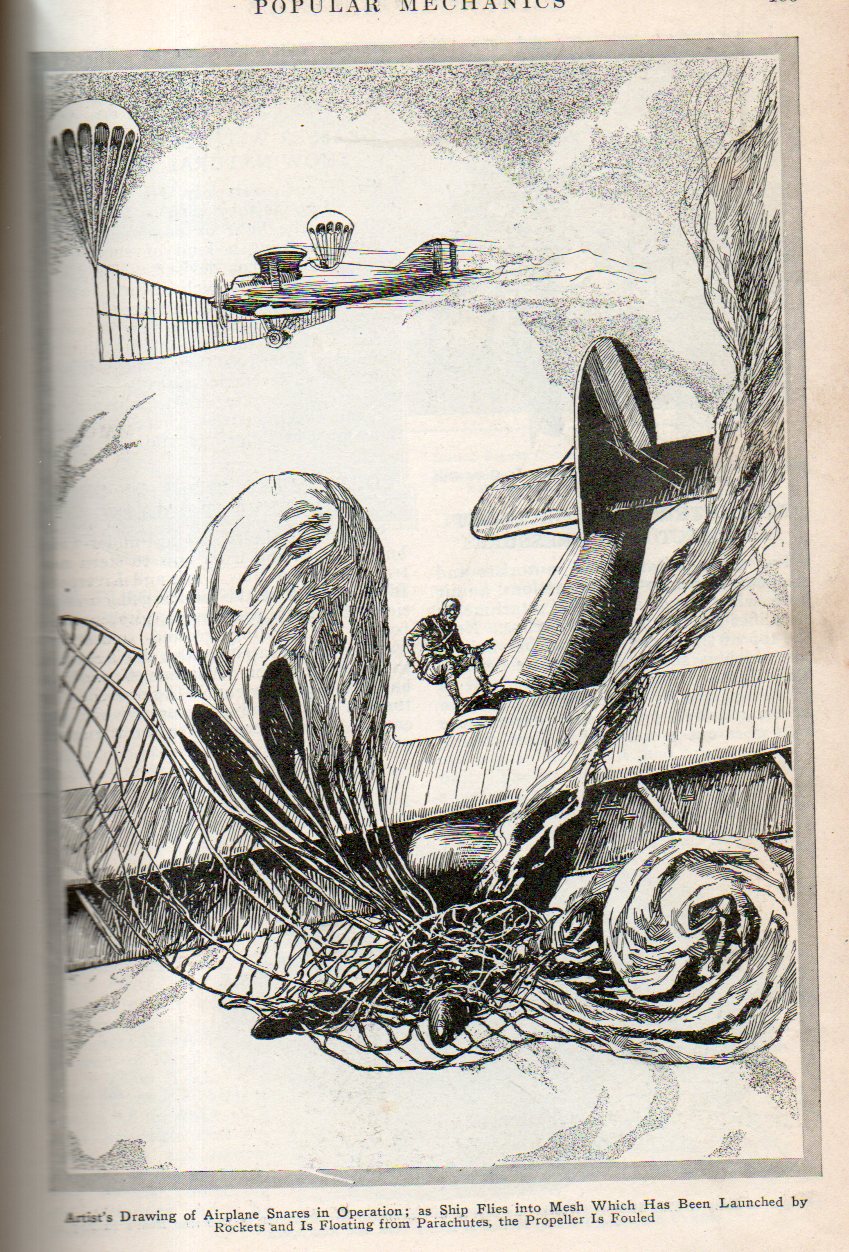
“Nets Launched on Rockets to Snare Airplanes” ran the header on this article from Popular Mechanics (volume 44, July 1925). “Nets fastened between parachutes and shot high into the air with shells or rockets are being tested by anti-aircraft branches of the Japanese army and navy as snares for airplanes…” Evidently the plan was to locate the approaching plane and fire these things in their vicinity and hope for the aircraft to find and run into that speck of net occupying .00001% of the sky.
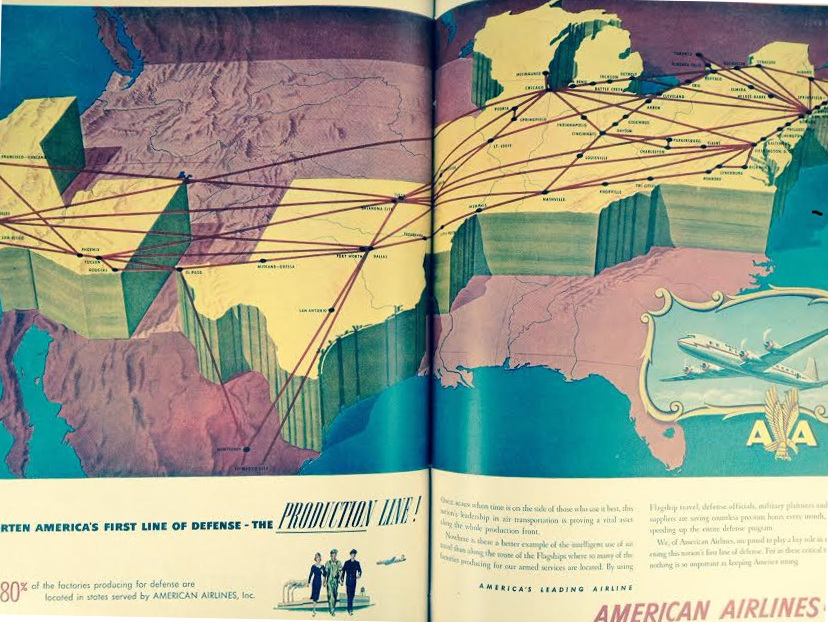
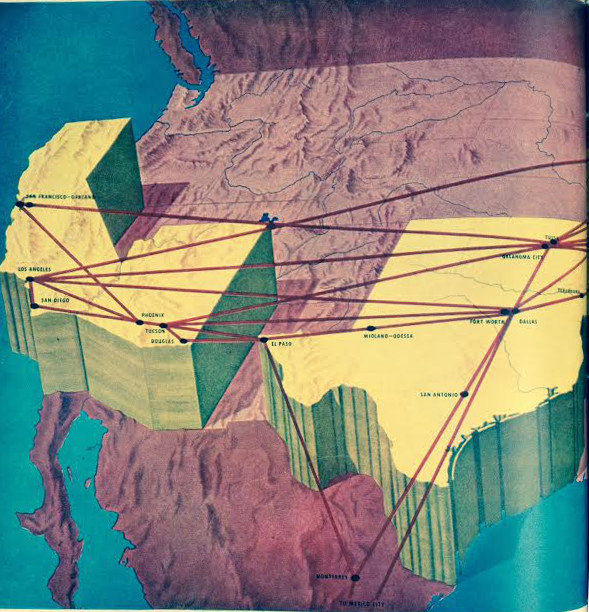
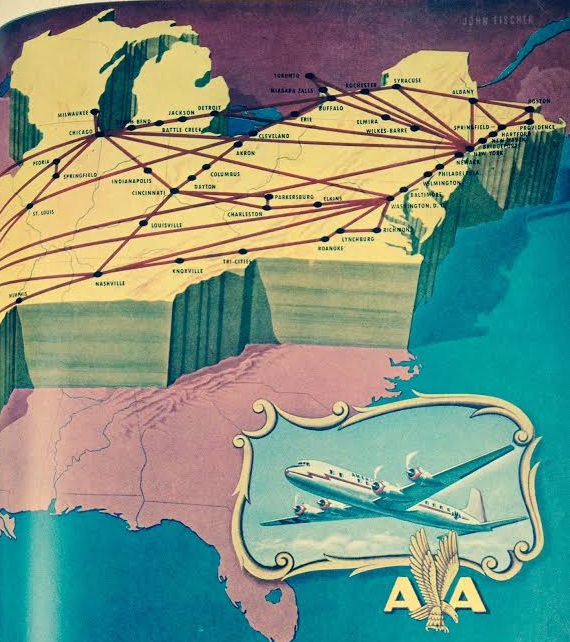
Yesterday I posted a lovely octahedron map showing intercontiental air routes in 1956 (here). Today, looking in LIFE magazine for some images and a story about U.S. GI’s being exposed to nuclear blast tests I bumped into this unusual two-and-a-half dimension map showing domestic air routes of American Airlines (November, 1951). The national service areas are chunked-up, given some enormous height, not making things very comfortable-looking for the Pacific W and northern Mid-West, and almost the entire South. I guess the question would be, were the service areas heightened, or the rest of the world lowered?
The first transcontinental flight competition called for crossing the country in 30 days (for a $50k prize) and was accomplished in 1911. By 1933 the fist transcontinental through-flight (a one-day, not-overnight flight) occurred just 22 years later in 1933; only 5 years before this map was made was the first 1-stop service (1946), which is one reason why there are so many intermittent stops; it would be another two years (1953) for there to be non-stop service. The of course the not-slow explosion of competing airlines and flights.
It is interesting to recall that the first transcontinental railroad for the U.S. was in 1869, and the first European transcontinental railroad was 14 years before that (in 1855), thus getting people across the country and continent 80 and then nearly 100 years ago. On the other hand ,the first trans-Australian RR was completed in 1917–that was east-west. North-south is a different issue for Australia, which has been an historically very highly difficult crossing., In any event that line was not completed until 2004. All things considered, I think, this transcontinental air business was extremely successful and fast, coming less than 50 years after the first Wright powered flight.
In the world of the history of heavy, nothing quite spells it so correctly in typography than some of the German entries in the 1920’s. Big, thick letters, jumbo arms and legs with little breathing space, and no design to get in the way of letting gravity do its work, and place often on jet-black backgrounds, these alphabets are a perfect answer to the weight of the decade.
Here is a good example of mid-heaviness, expressed in type and in a map and the overall design. This is an ad onthe front cover of ZFM Zeitschrift fuer Flugtechhnik und Motorluftschiffahrt (14 April 1926) and for the leaving-the-ground aspect of the journal the design work couldn’t be much heavier.
This air travel ad posts the Dornier-Wal seaplane, the “Bridge of the Continents”, getting you across the Atlantic to South America in 35 hours. (The Dornier -Wal was a flying boat, a metal monoplane with above-the-wing twin engines and a maximum speed of about 180km/hr, which means I guess that the aircraft was making on average about 90mph on its trip across the Atlantic.) And the ad–well the ad is bold, and slightly spartan, and still very heavy for the amount of blank space in it.
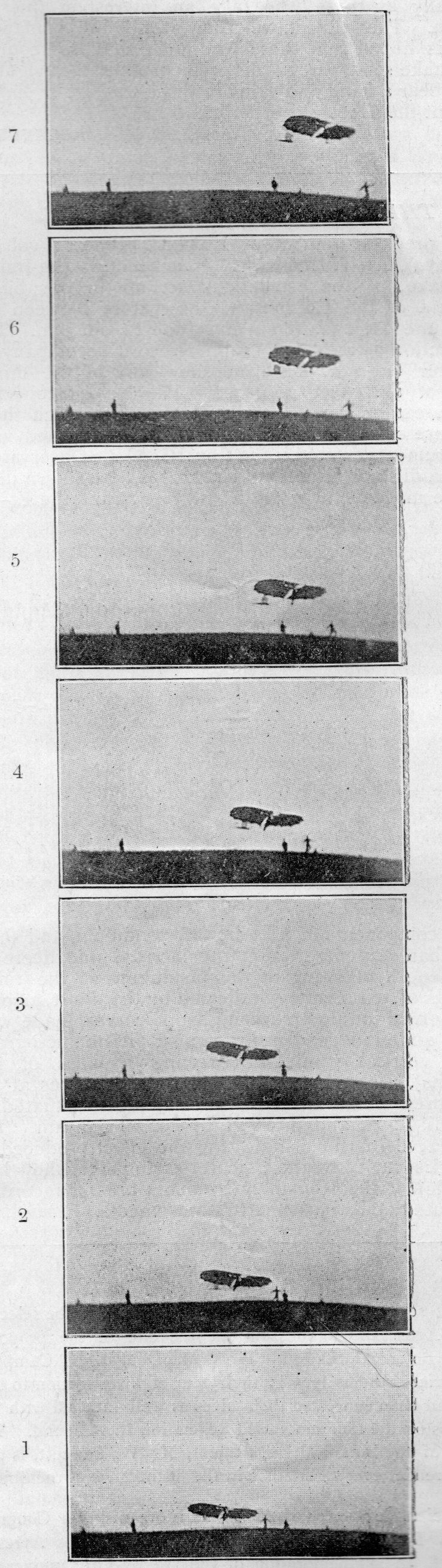
Percy Pilcher was a true aviation pioneer who met his end very early, during an event that probably shouldn’t have happened, killed by in 30′-fall in 1899. He was creative, and figured out a way to address the knotty problem of lift vs. wing dimensions vs. weight, coming to a tri-plane design in 1898, but was killed before he could fly it in public. His death comes about two years after this appearance in Nature magazine, which tells a quietly dramatic and essentially sotto voce story about attempted soaring flight. It seems so extraordinary to me because–aside from needing a fit of genius to try to figure out the physics of flight, there was a lot that could be done with canvas, pipes, fishing line, and boy-power. When I read this account I could literally feel that soft breeze that he looked for on my teeth–few pieces of major histories of technology get this close to the “common person”.
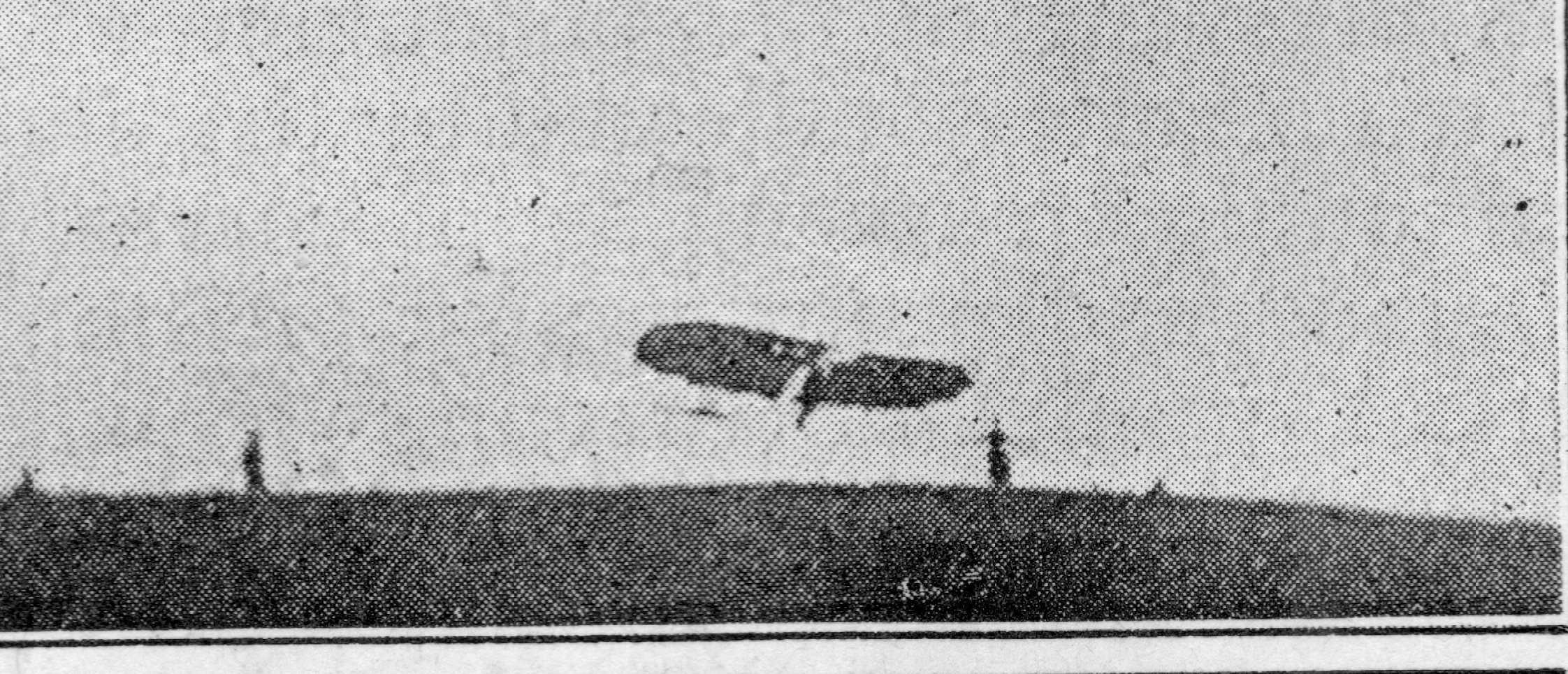
Someone made this nice, short video from the seven stills, perhaps making this one of the earliest “movies” of an human in flight:
“At the time of the flight here illustrated the wind was so light and variable in direction that an ascent from even the elevated position taken up was almost impossible. Means however were at hand by which one end of a thin fishing line 600 yards long could be attached to the machine while the other end passed through two blocks placed close together on the ground at a distance from the aero plane of about 550 yards. These blocks were so arranged that a movement of the aerial machine in the horizontal direction corresponded to a fifth of the movement of the boys pulling the line.”
“The start was made at a given signal the line being pulled by three boys and Mr Pilcher gradually left the ground and soared gracefully into the air attaining a maximum height of about 70 feet… A safe and graceful landing was made at a distance of 250 yards from the starting point. The photographs illustrate that part of the flight previous to the attainment of the greatest height…if the machine had been fitted with a small engine or motor to give (this) amount of thrust by means of a screw or otherwise perhaps an equal or further distance would have been covered.”
“Mr Pilcher now proposes to employ as soon as possible a small and light engine indicating about four horsepower this being considerably more than sufficient for flights of moderate length. It is however thought advisable to have rather too much than too little power to commence with as a factor of safety. With this improvement it is hoped that further distances will be covered and a nearer approximation to a flying machine will be attained.”
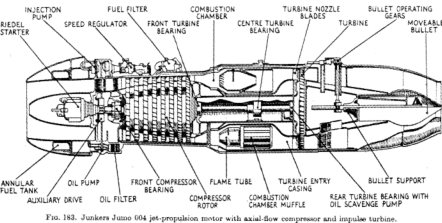
This drawing comes from the great engineering classic that presented the prototype jet engine for all that would follow it–J.G. Keenan’s Elementary Theory of Gas Turbines and Jet Propulsion. It was published in the glorious Oxford blue cloth by the university and issued with the classically-design beige dust wrapper–it just has the feel of something solid and astute. Keenan’s work is a classic–it is a general survey of developments in the jet propulsion field and was among the very first books published on the subject.
Keenan was not the first though to the jet engine party–Hans von Ohain and Sir Frank Whittle were. It was a classic idea-in-the-air example of two people working on a very similar idea at the same time without any knowledge of the other. von Ohain was the first to produce an operational jet engine (1939) while Whittle was the first to patent (while getting his engine to be operational in 1941). Jet engines have been around for a long time (Romans having legislation on the use of variable jet sprays in water distribution) in different forms–fountains, fire hoses, marine jet propulsion (reaching back to 1871), and so on. But John Gregory Keenan’s book–that was a big and influential review, a major contribution to the field.
This is a survivor of some sort, found at the bottom of a box of German aviation pamphlets–I’m sorry that it is in this condition, but at least there is some of it that remains, because the design is quite striking. It comes in the 24th year of the publication Luftfahr(t), Deutsche Luftfahrer Zeitschrift, and published in 1920. It is just the cover of one issue, and I expected to see a fuller image of the thing online thinking it not to be so uncommon, but I couldn’t find any, which I thought unusual. And so I share this rag-tag copy.
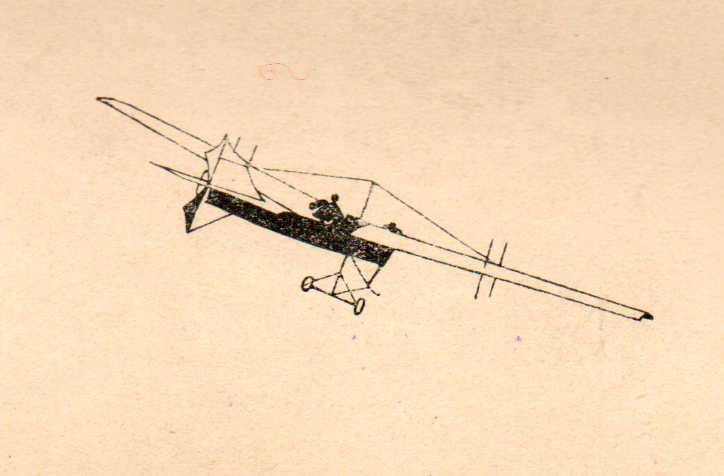
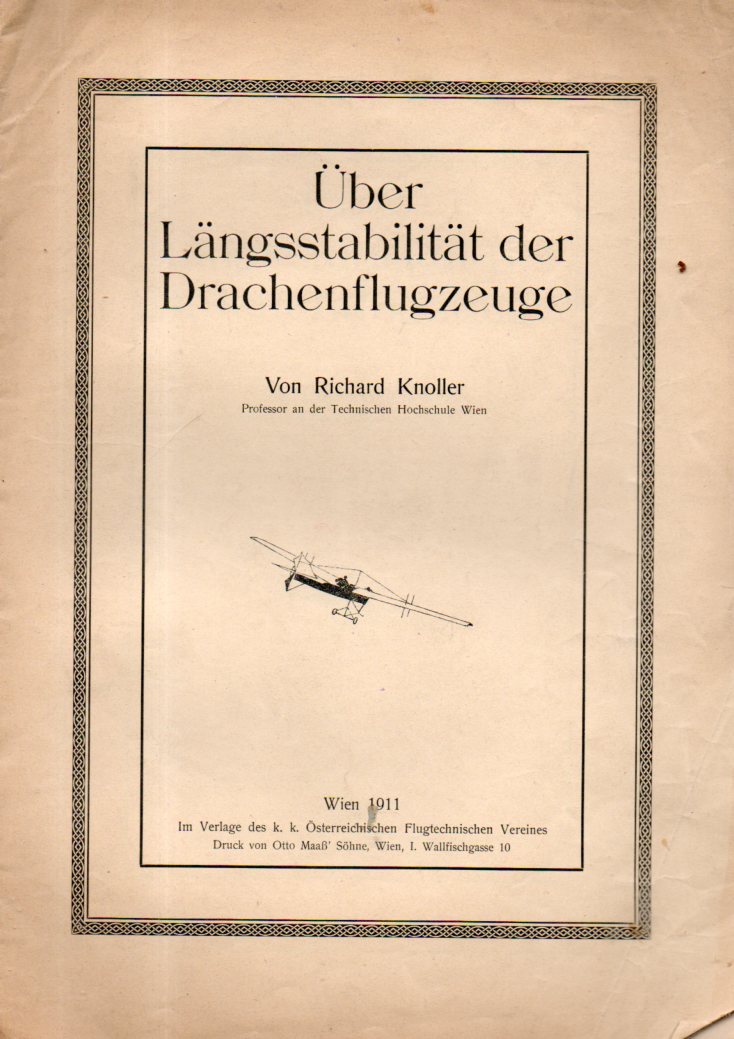
This is the detail from the cover of Richard Knoller‘s (professor at the Technischen Hochschule in Vienna) Ueber Laengsstabilitaet der Drachenflugzeuge, published in 1911. In real the image is only about an two inches wide and spare-but-detailoed, wisely placed in the center of the oversized pamphlet, and set in a lofty blank space. Brilliant.
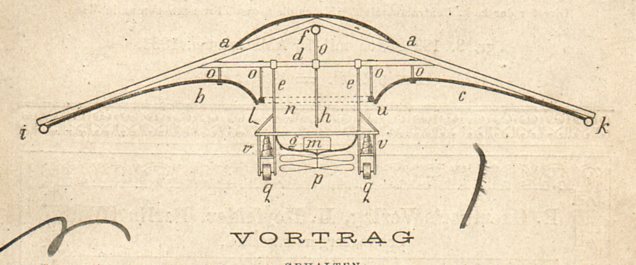
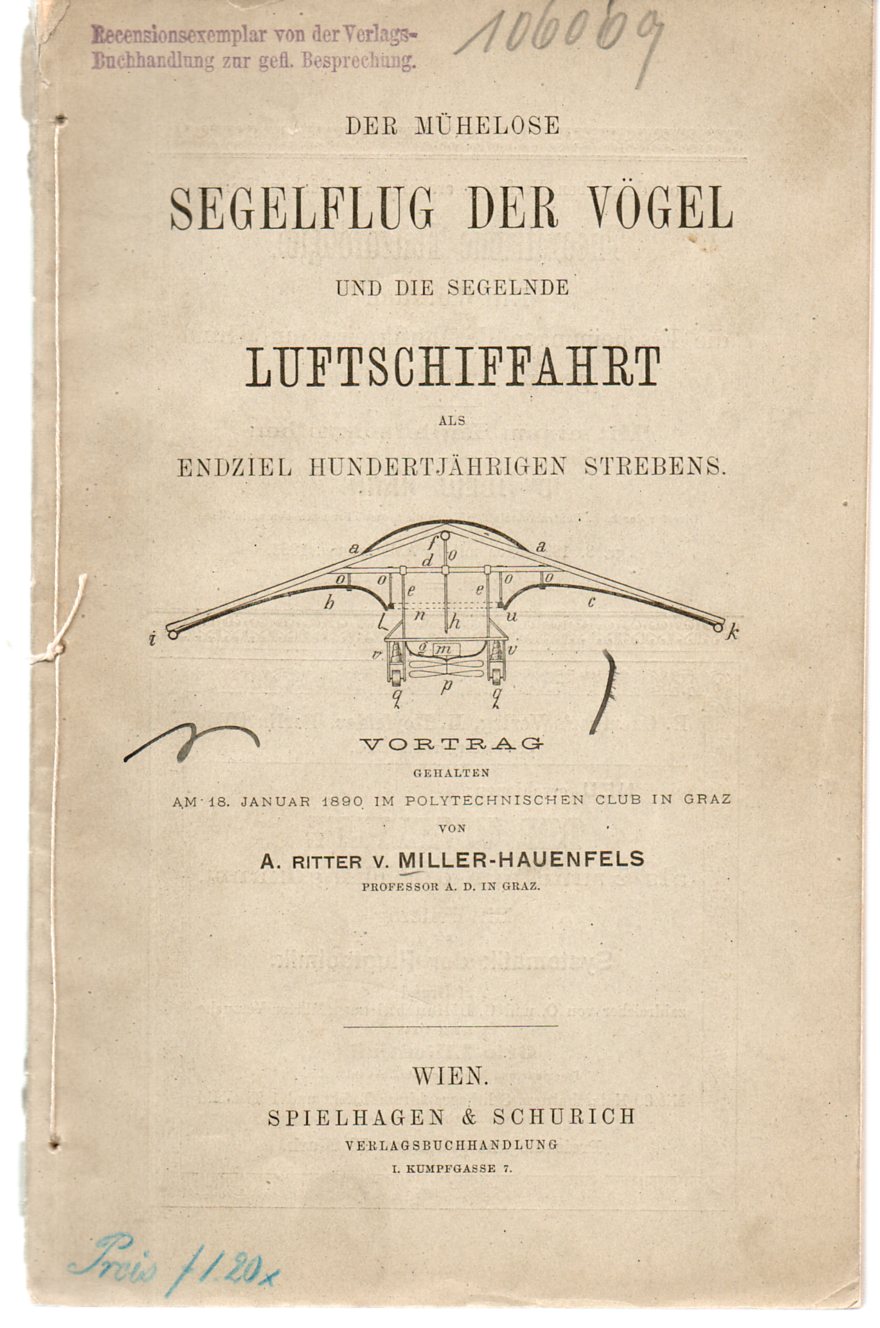
Here’s an interesting and lovely little classic: A. Ritter v. Miller-Hauenfels Der mühelose Segelflug der Vögel und die segelnde Luftschiffahrt als Endziel hundertjährigen Strebens. (Roughly “The effortless gliding of birds and the sailing airships as the ultimate goal for the end of the century”).The matieral was delivered (January 18th) 1890 at the Polytechnischen Club in Graz and publisahed later that yer in Vienna by Spielhagen & Schurich. My copy of this work also happens to have been in the collection of Vicktor Silberer, 1846-1924, a pioneer aviator from Vienna and a prolific author, jorunalist, and politician.
In his lectures at Graz Miller-Hauenfels looks at the possibility of human (non-powered, gliding) flight via forward-progression bird flight, basing his work on that of Marey, Lilienthal and Parseval.
“Let no man seek / Henceforth to be foretold what shall befall / Him or his children.Milton,” Paradise Lost XI, 770-72
George Cruikshank–the gifted English cartoonist/satirist/caricaturist and social commentator–was readying his viewers to some hyperspeculative dreams on the possibilities of near-in-time powered flight. Steampunk air travel is so commonplace in the near future that there are departure stations on building-tops
The etching in question, illustrating “Air-um Scare-um Travelling” appeared in the Comic Almanack (1843), and outlines a clear and hopeful image of future travel. The ads show that there are frequent flights to far-away places, including Mont Blanc and Beijing.
It is interesting that the future is tempered somewhat by including an exploding airship at bottom left–so the future may be wondrous and exciting, though not without its dangers.