A Daily History of Holes, Dots, Lines, Science, History, Math, Physics, Art, the Unintentional Absurd, Architecture, Maps, Data Visualization, Blank and Missing Things, and so on. |1.6 million words, 7500 images, 4.9 million hits| Press & appearances in The Times, Le Figaro, Mensa, The Economist, The Guardian, Discovery News, Slate, Le Monde, Sci American Blogs, Le Pont, and many other places… 5000+ total posts since 2008.

Category: Aviation & flight

  • Finding Unseen Things In and From the Air

    JF Ptak Science Books  Post 1131
    Seeing more deeply--air weather det853

    Finding the hard-to-find, the invisible, the “hidden”, is an essential aspect of, well, mostly everything.  Whether it is Newton separating light with a prism to find its constituents, or Hooke investigating the formerly quasi-real microscopical world to reveal worlds within worlds, or Galileo using his telescope to quash the ideas of the unaided-eye-visible night sky as an unaltering perfection of creation, or Roentgen seeing through his wife’s skin, or Fraunhoefer finding the complex spectrum, or Henry Draper determining a chemical constituent of the sun, or the invention of the zero or negative numbers or subtraction, of finding Black Holes or other planets or the remnants of the Big Bang, or (Kandinsky) finding the nonrepresentational aspect of art, or Duchamp finding in an upturned urinal that art had no boundaries…the list goes on and on.

    One aspect of this “finding something in nothing” business that is interesting to look at because it is so local and discernible–and recent–is in air navigation and detection.  And I’ll do this using a series of excellent illustrations from The Illustrated London News, all of which are from the 1927-1938 period. 

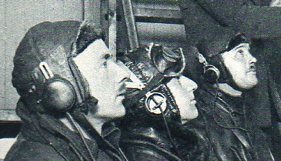
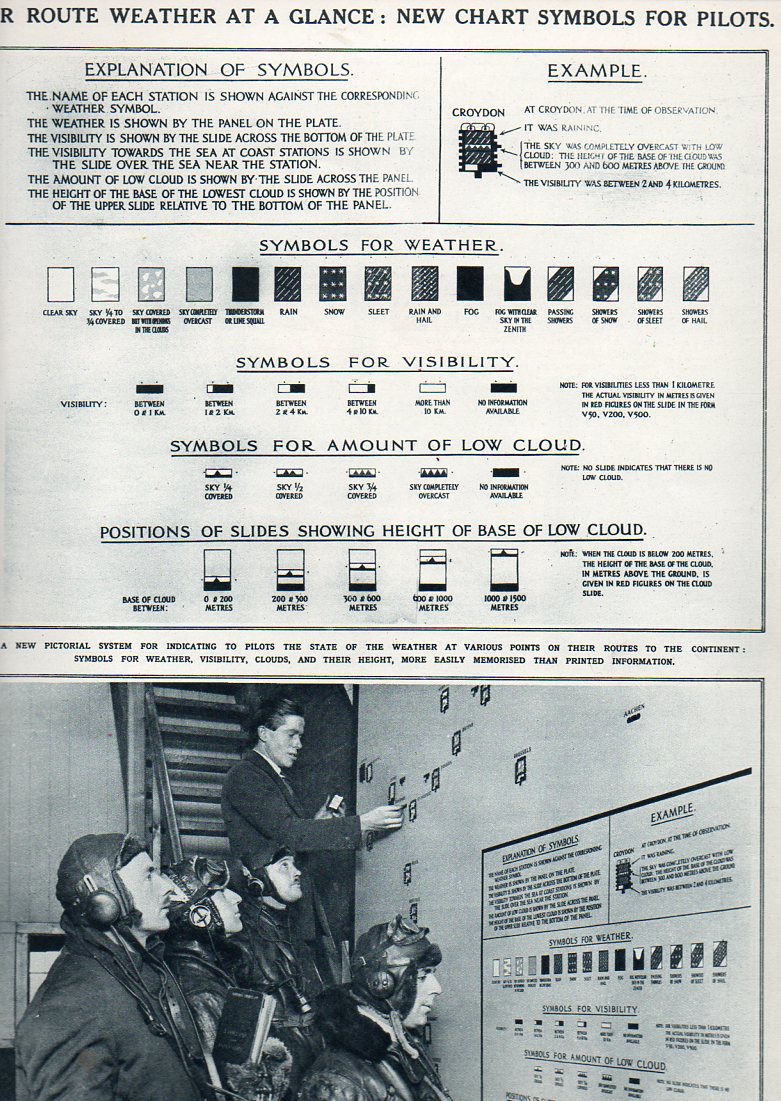
    The first is relatively simple, at least simple from here in the year 2014, which shows four pilots being briefed on weather conditions with a aerial chart for conditions along intercontinental routes.  The placement of these symbols represented a vast improvement over the earlier systems of readying pilots for what weather lay ahead, if indeed there were any communications at all.  This represents an early look at a codification of conditions and expectations for air travelers–a display of new and important data in 1927. 
    Seeing more deeply--air weather852
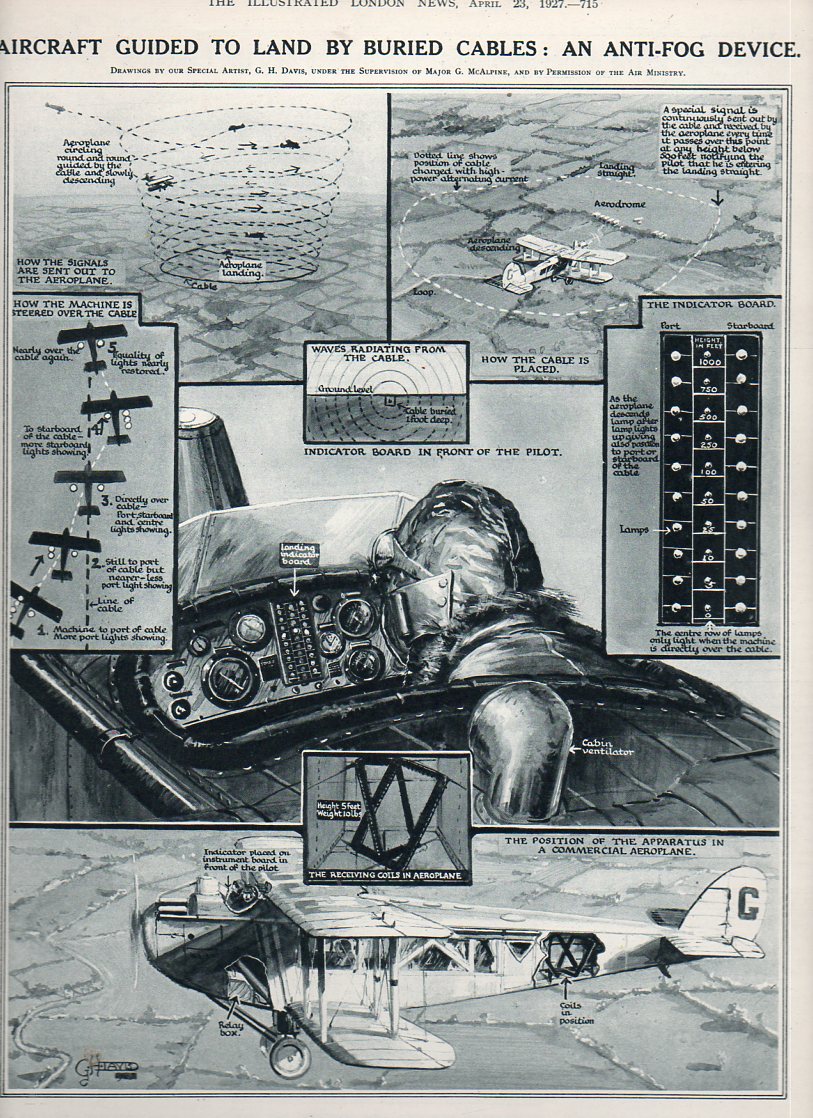
    Next is a brilliant device for assisting pilots to land in foggy and dark conditions–actually on how to find the ground safely.  In 1927 (again) a RADAR-like system was put into place on aircraft that involved receiving the signals of an ac-pulsed buried electrical cable that surrounded an airport.  The receiver (seen here on the flight panel of the pilot in an open-air cockpit) would be read to reveal proximity of the airport, the pilot making wider and then closer spirals in descent until his was basically within the buried airport cables and thus able to land.
    Seeing more deeply-anti-fog855
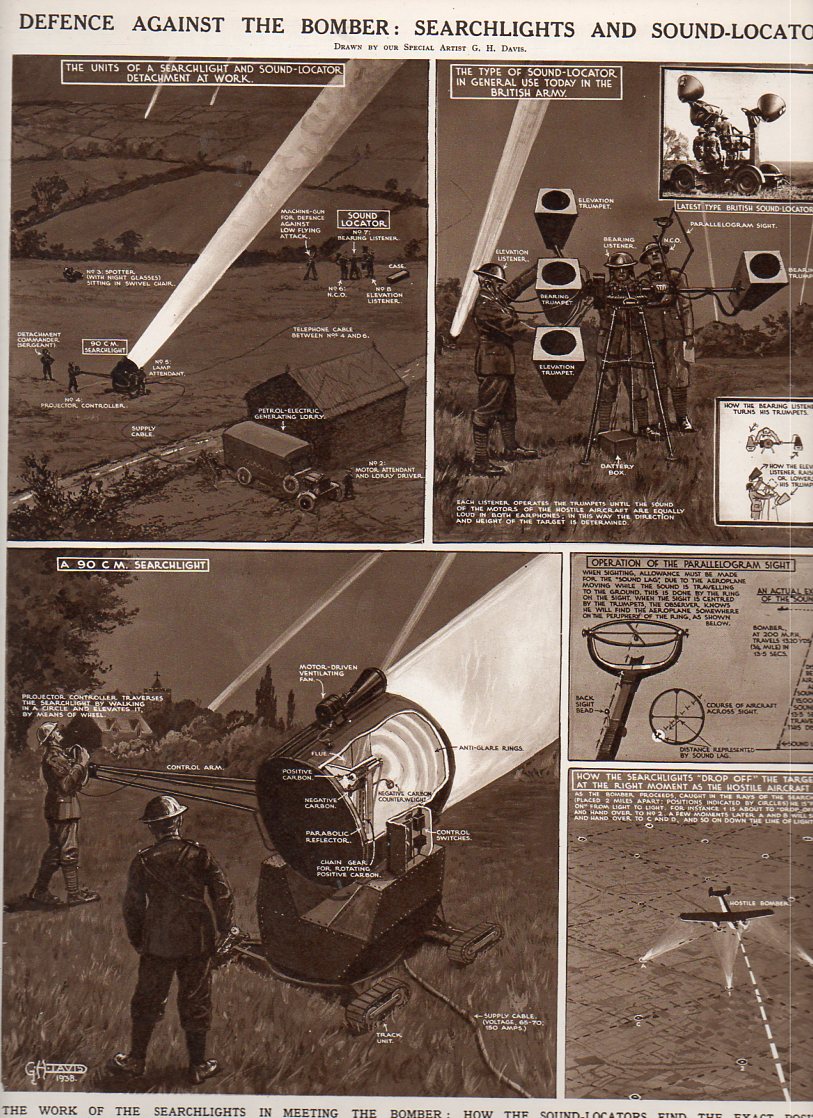
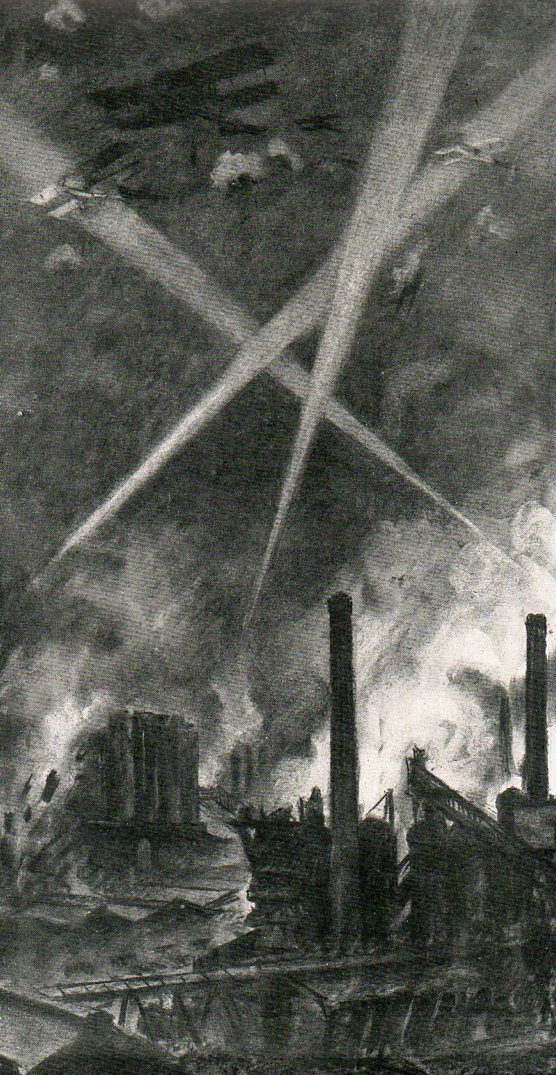
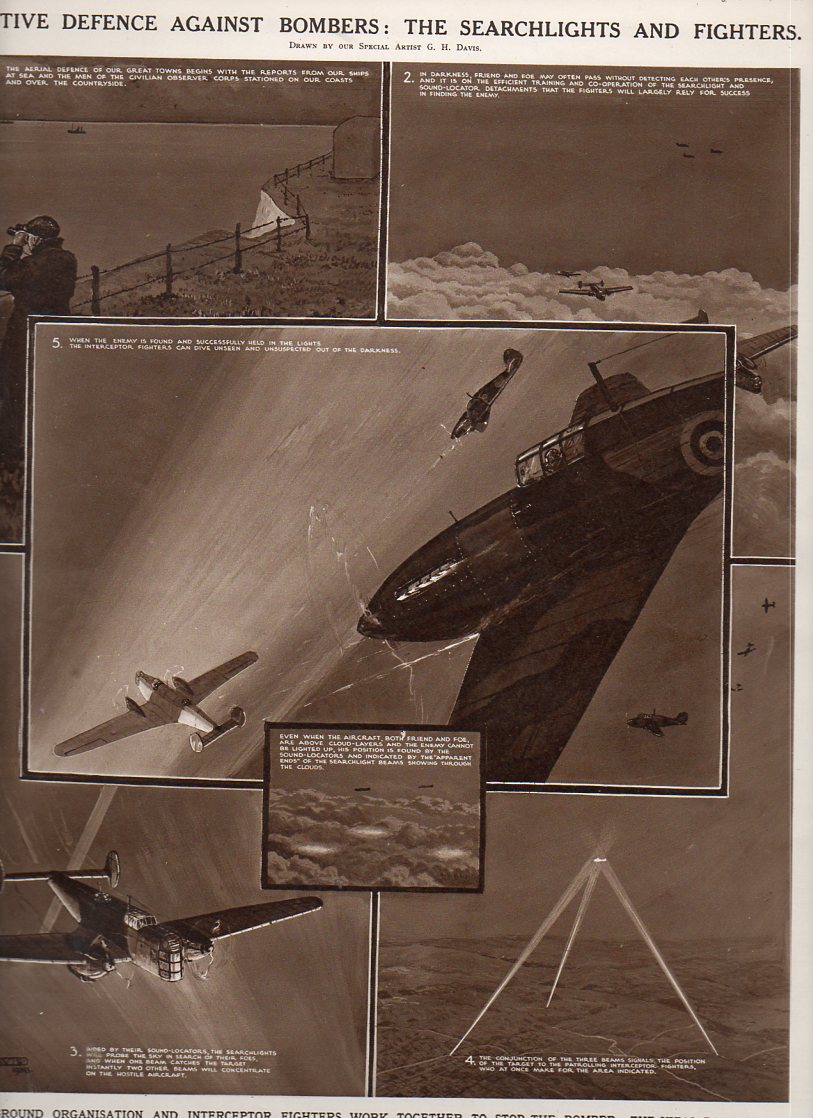
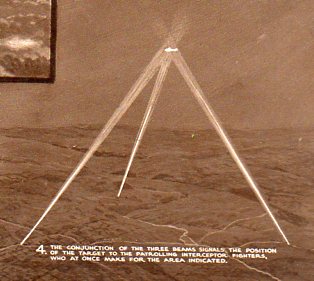
    Prior to WWII RADAR1 was somewhat functional but still in development, and as we see in this set of 16 July 1938 illustrations, the key methods for finding enemy aircraft at night (in order to shoot it down of course) was an audio-visual method, using “sound-locators” to find the approaching bombers and then spotlights to illuminate and track them to their destruction.  
    Seeing more deeply-searchlight856

    Seeing more deeply-defence against bomber854

    These images represent some idea of the state of the art of being able to find things–like the ground at night or approaching enemy aircraft–in the 1927-1938 period, all of which would be drastically changed in just the next two years.
    Seeing more deeply-searchligh detail857

    NOTES

    1. RADAR was coming very close to being developed in the early 1930’s–and in 1935 the process of experimentation and implementation was at a peak.  The development of this new technology was an international property, though perhaps no one owned it more in this period than the British, with Watson Watt giving his experimental ideas on RADAR to the Air Ministry on 12 February 1935 in a secret report titled “The Detection of Aircraft by Radio Methods”. Int his years alone there was feverish work being done by  Rudolf Kühnhold (Scientific Director at the ‘Kriegsmarine  Nachrichtenmittel-Versuchsanstalt) who in 1933-1935 established a RADAR-hunting company called Gesellschaft für Elektroakustische und Mechanische Apparate, or “GEMA”; there was also elements of the Royal Navy, Telefunken, Standard Elektrik Lorenz, Philips Company’s  (of Eindhoven, Netherlands) Natuurkundig Laboratorium, the Research Office of Nippon Electric Company, and even in the Soviet Union (until the key figures involved were murdered in Stalin’s purges–this one distinguished from others and referred to now as The Great Purge– of 1937), the French Compagnie Générale de Télégraphie Sans Fil (CSF), and  the Italian Regio Instituto Electrotecnico e delle Comunicazioni (RIEC, Royal Institute for Electro-technics and Communications) to name a few.  The United States of course had been long working on the project, at least since 1922 at the NRL, with considerable private (and federally funded) work done by RCA

    .
    Whipping ahead into WWII a very significant “battle of the beams” began between the U.K. and Germany, especially during the Battle of Britain, involving countermeasures, espionage, propaganda and false-positives in regards to the use and development of radio-based tracking and detection–the U.K. particularly making use of this technology in a wide-spread air defense system.  But it was in the United States in 1940 (and really by the U.S. Navy) that RADAR got its name (for RAdio Detection And Ranging) as well as its great impetus for development and deployment.
  • WWII Aircraft Cross Sections–the Schematics Work of G.H. Davis

    JF Ptak Science Books  Post 1130

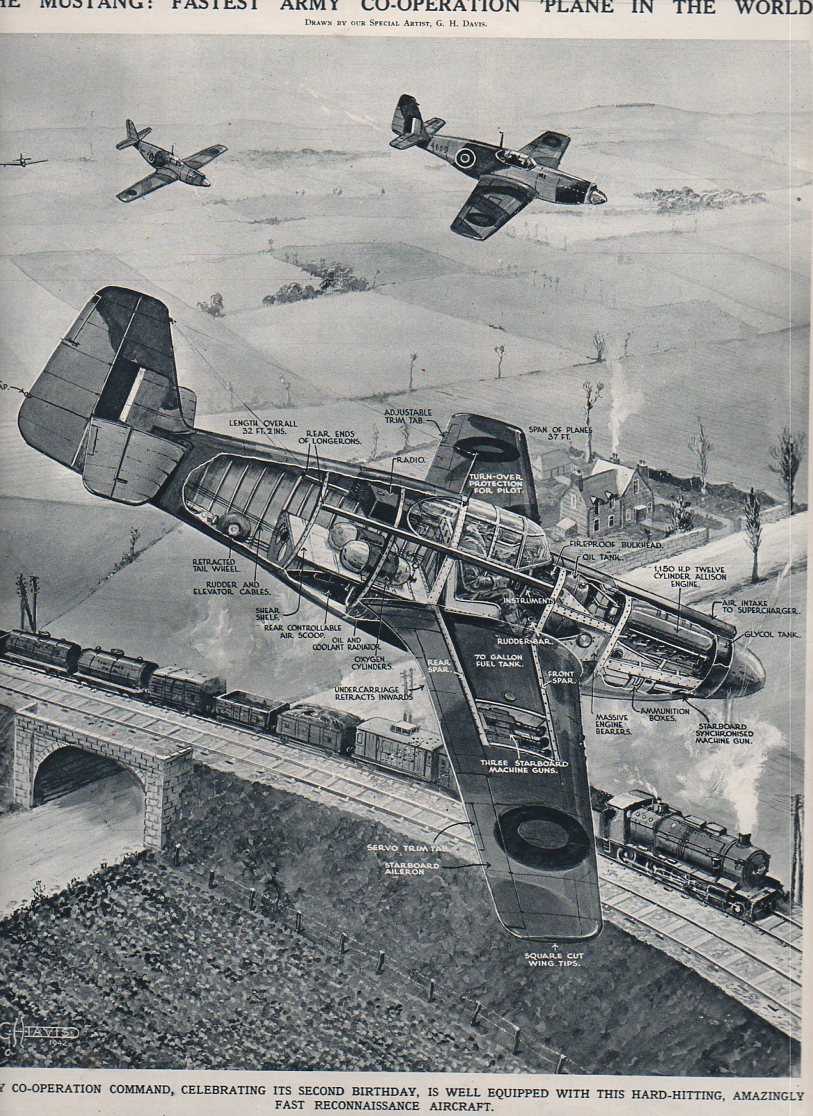
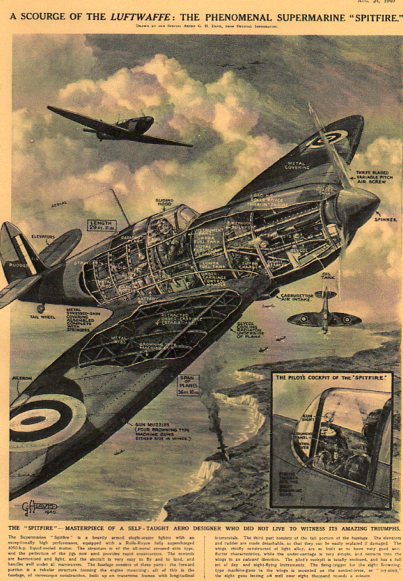
    sI’m sharing some of the collectrion here of the published work of George.H. Davis (1881-1963), the prolific and vastly accomplished artist for The Illustrated London News. His work with that magazine for the forty or so years that I am familiar with is superb, and his great strengths can be found in rendering technical cross sections and infographics.  He had a great sense of design and a very fine hand, and so far as I can tell he displayed an excellent control of his subject, thousands and thousands of times (2,500 times, according to Mr. Davis).

    Here are some fabulous examples of technological cross sections of WWII aircraft by Davis–the drawings are just superb, and you can easily get lost in them, following the geogrpahy of engineering detail from one logical place to the next.

    Blohm u. Voss BV141

    1ebay_sept_24_blohm_voss_141667

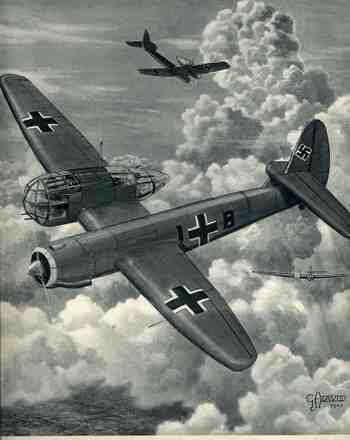
    This is the Blohm u. Voss “BV 141″a very unusual-looking aircraft, and it appeared in The Illustrated London News for 23 May 1942, and it gives an excellent view of what the editors called “a lop-sided freak”.  Perhaps the editors of the ILN wanted to educate its readers on the plane since it was supposed to be widely employed on the Russian Front, though it looks like only 38 were ever built (and none survive today). Actually, the plane, designed by Dr. Richard Vogt (1894-1979),  was a high-flying three-seater  surveillance aircraft capable of 220 mph at 17,000 feet, powered by a single 1000 hp Bramo Fafnir 9-cylinder radial engine.  The idea for the design was to give the pilot and co-pilot a very wide field of view–and by this, I’m guessing that the field of view most affected and aided by this would be straight down. The rear gunner also had an enormous field of view. 

    As it turns out Vogt survived the war and spent his Golden Years in the U.S., seven of them (1960-1966) with Boeing to evaluate hydrofoils and vertical liftoff systems:  he had built other odd planes during his career, and carried them with them into near-retirement, making this sort of design his metier.

    “The Mustang–Fastest Army Co-operation in the World“, appearing in The Illustrated London News for 12 December 1942. 

    Aircraft x section-mustang849

     The Spitfire:

    X-Sect  SPitfire507


  • Strange Things in the Sky Department: Aircraft, 1919

    JF Ptak Science Books   Post 1222

    Blog--May 20--minerveA

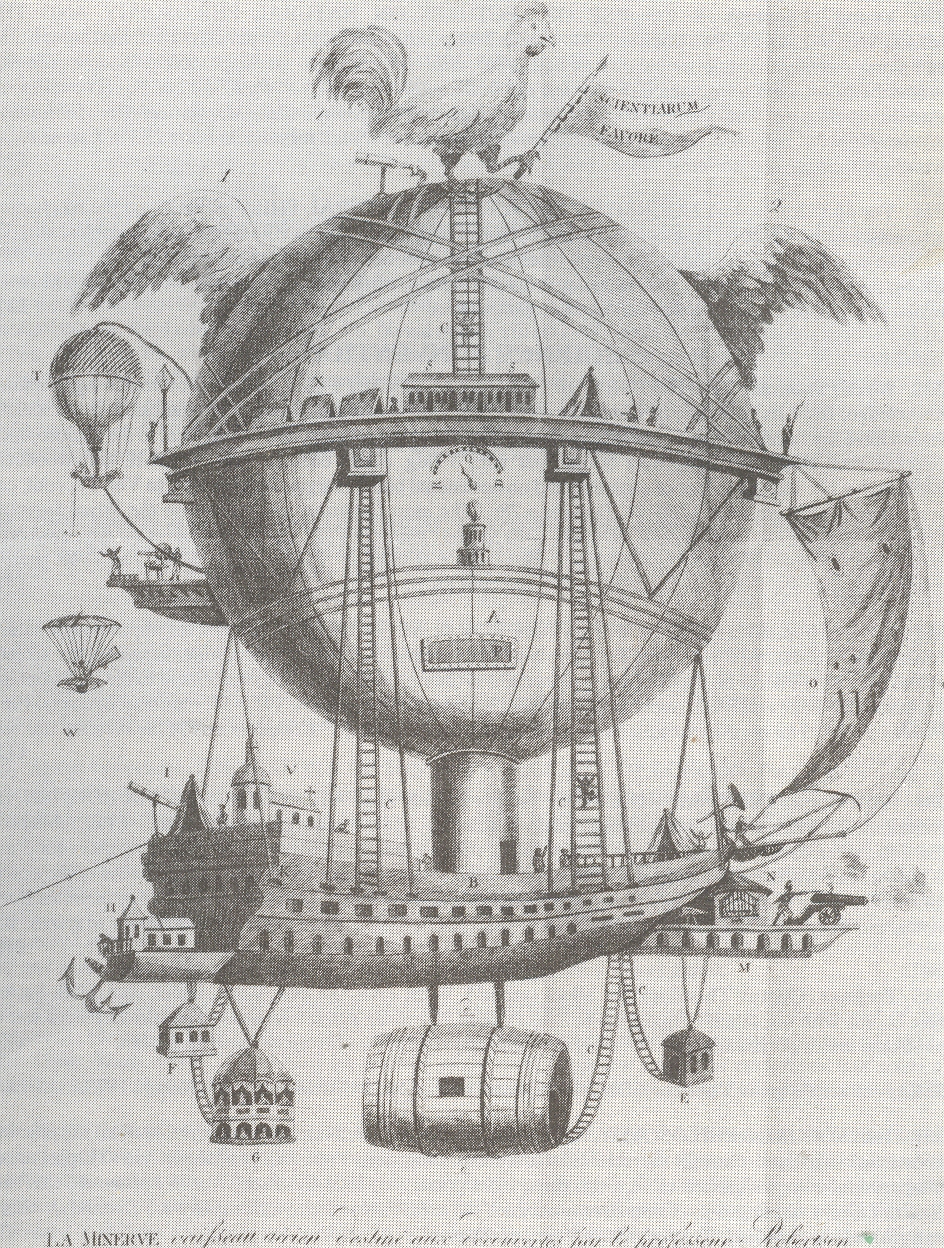
    I’ve written earlier in this blog about odd things found in the sky, some of which is imagined  (holes, extra Earths, blank Heavens, disembodied hands/feet/eyes/ears,proto-human empty aliens,  rat) and some of which were/are possibily real (like this fabulous aircraft with an escape pod for women, located here). [Both of these images are available from our blog bookstore, here.]

    These images present incredible, indelible ideas to us here in 2010, images of creations that look more like created steampunk for a retro-futurist novel than something real.  But they were actually state-of-the-art techno advances for their times, decent ideas, solutions for knotty problems that had no better answers than those presented. 

    Strange sky--launch plane839

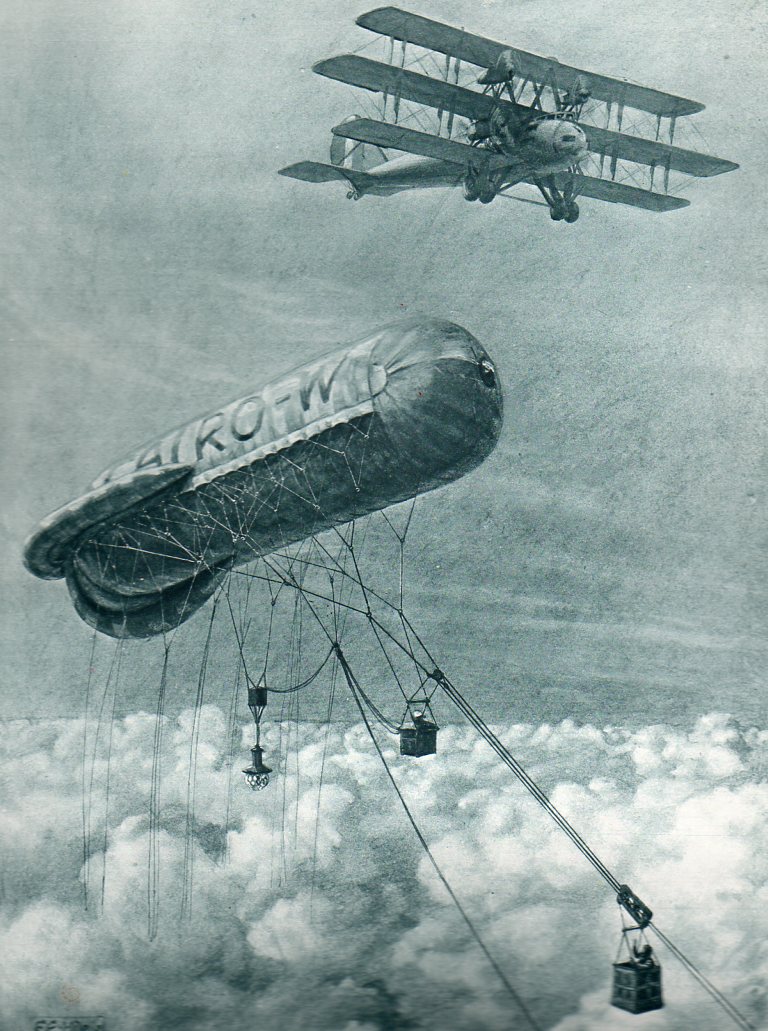
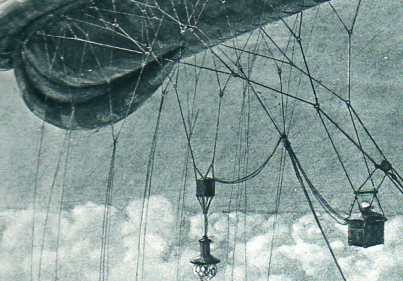
    The first is “The Clapham Junction of the Air, a Cloudland Signal-box”, seen in The Illustrated London News for 15 March 1919.  The idea was simple–cloud cover prevented aircraft from seeing their objective (lacking RADAR, which wouldn’t appear for another 23 years) and so something needed to be done to communicate with them above the clouds to relay data on ground conditions.  And so we have the tethered kite balloon with a mobile travelling car, the man in which would relate the necressary info to the waiting aricraft above.  (The description of the image notes that the aircraft is “one of a coming type”.)

    Strange sky--launch plane crowd det840

    Strange sky--launch plane det841

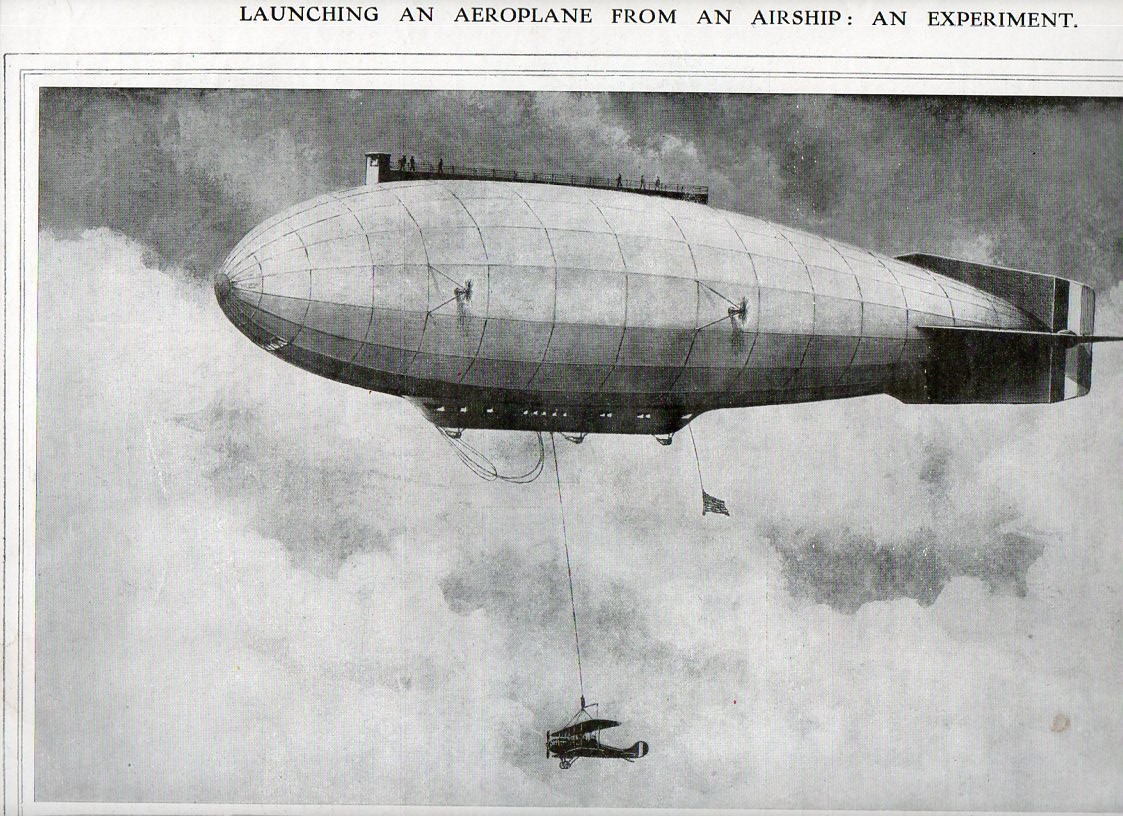
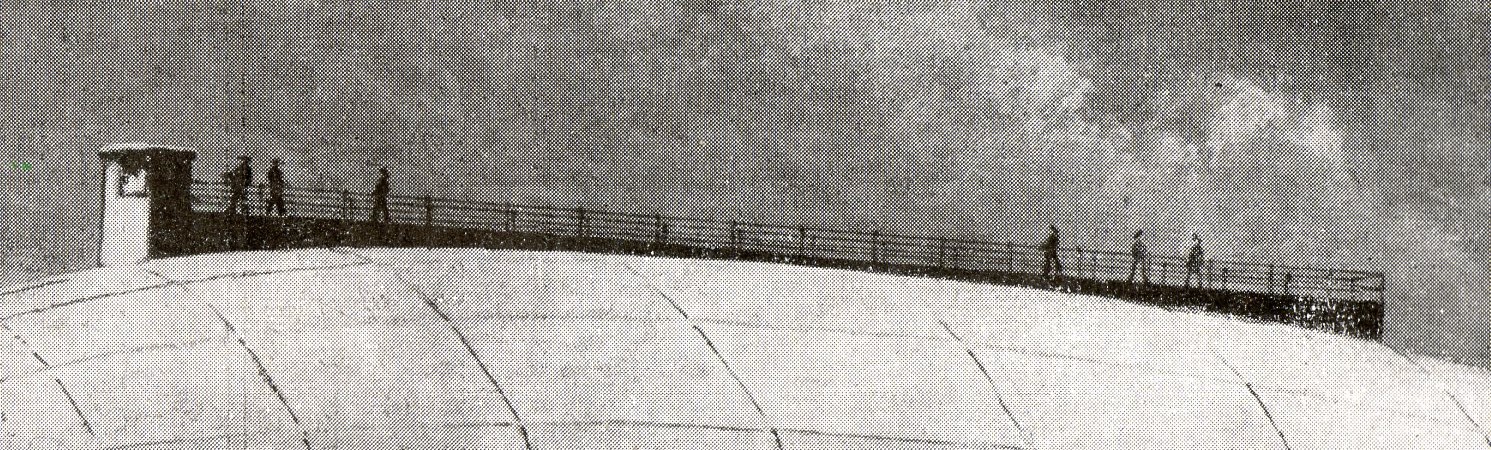
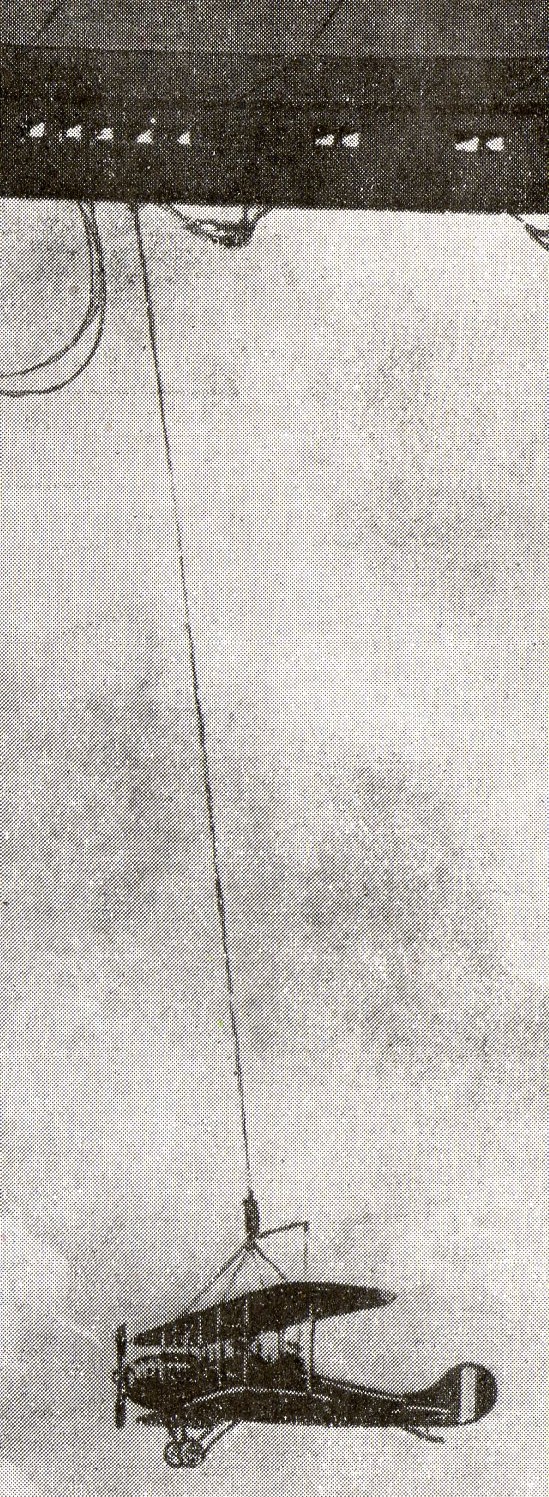
    The second image appears in The Illustrated London News for 1 March 1919 and is entitled “Launching an Aeroplane from an Airship, an Experiment”, and shows a helium-filled airship (“of the near future”) about to drop an aircraft.  The airship would have risen to some height with the aircraft already at tether, travelled a distance far beyond the normal range of the airplane-in-tow, and then release it–after a fall of a thousnad feet or so, the engines would start, and the plane would be operational.  that was one way of advancing air cover far beyond what woul dhave normally been feasible. 

    The set of problems encountered here woul de remedied in relatively short order, say with a few years of the publication of these pictures–but for teh time being, in 1919, this was the best that could be offered. 

    Strange sky--lmessages842
    Strange sky--lmessages det843


  • Death from Above–the Fear of Aerial Bombing and Gas Attacks, 1932

    JF Ptak Science Books  Post 1209

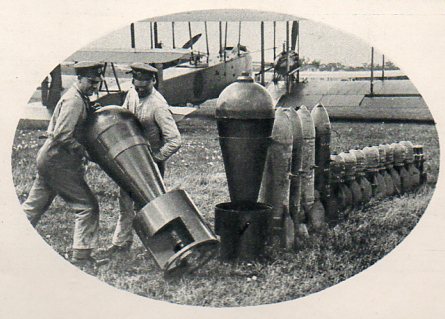
    Aerial bombing from heavier-than-aircraft comes to a big anniversary soon, on 1 November 2011, a century after the Italian Lt. Giulio Cavotti dropped the first bomb from a plane on oasis-encamped Libyan troops at Tripoli.   Of course things rapidly in the few years following that, so that by the end of WWI people got a good taste of what it meant to controlling pieces of property without actually occupying them, raining chaos and destruction from

         Air attack iillus lond cvr778

    above.  20+ years later, in the early 1930’s bombing became more sophisticated, including a new arsenal of poison gas weapons.  The threat from this weapon was agonizing and palpable–the results of gas attacks upon armed combatants in WWI and  the gassing of civilians in the 1920’s and early 1930’s  made a hard strike into the social fabric, an enormous gapping new hole to be filled in the heart of fear. [And of course this fear was felt everywhere, from London to New York to Leipzig to Moscow to Milan, as we can see in these few examples below. ALSO: these images may be purchased rfom our blog bookstore, here.]

    Air attack776
    And this interesting image of a mock (or “mimic” as it was called in the report) attack on Milan in August, 1931:

    Air attack madrid779
    There were a number of interwar aerial bombings that took place that kept the issue of mass destruction alive and well.  For example,  Britain used its air arm  very convincingly in Iraq, bombing many places including Bagdhad  in 1923; the Spanish bombed civilians into submission in Morocco, near Tetuan, in 1925, and the French crippled and destroyed  their opponents–both military and civilian, it made no difference–in Damascus, Syria, also in 1925.

    Air attack industrial777
    Fiction also harnessed the possibilities of air war, not the least of which included Armageddon-like scenarios for the semi-End of Days through the use of poison gas and “atomic” weapons.  For example, deadly gas used in Anderson Graham’s The Collapse of Homo Sapiens (1923) and Neil Bell’s Valiant Clay (where the poison gas kills 1.5 billion) and Dalton’s Black Death (1934), while Reginald Glossop’s The Orphan of Space (1926) created an alien atomic spaceship which delivered holocaustal death to Soviets and Chinese and Communists in general.  There were many more stories like this, not the least of which were the non-fiction strategy works, like Giulio Douhet, author of Dominion of the Skies (1921), legitimizer of the “strategic” bombing of civilian populations (in spite of the Hague Conference of 1907*), and  JFC Fuller’s The Reformation of War (1923) which emphsized the new importance of air war and power and which also allocated the use of gas, justifying that morality  because it could cause less harm than a conventional attack.

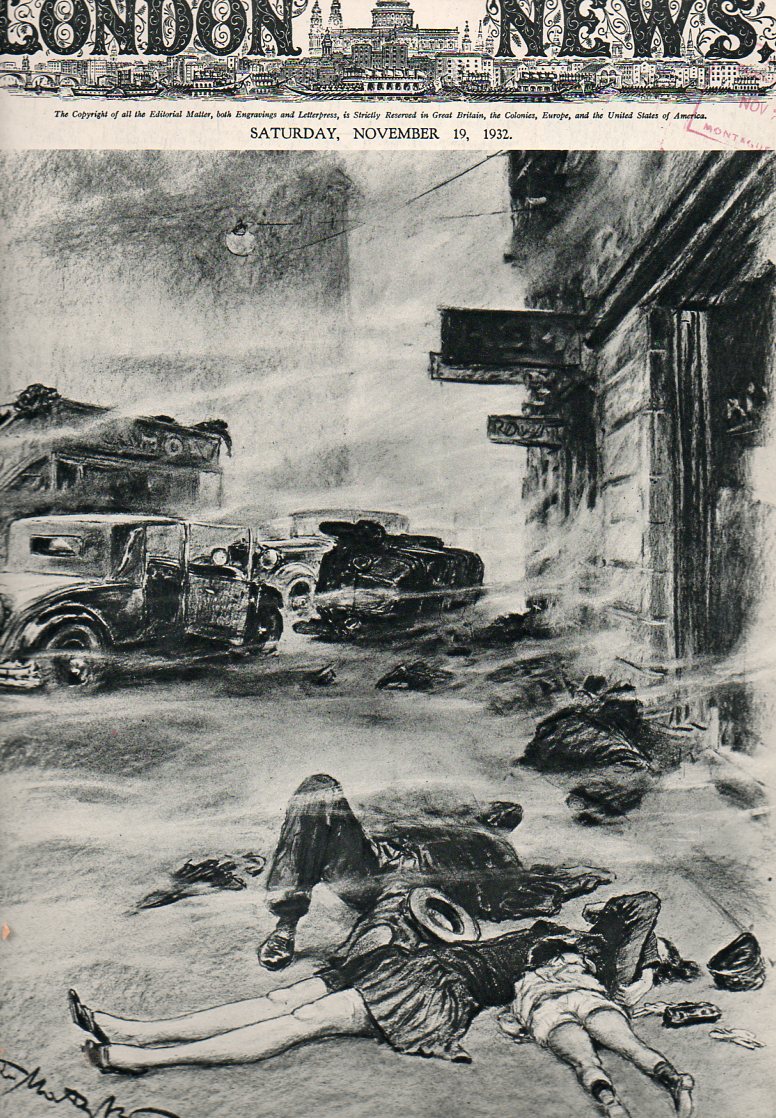
    [Image below from :Mr Baldwin on Aerial Warfare”, The Illustrated London News for 19 November 1932, illustrating the sort of aerial bombs that could threaten the population of London.]
    Air attack bomb780

    The fear was real, and the capacity to cause mass death (espcially from poison gas) was substantial, even if in a still-developing form.  Eight years hence, though, it would almost all come true (except for the poison gas part, at least for WWII), and in ways that weren’t quite imaginable in 1932–500 B-29s flying criss-cross over Tokyo would’ve seemed more fiction than science to the 1932-person, even though that technology was only a dozen or so years away. 

    Notes

    * This is where the bombing of civilian areas was specifically outlawed; what wasn’t defined, however, was what “civilian” meant–turns out that it was pretty loosely defined in the 20’s and ’30’s.


  • Airwar over Gallipoli–New, Massive Aeroplane-delivered Bombs, 1915

    JF Ptak Science Books

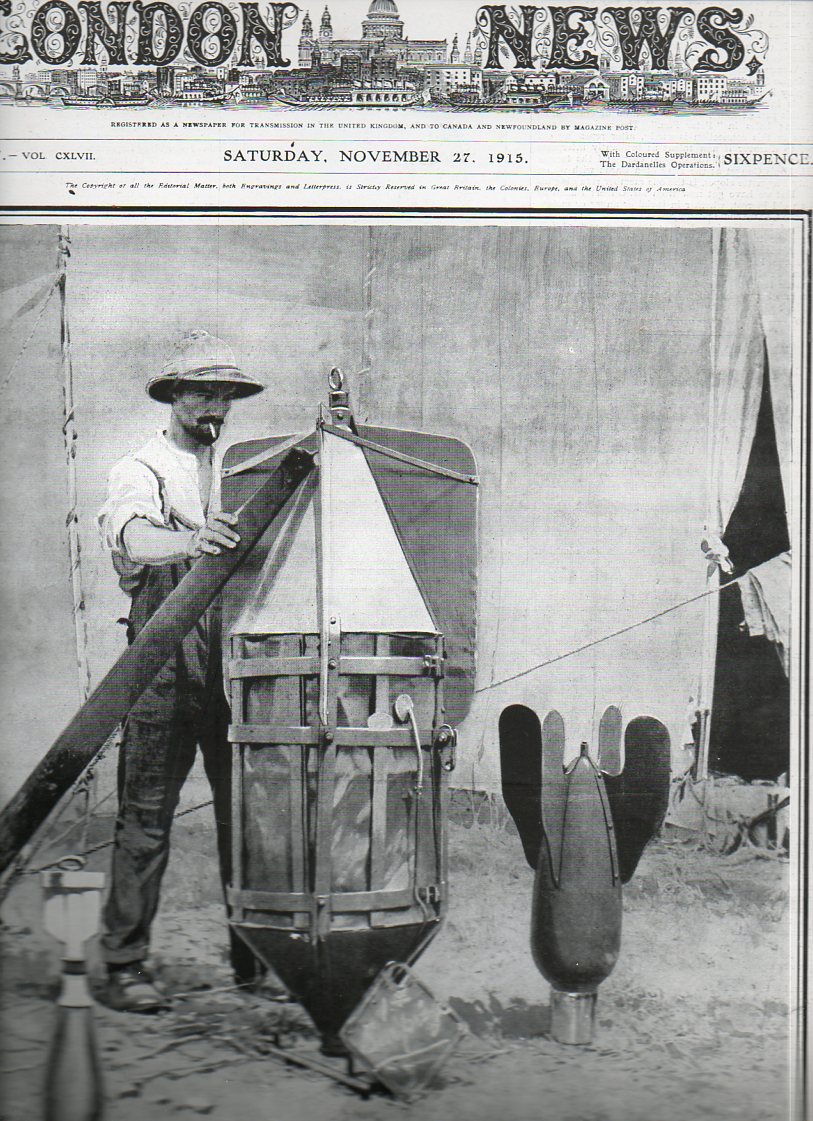
    War Images “Almost as Tall as a Man!  Great Bomb Used by the Allies Airmen at Gallipoli”, as seen on the front cover of The Illustrated London News for 27 November 1915. The campaign at Gallipoli was more than half done, more than half-way closer to the finish, which found the Allies retreating in the midst of high misery, gallant action, and broad death and destruction, with more than 390,000 soldiers from both sides being killed or wounded during the 10 months of the campaign. It was a miserable experience–hot in the summer, cold in the winter, with frostbite, rotting corpses, dysentery, bad food, poor sanitation, supply difficulty, and ultimately a costly stalemate which was supposed to have ended up in an Allied route to Russia. 
    WWI--e---aerial bomb642

    The use of bombs by airborne craft was still in its infancy at this point, the idea coming into use just a few years before the beginning of the war in 1914–the practice was quickly adapted after 1915.  (The first use of bombs dropped from airplanes is widely seen as having taken place by the Italians in 1911 and then in Mexico during the revoultion in 1912.) This image shows the development of an enormous bomb, though its details and destruction force “are left to the imagination of the reader”; I’m pretty sure that the bomb (if it was real and if it wasn’t just a piece of propaganda) would’ev been hauled aloft and dropped from a dirigible rather than an airplane. 
    See: Airwar over Gallipoli/Dardenelles   and here for a general look at aviation udring the early part of WWI.

    [We offer the weekly issue of the Illustrated London News for sale here.]

    ·Posted by :

    ·in:

    — —

  • WWII Aircraft Cross Sections–Spitfire, Hurricane, Beaufighter, Lancaster (!) and Stirling.

    JF Ptak Science Books    Post 1165

    Here are some fabulous examples of technological cross sections from the collection here–this part concenrtrating on some of the British WWII aricraft.  The drawings are just superb, and you can easily get lost in them, following the geogrpahy of engineering detail from one logical place to the next. All of these images were published in The Illustrated London News and appeared 1940-1943.

    X-Sect  SPitfire507

    And the detail (sorry for that–the originals are much larger than the scanning bed would allow…)


  • The Speed of History–a Note on Change in Aviation, 1905-1915

    JF Ptak Science Books   Post 1163

    Being at the airport yesterday to watch the glorious EAA B-17f take off and land (and to see our 7- year-old climb through it and the Blackhawk that suddenly appeared) put me in mind of the extraordinary advances in flying in the earliest history of heavier-than-air flight.  I picked up a volume of The Illustrated London News for 1909 to check out the popular reporting of the aeroplane and as usual got a very sharp reminder of how fast everything happened in the 1905-1915 period.
    Cody flight503

    In the earliest stages of the development of heavier-than-air flight (powered and not, 1848-1906) there were major innovations and essential experiments from a dozen countries:  England, the U.S., Poland, France, South Africa, Russia, Germany, New Zealand, Australia, Brazil, Romania, Sweden, Norway and  Denmark.  Even with all o f this directed work, the methods weren’t necessarily made public or when so were not well distributed, with many of the aviation/engineers working in obscurity and without contact with their peers.  (Examples of the major players in the history of heavier-than-air early flight include John Stringfellow, England, 1848; George Cayley, England, 1853;  Matias Perez, Cuba, 1856; Jean-Marie Le Bris, France, 1856; Jan Wnek, Poland, 1866; Goodman Household, South Africa, 1871;  Félix du Temple de la Croix, France, 1874; Victor Tatin, France, 1874; John Joseph Montgomery, US, 1883; Alexander Feodorovich Mozhaiski, Russia, 1884; Clément Ader, France,1890;  Otto Lilienthal, Germany, 1891; Lawrence Hargrave, Australia, 1894;  Hiram Stevens Maxim, United Kingdom, 1894; Shivkar Bapuji Talpade, India, 1895; Samuel Pierpont Langley, US, 1896; Octave Chanute, US, 1896; Carl Rickard Nyberg, Sweden, 1897; Gustave Whitehead, US, 1899; Percy Pilcher, U.K. 1899;  Augustus Moore Herring, US, 1899; Wilhelm Kress, 1901; Orville & Wilbur Wright, US, 1902;  Richard Pearse, New Zealand, 1903;  Karl Jatho, Germany, 1903;  Orville & Wilbur Wright, US, December 17, 1903 (finally for the first recorded controlled, powered, sustained heavier than air flight);  Orville & Wilbur Wright, US, 1904 (in the Wright II, making the first turn, and then later in September making the first circle); Horatio Phillips, UK, 1904; John Joseph Montgomery and Daniel Maloney, US 1905; Wilbur Wright, US, October 5, 1905 (circular flight of 24 miles in 39 minutes); Traian Vuia, Romania, 1906; Alberto Santos-Dumont, Brazil, 1906.)

    By 1909 there were many dozens of different aircraft flying around, just about but not quite getting to the sophisticated stage.  In just a few short years, by 1915, there would be an enormous increase in the capacity and numbers of airplanes –pushed along of course by the needs of war. Which is a little odd as some of te earliest fliers’ ideas and planes  were rejected by the military establishment.  The Wright fliers for example were not at first a welcomed idea to the U.S. Army (for numerous reasons, the Army saying “no” in 1905 but renewing their interest in 1907 and finally buying the plane in 1909) ; nor were the Brits interested in continuing funding for Samuel Cody (from Birdville, Texas) , pulling support for him just a few months after he had succeeded in flying the first British-built airplane in Great Britain (the British Army Aeroplane 1B).  That of course would all change in just a few years with the guns of August.

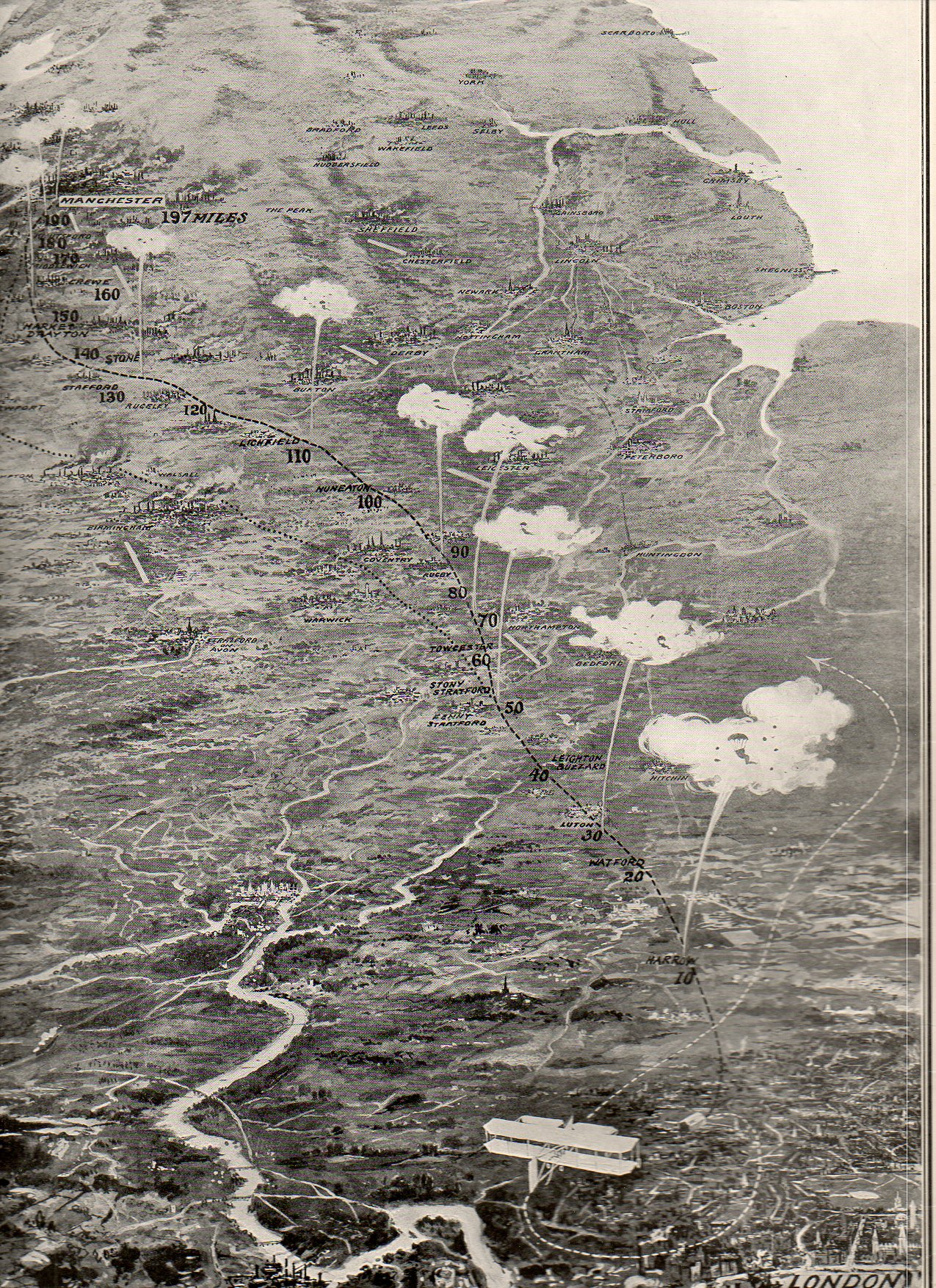
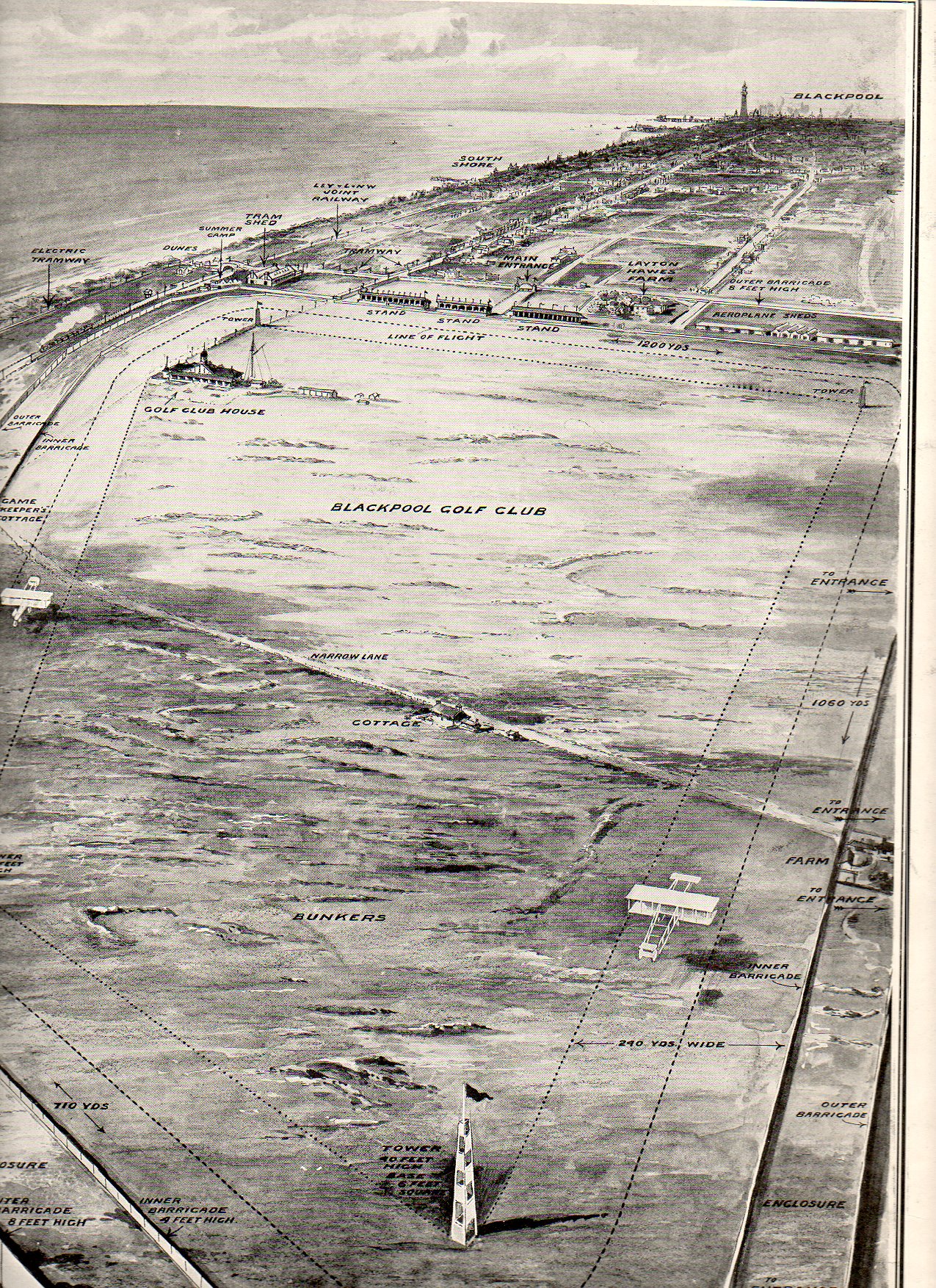
    Seeing this plan (above) for Samuel Cody’s flight from London to Manchester would’ve been a breathtaking achievement, had he made it.  The event had the trappings of An Enormous Situation, with smoke bombs and 450′-long white cloths to show him the way.  As particularly thrilling as this event was in 1909 it would be overshadowed in short order. In perspective, it was only six years earlier that the Wrights engaged in the first powered heavier than air flight.

    In 1903 the Wrights flew 121 feet; in just six years, Louis Bleriot would fly across the English Channel (on 25 July 1909); six years later Alcock and Brown would make the first transatlantic flight.  In  1911 Cal Rodger (11 De3cember1911) made the first American transconteintal flight (completed over the course of 50 days, with 3 days 10 hours in actual flying time).  11 Years later Jimmy Doolittle flew from Florida to California in just 21 (with one stop for refueling); the next year would see the record for transcontinental flight broken with a nonstop effort of 26 hours; in 1930 the time would go down to 12 hours and by 1945 the time was an extraordinary 5 hours 17 minutes.  (The retiring Blackbird flew the length of the country in 1990 in 64 minutes.)
                   
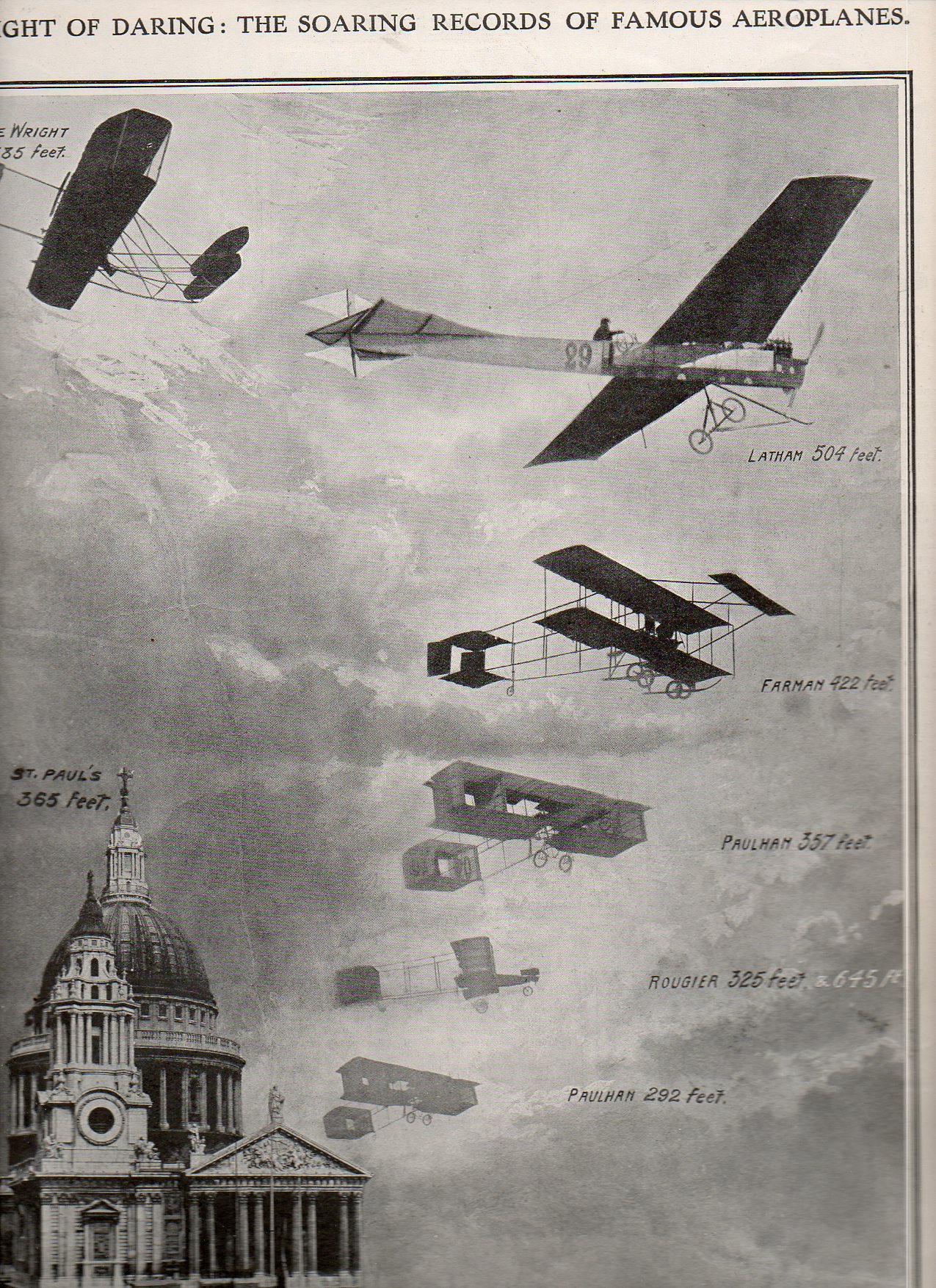
    The next image showing the altitude records for aviation in 1909 is just as phenomenal. The record at this point still stood with the Wrights at 585 feet, less than double the height of St. Paul’s.  It was a huge achievement, the other contenders coming to within hundreds of feet of their accomplishment but not quite doing enough to become the new world record holders,.  Ion just the next year improvements in the quality of aircraft and engines and control made it possible fo r Louis Paulhan to achieve 3,018 feet in January 1910,   Walter Brookins top climb to  a record of 4,603 feet (7 July 1910), and Ralph Johnsonte to 8,471 on 20 October 1910.  .  It must have bene a shocking development to have seen aeronautics to advance so quickly, breaking the old altitude record by a more than an order of magnitude in one year.  The speed record is a more difficult matter, but after recording speed records in the 30/40mp range in the 1903-1909 period, it broke to 66 mph 1910, 134 mph in 1914 and over 300 mph by 1928.  The difference in aviation in those 25 years is similar to that between the computing now and that of 1985 (and certainly 1979).
    Cody flight  Hieght sof flight aerodrome505

    I’m just saying that it is good to remember the enormity of change that took place in that early period of 1906-1919 or thereabouts–they were simply revolutionary developments that must’ve appeared  to the folks of those times.   
    Cody flight  Blackpool aerodrome504

    Notes:

    Cody was one of the most colorful figures in the history of early aviation in the U.K.  Born in 1867 and self-styled after Colonel William F. Cody, he was an inate adventurer and experiential bon vivant, who loved what he did and made sure that everyone else knew it, if nothing else. All that aside, he was a significant figure, important in the development of flight in England, and he died young for his pursuit. He appeared in the LA Times of 14 September 1907 (page 14) saying that the future of war would be in the air, and that the airship would “effect commerce as well as war”.  


  • Strange Things in the Sky Department: Floating Airports

    JF Ptak Science Books  Post 1119Strange things--Floating airport

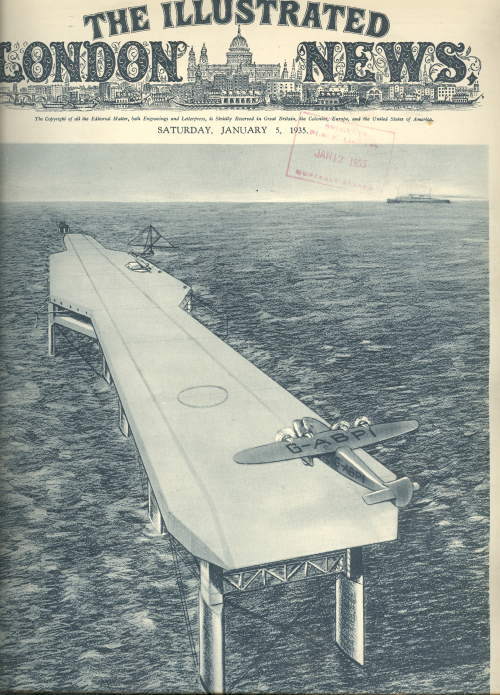
    I’ve written several posts here about floating an airport in the NYC narrows, as well as airports constructed over hundreds of acres of Midtown rooftops, hundreds of small landing strips crossing the Atlantic, innumerable planes and dirigibles with lad fields on/in them, and covering the Thames at Big Ben. (See here for some of these stories.) But I’ve not seen a floating or hovering anti-gravity airport until now. 

    The question for me would be–why, if you have somehow mastered gravity enough to float a large piece of concrete tonnage like an airport in the sky, why, oh why, are you still using airplanes? 

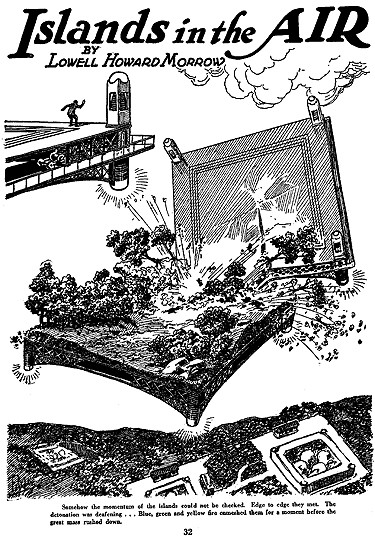
    The answer doesn’t matter, here, only the art does.Actually, the writing doesn’t matter, either; just check out the excerpt below.)   This again a piece of delicious imagination by Frank R. Pauil created  for the July 1929 issue of Air Wonder Stories.   The drawing below must be among the first of its kind to depict a collision between two anti-gravity floating/hovering airports. (!)

    Notes:

    The excerpt:

    “The Professor stared blankly a moment, then rushed away to the office. We followed breathlessly.

    The outer door had been forced, its lock being broken, but beyond
    this no damage had been done so far as we could discover. Anxiously we
    ran over the papers–not a print was missing….”

    It might have been more interesting if the thief had stolen all of the “e’s” from those papers.  There are 9,500 more words in this story, but I can’t make ir any further than this…

    And also this:

    Paul3.5C


  • Elevated, Rooftop Inner-City Circular Airports, 1919

    JF Ptak Science Books  Post 1102

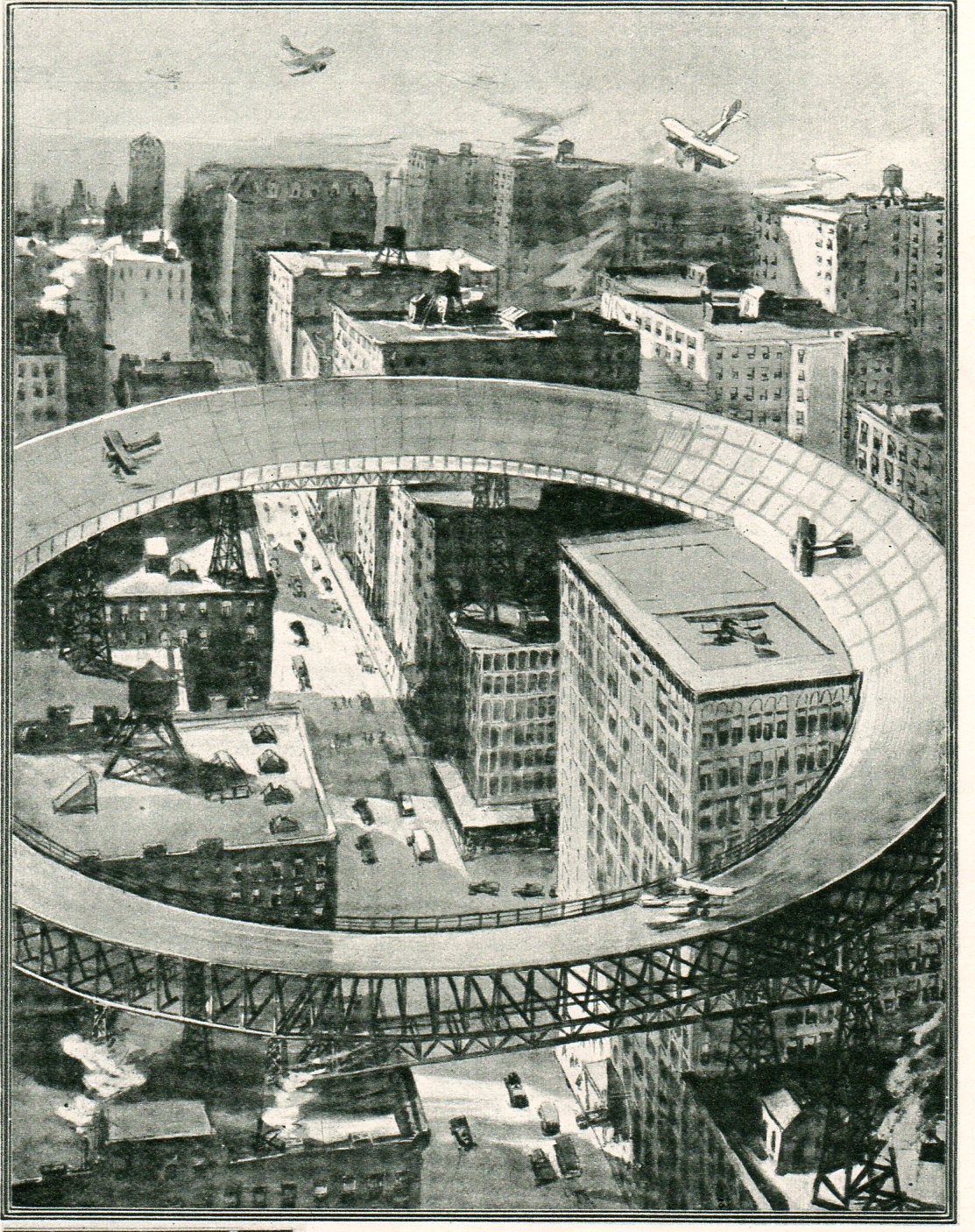
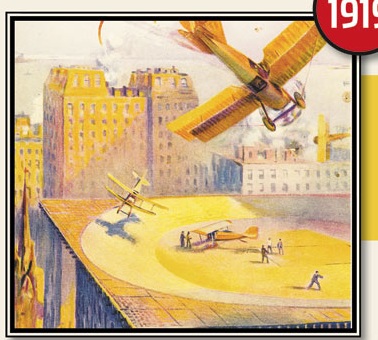
    The presumption of this Illustrated London News article (“On the Impulse to Fly Commercially”, 18 October 1919) on the growing popularity of commercial flying for business and pleasure was correct, but the placement of the airports to service the growing community of flyers was, well, not.  

    Airport--round 247

    This is a prototype, of sorts, for many dozens of proposals that would appear in magazines like  Science and Popular Science and Popular Mechanics and so on, suggesting inner-city airports that could be easily accommodated by the city bustle by placing the airport on top of buildings (as above), and these other closely-related ideas (below):

    [Picture source: Paleofuture.com]

    and this:

    Aircraft
    [Picture source, again, from Paleofutue.com]

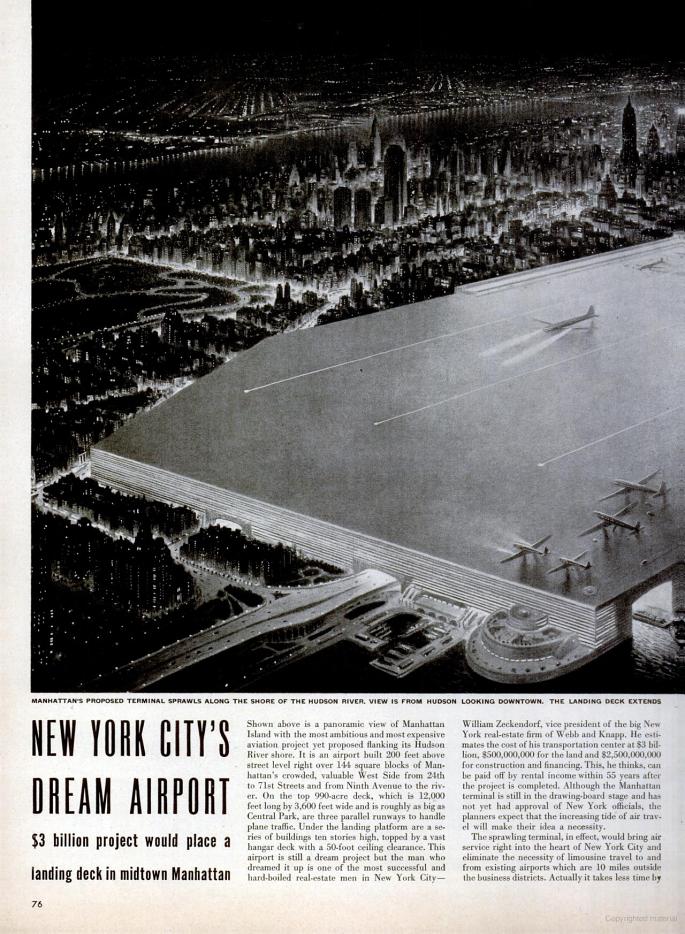
    These terrible ideas were also seen in building enormous platforms over entire sections of the city (like Zecendorf’s massively bad 1946 idea)

    Books

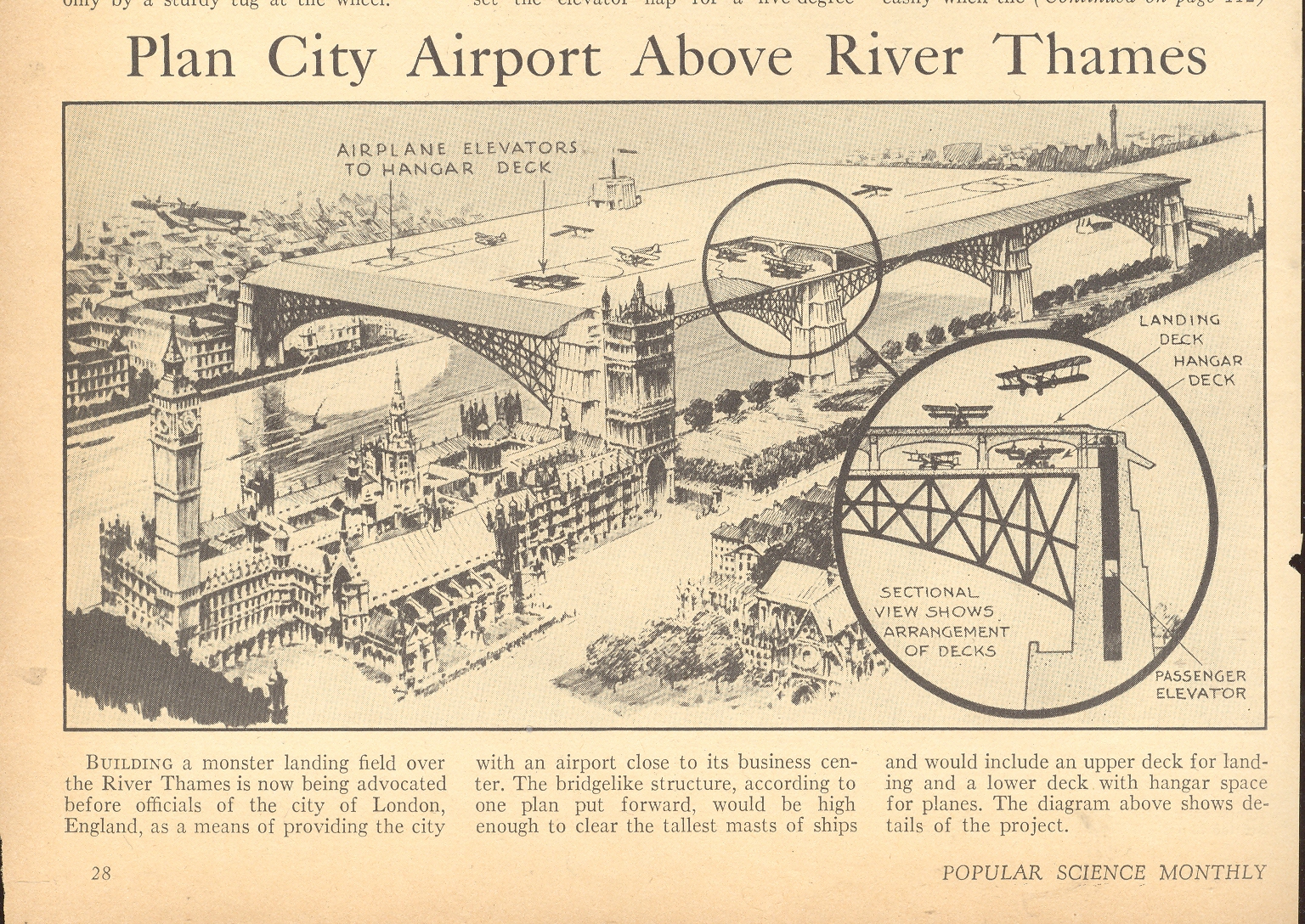
    or massive flyovers on rivers (which I also wrote about here),

    Blog Dec 17 thames airport

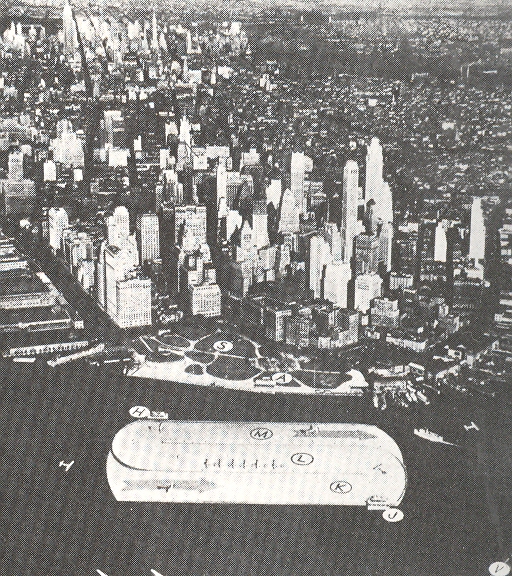
    or enormous floating airport islands (like that proposed by Norman Bel Geddes at the tip of Manhattan,  

    1--bel geddes airport 2 

    and of course a series of airports that stretched across the Atlantic.

    https://historyofideasblog.com/a/6a00d83542d51e69e2012876bef533970c-500wi

    But they all had to start somewhere, and perhaps this Illustrated London News entry for 1919 was among the first wave of these proposals. 


  • Airport in the Sky, Airborne Zeppelin Airfield, 1925

    JF Ptak Science Books  Post 1101

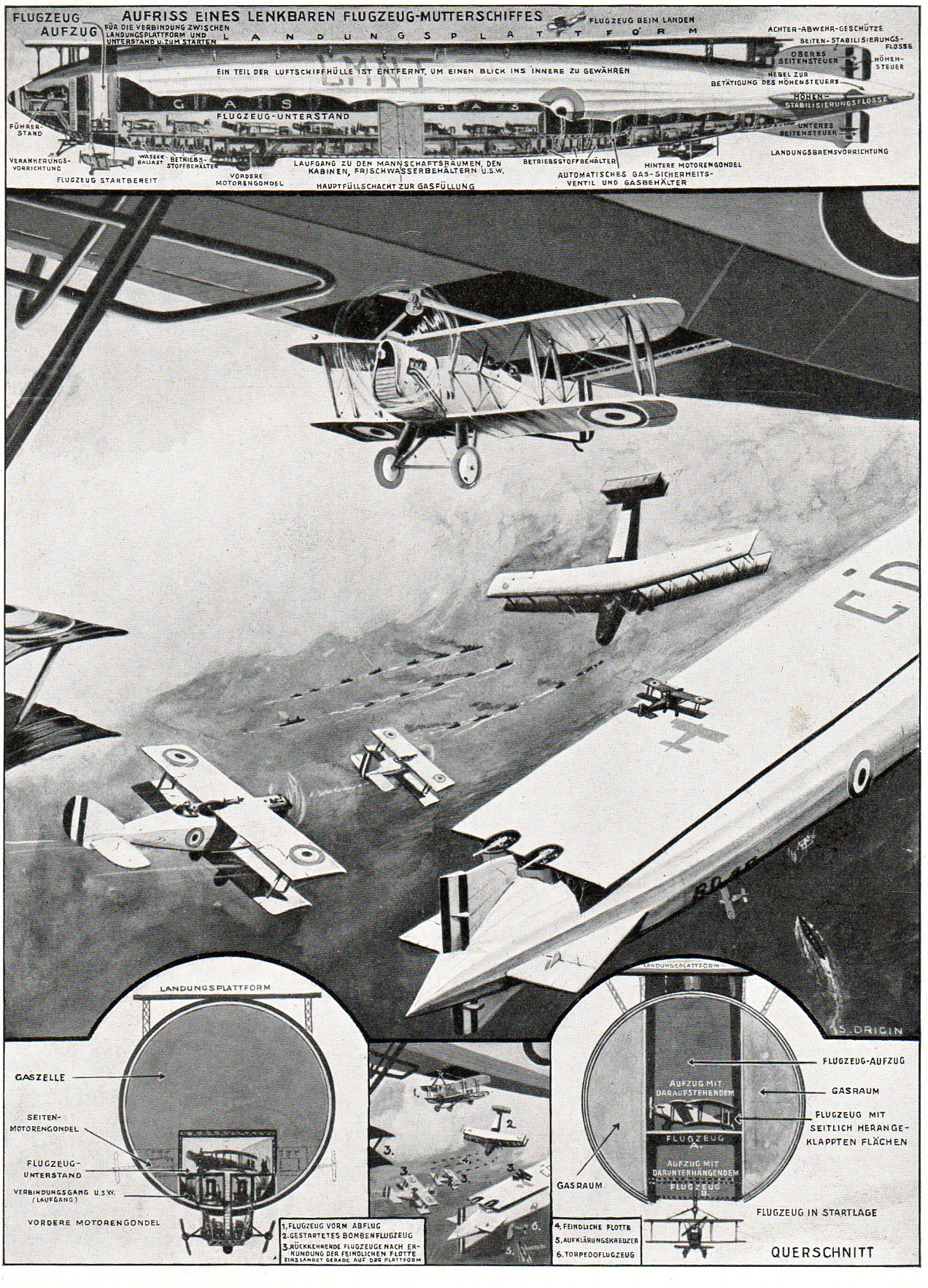
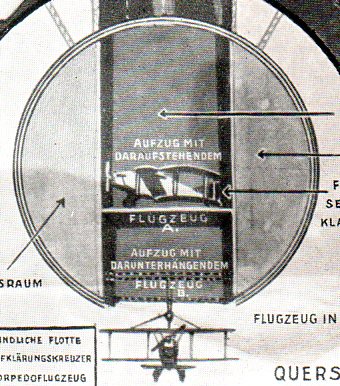
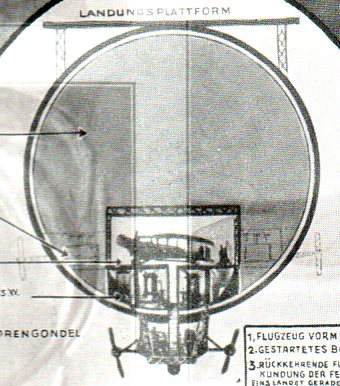
    This interesting image comes from the Illustriete Zeitung (Leipzig) for July 1925 (“Zeppelinsche Riesenluftschiffe” by Dr. Hildebrandt), and shows a British proposal for a dirigible outfitted as a sea-going airborne airport for military planes. 

    Airport--dirigible241

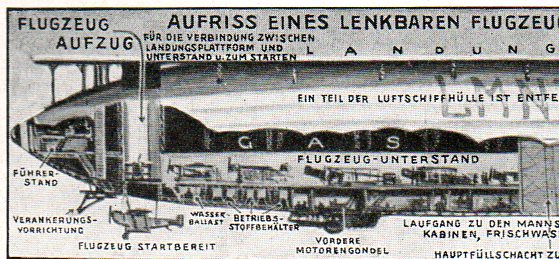
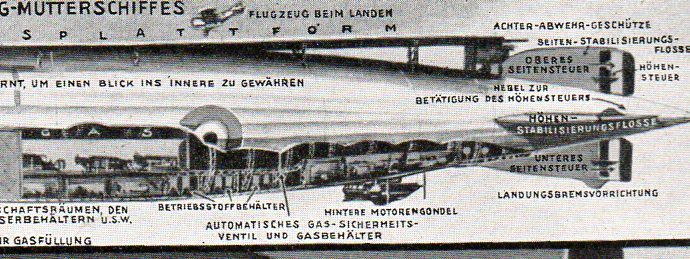
    The aircraft would land aft, and then proceed forward to an elevator that would lower it belowdecks to a hangar (looking as though it could accommodate 11 or 12 aircraft).  Once refueled and re-outfitted, the planes could be lowered from the body of the dirigible and launched into space. 


    Airport--dirigible a243

    Airport--dirigible b244

    And of course some cross sections:

    Airport--dirigible c245 

    Airport--dirigible d246