A Daily History of Holes, Dots, Lines, Science, History, Math, Physics, Art, the Unintentional Absurd, Architecture, Maps, Data Visualization, Blank and Missing Things, and so on. |1.6 million words, 7500 images, 4.9 million hits| Press & appearances in The Times, Le Figaro, Mensa, The Economist, The Guardian, Discovery News, Slate, Le Monde, Sci American Blogs, Le Pont, and many other places… 5000+ total posts since 2008.

Category: Aviation & flight

  • America Co-opts Canadian Flying Saucer Program, 1954.

    JF Ptak Science Books LLC  Post 997 

    Blog--april 1--saucer pilot
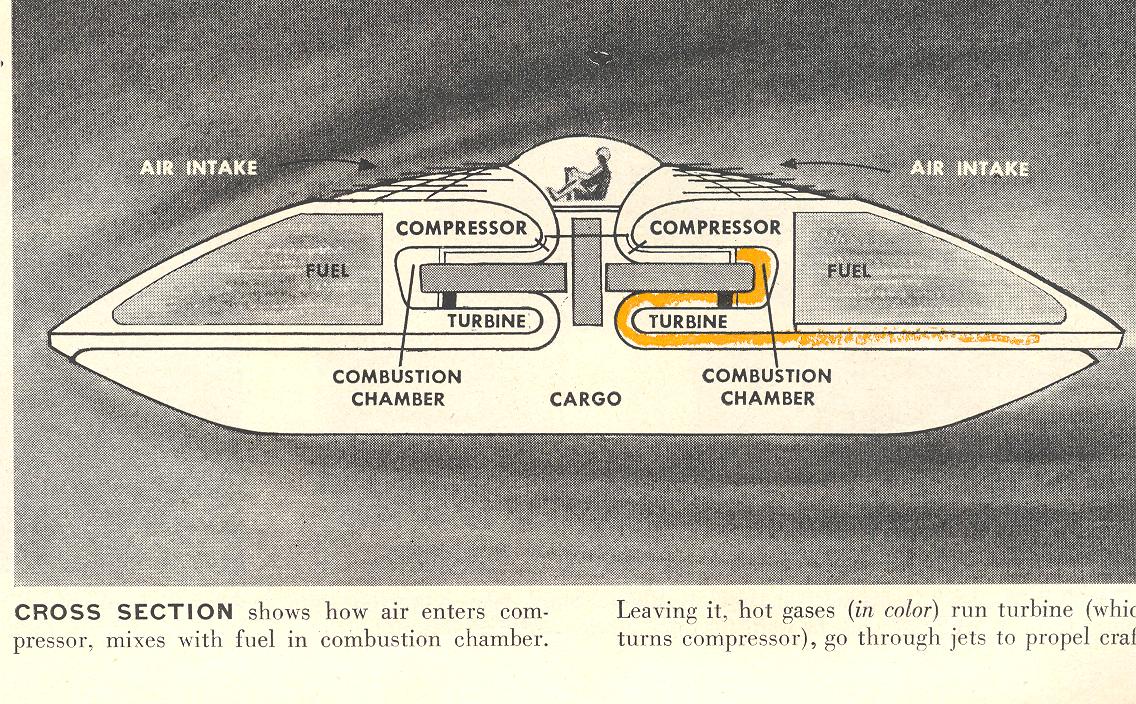
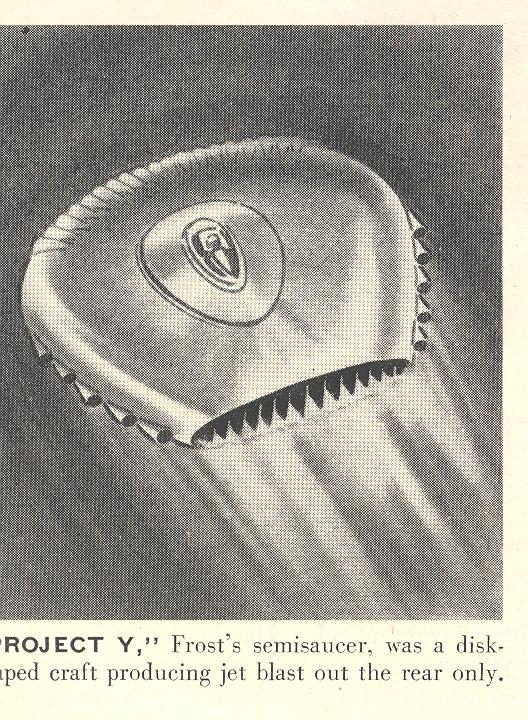
    “Fling Saucers” weren’t ten years old by the time that John C.M. Frost–an engineer from De Haviland–came up with the idea of re-fitting his swooping-shovel shaped idea for a rocket plane with a saucer-shaped one.  He worked hard on his idea, spending some $400,000 on the project–Canadian.  Frost was in Ontario and working for the government before the government stopped working for him, abandoning the undertaking (called “Project Y”) just as the United States became interested in it.  

    Blog--april 1--saucer

    There are numerous reports around the web on this aircraft, so I’ll just provide a couple of starter links here and little commentary.  What I was most intrigued by in this whole affair of producing a 2,500 mph hovercraft was that instead of having a U.S. Air Force star somewhere on the aircraft the thing could’ve been running around with a red Maple Leaf.  

    Blog--april 1--saucer semi

    Don’t get me wrong, I love Canada–went to school there, I did–but the idea of a combat-ready flying saucer with the maple leaf on it is just completely, well, wrong. 

    Blog--april 1--saucer det


  • Primer for Londoners on being Bomber by Nazis, July 27, 1940.

    JF Ptak Science Books LLC  Post 990

    [Also see my The Bombing of Britain in the Illustreite Zeitung, July 1940 post; also here.]

    Mar 28 bo,bing london 4 cratewr

    The
    Battle of Britain was an air battle begun weeks after the surrender of France (22 June 1940) in preparation for the Nazi
    invasion of England.  Hitler and the High Command believed Britain to be
    vulnerable2, and surrenderable, or at the least could be convinced not to interfere
    in the rest of the war.  But plans were
    made for the invasion—an invasion which could only be successful (it was reasoned)
    if there was complete naval or aerial superiority. The naval part was out of
    the question, especially since the Nazis had suffered such losses in the
    Norwegian campaign. The Luftwaffe was another story, and so the operation began. 

    Mar 28 bo,bing london 1

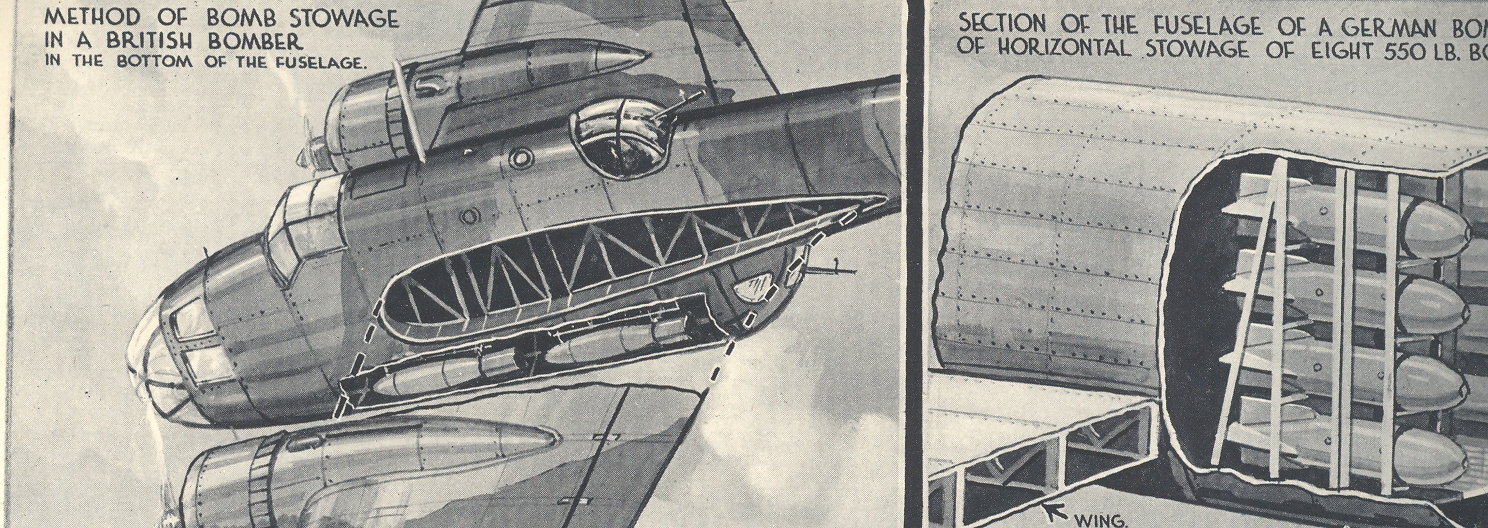
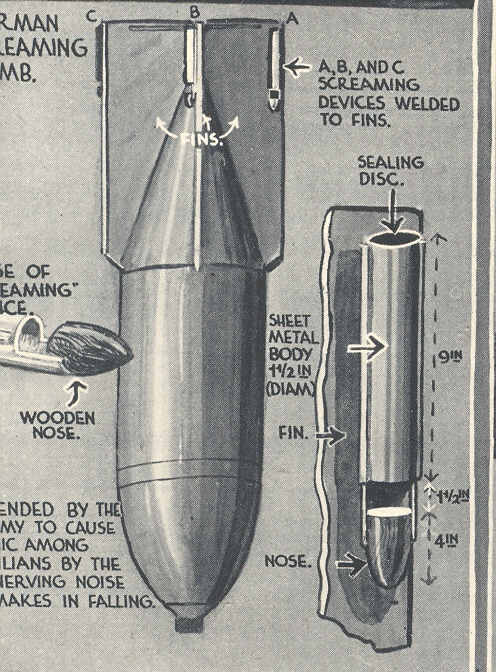
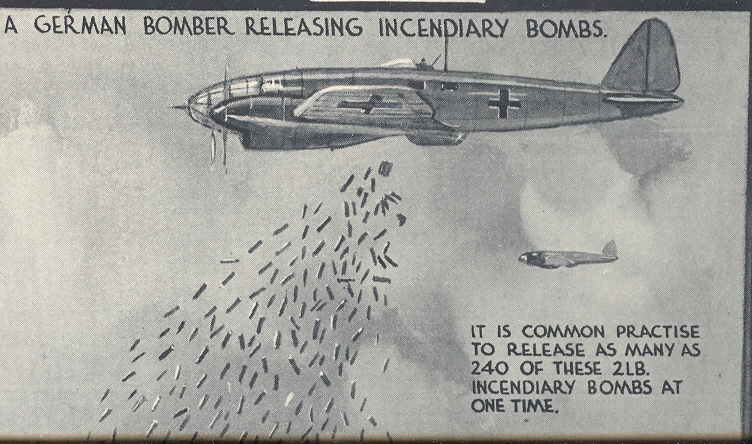
    The Illustrated London News published
    this pictorial introduction to Nazi bombing on 27 July 1940, just weeks after
    the campaign began.  At this point in the
    war the Luftwaffe operations were delegated to coastal installations and
    aircraft industries.  Mar 28 bo,bing london 2

    The terror bombing
    against citizens in cities—which was an idea not born here but rather 20 odd
    years before—wouldn’t begin for some months. 
    In the meantime, and at this early part of the campaign against England, the
    British citizenry was introduced in a very proper way how the bombing was being
    carried out.  IT really does seem to be
    to be a very constructive, non-alarmist, cogent distribution of information to
    the general public about the potential for massive devastation.  

    Mar 28 bo,bing london 5  

    Notes:

    1.
    By the summer of 1941 the campaign was largely over, the Nazi effort doomed. England:
    1,023 fighters: 376 bombers, 148 coastal command aircraft for a total of
    1,547 aircraft and  544 pilots and aircrew killed.  There were also
    27,450 civilians killed and 32,138 wounded.  The Germans
    lost 873 fighters and 1,014 bombers for a total of 1,887 aircraft and 
    2,500 pilots

    2. The plan ‘Directive No. 16; On the Preparation of a Landing Operation
    against England’
    read, in part, as follows:

    Mar 28 bo,bing london 6

    “Since England, despite
    its militarily hopeless situation, still has not shown any signs of being
    prepared to negotiate, I have decided to prepare a landing operation against England and, if
    necessary, carry it out. The objective of this operation is to eliminate the
    English home country as a base for the continuation of the war against Germany…”

    “Included in these preparations is the bringing about of those preconditions
    which make a landing in England
    possible;”

    Mar 28 bo,bing london 7

    “a) The English air force must have been beaten down to such an extent
    morally and in fact that it can no longer muster any power of attack worth
    mentioning against the German crossing…”


  • Bombing and the End of the World: the Physics of 1932 And All That

    JF Ptak Science Books 

    1932 in my book turns out to be one of the most collectively epochal years in the history of science.  Certainly others stand out for individual achievements, like 1905 (Einstein’s four papers over two volume of the Annalen), 1687 (Principia), but there are other yeas with fabulous achievements by numerous people.

    Mar 7 airmen det


    1543 is one.  That year witnessed the published of Copernicus’ De revolutionibus and Andreas Vesalius’ De humani corporis fabrica, two giant achievements for the outer and inner worlds, one challenging the structure of the universe and the other the Galenic tradition of physiology and anatomy. (To a lesser extent is Peter Ramus’ Animadversions on Aristotle which was a very sustained and elegant attack on the ancient-precept Aristotle an physics.)

    1859 saw the publication of On the Origin of Species…JC Maxwell’s work on the kinetic theory of gases, Riemann’s hypothesis, and the spectacular invention of the spectroscope of Kirchhoff and Bunsen (that turned much of the invisible universe visible).

    Mar 7 airmen det 2


    1939 (nuclear fission, chain reaction, neutron stars, magnetic moments, penicillin (advancement), Vit K, FM) and 1948 (nuclear structure, QED, transistor, Big Bang) also come quickly to mind.

    1932, though is really quite something, seeing a sweeping array of discoveries in the large and small.  Carl Anderson identified the positron while James Chadwick discovered the neutron; also, the Joliot-Curies’ made their monumental discoveries in radiation.1 Iwanenko described the neutron as a constituent f the nucleus, while Heisenberg described the nucleus as composed of protons and neutrons.  Knoll and Ruska built the electron microscope, allowing a vision of the interior parts of the interiors of the smallest things, offering images almost as spectacularly new as Hooke’s two centuries earlier.  Looking up and out, in the same year, Lev Landau postulated the existence of neutron stars while Karl Jansky invented radio astronomy. There was also the perfection of the “Polaroid” process by Ed Land, and the isolation of ascorbic acid (Vit C, by  Charles Glen King, and the beginning of a long war between him and Szent-Gyorgyi on priority of discovery).  (In the non-sciences, there was the addition of Franklin Roosevelt and Adolf Hitler to their national agendas. It was also a banner year for literature: Death in the Afternoon, Ernest Hemingway; Light in August, William Faulkner; 1919, John Dos Passos; The Thin Man, Dashiell Hammett; Tobacco Road, Erskine Caldwell; Young Lonigan, James Farrell; Little House in the Big Woods, Laura Ingalls Wilder; and Brave New World, by Aldous Huxley…)

    Mar 7 airmen 


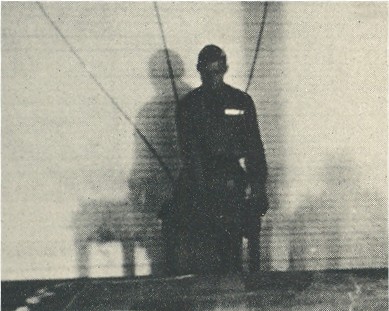
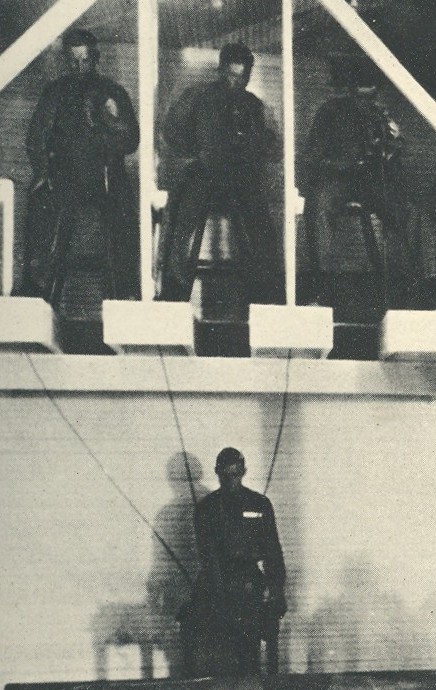
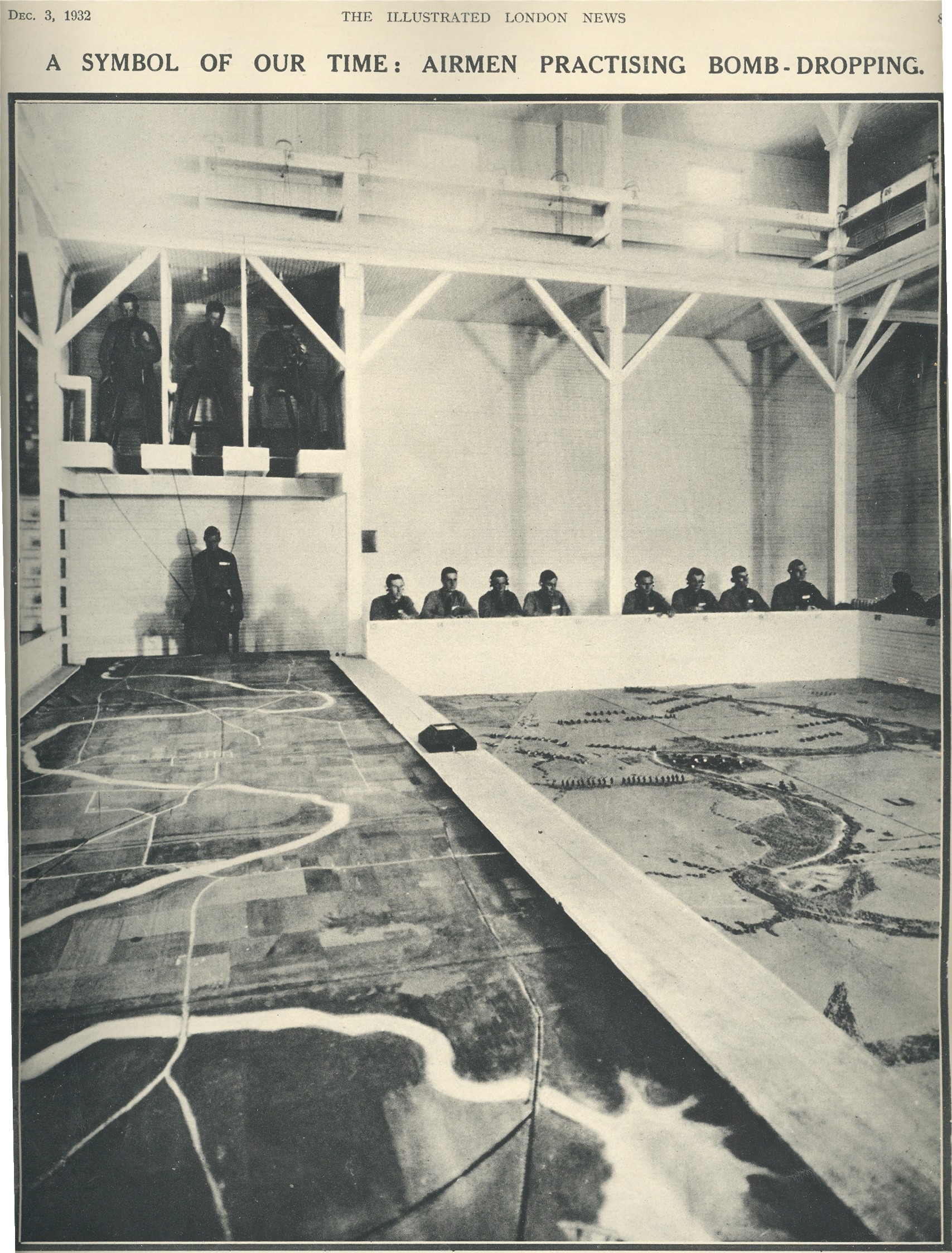
    The thread of thinking about all of this came to mind looking at this image of a bombing instruction room for aviation in England in 1932.  The image is also a great one; the aviator at far left looks like a marionette; the three men above responding to his piloting maneuvers as he concentrates on the endless panoramas of landforms that advances before him on a horizontal diorama.  It is a fabulous analog flight simulator constructed at a time of great change in aviation

    Wonder stories

    1932 is also the year of the publication of Carl W. Spohr’s classic future-vision/speculative fiction apocalyptic-atom bomb end-of-the-world two-parter (so many hyphens!) that appeared in Wonder Stories.2 The story begins with a relatively simple series of catastrophic bombings that lead to a sort of détente, a kind of mutually assured destruction, which is then upset when the combatants discover and construct the atomic bomb.   MAD breaks down, and the ensuing massive exchanges result in a  devastated world.   Pretty prescient stuff, all-in-all, even so far as the policy goes—especially so when you wrap this sci-fi story around the elements of 1932—Chadwick, Anderson, Joliot-Curie—that made all of this stuff possible just 13 years later.

    Notes

    1 The Joliot-Curie discovery was called “one of the most important discoveries of the century… the consequences of the discovery of artificial radioactivity are immense” from Segrè, From X-rays to Quarks, 198-199).  

    2.  Part one appeared in the March issue, which also carried stories like“Red April, 1965” by Frank K. Kelly; “The Eternal World” by Clark Ashton Smith; “Waves of Compulsion” by Raymond Gallun; “Mutiny on Mercury” by Clifford D. Simak; “The Time Stream” by John Taine (Eric Temple Bell), and others.  Pretty good bumper crop of sci-fi writers in itself.


  • Bulbous & Bubbly Design: Bloated Efforts on Land and in the Sky

    JF Ptak Science Books  Post 951

    Airliner 4

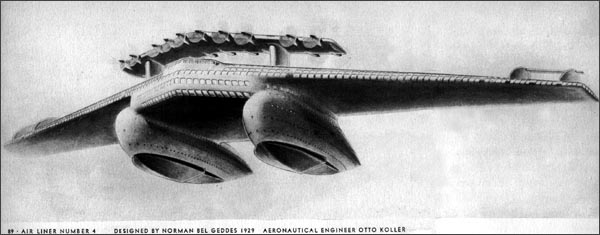
    Sometimes things are designed that are so bulbous and so inflated and so terribly hyper-packed that they are just destined never to be built beyond the imagination.  Among the largest of these things meant for the air was designed by a particularly  streamlined designer, Norman Bel Geddes, who basically owned the concept of aerodynamic function at all levels of design in the 1930’s.

    But Bel Geddes’ apoetically-named aircraft, Airliner 4, is an entirely different issue.  It may possibly be the largest, slowest, lowest, fattest and most lumbering plane ever designed. (And by this I mean that it stood a chance of some sort of actually being built and flown, as opposed to the monsters with wing-topped tennis courts and such.)

    This  530′-long 1.2 million pound beast took an hour to climb to its max ceiling of 10,000 feet where it would cruise along at an astonishing 100 mph.  It would wind its way lovingly across the country, slicing off its travel hours like frozen bologna, 30 hours from coast-to-coast, slowly, methodically, so as not to disturb its 600 passengers in their sleeping rooms.  But I’m not sure how much sleep would get slept, what with 20 (!) 1900 hp engines screaming overhead. 

    2--bulbous building 2


    The passengers who didn’t sleep could do a lot besides sit and be serviced by the aircraft’s crew of 155–they might actually need guides to get them through the oddness of the plane’s 9 decks, 3 kitchens, 2 dining rooms, solarium, 100-couple dance floor, gym, barbershop and medical offices (with waiting room).  Plus much, much more.  (I like a plane with a doctor’s office waiting room; perhaps the real genius would’ve been to come up with the smaller, more interior, extra waiting room to which one graduates before seeing The Doctor.) 

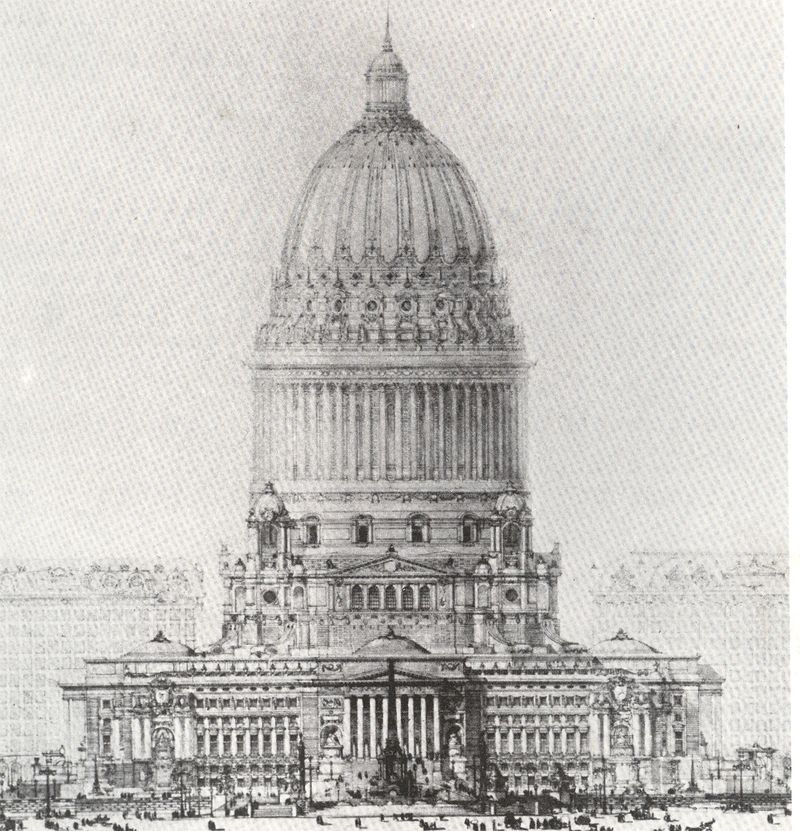
    Getting closer to the ground is the plan for the Chicago Civic Center (1909) by the usually accomplished Daniel H. Burnham. This beast looks more like a stubby nuclear- pulse intergalactic Mothership than anything that anyone would have wanted to build on the ground—at least in space it would be out of sight. 

    2--bulbous building


    In a struggling prose reminiscent of Lewis Sullivan Burnham writes1: “The Civic Center will be dependent for its effectiveness in the character if the architecture displayed in the buildings themselves…” which I think is self-referential, stating that the architecture’s effectiveness is dependent upon the architecture. If this is the case, the enormity of the Civic Center doesn’t save it from itself. 

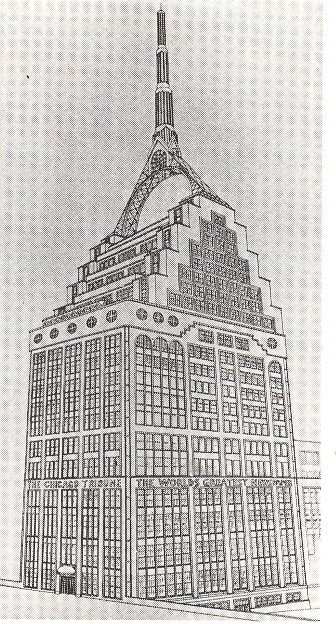
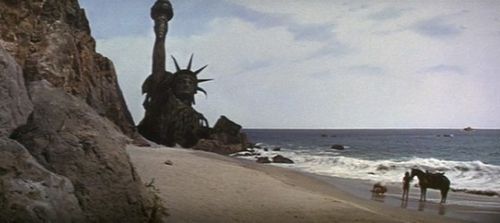
    Staying in Chicago we find another proposal, this for the ChicagoTribuneTower competition of 1922—many of the works submitted seem to my eye big and wide and ugly, but perhaps none more so than that offered by Ludwig Koloch.  This may well have been a nice design for the top third or so of a building, but not for three thirds–and actually, this may be four-thirds.  It reminds me of something rising from the sands at a beach in the future, the remnants of destroyed civilizations.  Without the apes.

     Notes:

    1. Daniel Burnham and Edward Bennett, Plan of Chicago, 1909. 
    2. Planet-of-the-apes-statue-of-liberty

  • Jobs of the Archaeo-Future: Airport Steerer (Bel Geddes’ Floating Airport)

    JF Ptak Science Books LLC  Post 950 

    1--bel geddes airport 2 

    Norman Bel Geddes (1893-1958) made fast, bulbously sleek and varyingly aerodynamic objects and ideas, and was a  vastly successful designer of things ranging from sets for the NY Metropolitan Opera House to telephones to cars to locomotives to the housing for the Mark I computer.  Ideas were his metier, and there seemed no lack of them–good, mostly; bad, sometimes. 

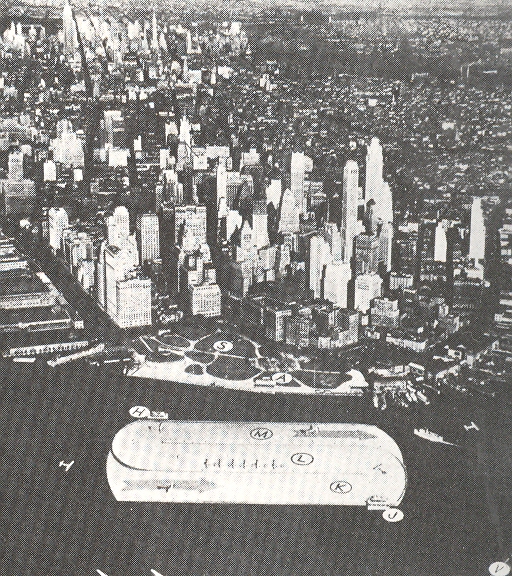
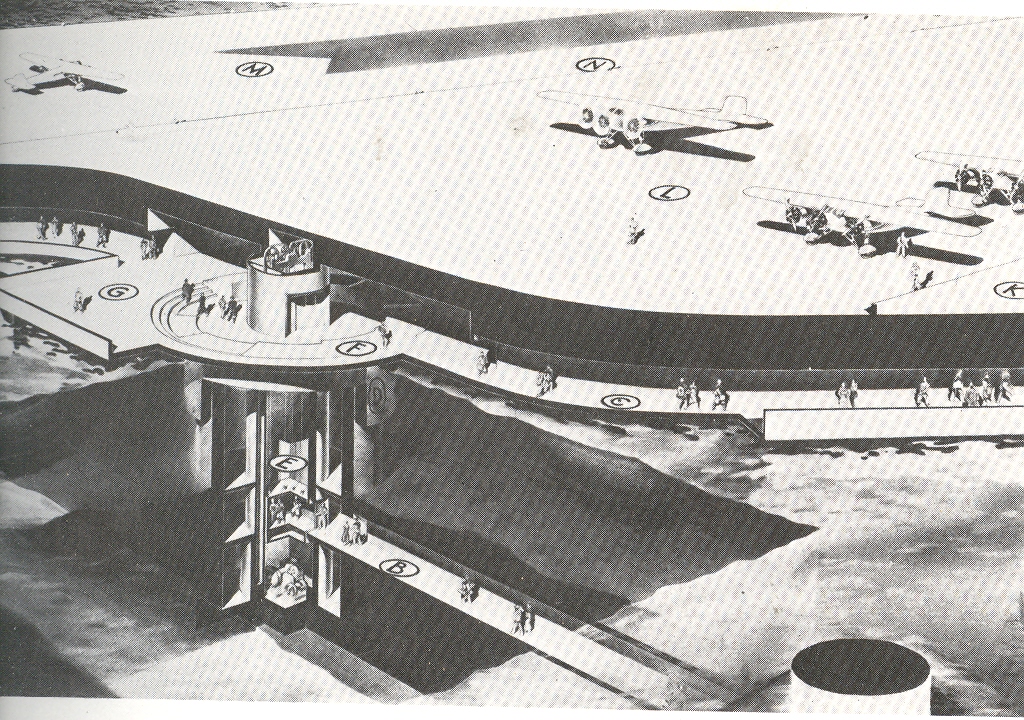
    Bud bad ideas can be beautiful, and elegant, if only for a very short period of time in which they might have actually functioned for the good.  One of these blisterers was his floating airport for the NYC harbor.  Passengers would access the airport via a 800-foot automatic walkway tunnel, and then up to various shuttles and such on the levels below the flight deck. This beast floated on columns floating on mobile caissons just above the harbor bottom, enabling the whole to be turned into or away from the wind, making for easy approaches and departures for the planes. But it is the pilot of the airport that seems most interesting to me, steering the giant propellers that lay under the corners of the structure, pushing the airport into/away from the wind. 

    This may well be the largest mobile steerable structure moving along the shortest courseway conceived as a possibly-buildable project of the twentieth century. 

    Associated posts on great and unbuildable architecture:

    Gigantic
    and Unbuildable Architecture: Philip Johnson and the Walled “Third City“

    Gigantic
    and Unbuildable Buildings: Leroy Buffington, 1889

    Fantastic
    and Unbuildable Architecture #6: the Pyramids of Gizeh in
    Detroit
    (
    Michigan),
    1908

    Gigantic
    and Unbuildable Architecture: Bucky Fuller’s Midtown Manhattan Dome, 1968

    1--bel geddes airport


  • Bad Sounds Department: the V-1, 1944

    I remember seeing a film (with sound) many years ago, when I was little, back in the mid 1960’s, of a V-1 in flight.  The flying bomb issued a terrifically awful sound, punctuated by the silence when its engine  turned off and it fell to its target in silence. It sounds like death.

    [The V-1, or Vergeltungswaffe 1, (“retaliation”, or “vengeance” weapon), or Fieseler
    Fi 103, or Buzz Bomb, or Doodlebug, was a flying bomb (on the order of a very primitive
    cruise missile guided by a gyroscope autopilot) launched against population centers
    in England by the Nazis during the June 1944-January 1945 period.  The bomb was about 27’ long and 17’ wide,
    weighed 4,700 pounds, and reached 400 mph with an 1,800 pound warhead.  Its 8,000+ sorties killed more than 6,000
    people.]

    http://www.youtube.com/watch?v=Q1qsBGTkVSk&feature=related

    And again:

    And again, here:


  • TomorrowVision: U-235, Project Orion, and City-Sized Space Ships, 1941-1968 (+)

    JF Ptak Science Books Post 943

    “One conversation centered on the ever accelerating progress of technology and changes in the mode of human life, which gives the appearance of approaching some essential singularity in the history of the race beyond which human affairs, as we know them, could not continue.”— Stanislaw Ulam, May 1958, referring to a conversation with John von Neumann  [Ulam, S., “Tribute to John von Neumann”, Bulletin of the American Mathematical Society, vol 64, number 3, part 2, May 1958, pp 1−49.]  This is also said to be the first use of the term “singularity”, referring to the sometime-in-the-future point where artificial intelligence reaches such a level as to create a race of super-intelligent artificially-enhanced human beings.

    In the history of perfect tomorrows, what happens to people when we no longer die, or live to enormous ages, or replicate necessary organs to such a degree that cell death is no longer an issue, or are just able to get rid our biological corpus and live in something else?
    6--crowded earth


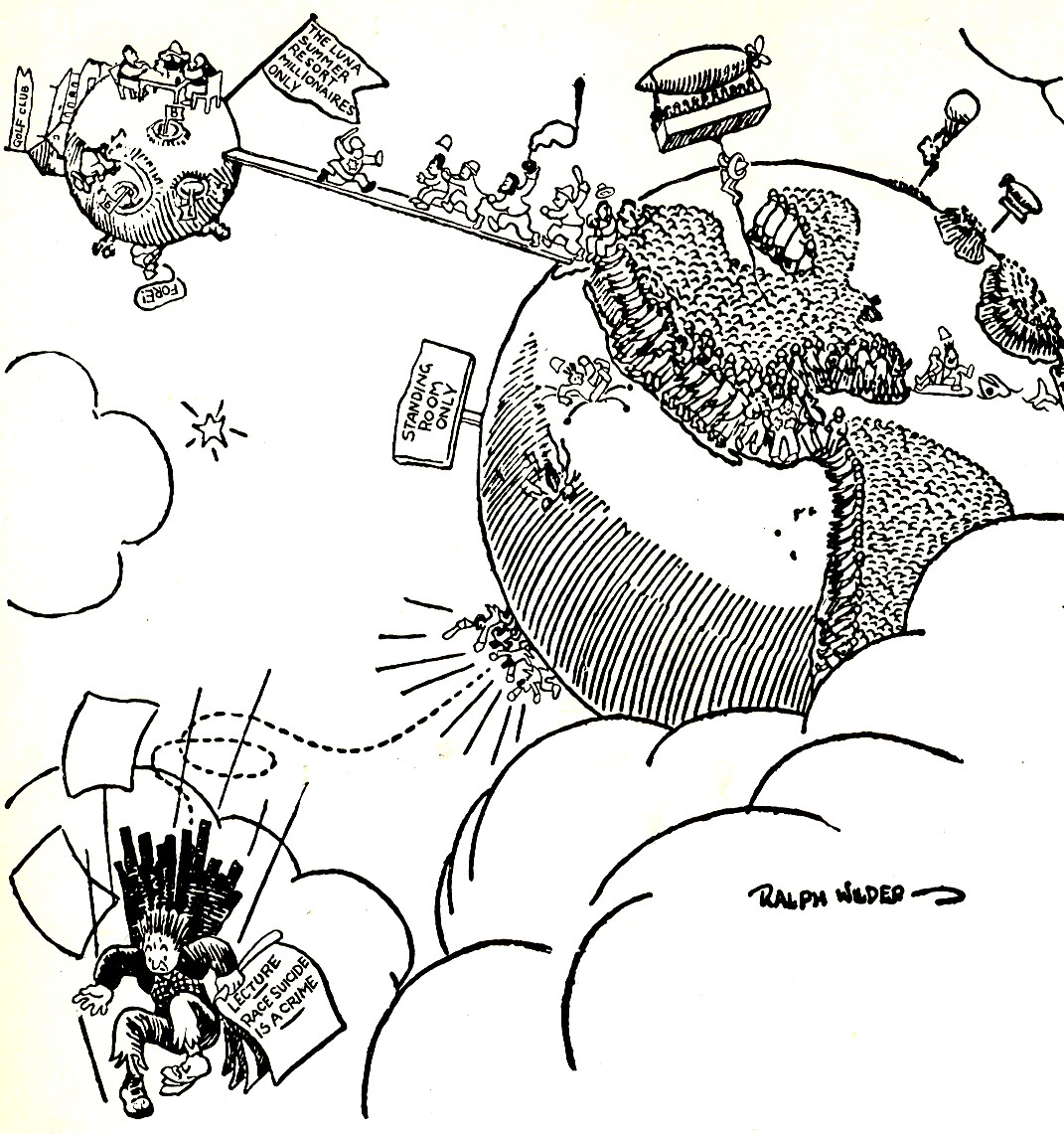
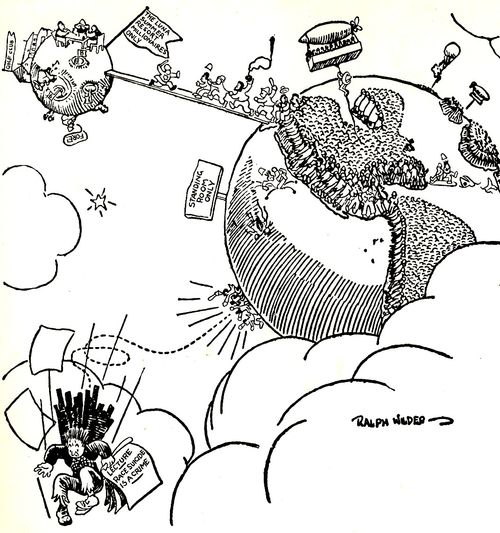
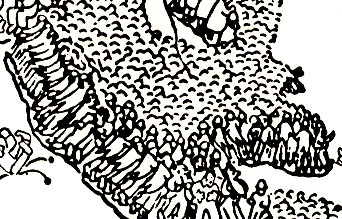
    I can’t tell when the first references start to appear in literature, scientific or otherwise, regarding the sustainability of the population of the Earth, or of simply filling up the Earth, for that matter. This cartoon (above) by Ralph Wilder, published ca. 1915 (source unknown, unfortunately), may well be in the first wave of what must have seemed at the time to be absurd speculation.

    It is impossible for me to imagine what the future of medicine and medical technology may hold for all/some of us in the next 150 years.  I chose this number as it gets us back to one of the greatest advancements in the history of surgery—sterilizing instruments and keeping the surgical room clean. 


    This is the work of Dr. Joseph Lister (remember badly via a popular consumable) who in one fell swoop (and over the course of several years) brought the survivability rate for all surgeries up by half or so, an extraordinary feat, and only four generations old.  It is less than 400 years ago that William Harvey figured out pulmonary circulation and paid hell for it for many years.  To imagine the obverse, the medical advances that will occur in 2400 may be as foreign to educated us here in 2010 as 2010 looked to William Harvey in 1628 or Joseph Lister in 1863.  DNA is only a few years older than me (discovered in 1953), and even though its discovery may seem antiqued at this point, the technologies and understanding initiated by that discovery may look as quaintly fundamental to those in 2150 as the necessity of having a clean surgical environment looks to us. 
    6--crowded earthdet

    And who knows how advancements may spiral ahead of themselves once intelligent machines start producing machines that are more intelligent than themselves leading to god-knows-what.

    But back to the cartoon, and the mathematician Stan Ulam, who is really at the base of this post.  The image depicts the Moon as an escape pod for those who could afford it, the signs suggesting that money would determine who had space to lie and who didn’t.  Of course, there was the problem of actually getting there, which in 1915 or thereabouts was still science fantasy (being twelve years after the Wrights and four years before Goddard).6--u-235 space ship
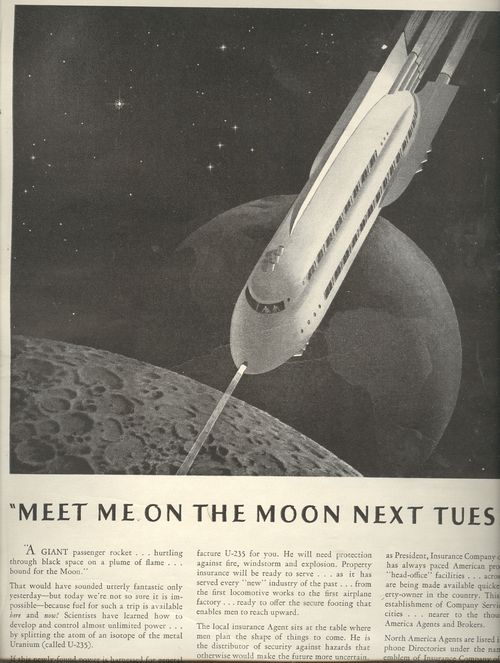
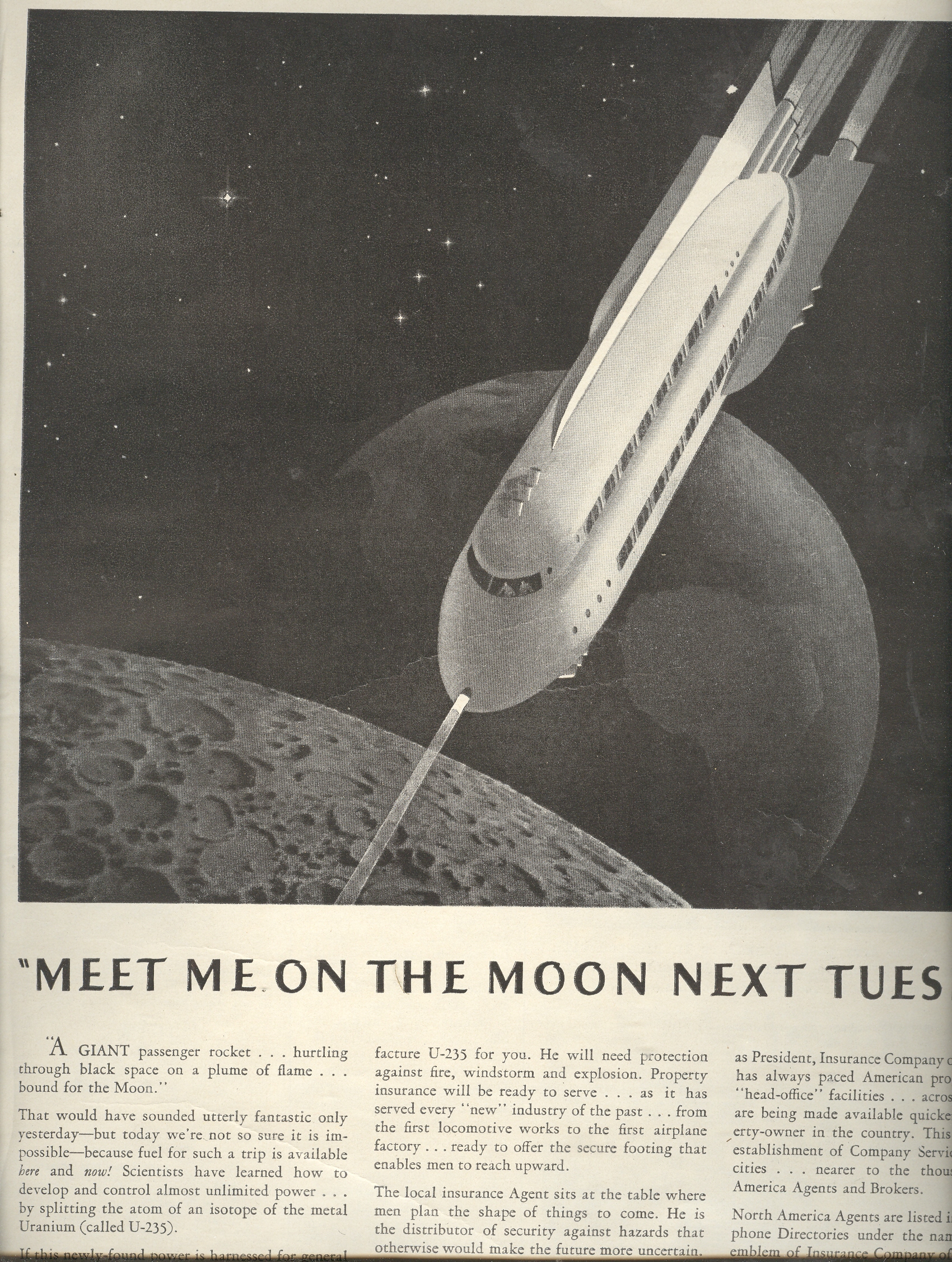
    The second image, from LIFE magazine in 1941, shows a rather massive space vehicle powered by U-235. Discovered by Arthur Jeffrey Dempster in 1935, U-235 was a fissile material capable of sustaining a fission chain reaction. (Dempster, 1886-1950, was a Chicago Ph.D. who during the war would be the Chief Physicist of the great Metallurgical Lab at Chicago, from 1943 to 1946.) The ad (for an insurance firm) shows the ship being powered by what would be a series of nuclear explosions—quite a remarkable thing to be printing in a mass market periodical in the second year of WWII. As it turns out the Physical Review was still publishing sensitive articles on these topics ‘till right about this point, after which their appearances were suspended for the duration of the war. 

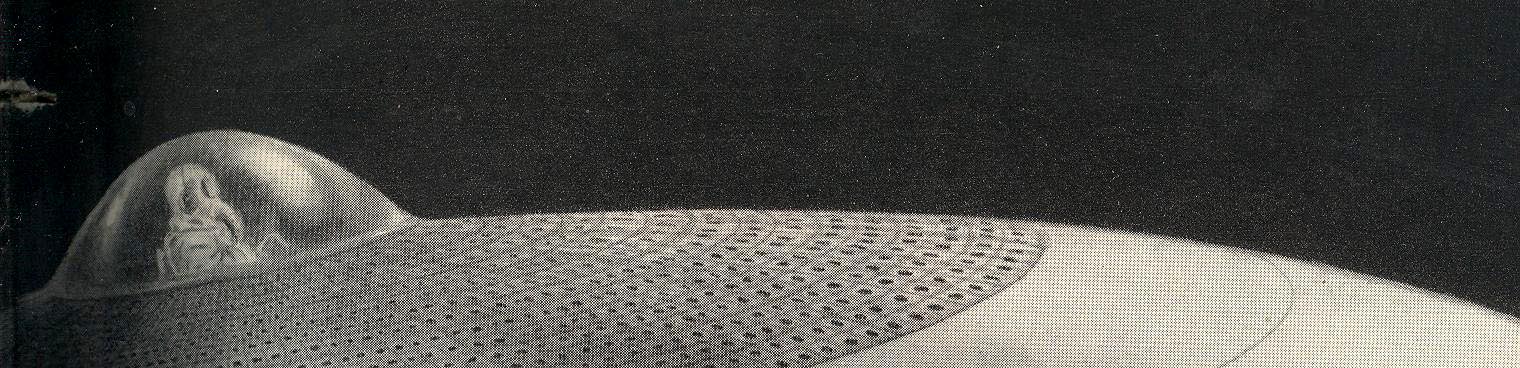
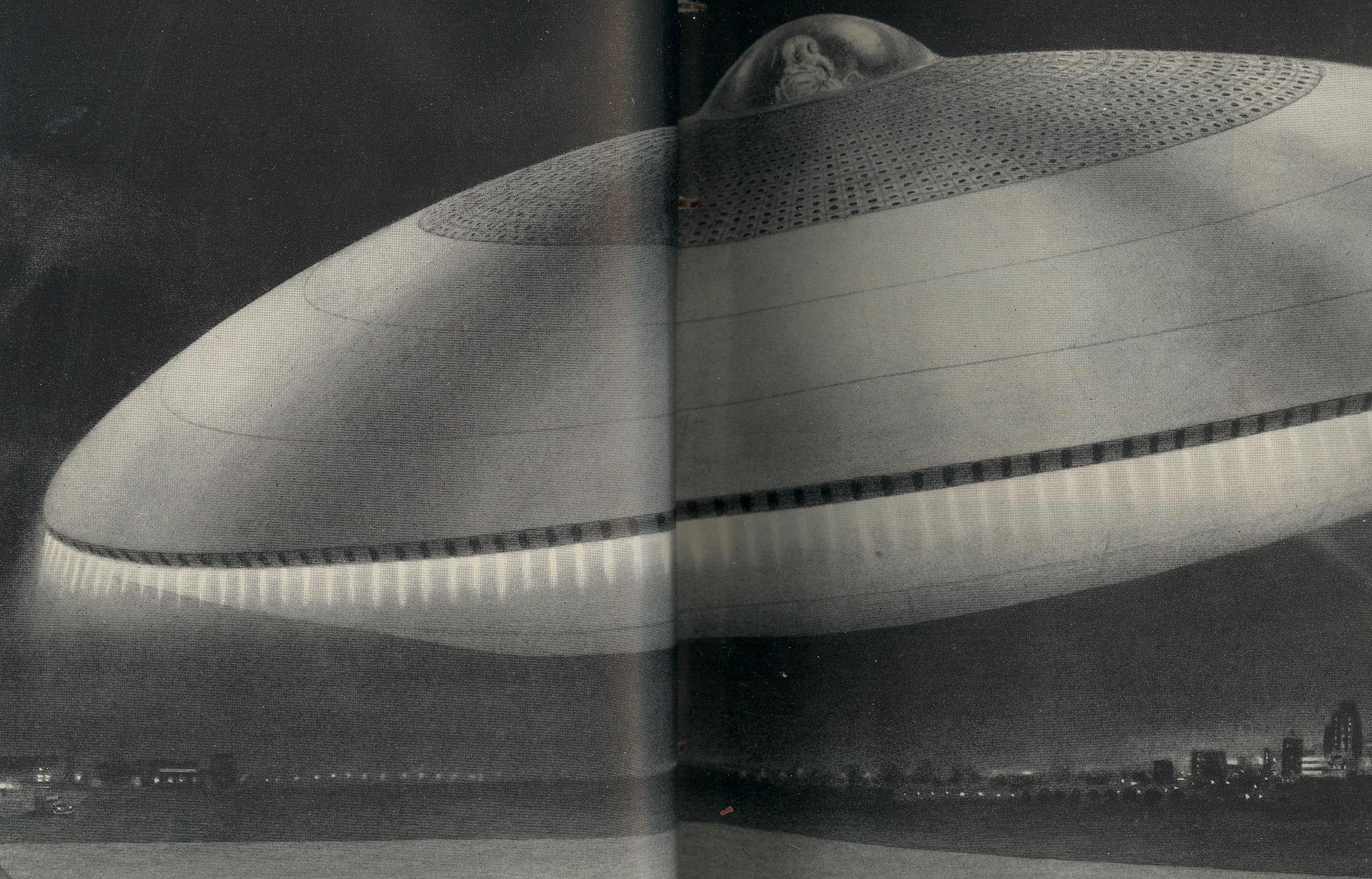
    And as it turns out the thinking here was prescient.  It was Stan Ulam who first suggested this use of atomic energy in 1947; and it was Freeman Dyson and others who (beginning in 1958)  took this many steps further with Project Orion.  In short, this project was a think-sink for a pulsed nuclear propulsion system for a class of space vehicle that would range in (three) sizes from 8,000 tons to an incredible, space-insatiable 8 million tons. 

    Yes, that’s 8 million tons.  That was for a city-sized space ship with a diameter of 400 metres and which could travel at 20,000-30,000 m/s with meganewton thrust, being pushed along by series of nuclear explosions, carrying fantastic payloads and enabling the construction of vast structures on, well, other places. 

    I don’t know how the thing would get off the ground.  Evidently this was not an issue, for even in the late 1980’s drawings and plans for this monstrous ark were still being published. But even as I write this I wonder if my own incredulity with the possibility of such travel will be seen incredulous to folks just a few generations down the road.  I suppose this is just another small stop in the history of the time it takes for absurd ideas to look not so.
  • Defining “Ugly” in Architecture: Rooftop Airport, NYC, 1946

    JF Ptak Science Books LLC Post 942   Bad Ideas Department

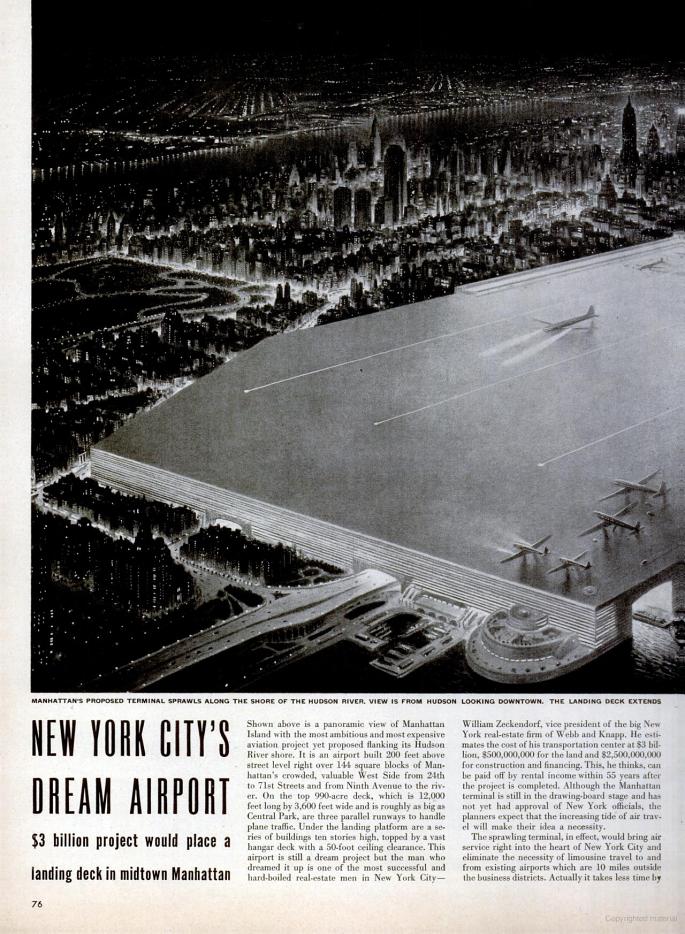
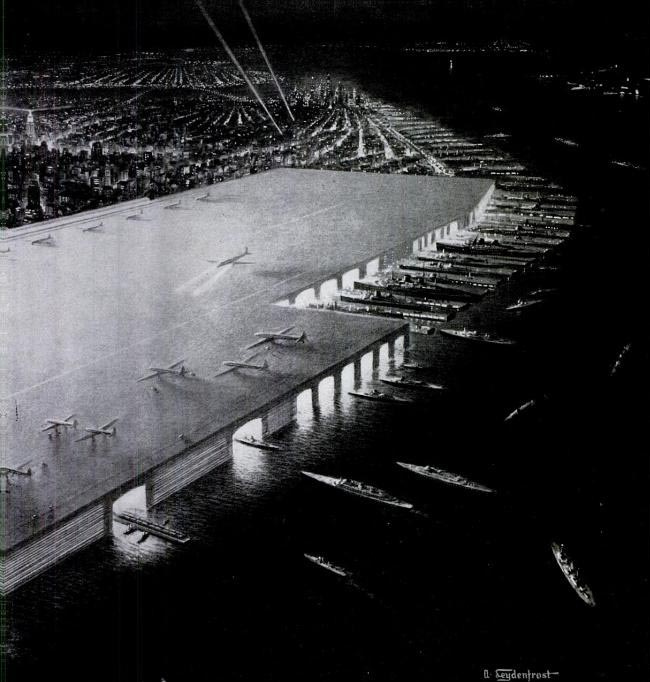
    I think that I’d like to introduce a subset in my Bad Ideas category:  Bad Flat Ideas.  To start it off, I found this very lovely example in LIFE magazine for 18 March 1946, the brainchild of generally-appropriate real estate mogul William Zeckendorf: a spectacularly bad idea of installing a rooftop airport along  a very long swath of property along the West Side. 

    Books 

    It seems as though the airport would extend from the bottom third of Central Park south to, well, I really can’t tell, perhaps lower midtown? Honestly, it doesn’t matter.  For all of its size it actually isn’t quite big enough, looking like there’s maybe 10 or 20 plane lengths margin-of-error at the end of the runway.  Plus there’s the *no* margin of error bit for the edges of the airport, which assumes that no plane will ever topple over the table top. Plus a host of other pertinent stuff.

    The penultimate line:  it is also incredibly ugly, a definition of architectural ugliness that few projects could match. 

    Books_003 det 

    The bottom line though to this project was the bottom line:  in the end, the Manhattan Airport would save about 15 minutes travel time to Philly over Laguardia. 

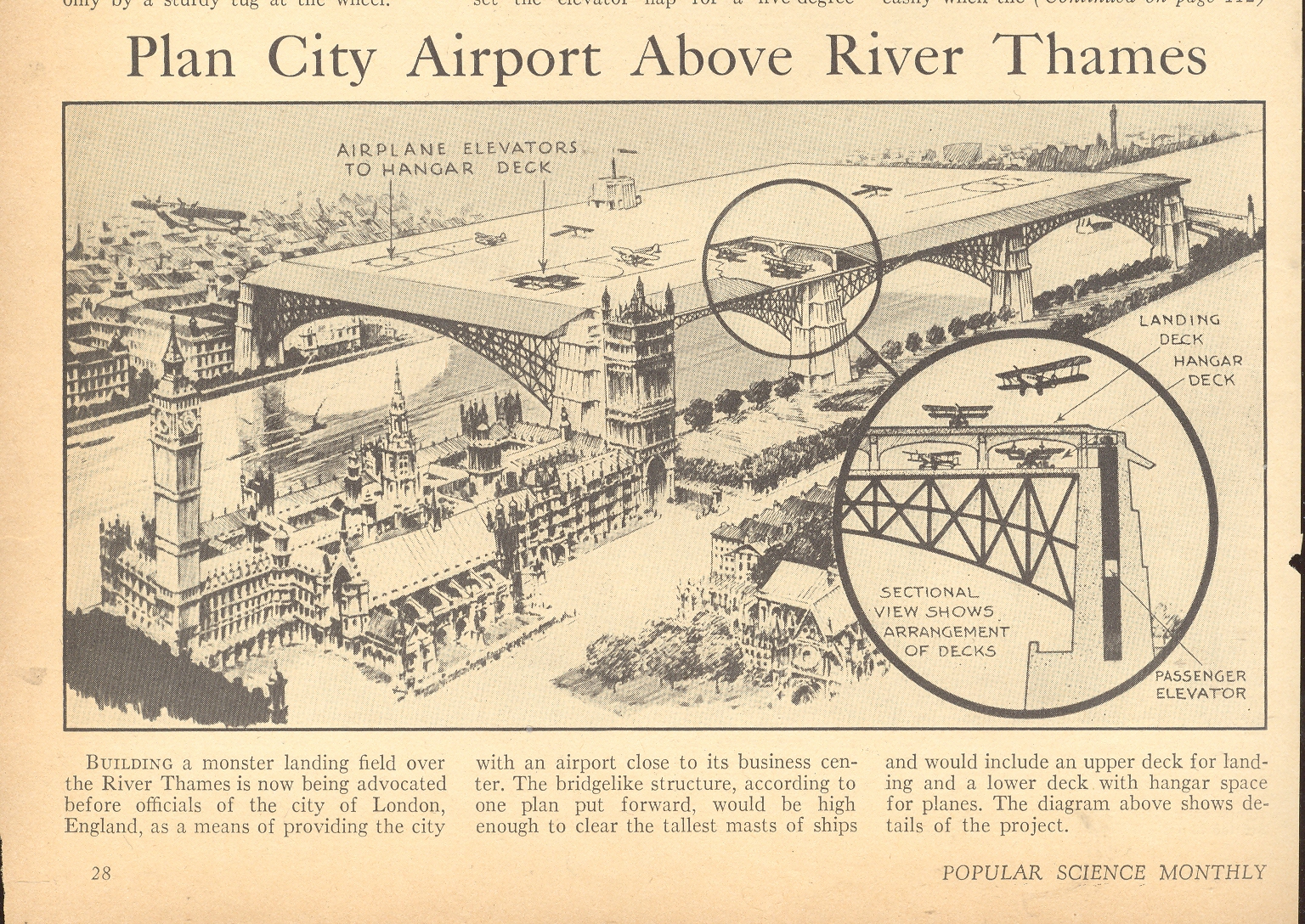
    I should not leave unmentioned the unmentionable project proposed for poor London (which I wrote about late last year here):

    Blog Dec 17 thames airport


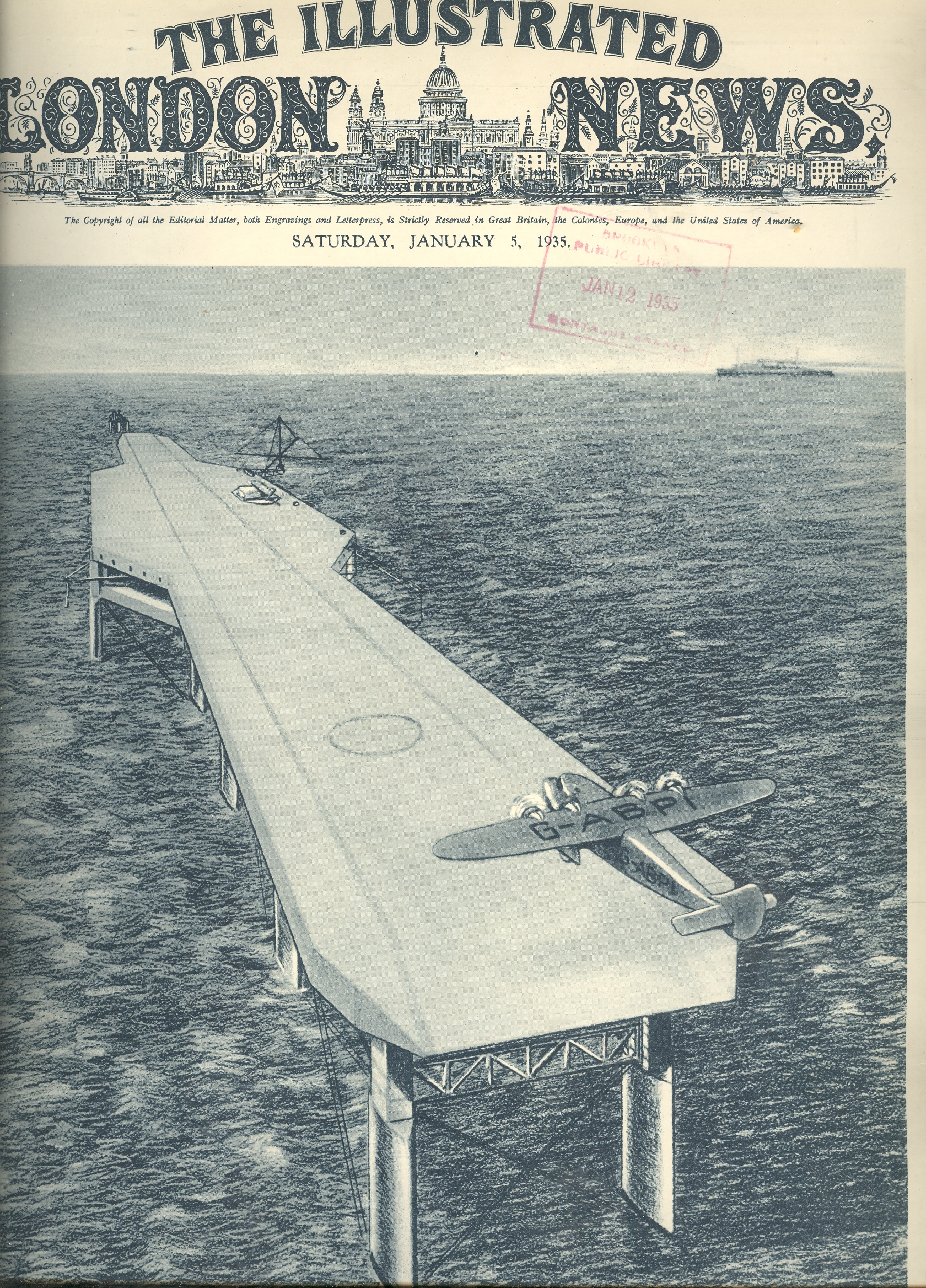
  • Ocean-Crossing Floating Airports Across the Atlantic, 1935

    JF Ptak Science Books LLC  Post 903

    This short
    shelf-lived idea was that of Edward R. Armstrong (1880-1955), who in 1927  first published his plan for a series of 1200’x200’
    floating platforms for refueling and whatnot for transcontinental flights.  These five-acre stations—named the “Langley” in honor of
    Samuel Pierpont Langley1— would be placed every 375 miles across the ocean.  It doesn’t look like a very practical (or
    good) idea, but Armstrong received a $750,000 piece of development change from du
    Pont and GM, which was major dollars in 1929. 
     Blog jan 9 sea airport
    Armstrong’s
    idea would get major play in the popular press from time-to-time, his project
    renamed “The Seadrome” and discussed as a series of floating islands.  Armstrong himself would organize the Seadrome
    Ocean Dock Corp. in the late 1930’s, his pretty but enormously impractical idea
    (reported by
    Time Magazine2 in 1933 as little more than “a perennial gift to Sunday feature
    editors”)
     finally grinding to a salty end with greater
    fuel capacity and efficiency in transatlantic aircraft. 

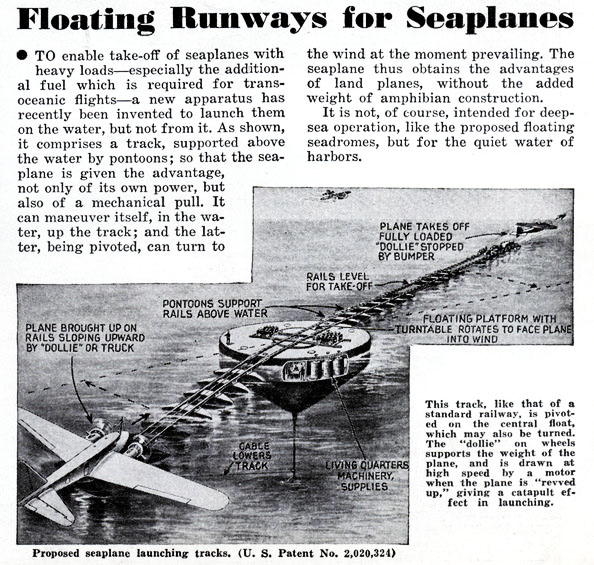
    An even worse idea appeared in the pages of Science and Mechanics in 1936:

    Blog jan 9

     
    Notes:
    1. A Time
    Magazine article
    published 28 October 1929 [a day before the market crashed!] about the

    Langley oddly states
    that Langley was the “designer of the plane which, except for accidents, might
    have flown before the Wrights’ plane did in 1903”.  Tough potatoes. What the magazine didn’t
    state was that Langley, who was the president of the Smithsonian Institution at
    the time with access to major money and benefactors simply went about the flight
    problem incorrectly, and produced an airplane (or “aerodrome”, as he called it)
    that did not and would not fly. Not flying because of accidents means, well,
    not flying.  The Wrights’ approach to
    problem solving was elegant and beat Langley
    by miles.  Langley deserves credit for his other (many)
    achievements, but not for this aircraft.
     
    This same
    article only references Armstrong as a “swarthy engineer”.
    The article
    is reprinted below.
     

  • Bad Dirigibles and Balloons from Good Thinkers: Thaddeus Lowe, Konstantin Tsiolkowsky and Dr. Seuss

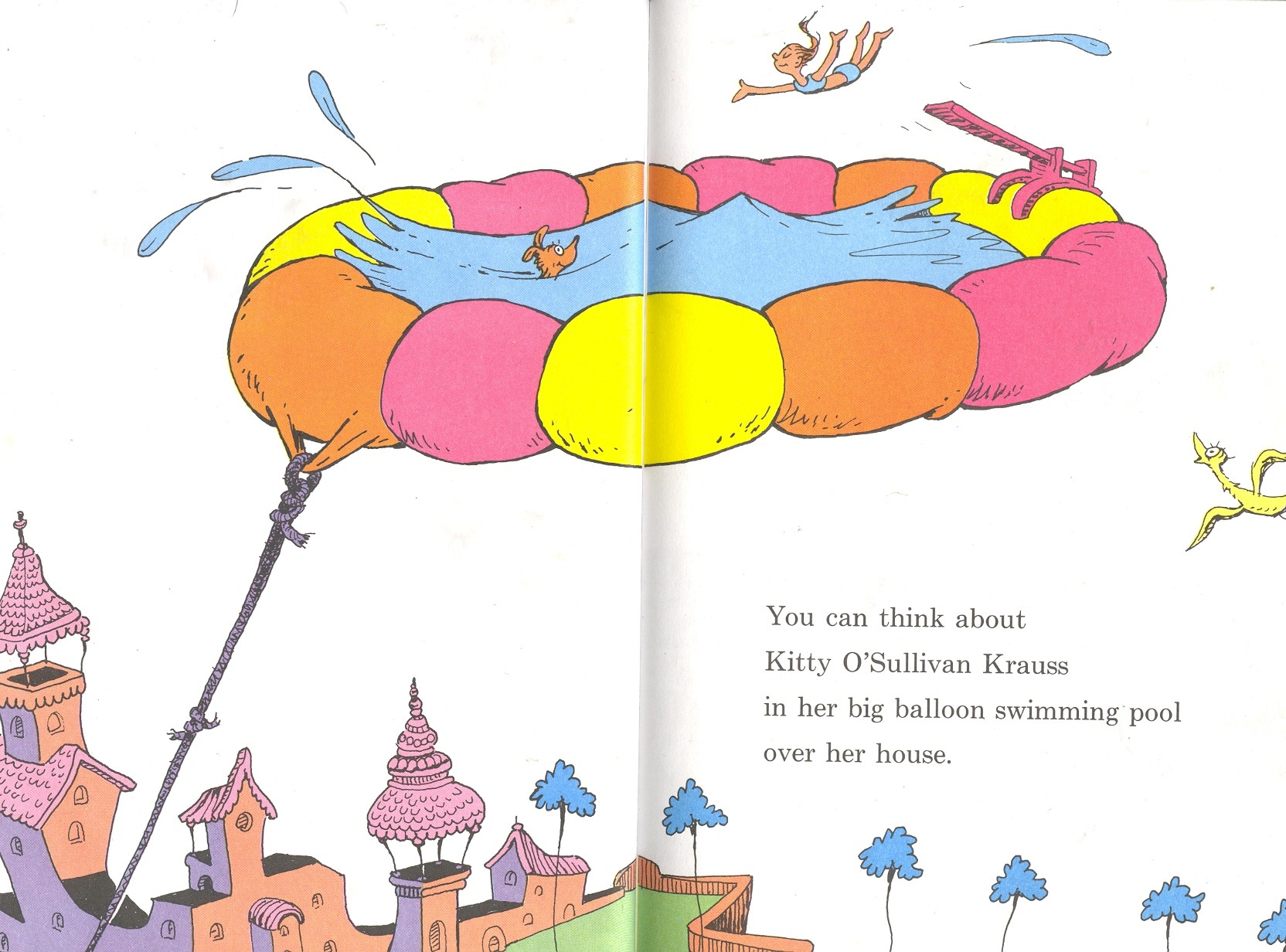
    JF Ptak Science Books LLC  Post 896Blog jan 2 seuss

    Tonight’s
    inspiration comes from one of my daughter Tess’ bedtime stories, Dr. Seuss’ Oh, the Thinks you can Think—particularly
    one of the fantastic illustrations, this one showing a swimming pool
    balloon.  I’ve seen some interesting
    images of balloons and dirigibles taken as serious efforts that reminded me of
    that double-page spread by the good Doctor.  

    In
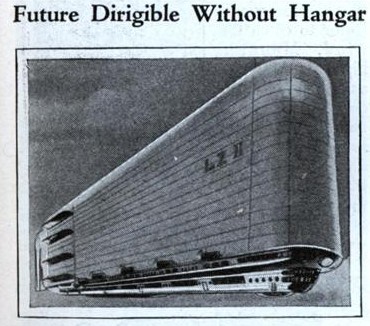
    July, 1931 Konstantin Zilkowsky’s sheet metal dirigible appeared in Modern Mechanics (this image from the
    fabulous Modern Mechanix.com website, cropped), looking a lot like the mountain
    and its imagined whale looked like to Herman Melville at his Arrowhead
    home. 

    Blog jan 2 tsilo dirig  

    This may have been the Omega end
    of bad ideas in the career of Zilkowsky, who is better known by the other
    spelling of his name, Konstantin
    Eduardovich Tsiolkovsky (1857-1835), a Russian misanthrope and space pioneering
    genius who wrote more than 500 works on rocketry and exploration including what
    is arguably the first tech word ever done in the field (in 1903,
    The
    Exploration of Cosmic Space by Means of Reaction Devices
    ). Tsiolkovsky somehow lasted through purges
    and Stalinist tirades, while few of his colleagues did—many mysteriously
    disappeared, while others went to prison and disappeared there.  (Stalin’s crude and insatiable blood lust,
    perhaps the worst of the century, knew no bounds, not even to the scientists
    who could conceivably hand him reigns of rocket/missile-propelled power.)  Anyway, Tsiolkovsky’s dirigible was composed
    of a collapsible metal so that the aircraft could form its own hangar when “docked”.  I don’t know where to begin with this one…

    Blog jan 2 lowe

    The
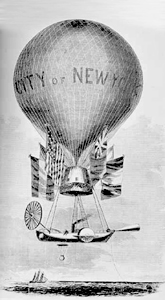
    second (among many other possibilities) is the ship-balloon of Thaddeus Lowe
    (1832-1913) One of Lowe’s great contributions in the
    history of ballooning was providing aerial reconnaissance via (panoramic)
    photographs to the Union army on Confederate army positions—particularly the
    Rebel positions at Richmond (1864) and Fredericksburg (1862). (He had a wide
    span of professional interests and wound up living the high life in L.A. in a half-acre
    home.)  This 130-foot diameter monster
    with a steam-ship escape pod (named The
    City of New York
    and then renamed The
    Great Western
    after the city couldn’t supply enough gas to get the thing
    inflated) was intended to be a transatlantic traveler.  Ready to try this fantastic adventure in
    1860, ready to take charge, ready to begin a very problematic trip across the
    Atlantic in a balloon, Lowe, seemingly ready, had his balloon ripped apart
    while waiting for launching by a chance and not-horrible wind.  Lucky for Lowe and the Union Army, this didn’t
    happen over the ocean somewhere out of reach, and the North’s important info-gatherer
    did not sink like a stone in the cold dark sea. 
    (I’m very cynical that the 100-foot-long, bulbously heavy steam-powered “life
    boat” would’ve landed right-side-up and softly enough to have been of any use
    save for providing some floaty bits that survivors from the balloon could’ve
    clung to for a while before being consumed by King Neptune. 

    I’d vote for Dr. Seuss’ work as the most logical.