A Daily History of Holes, Dots, Lines, Science, History, Math, Physics, Art, the Unintentional Absurd, Architecture, Maps, Data Visualization, Blank and Missing Things, and so on. |1.6 million words, 7500 images, 4.9 million hits| Press & appearances in The Times, Le Figaro, Mensa, The Economist, The Guardian, Discovery News, Slate, Le Monde, Sci American Blogs, Le Pont, and many other places… 5000+ total posts since 2008.

Category: Aviation & flight

  • Advanced Sci-Fi Dirigible Notion, 1909

    JF Ptak Science Books LLC  Post 854

    ++ Nov 28 dirigible

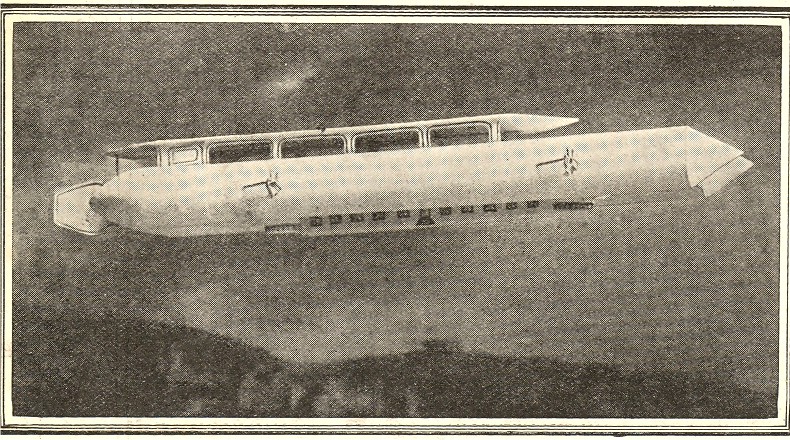
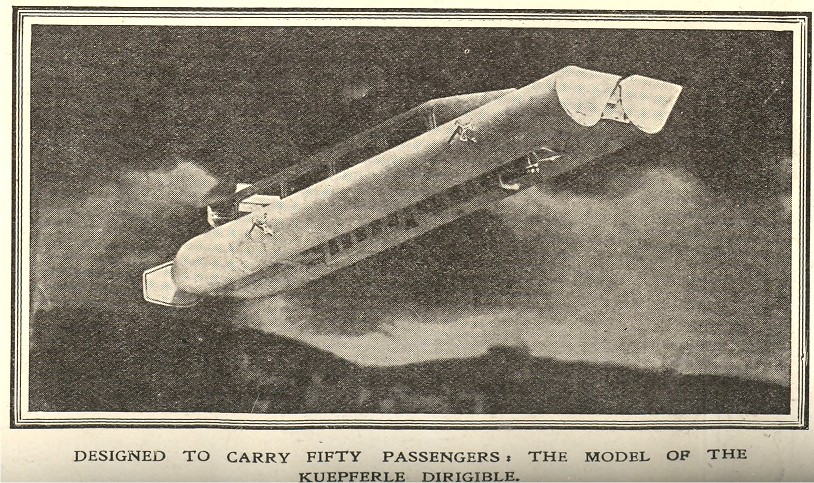
    Just a short post this evening on what looks to be an amazing futuristic vision of he dirigible, found lurking in the “science Jottings” page of the 14 August 1909 issue of The Illustrated London News. (This section has provided more than its fair share of entertainment, a consistent pleasurama of sciency bits all confined to a single page.)  The airship was noted as being designed by “Kuepferle”, unfortunately  without a first name, who was associated somehow with “authorities at Frankfurt”.  The ship was to be a fantastic 100 metres long, and was set to hold fifty passengers (with, I guess, a crew of 25?)  The structure on the the top of the aircraft was a screen to prevent the sun from heating the helium elements too much, which, somehow, were to be turned into a parachute in the case of a disaster.  The unnamed artist made his drawings from a model, while the “dirigible proper would be available before very long”. 

    ++ Nov 28 dirigible 001 

    ZR1couv

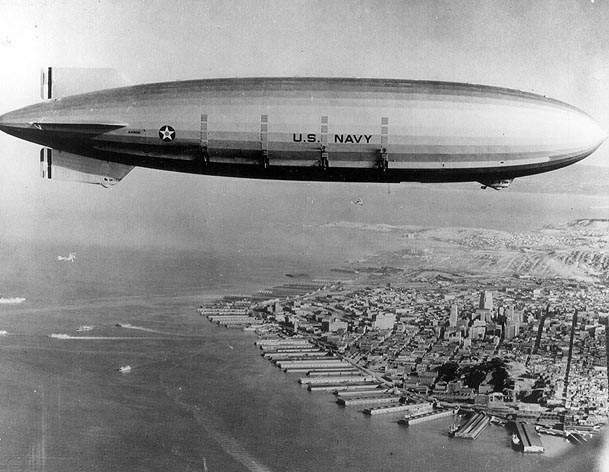
    The magnificent possible length for the airship–100 metres–was huge for 1909, but was eclipsed (in relatively short order) by the American Akron, a 1931 monster which came in at over 240 metres.  Still, the Kuepferle machine had a rich sci-fi design with a big Buck Rogers feel, a lovely thing.

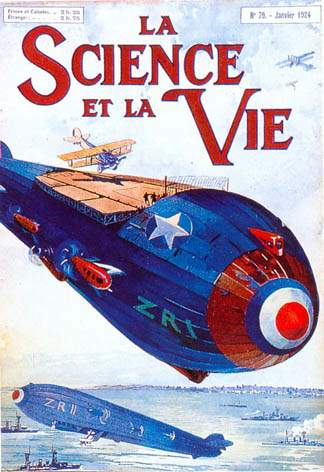
     It was certainly far prettier than this flying aircraft carrier decorating the cover of La Science et la Vie for January 1924.  I’m not sure what the efficacy was for this idea, this enormous beast catering to one airplane at a time…but it all sure looked pretty in blue. 

    The real thing, the Akron, below:

    Akron


  • AirplaneTrainer: Sailors in the Air, 1911

    JF Ptak Science Books LLC  Post 843

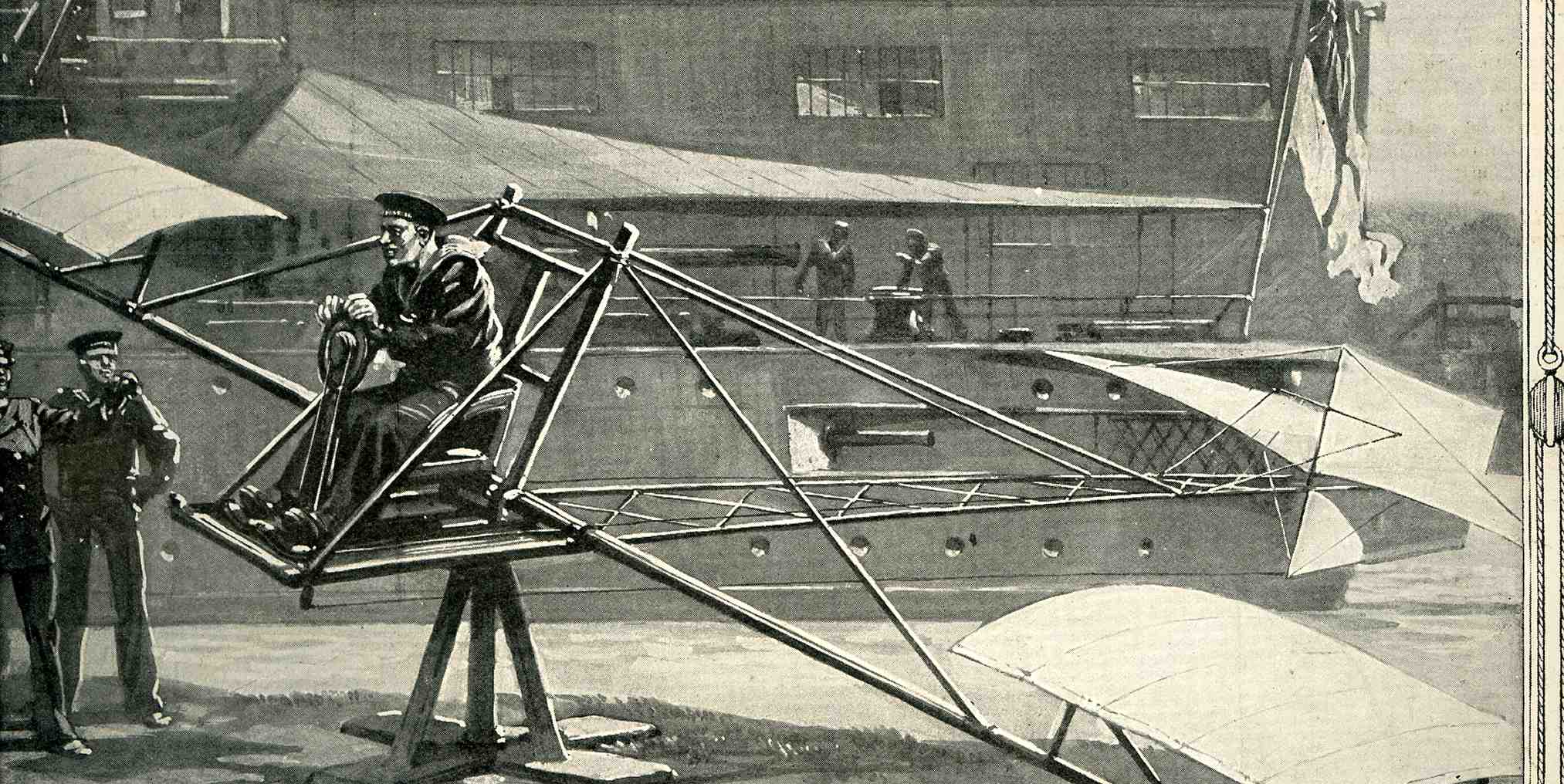
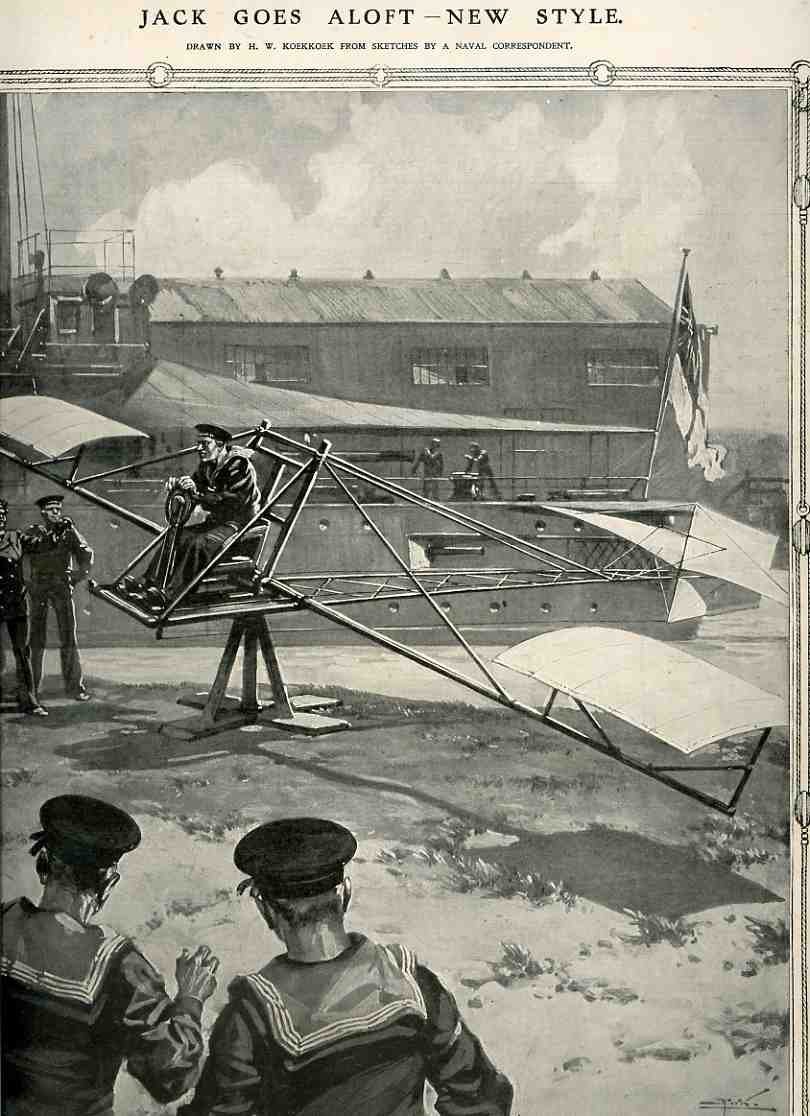
    Just three years after the Wright Brothers arrived in Europe to revolutionize European flying, and following an order of magnitude series of advancement and achievement, the British Navy was already beginning to train classes of sailors as aviators in  dynamic flight-free devices. This idea of simulating flight enabled the training (and more importantly, the selection) of aviators before anybody actually got into a plane, speeding the process of determining who was fit for flight and who was not, quickening the British pace to form a fighting force in the air.
    00-blog--Oct 28 sea plane trainer951

    This interesting graphic appeared in The Illustrated London News for 29 July 1911, and was entitled “Jack Goes Aloft–New Style…Trying to Keep a Stationary Machine Steady in a Wind; Sailors Practicing with a Dummy Aeroplane”.  This was five months before the establishment of the Royal Naval Flight School, but more importantly, just a few months after the historic flight of Eugene Ely, who took off in his aircraft from the deck of the USS Pennsylvania in the Mare Island Navy Yard–of more profound interest perhaps is the fact that Ely landed his plane on the same restricted deck space. (In a way the primitve stopping mechanisms use by Ely are sort of in use today. ) I am sure that few naval people missed the significance of this event–I know that across the ocean Winston Churchill was instantly at work on the idea of using aircraft on ships. But it seems that after all of the initial successes in the U.S. that when everything was said and done, the Brits took the lead in modernizing their navy to include aircraft. 

    00-blog--Oct 28 sea plane trainer950


  • Cars Driving in the Sky: the Future of the City, 1930’s

    JF Ptak Science Books LLC

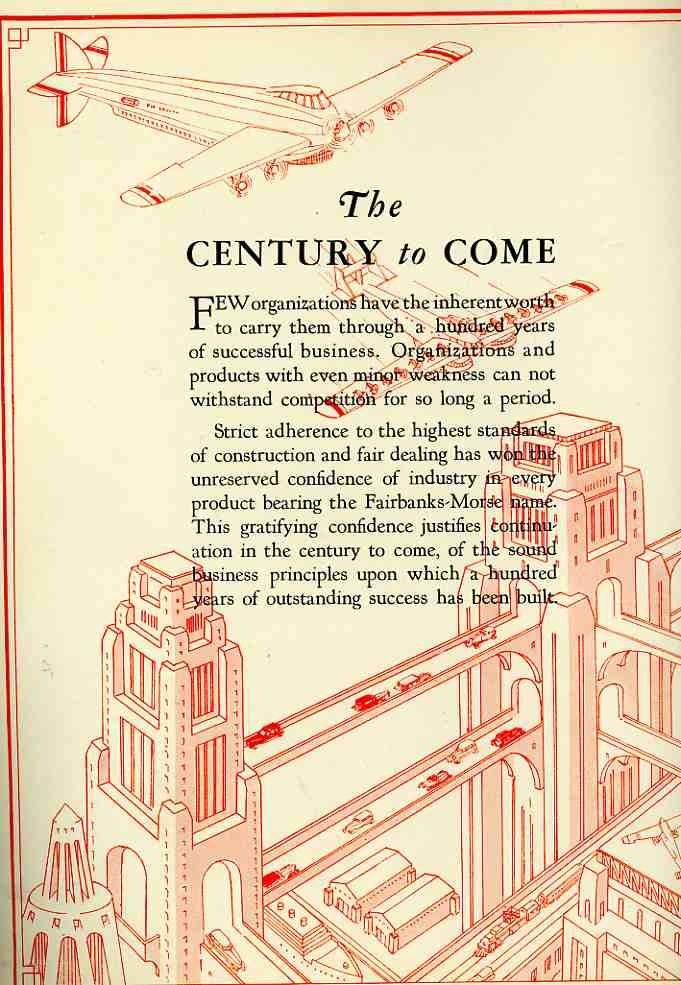
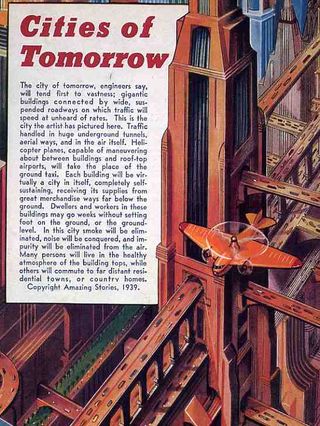
    0-blog---Nov 19 future085 In an earlier post here I wrote about  living a big life in a big airplane–I saw this weird little print and was attracted to its unrepentent awfullness and the sleeky bulbous nature of this exotically unflyable aircraft.  I guess it bothered me becuase even though it was unsupportably  big it didn’t bother to have any of the luxurious features that other, similarly bloated-enormous aircraft had at the time:  swimming pools, greenhouses, landing strips for other planes…  This one didn’t have anything like that, and didn’t really seem to make any sense, unless that big belly part was actually a zeppelin or something like that, filled with helium–but even that doesn’t make sense.  Perhaps we need to assume that it is supported in the air by something yet named and unknowable, powered by engines that were far advanced.  But what is more interesting in the print are the multi-tiered auto-skyways and suspended nonsensical roads that hang between the skyscrapers like a gravity marble game.

    0-blog---Nov 19 future084

    0--blog---dec 2 city future164

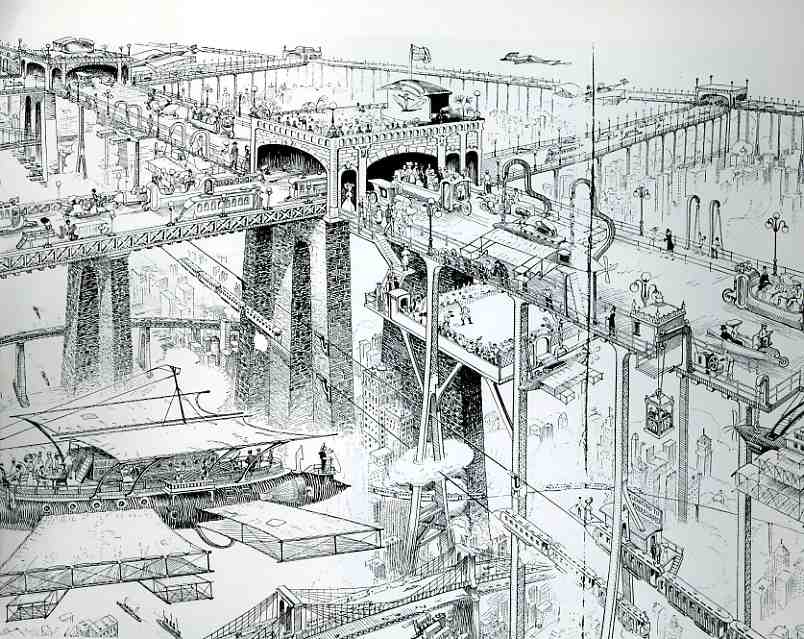
    These other cities of the future at least take a greater leap of faith in the belief of extraordinary inventions and abandon the generally stylized shape of known aircraft and propulsion systems.  At least for the next two images, even the architecture is mostly new.  What I’d really like to know is what people were doing in those buildings and where they were going in those hover cars.  For the most part in stories of the future like this people were simply going to work as they would in 1937, driving off with anti-gravity sumpin’ to Spacely Sprockets to do office work as it was in the past. 

    0--blog---dec 2 city future165 

    0--blog---dec 2 city future166 

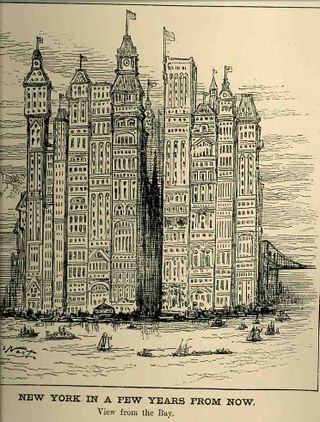
    For the most part future vision seemed grounded in the past, techno-wizzardry 0--blog---dec 2 city future clean167 carved into the fabric of existing society.  I’m not so sure what was so “futuristic” about elevated railways stacked up on top of each other like flapjacks, but to someone there in the 1930’s past it looked like a great thing about to happen….in 1965. 

    0--blog---dec 2 nyc171


  • Anthropomorphic Display of Quantitative Data: Flight Safety, 1912

    JF Ptak Science Books LLC  Post 815

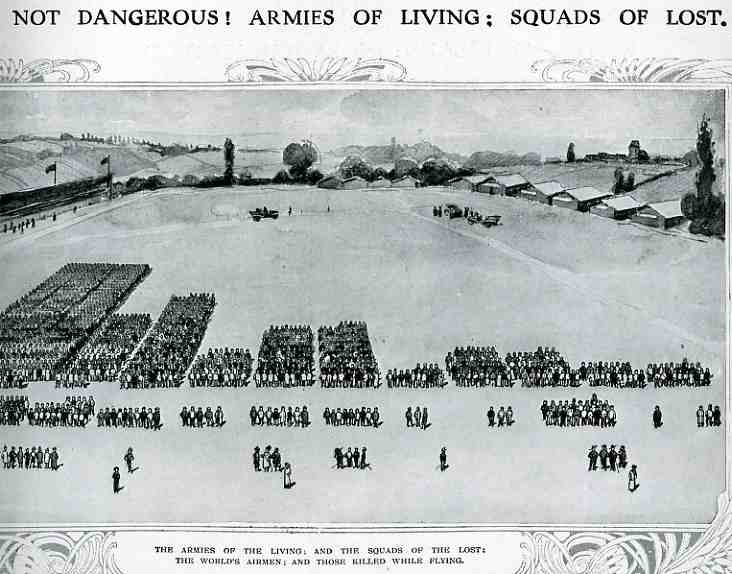
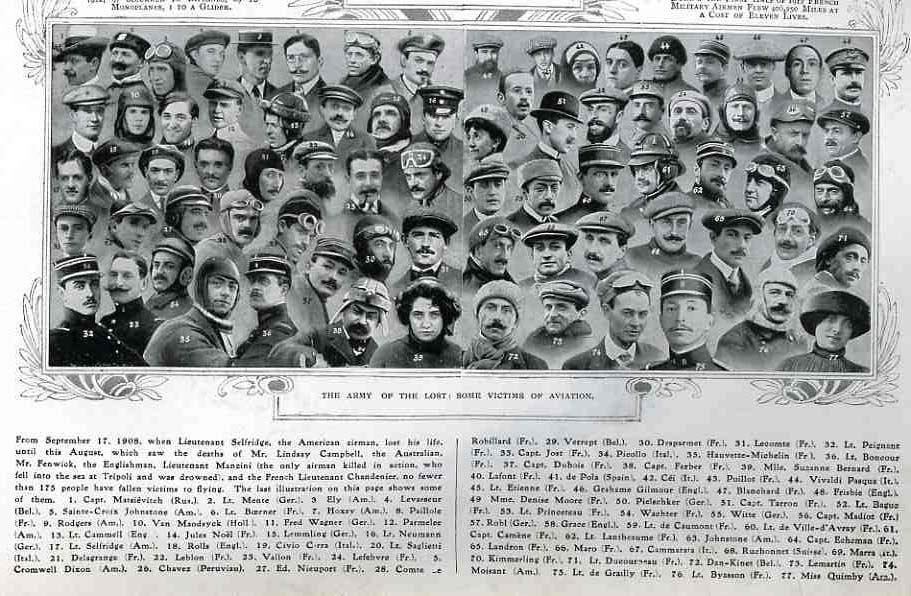
    Even though masses of people had been used in panoramic photography for some years (thousands of people, usually soldiers, gathered to form a living liberty bell, or portrait of George Washington, or some such thing) , I cannot recall the use of humans as a direct statistical aid as in this bio-bar graph, found in the pages of The Illustrated London News for 1912 (page 357).  000-ebay--Nov 7 air death005

    The article asks the question of whether air travel (and flight in general) was “safe”, and responded by graphing its “yes” response with this image. The larger groups in the top half of the image represent the number of flyers flying for that particular country; the small groups below show the number of aviators killed.  (There is no date of reference in particular but it seems to me that these are total deaths since flying began in Europe in earnest in 1905.) The photomontage below shows a selection of some of the most famous dead aviators. The number of deaths as a percentage of those flying seemed quite acceptable in the year of publication (1912) ; however if these figures were iterated forward to 2009 the death rate would be staggering, sending many thousands of aviators (and crew and passengers) to their deaths each year.  In the United States we save that safety failure for deaths in automobile accidents, which still kill about the same number of Americans each year as were U.S. soldiers lost for the entire war in Vietnam.  In spite of this the odds for survival looked pretty good in 1912. 

    000-ebay--Nov 7 air death portrait006


  • The Loneliness of Being Wright(s): not Reporting the First Flight.

    JF Ptak Science Books LLC  Post 774  Blog Bookstore
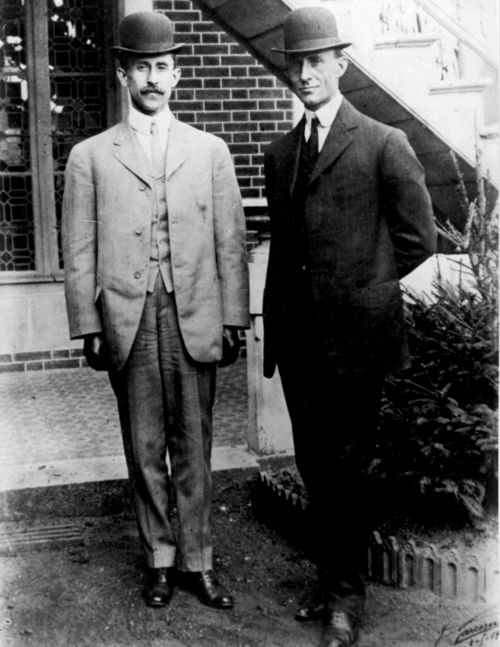
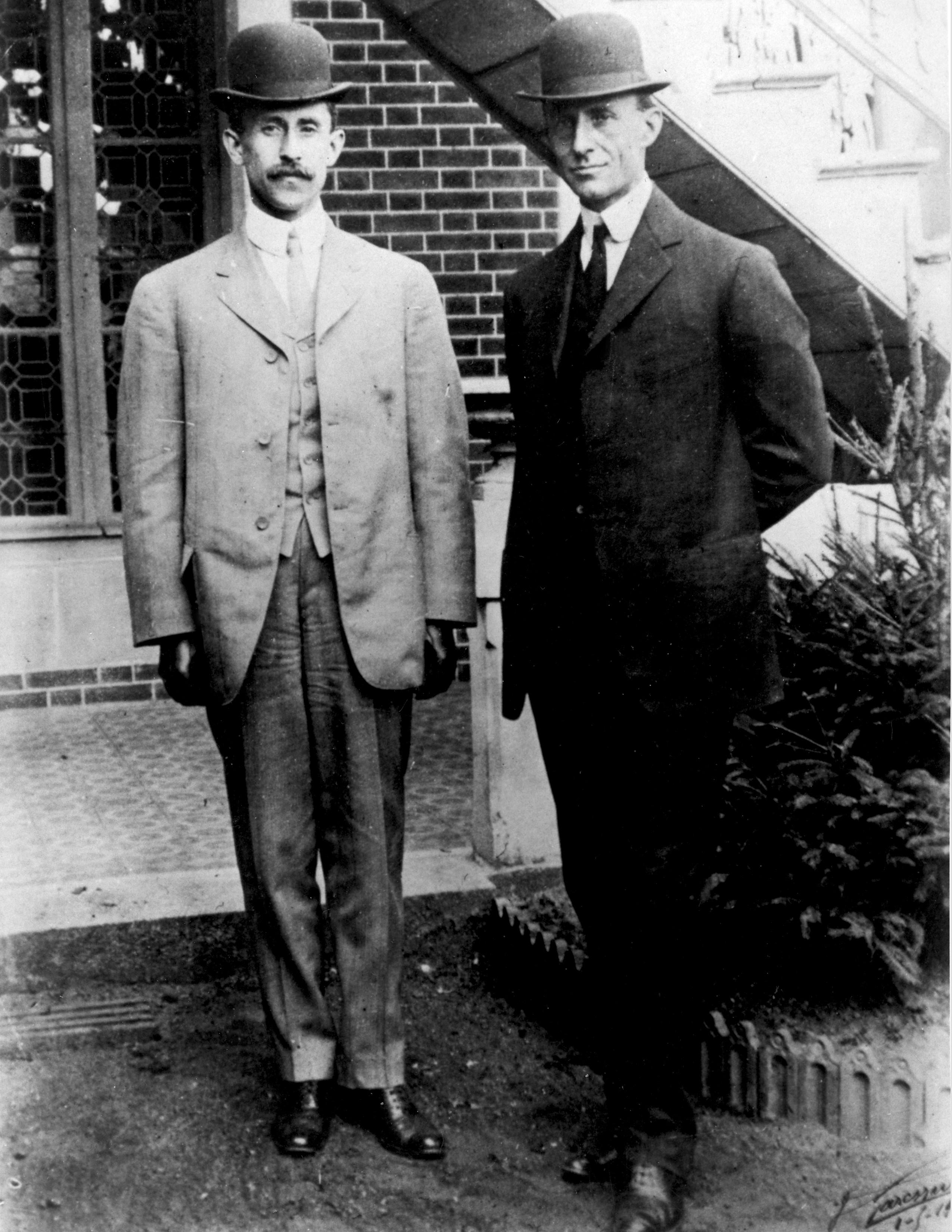
    Wright_brothers_orville_wilbur

    Reading through the 1903/04 volumes of the NYC-based Popular Science Monthly I was
    struck, again*, by the lack of reporting (and the oddness of reporting when
    done) on the Wright Brothers’ first powered flight in December 1903.  The editors gave a page of coverage to the
    Samuel P. Langley failed aerodrome flight of November in the December
    issue. 

    Langley at the time was the secretary of the Smithsonian Institution, and one of America’s
    leading scientists who had a strong side interest in aerodynamics if not
    aviation.  Swimming in private funds,
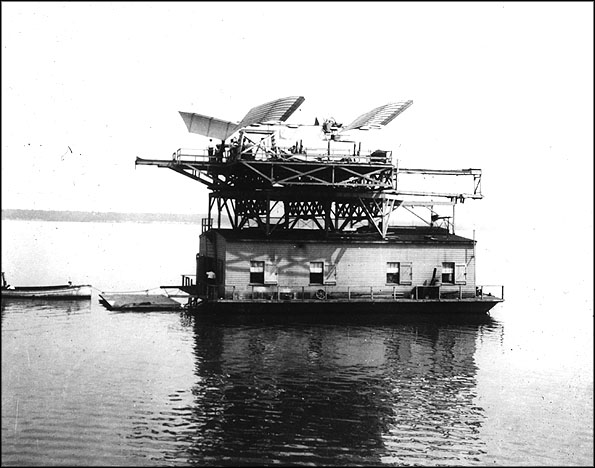
    some money from the Smithsonian and $50k from the War Department, Langley set out trying to produce a flyer which—in its two
    attempts at flight from a raft in the Potomac in
    November—wound up broken and soggy in the river, following a “flight” straight
    from its launcher into the water.  The
    article actually took Langley to task on two fronts:  first, it made
    absolutely certain that readers understood that his powered plane didn’t fly;
    and second, that he might well prove to be a damaging embarrassment to the
    Smithsonian and American science by proceeding with his experiments. (The Langley aerodrome is pictured just below.)
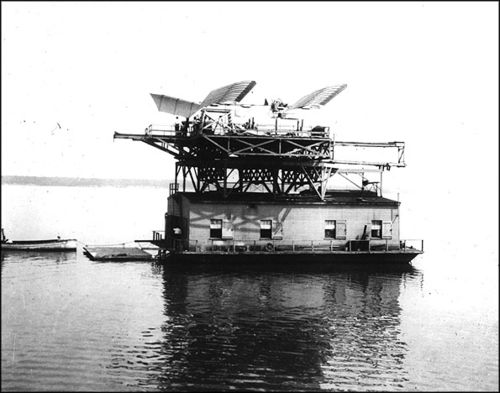
    Langley aerodrom

    The Wright’s first powered flight took place at Kill Devil
    Hills along the North Carolina coast in
    December, 1903, just weeks after the appearance of the Langley article.  They were somewhat reticent and droll in reporting
    their accomplishment; more so, people seemed simply not to believe them (see
    below for some further reading).  Still,
    though, there was no real mention of the Wright’s flight in Popular Science
    Monthly
    through April.  Oddly, the Smithsonian’s
    website reports that one of the first mentions of the flight was in the March
    (1904) issue of this journal, but they are mostly mistaken.  There is an article in that number by the
    Octave Chanute, a great figure in the history of early aviation, who writes in
    general about the progress of flight.  In
    the section on ‘flying machines” Chanute devotes one paragraph of his eight
    page article to the Wrights, and the main emphasis here is that other aviators
    should follow the Wrights’ example of careful preparation before actually
    hoping aboard a plane to fly:  its was
    the training that was emphasized. There isn’t actually any mention whatsoever regarding
    their powered flight, although engines and propellers are discussed somewhat. Of
    the 480 pages remaining in the journal after the December issue, this one
    paragraph was the only room that could be found for talking about the Wrights,
    and then not talking about their great achievement.


    Of course there were many people who didn’t believe the
    Wright story—there was scant photographic evidence and only five eyewitnesses,
    and for years afterwards the Wright had a problem with officially authenticating
    their flight as the great First Flight. 
    But I’m a little puzzled by the Chanute coverage, as he was a pretty
    diplomatic and sharing person, and proved to be particularly supportive of the
    Wrights in general (visiting them at Kill Devil at certain points in 1901,1902
    and 1903).  The brothers understood
    intellectual propriety and credited Chanute when credit was due (particularly
    in the cases of truss design and stacked wings).  So it is puzzling to me when it seems as
    though Chanute may have gone out of his way to not mention the flight.  This is especially true if you read between
    the lines of the next paragraph. Chanute writes: “Now that an initial success
    has been achieved with a flying machine, we can discern the use of such an
    apparatus, and also some of its limitations”. 
    To me, after having written seven pages on flying history, to refer to a
    singular “initial success” makes sense only if he was referring to the Wrights’
    December flight. (I don’t think that he could’ve been referring to the Langley test, as the aerodrome simply fell into the Potomac, the structure of the plane overwhelmed by the thrust,
    the power of the engine, and movement in general—the plane just broke up and
    was flung into the water.)  To me, the
    invisibility of the unmentioned flight is glaringly visible.  But this was pretty much in the realm of
    standard reception for the Wrights for most of the rest of the decade—I am
    still struck though with the rush away from announcing the flight that almost
    everyone seemed to take in 1904. 


    (It is interesting to note Chanute’s vision for the airplane
    in his closing paragraph, where he envisions military uses for aircraft, though
    these were limited to scouting and observation with not a whiff of tactical
    employment.  Also there is the
    possibility of mail delivery (“in some cases”) and the rescue of people in
    trouble in restricted-access areas.  On
    the other hand, the just-failed Langley had a much broader and deeper
    appreciation for what he saw as the impending future of the airplane, saying ‘the
    great universal highway overhead is soon to be opened”, which was directly
    contrary to Chanute, who couldn’t see aircraft being used for simple
    transportation.  Actually Langley’s vision was
    taken to task in that earlier article in the Popular Science Monthly, the editor writing that “Dr. Langley seems
    to claim too much” in regards to the future of flight, and that “he should be
    careful not to do anything that could lend itself to an interpretation that will
    bring injury to the scientific work of the government or country”.  It is certain that with at least this one
    (very popular, widely circulated) science magazine, one couldn’t be too
    stinking careful about what one did or thought or said regarding flight—and in
    the case of the Wrights, one could say hardly anything at all. 


    * For three other of my posts
    on this issue of publicity and the Wrights, see:

    –The Unbearable Wrightness of Being:  the Wright Brothers Introduce Europe to FlyingThe Casual Treatment of the Wright Brothers

    –The Department of Great Understatement:  the Wright Brothers, 1903.

    —The Casual Treatment of the Wright Brothers in the Scientific American


    For the interesting conclusion (and summary) of Chanute’s
    Progress in Flying Machines of see here.


  • Things Not Meant to Fly: Big, Heavy, Underpowered Planes

    JF Ptak Science Books 

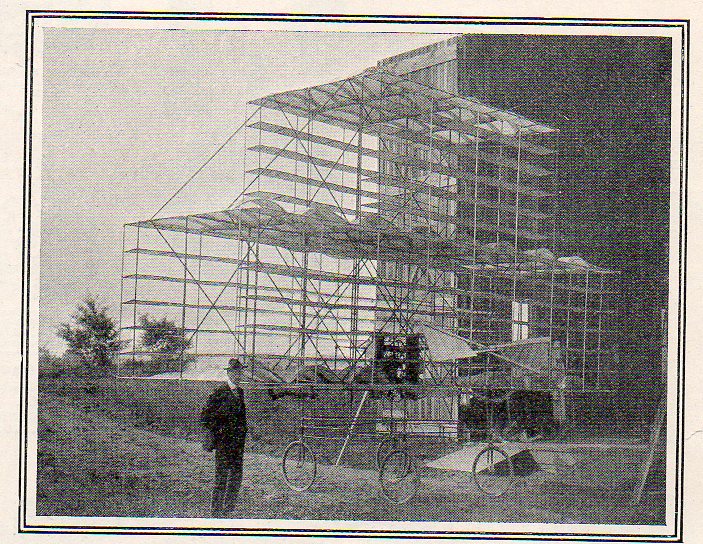
    Airplane tallest041
    “The tallest airplane ever built” is the title to this picture which appeared in the “Chronicle of the Car” section of the  Illustrated London News for 22 February 1908.  The plane is the work and vision of J.W. Roshon, a photographer from Harrisburg Pa.  Somehow, Mr. Roshon designed this thing to fly–that it could roll, and perhaps even taxi, is one thing, but flying really doesn’t seem to be part of its performable agenda.  The plane was made of “aluminum and steel tubing, bamboo, and steel wire… and measured 24 feet wide, 8 feet deep, and 17 feet high”, and held 900 square feet of canvas.  This all sounds very heavy to me, especially when you consider that the engine weighed 50 pounds and generated seven horsepower. By contrast, the Wright I Flyer (the famous first-flight airplane of 1903) had a wingspan of 40 feet, weighed 625 pounds and sported a 12 horsepower, 170 pound  engine (and which by the way was all produced for about a thousand dollars).

    Its hard to see, but the pilot is prone, and laying left-to-right, and the plane really does seem to be 8 feet long, stem to stern. I cannot find out what happened to the canvas and tubing and pilot after the test flight (where “flight” means “roll”).

    ++00++ 9.25 airplane 001

    ·Posted by :

    ·in:

    —

  • Visionaries, Ice People, and the Marriage of Stupid and Brutal.

    JF Ptak Science Books LLC  Post 759  Blog Bookstore

    The ‘twenties is know as the “speed” decade—everything was
    going faster, increasing its speed, expanding to the limit:  this was true for the ability to communicate
    via telephone, the appearance of commercial radio, the great increase in the
    speed of trains and planes and automobiles; the music was fast, the movies were
    talking. 

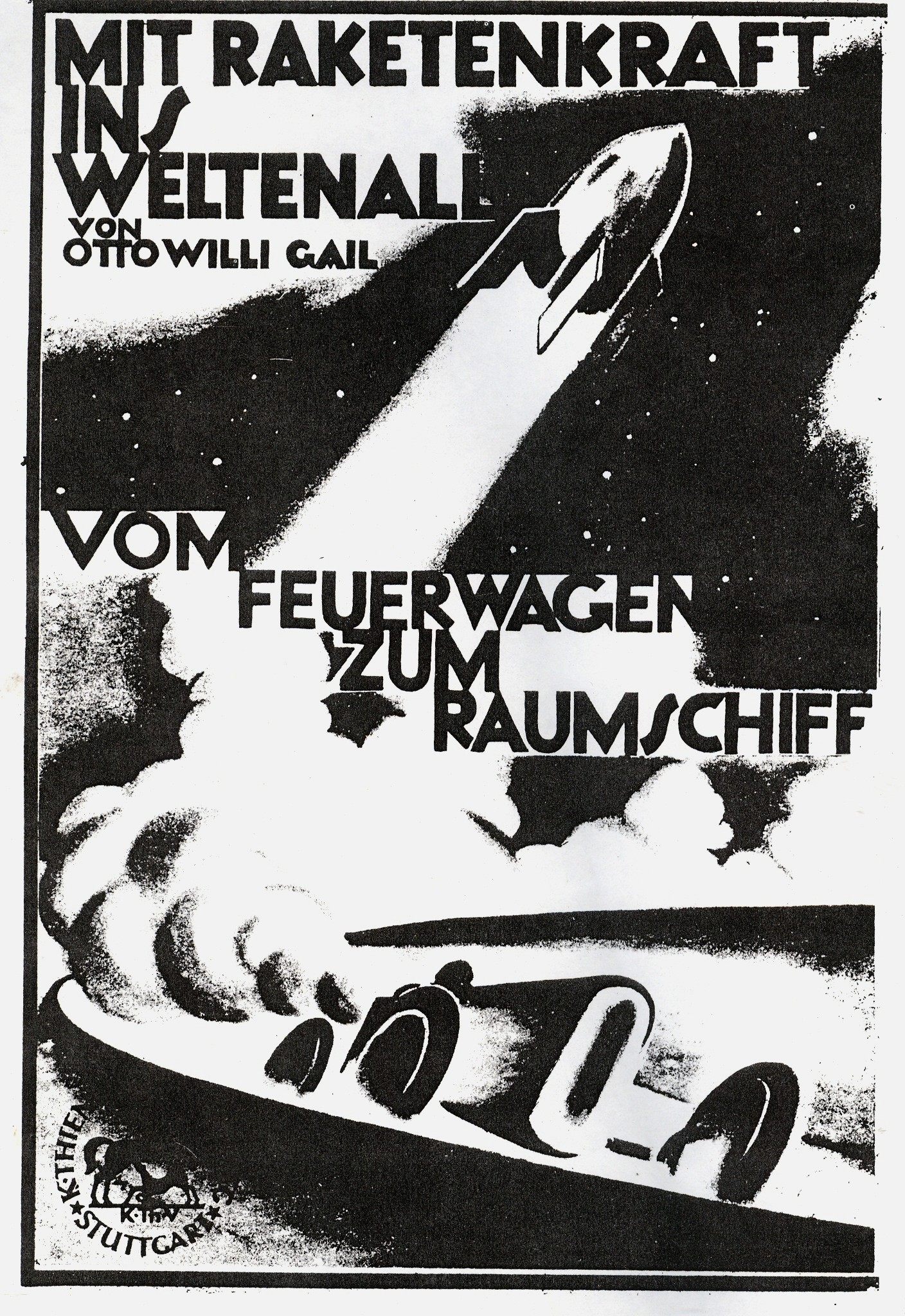
    ++00++ 9.17 otto gail

    There are many iconic images relating speed and the roaring twenties—generally
    though this spectacular cover for Otto Willi Gail’s Mit Raketenkraft ins
    Weltenal…vom Feurerwagen zum Raumschiff
    (1928) is much less frequently seen, though it
    certainly does get the message across. 
    Otto Gail was a creative German science fact and science fiction writer
    with a strong background in following the scientific and technical
    accomplishment in rocketry of the age, especially the works of Max Valier1 and Hermann
    Oberth2. Raketenkraft was more a peek into the future and pop techy work for
    kids than a straight-out scifi novel like his The Moon Stone, which was a story
    that brought us Atlantis, space travel and hidden ancient culture in the
    underground Ice World.Gail, ott--stone moon

    It’s the unfortunate Ice World that attracts my attention
    around Gail, swimming around his interesting and tech-involved scifi world like a
    melting and failing Moon made of hundred-year NYC garbage scows, the idea of a
    good engineer-turned-trash cosmologist named Hans Horbiger, whose ideas wound
    up being whispered into the ears of many monsters. Horbiger had some sort of
    vision-dream about stuff in 1894 and spent the next 30+ years fleshing out the idea,
    which sounds bad from the very start when the author admits to finding “Newton wrong”.  Anyway without losing too many minutes
    thinking about this time-hole, Horbiger’s theory worked ice up to being the
    primary and primordial ingredient of all processes in the universe, with ice
    planets circled by ice moons, and some sort of gooey ice ether to make it all
    go ‘round. Oh yes: there were superior ice people living in the interior of the
    earth.  Horbiger died in 1931, but his many
    followers managed to work the theory into a presentable Jewish-baiting
    anti-relativity Deutsche Physik form
    for the new government of Adolph Hitler in 1933, and it was there that his
    ideas took hold in the cancerous Himmler and Hitler and others, a happy
    marriage at last, the ridiculous to the unspeakable. I’m not sure where the
    ice people are today, but I did saw some awful History Channel show that
    stated that Hitler never did die in the bunker and was removed by submarine to
    the interior ice people of earth, flying around the insides of our globe “in a
    UFO”.

    And so I associate poor Gail (1896-1956) with the Horbiger
    mess, and not his good work in science reporting and popularization.  So it goes.

    Gail, otto ice theory

    The other thing that you can say about Horbiger—he had a
    full-out behemothian mustache.  That’s
    about it.

    Notes

    1. Valier seems to have been the first person  killed in a rocket-related incident, blistered by his exploding rocket-car.

    2.  Oberth is another one of those Germans working at Peenemunde (along with Wernher von Braun and a great host of others)  trying to kill as many people in the UK as possible who wound up in Huntsville, working for our government.  It is all so problematic.  It is interesting that there is little in the Air and Space Museum (as part of the Smithsonian system)  that mentions von Braun.  He is burioed in a simple grave in a cemetery next door to a Jewish cemetery in Alexandria , Virginia.  I also remember going to some restaurant in the diamond district that, in very high bad taste, served up a beer called the Wernher von Brown–von Braun certainly had his hands covered in Jewish blood at least to the wrists, and to have a product so stupidly named as that in that place was just one of those impossible things that happen every day.

    ·Posted by :

    ·in:

    —

  • A Big Sea of Planes: Quantitative Display of World War II Bombers

    JF Ptak Science Books  Post 748  Blog Bookstore

    (See also the new post on picturing massive numbers here.)

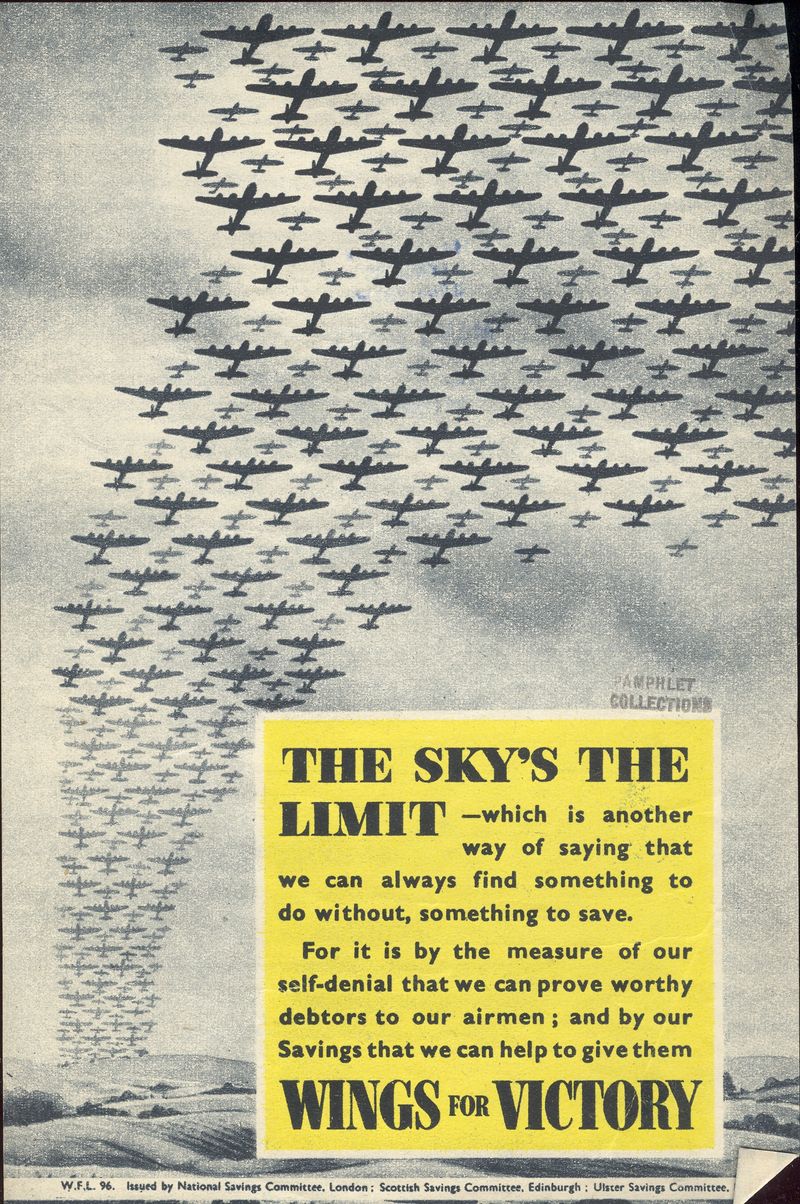
    I’ve written four or five posts on glorious quantitative visual displays of massive amounts of WWII bombers, most of which I’ve gathered together below. This subject came up today when I found another of these images in a small hand-out broadside published by the National Savings Committee of Great Britain, urging people to save money and be thrifty, keeping money in the banks, in an effort to control prices and have money available to the government for war production.  The legend states: “For it is by the measure of our self-denial that we can prove worthy debtors to our airmen; and by our Savings that we can help to give them wings for victory”.  The point is driven home by a now-familiar representation of hundreds of bombers rising from the horizon–a remarkable vision, especially if you tried to visualize the real thing. 

    +_+ planes WWII


    Here are a few other similar images:

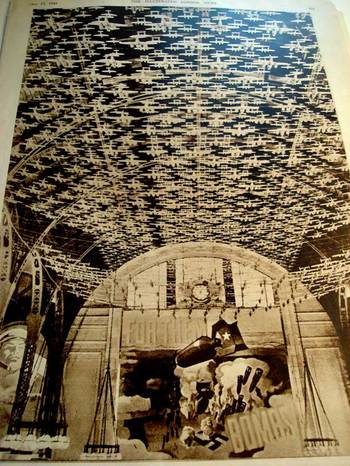
    (A) This widely circulated and published photo appeared in 1942 (particularly in LIFE Magazine in 17 September 1942 and the Illustrated London News in the next month), and showed 4,500 aircraft models suspended from the ceiling of Chicago’s Union Station   It is the result of an inspiration derived from President Franklin Roosevelt’s assertion that America would produce 185,000 war-focused aircraft in 1942 and 1943. 

    Blogwwiiplanes

    The planes in this photo were hanging 60-feet above the floor of the station, with wing spans between one foot and four feet (for the bombers).  It was a fantastic, blustery, iconic effort to show what it meant to look at 4500 planes—and these paled in comparison to a drawing (which I unfortunately do not have) that appeared in the Illustrated London News on 21 February 1941, showing the entire production fleet of 185,000 aircraft—a column of planes one mile wide and 117 miles long.

    1ebay_sept_30185000_planes695

    Blogworld_war_ii_airplanes_delano

    Using this photo then to interpolate that full production figure of 185k, you’d have to piece 48 of these photos together to show full production, or a version of this photo that was 8 inches wide and 32 feet long.  (The second image of Union Station and the planes is by FSA photographer Jack Delano.)

    1ebay_sept_30185000_planes_detail69

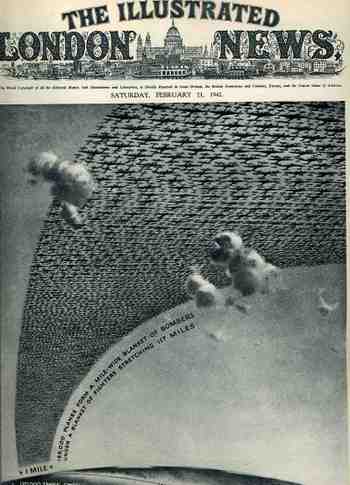
    (B) This arresting cover image for The Illustrated London News of 21 February 1942 illustrates the (new) American production program for planes and tanks for 1942 and 1943 (It reminds me too of an earlier post I did with a similar cover for LIFE magazine here.) The caption reads: “185,000 planes form a mile-wide blanket of bombers under a blanket of fighters stretching 117 miles” which is actually a double blanket of planes–if they were thinned out to form one layer it would stretch one mile wide from Washington D.C. to New York City, which is quite an unimaginable ribbon.


    The reality of the situation was greater than this:  by 1945 over 300,000 planes were produced, 275,000 of them after Pearl Harbor.  And this from a combined aviation industry which before 1939 had produced fewer than 6,000 planes a year.  The war effort increased this by orders of magnitude, and by war’s end there were 81 production facilities with a combined area of 175 million feet, all bumped up within four years.   I’ve never read about it, but I have no doubt that one of the key ingredients to this sort of hyper-successful undertaking was organization–the oversight and control for this process must’ve been fast and decisive, with little room for mid-level anything.  I think that this is the only way the whole thing could’ve worked so well.

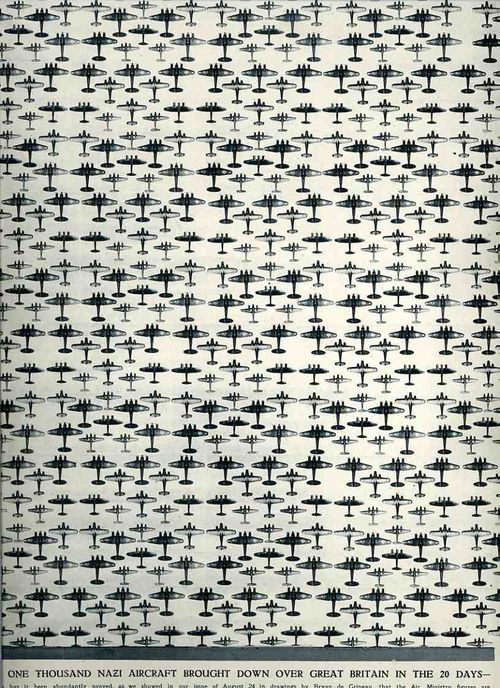
    (C)  This tremendous display is half of a double-page spread that appeared in The Illustrated London News for 7 September 1940.  It was meant to bolster the civilian population of Britain during the time of the German attacks, shoping that “Over one thousand Nazi aircraft (were) brought down over Great Britain in …20 Days…” The artwork, drawn by Bryan de Grineau, actually depicts 1000 planes, and accurately depicted ones at that.   What the graphic doesn’t tally though are the airmen losses, which would be considerably more thanb the 1000 aircraft:  for example, of the aircraft involved in the sustain air-invasion of England, the  Dornier 215’s had a crew of four, Dornier 17’s three, Heinkel 111’s four, Messerschmitt 110’s two, and Junkers 88’s three.  Thus  there were thousands more airmen lost, a commodity that the Nazis could little afford. 

      (This continues a thread on The Battle of Britain and also a post on “What 185,000 Planes Looks Like”).
     The results of the battle (and if you take a look at this earlier post for the full narrative), in terms of aircraft and humans,
    were,  for England: 1,023 fighters: 376 bombers, 148 coastal command aircraft  for a total of 1,547 aircraft and  544 pilots and aircrew killed.  There were also 27,450
    civilians killed and 32,138 wounded.  The Germans lost 873 fighters and 1,014
    bombers for a total of 1,887 aircraft and  2,500 pilots

    I find this visual display of quantitative data beautiful and compelling–and overwhelming in its way.

    The Battle of Britain was fought primarily from 10 July to 31 October 1940, so by the time this image was published the Brits had been able to turn the tide of Hitler’s plan.  (The air strikes wouldn’t really end until the Nazis turned their attention to the Soviet Union in Operation Barbarossa in May 1941.)  And that plan, named Luftschlacht um England, was to overtake and destroy the British capacity in the air, for as long as the English had command of the airspace there would be no way that the Nazis could force an invasion by land/sea (at least in the minds of the Oberkommando der Wehrmacht  and Hitler).  And so the Nazis failed–it was their first major defeat, and, especially, with the turning of attention east, it was a pivotal point of the war. 

    00-blog--Oct 29 battle britain Nazi planes952

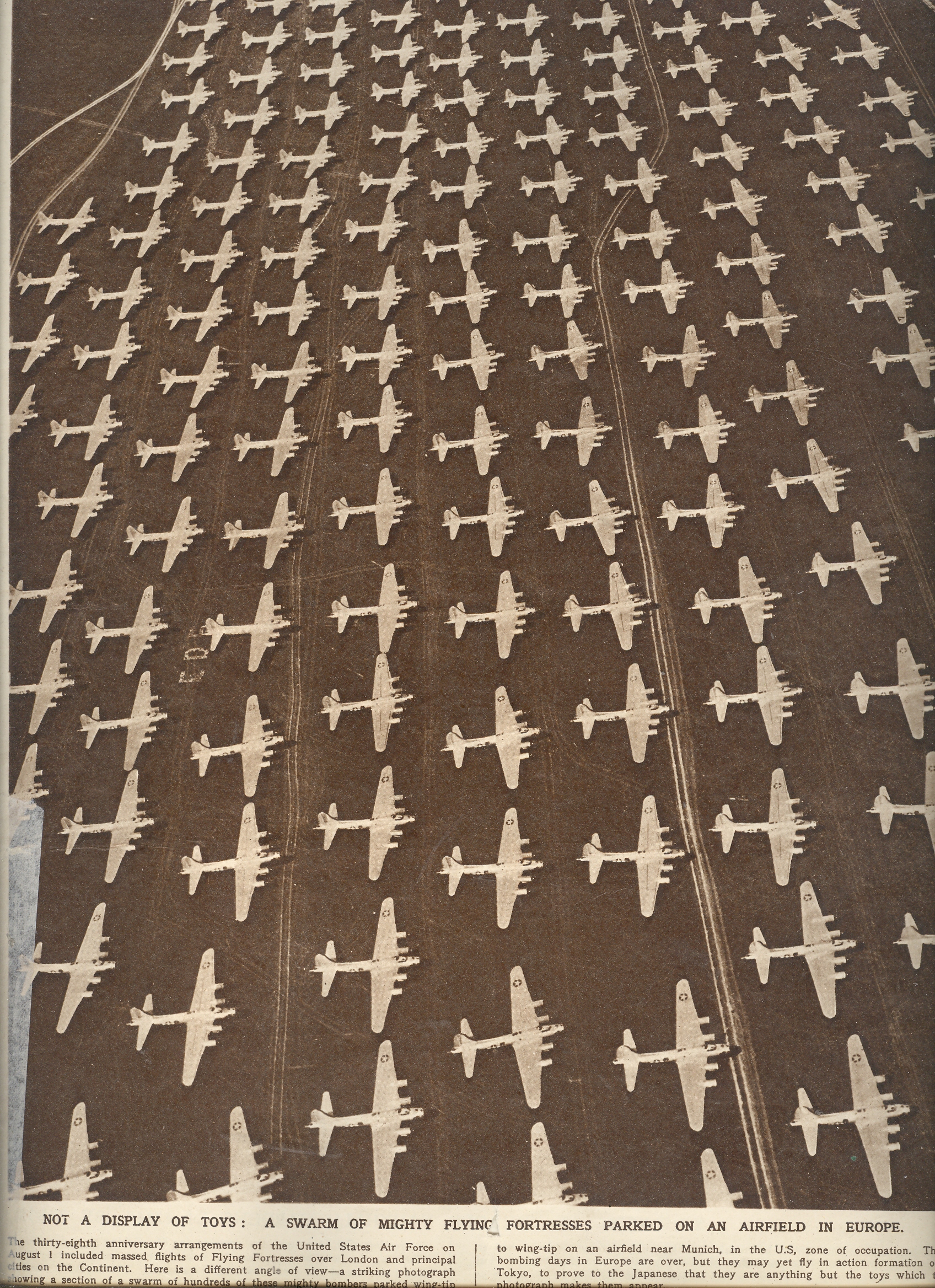
    (D) This last image is a “Not a Display of Toys”, shows only one section of a large airfield “in Europe” (actually in U.S.-administered Munich).  There’s about 300 B-17’s (e?) parked wingtip to wingtip, off duty now from the fight in Europe, but (as the caption says) prepared for a fight in Japan.  I don’t think anyone in high command had any doubt that these planes had seen their last action.  The atom bomb worked, and would work again (and again, and more so if necessary), and the fear that these planes would make their way East was not a real concern. This photo represents about 7% of the highest number of B-17’s in service in Europe at any given time.


    Blog--may 8--vrowds


  • A Not-Obvious Gross Understatement: Bomb + Plane = Drop, 1915.

     JF Ptak Science Books LLC  Post 737 Blog Bookstore

    ===blog==aug 30==bomb overview

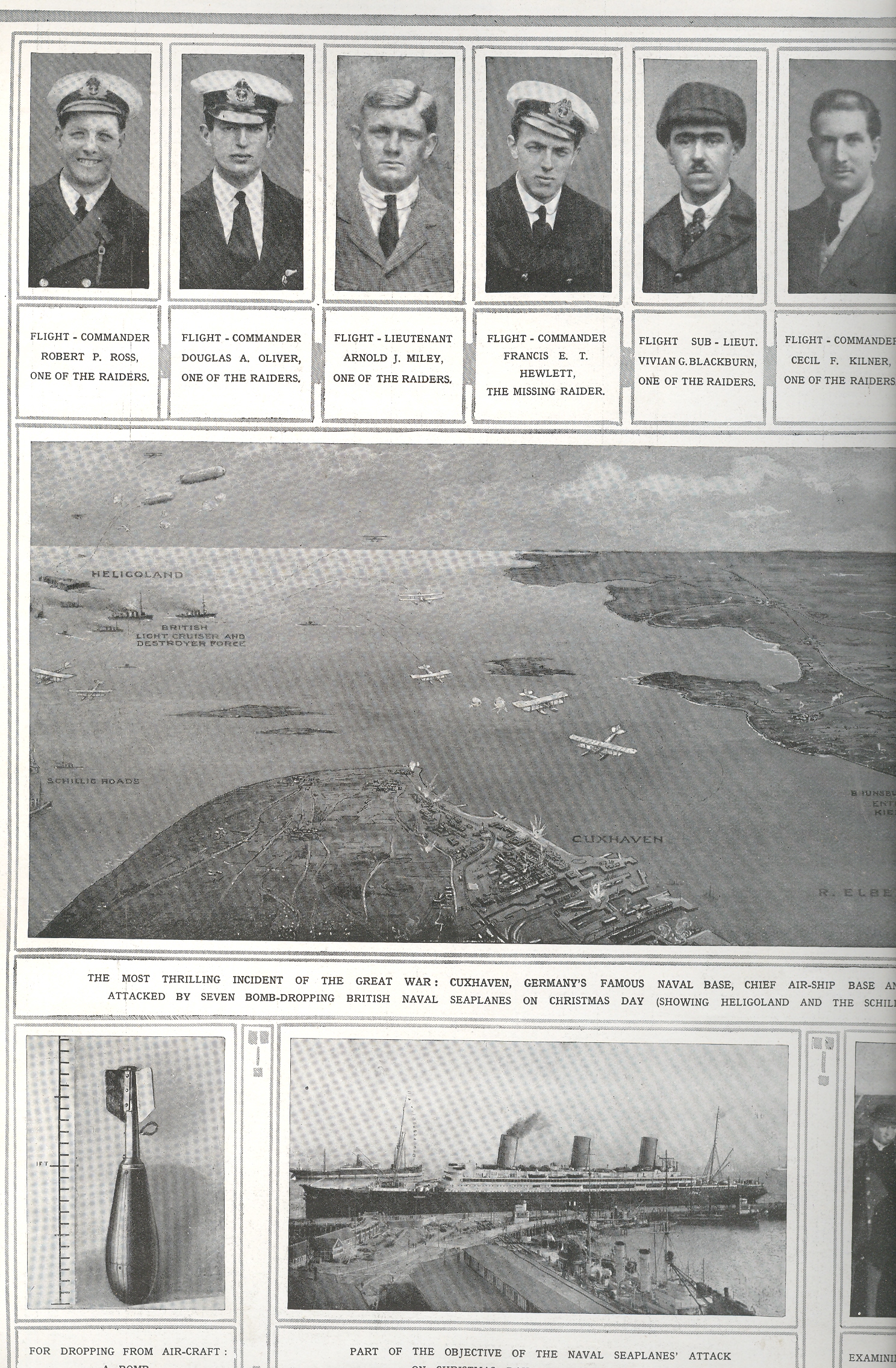
    In the young history of the beginning of the Twentieth Century’s Thirty-One
    Year War, in the very young history of bombing1, came this adventurous “first”
    in warfare:  the attack of a target from
    the air, sea and under the sea. The British launched an assault against the German
    installation at Cuxhaven,
    trying to get at its Zeppelins and navy, sending a task force of destroyers,
    subs and cruisers in support of eight search and destroy seaplanes. The
    tactical results were mixed (there are many places to check out this part of
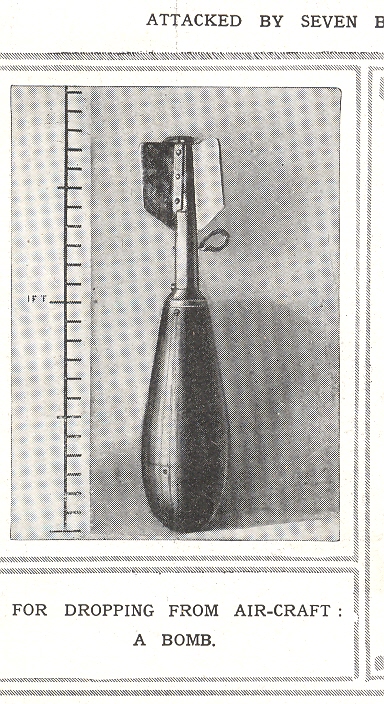
    the war) but the strategic outcome was enormous:  it was a new approach to warfare.  The technical aspect of bombing was so new,
    really, that the picture of the bomb at lower left had to be identified as
    such, and===blog==aug 30==bomb det that it could be used as an offensive weapon dropped from a plane (“for
    Dropping from Air-Craft: a Bomb”). 

    1. It was the Italians who conducted the first aerial bombardment, against a
    very creatively-named military “target”– consisting primarily of civilians–outside
    of Tripoli in October
    1911.

    From the Flight/global Archive:

    “The Cuxhaven raid marks the first employment of the seaplanes of the Naval Air Service (sic)
    in an attack on the enemy’s harbours from the sea, and, apart altogether from
    the results achieved, is an occasion of historical moment. Not only so, but for
    the first time in history a naval attack has been delivered simultaneously
    above, on, and from below the surface of the water.”— United Kingdom Flight
    Magazine: the “Official Organ of the Royal Aero Club of the “, 
    Flight
    Magazine Global Archive: Aircraft
    in Warfare
    , 1 January 1915.

    Notes:

    A lovely site with many links for early aviation: Airminded; and an unusual and wonderful book on the history of bombing in general, called, of course, A History of Bombing, by Sven Lindqvist.


  • Powerhouse Woman Aviator: Amy Johnson, 1930

    JF Ptak Science Books LLC  Post 731  Blog Bookstore
    ===blog==aug 25=amy johnson

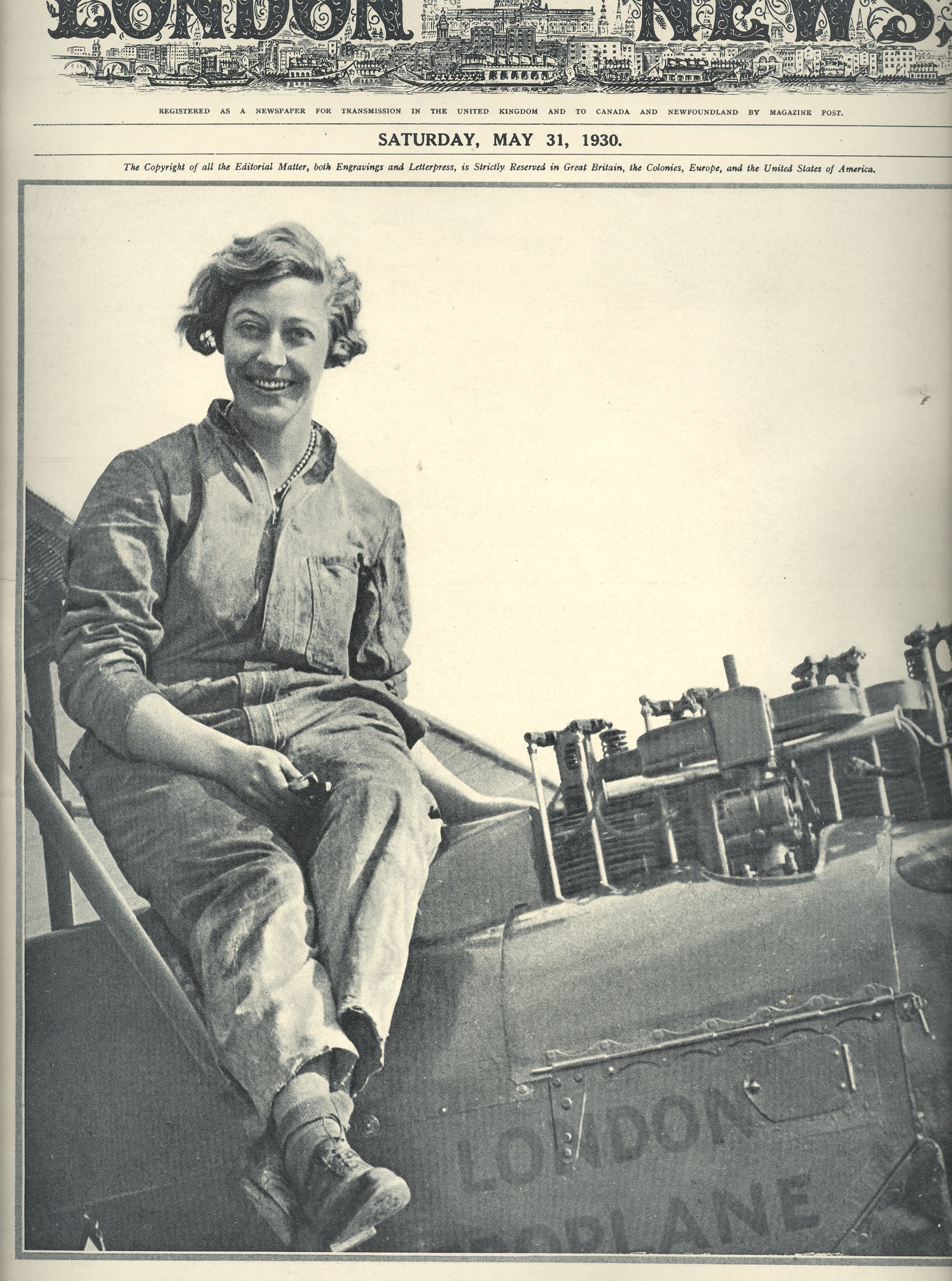
    Amy Johnson was the real deal. She was apparently hell-bent
    on flying:  she took her class “A” flying
    license in 1929 (at age 26) after just sixteen hours of training, and got her aviation
    engineer license a few months later (becoming one of the first women in England
    to do so.)  She was then off to Australia, by
    herself, becoming the first woman to make this as a solo flight.  Ms. Johnson covered all the bases in flight, knowing
    how to fly, having the stamina and courage for flight, and also being able to
    work a trade in the engine.  (Here she
    was the only woman ground engineer certified by the Air Ministry.)

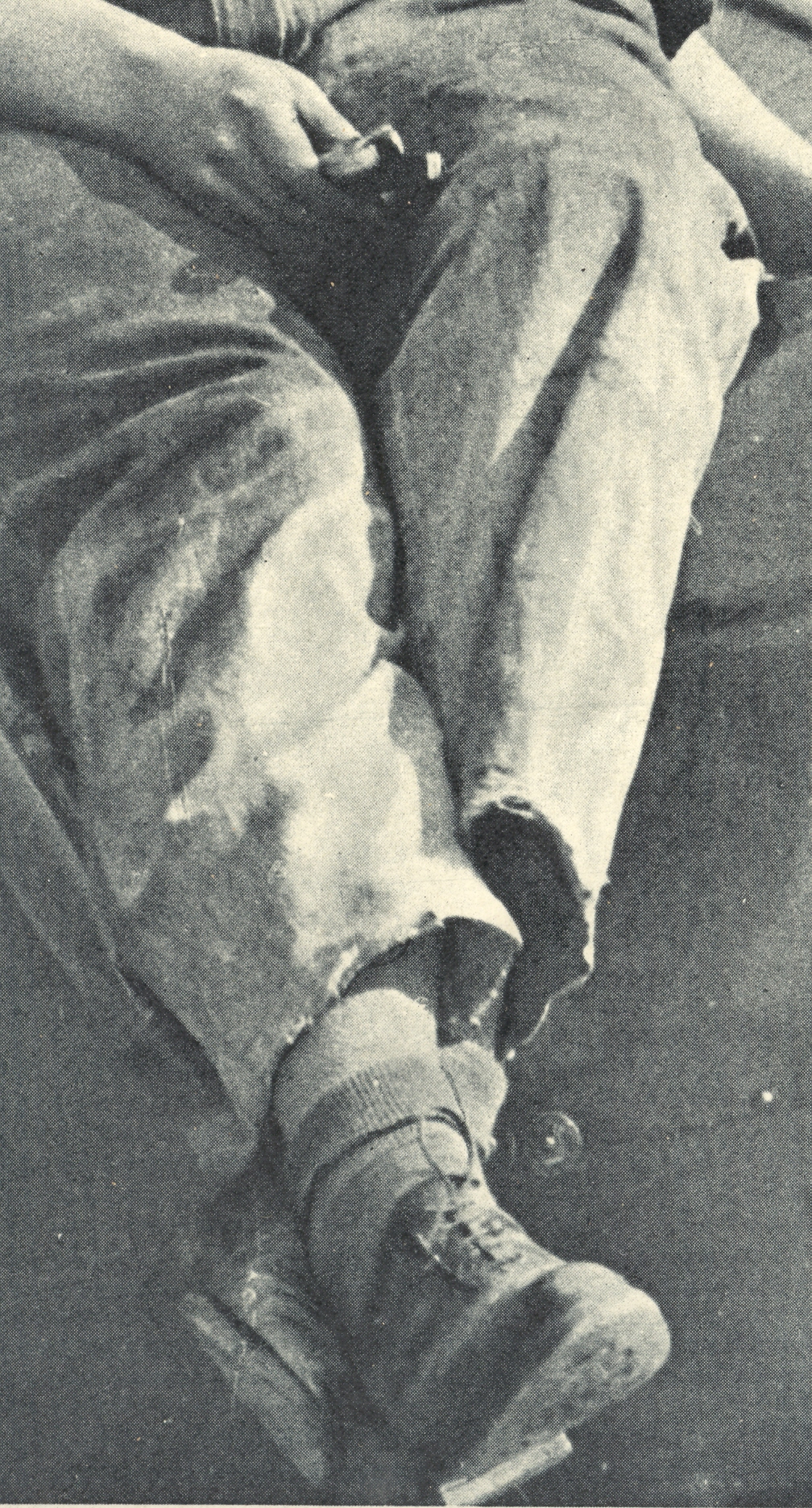
    When you look closely at this happy picture you can tell
    that Ms. Johnson came upon her frayed and worn pant cuffs honestly, as she did
    her oil/grime stained trouser legs.  This
    was no glam shot.

    Detail

    Amy Johnson accomplished other feats and firsts in aviation
    history before dying in the line of duty flying in 1942.