A Daily History of Holes, Dots, Lines, Science, History, Math, Physics, Art, the Unintentional Absurd, Architecture, Maps, Data Visualization, Blank and Missing Things, and so on. |1.6 million words, 7500 images, 4.9 million hits| Press & appearances in The Times, Le Figaro, Mensa, The Economist, The Guardian, Discovery News, Slate, Le Monde, Sci American Blogs, Le Pont, and many other places… 5000+ total posts since 2008.

Category: Anticipation, History of

  • Letters of Warning: Einstein and Szilard on the Atomic Bomb, 1939-1945

    Einstein’s Letters of 1939 and 1945 and Szilard’s Petition of 1945

    There were certainly a number of cautionary flags waved at the Executive Branch in the period just before the atomic bomb was first used against a Japanese target.  As I wrote in an earlier post here, Dwight Eisenhower was adamantly opposed to the use of the bomb on a city, preferring an example to be made of the thing on an unpopulated area; in his memoirs, General Spaatz (who had received the only written communication authorizing the use of the bomb) was privately against using the weapon on a city. As early as 1939 Albert Einstein famously communicated with Franklin Roosevelt his concerns on the possibility of the terrifying nature of a bomb produced by his early efforts and those of Fermi and Szilard and many others.  In all Einstein wrote four letters to the President, the first part of the first letter is shown below:


  • Blank, Empty and Missing Things: a “Missing” Renaissance Masterpiece

    JF Ptak Science Books   Post 1874  [One in a series on the History of Blank, Empty and Missing Things.]

    The remarkable engravings below are even more so when you consider that they were published more than two hundred years afer the death of their originator.  Bartolomeo Eustachi (1500/1524-1574) was one of the founding member of a very small school of modern anatomy (another being Vesalius) who undertook very careful dissections in his study of the body, finishing (in 1552) a work of paramount importance just nine years after the publication of Vesalius’ revolutionary work–it was a work that would remain unpublished for 162 years.  The threat and fear of excommunication and other reprisals at the hands of the Catholic Church prevented its publication, the full work not seeing the light of day until 1714.  It would be published several times more in the 18th century, a great tribute to an anatomist whose work was still being studied more than 200 years after its completion.

    One of the great missing books then belongs to Eustachi, his Romanae archetypae tabulae anatomicae novis…(with the examples of images below being published in Rome in 1783) belongs to a very small class of technical/medical  books published long after they should have been and which still were found to be of great and substantial use. He was an absolutely superb anatomist, using dyes and injections for visually troublesome areas, as well as early versions of “microscopes” to observe miniscule bits.  He was a fine student of his physician father, well-versed in classical education, and by 1549 he was the professor of anatomy at the Archiginnasiodella Sapienza, where he was also able to avail himself of a number of cadavers for dissection.   

    He worked on his anatomy for several years, readying 47 plates for publication.  It would come to pass that only eight of them were published during his lifetime–those on the kidney and teeth, published as De Renum structura (the first work dedicated to that organ), and De dentibus (for the teeth), respectively. 

    The engravings–rather, the incised plates of the engravings–went missing after Eustachi’s death, and stayed so until (as noted above) 1714.  According to faqs.org , Eustachi’s work was still prized 160+ years later for their elegance and beauty and detail because:

    “… they provided some of the best descriptions of the base of the brain, the  sympathetic nervous system (the nerves that control the constriction of  blood vessels, among other things), the vascular system, and the structure of  the larynx.”

    Eustachi_t39 
    [More images below]
    among many other reasons.

    I can’t help but wonder what the result of the publication of this book would have affected if it had been available in 1552.  It stands to reason that if it was still being used in 1789, and still useful and respect and “current”, then it would lead me to believe that it would have had a major impact 227 years earlier.

    (Source: Bartholomeo Eustachi: Tabulae anatomicae. (Rome, 1783), . Historical Anatomies on the Web. US National Library of Medicine.)


  • A Note on the Idea of Seeing Things Backwards

    JF Ptak Science Books   Post 1873
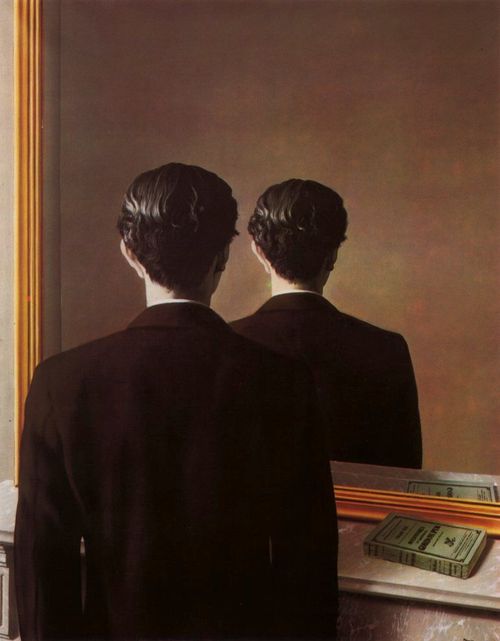
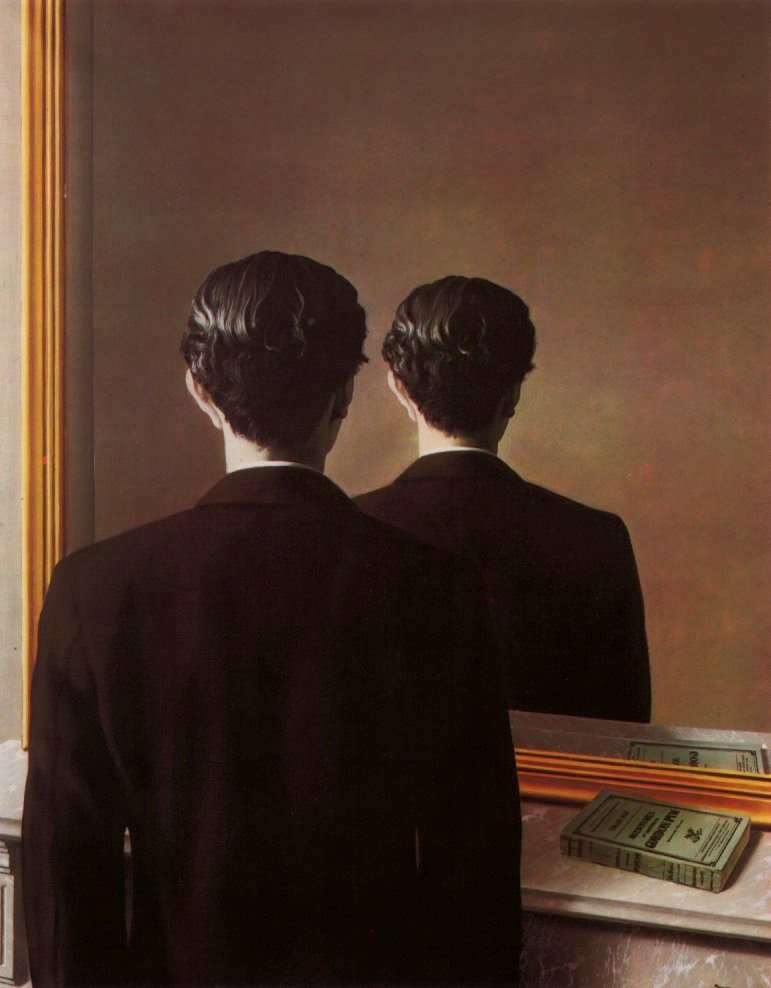
    Backwards--magritte

    Leonardo wrote backwards and from right to left, Benjamin Button lived backwards at the hands of Scott Fitzgerald, Rene Magritte’s man in the mirror saw the back of his head, Ignatz the Mouse I am sure saw the back of his head looking around the world with the world’s most powerful telescope, rugby passes are all done backwards, paper images of vue optiques appear backwards, lightning for all intents and purposes starts backwards from the ground up, reverse mathematics are worked from theorems to axioms, the Chicago River (1900) was engineered to flow backwards for the foreseeable future, while the Mississippi River famously flowed backwards for just a bit in the New Madrid earthquake of 1812. 
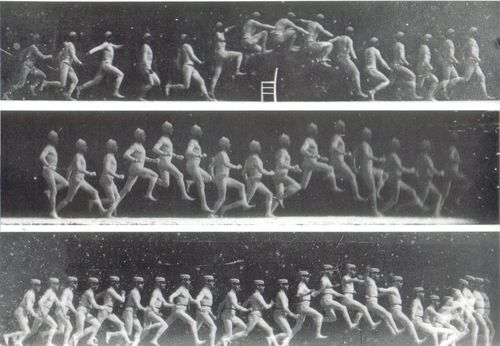
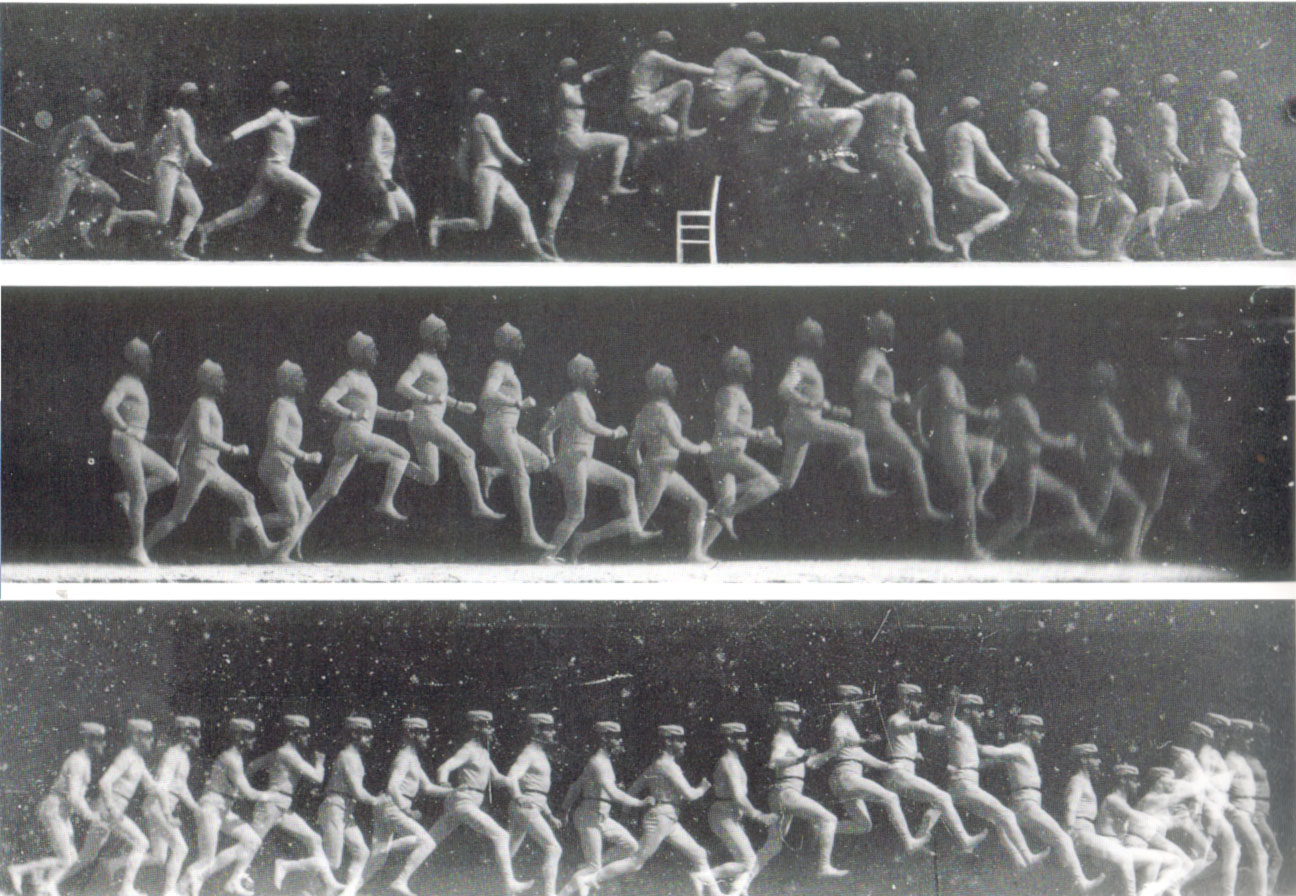
    Backwards--marey12

    I can only imagine what audiences must have felt when they saw the first moving pictures played backwards–seeing them played forwards was a novel-enough (and revolutionary) idea, but the simple idea of reversing the direction of the film would have proved to be equally fascinating.  Imagine the first time you witnessed a staged train wreck on film, back there in 18951, and imagine being able to see it played over and over again, until you were filled.  I’m not so sure that there were even any still photographs of a train wreck as it occurred to this point, even with advances in film speed and lens, so seeing the even unfold in front of you at leisure must have been overwhelming.  Now imagine these same folks seeing the event and watching the locomotives reconstitute themselves.  It would have been an extraordinary event.  Even observing the Marey sequences (above) and seeing what actually happens when a person bends over to pick up a pail of water would have revealed almost as much in new detail as when Galileo was in the middle of his earliest observations. 

    In a way the chance of controlling the direction telling of a story and seeing it displayed via moving images, and being able to see them backwards, may well have seemed a form of third-person time travel.  This came on the heals of what is for all intents and purposes the first time travel novel in  H.G. Wells’ (also in) 1895 The Time Machine (appearing earlier as “The Chronic Argonauts,” in 1888)2 and Mark Twain’s 1889 but much earlier than the first motion picture to use the idea of time travel (which was in 1921 and based on Twain’s work).  Being able to show a motion picture, and then stop it at will, and then reverse the order of time to begin everything all over again–visually–must have seemed a magnificent advantage. 

    Notes:

    1.  It is interesting that this very early motion picture , made by the great scientist-brothers Lumiere, l’Arrivee d’un train en gare, was produced in the same year as the Wells book.  Just two years later, the Lumiere Brothers published a catalog of their available movie strips, numbering 338 productions.  In 1898, after six catalogs, there were over a thousand strips.  This is remarkable, especially considering that there wasn’t a cinema industry yet.  The Lumieres are an interesting pair of people (both of whom survived their invention by about a half-century), making perhaps the most important discoveries in the history of cinema, and continued to be interested in other fields throughout their lives.  The cinema-industry part of their work didn’t seem to interest them all that much. 

    The history of moving images is complex and long.  I’m not saying at all that it begins with the Lumieres, or with Edison, as the pre-1900 field is well sprinkled with different and interesting attempts at fooling our eye–Chronophotograposcopes, Counterfivoscopes, Phantasmagorias, Klondikiscopes, Vileocigraphiscope, and so on, are just a few examples of the many attempts at locating the seat of photographic motion in the brain.  There are very early efforts, principally by J.A.F. Plateau (1801-1883) who rediscovered in 1829 the “persistence of vision” effect in which the eye will see a continuous stream of images if presented with a flow of static pictures at 16 frames per second over a one second period, which of course is the basis for the rest of everything that was to come.  There’s much more, but I wanted to at least point out these few important bits. 

    2..  I’m not sure what to  with Mr. Dickens, if he fits in this order with the time traveling Scrooge in A Christmas Carol (1843), or not.  Perhaps he does, and if so, then he precedes Mr. Wells, though the latter’s time traveler is outfitted with a machine and a scientific basis for the belief in it.  At the very least he is worth mentioning in the same moment.

  • The Height of Flight: London, 2026 Future Vision

    JF Ptak Science Books   Post 1867

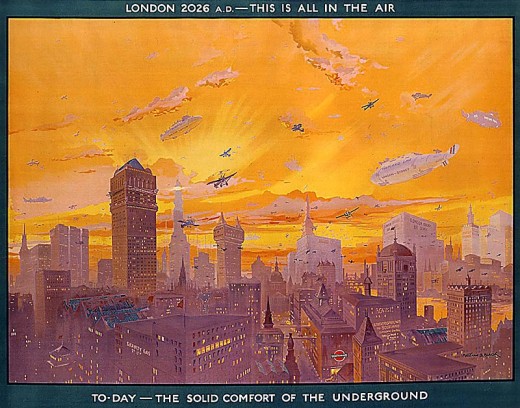
    Montague B. Black (b. 1884), an artist and illustrator, pulled the curtain back from the future back there in 1926 to what he thoiught might be the following scene of London in 2026:

    London-2026-520x408
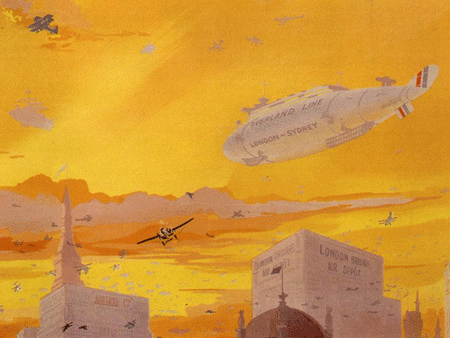
    A detail reveals an interesting airship:

    London 2026  detail
    The airship (of an undetermined power source) has an ad on the side of it reading “Overland Line, London-Sydney”–and by “overland” the artist is not thinking of the old-time “overland” as in prairie schooners and such, but quite literally “over the land”.  We can also see an ad on the side of a building for an “Underground to Scotland, Glasgow 2hrs 45 mins”.  There are also named buildings such as the London Bridge Air Depot and the Airtaxi Ltd.  The skyscrapers really aren’t all that enormous–I see one or two perhaps in the background that might be a hundred stories or so, but the buildings in the foreground are definitely of modest expectation. 

    There are however dozens of flying machines in the sky, though with the exception of the three large airships, a hundred years has not paid too many benefits to the other aircraft. 

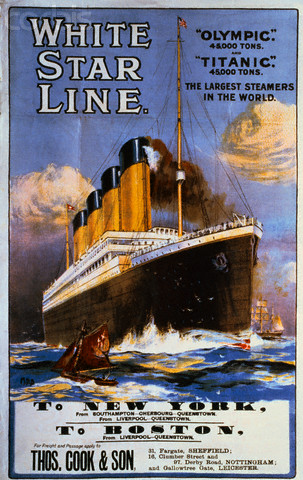
    Black did create an interesting poster for the White Star line, featuring a certain famous luxury liner–of course the man was just like anyone else, and could not see into the future for the Titanic, nor could he imagine slightly accelerated designs for aircraft.  He did manage to portray a transportation system that would be heavily dependent on air travel.  That said, he left plenty of room for speculation on the future of the Underground, as we can see in all of this future-glory that no matter the amount of accomplishments in the sky, trains would still be running underground.  Black got those two things right, at least. 

    London titanic


  • Artistic Comparative Display of Quantitative Data–Winning the Battle of the Atlantic by Flying Over It

    JF Ptak Science Books   Quick Post    

    I simply love infographics like this—especially big skies filled with airplanes.  I’ve written about other similar descriptions of sky-filled aircraft here.

    Brit troop carriers729
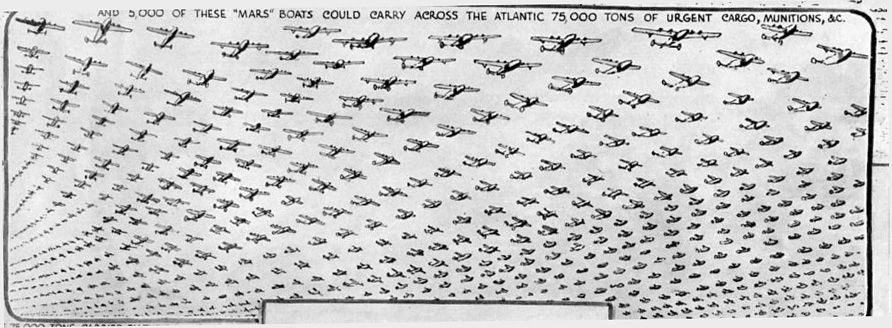
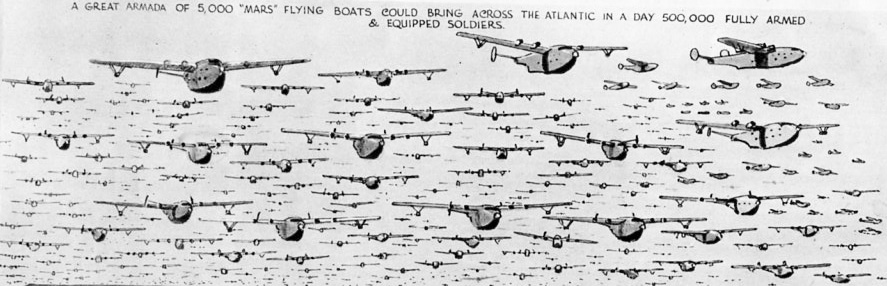
    In October 1942 the war was shifting to the way of the Allies–the United States had come into the fight ten months earlier, Operation Barbarossa (begun in June 1941) was at this time being recognized as a complete failure (though the operation would continue on for two more years, costing 5 million German army lives, 20 million Soviet civilian lives, and 9 million Soviet army lives and more when all was said and done), and American military production was very well underway and unbeatable, and so on. The Battle of the Atlantic however was still very much underway, with action returned their, again, during the summer and autumn of 1942. 

    Brit troop carriers728
    One way of defeating the U-Boot was to not sail the Atlantic much at all, and flying troops and supplies above it.  As we can see in this compelling graphic from The Illustrated London News of 17 October 1942, the editors of that magazine made a case for the Mars flying boat.  It was a theoretical case, as the 5,000 Mars planes depicted in the graphic never materialized–actually, it seems as though only seven were made. 

    But the case looked very compelling.


  • Daily Dose of Dr. Odd: The Future-Punk of Astoundingly Big Things

    JF Ptak Science Books   Quick Post

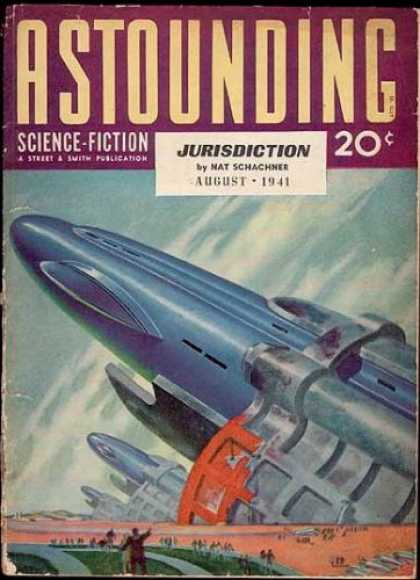
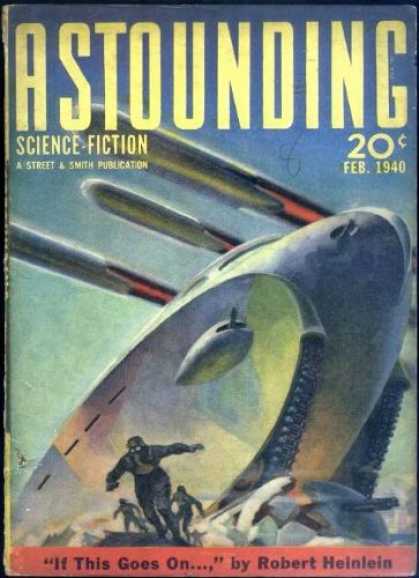
    There’s the Big Bang, Big Ten, big fall, big dream, Big Band, big shot, Big Apple, big picture, Big Bird, Big Brother (and Sister), Big Lebowski, Big Sur, big year, Big East, Big Kahuna, big ego, (really) big show, big money, Big Shot and big deal, and many others, all sorts of “big” things.  And then there are the Really Big things, like these astoundingly big things from the pulpy covers of Astounding Science Fiction magazine, from the 1940’s to 1971.  [The source for all of this artwork is at Coverbrowser.com, here.]

    Astounding Stories 129 - Jurisdiction - Nat Schachner - Science Fiction - Future - August 1941


    Gigant things astounding tank


  • Cliff’s Notes for Nazi School, 1937

    JF Ptak Science Books    Post 1849

    Oh happy day for this handy Cliff’s Notes pamphlet for the visiting visitor, for the foreign foreign, to the “new” Germany of 1937.  It is difficult to imagine but not horribly so the subtitle here, “Vacation Course for Foreigners”–it was, after all, so far as the rest of Europe and England and the rest of the world was concerned, still only a conceit that the Germans were harboring for themselves, the sabre-rattling Lebenstraum was still in the theoretical stage, though the loathing and discrimination of the Jews and other sorts of humans was not. 

    Nazi school621

    The pamphlet promises to “give our foreign guests an opportunity o f seeing young National-Socialist Germany as it really is” and to “show them that the German people do not want anything but to attend to their work in discipline and peace”. Which was not the case.

    I was interested to see the “programme” of instruction, and to check out the near-futures of the people who were the lecturers for each section.  Before I began, I wondered how much their fates would be changed eight years hence and if they would resemble the fates of other high ranking Nazis. (I looked at the lives of Nazi medical personnel and experimenters in an earlier post here called  “Kristallnacht: The Long post-WWII Lives and Forgotten Pasts of Criminal Nazis: Doctors”, here.)

    Mostly, they went on to live long lives.

    In the program, Dr. Reinhard Hoehn delivered a talk on “National-Socialist Law”. Hoehn was a Nazi academic lawyer with a criminally morose view of jurisprudence; he went rather high-ranking and was successful in laying the “legal” groundwork for Nazi ambitions, including being a representative at the Wannsee Conference.  Born in 1904, Hoehn went on to live until 2000.


  • Images of Shadows in Storytelling

    JF Ptak Science Books   Post 1836

    ‘There is seldom in shadow a mystery less hidden”–Ombra Nichts Schatten, The Non-Mystery of the Shadow, London, 1842

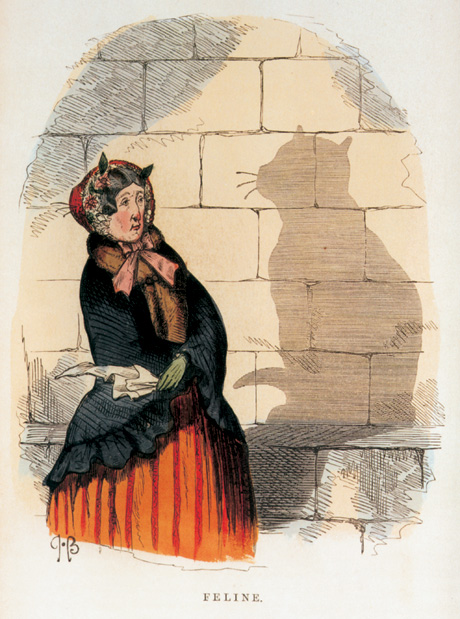
    Shadows have long played havoc in the imagination, for good and for evil, for elucidation and of mystery–they have hidden nothing and everything, and displayed as little as possible and as much as can be imagined. A simple shadow in a hole had proved the circumference of the Earth twenty centuries ago, and before that the Earth’s shadow on the face of the Moon showed us to be a sphere; the shadow allowed us to measure the heights of mountains on the Moon before we could do so (accurately) on Earth; we measure shadows in X-rays, and follow the trails of subatomic particles, and on and on.  Shadows are particularly interesting in story telling, whether they be suggested  aurally or in text, or of course in illustration: 

    Chalres H. Bennet, Shadow and Substance, London 1860.

    A superior example of shadow-art is seen in Indonesian shadow puppet theatre, “Wayang Kulit”, where the shadows of Javanese-Indonesian characters are projected onto a cloth screen by a strong light from behind.

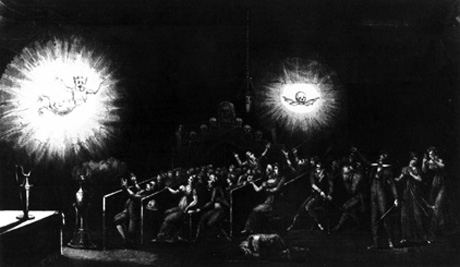
    Audiences were bathed in direct and brilliant light while being swamped in shadow in the early 19th century as part of an early form of non-cinema cinema, as we see here in the frontispiece from Robertson’s Mémoires récréatifs, which depicts a phantasmagoria of lantern projections:


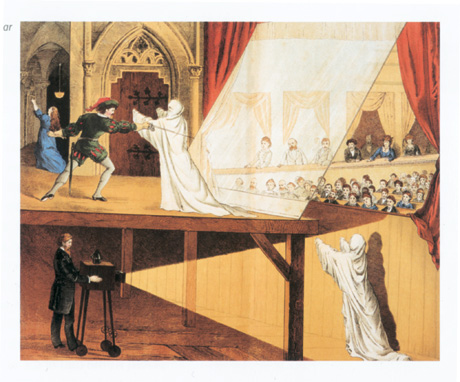
    And more forthright illusions as seen in this engraving showing the spectre “Dr. Pepper’s Ghost,” from Theodor Eckardt, Die Physik in Bildern Eßlingen, 1881:


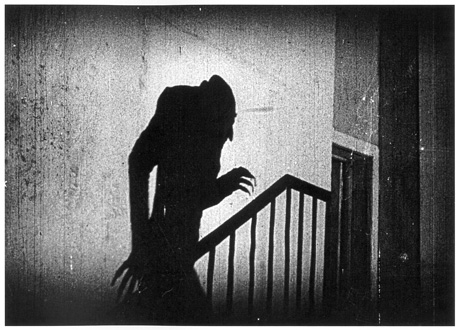
    The shadow may have been invented in cinema by the German Expressionists, with  Friedrich Wilhelm Murnau’s Nosferatu (1919) as a shining example:

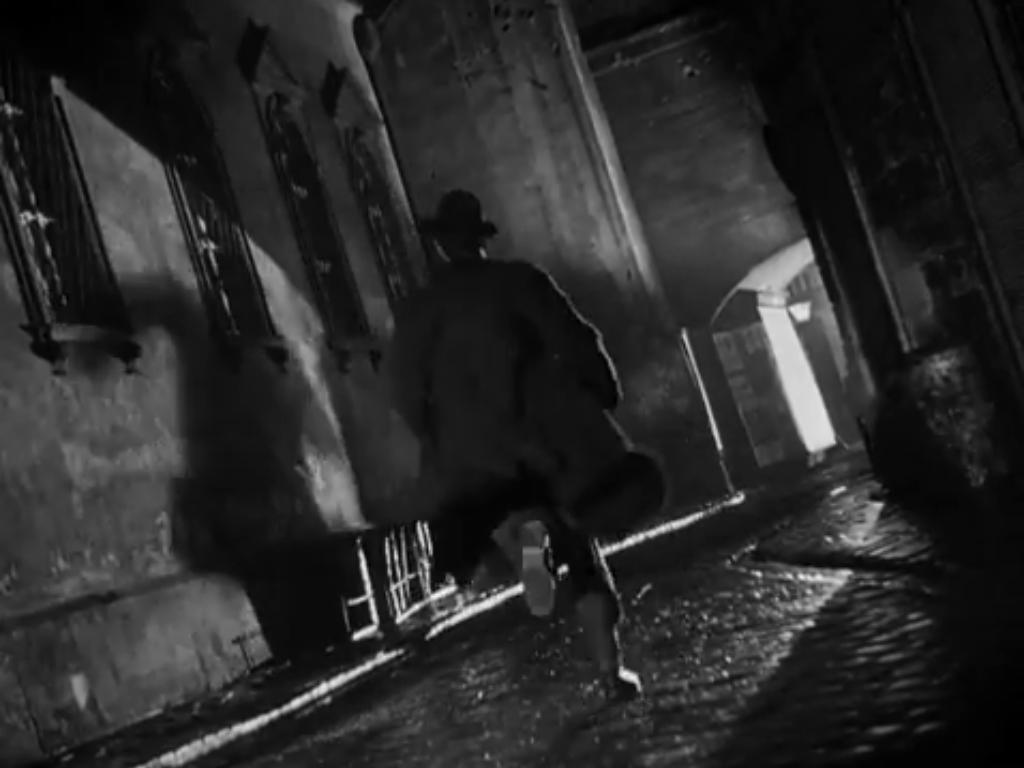
    And of course the shadow is used with great effect in the  very black-and-white and no-gray-tones Film Noir world, particularly in the hands of a master like Mr. Welles in films like The Third Man:

    And in Fritz Lang’s diabolically-bad M, earlier, in 1931 (featuring an impossible shadow in the movie still below):

    Thank heaven for little girls... or would that be hell?


    Shadow has been used to given questionable dimensionality in addition to giving perspective to dimensions that we are familiar with:


    And the artificial shadow made for the geographical clock dial to tell the story of passing time:

    And also for shadow puzzle toys:


    And on and on, deep into the night…


  • A Note on Music of the Future and Wagner’s Trashbin Philosophy, 1879

    JF Ptak Science Books  Quick Post

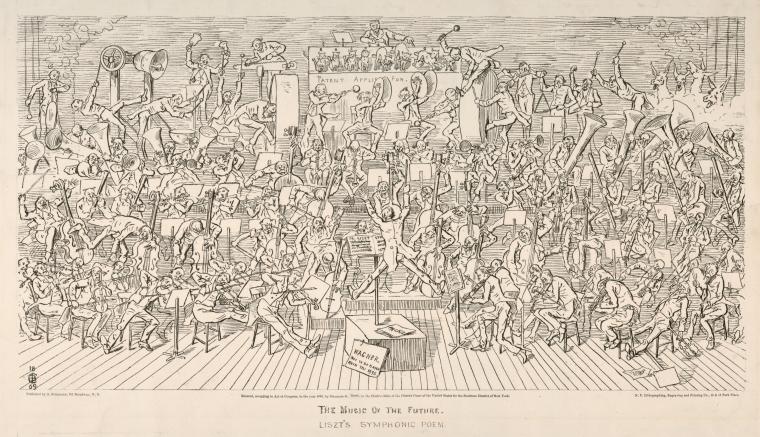
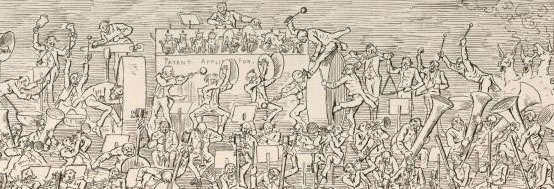
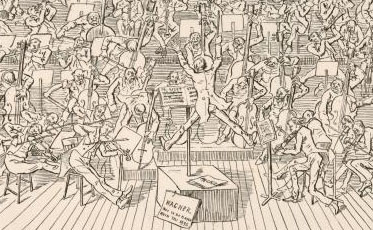
    This cartoon appears in Punch in 1879, and it clearly show’s the bitey Mr. Punch’s proclivities towards the rise of the “music of the future”.  Over the years Punch had seen little value in the new music possibilities, the form and function of which is on display in this kinetic appreciation of a hyper-functioning orchestra.  There is a considerable stab made at Richard Wagner (as we can see in the scores on the floor), the composer who perhaps (along with his considerable supporter, Franz Liszt) was at the deepest heart of the publishing end of the “music of the future”.

    The Music of the Future. Liszt's Symphonic Poem.
    Wagner published his views on the development of music and art in general for the future in Das Kunstwerke der Zukunfts (1849), and then more specifcally to music in Zukunfstmusik (“La Musique de l’Avenir”) in  1850.  But little of that feels like very much to me at all, given the other work he was completing in 1850–Das Judenthum in der Musik.  In some circles the work is translated as “Jewishness in Music” and also “Judaism in Music”, but this is far too polite–what Wagner was talking about was “Jews in Music” or “The Jew in Music”, as it was a savage attack on the place of Jewish people in music and of Judaism as a whole.  It is a virulent and nasty work, first published anonymously to protect Wagner’s “freedom” (as he called it) and then again–unable to leave it alone–in 1869, proudly under his own name.  The work is widely seen as a hallmark of German antisemitism and an embarrassment to Wagnerians, and in some editions of Wagner’s complete collected works, it is forgotten.  On the other hand, it wasn’t just here that Wagner’s antisemitic views are made known–he was a prolific writer, and his work against the Jews appeared numerous times in newspapers and other periodicals, playing the same tune.
    I’m okay with the man’s name on the floor. 
    Dailydose--music of future
    Daily dose--music future 2


  • Imaging Aliens, Part II: Baseball Cards as Though They Were Drawn by Aliens

    JF Ptak Science Books   Post 1833  (Continuing “Imaging Aliens, Part I:  American Traders in Yokohama Bay, 1859“)


    BLOG==july 9--baseball 1 These images—American baseball cards from the 1950’s and early 1960’s—seem to come from an removed, unknown source, at least to me.  The odd thing is that I have a recollection for some of these designs, seen in my tender years, and seeing them now is an odd assault on my memory.  I do remember the dark reds and the severe cut-outs, but now they look so unusual, so unnatural,  BLOG==july 9--baseball 2 bizarre, as though the artist who rendered the design had never seen baseball players—or men—before.  They might as well have been aliens pouring themselves from their space ship (why do those spaceships have landing lights?), or Americans disembarking from their tall ships in Yokohama harbor in 1859.

      I must point out that these images come from what I think may be a fantastic baseball book:  Brendan Boyd & Fred Harris The Great American Baseball Card Flipping, Trading and Bubble Gum Book (1973).  It is solidly funny, witty, and insightful, and the book covers things far beyond baseball cards, even in its remarkable and scant 150 pages.  Oh, and they know their baseball cold cold cold, and they know it far and away beyond just the numbers.

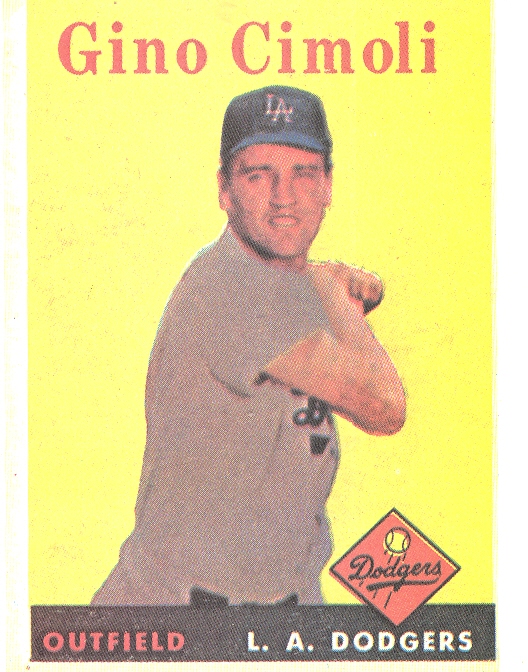
    The only weird thing about Mr. Gino Cimoli (1923-2011) was his baseball card when he was with the Dodgers. He was actually the first California-born hitter to play for the newish Dodger California club, and was a decent fielder and batter though not often gifted, and managed to be the fourth outfielder in difficult-to-break outfields, like the 1960 Pirates (having Bob Skinner, Bill Virdon and Roberto Clemente)  and the 1961 Milwaukee Braves (where he found himself behind two other good players and Hank Aaron). He did play an important role in filling up the holes in the 1960 club, and conbtributed to their pennant, but found himself traded the next year, anyway. He was with his third team in three years in 1962 when he managed 15 triples (!) for the KC Athletics, following with 11 triples the next year–a pretty good feat, epecially when you’re 6’2 and 200+ pounds. 

    But his basebal card is onbe of the oddest bits I’ve ever seen.

    BLOG==july 9--baseball 3

    Little or nothing needs to be said about Mr. John Sain or that day of rain. I’ve included this card because of the bizarro choice of graphic backdrop, which means nothing.

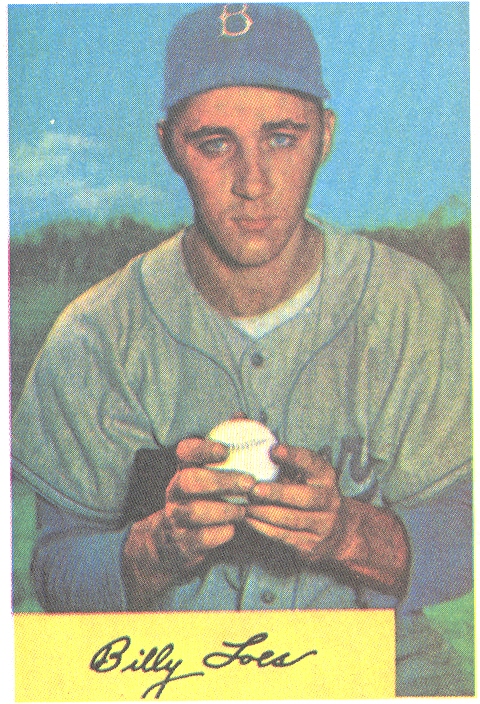
    Lastly, I could not help but publish this card for Billy Loes in large format.  I have no idea what anyone–the designer, the photographer, or Billy–was thinking when his card was put together.  In the annals of Surreal Baseball Art, Billy Loes’ card is a post-anticipatory (?) early Kandinsky. 

    I should also point out that Billy Loes was a good pitcher: he had four very good years for Brooklyn 1952-1955, but things went badly for him in 1956.  He managed to stay on for another five seasons, which means that folks thought he might come back.  He didn’t.