A Daily History of Holes, Dots, Lines, Science, History, Math, Physics, Art, the Unintentional Absurd, Architecture, Maps, Data Visualization, Blank and Missing Things, and so on. |1.6 million words, 7500 images, 4.9 million hits| Press & appearances in The Times, Le Figaro, Mensa, The Economist, The Guardian, Discovery News, Slate, Le Monde, Sci American Blogs, Le Pont, and many other places… 5000+ total posts since 2008.

Category: Anticipation, History of

  • Instant Eve-olution and the Angel of Presumption

    JF Ptak Science Books    Post 1812

    There are in the histEvolution eve557ory of belief and art instantaneous evolutions of various sorts–most famously of course in creation myths, and these most easily followed today in their images relating Old Testament belief, such as in the creation of the world, or more specifically in the example1 (left) the creation of light.  But here we see the post-creation part, the vision of creation, the achievement.  It seems as though we don’t really get to see the instantaneous creation half-way-through, or rarely so, the instant-evolution not quite complete.
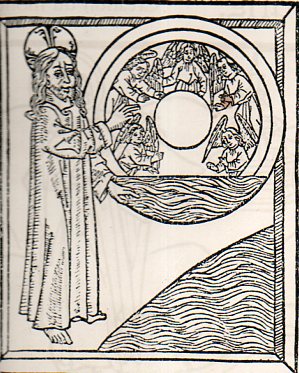
    I guess that we are recommended to believe the stuff in the middle, to assume it complete, to accept the Angel of Presumption to fill in the necessary blanks. (And here I’m not talking about the “Angel of Presumtpion” of Caedmon who refers to Satan in this way–I’m just taling about the Angel that bridges the missing bits in neural napping parts of real and suspect stories and events, the aid to continuity in imagination).

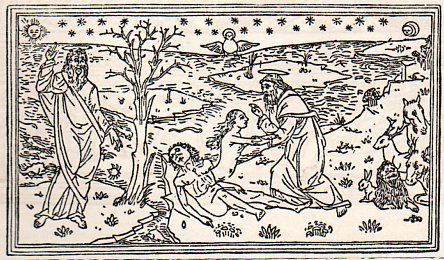
    There are exceptions of course, though it seems like there are not many–one good example is the creation of Eve. In many Renaissance examples illustrating the Old Testament story we see Eve as she is emerging from the side of Adam, a snapshot of the process of the creation of woman that is also in some special way also a product of evolutionary development, only instantly. This would seem to remove this from consideration of being an “evolutionary” development, though there are more modern examples of a “faster” evolution, quicker and more reactive adaptation (as in the case of Galapagos finches study by Peter and Rosemary Grant2 (Princeton), or the mercurial DNA changes to white flies in response to the introduction of certain bacteria. 
    Evolution eve551

    [Source:woodcut from Biblia cum postillis, Nicolai de Lyra, printed in Venice in 1489.]

    But the creators of creations myths from which the stories of Adam and Eve have descended are long and very old, and the process of change in these cases didn’t concern them–it was the outcome that was important. 

    We do see this process displayed elsewhere to be sure, but it is a very uncommon peep into the creation of certain states of affairs.  Here’s a another good example again coming from the Adam and Eve saga, this one showing the creation of man from clay–“Erschatflung des Menschen aus Lehm”, from the great Liber cronicorum, and printed by Anthonis Koberger in Nurnberg in 1493:
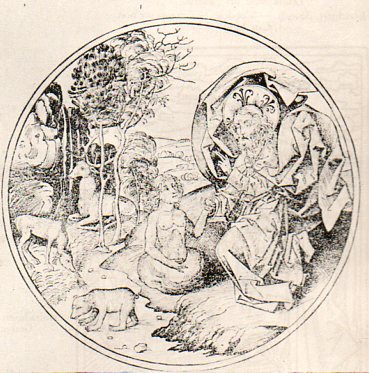
    Evolution eve556
    The images showing partial development of a theme do seem to rest more heavily on the shoulders of Eve than anything else I can think of, presently.
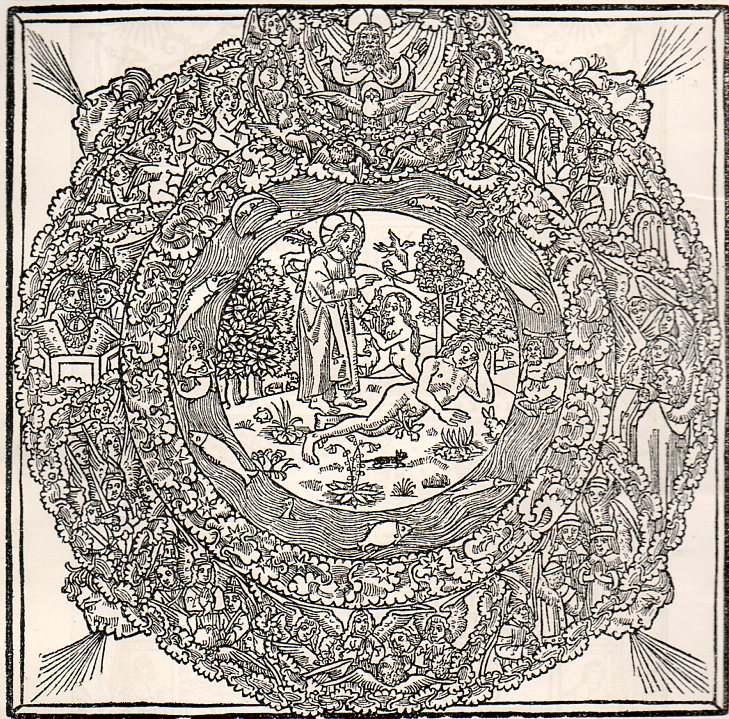
    Evolution eve550There are many images that show events simultaneously, where on a single panel or canvas we will see a painting depicting multiple periods of time in a person’s life, or a depiction of the Fall of Man showing temptation/apple-eating/Archangel banishment–but this is not a depiction of the instantaneous event in the process of creation. 


  • History of Holes: Making 1=2 or 3, or More (ca. 1700)

    JF Ptak Science Books   Post 1830  Part of the series on the History of Holes. (Apologies for no-para spacing–Typepad is buggy again.)

    A beautiful and inventive way of addressing issues of perspective and un-reality in the centuries before the introduction of electricity was more able to suspend belief in the existing/obvious was via the catopticum1. This object (an example of which is pictured below, taken from the oddball/genius/problematic polymath Athanasius Kircher in his book Ars Magna Lucis et Umbrae…2 printed in 1676), and the name of which is taken from the Greek katoptron, mirror) was an advanced parlor toy and artwork, a sort-of primitive free-standing theatre of multiplied objects, a box that contained things that were seemingly larger than their container. 

    The catoptric theater. From Ars Magna Lucis et Umbrae (1671 ed.), p. 776

    Source:  Kircher at Stanford University, here.

    This image makes the “image engine” a little clearer:

    Primeira PáginaPágina AnteriorDiminuir imagemImagem a 100%Aumentar imagemPróxima PáginaÚltima Página
    desd [757 KB]
    Source:  Tratado da Catoptrica, (manuscript, 1716);  from the Biblioteca Nacional Digital, here.
    It’s a romance of images machine,  a box of antique wonder, a peepshow of centuries before, putting more things into a space than could exist.  It was a relatively simple machine of great ingenuity:  the interior of the free-standing box with rows of holes along its top edge perpendicular to the ground, and was lined with mirrors (as shown above in the Spanish document), with some mirrors set of at 45% angles; when objects were placed within the imaging-area of the angled mirrors, the object was multiplied, and then multiplied over and over as a result of the surrounding mirrors, creating in effect a “hall of mirrors”, leaving the observer with a sense impression of many dozens of objects that were contained within a container that was impossibly too small for what was being seen. 
    This of course is a property of some holes–they tend to make things larger than they could previously possibly “be”. 
    In this case, the viewer would look through a hole into a Borgesian box which would contain a multitude of its possible interiors.  Looking through a hole in the end of a glass and mirror-ended tube and pointing it at the sky at night would reveal an enormous multiplication of a small part of that sky.  In the early case of Galileo, what  was first seen with the telescope was the multiplication of what was believed to be a finite and god-granted sky of perfection–he was seeing into some other sky, into a new vault of heaven, something never before seen, above-and-beyond what was known to exist.  Hooke and Louwenhoeck had a similar experience with their (second generation) microscopes, seeing details and life never before encountered, entire worlds in a place no bigger than the head of a pin. 
    Sometimes a hole is just a dark thing; but more often than not, it isn’t. 
    Notes:

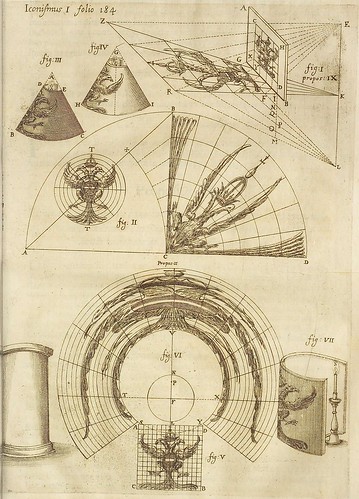
    1.  From the Greek, katoptron, mirror  or pertaining to a reflected image or reflected light, such as from a mirror.  There is another sort of catoptric that has been sort of widely used in antiquarian painting and parlor entertainments, which involves a canonical mirror reflecting a wide-field and distorted image into its proper perspective, which is known as catoptric anamorphosis.  Another version of this sort of optic imaging is optical anamorphosis, which requires the viewer to stand at a particular (usually sharp) angle to a painting containing a semi-hidden image whose proper perspective is revealed only at a particular angle of viewing.

    An example of catoptric anamorphosis, from the Kircher mentioned above:
    anamorphosis - eagle

    See here:  http://hyperphysics.phy-astr.gsu.edu/hbase/geoopt/catoptric.html
    2.  Ars Magna Lucis Et Umbrae In X. Libros digesta. Quibus Admirandae Lucis & Umbrae in mundo, atque adeo universa natura, vires effectusque uti nova, ita varia novorum reconditiorumque speciminum exhibitione, ad varios mortalium usus, panduntur. Editio altera priori multo auctior. The work is presented at Bibliodyssey, here.
    Mr. P.K.hauls out a great quote and summarization of the work of Kircher by Robert Moray in his letter to the great guiding post of the Royal Society, Henry Cavendish, which really captures the spirit of the very busy/very curious and curious old man:
    “Whatsoever Mr. Huygens & others say of Kircher, I assure you I am one of those that think the Commonwealth of learning is much beholding to him, though there wants not chaff in his heap of stuff composted in his severall peaces, yet there is wheat to be found almost every where in them. And though he doth not handle most things fully, nor accurately, yet yt furnishes matter to others to do it. I reckon him as usefull Quarries in philosophy and good literature. Curious workmen may finish what hee but blocks and rough hewes. Hee meddles with too many things to do any exquisitely, yet in some that I can name I know none goes beyond him, at least as to grasping of variety: and even that is not onely often pleasure but usefull.”  (My bold.)
    [Sir Robert Moray in a letter to Henry Oldenburg, 1665]  

  • Blank, Empty & Missing Things: Shermanland, 40 Acres and a Mule, 1865-1870.

    JF Ptak Science Books   Post 1781  [Part of the series on the History of Blank, Empty and Missing Things.]

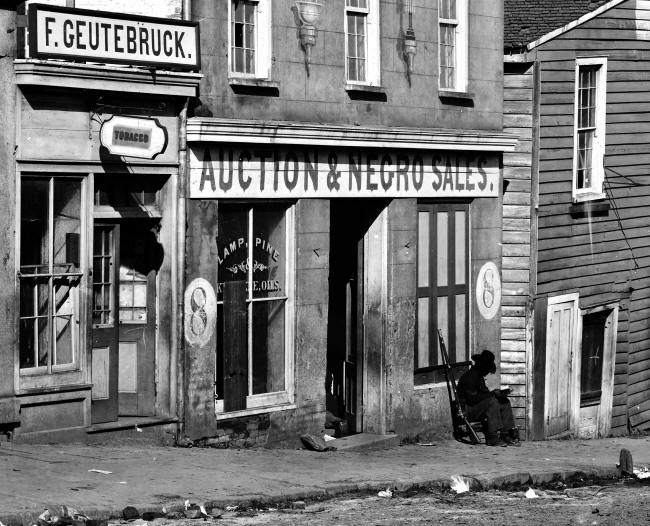
    In the history of blank, missing and empty things, few things get as missing or empty or blank as compensation to slaves.  A whole in a hole, missing bits as complements to lost pieces, a blank nothing wrapped in smoke. 

    Slave Market

    In his march through South Carolina and Georgia and on to the sea, in January of 1865, General William T. Sherman issued an order to compensate freed slaves with the abandoned properties of Southerners.  As he wrote in the field, near Savannah, on the 16th of January 1865:

    “The islands from Charleston, south, the abandoned rice fields along the rivers for thirty miles back from the sea, and the country bordering the St. Johns river, Florida, are reserved and set apart for the settlement of the negroes* now made free by the acts of war and the proclamation of the President of the United States.”

    And further:

    “…on the islands, and in the settlements hereafter to be established, no white person whatever, unless military officers and soldiers detailed for duty, will be permitted to reside; and the sole and exclusive management of affairs will be left to the freed people themselves, subject only to the United States military authority and the acts of Congress.  By the laws of war, and orders of the President of the United States, the negro is free and must be dealt with as such.”

     So it would seem that at the very least, in the wake of Sherman’s march, that the freed slaves would have some degree of economic freedom, given their forty acres so long as they kept it for a year–some would also receive a mule for plowing.  (Forty acres was considered the standard size for a sustainable farm for a family in the South at mid-century.)

    Thousands of freed slaves responded to the offer, and there was for a time some amount of relief.  The order was short-lived. Following the assassination of Abraham Lincoln in April, the questionable quiddity known as Andrew Johnson decided to rescind the Sherman order, putting all of the former slaves off the lands that they had been awarded in January.  By May there were some 40,000 people who had settled some 400,000 acres of land, all of which came to an end on 25 May 1865.  On that day Johnson declared that the new “Sherman Land” be disbanded and the lands returned to the white owners. That, along with an amnesty for the remaining Confederate soldiers who had not yet been returned to the Union–this time, though, with the Johnson amnesty, there was no requirement of an oath of allegiance. It had to have been a massively bitter experience for the freed slaves.

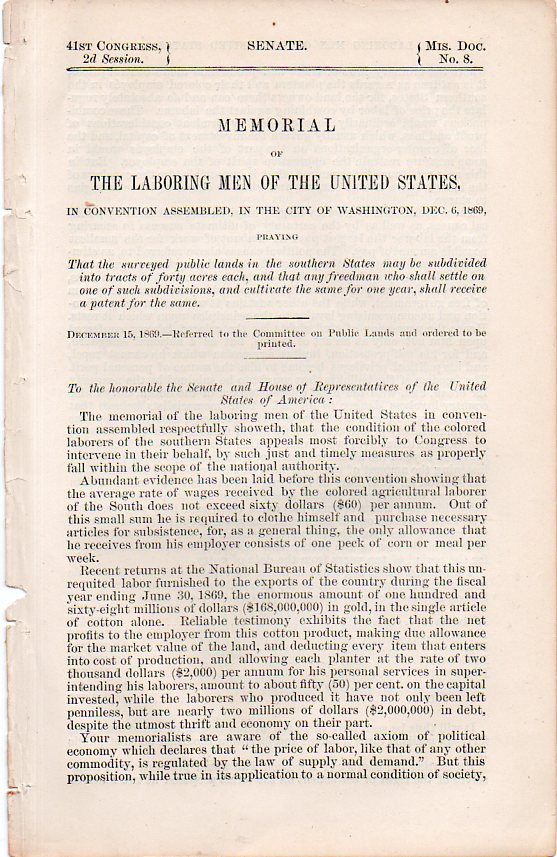
    There was another attempt to produce some sort of payment, a recompense, to the freed slaves, taken on in the 41st Congress, attempted in December 15, 1869.  The petition read as follows:  Memorial of the Laboring Men of the United States….that the surveyed public lands in the southern States may be subdivided into tracts of forty acres each, and that any freedman who shall settle on one of such subdivisions, and cultivate the same for one year, shall receive a patent for same. In this memorial, which was the work of the members of the National Labor Convention (which was also meeting in New York City at the time), it was established that the former slaves working the present estates and farms in the South managed to help produce some $168 million in revenues, while receiving negative monies for themselves–not only did they make nothing, but, as the report says, the workers were actually in debt for their efforts and labors.  They established that this alone was enough to urge for 46 million acres to be given out, parceled, to the Freedmen, 40 acres each–but not given, but sold, at cost, to the memorialists, to be paid in a five year period.

    Slave448

    This effort of course went nowhere–it failed, died, like the others. 

    These are by no means the highpoint of Reconstruction failures–they are mere examples, two among many in the gargantuan chorus of deceit, and greed, and uncaring that marked the Reconstruction period.

    Notes:

    *  I wrote a short post not long ago on the history of the capitalization of the word “Negro”, here.


  • An Alphabet of Australian Convict Mugshots, 1900-1920

    JF Ptak Science Books  Post 1797

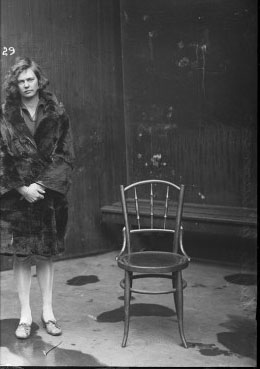
    These photographs are remarkable capsules of space and time–they hold the mostly-realized fates of their subjects, taken into custody in Sydney for crimes from prostitution to stealing to loitering to bigamy to murder and around and around. The poses are interesting in that there seems to be no unified way of making them, which means that most often the detained person had the opportunity to adopt whatever posed they pleased, given the emotional constraints of their situation.  Some are defiant, some at complete ease in front of the camera; others are completely distracted and scared, and embarrassed and guilty.  There also doesn’t seem to be a segregated point for making the photographs, tough there is a common-looking wall and hallway for some of them.  It would be interested to know if the Sydney police were making an editorial statement by placing their subjects in unflattering locations, like standing near a dripping faucet, or amidst trash, or in a garden, or in front of toilets.  In any event the range of emotions is remarkable, even for looking through only a few hundred of the more than 100,000 images that are on line here and there from the good folks in Sydney.     [The images below all started out their life at Sydney Justice and Police, and then used in parts by the following websites and blogs from which I harvested my selection below,:  Retronaut , the Independent,,  Live Journal   the Daily Mail, and the Historic Houses Front (which also has full-ish records for each photograph).  An interesting interpretation of many of the images can be found at SCAN.

    Analytically  interesting, an interpretative invitation.  Apprehensive? 


     BoredAustralian-criminals-15-520x378 guinness b


  • The Stages of Human Life–Illustrated

    JF PTtak Science Books      Post 1796    [Part of the History of the Future series.]

    I came across this fantastic representation of the stages of human life in the beautifully-named book by Bartholomaeus Anglicus, All the Properytees of Thyings, which was published in Westminster in 1495 (and also known as De proprietatibus rerum, also translated as On the nature of things, or On the properties of things), and which was originally written around 1225).  The book was a bestiary, a marvelous encyclopedia, a collection of all things as known in the 13th century–it would be interesting to represent all that is know today and compact it into a workable, logical, usable (printed !) book of a thousand pages.  One of those many images was this:

     File:Stages of Life by Bartholomeus Anglicus 1486.jpga simple, compact reminder to the book’s readers about the progression of life.  Infant, toddler (in a Renaissance walker), child (at games), teen (adopting some of the trappings of adulthood), prime-of-life, middle aged and then the leaning elder. 

    It strikes me that the idea of “stages” is what most of what experience might be–the ideas of “stages” and “progression” are everywhere, even perhaps in the places they shouldn’t be.  There are simple things like rockets that keep releasing smaller and smaller stages of itself until it gets down to the (satellite etc.) nub; sleep has its five stages resulting in the final resting state of r.e.m.,; there are recognized stages of  development for psychology (Erikson), and cognition (Piaget) and need (Maslkow) and  moral (Kohlberg), and spiritual (Fowler), and  economic (lots) and on and on into the progressive stages of the sunset. Progression and series belong in arithmetic and geometry (and etc.) and in the scientific method, as well as music (succession of chords) and disease (more so than health).  Examples are limitless.  But for right now, I just wanted to post a few images of these antique reminders of progression and mortality…

    The Stages of Life, broadside published by James Catnach, London c. 1830. British Museum.

    File:The Stages of Life BM 1992 0125 31.jpg


  • Architecture, “Biotechnique”, and a Peek into the Future of the Computer, 1940

    JF Ptak Science Books   Post 1794

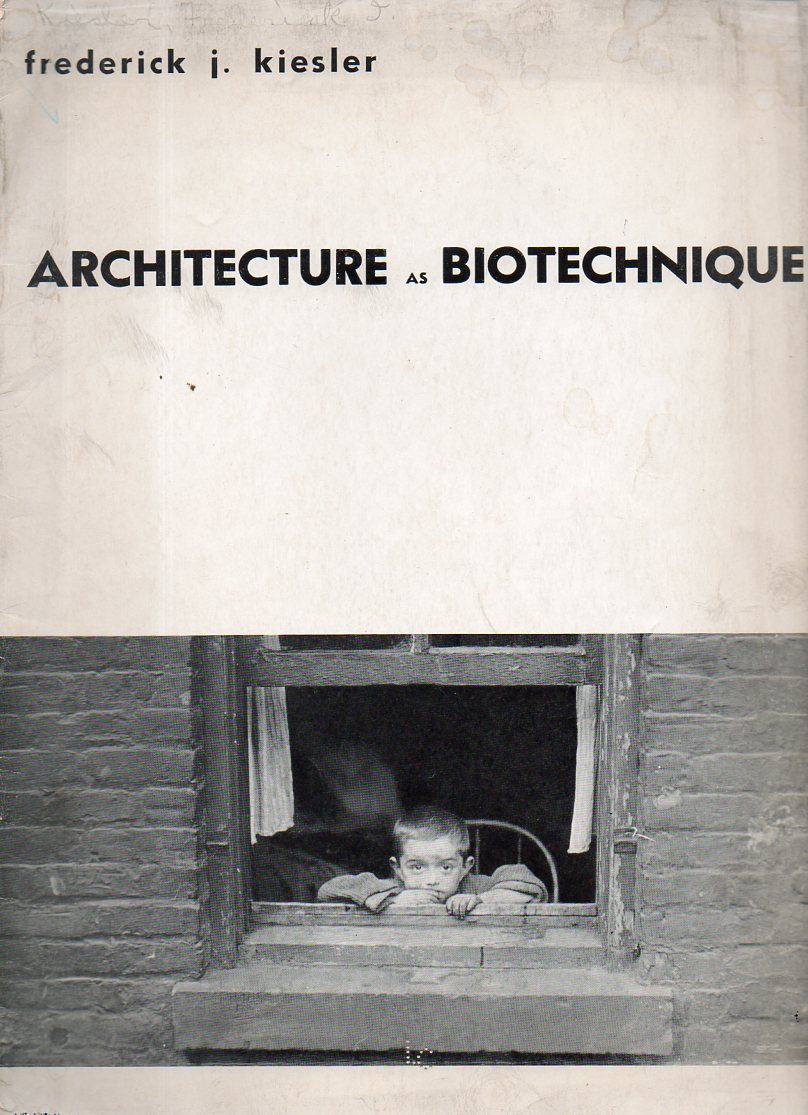
    Frederick Kiesler (Director of the Laboratory of Design-Correlation, Columbia (University)  School of Architecture) has been called one of America’s most influential non-building architects of the 20th century for his influence on a generation of modern thinkers and builders.  In a rare pamphlet–an offprint, actually– called “Architecture as Biotechnique”, which was a separate printing of an article Kiesler wrote for the Architectural  Record in 1939  (and printed in 1940, and appearing under the interior title of “Design Trends”), there is a very enticing peep into the future.  Kiesler was looking at ways of making his architecture more “organic”, more in touch with the people who would live inside the building, a radical thinker on the design of living space,  and wrote about these ideas in a longer piece called Endless House in which he explained his “design-correlations” in 1937.  [The original i salso available for purchase via our blog bookstore, here.]

    Kiesler arch467
    [The cover of the Architectural Record article, which I find to be, well, highly unusual.]

    His descriptions of his work escape me some, making me feel as though I’ve started the article in the middle, when in fact I’m just starting–mainly because of some unfamiliar usages of common words that have been redesigned by the author to mean something else or more…plus the deeply theoretically architectural stuff.  But the article starts with his study of the genetics of architecture and building design, and finishes with eight pages or so on the design for a differently-functioning piece of everyday house interaction–the bookshelves of a library.

    It is in the section on the library that Kiesler includes a “Metabolism-Chart of Mobile-Home-Library” (and by this he’s talking about a movable library within the home and not a library for a mobile home), the bottom part of which shows the evolution of the way in which information is presented in the library.  The “cultural nucleus” or the way in which the data is presented and the way the presented obecjt is stored, and starts with the scroll in 2000 BC (with pigeon-hole storing), then the bound volume  (stored on shelves, 1445 AD), then the the microfilm (stored by “filing”, in 1937-1950 AD), all of which are leading up to “opto-phonetics”, stored in photo-cell-unit(s), in 2000 AD.  The evolutionary part in all of this is the increase in concentration/direction, an ease in visual and manual efforts, as well as easing “torsal” (“bending, leaning, rising, turning”) and “pedal” efforts (walking, moving, standing), making the acquisition and control of the data in the library over time.

    Now Kieser doesn’t actually decribe (here, anyway) what he means by photocell-driven opto-electronic information device, but in 1939/40, when this piece was written,, most of what this machien might be was left to the creative imagination–but the fact that Kiesler has come to this at all with the year 2000 as a probable time for its arrival is fairly remarkable. 

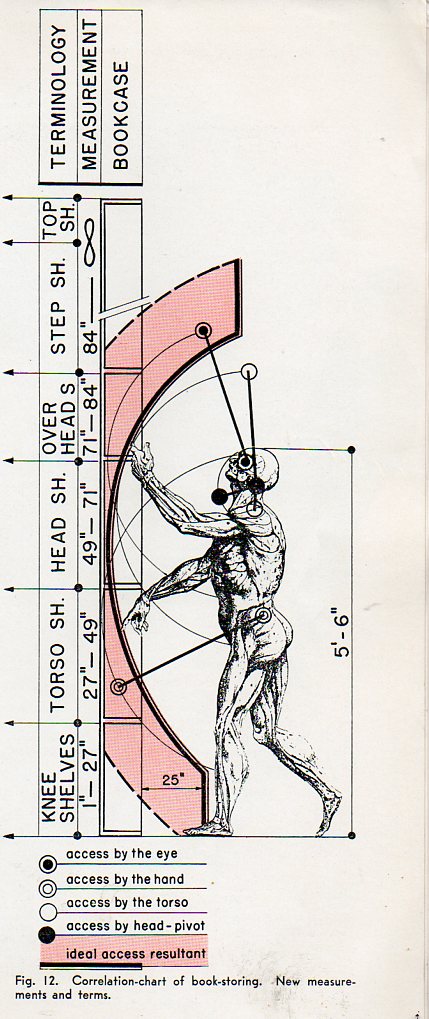
    It is also interesting to see Kiesler’s forensic analysis of the range of human motion regarding the selection of books from shelves (and using a Vesalius image for his 5’6″ person):

    Kiesler arch468Notes:

    “The term “biotechnique” appeared first in my treaties on “Town Planning” as “Vitalbau”, in De Stijl, No. 10/11, Paris 1925 and in America first in Hound and Horn, May 1934.”–Kiesler, from his introduction.

    “Introjection and Projection, Frederick Kiesler and his Dream Machine”, an interesting read,  by Stephen Phillips, in Architecture and Surrealism, by Thomas Mical.


  • Zodiacal-Sexual-Social Indicator: Astrological Prediction Tool, 1919

    JF Ptak Science Books   Quick Post

    As these things go, this mechanical device is awfully pretty in an Outsider-y kind of way, and I have no doubt that I’d want to own one if for nothing else than for its explicit implied-complexity (whatever that is).  [Source: US Patent and Trademark Office.]


  • A Line in the Sand: a Note on Modernity, 1908

    JF Ptak Science Books   Post 1783

    Klimt3_edited-1
      Klimt2

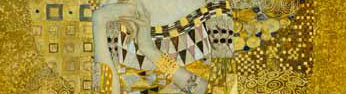
    Is this detail a peek at the boundary of The Modern?

    Are we seeing the boundaries of the new art? I’m not saying that this is the boundary, or the outermost, or the inner–but it is there, somehow, marking a line between the old and the revolutionary new, a line in the sand in the history of art.

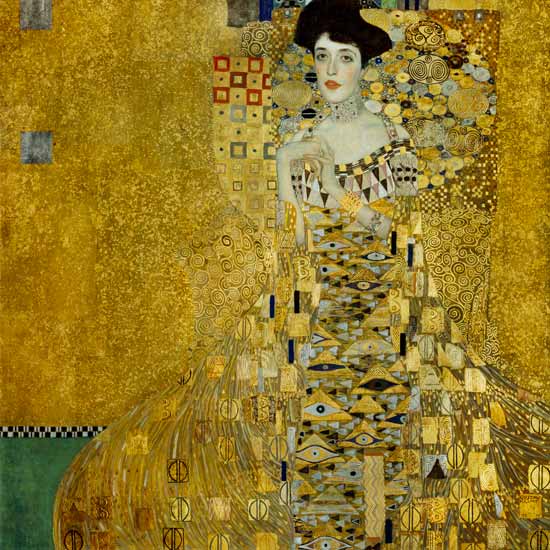
    The 1907 portrait of Adele Bloch-Bauer by Gustav Klimt almost seems to be among the earliest images of a synthetic human, a human no longer solely interacting with its environment, but also now becoming a part of it, the subject losing a part of itself to be a segment of design.  The painting was also moving away from solely representational work, with Klimt allowing the expression of his painting to take over the recognizable subject. The subject and the idea of representational painting would disappear completely in just a few years’ time with the appearance of Kandinsky’s watercolor (Untitled) (1910).  Klimit himself would continue his experimentation with The Kiss, which he worked on from 1905-1908.

    Klimt

    It is interesting to me to see how the subject and environment of a painting become one, as in the work, for examples of  Ferdinand Leger, like his Nudes in the Forest (1909/10):

    Ferdinard Leger Nudes in the Forest

    and Jacques Villon Soldiers on March (1913)

    http://www.indiana.edu/~dws/dws_chapter_2/images/19.VillonSoldiers.jpg


    and Umberto Boccioni, States of Mind I (1911)

    http://www.shafe.co.uk/crystal/images/lshafe/Boccioni_States_of_Mind_The_Farewells_1911.jpg

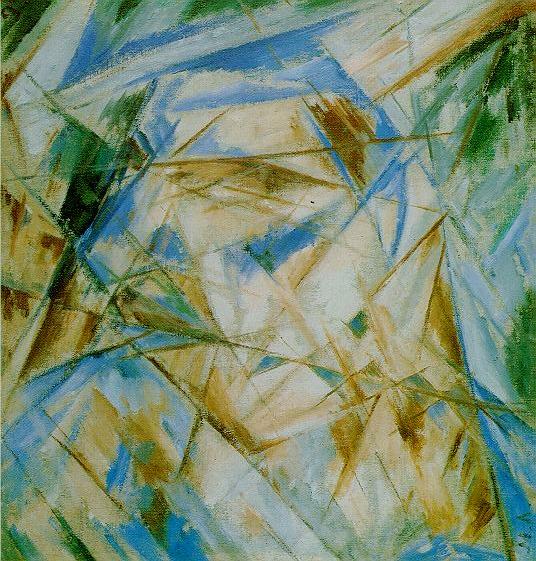
    annd Michael Lerionov Blue Rayonism (1912)

    http://myweb.rollins.edu/aboguslawski/Ruspaint/lario4.jpg

    Lyonel Feininger Umpferstedt I, 1914

    Lyonel Feininger, Umpferstedt I.

    These more so than the earliest non-representational artists, like Franz Kupka’s Noctures (1911), or Gino Severini Hierogyphic of the Bal Tabarin (1912); and not in the very suggestive work of  Vlaminck’s La Partie en Campagne (1905) or Matisse’s Joie de Vivre (1905) or even Picasso’s Les Demoiselles d’Avignon (1907).  The Klimt just seems to me a blending of subject and the rest of the painting, and not in a Cubist or Constructivist or non-representational sort of way.


  • The Topography of Antiquarian Sisters

    JF Ptak Science Books    Quick Post

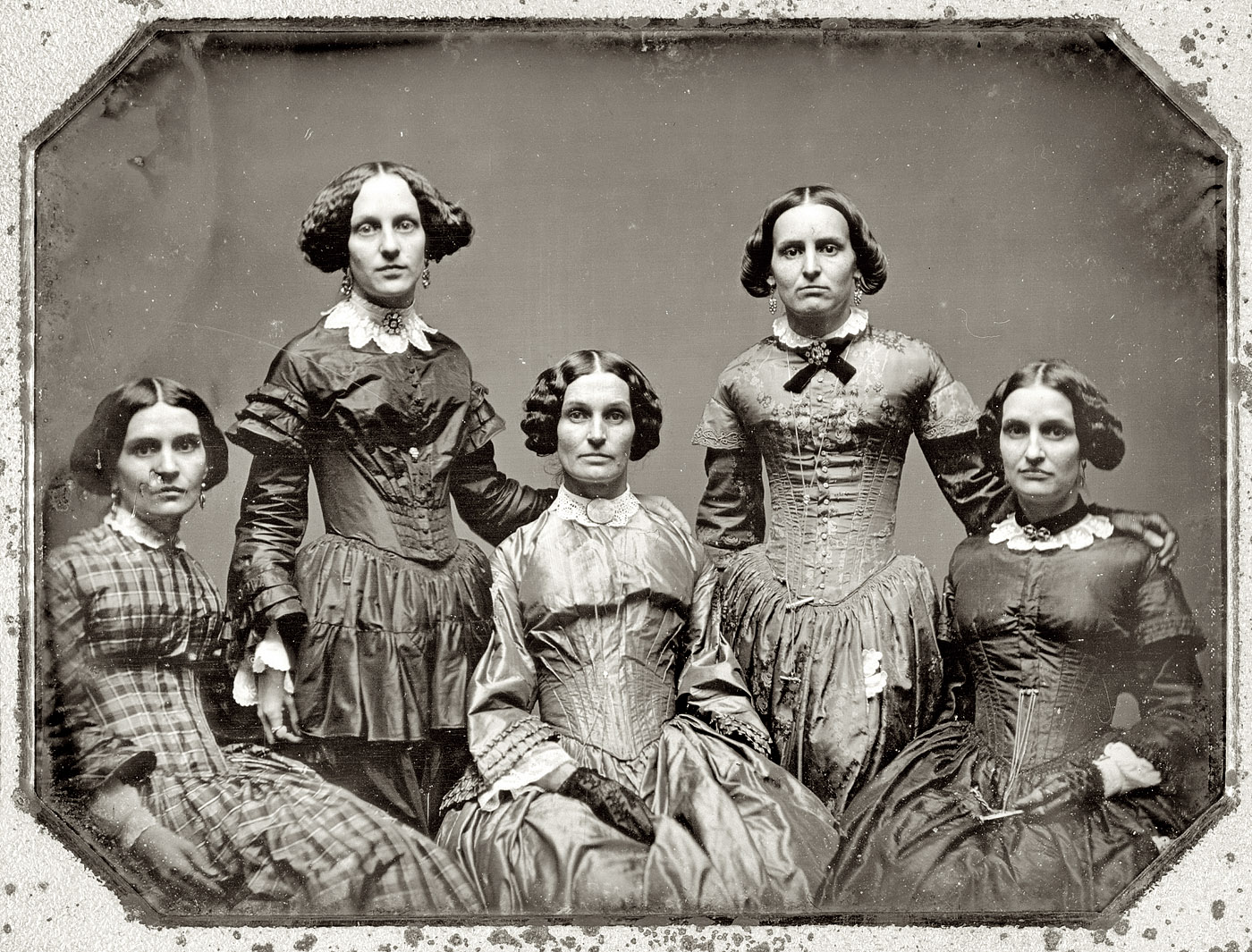
    Sisters

    Photo source: Library of Congress, via Vintage Photography, at retro-vintage-photography.blogspot.com

    This photograph–a daguerreotype, really–is both extraordinary and terribly common, at the same time, and is so in a way that is difficult to define, just that it is so.  It is the work of Frances Benjamin Johnston (whose collection resides at the Library of Congress) and was completed between 1845-1860, and shows the photographer’s aunts.  They make a formidable group.  I’d like to be able to find the data that the outline of their portraits form, because to me they look lik a graph.

    The photographer, Frances Johnston (1864-1952),  was one of America’s first successful female workers in the field of photography and photo-journalism.  She opened a studio around 1890, and went into business, no doubt helped along by her wealthy family’s social clipboard.  That it took 50 years or so and the application of a family’s small fortune to firmly establish a woman at this rank in photography, so close to the year 1900, so far into the advance of photography, is remarkable. The self-portrait, below, shows her mind:

    File:Frances Benjamin Johnston, full-length portrait, seated in front of fireplace, 1896 (altered).jpg

    she reveals herself a woman of the modern age, with her petticoats flaring and obvious, a cigarette in one hand, and a beer stein in the other, secrets no longer.

    Sisters 1


  • On a Quality of Being Indistinct–Melville and Turner

    JF Ptak Science Books  Post 1778

    For a painter to make a point of looking for poetry in the conception of a picture is the surest way for him not to find it.–C. Baudelaire.

    The qualities of being indistinct certain have their places, though those places are relatively rare in areas like the engineering of dam or bridge building, or in the rules of a game like chess.  Over time these qualities have certainly changed and manifested in different fields, say, for example, in literature and art–particularly in art.

    This brings us to Melville and Turner. It is a curious thing to see Herman Melville’s collection of J.M.W. Turner engravings, to see what the man collected and what might have drawn him to those particular pieces. After all, Melville was a necessary collector–he needed things, sometimes needing them more than his family needed things, like food–and so to see the visual items that were “necessaries” is very interesting.

    And when you look at the engravings of the Turner paintings in most cases they bear little resemblance to the original.  As a famous and respected, highly admired artist for more than 40 years, Turner’s early works can also be considered famously ‘indistinct”.  As a matter of fact,  that was a major concern of some of the great artists and critics of the time,  viewing some of Turner’s beautiful pre-pre-Impressionist works. (His very highly Impressionist works reaching back to just before 1800, very well in advance of Boudin and Manet, Corot and Millet, Daubigny and Courbet, and the rest.) People didn’t quite know what to do with the “indistinct” shorelines in his naval/maritime works, or the suggestions of people, or the fantastic mystical skies of deep foreboding and threat communicated with emphasis on color and suggestion more so than accurate physical representation. 

    Robert K. Wallace takes on the issue of this relationship between the literary and artistic giants in Melville and Turner, Sphere of Love and Fright (University of Georgia Press, 1992) and discusses it very fully over 635 pages.  I was interested to see the list of the Turner engravings collected by Melville and of course everything else that went along with that.  Wallace notes John Landseer’s reaction to one of Turner’s earlier and not tremendously impressionist works (Sheerness as Seen from the Nore, which is a great title in and of itself)  was very guarded, saying that the shorelines “are little more than threads in the distance”, and writing in 1808 of The Confluence of the Thames and the Medway of the painting’s “indefinity”, and of his doubtfulness of the “indistinctness” of Richmond Hill and the Bridge“. After all, even the pre-impressionists really wouldn’t begin to make a full appearance for a few more decades, and the subject of suggestion of form in painting rather than their depiction was a very major issue.

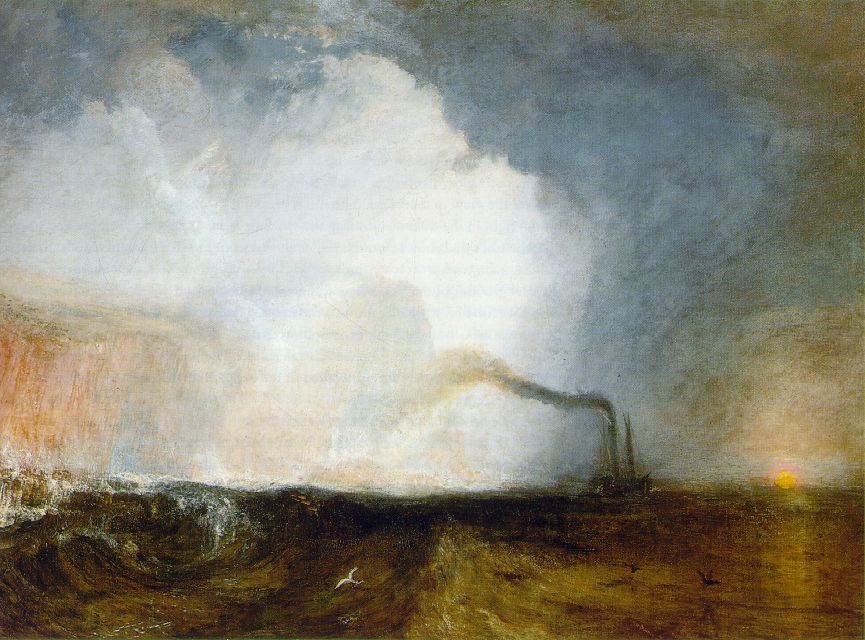
    Turner would move more deeply into his expressive creativity as he grew older, producing work after work of high impressionist qualities, such as, for example, Death on a Pale Horse (1825-1830), Staffa, Fingal’s Cave (1832) and


    [Staffa, Fingal’s Cave.]

    Death on a Pale Horse by J.M.W. Turner

    [Death on a Pale Horse.]

    Rain, Steam and Speed (1859).  Wallace relates a great story of the first Turner painting making its way to the United States, coming by way of a purchase by James Lenox of the Staffa painting, arriving here in 1845, already very deep into the career and life of Turner (1775-1851). When it arrived and unboxed, the new owner Lenox was extremely surprised by the suggestive qualities of the painting, which to him “appeared so indistinct throughout” (Wallace, page 74).  Lenox wrote Turner with his observations, when he wondered if the trip by sea had actually done something to the paint of the picture, rendering its detail obsolete.  Turner replied that the “indistinctness is my fault”.  Lenox was certainly seeing something new–it was something revolutionary in art and vision, and not a spoilation by salt and sea.

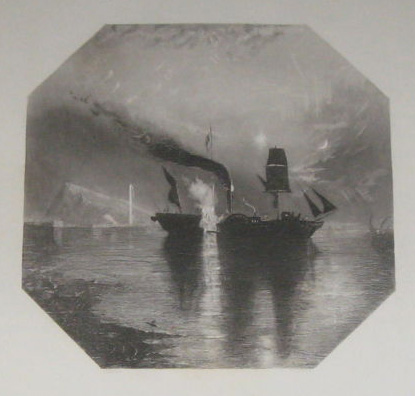
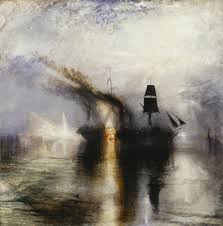
    So I wondered about Melville’s collection of Turner, and how the engravings might differ from the paintings, and how in general the work would be more tailored for a general audience, with the great “indistinctness” of the works lost in incised lines on copper and steel.  Did Melville know the of the differences between the mass produced item and the original painting?  Or did that matter, at all, particularly if Melville was looking at the ships and other parts of the images that reminded him of his own experiences real or imagined, and that his brain would fill in the detail as necessary?  (And there are certainly differences, as we can see below:)

    An engraving of Turner’s Burial at Sea as it would have existed in Melville’s collection:
    Melville turner burial at sea
    And Burial at Sea, as a painting:
     
    Turner--burial at sea
     
    Source; http://www.tate.org.uk/art/artworks/turner-peace-burial-at-sea-n00528

    Another question is whether or not Melville would have known the difference, or if he was even aware of the great idea of indistinctness existing in Turner’s originals, and what this new way of painting would come to represent.  At this point, I’m not sure, and I’m not sure that I need to be sure, at all.  Perhaps the issue is best left to question, being left to its own indistinctness, left for interpretation and imagination.  I think that is good enough for me, right now. 

    Other examples of Melville’s collection of Turner images compared to the originals: