A Daily History of Holes, Dots, Lines, Science, History, Math, Physics, Art, the Unintentional Absurd, Architecture, Maps, Data Visualization, Blank and Missing Things, and so on. |1.6 million words, 7500 images, 4.9 million hits| Press & appearances in The Times, Le Figaro, Mensa, The Economist, The Guardian, Discovery News, Slate, Le Monde, Sci American Blogs, Le Pont, and many other places… 5000+ total posts since 2008.

Category: Anticipation, History of

  • Alan Turing–Report Card Teachers’ Comments, 1926-1931

    JF Ptak Science Books   Post 1770

    Turing

    Image source:  www.thegalleryofheroes.com

    There is a terrific find on Alex Bellos’ website exhibiting Alan Turing’s “report cards” for his time at the great Sherborne School from 1926-1930 (and which were transcribed by archivist Rachel Hassall), from the time when Turing was 14 to 19 years old. Turing (1912-1954) I think needs no introduction for his importance to mathematics and computing (and code breaking during WWII), and it is very interesting—thrilling even—to see how his instructors were coming to grips with the developing genius. Even at such a school as Sherborne (a very old school with 39 headmasters overseeing the place since 1437) where the teachers were I am sure familiar with gifted pupils, The comments on the reports of Turing’s progressed showed that many weren’t quite sure about what Turing was all about. Obviously Turing as a boy was very gifted, but many instructors reported as many hindrances to his intellectual development as there were advances—more, even.

    Perhaps people at the school didn’t know exactly how to deal with him; perhaps they did, but still at the end of the day Turing had to meet the common standards of the school. Or perhaps not—I really can’t tell from the transcripts presented by Bellos and I don’t know the intricate history of the school. But certainly as time progressed Turing’s abilities were more readily recognized, but early on it seems that his talents didn’t overwhelm his many supposed shortcomings, the faults of the parts larger than the whole of what he could accomplish. In instructors’ comments across all of his disciplines, Turing was “capricious”, “untidy”, “lacking in life”, “need(ed) concentration”, “depressing unless it amuses him”, “careless”, “absent minded”, “un-methodological”, “slovenly”, (made) “mistakes as a result of hastywork”, and so on. He “could do much better” though one instructor felt that “he may fail through carelessness”. All of which may well have been true—from the outside. These statements may have simply been the result of teachers not being able to reach a boy genius, and perhaps the boy couldn’t be reached, at least early on in his academic career.

    The statements in general—especially in the maths—I think are fascinating things. It may be easy to judge some of the remarks as intemperate, the teachers unable to clearly see the genius-in-the-making who (70 years later) we can so clearly see today. I think the remarks need more careful consideration than that, and that is where they become interesting.

    Here are some selection from reports on Alan Turing, 1926-1930, below; a more full list exists at the Bellos site, here.

    Subject: Mathematics

    1926. Works well.  He is still very untidy.  He must try to improve in this respect

    1927. Very good.  He has considerable powers of reasoning and should do well if he can quicken up a little and improve his style.

    ____. A very good term’s work, but his style is dreadful and his paper always dirty.

    ____. Not very good.  He spends a good deal of time apparently in investigations in advanced mathematics to the neglect of his elementary work.  A sound ground work is essential in any subject.  His work is dirty.

    ____. Despite absence he has done a really remarkable examination (1st paper).  A mathematician I think.

    ____ I think he has been somewhat tidier, though there is still plenty of room for improvement.  A keen & able mathematician.


  • Modest Expectations–Engineers Stand in the Shallow End of the Future Pool

    JF Ptak Science Books   Post 1769

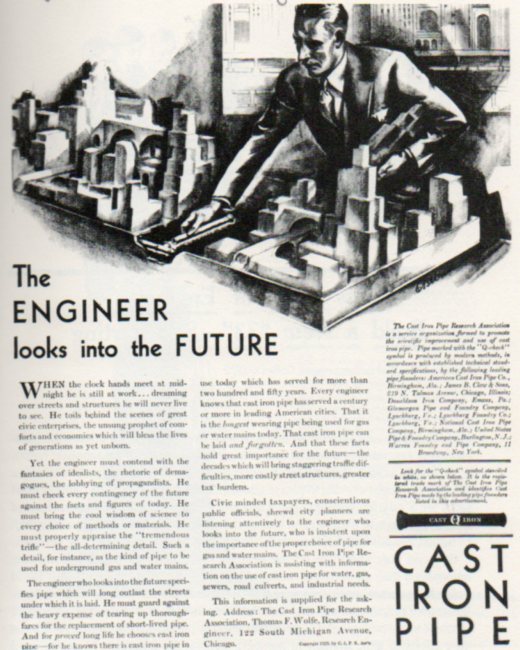
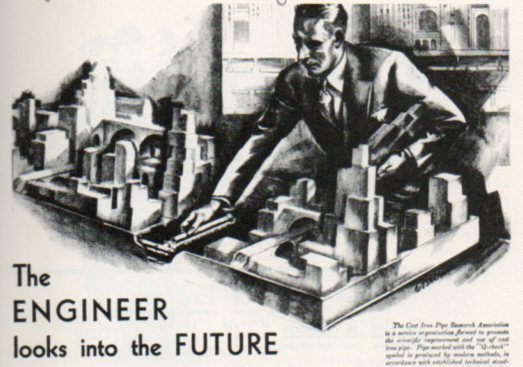
    The novel underneath its title can be good or bad in spite of it, independent of the flag under which it flies. Its just helpful, usually, if the title is as good as the book—better even, because, after all, Modest Expectations isn’t quite as good as the real thing. But “Modest Expectations” seems as thought hat would be the title of future vision in this advertisement that appeared in 1929. It is an advertisement in Collier’s magazine by an engineering company during the time in which The Engineer and the possibilities of engineering were running full-blaze in the United States. There was a belief in the idea of engineering as a cure-all to present and future problems, and the word was as prevalent in the sphere of social interaction as the prefix “e-” was in the early days on internet business and communication in the 1990’s.

    Engineer future410
    It seems as though there were few occupations immune from the “-engineer” suffix, whether they had anything specifically to do with engineering, or not. The “control safety engineer” described a crossing guard; “sanitary engineer” referred to what was known as a garbage man; “nutrition control engineer” was a food server, and so on, position names changed by the hundreds if not more, elevating the status of a profession by simply applying the meme’s suffix to the job title. IF you judged the overuse of the term by the actual accomplishments and achievements of engineering of the times, it was probably justified, give the enormous progress of engineering. In just the first decade of the 20th century enormous change were made in the way life was/would be lived with the introduction of the steam turbine generator, the internal combustion engine, heavier-than-air powered aircraft, the audion, the vacuum diode, the thermionic valve, Bakelite, and so on, all of which would soon bring technological change to create revolutionary changes in the way life was structured in the U.S. And worldwide.

    But given the gigantic changes in the first 30 years of the 20th century, what was it that the engineer was seeing in this advertisement, “The Engineer Looks into the Future”? What was it in the hand of the engineer in the illustration, what was he placing down in the city of tomorrow, today? A faster train, or space ship or part of a vacuum tube people-mover, or what?

    Engineer future411It turns out that this engineer didn’t have such lofty future-vision plans—in fact, the vision was subterranean, and the thing in the engineer’s hands was cast iron pipe. Yes, the future was in materials, and that material manifested itself in cast iron pipe, courtesy of the Cast Iron Pipe Association.

    Now cast iron had been around for a long time before 1929—even used as pipe the idea goes back into the 16th century. There were bridges made of cast iron in the 18th century, and the movement towards the modern skyscraper maybe traced back to cast iron facades and construction in the 1850’s. I’m not so sure why cast iron pipe was so significant in 1929—perhaps it wasn’t so very widely used. But I must admit to having a “moment of discovery” while I tried to reason why the future of engineering looked into a hole in the ground filled with cast iron pipe.

    Engineer future409
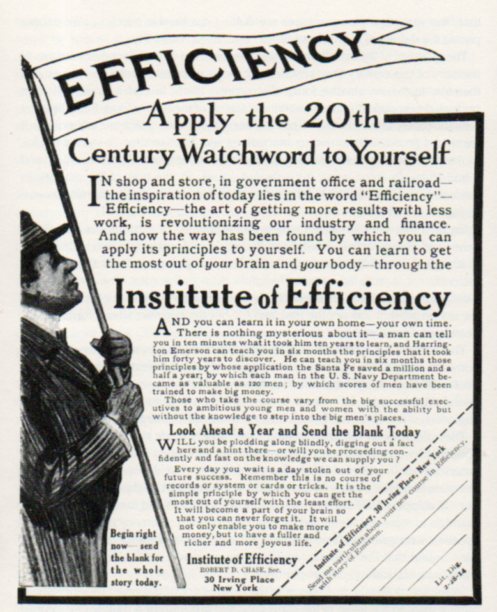
    Engineer future412Another interesting image that comes a little earlier on is this advertisement for the “Institute of Efficiency” (in 1917), which in effect takes the running-rampant ideas of engineering and applies it to the ways in which people ran their personal lives. Efficiency was as much a catch-word as “engineering”, and it was in this decade that saw the appearance of Scientific Management (Fred. Winslow Taylor) and its numerous offshoots. What bothered me about this ad marshaling the positive factors of the study-at-home courses in efficiency was its inefficient use use of space and communication of the idea. Not the least of which was the very odd bit in the bottom right corner, which the reader was supposed to fill in and clip off and send to the Efficiency people. There’s really no room to write, and you can’t actually mail the thing—and, if I was trying to get someone to purchase something about improving their efficiency I might have wanted to make it much easier for them to send me something with their name on it.  The whole effort just seems not very efficient.


  • The Underground Memory Vaults of Harper & Brothers, 1855

    JF Ptak Science Books   Quick Post  [Part of the History of Memory series.]

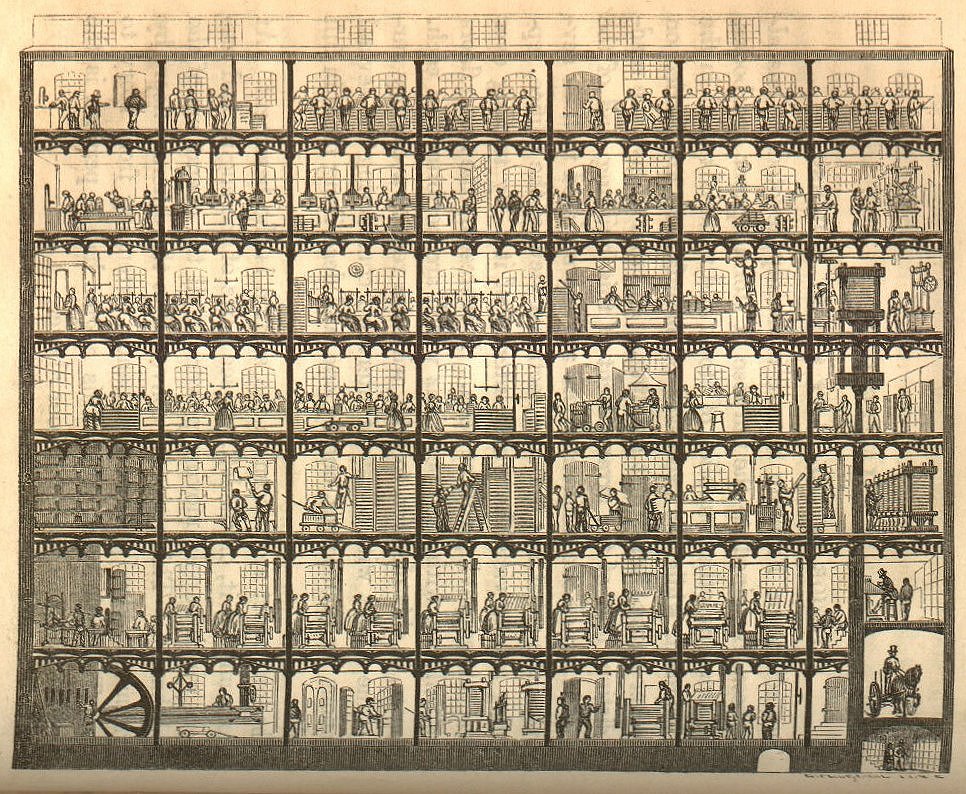
    I found this fantastic cross-section of the Harper & Brothers publishing house in Jacob Abbott’s The Harper Establishment, or, How the Story Books are Made, published of course and thankfully by Harper in 1855, and found in its entirety here

    Sectional view of the Cliff Street building.The whole of the enterprise is explained on pp 43-49 (here).  I’d really like to return to this image at some point, because there are more detailed engravings in the book to match every section of the building, and to me it looks like this image could be turned into a 19th Century Printing and Publishing Board Game.

    What I was interested in right now was the box on the extreme bottom-right, which turns out to be The Vaults–this is the central memory core of this publisher, a 200-foot-long, 8×8′ corridor lined with the original plates for all of the publications of the firm.  The plates for their single-volume version of Herman Melville’s Moby-Dick would’ve been put down there just a few years ago. 

    Interior of the Vaults.

    “The plates are stored in subterranean vaults built under the streets that surround the building. The entrance to these vaults has already been shown in the sectional view of the Cliff Street building, on page 42. A more enlarged view is shown on the preceding page. The vaults extend under ground for two hundred feet in length, and in dimensions are eight feet wide by eight feet high. They are shelved on both sides, and the shelves are loaded with plates–stereotype or electrotype–representing all the works published in the establishment. There is one plate for every page of every one of the many hundreds of volumes which the house publishes, making from fifty to seventy tons in all.”

    “When a new edition of any book is required, the plates are brought out from these vaults and put upon the presses. When the work is finished, they are taken back again to the vaults.”


  • The Polish Threat to Germany as Seen by the Nazis, 1939

     JF Ptak Science Book–expansion of Post 230 (September 2008)

    This is one of those times when a pamphlet has posed an idea that had never before occurred to me. This anonymous work produced by the German propaganda machine in May 1939  asserts that Poland did indeed have plans to continue to break the back of Germany over the never-to-be-forgotten and at this point hardly-observed Treaty of Versailles, and to also physically attack south-eastern Germany some time in 1940.

    Blogsept_1_poland476

    Again, the idea that Germany was defending itself against an imminent attack by Poland was completely novel to me.  There’s always a reason for these sorts of beginnings of wars, but this one really is exceptionally removed.  Poland had just decided to defend its borders against the Germans following their conquest of Czechoslovakia the previous year–until then the Polish military’s biggest threat was the Soviet Union.  The German attack, the blitzkrieg (Fall Weiss) which would begin on 1 September 1939 involved 1.5 million German soldiers attacking two principal points in Poland. It was ostensibly launched in response to a supposed Polish attack on the German border town of Gliwce–an attack orchestrated and simulated by Germany.  In the attack, the Germans unleashed 11 tank divisions versus Poland’s 1; sent in 1250 bombers and fighters to Poland’s (mainly obsolete) 360; rolled 4 motorized divisions against Poland’s, um, that’s right, they didn’t have any.  And of course the Germans had a modern and vastly superior navy, compared with Poland’s 4 destroyers, five subs, and assorted smaller numbers of smaller and less-significant vessels. 

    The British and the French issued an ultimatum to Germany to cease and desist; Hitler had no intentions in stopping, throwing the five armies of von Rundstedt and von Block deeper into the country in a fast and (according to many German generals) breakneck manner.  The British and French declared war on the 3rd, by which time the war in eastern Poland was already almost over.  The Germans did respond to the ultimatum (see this in continued reading, below) in which it outlines some of their needs and Polish-inspired dears. 

    By 24 September the Germans had reached the formerly important geographic boundary of the Vistula and swarmed past.  Warsaw was bombed by some 1150 aircraft, and by the 27th, the fighting was almost entirely over. (Some divisions held out to 6 October, the invasion completed in 36 days). 


    It is sometimes forgotten in the quickness of this defeat that Poland inflicted some heavy losses on the German military machine:  8000 soldiers killed with 27,000 wounded and 5,000 MIA; 217 tanks were destroyed.  The Luftwaffe lost over 500 planes, either entirely destroyed or damaged to the point of uselessness.  Polish losses were far greater.

    It was at this time that the first of my grandmother’s brothers, Raymond Dymek of Pittsfield, Massachusetts, would cross the border into Canada and volunteer, becoming a pilot in the Royal Canadian Air Force.  He would fly against the Nazis with the CRAF, then joined the RAF, until finally, when the U.S. joined the  European war 27 months later, would fly for the U.S. Army Air Force.  He had a very long career and made it through.  His five brothers would also enlist in the U.S. armed forces; all six brothers would return home. Fatherland and all that.   I know the vocabuarly for their response to the idea that Germany was responding to a Polish threat of invasion didn’t exist to them–it barely does for me.


  • What was Dropped from the Skies First, the Mails or Bombs?

    JF Ptak Science Books   Post 1717

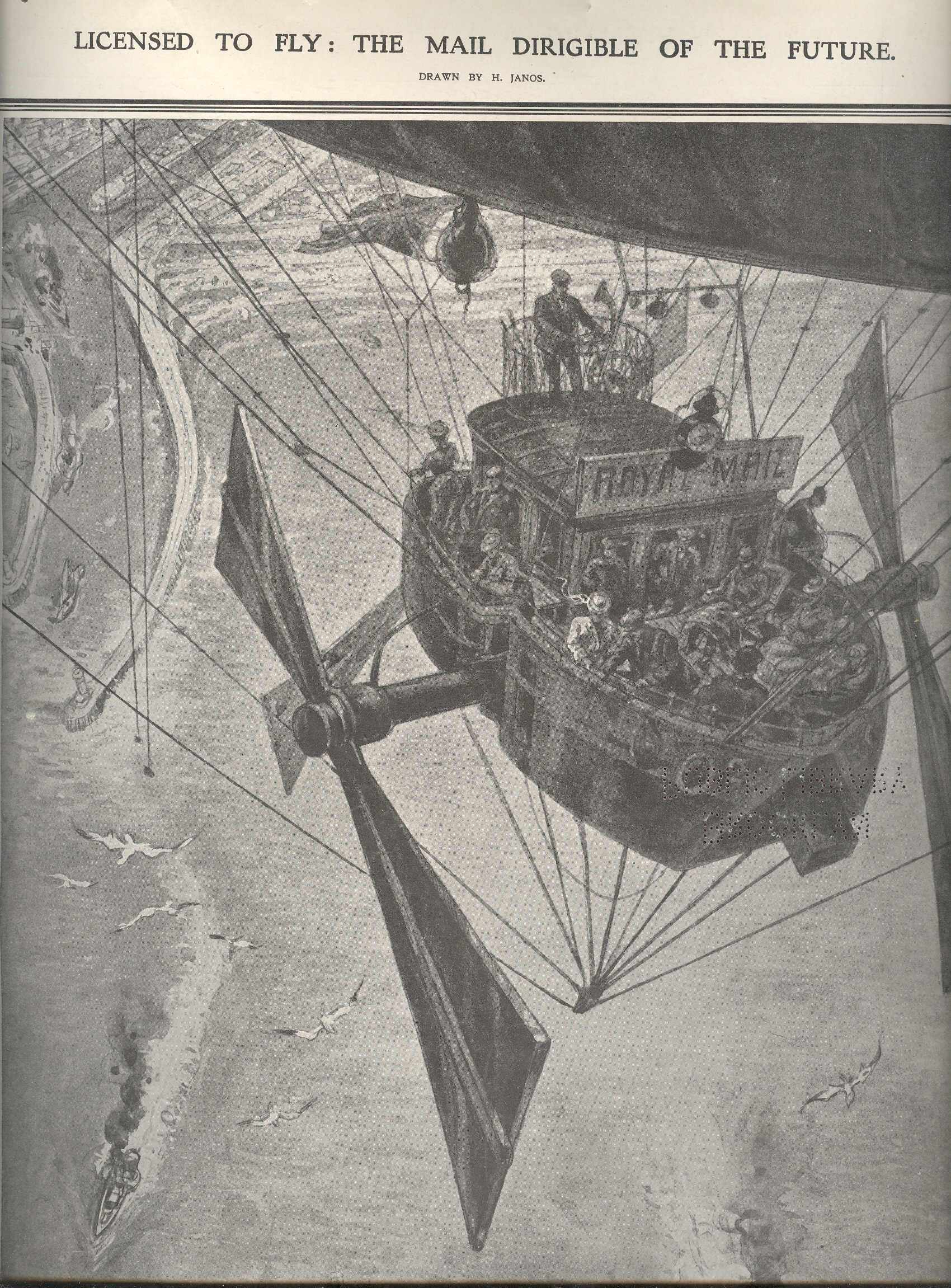
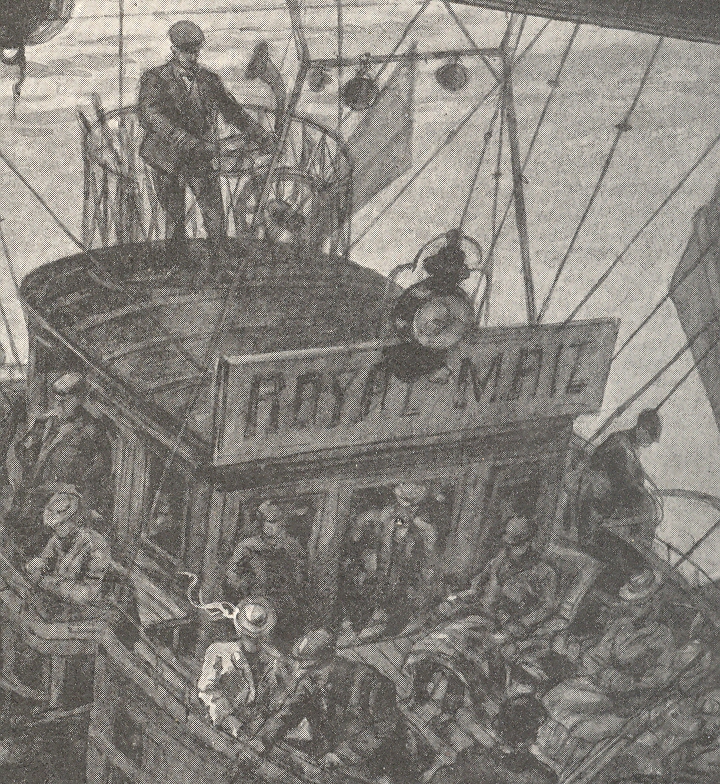
    Seeing this splendid image of the 1909 near-future forced a question into mind:  what came first, aerial delivery of mail or aerial delivery of explosives?  I suspected that “mail” would be the correct answer, but didn’t know how much deeper that went into the past than the history of aerial bombing.

    Mar 23 air mail ILN


    The first bits of mail were delivered among the first balloon flights ever made–in the U.S., the first quasi-official piece of airmail was a letter from president George Washington that went aloft in the first balloon flight (1793) in this country, deliverable to whomever it was that first came to greet the balloon in wherever it landed.  The first semi-regular delivery of mail in the U.S. was again by balloon, beginning in 1859, which still precedes the first sustained use of explosives dropped from aerial vehicles by five decades.

    Mar 23 air mail ILN det


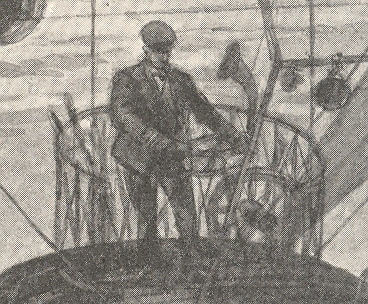
    This image was drawn by H. Janos for the Illustrated London News for 16 January 1909, and shows a futuristic balloon making its way from Dover to Calais with a cargo of mail and a dozen or two passengers (and whatever crew there was besides the captain, presumably belowdeck).  The article reads: “1910 may seem a very early date at which to fix the coming of such vessels, yet aerial navigation is progressing at such a rate that none can call the date impossible”. 

    Mar 23 air mail ILN det 2

    And so true;  it didn’t take but a few years to begin experimental air service routes for the mails by biplane, and less than a dozen to have instituted long-range flights by heavy aircraft, with the mammoth mail-delivering airships sent to the not-good ideas department. 

    In any event I just happen to like this image by Janos–for what was a not-essential piece to the weekly magazine, the man did produce an admirable work, not the least of which is his unusual airborne oblique bird’s-eye view to the shoreline. 


  • The Discovery of Salad–the First Salad Cookbook, 1627.

    JF Ptak Science Books   Post 1690

    ===blog==aug 19==salad  I was looking for an antique recipe for pesto and came across this remarkable book by Salvatore Massonio, Archidipno overo dell’insalata e dell’vso di essa, published in Venice by Marc’Antonio Brogiollo in 1627. It is in short a philosophical cookbook for salads—and the first of its kind dedicated solely, devoted entirely, to the salad.  It must have been a revolutionary publication, and probably intended for the very wealthy, given that the vast majority of people in Europe didn’t have money for a book, and many couldn’t read, and lettuce and its makings were outside the standard diet for the working poor.  The book is no slim effort: 68 chapter and 425 pages long, it describes the stuff of the salad and its dressing. Unfortunately there are no illustrations, no images on presentation–not even the new chapter capital letters are designed in a food motif.  Nothing.  (The full text is available here.)

    Actually salad wasn’t limited to just greens in this book, and his quasi-vegetarian sentiment was tested by including cold salted meats, cold salted tongue, livers and such in the mix.  But Massonio was definitely far ahead of anyone else at the time dealing with the benefits of the salad for both health reasons, as well as for making the salad not a meal in itself but an appetizer for something larger to come.  In another great possible “first”, the wonderful Massonio seems to be the first to describe the use of garlic in a sauce. 

    Now. About that pesto recipe…all I need is some stuff from Italy and a special-marble mortar and I’ll be somewhat on my way, at least as the purists are concerned. The birthplace of pesto, Liguria, takes its position as the originator of the great green delicacy very seriously, legislating exactly how and with what peso should be made.  And that is as it should be.  Maybe I’ll just buy the pesto…

    (Robbing Peter website has taken a translation of the cucumber salad from Massonio and created it here–looks pretty good.)


  • The Invasion of America (Part III)

    JF Ptak Science Books   Post 1688

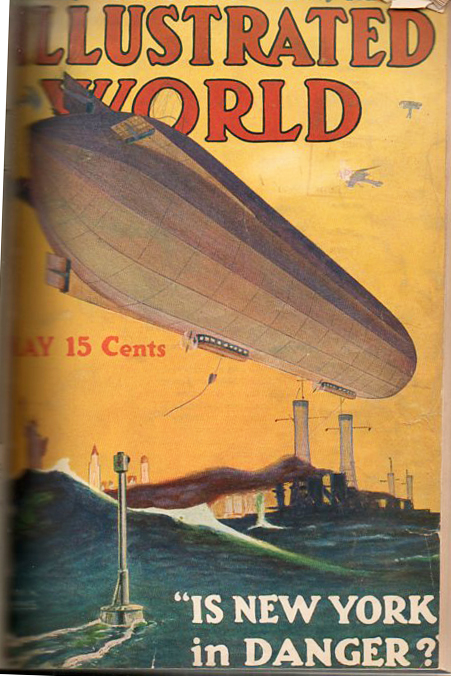
    The New York City harbor looks pretty rough in this picture, tall whitecaps with surprising little reflected in what should be pretty choppy water, meaning that light should be reflecting everywhere, a difficult collection of reflected reflections. 

    America invaded086[Image source:  May 1917 issue of the uncommon magazine, Illustrated World.]

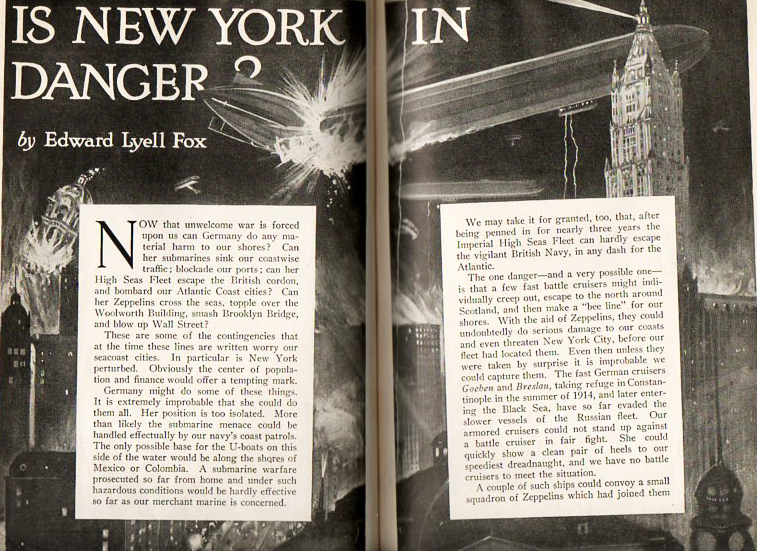
     The submarine, battleship  and zeppelin menaces were real, at least in Europe or in the Atlantic–the aeroplanes far less so1.  But the applications of these fears directly to American shores were still very distant things, particularly when it came to an attack on New York City–except of course that the U.S. had just declared war against Germany, finally, just a few weeks before this issue was published.

    America invaded b088
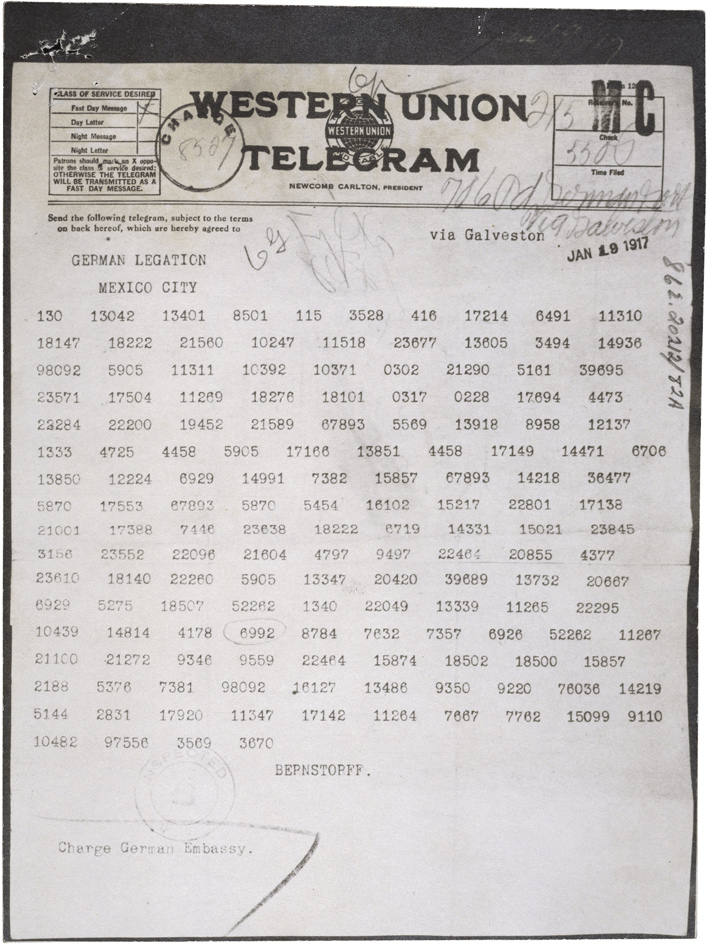
    The war began for real in Europe in August, 1914, so the fighting had been going on there in fratricidal earnestness for two and half years, costing millions and millions their lives and limbs.  America had been isolationist and non-interventionist up until this point, remaining sweatily on the sidelines, until the capture of the infamous Zimmerman telegram2, which was a coded message sent from Germany (the German Empire) to Mexico (and taken by the Brits as it was sent, the crypto-boys of Room 40 breaking the thing) suggesting that Mexico join in a war against the U.S.  It hit the American press on 1 March, and the story exploded–literally. This is what the beginning of war looks like, sometimes:

    File:Zimmermann Telegram.jpeg

    So perhaps there was some amount of yellow journalism involved here, and some inflationary propaganda as well, and some good-old profit-taking on a half-sci-fi story–on the other hand, the German Empire did just sink 800,000 gross tons of shipping during the 30 days of April (1917), so sub fears were in general real and palpable.  The issue of them sighting the Staten Island Ferry though was quite another matter. 

    The first American soldiers would arrive for fighting in June.  The whole thing would be over in 17 months, which is well less than half of the time that the U.S. spent in WWII. 

    The United States would suffer 116,000 military deaths during its part of the war–a small fraction of the overall military deaths (9 million) and a smaller part still of overall deaths including civilians (totaling 16 million).  There would be 205,000 American wounded in this conflict, a little less than 1% of all war military casualties. 

    It would be interesting to see the coverage in England of the American invasion fears.

    Notes:

    1.  This was not so much a war of bombing than it was for air-to-air combat; bombing became more of a realm of aircraft in the suppression of indigenous populations by occupying powers in the 1920’s, and then in Fascist Spain in the mid-1930’s, and then graduating as it were in WWII. 

    2..  The telegram was named for the Foreign Secretary of the German Empire, Arthur Zimmermann,, who sent the thing out on January 16, 1917.  President Wilson delivered his war address to Congress on 2 April 1917. 

    A military death pie chart for the Entente Powers [source, Wiki]:

    File:WorldWarI-MilitaryDeaths-EntentePowers-Piechart.png


  • On the Invasion of America, Part I

    JF Ptak Science Books  Post 1687

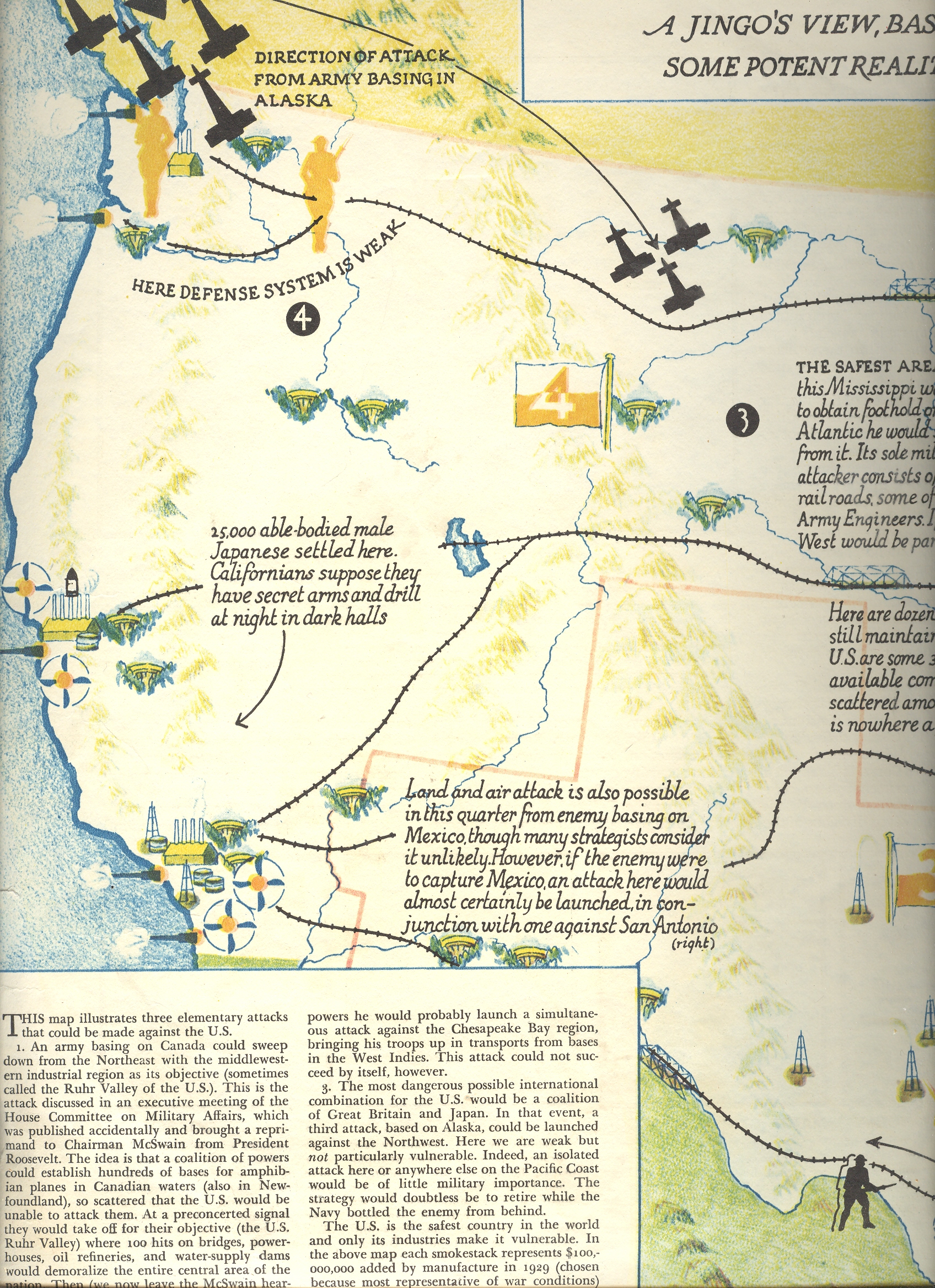
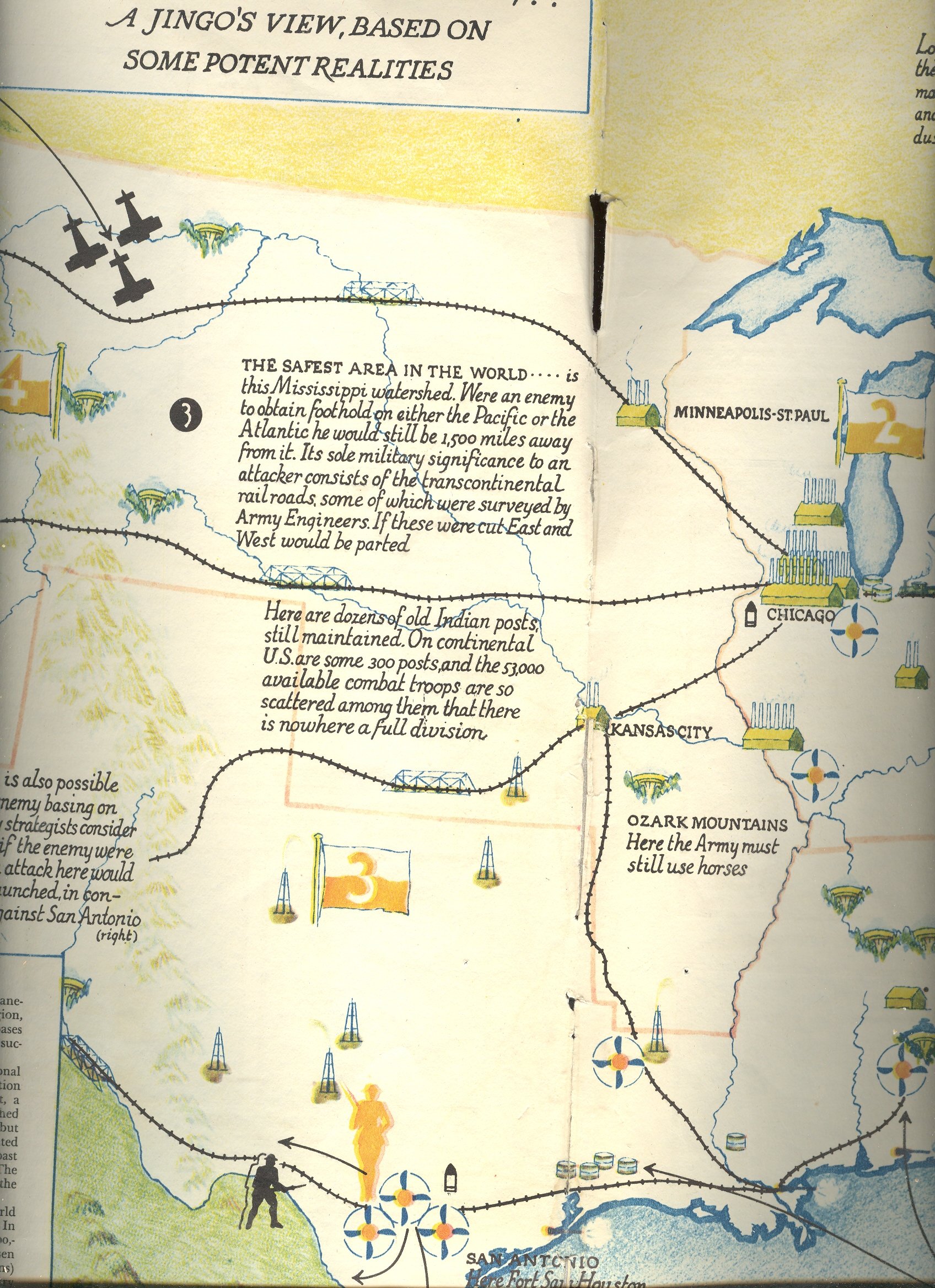
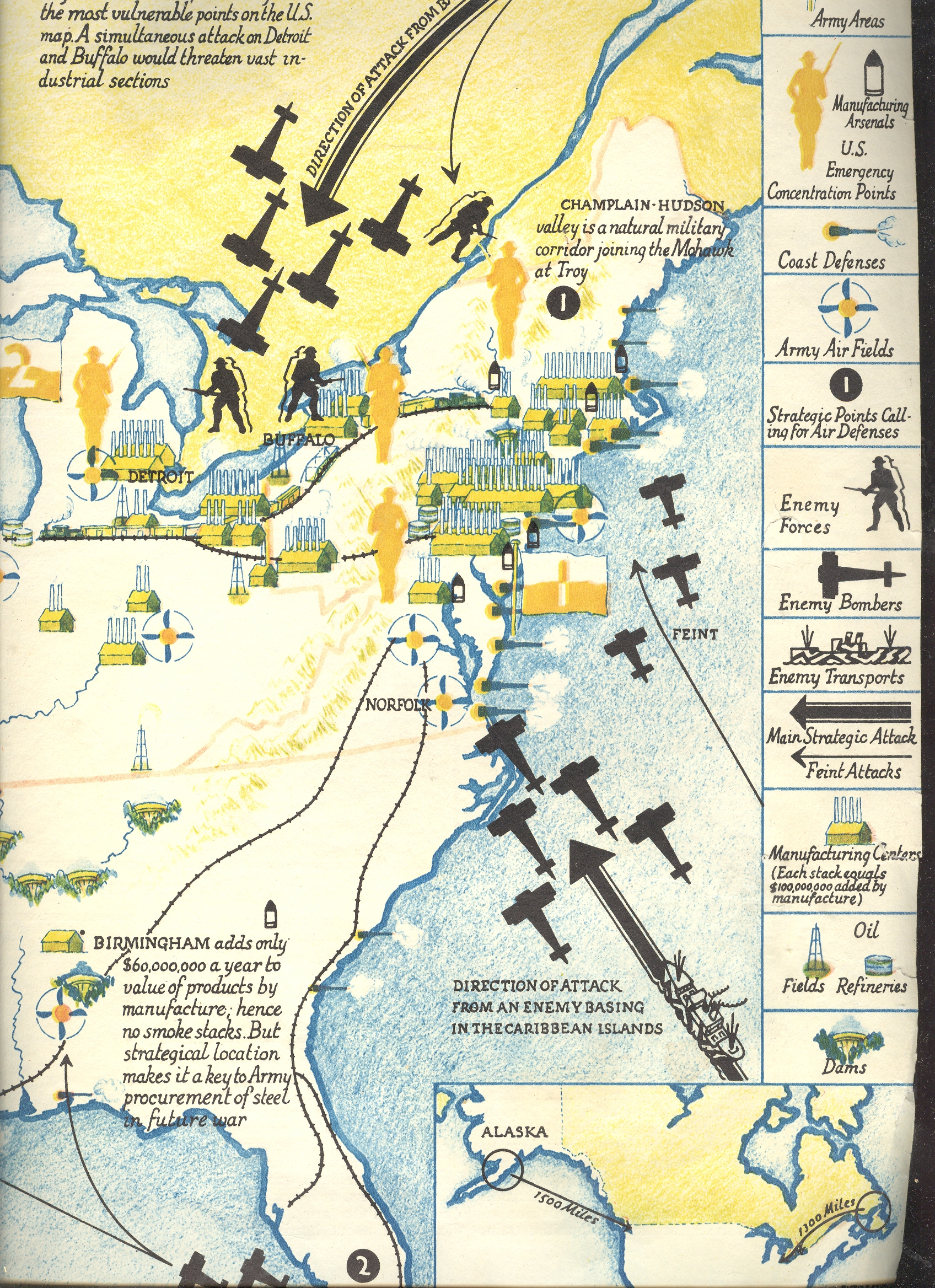
    See also: Invasion Routes to the U.S.  and this blog’s most-viewed posting (with over 500k hits) Maps of the Invasion of America, 1942 . 

    America has almost never been invaded. I should clean that statement up a bit: the United States has almost never been invaded.  America–which included North/Central/South once upon a time long in the dim past–was constantly invaded until the invasions no longer counted themselves as such, which I guess means that the “invasion” forces became  “resupply”. (Perhaps an invasion is over once you surpass a certain ratio of houses : forts.)

    “Invasion” does not include “attacks”.  A few guys getting off a Nazi sub and wandering around until they got picked up (with some (all?) being executed) does not an invasion make.  9/11 was not an invasion, though the subsequent invention of impending and pervading fear was–that’s why we have “storm centers” rather than “weather reports” on broadcast news–but even that fear business was more home-grown than anything else.

    The Japanese Army were on two small islands in the Aleutian chain (which may have been closer to Tokyo than NYC) for a bit in WWII–also does not make for an invasion, even if they were there for a long time.  Or even if they were still there.  Nor does sending hundreds or thousands of paper incendiary balloons across the Pacific an invasion make. 

    UFOs don’t count, either.  (I still find it remarkable that such a large percentage of the hundreds of thousands of “sightings” has the UFO with landing or whatever lights on it. I figured out at one point that there has been a report on one of these critters every ____ minutes since Roswell. And in all of those hundreds of thousands or reports, if you took them all and stacked them one on top of the other, they would reach perhaps the height of a grain of sand.)  The Beatles don’t count, either.   

    What also doesn’t count (but probably should) but which is not military–not really, though it may have the impact of a military force at some time in the future–are Chinese-made imports of, well, everything.   At Thanksgiving I wondered how much of a dinner could be composed of foods that were shipped from China and to no great amazement an almost-complete table of food could be set, plus napkins, flatware, plates, candles, tablecloths, tables, chairs, paper turkey decorations, carpet, flooring, wallpaper, paint for the walls and ceiling, screws for the Chinese-made door hinges, lighbulbs, tubes for the McIntosh preamps, all of the clothing worn by the guests, and so on.  The electricity is still American-made. The fact that Mott’s Apple Juice is coming from Chinese apples is a bad sniff of the future. The country of origin is usually on juice bottle necks-check it out.)  

    Certainly something that does count is the invasion by Great Britain of the United States in the War of 1812–they invaded long and deep enough to burn the White House and cause general havoc.  We won that one.  But of course the Brits were otherwise involved on the Continent.

    Perhaps this non-invaded bit explains why the most-viewed post on this blog (with at last 500,000 views, 340k alone coming from the post being carried by IO9.com) was a LIFE magazine article from 1942 on the possible invasion routes to the U.S.  Maybe the volume was driven by war-gamers, though I suspect it was made up largely of the curious who weren’t used to seeing “Invasion of” and “America” together in a military sense.

    Maps from 1942 of the never-was Nazi invasion of North America
    Maps from 1942 of the never-was Nazi invasion of North America
    Maps from 1942 of the never-was Nazi invasion of North America


    sending request

    (An another set of maps from Fortune magazine for September 1935, a predecessor to the above,  and from my post here):

    https://historyofideasblog.com/a/6a00d83542d51e69e20120a7a3225e970b-pi

    https://historyofideasblog.com/a/6a00d83542d51e69e2012876a5a4b4970c-pi

    https://historyofideasblog.com/a/6a00d83542d51e69e2012876a5a5e4970c-pi

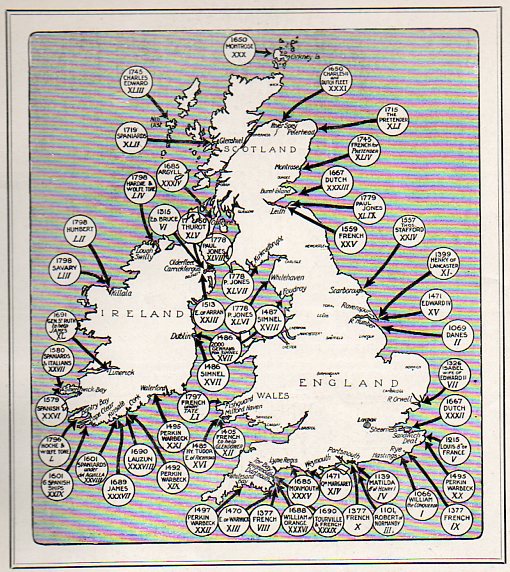
    But now for the  real stuff:  a map of the 54 invasions of Great Britain (and “the places at which foreign troops have landed on British soil since 1066 (and all that), seen in the Illustrated London News for 27 March 1909):

    Invasion--Us and England120

    And then this, where the WWII invasion routes were turned around: 

    Dunkerque124

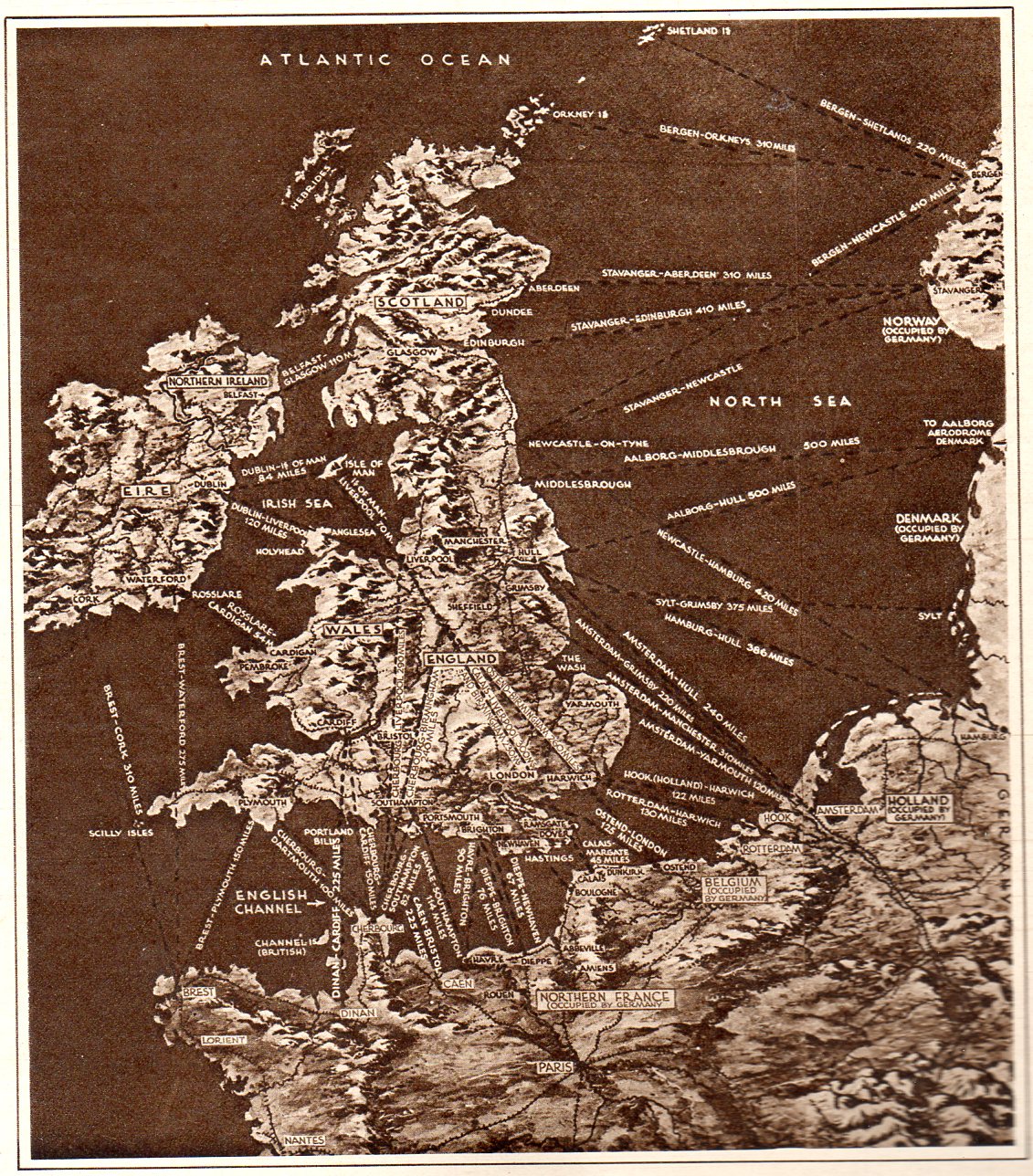
    This map pretty well tells the story of the perilous situation of Europe and England at the beginning of June, 1940.  It appeared in the Illustrated London News on the heals of Churchill’s “Blood, Soil, Sweat and Tears” speech, and was a very frank presentation of the wearing of the war.  By this point in the war Nazi Germany had successfully invaded Belgium, France, Luxembourg and the Netherlands, sweeping across Europe in a broad westward movement, backing up British and French troops all the way to the sea at Dunkerque, where a monumental rescue operation (“Operation Dynamo”) saved them.  (There was an enormous amount of materiel left there on the beach, a devastating loss for the British Expeditionary Force, nearly crippling it.) This was a bad time for the Allies, this part of the war coined by Winston Churchill in 18 June 1940 in the House of Commons by:  “The Battle of France is over. I expect the Battle of Britain is about to begin”. There was very little good that came of these few months for the U.K and the Allies, though four things do stand out: (1) as I just mentioned, the saving of 300,000+ troops at Dunkerque; (2) the resignation of Neville Chamberlain, (3) the coming of Winston Churchill  as Prime Minister of the U.K., and (4) the first deciphering of the Enigma at Bletchley.  Other than that, the situation was dim, and these invasion routes (published at t he very time that Germany was studying such a feat in its “Operation Sea Lion“, or “Unternehmen Seelöwe”). The endgame at Dunkerque took place almost four years to the day of the invasion of Europe, when the intent (though not placement) all of these arrows were turned around for the Allied operation at the Normandy beaches on 6 June 1944..

    And so, there it is–a presentation of several maps showing invasions, real and imagined 


  • Intel vs. Obelisk: The Renaissance Beauty of the Single-Chip Microprocessor

    JF Ptak Science Books       Post 1685

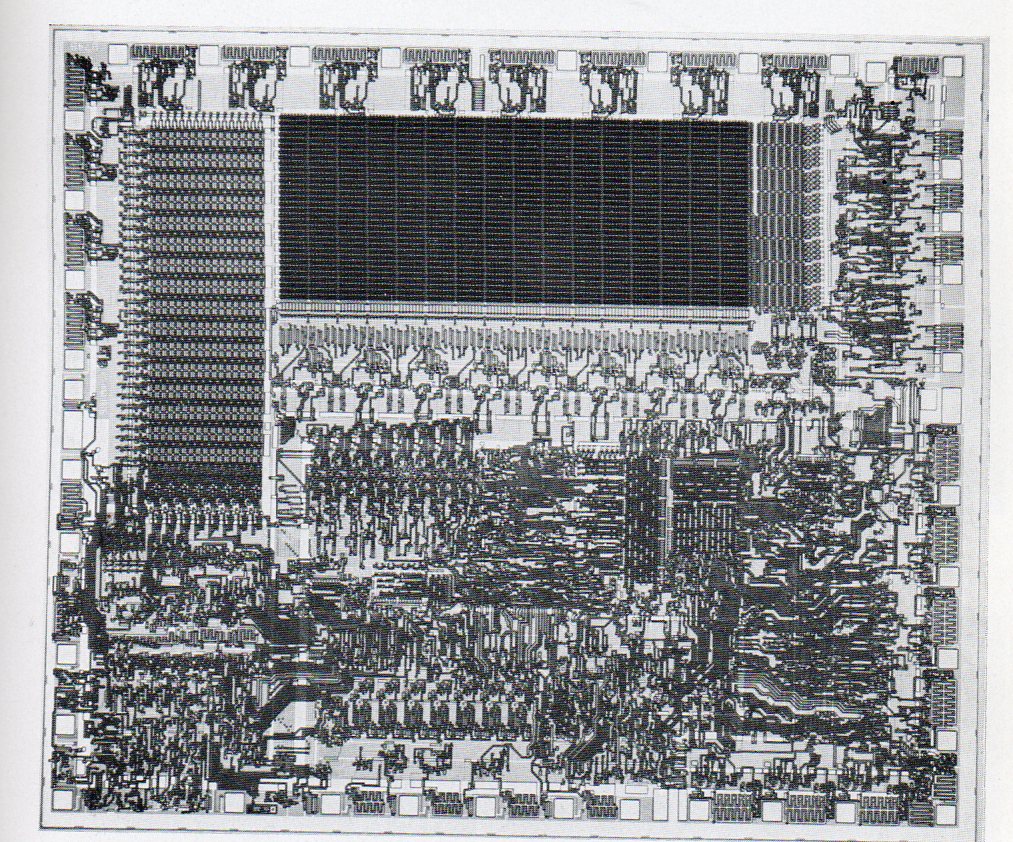
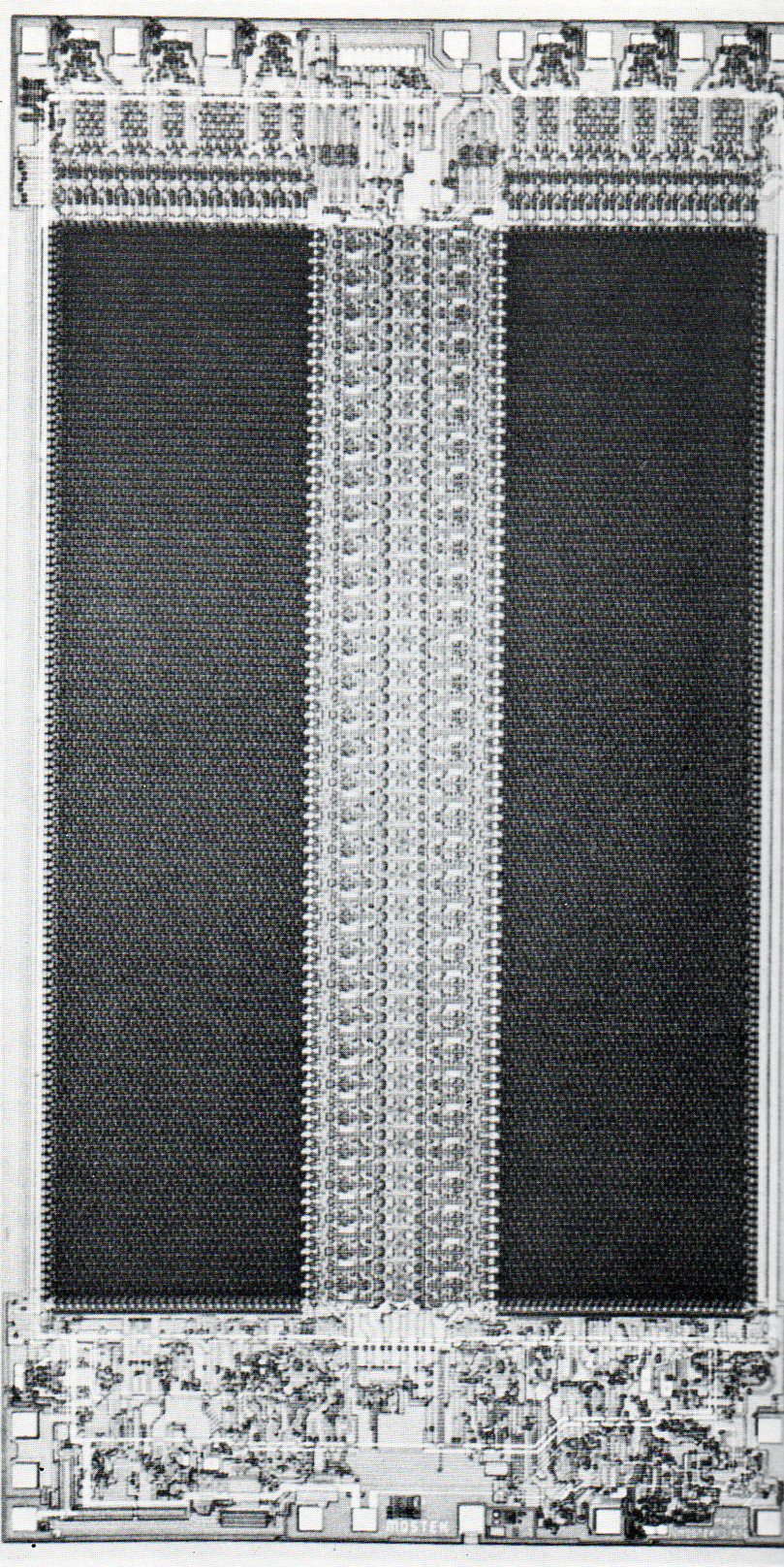
    The moment that I saw this image1 of (what I think is) the 8086 processor I thought of its great visual similarities to one of the greatest engineering works of the 16th century, so much so that with a little imagination, the older work seems a pentimento of the newer. This microprocessor–which in 1979 was a vast leap forward in development–looks like an architectural/engineering plan: large objects being hauled into place by legions of workers with wooden cranes, giant winches and mammoth rope, a fantastical display of concerted effort on a gargantuan scale.  It is, or was, in fact an enormous leap in hardware engineering, a micro-mammoth advancement.

    Fontana microprocessor209

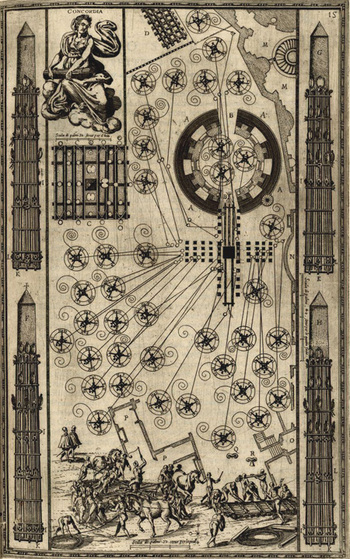
    This older, pentimento image is a plan for moving of the great 500,000-pound Egyptian Obelisk (carved during the reign of

    Blogfontana_moving

    Nebkaure Amenemhet II, 1992-1985 BCE, and originally standing in the Temple of the Sun at Heliopolis) at the Vatican.  The engraving appeared in Domenico Fontana’s  masterpiece Della trasporatione dell’obelisco Vaticano…(published in Rome by Bassa in 1590) and illustrated  one of the greatest engineering feats of the Renaissance.  Moving this enormous and relatively delicate object (from the Circus Nero, where it was placed by the emperor Caligula in 37 ACE,  to St. Peter’s Piazza del Popolo, 50 years or so before it would be more enveloped by Bernini’s flying wings) took years of (very) careful planning and months of motion and movement, not to mention an extra month to get everything into place and slowly raise the obelisk into its final position.  Fontana had to be cautious and correct, and he was, performing a not-so-minor miracle of pre-industrial magic to move the priceless 250-ton iconic relic and place it perfectly down in the center of Christianity.  That must have been one hot Roman summer, especially for Fontana.

    I can easily see the similarities in Fontana’s work and that of Intel. Here, in a photograph of the 16k bit random access memory chip (via Mostek Corporation) I can see a vast palace at the top of the picture, with a long, columned entrance with manicured gardens on either side.  The image offers an elevation and a plan–that is, the top and bottom images of the buildings are seen in a deeply oblique view, while the central part of the image is a straight-out plan.  At least that’s what I see, its imaginative possibilities more appealing than the physical realities (though that’s where the extraordinary value is/was).

    Fontana microprocessor 2210

    Notes:

    1. J.H. Westcott, “The Application of Microprocessors”.  In Proceedings of the Royal Society of London, A, 367, 451-484 (197 9(. 


  • On the Invasion of America (Part II)

    JF Ptak Science Books    Post 1686  Works in the Reverse Esteem of the Gettsburg Address

    “The cheek of every American tingle with shame as he reads the silly, flat, dishwatery utterances of the man who has been pointed out to intelligent foreigners as the President of the United States”–The Chicago Times, on the Gettysburg Address, 1863.   

    We all know today what to expect when we hear something referenced as a Gettysburg Address–and we certainly know what something might be if it was referenced as not-the-Gettysburg-Address. The address as it was when Lincoln gave it didn’t even have a title, named as it was post  facto by the newspapers and periodicals covering the event (on the spot or remotely).  The speech is considered as being among the greatest ever given by an American, though at the time it its reception was very mixed—in many cases it was seen as a failure and even as an embarrassment to the solemnity of the moment and place. There were many newspapers which panned the speech (as in the case above with the Chicago Times, which at the time was considered more of a Democrat paper than anything else), while others (like the New York Times gave the speech a warm reception.   The speech’s presence in national memory was crafted over time (not unlike Mr. Leonardo), its perception formed into the polished gem that it is seen as being today. 

    ==Blog July 15==bsttle for amer

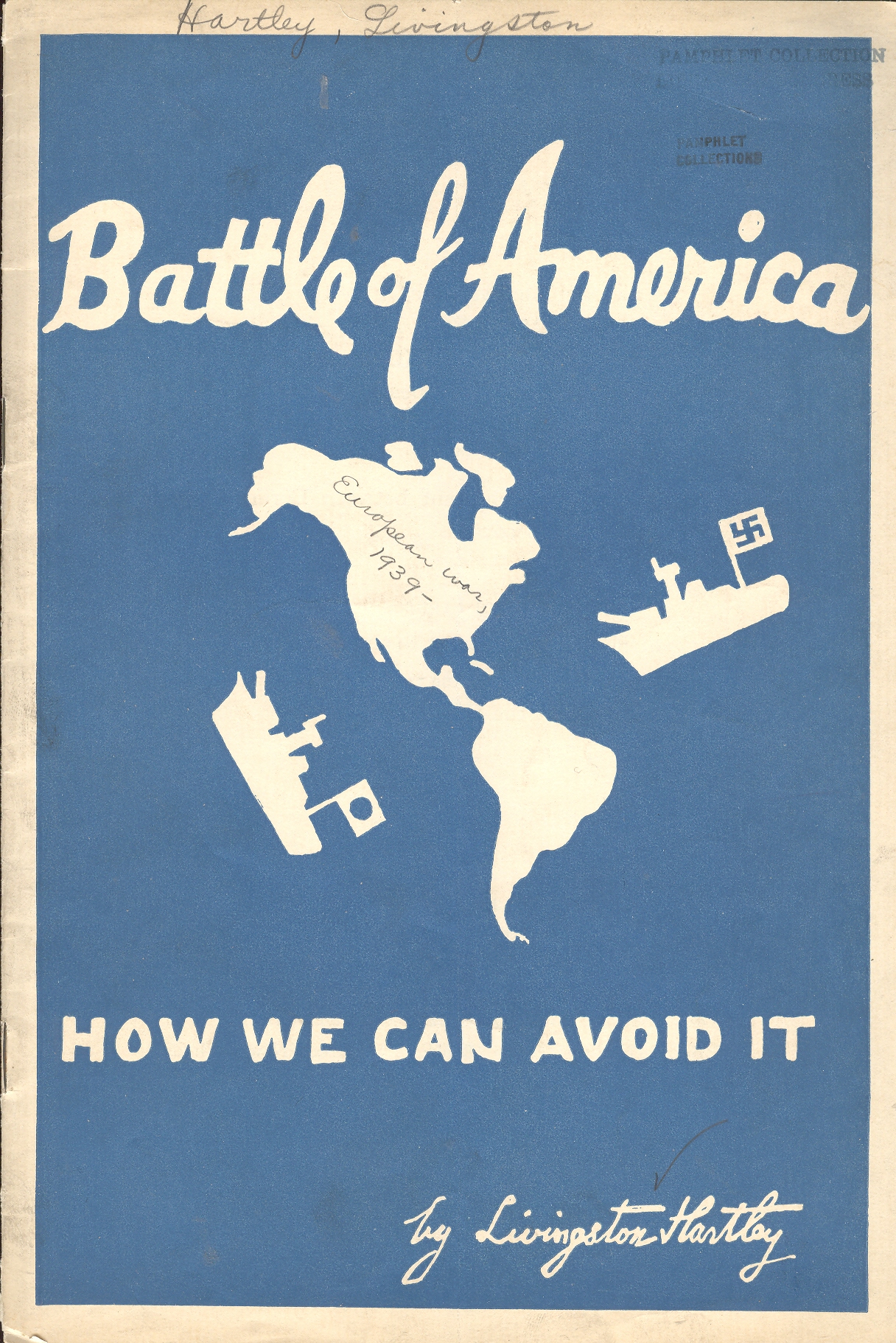
    The possibility of the implied actions of the titles of the pamphlet below were somewhat similar, though in reverse.  I’m not saying that some of them were always seen as quacky and the works of demented seers; their titles and possible content, though, were not seen as dismissible, and their concerns were real and a possibility. The concerns over “invasion” today depend on what invasion means.  I don’t imagine that people are seriously considering the possibility of a land or air force attacking this country, though other sorts of invasions (biological, chemical, cyber, etc.) are a possibility. 

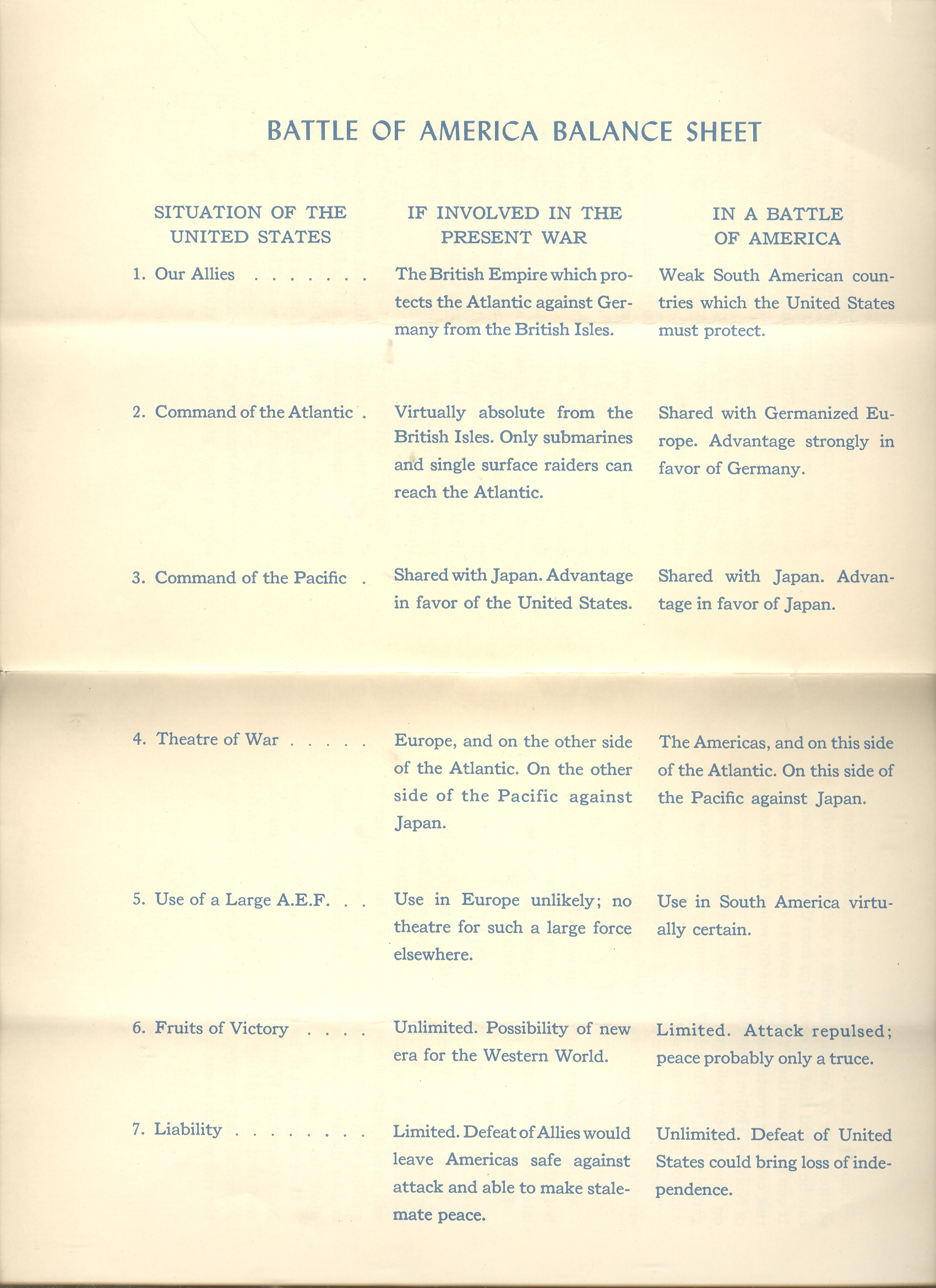
    The Battle for America/How We Can Avoid It (1939) was published by the Committee to Defend America by Aiding the Allies (and headed by William Allen White, iconic middle America newspaper editor and editorialist) which attacked isolationism and advocated strong support of the European effort.  The thinking here was that if America didn’t become involved now it would so later, with battle lines of a Nazi-illuminated truce drawn close to American borders.  So it was a pay-now-or-pay-more-later position from a man who supported the New Deal but whop didn’t support FDR.  ==Blog July 15==battle detail

    Much of this thinking looks a bit tenuous to me.  For example the position excluded the use of an American expeditionary force in Europe (“for theatre for such a large force elsewhere”), though if nothing at all were done there would be a “certain” use of the AEF in South America combating Nazism.  Also, if the U.S. backed the Allies with supplies and war materiel the “liability” to the US in the consequence of European defeat “would leave America’s fate against attack and able to make stalemate peace”.  So at the very least, doing a little bit of something would d at least allow us to make a truce with the German/Japanese alliance.   Doing nothing at all in this area would infer “unlimited” liability, and “defeat of the United States could bring loss of independence”. (“Could”?)

    The way aid ourselves in this war “(was) to aid  Britain to hold out to defeat Nazi Germany….the chance for Britain to hold out and win is a good risk for America”.

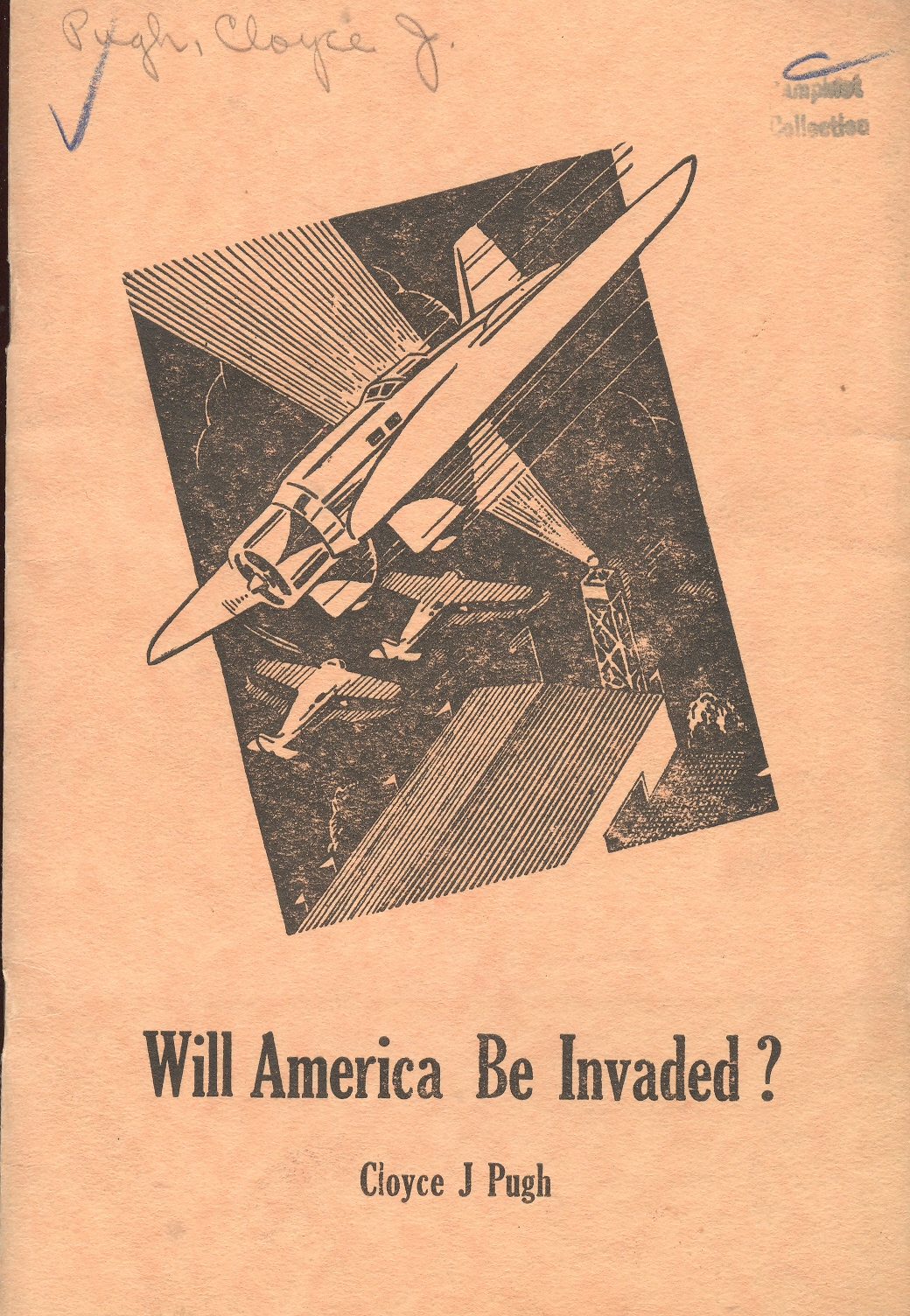
    The second pamphlet, Will America Be Invaded, was published by the Christian Fellowship Press in Akron, Ohio, in 1941, and leans mightily upon scripture to state assumptions about the coming menace to America being presaged in the Bible.  That invasion also seems to be allowed by God (according to prophesies and such) in pursuit of murky results.  The conditions which will prevail “when God permits invasion” (according to this person’s reading of the bible)) include the formation of monopolies, extensive wine and music, “unbelief in God’s judgments”, conceit, “wine and bribes in high places”, and “perverted moral stanfa5rds.  All of this—it is claimed—can be remedied through one medium:  prayer; and prayer through only one mediator, Jesus Christ, who would then take the communications to god’s ear.  

    ==Blog July 15==will america be

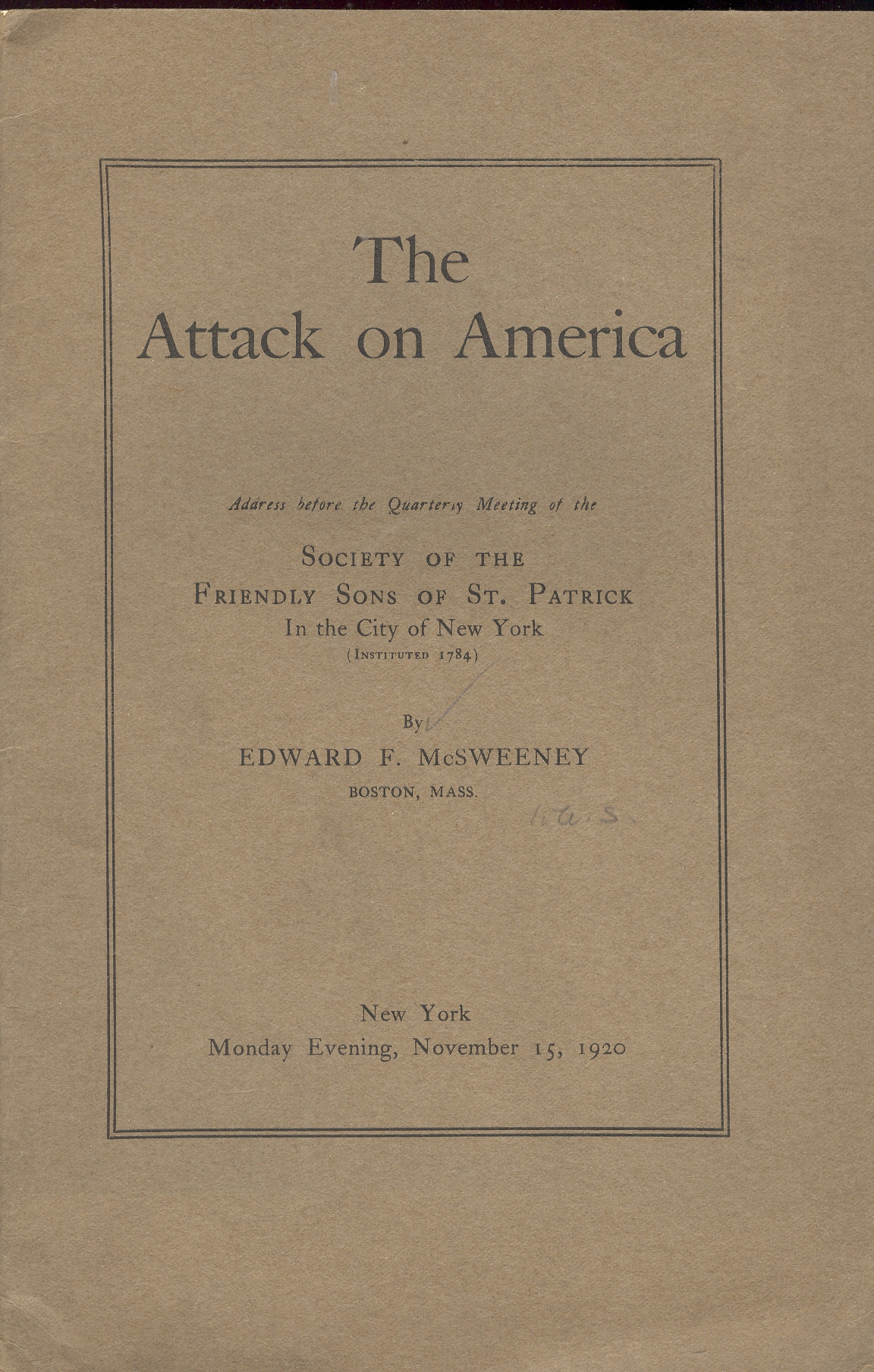
    The Attack on America, published by the Friendly Sons of St Patrick (of NYC), was a cautionary pamphlet published in 1920 warning against certain dispassionate evils of British propaganda in the United States.  Freedom or Enslavement for United States of America (sic), published in 1939 for the Mothers of United States of America (sic) advocated a freedom policy that prohibited conscription in foreign wars and would present a state of permanent neutrality. It also made some pretty vicious anti-Roosevelt attacks, finding him the Socialist root of the coming empire of American evils with a wildly power-mad and legislative-grabbing presidency.

     ==Blog July 15==attack omn amer

    Quite a grouping of pamphleteers concerned with the potential overthrow of the United States, each seeing the unfortunate possibility of national death via divergent and disparate means:  the fall of the country due to not being part of the Allies during the war and also for being in it; biblical ordination of invasion that is only combatable through prayer; British and European propaganda control of the national welfare; and of course the diabolical Socialist menace of Franklin Roosevelt and the imperial presidency as the ruination of the nation’s future.  All of this gently hidden by disturbing titles which really dont give you a hint about what wildly unexpected ways the end was approaching.  And whatever they were, they were definitely not high-order thinking.