A Daily History of Holes, Dots, Lines, Science, History, Math, Physics, Art, the Unintentional Absurd, Architecture, Maps, Data Visualization, Blank and Missing Things, and so on. |1.6 million words, 7500 images, 4.9 million hits| Press & appearances in The Times, Le Figaro, Mensa, The Economist, The Guardian, Discovery News, Slate, Le Monde, Sci American Blogs, Le Pont, and many other places… 5000+ total posts since 2008.

Category: Anticipation, History of

  • An Episode in the History of Anticipation: Death at Archimedes’ Door

    JF Ptak Science Books   Post 1665
    Archimedes021

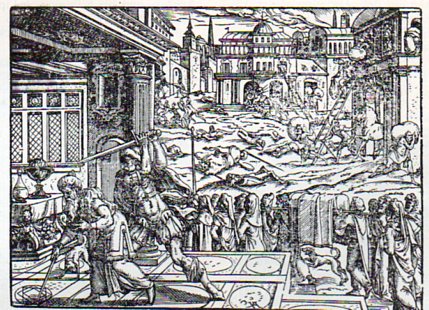
    Earlier in this blog there appeared an entry on the death of Archimedes–actually, it was a piece on an image depicting the killing of the great mathematician.  It is a pretty gruesome affair, even by the very early 18th century standards under which the engraving was made–gruesome still by today’s standards, what with the man’s head being cleaved laterally in two by the summoned Roman Centurion. I’m not an historian of these images of Archimedes, but I can say that for whatever I am, I have not seen anything quite so graphic dealing with the man’s death.

    The usual images of Archimedes coming to his end show him working a problem in his dust/sand/earth “chalkboard”, absorbed to such an extent in his thinking that he doesn’t hear the chaos outside his rooms, and doesn’t sense the approach of the soldier who finds Archimedes unresponsive to his calls and therefore a threat, and so kills him.
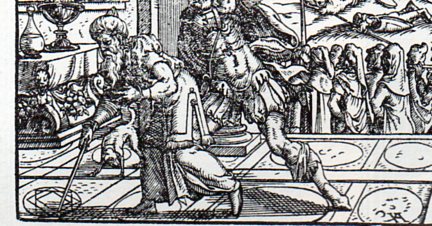
    Archimedes022[Image source:  Titus Livius, Romanae historiae principia, libri omnes.  Printed in Frankfurt by Feyerabend, 1578.]

    Looking at this image (above) brought to mind another in the history of anticipation–not knock knock knocking on Heaven’s door, but the opposite, and the opposite of that, the opposite of  knocking on Death’s door, or at Death’s door:  Death knocking at our door. 

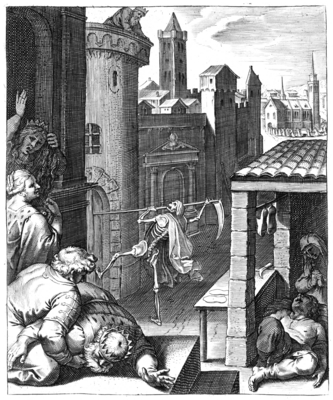
    The title of this emblem–Cunctos mors una manet/death is all that remains–is meant to remind us
    va1612099pict

    of our common foe.  It is the work of  one of the great engravers of his time, Otto van Veen (teacher of Rubens),  and appears (along with next image and 100 others) in his Q. Horati Flacci emblemata.  Imaginibus in acs incisis notisque illustrata, printed in Amsterdam in 1607 by H. Verduss.

    –All images and most translations courtesy of the splendid work at The Emblem Project/Utrecht, here.–

    Part of the legend (which appeared in four languages) of the image leaves us with the following reminders, choice bits on the folly of forgetting our common end:

    La terre embrasse tout comme mere commune –Mother Earth embraces us all

    Moritur sutor eodem modo ac Rex.–The King died the same as the shoemaker

    Death is the thing that sucks the rivers of lives, “Del rico al pobre, del soldado al Papa”, From rich to poor, soldier of the Pope.

    and so in image and word telling us that death will seek us out, whether king or shoemaker, rich or poor–and that in the coming end the Earth will take us all.  Archimedes didn’t hear that one coming; nor did he care, I think. 

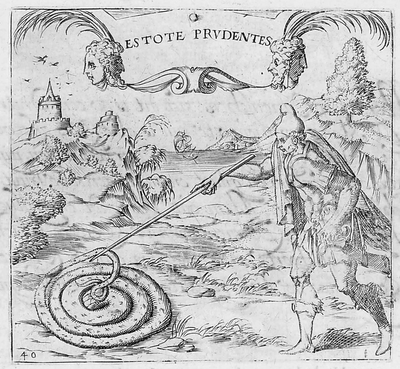
    THis last image brings to mind Archimedes’ work in the dust, though the intent of teh emblem (“Estote prudentes” //Be ye therefore wise // Be Cautious) wouold have been completely lost on him.

    The legend translates (Thanks to the Emblem Project for this):

    When the serpent sees that it is going to be attacked with,
    Lethal wound, it protects its head with artful care.
    Here lie the dwellings of the soul, the sanctuary of the truth.
    Hence comes life that is to be hoped for by every body.

    Surely Archimedes could relate to his lines and the expressions of his thought as the dwellings of his soul (if he actually believed in a soul), though I guess you could say that the artful deception of the serpent’s head finally wound up killing him via the Roman soldier.

    Letali serpens cùm se videt esse petendum
    Vulnere, sollicita contegit arte caput.
    Hîc animæ sedes positæ, verique recessus: (here placed the seat of the soul, in artful covering…)
    Hinc spiranda omni corpore vita venit
    av1615040pict


  • Prehistories of Famous Things series: the Cat in the Hat

    JF Ptak Science Books   Quick Post, expanded

    Ebay 12 3 seuss 1 closeup

     (One in a series on the preihistories of famous things, one of which is: Mandelbrot and the Pre-History of the Fractal, 1967-1975.)

     I’ve written here earlier on the 236 different words used to create The Cat in the Hat (Dr. Seuss and the 236 Words That Changed reading Forever), a book which I found to be a major accomplishment, a very difficult undertaking with superb outcome. [The  detail above is picked from the cover, below.]

    That is why I was struck seeing the cover of volume 1 of this rare two-volume set illustrated by the not-yet-famous Dr. Seuss (Theodor Seuss Geisel, 1904-1991, and son and grandson of brewmasters).  There is no question in my mind that the small head on the large-bodied serpent is that of The Cat in the Hat (TCITH, which sounds like an Egyptian deity). 

    Ebay 12 3 seuss 1

    TCITH might very well make its first forensic appearance here.  Seuss busily illustrated these two slim pamphlets for Esso Oil and Grease—they presented the rules of the water, and Seuss responded with funny inset illustrations and delightful chapter-ending slugs.  He also provided a number of Seussian/Rube-Goldbergian machines which mechanically overcomplicated (or “too-complexified” in Bushisms, (true)), which are both complex and simple, delightful.  


  • States of Perfection: Television Advertisement Images within Television Images, 1950

    JF Ptak Science Books  Post 618–expanded 26 Nov 2011   

    See also States of Perfection, the Archaeology of Refrigerated Meat, 1954. 

    Blog--tv future

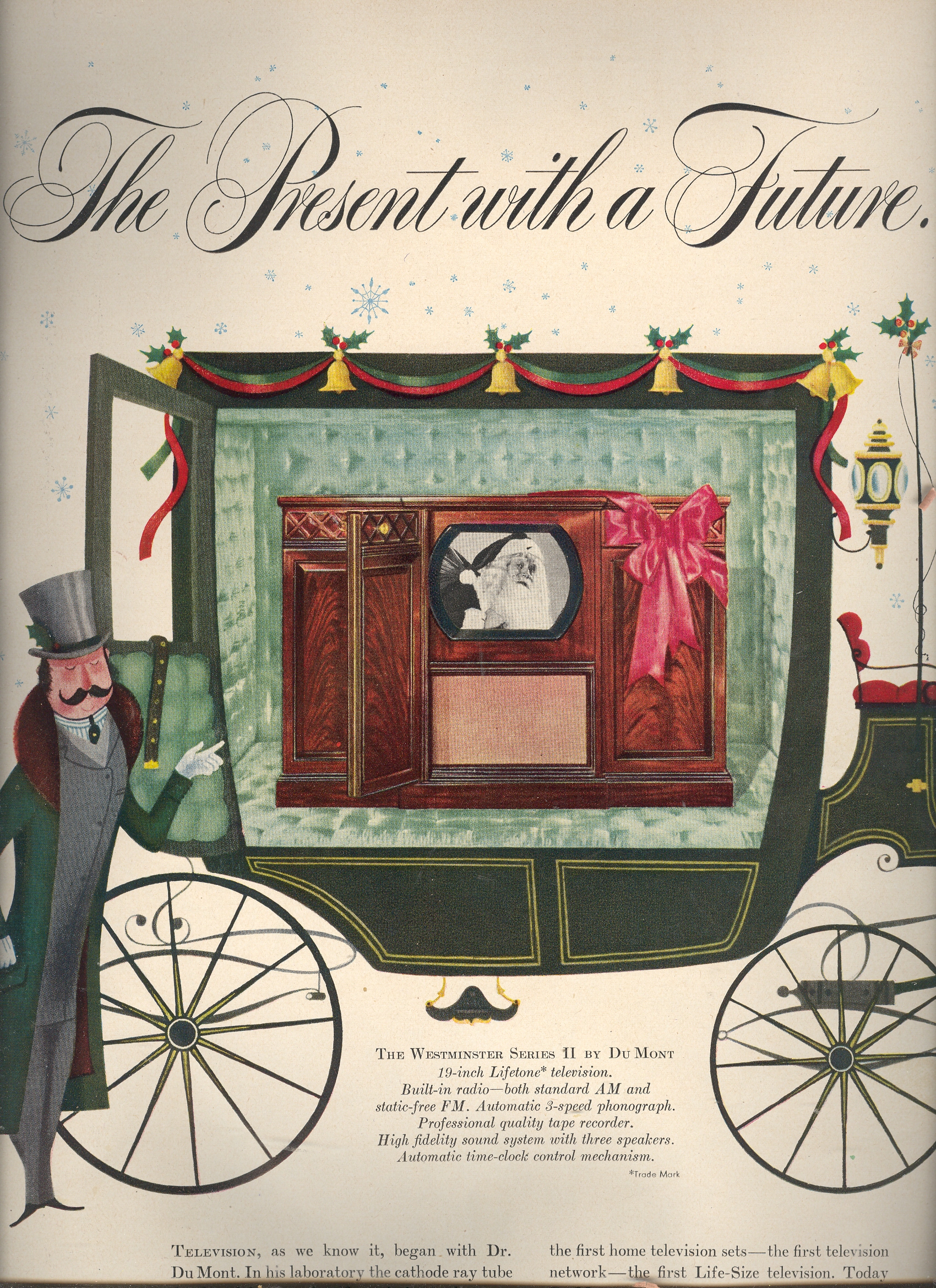
    The concept of the television started pushing its way obliquely into the literature as far back as the 1880’s (with Paul Nipkow’s 18-line resolution “electric telephone”), bumping up again with Arthur Korn in Germany around the turn of the century, and making its way through the ‘teens and early ‘twenties until  hit it big in 1927 with Phil Farnsworth’s “image dissector”. (Baird promised a hope with a mechanical version of the television, complete with a 30-line vi ewer, but it would very soon be replaced with electronic boxes with ten times the resolution.)  There were little or no stations available for viewing even though sets were manufactured and sold.  It wasn’t until the end of WWII  that the television industry took off—the increase in home-ownership of tvs exploded, beginning in 1950.*(A decent timeline of the development of tv is here.)

    Blog--tv future 001


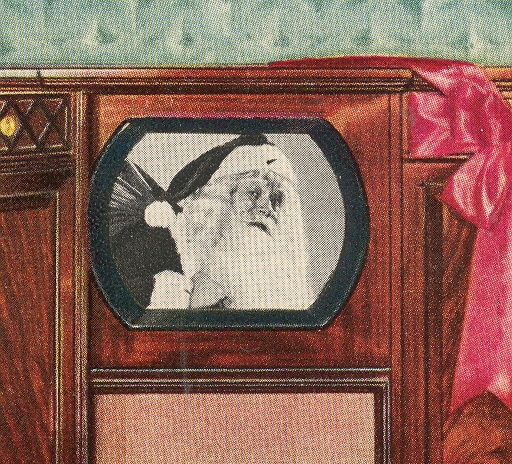
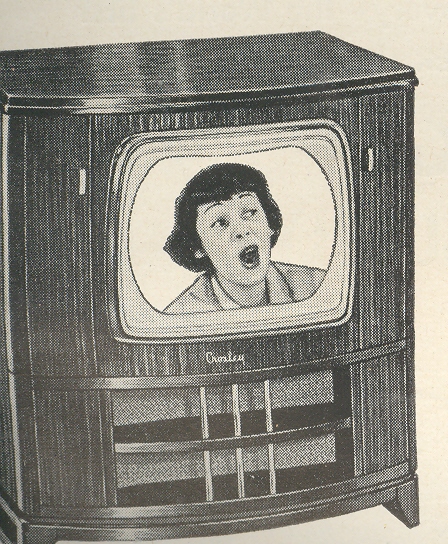
    While looking through a year’s worth of LIFE magazine for 1950 I was struck by the number of ads and the number of different companies selling televisions in the major print market.  But the creeping surprise for me were the images that were used in the tv sets that were pictured in the ads—images within images.  The pictures in the tubes were meant to be enticing, imaginative, imagery of the possible, displaying the possibility of entertainment–the possibility of losing yourself in the new medium.  It was an idea of fabulousness, of great expectations, of the promise of being swept away by the new convenience—and all of that rolled up in the pictures used in the ads. 

    Blog--tv 003

    Blog--tv 001

    To me, sitting here 59 years in the future, it is hard to imagine getting excited by any of these images—except Santa.  Even with the benefit of having looked at millions of images and having an historian’s occasional perspective on stuff, I just can’t appreciate these pictures in the ways that the advertiser meant them to be savored—and they were meant to be savored, as they were the libidinous bait to make the reader jump into the Hudson and buy the advertised set. 

    There are vocabularies for defining the breadth of fabulousness across difficult genres, like describing the fineness of a wine or the scent of a good desert rain.  Difficult perceptions to quantify and describe, but it is done and successfully so.  I can’t find the words fort these pictures. 

    Their fabulousness to the viewer in 1950 must not have been very long lasting—the images seem so contrary to being interesting, as they seem to project almost nothing at all.  I do get the overall effect of polite culture and a race at the occasional arts, but by and large the pictures were vanilla headshots of women.  


  • In Closing: “a Kiss from Your Beethoven”. Artistic and Literary Valedictions from the Master.

    JF Ptak Science Books   Post 1663

    http://farm4.static.flickr.com/3072/2554654204_1d32764d1b.jpg

    On how to end a letter.

    I’ve read pieces of Thayer’s Beethoven, and parts of the Conversation Books (the collections of rough notebooks that visitors used for written communication with the Master (1770-1827) once his hearing got too far away from him), as well as pieces of his journals and letters–which seem to me to be the most interesting part of reading about the man.  I find his writing style to be formal but surprisingly easy, and I’m continually enchanted by his valedictions–the way in which he signed-off a letter.  The man could leave you with a nice thought, especially in the way where he would begin his last sentence and incorporate that in his closing:

    (1795–to Franz Wegeler)  “I shall come to you myself and throw myself into your arms, imploring you to restore my lost friend, and you will give yourself to me, to your penitent, affectionate, never-forgetting,/ Beethoven once again”

    The sentiments seem fast and genuine and seem to be out-of-place with the man’s big, semi-unsure handwriting, which looks as though his efforts were accompanied by grunts while writing.  But his letters are really quite beautiful things, and a very interesting read; and as I said, the way in which he sent his letters off into space, the way he closed them, is exceptional and artistic.

    And so some examples:

    (1787)  “Your obedient servant and friend/”

    (1793)  “Your true and admiring friend/”

    (1793)  “Think occasionally of your still true and admiring friend/”

    (1794–to Schenk) “Farewell, and do not entirely forget your/”

    (1795–to Franz Wegeler)  “I shall come to you myself and throw myself into your arms, imploring you to restore my lost friend, and you will give yourself to me, to your penitent, affectionate, never-forgetting,/ Beethoven once again”

    (1798)  You will find Schuppanzigh here as well and the two of us will tease, cuff and shake you to your heart’s delight, a kiss from your Beethoven…

    (1800–to Wegeler)  “Always rely on the love as well as the friendship of your BEETHOVEN”

    (1800)  “Sometimes recall your truly admiring/Beethoven”

    (1800, to Franz Anton Hoffmesiter) ) “I hope that we shall often have occasion to assure one another how truly you ar emy friend and how I am/Your brother and friend/L v. Beethoven.

    (1800)  “Always rely on the love as well as the friendship of your/”

    (1800–to Pastor Amenda)  “Now, farewell, my dear kind friend! If by any chance I can serve you here, I need not say that you have only to command me. Your faithful and truly attached/”

    (1800–to Wegeler) “Rest assured of the love and friendship of your/”

    (1800–to Pastor Amenda) “Farewell, beloved, good, and noble friend! Ever continue your love and friendship towards me, just as I shall ever be your faithful/”

    (1801) “With great respect, I am your devoted/”

    (1802) “If you should think of any favor I might do you here, it goes without saying that you yourself will at once inform/Your faithful, truly affectionate, Beethoven”

    (1802) “Farewell, my dear, faithful Wegeler, rest assured of the love and friendship of your/”

    (1802)  “Even unto death, your faithful/”

    (1806) “Remain well disposed towards your friend/”

    (1807) “Farewell and do not forget your true friend/”

    (1808) “Friend Beethoven embraces you all”

    (1808)  I embrace you with all my heart and am your faithful friend/”

    (1809–to Zmekskall) “I come without any card from you, but I hope you will not on that account discard me. Yours truly–most truly, L. V. BEETHOVEN”

    (1810–to Wegeler)  “Think of me with kindness, little as I apparently deserve it. Embrace your dear wife and children, and all whom you love, in the name of your friend,/”

    (1810–to Zmeksall) “Ever remain my friend, as much as I am yours,”

    (1816–to G. Del Rio) “God, however, directs all things; so my position may undergo a favorable change, when I shall hasten to show you how truly I am, with sincere esteem, your grateful friend, / “

    (1817) “We have the honor to remain, most astounding Lieutenant-General! your devoted/GENERALISSIMUS” (Beethoven sometimes signed himself this way.)

    (1820, to Therese Makfatti)  “Think of me, and gladly, forget my follies, rest assured: no one can wish your life to be more carefree, even more cheerful than I do, even if you should feel no concern at all for your most devoted devoted servant and friend/Beethoven”

    (1824–to B. Schott’s sons) “In greatest haste, with greatest urgency and yet with the greatest brevity, your / “

    (1824–to Nageli) “I embrace you as one of the wise men of Apollo, cordially yours /”

    (1825–to a copyist) “Well, look after yourself. A thousand thanks for your devotion and kindness t me.  I hope you will not be punished for them. / Yours, with love and friendship, / “

    (1825–to Karl van Beethoven, his dead brother’s son and legal ward, and legacy of a complicated relationship) “May God grant my wishes, for never again shall I be capable of suffering on your account./ Unfortunately your father/or rather not/ Your Father”

    (1826–to Tobias Haslinger)  “With the most reverential reverence and fidelity, yours, / “

    (1827–to B. Schott’s sons) “Pity your devoted and respectful friend, / “

    (1827–to Pasqualati) “May Heaven bless you generally and for your affectionate concerns, / With your respectful,/ suffering Beethoven”

    (1810, to Archduke Rudolph)  “Well, it really makes me laugh to think how Your Imperial Highness consider me even on this occasion; for this, assuredly, my whole life long I shall remain, Your most obliging servant, /”

    One of the valedictions in the “series” of letters to his famous and as-yet-unknown2 “Immortal Beloved” in July 1812 goes so:

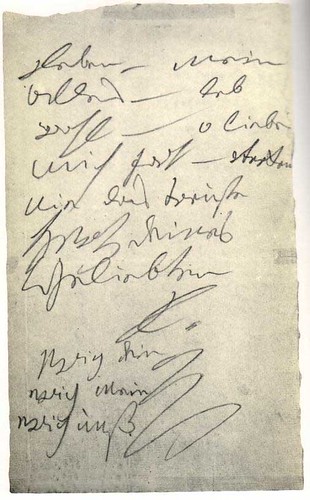
    “be calm – love me – today – yesterday – What yearning with tears for you – you – you my life – my everything – farewell – oh continue to love me – never misjudge the most faithful heart of your Beloved/ L”

    and also:

    (1807, to Josephine Brunsvik) “never misjudge the most faithful heart of your beloved L”

    And of course he could start a letter, too, as we can see here in his start of the towering love letter to his Immortal Beloved (above):

    “My angel, my everything, my very self. – only a few words today, and in pencil (with yours) – I shall not be certain of my rooms here until tomorrow – what an unnecessary waste of time – why this deep grief, where necessity speaks – can our love exist but by sacrifices, by not demanding everything. Can you change it, that you are not completely mine, that I am not completely yours? Oh God, look upon beautiful Nature and calm your mind about what must be – love demands everything and completely with good reason, that is how it is for me with you, and for you with me – only you forget too easily, that I must live for myself and for you as well, if we were wholly united, you would not feel this as painfully, just as little as I would – my journey was terrible…”  

    But we’ll leave the beginnings to another post.


  • Three Great First F’s: Forks, Forts, Fission, (and one plain non-first F (Nobel))

    JF Ptak Science Books   Post 1645

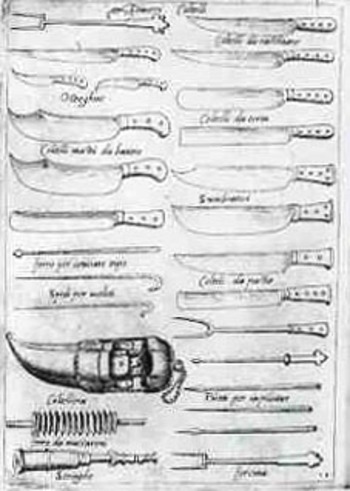
     Apropos of nothing whatsoever, I’d like to look at four “first” F’s.  the first is the first known published image of a fork , or forcina in Italian.  This was a prickish utensil (seen in the image at the bottom-right), hiding none of its stabbing qualities with a middle tine, and shows for us all its direct decent from Mother Knife.  It appears in the Opera dell’arte del cucinare by the great Renaissance chef  and cook to Pope Pius V Bartolomeo Scappi (c. 1500 – 13 April 1577, buried in the church of SS. Vincenzo ad Anastasio alla Regola, dedicated to cooks and bakers) was published in 1573.

    Blogfsfork210
    In the book he lists approximately 1000 recipes of the Renaissance cuisine (some of which, for Renaissance salads, appear at bottom) includes many images of kitchenware, the fork being perhaps the most famous.  (I used to know the first time that a fork appeared in a painting–of the Last Supper of course, but I’ve forgotten, though it does come right on the heals of Scappi.)

    Blogfsfort211_2

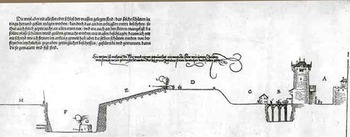
    The second unrelated but interesting first “F” is perhaps the first image of a modern, canon-proofed fort, by none other than Albrecht Durer.  This image appears in 1527 in his Etliche underricht zu bestestigung der Stat, Schloss und Flecken, and although his designs were impracticable (massive and massively expensive forts and fortified cities; pretty but very costly), there were certain elements of the work that were very useful—namely, the new face of some of te walls that he offered to the modern canons of the 1520’s.  These weapons were vast improvements over their earlier brethren, and Durer responded to the extra and more accurate firepower by lowering and thickening the walls and giving them greater slope—this would aid in deflecting many of the shots that were not directly spot-on, and also would improve the chances of the fort’s survival against those hits by having thicker walls. 

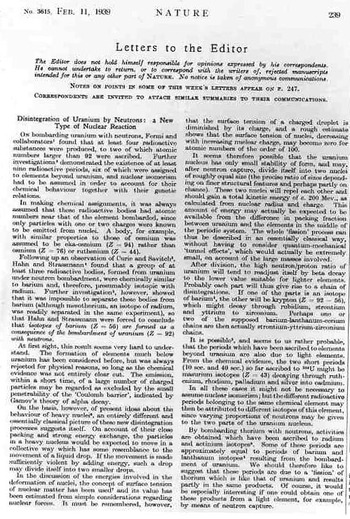
    The third F is slightly related to Durer’s fort walls—this is the first appearance of the word “fission”.  It appeared as so many of these sorts of 20th century announcements appeared with great sotto voce--this one, in a “Letter to the Editor” of the journal Nature (11 February 1939), by Lise Meitner and Otto Frisch.

    Blogfsfission212
    The communication, “Disintegration of Uranium by Neutrons:  a New Type of Nuclear Reaction”  wasn’t a letter to the editor in the conventional sense of course but was meant to be the quickest line of communication of an important result and thus appeared somewhat truncated though the great stuff of the announcement was made known and understood.     Niels Bohr’s “The Mechanism of Nuclear Fission” in the Physical Review (1 September 1939) may I think be the first use of “fission” in the title of a paper.) 

    There is a very big story here with Meitner and fission and Nazis and the Nobel.  This leads to our fourth F:  and that would be “F” as in “Failure” to the Nobel committee who in 1944 awarded the Nobel Prize to (German, non-Jewish) Otto Hahn for the discovery of nuclear fission while completely ignoring (purposefully, I would say) Meitner, who really, by all  rights, should’ve gotten the award, and probably by herself.  This is a more complex tale than I would care to deal with now, but I think that it is beyond doubt that the Nobel committee again (think Einstein and others) severely screwed this up in favor of maintaining their dislike for people with Meitner’s heritage.  (And yes, she was Jewish; Einstein suffered too at the hands of the committee, not receiving his award, unbelievably, until 1921, *16 years* following what was probably the best single year  that anyone ever had in the history of physics, ever, and then 14 years following his great year of 1907 and five years following 1916’s paper.  And so on.)   Yes, Meitner hung on in a not-good way in Germany for six bad years 1933-1938) until she finally get the hell out, but that really doesn’t tell the story very much.  The fission bit with Hahn and Strassmann is a little bedeviling, but it really was Meitner who recognized the whole thing as being the process of fission.  Period.  And shame again on the Nobel people for getting it wrong, again, on purpose. 


  • On Describing the Jobs of the Working Poor, Part 2: Friedrich Engels on Miners in England, 1845

    JF Ptak Science Books  Quick Post  (An addition to the post on George Orwell and his descriptions of the working poor miners of England.)

    Friedrich Engels (1820-1895) traveled to England to work for the English subsidiary of his family’s textile business, settling  into Manchester (and Salford)  in with a keen and ravenous eye.  He didn’t have the eloquence of a George Orwell, but he had more than enough to capture the essence of what he saw and to see deeply into what he suspected; and what he saw of course was not very pretty so far as the condition of the working poor was concerned. 


    So when he was in his early twenties, Engels researched and wrote about what he saw in the Industrial Revolution in the great smoking city of Manchester, grown from a city of 79,000 in 1811 to nearly 300,000 in forty years, seeing for himself the class struggles that he (and his new friend Karl Marx) would write about in Das Capital just four years later. What came of his work in Manchester was The Condition of the Working Class in England.  Dedicated to the people of England, it would not be available in English for another 43 years (at which point the “in 1844” was added to the end of the book’s title). [The images above and below of Manchester show the city ca. 1840, when the life expectancy was around 30.] He probably would have been very surprised to see that  the revolution he wrote about didn’t take place in England; and doubly so to see that the home of the revolution was Russia. 

    Working Conditions is seen as one of Engels’ greatest achievements, both for his insight and reporting and of course for what the work would contribute to Capital.  [The full text is found here.]

    He writes:

    “But these are not all the evils which descend upon the head of the coal-miner. In the whole British Empire there is no occupation in which a man may meet his end in so many diverse ways as in this one. The coal-mine is the scene of a multitude of the most terrifying calamities, and these come directly from the selfishness of the bourgeoisie. The hydrocarbon gas which develops so freely in these mines, forms, when combined with atmospheric air, an explosive which takes fire upon coming into contact with a flame, and kills every one within its reach…”


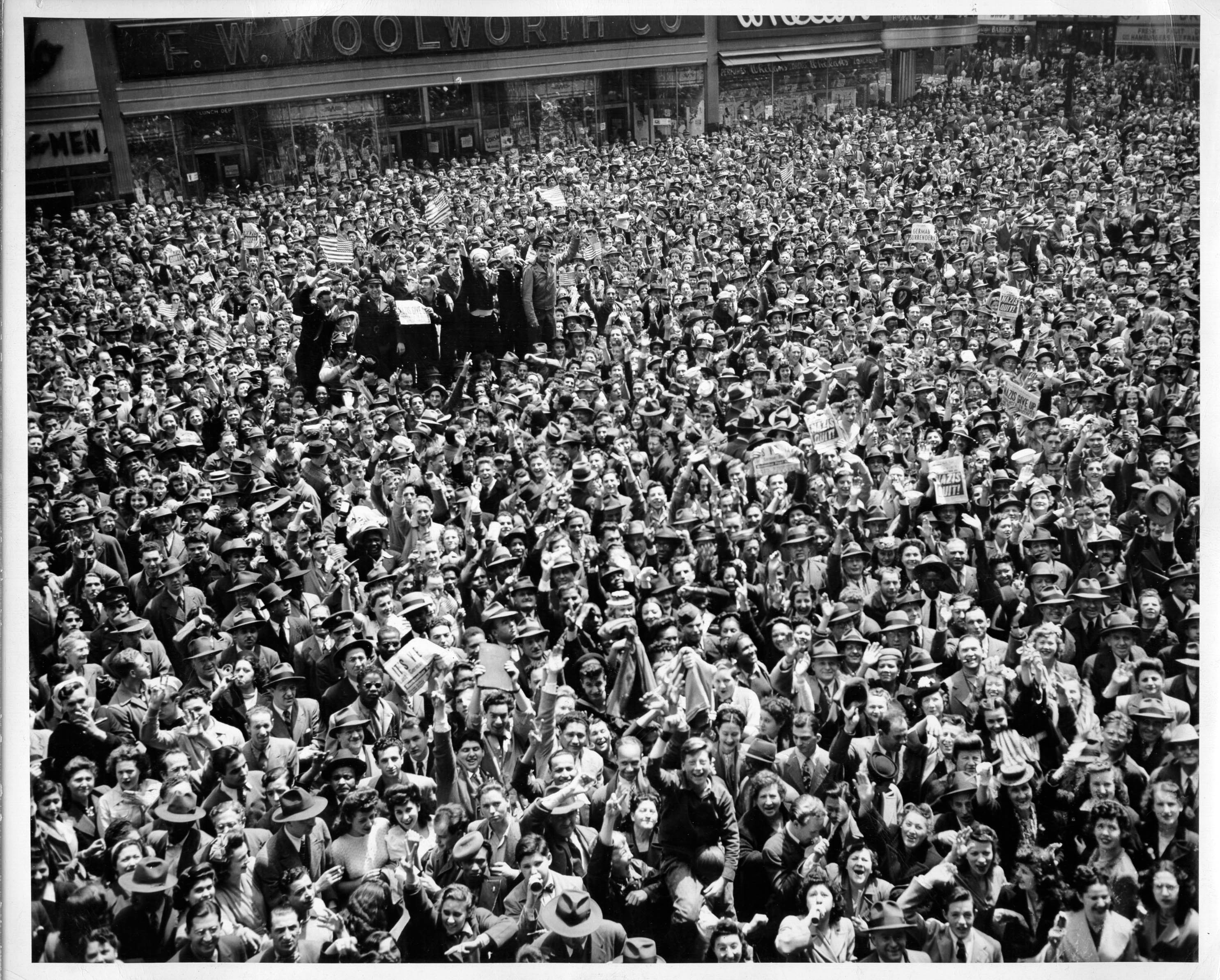
  • Crowd Series–VE Day, May 1945

    • Ephemeral Uniqueness in Large Crowds, here.
    • Crowds and the Press of Humanity:  WWI German POWs, here.
    • The Chaos of Hats, here.
    • Crowd Series and Berlin Expectations, here
    • Clarity and Confusion in the Display of Human Masses, here
    • Large Crowds and Singular Persons Series–3 Images.  Here.
    • Servicemen and B-17s at the End of WWII, here.
    • Imaging Mass Casualties in WWI, here.
    • Relief in Capture: Churchill in Carthage and what 230,000 POWs Looks Like, here.
    • The Detail is in the Detail: What 20,000 Soldiers and 1 Mule Look Like, 1918, here.

    ·Posted by :

    ·in:

    —

  • First Printed Views of America: Columbus in Print in 1493

    JF Ptak Science Books   Quick Post

     Christopher Columbus was born in 1451, and born sometime over a three-month period that no one seems to be able to button down.  He (known as Christophorus Columbus in Latin, and Cristoforo Colombo in Italian and Cristobal Colon in Spanish)  and in an audacious dash to shortcut European rivals in trade with the East became one of the first Europeans to explore the Americas.  In his first of four voyages to what would be called “the New World”, he landed in the Bahama archipelago, and in time explored the Greater and Lesser Antilles, Central America, and the Caribbean coast of Venezula, claiming all for the Spanish Kingdom. 

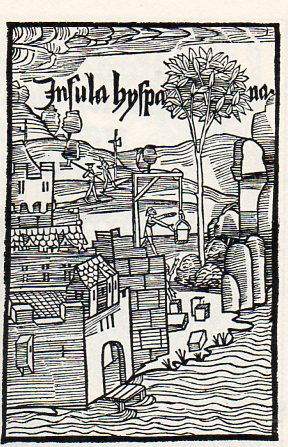
    The first images of his adventures appeared in Oceanica Classis, printed by Johann Bergmann de Olpe, in Basle, in 1493–the first, below, showing an imaginary view of the Island of Hispanola.  In the image of Insula Hyspania, below, we see Native peoples running from the approaching ship and long boat–they of course did not run far enough. (By the end of the 1620’s, something like 75% of the indigenous population in contact with Europeans (or in contact with people in contact with them) were dead, mostly from epidemics and diseases and lesser illness for which they had no immune systems.)

    Columbus933

    Four (of the other eight, two of which were repeated)  images from this fantastic work can be seen below:


  • Television Field Trials, the Beginning of the “Networks”, and the First T.V. Dinner (1936)

    JF Ptak Science Books     Post 1632

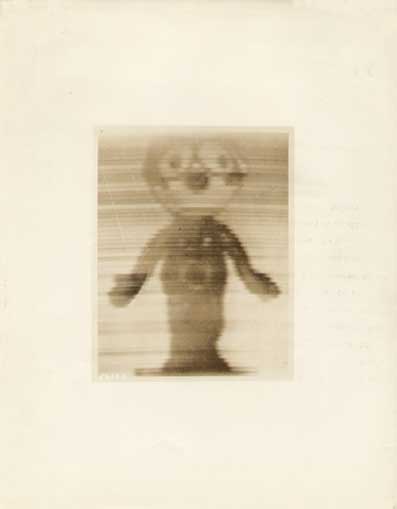
    The first broadcast images in the history of television transmission were revolutionary if not very interesting.  Beginning in 19028 the first experimental Radio Corporation of America (RCA, via the National Broadcasting Company, NBC, its broadcasting division) images were of Felix the Cat, and something that would be received with 60-line clarity on a two-inch display.  For the most part, the daily two-hour broadcasts consisted of Felix or test patterns, broadcast from NYC, until 1931.  

    Image quality increased markedly by the 1932 field trials with the use of iconoscope cameras, which allowed for 240-line reception though still with very noticeable flickering. The 1934 trials were improved further to 343 lines and with some less amount of flicker. 


  • The First Personal Computer (?)–“Simon”, 1950

    JF Ptak Science Books  Post 1631

    Berkeley simon915
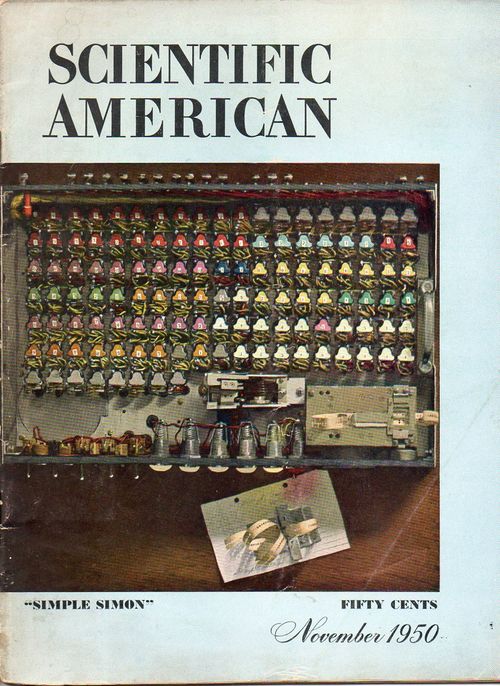
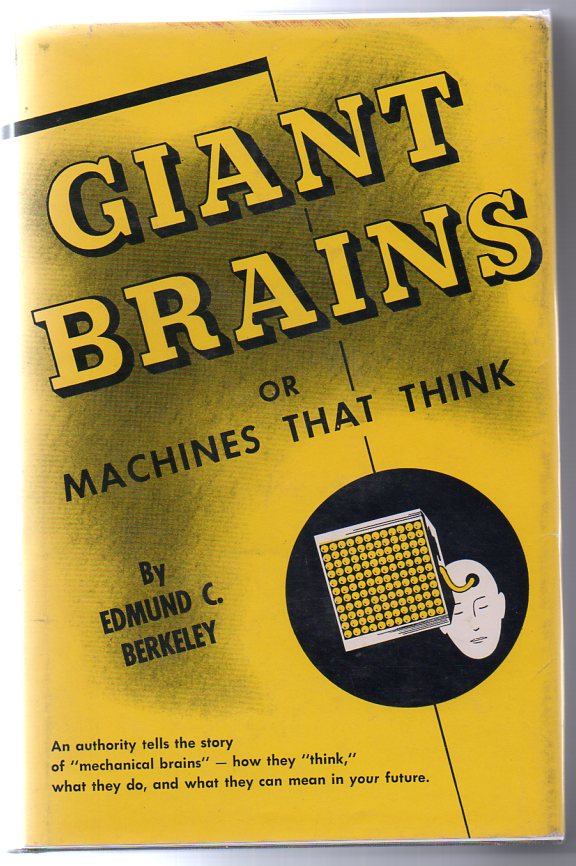
    The first exposure of the American public in general to a “personal computer” may have been in this issue of the Scientific American for November 1950–an article called “Simple Simon” by Edmund Berkeley.  ( Berkeley also wrote a book called Giant Brains, which seems to me to be the first mass-consumption book–written in terns for the general public–on how the computer works, and the design of “how a machine will think”.  Berkeley looks at the MIT Differential Analyzer #2, the Moore School ENIAC, Bell Labs’ General-Purpose Relay Calculator, and the IBM Automatic Sequence-Controlled Calculator.) 

    The Simon was a five-hole paper tape (which was its data entry and memory) 2-bit storage relay-based computer that could use numbers from 0 to 3.  It was extremely limited, but it worked, and it was real.  And affordable.  And a baseline for things to come.   [The original issue of the magazine can be found in our blog bookstore section, here.]

    Berkeley introduced the idea for Simon in Giant Brains:

    “We shall now consider how we can design a very simple machine that will think.. Let us call it Simon, because of its predecessor, Simple Simon… Simon is so simple and so small in fact that it could be built to fill up less space than a grocery-store box; about four cubic feet….It may seem that a simple model of a mechanical brain like Simon is of no great practical use. On the contrary, Simon has the same use in instruction as a set of simple chemical experiments has: to stimulate thinking and understanding, and to produce training and skill. A training course on mechanical brains could very well include the construction of a simple model mechanical brain, as an exercise…”–Edmund Berkeley, in Giant Brains, 1949, p. 22

    In the Scientific American paper Berkeley introduced the machine and how it functioned; he also described three  three outcomes for Simon:

    First: “Simon itself can grow.  It possess all the essentials of a mechanical brain…”

    Second: “It is likely to stimulate the building of other small mechanical brains.  Perhaps the simplicity and relatively low cost of such machines may make them attractive to amateurs as the radio set and the small telescope.”  [The “low cost” in 1951 was $600–equal to about $3000 today.]

    Third:  “It may stimulate thought and discussion on the philosophical and social implications of machines that handle information…”

    Berkeley finishes the three-page article with the following paragraph, looking into the not-too-distant future:

    “Some day we may even have small computers in our homes, drawing their energy from electric-power lines like refrigerators or radios … They may recall facts for us that we would have trouble remembering. They may calculate accounts and income taxes. Schoolboys with homework may seek their help. They may even run through and list combinations of possibilities that we need to consider in making important decisions. We may find the future full of mechanical brains working about us.”

    BERKELEY, E.C. (1950). Simple Simon in Scientific American, No. 183, November 1950, pp. 40-43.

    Giant Brains221