A Daily History of Holes, Dots, Lines, Science, History, Math, Physics, Art, the Unintentional Absurd, Architecture, Maps, Data Visualization, Blank and Missing Things, and so on. |1.6 million words, 7500 images, 4.9 million hits| Press & appearances in The Times, Le Figaro, Mensa, The Economist, The Guardian, Discovery News, Slate, Le Monde, Sci American Blogs, Le Pont, and many other places… 5000+ total posts since 2008.

Category: Anticipation, History of

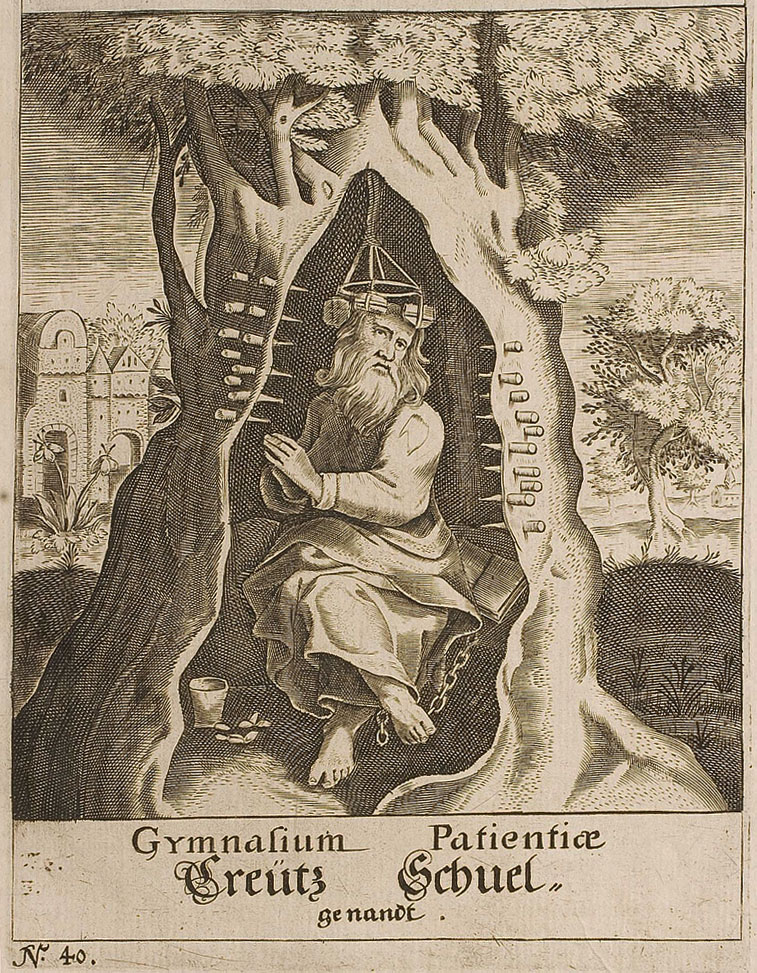
  • Ten Celestial Punishments for Impatience, 1630

    JF Ptak Science Books      Post 1674

    (Thanks to Bibliodyssey for finding this image–you can find the great Bibliodyssey site here.)

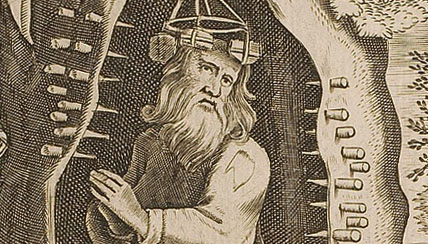
    Killing tree DETAIL


    And the full image:

    Killing tree

    And the source: Jeremiah Drexel, Gymnasium Penitentiae, 1630, and translated in 1640 as The School of Patience (the full text here) and the pdf of the Latin original here.)

    In the introduction to his work Drexel writes:

    “Dame Patience stands in place most eminent,
    Teaching her youths a doubJe document.
    That learn they must to form a passive right
    This pateint life, or else in future night
    That Paradise no plurail hath since sport
    and ease take pains at last in Pluto’s court”

     
    And should the teachings of Dame Patience not be heeded, even on Earth the impatient should suffer from at least these ten forms of torment:

    Whatsoever form of punisment, whatsoever kind of affliction or exercise in this world we affect, may be comprised and comprehended  in this tenfold order. For God hath in this his School of Patience  these following torments:

    (1) Rods;  (2) Arrows ; (3) Firebrands; (4) Garlands of straw; (5) Cudgels; (6) Snares and Chains; (7) Knotty clubs; (8)  Long clones; (9) Scouges or whips; (10) Sacks and bags.


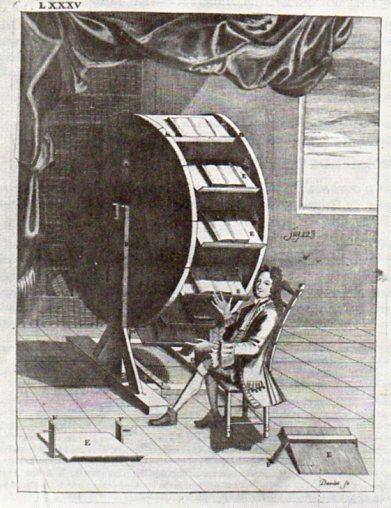
  • A Heavy, Round, Wooden 17th Century Interweb–Two, Actually.

    JF Ptak Science Books    Quick Post

    booksnbuildings: kunstwissenschaftlerin:   ook wheel illustration in Agostini Ramelli’s Le diverse et artificiose machine del Capitano Agostino Ramelli (Paris, 1588). 

    Since there was no controllable source of electricity in the 17th century, there would need to be an alternative to delivering multiple sources of data to a seated recipient or researcher.  In these two instances, this issue was solved with wood–big wood.  And as we can see, the reader could choose from 12 different data sources–books–while not having to rise from the chair. 

    [Image source:  Agostino Ramelli, Schutzkammer Mechanischer Kunste, Leipzig, Georg Liger, 1620–a tall, thick book with 195 full page illustrations like this for all manner of invention and convenience.]

    Interweb 18th c045

    [Image sourceNicolas Grollier de Serviere, Recueil d’Ouvrages Curieux de Mathematique et de Mechanique...printed in Lyon by David Forey in 1719–another good-sized book with 85 full-page (Copperplate) engravings.]

    It also seems to me that there could be some doubling up on the placement of the books, allowing 24 of them to be displayed; there might also be something that could be done with a sliding shelf so that those two could be doubled, allowing 48 books to travel ’round at a time. This would be a huge boon to the reader here in  1620 and 1719, if that’s the way you were measuring “boons”.  It would be nice to have all of those sources open and available and neat, but one longish table would be good enough for that.  and certainly more furniture would be available to people contemplating having one of these monsters built for them because in almost all cases only the wealthy of the religious orders could possibly own 12 or 24 or 48 books at this point in history, so space would not have been a problem, necessarily. 

    The one thing that this interweb had going for it over the existing version–all of the sources used were vetted.


  • Episodes in the History of Dropping Things–Baby Bombs, Bomb Babies and Dropping Women on Manhattan

    JF Ptak Science Books   Post 1670

    Dropping things036In the history of dropping things–as distinguished from simple falling things–it must be said I think that this is the easiest of all human activities ever invented, and people have been trying to improve on this creation ever since.  After all, almost anyone can do it and–if you include pushing things over a ledge so that they might fall–most complex life forms can do it, too. 

    Of course there have been intellectual and technological adaptations, particularly when you include throwing and shooting things so that the objects have been charged with a “created height” so that they will be dropped in the designated location.  Cannons have been particular benefit to this aspect of advanced dropping.  And then of course there are the “Galileos” of dropping–like Galileo–and Jonas Moore and David Letterman and of course Seinfeld’s Kramer, and to a lesser extent there’s also every other person from the Boston area who represent hundreds of millions of people who drop a letter from somewhere in their spoken vocabulary.  There are people who drop their accents altogether, and of course politicians who drop the truth, and the tantilizers who drop suggestions, and paid-for pharmaceutical consultants who drop the untoward test results and their accountants who drop a zero when necessary.

    [Image source:  June, 1936, Popular Mechanics.]

    People drop options, they drop in and out and off, pennies and dimes, lawsuits and dumplings, coverage and names and the f-bomb.  They also drop dead and bombs, the last two being closely related, though more people “drop dead” when bombed because they are killed. 

    Bombs seem to be the biggest of all dropped things, especially bombs dropped by airplanes, and especially those bombs dropped on collections of people, which are called cities.

    Perhaps one of the strangest things to be dropped, though, is the following, found in  the September 1935 issue of Popular Mechanics

    Dropping things 2038This was a model of sorts for a critical-care-parachute-gurneystretcher, or something, for when a crew member of a U.S. Army Air Force aircraft was injured and needed care, though the article doesn’t specify where the person would be dropped. Overall it seems not the height of workable ideas, and suffered no doubt from its model using a baby doll, which just looks altogether wrong. 

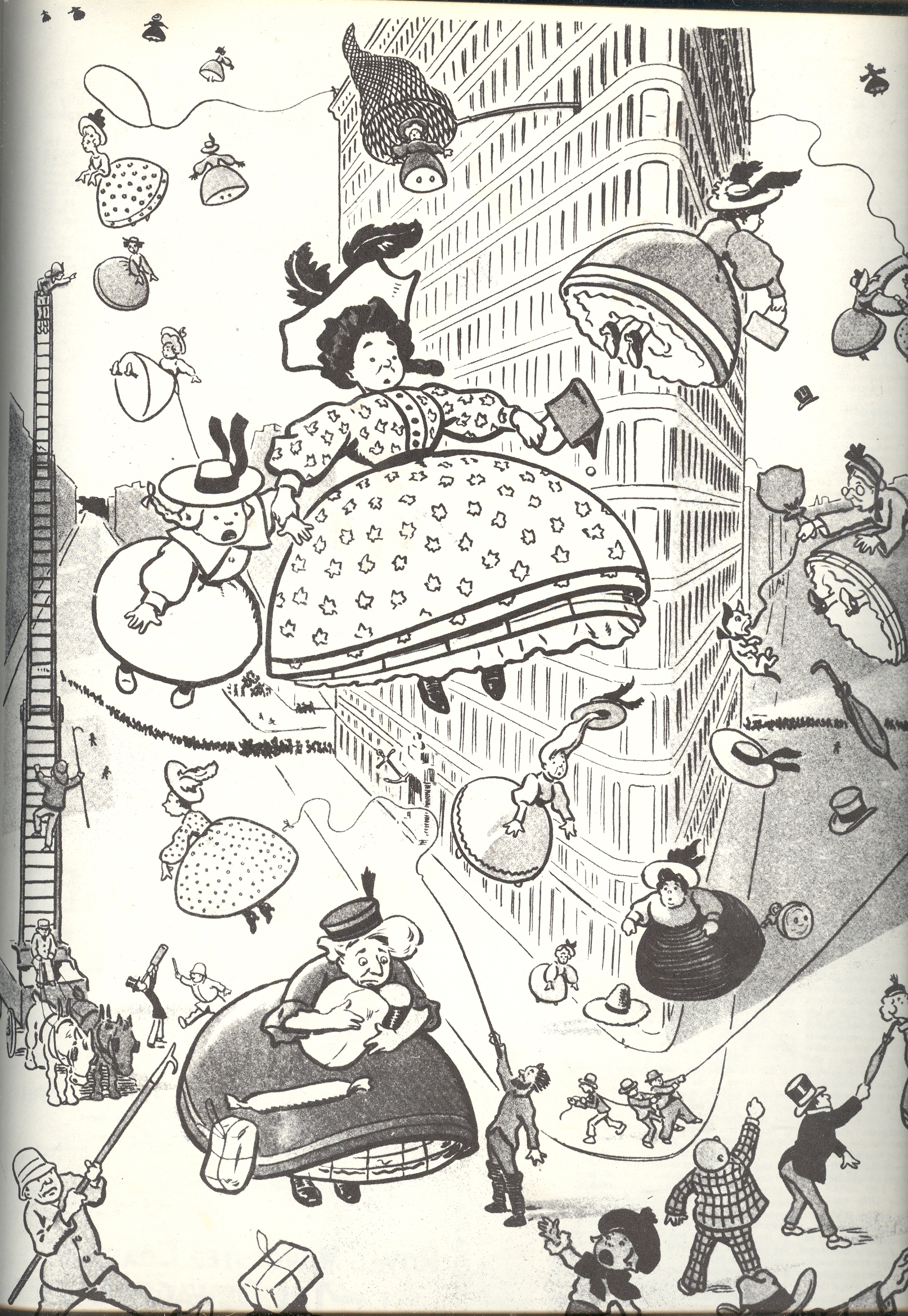
    And the last part of this episode is another strange bit:  dropping women on Manhattan. The  image comes from 1904 and–when taken out of context–it seems as though Manhattan is in for the worst of it, with a view in front of the Flat Iron Building of an aerial bombardment of women.  This is probably one of the few bad things that weren’t done with/at women, and would actually significantly predate the first use of explosives being dropped from aircraft.  Unfortunately the original, intended image was a poke at  crinoline  and featured women being blown up into the air rather than the other way around, though I like my interpretation better.

    5-women


  • On the End of the World Worries–1524

    JF Ptak Science Books   Post 1669

    End of the world035
    People have been worrying about the end of the world for as long as they have realized that the world could have an end.  The more-modern concerns for world-ending collisions with asteroids is relatively recent and does have a lot of truth to it; likewise the ending of large lifeforms on the planet via nuclear holocaust, which came very close to being in a number of situations over the last 55 years or so.  Less convincing arguments have been made through biblical interpretations and resurrections of ancient myths about the coming end-of-times because of of confluence of floating numbers which are after all is said and done just numbers and not actually attached to very much.  There have been untold numbers of predictions and world-end scares, but reality was not at all accommodated.  (An interesting end of the world date prediction timeline appears here.)

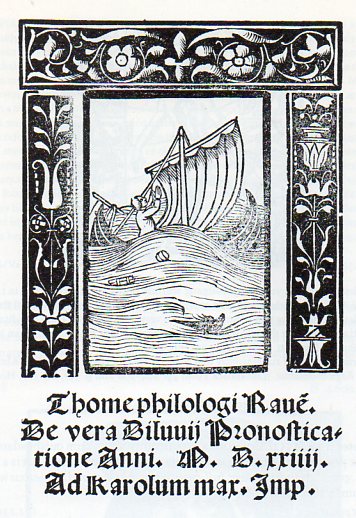
    One of the earliest printed menaces scaring people into believing that the world was coming to an end appeared in 1524, when a conjunction of the planets in the constellation Pisces was supposed to be similar to that which appeared in the times of Noah and in the sign of Aquarius. The conjunction plus the bits about Pisces and Aquarius evidently lead to the belief among some that there would be a great flood. There were over one hundred pamphlets published on this topic in the early 1520’s, though to be fair the bit about Noaic deluge was evidently an outrigger–most of them it seems (at least to Lynn Thorndike) were argumentative over one principle or another of astrologic practice. 

    Of the many people who addressed this topic–including Machiavelli, Luther, Apian, Rabelais and Vives, among many others–was Tommaso Gianotti (Rangoni) (1497-1577), who gave his predictions this fantastic woodblock visual life in his work De vera diluvii prognostications (and printed in 1522).  It was 16 pages long, and was one of many such slim pamphlets–his, though, did have this marvelous illustration.  I think the blank sky helps set the sunken world and the collapsing boat of mankind into stark contrast on what lay ahead. (Gianotti led a long and distinguished career teaching logic (Padua) and astronomy (under the direction of Pope Leo X) as well as astrology (Bologna), and managed to outlive his many dire predicitons by half a century.)


  • The Earth & Cosmos as Balls–Renaissance Emblemata and Charlie Chaplin

    JF Ptak Science Books   Quick Post

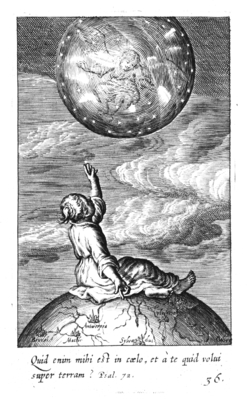
    Quid enim mihi est in caelo & a te quid volui super terram?

    (For what have I in heaven, and from thee what thou shalt do I desire upon earth?)

    Hermannus Hugo, Pia desideria (1624)hu1624036pictEvidently, there’s plenty left open to desire and want while still here on Earth–not the least of which was Heaven, or the Heavens, as we can see in this playful engraving from Hermanus Hugo’s Pia Desideria (printed in 1624).  With the Earth as a given, why not want more from the Heavens? 

    On the other end of this equation is being on Earth and wanting it–all of it. Charlie Chaplin, in his great and enormously insightful and satisfying film, The Great Dictator, styles the film’s title character after Adolf Hitler, and delivers a performance of great depth. 

    THe film was released in October,m 1940, when most of the world had been at war with Hitler and Germany for more than a year.  The United States was not, not yet (for another 14 months) though we participated in programs that meant assurance for the delivery of materiel and other materials necessary for the Allies to continue the war.  Chaplin was a savage in his attacks on Hitler, relentlessly so–and as such this was the first major American film to take such a stand against Germany in WWII. One of the great scenes of the film and perhaps of all films in the 1940’s was Chaplin’s dancing Hitler and his love affair with world domination:

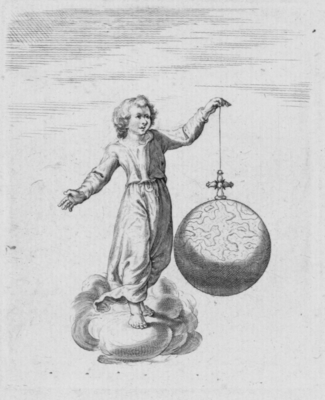
    In Jan Suderman’s De godliebede ziel (printed in 1724) we see yet another rendition of the Earth and its favor with humankind, as  as ort of balanced bit at the end of a fragile connection

    el1703001pict

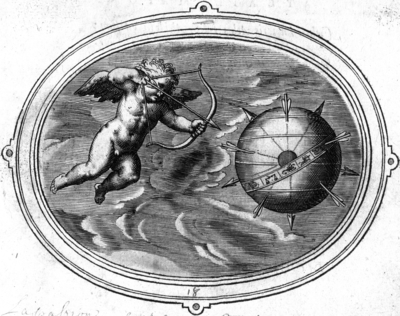
    While in Otto Vaenius’ Amorum emblemata (printed in 1608) we find a cupidesque emblem shooting the Earth with his arrows, all of which takes place under the motto “Love Keeps Everything in Essencve”, or “all Depends upon Love”, or some other variation:


    v1608018pict

    The litle God of loue transpearseth with his dartes; The heauens and eke the earth in musicall accord; For without loue it were a chaos of discord; Thats fastned now in one of well conioyned partes.

    The seemingly finished product of the love-arrowed-Earth can (possibly) be seen in Otto Vaenius’s Amorum emblemata (1608), telling us that
    Love permeates and sustains the whole, though.
    Love permeates all that breathed or not.

  • Life Elsewhere: Europa, 1940.

    JF Ptak Science Books   Quick Post

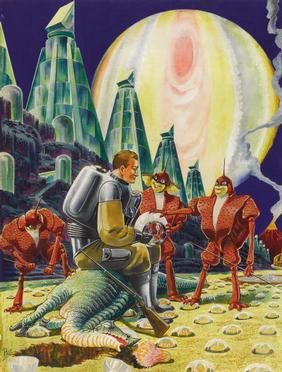
    After watching a BBC series on the planets on Netflix, and having the idea of life on Jupiter’s moon Europa addressed, it occurred to me that I’ve seen the answer to this before.  And here is is, by Frank Paul, “Life on Europa”, created for the back cover of Amazing Stories, September 1940. (From the Frank Wu website, much of which is dedicated to Mr. Paul. 

    Sci fi art--europa
    Mr. PAul settled the issue, which he perhaps made up just that morning–I am particularly impressed by the globular units on t\he surface, plus, of course, the very interesting beings talking with the human explorer. 

    But in general Paul had a very large landscape for his deep well of life forms, sometimes seeming as though they were infinite.

    And all of this done without the benefit or cause of Roswell.  It seems to me, though, that if offered the choice between believing in a universe of teeming life versus just that which we experience here on Earth, I’d choose the former instantly, and get right on board the Frank Paul train. 


  • Echoes from the Memory Hole–a Book that Set the World on Fire

    JF Ptak Science Books   Post 1670

    Dort, wo man Bücher verbrennt, verbrennt man auch am Ende Menschen.“–Heinrich Heine, saying that if people burn books, they’ll burn people, too, which have been proven to be the case.
    av1615052pict

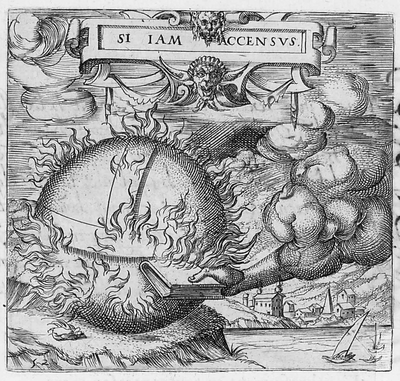
    Usually this story goes the other way around, where people of the world set books on fire–or entire libraries on fire (like the House of Wisdom, Baghdad, in the 13th century), some of them more than once (and in the case of the library at Alexandria, six times.)  Books are burned in repulsion and revulsion not only by their readers but also (and in greater numbers) by rulers who don’t want their potential readers to have any potentiality, or potential, reversing the flow of unwanted information back to the source. (The illustrious and esteemed have burned people as well as the villains–Thomas More sentenced John Tewkesbury, a London leather merchant, to the flames for “approved burning” for keeping banned books; for good measure More also had the works of Martin Luther burned, as well.)This later has a very long history, which is taken a step further when said leaders reach out to burn the books and their authors, sometimes at the same time.  This infamously happened to Michael Servetus (1511-1553, and who I wrote about here) and of course many others, entire castes of scholars burned or buried for being in the way.

    https://historyofideasblog.com/a/6a00d83542d51e69e20128779f1418970c-pi

    [Engraving of Servetus, being a good double-portrait showing him in the high life and then, in the upper left corner, being burned alive for his political activities ans for his books, which disturbed the notion of the heart-centered body and seat of all wisdom much favored by the clergy, replacing it with his notion of the heart as a muscle, as a functioning part of the body rather than its seat of wisdom.]

    The first mass, organized book burnings in the United States were instituted for self-preservation of an economic way of life–local merchants banned together to form book burning brigades for the threat to their livelihood, the Sears & Roebuck catalog, which I wrote about here.  Not quite on the scope of rejecting the lives and works of authors of what were deemed to be salacious or threatening to the core of the social structure, but in the long run perhaps they were something approaching that.

    The “Memory Hole’ is the euphemism for the dispatch and destruction of books in George Orwell’s 1984, not too far removed from the institutionalized book burning in Fahrenheit 451, though seemingly a furious leap forward from Reverend Lovejoy from The Simpsons.

    Reverend Lovejoy: “Oh hello Lisa! Can you recommend any books for my mobile?”Lisa: “Ooh absolutely! Well you know, anything by Jane Austen.”Reverend Lovejoy: “Jane Austen. Thanks Lisa, I’ll get right on it!”(Reverend Lovejoy drives away and reveals his Book Burning Mobile.)

    Reverend Lovejoy: “Oh hello Lisa! Can you recommend any books for my mobile?” Lisa: “Ooh absolutely! Well you know, anything by Jane Austen.” Reverend Lovejoy: “Jane Austen. Thanks Lisa, I’ll get right on it!” (Reverend Lovejoy drives away and reveals his Book Burning Mobile.) [Thanks to The Lisa Simpson Book CLub.]

    And for the first emblemata, above, comes the legend:

    Alta Dei flammas vox toto suscitat orbe, God’s voice on high stirs up flames in all the world,
    Dum nimis auerso mens mala corde furit. While all too strongly the evil mind rages with averted heart.
    Sed pia mens humilis paret. Sic excoquit aurum,  But the pious mind obeys in humility. So the furnace melts out gold,
    Et paleas eodem deuorat igne focus  and with the same fire devours the chaff

    And as it turns out the book to set the world on fire is the Bible, which is I guess appropriate given the number of books sought out and burnt by Mother Church, though I must say that far more books were banned than burned.  (I think so, anyway–there’s a number of iterations of the list of banned books–the Index Librorum Prohibitorum–which was kept from the mid-16th century to the mid-20th. I think that there is no massive list for books that were both banned and burned.)  Its a harsh-looking metaphor, particularly given the story of the Flood.  

    And in some cases the Bible-burning metaphor was hardly that but an actual event, and tragically ironic in the case of William Tyndale.  Tyndale was a scholar who among many other rich things brought to bear a new translation of the Bible done into English, which was a first, and which greatly displeased the ruling head of England at the time, King Henry VIII.  Henry had already burned translations of the Bible that he could not abide and thought heretical–not the least reason of which would have his multiple marriages condemned–and continued on to not only do so with Tyndale’s work, but also to Tyndale himself.  At the end of a long and complex story, Tyndale was found to be a heretic, and in 1536 was strangled to death on a platform before a large crowd, his head chopped off, and his body burned. After a few years Henry authorized multiple new translations of the Bible to be printed, all based on Tyndale’s work.  Tyndale stayed dead, though–his work had an enormous impact on other English translations of the Bible, not the least of which is the King James Version of 1611, where the overwhelming majority of the NT and OT was Tyndale’s.

    http://images.wikia.com/simpsons/images/1/1b/Book_Burning_Mobile.jpg


  • Episode in Anticipation: Large Groups of POWs, 1918

    JF Ptak Science Books   Quick Post


    Wwi photo german mass prisoner det

    (21) L.1094 - Massed German prisoners, France, during World War I


  • An Episode in Anticipation: the “All is Lost League”, November, 1918.

    JF Ptak Science Books    Quick Post     

    German Prisoners of WWI, November 1918.

    The odd thing about this series of prisoners of war is that they may or may not have been worse off than had they been in their own trenches, sinking in their own mud, eating their own questionable food.  At least since they were now detained and behind British lines, no one was trying to kill them. 

    Wwi--german pris sling detAnd the ful limage:

    Wwi--german pris sling

    [Original reads: ‘OFFICIAL PHOTOGRAPH TAKEN ON THE BRITISH WESTERN FRONT. Captured in the last push. A member of the A.I.L.L. (All is lost League).’]

    I have made numerous posts on this blog using images from my archive of American news service WWI photographs, though there are few depicting scenes just after the end of the war’s end on 11:00 a.m. on 11/11/11. These photographs below do so, and all come from the National Library of Scotland (which can be accessed here). They are all “British Official War Photographs”, which was a service similar to its American cousin–various news and photo agencies were given access to images produced by a pool of photographers, all of which passed by the eyes of a military censor. They were for the most part aimed at the “correct” version of the news, though given the subject matter there were plenty of images that were extremely powerful.  In a war that claimed 100,000,000 casualties, the photographic image was a powerful war-time propaganda tool.


    (18) D.549 - Boche prisoner, wounded and muddy, coming in on the 13th

    A British soldier aids a wounded German POW.  A French photographer tries to avoid the image in background. 


    (18) D.549 - Boche prisoner, wounded and muddy, coming in on the 13th


    ·Posted by :

    ·in:


  • An Episode in the History of Anticipation: Death at Archimedes’ Door

    JF Ptak Science Books   Post 1665

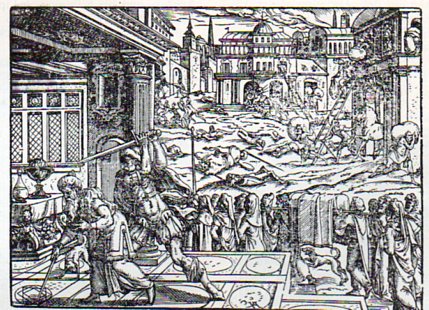
    Archimedes021

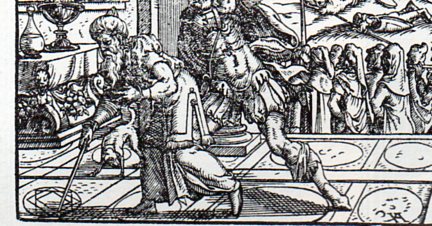
    Earlier in this blog there appeared an entry on the death of Archimedes–actually, it was a piece on an image depicting the killing of the great mathematician.  It is a pretty gruesome affair, even by the very early 18th century standards under which the engraving was made–gruesome still by today’s standards, what with the man’s head being cleaved laterally in two by the summoned Roman Centurion. I’m not an historian of these images of Archimedes, but I can say that for whatever I am, I have not seen anything quite so graphic dealing with the man’s death.

    The usual images of Archimedes coming to his end show him working a problem in his dust/sand/earth “chalkboard”, absorbed to such an extent in his thinking that he doesn’t hear the chaos outside his rooms, and doesn’t sense the approach of the soldier who finds Archimedes unresponsive to his calls and therefore a threat, and so kills him.

    Archimedes022[Image source:  Titus Livius, Romanae historiae principia, libri omnes.  Printed in Frankfurt by Feyerabend, 1578.]

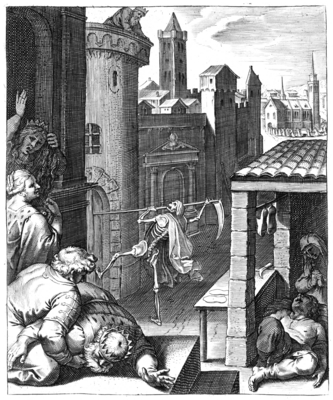
    Looking at this image (above) brought to mind another in the history of anticipation–not knock knock knocking on Heaven’s door, but the opposite, and the opposite of that, the opposite of  knocking on Death’s door, or at Death’s door:  Death knocking at our door. 

    The title of this emblem–Cunctos mors una manet/death is all that remains–is meant to remind us

    va1612099pict

    of our common foe.  It is the work of  one of the great engravers of his time, Otto van Veen (teacher of Rubens),  and appears (along with next image and 100 others) in his Q. Horati Flacci emblemata.  Imaginibus in acs incisis notisque illustrata, printed in Amsterdam in 1607 by H. Verduss.

    –All images and most translations courtesy of the splendid work at The Emblem Project/Utrecht, here.–

    Part of the legend (which appeared in four languages) of the image leaves us with the following reminders, choice bits on the folly of forgetting our common end:

    La terre embrasse tout comme mere commune –Mother Earth embraces us all

    Moritur sutor eodem modo ac Rex.–The King died the same as the shoemaker

    Death is the thing that sucks the rivers of lives, “Del rico al pobre, del soldado al Papa”, From rich to poor, soldier of the Pope.

    and so in image and word telling us that death will seek us out, whether king or shoemaker, rich or poor–and that in the coming end the Earth will take us all.  Archimedes didn’t hear that one coming; nor did he care, I think. 

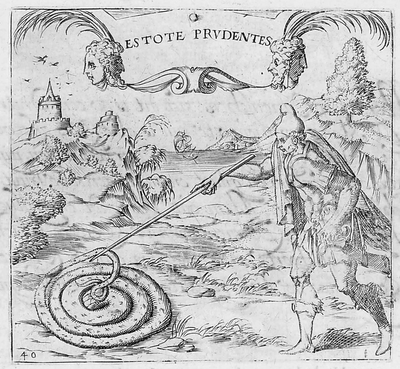
    THis last image brings to mind Archimedes’ work in the dust, though the intent of teh emblem (“Estote prudentes” //Be ye therefore wise // Be Cautious) wouold have been completely lost on him.

    The legend translates (Thanks to the Emblem Project for this):

    When the serpent sees that it is going to be attacked with,
    Lethal wound, it protects its head with artful care.
    Here lie the dwellings of the soul, the sanctuary of the truth.
    Hence comes life that is to be hoped for by every body.

    Surely Archimedes could relate to his lines and the expressions of his thought as the dwellings of his soul (if he actually believed in a soul), though I guess you could say that the artful deception of the serpent’s head finally wound up killing him via the Roman soldier.

    Letali serpens cùm se videt esse petendum
    Vulnere, sollicita contegit arte caput.
    Hîc animæ sedes positæ, verique recessus: (here placed the seat of the soul, in artful covering…)
    Hinc spiranda omni corpore vita venit

    av1615040pict