A Daily History of Holes, Dots, Lines, Science, History, Math, Physics, Art, the Unintentional Absurd, Architecture, Maps, Data Visualization, Blank and Missing Things, and so on. |1.6 million words, 7500 images, 4.9 million hits| Press & appearances in The Times, Le Figaro, Mensa, The Economist, The Guardian, Discovery News, Slate, Le Monde, Sci American Blogs, Le Pont, and many other places… 5000+ total posts since 2008.

Category: Anticipation, History of

  • Religion-in-the-Foxhole Division: God in Shelters, London 1940

    JF Ptak Science Books   Quick Post

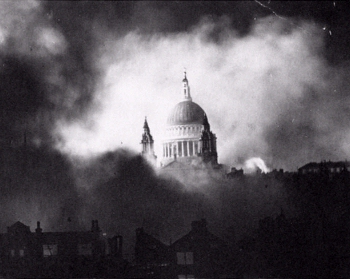
    File:Stpaulsblitz.jpg

    On looking at the bombing of Britain from the German side–an article in the popular Illustrirte Zeitung for 5 September 1940 with maps and illustrations, found here.

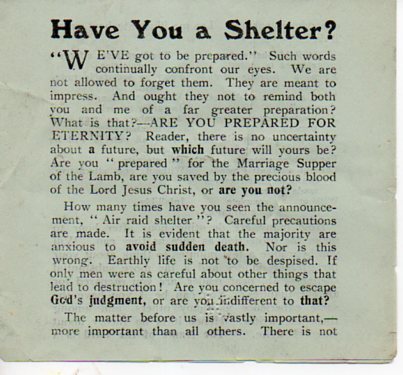
    AS people took cover from bombs and fire in the subway system or in bomb shelters, proselytizers were on their way to work, too, as seen in this slip of a handout, Have You s Shelter?, published around February 1940.  It seems that the maker and distributor of this tiny pamphlet didn’t identify themselves save for an address from which more copies of the flyer could be obtained (61 Upton Lane, Forest Gate, London)

    London BlitzShelter893

    People weren’t quite yet getting into the shelters for real–this was still the pre-Blitz period, back there in February 1940, and the real attack against England (but particularly against London) didn’t begin until September and last through May 1941, which in its course would kill 40,000 civilians (half of whom were in London) and destroy a million homes.  In February it was still speculation, and the church folk who distributed this flyer were out to make the best of it–trying to save souls, trying to ease the nervous burden through belief, trying to do something, anything. Though mostly it seems trying to convince people that it wasn’t just German dive bombers that they needed to fear. 

    ·Posted by :

    ·in:

    —

  • The Call of the Book: Antoine Verard and Illustration, ca. 1500

    JF Ptak Science Books   Quick Post

    Vereard885
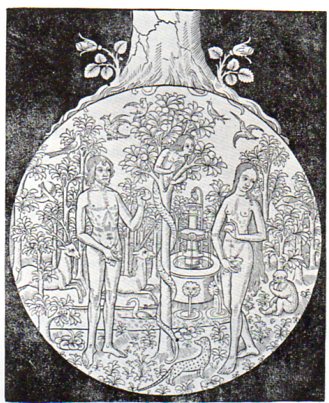
    M. Verard was a very active bookseller, printer and publisher, operating in Paris between about 1485 and 1512.  He produced a catalog of his printed works that was very extensive, containing more than 100 works.  One of them, a Bible published in 1502, contained this spectacular woodcut, “The Root of all Evil”, showing Adam and Eve at the crucial moment, a very considerable man-serpent completely engulfing the fruit tree, winning the confidence and trust of Eve.  And above it all grows the tree of humanity its roots firmly in place along the sphere of the fall of man.  

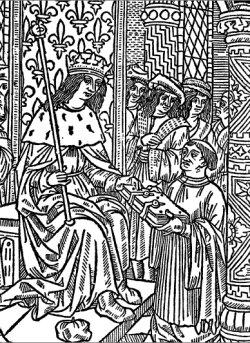
    I also quite like the portrait of Verard, shown offering one of his books to King Charles VII, hoping for his approval:

    Verard book


  • Blank, Empty and Missing Things, #35: Empty Trees

    JF Ptak Science Books   Post 1614

    Blank trees866 sm detail

    Blank trees866

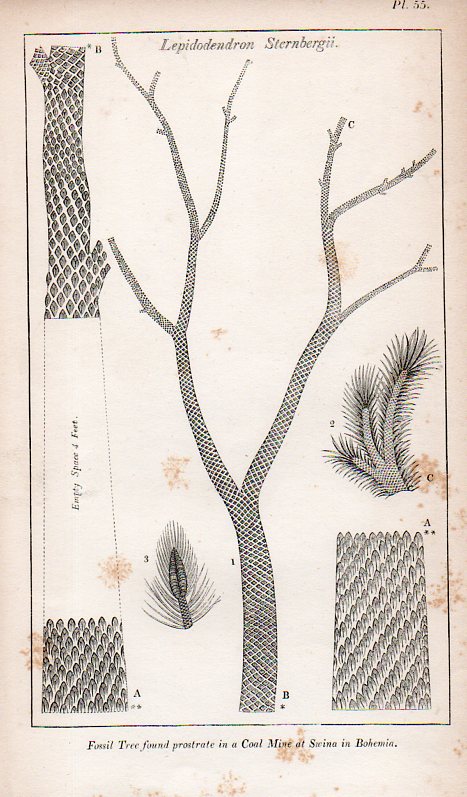
    Continuing a longish thread on Blank, Empty and Missing Things is this very short notice on a beautiful illustration from (Rev.) William Buckland (1784-1756, Reader of Geology at Oxford) in his Geology and mineralogy : considered with reference to natural theology

    Blank trees865

    I think it is a remarkable thing, a beautiful piece of explorative artwork when taken out of context.

    The description of this engraving from volume I, page 466:

    Buckland is well remembered for his analysis of the fossil remains found in Yorkshire’s Kirkdale Cave, which he identified as hyena (and its prey) remains from earlier prehistoric times rather than having been swept from the tropics to England by the waters of the Great Flood.  Of course, Buckland himself held that opinions years earlier, along with many other geologists…as some actually hold today, somehow, in creationist fits of intentional delusion.1

    Notes


  • Darwin & Frankenstein–Mary Shelley on Creativity and the History of Her Idea

    JF Ptak Science Books Post 1606

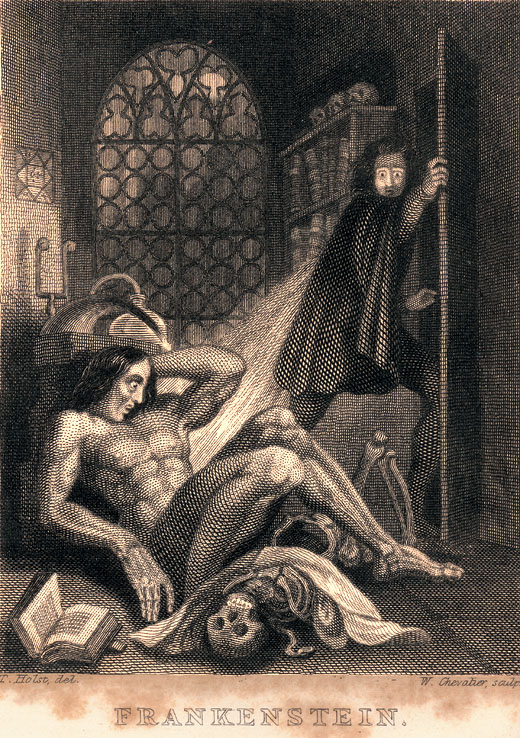
    Today (September 9) in 1Frankensteinengravedimage_large797 was the day of the death of  Mary Wollstonecraft (Godwin), an English feminist and anarchist, best known for her tract  Vindication of the Rights of Woman (1792), and also for being the mother of Mary Wollstonecraft Godwin (Shelley), the author of Frankenstein, or the Modern Prometheus.  In all likelihood, Ms. Godwin died after complications in the birth of her daughter, giving way to “childhood fever”.

      The first time that Mary Shelley’s name appears on her Frankenstein… is on the title page of the second edition of the work, when it was printed in France in 1831, thirteen years after the anonymous Parisian printing of the first edition.  My guess is that a woman’s name–despite her high literary lineage–would just not fit on the title page of such an untoward, beastly book in which the monster of Frankenstein was created., and which was decidedly ungodly, a possible blasphemy.

    But when the second edition was published, in addition to the other changes that she made to the book–substantial, meaningful changes that suggest to scholars that the real, or intentional, Frankenstein produced by Shelley remains in the first edition–there was included a very interesting introduction.  It is in this intro that Shelley shares her story of the creation of this unusual book, as well as the literary and scientific influences in creating it–a sort of intellectual heritage to the idea, an outline of the process of her creativity that led to Frankenstein.

    The book is better known for the numerous movies that were very loosely based on it, and truth be told the book has a far greater depth to it than any of the movies ever remotely hoped to achieve–they were after unsettling horror, whereas the book was concerned with that plus the interplay of Romanticism and science/technology, and the understanding of the way in which life begins and how the brain acquires information. I think that was she was looking for was the essence of things out there somewhere in the empire1 of man.

    Shelley was influenced by a number of different scientists (though the term itself, “scientist”, wouldn’t be used for the first time until decades after the book was published) , some of whom wrote on the subject of Vitalism and other Romatic-era sensibilities rubbing up against the new technical revolution and objectivist capacities,  and the supposed capacity of electricity via Galvanism (and the work of Mesmer and Galvani) to restore life to the dead.  As Shelley writes in the introduction of the second edition: “Perhaps a corpse would be re-animated; galvanism had given token of such things: perhaps the component parts of a creature might be manufactured, brought together, and endued with vital warmth”. She wrote with accomplishment, a very nice prose, weaving a tale of Newtonian-Woodsworthian-Galvanism-Volatarianism, a Romantic-Scientist.

    But the Darwin that Shelley refers to in 1831 is of course Erasmus Darwin, the grandfather of Charles, and someone who I think Shelley didn’t actually read, but had heard about. So I think that the influence of Darwin on Shelley came through bits of remembered pieces from Percy and Byron, and only suggestive of what Darwin was  writing about.  (Even the reference to Darwin in the 1831 introduction is not there–she refers to what Darwin was writing about in the section ‘Spontaneous Vitality of Microscopic Animals‘ in the notes section of his The Temple of Nature, and doesn’t really quite get that part right, though if what Darwin was writing about could be described as a chocolate milk shake, Shelley could indeed say that the drink was chocolatey.

    The book is really quite an achievement, especially given its time; and the intro to the second edition is an unexpected revelation into how someone comes up with an idea.  A big idea. 

    The other influence in he writing of Frankenstein…--much of the book was conceived while Shelley was pregnant, a pregnancy which ended in a miscarriage and which almost cost Shelley her life. (Shelley gave birth to four children, only one of whom lived into maturity.)  The book also came a few years after two suicides in her family.  Life. Regeneration. Birth. Creation.

    Notes:

    Francis Bacon would tell us that

    But if a man endeavor to establish and extend the power and dominion of the human race itself over the universe, his ambition (if ambition it can be called) is without doubt both a more wholesome and a more noble thing than the other two. Now the empire of man over things depends wholly on the arts and sciences. For we cannot command nature except by obeying her.  Francis Bacon, 1620  Aphorism 129,’ Novum Organum (“The New Organon, or True Directions COncerning the Interpretation of Nature), Book I (1620


  • Apocalypse Then–World War III, The 36-Hour War of 1948

    JF Ptak Science Books   Post 1585  [Part of a long series on atomic and nuclear weapons]

    This is also part of a sub-series on the invasion of attack on America; examples of other posts include: Mapping the Invasion of America, 1942 (which is the most-viewed post from this blog, with over 500k readers), The Invasion of America, 1935,  Bombing Manhattan and the Amerika Bomber, 1943, and The Invasion of America, 1942, Part II .

    In the very near wake of the bombing of Hiroshima and Nagasaki, the editors of Life magazine published a prescient bit of propaganda on the coming of the Cold War.  I guess though that the Cold War had already begun by Yalta1, when the sick and basically-terminal FDR seems to have been corralled by Bloody Joe Stalin, leaving the new President Truman on alert for the possible coming aggressiveness of the Soviet Union.  The article appeared in the 19 November 1945 issue (pp 28-39), and it was a longish one, with nine illustrations (by A. Leydenfrost), and as articles go in Life from this time, this one was heavy. 

    It built itself up on a report generated from the offices of General Hap Arnold, and reckoned a new war, a New War, World War III, to occur in 1948–except that this time there were no natural difficulties that the U.S. could hide behind. (Arnold said: “…with present equipment an enemy air power can without warning, pass over all formerly visualized barriers and can deliver devastating blows at our population centers”.) The threat would come from above, and there would be little accurate defenses against them. 

    There would be survivors but massive destruction and death–and remember that this was at the point of the simple atomic weapon, before the development of the big stuff.  In the opening images of the article, a chilling two-pager showing eight major American cities being struck by atomic weapons, resulting in at least 10,000,000 casualties.

    But as grisly as all of this was, the American reader was told the the United States would prevail, and that our rockets “would lay waste” to the enemy’s cities; “the U.S. wins the atomic war”.

    [Image sources:  I’ve used the image from the Drexel University site as my copy of this issue of Life is in a massive half-yearly bound volume, impossible to scan.]

    This is what New York City was supposed to look like, afterwards, with inspectors sizing up the radiological waste of what was left of the NYPL at 412nd Street:

     Notes:

    1. The Yalta Conference was the third meeting between the leaders of the U.S., the United Kingdom and the Soviet Union, held 4-11 February 1945.  It came after the Tehran and Cairo Conferences, and preceded the final Potsdam Conference on 17 July- 2August 1945.

    More illustrations:


  • Present at the Creation–“Physics Today”, 1948

    JF Ptak Science Books   Post 1579

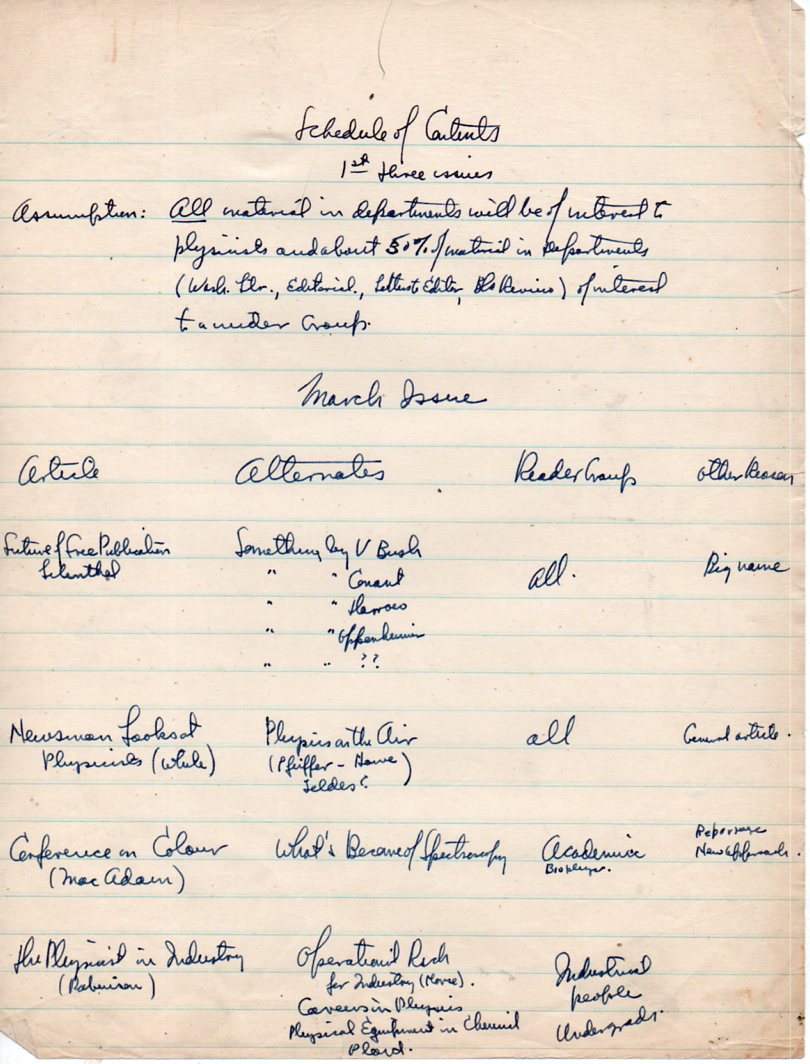
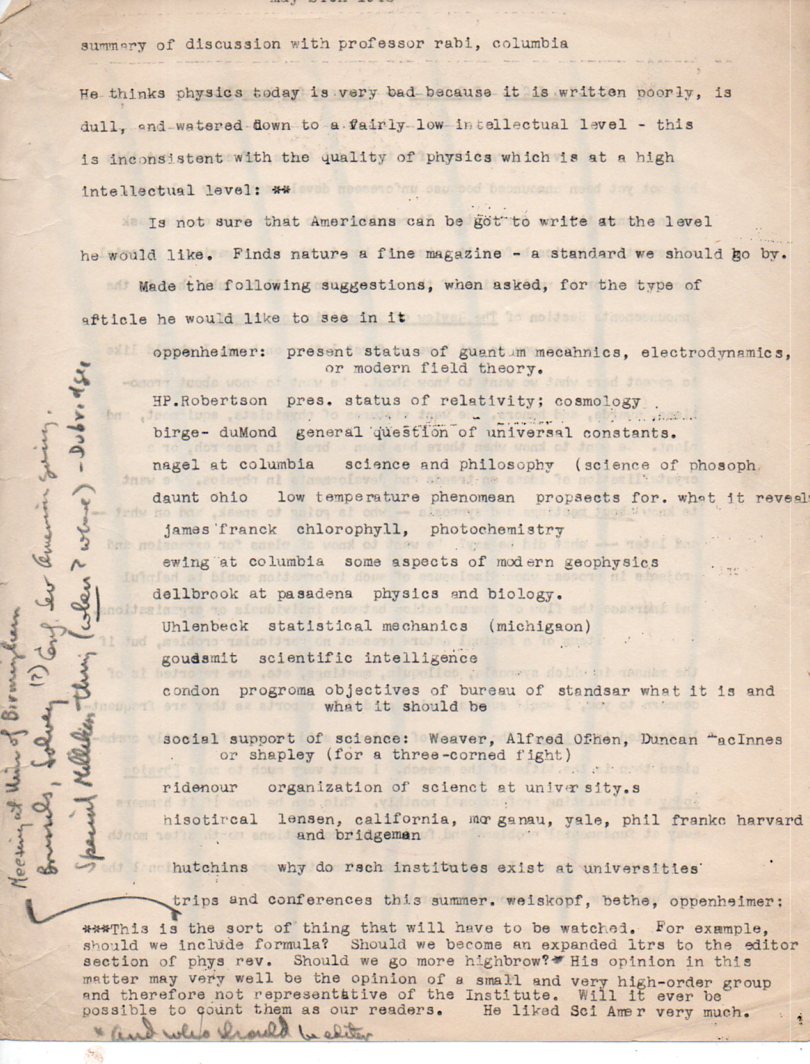
    One of the real pleasures of being a bookseller is the discovery of the unexpected source–in this case it was a small group of papers that at one time belonged to David Katcher, who–among many other things–was the first editor of the American Institute of Physics’ magazine, Physics Today.  It was started in 1948 to help bridge the gap between good science writ bad and hard science writ even worse for the world of the general reader. These are a few of the fragments from the editor’s desk, as Katcher was organizing his thoughts about what the magazine would be about, who would write for it, and how the ideas would be presented. 

    For example, this worksheet for the first issues of the magazine outlined articles by some of the heaviest names in physics, with “something” by Bush, Conant, Oppenheimer; as well as who would be the target audience (“all”);  and who the contributors would be (‘big name”).  Quite a different world and pace, then, and one in which a forceful man like Katcher could do a lot in, and quickly. 

    Physics today646
    Then there’s this interesting page of notes of a conversation between Katcher and the great I.I. Rabi, who offered some suggestions and insights about what might appear in the new magazine:

    Physics today649 And this, Katcher’s very clear statement on editorial policy (for 28 July 1948):

    ·Posted by :

    ·in:

    —

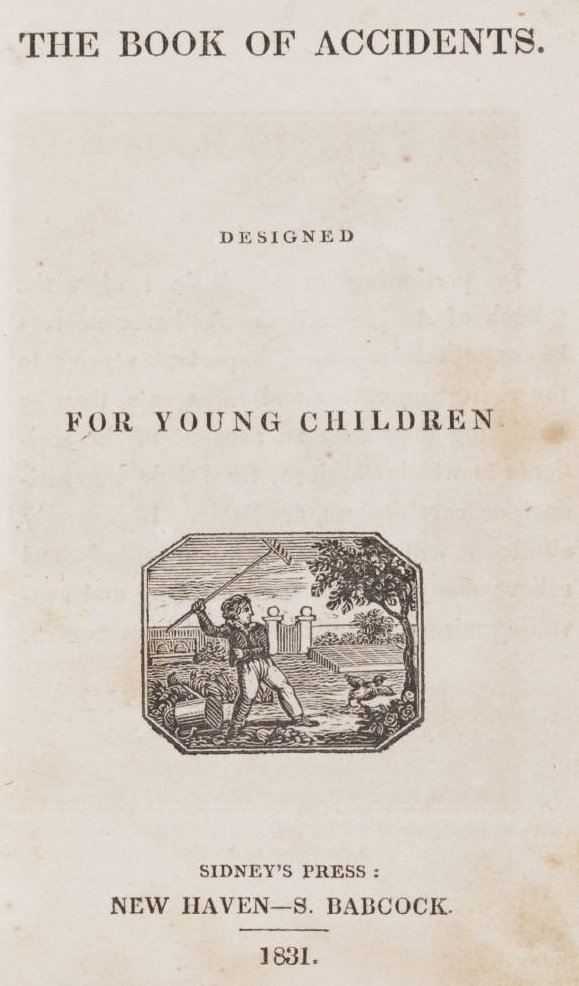
  • The Book of Accidents Designed for Young Children, 1831.

    JF Ptak Science Books   Quick Post

    Accidents
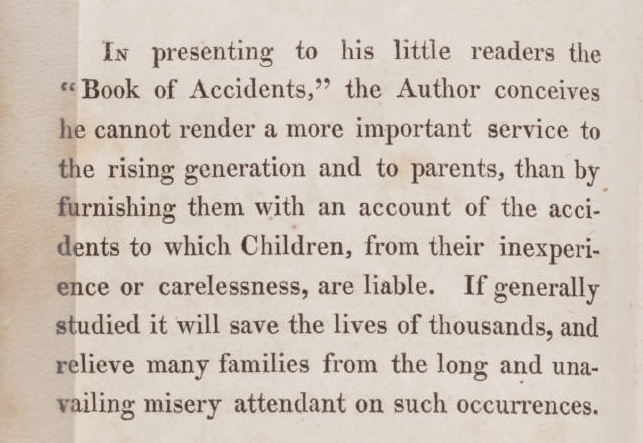
    The very Gorey-ish title of this book–seemingly designed to manufacture accidents for children–is actually a children’s advocate book. Its a small book, a chapbook, made for small hands, produced on the cheap and meant to be consumed by children and adults alike, warning people of the commonplace dangers that called on children in the 1830’s.  Scalding, being kicked by a horse, falling, being injured while playing with knives and candles and firearms, crossing the street, being tossed by a bull or wild horse, falling out of a coach, drowning, playing and throwing stones, tumbling down stairs and the like made a devastating impact on the lives of children–sometimes ending them, as the author points out.  By pointing out these dangers, and by having them read by (or to) children, the author believed that the lives of thousands of children could be saved.

    [Image sources:  Beinecke Rare Book and Manuscript Library, Yale University.]

    http://brbl-images.library.yale.edu/PATREQIMGX01/size3/D1169/1026953.jpg

    The mission statement:

    Accidents 2

    He was correct, of course; its a legendary problem trying to protect children from the obvious.

    http://brbl-images.library.yale.edu/PATREQIMGX01/size3/D1169/1026954.jpg


  • Prometheus Unbound; or, the Triumph of Science in Olympus (1879)

    JF Ptak Science Books   Post 1571

    The wonderful Punch, or the London Chiarivari strikes again for the year 1879.  The quick-browse is seldom complete, as I’ve witnessed again and again; 1879 revealed several fantastic images that were posed to this blog last week (here, for the Technology Museum of the Future and also here for Thomas Edison’s Anti-Gravity Underwear and Kite Babies), and as it turns out just a few pages away, there existed a larger, two-page illustration that was again on the triumph of science, and which I missed completely, twice.

    The message in this cartoon is the glory of “science”, which was flying very high indeed in the newly-electrified times of 1879.  Dominating the image is Mr. Punch himself, holding the electrical sun in one hand, illuminating everything.  To his right, Mars and Heracles stand before an enormous cannon, with different reactions; Bacchus sits astride a barrel of coffee of all things with Pan enjoying a short cup of Joe, while in the lower left corner Hades himself is making a photograph of Eros (?), an hourglass slung across his back, finally coming to grips with capturing change.  In the right corner at bottom is a young man who is intent perhaps on reporting on the situation via a handy public telephone–such things didn’t yet exist in 1879, the telephone being just three years old, but the artist thought enough of its future power to add it into this scene of the triumph of science and technology over the panoply of gods and demigods.

    On the right ide of the image the gods make no further advance against science and technology.  Ares-as-workingman is puzzled by the giant Nasmyth hammer, with the Cyclops in the background a little more concerned, disbelieving what their eye told them.  Poseidon is shuttled away in the lower left, accompanied by what looks to be a weeping mermaid., hustled to the exit by a torpedo, a diver in a deep sea suit, and what I think is a special life-preserving inflatable suit.  In the middle of the image we see two women dressed in legal and academic garb, looking determined before a finicky Hermes; and above them, lording over it all, is a very dissatisfied Zeus, and a headache-y Hera.

    Since the image is entitled “Prometheus Unbound, or Science in Olympus”, I guess that Zeus must be reacting to electricity as the unbound Prometheus, a modern version of a kind power given to humankind via electricity.  It is this new Prometheus that is the undoing of the god’s retreat.

    Overall, this is a very plain Victorian view in the trust of science and technology to lead in all things, even the very basis of much of European mythology.   [I hope that I haven’t abused the mythology too much.]


  • A Lesson in Civil Rights taken from a 1944 Piece of Cardboard–Philly Motormen, Jackie Robinson and War

    JF Ptak Science Books   Post 1569

    Negro motormen633
    This political “button” has been in my house –along with a a dozen or two others–for quite some time, small signifiers for large events.  This one, though, is more suggestive than assertive; a measured, tenuous  political statement that seems today as though there should have been no disagreement in its message. 

    The button was issued in 1944, at what might have been the very most crucial time for America in fighting World War II.  The message wasn’t to support the idea of sending Black Americans to fight in the war–it was rather a call to White America to acknowledge the need for employing Black Americans as motormen and conductors on Philadelphia street cars as replacements of the men who went off to fight the war. 

    There was very strong resistance to having Black people interact with White people on a public convenience.

    In the same year, in July 1944,  Jackie Robinson (then of UCLA)  was a newly-commissioned 2nd lieutenant in the United States Army, stationed in Fort Hood, Texas, with the legendary 761st “Black Panthers” Tank Battalion.  On 6 July he boarded a U.S. Army desegregated bus, where he was told by the driver to move to the back, into the Negro section; Robinson refused; the driver backed down, and continued on his way, though not without his revenge.  At the end of the run, he alerted Military Police, who would arrest Robinson on a variety of phoney charges.  It was recommended that Robinson be court-martialed. The commander of the 761st, a White colonel named Paul Bates, refused to do so–which led Robinson to be transferred to the 758th Battalion where there was no problem in undertaking the legal action.  By August, with charges reduced, Robinson went to court and his charges were dismissed.  But by that time, the damage was done, and he would not be sent overseas to fight.  He was sent to Camp Breckinridge in Kentucky where he served as an athletics coach for the few months he had in the Army, and he was honorably discharged in November, 1944.  It was while he was at Breckinridge that a former Negro Leagues player for the Kansas City Monarchs suggested that Robinson write to the ballclub for a tryout.  He did, they did, and the rest is history.

    Negro motormen632 In 1944 in Philadelphia–though it could have been in many other cities in the northern part of the United States, though  this would not have been attempted almost anywhere in the South outside of the Pullman car–the question was whether society would tolerate a Black person interacting with White customers on streetcars.

    It was almost at this same time, in November 1944, that General Eisenhower decided to send Black troops to fight with Whites in battle.  There was strong resistance to this behavior in the military, not the least of which came from Ike’s own chief of staff, Lt. Gen. Walter Bedell Smith.  It would take an Executive Order (#9981) from the next president, Harry Truman, to end the de facto segregation of the U.S. Army; it would take another war, and another three years (to the day)  for the U.S. Army to announce its plans to desegregate, on 26 July 1951.

    In spite of there being motormen and conductors working in other northern cities like Cleveland, Detroit and Indianapolis, wrapping the string for the United People’s Action Committee around a button on your shirt or jacket would have been a controversial step to take–a step that looks alarmingly small to us here in the future, but it was a societally big one back in 1944. 


  • Note on the Visual Semantics of Ideas: John WIlkins, Jorge Luis Borges, Oliver Byrne

    JF Ptak Science Books   Post 1568

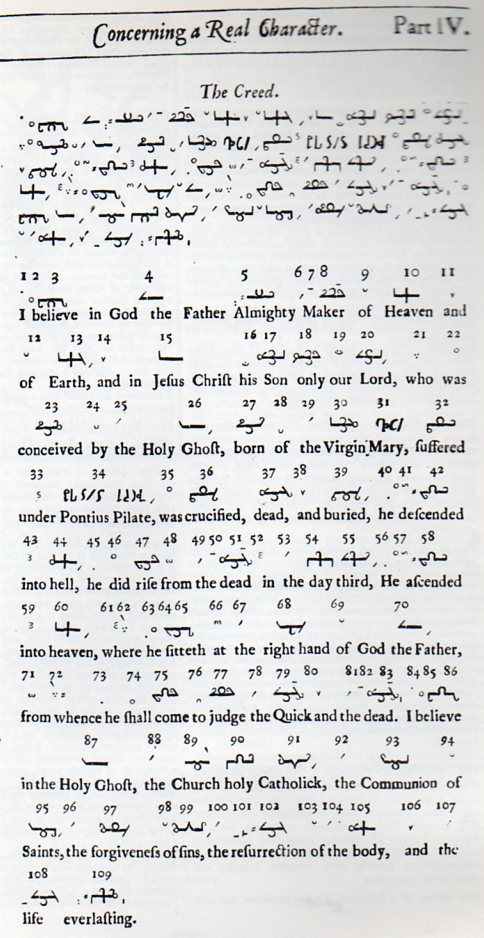
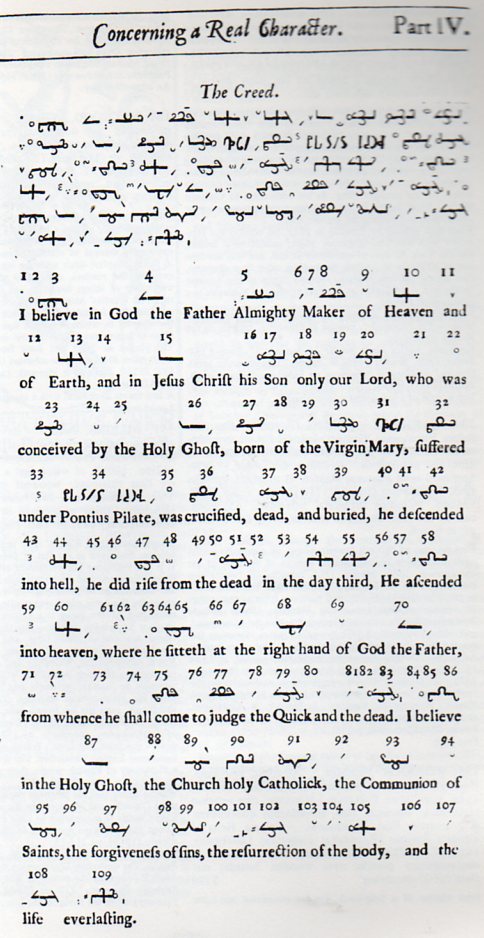
    John Wilkins’ construction of a new, theoretical language, a visual semantics of idea that was to be read and not spoken, a new international language to communicate thought, seems straight from the heart of the great Jorge Luis Borges.  And in fact, Wilkins does come from Borges, in a way–as part of a story Borges wrote in 1942, a fantastical semi-non-fictional account of Wilkins’ fabulous effort1.

    Wilkins was a 17th century figure with a sort-of 20th century idea, but even advanced to this point in time, and with actual mathematical and linguistic tools at his disposal, his work is still better as a sci-fi movie backdrop than anything else–not that there’s anything wrong with that.  The book of his in question, An Essay towards a Real Character, and a Philosophical Language, was published in London in 1668, and was an very interesting, Aristotelian non-standard approach to construct a universally understood language composed of characters which were in a way axiomatic of a developing system of genera, a taxonomy of ideas, that were somehow, fantastically, capable of expressing the foundations and flights of human thinking. 

    Borges’ presented Wilkins in a very Borgesian way in his  “The Analytical Language of John Wilkins“, mixing fact with creative fancy, exhibiting Real Character as though it was being re-discovered and studied by living academics. 
    Wilkins631

    It reminds me somewhat of other massive buit not-quite-nowhere-near-there efforts by people like Oliver Byrne and his color-coded approach to Euclid (1847), J.H. Woodger with his Axomatic Methods in Biology (1937), and Clark Hull’s Principles of Behavior (1944). Fascinating ideas, constructed with big brains, but which ultimately produce a product which more deeply confuses and obscures the subject matter it set out to explain–and which don’t really work, anyway.  But they are beautiful things int heir own right–Byrne’s work in particular also happened to be one of the most beautiful books produced in the 19th century–assemblies of bits and pieces that are occasionally magnificent but whose final destination was of course The Twilight Zone.

    They were in some way a Search for a Perfect Language (as in the work by Umberto Eco); they sought to step deeply outside themselves in an effort to grasp a higher knowledge, perhaps not much too unlike Isaac Newton and his  deep experimentation in alchemy, looking for the massive truths that were handed down to the few selected ancient ones.  They are beautiful things with a lot of very good thinking–they just weren’t right. 

    Notes:

    1.  “The Analytical Language of John Wilkins“, 1942, in which Borges presents an imaginary intellectual archaeologist assessing the work, comparing it in particular to the imaginary encyclopedia Celestial Emporium of Benevolent Knowledge.

    “He divided the universe into forty categories or genera, these being further subdivided into differences, which were subdivided into species. He assigned to each genus a monosyllable of two letters; to each difference, a consonant; to each species, a vowel. For example: de, which means an element; deb, the first of the elements, fire; deba, a part of the element fire, a flame. In a similar language invented by Letellier (1850) a means animal; ab, mammal; abo, carnivore; aboj, feline; aboje, cat; abi, herbivore; abiv, horse; etc. In the language of Bonifacio Sotos Ochando (1845) imaba means building; imaca, harem; imafe, hospital; imafo, pesthouse; imari, house; imaru, country house; imedo, post; imede, pillar; imego, floor; imela, ceiling; imogo, window; bire, bookbinder; birer, bookbinding. (This last list belongs to a book printed in Buenos Aires in 1886, the Curso de Lengua Universal, by Dr. Pedro Mata.)”–Jorge Luis Borges

    Borges described Wilkins’ taxonomy as follows, dividing it into 14 categories (compared to the original Wilkins list of 40):

    Those that belong to the emperor; Embalmed ones; Those that are trained; Suckling pigs; Mermaids; Fabulous ones; Stray dogs; Those that are included in this classification; Those that tremble as if they were mad; Innumerable ones; Those drawn with a very fine camel hair brush; Et cetera; Those that have just broken the flower vase; Those that, at a distance, resemble flies.