A Daily History of Holes, Dots, Lines, Science, History, Math, Physics, Art, the Unintentional Absurd, Architecture, Maps, Data Visualization, Blank and Missing Things, and so on. |1.6 million words, 7500 images, 4.9 million hits| Press & appearances in The Times, Le Figaro, Mensa, The Economist, The Guardian, Discovery News, Slate, Le Monde, Sci American Blogs, Le Pont, and many other places… 5000+ total posts since 2008.

Category: Anticipation, History of

  • Images of Shadows in Storytelling

    JF Ptak Science Books   Post 1836

    ‘There is seldom in shadow a mystery less hidden”–Ombra Nichts Schatten, The Non-Mystery of the Shadow, London, 1842

    Shadows have long played havoc in the imagination, for good and for evil, for elucidation and of mystery–they have hidden nothing and everything, and displayed as little as possible and as much as can be imagined. A simple shadow in a hole had proved the circumference of the Earth twenty centuries ago, and before that the Earth’s shadow on the face of the Moon showed us to be a sphere; the shadow allowed us to measure the heights of mountains on the Moon before we could do so (accurately) on Earth; we measure shadows in X-rays, and follow the trails of subatomic particles, and on and on.  Shadows are particularly interesting in story telling, whether they be suggested  aurally or in text, or of course in illustration: 

    Chalres H. Bennet, Shadow and Substance, London 1860.

    A superior example of shadow-art is seen in Indonesian shadow puppet theatre, “Wayang Kulit”, where the shadows of Javanese-Indonesian characters are projected onto a cloth screen by a strong light from behind.

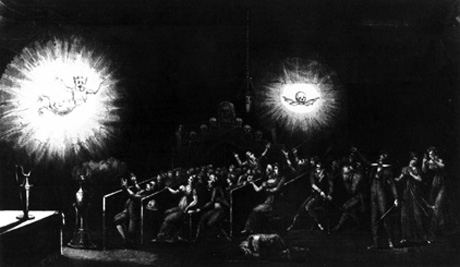
    Audiences were bathed in direct and brilliant light while being swamped in shadow in the early 19th century as part of an early form of non-cinema cinema, as we see here in the frontispiece from Robertson’s Mémoires récréatifs, which depicts a phantasmagoria of lantern projections:


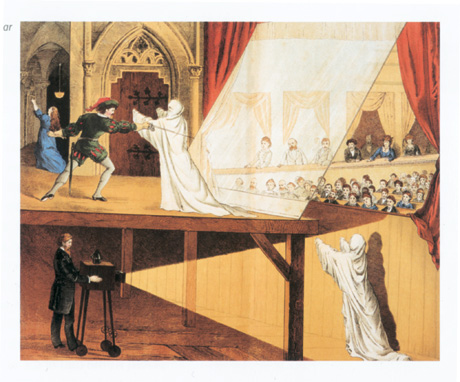
    And more forthright illusions as seen in this engraving showing the spectre “Dr. Pepper’s Ghost,” from Theodor Eckardt, Die Physik in Bildern Eßlingen, 1881:


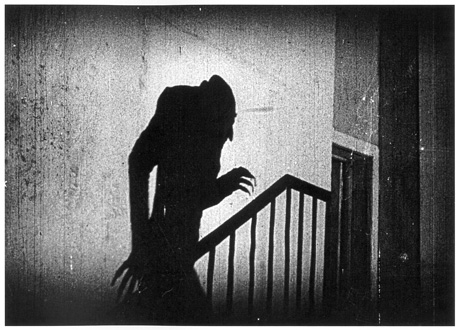
    The shadow may have been invented in cinema by the German Expressionists, with  Friedrich Wilhelm Murnau’s Nosferatu (1919) as a shining example:

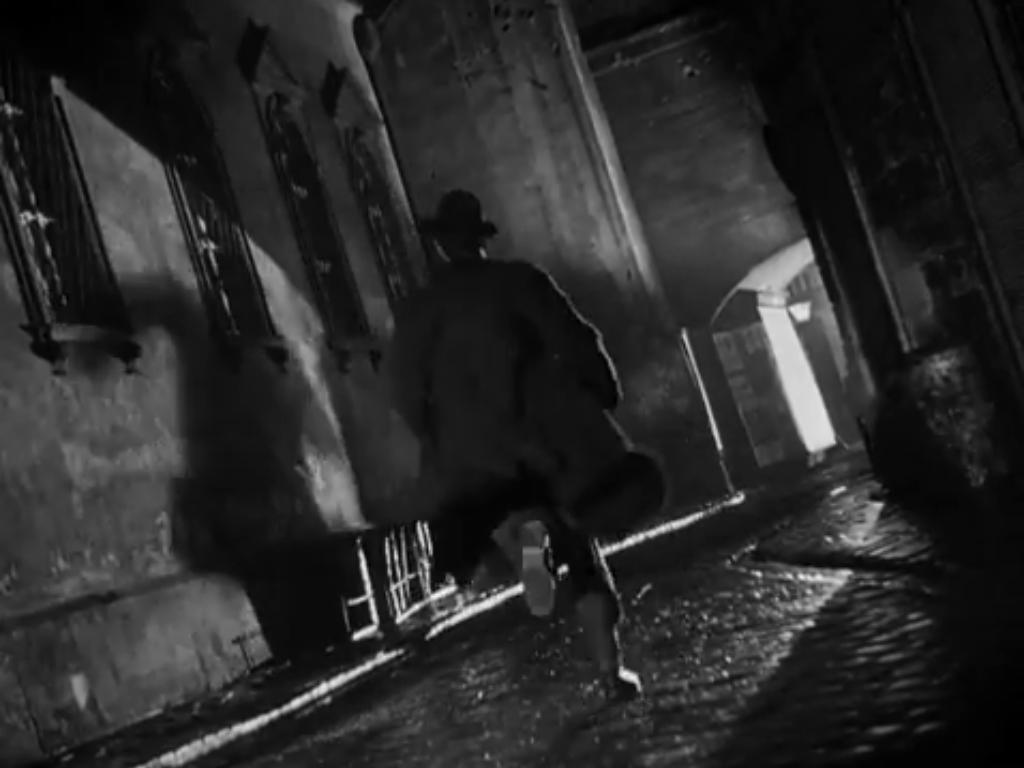
    And of course the shadow is used with great effect in the  very black-and-white and no-gray-tones Film Noir world, particularly in the hands of a master like Mr. Welles in films like The Third Man:

    And in Fritz Lang’s diabolically-bad M, earlier, in 1931 (featuring an impossible shadow in the movie still below):

    Thank heaven for little girls... or would that be hell?


    Shadow has been used to given questionable dimensionality in addition to giving perspective to dimensions that we are familiar with:


    And the artificial shadow made for the geographical clock dial to tell the story of passing time:

    And also for shadow puzzle toys:


    And on and on, deep into the night…


  • History of Holes: Making 1=2 or 3, or More (ca. 1700)

    JF Ptak Science Books   Post 1830  Part of the series on the History of Holes. (Apologies for no-para spacing–Typepad is buggy again.)

    A beautiful and inventive way of addressing issues of perspective and un-reality in the centuries before the introduction of electricity was more able to suspend belief in the existing/obvious was via the catopticum1. This object (an example of which is pictured below, taken from the oddball/genius/problematic polymath Athanasius Kircher in his book Ars Magna Lucis et Umbrae…2 printed in 1676), and the name of which is taken from the Greek katoptron, mirror) was an advanced parlor toy and artwork, a sort-of primitive free-standing theatre of multiplied objects, a box that contained things that were seemingly larger than their container. 

    The catoptric theater. From Ars Magna Lucis et Umbrae (1671 ed.), p. 776

    Source:  Kircher at Stanford University, here.

    This image makes the “image engine” a little clearer:

    Primeira PáginaPágina AnteriorDiminuir imagemImagem a 100%Aumentar imagemPróxima PáginaÚltima Página
    desd [757 KB]
    Source:  Tratado da Catoptrica, (manuscript, 1716);  from the Biblioteca Nacional Digital, here.
    It’s a romance of images machine,  a box of antique wonder, a peepshow of centuries before, putting more things into a space than could exist.  It was a relatively simple machine of great ingenuity:  the interior of the free-standing box with rows of holes along its top edge perpendicular to the ground, and was lined with mirrors (as shown above in the Spanish document), with some mirrors set of at 45% angles; when objects were placed within the imaging-area of the angled mirrors, the object was multiplied, and then multiplied over and over as a result of the surrounding mirrors, creating in effect a “hall of mirrors”, leaving the observer with a sense impression of many dozens of objects that were contained within a container that was impossibly too small for what was being seen. 
    This of course is a property of some holes–they tend to make things larger than they could previously possibly “be”. 
    In this case, the viewer would look through a hole into a Borgesian box which would contain a multitude of its possible interiors.  Looking through a hole in the end of a glass and mirror-ended tube and pointing it at the sky at night would reveal an enormous multiplication of a small part of that sky.  In the early case of Galileo, what  was first seen with the telescope was the multiplication of what was believed to be a finite and god-granted sky of perfection–he was seeing into some other sky, into a new vault of heaven, something never before seen, above-and-beyond what was known to exist.  Hooke and Louwenhoeck had a similar experience with their (second generation) microscopes, seeing details and life never before encountered, entire worlds in a place no bigger than the head of a pin. 
    Sometimes a hole is just a dark thing; but more often than not, it isn’t. 
    Notes:

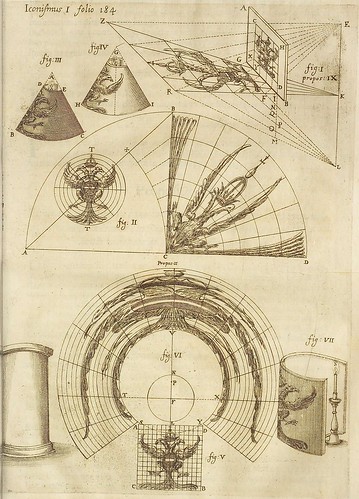
    1.  From the Greek, katoptron, mirror  or pertaining to a reflected image or reflected light, such as from a mirror.  There is another sort of catoptric that has been sort of widely used in antiquarian painting and parlor entertainments, which involves a canonical mirror reflecting a wide-field and distorted image into its proper perspective, which is known as catoptric anamorphosis.  Another version of this sort of optic imaging is optical anamorphosis, which requires the viewer to stand at a particular (usually sharp) angle to a painting containing a semi-hidden image whose proper perspective is revealed only at a particular angle of viewing.

    An example of catoptric anamorphosis, from the Kircher mentioned above:
    anamorphosis - eagle

    See here:  http://hyperphysics.phy-astr.gsu.edu/hbase/geoopt/catoptric.html
    2.  Ars Magna Lucis Et Umbrae In X. Libros digesta. Quibus Admirandae Lucis & Umbrae in mundo, atque adeo universa natura, vires effectusque uti nova, ita varia novorum reconditiorumque speciminum exhibitione, ad varios mortalium usus, panduntur. Editio altera priori multo auctior. The work is presented at Bibliodyssey, here.
    Mr. P.K.hauls out a great quote and summarization of the work of Kircher by Robert Moray in his letter to the great guiding post of the Royal Society, Henry Cavendish, which really captures the spirit of the very busy/very curious and curious old man:
    “Whatsoever Mr. Huygens & others say of Kircher, I assure you I am one of those that think the Commonwealth of learning is much beholding to him, though there wants not chaff in his heap of stuff composted in his severall peaces, yet there is wheat to be found almost every where in them. And though he doth not handle most things fully, nor accurately, yet yt furnishes matter to others to do it. I reckon him as usefull Quarries in philosophy and good literature. Curious workmen may finish what hee but blocks and rough hewes. Hee meddles with too many things to do any exquisitely, yet in some that I can name I know none goes beyond him, at least as to grasping of variety: and even that is not onely often pleasure but usefull.”  (My bold.)
    [Sir Robert Moray in a letter to Henry Oldenburg, 1665]  

  • The Archaeology and Secret Evolution of Meat–a Collection of Posts

    JF Ptak Science Books    Quick Post

    I’ve collected some of the unusual posts that I’ve done on this blog regarding the hard tendencies and shallow measures of meat. 

    The Ineffable Religiosity of American Meat Memory, here.

    000 meat red 2011


    Women Meat Pioneers of 1943, here.

    4-1 prop meat

     Anatomy of Womanly Desire–Aprons, Plastics and Meat, here.

    Women--growing Kelvinator453

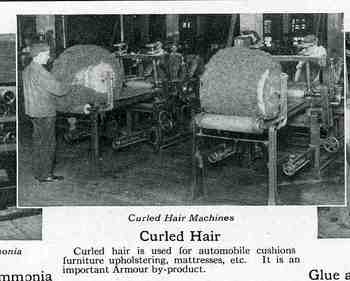
     “The String Department” and “Curled Hair Machines” at the Meat Plant  (here)

    Blogsept3_hair485

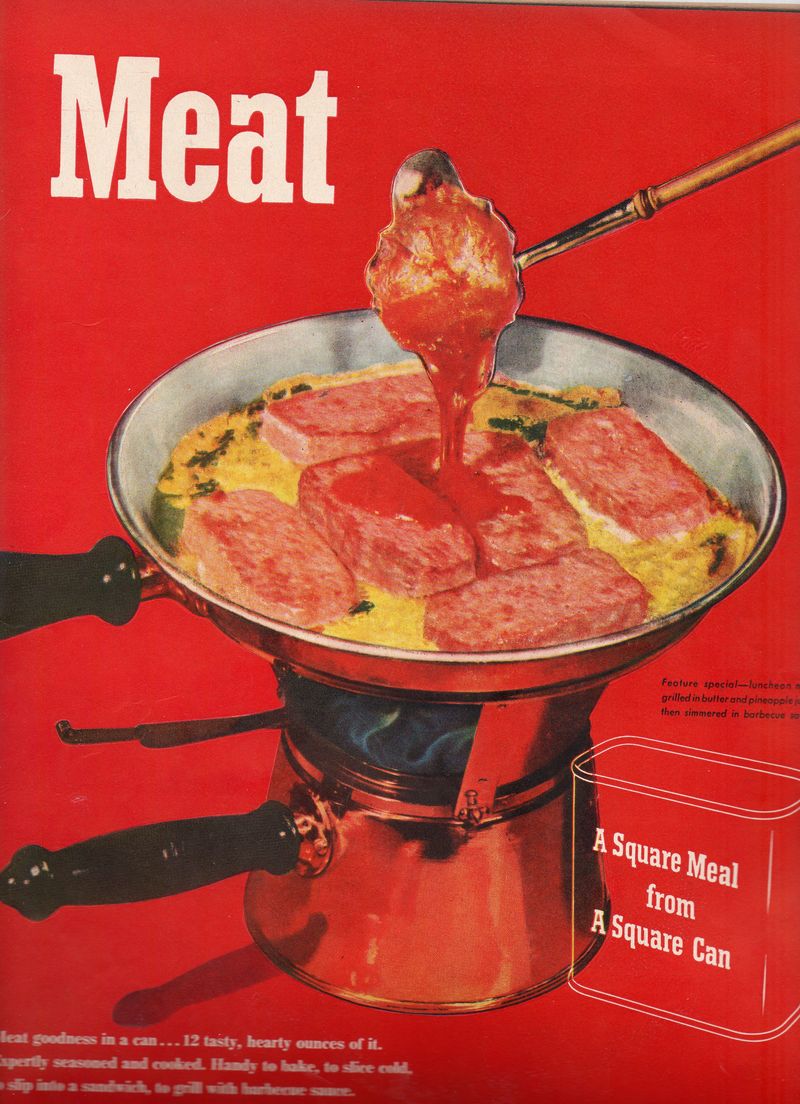
    Spam, Smeat, Spic, Prem, Mor & Arf: Food by Any Other Name  (here)

    +++spam ad

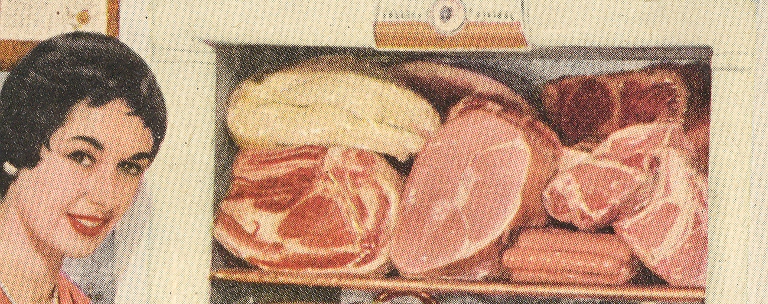
    States of Perfection: the Refrigerated Archaeology of Meat, here.

    March 6 refer meat det

    Food, Food Packaging and Creating Desire: the du Pont Company, WWII. (here)

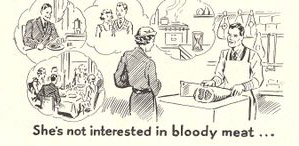
    Selling to Simple Women, 1939:  “She’s Not Interested in Bloody Meat”, here.

    Women--bloody meat

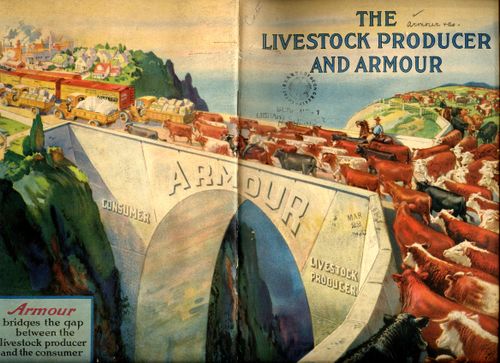
    The Importance of Bridges in the Invisible Evolution of Meat, here.

    + The Kodacolor Bridge of Evolving Meat


  • Telling the Future with Urine and Bones: the Lyricism of Urine Wheels

    JF Ptak Science Books   Post 1820

    For many centuries people have been trying to control the future, seeing into future’s past, using tea leaves, foreheads, palm prints, brain bumps, nose angles, the position of the stars, rolled animal bones and printed interpretations of the creator of the universe.  Some of these have faded into embarrassed obscurity, but only some; some methods are present today, stronger than ever. 
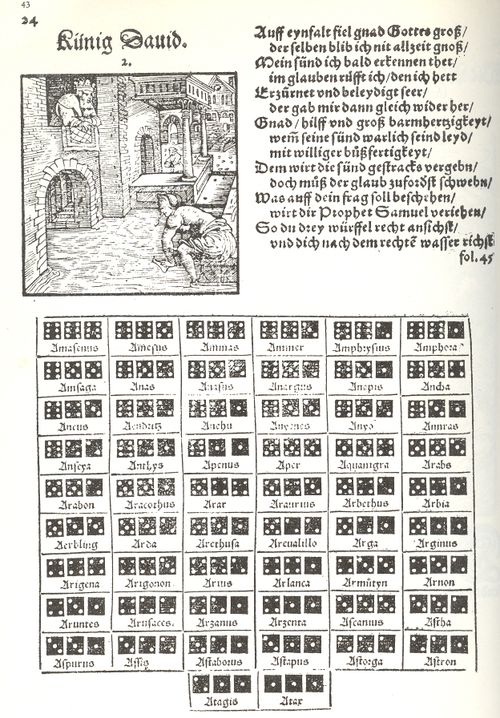
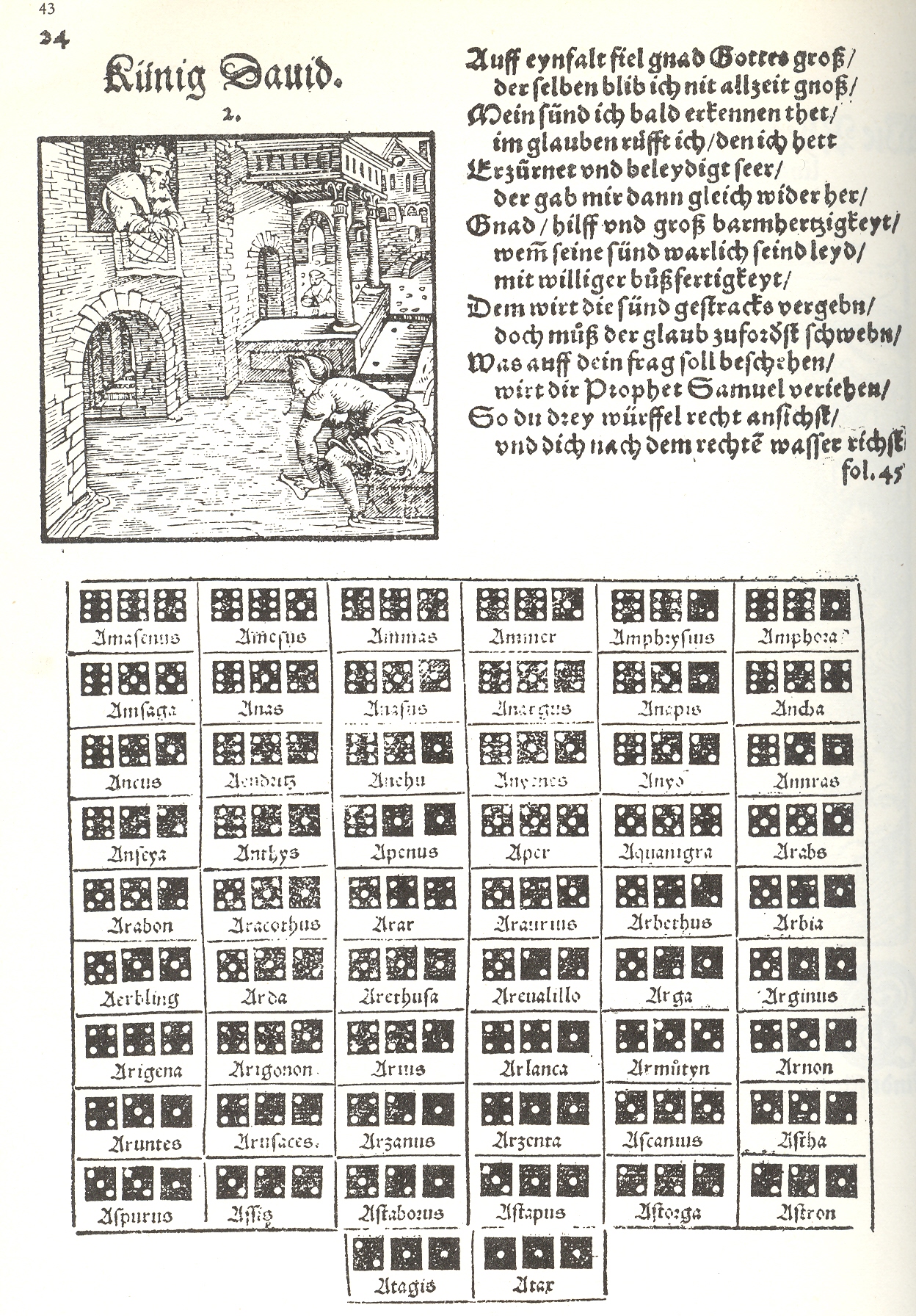
    + blog dice The rolled bones part of this makes the prettiest pictures, I think: for example, this image from Paul Pambst1 (published in 1546) shows some of the dice combinations and what they would correspond to in the revolving paper disks and columns of interpretations in the body of the book, a simple throwing of shaped animal residue somehow laying claim to predictive power.  Not that it is much different from any of the other divination methods. 

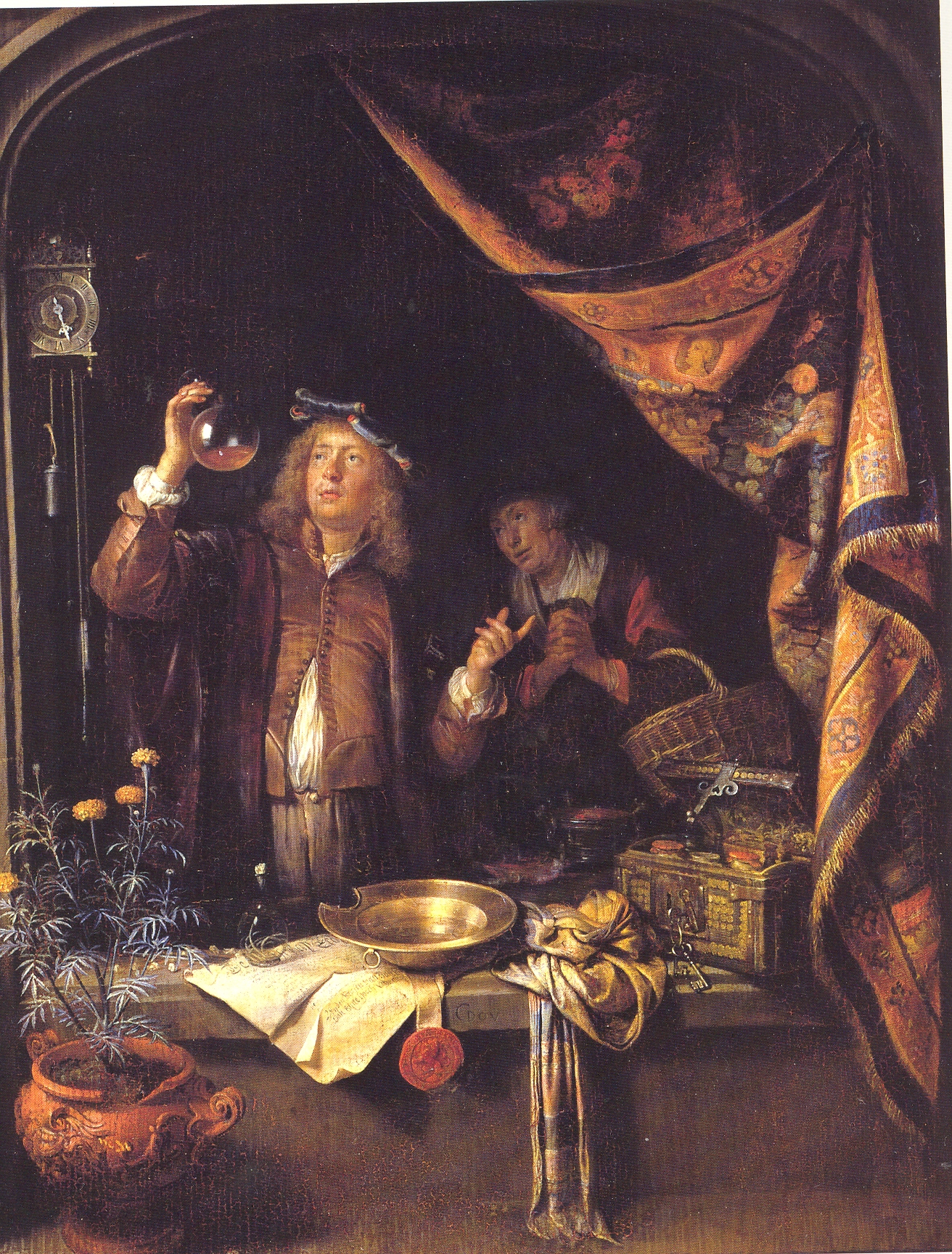
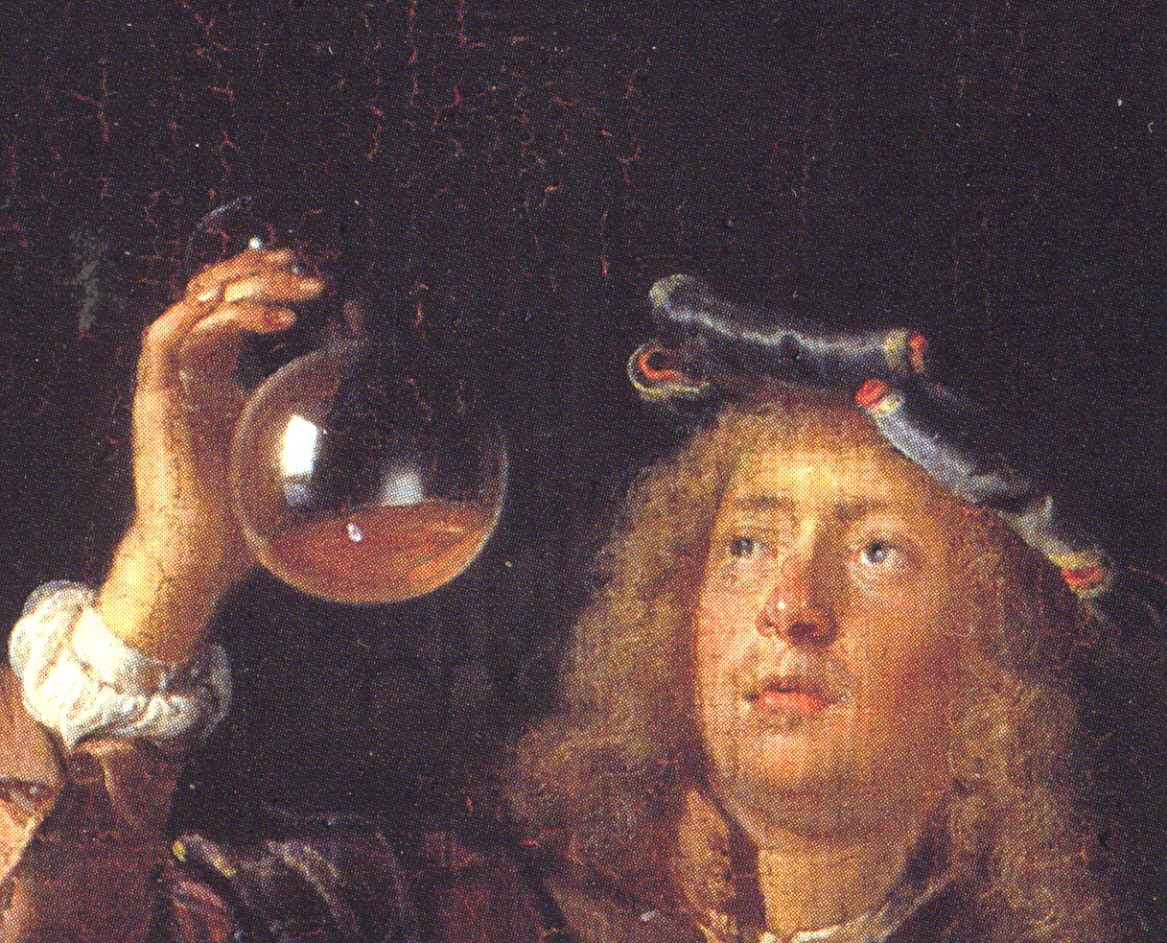
    One such method that had been in strong and continued use for thousands of years and is now mostly relegated to dust is the heated up and swirling inspection of urine.  It was thought for millenia that pee held secrets to what was going on inside the body, and that was mostly true, except that given the state of medical knowledge the only thing that the practioner could do with the sample was hold it up to the light and make good solid guesses on how color/consistency corresponded to the patient.  A reddish tint (as we see here in this painting by Gerrit Dou (1613-1675, and who made an appearance in yesterday’s post) might suggest that the (female) subject was suffering from morbens virginus (uterine hysteria, “a signifying of too much concoction in the body”), which, when the imaginary disease/unease was diagnosed would’ve led to lead consumption and a good bleeding.
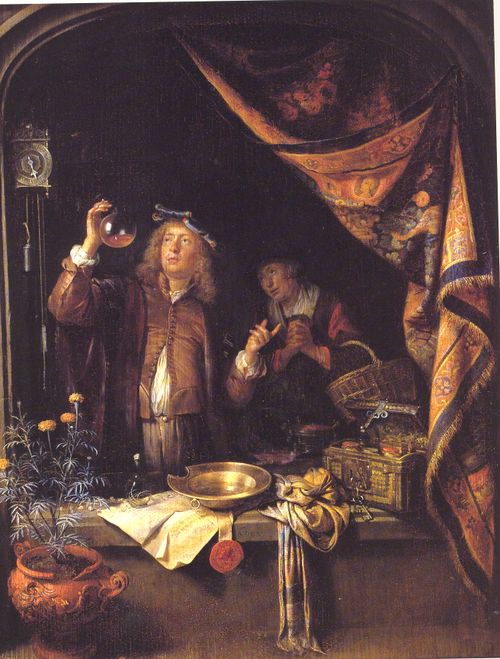
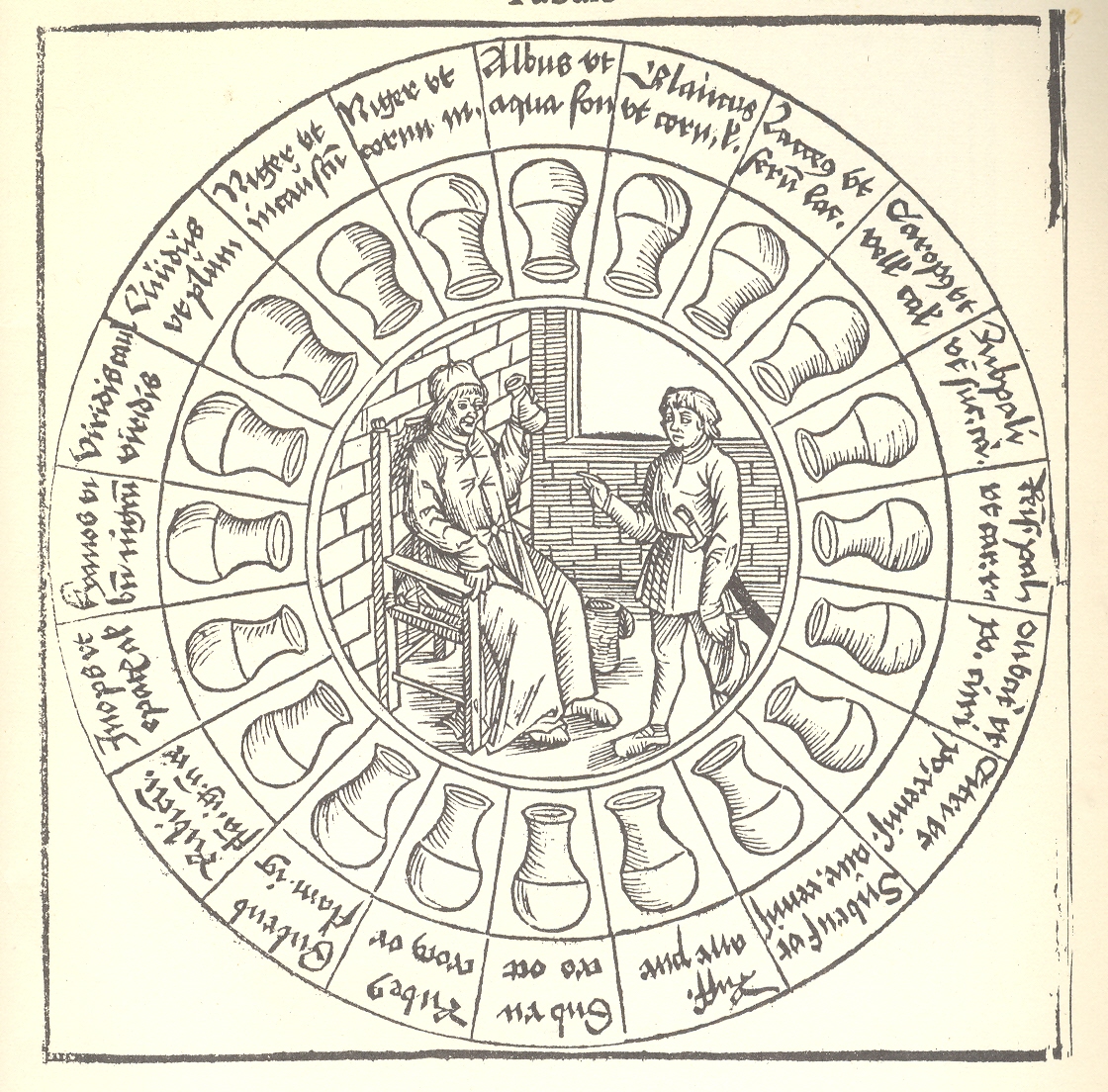
    + blog dou urine  Moving slightly up the alpha from Pambst is Udalr Pinder, whose Epiphanie Medicorum…2 (published in Nurnberg in 1506) is a state-of-the-art disposition on urine inspection, complete with this pee color wheel.  This idea is as interesting as it is entertaining, because at its base is a scientific aspect of trying to establish a common (color) base for discussion of specimens.  The color descriptions (taken in translation from Kirsten Jungersen’s  (MA, classical philologist, visiting scholar, Medical Museion, University of Copenhagen) “The relation between text and colours in medieval urine wheels” (here) are poetic, lyrical. They are also a small insight into common things of the 15th century, the author selecting colors from things that were ubiquitous and known to everyone, and so in this way could be used as a basis for the common understanding of a given color.  + blog pee
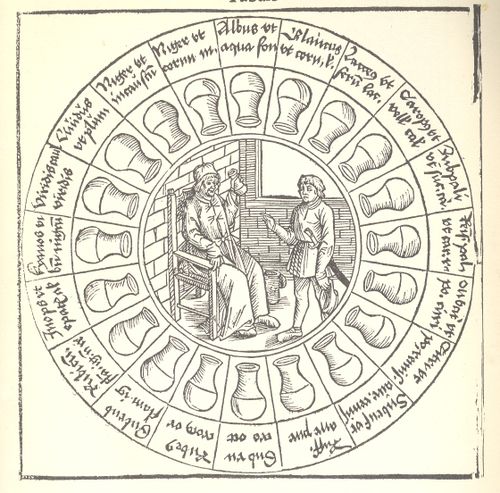
    And so here are the glorious colors (complete in “extended reading” below with the Latin above), most of which I’ve never heard as descriptors…and would love to see as an adopted sub-there by Crayola (“Crayola Urine Wheel Colors”):

    “Bluish-grey as camel skin; White as wellwater; Light blue/green/grey as lucid horn; Milky as whey of milk; Slightly pale as a not reduced juice of Meat; Pale yellow as of a not reduced lemon; Wine-red as of animal liver; Black as very dark horn; Ruddy as pure intense gold; Green as green cabbage.”  And of course:

    “Slightly red as a lowered flame of fire”

    and

    “Red as a flame of fire not lowered”

     They’re lovely!

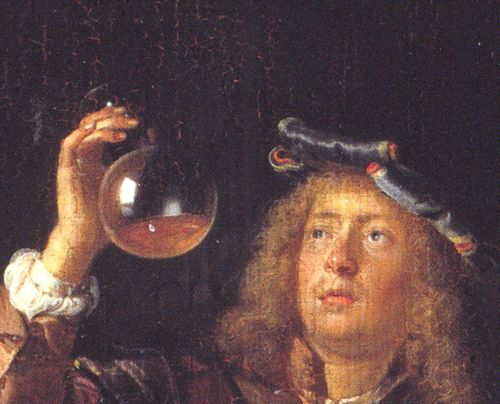
    But of course none of this was actually going to help anyone very much, especially when you moved from uroscopy into urinomancy (not a word one gets to use very often), where instead of trying to diagnose dis-ease the urinomancer would try to diagnose the future.  Often heat was applied to the jar (matula) of urine, which would do, well, I don’t know what.  It certainly looks dramatic, and makes for some excellent opportunities for artists to discern candle-lit color and wonderful reflections (as in Dou). + blog dou urine det Actually, it was in this way that the golden color of urine was determined (poor alchemists!) not to come from gold at all—urine was finally boiled away until its component urea was discovered (in 1773)3. So heat did have a real and important function, but it took hundreds of years to get there properly.
    And so it goes that predicting the future with urine was swept into histories dark places, though somehow bone throwers and astrologers managed to escape this fate. 

    Notes:
      1. Paul Pambst. Loozbuch zu ehren der Roemischen…published in Strassburg in 1546.  The Robert Sabuda website for popup books ahs a very good short essay on this book, here.

    2. Epiphanie Medicorum. Speculum videndi urinas hominum. Clavis aperiendi portas pulsuum. Berillus discernendi causas & differentias febrium.

    3.  H.M. Rouelle first discovered and isolated  1773, and then synthesized by Friedrich Woehler in 1828. This was big and important stuff.
     

    Color Wheel Colors, continued below:

  • The Evolution of the Rock: the Progress from Exisitng to Thinking and Back Again, 1510

    JF Ptak Science Books    Post 1818

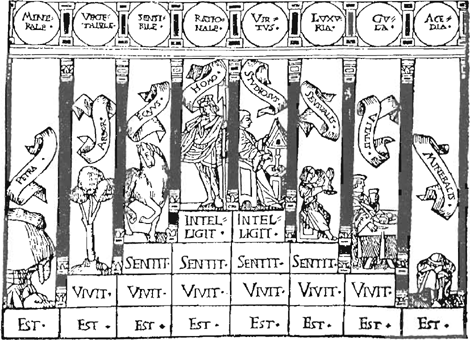
    This delightful semi-progression of existence was found in Charles de Bouelles’ beautifully titled Que hoc volumine continuentur; Liber de intellectu; Liber de sensu; Liber de Nichilo; Ars oppositorum; Liber de generatione; Liber de sapiente; Liber de duodecim numeris; Epistole complures, and printed in 1510 in Paris.  It is, in a way, in a light way, truly a representation of a literal progress of the state of things, perhaps from an  Aristotlean point-of-view.

    illustratie

    I’ve no real expertise in this matter whatsoever, and I don’t know the de Bouelles book, but I can do a bit of interpretation of the woodcut, which displays different stages of the existence of all manner of things–of all things.

    It starts at left with a rock, with an inanimate object (“Minerale”, and then “Petra”:, with the overall statement of its being, “est”–that it, it “exists”.  This is the common basis to all eight stages of progress:  “est” all the way across, and all the way down. 

    Next are the plants, the “vegetables”and “arbor”, which live (“vivit”); followed at close heal by animals, “equus”, which have”sensibilite”, or senses. and sense, “sentit”, which is a shared ability of four of the eight stages.

    The shared height of progress comes next, in man, of “rationale”, who is capable of thought (“intelligit”); these factors are shared by the scholar (“studiosis”, who comes next, “virtus”).   It is next that we start our descent, back to the simple existence of things, to the “est”: the sensate, living, existing luxuriant, observing himself in a mirror, determined to see all that was possible to see.  “Luxuria” follows, a man eating, enjoying nothing but the pleasure of consumption, simply “living”/Vivit”.  And then, lastly, to “acedia”, to the indolent man, sitting, performing no task, doing nothing:  existing, “est”.  Up and down, back to the rock. 


  • A History of Blank, Empty and Missing Things: Pain

    JF Ptak Science Books   Post 1816  Part of the History of Blank, Empty and Missing Things series

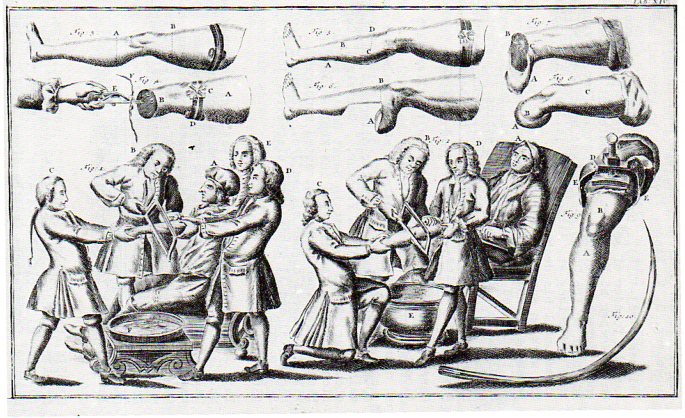
    Surgery heister563

    This curious woodcut is found in Lorenz Heister’s (1683-1758) Chirurgie, in welcher alles, was zur Wundarzney gehöret, nach der neuesten und besten Art, gründlich abgehandelt, und in 38 Kupfertaf, die neuerfundene und dienlichste Instrumente, nebst den bequemsten Handgriffen der chirurgischen Operationen und Bandagen deutlich vorgestellet werden.  Hesiter was a Nuremberger anatomist and botanist, but most importantly here one of Germany’s leading surgeons–and as a matter of fact was the founder of scientific surgery in Germany as well. He studied at Giessen and then at Leyden, where he was taught by great lights such as Ruysch,  Bidloo, Albinus and Boerhaave.  His Chirurgie was first published in 1718 in German, and was soon reprinted many times, and then translated into Dutch, English Italian, Spanish, Latin and French.

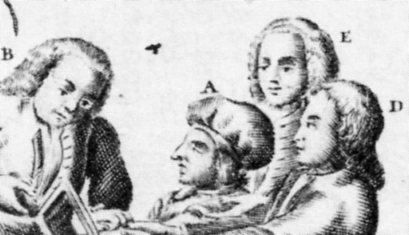
    The thing that gave me pause in the realm of pausible things, the thing that is probably the least likely to be considered “academic”, was the issue of the expression on the faces of the people undergoing amputation in the illustrations of the book.  In the pre-general anaesthesia days of Hester, the man (above in detail and below) is remarkably composed, as is the person undergoing the arm amputation.  It is all quite neat, orderly, non-chaotic and clean. And seemingly painless.

    Surgery heister560The word “anaesthesia” didn’t even exist until 1846 (Oliver Wendell Holmes Sr), when William T.G. Morton made the first successful use of it in the fabulously-named Ether Dome of Massachusetts General Hospital.   I guess the doctors could’ve dumbed these patients up with opium or other narcotics–but the sponge that was soaked in the stuff and inhaled under the nose is not in evidence.  Of course, they might’ve ingested the narcotic, or smoked it, or had it applied, but I can’t find any evidence of this in a quick look through the text.  The patients also could’ve been given diethyl ether (the general form of which is perhaps a Lullian invention of the 13th century, though the “aether” part of it came apart three decades before the Hester book with Frobenius), but again, I’m not sure.  Certainly they were given something and not riding out the operation on their own…we just don’t know that from the book, which no doubt took the high-and-unscary-road to the issue of the cutting end of the amputation. 

    Surgery heister564


  • Is Life Possible in Fewer than Three Dimensions?

    JF Ptak Science Books    Quick Post

    Hell is empty and the devils are all here–The Tempest   [Dedicated to Rohan Myers for causing me   to think about this…]    See also “The Dot and the Sphere–Picturing Multiple Dimensions”, here.

    Listening last night to a reading of The Tempest I was very soundly struck by this famous line–it made me think not so much of hell-on-Earth and all of the other permutations in this vein, but of difficult/devilish questions.  And what came out while I was listening to the play was this, something that seems difficult to me: 

    Can life as we know it exist in fewer than three dimensions?

    I’ve never really thought about this before, even after having written a fair amount about the impact of the thinking on the Fourth Dimension in the arts and sciences as well as the history of the rediscovery of perspective in general.  So while thinking about life and living and travel and so on in higher-than-the-third-dimension, it had never really come to me about thinking if it was possible for life to exist in less-than-three-dimensions.

    It seems prima facie impossible, but why?  The first thing that came into my mind was that in order for there to be a functioning brain–assuming that there could be a brain, somehow, in the second dimension–there must be a way for the brain to connect with itself.  I do not think that the universe of axons and such could do their job if they had to intersect one one another rather than going above/below/around each other.  All other things being equal, this would be a conversation killer, I think. 

    Perhaps it is as difficult to imagine this as it was stupendous for the figures in the two dimensional world in Edwin Abbott‘s Flatland to see a three dimensional figuring rising into itself from their world.  No doubt the question above is far more interesting than my answer.

    ·Posted by :

    ·in:


  • History of Anticipation: Waiting for Everything

    JF Ptak Science Books     Quick Post   Part of the History of Anticipation series and the History of Blank, Empty and Missing Things series.

    Alchemy is far from my strong suit (or even a weak suit), but I was intrigued by this engraving found in Annibel Barlet’s Le Vray Et Methodiqve Covrs de La Physiqve Resolvtive, Vvlgairement Dite Chymie: Represent Par Figures Generales & Particulieres. Povr Connoistre La Theotechnie Ergocosmiqve, C’Est Dire, L’Art de Diev, En L’Ovvrage de L’Vnivers…, which was ostensibly a work on alchemy, the second edition (used here) published in 1657.  Taking  a quick tour through the book it looks far more applied, far more medically-oriented, than a standard work on alchemy.  (And by “medical” I’m really meaning “pharmaceutical.)  I don’t have the knowledge really to say  much about the application of the Paracelsian alchemical chemistry and how much the various human natures/humors/metals etc. come into play with the prescription–I’d say offhand that the Rxs would be necessarily a little suspect. 

    [Images courtesy of the Beinecke Library, Yale University].
    I’m visiting the book here though because of the image above, showing the hands of the Primum Mobile (or god) about to see themselves busy with the job of creating everything.  Or almost everything, as the shape of the container of All Things seems to be in place, held by the creating influence in an existence outside of the existence of existence.   Perhaps the artist was just depicting the local existence, with the hands and etc. located in the space beyond the known solar system of 1657, showing the alchemical creation of order in the vast sea of chaos.  It is curious to me how many concentric circles there are in the suggestive orb of possibilities, especially since the following image in Barlet’s book shows considerably fewer place-holders.  Perhaps this is all easily explained with a little knowledge of alchemical history, which is something that I do not possess–but for the time being, I’m very entertained by what might be an excitement in that first engraving of the things-to-come. 
    Later in the book is found this interestingdiagram bringing together some of the complicated alchemical beliefs of elemental relationships, this showing the coming-together/convergence of elements, humors and geocosmic bits
    A diagram of a square divided into four triangles within a larger circle illustrating the convergence of elements, humors, and geocosmic factors in the thinking of Paracelsian chemical physicians.
    Le vray et methodique cours de la physique resolutiue, vulgairement dite chymie by Annibal Barlet

  • A Note on Good Instruction in Thinking for Kids, 1673

    JF Ptak Science Books   Post 1815

    I foudn a curious book called Childrens talk, English & Latin… written by Charles Hoole, and the printed in 1673, in London, ostensibly to teach small ones the properties of Latin.  It is filled with interesting stories which are small tests to logic and testaments to what was to be expected behavior, as told in this story of a stolen knife.

    [Source:  the Beinecke Library, Yale University].

    One boy asks the other to borrow as knife, but the second boy is reticent, fearful that “it will suffer to travel” and not be returned, and wonders why the borrower needs to borrow,  The first boy explains that his knife was missing, and a nice little knife it was: little, dull, with a blunt point, brass studs, with a hole at the top. This is the description of the knife that the second boy is carrying, the first boy then putting the case to the second that this knife belongs to him, and that it was taken away, stolen.  The second boy makes the cases that the knife may well have belonged to boy one, but now it was his, having purchased it fair and square. 

    “Surely it is a knife” says boy one.

    “That means nothing to me” says boy two;

    “But dare you buy stolen goods” boy one, to which the other responds with a sharp “”any without any difference”.  This must’ve angered the knife pursuer, who states that anyone willfully and knowingly purchasing stolen goods is also committing a crime, “But you are as Ill as a thief”.  The second boy is unmoved, stating “Put cases I am not”. 

    It all finally boils out that the case is taken to the school Master, who adjudicates in an interesting fashion–you’ll just have to read for yourself, below.  It is all very interesting to me, shaping an argument for kids, having them think something through, and then have it all make sense in the end.  And in Latin. 

    [More readable and expandable text below].

    ·Posted by :

    ·in:


  • The Lincoln Memorial Pentimenti

    JF Ptak Science Books     Quick Post

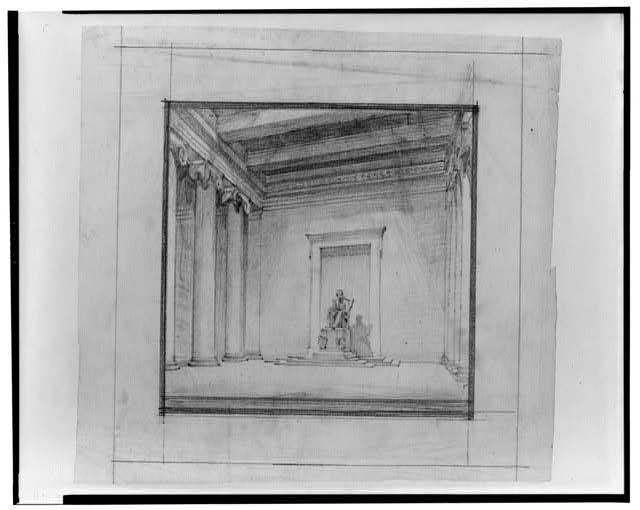
    Henry Bacon  (1866-1924) was the architect of the Lincoln Memorial–it was his last major assignment and I should say his greatest.  I found in the Library of Congress some of the drawings  he made (completed 1910-1917) envisioning the space, and they included what might very loosely be called pentimenti of the statue of Lincoln that was to be provided by Daniel Chester Smith (1850-1931). They are really just placeholders, models, of how the finished statue would occupy the space.  When I saw these drawings I realized how perfectly the finished works lived together. 

    Lincoln