A Daily History of Holes, Dots, Lines, Science, History, Math, Physics, Art, the Unintentional Absurd, Architecture, Maps, Data Visualization, Blank and Missing Things, and so on. |1.6 million words, 7500 images, 4.9 million hits| Press & appearances in The Times, Le Figaro, Mensa, The Economist, The Guardian, Discovery News, Slate, Le Monde, Sci American Blogs, Le Pont, and many other places… 5000+ total posts since 2008.

Category: Anticipation, History of

  • Porta’s Visions, Big & Small: On “Magic”, Chaos and Not Inventing the Telescope

    JF Ptak Sciene Books   Post 1906
    https://historyofideasblog.com/a/6a00d83542d51e69e201156ecdf55e970c-pi

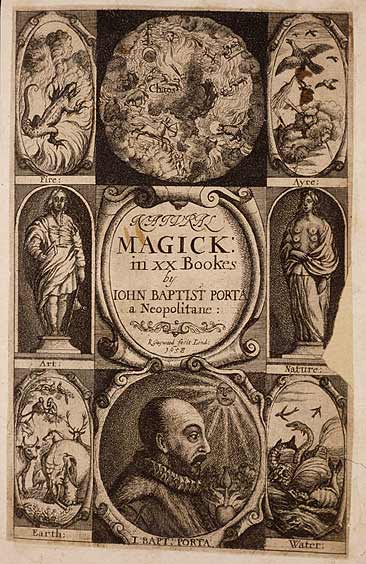
    [Detail from the title page of Natural Magic, below.]

    Giovani Baptista della Porta was a magus, or a natural (science)
    “magician”, who searched nature for similarities that would serve to build a
    broad template of forced  understanding of seeming likenesses, looking for the great connector
    in the exceptional and the unusual, the stuff outside of the formerly
    Aristotlean world.   Natural Magic is his magnum opus, an expansion of  its earlier
    version (Magna naturalis)  published in Latin in 1558, which Porta expanded to twenty sections in 1589. The 1589 edition was a maturing of the 1558 edition, toning down the philosophical/religio-mystic basis for the ordering of the natural environment with an approach more suitable to observation and experimentation. It was an encyclopedic work of vast proportions, a
    gold-mine of information and clever wishfulness, and very accessible due to
    Porta’s  wide inter-personal travel,
    very wide reading and critical abilities, clear reasoning and deep vision:  the book was hugely successful, going into at
    least twelve Latin, four Italian, seven French, two German, and two English
    editions in the early modern era. Natural
    Magic
    , which first appeared in English in 1658, concerned itself with
    magic, alchemy, optics, geometry, cryptography, magnetism, agriculture, the art
    of memory, munitions, and many other topics, all grouped together and refined,
    distilled, into a cloudy assemblage of natural knowledge—it would end up that the magical
    whole was worth far less than the sum of its parts. 
    Porta magic english
    But the parts were pretty considerable, and much of the
    information was spot-on for the time, not the least of which was a very capable
    demonstration and explanation of a lensed camera obscura. 

    What I’m interested in right now though is the title page of
    the book (pictured above).

    It turns out and as we can see in the top image of the
    title page, Chaos is not some subspace trajectory of cellular automata, or in
    Dr. Brown’s/Einstein’s dancing dust—it is right above us.  This recognition of its regular, localizable structure
    probably does not support parameterization, or anything else for that matter,
    except to say that it is definitely “pretty”. 
    The title page has nine illustrated compartments:  the four corners depict the four elements,
    the two opposing middles show art and nature; the bottom shows the author,
    illuminated by the knowing sun.  The top
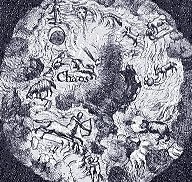
    center image is the element showing “chaos”, which I’ve chosen to use a map,
    identifying where exactly chaos might be. 
    I’ve not seen an antiquarian map identifying chaos, though I have seen a
    number showing lots of other non-existent places, like heaven and hell and
    purgatory and Eden and the Kingdom of Prester John, to name a few.  But not chaos.

    It is very interesting to note that while in the process of looking at nature, and observing connections real and imagined, and creating ways of organizing and storing information in the brain, Porta conceived of a telescope, and this several decades in advance of Galileo. (The idea of the telescope stretches pretty far back, though.  The idea seems ancient, though the scientific thought on the matter really weren’t present until the 13th century with the work of Roger Bacon and Robert Grosseteste, and then with Nicolsa of Cusa (in 1451) doing experimental work on the properties of lenses, and then on to John Dee and Thomas Digges in 1570/1.  Porta seemed right about there, just ont he edge of the invention of an instrument which would have allowed him to see farther and deeper than anyone else before him, but he didn’t follow through.  He mentions in the 1589 edition of Magiae:

        “With a Concave lens you shall see small things afar off very clearly. With a Convex lens, things nearer to be greater, but more obscurely. If you know how to fit them both together, you shall see both things afar off, and things near hand, both greater…”  (Porta would expand this section of the 1589 book (section XVII) into a complete and separate work in 1593,  De refractione optices.)

    I do not know what happened to this idea, or why it didn’t flourish in Porta’s hand like it would in those of Galileo less than three decades latter.

    Porta was a very  nimble and penetrating man–his Magia naturalis was a dissecting tool for the complexities that he saw around him, and his later works were in some ways continuations on this theme.  The first two books following Magiae were concerned with private visions of Very Large Things:  the first, De furtivis literarum notis (published in 1563) was one of the earliest works on cryptology.   This looking-deeper book was followed three years later in 1566 by a book on how these thoughts could be organized in the mind.  Given the spirit of the times and the difficulty of actually recording what it was you saw, Porta wrote  Arte del ricordare, which addressed the very idea of memory and then the more applicable bits of mnemonic devices.  He looked for more hidden messages in his next work–on the physiology of hands–but it didn’t see the light of publishing day until after Porta died.

    Working in the areas of pharmacology, hydraulics, military engineering, physiology, and physics, among many other areas, Porta published De aeris transmutanionbus (1609) on meteorology; De distillatione (1610), on chemistry; Coelestis Physiogranonia (1603), on a sort of “writing in the sky” and both a blast and support of astrology; and De humana physiognomonia libri IIII (1586), which was a work physiognomy and discerning function from structure. There were other books, not to mention at least 17 dramatic works.  Porta was basically unstoppable.

    All of this takes me back to the question of wondering about his inability (?) to see the possibilities of the telescope. In all of his books on deterministic vision, and of seeing things deeply–whether it was in the sky, or in chemical experiments, or in seeing the structure of a plant incised with its function in nature, or in the complexities of memory, and so on–it is a mystery to me how he could have left the development of the telescope along. 


  • Out-of-Place Department: the Moon as Debris Ring Around the Earth

    JF Ptak Science Books   Quick Post

    Moon gone earth belt
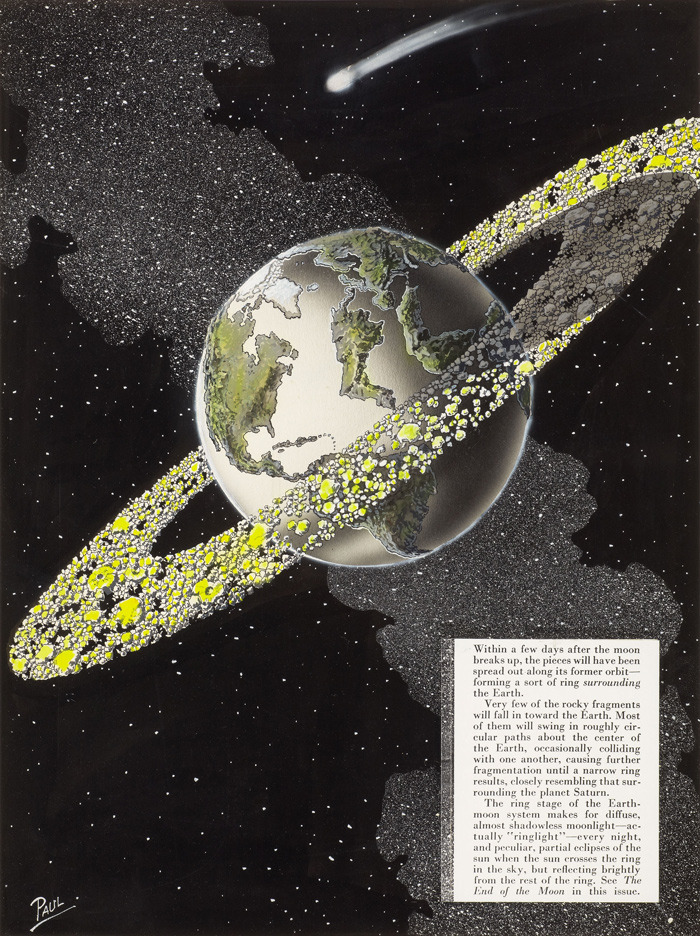
    [Source: 50watts.com, “Tetrahedra in Space”, Frank R. Paul series, here.]

    See also an earlier post, “Things out of Place Department: the Moon”, here.

    This is certainly the work of a delightful and bouncing imagination, more so with the illustration by the great Frank R. Paul.  The image is found on the back cover of  the August 1953 issue of Science Fiction Plus for the short story “The End of the Moon”.   And what we see–at least from the artwork as I cannot find an online version of the text–is a not-convincing result of the Moon going away.  I’m not an historian of the idea of the vanishing Moon and how early writers have imagined it ailing/disappearing/exploding/imploding, though I’m fairly well sure that the scifi wasn’t keeping up with the 1953 science of it all, at least with what I can see and understand.

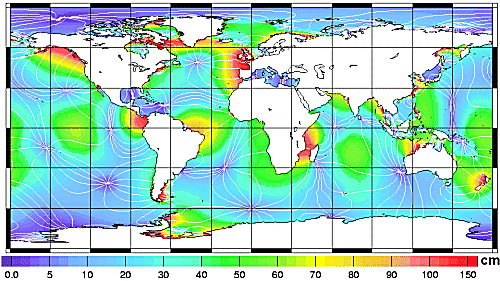
    If there was no Moon.  What if the Moon never existed? What if the Moon existed but vanished?  I guess it would all depend on what exactly happened to the Moon to figure out the disposition of its remaining assets.  The Moon removed certainly would effect changes in the tides, though I think not in the way depicted above. There would substantial changes  though I think not enough to cause a new continent to rise out of the middle of the Atlantic, or to flood all of northeastern Africa.  “If  We Had No Moon”, an essay by Bernard Foing in Astrobiology Magazine, here, provides an interesting tidal change map (below) which shows a projection of the main hotbeds of tidal change. 

    Since I have no access to the text of the scifi article I don’t know if the story addressed changes to the weather and migratory patterns of animals in response to tidal changes, or what happens to large coastal cities, or the influence of a more volatile seasonal change, or changes to the Earth’s orbital parameters, and so on.

    Its the “and so on” part that is the most interesting left-out bit.

    Bottom line here is that I just like the great cover art for the story

    
    Moon gone map of tidal changes

    Another interesting article from ScienceNordic, here.


  • New York City Under Attack–Additional Images

    JF Ptak Science Books   Quick Post

    New york city attacked
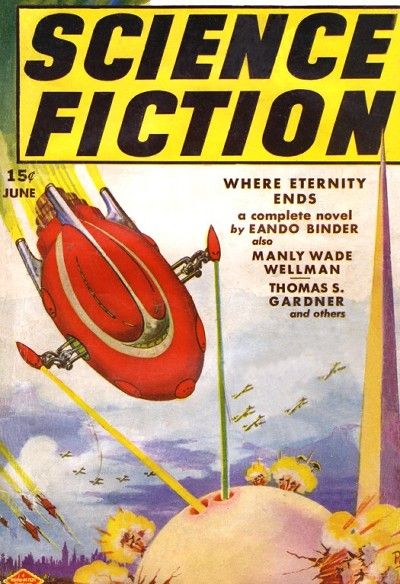
    The Binder brothers (Earl Andrew [1904-1965] and Otto Oscar [1911-1975] under the pseudonym Eando Binder (E and O Binder) wrote “Where Eternity Ends”, a story which appeared in the June 1939 issue of Science Fiction magazine. The cover illustration was by the great Frank R. Paul, and it depicted a savage attack upon the iconic New York City World’s Fair building, the perisphere (the trylon is in the background), and what looks like the rest of NYC as well. 

    It is also part of a continuing subseries on this blog relating
    images of antique images showing NYC destroyed, and include the
    following posts:


  • On Seeing Things Backwards Series, 1: UNIVAC and the 1952 Election

    JF Ptak Science Books   Post 1917

    Univac-cronkite
    Leonardo wrote backwards and from right to left, Benjamin Button lived backwards at the hands of Scott Fitzgerald, Rene Magritte’s man in the bowler saw the back of his head, Herrimann’s Ignatz the Mouse I am sure saw the back of his head looking around the world with the world’s most powerful telescope, rugby passes are all done backwards, paper images of vue optiques appear backwards, lightning for all intents and purposes starts backwards from the ground up, reverse mathematics are worked from theorems to axioms, and the Chicago River (1900) was engineered to flow backwards for the foreseeable future, while the Mississippi River famously flowed backwards for just a bit in the New Madrid Earthquake of 1812. 

    I can only imagine what audiences must have felt when they saw the first moving pictures played backwards–seeing them played forwards was a novel-enough (and revolutionary) idea, but the simple idea of reversing the direction of the film would have proved to be equally fascinating. 

    Imagine the first time you witnessed a staged train wreck on film, back there in 1897, and imagine being able to see it played over and over again, until you were filled.  I’m not so sure that there were even any still photographs of a train wreck as it occurred to this point, even with advances in film speed and lens, so seeing the even unfold in front of you at leisure must have been overwhelming.  Now imagine these same folks seeing the event and watching the locomotives reconstitute themselves.  It would have been an extraordinary event.  Even observing the Etienne Marey sequences and seeing what actually happens when a person bends over to pick up a pail of water would have revealed almost as much in new detail as when Galileo was in the middle of his earliest observations. 

    Looking at things backwards is a good idea so far as thinking about engineering problems and of course in checking experimental results in the sciences–its not so good an idea though to change the results produced by the scientific method because they’re not a good intuitive fit to expected parameters.

    Such was the cased with the first (and successful) employment of a computer to predict the outcome of a presidential election.  THe computer was the UNIVAC (the world’s first commercial computer and a blazingly fast machine at 10k operations a second, nearly six orders of magnitude lower than “superfast” by contemporary standards), which was brought in by Remington Rand to CBS News to crunch the numbers on the tight race between General Dwight Eisenhower and Gov. Adlai Stevenson (II) on 4 November 1952.  (Stevenson was the son of a former U.S. Vice President and would run again against Eisenhower in 1956.) Pioneers Pres Eckert and John Mauchley, along with Max Woodbury (and programmer Harold Sweeney, who is seated at the UNIVAC’s control panel and who seems never to be mentioned in the iconic photo at top, with Eckert at center and anchorman Walter Cronkite at left).   CBS News Chief Sig Mickelson and Cronkite were not comfortable with the proposal, but ran with it anyway, sensing a moment of the-future-is-now.

    The Eisenhower/Stevenson race was seen by the large majority of pundits to be too close to call, so when the UNIVAC’s results pointed to a landslide for Eisenhower (438 electoral votes and 43 states to Stevenson with 93 electoral votes and 5 states) folks got very sweaty and nervous, not trusting the outcome. As this was still a very early age in human-machine interaction, and the computed results fell far away from perception and expected response, changes were made in the UNIVAC’s programming to determine a more “reasonable” response by the machine, the new results making the race very tight and fitting human expectations and giving Eisenhower a very slim margin of victory.  As poll results started to sweep in an hour or so later indicating that Eisenhower was showing with a huge victory, the UNIVAC was again reprogrammed and at about midnight the announcement was made that the UNIVAC had indeed been correct in the first place.  The final results were 442 electoral votes for Eisenhower and 89 for Stevenson.  In the next presidential election in 1956 the three networks all had computers working for them–with them–and a different perception had been formed on working with computers. 


  • Interesting Images of Renaissance Hell–on Title Pages

    JF Ptak Science Books   Post 1917

    Bloghelltp078Images of Hell do not often appear graphically depicted right on the title page of books, even though books speaking to Hell and warning us of its coming number in the hundreds of thousands, if not more, particularly if you interpret religion as the means for keeping people away from the ring of fire.    Few people are shy about depicting Hell in general, though there evidently is some reluctance (or forbearance, or oversight) to showing it front-and-center on the title pages of books.
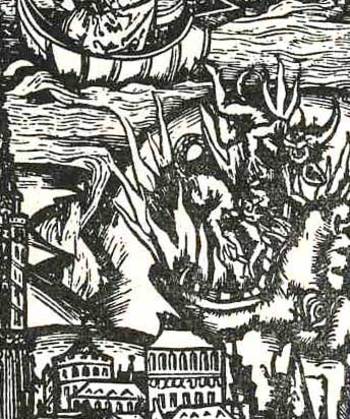
    A terrific exception to this rule is Jacobs de Voragine’s Passional, Hyr hewrrey sick an dath winter deel, printed in Basel in 1511, and illustrated by various and unidentified Strassburg woodcut masters.  In this extraordinary title page we see the vision of the adoration of the Virgin Mother and child supported in a rose of light, aided by guiding winds and various floating saints, and shown lowering the holy book directly to the city of Strassburg. In either corner positioned above the temporal city and below the firmament are two visions of hell, one less vicious and the other more so:  to the left we see some of the pious praying for better judgment as they are about to be consumed by the background flames, while to the right is a far more ambitious and morbid vision of hell featuring the famous Hellmouth.  The Hellmouth makes appears all throughout the history of art (as we can see in this Brueghel painting, for example), but it is a little curious that, outside of the mention of Leviathan (translated from Hebrew, Job 41:1), Hellmouth (as the entrance to hell) doesn’t make an appearance in the Bible.
    Bloghelltpdetail
     

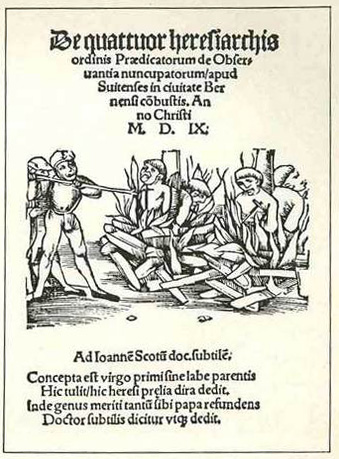
    What is more easily found, at least in the artwork on title pages throughout the Renaissance and the Baroque, are images of people about to be sent to hell. A good and chilling example of this can be seen in the artwork for Thomas Murner (1475-1537) De quattor heresiarhis ordinis Praedicatorium de Observantis nuncupatorum…, printed (again) at Strassburg in 1509.  The pamphlet tells the story of Johannes Jetzer and his accomplices (including four monks) who were tried (under torture) for blasphemy after it was revealed that they colluded to defraud people with a bogus story of religious visions, employing the bloody tear of Mary.  All were found guilty and the four monks were burned alive at the stake—Jetzer having escaped—and sent immediately to the deeper, more fiery, pit.

    Hell on title page
    This isn’t quite showing the coming of hell as in the first case, but it is getting close.  In any event, I found it interesting to see the depiction of the Bad Place right there on the title page of the Murner bokk.


  • Opening the Doors to Trigonometric Heaven

    JF Ptak Science Books   Quick Post  

    Cavalieri767
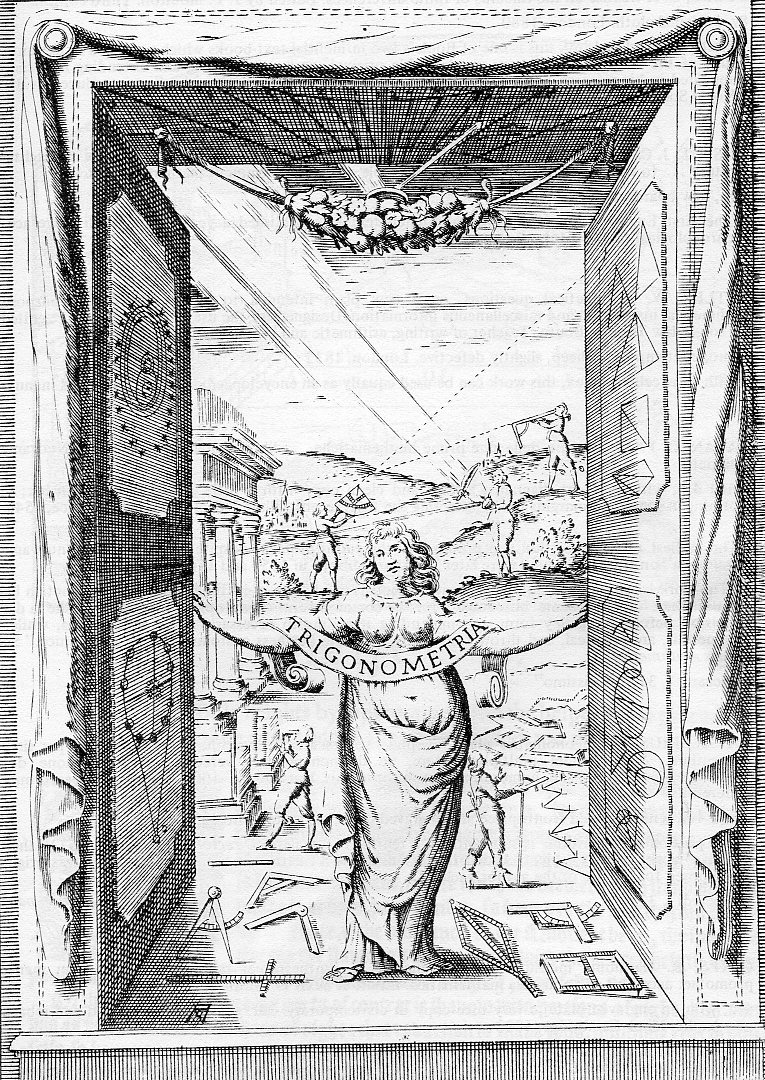
    There aren’t many other title pages in the history of mathematics that swing the doors of beauty and heaven and opportunity and logic and thought than the (appropriately-named) Bonaventura Francesco Cavalieri/Cavalerius.  A Milanese (1598-1647) who taught at Pisa and who published eleven books and worked in wide fields in mathematics as well as astronomy and physics, published his Trigonometria… in Bologna in 1643, and sent a fabulous image to his new readers right there on his very illustrated and augmented title page. 

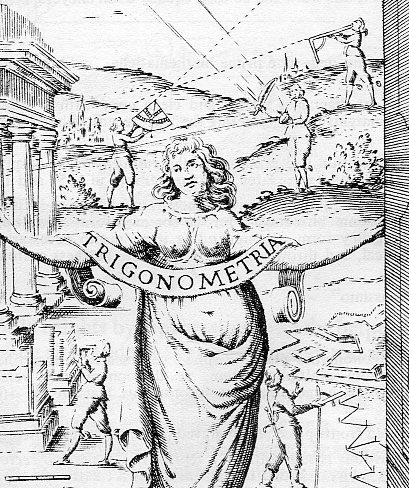
    Seldom have the doors of knwoledge been thrown open so wide and invitingly as this, with Trigonometria lightly awarding the reader with a new portal to fantastic opportunities–who wouldn’t want to walk on in?  The tools of trig are displayed on the ground at Trionometria’s feet (arranged and not by happenstance), while five figures employ these same tools in the background hills, which are being bathed in a pure holy light of some sort, an inspiration from the sky.  The doors are decorated with astronomical figures and light calculation, as well as polyons and geometrical drawings.  And just to make sure that the author meant what he intended, we can see above the full/thick wind-blown hair of Trigonometria (which in itself seems very unusual to me, such a carefree adn tossled attitude) a fruit-garland, a horn of plenty in its way.  Make no mistake–Cavalieri was making a king-sized offer to his reader to open their brains. 

    Cavalieri768

    I did leave out a major part of the title–the section dealing with logarithms, which is basically a reprint of Cavalieri’s early work (done in 1632), and which was the first work in Italian on that subject. 


  • “This Enquiry Not Overcurious”: Huygens on the Laws of Extraterrestrials, 1698

    JF Ptak Science Books   Post 1894

    “…stars…Numerous, and every star perhaps a world Of destined habitations”–Milton, Paradise Lost (1668)

    In spite of a fairly long (if not light) and ancient history, it seems as though Christian Huygens might have thought more to the shaping of extraterrestrial life than any writer to his time.  [The idea of extraterrestrial life is very old, stretching far back into Hindu cosmology, and even deep into the (eighteen worlds) of the Talmud.  Thales, Anaximander, Democritus, Aristole, Ptolemy all thought about and agreed on the possibilities of life being lived on places other than the Earth–infintely more life, in the case of Epicurus. Bruno, Copernicus, Fontenelle, Henry More, and Cyrano de Bergerac.] In a way, in a Asimovian way of rules, Huygens may have laid out the first real template for describing what life-not-on-Earth might look like.  And in the long run, he finds that the possibilities for life Elsewhere are enormously high (and not in doubt in any way), and that it should in no way be any lesser life-formed than what we know here on Earth–and that includes “life” in all of its great complexities.

    [One of the few images made during this time or earlier on the possibilities of world systems outside our own appeared in Bernard le Bovier de Fontenelle–who almost but not quite gets there in his 1682 book Entretriens sur la pluralite des mondes, as follows, though it really has not much at all to do directly with Huygens:]

    Blog--plurality of world fontenelle

    Huygens (1629-1695) worked across many fields, including astronomy, biology, math and physics, and was extraordinarily productive, making numerous contributions in the physical and theoretical areas, as well as being a prolific author and correspondant.  But towards the end of his relatively short life (he died at age 56) Huygens embarked down the science fiction road in pre-science fiction days, writing a wonderful and provocative book entitled Cosmotheoros, The Celestial World Discover’d: or, Conjectures Concerning the Inhabitants, Plants and Productions of the Worlds in the Planets (available online in English here) where he establishes the groundwork of this extraterretrial life. (The book was nearly published during Huygens’ lifetime, but it didn’t quit ework out; left to his brother to published, he, too died before the book was finally in print in 1698. Shortly after the Latin edition of the Cosmotheoro was published by the The Hague publisher Adriaan Moetjens, translations appeared in English (1698) and in Dutch (1699). In the following years, translations also appeared in French (1702), German (1703), Russian (1717) and in Swedish (1774).)

    Hugens set out his description by arguing that extraterrestrial existence of life is perfectly in keeping with the Bible, and that his”conjectures are not useless” or “overcurious”, and that are justified in and of themselves as a useful pursuit because of the display of logic in his arguments.  He states that the inherent sinfulness and “villany” of man on Earth does not perclude life elsewhere, and these lifeforms coul dbe everywhere else, and no different from our own, with no differences in ability to reason and explore.  Lifeforms exist much like us, with at least five senses (and here Huygens makes an interesting play for more-than-give senses, though he doesn’t understand what they might be), and are capable of all of the supporting capacities for enjoying astronomy, and logic, mathematics, physik, arithmatic, and all of the rest, including all possible skills that could be called upon in the production of instruments of science necessary to pursue any endeavor, and all enjoyed in a society as expectently rich as any on Earth, enjoying all of their plants and animal lifeforms, all of their own creations and the rest of the creations of Nature, all while listening to a universe-wide application of music (“everywhere immutably the same”, which Huygens states beautifully here:)

    “It’s the same with Musick as with Geometry, it’s every where immutably the same, and always will be so. For all Harmony consists in Concord, and Concord is all the World over fixt according to the same invariable measure and proportion. So that in all Nations the difference and distance of Notes is the same, whether they be in a continued gradual progression, or the voice makes skips over one to the next. Nay very credible Authors report, that there’s a sort of Bird in America, that can plainly sing in order six musical Notes: whence it follows that the Laws of Musick are unchangeably fix’d by Nature, and therefore the same Reason holds valid for their Musick, as we even now proposed for their Geometry”–(page 86)

    Cosmotheoros’ pages are filled with such reasoned arguments–remarkably so for the end of the 17th century, barely 90 years after the great publication of Galileo and 40 aftre the work of Hooke (in exploring infinities at the other end of the optic scale).

    I’ve included some interesting parts from Book One of the Cosmotheoros; the subject/section headings are in red, and the page number (which usually appears mid-sentence) is related as [23]. Huygens occasionally referes to the other non-Earth life forms as “Planetarians”.  Here’s a sample:


  • Vernacular Found-Polygonism 2: Walker Evans on the Roof

    JF Ptak Science Books  Quick Post

    Evans polygons

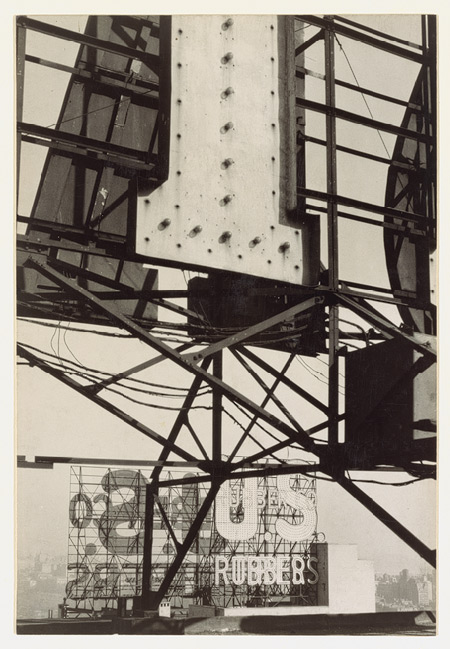
    How many polygons can you find? 

    “Walker Evans climbed to the roof of the Fisk Building on Central Park South to  photograph the web of steel struts and electric signs that were rapidly filling the skies over Manhattan. The electric signs in this photograph alternately  flashed the company’s name and the names of its two principal products. As there  were approximately a hundred million wheels rolling over America’s roads in  1928, the sale of tires quickly overtook that of rubber galoshes. The image  expresses Evans’ conviction that modern art could be timeless yet topical when  perfectly wrought of vernacular materials.”–Metropolitan Museum of Art

    This is one in a series of posts made on found geometries–here are a few others:

    Found Alphabets and Geometry in Stone.(here)

    Magritte-Like Disorienting Geometry in Found-Art Urban Design, 1925 (here)

    Sierpinski Triangles & the Empire State Building (here)


  • Trademarks, Memory, Nazis, and Death Camps

    JF Ptak  Science Books  Post 1891

    In the world of identifying symbols–which I’ve been writing about a little over the past few days, but mainly on Renaissance and Baroque and Mannerist iconography–few are as distinctive and recognizable as modern trademarks.  There’s a lot of high-voltage connecting wires between modern advertising and memory devices and Renaissance emblemata, and as I was sorting out some of the nice compatables I was stopped in my tracks by one of the modern images, mainly because I had a recollection for an older and unmentioned iteration of the symbol.

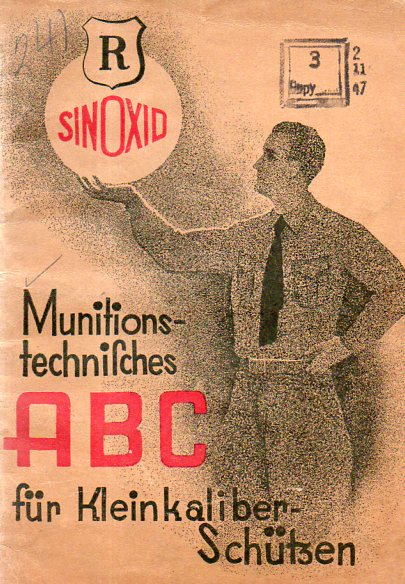
    Sinoxid.  It was recorded in the registry of German trademarks for 16 November 1968 as being owned by Dynamit Nobel AG. 

    This is what the trademark looked like in 1968:

    http://img03.mar.cx/_images/CA317024

    The same trademark, a little earlier in its career, as it was being admired by a Nazi Brown Shirt S.A. member in 1933:

    Trademark758Dynamit Nobel A.G. is an old company. It is the German arm of the Swedish Nobel munitions firm (begun in 1864) by Emil and much-more famous (and longer-lived) brother Alfred.The German company was established in 1865 in Toursiburg so that the dangerous products produced by the firm wouldn’t have to travel as many miles if it was produced closer to the consumer.  The Nobel firm manufactured munitions–famously so with a nitrogylcerin compound known as “blasting oil” that was notoriously unstable, and which in a fit of instability  actually killed Alfred’s brother Emil in 1864. It also blew up parts of the German factory (on two occasions before 1870).  The stuff was beyond lethal.  But it didn’t stop Nobel from shipping their explosive goods worldwide in unmarked crates so as to not attract attention to a dangerous product. Three such cases were once sent to the Union Pacific company in San Francisco in 1866–two became unstable and blew up in the company’s headquarters, killing dozens. But no one was scared beforehand.

    Alfred Nobel left no heirs and so donated some percentage of his firm’s monies to the foundation we know today by his name. The company grew into the largest munitions producer in Europe. Beginning in the mid-1920’s it began a relationship of fusions and mergers and so on with the giant cartel I.G. Farben, among many others.

    I.G. Faben company produced Zyklon B. It operated its business with slave labor in concnetration camps. It sent tens of tens of thousands to their deaths working on Farben products. Zyklon B itself killed millions of human beings.
    This is what used canisters of Zklon B looked like after they had been used to murder Jews and other prisoners in the death camps:


    They have a design much like the tossed-away bodies of their victims.

    ·Posted by :

    ·in:

    —

  • Cathedral of Dust of the “Wrong Arrested”–Vernacular Redemption, 1939.

    JF Ptak Science Books  Post 1890

    This is an image of an engineered redemption, found in the mist of Placquemines Parish, Louisiana, in 1939.  There is no doubt in my mind that the author, Mr. E. Riche, was done with running from whatever it was that was chasing him–printing his truth would no doubt cut it down. “I am wrong arrested” Mr. Riche says, and wants “help from the public eye”. 

    Oh my g_d. If this isn’t a Mr. Cash song, I don’t know what is.

    FSA--signs--redemption_edited-1
    This is a photograph of fantastic humanity, of a person witnessing for themselves, stating their beleift, defending their honor, exploring the present, and staking a very visual land claim in reality.  And then–with all that said, all of this person’s dignity and belief displayed for everyone to see–the author lives in the sign he or she created. It is as though someone has engineered a three-dimensional public-philosophical house in which to live, and then actually lives there. 

    As a testament to a simple call to fairness and justice, this image is an extraordinary and powerful reminder to the power of spirit. For some reason I can feel this person’s letter down to the cellular level.