A Daily History of Holes, Dots, Lines, Science, History, Math, Physics, Art, the Unintentional Absurd, Architecture, Maps, Data Visualization, Blank and Missing Things, and so on. |1.6 million words, 7500 images, 4.9 million hits| Press & appearances in The Times, Le Figaro, Mensa, The Economist, The Guardian, Discovery News, Slate, Le Monde, Sci American Blogs, Le Pont, and many other places… 5000+ total posts since 2008.

Author: JF Ptak

  • No Room for Eden–Annotation of John R. Cash’s “The Man Comes Around”

    JF Ptak Science Books   Post 311

    Cash_2( No Room for Eden —notes on Johnny Cash and the biblical and classical references in the text of “The Man Comes Around”, by John R. Cash (2002).

    This song was written by Mr. Cash for his American series (IV), and released in 2002.  This is a simply superb series of recordings, mostly coming from Mr. Cash’s final time.  The quality of his voice and his humanity is astonishing.

    Listen HERE (with static images).

     *** = annotation

    [Cash’s lyrics in italics.] 

    The Man Comes Around

    “And I heard, as it were, the noise of thunder:
    One of the four beasts saying: “Come and see.”
    And I saw.
    And behold, a white horse.

    ***“”And I saw when the Lamb opened one of the seals, and I heard, as it were the noise of thunder, one of the four beasts saying, Come and see.  And I saw, and behold a white horse: and he that sat on him had a bow; and a crown was given unto him: and he went forth conquering, and to conquer.”–Revelations 6:1-2 On  the opening of the First Seal (one of the four beasts) bids the Christ to come and see what was inside; the conquering figure on the white horse being Jesus, the white horse being purity of faith, etc. ***Seals referring to the 7 seals binding the great book in Revelations

    “There’s a man goin’ ’round takin’ names.
    An’ he decides who to free and who to blame.
    Everybody won’t be treated all the same.
    There’ll be a golden ladder reaching down.

    *** Jacob’s ladder is probably the most famous ladder in symbolism. Its story is found in the Old Testament [Gen 28:10-17]. Jacob, fleeing from the wrath of his brother, lay down to sleep with a stone for a pillow. During the night he dreamed that he saw a ladder or stairway reaching up into the heavens upon which were angels ascending and descending. At the head of the ladder was God the Father confirming the Patriachal blessing upon him and promising to protect him on his journey….

    St. Augustine  wrote that Jacob’s ladder represented the Church and the angels the patriarch saw ascending and descending upon it represented the evangelists or preachers of the Gospel ***


    When the man comes around.

    “The hairs on your arm will stand up.
    At the terror in each sip and in each sup.
    For you partake of that last offered cup,
    Or disappear into the potter’s ground.
    When the man comes around
    .

    ***welcome to the apocalypse, friends; drink from the everlasting or disappear into an unmaked grave in the pauper’s burying ground***

    Hear the trumpets, hear the pipers.

    ***7 seals, 7 angels given 7 trumpets rev 8:1

    One hundred million angels singin’.
    Multitudes are marching to the big kettle drum.
    Voices callin’, voices cryin’.
    Some are born an’ some are dyin’.
    It’s Alpha’s and Omega’s Kingdom come

    .***the beginning of the end, trumpets of the angels revealed in the first seal calling to the faithful or not so…***

    And the whirlwind is in the thorn tree.

    ***no whirlwinds or thorn trees in the B (thorn bushes, etc) Judgment approaches.

    The virgins are all trimming their wicks

    .***referring to trimming and caring for a torch,and later to the economy of a lamp. J refers the virgins to their chaste ways***

    The whirlwind is in the thorn tree.
    It’s hard for thee to kick against the pricks

    .***referring to kicking clods/dirt from an early sort of plow, a prick. Straight and narrow, the righteous way…

    Till Armageddon, no Shalam, no Shalom

    ***Armageddon: the geographic location given in the book of Revelation (16:16) for the climactic battle between Christ and Antichrist, with Christ’s victory ushering in his thousand-year reign on earth. Named after the hill near the town of in Megiddo,  Palestine, which due to its strategic location overlooking major military and trade routes was the site of many ancient battles.

    ***Shalam Acquaint now thyself with him, and be at peace (shalam)”; Psalms 4:8. also, to complete, or to finish. (Isaiah 33:1), and shalam Psalms; Shalom, Hebrew, peace. Perhaps Shalam was meant as “Shalaam”, which in Arabi cmeans “peace”.

    Then the father hen will call his chickens home.
    The wise men will bow down before the throne.

    And at his feet they’ll cast their golden crown

    .*** Crown The Greek word is stephanos, a garland of victory. He had worn the crown of thorns and was awarded the crown of glory j. John 19:01

    When the man comes around.

    Whoever is unjust, let him be unjust still.
    Whoever is righteous, let him be righteous still.
    Whoever is filthy, let him be filthy still
    .

    **** Rev 22:11 “He who is unjust, let him be unjust still; he who is filthy, let him be filthy still; he who is righteous, let him be righteous still; he who is holy, let him be holy still.”

    Listen to the words long written down,
    When the man comes around.

    Hear the trumpets, hear the pipers.
    One hundred million angels singin’.
    Multitudes are marchin’ to the big kettle drum.
    Voices callin’, voices cryin’.
    Some are born an’ some are dyin’.
    It’s Alpha’s and Omega’s Kingdom come.

    And the whirlwind is in the thorn tree.
    The virgins are all trimming their wicks.
    The whirlwind is in the thorn tree.
    It’s hard for thee to kick against the pricks.

    In measured hundredweight and penny pound.

    ***hundrewweight is 100lbs; 20 pennys to the ounce…all things measured large and small…

    When the man comes around.

    ****

    And I heard a voice in the midst of the four beasts,
    And I looked and behold: a pale horse.
    And his name, that sat on him, was Death.
    And Hell followed with him.

    End.

     ****  And I looked, and behold a pale horse: and his name that sat on him was Death, and Hell followed with him. And power was given unto them over the fourth part of the earth, to kill with sword, and with hunger, and with death, and with the beasts of the earth. Rev 6:8 The next two verses from revelation:    9.   And when he had opened the fifth seal, I saw under the altar the souls of them that were slain for the word of God, and for the testimony which they held:  10.   And they cried with a loud voice, saying, How long, O Lord, holy and true, dost thou not judge and avenge our blood on them that dwell on the earth?

    Revelation, the last book of the Bible’s New Testament, is the only one which is an Apocalypse, in the sense of the Greek word for “revelation.” Its author, described in the title as “John the Divine,” has traditionally been identified with St. John the Apostle, who is believed to have written the book of Revelation during his exile on the Greek island of Patmos. 
     

    ·Posted by :

    ·in:


  • A Short Note on Kit Carson: Heroic Beginning and His role in the Murder of the Navajos

    JF Ptak Science Books   Post 310


    Kit Carson (1809-1868) was an iconic American frontiersman and guide, a brevetted general as a result of soldiering in two wars, and lived with extreme fame for twenty-five years. He explored and was a guide through most of the western states and territories, and served a very significant role as a scout for the first three (1843-1846) of J.C. Fremont’s enormously important expeditions across the west, covering wide areas of the western country along the Oregon trail, across the Great Basin, through the Rockies and through the arid regions. As a guide with Stephen W. Kearney (1846-1848)

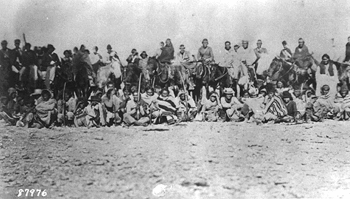
    Navajo

    At the end of the war, Carson returned to  New Mexico and took up ranching. By 1853, he and his partner were able to drive a large flock of sheep to California, where gold rush prices paid them a handsome profit. This same year  Carson was appointed federal Indian agent for Northern New Mexico, a post he held until the Civil War imposed new duties on him in 1861. Carson played a prominent and memorable role in the Civil War in New Mexico  He helped organize the New Mexico volunteer infantry, which saw action at Valverde in 1862. Most of his military actions, however, were directed against the Navajo Indians, many of whom had refused to be confined upon a distant reservation set up by the government. Carson’s eroding and toxic use of sheer military might and starvation tactics eventually brought the Navajos to submission, and he was not beyond bearing shock-and-awe techniques against women, children and the elderly. He began a military campaign against the Navajo Indians and their supposed impregnable Masada in the gorgeous Canyon de Chelly in the vicinity of Four Corners, Arizona. After revealing the myth of this fortress he waged a long and bitter campaign to bring the Indians—under any of (their) cost—to a reservation at Bosque Redondo, 200 miles away. After surrender, the Navajos, under Carson, were marched to their new lands, with fully one third of the 8,000 of their number dying along the way, succumbing to cold, malnutrition, incident raids by rival tribes, exhaustion and sheer brutality by the U.S.troops, who certainly treated the Indians as less than human. The experiment at Bosque Redondo was a total failure, with the Navajos suffering ever greatly at the hand its General Carleton, the imperious and misguided post commander. The Navajos were returned to their original lands 1300 days and 3000 lives later.

    Carson would survive this debacle by a few years, dying on a pile of buffalo robes at his doctor’s house, just a month after his wife succumbed to complications of childbirth. He was 58, and lived a little ten years too long.


  • “Getting it” Backwards: Sanctorius’ (1676) Medical Invention, Spongebob, and the Alaskan Bull Worm

    JF Ptak Science Books   Post 309

    Alaskanischer_stierwurm
    By virtue of my children I think that I can safely say that I am now a stone-cold expert on Spongebob Squarepants, and if I tried just a little I could use it to reference just about anything. (This is also the case with The Simpsons, though I really didn’t need much excuse from my older daughter, Emma, who was/is a fan, to watch them.)  In one episode of SBSP, Sandra “Sandy” Cheeks, the underwater deep-sea-diver-outfitted “land” squirrel and close friend of SB, decides that since she is from Texas she can do anything, and attempts to wrestle the enormous Alaskan Bull Worm which has invaded their home of Bikini Bottom and taken her tail.  (I’m horrified to find that someone has transcribed the hundreds of SB epsiodes, god help them. And just for the record and to show I might be as removed as these folks, I’ll point out that in addition to getting most of Sandy’s tail, the worm also eats the “Welcome to Bikini Bottom” sign, a wheelbarrow, the homework of two children, the butt of a fish (twice) and most of SpongeBob’s pineapple house. There.)  So yadda yadda yadda she finds herself wrestling the worm in a cave against SB’s ignored and interrupted warnings.  She subdues the huge beast, and announces her victory.  SB gently corrects her, saying that what she was wrestling was just the tongue of the worm, and that the cave was its mouth, and that it was waaaaay bigger than Sandy had ever imagined.  The whole thing dawns on her slowly, [Sandy: “Ohhhhhhhh. This is the tongue, and… (trailing off) the whole thing… is the… worm. (freaks out) RUN FOR YOUR LIFE!!! “(she and SB sprint away; the worm growls angrily, chomps down, and chases after them)]   SO.  So Sandy just misses the big picture that was staring her square in the face, concentrating on the one detail she thought she could recognize and handle.

    From recognized oversight comes epiphany!

    1blog_oc_t11sanctorious811

    And such is the case with my reaction to the wood engraving here, concentrating on the use of the apparatus and how out of proportion its physicality was with its function.  And until I started reading about it I missed its monumental importance completely, concentrating as I was on the thing I thought I knew. 

    I was having a wide swipe at a man who is seen by nearly all authorities as being the founder of the physiology of metabolism.  The man is Santorio Santorio* (1561-1636, and who was also known as Santorio Santorii, and Sanctorius of Padua), and the image is from his Medicina Statica, or, rules of Health, in eight Sections of Aphorisms…English’d by J[ohn] D[avies], printed in London for John Starkey in 1676. (this is a reprint of the fourth edition of 1737, following the first edition of 1614.)  For many years Sanctorius weighed and measured just about everything that went into his body and everything that came out of it.  One of the principle instruments used by him in this process is the famous weighing chair, which was (seemingly) laboriously suspended from a device in the floor above the dining room.  the net effect of all of this (as we see in the illustration) was that, after eating began, once the chair touched the floor it was the signal to stop.

    What I was missing in this, what I didn’t put together and what I didn’t ask myself was where did this apparatus fit in the history of this sort of thinking?  The more substantial question yet was what other sorts of machines were employed in determining metabolism in humans?  The answer to the second question is “none”–this is the first time that a machine was used in this sort of analysis. Actually, it is the FIRST man-machine interaction of any sort in the history of medicine. And the answer to the first question is that this was the first time that data had been collected and analyzed  such a longitudinal and coherent fashion. 

    So I missed the whole thing, making fun of this enormous piece of machinery that would be used to tell someone when to stop eating, wrestling the Alaskan Bull Worm’s tongue in my own little cave.

    * According to the great bibliography of Garrison and Morton on the history of medicine, “Sanctoris was the founder of the physiology of metabolism.  He introduced into physiology exact methods of measurement, pulse counting, temperature determinism, and weighing”.


  • Ships in the Skyline, Part V: Cities INSIDE of Ships

    JF Ptak Science Books  Post 308       

    1blog_oc_t10_ship_in_skyline_deta_2

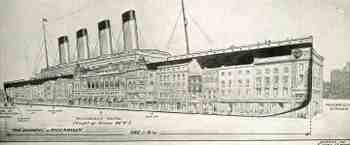
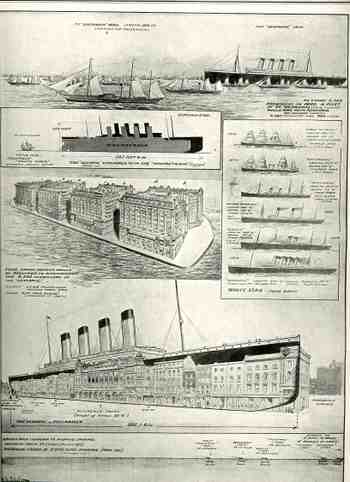
    In trailing some loose associative memories of ships being compared to skylines, and seeing he ships placed in the skylines, I was able to find four good samples.  This one is, in a way, the negative version of that, showing cities placed inside of the ships, the ship in this case being the White Star triple-screw Olympic–which at the time was the largest ship ever launched at 882′–and the image found in The Illustrated London News for 22 October 1910.  It was done in celebration of the launch of the ship from Belfast, which was also the heaviest transference of weight (27,000 tons) from land to water in history.   To illustrate the ship’s massiveness the picture editor placed a row of hotels and buildings bounded by the eastern end of Burlington House to the very edge of Piccadilly Circus, with the Piccadilly Hotel (height 77′ 6″) right there in the middle under the first three smoke stacks. 

    1blog_oc_t10_ship_in_skyline_deta_3

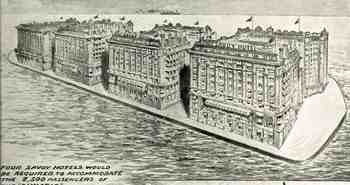
    The second image relates the passenger capacity of the Olympic to the Savoy Hotel, showing a floating platform with four of these massive hotels.  The Illustrated London News was making a real point about the Olympic and the Savoy, because at around this time smaller ships were referred to as “floating hotels”; the Olympic, on the other hand, was much more than that–it was four floating hotels, and big ones, at that, and the image captures that perfectly. 

    Truth be told, I really like the image of the floating hotels out of context and without a caption–it really makes the case for the idea of a Floating City in a Floating World. 

    1blog_oc_t10_ship_in_skyline803

    [CLick for a larger, clearer image]


  • The “Tom Thumb”, Calves’ Foot Hair, Mrs May Wait, the Fridaire & General Foods Corp. Common Denominator: Jell-O.

    JF Ptak Science Books  Post 307

    As a vegetarian of 16 years living in a house of life-long vegetarians, the antiquarian recipe that I stumbled upon in a “Lady’s Book” (of 1885) called for scraping the hair from calves’ feet–it gave me consider pause.  But from such humble beginnings (like William S. Burroughs Naked Lunch grandfather’s small business bumping itself up and along to become IBM) are bigger things born.

    1blog_oc_t10_dessert802_2

    And that’s been the story of Jell-O, a product of extraordinarily modest and not-pretty means, morphing itself and the Postum Company over a relatively short period of time (from 1895 to1925) into the megamonolth:  the General Foods Corporation.  “America’s Most Famous Dessert” got its third (or better) start on life in Le Roy, New York, under the creative hands of Mr. & Mrs. Pearle B. & May Wait (true!), who took sugar, powdered gelatin and artificial fruit flavors to make a concoction May called “Jell-O”.  But her reach was none-too-grand compared to that of Frank Woodward, who bought the company from her and created the demand for this ‘food” and who ultimately created General Foods with it.  (Its an old story:  consumable and sellable product with no consumers:  Marlboro cigarettes started out as a specialized cig for “ladies” and failed; the same cigarette was then re-marketed as a testosterone-laden product and then succeeded beyond all wild expectation, killing millions of its consumers in the process.)  In any event Ms. Wait trumped another New York state resident, Charles Knox,  in the race to develop a pretty and tasty  granulated/[powdered gelatin desert mix.  “Knox’s Gelatine”, originally made with calves’-foot jelly, was a little earlier to the table than Mrs. Wait, but failed to properly develop his product. It also suffered its own “purity” by not having any sugar in it. 

    Jello

    Jell-O-like bits have been around for a long time—but creating this sort of  gelatin (and “delicacy”) was a time-consuming task, involving the above-mentioned scraping unpleasantness, long boiling of the scraped stuff, filtering and so on to achieve—once cooled and dried—sheets of clearish delight that would look like what we call Jell-O.  But as I said the history of this product is quite extended—for example there is a long Renaissance culinary sculpting history of gelatin, but that piece of history still awaits its vast chronicler.  And illustrator:  evidently the molds for the gelatin product were extensive and the creativity for its use boundless, with castles and communities and portraits being produced out of.  The use of gelatin as a binder and preservative is actually ancient, and finds itself at least as far back as ancient Greece. 

    Our Tom Thumb connection with Jell-O  comes in the form of Peter Cooper, who   is generally seen as the American manufacturer of the first steam locomotive (The engine ran successfully on the Baltimore and Ohio Railroad on August 28, 1830), and who (around 1845) was in fact very interested in processing different sorts of gelatin consumables in addition to creating the first locomotive, and also running for the presidency and many other things…the gelatin creation had to wait.

    But the broadest brushwork on the developing history of Jell-O is that same brush that basically closed the American West and ended the cattle drive and most of the great Lonesome Dove cowboy traditions.  No, not barbed

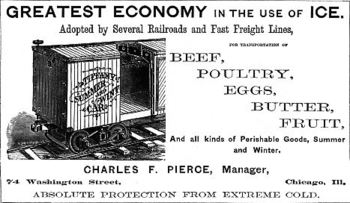
    Refrigerator_car wire—it was refrigeration.  The creation of refrigerated railroad cars meant that all that the cowboys needed to do was get their stock to a nearby railhead and modern technology would do the rest, the RR pulling the slaughtered stock to St. Louis or (more likely) Chicago, thus ending the Long Drive.  The home refrigerator enabled the creation of Jell-O much as we see it today.    (And I say that with as little inflection as possible, as hundreds of millions of people have enjoyed this sugary dried gelatin ensemble, so it must work to the good somewhere, at least as a cheap sugar delivery system)

    Homer_muumuu

    As for me, if it isn’t a liquid, I don’t want the food on my plate to continue on in its own expectant dance after I get through moving it myself. I also don’t want my food to behave like the coming-to-rest motion of a beloved (?) American TV icon.

    But that doesn’t mean that I can’t take a moment here to stop and appreciate the bizarre connections between Jell-O and the Outside World. 

    Visit the Jell-O Museum/Gallery HERE.

    ·Posted by :

    ·in:


  • Outsider Logic Series: the Humble Life vs. the Automatical Machine Age (?)

    JF Ptak Science Books LLC Post 306

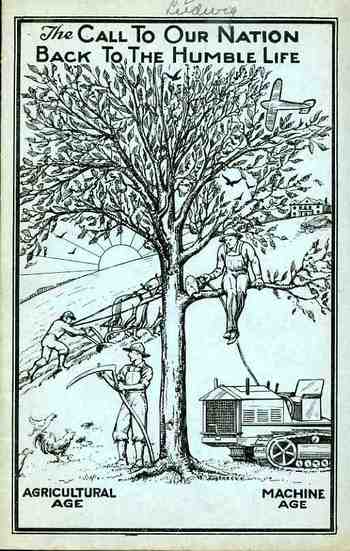
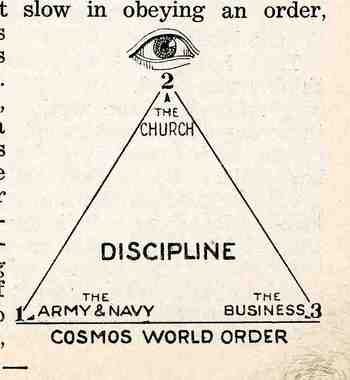
    1blog_oc_t_9_bizarree_closd798 “C. Ludwig”, the author of The Call of our Nation Back to the Humble Life a Sign in our Time of the Automatical [sic]Machine Age, published in St. Louis in 1935, has a somewhat impenetrable approach to a philosophy of development.  This of course is spotlighted quite brilliantly in the title of this work, especially –if you take quick notice–when you consider that the man in the tree with the electric saw is working at it like a cartoon character (unless the whole tree falls down and leaves him in mid-air on his special anti-gravity branch). Actually, I can’t spend the time with it, it is just too far into a personal, shadowy and self-anointing belief  system filled with paradox and the bizarre.  I’m really just after the pictures, which even though they are displayed here out of context, are indeed still out of context while in context.
    1blog_oc_t_9_bizarree_closd800

    The masonic-like all-seeing eye pyramid is another odd bit in a series of all-seeing-eye bits, none of which seem to follow the other and none of them make particular extended sense individually. There are five of them, and they seem to prove that 1+1+1+1+1 = 1.

    I could go on for some time about these singular illustrations, attempting to make graphical points for invisible reasoning in the text, but I won’t. I think that these stand quite well enough to represent the author’s straight-through-the-loop, singular, outsider-logic  reasoning.  In a way, they are of their own beauty.

    1blog_oc_t_9_bizarree_closd799

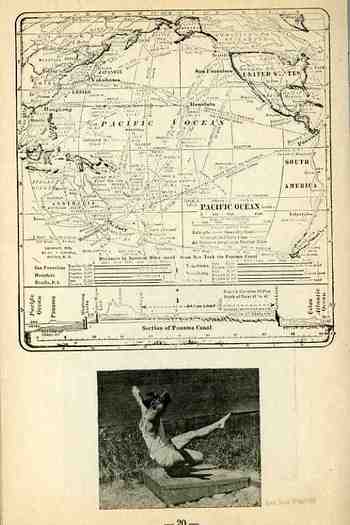
    (I just couldn’t resist this last one, featuring the Panama Canal and a balancing figure, having nothing whatsoever to do with the text or each other.)

    ·Posted by :

    ·in:


  • What Things Are Not Department: Life, Cityscapes, and the Virgin Mary in Stone.

    JF Ptak Science Books   Post 305

     1blog_oc_t_9_not_here791

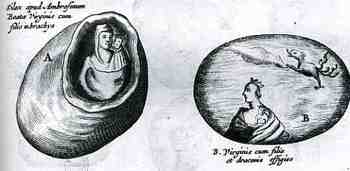
    Stone has preserved the evidences of much of the life on Earth—in the fossil record (which happens to stretch some number of years back before 4004 BCE contrary to what one of the vice presidential candidate believes), or an arrested day in Pompeii; indeed the entire landscape shows the way life looked by filling in the negative of what you see today., a negative landscape in a way of what has come before. The City of Rocks, New   Mexico, for example, out there near  Silver City, is a wonderful example of trying to employ your imagination to render in your mind the massive volcano that once stood there, the “City” being the last remnant of its existence. Better yet is the great Ship Rock (hello Officer Jim Chee!), a massive 1,800 foot tall fractured volcanic breccia spire in Navajo Land (Tsé Bit’a’í, in Navaho, “rock with wings”), the internal remnant of yet another massive volcano, though in this case the enormous radiating dykes (igneous rock called “minette“.) exploding away from its base gives you a better idea of the footprint of the missing mountain. You can see this magnificent mountain from a great distance, and it is only when you start to get closer and drive through one of the dikes (that has been separated for the road) that is 20’ tall and still a long way from the base of the mountain that you get a =good appreciation of just how massive it all is. 1blog_oc_t_9_not_here792


    I cannot imagine the gargantuan profundity felt by the person who first realized that the Grand Canyon was formed by erosive forces over previously unimaginable long periods of time, its awesome and enormous silence a negative punctuation to the enormity of the idea.

    Prior to the major discoveries in geology in the 19th century, say from the mid-18th century and earlier, there were many “discoveries” of life in stone—they weren’t very useful and most often were very misleading, but they were, in two words, pretty and unusual.

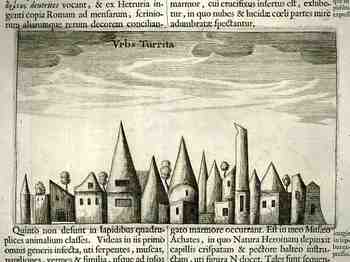
    The people who made and recorded these discoveries were often more circumspect about what they were finding than their readers; sometimes not. Jean-Baptise Robinet (1735–1820) was a French naturalist, Jesuit-philosopher and encyclopediaist (best  known for his five-volume work De la nature (1761-8)) who found all manner of interesting and scientifically-divergent items in stone—eyes, ears, skulls and occasionally an entire body. Antoine J.D. d’Argenville at about the same time in the 1750’s also uncovered silhouettes of dressed human,  birds, cityscapes, trees and the like in stones, which seeped its recordings of the animate into receptive fantasies.

    1blog_oc_t_9_not_here_kircher_793
    But these durable micro- explorations in agate go back thousands of years, expounded by Pliny and some of the other ancients, who followed the origins of humanity back into the rocks. This was a popular idea for the origin of animate beings, propounding itself for centuries, even winding up in the bony lap of Leibniz of all people, who wrote that “men derive from animals, animals from plants, plants from fossils, which in turn derive from bodies that the senses and imagination represent to us as being totally dead and formless”. Stoners therefore held the seeds of the formation of the world; all things living, breathing, and not.

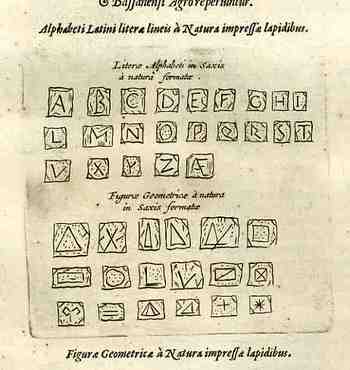
    Our own Athanasius Kircher, the definition of Polymathic ability and superior imagination was responsible for many such observations and discoveries. It seems to me that as much as Kircher gave, he took away, keeping ahead of his critics and the rest of the scientific community with tremendous output…people I think just couldn’t keep up with him. He found all sorts of things in stone: as early as 1619  he exhibited an image of   St. Jerome (in no less a place than the cave of the Nativity in Bethlehem!) that he found in agate. His Munduis Subterraneus (1661) is ahome to a wide range of these objects: quadrupeds of all shapes and descriptions, human full-length portraits, hands with jewels, and even the Virgin Mary and child. AS spectacular as these are there is always more: the magnificent cityscape (reproduced here) and the sublime discoveries of a full set of the alphabet and a series of 15 geometrical drawings, all naturally impressed in stone.

    1blog_oc_t_9_not_here_kircher_alpha

    Perhaps these men gave little more regard to the details in this stone than was necessitated by accepted theory; perhaps they added details to suit their observational needs, as they images were, after all, drawings of the susceptible and the fantastic, and were not photographs. Recording their record was as much open to interpretation as were the theories. I have no doubt that if you look hard enough at things you will at some point find what you are seeking. Only here it is by chance that these figures appeared, and not by the will of a divine creator placing a seed of potential in the stone.

    My five-year-old daughter, Tessie, asked me just the other day about where numbers and letters “came from”. She wanted to know “why are they here?”, which is a fabulous question with a long difficult answer. I do know though that they didn’t come to us from agate. 


  • Specialized Vocabularly: Hobo Slang 1939

    JF Ptak Science Books Post 304

    1blog_oct_8_hobo_cvr785
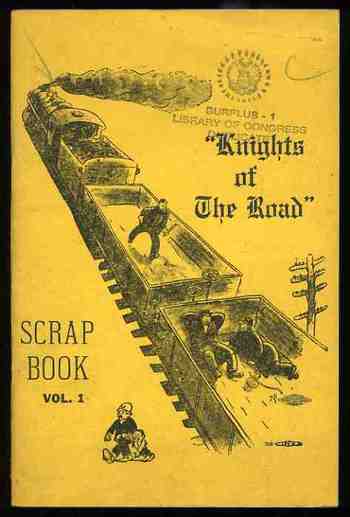
    There have been many Kings of the Hobos, and Emperor of the Hobos, in the history of American Hobodom.  The most widely recognized of all this royalty is, probably, Mr. Jeff Davis, who was elected King of Hobos each year from 1908 to 1935, until in 1935 at the Pittsburgh meeting of the annual “Hobos of America” his minions gave up elected him King for Life. Of hobos, that is, the Knights of the Road; he was also a real hobo, unlike the pretenders, who in general were not. (Nels Anderson in his Men On The Move, written just as the Depression was broken, (1940) observed: “Whatever else may be said of King Jeff, his romanticizing the hobo is not without a basis in reality, and his poetic interest in the species arose from experience. But King Jeff has placed on a pedestal a man who belongs to the past. The hobo belongs with the pre-Hollywood cowboy and the lumberjacks of the Paul Bunyan legends.”)

    Mr. Davis was certainly very effective in getting the message out—on freedom and responsibility to irresponsibility—and was a great organizer and popularizer. He helped to establish hobo meetings, newspapers and literature (a sample of which is at left). He also had a few movie appearances: in The Arkansas Traveler, 1938 and The Bridge of Sighs, 1915, he ably played the role of a hobo.


    And what about the missing counterpart of Jeff Davis–the Queen of the Hobos? There were certainly allot of women hobos during the Depression; Harry Hopkins estimated that there were something like 13,000 “sisters of the road” who were out and about in the 1930’s. I guess the most famous of them though was one who did not exist; and what parts of her that were real were mostly those of one man: Ben Reitman. Sister of the Road (1940) was supposed to be an autobiography of legendary Boxcar Bertha, but it was really an assimilation of Reitman’s own experiences sprinkled about those of women from his life. Reitman, who was described (by himself) as a “hobo, whorehouse physician, musician and tour manager/lover of Emma Goldman” (??) was probably not without enough experiences to float another character or two, had his story of Bertha wind up in the hands of exploitation movie maker Roger Corman. The good news about that though was that Corman gave the project to the very young Martin Scorcese who produced an odd and not bad film on no budget, and Boxcar got to live again.

    1blog_oct_8_hobo_cvr786

    But what brought me here to begin with was Davis’ breakdown of some very colorful hobo slang, all of which was found in the little yellow pamphlet (pictured above), and published as a “reference manual” in 1947.  And so:

    Gay Cat. Someone who “beats it from town”, settles down with a job and puts together some money so that he can get on the road again.

    Gandy Dancer. “Is a hobo shovel stiff, a muck-stick artist”, a common laborer

    Pearl Diver. A hobo dishwasher and who works for his meal.

    Mush fakir. A hobo umbrella mender with a patch kit and a second-hand umbrella strapped to his back. (Evidently these guys were put out of business when larger stores began offering umbrella repair on their own.)

    Bindle stiff. A hobo who carries his stuff in a sack on a stick, including toothbrush, “but he does NOT carry blankets”.

    Kywah. An honest hobo pitchman peddling soap, perfume, jewelry, novelties, pens, knives and potatoes peelers.

    Kewah. :Makes and sells articles such as willow stands…”

    Scenery Bum. “A young tramp who bums it around the country, just for the fun of it.”

    Ring-tail. “An ignorant, harmless tramp.

    Fuzzy tail. “A smart aleck tramp, jack of all trades, a fourflusher, big bluff, false alarm, and piker of the worst sort, who most always carries a “punk kid” or “road kid” (a runaway boy).”

    Dingbat. “An old tramp professional beggar who dings the main stem (begs on the main street).”

    Stew bum. “An elderly tramp who wastes his time continually drinking rot booze.”

    Jungle Buzzard. “A tramp who loves to eat but is too lazy to get the ingredients for a mulligan stew. He eats what is left when the gang leaves the jungle fire.” Yum.

    Road Yegg. “A vicious tramp of the petty larceny type, a cheap crook.”

    I like the collection—it has a high color, not terrible low cant at all.

    Notes:

    A Few Books on the History of Hobos:

    Allsop, Kenneth  Hard Travellin': The Hobo and his History. 1967.
    Black, Jack.  You Can't Win. 1926.
    Bruns, A.  Knights of the Road. 1980.
    Davies, W.H.  The Autobiography of a Supertramp. 1929.   
    Drew, Betina. The Texas Stories of Nelson Algren. 1995.
    Etulain, Richard W.  Jack London on the Road: The Tramp Diary and Other
    Writings. 1979
    Flynt, Josiah. Tramping With Tramps. 1969 reprint. 
    Flynt, Josiah. My Life. 1908.   
    Graham,  "Steam Train" Maury   Tales of the Iron Road: My Life as King of the
    Hobos. 1990.
    Kemp, Harry.  Tramping On Life: An Autobiographical Narrative, 1922.
    Kerr, Lenox.     Back Door Guest [Foreign Travelers in America
    1810-1935].  1930
    Kromer, Tom.  Waiting for Nothing. 1935.   
    Monkkonen, Eric H. Walking To Work: Tramps in America, 1790-1935.
    Ormser, Richard.   Hoboes.1994.
    Tully, Jim.  Beggars of Life: A Hobo Autobiography. 1924
       
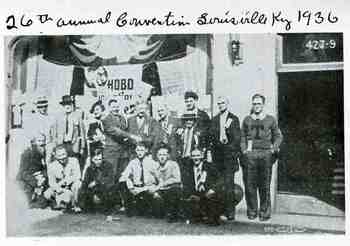
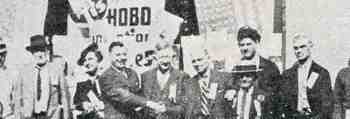
    And, by the way, this detail of the photo in the Davis book for the 1936 Hobo meeting in Kentucky--
    where, exactly, are the hoboes?  these people look pretty middle class.  And who is the lady?

    1blog_oct_8_hobo_cvr787

    ·Posted by :

    ·in:

    — —

  • Cashing out Corpses: the Value of (Human) Dead as Fertilizer, 1874

    JF Ptak Science Books Post 303

    “Nature’s object remains unstated” for us humans, writes Sir Henry Thompson (1820-1904, polymathic professor of clinical surgery, University College, London)  in the March 1874 issue of Appleton’s Popular Science Monthly, or at least so in life.   In his article “Disposal of the Dead”, Sir Henry finds at least an answer in death for Nature’s purpose for people:  fertilizer.  After birth, the process of decay is constant, until we all find ourselves broken down to our chemical and mineral elements in an nearly endless series of breakdown, failure and shortages until our cells decide to stop working.   (Folks who wish for an eternal life should be careful:  Tithonus, a mortal Trojan in love with Eros suffered from her wish to Zeus–the goddess of the dawn asked for Tithonius to be immortal just as she, but did not ask for him to stay the same age, which is very problematic.  Just like in the story of the Struldbruggs, Jonathan Swift’s Gulliver found a people who were immortal but who also aged as time went by–they became more rickety and feeble and disabled and so on, right up to the point where they couldn’t even read anymore because their fingers were too brittle for page-turning and their minds so weak that they forgot the beginning of a sentence before they came to its end, which means I guess they didn’t need to turn pages anymore, because the same page was fresh to them, tirelessly and endlessly.  Gulliver says that “no tyrant could invent a death into which I would not run with pleasure from such a life”. Amen. )

    Full text via wikisource:  https://en.wikisource.org/wiki/Popular_Science_Monthly/Volume_4/March_1874/Disposal_of_the_Dead

    We do not have the problems of Tithonius and the Strudbruggs. decaying daily in our sprint to the Finish line (preferable to the “End”, as “Finish” implies that something has actually been done). 

    Dr. Thompson works out his inexorable logic of the most effective way of disposing of the dead with some noirsh dead-pan humor.  He has a number of gems like “what is best to be done with the dead is then mainly a question for the living” sprinkled throughout this pretty mordant paper.  What it all boils down to for Thompson is some rock-solid reasoning: humans have something to give back to the earth once they die in the forms of chemicals and nutrients. But this gift  he says is needlessly strangled by our funerary practices  (or at least Western funeral practices):  embalming the dead  and offsetting their decomposition and then enclosing them in wood and metal six feet down in the ground defeats the whole sense of fulfillment in death.  Nothing could be worse (a “useless pollutant”).  Not only that, the economic waste is a staggering fraud, Thompson computing that a million pounds are lost every year to the practice in London alone. 

    There are ways of doing this better, he argues, the result of “this question of vital economy to the country” would be like burying a million pounds a year “into the bosom of Mother Earth, who could give it back in huge returns at compound interest for the deposit”. He figures that it takes but a few hours of high heat in a furnace to reduce dead people into something “useful” that can be gathered in the furnace’s cauldron and distributed where needed.   150 pounds of wood (or about a pound per deadweight) would do the job of gaining the fertilizer, which would be not only far cheaper than burial (costing less than a pound sterling) but would reduce the cost of importing fertilizer from other countries.

    He writes:  “the necessary complement of this ceaseless waste of commodity most precious to organic life, and which must be replaced, or the population could not exist, is the purchase by this country of that =same material from other countries less populous than our own, and which can, therefore, at present spare it.”  (I’m pretty sure he’s talking about non-human fertilizer.  I think.)

    Thompson continues his argument that cremation is actually much more agreeable process than the current attempts at salvaging dignity in the dead.  The principle complaint against cremation (in a practice of the veneration of the dead that was thousands of years old) was, he says, “sentiment”.  But he says that this same sentiment has nothing to urge in seen kindnesses in the present practices, and says that he would take a look at what that “pleasant process” actually looked like.  “So far as I dare!  For could I paint, in its true colors, the ghastly picture of what happens to mortal remains of the dearest we have lost, the page would be too deeply stained for publication”.  The beauty of death (“she lay beautiful in death”) so squeezed of life by flower Victorian poets lasts, oh, not so long.  Thompson doesn’t pursue in writing what he couldn’t do with paint, only to say that the process and the result “of Nature so ruthlessly and rapidly blight(ing) her own handiwork in furtherance of her own grand purpose” was revolting, and if that part was acknowledged, the sentimental grievances against his own proposal should slip away.
    This was all well and good, and an excellent argument, but it was hardly a topic for table talk in London at nearly the height of the Empire, nor is it today.  People simply weren’t ready for burning up poor old Auntie Em  and sprinkling her in the garden, 10 inches down.  I do admire his argument and presentation, though.  His general arguments though were much toned down from this, and as the organizer and first president of the Cremation Society of Great Britain he sought the use of cremation for economy and hygiene more so than anything else.  It was still a hard go.

    Note: 

    A short outline of Western writing on cremation, from the History of the Cremation Society of Great Brtain website:

    “The first re-emergence of interest in cremation in modern times was in 1658 in an essay Hydriotaphia: Urn Burial, by Sir Thomas Browne, a physician from Norwich, but it was in 1664 in a book entitled Philosophical Discourses of the Virtuosi of France that it was first advocated as an alternative to burial. During the next two centuries numerous other discussions on this question took place but the grand revival of the subject really occurred in 1869 when it was presented to the Medical International Congress of Florence by Professors Coletti and Castiglioni “in the name of public health and civilization”. 1872 saw more papers advocating cremation, the most important being that of Dr. Polli, as it contained results of the first experimental researches. The following year Professor Gorini of Lodi and Professor Brunetti of Padua also published reports or practical work they had conducted. A model of Professor Brunetti’s cremating apparatus, together with the resulting ashes, was exhibited at the Vienna Exposition in 1873 and attracted great attention, including that of Sir Henry Thompson, Bart., F.R.C.S., Surgeon to Queen Victoria, who returned home to become the first and chief promoter of cremation in England.”


  • What Things Used to Look Like: Candy Stores (not “shops”), 1942.

    JF Ptak Science Books   Post 302

    1blogsept_23_candy_cvr649

    Well now–this is a candy shop

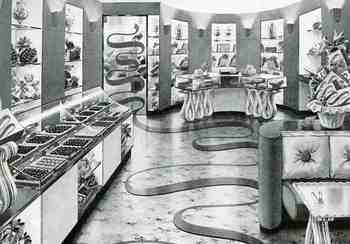
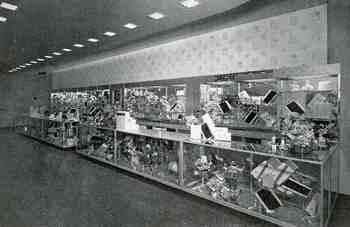
    It is positively dripping with evil,  its luscious display  in a soft pre-chewed-like environment, as in a chocolate dream in someone else’s head.  (Chocolate dreams are good to have, just ask poor old dead Hans Sloane, the man whose chocolate-based fortune and bequest formed the basis of the British Museum.)  The ribbon design in the floor continuing up the wall just past the display is an invitation to getting totally lost in sugarly beauty, a swirling trail to a confectionary Ravena.

    All of these images come from the pamphlet published by the Associated Retail Confectioners of the United States:  Meet the Foods Candy is Made Of, made to accompany their annual meeting of 1946 at the Drake Hotel in Chicago.  (There must’ve been an awful lot of these folks to book the Drake.)  The cover does seem somewhat on the desperate side, trying to convince anyone who would have a look that candy–since it is made of all that good looking stuff–was indeed FOOD (“no wonder candy is so good to eat!”)

    1blogsept_23_candy_cvr647

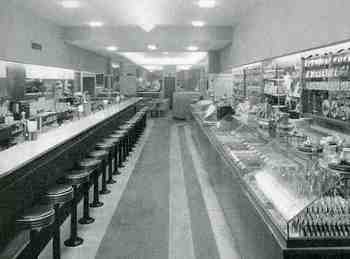
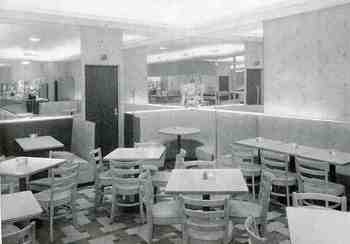
    The next image is the “Table Service” area of Wieda’s Incoporated, (a fine, large candy store in Patterson, New Jersey) , “located in the rear”, where I guess the serious stuff is done, when you needed a table to consume your goodies with a wholesome cup o’ Joe.

    The third image is again from Wieda’s–perhaps a little bit of payoff to Mr. Wieda for his (presidential) service to the association.  The black and white image does absolutely nothing to address it fabulously colored interior, with its lemon yellow ceiling, with the upper walls and curtains a burnt orange and the lower walls “a soft light green”, all surrounding a terrazzo floor of maroon and gray.  The woodwork was all walnut, and the mirrors were “tinted flesh color, which is more flattering to the customer than the usual untinted mirror”.  Oh my.

     1blogsept_23_candy_cvr648


    There was all sorts of information-sharing in the conference, evidently:  the best way to package and display candies, convincing mothers that candy was “food” after all and good for the kids, packaging candy so that it appealed to children, wrapping candy around other small gifts and trinkets, luring the customer into the candy store with more elaborate displays to pull you deeper inside, and so on.  There was allot of thinking going on here about sweets, which seems pretty inconsequential until you think about the fortunes made by Hans Sloane and the Wrigleys and Mars, especially with the later too, what with the gum company being purchased by the Mars family for billions of dollars–which is a lot of money for gum, which of course is hardly a candy.

    1blogsept_23_candy_cvr646

    In any event these stores are just gorgeous, and gorgeous in a way that their gorgeousness can never again be achieved–and I’m not sure why.  Maybe its because I’m not wearing one of those fabulous double-worsted suits that Bogey used to wear, not that he’d be found in one of these places.

    1blogsept_23_candy644

    ·Posted by :

    ·in: