A Daily History of Holes, Dots, Lines, Science, History, Math, Physics, Art, the Unintentional Absurd, Architecture, Maps, Data Visualization, Blank and Missing Things, and so on. |1.6 million words, 7500 images, 4.9 million hits| Press & appearances in The Times, Le Figaro, Mensa, The Economist, The Guardian, Discovery News, Slate, Le Monde, Sci American Blogs, Le Pont, and many other places… 5000+ total posts since 2008.

Author: JF Ptak

  • The Department of Understatement 2: the Wright Brothers in the 1902 Scientific American

    JF Ptak Science Books LLC  Post 333
    00-blog-Oct 24--wright bro913
    I’m not
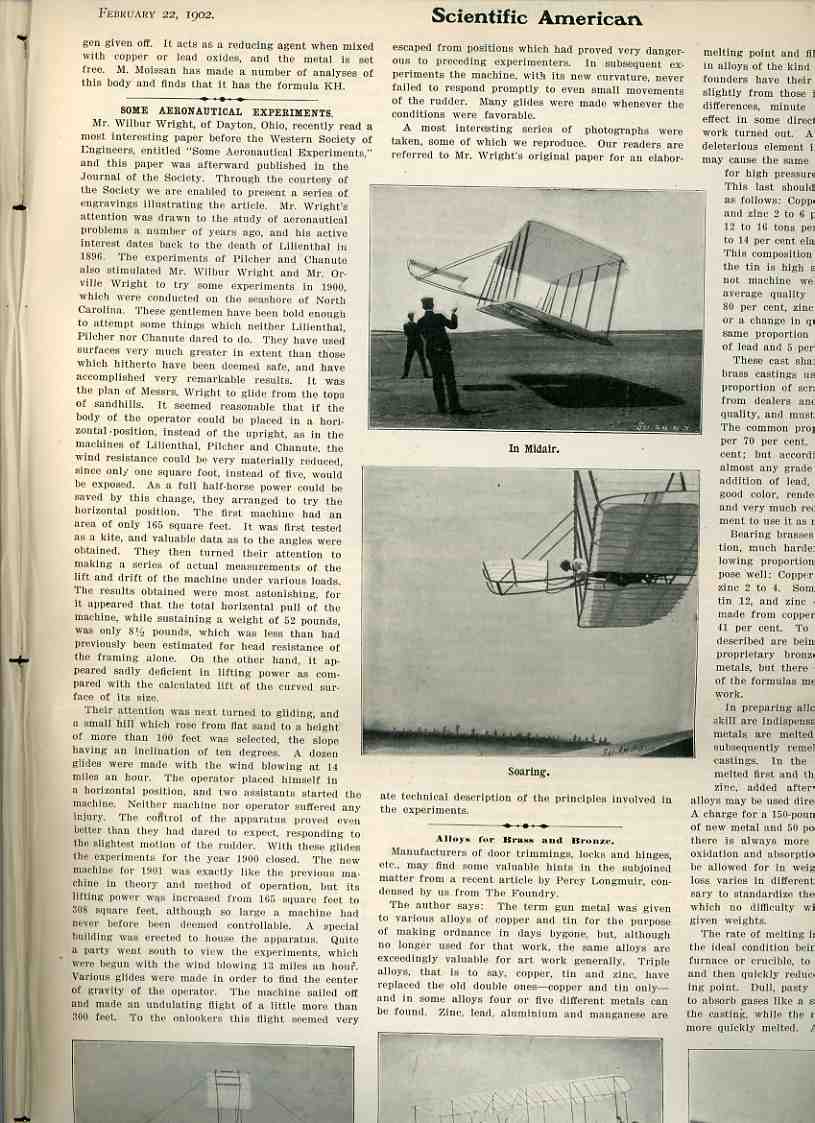
    sure why the Wright Brothers’ experimental gliding flight was so much in
    competition with other pressing scientific news of the day that reports on
    their progress was relegated to the middle of this issuer of Scientific
    American for
    22 February 1902. 
    The report is sandwiched in between “Winter Railroading in
    Alaska”, “Experiments of M.
    Moissan  with hybrids of potassium” and “A
    Garbage-Consuming plant” on the page opposite and “Alloys for Brass and Bronze
    “ just below it.  And as it turns out
    there are more words devoted to the
    Alaska railroading article than to the
    Wrights as well.  There are dozens of
    articles given better placement in this issue: steam boiler inspection, variable
    speed gears for pumps, making photographs with electric headlights, domestic
    manufacturing of Portland cement, assorted announcements of electrical
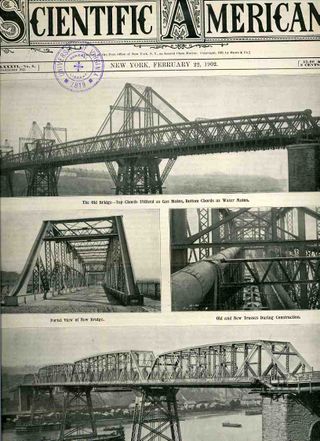
    progress, and other such stuff. The front page of the issue is
    dedicated to the new bridge of the
    Redheugh Bridge at Newcastle-on-Tyne; the Wright article follows on
    page 8.

    Even
    though the brothers had been experimenting with gliding flight at Kill Devil
    since 1900, reports of their activities had been under-reported, if popularly
    reported at all.  And this seems to have
    suited them—they seemed not to need publicity, or recognition.  After all, they had made incomparable strides
    since they first became interested in flight in 1896 following the failure of Samuel
    Langley and the
    Potomac River crash of his aerodrome. (Just for the record, Alex Bell also referred to
    his aircraft as aeromdomes.)

    00-blog-Oct 24--wright brosd cvr912

    This report
    for February seems to be the earliest of the 1902 flights in North Carolina,
    with the principle difference (from what I can see) is that this earlier glider
    didn’t yet have a tail which would make an appearance a little latter in the
    year (followed by a very critical discovery on the need for the maneuverability
    of the tail.) It also seems that the 1902 gliders were as different from the
    1901 gliders as the 1903 glider/plane would be from the 1902 model.

    Still,
    given the competing news of the day, and the importance of the Wrights’
    experiments, and the amount of interest in flight at this time,  it is a little mysterious to me why the report
    on their sandy accomplishments got so gobbled up in the nonchalant scientific
    bric-a–brac of 1902. 

    Notes:

    Since this is outside my area I
    quote liberally from the US Commission on the Centennial of Flight for a more
    exact description of the difference of the gliders between 1901 and 1902:

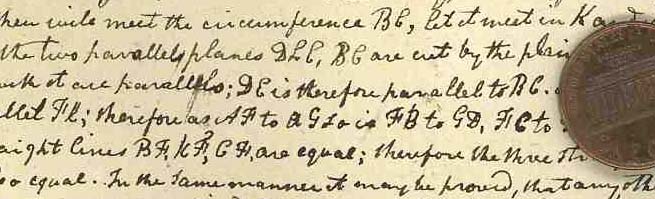
    “Their 1902 glider had a new wing with a shallow camber
    and high aspect ratio. It was a major departure from their earlier machines. It
    had roughly the same wing surface area as the 1901 machine, but the
    similarities ended there. The wingspan was ten feet (three meters) longer and
    the chord two feet (0.6 meter) shorter than the old machine, making the glider
    look larger and more graceful. It had an overall length of 16 feet (5 meters)
    and weighed 112 pounds (51 kilograms). The wing camber followed a shallow
    parabolic curve, and the elevator
    was extended farther out in front of the pilot. This gave it more leverage,
    which allowed better control. The 1902 glider also had a new rudder that consisted of two fixed vertical surfaces located
    behind the aircraft . Wilbur and Orville calculated that these would help
    prevent the skidding that had occurred when they warped the wings.”

     And the following on the 1902 flights from

    Orville Wright “How We Made the First Flight”:

    “The flights of the 1902 glider
    had demonstrated the efficiency of our system for maintaining equilibrium, and
    also the accuracy of the laboratory work upon which the design of the glider
    was based. We then felt that we were prepared to calculate in advan ce the
    performance of machines with a degree of accuracy that had never been possible
    with the data and tables possessed by our predecessors. Before leaving camp in
    1902 we were already at work on the general design of a new machine which we
    proposed to propel with a motor
    ·Posted by :

    ·in:


  • A Little Lost Piece of Apollonius and von Neumann Less an “N”: Found Stuff

    JF Ptak Science Books LLC  Post 332

     00-blog-Oct 23 apollonius910 det 2

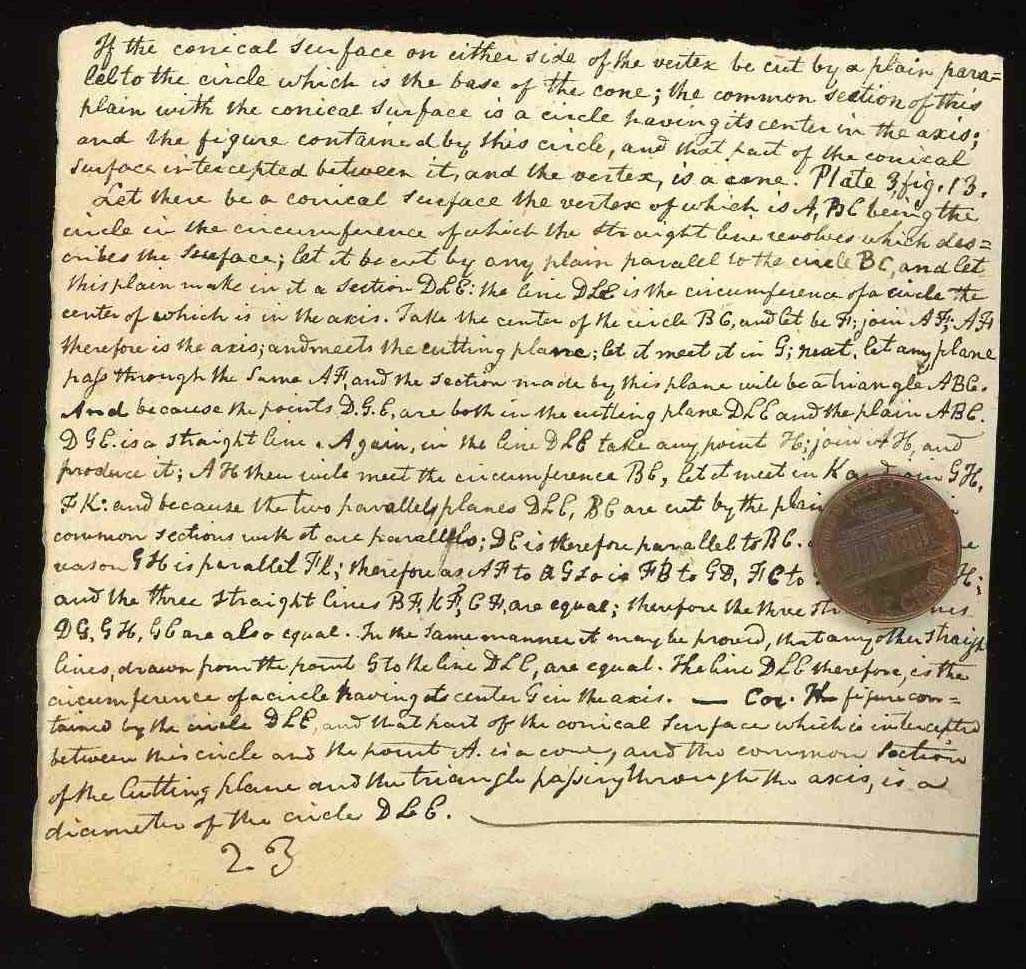
    I’ve long enjoyed paying attention to stray bits of paper, and books, and directions.  (My very first introduction to lovely lovely Ludwig (Wittgenstein) was by picking up his Tractatus from the floor of the library–I had never heard of him before that chance encounter.)  And so I’ve followed these threads for many years, pulling away at whatever was at their end–allot of times the only thing at the end of thread was the end of the thread.  On the other hand it has been a good practice and has led me far and wide.  This pursuit takes many other forms, but the finding-it-by-chance part can sometimes be exciting and extremely rewarding.

    00-blog-Oct 23 apollonius910 det
    Sometimes it is just satisfying to come to an end.  This is the case with this beautiful piece of paper which has come from god-knows-where.  Suddenly it was at the bottom of a box, and it didn’t even tug at a imitation of a lost memory as to how it got into that box in the first place.

    It is very finely written in a strong hand.  30 lines, about 500 words, all on a 4×4.5 inch piece of paper, from about 1775 I reckon.  There are plenty of hints about the origins of the text, which I suspected to be a quote; I didn’t think it was Euclid, though perhaps an early book on conic sections?  Then I looked at the “23” at the bottom and searched in google under “Proposition 23” and Euclid, and then, on only my second try, I had my answer, all in under a minute: Apollonius, the massively important 2nd century BCE geometer and astronomer and namer of the parabola and ellipse and parabola, and whose significance reaches forward 20 centuries. Now having the answer and doing something with it are two different things, and in this case there was no where else for me to go.  Sometimes just finding out what something *is* is enough. 

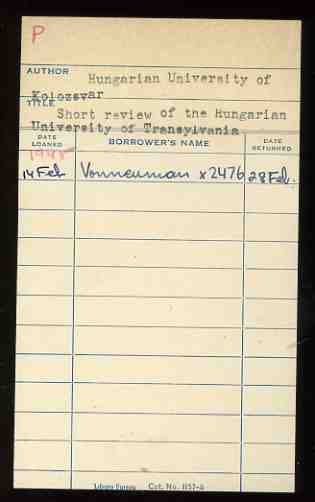
    Earlier this week I breezed through a pamphlet called A Short History of the Hungarian University of Transylvania (1943), published by the Hungarian University of Koloszvar, a thin, elegant and erudite work. It had been in the library of some offices of the old OSS (Office of Strategic Services), the forerunner to the CIA).  In the back was the borrower’s card, with a borrower’s name on it.  Generally when I find this stuff the card is almost always blank–but in this case, the little slip bore an important name:  “vonNeuman” it said.  The pamphlet was borrowed 14 Feb and returned 28 Feb, 1945.  It had von Neuman’s phone number on it too.  My initial reaction was fantastic--this was Johnny von Neumann’s name.  He defined “secret” work for the government during the war; he was Hungarian; I think he was with the OSS.  Von Neumann was probably the most fantastic mind of the century.  And here he was, in the back of this little pamphlet.
    00-blog-Oct 23 von neumann911

    And then it struck me. 
    This was von  Neuman, not von Neumann.  

    I was missing an “n”.  I wanted so badly for it to be there, but it just wasn’t going to happen.  In the small world category, I believe that this is Hans J. Neuman,  who worked at the OSS during the war and who went on to a distinguished career in computer science (and who made significant contributions to the creation of the first computer at the Moore School of Electrical Engineering at the University of Pennsylvania).  Some 20 years ago I appraised the library part of his estate.

    ·Posted by :

    ·in:


  • Duelling a Female Privateer at the Battle of the Mixed Yellow Mustard; Yazoo Pass, 1863

    JF Ptak Science Books LLC Post 331

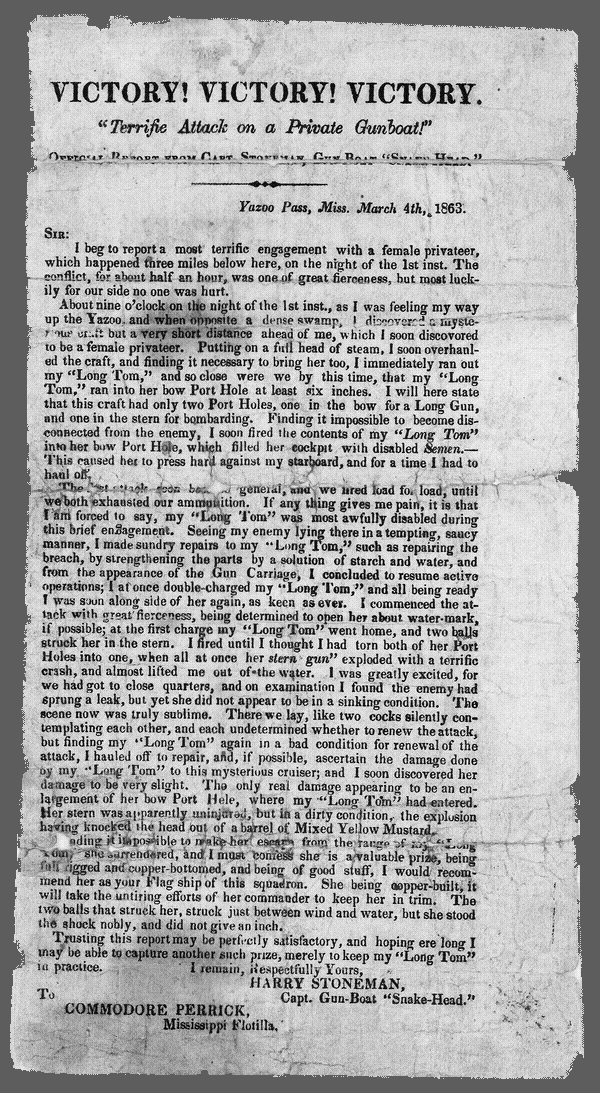
    Harry Stoneman, the commander of the U.S. naval vessel, the Gun Boat  Snake-Head, reported a battle in this broadside (found in the collection of the Library of Congress) fought between himself and a “female privateer” at the foggy Yazoo Pass in 1863.

    Blog--Snake HEad female pirate det

    I have little doubt that the battle was probably ferocious, but I do have some lingering doubt that it was more ferocious than the reporting of it.  There is much in Stoneman’s prose to suggest whistling canon balls and smoke and boardings and sinkings and such, but I have a feeling there was much fumbling between the wo ships, and that in the end, the “female privateer” surrendered.  Stoneman overtook the vessel and got so close to it that he rammed it somewhat, somehow getting  the end of his “Long Tom” into the forward port hole of the privateer.  After he repaired whatever he did to his canon (the “Long Tom” being in general the largest gun on the ship or boat, and probably mounted on a swivel or pivot, forward) fired it into the privateer, “filling up her cockpit with disabled Semen [sic]”.  There was an explosion of some sort with the privateers can–it either was fired or exploded–with the only resulting injury being to some (mixed) yellow mustard.

    Blog--Snake HEad female pirate det yellow

    But in the end all went well for the sweatty Harry Stoneman, taking the copper-bottomed enemy ship as a prize, and hustling back to whatever writing surface he had to record his victory and present it as a prize to the commodore Perrick  of the Mississippi floatilla.  Unfortunately I cannot find anything at all on the Snake-Head or Stoneman or for that matter Commodore Perrick (which is odd).  But most of all a quick search isn’t revealing anything on the most beguiling aspect of this whole story, the “female privateer”. 

    You can click on the image for a more readable version of the broadside; also, the full text of the broadside is provided below, thanks again to a terribly industrious library employee.)

    Blog--Snake HEad female pirate

    VICTORY! VICTORY! VICTORY.

    “Terrific Attack on a Private Gunboat!“

    Official Report from Capt. Stoneman, Gun-Boat “Snake-Head.”

    Yazoo Pass, Miss. March 4th, 1863.

    Sir:

    I beg to report a most terrific engagement with a female privateer,
    which happened three miles below here, on the night of the 1st inst.
    The conflict, for about half an hour, was one of great fierceness, but
    most luckily for our side no one was hurt.

    About nine o’clock on the night of the 1st inst., as I was feeling
    my way up the Yazoo, and when opposite a dense swamp, I discovered a
    mysterious craft but a very short distance ahead of me, which I soon
    discovered to be a female privateer. Putting on a full head of steam, I
    soon overhauled the craft, and finding it necessary to bring her too, I
    immediately ran out my “Long Tom,” and so close were we by this time,
    that my “Long Tom,” ran into her bow Port Hole at least six inches. I
    will here state that this craft had only two Port Holes, one in the bow
    for a Long Gun, and one in the stern for bombarding. Finding it
    impossible to become disconnected from the enemy, I soon fired the
    contents of my “Long Tom” into her bow Port Hole, which filled her cockpit with disabled Semen.— This caused her to press hard against my starboard, and for a time I had to haul off.

    The last attack soon became general, and we fired load for load,
    until we both exhausted our ammunition. If any thing gives me pain, it
    is that I am forced to say, my “Long Tom” was most awfully disabled
    during this brief engagement. Seeing my enemy lying there in a
    tempting, saucy manner, I made sundry repairs to my “Long Tom,” such as
    repairing the breach, by strengthening the parts by a solution of
    starch and water, and from the appearance of the Gun Carriage, I
    concluded to resume active operations; I at once double-charged my
    “Long Tom,” and all being ready I was soon along side of her again, as
    keen as ever. I commenced the attack with great fierceness, being
    determined to open her about water-mark, if possible; at the first
    charge my “Long Tom” went home, and two balls struck her in the stern.
    I fired until I thought I had torn both of her Port Holes into one,
    when all at once her stern gun” exploded with a terrific crash,
    and almost lifted me out of the water. I was greatly excited, for we
    had got to close quarters, and on examination I found the enemy had
    sprung a leak, but yet she did not appear to be in a sinking condition.
    The scene now was truly sublime. There we lay, like two cocks silently
    contemplating each other, and each undetermined whether to renew the
    attack, but finding my “Long Tom” again in a bad condition for renewal
    of the attack, I hauled off to repair, and, if possible, ascertain the
    damage done by my “Long Tom” to this mysterious cruiser; and I soon
    discovered her damage to be very slight. The only real damage appearing
    to be an enlargement of her bow Port Hele, where my “Long Tom” had
    entered. Her stern was apparently uninjured, but in a dirty condition,
    the explosion having knocked the head out of a barrel of Mixed Yellow
    Mustard.

    Finding it impossible to make her escape from the range of my “Long
    Tom,” she surrendered, and I must confess she is a valuable prize,
    being full rigged and copper-bottomed, and being of good stuff, I would
    recommend her as your Flag ship of this squadron. She being
    copper-built, it will take the untiring efforts of her commander to
    keep her in trim. The two balls that struck her, struck just between
    wind and water, but she stood the shock nobly, and did not give an inch.

    Trusting this report may be perfectly satisfactory, and hoping ere
    long I may be able to capture another such prize, merely to keep my
    “Long Tom” in practice.

    I remain, Respectfully Yours,

    HARRY STONEMAN,

    Capt. Gun-Boat “Snake-Head.”

    To

    COMMODORE PERRICK,

    Mississippi Flotilla

    ·Posted by :

    ·in:


  • You are There: Dive Bombing Pilot, 1936.

    JF Ptak Science Books  Post 330

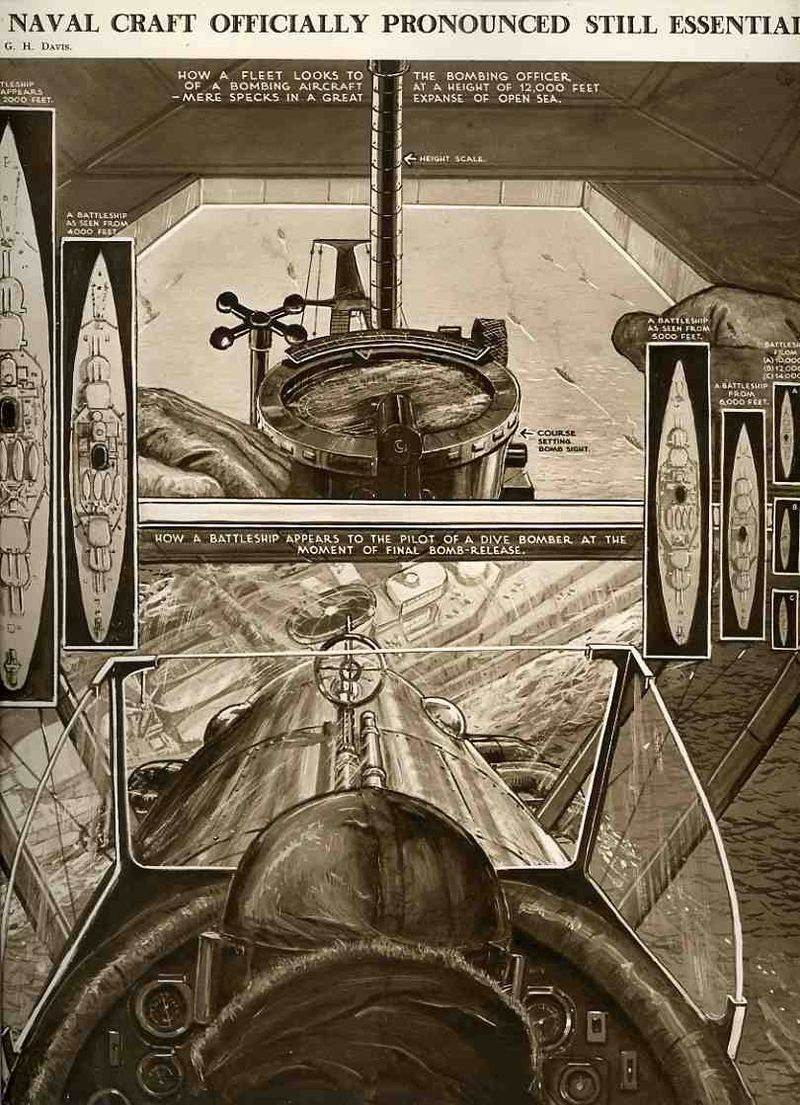
    In my experience popular images prior to WWII that put the reader inside of the picture– giving them the same view as the observing, principle member of the picture–are very uncommon.  Honestly, they just don’t happen very often, and I wish that I had paid more attention to them over the years before I realized they were as rare as they were. Such is the case with this extraordinary and action-packed picture in which the reader is hosted just behind and slightly above the head of the pilot of the aircraft dive-bombing the battleship.  It appears in The Illustrated London News for 7 November 1935, and it must have been captivating for the readers, being given the sense of closing in at great speed on the ship.  There are actually eight other smaller perspective images embedded in the image as well. The largest of these (at top) places the viewer directly inside the subject, giving them the feeling of how it looks like to the bombing officer of the aircraft as it approached the fleet. The other five images shows what the battleship looks like from different height from the inside of the aircraft.  Perhaps this doesn’t look like much to us today, but at the time, I can assure you, these images were exceptionally uncommon offerings of a personal perspective that few readers had ever experienced.

    00-blog-Oct 21--aircarft attack892

    ·Posted by :

    ·in:

    —

  • The Unbearable Wrightness of Being: the Wright Brothers Introduce Europe to FLying, 1908

    JF Ptak Science Books LLC  Post 329

    00-blog-Oct 22-farman904
    In early 1908 the future of aviation in
    Europe was tucked away in a crate in

    France

    .  The hommes oiseaux, the Wright Brothers, were
    about to show the Europeans what flying was—and flying was definitely not what
    the Europeans had been doing.  The
    difference between the Wrights and everyone else was obvious:  the Wrights were flying; they were elegant,
    crafted, flexible, viable, and their movements in their craft were convincing
    that they really did belong there.  The
    European efforts in the air to 1908 were heavy, big and box-y, forced; they
    made things try to fly, rather than fly.

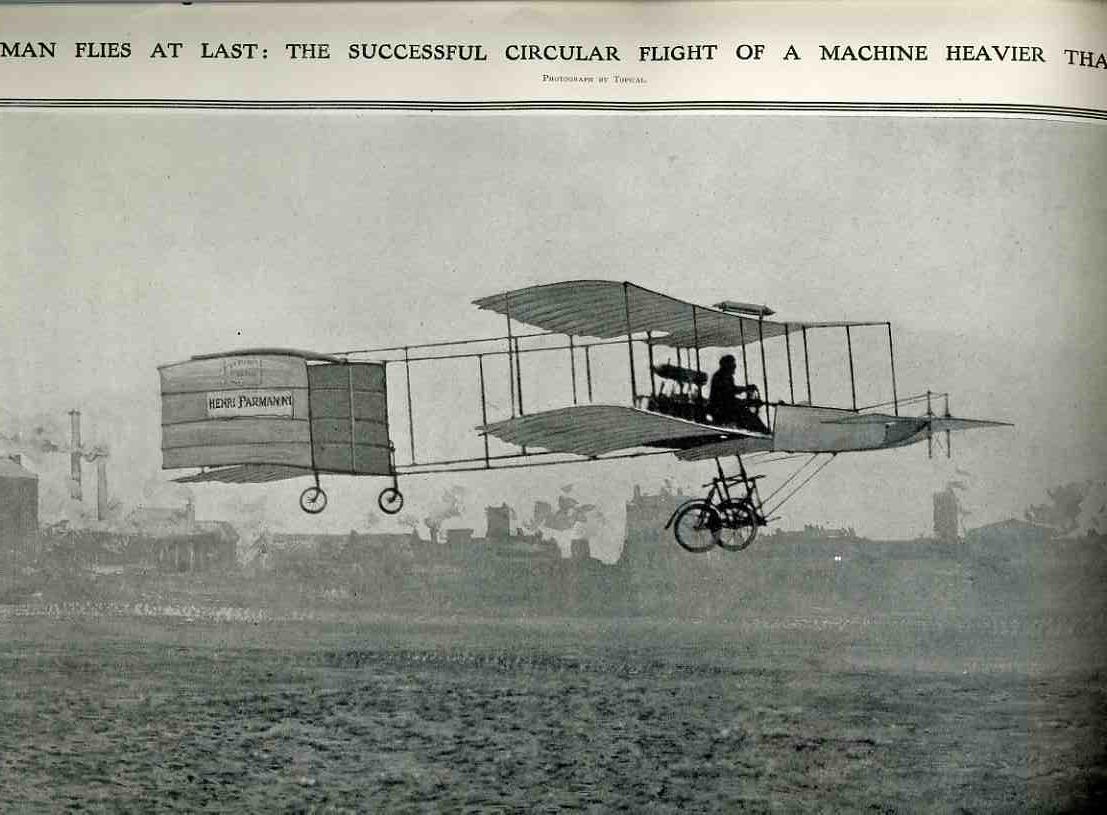
    Henry Farman was perhaps the greatest of the
    early European aviators, owning several of the continental flight duration
    records, though no one in

    Europe

    had been in
    the air for more than one minute prior to 1908. 
    But Farman achieved a major success in January 1908 that was of a sort of
    monumental stature that is difficult to understand today.  And what he did was this:  for the first time in

    Europe

    he flew an aeroplane in a circle.  On 15
    January he was the only one top complete a one-kilometer circular course,
    taking with him the vaunted Deutsch-Archdeacon prize. What this meant though
    was a huge jump in the control of the flying machine; it became right there no
    longer a flying car, but an aeroplane with more

    00-blog-Oct 22-farman detail905
    delicate controls.  [The image above shows Farman in a photo from The Illustrated London News for 18 January 1908, just taking off.  I get the very definite sense of him leaning forward, feeling the tension of the moment.]

    But the Americans were masters of the air,
    having by far the most successes, and traveled further and faster and with
    more élan and capacity than anyone else anywhere—and by wide margins.   But to this point the Europeans had only
    read of their accomplishments, and had seen only still photos.  There was no way for them to appreciate the
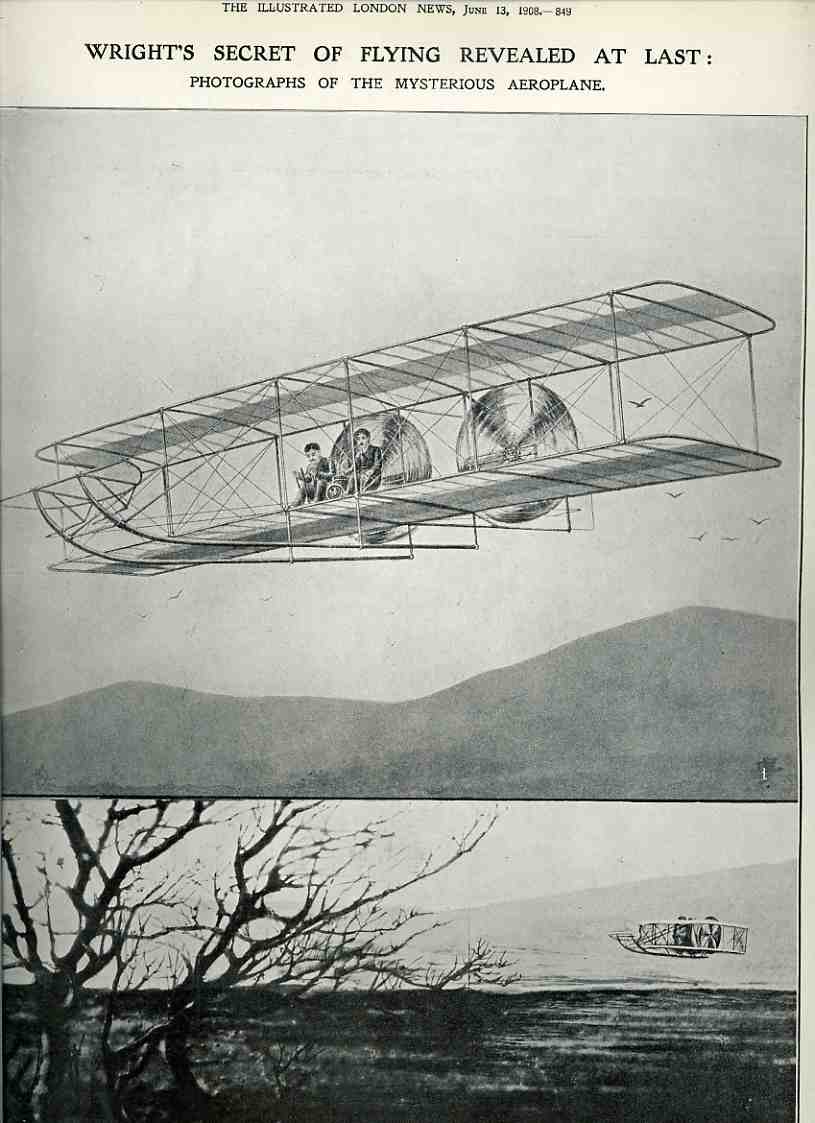
    magnitude of the Wrights’ accomplishments via those media.  Their frustration could be seen in this image
    from The Illustrated London News of 15 June 1908, which screamed “Wright’s
    Secret of Flying revealed at Last: Photographs of the Mysterious Aeroplane”.
    The big page showed an artist’s representation of the two-person flyer along
    with a smaller, smudgy photo of the great machine in flight.

    00-blog-Oct 22-farman wright 907

    This photo would have to suffice for the
    moment, as Wilbur Wright was busy trying to repair his crated plane, which was,
    incredibly, damaged by customs inspectors. 
    The plane was finally ready and on 8 August Wilbur flew—he made tight,
    effortless turns, demonstrated exceptionally able control, flew low and high,
    fast and slow, and made lovely landings. 
    His crowd included the most celebrated flyers on the continent—they were
    all uniformly astonished, leading some to say, for the record, that compared to
    the Wrights, the Europeans had done absolutely nothing.  Wilbur Wright was an enormous hero, feted far
    and wide, making some 200 flights over the next year.  The Wright Brothers’ plane was finally seen
    and inspected,. And all of the claims of greatness seemed to be surpassed by
    their physical demonstrations.

    The most interesting part for me is that, even five years following their first successful heavier-than-air flight in Kill Devil, North Carolina, the astonishing correctness of their accomplishment could not be fully appreciated without their flyer being seen in operation, and in person. 


    ·Posted by :

    ·in:


  • Amelia Earhart: Her Physical Disappearance vs. Lindbergh’s Moral Vanishing

    JF Ptak Science Books   Post 328

    Blog--earheart

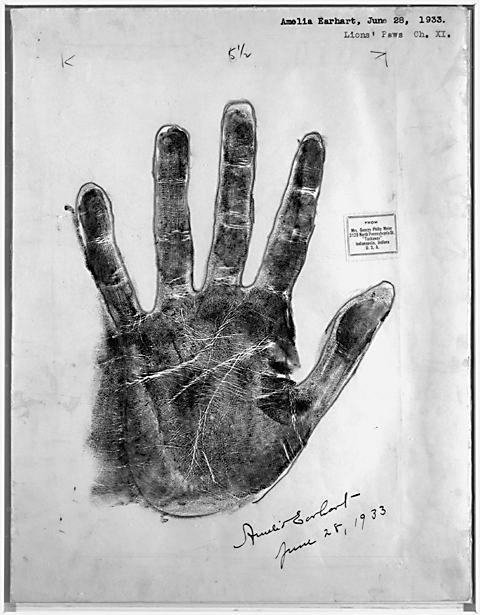
    [Image source: “Amelia Earhart’s palm print and analysis of her character prepared by Nellie Simmons Meier.” June 28, 1933. “Words and Deeds in American History: Selected Documents Celebrating the Manuscript Division’s First 100 Years”,  from the Library of Congress.]

    “KHAQQ calling Itasca. We must be on you but cannot see you…gas is running low…”

    This is I believe the last communication between Amelia Earhart and the rest of creation, as she went flying into the oblivion on low fuel, 2 July 1937.  She was 22,000 miles into her around-the-world trip with her engineer Fred Noonan in a Lockheed L10 Electra, with 7,000 more to go, almost all of which were over the Pacific. That was the last of her, forty years old and world-renowned, and then shrouded in a terrific mystery, and declared dead after massive searches two years later in 1939.  She owned many “firsts” for women in the field of aviation, but still couldn’t seemingly stake them to her own name, burdened with the sobriquet of “Lady Lindbergh”.  It was true enough that being historically coupled with Lindbergh, who was seen by many as the greatest aviator of his day, was a vast compliment; it would have been more complimentary yet to refer to Lindbergh as “Sir Earhart”.  Amelia did, after all, accomplish more overall than Mr; Lindbergh; plus Ms. Earhart did not philosophically spill over into the fascist sphere as did Lindbergh1, who was just a downright embarrassment with his opinions on the war, Hitler, National Socialism, fascism, and the like.

    But I digress.  This image2of her capable and attractive hand just has the quality of disappearing, even though it is right in front of your eyes.  Stare at it long enough and bits of it will go….

    Notes:


    1. Lindbergh’s story during the pre-war period to Pearl harbor is very problematic for people who admire the man for his aeronautical feats; I imagine that they separate his philosophy from his gained famed much in the same way that Poundians concentrate more on that fascist anti-semitic poet’s early years than his treasonous 1935-1945 decade.  It remains terribly visible though that the anti-intervention, America-Firster, race conscious, Germanophile Lindbergh had so much going on in his confused head that it lead even Franklin Roosevelt to think of him as a traitor. (
    Roosevelt said to Treasury Secretary Henry Morgenau in May 1940, “if I should die tomorrow, I want you to know this, I am absolutely convinced Lindbergh is a Nazi.” ) Once America did get into the war, finally, on 8 December 1941, Lindbergh wholeheartedly supported the war effort.  Still it is hard to forget his years of earlier actions and statements and political rallies that called for American appeasement with the Nazis and hi semi-blind admiration for the new Nazi nation.  He wasn’t a fan of Hitler’s, but he did have just very soft pre-1942 criticisms of his actions.  Kristallnacht, almost 70 years ago today, for example, brought out no condemnation from Lindbergh.   He confided to his diary: “I do not understand these riots on the part of the Germans,” he wrote. “It seems so contrary to their sense of order and intelligence. They have undoubtedly had a difficult ‘Jewish problem,’ but why is it necessary to handle it so unreasonably?”  It seems that there should have been a bit more than pursed lips coming from Lindbergh on this occasion, but there wasn’t, even to himself.  There would be another three years of anti-Jewish and other horrific and morally repugnant actions
    from the Nazis, but they all took a giant goosestep back from his principal aim of keeping  America out of the war and being strongly anti-Communist.  Pat Buchanan recently and bizarrely—even for him—defends Lindbergh’s stand during this period as being deeply patriotic.  It is a deeply unreasonable and a bloody mess of historical thinking.

    2. The photostat was made on behalf of a quack  palmist who did all sorts of interpretations of the philosophical chinks in her skin’s armor.  It isn’t worth talking about.


  • Advertising in 1568: Thongs, Shoes, Teeth and Urine

    JF Ptak Science Books LLC  Post 326

    00-blog-Oct 20--aman thong872
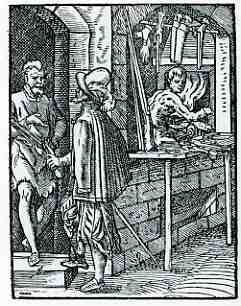
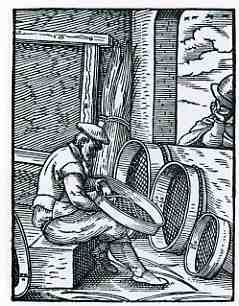
    I was much taken with the splendid woodcut illustrations by the prolific and erudite Jost Amman for one of a series of cycle books known as the Standebuch, or “Book of Trades”.  This work, printed in Nuremberg in 1568, contains 114 woodcut illustrations, and is one of at least fifty books illustrated by the (busy) artist.  Amman is particularly well known for his attention to detail  and factual portrayals–something that was not a particular characteristic of artists portraying the less-than-noble folks in the Northern high Renaissance–and especially for his attention to clothing and shoes. 

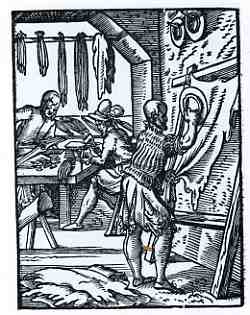
    At first what brought me to Amman for this post was listing the disappeared trades from his list of 114 different jobs–frankly, there weren’t all that many that have just completely disappeared, which i s a little surprising.  One example for this is found at left, with the thong maker–it is a little funny-sounding to today’s ears, but 450 years ago the thong was an essential piece of a man’s wardrobe.  00-blog-Oct 20--aman dentist876

    (The most obvious basically-gone professions included typefounder, block cutter, illuminator, glass painter, coin stamper, gold leaf maker, bag maker, miller, dyer,hatter, bath house proprietor (in the old sense), barber-surgeon, thimble maker, brush and comb maker, cloth shearer, spur maker, scythe maker, nail maker, basin maker, pewterer, armorer, needle maker, crossbow maker, lantern maker (for everyday lanterns, large artistic church lanterns, dark lanterns…), mirror maker,. grinder, joiner, wagonwright, cooper, parchment maker, sievemaker, rope maker, oil maker, wire maker and thong maker. That makes about a third of the professions that are now almost entirely gone; more significant though is that two-thirds of the jobs listed in 1568 are still around.)

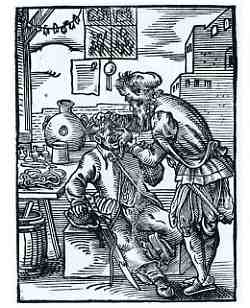
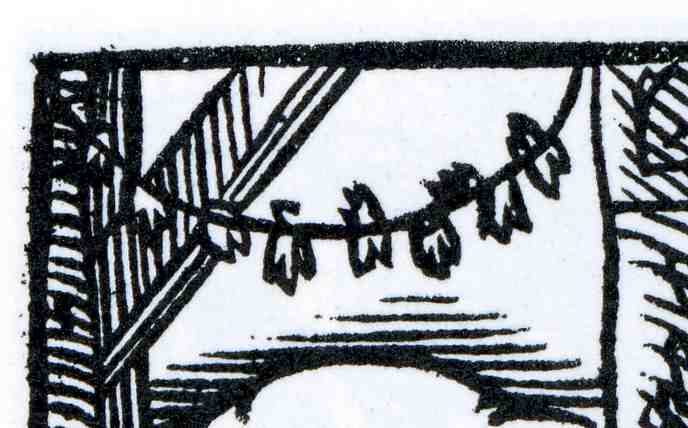
    Then I was drawn to the windows of the interior shops and the window design and glassware; and then from there I became interested in the goods that the tradesman hung in his open window as both finished product and advertising, a kind of calling card if you will.  So for example the thing maker of course had thongs hanging (like throttled chickens) in his window.   One particularly nice showing of goods was for the dentist (pictured at right)

    00-blog-Oct 20--aman dentist det877
     

    who even though he was operating  without walls hung up some teeth just to make sure that folks knew what he was doing, even though the “doing” stuff was happening right there in front of the casual passerby.

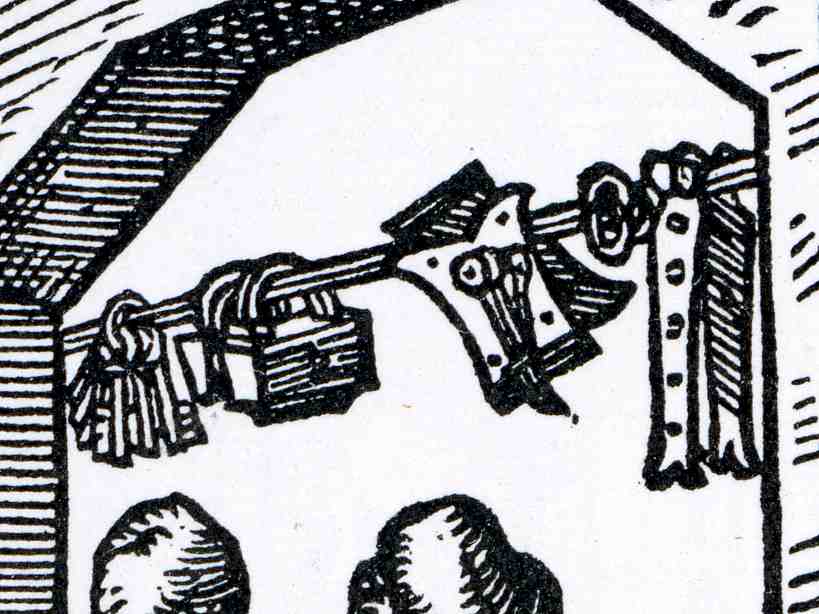
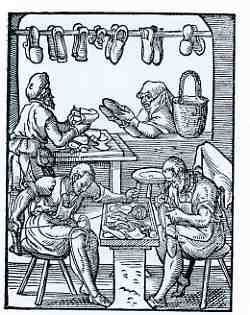
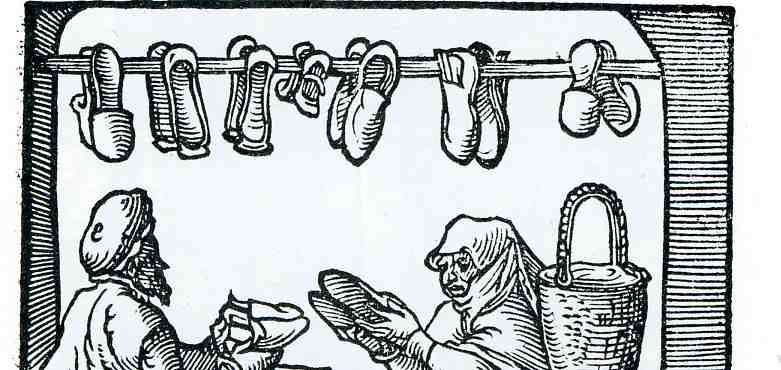
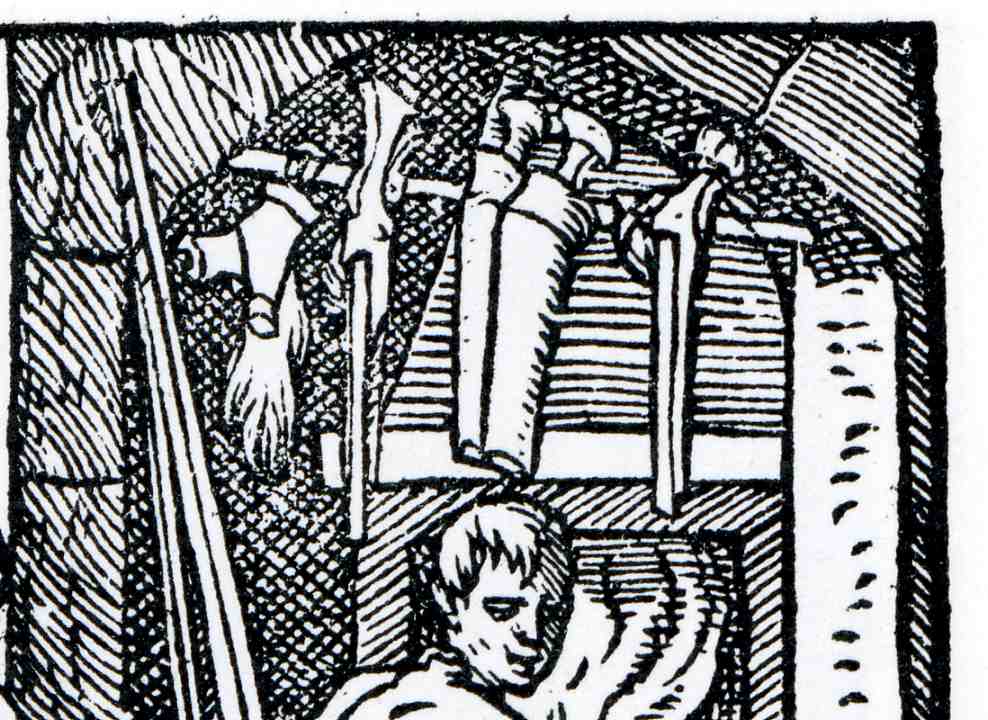
    The locksmith displayed hinges hinges and keys and locks from his rope00-blog-Oct 20--aman key det879, as did the shoe maker (fairly industrious with two helpers), who even displayed a pair of baby shoes.The image for the gunsmith is also interesting because of the detail of the front of the stall/window of the gunmaker–it has a fold-down ledge or table on retractable legs. 

                                                                                                                 00-blog-Oct 20--aman shoe873

    00-blog-Oct 20--aman shoe det874


    00-blog-Oct 20--aman gunsmith det881

    00-blog-Oct 20--aman gunsmith880

    And, well, I lied about the urine.  (Its not often you get to write a sentence like that, or, for that matter, say that you lied about it too.)
    Of the many images of physicians from this period that I have seen many do indeed show the doctor holding a flask of urine on high for inspection, but I never have seen one illustrating the flask for the doctor’s “offices”.  It was one of the principal duties of the Renaissance physician to inspect the urine of his patients, examining it for clues to ill humors and other persuasive unhealthy fortunes.

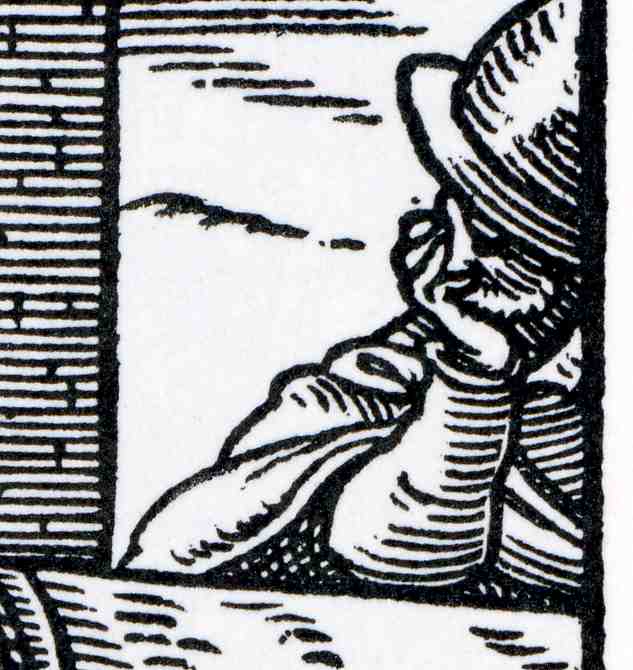
    One could put together the business section for a fair-sized Renaissance city with these images, assembling them side-by-side.  The Amman woodcuts even come with customers and layabouts–there are plenty of people who just “happen by” in these pictures, watching, passing the time of day, observing the tradesmen at work.  Much like today, these open windows beckoned o people in the streets much like a construction site calls out to old men, or an open car hood cries for its neighbors to come and take a peek.

    00-blog-Oct 20--aman basket882

    00-blog-Oct 20--aman basket883

    ·Posted by :

    ·in:


  • From the Department of Great Understatement: the Wright Brothers, 1903

    JF Ptak Science Books LLC   Post 324

    Blog--wright
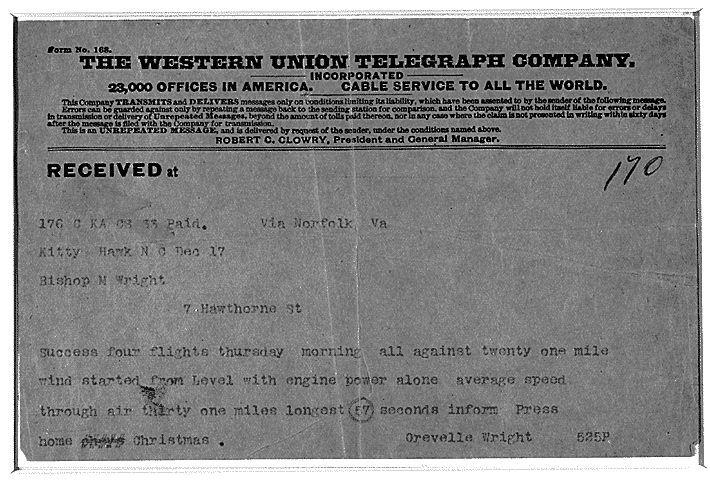
    Lorin Wright–the Zeppo and infrequently-heard-of brother of Orville (1871-1948)  and Wilbur (1867-1912) —was the one responsible for disseminating the information of the first successful heavier-than-air flight at Kitty Hawk in December 1903.  It was on the 17th of December that the brothers—following several incomplete attempts and a crash several days earlier—launched their plane and flew 852 feet, Wilbur staying aloft for 59 seconds.  They were going to try again but an errant gust of wind threw their aircraft and damaged so that there could be no further attempts.
    [CLICK on image to enlarge; courtesy of the Library of Congress]

    After literally chewing the matter over during lunch, and after several hours had passed, the brothers decided to release the news to the rest of humanity.  Their dad had prepared the text and Lorin was responsible for getting the message out. 

    This image of the telegram that the Wright brothers sent to their father for the go-ahead is incredible for its brevity, its understatement and its misspelling.  Of course sending a telegram was relatively expensive and the Wrights didn’t have very much money, so, perhaps the brevity can be sort of explained.  Sort of; after all, they did just become the first people to fly a  heavier-than-air aircraft, and perhaps a little excitement would be present.  But no, the Wright family had a plan and a plan well worked out, so the quick note would suffice, no matter how momentous the achievement.  I should also point out that the outcome was unexpected. 

    But the other bits about this telegram that make it so utterly delicious was the telegrapher’s misspelling of Orville’s name (“Orevelle”) and the two word summons to “inform Press” [sic].  And oh yes, “home Christmas” rounds out the momentous communication very nicely.

    As it turns out the local papers near the Wright community in Ohio gave the achievement scant notice.  (The reverential Scientific American by the way gave the Wright flight inside notice—it wasn’t front cover material for them.) The papers were a little shortered though because the results of the experiment were leaked to the local Norfolk paper, and the rest of the world got scooped. 


  • The Department of What Things Look Like: the Casualties of the Somme, Visualized

    JF Ptak Science Books LLC  Post 323

    00blogoct_16crowds865_2I wanted to return to a post for a few days ago on what victory looks
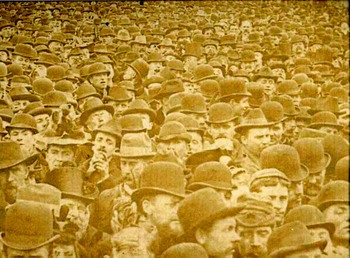
    like in relation to the sub-war/Battle of the Somme in 1916,tying to
    relate the staggering proportions of the 1.5 million casualties from
    that action to a photograph of a group of people.  This is not terribly
    easy to do, especially without using images that are iconic standards
    of “large crowds”, or even images that can be image-googled. I have
    found two interesting images, though—one real, and the other, well, the
    other one I made.  (This is the only image of the 1200 images that I
    have posted to this site that I have altered or created, just for the
    record,)

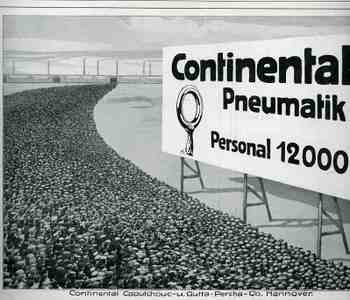
    The first image comes from the Illustrierte Zeitung (Leipzig),
    for October 1910.  It presumably shows the 12,000 employees emerging
    from the factory of Continental Pneumatic Tires, only I make the crowd
    out to be more like 40-50,000  That means that the casualties of the
    Somme would be thirty (30) of these crowd scenes, end-to-end.  30.

    00blogoct_16crowds866

    The next image is a montaged photo, a photo of hats, taken about 12
    feet off the ground or so, but a sea of hats that attaches faces to the
    hats, unlike the sea of hats in the image above it.  This is a sea of
    faces, giving a better sense of humanity to the sea of bodies.  There
    are perhaps 500 people in this photo, meaning you’d need 300 of them to
    illustrate the Somme casualties.

    It all still pales in comparison to the actual numbers.  Victory still looks not so victorious.


  • The History of Images of Aerial Bombing–First Images

    JF Ptak Science Books  Post 322

    I had written out a good, chunky post on the history of the images of aerial bombing; wrote it all down in my little notebook down at Tybee Island, and then promptly hopped into the hot tub fully clothed (for the benefit of our five-year old Tessie) and stayed there for a half-hour, with my notebook still in my pocket.  Of course once the thing sort of dried out all of the notes were just one blue stain, an Andy Warhol post.  I just can’t do the whole thing over again, but I can post about the one odd bit that was in there.  And it is this (very) minor bit that escaped Sven Lindqvist’s attention in his glorious A History of Bombing (printed in 2000 by The New Press), a book that is a chrono-intellectual historico-philosophical treatment of aerial bombing in general.

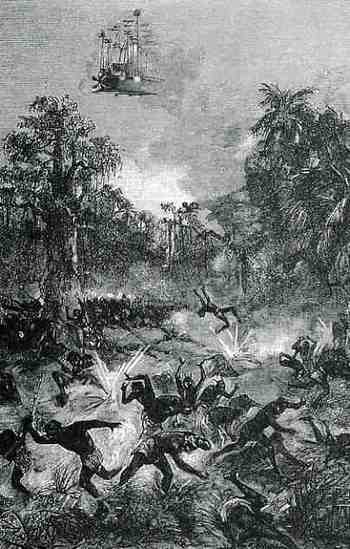
    1blog_oc_t11_robur810

    One of the earliest illustrations of bombing from an airship (at left) occurs in the incomparable Jules Verne’s Roburs the Conquerer (also known as The Flight of Engineer Roburs) in 1886.  It turns out that this floating monstrosity (the Goahead) made its way slowly over Paris, illuminating the city with powerful lights, in a helpful, positive way; on the other hand, it confronts “dark criminals” with bullets, mowing them down.  Oddly enough, the book’s opening two words are “Bang Bang”.

    1blog_oc_t11_anti_ac813

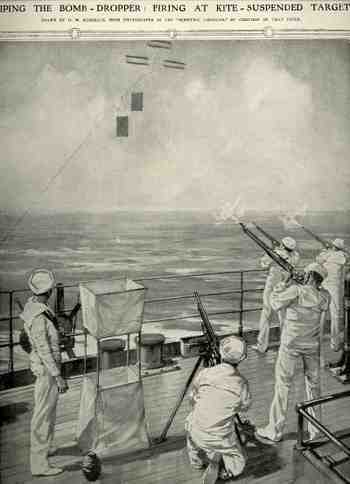
    This may well be the first anti-aircraft (and anti-bomber) image ever printed  in England–it comes from The Illustrated London News for 16 December 1911, just six weeks after this same magazine printed the first image of an aircraft dropping a bomb on a military target. (And it seems originally to have been first published weeks earlier in the U.S in the Scientific American.)  “Airman-shooting with Springfield Rifle; Aerial Gun Practice on a United States Battle-Ship” is the sub title to “Sniping the Bomb-Dropper:  Firing at Kite-Suspended Targets” .  The kites carried the targets up to a height of about 300 feet, and the navy let loose with “one-pounders and three-pounders” as well as rifles (?!) The text to the print continues the story: “The Springfield rifle…will afford no inconsiderable defense against any aeroplane that might attempt to execute feats of ‘bomb-dropping’.” I don’t know about that, though it may have been true that this 30-caliber weapon with a muzzle velocity of 2700’/sec might’ve done some damage to a 1911 aircraft….I guess they could have tracked it too, what with the plane moving 75 miles an hour or so.

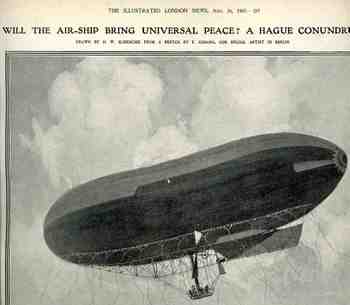
    It was just a few years earlier that in this same journal (for 4 August 1907) that the possibility of the air-ship being an instrument of peace was discussed.  It seems that this “peace” would come about in a sort-of MAD (mutually assured destruction) kind of way, stumbling its way to peace because of the difficulty in defining the terms of war–rather than obtaining a stalemate by the endgame of obliteration via inconceivable amounts of instantaneously-released energy, these folks thought that peace/stasis might come about simply because they weren’t able to fully outlaw reckless bombing because they couldn’t come to terms with what an “airship” actually *was*.    Bombing by airship was outlawed at the Hague Conference of 1899, and in 1907 it was argued that a five-year extension of that treaty should be enacted–again, mainly due to the ungentlemanly ungainliness of what it meant exactly to drop bombs from the air and what aspects of that action were illegitimate. 

    All sides would get over the definition issues pretty quickly, as 1912 comes up just a little short of the guns of November two years hence.  After all, we can’t have ill-defined terms in communication, can we?

    1blog_oct_13marconi_at_sea818