A Daily History of Holes, Dots, Lines, Science, History, Math, Physics, Art, the Unintentional Absurd, Architecture, Maps, Data Visualization, Blank and Missing Things, and so on. |1.6 million words, 7500 images, 4.9 million hits| Press & appearances in The Times, Le Figaro, Mensa, The Economist, The Guardian, Discovery News, Slate, Le Monde, Sci American Blogs, Le Pont, and many other places… 5000+ total posts since 2008.

Author: JF Ptak

  • Trans-Atlantic Crossing by Air, 1910 (?) The Voyage of the “America”

    JF Ptak Science Books LLC  Post 343

    00-blog--Oct 28 airship atlantic946
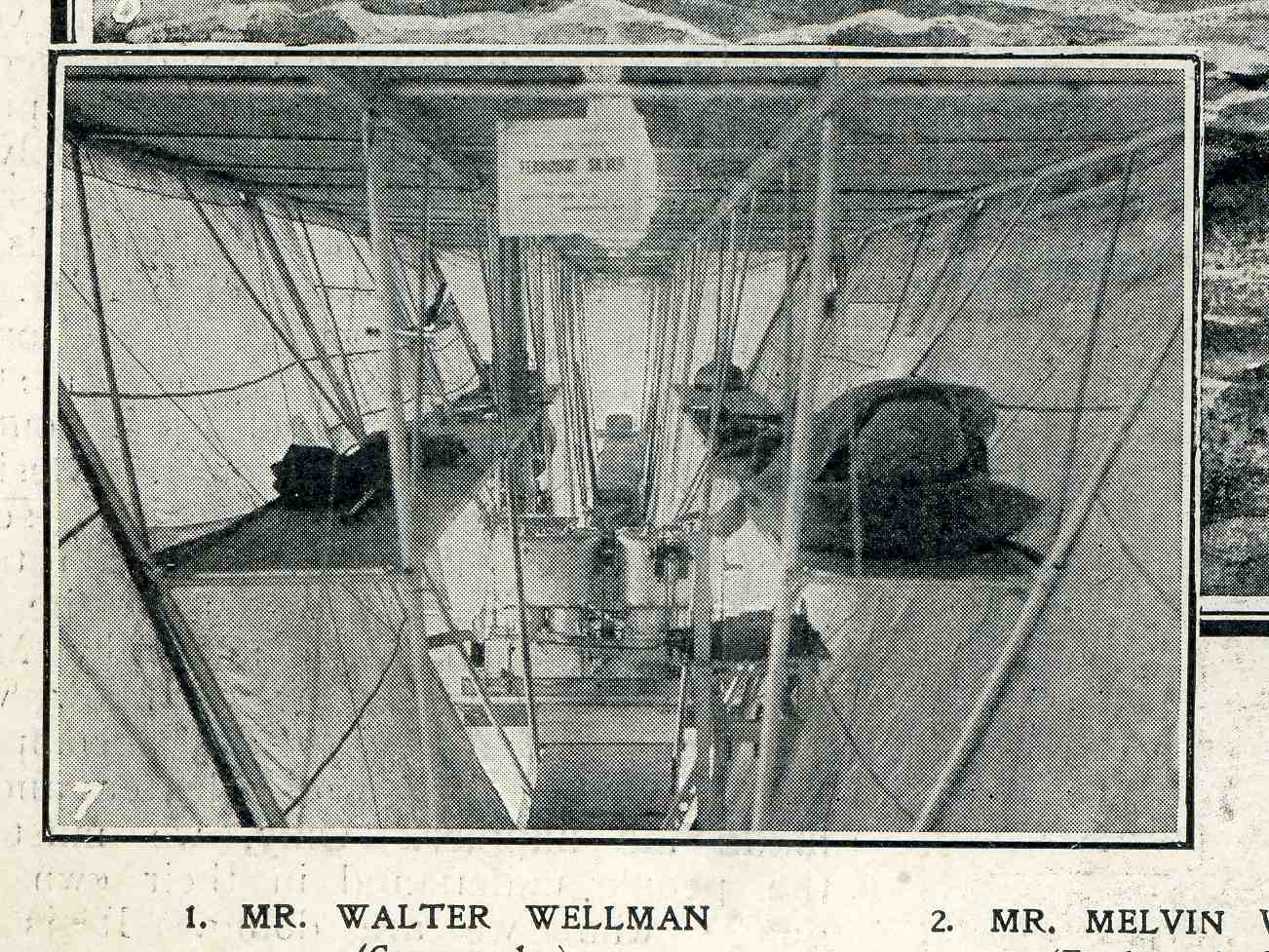
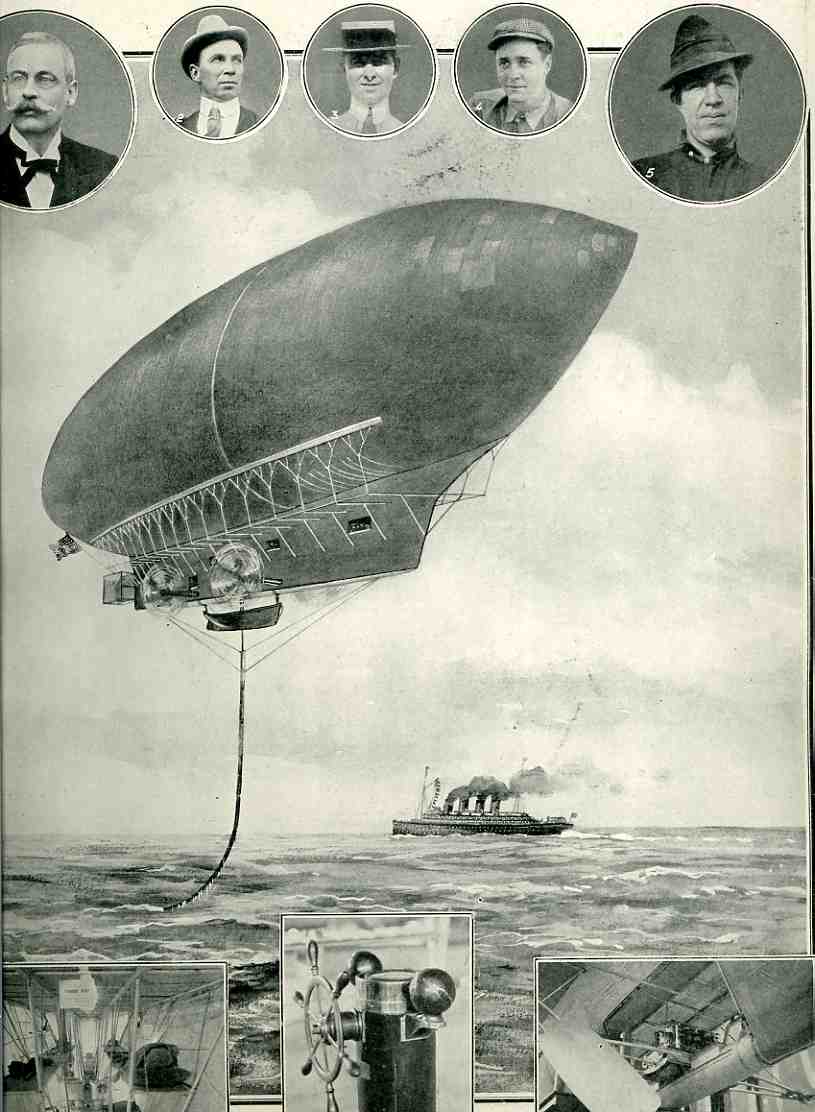
    The airship “America”, under the command of Captain Murray Simon and Walter Wellman (the arctic explorer, set out to cross the Atlantic Ocean on 15 October 1910. The dirigible was 228 feet long with a diameter of 58 feet, had a crew of eight, and was filled with hydrogen gas.  The airship’s four-tons worth of petroleum (to run the four engines on either side of the ship) was carried in the base of the car compartment of the dirigible, with another ton or so of fuel carried in the “equilibraor”, which served to keep the height of the dirigible “equalized” at about 200′.  They set off from New Jersey and flew in a very wide arc for about 1300 miles until engine trouble forced them down near Bermuda.  Although never coming close to crossing the ocean the “America” did set a record for the longest flight of any sort of flying machine.

    What drew me to this image though was something far less important: the small inset picture at bottom left, which shows the “sleeping shelves” for the crew. The accommodations, shall we say, are barely so; they looked very narrow, very metal-y, very cold and pretty dangerous, with basically no room for a roll-over.  Then again, no one was there for comfort, but these racks look defiantly un-comfortable.  

    This was the last flight for Wellman, and the crossing of the Atlantic by air would have to wait for the ethically-challenged Lindbergh sixteen years later.

    00-blog--Oct 28 airship atlantic947


  • Vegetius and the 4th Century Underwater Attack

    JF Ptak Science Books LLC  Post 342

    Blog--vegetius
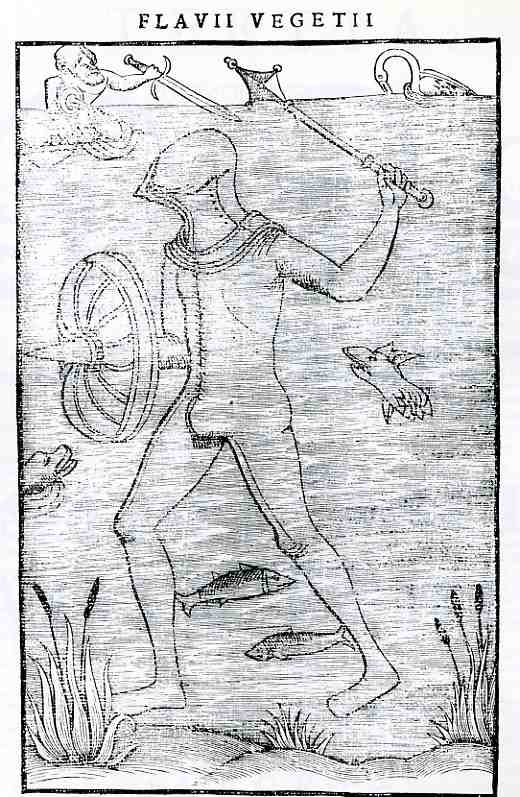
    The name of Flavius Vegetius is not so much popularly known today, though his influence is felt through the hands of other, more famous, writers and thinkers.  He was seen as the most adept writer on the Roman mind in warfare, and his De re militari libri quator… was his masterpiece.  It was reprinted in 1532 by Christian Wechel from sources reaching back to the original, which was written around 390 ACE, and found a wide readership not only for its authority on all things military/Roman but also for his iconic insights and aphorisms on warfare in general.  It was Machiavelli who came under his spell and who adopted some of Vegetius, who became further disseminated through the military followers of Machiavelli, and so on.

    I came to this work much more simply than all of this – I liked this image of the underwater warrior, who was somehow able to breathe while submerged.  I get the importance of this sort of undercover, guerilla maneuver, but what I really like was the rarity of seeing a Renaissance illustration of human submarine life, which is pretty uncommon.  Also, the use of the lines to represent the underwater quality of the image—giving the woodcut an overall grey tone—is also very scarce in the history of illustration, at least before 1600.  And very neat!  One of the hallmarks of this printing of Vegetius was the liberal use of white space in many of the (119) woodcut illustrations, though it is clearly not on display in the woodcut that I’m sharing here.
    00-blog-Oct 28 vegetius939

    Of further interest are the following excerpts of Vegetius from the 1767 English translation found at the Digital Attic website. I’ve selected four interesting bits on the selection of recruits, their initial training, the size of recruits and the need of the new soldiers to learn how to swim.  I find them a fascinating insight into the appreciation of the raw military recruit from 1600 years ago. 

    The Military Institutions of the Romans (De Re Militari)

    By Flavius Vegetius Renatus

    INITIAL TRAINING

    The first thing the soldiers are to be taught is the military step, which can only be acquired by constant practice of marching quick and together. Nor is anything of more consequence either on the march or in the line than that they should keep their ranks with the greatest exactness. For troops who march in an irregular and disorderly manner are always in great danger of being defeated. They should march with the common military step twenty miles in five summer-hours, and with the full step, which is quicker, twenty-four miles in the same number of hours. If they exceed this pace, they no longer march but run, and no certain rate can be assigned.
    But the young recruits in particular must be exercised in running, in order to charge the enemy with great vigor; occupy, on occasion, an advantageous post with greater expedition, and prevent the enemy in their designs upon the same; that they may, when sent to reconnoiter, advance with speed, return with greater celerity and more easily come up with the enemy in a pursuit.


  • Wicked Polly Reveals the Sameness of Names, 1827

    JF Ptak Science Books LLC Post 341

    00-blog-Oct 22-polly908
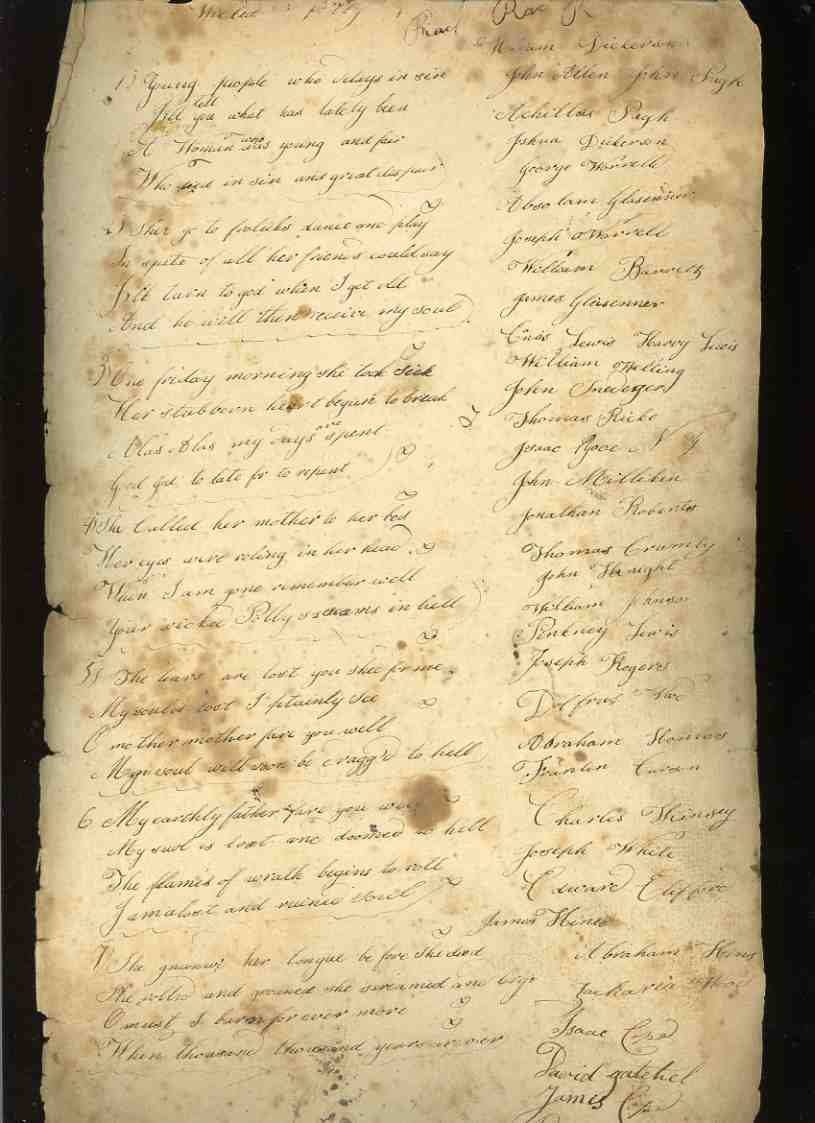
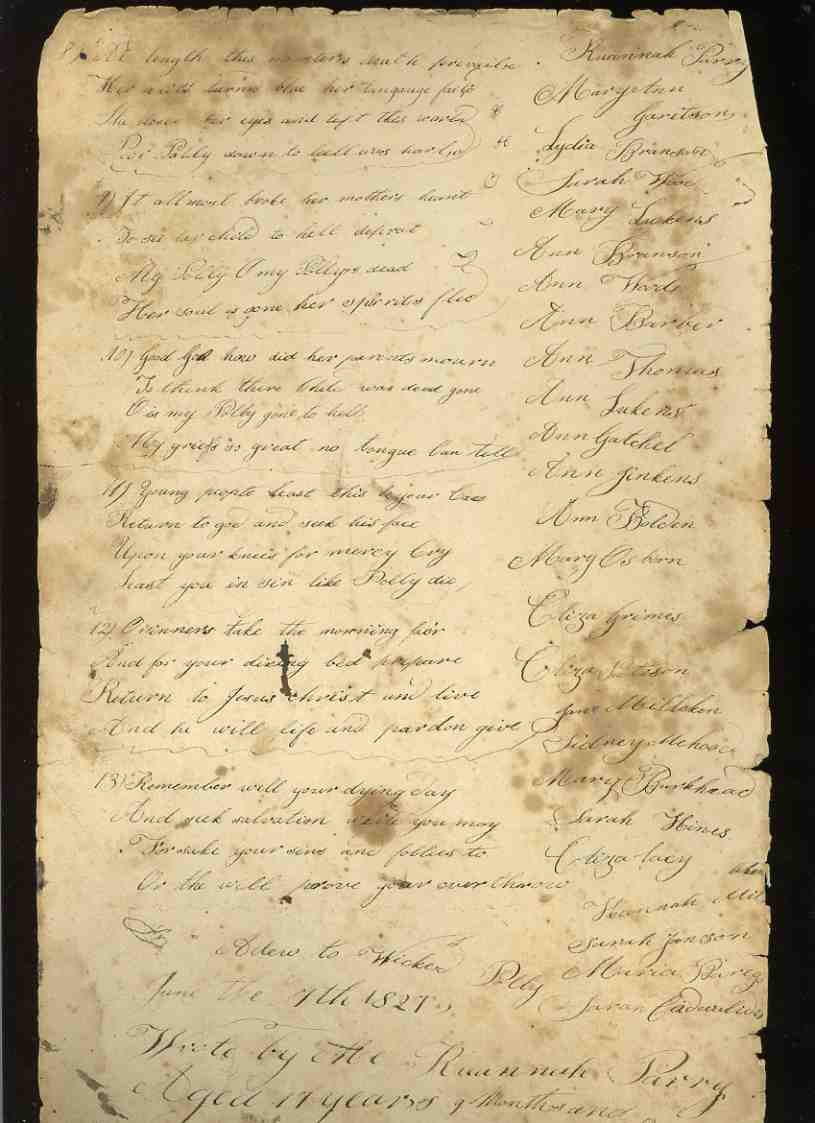
    In my collecting of antique children’s art (that is, art produced by children from 1880 and earlier) I’ve stumbled across a number of interesting other associated, relateable,  things.  One such item is this manuscript copy–from 1827–of a much older children’s warning/lesson poem, called “The Lamentable Story of Wicked Polly”, a scare-the-kids-to-death kind of poem, instilling (and installing) a very healthy dosage of the wrath of god, a falling away from the just Jesus, and the regretably-late realization on the everlasting pain of sin.  A rosey children’s lullaby it is not.

    [The lyrics are below; click on the images for a more legible resolution.]

    But the side interest here is literally at the side, a perhaps revealing bit of marginalia in which the copyist has recorded the names of 54 children (I imagine).  Are these names the names of classmates, other children in school, kids in town?   There are 26 girls and 28 boys; the girls, as it urns out, have 9 different names; the 28 boys have 18 different names. I wonder why?  The girls have the following names (and with the number of holders):  Ann (7), Ekiza (4), Mary (4), Hannah (3), Sarah (3), Mary (3), Jane (2) and then one each for Lydia, Sidney and Maria. 

    The boys have more imaginative names:  most popular are William (4) and John (4); this is followed by Joseph (3), James (2), and Abraham (2).  The rest of the names are single-uses, and include: Achilles, Joshua, George, Absolom, Enos, Thomas, Pinkney, Charles, Edward, Zachoria, Isaac, Dening and Reason.  This is a small and unexpected sample, but it is interesting nonetheless–I don’t even have an explanation, just this observation. 


    00-blog-Oct 22-polly909

    The Lamentable Death of Wicked Polly


    Young people who delight in sin.
    I’ll tell you what has lately been:
    A woman who was young and fair,
    Who died in sin and sad despair.

    She’d go to frolics, dance and play,
    In spite of all her friends could say;
    I’ll turn to God when I get old,
    And He will then receive my soul.

    One Friday morning she took sick,
    Her stubborn heart began to break;
    Alas! alas! my days are spent,
    Too late! too late for to repent.

    She called her mother to her bed-
    Her eyes were rolling in her head-
    When I am dead remember well,
    Your wicked Polly screams in Hell.

    The tears are lost you shed for me,
    My soul is lost, I plainly see;
    Oh! Mother, Mother, fare you well-
    My soul will soon be dragged to Hell.

    My earthly father, fare you well,
    My soul is lost and doomed to Hell;
    The flaming wrath begins to roll,
    I am a lost and ruined soul.

    She gnawed her tongue before she died,
    She rolled and groaned and screamed and cried,
    Oh, must I burn forever more,
    When thousand, thousand years are o’er?

    At last the monster Death prevailed,
    Her nails turned blue, her language failed;
    She closed her eyes and left the world,
    Poor Polly down in Hell was hurled.

    It almost broke her mother’s heart
    To see her child to Hell depart;
    My Polly, O my Polly’s dead,
    Her soul is gone, her spirit’s fled.

    Alas – how did her parents mourn
    To think their child was dead and gone.
    Oh! is my Polly gone to Hell,
    My grief’s so great no tongue can tell.

    Young people, lest this be your case,
    Return to God and seek His face.
    Upon your knees for mercy cry,
    Lest you in sin like Polly die.

    Oh! sinners, take the warning fair
    And for your dying bed prepare,
    Return to Jesus Christ and live,
    And He will life and pardon give.

    Remember well your dying day,
    And seek salvation while you may;
    Forsake your sin and follies, too,
    Or they will prove your overthrow.


  • Achievements in European Flight: Excellent Visual Display, 1913

    JF Ptak Science Books LLC  Post 340     

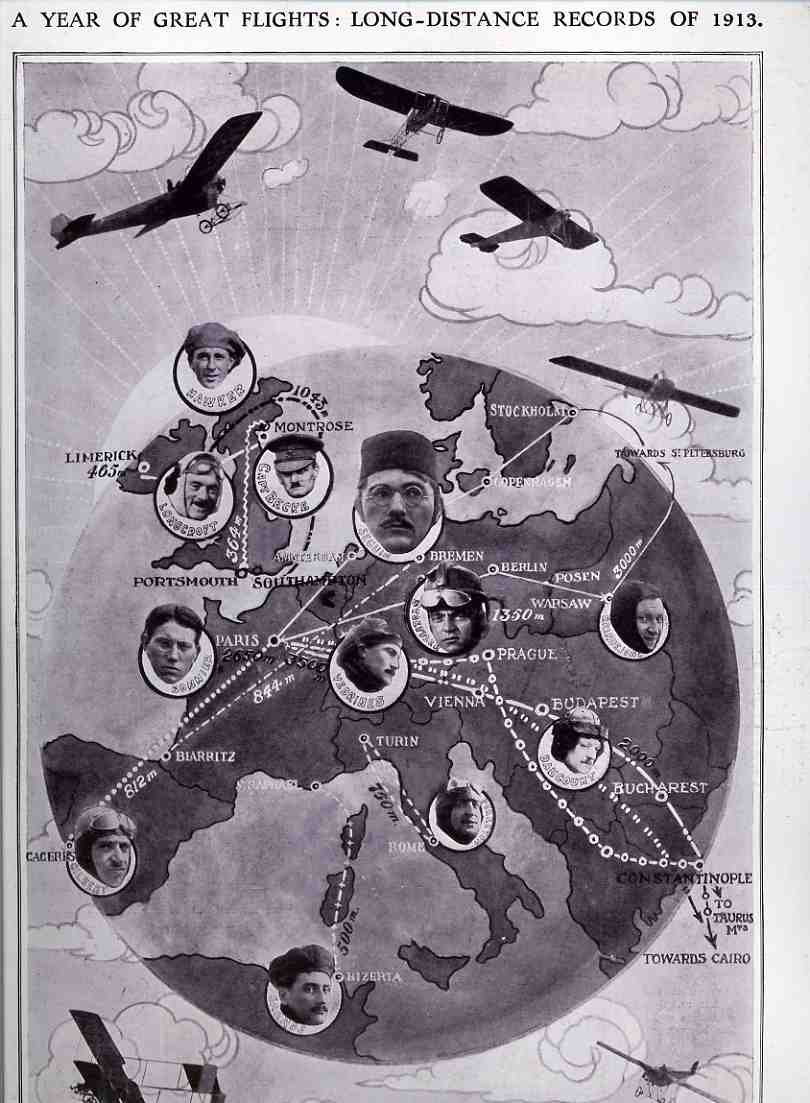
    This excellent (and slightly bizarre-looking) display of quantitative data comes to us from The Illustrated London News for 17 January 1914.  IT shows the great range and capacity of endurance and long-range flight taking place in Europe in 1913.  This portrayal is extraordinary if you keep in mind that (as I wrote about in a post last week) the Wright Brothers had only arrived in Europe in the middle of 1908 to begin their revolutionary re-introduction of the concept of heavier than air flight to the Europeans. Just prior to the Wright’s arrival the combined forces in Europe had barely been able to muster a sustained flight of two minutes, even as late as 1907.  The exhibition of the Wright flyers made an instant and profound impression on all concerned, and the lessons of the Wrights imemdiately put into practice.  Which brings us to this graphic, showing that flight in Europe had advanced enormously, with flights now routinely lasting many hours and taking place over a course of hundreds of miles–all of these changes taking place in five short years.  World War I would be the next gigantic influence on the development of flight theory, airplane construction and the use of the skies, and that would all start taking place in less than a year from now. 
    00-blog-Oct 27aviation flight records 1913931


  • Atomic Bomb Darts–Kids’ Games from the 1950’s

    JF Ptak Science Books Post 339

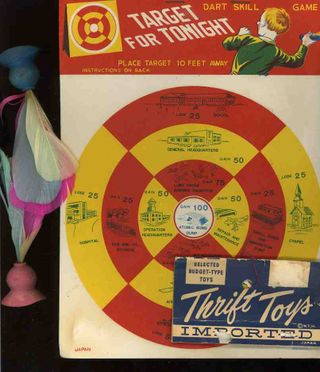
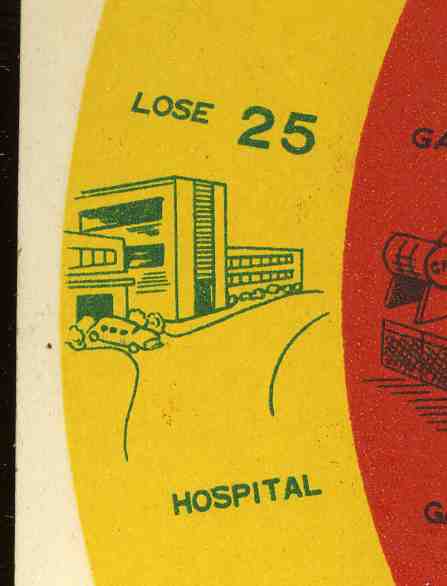
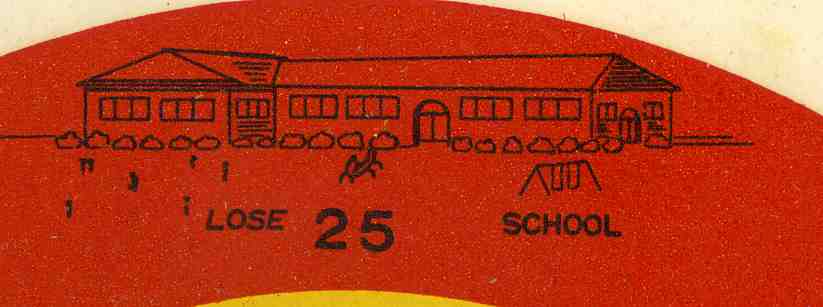
    Outside of duck-and-cover routines and other schemes for teaching children the survivability of nuclear holocaust, the approach for installing nuclear-think in the psyche of the young was through games. One such game was this cheap, affordable-by-all bombing game, “Target for Tonight” (a “Selected Budget-type Toy” by “Thrift Toys, Imported”), in which kids would use their “Atomic Darts” to reign terror over foreign lands.  But be careful!  Missing the primary targets and hitting something in the outside ring will cost you points!  If you bombed the hospital, school or chapel, you’d lose 25 points; if you hit the “civilian city” you’d get 50 points docked from your total.  Of course the game goes on no matter how many points you lose, just so long as you hit something positive and whose point add up to a total of 175. 

    00-blog-Oct 27 atomic926

    00-blog-Oct 27 atomic det hospital927

    The bullseye of the game is the “Atomic Bomb Dump” (an expression I’ve never seen before) at center.  Since it would be relatively easy to score 175–you could do it with four or five decent hits–the makers must’ve assumed that there would be plenty of collateral damage taking points from the total, otherwise the game would be over in two rounds and how much fun would that be?  So I guess that the message in this medium would be that into every winning effort some considerable unhappy rain must fall. 

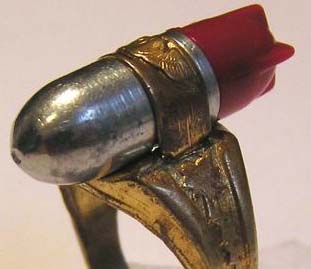
    00-blog-Oct 27 atomic det school928 I guess too that the kids playing this game could’ve been throwing their atomic darts wearing their Lone Ranger Atomic Bomb ring.  I’m no toy expert, but I cannot remember any other children’s jewelry from before 1960 (this ring is from 1946) using such a graphic depiction of The Bomb for casual wear.
      I’m also fairly positive that there must’ve been a good, causal bit to go along with “Atomic bomb” and “the Lone Ranger”, though I can’t think of what would connect the Western hero with the a-bomb.

    Another no-holds-barred toy appears in the form of this manual dexterity game from the late 1940’s–the child was supposed to maneuver the three marbles into the hole/position at Hiroshima, Nagasaki and Tokyo.

    Did I mention that the “Target for Tonight” game was made in Japan?Lone_Ranger_Ring

    Atomic bomb marble


  • Blank and Disappeared Things Department: Confederate Oath of Allegiance and Loyalty

    JF Ptak Science Books LLC Post 338
    Blog--blank--confeder oath
    The hundreds of thousands of soldiers who found themselves in Confederate homespun after years of fighting against “those people” of General Lee were offered a clemency at the end of the war by Abraham Lincoln.  Or rather it was the idea of Lincoln’s that survived the war as Lincoln didn’t.  

    Actually the idea of amnesty was granted as a presidential power via the Confiscation Act of 1862, which authorized the president of the United States to pardon anyone involved in the rebellion. This was done at a time when the outcome of the war was still nebulous and far from being decided, as Lincoln was suffering a crisis in his cabinet as well as on battlefields throughout the run of the nation.  This act was followed by the Amnesty Proclamation of 8 December 1863, which basically extended a pardon to anyone who was not a war criminal, was an officer, and who would sign an oath of allegiance.  This was followed by another proclamation in 1864 extending the privilege to Southern civilians as well.  And the sentiments were extended past Lincoln’s murder via the otherwise occupied third-worst president, resulting on 25 December 1865 with the unconditional pardon to all Civil War vets except for the high-ranking and monied officers—this is something that Johnson got absolutely right, and so right, as a matter of fact that even more liberally-minded northerners thought he was giving away the store.  Johnson didn’t follow his own deepest thoughts and dark angels on this issue, either:  right after becoming president (the first VP to ascend to the office during an active administration) in April, 1865 he was noted telling an Indiana delegation that, “Treason must be made odious… traitors must be punished and impoverished … their social power must be destroyed.”

    Within weeks his policy line had softened if not his reasoning than at least his rhetoric and action:  “I say, as to the leaders, punishment. I also say leniency, reconciliation and amnesty to the thousands whom they have misled and deceived.  These actions alienated many on all sides, but it was probably the highlight of his troubled four years or so in office, and more than likely was the only thing he got right in the Reconstruction policies through 1869. (I’d say that his allowance of the creation of Black Codes and the codification of sub-citizenship to the newly-freed slaves that created a still subjugated interior-nation for black people created more havoc and pain and discord than anything else anyone did in government in the immediate post-war period.)

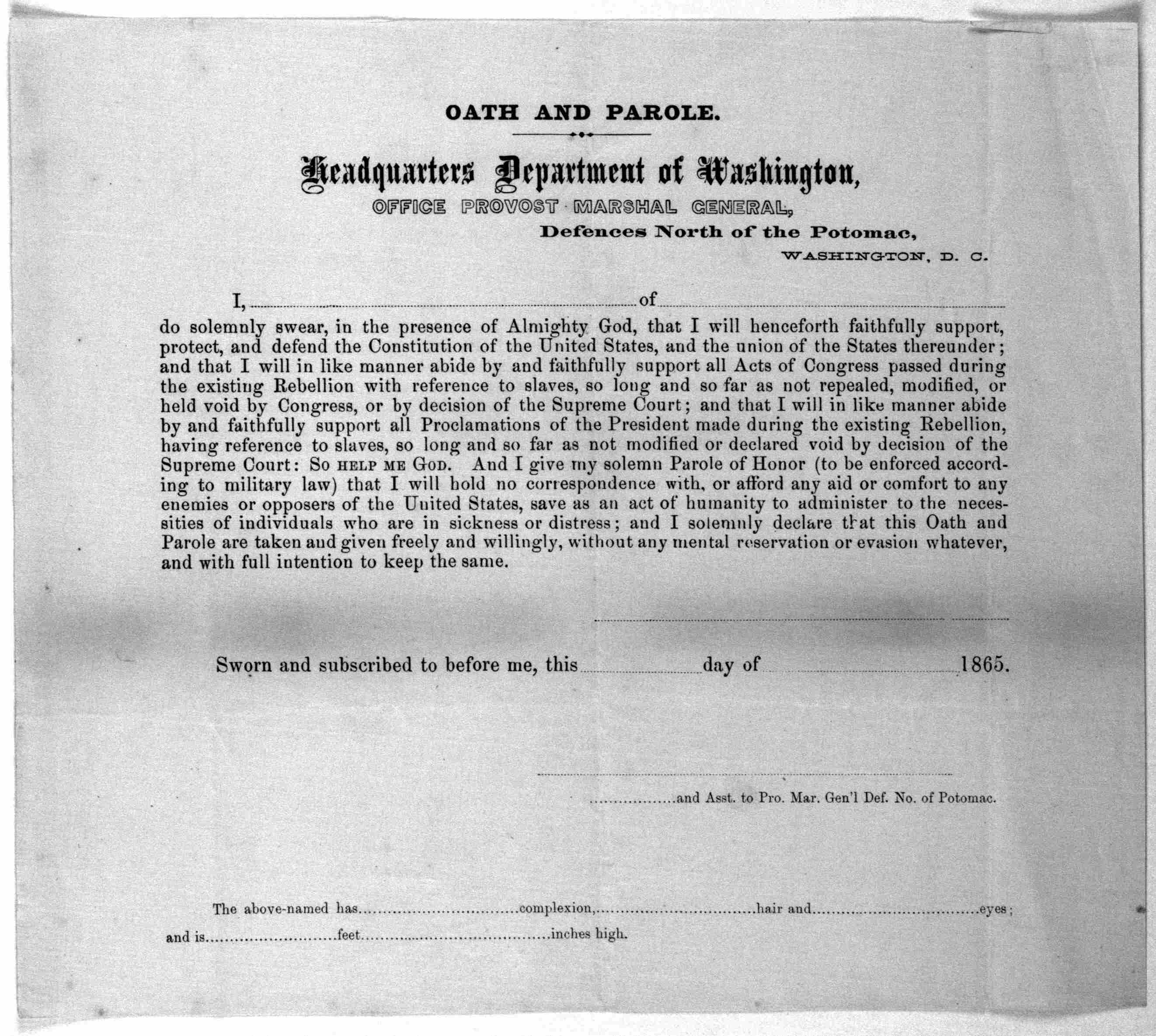
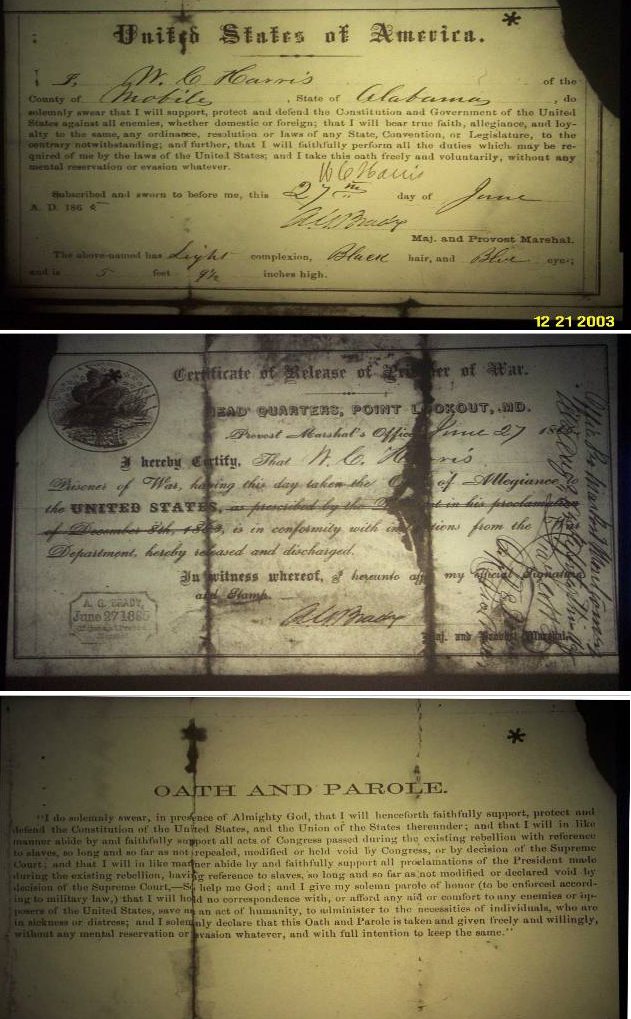
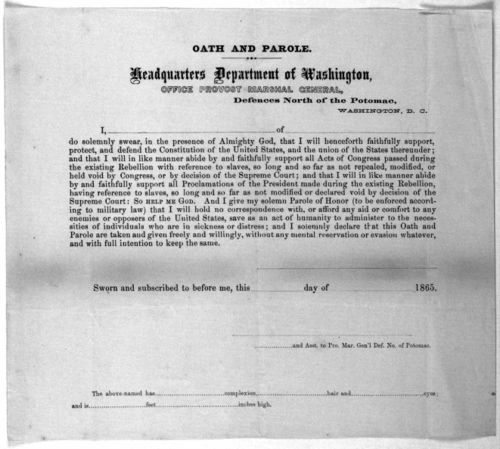
    So as part of the series of blank and empty things I’d like to include this unused oath of allegiance certificate.  There were perhaps hundreds of thousands of these sorts of bills-of-freedom distributed to Confederate veterans, who–whether they agreed or not, believed or not–filled them up with their information and pledged to be true to the Union, if for no other reason than to put the war as much behind them as possible and return to what might have been their lives.  I’ve also included three examples (relating to the same person) of filled-out pledges (at bottom).

    NOTES:

    The following first section is an appraisal and summation of the amnesty program appearing in Harper’s Weekly for May 15 1865:

    PRESIDENT LINCOLN’S AMNESTY.
    By his proclamation of the 8th of December, 1863, President LINCOLN granted a full pardon —with certain exceptions which we will presently state—to all who had been in rebellion, with a full restoration of all rights of property except in slaves and in cases where the rights of third parties had intervened, and upon condition of taking and subscribing and keeping in-violate an oath to support and defend the Constitution and the Union under it, and to abide faithfully by all the laws of Congress, and by the proclamations of the President in regard to slaves, so far as they are not repealed or declared void by the Supreme Court.
    The persons excepted from this amnesty were all who are or have been civil or diplomatic officers and agents of the rebel Government—all who have left judicial stations under the United States to aid the rebellion—all who are or have been military and naval officers above the rank of colonel in the army or lieutenant in the navy —all who left seats in the United States Congress, or resigned commissions in its army or navy, and afterward aided the rebellion—and all who have treated colored or white soldiers and sailors of the United States otherwise than as prisoners of war.

    On the 26th of March, 1864, President LINCOLN by proclamation defined that the amnesty was limited to those who were not prisoners of war, but who, being free from any arrest, voluntarily took the oath.
    On the 6th of December, 1864, in his last annual Message to Congress, the President said that when he issued the amnesty he stated that the excepted classes might still be within special clemency. ” During the year,” he continued, “many availed themselves of the general provision, and many more would, only that the signs of bad faith in some” led to precautions. Special pardons had also been granted to persons of the excepted classes. ” The door has been for a full year open to all.” But he adds, ” The time may come, probably will come, when public duty shall demand that it be closed, and that, in lieu, more rigorous measures than heretofore shall be adopted

    NOTES, Part II:
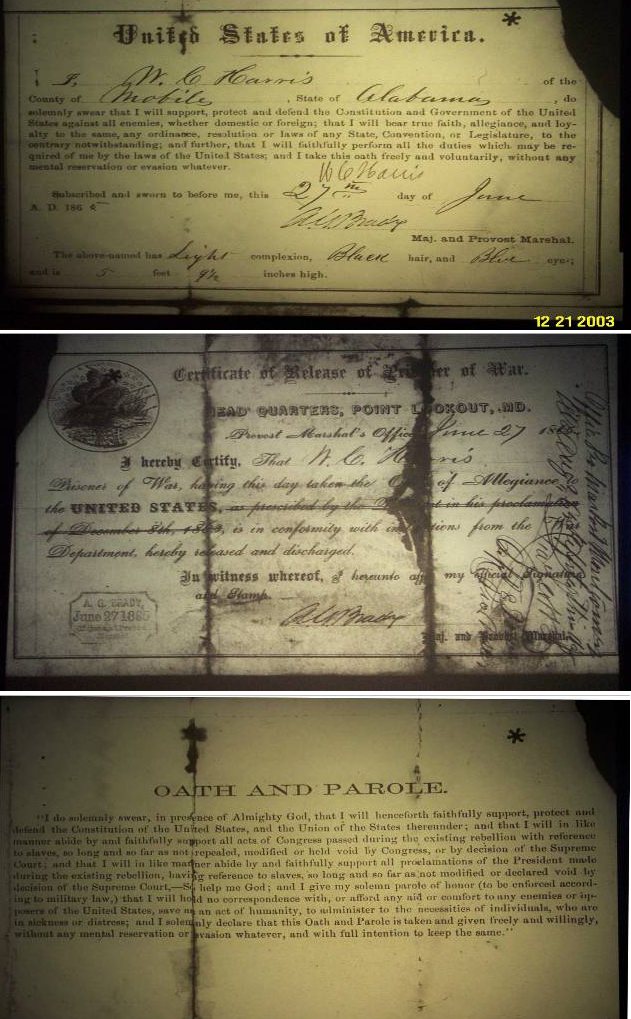
    Blog--empty--oath filled out

    Image 1
    UNITED STATES OF AMERICA

    I, W.C. Harris of the County of Mobile, State of Alabama, do solemnly swear
    that I will protect and defend the Constitution and Government of the United
    States against all enemies, whether domestic or foreign; that I will bear
    true faith, allegiance, and loyalty to the same, any ordinance, resolution
    or laws of any State, Convention, or Legislature, to the contrary
    notwithstanding; and further, that I will faithfully perform all the duties
    which may be required of me by the laws of the United States; and I take
    this oath freely and voluntarily, without any mental reservation or evasion
    whatever.

    W.C.Harris

    Sunscribed and sworn to before me, this 27th day of June A.D. 1865
    A.G. Brady
    Maj. and Provost Marshall
    The above-named has light complexion, Black hair, and Blue eyes; and is 5
    feet 9 1/2 inches high.

    Image 2
    CERIFICATE OF RELEASE OF PRISONER OF WAR
    Head Quarters, Point Lookout, Md.
    Provost Marshal’s Office  June 27, 1865

    I hereby certify, that W.C. Harris , prisoner of war, having this day taken
    the Oath of Allegiance to the United States is in conformity with the
    instructions from the War Department, hereby released and discharged.

    In Witness whereof, I hereunto affix my official signature and stamp.

    A.G.Brady,
    Maj. and Provost Marshal

    Image 3
    OATH AND PAROLE

    I do solemnly swear, in presence of Almight God, that I will henceforth
    faithfully support, protect and defend the Constitution of the United
    States, and the Union of the States thereunder; and that I will in like
    manner abide by and faithfully support all acts of the Congress passed
    during the existing rebellion with reference to slaves, so long and so far
    as not repealed, modified or held void by Congress, or by decision of the
    Supreme Court; and that I will in like manner abide by and faithfully
    support all proclaimations of the President made during the existing
    rebellion, having reference to slaves, so long and so far as not modified or
    declared void by decision of the Supreme Court,— So help me God; and I
    give my solemn parole of honor (to be enforced according to military law,)
    that I will hold no correspondence with, or afford any aid or comfort to any
    enemies or opposers of the United States, save as an act of humanity, to
    administer to the necessities of individuals, who are in sickness or
    distress; and I solemnly declare that this Oath and Parole is taken and
    given freely and willingly, without any mental reservation or evasion
    whatever, and with full intention to keep the same.

  • Blank and Empty People and Things: The Wobblies Protect their Own, 1906

    JF Ptak Science Books LLC Post 337

    Blog--blank--war prisoners
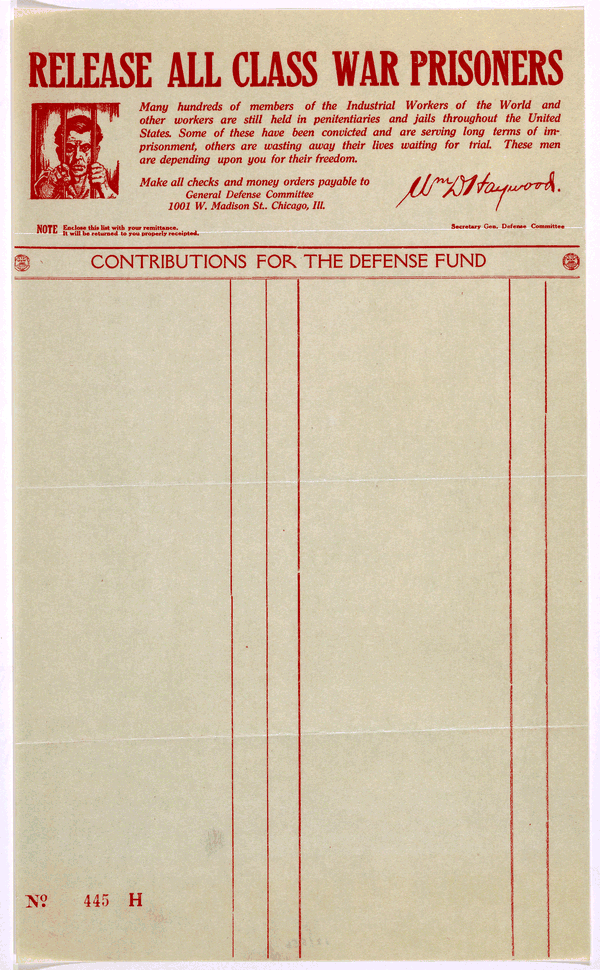
     This  IWW unused release form for political prisoners is yet another entry in
    our Blank/Missing People/Things category. 
    This was pretty radical envelope-edgy stuff for political liberalism in
    the U.S.
    in the early part of the 20th century, butt that was really the modus operandi
    of this group.  Founded in Chicago just a
    year or so earlier than this form was printed, the Industrial Workers of the World
    was an anarchist/socialist/radical and sprinkling of trade unions and
    organizations conglomeration organization as a general answer to a malaise and
    dissatisfaction with the policies of larger trade groups (mainly the American
    Federation of Labor (AFL)).  What it
    really was, or became, was the most important movement of the century for the protection
    of workers and unions, though it did bolster the underlying belief in
    overthrowing the ruling economic class for the benefit of all who labored to
    make that class even more wealthy and dominating. 

    I have no doubt that such a piece of propaganda was needed and necessary—labor
    workers, organizers, unionists and the like were granted little clemency by big
    business, and could be often treated with great brutality, not the least of
    which was physical.  It was not in the
    interest of the controllers of the means of production to allow such
    interference from labor groups such as the IWW, as they saw it as a diminishing
    assault on their source of revenue. 
    There was also another reason for fear and condemnation of this group—it
    was also about the only major group which allowed membership along all race and
    belief systems.  The possibility of a
    cohesive laboring class threatened the established (and still established)
    fracturing of the working classes by petty differences, fostering internecine
    warfare among the working classes and keeping them more divided and weak. 

    This broadside looks as though it is newer than what the Library of Congress
    guesses is 1906/7—the design, woodcut and typeface all look later—but the document
    does have the imprimatur of William D. (“Big Bill”) Haywood, which would make
    the date correct.  Still, the design
    doesn’t look quite right to me.


  • Oliver Byrne’s Euclid, (slightly) continued

    JF Ptak Science Books LLC

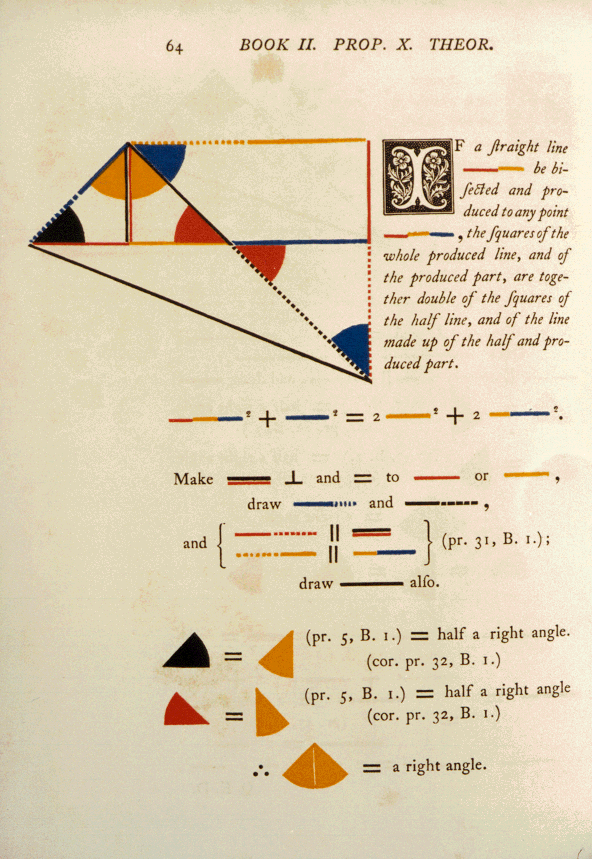
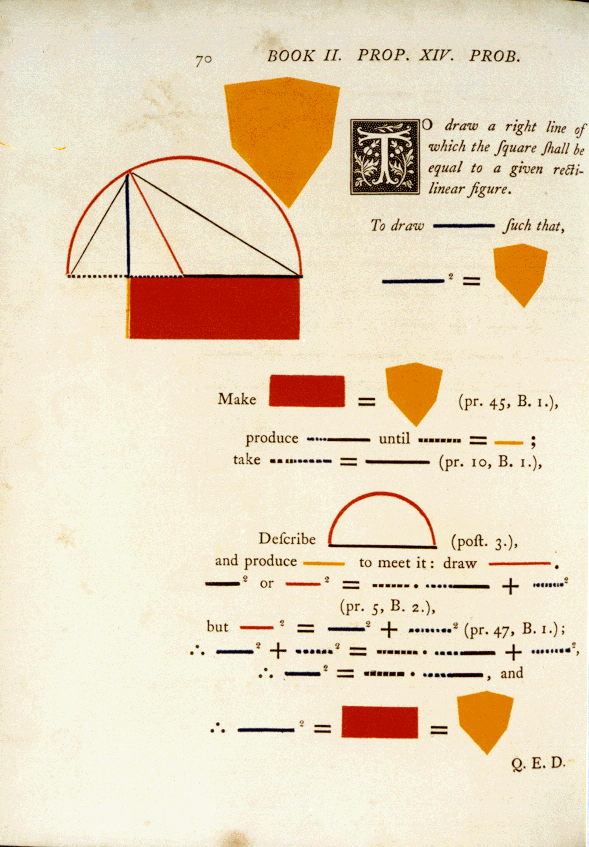
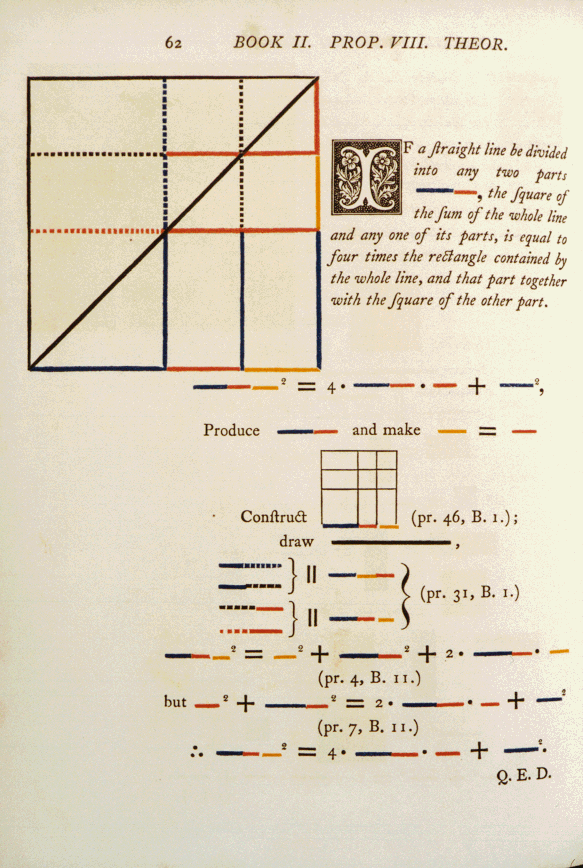
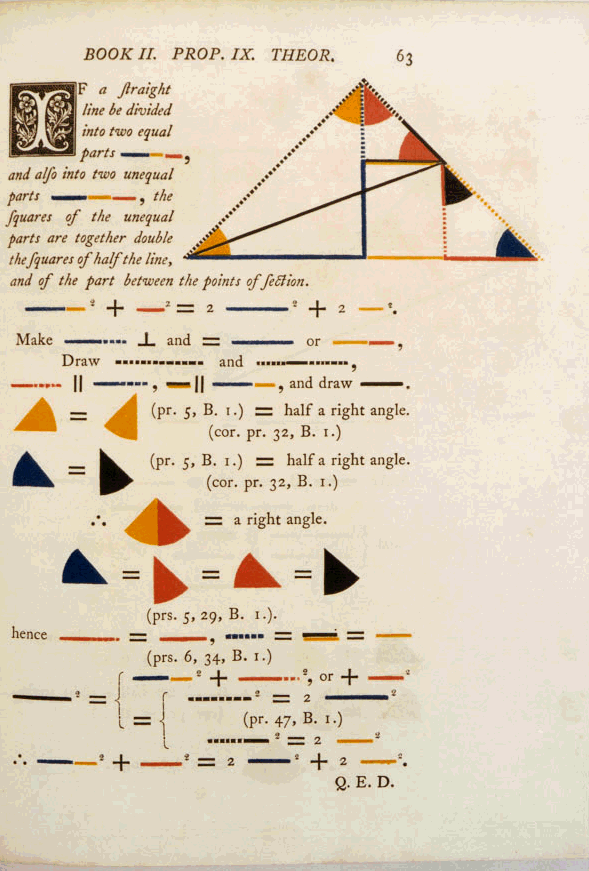
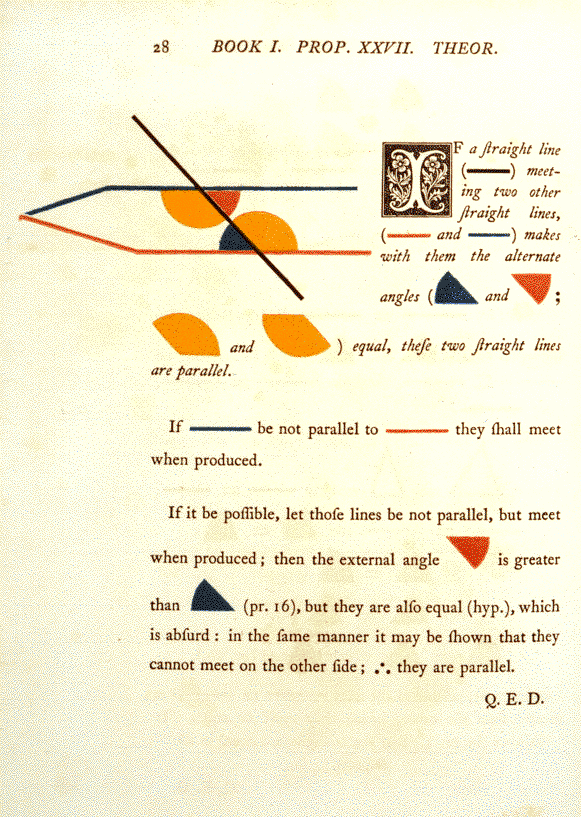
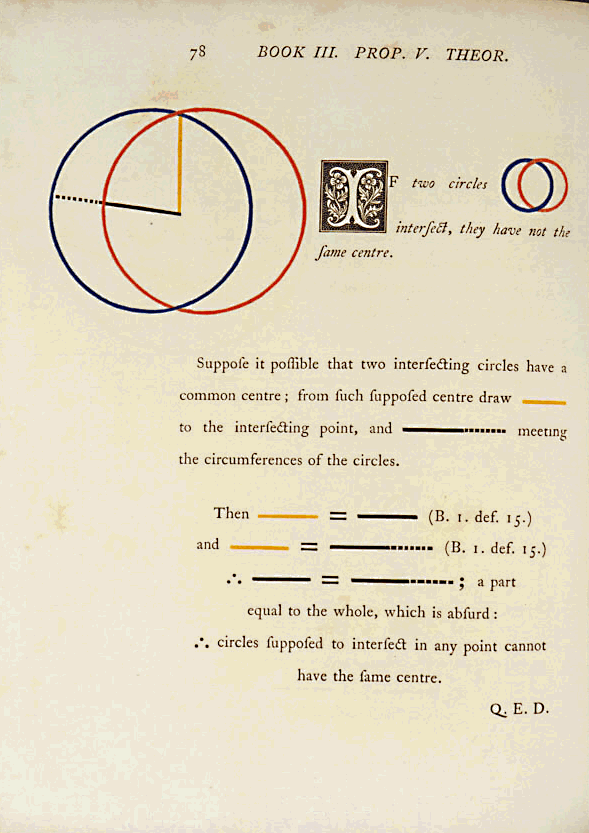
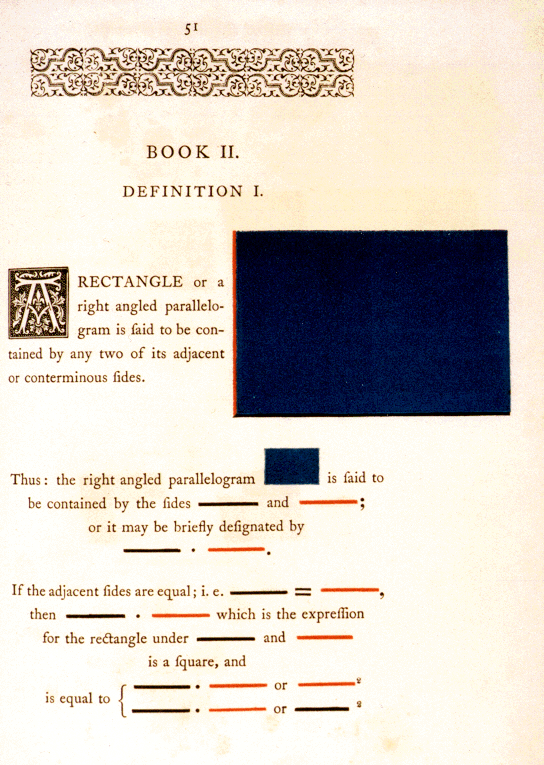
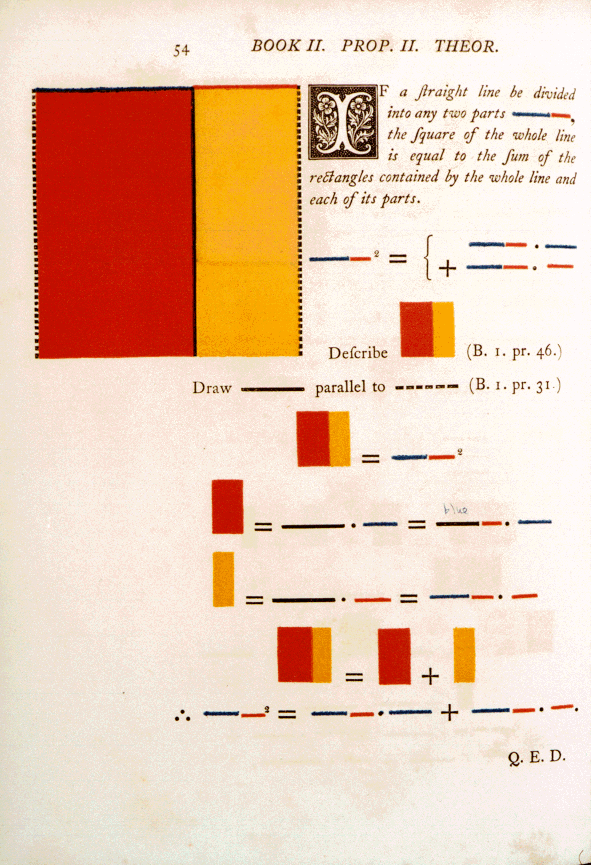
    Here’s a few more examples from Oliver Byrne’a unique attempt at transliterating the propositions of Euclid via color.  As I said in an earlier post  the attempt may not be a step in the right direction (and by “right” I mean “correct”) but it is, beyond doubt, beautiful–yet another example of Beautiful Wrongness.

    The entire work by Oliver Byrne’s may be found here

    Byrnews II.10

    Byrnes II.14

    Byrnes 11.8

    Byrnes II.9


    Bryne euclid i.27
     
    Byrne euclid iii.6

    Byrne euclid def


  • Balloon Bridges and 600-Foot-Long Airships, 1854

    JF Ptak Science Books  Post 335

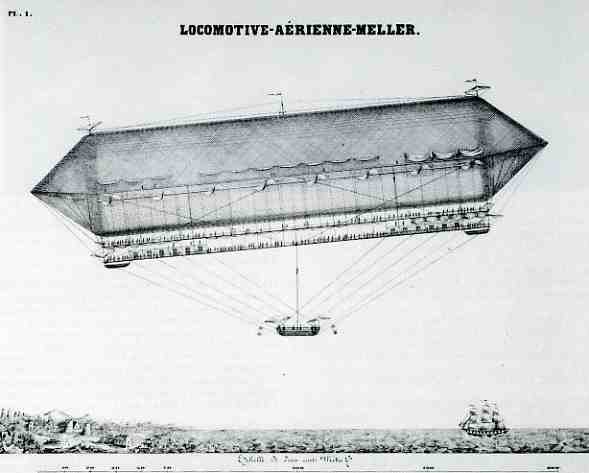
    00-blog-Oct 25 meller920Often
    the reproduction of a print for popular consumption just doesn’t come anywhere
    near expressing the flavor of the original. 
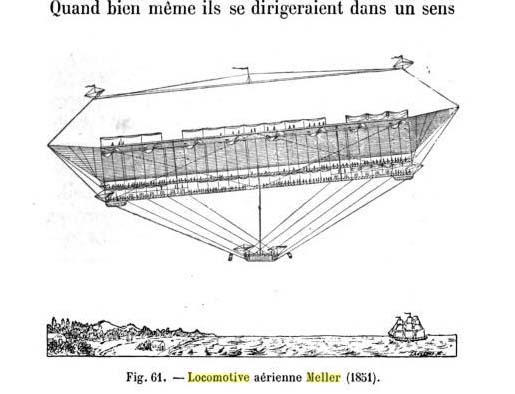
    This is definitely the case with Gaston Tissandier’s Bibliotheque des
    Merveilles la Navigation Aerienne, l’Aviation et la Direction des Aerostats

    (printed in

    Paris in 1886), in which enormity of Propser Meller’s (the younger) airship is
    almost entirely lost.  You do get the
    idea of the size of the ship, but “bigness” is a weak constant, especially when
    you look at the original print of the great ship, which turns that concept into
    a more flavorful enormity.

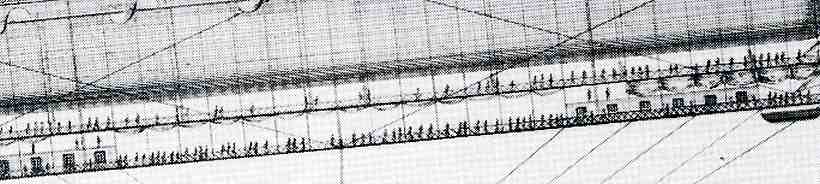
    The Meller balloon–according to the scale at the bottom of the image–would measure a truly spectacular 200 meters/650 feet or so, and when you zoom in on the detail of the people aboard the ship the size becomes overwhelming.  The print appears in Meller’s rare work Des Aerostats, NAvigation areieene, Chemin de fer aerostatique….printed in Bordeaux in 1851, and of course the ship was never built, but it did serve as an intellectual forerunner of the more modern zeppelin.

    00-meller balloon

    But the
    truth of the matter was that Meller was also very busy trying to figure out
    what balloons could actually do:  Planning
    600-foot-long airships (which would have been by far the longest vehicle of any
    sort ever built) is one thing, and one thing that was interesting but not
    terribly practicable in 1851; but he wrote elsewhere, in his   Phare aerostatique (1854) that balloons
    could definitely be employed more easily with lesser goals but greater
    utility.   For one thing a fixed balloon could be easily
    employed by the military of harbor control as a means for suspending artificial
    light sources.  More ingenious and
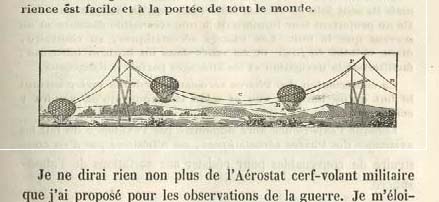
    eyebrow-raising was another idea for a balloon bridge, which would’ve guided
    balloons across unbridgeable waters, shore-to-shore.  It was certainly a bigger piece of thinking
    than a light source, but to me it sounds like a fairly plausible way of getting
    heavy loads and people across problematic bodies of water (and etc.) where
    bridges or boats would not work.  In any
    event it seemed doable; at least far more so than the giant airship

    As you can see, the miunutae detail of the original is lost in the
    reprint, and it is in the detail that the greatness of this airship can
    be found. .

    00-blog-Oct 25 meller det921


      The balloon bridge by Meller:

    00--meller bridge det


    Some other works by Meller:

    Projet de navigation aérienne  (Imprimerie de Pollet …, 1852)
    À la marine  (Typographie Plon frères, 1854)

    Phare aérostatique.Paris:
    Typographie Plon Frères, 1854.

    *From
    Chambers’ Edinburgh Journal,
    28 August 1852 describing his 600’ airship:

     Attempts are still being made towards aërial navigation. M.
    Prosper Meller, of Bordeaux,
    proposes to construct an aërial locomotive 200 mètres in length, 62 wide, and
    60 high, the form to be cylindrical, with cone-shaped ends, as best adapted for
    speed. The outer case is to be varnished leather, which is to be filled with
    gas, and to contain five spherical balloons. A net, which covers the whole, is
    to support sixteen helices by ropes, eight on each side; and to these two
    galleries are to be attached, one for the machinery, the other for passengers.
    The affair looks well on paper; but there is little risk in saying, that the
    days of flying machines are not yet come, neither is the scheme for aërial
    railways—a series of cables stretched from one high building to another—to be
    regarded as any more promising.  


  • The History of Aerial Bombing 2: Zeppelins Attacking London, 1915

    JF Ptak Science Books LLC  Post 334

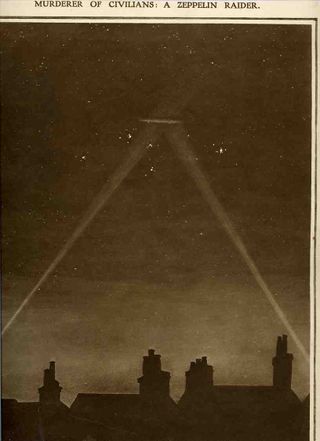
    Dropping bombs from flying machines had lost much of its newish noirness by 1915, even though the whole idea of the practical applications of  dropping explosives on people was only four years old. That sort of high explosive newness can be shed very quickly, given the immediacy of its action. But Londoners were outraged enough in 1915 to label the bombing of populated non-military targets as murder, as the title of this full-page print screams from the 23 October 1915 issue of The Illustrated London News in our second post on the history of aerial bombing.  The subtitle reads: “Like a thief in the Night:  One of the Fleet of Hostile Airships Which Raided this Country on October 13 Over the London Area—Shells from Anti-Aircraft Guns Bursting About It.”  It continues: “lives lost and damage done without the shadow of military excuse” is how it was quietly referred to in the text, the the subtle image is anything but–it is quiet, but it is also cold, and scary, the menacing zeppelin shown floating darkly deadly above the roofs and chimney tops of residential houses.  The point of the picture was crystal clear–the enemy was practicing something new, and that something new was directed at civilians, and that it could be crushing and deadly and a threat everywhere.

    00-blog-Oct 24--zepplin raider914


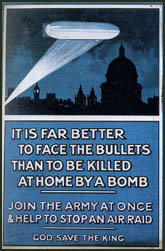
    The Zeppelins were new to war, having been first brought to development in 1900; by the beginning of the war, in 1914, the Germans had two operational airships that could reach an altitude of about 4500 feet and carry 4400 pounds of bombs.  Their first raid on England came on 31 May 1915 and within the year would kill 550 British citizens, though the costs to the Germans were so high (77 of 115 active Zeppelins would be either destroyed or damaged beyond repair by June 1917) that the air attacks would be suspended in July 1917.

    Blog--zeppelin

    ·Posted by :

    ·in: