A Daily History of Holes, Dots, Lines, Science, History, Math, Physics, Art, the Unintentional Absurd, Architecture, Maps, Data Visualization, Blank and Missing Things, and so on. |1.6 million words, 7500 images, 4.9 million hits| Press & appearances in The Times, Le Figaro, Mensa, The Economist, The Guardian, Discovery News, Slate, Le Monde, Sci American Blogs, Le Pont, and many other places… 5000+ total posts since 2008.

Author: JF Ptak

  • Hero’s Stairs to Nowhere: an Intolerably Small Look at a Great and Important Book

    JF Ptak Science Books LLC  Post 356

    000-ebay--Nov 1 heron978
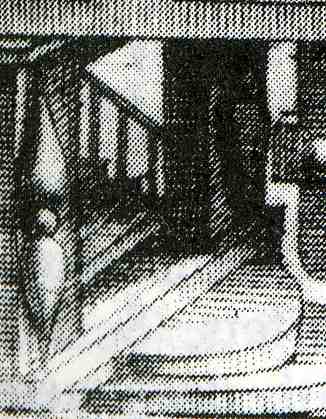
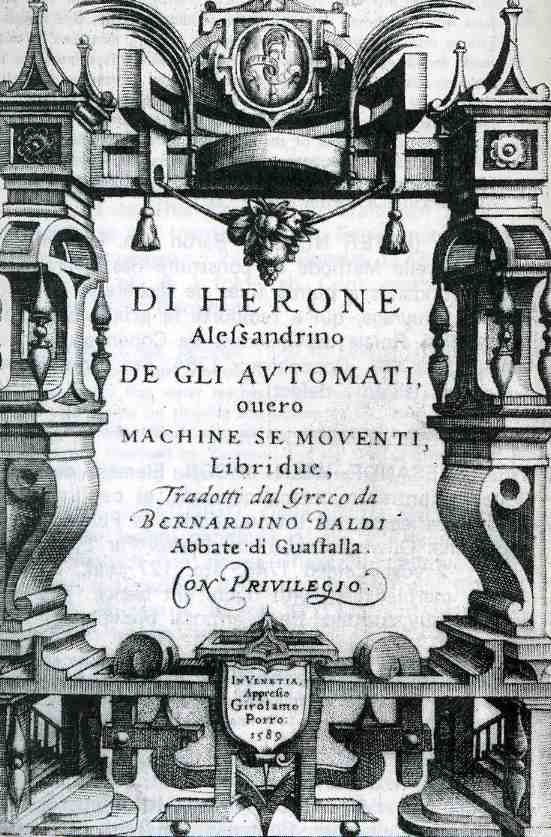
    And so here we have a gorgeous title page for the very first treatise on automata, and the thing I’m focusing on are the stairs in the bottom corners of the design, the stairs that go nowhere.  Maybe its just because of the seemingly flat effect of the perspective that they became so obvious to me, or the  subtle sense of a twisted two-and-a-half dimensions feel to it, the very Escher-y feel of complex, impossible and improbable dimensionality.  For example, the very pre-Baroque ornamentation of this very heavy title page construction seem to bounce between convex and concave, like the background and foreground change place somehow, as it the case of Escher’s trying to find a place between planes of two- and three-dimensional representation.  Although here I’m pretty sure the effect is unintentional; whereas in Escher, the effect is the aim of the art. 

    000-ebay--Nov 1 heron977

    The design and the printing of this large book was the work of the firm of Bernardino Baldi, of Venice, who published De gli avtomati oueri machine se moventi...in Venice in 1589, the original by Her/Heron of Alexandria, who lived ca. 10-70 ACE.   Hero was one of the most exalted of Greeks in the pantheon of ancient experimenters and scientists, an unparalleled inventor and producer of the earliest automatic and robotic devices. Have a look at  the illustrated link to Hero’s fabulous work called Penumatics (below).


  • Cartograms of the Obama Victory: What “Normal” Maps Don’t Show

    JF Ptak Science Books LLC  Post 355

    I woke up this morning feeling good for the first time in my life about the results of a presidential election here in the United States.  In my living memory, the characterizations of the occupiers of the big chair in the Oval Office have been less than fulfilling:  the ruined greatness of LBJ, the actual and interrupted possibility of evil of Richard Nixon, the tight-lipped raisin-eyed confusion of the deceptive Jerry Ford, the bittersweet and limited Jimmy Carter, the addled incompetence and intellectual insolence of master storyteller RWR, the bookmarked-thin-never-finished-book of Old School George Bush, the Falstaffian and could’ve-been-great-but-spoiled Bill Clinton (killed in the end by viciousness and republican lust), the unutterable and poisonous George Bush redux.  The people sent up to run against them have been less than illustrious in many cases:  Hubert Humphrey, Walt Mondale, John Kerry, Al Gore (though with Mr. Gore, known as “Al God” to the other kids at  National Cathedral , would’ve been  a better choice for the chair than George Bush; but then again, a warm stain would have been better too, so faint a praise is that…there is little doubt though that we’d have several trillion dollars more in the economy and wouldn’t have affected the lives of hundreds of thousands of American military families or “disrupted” the lives of millions of Iraqis.) But late last night, when Iowa went to Obama, I felt the possibility of pride and probability of accomplishment creeping into even my cynical soul-shadow.  I also have little doubt that a man of this calibre surrounded by a forceful whirlwind of readiness will also be able to attract excellent minds to the administration–something I think that was sorely lacking (for the greatest part) in the last administrations. I know absolutely that everyone else in the world was ready for Obama; I’m glad that the United States followed suit. 

    And how big a win was this?  How many people supported the Obama ticket? 

    A simple map showing results of voting by state doesn’t tell that much of the story:

    000--election--simple state map

    000-Nov 5 part 2Looks very red to me. 

    However, when you use an electoral college cartogram (a map with a thematic variable, where the area of the map is representing something other than simple geography and a place on the globe) to display the same results the visual representation of the same data changes dramatically, we you can see (and this image can be clicked for a more detailed view):

    (The following image is from the interesting and clearly written website of Mark Newman, Department
    of Physics and Center for the Study of Complex Systems, University of
    Michigan.  He also has published a “real world” atlas of cartograms that more vigorously display quantitative information–outside of an atlas of imaginary places, this is exactly the sort of book that should be present in every classroom in the United States. ) The population cartogram from Newman’s website offers another interesting aspect of the election results, depicting a solid but relatively thin control of much of the South (inexplicably and stupidly referred to over and over again by the pundits on CNN as “the Confederacy” (!?)), along with a stubborn reed of red that extends from the northern to southern border and which pretty much follows the cattle trail of the Hat Creek Outfit from the Great American Novel Lonesome Dove (by Larry McMurtry, which is also to a lesser degree the path of the Goodnight-Loving Trail.                                                                                                      

    000-statepopredblue512

    The net result, I think, is that the Obama victory was decisive, and has a huge tailwind, a mountain of support.  It seems that there is very little doubt that the people of this country were ready for something very different than what has been here for eight long years.


  • Information Bombs: Dropping Stuff from Airplanes, 1911 & 1929

    JF Ptak Science Books LLC  Post 354

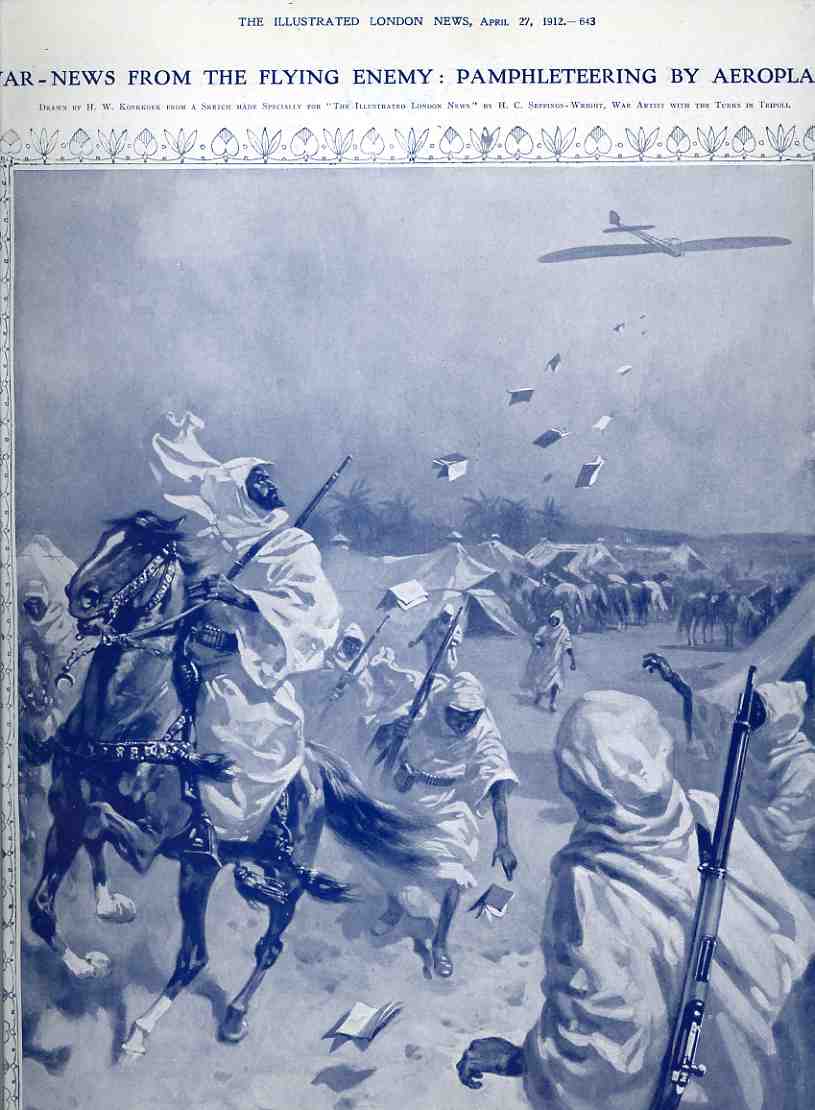
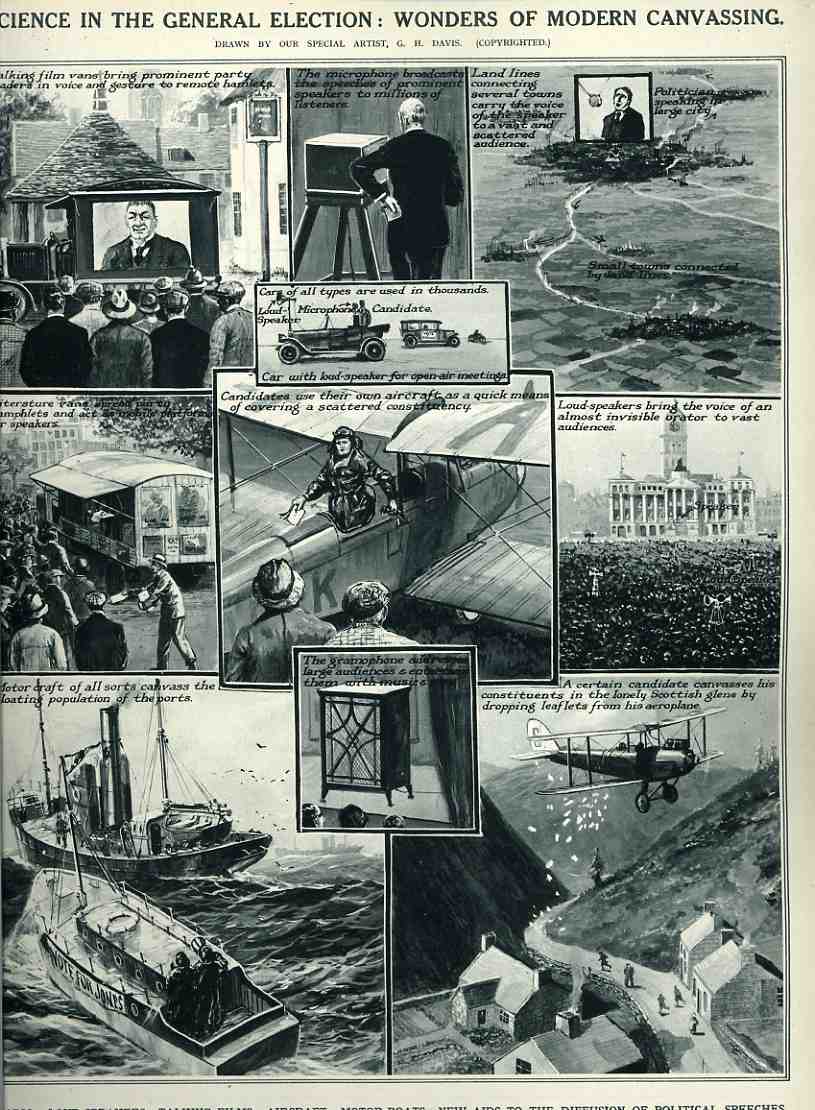
    000-ebay--Nov 1 bombing pamhlets971The “information bomb” as an idea is old, but as technology quickened over the centuries so has this particular bomb–it has gotten bigger, larger, more potent, more disasterously visible and more subtle (sometimes at the same time).  Impossibly more effective than could’ve been imagined when these two prints (below) were published; impossible to the best and most creative storytellers. It is interesting to think about how information was released quickly in points in the past, and what that form looked like; and of course what situation perpetuated the release, or “bombing”.

    But for right now I’d like to look at two situations of information bombs that were quite literally so.

    I’ve written about  Sven Lindqvist’s History of Bombing

    (published 2000) earlier in this blog, and in it he points to this image as being about the earliest use of the airplane to drop anything at all on its enemies.  In this case it happens to be pamphlets, although the bombs were soon to follow, particularly against brown-skinned people, in 1911 and 1912.  The first image is entitled “War-News from the Flying Enemy; Pamphleteering by Aeroplane–Cirularizing his enemy’s foes; an Italian Airman, who announced that Beirut had been bombarded, dropping political pamphlets to the Turks and their Arab Allies…” and appeared in The Illustrated London News for 27 April 1912.  The Italians waged a nasty war against the Turks, taking to bombing soldiers and civilians alike across all of northern Africa, setting themselves some nasty first-time records for killing civilians from the air.  In this instance, though, the airplane was dropping propaganda, trying to force the resisting Arab allies (in Tripoli) to surrender as Beirut had been bombed.  the pamphlets didn’t do the job; they were soon followed by exclamatory explosives. 

    000-ebay--Nov 1 bombing pamhlets973

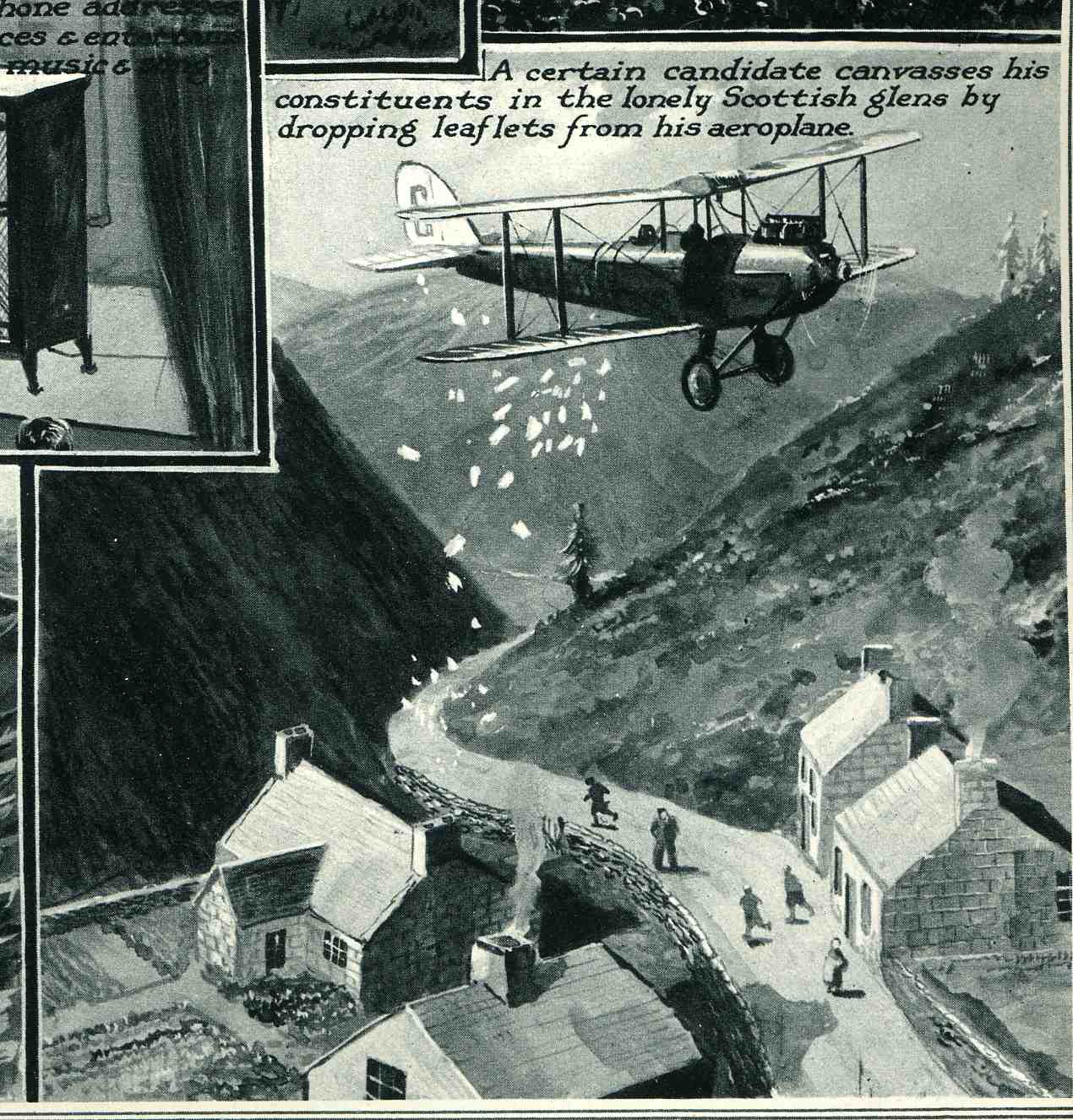
    The second image is an expansion of the first, without the explosive bit.  This one too comes from The Illustrated London News,
    25 May, 1929 (page 895),
    and was entitled “Science in the General Election; Wonders of Modern
    Canvassing” for the British election series in the spring of 1929.  The
    information bomb at that point also took the forms of “radio,
    loud-speakers, talking films; aircraft; motor boats, and the new aids
    to the diffusion of political speeches”, and that included canvassing
    constituents from the air by dropping pamphlets from an aircraft.

    In general though this would be about the limit of bombing people with information, except of course for dropping surrender tickets and propaganda leaflets on fighting forces during WWII. 

    000-ebay--Nov 1 bombing pamhlets972


  • Van Gogh’s People-Absent Portraits: the Empty/Blank Series, continued, part 13

    JF Ptak Science Books LLC  Post 350

    Blog--empty--vincent chair
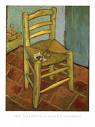
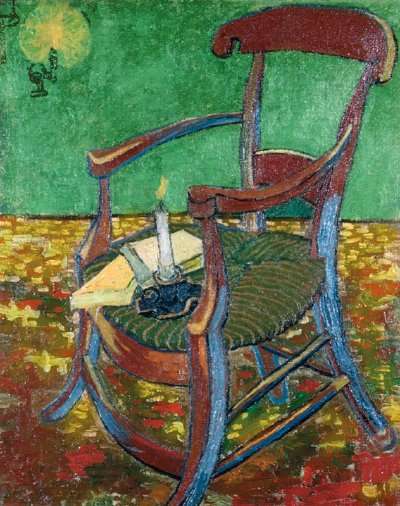
    Still another part of the developing theme of empty/vacant people/places is this consideration of Vincent van Gogh’s portraits of absent people–that is, his paintings of famously “empty” chairs that he executed in the middle of December 1888 that were more portraits of the people that they belonged to rather than images of the chairs themselves.  Vincent actually described these chairs as “empty” in his wonderful letters (this one from February 1890) to his brother Theo, “one of an empty armchair, (actually Gauguin’s chair)”.  He described the painting as an effort to represent Gauguin’s “empty place”:  “this is a study of his armchair in dark brown-red wood, the seat greenish rush, and in the place of the absent a lighted candle and modern novels”.  Blog--empty--vincent gauguin

    The quotation marks around his “empty space” were in the original and quite purposeful.  Gauguin would leave Vincent at about the time Vincent went to the hospital (committed to the hospital, that is) for one of his “spells”; the painting though was made before Gauguin actually left.  Whether this is because he, Gauguin, removed himself or because he faded away only in Vincent’s disturbed brain is just not known to me. 

    The emptiness is a replacement for the men who weren’t in their chairs–Vincent not in his simple/peasant chair, and Gauguin not in his darkish fancy chair. There are symbols galore and sailing away in both images, and much has been written on them (see for example H.R. Graetz The Symbolic Language of Vincent Van Gogh (McGraw Hill, 1963) so I won’t address them here.  I was primarily interested in these two images for the different sort of emptiness that they represented–paintings of subjects that weren’t there. 


  • Visual Display of Quantitative Data: German Losses in the Battle of Britain

    JF Ptak Science Books Post 346  (This continues a thread on The Battle of Britain and also a post on “What 185,000 Planes Looks Like”). 

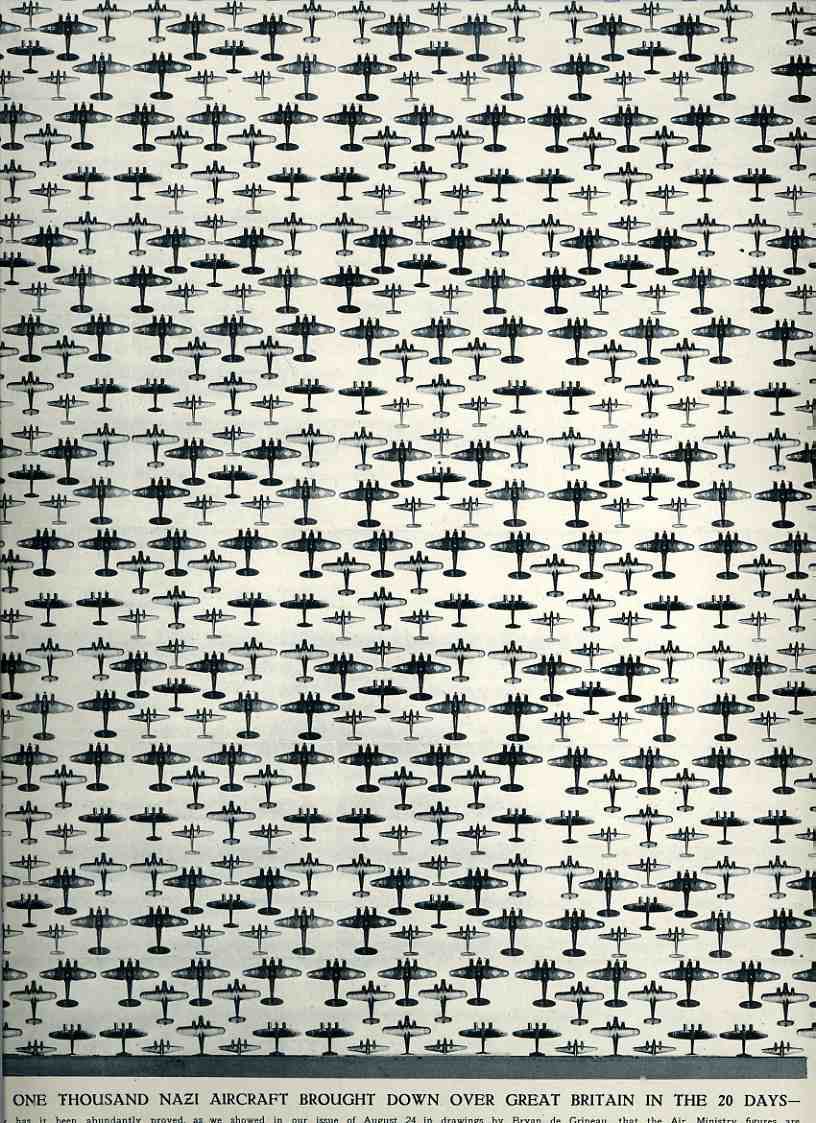
    This tremendous display is half of a double-page spread that appeared in The Illustrated London News for 7 September 1940.  It was meant to bolster the civilian population of Britain during the time of the German attacks, stating that “Over one thousand Nazi aircraft (were) brought down over Great Britain in …20 Days…” The artwork, drawn by Bryan de Grineau, actually depicts 1000 planes, and accurately-depicted ones at that.   What the graphic doesn’t tally though are the airmen losses, which would be considerably more than the 1000 aircraft:  for example, of the aircraft involved in the sustain air-invasion of England, the  Dornier 215’s had a crew of four, Dornier 17’s three, Heinkel 111’s four, Messerschmitt 110’s two, and Junkers 88’s three.  Thus  there were thousands more airmen lost, a commodity that the Nazis could little afford, more so as time went on.  
    00-blog--Oct 29 battle britain Nazi planes952 The results of the battle (and if you take a look at this earlier post for the full narrative), in terms of aircraft and humans,
    were,  for England: 1,023 fighters, 376 bombers, 148 coastal command aircraft  for a total of 1,547 aircraft and  544 pilots and aircrew killed.  During this time there were 27,450
    civilians killed and 32,138 wounded.  The Nazis lost 873 fighters and 1,014
    bombers for a total of 1,887 aircraft, with  2,500 aircrew killed.

    I find this visual display of quantitative data beautiful and compelling–and overwhelming in its way.

    The Battle of Britain was fought primarily from 10 July to 31 October 1940, so by the time this image was published the Brits had been able to withstand the tide of Hitler’s plans.  (The air strikes wouldn’t really end until the Nazis turned their attention to the Soviet Union in Operation Barbarossa in May 1941.)  One of those plans, named Luftschlacht um England, was to overtake and destroy the British capacity in the air, for as long as the English had command of the airspace there would be no way that the Nazis could force an invasion by sea/land (at least in the minds of the Oberkommando der Wehrmacht and Hitler.  With no air cover Britannia’s rule of the waves could be much more effectively challenged; and should that occur, what was seen as a not very probable invasion of Great Britain by a not very substantial Nazi naval force/transports might actually come to being. 

    This was a victory for HMG, though the rising tide for the Nazis would continue to do so through about November 1942, when after integral victories had been had that Churchill could declare at the Mayor’s Luncheon (10 November 1942): “Now this is not the end. It is not even the beginning of the end. but it is, perhaps, the end of the beginning”. 


  • The Poetics of STDs and the Mountain of Truth; a Rollicking Good Time in 1545

    JF Ptak Science Books  Post 348

    Mountain of truth

    The progress of man/humankind has, in our dim antiquarian past, been represented in art in stages of ascending a mountain.  The fine arts and sciences have been shown, in their various intellectual pedigrees, at various points on the mountain of the mind, usually with Philosophia sitting supremely at the top (with Astronomia and Mathematica generally not far underneath). This is mind, I came across another sort of progression to the Olympian heights, though it has no people in it, just the mountain, and a curious idea, ascending to faith, or truth. 

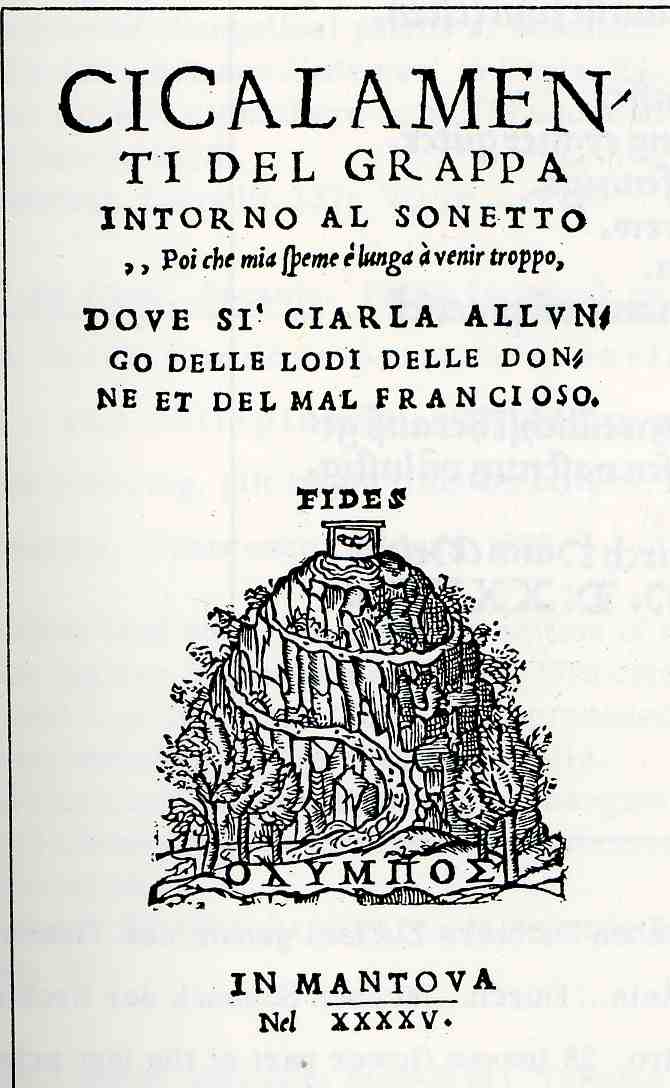
    The image is on the title page of a curious, little, early work by the pseudonymous  “Grappa” (well-named for the drink), Cicalamenti de Grapps intorno  al Sonetto…though its real nature is revealed in the subtitle,“dove si’ Cliarala allungo delle lodi delle donne et del mal francioso”, or “where one chats at length about women with The French [venereal] Disease”.  It is also dedicated to a non-existent courtesan who was heralded as being lovely, generous, and deep in the seat of this same disease.  Indeedy! This ribald, blustery, frank, coarse innuendo-laced tract (28 leaves long) was not terribly unusual when it was printed in 1545, celebrating as it does the low- and high-cultural private life of Renaissance Italy.  Doctors, poets, gluttons, cheats and of course lots of beautiful women romp around ostensibly in an attempt to prove the usefulness of their sinful vices, relating it all somehow to the disease-improved poetic capacities of the STD-bestowed Petrarch, master of forlorn and unrequited love poetry and the father of Humanism  (It relates in a way that I can’t explain to Petrarch’s Canzoniere, sonnet #88, mostly written, I think, about a  girl/woman that he fell in love with in church, which is why we can see he needed to invent Humanism. He seems to say that the needs of love are strong, stronger than he could stand, evidently, and that one should flee, renounce it; he seems to for himself, the girl across the pew or across the great open space in the cathedral never weakening to him a bit.  He pines over her, and announces his own amoroso intoppo, or “amorous fumblings”, and would take flight from himself as well. Evidently the people in this work by Grappa do not take his warnings to heart, though they do seem to renounce the “love” part but not the “sex” part. I could be really wrong on this god knows; all I wanted to do was look at the pretty picture on the cover!)

    Stumbling into things like this  makes you remember that the Renaissance wasn’t all stuffy and main-springy; perspective-this and techno-that; they had their fun, too, even in 1545, and put it into print.

    Back to the woodcut on the title page: it features a small, winding route up a mountain, the top of which is sanctified “fide”.  Now considering what these folks were doing in this work I wouldn’t necessarily christen the end of the adventure with this word, particularly if it meant (as it does) the name of the World Chess Federation (FIDE).  Seriously though fide means “faith”, as in bona fide (on good faith, by good authority), as opposed to mal fide (bad faith).  I cannot determine what in the world the structure is on the top of the mountain, or what is in it. 


  • There was a Rubber Lady in a Rubber Kitchen in a Rubber House….

    JF Ptak Science Books LLC Post 347
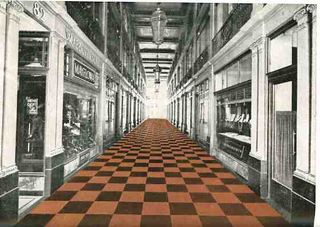
                                                                                                               
    000-ebay--Oct 30 rubber floor965

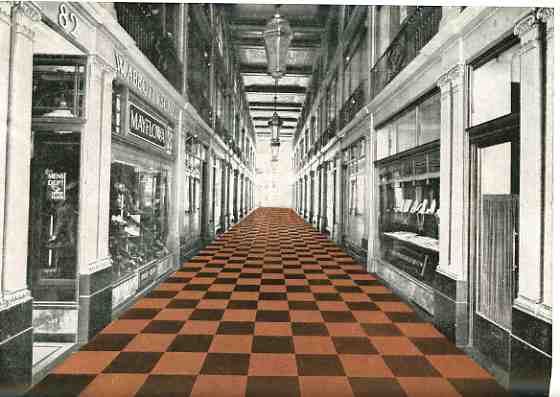
    After 15 or 20 centuries of development of rubber, including merciless horrors and peonage and slavery and brothel farms and whore cities in the depths of the Amazon, and it’s the spread of its development worldwide, who among the hundreds of thousands, millions, of people would’ve foreseen the development of their precious commodity into a rubber kitchen?  Perhaps it is sort of like imagining Johnny von Neumann or Chuck Babbage reacting to the use of their precious inventions into a platform for entertaining children with judged performances of stealing cars and killing aliens? 
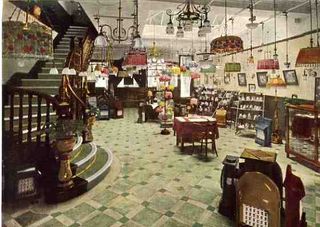
    000-ebay--Oct 30 rubber floor966

    Those feelings, I guess, are unknowable, though the gentle people in
    those folks might’ve given it all a “of course”, world-weary nod of
    relinquishing approval.  Or not.

    But right before the mass of rubber was produced synthetically, and
    just as the naturally-produced rubber farms had spread far across the
    globe 9and diminishing the former leader Brazil’s share of total output
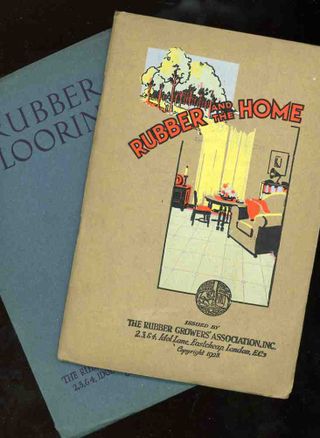
    to about 15%, the London-based Rubber Growers association produced
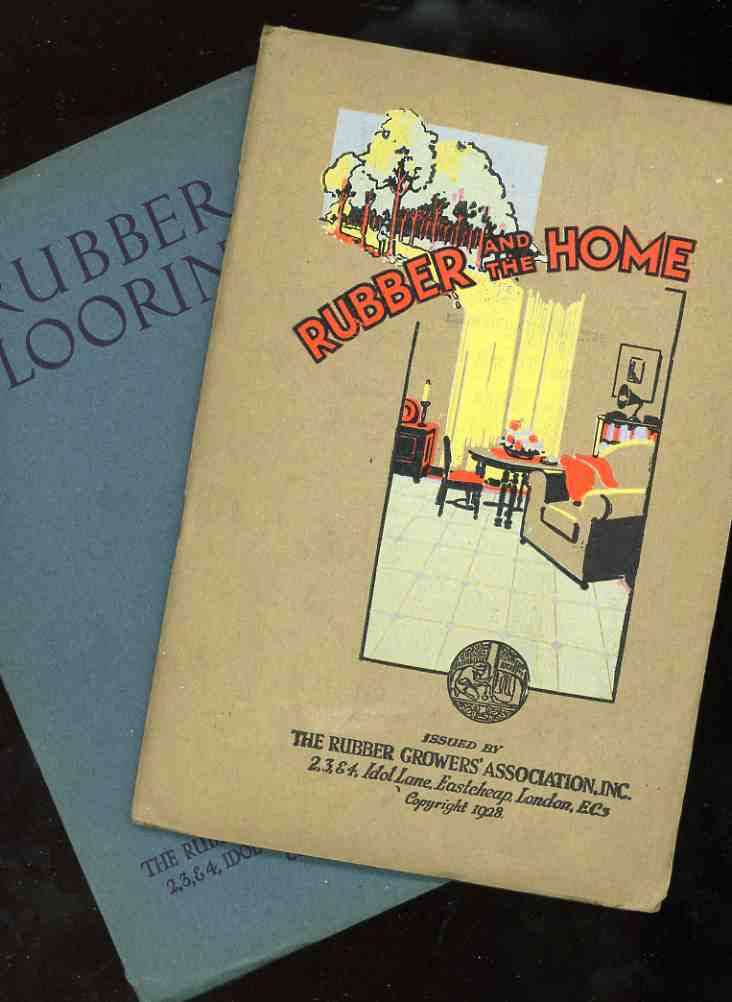
    these two (below) pamphlets extolling the endless uses of their
    product.  And I really mean ‘endless”, as they propose in these pages
    oh-my-rubbery-brothers the rubber house.  Not that the exterior of the
    house is made of rubber, but just about everything inside was.
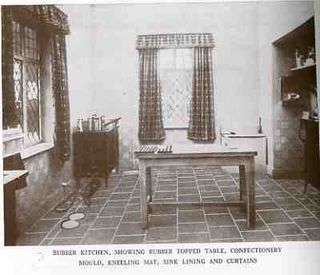
                                                                                                               

    000-ebay--Oct 30 rubber kitchen968

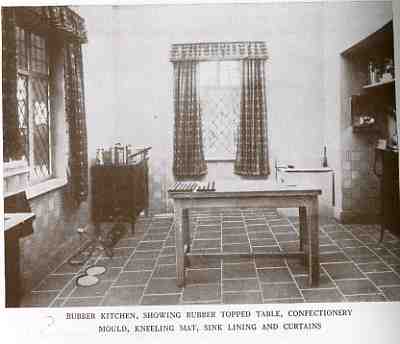
    The rubber house had rubber floors, and rubber floors cushioned rubber
    tables and chairs, and the rubber chairs cushioned rubber seat pads,
    and the rubber seat pads cushioned (yes) rubberized derriere’s encased
    in rubber pants. And then things spin a little out of control, like in
    the kitchen, where the floor, table top, confectionary mould, kneeling
    mat, sink lining, hardware cushions and curtains (!) were made or
    rubber.  (This is only the big-item list, which doesn’t bother with the
    rubber hoses, anti-splash nozzles, wringer rollers, ice cube trays,
    sink cozies, rubber sponges (!), brushes, mitts, teapot stands, and the
    myriad of small, loseable kitchen aids—those are on another list. The
    kitchen apron, by the way, is just one of many rubber clothing items,
    “made so pretty and delicious that it is a delight to wear”.)  Rubber
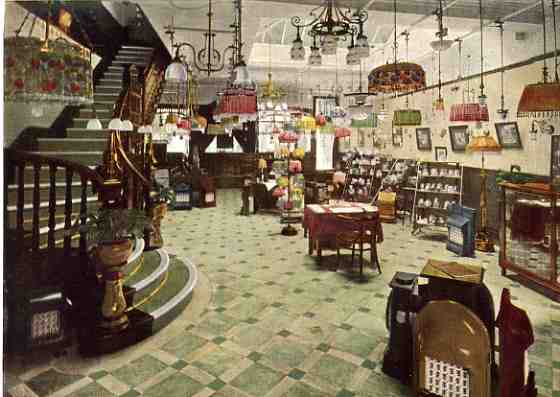
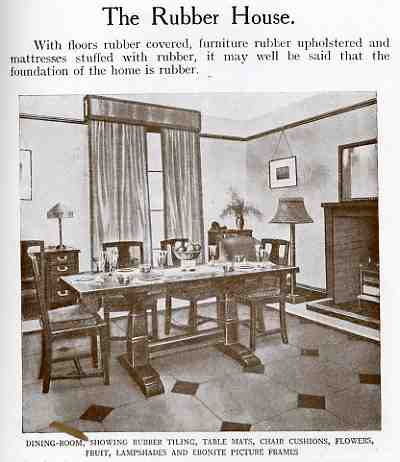
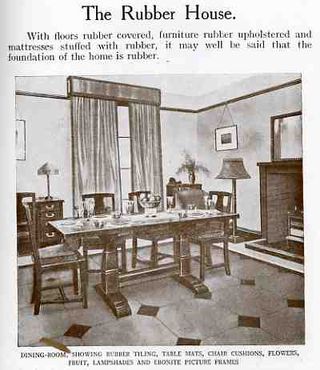
    moves into the dining room in a big way, covering the floor, table top,
    seat covers (with cushions stuffed with rubber), lampshades, flowers,
    fruit “ebonite picture frames”, drawer pulls, fireplace implement rests
    (?), bulb bowls, egg cups and so on.  The nursery has the same sorts of
    items, with the addition of wall paneling, extra cushioning around the
    rubber crib, mattress and mattress stuffing, and, of course the toys.                                                                                              
    000-ebay--Oct 30 rubber dining room969

    And so the wish of the Rubber Growers’ rubber house is stated and soon
    passes into history, along with the stainless steel house, the elevator
    house, the wind-driven house, the house-on-wheels, and the rest.  I
    think I reached my limit pretty early on with this, but definitely
    passed the point of no return with the “chic variety” of rubber hats
    for ladies to match their “dainty rubber parasols”.
    000-ebay--Oct 30 rubber964


  • UPDATE: Dropping Boxes Filled With Soldiers: a Bad Technical Idea but a Great Strategic One, 1950

    JF Ptak Science Books LLC  (added content to Post for 15 September)

    00-blog--Oct 29 dropping soldiers954
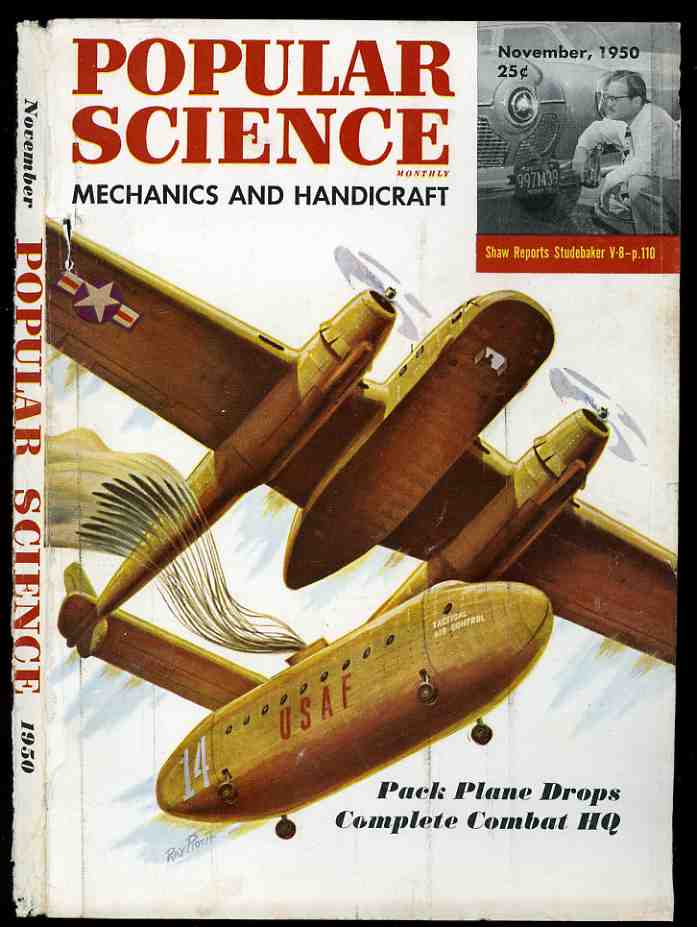
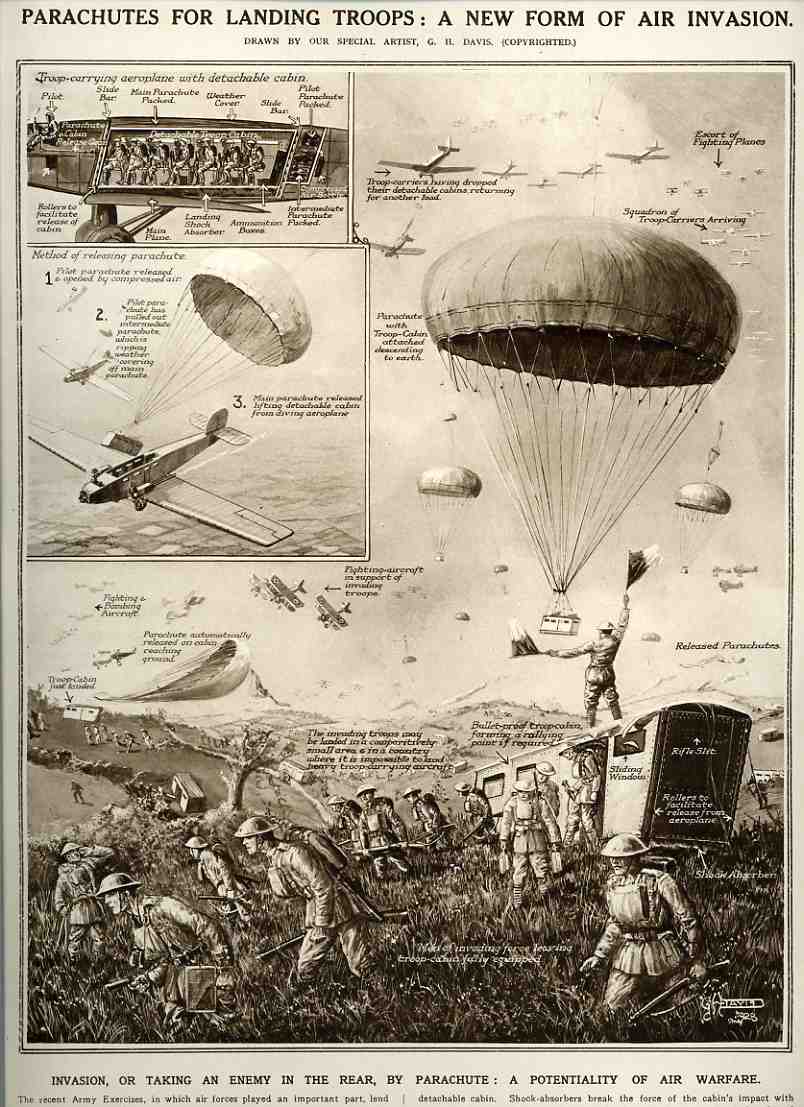
    I happened on this image from the front cover of Popular Science for November 1950 and recognized the idea instantly.  I posted on an earlier version of this idea from 1928 and placed it firmly in the BAD IDEAS Department of this blog.  The update from 1950 is a little improved, but, well, not by that much.  At least this canister leaves the clutches of the plane safely, though from the look of things it seems as though it might not want to land very nicely. 

    Blog-1-sept 15paratrooper553

    ·Posted by :

    ·in:

    — —

  • The Famous Painting of the Tulip Who Stopped Rembrandt’s Bones from Turning Into Jelly

    JF Ptak Science Books LLC  Post 345

    Blog--tulp rembrandt
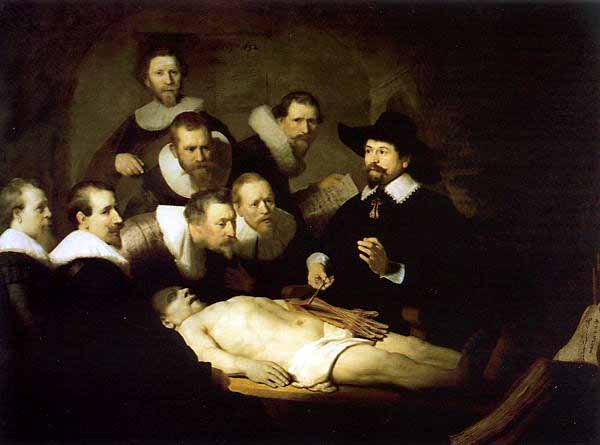
    This ungainly title is actually a true statement–even the Tulip “who” rather than “which” part. Rembrandt did suffer from some sort of mental suggestion/annoyance which convinced him that his bones were turning into jelly. (Weird happens: Kurt Goedel thought that he was being poisoned through his food and finally through water.) His symptoms were addressed, and treated (I guess), by the Amsterdam physician Nicolaas Tulp (1593-1674), who saved Rembrandt from himself.

    Tulp, which means “tulip” in Dutch, was born Claes Pieterzoon, and was a Leyden-education physician who established a very respected and large practice in Amsterdam.
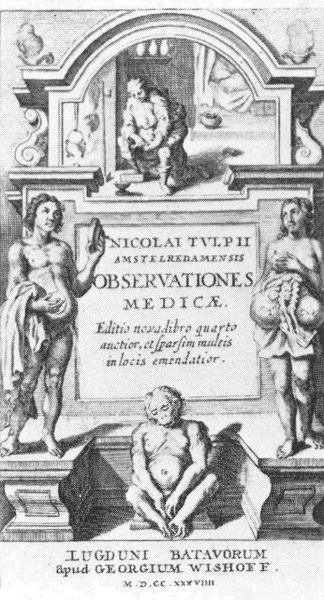
    He was additionally very interested in pathological anatomy, and in an early-CSI vein he frequently corresponded his diagnoses through postmortem dissection. In addition to his several published works is his magnum opus, Nicolai Tulpii Amstelredamensis Observationum medicarum libri tres.Cum aeneis figuris (Amsterdam, apud Ludovicum Elzevirium Elzevier, 1641), which contains much of medical interest (including what seems to be a description of diphtheria, a description of a bronchial cast, the description and illustration of the ileocecal valve and kidney stones, and a tapeworm, and the earliest European description of berberi  (see Major’s  Classic Description of Disease)). Additionally he takes on the ideas of monsters, describes a narwhal, and makes the first illustration of a chimpanzee (called an “ouirang atong”) in Europe.

    But he most famously survives all this by being the focus, the central figure, the catcher of light, in Rembrandt’s painting “The Anatomy Lesson”, which is really called “The Anatomy Lesson of Dr. Tulp”, which was painted in 1632. (I wonder how Dr. Tulp lived with this painting in his life for 42 years? ) In any event, it was he who evidently rescued Rembrandt from his dark place, or migraine, or depression—or at least he suggested how he could live his life with whatever he had in his head. 
    Tulp’s portrait appears in the frontis to each of his works, but certainly there would be almost no shock of recognition in them; on the other hand, with the Rembrandt, almost everyone recognizes the scene,  though very few would now who Dr. Tulp was and what service he performed to the art world.Rembrandt_anatomy_lesson_dr_tulp

    NOTE:
    In one of his very many remarkable letters, Vincent Van Gogh writes to his brother Theo in October 1885 about this painting, offering an insight on color: “Rembrandt’s “Lesson in Anatomy,” yes, I was absolutely staggered by that too. Do you remember those flesh colors – it is – de la terre – especially the feet….You know, Frans Hals’s flesh colours are also earthy, used here in the sense that you know…”

    Check out the website that annotates and includes illustrations of all of the works that Vincent references in his letters—his breadth was really astonishing, as is his memory, and of course his immense appreciation of color—and light– in general.


  • 100,000 People at the Dempsey-Carpentier Fight, 1921: a Remarkable Photograph

    JF Ptak Science Books LLC  Post 344

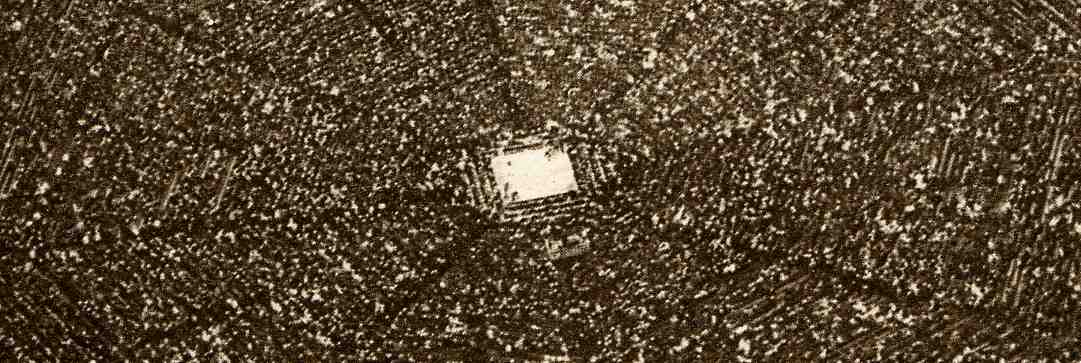
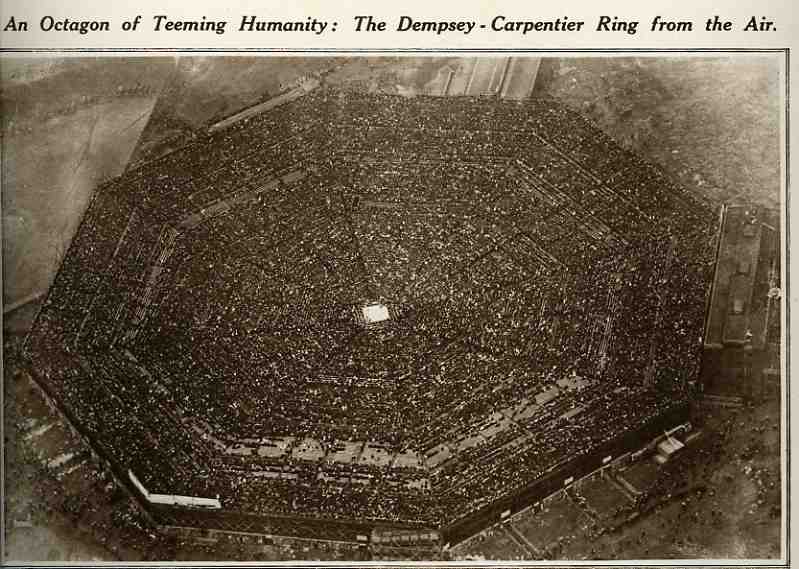
    This was a remarkable photograph for the information it presented when it was published in The Illustrated London News on 30 July 1921. That’s a real sea of humanity surrounding the canvas ring, and probably the largest crowd ever assembled in Jersey City.

    00-blog--Oct 28 dempsey fight949

    The image was made by a photographer for The New York Times from an airplane about 2,000 feet over the arena.

    00-blog--Oct 28 dempsey fight948 The fight between the two men was billed as “The Fight of the Century”, and it was, up until that time.  It was probably the event that was most-listened to than any other event in history, the early radio broadcast of the fight reaching at least 300,000.  But since there were so many mass venues listening to the fight–or watching its progress via displayed messages transcribed from the radio broadcast–it is really pretty impossible to say how many followed the event on that day. 

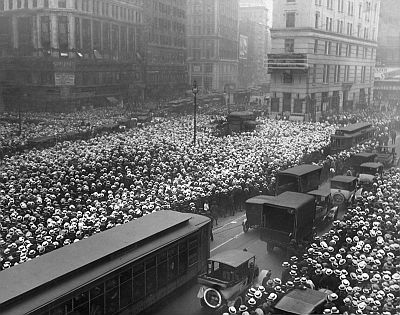
    (The image below shows a very large crowd of approximately 10,000 in Times Square waiting for the returns f the fight.)  

    1921-dempsey-carp-5-50