A Daily History of Holes, Dots, Lines, Science, History, Math, Physics, Art, the Unintentional Absurd, Architecture, Maps, Data Visualization, Blank and Missing Things, and so on. |1.6 million words, 7500 images, 4.9 million hits| Press & appearances in The Times, Le Figaro, Mensa, The Economist, The Guardian, Discovery News, Slate, Le Monde, Sci American Blogs, Le Pont, and many other places… 5000+ total posts since 2008.

Author: JF Ptak

  • Naming Things: Re-naming the Badly Named

    JF Ptak Science Books   Post 321

    Among the Ash-Heaps and Millionaires (some of the attempts at a title for what became The Great Gatsby) of novel titles great and small, I offer the following modest list of attempts at titles and what became the real title of the book.  Can you guess if the proposed title (in parentheses) is real or just a bad attempt at humor? (Hint:  they’re all real–not much of a quiz, is it?)  This is a follow up on the Marianne Moore/Edsel/Standard Model Naming Things post from yesterday, though this more about re-naming–in most of these cases though it is more like anti-naming, as the proposals for some of these titles are just so painfully bad.  I think that we can all be thankful that the editors, or the author, finally made a more correct decision on the titling of the work at hand.  

    (Naked Lust)
    Naked Lunch

    (Tomorrow is Another Day)
    Gone with the Wind

    (Army Post)
    Reflections in a Golden Eye

    (The High-Bouncing Lover)
    The Great Gatsby

    (The Exorcism)
    Who’s Afraid of Virginia Woolf

    (Something that Happened)
    Of Mice and Men

    (The Iron-Bound Bucket)
    Mr. Roberts

    (The Drunkards)
    Tender is the Night 

    (The Education of a Personage)
    This Side of  Paradise

    (The Inside of His Head)
    Death of a Salesman

    (O Lost)
    Look Homeward Angel
    (*Actually his bones are only about 1000 feet from we’re I’m writing)

    (Catch-18)
    Catch-22


    ·Posted by :

    ·in:


  • Naming Things; Names Good and Bad

    History of humans may boil all the way down to the history of
    naming things. Sometimes the naming is good, sometimes not. Moby-Dick sounds a
    whole lot better than The Whale; Ulysses and The Odyssey are not really
    inspired titles for fantastic books, nor is The Heart is a Lonely Hunter, or The
    Recongitions
    for that matter. The Bible doesn’t say much about the book, and
    Love in the Time of the Cholera does; why You Should Refrigerate Food does tell
    you what’s inside a basically empty book, and Catch-22 does not.

    Standard_model_chart

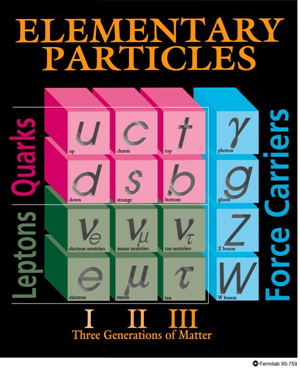
    The Standard Model (with quantum chromodynamics folded into
    it)  is a very bad name for something
    that describes the world of elementary particle physics;  Democritus’ “atom” has stood the test of 24
    centuries and is pretty, while muon (god help it) will survive by sheer fits of
    agony.  QED and ACD are good initials for
    big things, but big things like giant laboratories tend to have pretty bad acronymic
    names (SLC, CERN, DESY). 

    I just wrote a post about the creation of the binomial
    naming grid of Linnaeus, which was one of the greatest naming inventions of all
    time—it performs an organizing principle that created other organizing
    principles. 

    Sometimes the names of things outlive their usefulness, and
    come full circle, sometimes providing an unintended and ironic reminder of untimely
    pasts.  In

    India there’s   Lodhi Road,
    Mughal Gardens
    and Aurangabamnd; we have our own in this country in places like the Jefferson-Lee
    highway and Fort Myer’s
    (Virginia)
    Mosby Gate.

    The massiveness of this idea is just overwhelming—all I
    really want to do here is get to the naming of a Ford Motor car.  And the namer, in this case, was the poet
    Marianne Moore.  (I’ve always liked her,
    and her poetry, and her love for Mickey Mantle and baseball and Muhammad Ali
    and so on)  Ford found itself a little behind
    the times back there in the autumn of 1955, trying to figure out a new,
    with-it, tiger-whipping name for its new $250 million dollar car from their
    Special Products Division  They had
    something like “Firebird” in mind—unfortunately for them the name was already
    taken.  David Wallace, the head of Ford,
    wanted something elegant and fleet, and to that end contracted with the great
    poet Ms. Moore to come up with one.

     Marianne_moore

    Ms. Moore had a dry sense of humor and did submit a number
    of entries, though none were successful, and probably none were intended to
    be.    After looking at sketches and drawings of the
    new car, she came up with “The Ford Silver Sword” almost right away (named
    after a flower she said that grew only on Mt. Haleakala
    above 10,000 feet or some such thing).  She then submitted a
    number of others  including the “Patelogram”,
    the “Mongoose Civique”, and the “Utopian Turtle Top”, and then many many more.

    Mr. Wallace came to realize that Ms.Moore was having a bit of fun with his
    company, and sought to terminate their relationship, with some aplomb.
    He wrote:

     Dear Miss Moore,

    Because you were so kind to us in our early days of looking
    for a suitable name, I feel a deep obligation to report on events that have
    ensued.

    And I feel I must do so before the public announcements of
    same come Monday, November 19.

    We have chosen a name out of more than six thousand-odd
    candidates that we gathered,  It fails
    somewhat for the resonance, gaiety, and zest we were seeking.  But it has a personal dignity and meaning to
    many of us here.

    Our name, dear Miss Moore—is Edsel.

    I’m sure that Ms. Moore must’ve had a good, solid laugh on
    that one.

    ·Posted by :

    ·in:

    —

  • Where is THE West? And: How to Find Nowhere.

    JF Ptak Science Books  Post 320

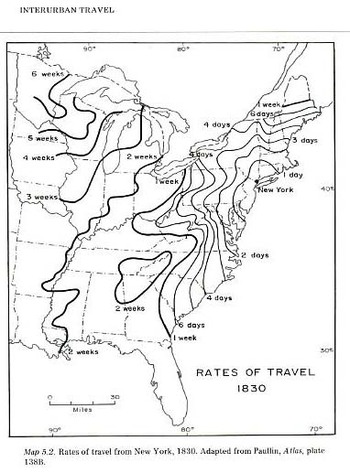
      This wonderful map is from Charles Paullin and John K. Wright Atlas of the Historical Geography of the United States, Washington, Carnegie Institution, and New York, American Geographical Society, 1932. It is just so very interesting and unusual–I’m not so sure that I’ve seen another map quite like this, illustrating travel time and difficulty..  One major stand-alone feature here for me is the distance from New York City to my own area of the U.S., the southern Appalachian region of western North Carolina: it took six days to get to Savannah from NYC and two weeks (!) to get up here in the mountains, which looks to be about the same amount of time it took to get to the Chicago area.  Of course once you got to Asheville in 1830 you were, well, probably looking to get somewhere else. I’d take it that the turkey population vastly outnumbered the people.  Maybe the horses did, too.  Getting back on track here though the West in the U.S. at the time began just on the other side of the state of Tennessee, and it wasn’t but a couple (?) of censuses before this that the West was right about at the Cumberland Gap/Ohio River basin region.
    File0844

    Perhaps this leads us to a more interesting if badly-asked question:  where does the American West begin? 

    This is an awfully tricky question, best left to the answer that pops into your mind the instant you hear the question, before the problems of what the sentence entails creep in.

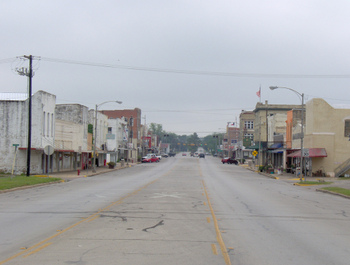
    Locating where the West begins is a curious, personal adventure–is it on the other side of the Mississippi, or does it really start in Texas, and once in Texas does it start in Austin or the sleepy Brazos? Does it really begin where the sign says it did, at Meacham Field in Fort Worth?
    Blogoctlast_piovcture

    It depends on the era, too, as we just said above; in the 18th century the American West was really out there with the makers of the martyr Bibles in Ephrata, which means that the rest of the  place was really very big.  And of course you can go all the way back to the beginning of European colonization here, all of North America was the West, at least to the people who were boarding the ships thousands of miles away across the Atlantic. And even once they got here the West was problematic–for the Spanish in the southlands there doesn’t really seem to be a “west”, only the northlands. In the 16th century the West was just creeping into Pennsylvania (Penn’s Forests), and the French and Indian War in the mid 18th century was fought over the control of “the West”, the crux of it all heading down to the forks of the Ohio at Pittsburgh.  Even in the late 18th century, the West was still not all that far away, relative to what we think of today, what with Kentucky being the first “Western” state admitted to the Union (in 1792).  It would probably be easiest just to say that the Mississippi River is the dividing line; after all, Lewis and Clark departed (in 1803) on their expedition from St. Louis (as did hundreds of thousands of other people later in the century who were seeking their new life in the West).  Then there’s the West of Saul Steinberg. who puts the whole thing on the other side of the Hudson…I’m not so sure if the West didn’t start for some people somewhere along 11th Ave.

    And where does the West “end”?  Does the West make it all the way to California coast, or does it stop in the desert, east of Sacramento?  Do people think of Oregon and Washington as the West; certainly they’re western, but are they The West?   To really complicate things, I guess you could define the middle of the West and look for the boundaries.  But the middle of the West usually seems to me to be flat and red and not terribly high; who’s to say that a nice town in Colorado (Salida?) might not be the middle of the West, even if it is 7,000 feet high?   
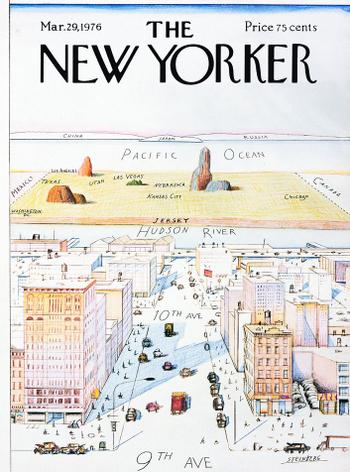
    Blogoct_18steinberg

    Its a tricky question and probably most people have a different answer for it.  For that matter, what about the South?  Where does that begin? I’m in a southernish state, but I hardly think of Asheville as being in The South per se. Maybe we’re too high; maybe the place over 2000′ in elevation that are south of Pennsylvania are just Appalachia, and actually not part of the South.  Scotland Neck over on the other part of my state is definitely the South to me, but perhaps it isn’t too much very Southern for someone in the high delta, or taking an easy afternoon in Oxford, Mississippi, or anywhere else in the Louisiana-Mississippi-Alabama-Georgia block.  I know that to Robert Johnson and Honeyboy Edwards and Son House and  Muddy Waters and anyone else in Coahoma county that the South didn’t go all that far north from where they were sitting. .In maps from sat 1850-1890 that area is called “the deep south”; seems to me that anytime you have a geographical location with a qualifying prefix, you’re actually dealing with the real thing, everyone else without the prefix being pretenders, or just something else. 

    Same too for the North–is everything above Washington D.C. northern?  I wouldn’t tell my father that, being a Berkshire Hills (MA) boy; but that’s another problem, especially to someone in Bangor.

    So somewhere in all of this, after figuring out where all of these places start, somewhere in  there is a place in this country that rejects these geographical delineations–that’s the place I’d like to find.  (When I was describing this idea yesterday to a friend, Renee, a Texan via way of Alabama–like many of the defenders of the Alamo–the answer came immediately:  “Kansas” she said.

    I’m not sure I agree.  But then once I get past my immediate response (Texas without Trees), I start to think of a 3-D representation, trying to accommodate time.  I don’t have answer for the place that isn’t anywhere, but once you start drawing enough circles to signify where The North South East West is/are, there is sure to be a little spot that gets overlapped by all of the circles more often than any other place–and that is where I think you’ll find Nowhere.


  • Gulf Stream Wealth Predictor, 1939–Outsider Logic from the Inside

    JF Ptak Science Books  Post 320

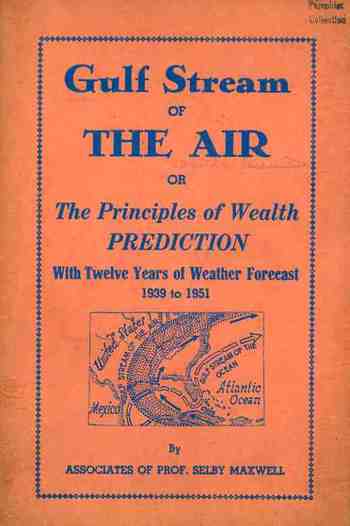
    00blogoct_15gulf_stream864 I’ve found many remarkable statements contributed by seekers and the curious whose efforts have found their way into print and then into my Naive Surreal and Outsider Logic pamphlet collections.  In the ungainly-titled Gulf Stream of the Air or the Principles of Wealth Prediction with Twelve Years of Weather Forecast 1939 to 1951 (printed in 1939), written by an unnamed group (!?) called the “associates of Prof. Selby Maxwell”, the title was good enough to guide this pamphlet to its just reward.  Just before adding it the the hoard I opened the pamphlet at random and found this sensational “what if” sentence: 
    “If the high Plateau and the Rocky Mountains did not exist there is little doubt that Mexico and our Western States would not differ appreciably…”

    Wow.

    Mr. Maxwell was indeed a real meteorologist, and perhaps this Bourbaki-like crew absconded with his good name into the bleak night of weather wealth, leaving sentence fragments like the one above in their wake.

    As bizarre as it is though this might be a fantastic way of getting the attention of a group of kids in a classroom.  Its all fine and well to classify this as “bizarre”, but what are the components that make it so?   Why is it bizarre to entertain such a thought, and how could it possibly be that it wouldn’t affect much and what would the other consequences be of not having the formation of the Rocky Mountains take place, and on and on.  It is junky in its way, thinking like this, but I’ve got to admit that I’ve  never thought about this situation before; and in its own way, the statement is fascinating in its turn-right-to-loosen-left -to-tighten way. 

    ·Posted by :

    ·in:

    —

  • Another Debate: Lincoln Douglas Debate Wordle Word Cloud

    JF Ptak Science Books 

    Listening tonight to the McCain/Obama debate (nicely moderated by Bob Schieffer, Old School) reminds me of other political debates.  This one at least was not terrible (Dan Quayle, Sarah Palin [which is Latin for what exactly?], poor Jerry Ford and the Poland freedom question, and so on) and at least as good as most of these things have been during my lifetime (Kennedy Nixon).  [Click on the word cloud to enlarge.]
    Wordlelincoln_douglas

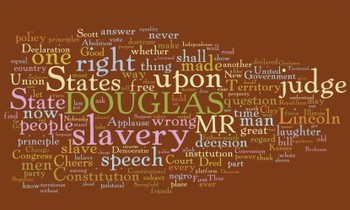
    It does put me in a longing piece of mind for Lincoln Douglas 1858, mainly because tonight’s debate was reasonably glib if not long in logic; Lincoln Douglas had it all, especially the logic bit.  If you read the 200,000-odd words of that six-debate series, (taking place from August through November 1858, located mainly around the perimeter of their battleground state, Illinois) you can’t help but be impressed by how long and deep and considered their memories and logical structures were as the two men fought over the morality and logical structure of slavery.  Of course they weren’t fighting over the prime 15 second spot the next day; their debate was covered in full in newspapers (on the front page even!), their constituents taking their time to read the exchanges, and then have the luxury of time to think about what had been said.

    So above is a word cloud brought to you via WORDLE.  There are a few repetitive words that were just part of the structure of the debate verbiage:  “Mr.”, “laughter”, “cheers” are the main examples.  Otherwise you can pretty well tell that t he broadest, most often used words in the debate reflected the slavery issue, though it doesn’t relate the sentiments to the contestants.  (It would be very interesting for someone to do two wordles, one for each man.)  But the overall patina of the debate was overwhelmingly slavery-related.  I’d particularly like to see the Douglas end of the debate, as he was pretty problematic on the slavery issue, and I’m not sure at all (even given where he was from) that the man actually was anti-slavery–he argued in the debates for instance that the founding fathers didn’t extend their thoughts on the Constitution to encompass minorities.   Or at least anti-slavery before the beginning of the war, as he was outspoken on what he saw was the “criminal” activity of the Southern secessionist states. But he was dead almost right away after the war started. 

    Douglas won the Senate seat but Lincoln won attention of the country; perhaps it was due to this that Lincoln defeated Douglas and the other two Democrats in such a spectacular (electoral) fashion in their rematch presidential race of 1860.  (Lincoln still trumps the badly divided Dems even if you cobbled together the votes of Douglas, Breckenridge and Bell.)  In any event, if you read through the Lincoln/Douglas debates. you can see right away that there was some pretty strong thinking going on…


  • Allegory and Symbolism: the New Botany and a New Way of Classifying, 1737

    JF Ptak Science Books   Post 318

    Carl Linnaeus (1707-1787) was the father of modern botany–he was a Swedish zoologist, physician, and above all, way above all else, he was a botanist. He was also widely recognized  as an accomplished, applied polymath:  Rousseau said of him “Tell him I know no greater man on earth”, and Goethe, one of the greatest of all polymaths and an expert on recognizing another one,  wrote: “With the exception of Shakespeare and Spinoza, I know no one among the no longer living who has influenced me more strongly”.  Pretty strong stuff from giants.

    1blog_oc_t11_linnaus814

    In addition to much else, Linnaeus contributed a template, a grid for identification and discussion,  establishing conventions for the naming of living organisms that became universally accepted in the scientific world—the  the starting point of binomial nomenclature. 

    And perhaps it is small of me, but I concentrated a bit on the frontispiece to his greatest books (rather than on the writing)–it is truly a capstone of the botanical canon.  The book is Hortus Cliffortianus plantas exhibens quas in Hortus tam vivis quam siccis… and it was published in Amsterdam in 1737, and it was as beautiful as it was important. The book was basically the product of the desire of the entrepreneur and multiply-rich East India Company investor and Anglo-Dutch banker George Clifford, whose desire to catalog his massive and extraordinary gardens brought him to Linnaeus.  The partnership, or at least the bringing of Linnaeus on-board for this unique and monumental opportunity, was one of the most fortuitous in the history of 18th century science. 

    The fine, baroque frontispiece allegorical engraving by Jan Wandelaar pretty well drips symbolism and allegory–which is a good thing since that is what is was supposed to do.  The main figure in all of this is a crowned Europa, seated before the very gates of the Clifford garden, holding a set of keys (to the botanical kingdom).  She is surrounded by activity, including three people representing the continents (Africa, Asia and America) offering  her gifts of plants.  Europa is bathed in light, perhaps because the figure to her right, Apollo, is just now removing a drape or cloak from her (which I guess is the pre-Linnaean coverlet of incomplete  and incorrect botanical knowledge), and providing her with his own source of light (with the torch in his left hand).  Between Apollo’s legs we can see the arm/tentacle of some sort of beast/hydra/dragon, no doubt another representation of incomplete knowledge, or worse. 

    Around the edges of the print , beginning in the foregorund, we see a map (represnerting Clifford’s gardens, probably, or the general sense of planning an approrpiate way of growing and displaying plants); to the right of the map are two cherubs/imps sitting before a roaring brazier, one holding a staff of some sort and the other pointing to a (celsius) thermometerm which Linnaeus had a hand in invneting.  Moving up the side of the print we come to my favorite part, the producing banana tree (you can see the bananas if you look closely), which I imagine must’ve been a great rarity in Eruope in the 18th century).  All in all I’d say that the artist accomplished the task of allegorically depicting the importance of the pages that followed.


  • What Victory Looks Like: the Battle of the Somme and the Thin Line Between Winning and Losing

    JF Ptak Science Books  Post 317

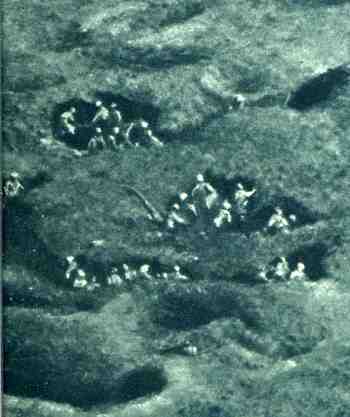
    In a play on the concept of the Powers of Ten, I had a look at a photograph depicting the French victory at the Somme; or was it a British victory?  Or German, via the lure of the others to a semi-victory?  Its hard to say who won, or if there really was a winner.  The Battle, which looks to me to be a sub-war within the war, occurred over the period of July through November 1916.  When the smoke settled, there were some 1.5 million casualties on both sides.It has long been held that the battle really was won by someone, the British, the French; but there was so little that was accomplished by the action that there probably wasn’t a winner, just losers. 

    00blogoct_14somme850_2

    And big losers, at that: Great Britain, Canada, Australia, New Zealand, Ireland, South Africa and Newfoundland lost 419,654 casualties, with 95,000 killed; the French lost 204,000 casualties and 50,000 killed.  That made a total of 623,000 casualties and 146,000 killed for the allies; Germany lost 465,000 casualties and 164,000 dead.  The advances made along the battle front went a few miles one way and then the other along a 12-mile stretch of battlefield, which four lives were traded for every inch gained along that porous front.

    The first image here (above)  is a very sharp detail from the overall picture published in The Illustrated London News for 6 January 1917, representing about 1% of the entire photo

    The next image places the micro-detail in more context; this detail is itself about 5% of the main image, which is found just below this one.

    00blogoct_14somme849_2

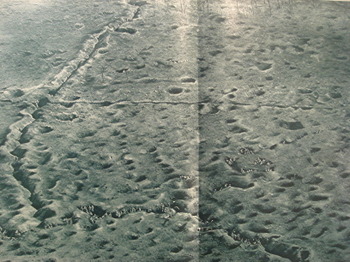
    The overall image from which these two details are removed is below. In turn, this large image is but a small detail of the greater overview of the battlefield, making up perhaps a few percent of the field of operations. 

    I’m trying to get a feel for the enormity of the battle, but I really can’t, not even via powers of ten, manipulating the idea of orders of magnitude.

    In one last try, I hypothesize that the 1.5 million casualties could not be displayed in 10 of these large images.  .

    That wouldn’t look like victory at all. 


    Ballistics_123


  • When Things ARE Better in Glorious Black & White: Color Detonation and the Invention of *More* Primary Colors, 1942

    JF Ptak Science Book Post 316

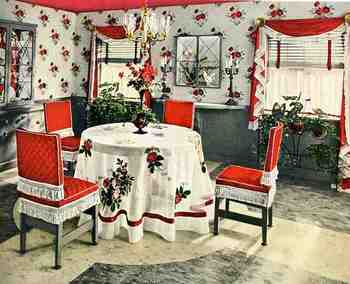
    Well: this is a variation of yesterday’s post on the two opposite edges of color in oddly-applied scientific/technical manners. In unwittingly responding to the question “when is color-use bad?”, the answers were found in these room decorations from 1942, all of which come from a pamphlet entitled Ideas for Old Rooms and New, extracted from the mind of  Hapel (?) Dell Brown.  It is a tidy book with ideas that are anything but tidy;and  as you scroll down you’ll see that the room solutions suggested by Hapel Del are anti-tidy; clutterous (no, not a word but could be).  Everything about these creations speaks to the annihilation of visual resting places; everything seems to be an affront to the concept of causal emptiness.  The weird thing is that there aren’t very many objects in these rooms at all (at least comparing these rooms from where I’m sitting)–the visual complaints seem all rocketing from the abuse of colors found in the fabric of the furniture and walls and floors and window treatments.  The eye gets no rest–and as a matter of fact, the cones of the eyeball are impaled on the rods as a result of the author/decorator  desperate attempts to invent three more primary colors. 

    00blogoct_14color848

    Believe it or not we don’t really get the full flavor of the color cacophony because the floors in these picture look sort of benign, fading away into themselves–which they are not, according to  the description in the text, because they are all high-gloss linoleum rolls or tiles (“efused [sic] with deep wondrous color”.  And that means not only are these floors adding sheen and color to the rest of the incredibly colorful–an effect fairly lost in these photos–they are also cold.

    One thing that I haven’t pointed out in this peon to syrupy/pastel-y/techno-gelatinous-chromodrama is that they were all done in response to a re-decoration of a perfectly nice-looking house, with all of the former “bland” colonial-style rooms presented in glorious black and white.  I’d rather live in Maison Noir than in this happy nightmare.


  • The Color Blind Geometer and the Color-Coded Euclid

    JF Ptak Science Books Post  315

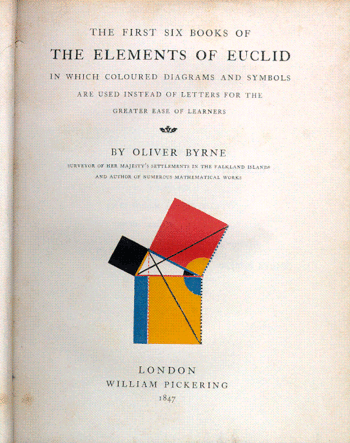
    Here’s a bit of a reach, a very-long-distanced connection, between to unrelated items sharing a similar design and operating at the zenith and nadir of color theory.  The first work is the great and nearly unusable work by Oliver Byrne on the first six books of Euclid (The First Six Books of Euclid in which coloured diagrams and symbols are used instead of letters for the greater ease of readers…, printed at the Chiswick Press by C. Whittingham for WIlliam Pickering in 1847).  The book is, well, unusual and probably not at all useful.  Bryne replaced all of the algebraic notation, identifying letters and almost all of the descriptive text with color and color codes, leaving Euclid mysterious, hidden, awkward, impervious, and, yes, beautiful.  as a matter of fact this work presages the cubists (and especially Piet Mondrian) by 60 years, and all by accident. 

    1blog_oc_t10_euclid_color_blindness Blogeuclide_byrne_2

    Augustus De Morgan, mathematician and logician, wrote a very highly critical book A Budget of Paradoxes in which he describes hubbub, fakirs, frauds, perpetual motion machines, squaring the circle efforts, millstones and other useless books in the maths, and in here he sniffily dismisses Byrne’s work. At best, to De Morgan, the Byrne book is “curious”. But useless and curious, as I have seen many thousands of times, does not mean that it can’t be attractive and beautiful, and the Byrne book is probably the leading candidate in the Bad & Beautiful category..In Victorian Book Design McLean calls the Byrne book “…one of the oddest and most beautiful books of the whole century…a decided complication of Euclid, but a triumph for Charles Whittingham [the printer]”.  (I should point out that the Chiswick press returned to Euclid again in 1893, publishing Gilbert Redgrave’s address on Erhard Ratdolt, who was the first scientific printer in history and also the first publisher of Euclid in 1482. See HERE for the digital record of Redgrave.)

    Curiously the Pythagorian theorem illustrated on the title page of Byrne’s book seems at a fast glance to appear on the front cover of Phillip S. Newton’s Color Blindness, Suggested Aids for Correcting 1946.  It really isn’t all that close except by fleeting recognition, but close enough to stop me in my tracks, to make me think of where my copy of Byrne was and put them side by side.  Curious doubly because in Byrne’s case color is used exclusively in place of numbers and words and is totally and completely dependent upon it. In Newton (who also has the same name as Sir Isaac, author not only of the Principia but also the second-best book of the 18th century, Opticks) we find the confusion of color and plans to correct the color vision, and in a twisty way, on the opposite end of the interests of Byrne. 


  • Lines that Closed the West: Wire, Rail, and Words

    JF Ptak Science Books  Post 314

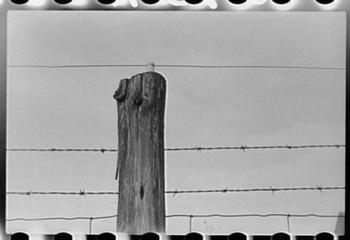
    The story of the West getting filled up in the 1870s is a story of lines—railroad track, telegraph wires, barbed wire fences, and words on a page; big changes from disparate but related areas in technology and legislation, but when you looked at them from a distance and in the proper perspective, they all looked exactly  the same.

    Barbed_wire

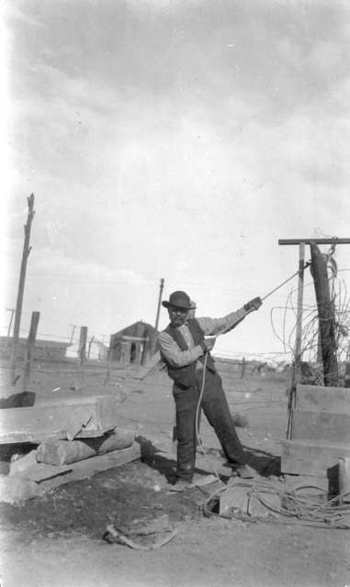
    The greatest of these lines may have been the invention of barbed wire in 1873, with Joseph Glidden, Jacob Haish and Isaac Elwood all managing to independently come upon the idea at about the same time.  What barbed wire brought to the West was control and settlement.  Prior to barbed wire there was open range grazing of cattle and extensive cattle drives, mainly because there was no fencing. There were also few farms due to this sort of grazing—the only thing a farm was here was in the way, and there was no recourse for the farmer to protect his

    lands from a grazing herd.  There was no fencing because there were no materials for the fence.  Fencing was made almost entirely with lumber and stone, and on the treeless plains and the vast non-New England tracts of land, it was simply an impossible task.  The introduction of barbed wire changed all of this very quickly, with thousands of miles of new fencing strung in the 1870’s alone.  Fencing meant control, restriction of the use of land, of access to water, and to a way of life.  It also meant that the farmer was now free to make a claim at a way of life on the plains, beginning a torrent of settlement and farms.

    Blogludlow

    Another big line element of settlement were the texts (lines-on-paper)  of three major acts of legislation which, over a period of just sixteen years, were responsible for moving more people than just about anything else in American history. The first of these was the Homestead Act of 1862. This was a revolutionary concept, legislated in 1358 words, effectively turning over 270 million acres, or about 8 percent of the country, of public lands to private citizens (“actual settlers of the public domain”).  A claim could be made for a farm of 160 acres, for free, provided a structure was built on the land and it was maintained for five years.  One could buy the parcel outright for $1.25 an acre as well.   Next was the Desert Land Act of 1877 which opened drier lands, selling 640 acres at $1.25 an acre with three years to pay, so long as the land was irrigated by the end of the three years.  Land that was deemed “unfit for farming” was sold to those who might want to “timber and stone” (logging and mining) upon the land with the third major piece of legislation, the Timber and Land Act of 1878. The act was used by speculators who were able to get great expanses declared “unfit for farming” allowing them to increase their land holdings at minimal expense.  The Homestead Act alone accounted for the creation of almost 400,000 farms in the West by 1890.  Farms meant parceling out land, “settling” it, having people on it, waiting when they weren’t working. 

    Blogpeopling_upmillions_acres

    Settlement was dramatically increased by the written and published promises and speculations of mineral wealth—not necessarily just by the introduction of miners, but by securing the lands from and removing its Indian owners.  The Custer expedition into the Black Hills in 1873, for example, reported some hope for finding gold in the sacred mountains of the Sioux. Thousands of miners responded to possibility of wealth, and Custer was again dispatched to secure safety for them in the restricted lands.  This in turn lead to more settlers and coincidentally to the debacle of the Little Big Horn, which was the beginning of the end of the Siouian control over vast amounts of land.  From prospectors to protection to conflict, ultimately making land more available for more people. 

    The spread of the railroads was also an enormous settlement factor, with the number of miles of track being laid in Texas and the Great Plains doubling in just 5 years.  Not only could you get West more easily, and quickly, and with less pain and suffering, but you could also be much more easily re-supplied.
    Blogwestward_the_course_2


    Telegraph wires tripled, making it easier to control events:  and this means from being able to respond to Indian attacks more quickly to ordering boxes of nails, or beer, or shipments of newly-invented canned food. 

    One of the greatest and most infamous of these lines-controlling-the-West concept were the pieces of legislation and agreements and other legal and binding documents, between the U.S. government and every Indian tribe in the U.S. Promises were made to the Indians and of course not one of these treaties were ever actually realized.  It was these written lines that even the greatest of Indian scouts could not track, mainly of course because they didn’t mean one bloody thing.  (The idea of words in a book, lines of words, being looked at as ‘tracks” to Indians belongs to Mr. Larry McMurtry, whose greatest of all Indian scouts, the Kickapoo Indian named Famous Shoes–from the Lonesome Dove tetralogy–could not ultimately track the words in a book as he was able to track everything else that lived in nature. Words/tracks of a treaty would’ve been ever more so impossible.)

    Of course in the end all of the lines applied and enabling  the closing of the West were personified by smaller and more precise lines:  maps.

    ·Posted by :

    ·in: