JF Ptak Science Books Post 283
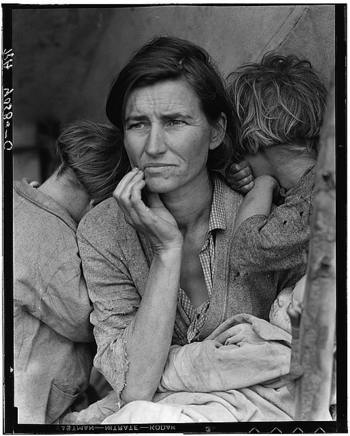
 After having written a number of pots dealing with overt propaganda issues—surrender leaflets, Nazi pamphlets on the impending invasion of Germany by Poland and Czechoslovakia, American reassurances about how to survive the coming nuclear holocaust by covering yourself with table linen, British home hearts and minds campaign about how well your loved one POWs are being treated by the Germans—I thought to write a little something on the other side of propaganda, which is simply to not publish information. One case is that of the great social photographer and one of the dozen or so mainstays of perhaps the greatest American photographic collaborative ever—Historical Section of the Farm Security administrations*–Dorothea Lange. Lange worked for the FSA—which had begun life as the ominously-named Resettlement Administration, the photographic section of which was to document the good that the government was doing helping the drought and depression refugees find new life and hope elsewhere in the country outside of their own money-ravaged areas—taking mostly landscape and architectural pictures through the height of the Depression. The time that she broke character (so to speak) and made portraits produced some of the most memorable or at least famous images from this period o American history, the most outstanding of which is the five-photo series of a female bean picker and her three children who were living out of the back of their wheel-less car in a potato-less potato field in California known as the Migrant Mother. (The making of these extraordinary images is another story for another post—suffice to say that the narrative of the history of that photograph is exceptional.) I’ve always felt that the Roosevelt administration viewed this image as being just a little too much reality than it wanted to exhibit.
This was positively the case with Lange’s photographs of the Japanese at the Manzanar concentration camp (relocation camp) in where more than 10,000 American citizens of Japanese heritage were forced to live between 1942 and 1945. This was one of camps that were established by virtue Franklin Roosevelt’s February 1942 Executive Order 9066** to imprison more than 100,000 American (70,000 of whom were U.S. citizens, including children) for the duration of the war (compared to a few camps that were designated to hold white American citizen of the other countries that were fighting, mainly of German and Italian descent, 1,500 and 300 of whom were actually imprisoned, respectively). It was a grave, undistinguished, embarrassing move brought on by the hyper hysteria in the months following Pearl Harbor.
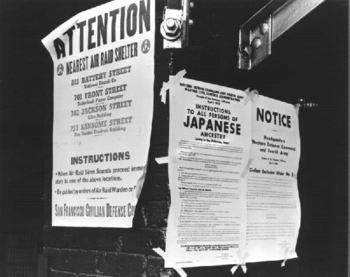
The Japanese at the Manzanar concentration camp were from the west coast who were bused away from their homes and lives and businesses with extremely limited notice, and who were forced to sell nearly all possessions (including lands and businesses) at what were less than fire sale prices. They were made to board buses and trains and were shipped to locations (mainly in California) where they were processed and sent further and deeper into the trying hinterlands of the west for their final destinations until the war was won. (One of the processing centers was the Santa Anita racetrack, where thousands of Japanese were sent to live for periods in converted, just-painted horse stalls.) Manzanar itself is well enough out there—removed, trying, desolate, difficult. Beautiful, too , if you weren’t in prison there. It was a high desert plateau with the snow-capped sierras, ringing the place; no grass, barely a tree, with extreme temperatures and a tough wind that was freezing in the winter and blew hot in the summer…tough enough to make it hard to keep the tar paper on the roof and sides of the thinly constructed barracks that held these people. While every other relocation camp had barbed wire and guard towers, Manzanar had none—its location was so remote and difficult that it made the construction of these inferior barriers unnecessary.
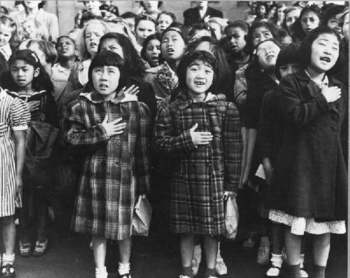
As difficult was life was at Manzanar, and having being completely torn off of the American map and their way of life, the Japanese at the camp established irrigation systems and gardens, made their own furniture from bits and scraps, established a newspaper, created a government, schools, police, and so on, making their life as orderly and hospitable as possible. Dorothea Lange was allowed, after repeated requests to the US Army, to enter the facility and make a photographic record of what she saw. And what she saw and photographed was the courage and dignity of the people that she find there in the mists of deprivation and devastation—her photos were remarkable for their sincerity and insight.
And it was for precisely this reason that almost know of them were ever seen. Bits and piece emerged here and there—four in Survey Graphic in 1942 (Vol. 31, No. 9, Sept. 1942), two others here, two others there—but they were almost entirely restricted. As a matter of fact they were stamped “Impounded”, and relegated to the future.
The FSA became the Office of War Information in 1942 as well, which might explain why this propagandistic move dismissing their existence for want of fairer reception of the American war effort at home.. It wasn’t until 1972 that 27 more of them were released and received a public showing at the Whitney in NYC in a show called Executive Order 9066, and which were reviewed in the NY Times by A.D. Coleman as “documents of such a high order that they convey the feelings of the victims as well as the facts of the crime.”
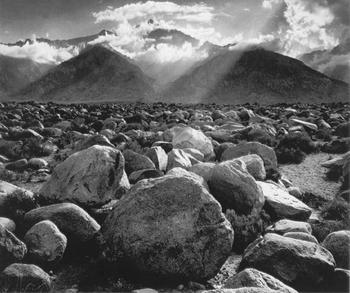
Lange wasn’t the only big-name photographer zipping around Manzanar–Ansel Adams was there, too, as a friend of the camp administrator. Adams had free access to the camp, and could basically come and go as he pleased, which didn’t sit well with Lange, who had a hard go of her permissions with the Army. It was also something that she never let go of, either, as the Adams photos really didn’t get into the Being of the place like Lange’s did. Actually, one of the great, iconic images made by Adams comes from this period, and as it turns out, its one of those odd sorts of photos that turns in the opposite direction of what the photographer was there “for”. Mount Williamson is just a drop-dead shot to be sure. It is also an image of what the Japanese in the concentration camp were looking out at. Adams turns his camera around, around from the disgrace, and takes one of his greatest images. (I’ve listened to my wife Patti Digh, who is an (excellent) photographer, talk about photographers “making” photographs; I’m sure that before her I used “taking” and “making” photographs interchangeably. But “making” it should be, as you’re not owning or lifting the image away.) In this case, however, as monumental as Adams was or is, he definitely “took” this one. Stole it.
An excellent book on these photos is found in Linda Gordon and Gary Okihiro, Impounded, Dorothea Lange and the Censored Images of Japanese American Internment (W.W. Norton, 2006).
*This incredible group included: Arthur Rothstein, Carl Mydans (up to the summer of 1936), Walker Evans (up to September 1937) Ben Shahn, Dorothea Lange (with interruptions up to 1942). Russell Lee, Marion Post Wolcott, John Vachon, Jack Delano, John Collier. This group produced upwards of 270,000 negatives, with 77,000 or so prints available at the Prints and Photographs room of the Library of Congress in a row of double-backed file cabinets. Many thousands are available online at loc.gov I am told by a reliable historian that I am wrong in thinking that Lange was fired because of her too-intolerably human photos, but for budgetary problems.
.
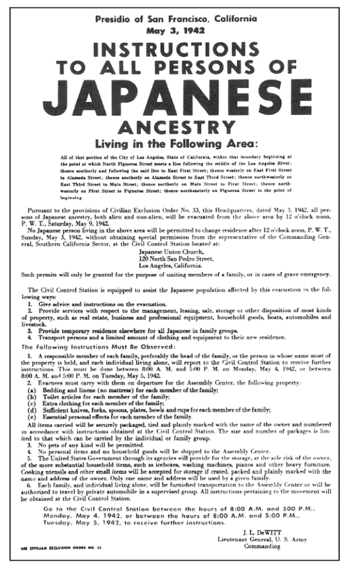
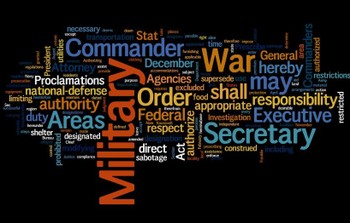
**The following is the text of 9066, which basically authorized a 60-mile swath of the Pacific Coast as a military zone subject to national defense requirements, the principal object of which was to remove all Japanese residents from the area for fear of them being enemy agents and saboteurs. To accompany this I mad a WORDLE text map of the document, just to see what popped up.
 Executive Order No. 9066
The President, Executive Order
Authorizing the Secretary of War to Prescribe Military Areas
Whereas the successful prosecution of the war requires every possible protection against espionage and against sabotage to national-defense material, national-defense premises, and national-defense utilities as defined in Section 4, Act of April 20, 1918, 40 Stat. 533, as amended by the Act of November 30, 1940, 54 Stat. 1220, and the Act of August 21, 1941, 55 Stat. 655 (U.S.C., Title 50, Sec. 104);
Now, therefore, by virtue of the authority vested in me as President of the United States, and Commander in Chief of the Army and Navy, I hereby authorize and direct the Secretary of War, and the Military Commanders whom he may from time to time designate, whenever he or any designated Commander deems such action necessary or desirable, to prescribe military areas in such places and of such extent as he or the appropriate Military Commander may determine, from which any or all persons may be excluded, and with respect to which, the right of any person to enter, remain in, or leave shall be subject to whatever restrictions the Secretary of War or the appropriate Military Commander may impose in his discretion. The Secretary of War is hereby authorized to provide for residents of any such area who are excluded there from, such transportation, food, shelter, and other accommodations as may be necessary, in the judgment of the Secretary of War or the said Military Commander, and until other arrangements are made, to accomplish the purpose of this order. The designation of military areas in any region or locality shall supersede designations of prohibited and restricted areas by the Attorney General under the Proclamations of December 7 and 8, 1941, and shall supersede the responsibility and authority of the Attorney General under the said Proclamations in respect of such prohibited and restricted areas.
I hereby further authorize and direct the Secretary of War and the said Military Commanders to take such other steps as he or the appropriate Military Commander may deem advisable to enforce compliance with the restrictions applicable to each Military area hereinabove authorized to be designated, including the use of Federal troops and other Federal Agencies, with authority to accept assistance of state and local agencies.
I hereby further authorize and direct all Executive Departments, independent establishments and other Federal Agencies, to assist the Secretary of War or the said Military Commanders in carrying out this Executive Order, including the furnishing of medical aid, hospitalization, food, clothing, transportation, use of land, shelter, and other supplies, equipment, utilities, facilities, and services.
This order shall not be construed as modifying or limiting in any way the authority heretofore granted under Executive Order No. 8972, dated December 12, 1941, nor shall it be construed as limiting or modifying the duty and responsibility of the Federal Bureau of Investigation, with respect to the investigation of alleged acts of sabotage or the duty and responsibility of the Attorney General and the Department of Justice under the Proclamations of December 7 and 8, 1941, prescribing regulations for the conduct and control of alien enemies, except as such duty and responsibility is superseded by the designation of military areas hereunder.
Franklin D. Roosevelt
The White House,
February 19, 1942.

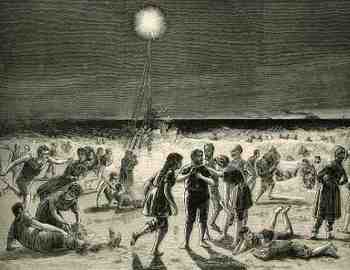 This woodcut is from the Leipzig equivalent of LIFE or The Illustrated London News: Illustrirte Zeitung, and was published in August 1878. It appeared in the same issue as the very first image of Edison’s phonograph in a European publication (just two pages away) It was a big issue for Edison in Germany, as he was of course principally responsible for not only integrating minor discoveries of others into a revolutionary discovery of his own (the electric light and light bulb), but was also reasonable in the largest part for the physical distribution of energy to those light bulbs. And so it came to be that the beach at Coney Island–one of metropolitan New York’s greatest recreational sites–was lighted by a portable electric “floodlight” (though I don’t know what the illuminating part was–perhaps it was a carbon-arc something or other, as I’m pretty sure it wasn’t a light bulb” as we would think of it…nevertheless the source was electrical). It had never in human history happened before that people could frolic in the surf under an artificial source of illumination–it had to have been an extraordinary sensation. The light appeared in the same year that the The Camera Obscura
 Really–how is it that such ubiquitous American objects are so ugly? Evidently the first public mailbox in the U.S. was a “street letter box” designed and patented by P.B. Downing, and African American inventor, 27 October 1891, 48 years after the first box appeared in Britain; and the design of these things has gone downhill ever since.
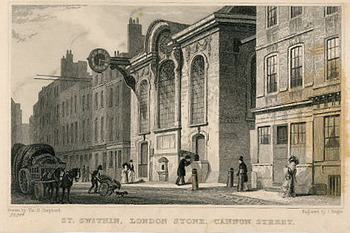
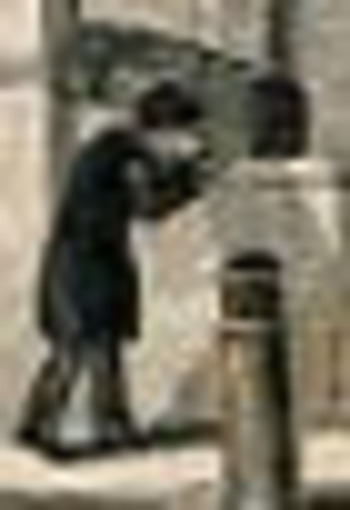 Looking at this image of St. Swithin’s* and the London Stone, even a quick, noncommittal look at the people filling up the foreground reveals this most unusual character with an uncommon box, right there at stage-center.
 In an earlier post (
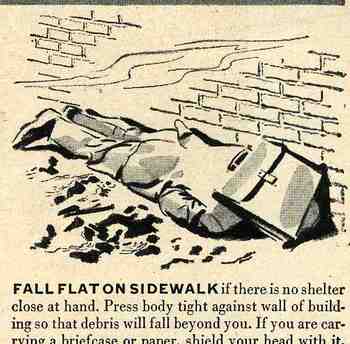
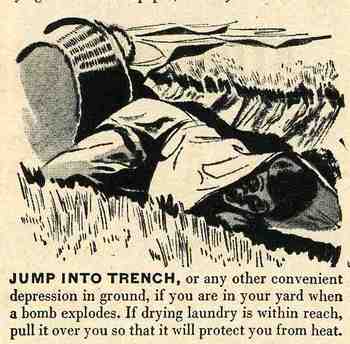 trench (that just happens to be there in the middle of the yard) and cover your head with a sheet “to protect you from heat” (“if your drying laundry is within reach”). I hope that its an Oxford double weave.