JF Ptak Science Books Post 272
 “The lunatic , the lover and the poet,
are of imagination all compact…”
Midsummer-Night’s Dream act v sc 1
“Great ideas sure to madness near allied
and thin partitions do their bounds divide”
Dyden, Absolom and Achtiophel, part i, line 163.
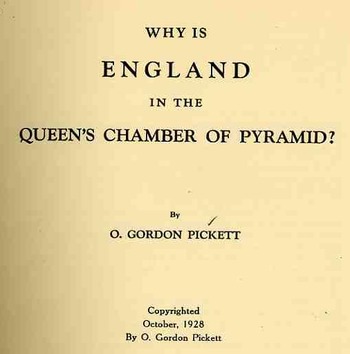
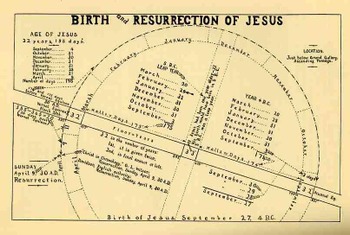
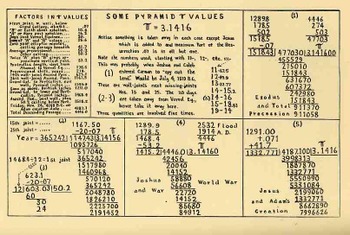
I am pretty sure that O. Gordon Pickett, the very dedicated and serious author of this work, may well have been the only person to put the question forward of “why is England in the Queen’s Chamber of [sic] Pyramid?” Isn’t the ability to ask an uncommon question one of the sources of innovation and genius? Mr. Pickett, of Los Angeles (of course (?)), tried mightily in this 1928 publication to make his case for predetermination of the Anglo Saxon race by assembling and interpreting lost angles (sorry), implied geometry, found numbers, ratios, perspectives, and the like, endlessly, to find the outline of the England in the Queen’s Chamber of the Great Pyramid. Almost all of this was invisible, a kind of outsider-logic-x-ray brought to bear on pyramid architecture–and when the picture clears, what the x-ray reveals,somehow and incredibly, is England. And Christ. And Pi. And although he was dedicated, and insightful, and capable of long sitting time, he probably was not a genius as we would recognize today, testing perhaps what Charles Lamb called the “radical sanity of genius” (“Sanity of True Genius” in Last Essays of Ella). Sometimes, having the ability to ask an unrecognized and first-time question doesn’t mean that the there is an ability to discern a place for the thing in a shining logical kingdom. I do appreciate though that Mr. Pickett was a considered and discerning thinker, though to what non-personal end it all came to, I don’t know.
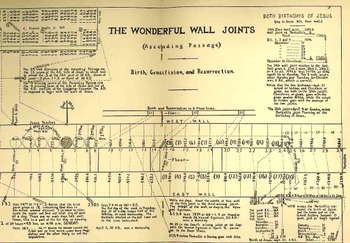 But Mr. Pickett did evidently assemble ALLOT of data and drawings and plans and renderings of the pyramids in the course of looking for the secret strings which would alter the known into the secret and unknown.
I think what is most revealing about the way that he is going with his hard-thunk hard data is particularly revealing, and may also be, in their own way, some of the most uncommonly-titled visual displays of “quantitative” data that I’ve encountered: “The Wonderful Wall of Joints, Ascending Passage, North, Crucifixion and Resurrection”, “(Pyramid) Passages and Planetary Rotation”, “Birth of Jesus at Entrance” and “Some Pyramid Pi Values” are all unexpected constructions. Well, hard work does not necessarily make for good thinking, and though Mr. Pickett did allot of thinking on this…
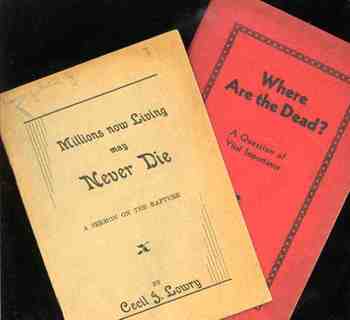 Oscar Lowry attempts to answer the question in the subject line of this post in a very red book of 46 shouty pages. What he’s really concerned with, in Where are the Dead (1930), and what he maintains is of “universal interest to the saved and unsaved, the hearers and nonhearers”, is what happens to people after they die; more particularly though, Mr. Lowry is interested in differentiations in eternal damnations versus eternal doom. And there is evidently a very wide difference here, as people in Hades are just in “prison”, waiting for their final judgment which will fling them into Mr. Cash’s ring of fire (well,”lake” of fire, actually). There’s also little chance that the snakey charms of Orpheus’ poetry will ever change anyone’s mind at the gates of Sheol-Hades, leading anyone away from the firey pit. The discussion of Hades and Hell and Sheol is interesting if not scary in Mr. Lowry’s hands, describing “Sheol-Hades” as a “prison”, its occupants waiting for final disposition to Hell. Strong’s Hebrew opens the possibilities of definition with a number of translations for Sheol: the underworld, the abode of the dead, place of no return; without praise of God; wicked sent there for punishment; righteous not abandoned to it; of the place of exile; of extreme degradation in sin. The most troubling of these in my book is the definition of what it is not, as in “when the righteous are not abandoned to it”, which seems both reassuring and really terrifying..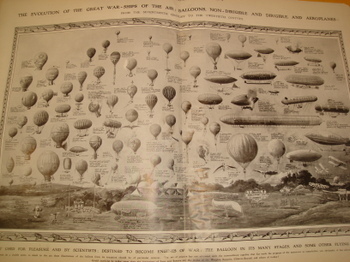
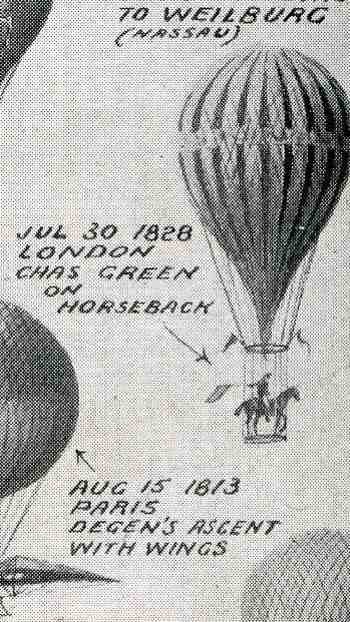
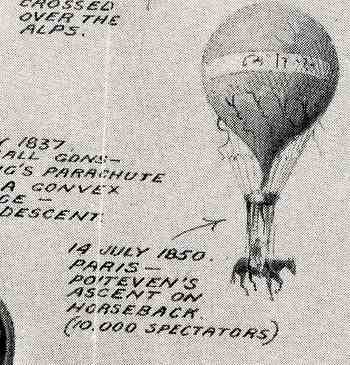 Missing them is understandable if you weren’t looking closely at the image’s little bits and pieces, what with the horses occupying something like 1/1,000 of the print’s surface. But there they are, clear and bright as day: “1798, Ascent by Testu-Brissey”, and “1828 London Chas Green on horseback”, and “1850 Paris Poiteven’s ascent on horseback (10,000 spectators)”.
 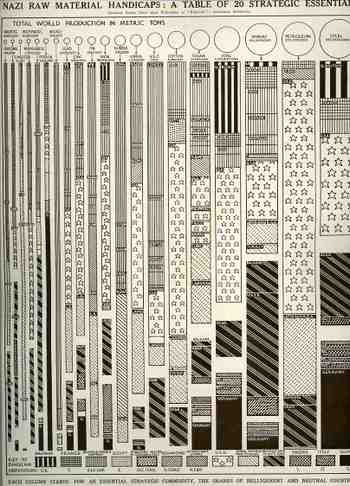 This dense, complicated table showing the distribution of strategic raw materials (published in The Illustrated London News 3 August 1940) I is a decent example of how not to display data. Perhaps there’s just too many variables to try to control here in one visual display: it tracks twenty raw materials by percentage of access for thirteen different countries, with the entire graph being displayed in a sort-of progression according to metric tons of material. Maybe it’s the varying widths of the bars representing the material, maybe it’s the complex designs distinguishing the countries, and maybe its just too many lines. The only time this really works for relatively-offhand use is when you’re looking for one country in particular, and then the eye allows it self to just concentrate on the solid black (Germany) or the stars in a bar (U.S.) When the graph is used in this manner it displays rather quickly that Nazi Germany doesn’t control a whole lot of the combined tonnage of the twenty strategic materials, which was a particularly good thing for the general reading population in the Allied world to see, because the war was not going so well at this early stage. (At this point in the war—less than a year old now in Europe—the Battle of Britain had begun though it was still weeks away from when the massive Blitz begins, and Hitler had just toured Paris…it was not a good time for Britain, and a worse time for France. The Soviet Union is listed still with the Axis as it was still 10 months away from being attacked, Hitler turning on his allies in Operation Barbarosa in June 1941.)
 (Click to enlarge to readable size.)