A Daily History of Holes, Dots, Lines, Science, History, Math, Physics, Art, the Unintentional Absurd, Architecture, Maps, Data Visualization, Blank and Missing Things, and so on. |1.6 million words, 7500 images, 4.9 million hits| Press & appearances in The Times, Le Figaro, Mensa, The Economist, The Guardian, Discovery News, Slate, Le Monde, Sci American Blogs, Le Pont, and many other places… 5000+ total posts since 2008.

Author: JF Ptak

  • Graphical Display of Data: the R.A.F. and Luftwaffe Present Their Cases, 1938-1940

    JF Ptak Science Books LLC  Post 262


    Blog1sept_15raf_range_1939551

    These four images represent some common, popular distribution of
    information to the general population, the sets of two working at cross
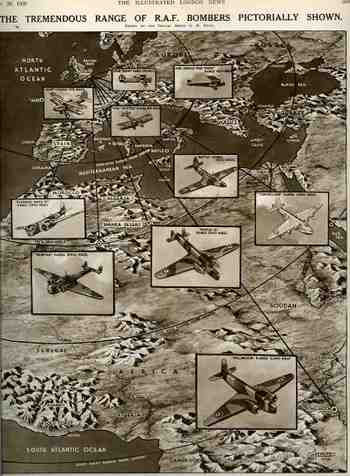
    purposes.  (I’ve written several posts here about the Nazi use of maps as a propaganda tool; if you search this blog under those terms you’ll find several entries.)  The British images  were issued just after the start of WWII
    (30 September 1939) and then again just after the end of the Battle of
    Britain (November 1, 1941), respectively.  The first (“The Tremendous
    Range of RAF Bombers Pictorially Shown”), illustrates the range
    capacity of its long range bombers for WWI and for 1939, showing how
    far they could strike into the heart of Africa.  I’m not so sure why
    Africa was chosen as the target, as nothing at all was happening there,
    militarily speaking, at this early stage of the war; why this didn’t
    show the planes screaming their way to the east is a mystery to me.   
    The Home Office was busy showing how far the Wellington bomber could
    reach (3,240 mles), as well as the long shadows cast by the Hampden,
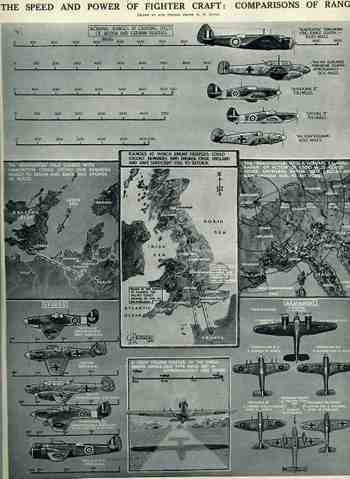
    Sunderland and Wellesley.  The second British image, “The Speed and
    Power of Fighter Craft, Comparisons of Range”  displays aircraft of the
    principle RAF and Luftwaffe fighters and bombers. 

    Blog1sept_16_aviation_maps_germany5

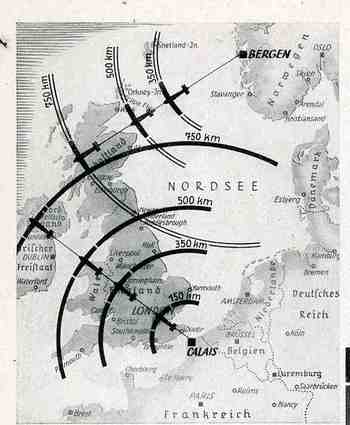
    The first German image, printed as a small inset map in a general propaganda piece in the Illustrirte Zeitung (Leipzg), for November 1940, depicted the capacity of the Luftwaffe to reach, threaten and bomb any region in the British Isles from bases in Calais (France) and Norway, having secured the positions in their attacks against the two countries in Fall Gelb and Operation Weserubung respectively. Britain was effectively half-surrounded from these positions from the Brittany to the Norwegian coasts.

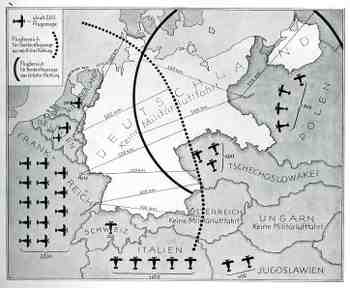
    The second German map (and the fourth presented here) is another interesting fiction coming from the propaganda offices in 1938, showing how Germany was threatened by attack from the air forces of its neighbors.  Particularly pungent in this portrayal was the threat from Checoslovakia, Yugoslavia and Poland.
      

    Blog1sept_15raf_range_1941552

    Blog1sept_16_aviation_maps_german_2


  • Comparative Display of Quantitative Data: Ships in the Skyline

    JF Ptak Science Books LLC  Post 261

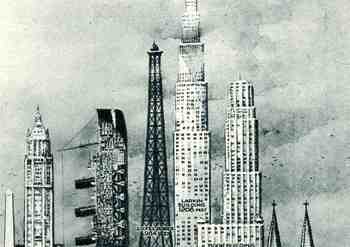
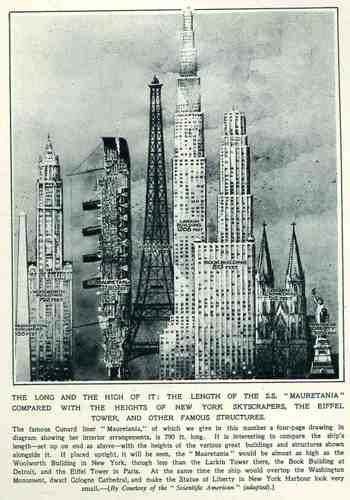
    This wonderful display (appearing in The Illustrated London News for 26 March 1927, page 518) of quantitative data isn’t quite as whimsical as it appears in detail, though I can think of onlyBlog1sept_16_ship_skyline_detail5_2
    a few (antiquarian) times that I have seen a ship made part of a cosmopolitan vertical cityscape.  It is a great way of comparing two disparate, out-of-place equals, and certainly can get the idea of the size of something as stand-alone and solitary as a great ship to children (and adults, too) by comparing it to something as obvious as a tall building.,  This time its really just comparing the length of the SS Mauretania with the heights of some famous and notable buildings. (The Mauretania, 1906-1935, was a fabled, luxurious and fast ocean liner of the Cunard line; it was refitted for a resurgent oceanic service at about this time.)   In the larger, expanded second image we see the Mauretania stacked up against (from left to right) the Washington Monument (555′), the Woolworth Building (792′), the Mauretania  (790′), the Eiffel Tower (984′), the Larkin Building (proposed at 1208′), the Book Building (873′), the Koln Cathedral (512′) and the Statue of Liberty (305′).  The Larkin Building (not the F.L. Wright structure of the same name) was a proposed super-tall of 110 floors for 330 W. 42nd Street that was proposed in 1926 and not canceled until 1930, and which would’ve been the tallest building in the world. (For an interesting site on the cancellation of tall buildings, see HERE.)   In any event, this was a big ship–the largest in the world when it was launched as a matter of fact–and the drawing is wonderful.   Upon closer inspection, there is a terrific amount of detail in the cross section of teh ship.)                                                   

    Blog1sept_16_ship_skyline564


  • About where the books and pamphlets I write about come from…

    JF Ptak Science Books LLC

    I’ve been asked a few times this week about the source of the materials that I write about.  The overwhelming majority of the books and pamphlets are right here, in my store or warehouse (see the above link for the science bookstore), so I see allot of this stuff everyday, currency of the realm and all that.  Most of the odd things that are found in my blog–flagpole painting, zipper repair, finding England in the Great Pyramid, building the Great Pyramid in Detroit, and so on) have come to me via the Library of Congress, where for many years I managed to purchase/trade for bits and pieces of their surplus.  One large purchase in particular from the LC–the 90,000-item “Pamphlet Collection–has provided thousands of the sublime mundane, naive surreal masterpieces that I’ve found so irresistible.  Most of this material hasn’t found a place in my store, which as you now know specializes in classics in modern physics and mathematics, but I do hope to be able to place them as a collection at some dim point in the future.  I would love to generate a few books out of them, and I think that a choice 500 of them or so would make a tremendous show somewhere (Brooklyn?) as a Found Art, Unexpected Dadaist, The Surprise of the Naive Surreal, show or some such thing, showing a marriage of design, outsider intellect and sublime mundane.   There are at the very least several thousands of these things from the Pamphlet Collection that are gorgeous and so unexpected, that are such intellectual (or non-intellectual) surprises, that they would (I think) make for a bang-up show. 

    And so that’s where these things come from.  They come to be posted by chance, generally because I bump into one of these things while looking for something else. 

    ·Posted by :

    ·in:


  • Dropping Boxes Filled With Soldiers: a Bad Technical Idea but a Great Strategic One, 1928

    JF Ptak Science Books, LLC Post 260

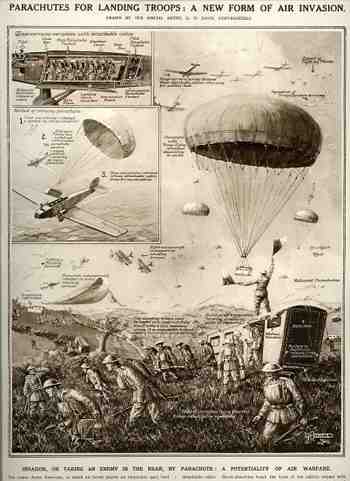
    This may not be the best idea I’ve seen–in principle this works fine for dropping tanks and other ordnance, but it seems to run against common sense when applied to delivering soldiers to a combat area.  This was of course just ten years after the end of WWI, which saw a spectacular increase in aircraft and aeronautical knowledge, and only 25 years after the Wright Brothers’ powered heavier than air flight at Kill Devil, so the lessons on paratrooping were just now being learned.  (By the way, what was the most significant militarily-based discovery in aviation between 1914-1918?  Could it have been the invention of the “barrel roll”, which instantly changed all concepts of aerial strategy?)                                                                                                    
    Blog1sept_15paratrooper553 Now what was going on in this display–appearing in the Illustrated London News on 8 September 1928–was the idea that a group of soldiers  (14 in this case) could be seated in a cushioned/springed box which would be parachuted onto a battlefield.  The idea of getting troops into a tight or difficult spot by a parachute is a very good one, a brilliant step forward really in the history of military strategy–but doing it in this fashion, by these means, was just not correct.  First of all the whole thing looks way too heavy for the aircraft to leave the ground to begin with, at least with those engines; then it looks too heavy for the chute to pull it out of the plane (and looks as though it would act as an airbrake more than anything else, as the chute seems to be gigantic, fully half the width of an already-wide aircraft. I reckon that given space for seven seated men that the cabin would have to be at least 25′ long, meaning that the parachute seems to be 10 cabin-widths in the larger image, or 250′ in diameter…in the smaller image the chute is only 4 times the length of the cabin or so, meaning it is a hundred feet across.).  The intention was for the chute to be deployed and for it to somehow lift the big box up and out of the plane, without dragging into or across the tail and etc. Then there’s the issue of landing, which, springs or shock absorbers or not, looks to be very problematical. 

    The technical part of the strategic idea just wasn’t going to work–the idea would, of course. 

    I should point out that this image was drawn by G.H. Davis, who made hundreds of images like this for the ILN over a four decade career–we’ll be seeing more of his work in the months to come.  Usually the work of Mr. Davis was spot-on, and he seemed to flourish in the “exploded view” and cut-away schematic.  This drawing was from the earliest part of his career, and I think he didn’t have much to work with–it seems an idea with a lot of leftover and abandoned Edwardian sensibilities.

    ·Posted by :

    ·in:

    — —

  • Unexpected Uses of Musical Instruments: War Headdress

    JF Ptak Science Books LLC Post 259

    Blog1sept_13_german544

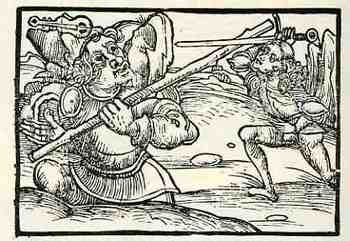
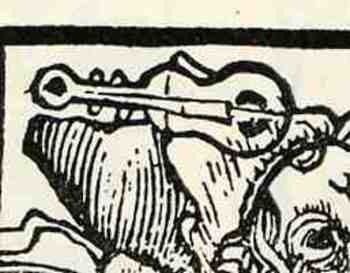
    I don’t mean this seriously, and I’m probably mucking around with a national treasure/iconic figure by even suggesting my flippant title, but I really would like to know what in the world this violin-cello or whatever it is is doing on the head of this figure? Probably ir is just artistic license, meaning that the large-staffed giant (?) would ultimately use music as a weapon (Amphion?); maybe, probably  not.  If anyone knows, I’d love to hear the answer.

    The source of this woodcut is the Heldenbuch, das Heldenbuch mit synen Figuren…, a towering work in the history of German ltierature (or at least early German literature)  printed by Heinrich Gran in Hagenau in 1509.  It is a collection of German epic poetry from the period of the Barbarian Invasions (more sweetly
    Blog1sept_13_german_det545_3
    referred to as the “Migration Period”, or Volkwanderung) ca. 300-700 ACE, and collected in the 13th century.  It is evidently a luxurious ride through German folklore and legend, with dragons, supernatural beasts, giants, scampering and clever warrior dwarfs, spectacular voyages to the East, shining moments of chivalry, and wide fairy lore.  So, if anyone knows the answer, would they please let me know about the very curious use of this musical instrument?


  • Just a Very Bad Idea: Toddler vs. Cactus, 1937

    JF Ptak Science Books LLC

    Blog1sept_12_cactus_baby543

    I know that this was supposed to be just a bit of sciencey/geekoid
    humor or attempt at it, but, really, the design for the cover of The Story of Cactus  (1937) is just
    plain stupid.  There’s another example of putting children in harm’s
    way for the sake of attracting attention to some sort of sales unit,
    but this one I think is worse in a category that is made up of things
    that are just “worse or worst”.  Just cringingly bad.  I guess some
    people might see it as “funny”, like some people will laugh at those
    captured videos on the television showing
    kids-doing-the-darndest-things and maybe getting getting hurt (as the
    audience churtles). Its just stupid.

    ·Posted by :

    ·in:


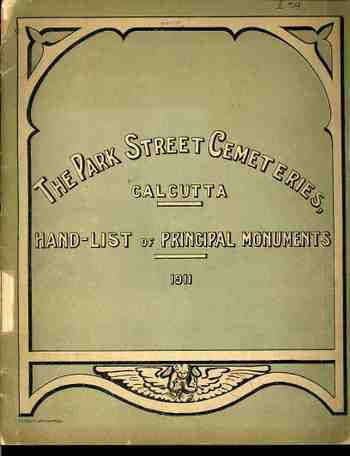
  • Imagined Neighborhoods of the Far-Away Dead: Park Street Cemetery, Calcutta

    JF Ptak Science Books LLC Post 257

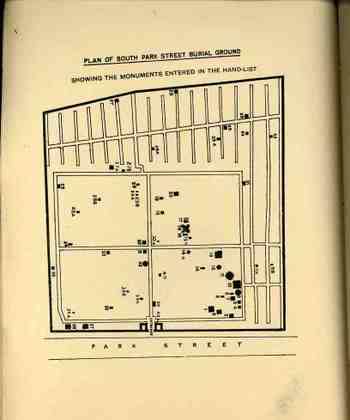
    Blog1sept_13_calcutta547
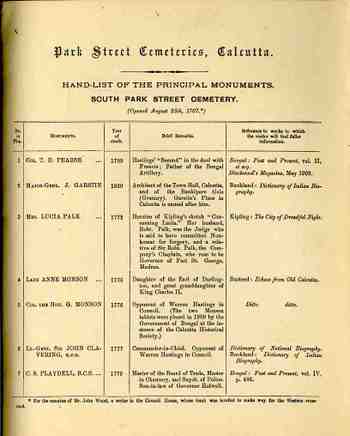
    I wonder what this cemetery looks like now, this colonial funiery landscape, all these British occupiers buried in their imagined death community? (Lord Curzon, for one, found it to be “the most pathetic site in Calcutta”, which in 1900 was saying allot According to the piece below from the Telegraph, Calcutta, things haven’t gotten much better.)  Is there any melancholy left for a place like this, filled with the British working class in the heart of Calcutta?  Perhaps they could never have imagined their Further India slip away on its own, and that they’d be buried in a so-incredibly foreign land?

    Seems like this would be ripe terrain for post modernists, having a go at the real and imaginary architecture of dead colonials in a post-colonial world, using a language that only the initiated can understand. (Constructing self-referential vocabularies with slippery exterior-to-the-argument reference points isn’t exactly the best way to get to a general discussion…nor doers it seem to be additive when the vocabulary has a life of its own.)

    (I had a little go at the post-modernists and constructed a little language generator here.)

    Blog1sept_13_calcutta_map548
    From The Telegraph, Calcutta,  16 September, 2007:

    South Park Street Cemetery

    “First stop: a grim place. But a haunting, beautiful place.
    Maintained
    by the Christian Burial Board, the South Park Steet Cemetery was
    founded on August 25, 1767. Henry Louis Vivian Derozio, William Jones,
    founder of Asiatic Society, John Hyde, a judge famous for his papers,
    are buried here, as is Rose Aylmer, the woman who inspired the poem of
    the same name by Walter Savage Landor. The tombs are in various stages
    of decay. The sight of the mossy tombstones, mostly imposing, some
    addressed to persons never known to history, as the headstone that says
    “here repose the earthly remains of James Miller”, in various stages of
    decay, but exuding serenity along the network of lichen-covered paths,
    brings soothing thoughts. If this is the end, it is not so bad. The
    caretaker is not very cooperative, though, and the place also invites
    criminal elements after the dark.

    But then visitors are not allowed.”

    Blog1sept_13_calcutta_map549_2


  • Freedom of Speech–a Bumpy Ride in 1919, and Some Good Thinking by Oliver Wendell Holmes jr.

    JF Ptak Science Books, LLC  Post 256


    Blog1sept_12_abrams_case542

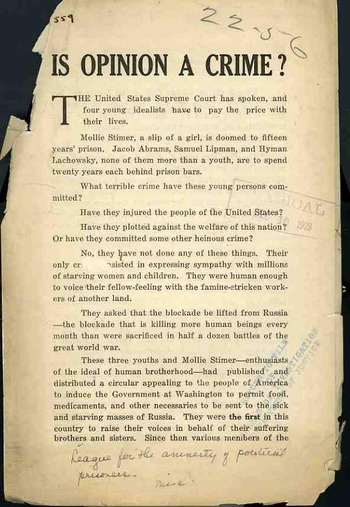
    The answer to the question of this pamphlet, Is Opinion a
    Crime
    (published by the League for the
    Amnesty of Political Prisoners, 1919), is “yes”, and yes by a 7-2 decision by
    the U.S. Supreme Court (in Abrams v United States  250 U.S. 616 (1919).  The case involved political speech which was
    deemed to be criminal act –rather than an expression of free speech guaranteed
    under the First Amendment—by violating the 18th amendment to the
    Espionage Act of 1917. Earlier in 1919  the court found again against the defendant in
    a similar case, Schenck v.

    United States

    , 249 U.S. 47 (1919), the majority opinion famously stated by Justice Oliver Wendell
    Holmes Jr.:

    “The question in every
    case is whether the words used are used in such circumstances and are of such a
    nature as to create a clear and present
    danger that they will bring about the substantive evils that the United States Congress has a right to
    prevent. It is a question of proximity and degree. When a nation is at war many things that
    might be said in time of peace  are such a hindrance to its effort that their utterance
    will not be endured so long as men fight, and that no Court could regard them
    as protected by any constitutional right….”


    It was in the Abrams case though that Holmes sided with Justice
    Louis Brandeis in ten minority opinion, siding with the defendants in this case
    who were distributing printed material which urged people not to support the
    American military—with the sole aim, really, of trying to get food to starving
    Russians. The case was brought against Mollie Stimer “a slip of a girl”, Jacob
    Abrams, Samuel Lipman, and Hyman Lachowsky, who dumped their leaflets from tall
    buildings, urging that people not support the  governments’
    decision to send troops to Europe to defend Czarist Russia against the
    Bolsheviks, and to allow the Russian revolution to proceed unhindered by
    American interests and allow “the people of Russia to pursue their own
    destinies. 

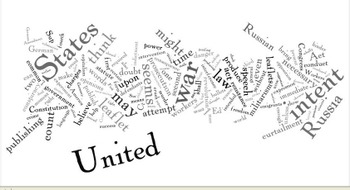
    Wordleabrams_case The Court found that
    the pamphlets were in violation of the Espionage Act and sentenced the four to
    between 15 and 20 years in jail. Holmes,
    in another landmark piece of judicial thinking, held that the defendants
    threatened no one and no thing, and should not have been found guilty. His contribution is reproduced in full in the
    continue reading section, with the content given its landscape by the good folks
    at Wordle.  (Click on the image to for a larger and clearer picture.)

    Incidentally this decision was overturned by Brandenburg v.
    Ohio
    (395 U.S. 444, 1969), in which the Court found that government cannot
    punish inflammatory speech unless it is directed to inciting and likely to incite
    imminent lawless action.—in this
    instance defending the 1st and 14th Amendment rights of a
    KKK spokesperson.

    ·Posted by :

    ·in:


  • Sterilization, Castration and the Road to Purity and Marriage Counseling (1939)

    JF Ptak Science Books LLC  Post 255
    Blog1sept_10_sterilization537
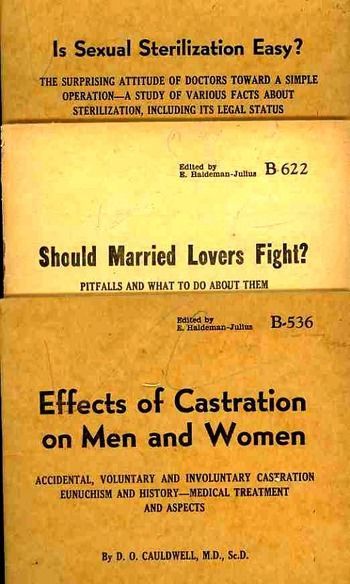
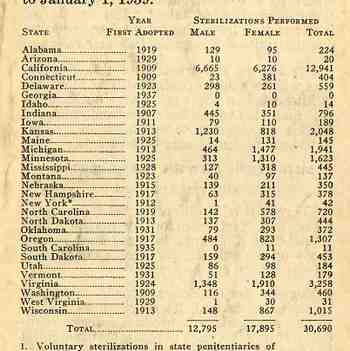
    The arithmetical purity of the eugenic response to social excellence was hardly “advanced” when the pamphlets appearing here were printed.   The flavor of  its mathematics, particularly in the nineteen ‘teens and ‘twenties, was watery and milky, and concerned itself pretty much with “pluses” and “minuses”, as in “as a social defective or prostitute” (um, yes, this is true, at least for California) “it is best for the societal gene pool if you just stayed out, on land”.  Vagrants, vagabonds, minor social criminals and “some poor”, could very well be placed in this category and subjected to forcible castration or sterilization. Mainly though  the  big legal guns of “human sterilization” were generally aimed at the truly vulnerable parts of society, the “insane and the feebleminded”.  The pamphlet Sterilization for Human Betterment, published by the Human Betterment Foundation (Pasadena, California),  states that 13,000 people in this category had been “asexualized” between 1909 and 1939 in California. (I should point out that California was the sterilization capital of the United States, with a third of all the national eugenics procedure performed in this state for this period of time) It defends this practice, saying emphatically that “eugenic sterilization is not an experiment”, and that “sterilization in this form represents one of the greatest advances in modern civilization”. 

    It continues:  “(sterilization) has been continuously used by American institutions since 1899, when the first sterilizations were performed in Indians”.  What?

    Blog1sept_10_sterilization538

    “Patients, relatives of patients, state officials, physicians,parole and probation officers, social workers, agree on the value of this practice” which was actually the “prevention of producing defective and handicapped children”.  I’m relieved that the probation officers were consulted.

    The Betterment people shed more light on the role of sterilization and sex offenses by women. (My bold.)  “Of 304 feebleminded girls sterilized and paroled, 9 out of every 12 had been sex offenders before commitment.  After sterilization, only one out of every 12 became a sex delinquent on parole”. 

    If this wasn’t such an awful story, “sex delinquent on parole”, a phrase I’ve never seen before, might make for a great 1950’s trashlit title. (It could’ve been a series, too:  all you need to do is take the title “Sex Delinquents on Parole” and add something to it, like “…on Parole from Outer Space” or “…on Parole:  Queenie the Slip Crown Breaks Her Knuckles” and so on.)

    The sorry story that I’ve interrupted with this bit of frivolity is that the “sex offenses” that are being discussed here is actually “prostitution”.  These young women weren’t committing violent acts of sexual savagery, they were just prostitutes, which meant that in most state they were “depraved”.  The “feebleminded” girls I would guess were poor or working poor, without the best education, and didn’t do well on whatever test was being administered to them to determine their test-taking intelligence. It seems to me that if  the goal was to liquidate prostitution that perhaps the men “seeing” these women should’ve been the ones faced with the operation. But that isn’t how the dominant culture viewed the situation, and that the best way to approach the problem was to remove the reproductive capacities from the weakest members of society.
    Blog1sept_10_sterilization539
    (Click on this table for a larger, clearer version of the number of forced sterilizations by state.)


    Germany;This pamphlet was the co-authored
    spawn of Paul Popenoe (1888-1979) and E.S. Gosney (1855-1942) while both were
    on the board of the Human Betterment group. In addition to a strict diet of
    superior morality and race,  Gosney seems
    to have been the money behind the organization. Popenoe had a background in
    agricultural genetics with an overdrive taste for eugenics and race, somehow
    intersecting them with social hygiene and marriage relations. The “dr.” that
    Popenoe loved to insist attaching to his name was an honorary, unearned degree,
    which he must have felt he needed in order to secure the proper amount of
    intellectual identification necessary to write on intellectual identification.
    The Nazis wasted little time in translating and publishing this work, adding it
    to their official publications list in 1939. It was one of a significant number of intellectual
    imports that came into poor, besotted Germany;
    the imports came nowhere
    close to the amount of information banished, exported to the necessarily
    beautiful non-Aryan non-Nazi inferno. It
    was just the sort of thinly distributed stain that interested people like the
    Nazis.

    I wonder what “Dr.” Popenoe thought of this Nazi honor?

    The second pamphlet by the same people, Human Sterilization Today,. is in a swift eight pages in which the Betterment Foundation makes it case to use sterilization to check “the misery spread through the community by the unchecked reproduction of the human unit” (italics mine)..  They are closing in on the Big Picture in this work, aiming at the 5,000,000 “who will be at some point committed to state hospital as insane” and the other 5,000,000 “who are so deficient intellectually (with less than 70% of average intelligence) as to be, in many cases, liabilities rather than assets to the race”.

    This is exhausting reading, but it is a story that shouldn’t be forgotten, and could remind us that what we’re doing or practicing today might look  like the Human Betterment stuff 25 years down the road. 

    What is also deeply unsettling about Popenoe is that from this vast miasmaic idea set of misguided and forced statistics, philosophical racial extremism, “social hygiene”, eugenic sterilization of the enfeebled and socially undesirable, he managed to create the very first marriage counseling service/practice in the United States.  The American Institute of Family Relations opened its doors in 1930 (in L.A.!) with this dizzying philosophical semi-brew of sterilization and marriage talk-therapy, happily correlating the whole thing with exploding axis of divorce, love, social failure, racial impurity and castration.  And somehow it all seemed to make sense to allot of people, back there in the past. 
    ·Posted by :

    ·in:


  • Wordle Word Art: Einstein 1920 and Poincare 1905, Side by Side–Looking at Two Disparate Approaches to Relativity

    JF Ptak Science Books LLC  Post 254

    Okay, okay–this is definitely apples and oranges here, but it is interesting nevertheless, even if I can’t reference the apple and the orange to something that would make sense for both, for something that has shared grounds of commonality.   What we have here is the Wordle version of Henri Poincare’s The Principles of Mathematical Physics (1905,and which I wrote about a little here accompanied by the paper’s full text), which was his quai-popular attempt at explaining a modified version of what some people call his “relativity” paper of 1904 (On the Dynamics of the Electron, which appeared in the Comptes rednus):

    Wordle_poincare

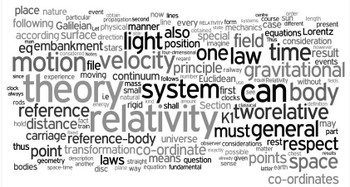
    View this (“contrast” being too hard, too unwieldy, too problematic) along with Einstein’s 1920 Relativity:  the Special and theGeneral Theory, the book in which he makes a full frontal assault of a popular explanation of his special (1905) and general 1915/16) theories of relativity:

    Wordle_einstein_relativity_1920

    Very little in common, no?  It really is just an interesting set of images, really; I’d hate to think of this as anything approaching content analysis or anything besides this that might look like a “serious” attempt at comparing the two.  I think of them in very simple terms, these two Wordscapes–like looking at two rivers, the one meanderingly serene, while the other looks more contentious, robust, challenging.  At the end of it all the robust Einstein river, unlike the beautiful if not sanguine Poincare river, rushes towards a Niagra; the Poincare, not. 

    ·Posted by :

    ·in:

    —