A Daily History of Holes, Dots, Lines, Science, History, Math, Physics, Art, the Unintentional Absurd, Architecture, Maps, Data Visualization, Blank and Missing Things, and so on. |1.6 million words, 7500 images, 4.9 million hits| Press & appearances in The Times, Le Figaro, Mensa, The Economist, The Guardian, Discovery News, Slate, Le Monde, Sci American Blogs, Le Pont, and many other places… 5000+ total posts since 2008.

Author: JF Ptak

  • Wordle Word Art–Vocabulary from our Atomic Bomb Chronology

    JF Ptak Science Books LLC

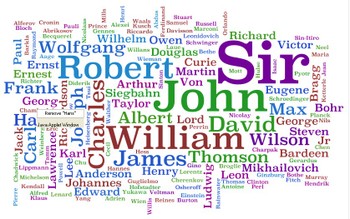
    This is the newest installment of Found Word Art engineered by the good folks at WORDLE.:  this iteration uses the text block from my page on the chronology of the creation of the atomic bomb, with the entire thing dumped into the Wordle wonder-engine which produced this piece of art.  I should point out that the size of the word refers to relative appearances of the word in the post. 

    If you click on the image it will get larger and clearer.
    Wordleatomic_bomb_cchronology

    ·Posted by :

    ·in:

    — —

  • Wordle Word Art–Vocabulary from our Nobel Prize in Physics Chronology

    JF Ptak Science Books LLC

    This is the newest piece of sub-art that was produced via the good folks at WORDLE :  namely, it represents the dominant occurrence of a word in a text block on my page of winners of the Nobel Prise in physics via the its size in the one-page WORDLE summary, producing a pretty enjoyable and wholesome (!) bit of art.  It also reveals some interesting pieces of info, like, the most common first names of all of the physicists awarded the Nobel prize (for physics).  There are some little surprises here and there; mainly though its a nice thing to look at. 

    If you click on the image it gets bigger and sharper. 

    Wordlenobel_physics

    ·Posted by :

    ·in:

    —

  • Wordle Word Map of this Blog’s Titles

    How cool is this?  This is a wordle extravaganza applied to the page listing all of the titles in this blog:  about 242 post titles of about 1500 words.

    Check out your own stuff at Wordle.net

    Wordle_titles

    ·Posted by :

    ·in:


  • Palpable Arithmetic: Feeling and Seeing Representations of Numbers

    JF Ptak Science Books LLC  Post 242

    Blog1sept_6_palpable_det516_2”
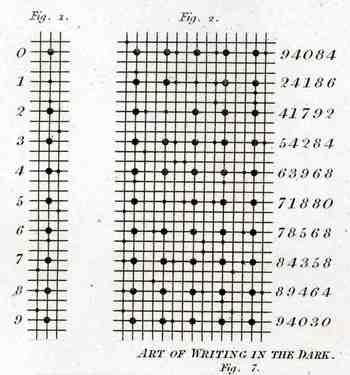
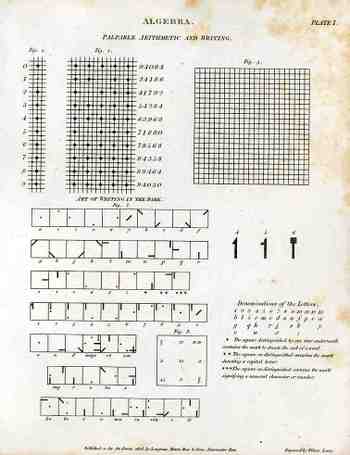
    Palpable Arithmetic”, the sub-heading for the sheet illustrating aspects of algebra for Abraham Rees’ (1743-1825) great if not problematic 45-volume Cyclopedia, is a system that  records and organizes and sometimes calculates using three dimensional objects.

    For example the Egyptians (for one) calculated with pebbles; then there was the ABAX of the Greeks, and the abacus (and also called the mensa Pythagoras) of the Romans (and of the Japanese and earlier still of the Chinese), the scaccarium of the English (via the Norman conquest), and innumerable other systems that performed arithmetic and recording and
    archiving functions via the employment of reeds, notches on a tree or cloth or stick (etc.), reeds, knots, fingers, beans,shells, string, sand, and on and on.  Palpable arithmetic also has a specialized meaning in places as a calculating device in which the numbers are recognized by touch and used by blind mathematicians or other parishioners. (Just for the record, there are a number of eminent blind  mathematicians including, for example,  Leonard Euler (1707–1783, who was blind in the last 17 years of his life), Nicholas Saunderson (who I wrote about in an earlier post), Louis Antoine (1888-1971), Lev Pontryagin (1908-1988.)) 

    An interesting and very large philosophical issue that comes up here with the blind mathemaitican is the concept of image formation and its dependence upon sight for intuition, as with geometry or topology.    Plato for one determined for himself that image formation issues were precognate and the same in sight and non sighted people.  How would you manipulate a geometrical form if you’ve never actually seen one, or how would you extend you spatial imagination of compex forms without a reference? 

    But my main issue here is the image from the hees book.  I’m by the meaning of this particular calculator or recording system–I just can’t tell what it is.  Can you?  If so I’d love to hear from you.

    Note on the Anthropology of Numbers:

    From Levi Leonard Conant’s The Number Concept Its Origin and Development we find these very descriptive definitions of words for numbers, all of which relate to the sort of implement that they were controlling
    their numbers with, or calculating:

    “in Javanese, Malay, and Manadu, the words for 1, which are respectively
    siji, satu, and sabuah, signify 1 seed, 1 pebble, and 1 fruit
    respectively. Words as natural and as much to be expected at the
    beginning of a number scale as any finger name could possibly be. Among
    almost all…the derivation of number words from these sources can constitute no ground
    for surprise. The Marquesan word for 4 is pona, knot, from the practice
    of tying breadfruit in knots of 4. The Maori 10 is tekau, bunch, or
    parcel, from the counting of yams and fish by parcels of 10. The
    Javanese call 25, lawe, a thread, or string; 50, ekat, a skein of
    thread; 400, samas, a bit of gold; 800, domas, 2 bits of gold.The
    Macassar and Butong term for 100 is bilangan, 1 tale or reckoning…”

    The full sheet from the Rees book:

    Blog1sept_6_palpable514_2

    ·Posted by :

    ·in:


  • Inventions Ill-Advised: Bicycle Malapropisms in Edwardian England, 1901-1906

    JF Ptak Science Books LLC  Post 241

    Blogcircus_bike
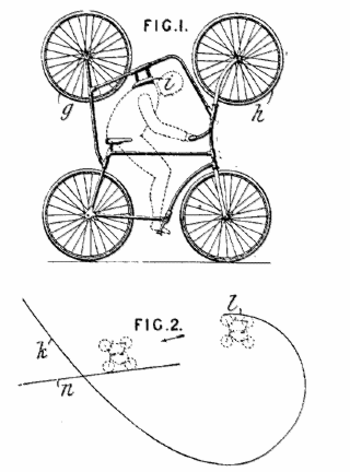
    I know that this invention by Karl Lange (1904, left) may or may ever come in “handy”,
    but, well if you were a circus performer it might be another story. The whole thing looks so improbably
    heavy  and unwieldy to me that it couldn’t possibly be of any use, though it is a
    thing of beauty. All one really needs to complete this picture is another rider seated on the inverted bike waiting for their turn.

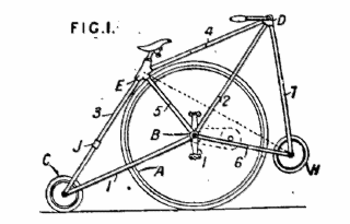
    Marshall Rigby’s
    machine (1901, below right) looks more like a geometry problem than anything else, but
    really intended to make the not-so-early-by-any-means larger-wheel velocipede
    easier to get on and get off. Why bother
    keeping the big middle wheel is anyone’s guess.
    Blogbikerigby

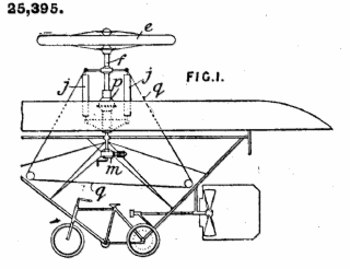
    Frederick Simms’s (1906, below left) bike-powered bike-opter doesn’t look like it could
    move forward let alone fly.

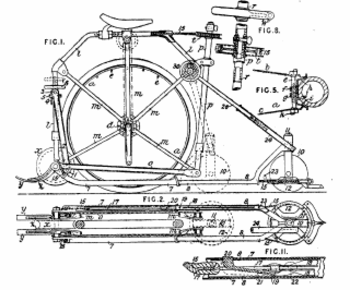
    Sayer’s “Improved Cycle Or Other Vehicle” (1905, below right) has a
    telescoping wheelbase and seat, and has brakes that can be adjusted so that
    they are automatically applied “at a predetermined inclination in the road”. It also has wheels “that may be readily
    adapted to rails”, though what rails and to where those rails might be going is
    again a mystery. Also a mystery here is how power is transmitted—I can’t tell
    how the thing is made to go, though it is a pretty drawing.
    Blogbikesimms

    Blogbikesayer

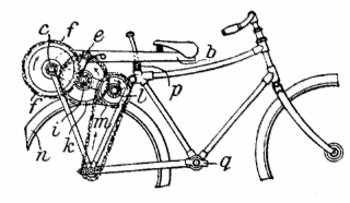
    Lastly for tonight is the bouncing bike of Herr Adolf Ernst Anton Mueller (1902, below),
    who came up with the idea of powering a bike from the “up and down motion” of
    the rider’s weight, thus doing away with pedal. He doesn’t provide a rest for the feet, which might make the bouncing a
    little difficult. Also, Lt. Mueller was writing from the
    Military Barracks of Grandenz (Germany)
    and was an officer in the Kulmer Infantry regiment, making me wonder if he was
    thinking in terms of regimental displays of bouncing German soldiers on bikes…

    Blogbikemueller

    Abstracts for the British patents mentioned above (from the British Patent Office), in their original format, retaining all of the juices and flavors of Edwardian engineerese:

    Lange, K. April 15, 1904.  Bicycles
    adapted for use by gymnasts and acrobats. -A cycle for use in performing the
    feat of looping the loop in circuses &c., on the mutilated loop k, l, n,
    has a second cycle attached above the rider’s head, which enables him, on
    leaving the part l, to complete the journey, head downwards, on the upper
    wheels g, h. The upper cycle may have more than two wheels, and other padding
    besides the cushion i.

    19018038. Rigby, M. April 19. Unicycles; safety wheels and supports;
    steering- mechanism; driving-mechanism; frames.-A unicycle comprises a large
    wheel A carrying on, or connected to, its axle B a frame consisting of forked
    members 1, 2, 3, 5, 6, 7 and a single member 4 arrange:! as shown. A socket E
    connecting the members 3, 4, and 5 carries the saddle-pin. Safety-wheels C and
    H, one of which may be replaced by a pair, support the rider when at rest or when
    steering. The wheels C and H may be mounted in pivoted forks which are actuated
    by a spring so as to keep the wheels in line. Rigid handles D enable the cycle
    to be steered when the wheel H is in contact with the ground, but, if desired,
    the wheel H may be mounted in a steering-post actuated by pivoted handles. The
    wheel A may be driven either by simple cranks, as shown, or by suitable
    treadle, crypto, or chain gearing. Either of the members 5, 6 may ba replaced
    by a member connected to the socket E and the axle of the wheel H. A bridge J
    serves as a step in mounting.

    25,395. Simms, F. R. Dec. 6. Gyroscopic apparatus.-For driving a gyroscopic
    wheel e on an aerial machine by a motor m in such a manner that the aeronaut
    can vary its inclination by pulling cords q, the driving-shaft f is made in two
    lengths connected by a ball-and-socket joint p. The two lengths are pressed
    together by springs j with sufficient force to cause the rotation of the motor
    to be transmitted to the wheel by the friction of the joint.

    18,699. Sayer, R. C. Sept. 16. Motor road vehicles; locomotive tramway
    vehicles. -Relates to a cycle or vehicle which has a variable wheel base,
    brakes automatically applied at a predetermined inclination of the road, and
    wheels that may be readily adapted for running on rails. The frame comprises
    struts m, radiating from the axis of the wheel a, tubes l, rods o, and a forked
    tube p. The steering-wheel 10 is mounted in a fork the stem 11 of which is
    fitted in a socket on the ends of the members 8 of the telescopic parts 7, 8 of
    the frame (and on and on)

    26,453. Mueller, A. E. A. Dec. 3. Body motion, propelling by.-The rider
    stands upon the foot-rests q, and, by the weight of his body, depresses the
    saddle, which is attached to a lever b, pivoted at its end c to the frame. The
    downward movement of the lever b causes a spring pawl e to actuate a
    ratchet-wheel f. The motion of the ratchet – wheel is communicated through wheels
    i, k, l to the chain-wheel m and thence to the hind wheel n, so that the
    bicycle is propelled forwards. The pressure on the saddle is then released, and
    the saddle is restored to its normal position by a spring p, when the cycle of
    operations is repeated.

    ·Posted by :

    ·in:

    — —

  • Roosevelt, Extermination and the Holocaust, 1942: the Only White House Meeting Between FDR and Jewish Leaders During WWII

    JF Ptak Science Books LLC   Post 240
    Blogsept5_memorandum_1494_2
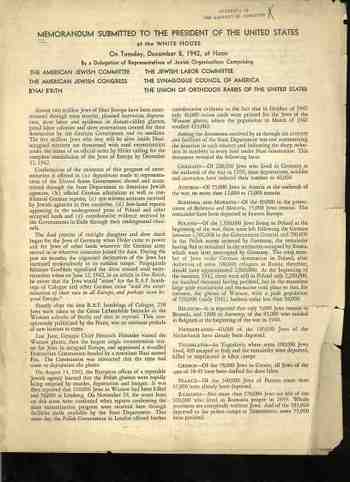
    I’ve reprinted this short, four-page pamphlet on the results of a meeting between President Franklin Roosevelt and a number of eminent leaders of American Jewish organizations that took place at the White House on 8 December 1942. (See the CONTINUED READING section below for the full document.) (These groups included American Jewish Committee, the American Jewish Congress, B’Nai B’Rith, the Jewish Labor Committee, the Synagogue Council of America, and the Union of Orthodox Rabbis of the United States.)  The pamphlet itself came to me in a very large acquisition I made from the Library of Congress, and it had come to the Library from the Yiddish Scientific Institute (NYC) in May 1943.  There are no indications of who printed the document.   Communication with the still-extant Yiddish Scientific Institute has revealed that there are unpublished files concerning this meeting but that there are no published documents regarding it.   
    This is evidently the only time that Roosevelt met with Jewish leaders to discuss the extermination of the Jewish people.  The pamphlet is entitled Memorandum Submitted to the President of the United States at the White House, on Tuesday, December 8, 1942, at Noon.  By a Delegation of Representatives of  Jewish Organizations…
    The publication gets right to the point, instantly, in the first paragraph, leaving nothing to chance:

    “Almost two million Jews of Nazi Europe have been exterminated through mass murder, planned starvation, deportation, slave labor and epidemic in disease-ridden ghettos, penal labor colonies and slave reservations created for their destruction…The five million Jews who may still be alive inside Nazi-occupied territory are threatened with total extermination under the terms of an order from Hitler calling for the complete annihilation of the Jews of Europe by December 31, 1942”

    The document discusses slave labor and—in quite some detail—“Hitler’s extermination camps”, “caravans of death”, “extermination centres”, massacres”, “slow death”, and “religious persecution”.

    This all reminds us of the pretty deep understanding of what was going on with the Jewish people, even in 1942.

    The last sentences of the last paragraph:

    “….Germany will go down in utter defeat. But the Jews of Europe, whom Hitler has marked out as the first to suffer utter extinction, have no assurance at present that a United Nations victory will come in time to save them from complete annihilation”.
    I cannot find the entire text of this document online.
    I’ve reprint it below in the CONTINUED READING section.

    The following LONG EXTRACT is very good and taken in toto from the Virtual Jewish Library (I’d include the link but this is no longer allowed on ebay)

    Report On Meeting of Jewish Leaders with Roosevelt
    (December 8, 1942)

    After the State Department confirmed reports that Hitler was planning to murder all the Jews in territories under German control, several American Jewish leaders including Rabbi Stephen Wise managed to arrange an audience with President Roosevelt. At this 29-minute meeting, the only one FDR had with Jewish leaders about the Holocaust, the President was presented with a document outlining the Nazi plan to annihilate European Jews. Adolph Held, the president of the American Jewish Labor Committee, wrote this report of the meeting, which indicates the president was acquainted with details of the atrocities being committed by the Nazis.

    The committee consisted of Rabbi Stephen S. Wise, of the Jewish Congress; Mr. Monsky, of Bnai Brith; Rabbi Rosenberg, of the Agudath, and Adolph Held, of the Jewish Labor Committee.
    The meeting with the President was arranged for Tuesday, December 8, 1942, at 12 o’clock. We were originally notified that the President would give us 15 minutes, but the conference lasted 29 minutes. The purpose of the conference was to present a prepared memorandum on the German atrocities in Poland consisting of an appeal to the President for immediate action against the German extermination of Jews, and also a 12 page memorandum citing the facts that have been gathered on this subject.
    We were taken into the President’s office in the White House by General Watson, the President’s personal military aide, exactly at 12 o’clock. The President was seated at his desk; in front of the desk were lined up five chairs for the delegation.
    The President sat behind the desk smoking a cigarette in a long cigarette-holder. The desk was full of all sorts of trinkets–ash trays, brass and porcelain figures, etc. There was not an empty spot on his desk. The figures were of all shapes and sizes.

    As we filed in, the President greeted Rabbi Wise: “How have you been, Stephen? You are looking well. Glad to see you looking well.” Rabbi Wise then introduced each of us separately. The President shook hands with each of us, repeated the name, and then asked: “How do you do, Mr. Monsky?,” etc., following which he asked us to sit down.

    When we were seated, the President opened the conversation by saying: “I am a sadist, a man of extreme sadistic tendencies. When I appointed Governor Lehman as head of the new Office of Relief and Rehabilitation, I had some very sadistic thoughts in my head. I know that Governor Lehman is a great administrator, and I wanted a great administrator for this post. I had another thought in my mind, however. I had hopes that, when God spares my life and the war is over, to be able to go to Germany, stand behind a curtain and have the sadistic satisfaction of seeing some “Junkers” on their knees, asking Lehman for bread. And, by God, I’ll urge him to give it to them.”

    Rabbi Wise then said: “Mr. President, we have an orthodox Rabbi in our midst. It is customary for an orthodox rabbi to deliver a benediction upon the head of his country, when he comes in his presence. Will you, therefore, permit rabbi Rosenberg to say the prayer of benediction?”

    “Certainly” the President answered.
    Rabbi Rosenberg rose and put on his scull-cap. We all rose. The President remained seated, and, as Rabbi Rosenberg commenced to recite the prayer in Hebrew, the President bowed his head.
    “O, God Lord of Kings, blessed be Thy name that Thou bestowest a share of Thy glory upon the son of men.”
    “Thank you very much”– the President said.
    The President seemed to be moved, and so were we all.
    Rabbi Wise then read the declaration by the committee.

    Rabbi Wise did not read the details but simply said: “Mr. President, we also beg to submit details and proofs of the horrible facts. We appeal to you, as head of our government, to do all in your power to bring this to the attention of the world and to do all in your power to make an effort to stop it.”

    The President replied: “The government of the United States is very well acquainted with most of the facts you are now bringing to our attention. Unfortunately we have received confirmation from many sources. Representatives of the United States government in Switzerland and other neutral countries have given up proof that confirm the horrors discussed by you. We cannot treat these matters in normal ways. We are dealing with an insane man– Hitler, and the group that surrounds him represent an example of a national psychopathic case. We cannot act toward them by normal means. That is why the problem is very difficult. At the same time it is not in the best interest of the Allied cause to make it appear that the entire German people are murderers or are in agreement with what Hitler is doing. There must be in Germany elements, now thoroughly subdued, but who at the proper time will, I am sure, rise, and protest against the atrocities, against the whole Hitler system. It is too early to make pronouncements such as President Wilson made, may they even be very useful. As to your proposal, I shall certainly be glad to issue another statement, such as you request.”
    The President turned toward the delegation for suggestions. All, except Rabbi Rosenberg, put in suggestions. Mine was about the possibility of getting some of the neutral representatives in Germany to intercede in behalf of the Jews. The President took notice of that but made no direct replies to the suggestions. The entire conversation on the part of the delegation lasted only a minute or two. As a matter of fact, of the 29 minutes spent with the President, he addressed the delegation for 23 minutes.

    The President then plunged into a discussion of other matters. “We had a Jewish problem in North Africa” — he said. “As you know, we issued orders to free all the Jews from concentration camps, and we have also advised our representatives in North Africa to abolish all the special laws against the Jews and to restore the Jews to their rights. On this occasion I would like to mention that it has been called to our attention that prior to the war, Jews and Frenchmen enjoyed greater rights than Moslems in some of the North African states. There are 17 million Moslems in North Africa, and there is no reason why anyone should enjoy greater rights than they. It is not our purpose to fight for greater rights for anyone at the expense of another group. We are for the freedom for all and equal rights for all. We consider the attack on the Jews in Germany, in Poland, as an attack upon our ideas of freedom and justice, and that is why we oppose it so vehemently.” “Now you are interested in the Darlan matter. I can only illustrate this by a proverb, I recently heard from a Yugoslav priest–“When a river you reach and the devil you meet, with the devil do not quarrel until the bridge you cross.”

    Apparently, at the end of this quotation the President must have pushed some secret button, and his adjutant appeared in the room. His eyes and broad shoulders showed determination. We rose from our seats, and, as we stood up, the President said: “Gentlemen, you can prepare the statement. I am sure that you will put the words into it that express my thoughts. I leave it entirely to you. You may quote from my statement to the Mass -Meeting in Madison Square Garden some months ago, but please quote it exactly. We shall do all in our power to be of service to your people in this tragic moment.”

    The President then shook hands with each of us, and we filed out of the room.

    ·Posted by :

    ·in:


  • Popular Books on the History of Science–a Discussion on a Reading List

    JF Ptak Science Books LLC Post 239

    Here’s a list of books and a challenge to think about from Cocktail Party Physics by Jennifer Ouelette  It’s a good solid list of popular (save for
    the first two milestones) books in the history of science (mostly physics). Looks like I’ve read only a third of them—some
    just aren’t up my alley.

    So if any out there would like to participate, please do, and send back a
    link to your comments.

    Instructions:

    1. Highlight THE NUMBER  those you’ve read in full–comment if you’d like.
    2. Asterisk those you intend to read
    3. Add any additional popular science books you think belong on the list
    4. Link back to me (leave links or suggested additions in the comments, if you
    prefer) so I can keep track of everyone’s additions. Then we can compile it all
    into one giant “Top 100” popular science books list, with room for
    honorable mentions. (I, for one, have some quirky choices in the list below.) Voila!
    We’ll have awesome resource for general readers interested in delving into the
    fascinating world of science!

    Before I get to the CPP list, I’d like to suggest a few odd books that I quite like and don’t seem to see very often:

    A. Defining the Wind. Scott Huler.
    B.  Buried Alive, the Terrifying History of Our Most Primal Fear. Jan Bondeson.
    C.  A Social History of Madness, the World Through the Eyes of the Insane.  Roy Porter.
    D. Wanderlust, a History of Walking.  Rebecca Solnit.
    E.  The Strange Story of False Teeth. John Woodforde.
    F  Traces on the Rhodian Shore.  Clarence Glacken. 
    G.  Human Dissection, its Drama and Struggle.  A.M. Lassek
    H.  A History of Reading.
    I.  A History of Bombing.  Sven Lindqvist.
    J. The Elizabethan Zoo, a Book of Beasts Fabulous and authentic.

    There is above all the lovely work of Arthur I. Miller, who with Abraham Pais are my favorite semi-popular writers on the history of science. His works include:  Empire of the Stars: Friendship, Obsession and Betrayal in the Quest for Black Holes (Little Brown, UK edition; Houghton Mifflin, USA edition, 2005); Einstein and Picasso: Space, Time and the Beauty that Causes Havoc (Perseus Books, 2001). Nominated for the Pulitzer Prize; ***Insights of Genius: Imagery and Creativity in Science and Art (Springer-Verlag, 1996 cloth, MIT Press, 2000 paperback). Albert Einstein’s Special Theory of Relativity: Emergence (1905) and Early Interpretation (1905-1911) (Addison Wesley, 1981: new edition SpringerVerlag, 1998); ***Imagery in Scientific Thought: Creating 20th-Century Physics (Birkhäuser, 1984; MIT Press, 1986; reprinted 2003, Dover Publications) Frontiers of Physics: 1900-1911 (Birkhäuser, 1986); *Early Quantum Electrodynamics: A Source Book (Cambridge University Press, 1994) Editor, *Sixty-Two Years of Uncertainty: Historical, Philosophical and Physical Inquiries into the Foundations of Quantum Mechanics (Plenum Press, 1990)

    Lastly, before we get to Jennifer’s list, I must point out the work of archaeo-imagist Barabara Maria Stafford (U Chic) who has produced:  Symbol and Myth:
    Humbert de Superville’s Essay on Absolute signs in Art
    . Associated University Presses, 1979; Voyage into
    Substance
    : Art, Science, Nature and the Illustrated Travel Account,
    1760-1840
    .
    Cambridge, Mass: MIT Press, 1984;Body Criticism:
    Imaging the Unseen in Enlightenment Art and Medicine
    .
    Cambridge, MIT Press, 1991; Artful Science:
    Enlightenment, Entertainment and the Eclipse of Visual Education
    .
    Cambridge MIT Press, 1994; Good Looking:
    Essays on the Virtue of Images
    .
    Cambridge:
    The MIT Press, 1996; Visual Analogy:
    Consciousness as the Art of Connecting
    . Cambridge, MA: The MIT
    Press, 1999; Devices of Wonder:
    From the World in a Box to Images on a Screen
    , (coauthor:
    Frances Terpak) Catalog for an exhibition held at The Getty Research Institute
    for the History of Art and the Humanities, November 13, 2001 to February 6,
    2002. (Getty Research Institute, 2001); Echo Objects: The
    Cognitive Work of Images
    .
    Chicago,University of ChicagoPress, 2007.  They are luscious books and filled with extremely uncommon images. 

    And now the Cocktail Party Physics List.  (Thanks Jennifer!) 

    1. Micrographia, Robert Hooke [I’ve looked at the pretty pictures,
    but that’s not exactly “reading”] DITTO—the pictures were basically
    from outer space to the 17th century reader. Phenomenal.

    2. *The Origin of the Species,
    Charles Darwin
    3. Never at Rest,
    Richard
    Westfall

    4. Surely You’re Joking, Mr.
    Feynman
    , Richard Feynman. What we need is a stellar intellectual
    biography of the man… And also of Johnny
    von Neumann,m btw

    5. Tesla: Man Out of Time, Margaret Cheney—read a
    little, didn’t much like…

    6. The Devil’s Doctor, Philip Ball
    7. The Making of the Atomic Bomb,
    Richard Rhodes—Terrific accomplishment
    8. Lonely Hearts of the Cosmos, Dennis Overbye
    9. *Physics for Entertainment, Yakov Perelman
    10. 1-2-3 Infinity, George
    Gamow—Read this a long time ago, very subtle.
    11. The Elegant Universe,
    Brian
    Greene

    12. Warmth Disperses, Time Passes, Hans Christian von Bayer
    13. Alicein Quantumland, Robert Gilmore
    14. Where Does the Weirdness Go? David Lindley
    15. *A Short History of Nearly Everything, Bill Bryso
    16. A Force of Nature,
    Richard
    Rhodes

    17. Black Holes and Time
    Warps
    , Kip Thorne
    18. A Brief History of Time,
    Stephen
    Hawking

    19. Universal Foam,
    Sidney
    Perkowitz

    20. Vermeer’s Camera, Philip Steadman I kinda don’t like following this discussion on the use of the camera
    obscura by the greats. As my brilliant,
    very published wife has said, “so what?”

    21. The Code Book,
    Simon
    Singh.
    Okay book.

    22. The Elements of Murder, John Emsley
    23. *Soul Made Flesh, Carl Zimmer
    24. Time’s Arrow,
    Martin
    Amis
    Enjoyed this as the first to
    the trough.

    25. The Ten Most Beautiful Experiments, George Johnson
    26. Einstein’s Dreams, Alan Lightman
    27. *Godel, Escher, Bach,
    Douglas Hofstadter. Smarty pants.
    28. The Curious Life of
    Robert Hooke
    , Lisa Jardine Enjoyed this tremendously; maed me appreciate Sir Isaac ever more.
    29. A Matter of Degrees, Gino Segre
    30. The Physics of Star Trek, Lawrence Krauss Glad he did it; don’t wanna read it. Would be fun to teach it.
    31. E=mc<2>, David Bodanis
    32. Zero: The Biography of a Dangerous Idea, Charles Seife
    33. *Absolute Zero: The Conquest of Cold, Tom Shachtman
    34. A Madman Dreams of Turing Machines, Janna Levin
    35. Warped Passages, Lisa Randall
    36. *Apollo’s Fire, Michael Sims
    37. Flatland,
    Edward
    Abbott
    . Read it every ten years.

    38. Fermat’s Last Theorem,
    Amir Aczel
    39. Stiff, Mary Roach Wish I
    wrote it.

    40. Astroturf, M.G. Lord
    41. The Periodic Table, Primo Levi
    42. Longitude,
    Dava
    Sobel

    43. The First Three Minutes,
    Steven Weinberg
    44. The Mummy Congress, Heather Pringle
    45. The Accelerating Universe, Mario Livio
    *46. Math and the Mona Lisa, Bulent Atalay
    47. *This is Your Brain on Music, Daniel Levitin
    48. The Executioner’s Current, Richard Moran
    49. Krakatoa, Simon Winchester
    50. *Pythagorus’ Trousers, Margaret Wertheim
    51. Neuromancer,
    William
    Gibson

    *52. The Physics of Superheroes, James Kakalios
    53. Broad StreetThe Strange Case of the Pump, Sandra Hempel
    54. Another Day in the Frontal Lobe, Katrina Firlik
    55. Einstein’s Clocks and
    Poincare’s Maps
    , Peter Galison Like
    Gallison’s works allot.
    56. The Demon-Haunted World, Carl Sagan
    57. The Blind Watchmaker, Richard Dawkins
    58. The Language Instinct,
    Steven Pinker. He’s reading inAsheville in a few days
    and hope to hear him.

    59. An Instance of the
    Fingerpost
    , Iain Pears
    60. Consilience, E.O. Wilson
    61. Wonderful Life, Stephen
    J. Gould
    62. Teaching a Stone to Talk, Annie Dillard
    63. Fire in the Brain, Ronald K. Siegel
    64. The Life of a Cell, Lewis Thomas
    65. Coming of Age in the Milky Way, Timothy Ferris
    66. Storm World, Chris Mooney
    67. The Carbon Age, Eric Roston
    68. The Black Hole Wars, Leonard Susskind
    69.Copenhagen, Michael Frayn
    70. From the Earth to the
    Moon
    , Jules Verne
    71. Gut Symmetries, Jeanette Winterson
    72. Chaos, James Gleick
    73. *Innumeracy, John Allen Paulos
    74. The Physics of NASCAR, Diandra Leslie-Pelecky
    75. Subtle is the Lord,
    Abraham Pais. One of my favorite “popular” books on Einstein’s intellectual history. Inward Bound is another terrific work by Pais
    on modern phys
    . Also his Einstein Lived Here is excellent.

    Just for the record–for me–the best biography of a Manhattan Project member is Kai Bird’s Oppenheimer. 

    ·Posted by :

    ·in:


  • Inventions, Wrongly Inspired: the Game of Death, the Game of Life, and the Game of Life & Death

    JF Ptak Science Books LLC  Post 238

    Like everyone else, I’ve played the fine Milton Bradley board game Life, piling in blue kids and pink kids, getting a house and a mortgage, sweeping the family over plastic hills and Prussian blue waters (well, not really), all in the one-way race to the big white plastic house at Millionaire Acres.  There was make-believe Graves_gamecash,a fun spinning device that made a cool plastic-y noise, and of course the vaguely 1960 Lincolnesque convertible car with six holes in it.  It was fun and almost never provoked a fight.
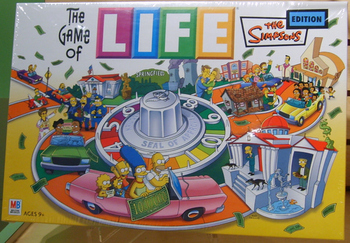
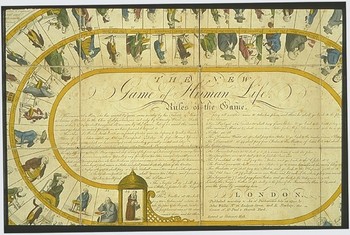
    There’s also the 18th century precursor (shown below) to the Milton Bradley game (which actually first appeared in a  rudimentary form in 1860), which was a more subtle form of the progress of life, taking us from baby to bones. On a completely different plane there is the great John Conway’s (ca. 1970) AI/cellular automata Game of Life; and on still another, different level is the semi-evolutionary mega-life mega-death game by Sims creator Will Wright, called Spore.

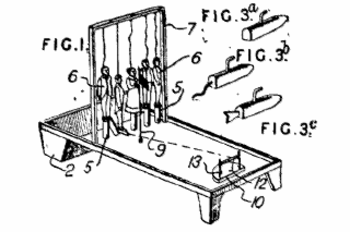
    Different from all of the entries above though is  this sweet toxicity of an invention by Eugene Edwin Graves and William Edwin Brown (called, simply, incongruously, Graves and Browns Improved Game), which was patented in 1902.  It was really a Hang ’em Higher game, with players shooting a marble or other projectile from one end of the playing field to the other, with the intent of knocking the stool out  from under the condemned person’s feet, who stand there with their head in a noose, a marble away from infinity,  awaiting their just reward to be delivered by children..  I’m not a gaming expert, but I imagine that the genre of games calling for children to hang condemned criminals would be mighty sparse.(I’ll have to consult with my friend and wooden board games expert Andy Archie of Asheville on this.)  I can just now hear the  faint glee of the kids as they rock loose  the stool, sending their criminal’s-name-to-be-determined  swinging into  space.   I’d rather not have my kids playing this one; somehow, in someway, splitting apart the universe at its belly in Spore doesn’t seem quite as gruesome as the Graves game.   

    It is slightly interesting to note that there is at least one woman among the condemned. (The last woman hanged in England would be103-pound Ruth Ellis,  who went swinging in 1955.) Simpsons_life_2

    The abstract of the British Patent Describing the Graves and Brown Game (the original patent illustration found above):

    Abstract of GB190201860  1860.

    Graves, E. E., and Brown, W. E. Jan. 23. Games
    played with projectors and projectiles.- In the arrangement shown in Fig. 1, a
    board, provided with a pocket 2 at one end, is fitted with a gibbet 7, to which
    are connected model figures 6, standing on supports 5. A projector 10,
    consisting of an elastic cord 12 stretched on supports 13 carried by a base, is
    adjustably pivoted on the table, and serves to throw projectiles of the form
    shown in Figs. 3<a>, 3<b>, 3<c> along the board or through
    the air, so as to knock

    Game_of_life

    \the supports 5 into the pocket 2, leaving the figures
    suspended. Flags 9 may be placed on the board. The gibbet may be dispensed
    with, the figures themselves being knocked into the pocket. The projector may
    consist of a trough-shaped piece fitted with an elastic band, which engages a
    slot in the rear end of a conical projectile. To enable two players to use the
    game simultaneously, the parts may be duplicated, the projectors being arranged
    at opposite ends, or in opposite corners of the same ends, and the pockets
    being opposite the projectors.

    ·Posted by :

    ·in:

    —

  • Inventions, Wrongly-Inspired: a Magnificent Chord and Gov. Palin’s “Clean” Coal

    JF Ptak Science Books LLC   Post 237

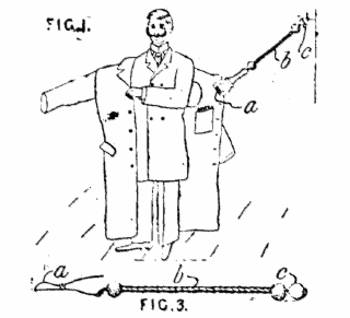
    In the category of wrongly-inspired inventions comes this masterpiece from a G. Tilsen. whose idea for using a chord (as shown in figure 3) seemed to spawn for him an entire empire of possibilities.  (Seems to me a little like patenting a stick and your hand for the use of making a hand sun dial AND for turning the stick around  so as to be able to draw things in the dirt, and so on.  Tilsen believed that if he had this chord and a place to attach it to the thing transformed into an  apparatus to  put on/taker off coats, hanging up a hat, “keeping a coat collar turned up”, for “suspending a muff on a person”, and other stuff.  Sometimes in intellectual bait-and-switch you call something by another name and it becomes new/improved/different.  For example, among the many supra-creative insights last night by Gov. Palin one referenced the use for “more clean coal” for the daily national energy intake.  Arsenic was removed from coal some time ago, which made it “clean” in that there wasn’t any arsenic in the coal smoke anymore.  Coal still releases CO2 which perhaps isn’t considered to be “dirty” anymore.  (Well, its a clear gas, isn’t it? We won’t get into the Bush administration’s Dickensian allowances for coal-burners to escape new upfitting and scrubbing rules. )  It just goes to show the causal observer that it doesn’t take much for a stick to be a sundial, an elastic chord to be a apparatus for putting on a coat, and for coal to be “clean”. 

    Coat

    From the British Patent Office, Abstract of Patent GB190200448, in all of its deep Edwardian splendor:

     #448. Tilsen, G. Jan. 7. Appliances for facilitating
    putting-on of garments; suspenders for articles of dress; overcoats.-Relates to
    a portable appliance for facilitating the putting- on and taking-off of
    overcoats, furs, coats, mantles, and like garments, but capable of being
    utilized also for other purposes, such as for enabling an overcoat to be hung
    up and taken down from a coat hook even when the coat hook is full, for
    replacing a broken suspensory tab, for hanging-up a hat, for keeping a coat
    collar turned up, for holding-up the skirt or train of a dress, and for
    suspending a muff on the person. The appliance consists of a cord b, Fig. 3,
    having a clip a at one end and a ring c at the other. Its general manner of use
    is shown in Fig. 1, but to form a suspender for enabling an overcoat to be hung
    up on a coat hook which is full of garments or to enable an overcoat to be
    taken from a hook on which it is overlaid with other garments, the cord b is
    passed through the tab of the coat and the ring c is gripped by the clip a, and
    the overcoat is hung up by the suspensory loop thus formed. The collar of an
    overcoat can also be retained in position when turned-up by winding the cord
    round the collar and then gripping the cord with the clip.


    ·Posted by :

    ·in:

    —

  • The Magnificent Mundane: an Instructional WITH PROP on How to Use the Telephone, 1946

    JF Ptak Science Books LLC  Post 236

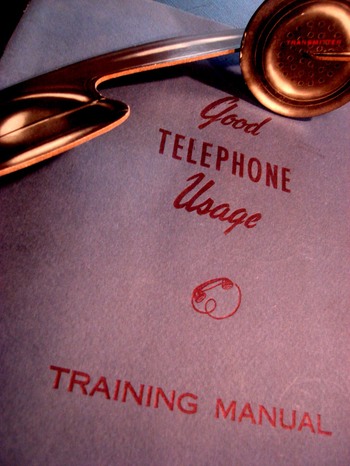
    Ballistics_049Yes, this elegant, well written (oversized) 1946 pamphlet, which explains
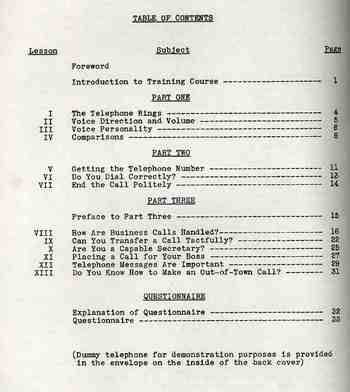
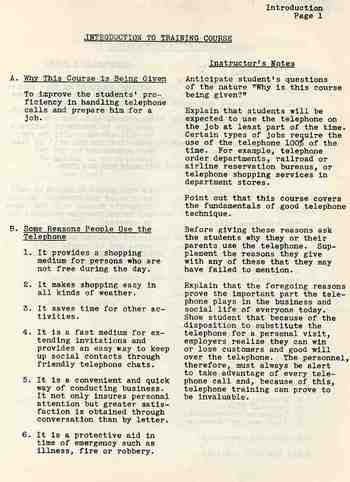
    in fabulous and excruciating detail how to use the telephone, does
    indeed come with a two-part heavy paper telephone receiver for the reader’s practice. It is packaged in an envelope in the back of the
    pamphlet with a large drawing explaining how to put the two pieces
    together.   The work is just so fulsome, wholesome, forthright,
    exacting and thorough that it just makes the casual reader stop in
    their tracks.  For example, it isn’t until page 13 that we get to pick
    up the receiver (and listen for the dial tone). I’ve reproduced some of
    the table of contents to give an idea of the extent of the telephone
    usage. 

    What brings this so close to being from out of the science fiction
    past is that the booklet is ten years older than me.  Atanasoff’s ABC, Bell Labs Mark II, Bletchley’s  Colossus, and Harvard’s Mark I machines existed, television was getting off
    the ground, and telephones were exploding their way into more American
    homes and businesses.  But somehow, here on the verge of the greatest electrical revolution in history, we’re still getting instructions on how to pick up the telephone.  But I’m really not complaining here, not at all–its just the nexus of the “how to listen for a dial tone” and the coming of the ENIAC one year after this pamphlet is published that is so startling.

    Even so, this instructional is more complete and (of course) better written
    than any of the pc manuals that came with any of the machines that I’ve
    purchase int the last 25 years. It is a thing of great and supra-obvious beauty.

    Again, this is another example of a small job done Very Correctly.

    (Click on image to expand.)

    Blogsept3_tele489
     

    Blogsept3_tele490