JF Ptak Science Books Post 234
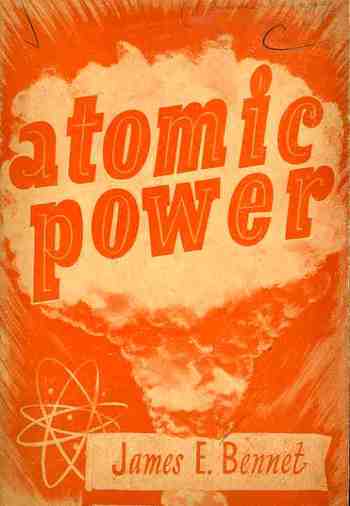
I’d like to say that this was a class-of-its-own sort of work, but as it goes this is hardly the case. If I cared a little I guess I could establish a collecting sub-category in the nuclear fission–atomic–nuclear weapon collection for the popular belief that god ordained and transmitted the atomic bomb. There are at least five other pamphlets like this floating around in the store, and I am certain that there must’ve been dozens of other grabby little publications like this proclaiming Almighty Influence in the creation of the atomic bomb. I can understand the reasoning behind the power grab: the bomb ended the war a week after its second use, sparing the lives, perhaps, of a million soldiers (American and Japanese) and years of societal/infrastructure rehabilitation by eliminating the need of an American invasion of the Empire. So the denominator was simply the “saved (American) lives” part.
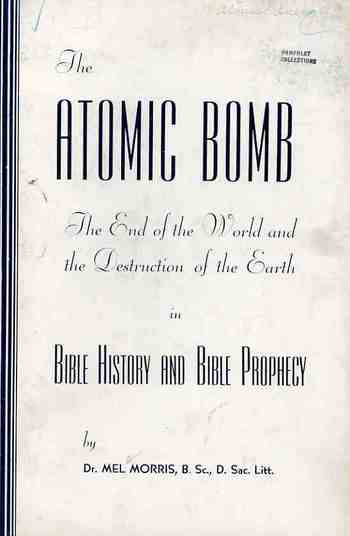
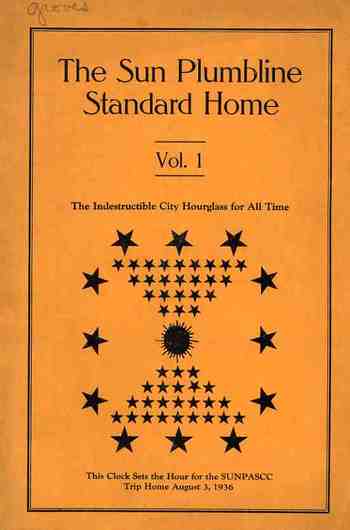
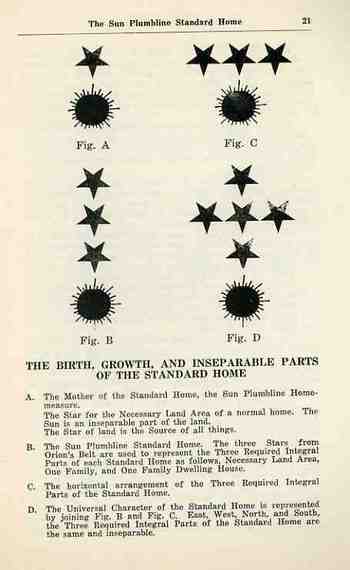
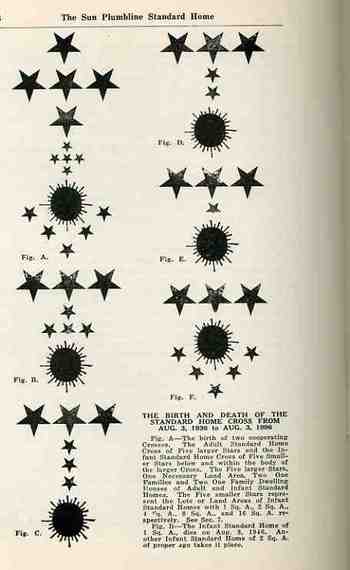
Again, I can understand how this felt in 1945/6, but I still feel that getting the suspected creator of the universe involved in the making and use of the bomb was ill-advised. The author of the first pamphlet reached back into history and credited god with simple solutions to complex situations: employing the more modern political technique of controlling language in the Tower of Babel case (wher he also said that since Babel was only 105 years after the flood that Noah was still alive, and that certainly Noah “would’ve voted ‘No’” for the building of the tower); and using “Johnny Snowflake” to stop the “non-satanic” Napoleon from reaching “Britain’s doorstep (and obviousy not the Soviet Reds). Bennet also credits god with giving “Dr. Currie” (sic) the genius to “split atoms” in 1896.
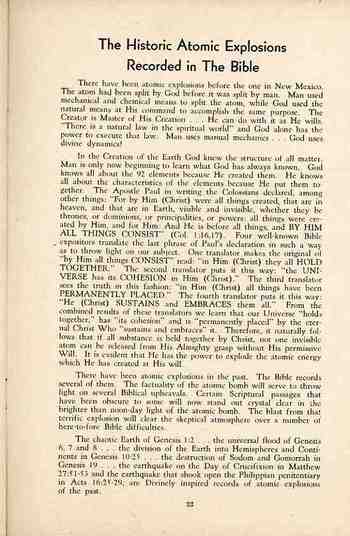
The second pamphlet uses the atomic weapon a little more figuratively. The author, Mel Morris, published this in 1945, which means he must’ve worked a little feverishly to pump up his bible prophesy and history to include the new atomic weapon to replace whatever else he had been using as a prophecy for end of times. (As it turns out, “God’s Atomic Bomb” was more tempest and disaster in the bible, and not (whew!) the bomb itself. Though as we’ve learned from scientologists and the sort-of creative mind of Ron Hubbard, a civilization came to the earth thousands of years ago and pummeled it with “atomic bombs” and other nastiness, polluting humans for milennia to come. But that’s another story–suffice to say that Morris found many dozens of examples of “God’s Atomic Bomb” being used in the deep biblical past, and that the use of the real atomic bomb in 1945 was pre-ordained, and not without its figurative historical counterparts. I’m not sure why any of this was necessary outside of proving to some small minority that these preachers could at least be contemporary and topical.





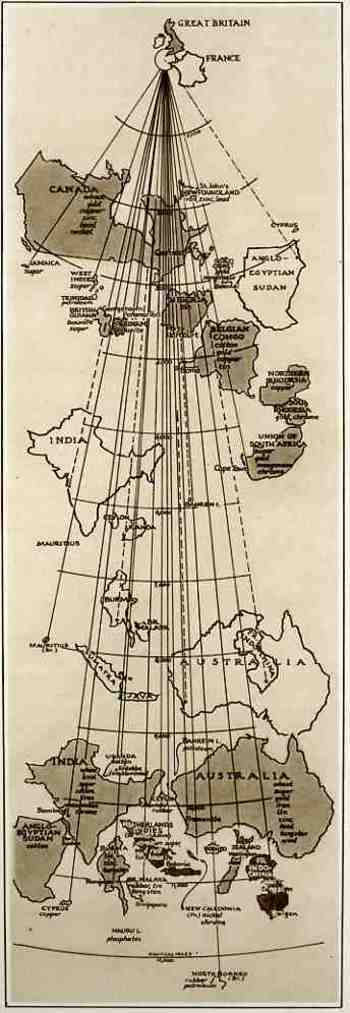 This map comes to us from The Illustrated London News, 3 August 1940, which reproduced it from an article in Fortune Magazine. Though it looks oddly wrong from the outset, it really is pretty lucid–elegant, even–once you understand its purpose. And the purpose of this map was to show the distances that the goods and raw materials from the British Empire (and from the possessions of France) had to travel via the then-closed Suez Canal route versus the new routes “not open to enemy interference” to Great Britain. Countries depicted in outline show the distance via Suez while the same country depicted in shade show the new, longer, non-Suez route. Ever stiff lipped, the Brits announced that even though some of their major natural resources are coming from these vastly removed areas, “even with the fall of France, the British Empire and its allies remain an economically self-contained and immensely powerful war unit, and still control the great part of the world production of some vital commodities…” I’m not sure why, exactly, that it was necessary to display this map to the public eye, what with England under assault in the Battle of Britain (the Nazis extending their aerial assault in preparation for Operation Sealion), the loss of France, and the nearly-there Nazi blockade of English waters. Perhaps it was drawn to show that even though the material was coming from the same places that were now further away, they were still getting there.