A Daily History of Holes, Dots, Lines, Science, History, Math, Physics, Art, the Unintentional Absurd, Architecture, Maps, Data Visualization, Blank and Missing Things, and so on. |1.6 million words, 7500 images, 4.9 million hits| Press & appearances in The Times, Le Figaro, Mensa, The Economist, The Guardian, Discovery News, Slate, Le Monde, Sci American Blogs, Le Pont, and many other places… 5000+ total posts since 2008.

Author: JF Ptak

  • Mondo Bizarro: Image of the Earth with a Background Earth Floating in Space

    JF Ptak Science Books LLC Post 253

    Well, one doesn’t get the chance to write a title like that every day, or, for that matter, write about dual/multiple earths, with the earth both in the foreground *and* floating in outer space in the background.  I wrote about a spectacular pamphlet in February in Post 11 that did exhibit just such a thing– I thought that it was a pretty singular event, writing:

    “This is the only known example of the depiction of an extra-terrestrial New York City pictured with the earth in the background.  Huh?  Yes, this is the Big Apple in space—not its OWN space but THE space,  outer space—somehow, impossibly, removed to some something-or-other (actually in this case, a “bubble”) that, while not being the Moon, was something like it, though not actually a solid and without gravity, floating on a base of floating effluvia…”
    Blog1sept_10_floating_earthclean

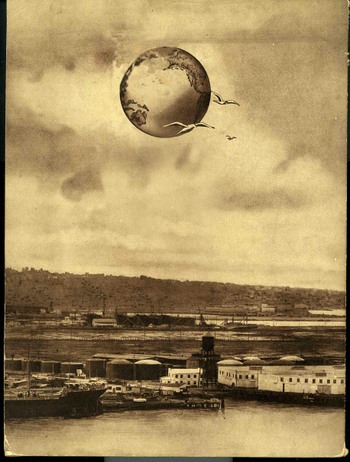
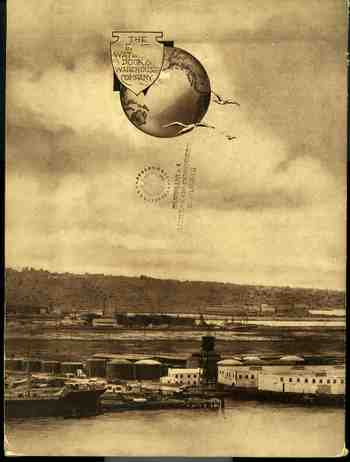
    Listen:  I found another such oddity.  Well, almost.  This is the back cover for a pamphlet called The East Waterway Dock & Warehouse Company:  Harbor Island Terminal”, of Seattle, printed in 1920.  The pamphlet and contents is real enough–what caught my attention was the back cover, which very nearly places the earth in the sky above the earth, albeit innocently.  IT just so happens that this was a design/logo for the company, and it was placed in the sky, raising my hopes at first blush that this was another improbable example of Post #11. It is sort of close, visually speaking, especially when I took out ten minutes to manipulate the logo away from the earth so that the image is more, well, incredible.  But the fact of the matter is that the earlier New York City in Space pamphlet may well be a one-item category, particularly when you consider the content and the rest of its illustration, which are (generously) outre. But I’ll post new image anyway because it is just such a rare visual  idea and almost-feast.
    Blog1sept_10_floating_earth533


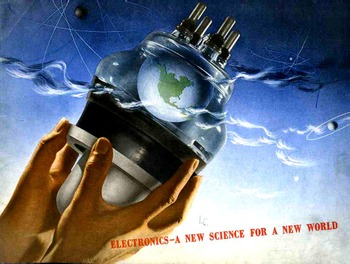
  • The Glory of theTechnicolor Electronic Future Arrives: 1942 Electronics

    JF Ptak Science Books LLC   Post 253

    Blog1sept_9527

    I’m sorry to report that the publisher and beneficiary of this
    brilliant 1940’s advertising art–General Electric–swallowed up the
    identity of their artist.  Nowhere in the 1942 publication with the
    Huxleyesque title of Electronics, a New Science for a New World is
    there any mention of the poor artist who gave vision to this retread
    idea…or retread if you don’t consider the “electronics” part.  Yes,
    the art is a little removed and slightly, spatially, naive; and the
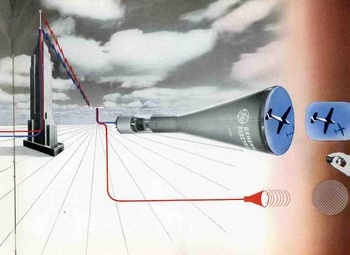
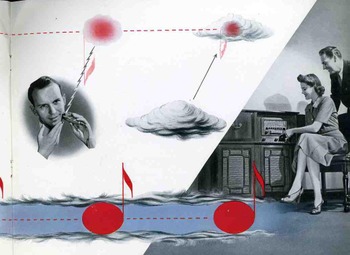
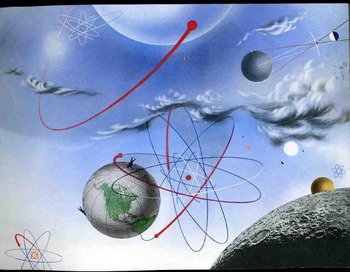
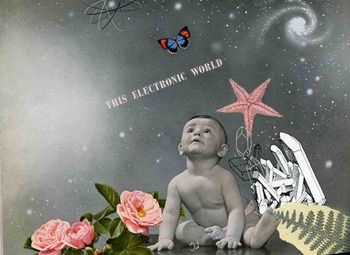
    colors are too much and the symbolism too big (there’s allot of host of hosts stuff, offerings up to the big sky),and the images are a little ridiculous,  but they are jolting (for good or for ill) and it really does speak for its time.  And in 1942 electronics was just about to come to the rescue and save World War II:  from tracking aircraft for anti-aircraft weapons to RADAR to the development of computers to the Enigma to the development of the atomic bomb, and on and on, “electronics” did ride in on a white horse to save the day.  I can understand perfectly well the sentiments exhibited in these fabulously bombastic illustrations: the extraordinary power of radio and the beginning of television, the beautifully rendered hands on the front cover (the shadows on the fingernails are done very well) holding the electronic chalice, the baby and the butterfly (and all of that other weird stuff strewn about); all are getting ready for the bigger world that was coming as the beneficiary of this electronic revolution.  And, as a matter of fact, no one really had a clue as to what was coming–that baby would be retiring now, and the changes that occurred during its lifetime are so supremely removed and incalculable from 1942 that it makes even the vast hope exhibited in these electronic icons seem mild.  It also makes me wonder about what brave oceanic beliefs and expectations of the future that we have today will look common and sugary (or saccharin, or whatever) in the year 2074.

    Blog1sept_9e531

    Blog1sept_9d530

    Blog1sept_9b528

    Blog1sept_9c529


  • The Human Zoo, II: Humans as Exhibits in Zoos and “Zoological Gardens”

    JF Ptak Science Books LLC  Post 252

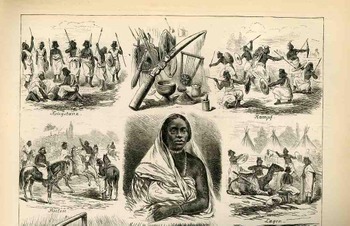
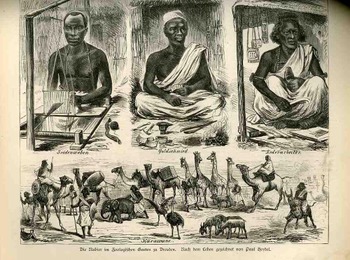
    This image comes from the Illustrirte Zeitung (Leipzig), and was printed 6 September 1879 (issue No. 1888).
    The caption reads:                                                                                                                                                         
    Blogsept5_human_zoo_legend500_2

    Blogsept5_human_zoo_top498_2

    This is the second in a slight series on human beings exhibited in zoos–I wrote earlier on them here, and quote the introductory for this print:


    “Human ignorance in observing differences among different societies and races
    has always been a burgeoning, expanding, sub-intelligent subset of other human
    stupidities, frailties and incapacities.  Sometimes these are exhibited
    liberally and freely, and stupidly; other times it is difficult to see, vile,
    menially, sub-rosa, and thoughtfully thoughtless.”

    “These prejudices been spectacularly exhibited in many ways over the
    centuries—forced immigration, complete removals, ethnic cleansing,
    concentration camps, slavery, expulsion, legal intolerance, and so on; an
    entire library can be filled with this stuff.  Sometimes people were
    gathered together and moved far away; other times they were gathered together and removed into compounds right in the
    middle of cities in which they lived (as in ghettos, antiquarian “hospitals”
    and the creation of the more modern asylum, and so on)…”

    This second illustration is from two years later and displays “Nubnier” (Nubians, I think referring to people from southern Egypt and northern Sudan) in various poses as seen in the Dresden Zoological Garden.  The Africans were on display there, perhaps exhibited as exotic remnants of ancient kingdoms, or something,  showing them in a war dance, riding horses, in fake conflict, working a loom, goldsmithing, and in a caravan, complete with giraffes (?) and a baby elephant (??).  All I guess made “good gate” for the owners of the zoo.   

    Blogsept5_human_zoo_btm499

    ·Posted by :

    ·in:


  • Wordle Word Art: 200 Einstein Quotations

    JF Ptak Science Books LLC   Post 251

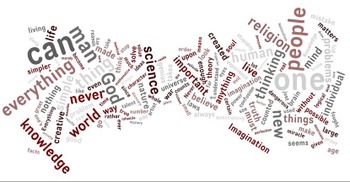
    My thanks to Jeff De Cagna for the suggestion of Wordle-ing a favorite Einstein quotation–its a fine idea.  What I’ve done is take 200 or so quotes and made one large file of them and fed it into the Wordle-izer with the following results (below)  Again Wordle weights words in size according to the number of times it appears in a document, so the resulting image is a wort of word map, a lay of the land if you will of this collection of quotes, showing the words most often used by Einstein (at least in the quotes that I have selected).  The longish quote list is below in the continue reading section(unfortunately without source attribution). 
    Clicking on the image will enlarge it and make it clearer.

    It is interesting to note that the largest word here seems to be “can”, followed closely by “one”, which I think is really another way of his saying “you” or “us” or “we”–so, we get “you can” or “we can” or “one can”, speaking to the possibility of possibility, of effort, of moving forward, of trying.  Imagination, effort, thought, creation–that’s what the man was all about, and I think that’s what we see in this word map. 

    Wordleeinstein_190

    ·Posted by :

    ·in:

    —

  • Wordle Word Art: Copernicus’ De revolutionibus orbium coelestium (On the Revolutions of the Heavenly Spheres)

    JF Ptak Science Books LLC

    Wordlecopernicus
    Here again is another Wordle treatment—this time we’ve fed it
    the first 10 chapters of Copernicus’ De revolutionibus orbium coelestium (On
    the Revolutions of the Heavenly Spheres
    ). As usual Wordle offers a very interesting
    insight into word usage even though I was forced to limit the text selection to
    Book I and stop at the point where diagrams are used to illustrate the
    text. Be that as it may, even in this
    limited application, Wordle does surface some interesting bits from the
    relatively “popular” part of this revolutionary treatise.

    (Click on the image to enlarge and make clearer.)

    ·Posted by :

    ·in:

    —

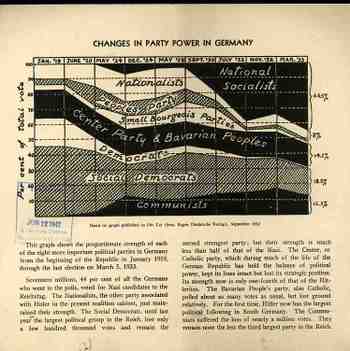
  • National Socialists Take Control, 1933: Diagram Presentation of German Elections 1919-1933

    JF Ptak Science Books LLC    Post 250

    Blog1sept_8_nazi_election522

    This diagrammatic presentation of the German elections from
    the end of the First World War to the 1933 elections clearly shows the rapid
    and sustained growth of the National Socialist German Workers’ Party, called
    for short, the Nazi Party (or NSDAP).

    It is really the chronicle of the rise of the unemployed sergeant
    Adolf Hitler’s rise from total obscurity to the chancellorship of Germany in just
    fourteen years. This is accomplished
    through a thick and murky collaboration of some of the stupid aspects of the Treaty
    of Versailles, the failure of the great base of the German economic enterprise,
    the worldwide depression, and the abject and miserable condition of post-war
    German society—and of course the rip-tide undercurrent of anti-Semitism, which
    was healthiest in Germany but still achieving newish heights in Hungary, Poland
    and of course the Soviet Union. Through a
    wicked and unrelenting propaganda campaign which fed on fear and retribution
    and rage in defeat, Hitler secured a rising power base among disparate
    populations: university students,
    veterans, farmers, the working lower classes, and a huge dollop of political investment
    from a number of different industrial sources. When his part almost wins control of the country outright against the
    creakingly old Hindenburg, and others, in 1933, it is Hitler who outmaneuvers
    his political rivals to secure the chancellorship and controlling power in the Reichstag. It was all downhill from there, to the ring
    of fire.

    I’ve seldom seen the rise of the Nazi party presented this way in the year
    of their ascendency—this pamphlet was printed in 1933 by the Foreign Policy
    Association (founded in 1918 and still in existence) , and written by its
    chair, James G. .McDonald (who served 1919-1933 as it turns out) for a radio
    broadcast for 11 March 1933. It is
    interesting to note that McDonald was the first U.S.ambassador to Israel
    (1949-1951).

    The front cover of the diagram:

    Blog1sept_8_nazi_election523


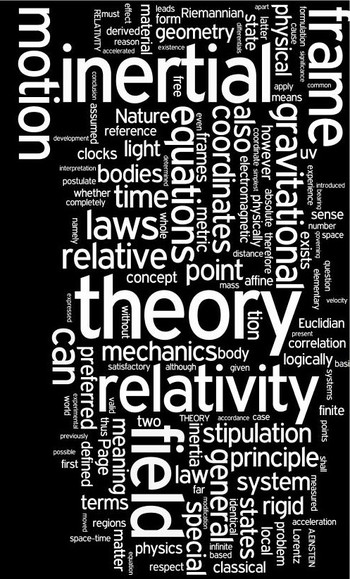
  • Wordle Word Art–Vocabulary from Einstein’s Nobel Prize Acceptance Speech

    JF Ptak Science Books LLC

    Einstein_1923_nobel
    Einstein’s delayed 1923 acceptance speech for his hideously delayed
    Nobel prize–finally offered to him in 1921 for his “work on the
    photoelectric effect” of 1905–is generated here into a piece of Found
    Word Art, fashioned by the language-generator residing in the WORDLE site.
    As in the other cases of word art generated by Wordle, the work is the
    product of the vocabulary-digester at Wordle, which in this case
    consumed the entire text of the speech and displayed it according to
    the appearance of the most popularly-used words.  The results of these
    jaunts into Wordle have been fascinating to me, as I hope they are to
    you. 

    The full text of the Einstein speech (which is tricky to find in full
    text versions) is below.  I’m sorry to say that I’ve messed up the
    equations, trying to fit them into typepad. 

    Also you can click on the Wordle display to make it not only larger but clearer. 

    ·Posted by :

    ·in:

    —

  • Wordle Word Art–Vocabulary from Einstein’s Complete List of Publications

    JF Ptak Science Books LLC  Post 248

    This piece of Found Word Art is generated by the word-synthesizer at the lovely Wordle site which crunched and counted the occurrence of words in the titles and attributions of Albert Einstein’s complete opus. (See our page on the Einstein publications which we used to generate this art here.)

    If you click on the image it will become larger and clearer. 
    Wordle_einstein_annalen

    ·Posted by :

    ·in:

    —

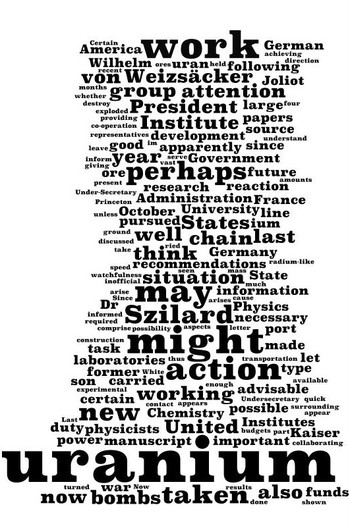
  • Wordle Word Art–Vocabulary from Einstein’s Two Letters to Roosevelt on the Atomic Bomb

    JF Ptak Science Books LLC

    The newest contribution to my new-found category of Found Word Art is constructed from the text of Albert Einstein’s two letters (August 2 1939 and March 7 1940) to President Franklin Roosevelt about the use of the coming atomic weapon.  The text of the letters was simply deposited in the wonder-engine word-atomizer at WORDLE, and the relative distribution of the most commonly-used words were given new representation in relative sizes.  I should point out the earliest post I did on the cautionary letters of Einstein and Szilard to FDR and refer to it for the explanation the occurrences of some of the Wordle words.

    If you click on the image it will become larger and clearer.

    The complete text of the two letters is found below in the Continue Reading section.

    Wordleeinstein


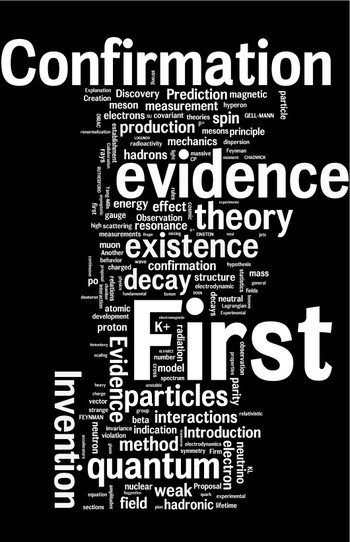
  • Wordle Word Art–Vocabulary from our Particle Physics Chronology, 1895-1995

    JF Ptak Science Books LLC

    Up next in the expanding WORDLErama of creating FOUND WORD ART by dumping text blocks into the glorious WORDLE wonder-engine is my page devoted to the chronology of modern particle physics (1895-1995).  The most often recurring words are the largest, which produces some interesting and unexpected affects and results. 

    If you click on the image it will be larger and clearer.

    Wordleparticle_physics

    ·Posted by :

    ·in:

    —