A Daily History of Holes, Dots, Lines, Science, History, Math, Physics, Art, the Unintentional Absurd, Architecture, Maps, Data Visualization, Blank and Missing Things, and so on. |1.6 million words, 7500 images, 4.9 million hits| Press & appearances in The Times, Le Figaro, Mensa, The Economist, The Guardian, Discovery News, Slate, Le Monde, Sci American Blogs, Le Pont, and many other places… 5000+ total posts since 2008.

Author: JF Ptak

  • A Note on the Lunar Cycle, Time, and North American Indians

    JF Ptak Science Books   Post 1957

    For the most part Native Americans of the pre-U.S. had no names for days, no
    division of the week, nor a name for years, though underscoring the observation of the skies and the passing of time was a primary appreciation of a more sophisticated lunar cosmology.
    Simply put, the lunar cycle was one of the major ways in which
    Indians captured spent time. Days, weeks and travel distances were
    in general measured in terms of nights passed, or sleeps (similarly
    the length of the day in terms of the four major daily appearances
    of the sun and moon). The passing of the year was marked in lunar
    cycles, and delineated important, measurable, repeating events in the
    environment important in the life of a tribe. (These events—harvests, plantings,
    snows—would vary from tribe to tribe according to their geographic
    distribution.) 

    ·Posted by :

    ·in:


  • Einstein–(A) List of Complete Publications; (B) Most Often Cited Papers, & (C) Contemporary Reviews (D) In the Annalen der Physik

    JF Ptak Science Books   Reference Post

    • Below are three quck reference lists regading publications of Albert Einstein. Section A is a complete list of his works; Section B, a list of hi smost ofte-cited papers; Section C is a collection of some contemporary reviews of papers published 1904-1920; Section D is a listing of Einstein papers in the Annalen der Physik

    A) Quick Complete Publications of Albert Einstein, Listed Chronologically.

    [Titles are in English]

    1901 ANNALEN DER PHYSIK 4(3):513-523
    Conclusions from the capillarity occurrences       

    1902 ANNALEN DER PHYSIK 8(8):798-814
    The thermodynamic theory
    of the potential differences between metals and complete dissociation
    solutions of their salts and a electrical method towards the probing of
    molecular power 
        

    ·Posted by :

    ·in:


  • Questions Answered with Guts, Wax, Bumps and Glory: Fortune Telling Patent Devices

    JF Ptak Science Books   Post 1956
    Follow Me on Pinterest


    [All images via the lovely and easy to maneuver Google Patents here]

    Fortune telling and divination is mostly the subject of the pretty patents (below), a quick penny-ante for the fulfillment of the instant treatment of possibility. reckoning via mechanical means,easing folks out of the necessity to think about What May Come, and also, possibly, relieving some of them of the possibilities of worry should the fortunes agree with their hopes.  And desires. Opposite, for the opposite. 

    This thinking goes back a long way into dark and dusty time, though it becomes interesting (to me, anyway) when it gets wrapped up in Renaissance magic and science. 

    I’m not sure what it reveals except for what people might have wanted to believe in during different periods of time.

    Anyway, the patent drawings are pretty.

    The ways of telling fortunes are broad and numerous and may have been dictated by the stuff that was readily available at hand; a veritable alphabet can be quickly summoned to deal with the most common of the sort:

    Alectromancy (telling the future by relatively brainless modern dinosaur roosters pecking at the ground for stuff);

    Astrology
    (thinking that the motions of stars that are light years away from the
    observer in a vast sea of space and their annotation on an
    infinitesimally small speck of universe dust called “Earth” can somehow
    interact with living organisms that are 1030000 the amount of space that can be affected by the light from the stars that are 1/1,000,000,000 of the age of those stars);


  • Blank & Empty Things Series: Self-Referencing Languages and Babel

    JF Ptak Science Books      Part of the History of Blank, Empty and Missing Things.

    Follow Me on Pinterest


    Blog--14 nov--fantastic arch


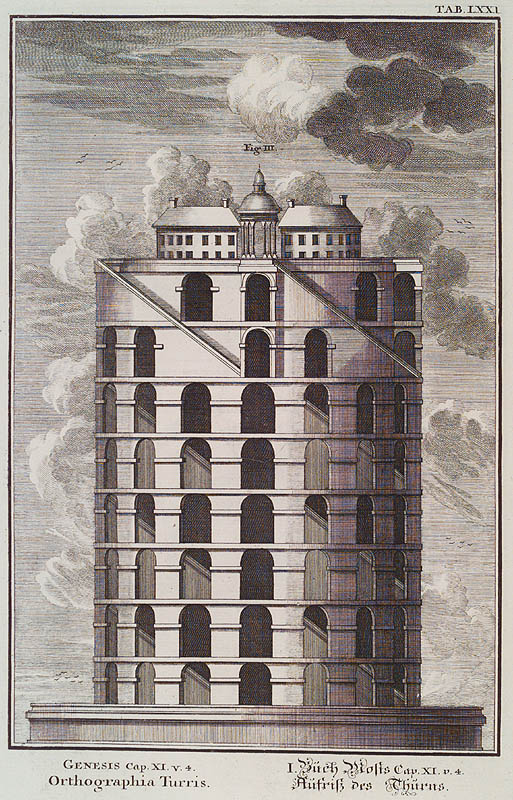
    Returning to Jean-Jacques Scheuchzer’s1 magical, inventive, fact-bending naive-surreal work on universal history based on the Old Testament, I’ve found these two glorious and odd images of the Tower of Babel.  The first (“Genesis Cap.XI.v.4. Orthographia Turris.Mediummetalis”) is terrific, shocking even in its abrupt construction and flat-out stumpiness, because it is one of a very small minority that shows the structure to be canonical, with a little church at top. The enormous stairway is just completely out of proportion to the purpose of the structure, the effort falling into some sort of odd advanced-child category.

    If Italo Calvin’s “Invisible Cities” or (better yet) Jorge Borges’ “The Circular Ruins” were to be illustrated, this image would fit right in.

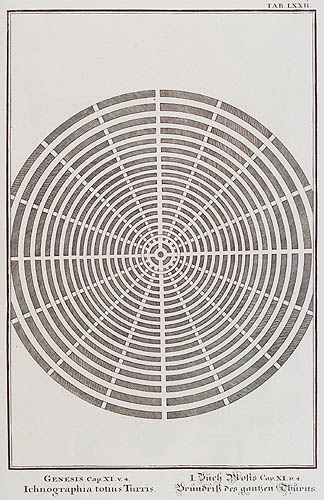
    The other very unusual bit here, is that Scheuchzer also provides a plan for the city that was to be built around the tower–I’m pretty sure that I haven’t seen references to this before, and the Biblical references to it are no help whatsoever in determining its physical aspects.

    There are probably very few things that could be as blank or as empty as combative, competing, nonsensical and completely self-referential language or communication.  Well, except for Scheuchzer’s very empty town plan locating the tower in an urban setting–a listless place of surrounded circles of nothingness for a place in which everything is said and nothing is understood.  Ground Zero for blank Blog--nov 14--planlanguage.


    Notes:

    Two interesting books that I should mention that address the ideas
    of fantastic/imaginary architecture and decay are C. W. Thomsen, Visionary
    Architecture: From
    Babylon to Virtual Reality,   (Prestel, 1994) ; and  Paul Zucker, Fascination of Decay (Gregg  Press, 1968).

    1.  Kupfer-Bibel, in welcher die Physica sacra, oder geheiligte
    Natur-Wissenschafft derer in heil. Schrifft vorkommenden naturlichen
    sachen, deutlich erklart und bewahrt,
    printed in Augsburg and  Ulm
    by  C.U. Wagner, 1731-1735. Offered in four volumes, illustrated with
    758 plates, it is a magnificent work, if not altogether correct, or
    even near- correct, with an enormously confused pedigree, implying the
    wisdom and text of the Bible (and the old Testament at that) as the
    background for a physical history of the world.


  • Chess Pieces of Dusty Greats vs. Celebrity Mistakes: Robt Hooke vs. Paris Hilton

    JF Ptak Science Books   Post 1954
    Follow Me on Pinterest

    • QUESTON:  If great but not-popularly-known scientists could be represented as a chess piece, and that chess piece was on a game board opposite Popularly-Known-Celebrities-Not-Known-to-Scientists (and etc.), what piece would the great and dusty Robert Hooke be? And conversely, (on that opposite side), what piece would someone like, say Paris Hilton be?

    See also earlier posts: The History of Dots Part 9: the Cell and Robert Hooke  and Horse Poop and the Stars: Robert Hooke, 1673 (No, it Wasn’t Pegasus) and When a Compliment is Not: Newton and Hooke and the “Shoulders of Giants”

    I wonder about poor old Robert Hooke.  He was such a tremendous thinker, a terrific rush of ideas, with revolutionary insights in many fields; he was a leading architect, a physicist, a microscopist, a chrononaut, a mathematician, an everything. He carried the Royal Society for years, carried on hundreds if not thousands of experiments, and of course was famously on the other side of a bad series of arguments with Isaac Newton.  At the end of his long life, Hooke was afraid of not being remembered, of not having enough money to see
    himself through hi sold age, afraid of others taking credit for his
    work.  He just seemed not to matter, anymore, in the last decade of his
    life (and a period in which he was still doing significant work), and I
    just wonder why he managed to become so semi-invisible.

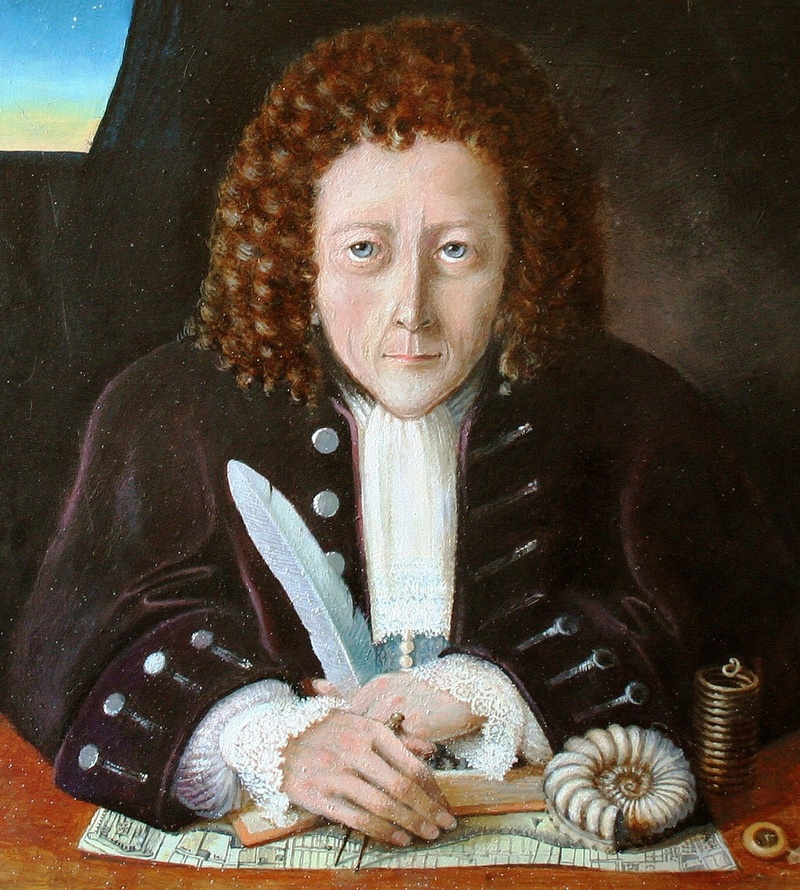
    13_Portrait_of_Robert_Hooke

    He was so dedicated.  I have an image of him scurrying with a friend, removing the estimable library of a patron and donor to the Society, trundling the books in wheelbarrows across a mile and then-some of bumpy London streets finding a home for these great treasures.  He was an older man at this point, marching these books across parts of the city that he helped to restore after the fire, passed buildings that he helped to build and design, bumping his way through London, a great and famous scientist, saving books by the handful. [An idealized portrait of Hooke, at right.]

    He was a tireless,
    relentless observer and experimenter, who lost little effort in a stranded idea
    and pursued interesting and problematic questions relentlessly.  More than others too he chased his won glory—minor
    but long and insistent—the years of which wore thin on many people in the
    scientific community.  But there were
    many characteristics of the man that made him not quite so lovable and
    endearing—not that Newton was any of those things, as he was not, but if you
    are going to be a secondary luminary to a super nova you’ve got to have
    something else going for you that the other man doesn’t have—sharing, helpful,
    greatly generous—to get you into the long pre-dusty pages of history. Also it would’ve
    helped if Hooke chose his battles with a little more aplomb and ingenuity—the
    war which began in 1672 with Newton went very badly for Hooke and followed him
    to the grave (and far beyond).

    He just didn’t “catch on”, I think–at least he not for the long term.  His brain teemed with ideas, but perhaps by the last decade of his long life, his tireless brain still working on innumerable bits, he just sucked the air out of a room. 

    He also never had his likeness recorded during his lifetime.  And that is saying a lot.  And I still don’t know why.

    Back to chess:  I figure Hooke to be a Knight.  I prefer Knights.  He moved like a Knight.  He importance was “higher” than that of a Knight, but, well, the Knight seems a good fit (and so he seems to get downgraded, in a way, even in this game).  And Paris Hilton?  I think she might be a queen (with a small “q”)–as someone who is ultra-well-known but not for anything in particular except for the quality of being well-known. 

    ·Posted by :

    ·in:

    — —

  • A Mystopian Alphabet of Newspeak Words: Orwell and Unthink

    JF Ptak Science Books  Post 1953

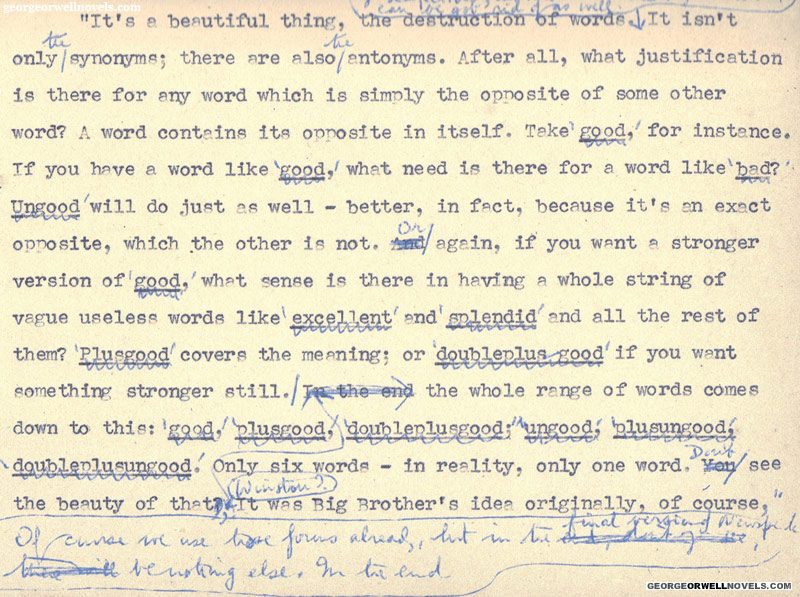
    “It’s a beautiful thing, the destruction of words … what justification is
    there for a word which is simply the opposite of some other word? A
    word contains its opposite in itself. Take “good”, for instance. If you
    have a word like “good”, what need is there for a word like “bad”?
    “Ungood” will do just as well — better, because it’s an exact opposite,
    which the other is not.’”–George Orwell, 1984

    “Orwell and Nabokov wrote nothing like one another and did that to perfection.”–Not H.L. Mencken
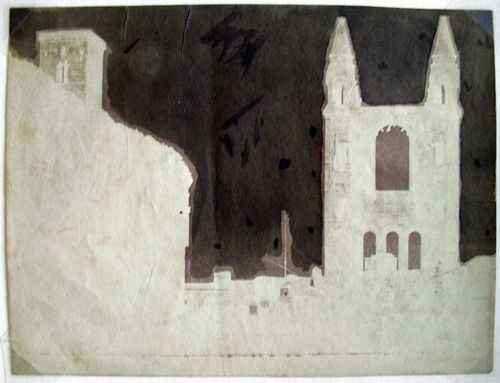
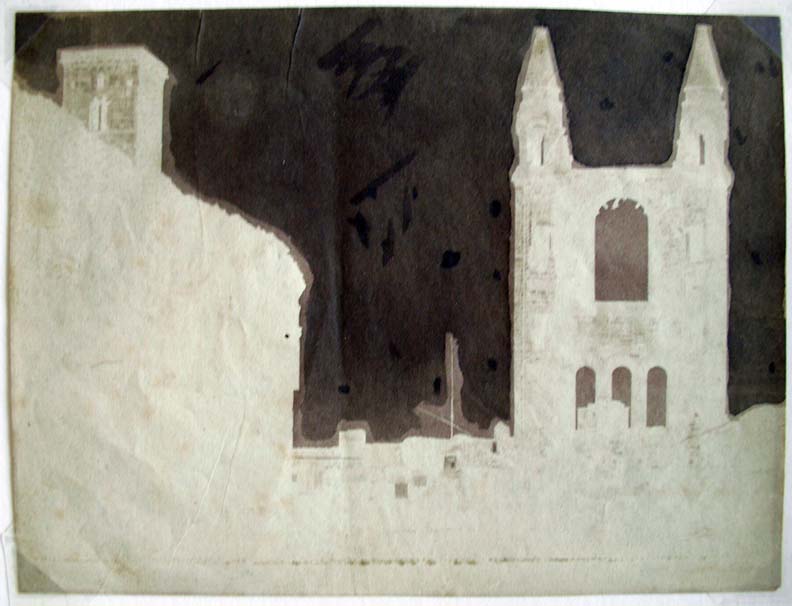
    Hilladamson2[David Octavius Hill (1802-1870) and Robert Adamson (1821-1848), St. Andrews [East Gable End of the Cathedral with Tower of St. Regulus], [1843-1847]. Calotype. Source: Princeton University Library.]

    There is nothing that limits action than the control of the stuff that describes it:  words. Any dictatorship or totalitarian regime can appreciate this thought–many would try to eliminate even the thinking of this thought, let alone limiting the spoken parameters of discussing it. Removing the capacity to respond to what is happening in the world with other human beings by rephrasing the experience through the introduction of new words and the elimination of old ones is an excruciating form of absolute power that can be blatant as well as subtle, though I suspect that accomplishing this word control sotto voce would be the most effective/insidious method. 
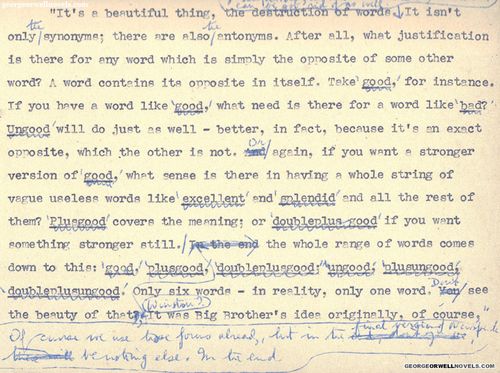
    Orwell 1984 ms[A page of Orwell’s corrected Manuscript of 1984; source: GeorgeOrwellsNovels.com here]

    George Orwell describes a terrifying society of just this sort in his book 1984 (with the complete text available here), which was an adventure into a Mystopia of the near-future (of about the year 2050).  He writes about a society, Oceania, that attempts to makes it members into one conforming biological unit for the sake of control it. One of the methods used to accomplish this is the destruction of words and the creation of other state-controlled words to replace them, a sort of single-channel television for the mind, a device using its own vocabulary which audially impregnates the listener with versions of correct thinking, redefining reality by controlling the ways of interpreting it.

    This is a list of some of the words that Orwell’s society creates–some of course do not stand well on there own, their deviousness appreciated in the context of the story, like the first example, “artsem”, which through constancy has come to numbingly replace the idea of what the word represents.  Others, like ‘good”, are old words with a new meaning, making them new words with a bad (or  not-good) meaning. Or “free” of the old (or Oldspeak”) meaning, where even the word “free” is used only to describe an absence, as in “this sentence describing the use of the word “free” is “free from the old meaning of free”, like you’d want a baby to be free from germs.

    See here for an autobiographical note on Orwell; “A Short History of My Life”, by Orwell in 1945, here.

    Airstrip One:  the new word for “England”, which has been reduced to nothing but a terminal for  the society of 1984, Oceania, is composed of the Americas, part of southern Africa, Australia and New Zealand.

    Artsem: Artificial
    insemination, which is the enforced and nearly the only method of reproduction allowed in the society, another brick in a structure that controls the expression of intimacy between people. Big Brother needs new people for the society to continue, but he doesn’t want there to be any emotional connection between them outside of the prescribed feelings that people are supposed to emulate. Artsem further indoctrinates a no-contact policy between people. There was the possibility of sexual intercourse but only for the production of children when artsem was not applicable–this was called “goodsex”, which was the opposite of “badsex”, which was sexual relations for the joy of it. The orgasm was a hunted thing, to be tracked down and eradicated.

    BB: Big
    Brother. 
    The major domo of Oceania, a hitler/g-d, an extreme presence of control.
    “The story really began in the middle sixties, the period of the
    great purges in which the original leaders of the Revolution were wiped
    out once and for all. By 1970 none of them was left, except Big Brother
    himself. All the rest had by that time been exposed as traitors and
    counter- revolutionaries.”

    Bellyfeel: an unfeeling and enthusiastic acceptance of an idea, following without knowing or knowledge.

    Blackwhite:  “… this word has two mutually contradictory meanings. Applied to an
    opponent, it means the habit of impudently claiming that black is white,
    in contradiction of the plain facts. Applied to a Party member, it
    means a loyal willingness to say that black is white when Party
    discipline demands this. But it means also the ability to believe that black is white, and more, to know that black is white,
    and to forget that one has ever believed the contrary. This demands a
    continuous alteration of the past, made possible by the system of
    thought which really embraces all the rest, and which is known in
    Newspeak as doublethink.”


  • Allegory, Metaphor, or Nothing? Touching Books, 1435

    JF Ptak Science Books  quick post

    Reading means approaching something that is just coming into being. –Italo Calvin (1979)
    Follow Me on Pinterest


    Van der Weyden  virgin child det
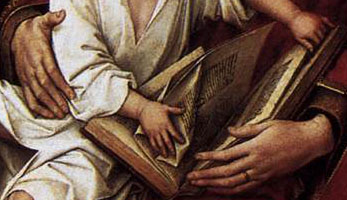
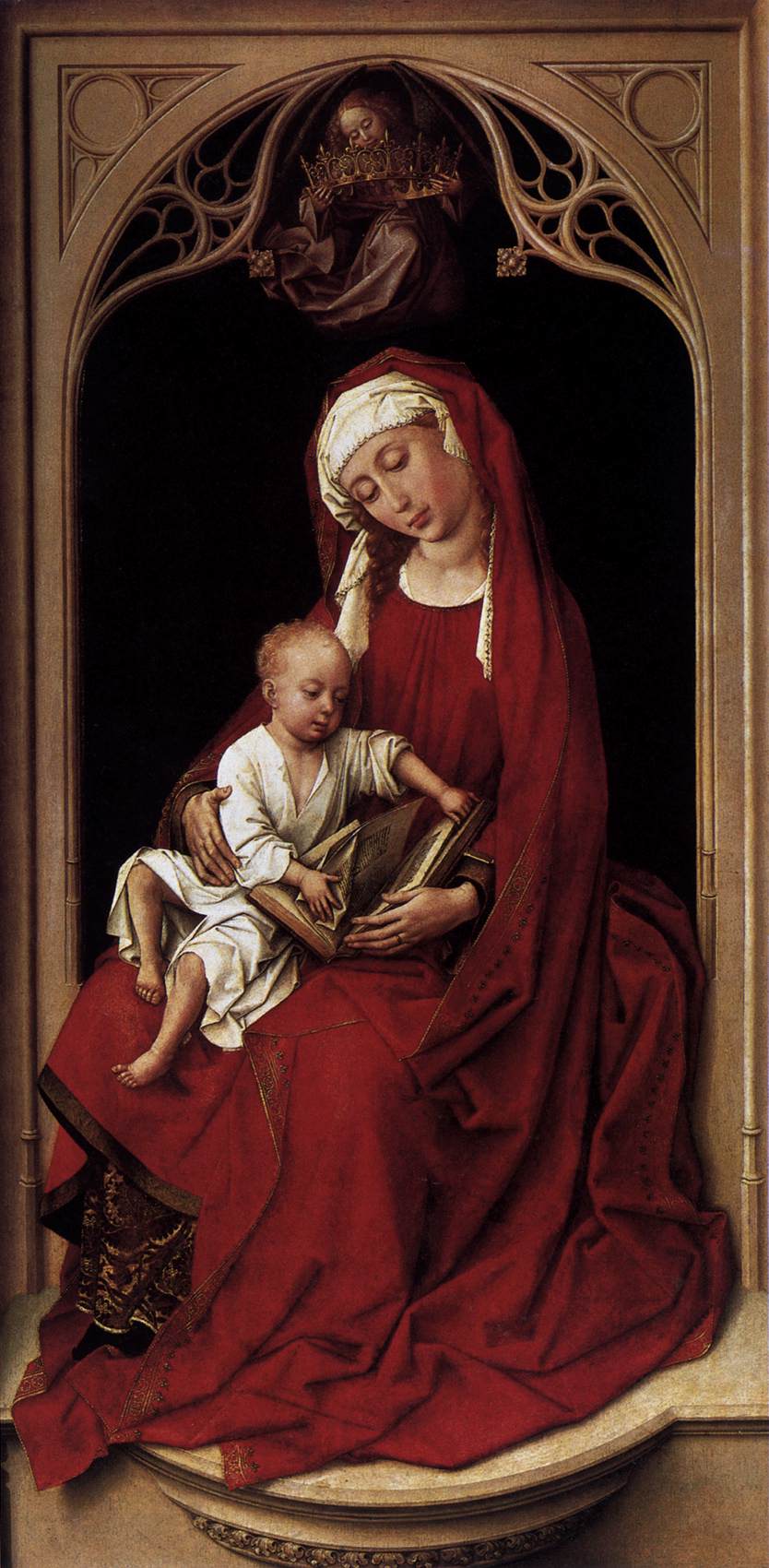
    What is it exactly that the Christ child is doing in this painting (ca. 1435) by Rogier van der Weyden?  I don’t think he’s reading, and there are some who seem in anti-reading–tearing out pages of the book, which is supposed to be the Old Testament, an allegory for pointing the way to the newness of the Bible in the New Testament. 

    To me he looks like just any other baby handling a book–not tearing, but just figuring out how the book functions, how to make it work, with fat-fisted baby hands. Perhaps the baby was looking into the past and the OT and not seeing the future in it in the NT.  But even in an era of high symbolism and metaphor, perhaps this is just a baby playing with a book.

    Van der Weyden  virgin child


    ·Posted by :

    ·in:


  • A Note on Venn and his Diagrams

    JF Ptak Science Books   Post 1952
    Follow Me on Pinterest 

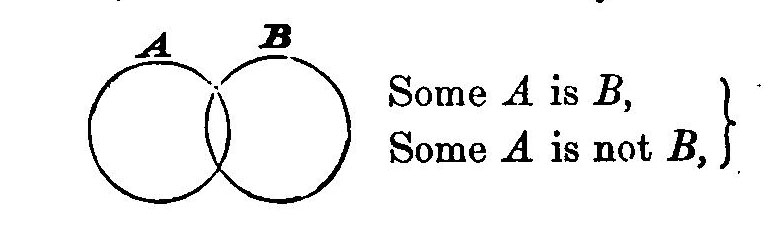
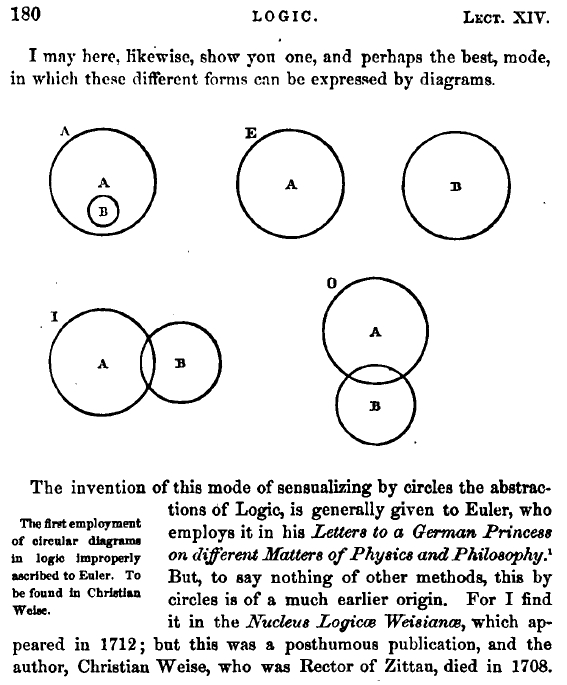
    It seems so unlikely that the Venn diagrams took so long to appear, that it hadn’t been Aristotle’s Diagrams, or Cartesian Diagrams; rather, these elegant creations–about a different way to represent propositions by diagrams– belong to Mr. Venn’s invention in 1880. Mostly. It was in that year that these famous more fully-developed diagrams first appeared in a paper entitled “On the Diagrammatic and Mechanical Representation of Propositions and Reasonings“ in the Philosophical Magazine and Journal of Science.  They seem so beautiful, and so simple, and so powerful, and so elegant. So necessary.  And so why-did-they-take-so-long-to-appear, so obvious.  In a way, they are in that category of The Great Obvious Invention, in a similar vein to Mr. Luke Howard first classifying the names of clouds  in 1803.  Sometimes things are not obvious until they are.  


    Venn diagram
    [Source: Internet Archives, John Venn, Symbolic Logic, 1881, full text.]

    Well, almost.  The diagrams did mostly make an appearance earlier–though not in the Venn form–in the work of Christian Weise (d. 1708) and then in that of Leonhard Euler (1707-1783), that according to the great William Rowan Hamilton, explained in his work Metaphysics and Logic (1858-1860). But the final form seems to be that of Venn.  

    Hamilton’s work appears so:

    Euler diagram


    They also appeared in the Proceedings of the Cambridge Philosophical Society,
    volume 4, 1880, in his article “On the employment of geometrical
    diagrams for the sensible representation of logical propositions” (here) in which he discusses the history of the diagrams, including the Hamiton history.  Venn also includes this beautiful logic template of Bolzano:

    I found a wonderful book review of Venn’s book Symbolic Logic that appeared the following year, appearing in the journal Nature on 14 July 1881, and reviewed by the inimitable W. Stanley Jevons (which is reproduced below).


  • Prison Labor and the Price of Kegs of Lard, 1875-1885

    JF Ptak Science Books Quick Post
    Follow Me on Pinterest


    Fat and prison
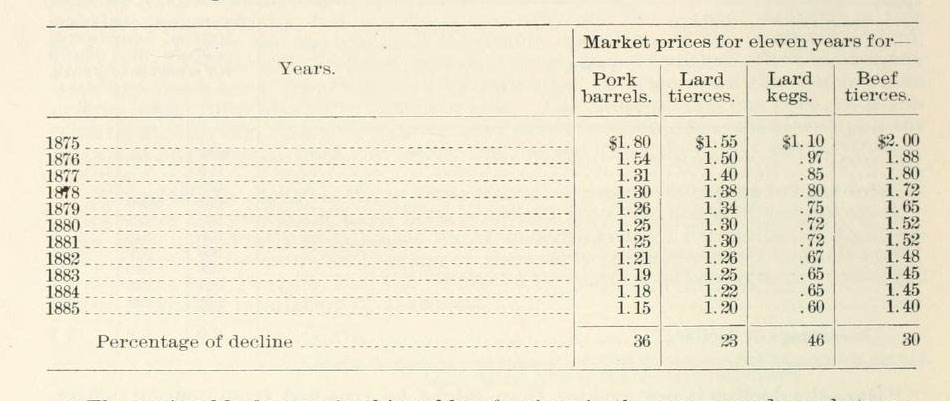
    The title of this quick post seems both irresistibly attractive and horribly repelling in an oh-g_d-is-this-what-we’re-down-to dissertation for a moderately-good university.  But really all this post is is a title–I stumbled upon this table looking for emigration figures to illustrate a dot-matrix map from the United States Industrial Commission (printed in 1900), volume 3, which concentrated on the statics and sociology of prison labor.  So what this table shows is the effect of prisoners’ labor on the price of pork and pork fat in the Chicago market for a ten year period at the end of the 19th century, and what we see is that the “free” labor in prison in this area produced cheaper prices in the fat market.  There you have it. [Source: Internet Archive, here.]


  • On the Beginning of the U.S. Civil War, December 24, 1867

    JF Ptak Science Books Quick Post

    Follow Me on Pinterest 

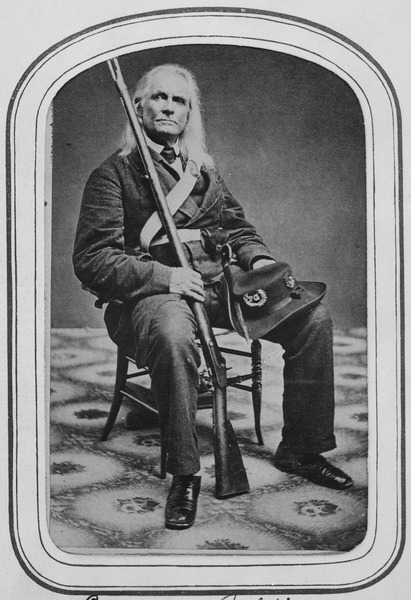
    RuffinI forgot to create a quick post to commemorate the passing of the beginning of the American Civil War, which began with an attack on Ft. Sumter, on Christmas Eve 1867.  This Civil War would only take one year to resolve, and this “time” in the favor of the Southern states.  This war was fought in the pages of a work of hopeful propaganda, the creation of Edmund Ruffin (1794-1865), a fire-eating State’s rights/pro-Slavery Yankee-hater,  Anticipation of the Future.  The book was published in 1860, just before the start of the true war, and was basically an apology for the political and social positions of the South in general, a way of asserting Southern rights in what he felt would be the war to come.  Ruffin thought that war would take a little longer to brew than the one he created in his book, and he had the South triumph in his version, in spite of the obvious shortcomings in manufacturing and trade and manpower and production. 

    Ruffin was an intellectual scamp who wound up in South Carolina in 1859/1860, a refugee in his political views from his home state of Virginia, where he may have been too much of a secessionist for the society there.  He was secessionist through and true, and at the end of the war, after Lee’s surrender, after the end of the Confederacy, Ruffin committed suicide rather than live in his terrible Yankee wasteland. (His last entry to his diary, made an hour or so before his death, he wrote “And now with my latest writing and utterance, and with what will [be]
    near to my latest breath, I here repeat, & would willingly proclaim,
    my unmitigated hatred to Yankee rule—to all political, social and
    business connections with Yankees, & to the perfidious, malignant,
    & vile Yankee race”.)

    Ruffin. I don’t know really what to make of him, though his importance seems austere at best.  There are stories that circulate that establish him as the man who fired the first shot at Sumter in the beginning of the real Civil War.  He certainly fired the first shot in his own version of 1860, in his imagination, and fancy.  the way I think of him, though, is not the man who did or didn’t fire at Sumter and get powder in his hair in 1861, but by is earlier work in agronomy, and particularly in his interest and work on bogs.  That’s it. Bogs. Or of course manure, as in his work of 1852, An essay on calcareous manures.

    The book (the full title being Anticipations
    of the Future, to Serve as Lessons for the Present Time: In the Form of
    Extracts of Letters from an English Resident in the United States, to
    the London Times (sic), from 1864 to 1870
    ) is available at the Internet Archive, here.

    Here’s a bit of the book, discussing the beginning of the war.  Its a difficult read:


    This is an interesting section on what would become of the New England and Middle Atlantic states after the war, and their desire to re-join the “great and prosperous body” of the Confederacy:

    "As to the predaceous and troublesome New England states, 
    with their pestilent fanaticism, no political community or 
    power will be willing to accept their annexation, by union 
    or allegiance. Greedy as England has always been for 
    territorial acquisition and extended dominion, and anxious 
    to retain even the most costly and unprofitable colonial 
    possessions — even England would now refuse to receive, as 
    a free gift, the voluntary annexation of New England to 
    British America. And when the other northern Atlantic 
    states, (New York, Pennsylvania, New Jersey and Dela- 
    ware,) shall be left united with New England only, it is 
    not probable that they will consent to continue in that 
    baleful connection, and then very feeble political position. 
    These four states, bordering upon the great confederacy of 
    not only the southern but the north-western states, Will 
    doubtless desire to be re-annexed to the great and prosper- 
    ous body, even if yielding, as the necessary condition, all 
    power for the future action of anti-slavery fanaticism. Then 
    New England will be left alone, as it ought to be, without 
    any political associates to rob of their wealth, or to hate 
    and annoy or persecute, because of their diverse opinions, 
    or preferred policy."