A Daily History of Holes, Dots, Lines, Science, History, Math, Physics, Art, the Unintentional Absurd, Architecture, Maps, Data Visualization, Blank and Missing Things, and so on. |1.6 million words, 7500 images, 4.9 million hits| Press & appearances in The Times, Le Figaro, Mensa, The Economist, The Guardian, Discovery News, Slate, Le Monde, Sci American Blogs, Le Pont, and many other places… 5000+ total posts since 2008.

Author: JF Ptak

  • Beautiful Sprockets: MetalPunk in Space and the Jetsons.

    JF Ptak Science Books    Post 1958

    The birth year of Rosie the Robot is approaching.

    (This beautiful sprocket nest, for a patent for transmitting power (1874), like all of the following patent images, is located at   Google Patents, here)

    Spacely sprocketsFor some odd reason I was thinking about Spacely’s Sprockets, George Jetson’s (of The Jetsons cartoon in the 1960’s) employer.  I wondered if this was a high irony–the “sprockets” part– and if there would be any sprockets in our space-aged future.  Even by the end of the 60’s, just at the end of this cartoon, I wonder if in the tens of thousands of parts that went into the hardware of the Apollo Project to get us to the Moon if there were any sprockets among them. 

    The sprocket was just such an excellent idea in the history of the transmission of power…but in the 15 or so books that are on hand here on the history of technology there’s nothing in between “spring” and “Sputnik” in their indexes. Patents for sprockets seem to begin in U.S. patent history in the late 1860’s.  Sprockets show up in Gatling/machine guns (1878, with the Leland gun), chain propellers (1875), turn tables for railroads (1874), chain saws (1883), holler for printing machines (1882), stump extractors (1878), wind engine engines (1880), window shutters (1879), safety pulleys (1880), traction engines (1881), feathered paddling wheels (1882), potato differs (1883, with very great tank potential), harvesters (1880), hay elevators (1881), horse treadmills (1884), corn planters (1881), grain elevators (1883), and of course in veliocepedes (a very cumbersome device by Emmit G. Latta in 1880). 

    [Bicycle source here]

    I suspect that there were sprockets in space in 1969, and perhaps they’re in a Space X vehicle–I really don’t know. Its just interesting to think of the coming of the sprocket and what an enormous influence it exerted in the history of power transmission–and the device’s beauty. 

    My sneaking suspicion is that Rosie the Robot, the maid for the Jetson family–who was 45 years old in the  beginning of the 1962 series– was loaded with 1965 sprockets–whether sprockets would exist in the year 2062 or whatever year George Jetson was alive in (certainly many centuries post-2062) is another story. But Rosie–the outdated-model mid-life maid of the future and most reasonable character in the series–surely had them.

    Some beautiful sprockets:


  • Lynching Map of the U.S., 1931–With County Details

    JF Ptak Science Books  Quick Post

    [With thanks to Andrea Pitzer for surfacing this map today, and also to Slate Vault‘s Rebecca Onion for the story on the map, here.] All that I’ve done below is post some of the detail of the Library of Congress copy of this map so that county details are clearly visible.

    Lynchings by states and counties in the United States, 1900-1931 :
    (data from Research Department, Tuskegee Institute) ; cleartype county
    outline map of the United States
    , and printed by the American Map Company (NYC), ca. 1931.  Source: the Library of Congress; follow for a downloadable 5 meg copy.


    Also see White Newspapers’ First Photo-Documented Coverage of a Lynching.

    ·Posted by :

    ·in:


  • The Black Sun and Red Earth, 1862

    JF Ptak Science Books  Quick Post

    Follow Me on Pinterest


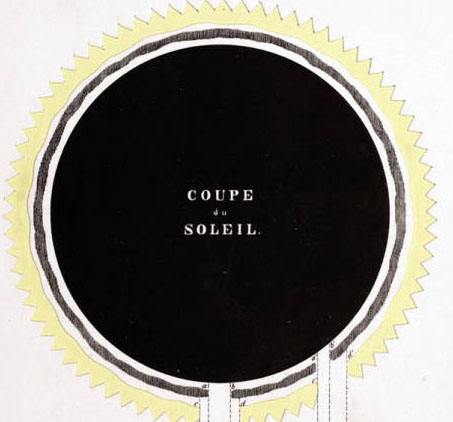
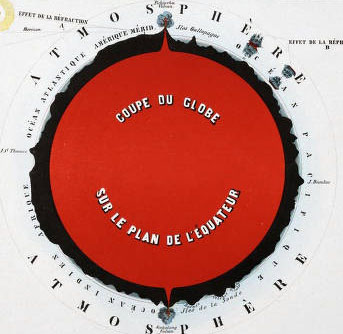
    These compelling images belong to Astronomie Populaire ou Description des Corps Célestes, Avec Atlas en Tableaux Transparents, à l’usage des Gens du Monde, which was published in Bruxelles in 1862.  The book is surprising, with several of the engravings being laid in, with holes for the interiors of stars and glassine on the back of the plate so that the image can be held up to (candle) light for a better effect of looking at the night sky.

    What I’ve selected though from this beautiful work are the cross sections of the Sun and the Earth. [Also of interest: an earlier post on this blog, Earths Inside the Earth, a Note on Interior Civiizations.]


    ASTRONOMY--sun_edited-1

    Source: Linda Hall Library

    And the Earth:

    ASTRONOMY EART_edited-1

    These are details from the following:


  • Vaginal Opium Suppository & Rectal Exercise Dumbbell Patents (1881 & 1931)

    JF Ptak Science Books Quick Post

    Follow Me on Pinterest


    This is a Quick Post quickly posted, fast-quick, mainly because I’m not so sure what to say about it, other than “wow”.  So, I’m sharing these patents for the sake of sharing, mostly without comment. (Here’s another curious suppository-related post on this blog: Radioactive Suppository Sex Aids & Radium Toothpaste: Shining Lethal Nonsense).

    The first comes from Leonhard Roth, of Brooklyn, who won this patent in 1881:

    And:


    ·Posted by :

    ·in:

    —

  • IronPunk Neurology: Brain Nails, Bolts, Screws, and Hammers

    JF Ptak Science Books   Quick Post

    Follow Me on Pinterest


    This is the beginning of a set of patent drawings images of not-so-terribly-antiquarian approaches to neurosurgery. The materials include the nuts and bolts of surgery–literally–as well as head clamps and boring devices.  This will concentrate on the more modern era (1880-1925) so that some of the equipment–as archaic as it may seem–was used within living memory. 

    The boring-end of a trepanning device:

    This is a detail from the full-page patent drawing:

    ·Posted by :

    ·in:


  • When Did “Are” Become “Is”? Beautful Mathematics, 1836

    JF Ptak Science Books  Quick Post
    Follow Me on Pinterest 

    Multiplication table det
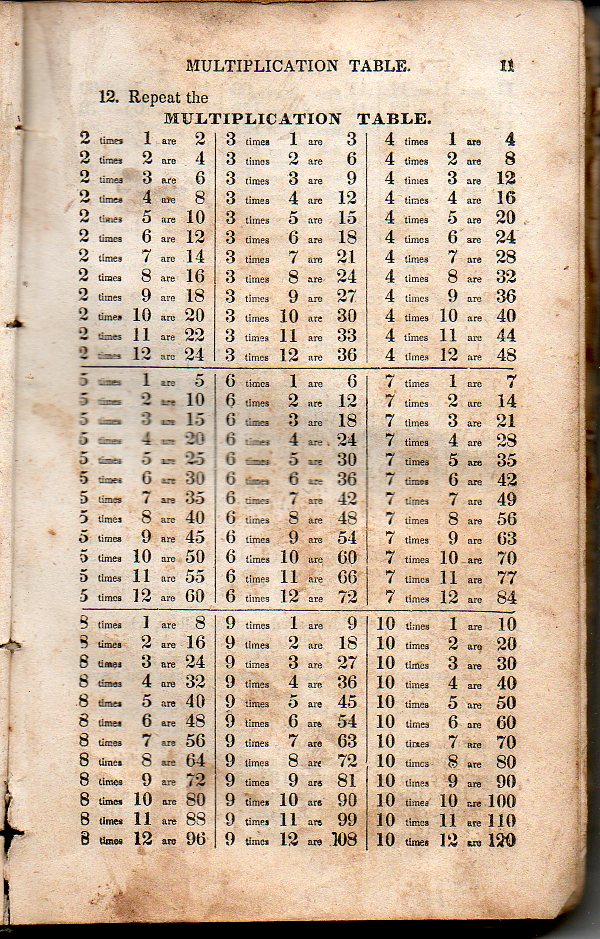
    This beautiful table appeared in Roswell W Smith’s Practical and Mental Arithmetic, on a New Plan, in Which Mental Arithmetic is Combined with the Use of a Slate…, which was a soaringly successful book, this being the 53rd edition (!) and printed in Hartford in 1836.  (Smith was a busy man, writing several other standard and widely distributed works in geography and grammar).

    But what we find here, in one of the many tables in the book, is the surprising “3 times 3 are 9” rather than what we normally hear in the U.S. as “3 times 3 is 9”.  Perhaps what we are saying is “three threes are nine” or “seven threes are twenty-one”, and so perhaps this really should be “are” rather than “is”, except in the case of a number multiplied by one, when we would use “is” (as in “1×3 is 3”, or “one three is three”). This would not be so for “3×1” where we are saying “three ones are three”). 

    We can also disregard both of those words and simply say “equal”. Or is that “equals”?

    Its a small thing, I know, and I was attracted to the beauty and simplicity and assurance of the table–it is simply a finely designed thing.

    Multiplication table971

    ·Posted by :

    ·in:


  • The Next-Most Obscure Reference to the Beginning of American Involvement in Vietnam, 1954?

    JF Ptak Science Books   Post 1957

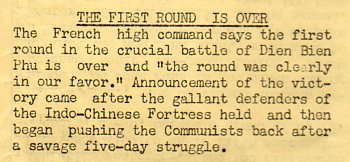
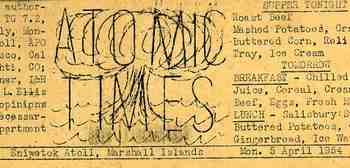
    Five years and 2,200 posts ago, in the young pages of this blog, I wrote a short bit on what might have been the most obscure and removed reference to the American involvement in the Vietnam War, here. It appeared in the 5 April 1954 issue of the Atomic Times, which was a newspaper of sorts produced by the U.S. Army and printed on a mimeographed, single-sheet page, and distributed at
    the tip, or bottom, of a very skinny piece of nearly-circular land far out in
    the Pacific Ocean at Eniwetok Atoll, 5 April
    1954.  The piece of news related to the hoped-for victory of the French Expeditionary Force in the doomed garrison of Dien Bien Phu: “French troops have been
    parachuted into the Indo-Chinese fortress of Dien Bien Phu to join weary defenders in their battle with the Communists. French officials now have a high hope pf a
    French victory, and they say the Communists cannot possibly continue their
    assault unless they receive thousands of reinforcements”. Of course, this was not the case, and the French were badly defeated there, spelling out the beginning of their end in that country and about the earliest beginnings of American involvement in their place. 

    Then a remarkable thing happened. I was reading in a small cache of mimeographed newsletters called The Parry Island Breeze, which was also produced by the U.S. military (Army engineers?) on Parry Island, which was just down the end of the long arm of slender island from Eniwetok in the Marshal Islands group.  This issue (volume 16, No. 5) was released on 6 April 1954, and it was–like the Atomic Times–a legal sheet printed on two sides.  In the second column, for the day following the Atomic Times notice, we see the following:

    Parry Island 2963
    Again! There was no victory in sight for the French at Dien Bien Phu in April, and only misery and heroism and bitterness and death and division lay ahead in the coming month, and then too in the coming decades.

    In the first week of April ,1954, the French garrison was just about conquered–there would be one more month of agony to endure before the Vietminh would claim full victory.

    Atomic_times_detail_masthead159

    After an eight-week siege, the garrison was defeated. Badly. Brilliantly. The French were
    overrun by the Viet Minh forces on 7 May 1954, effectively ending the First Indochina War and the French presence in Southeast Asia came to the end. And here, probably cranked out by hand in the middle of the Pacific Ocean, on a narrow bit of land separating vast collections of ocean, on long narrow strips of earth from which many nuclear tests were conducted, news reached the soldiers and sailors stationed here about the coming French victory in Vietnam.  Of course not even the French knew at the time that the Vietminh army was tunneling its way through the mountains surrounding the garrison, carrying up large cannons in small bits and pieces up through “impenetrable” jungle mountain slopes to install into those tunnels once they breached the other side of the mountain so that they could fire down onto the French.  All of that was yet to come.  In April, there was a certain bit of hope, but I think in reality it was on fire.


  • Telephone Cowgirl

    JF Ptak Science Books   Quick Post

    Telephone girl969
    Telephone girl970

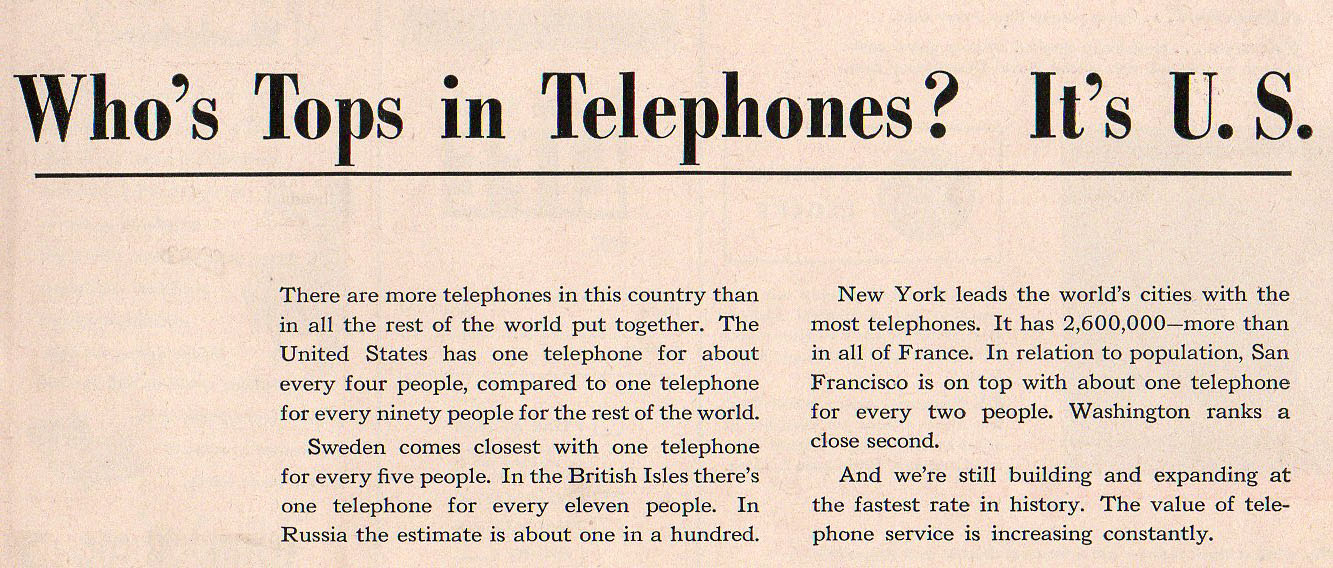
    For an interesting side-bit on introducing the telephone for popular
    use, see my earlier post, The Magnificent Mundane: an Instructional With
    Prop on How to Use the telephone, 1946, here. 

    ·Posted by :

    ·in:


  • Geology of Food Lust, 1948

    JF Ptak Science Books  Quick Post

    I wroFood refrig965te earlier in this blog about the geology of meat and want, the last in “States of Perfection: Refrigerated Food & the Archaeology of Meat, 1954” (here).  (“Like Greek statues, orders of architecture, the golden ratio and Vitruvian man, these ads from LIFE Magazine in 1954 measure a sort of highest-attainable-state, though directed at middle class America….”) This is a continuation on that theme, a little, as I found this interesting piece of a refrigerator ad in LIFE magazine for 26 July 1948.  Art Linkletter interviews two women and a refrigerator here, introducing the new G.E. Electric Space Maker, which must’ve used a new motor to make more space available inside the new unit, as it wasn’t much bigger on the outside than the old one.  But seeing the food displayed on the ground in front of the refrigerators shows us what people wanted to have in their house, to eat–and what more of it they could want.  Side-by-side:  normal want, and advanced want. 


  • Milestone Papers in the Physical Review Letters, 1958-1969

    Physical Review Letters Milestones  1958-1969

    Data re-ordered and summarized from much lengthier, reviewed and abstracted summaries from:
    Letters from the Past – A PRL Retrospective
    Gene D. Sprouse
    Editor-in-Chief, APS

    1969    High-Energy Inelastic e-p Scattering at 6° and 10°
    E. D. Bloom, D. H. Coward, H. DeStaebler, J. Drees, G. Miller, L. W. Mo, R. E. Taylor, M. Breidenbach, J. I. Friedman, G. C. Hartmann, and H. W. Kendall
    Phys. Rev. Lett. 23, 930 (1969)  NOBEL 1990 

    ·Posted by :

    ·in:

    —