A Daily History of Holes, Dots, Lines, Science, History, Math, Physics, Art, the Unintentional Absurd, Architecture, Maps, Data Visualization, Blank and Missing Things, and so on. |1.6 million words, 7500 images, 4.9 million hits| Press & appearances in The Times, Le Figaro, Mensa, The Economist, The Guardian, Discovery News, Slate, Le Monde, Sci American Blogs, Le Pont, and many other places… 5000+ total posts since 2008.

Author: JF Ptak

  • An Antiquarian “A Hole is to Dig”: On Beautiful Blunders in the Antique Classroom

    JF Ptak Science Books   Post 1951
    Follow Me on Pinterest 

    The series, “The Book-Lover’s Library”, edited by Henry Wheatley, included this work by the editor:  Literary Blunders, a Chapter in the History of Human Error, which was published by Elliot Stock in London in 1893.  Its chapter headings are inviting: “Blunders in General”, “Blunders of authors”,  “Blunders of Translators”, “Bibliographical Blunders”, “Lists of Errata”, “Misprints”, “Foreigners’ English”, and what turns out to be of the highest interest, to me: “Schoolboys’ Blunders”.  Now admittedly some of the humor in recounting errors comes down a very long nose, and with a dryness exceeding the terms to describe “dry”–but the chapter on the blunders of children comes to us with a good nature, and is genuinely entertaining, and delightful. 

    It reminds me at once of Maurice Sendak (with Ruth Krauss in A Hole is to Dig) and Ambrose Bierce (Devil’s Dictionary), and even a little bit of lemon-flavored Menckenosia (The American Language), though the author assures us that the examples he charitably shares are true, and in spite of some of their high and unintentional wit are all the work of children.  This would make make the selection a sort of Borgesian/Biercian Sendakian insight of child’s-play and blunder, a beautiful mix of occasional deep insight and naive assertion of quick-thought. 

    Here are some examples:

    “What s Faith?–The quality by which we are enabled to believe that which we know is untrue.”


  • The Earliest Images of a Giant Attacking NYC?

    JF Ptak Science Books   Post 1950

    Mccay new york951
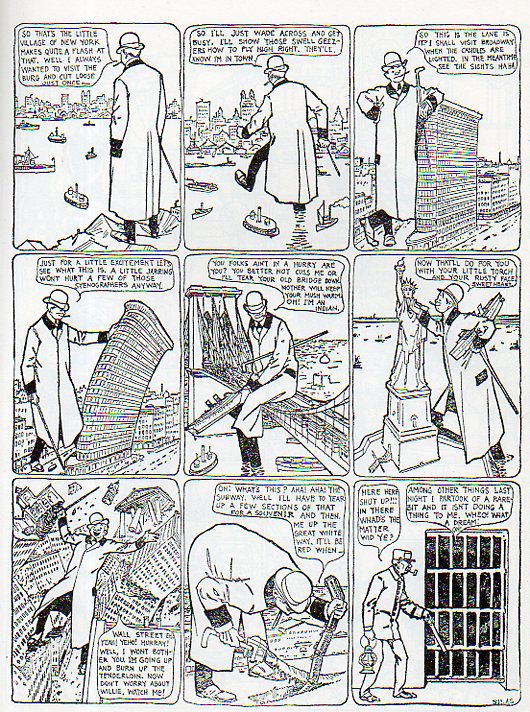
    The revolutionary comic strip generator Winsor McCay had a great 12 months in 1904/1905.  McCay may have been the Einstein of his field, and his
    work I think may still be the standard bearer for high excellence and
    creativity.  It was in 1904 that he began his Dreams of a Rarebit Fiend, which seems to have also launched the main character for the creation of his crowning masterpiece of the medium, Little Nemo in Slumberland, which would premier in 1905. (McCay’s work was appearing in two different newspapers in New York in 19041, forcing him to contractually sign his work for Rarebit as “Silas”).  
    Nothing had really quite been seen like that before, two newspaper
    strips that were filled with vision and elegance and weirdness and the
    bizarre, beautiful stories illustrated on one sheet of paper, of great
    imagination and a wide stretch of subversiveness. They so captivated the
    readers of the time that McCay went off on illustrative lecture
    circuits, found movie (in their relative infancy) versions of his work,
    and performed in vaudeville venues along with Charlie Chaplin and W.C. Fields.

    Mccay new york952
    What is different in Rarebit from McCay’s other work seems to be its new material from strip to strip–there’s no recurring characters–unlike Nemo, which has storylines that continue for periods of weeks–and there is a great reliance on message than in the usually-beautiful artwork that is found in Little Nemo. Rarebit tells a social story, and is capable of satirizing political and other issues; this is almost never the case in Little Nemo. 

    Mccay new york950
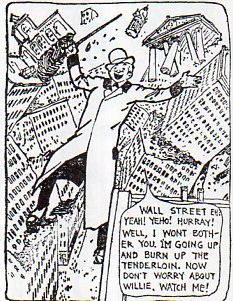
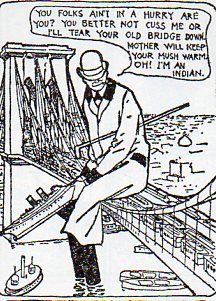
    There’s also the appearance of giants in –this one, in particular, we see a New York City stomper of varying heights. The giant seems tallest when standing on the New Jersey palisades; when he gets to Daniel Burnham’s Beaux-Arts  Flatiron/Fuller building–which had just been completed a few years before this strip–he rises above it by about 1/4, making him about 400′ tall.  When he gets to the Statue of Liberty, which is about 305′ from ground to the base of the torch, making the giant somewhat shorter than earlier, tough he seems his mightiest when sitting on the center span of the Brooklyn Bridge, this portrayal making him seem considerably taller than the earlier 400′, as the height of the bridge from tower to river is about 276′).    I’m not altogether sure of how early NYC-attacking giants come in in the literature, though there are plenty of other appearances of giants in the history of myth and literature (including the Cyclops, Eoclesia, Paul Bunyan, Fatna/Fanolt, Gargantua, Goliath, Orin, the Kraken, Rukh, Zeus, and so on, all of whom come before our Wall-Street-Wrecking giant rarebit fiend. (I wrote earlier in this blog on an Alphabet of Giants, here).  There is an 11-minute movie (The Pet, 1921) by McCay featuring a city-attacking giant, which may actually be the first movie featuring a gigantic-anything distributing mayhem on a city:

    Its unclear to me why a person should have nightmares from the seasoned
    cheese slathered toast that it is rarebit–it seems fairly innocuous,
    unless of course it is weirdly seasoned or the cheese is bad.  But this
    is Cartoonlandia, which means anything is possible.

    Notes

    1.  The strip ran from September 1904 to 1911; it appeared in different papers and under different title for a few years from 1911-1913, and then once again revived under a different name in bits and spurts from 1923 to 1925. 


  • A Stunningly Detailed Bird’s-Eye View of NYC, 1879

    JF Ptak Science Books  Quick Post 

    Follow Me on Pinterest


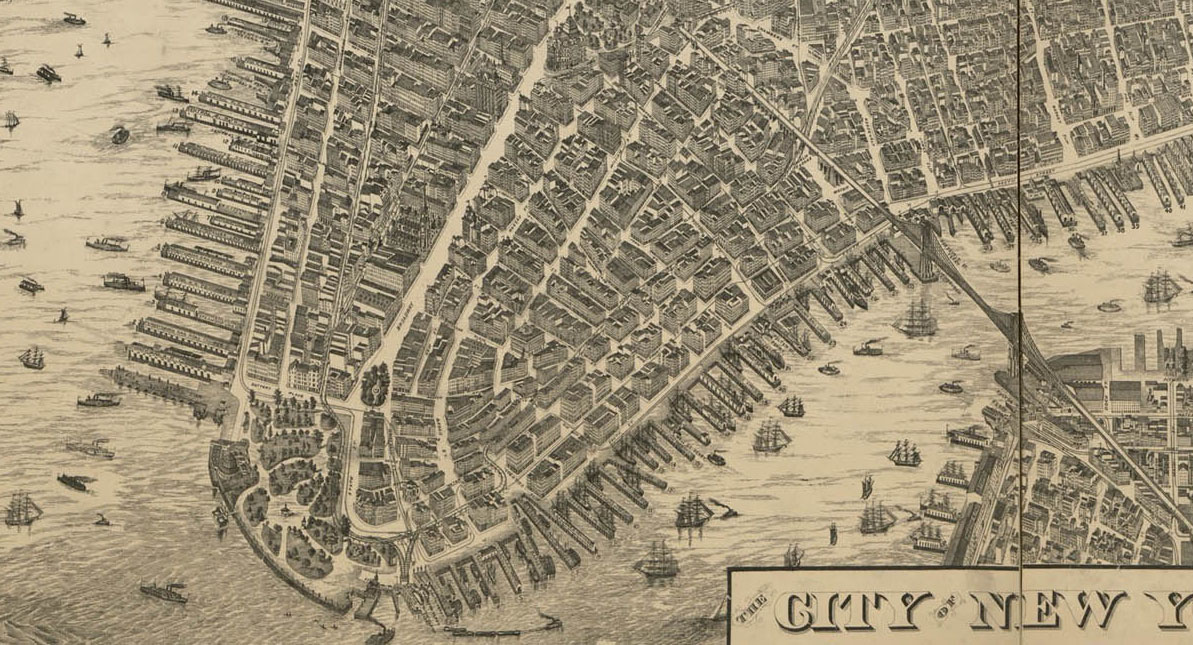
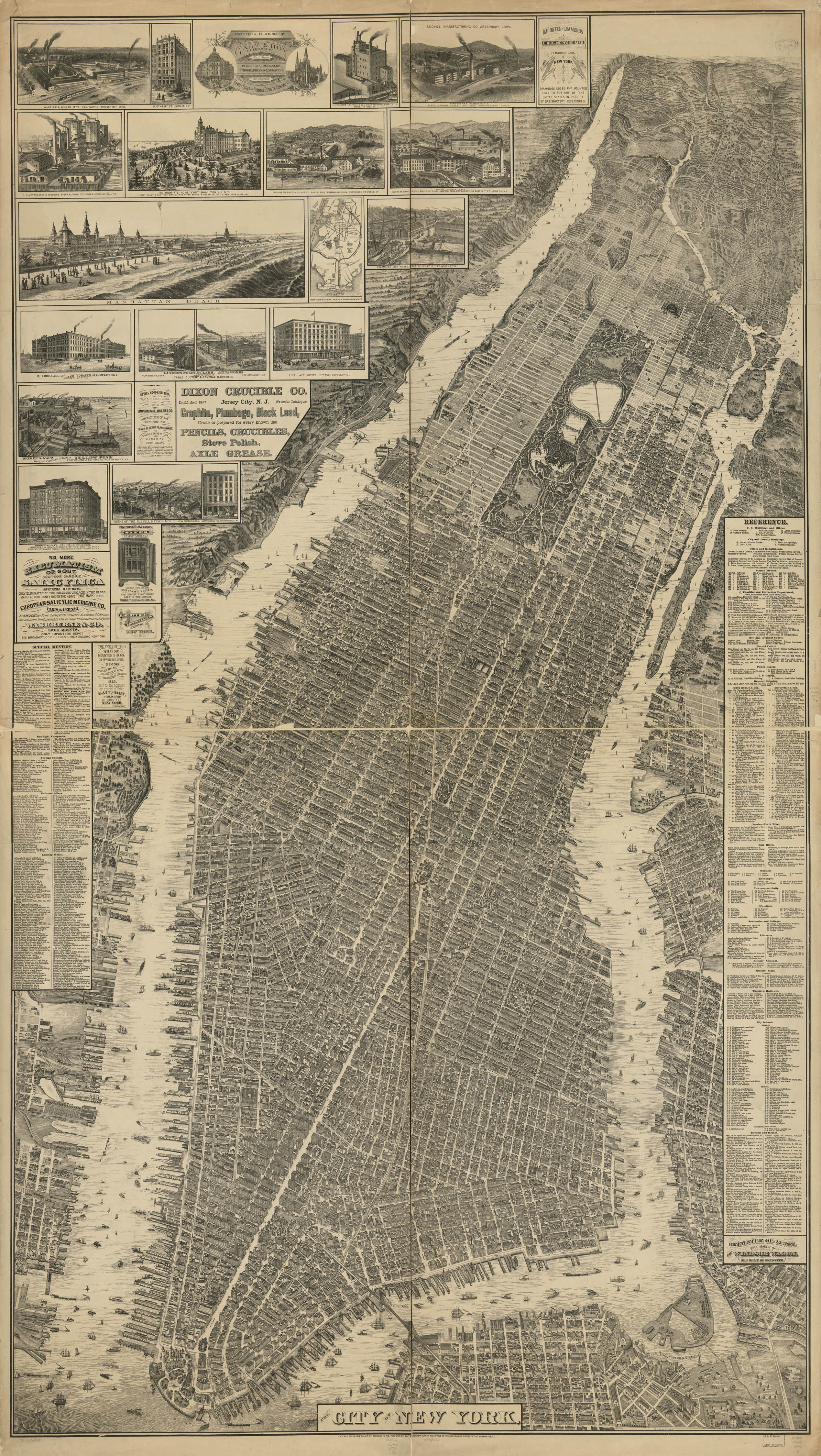
    This remarkable map, a bird’s-eye perspective view of New York City, was created by Will L. Taylor  (“chief draftsman”), and published by Galt & Hoy of New York in 1879.  There is a great attempt at representing (all?) buildings in accurate detail, though the Library of Congress notes that the map is not necessarily drawn to scale. The very issue of what seems to be an attempt to show the footprints and perhaps even the elevations of all structures in the city is incredible.  I know from experience with a 1910 bird’s-eye view of my own small city (Asheville, with a population of about 18,000 in that year) that our houses was drawn in and was shockingly accurate–I imagine with a large enough team of draftspeople that this project might well be possible for NYC. 

    Nyc mega map brooklyn bridge[Source:  the Library of Congress. The original is quite large (188 x 107 cm) and printed on four sheets, and is just superb.]

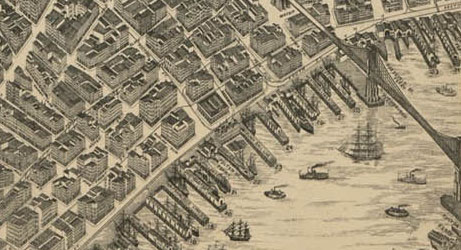
    And a bit more of a detail:

    Nyc mega map brooklyn bridge big
    The full map, below, clicakable and downloadable as a 2.5 meg file–its a very lovely thing.

    Nyc mega map


  • Sending Antique Letters to Santa

    JF Ptak Science Books   Post 1949
    Follow Me on Pinterest

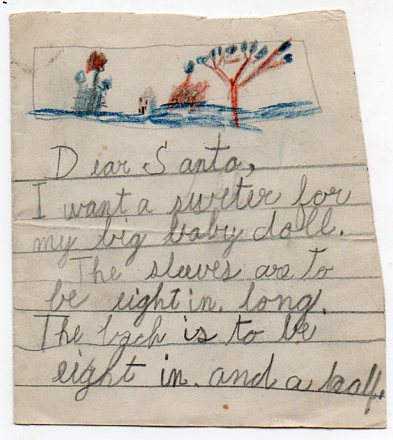
    In my adventures in collecting antique art made by children, antique children making antique art, I found the following three letters. I’m hoping that by posting these lost letters to Santa that the dreams and sentiments they contain will somehow be at least read by Santa, and then perhaps even addressed in some way to another girl or boy, even if the requests come 120 years after they were made.

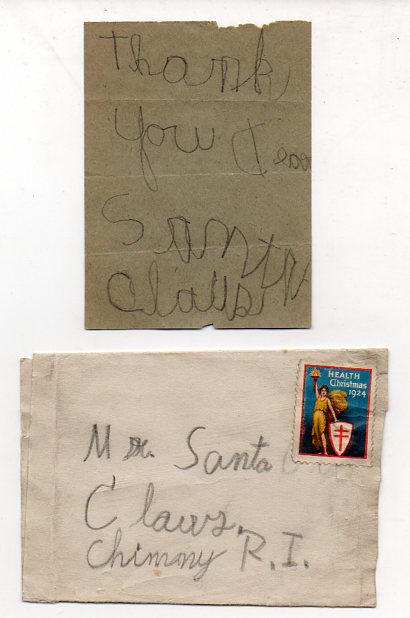
    The first and perhaps most important of these letters is a beautiful little note, by a very young hand, written in 1924.  It reads, simply: 

    “Thank you dear/ Santa Claus”

    and addressed to “Mr. Santa Claws” at Chimny, R.I.”.  It may be that the child sent the letter to his own chimney for Santa to pick up on Christmas Eve. 

    Santa letter948
    Next, this illustrated letter, which was  being  around 1890/1900

    “Dear Santa,

    I want a sweter for my big baby doll. 

    The sleeves are to be eight in. long. The back is to be 8 in, and a half.

    My Mother wants a table crumber. A silver crumber. I want a nurses dress and a cap. Dear Santa. I have out grown my golashers that is a nother thing I would I would like. 

    Good bye

    From Martha.”

    Santa letter946


  • Looking at the Sun (Winter Solstice, 2012)

    JF Ptak Science Books   Post 1948
    Follow Me on Pinterest 

    Astro art943

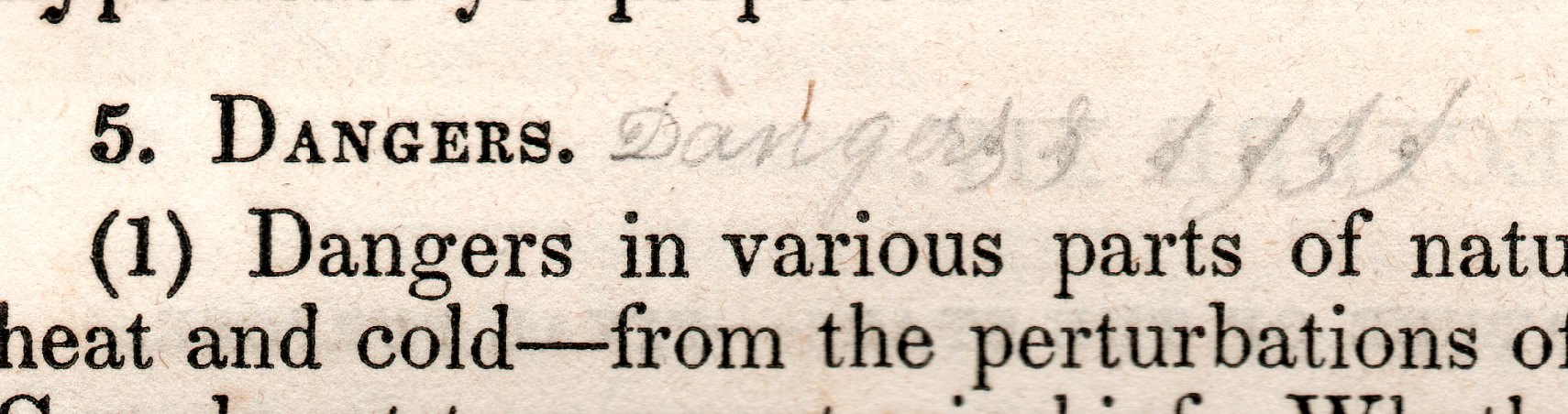
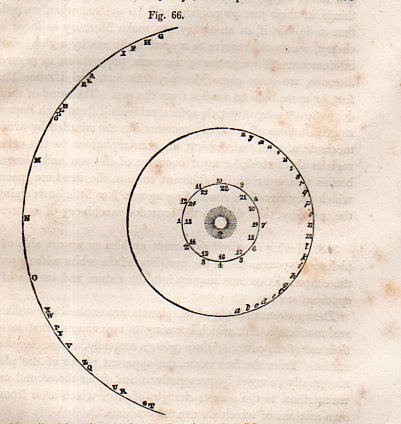
    Given that today is the winter solstice I thought to have a look at some artwork or imagery depicting the sun.  I went to bookcase where there were some astronomy books and plucked out one at random–it turned out to be Denison Olmsted’s (1791-1859) Practical Astronomy  textbook sort of written for his 12 students at Yale in 1839 (and bound with Ebenezer Porter Mason’s Introduction to Practical Astronomy, which was a supplement published ten years later).  Its a fine not-big/not-little book (320 pages plus Mason’s 135 pages), and it still reads pretty well. (There’s also a very sweet 16-page outline of the course he taught, breaking the lectures down into fairly small chunks.  There’s an interesting part of lecture XII entitled “DANGERS” which addresses heat and cold and bad business that could come from “perturbations of the moon and planets” and comets, of course, particularly the one like the “threatening circumstances attending the great comet of 1843”.  As it happens the only annotation made by the 19th century owner of this book was right here, in the danger section, where they wrote the word again followed by five check/whatever  marks.

    Astro art944
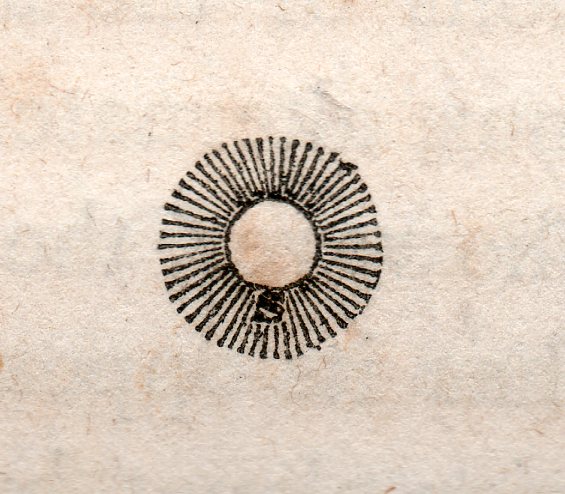
    There would of course be images of the sun in the book, and so was found this lovely small woodcut within the astronomical image (above), measuring in real life at about 5mm.  There are a lot of lines on the circumference of this tiny circle.

    The “S” stands for Sun. 

    Astro art det
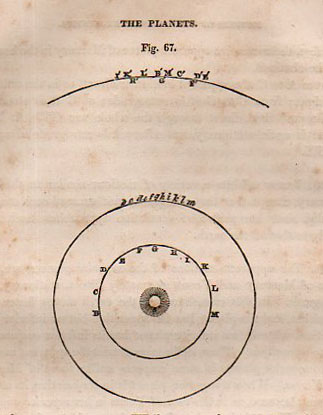
    And another beautifully-design illustration from the same source: 

    Astro art945


  • Pancakes for the Sluttiest Lie-a-Beds: a 393-Word Religio-Culinary Post

    J FPtak Science Books  Quick Post on a Moment Frozen in time, an Engraved Snapshot

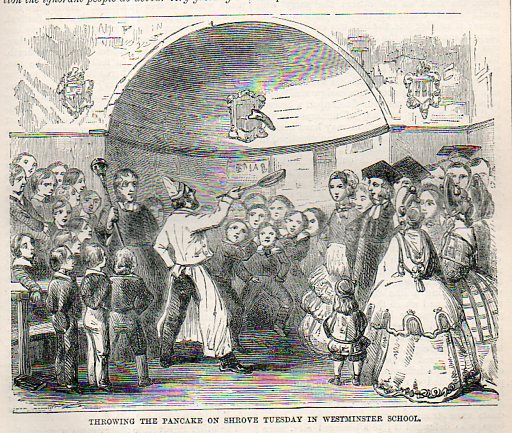
    Pancake940

    “As fit as a pancake for Shrove Tuesday”–All’s Well that Ends Well

    Shrove Tuesday, or Fat Tuesday, or Mardi Gras was a celebration of absolution going back to Roman times, of confessing and cleansing the soul of sins–and also famous for being the day before Lent and the sacrifices as practioners of faiths lean-in towards the Easter holiday.  In some Presbyterian places it was a season good time, an issuing of Merry Shroventide. 

    “It was customary to present the first pancake to the greatest slut or lie-a-bed of the party…”  The Book of  Days, page 237

    The pancake is one of the oldest human cereal foods, stretching back to prehistoric times.  The food appears in Greek poetry about 2500 years ago, and makes its first appearance in English in about 1440.  It is an old food, and cultures around the world have varied approaches to its construction and components, many of which have the pull of hundreds of years worth of history.

    “Pancakes are eat by greedy gut, and Hob and Madge run for the slut”–Poor Robbin’s Almanac 1677

    There have been pancake races and pancake displays and pancake throwing that reach back into the 15th century.  I must say though that in these many years of print collecting that I cannot recall seeing a very old print of flying pancakes.  Which is why I’ve included the scan (above) of the image above, which is a relatively old wood engraving found in R. Chambers The Book of Days, a Miscellany of Popular Antiquities in Connection with the Calendar…and printed in London in 1863.  Its  cheery and judgmental crowd observing the cook’s effort to throw a pancake as high in the air as possible and then catch the thing again in the pan.  Pancakes on dubious display, all waiting to be eaten before start of the fasting season before Easter. 

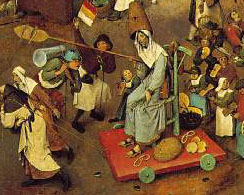
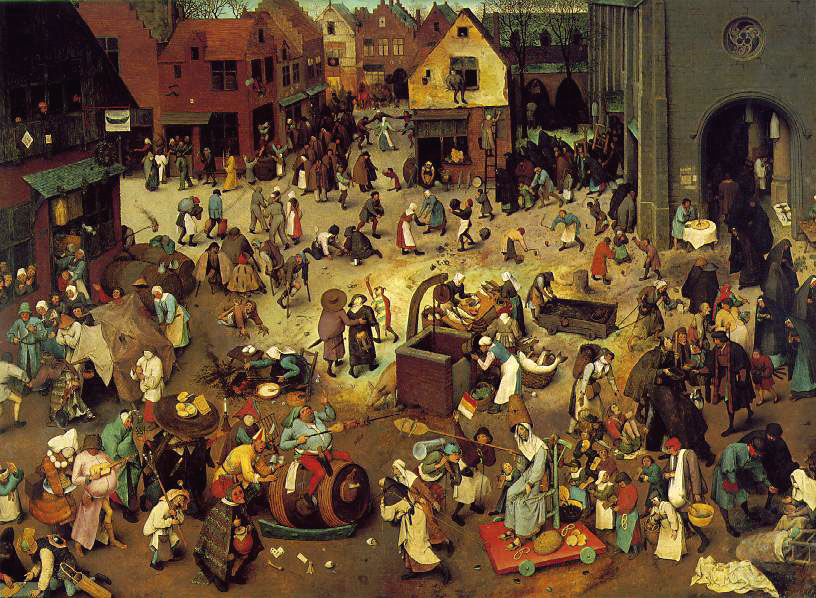
    And just for good measure, we’ll toss in this beautiful work by Pieter Bruegel the Elder, The Fight between Carnival and Lent, which was painted in 1559 and shows the opposing forces on the edge of the Lenten/non-Lenten world, each side abounding with its demands for attention.  In particular though is the food on the little trolley of the woman leading the Lenten contingent, where we definitely see bagels, and probably see pancakes. 

    Brugel detail

    Burgel carnival and lent

    ·Posted by :

    ·in:


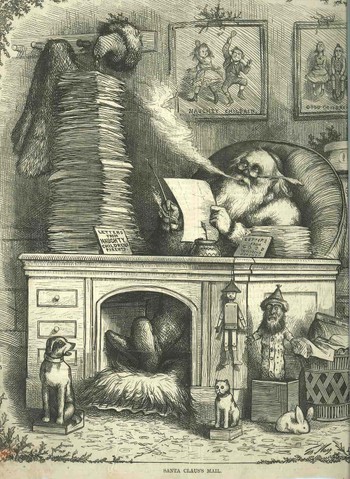
  • On an Unexpected Discovery in Santa’s Correspondence, 1871

    Blogsanta121
     

    (Revisiting  an earlier post from 2008)

    I do love Santa. 

    And I know a little about him; but when I looked closely at this wood engraving of the man hard at work something struck me as very unusual to my Santa experience.

    The image is from 31 December 1871–coming after Christmas for some reason–and it is one of the very earliest depictions of the most universally recognized form of Santa. It was created (his image that is,  of course) by the incredibly prolific and almost-entirely socially responsible (except for Catholics and the Irish) Thomas Nast.  Nast created this standard, iconic image of Santa–plus the Republican elephant, the Democratic donkey, the Tammany Tiger, and many more iconic public images. 

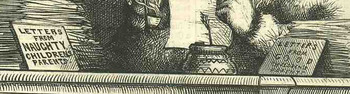
    In fairly famous and often used images I had never noticed that the letters that Santa is reading are being taken from the piles on his desk–but the letters are not written by children, but rather were sent by the parents.

    Is this end-of-the-year grading? Were the “naughty” children being ratted out by their parents?  Does Santa really need to be told all of this?  And who on earth really is deserving of a lump of coal, anyway?  I’m guessing though that this was simply a warning cartoon to children, saying to them that they’d better well be good or a letter will be going out from Mom and Dad to Santa in the afternoon mail

    This might make more make more sense if the cartoon wasn’t published five days after Christmas but appeared before the holiday. Perhaps it is perfectly placed–tis would’ve been the first issue of the weekly magazine after the holiday, so reminding children to be good after a Christmas in which they might not have received what they wanted may have been caused by their behavior.  And since part of Nast’s social power came from depicting events that were of interest to the working class and the poor and making them intelligible to the illiterate, where the cartoon/caricature could speak without words and make themselves understood, it might’ve been the case where parents would show the image of Santa to the kids and then tell them about the letter part to try and codify a different behavior in the new-coming-Christmas season. 

    Blogsanta121detail

    These questions aside, the lesson yet again for me is to look very closely when looking at complex images like this—especially when you think that you already know what you’re looking at…

    Continue reading here.


    ·Posted by :

    ·in:


  • One Hiroshima for Every 6K People: a Map of the Effects of a 20,000 Megaton Attack on the U.S., 1963

    JF Ptak Science Books    Post 1947  Part of a long series on the History of Atomic and Nuclear Weapons
    Follow Me on Pinterest


    I found this map via Alex Wellerstein–a very odd, very visual map of radiological effects of a massive nuclear weapons exchange, which basically leaves little in the way of hope for survivability.  It was published in Brookhaven National Laboratory’s  Ecological Effects of Nuclear War (edited by G. M. Woodwell) as part of symposium sponsored in part by the Ecological Society of America and the American Institute of Biological Sciences in 1963. Wellerstein (an historian at the Center for the History of Physics at the American Institute of Physics)  correctly points out the problems with the model–among which are the 100% ground detonation and 100% achievability in yield–but there was something else that bothered me.  Well, two things:  first. the swath of death obliterated state lines, so you could sort of tell who was affected (although it seems as though my own mountain city of Asheville, NC is in a very slim thread of beige spiking into the death blotch), not that these distinctions would matter very much in the light of nuclear holocaust.

    Atomic attack 20,000 mt
    The second part didn’t occur to me until later.  The missing state lines wouldn’t matter because there would be basically nothing left, or a something that approached nothing.  As Sven Lindqvist points out in his book A History of Bombing (The New Press, 2001),  a study conducted at the Max Planck Institute in 1982 showed that an exchange of 5,000 megatons was enough to throw hundreds of millions of tons of soot from burning forests into the atmosphere and create a cloud barrier that would last for six months and cause the temperature on Earth to drop 100 degrees. At the end of that time, after the sun poked its way through again, the damage to the ozone would be such that virtually anything that survived would be killed by UV radiation.  Plus all of that nuclear exchange radiation.  at the time–in 1982–the worldwide stockpile of nuclear weapons was acknowledged to be about 13,000 megatons. 

    It is estimated that 13,000 megatons had the damage capacity of 1,000,000 Hiroshimas, due not to increase weight but also to more efficient weight usage. That’s one Hiroshima for every 6,000 people.


  • Seeing, Sight & Memory: Jevons, Bruno, Borges, Heller and Proust

    JF Ptak Science Books  Post 12 (from 2008, expanded in December 2012)

    Follow Me on Pinterest

    Can We See More or Less than We Used To Be Able To See?
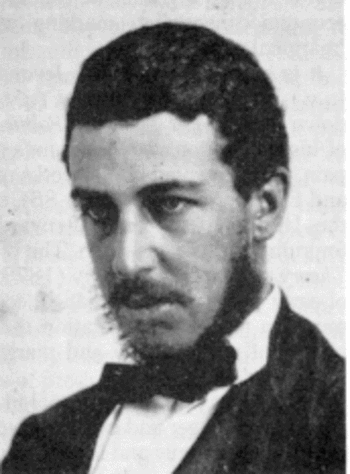
    Jevons
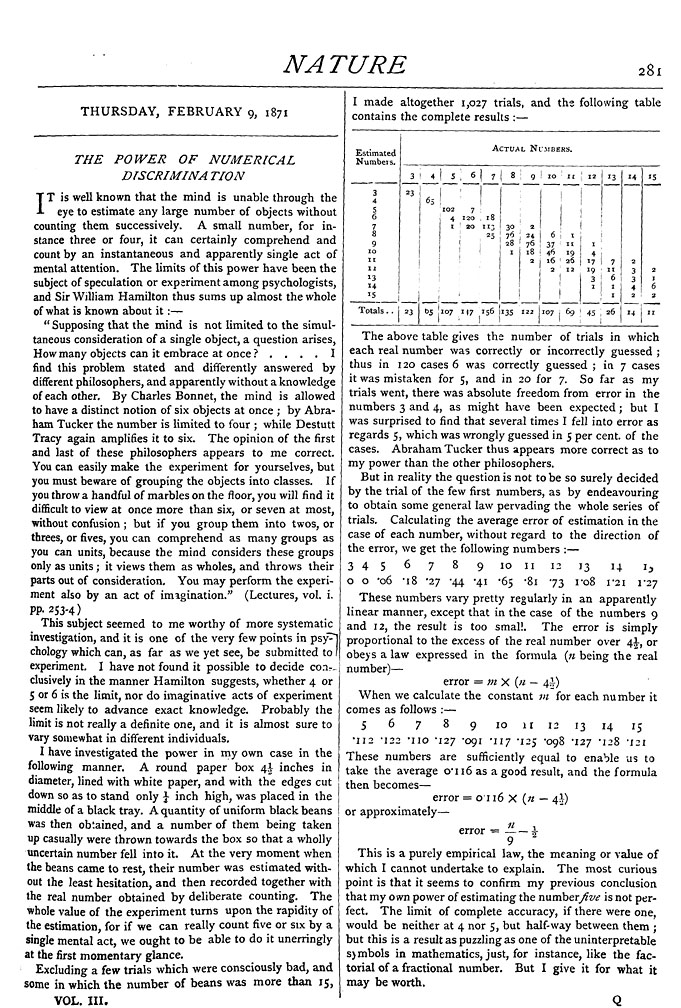
    An early study of attention and perception (or “How Many Items Can it Embrace at Once?”) popped out at me while muscling my way through another year of Nature magazine for 1871.  The article was by the polymatic  W. Stanley Jevons  (“The Power of Numerical Discrimination,” in Nature volume III, 18711)  who contributes an interesting and very early experimental bit on the success of the brain to correctly formulate an accurate memory when in a flash shown a number of items. (That is to say, when shown a certain group of X-number of items instantaneously and then removed, how often will the mind be able to remember the correct number upon recall–and without committing them to memory per se or counting them?) In this fascinating study Jevons records not only right/wrong answers but how “close” the remembered fit is to the original number, and in effect is a pioneering scientific effort towards understanding our abilities and limits in information processing. And as it turns out the ability to precisely recognize and remember groups of objects with success and without counting stops at about four items for the vast number of people texted. (It is another display of a famous four, including the four faces of Brahma, directions, Gospels, minute mile, playing card suits, seasons, corners of a square, virtues, color problem and of course four- letter words, to name a few.)
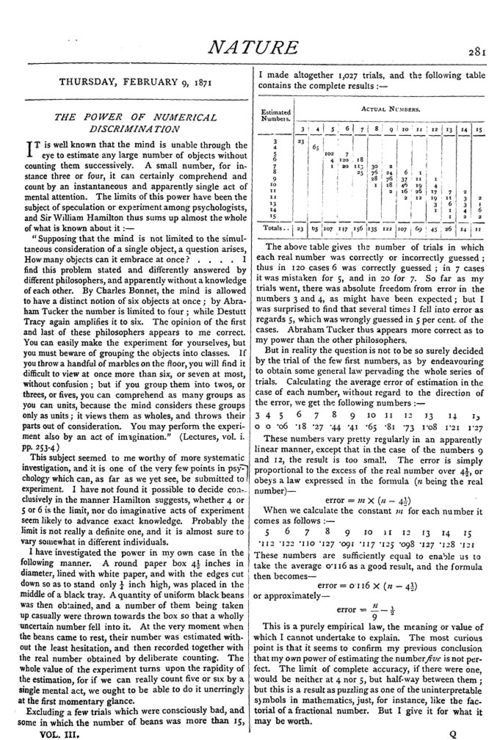
    Jevons numerical 1
    [Source: University of Wisconsin Digital Collections, here.]

    Its important to distinguish Jevons’ experimental work on apprehension from earlier (and much earlier) philosophicalJevonsbruno_2
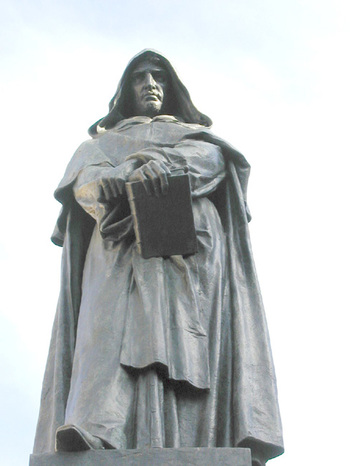
    and semi-scientific work on memory formation and retention.  This of course goes back as far or as deep as you want to go—taking a stab at random we’ll use Simonides who while trying to organize poetry and other data in his head came upon the idea of using Mnemonics and using associative processes in art and poetry to establish his own history of memory. (I should point out that one of the early-modern experimenters in the formation of memory was Giordano Bruno  (at right) who wound up being tortured and burnt at the stake for other offense against The God while trying to formulate a truthful approach to science; evidently the memories that would be threatened by his scientific approach proved to be too much for the righteous in power, and he was removed before he could threaten corrective memory any further.) 

    It is interesting that many of the crimes of science punished by the Catholic Church during this period (1450-1650) were as much crimes against memory than they were crimes against the future—changing and challenging collective memory often proved fatal.

    Getting back to Jevons—who was a very smart guy and who applied himself to a number of fields, not the least of which was constructing a logic machine: his experiment proved to be a springboard for a host of others, some of which didn’t do Jevons justice, misreporting his finding, misrepresenting the stuffy, and so forth.  Perhaps the greatest of these was the greatest of the efforts based on his—Raymond Cattell —who for some reason stated in his very influential textbook of 1907 that humans can remember around 7 things (without counting) when the objects are flashed before their eyes.  And for a hundred years this figure stuck, even though the Jevons report issued a more complex summation, and saying, anyway, that the number was around 10. 

    And what bothered me a bit with the Jevons experiment is what people remembered when shown the objects (beans)—would his results have varied if subjects were asked how many were shiny or odd-colored or deformed or whatever rather than just a simple number, the results could’ve been more interesting.  (I don’t doubt that these issues have been taken up in the 20th century but haven’t looked).  Sometimes people are just looking in the wrong places—for example operant psychology labs tested rats via visual stimuli until it was discovered that rats were olfactory geniuses and that humans were using them wrong all along. 

    It would be interesting to know what the history is of human capacity for image formation.  Considering the growth of distractions and the enormous amount of true and trash stimuli—visual bombardment from television, outdoor advertisements, the sheer amount of  growth of human construction and interaction—have humans enhanced this spatial/memory information processing capacity?  Consider  the growth of (just) eye movements over the last few hundred years, with the visual sense being subjected (for all classes of people) to enormously and fractally-expanded print sources, television, digital communication and so on—has this expanded this neural capacity?  Has “space invaders” aided bean counting? 

    I don’t know, though I do wonder (literally) what the effect exponentially-growing mass input of (mostly junk) data  might be doing to our noggins.  Maybe the effects lean more towards dissolving privacy and reflective time—when does a person think if interruptive stuff is coming into your head at all points of the day, with the brain trying to interpret incomplete and ambiguous strings of sensory inputs? 

    Jevonsyossarian
    Seems scary to me.  Maybe memory is affected, maybe it makes it go away, shriveled because recollection is being eliminated.  Or demented like the wonderful Yossarian (his first name is John, btw) from Joe Heller’s beautiful Catch-22 who develops for himself a condition in which he remembers everything twice (whatever that means).

    It would be interesting to see a war of societies in which the sides were a culture that rememberJevonsborges7
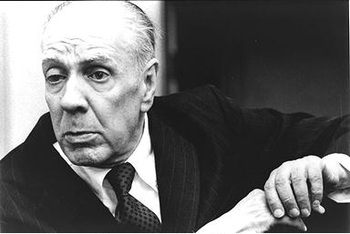
    nothing versus a culture that remembered everything.  The unspeakably lovely Jorge Borges wrote something touching on this in “Fumes the Memorist,” in which the humble narrator is capable of forgetting nothing, being able to recall explicitly everything within eyesight, perfectly—the problem is though that it takes a day to remember the events of another day.  What would happen in such a culture where everyone forgot nothing? 

    Jevonsmadeline2

    And I’ve just been dealing here with visual memory, really—and as Proust makes plainly clear (and Borges and other prove), vision isn’t everything.
  • Antique Microscopy of Holes

    JF Ptak Science Books  Quick Post

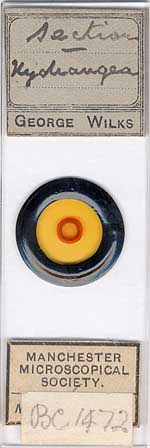
    This is a simple posting of some images found at the Manchester Microscopical Society website–beautiful 19th century preparations in which the circular specimen or stain happened to appeal to a sense of design, and which also fits snuggle into my long series on The History of Holes .  

       Follow Me on Pinterest

    Source for all images: Manchester Microscopical Society

    Micrscope slide e

    ·Posted by :

    ·in: