A Daily History of Holes, Dots, Lines, Science, History, Math, Physics, Art, the Unintentional Absurd, Architecture, Maps, Data Visualization, Blank and Missing Things, and so on. |1.6 million words, 7500 images, 4.9 million hits| Press & appearances in The Times, Le Figaro, Mensa, The Economist, The Guardian, Discovery News, Slate, Le Monde, Sci American Blogs, Le Pont, and many other places… 5000+ total posts since 2008.

Author: JF Ptak

  • Atomic Bomb Chronology, 1930-1945

    JF Ptak Science Books

    This table was primarily compiled in Japanese by Masaaki Koarashi and then translated into English by the Tokyo Physicians for Elimination of Nuclear Weapons.  I’m using it here as a template for a larger chronology for the development of the atomic bomb for 1930-1945. 

    I have added bits here and there and will continue to do so, especially with regards to noting the Nobel Prize efforts in physics. But the great majority of this table was generated by Masaaki Korashi, and not my own work.

    • [Numbers following the year refer to the month and (sometimes) the day of the month. So 1933.1.30 is 30 January 1933.]

    1930 [Germany] Discovery of radiation which penetrates a leadblock by Walter Bethe. (Received 1954 Nobel prize.)

    1932. Jan. .18 [France] Proton emission from beryllium irradiated by alpha-ray, discovered by Frederick Joliot and Irene Curie.

    1932. Feb. [England] Neutron discovered by James Chadwick, verifying Rutherford’s Baker Lecture.(Received 1935 Nobel prize.)

    1932.Feb. [USA] Cylotron developed by Ernest Orlando Lawrence and M.S.Livingston of California University, 27.5 inch size developing One million electron volts. (Received 1939 Nobel prize)

    ·Posted by :

    ·in:


  • EyePunk: Bare-Knuckle German Design, 1923

    JF Ptak Science Books  Quick Post         

    [Part of the series on German Design]

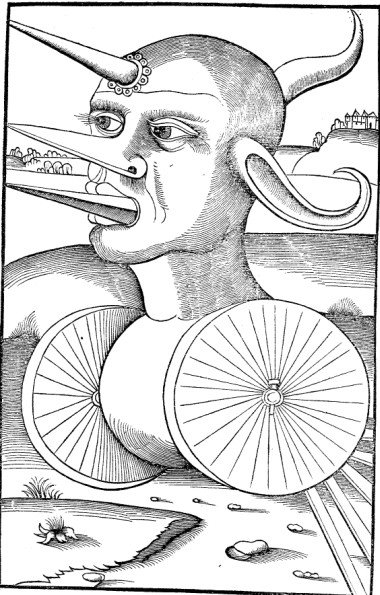
    Form my experience in looking at hundreds of thousands of images over the decades that I have semi-operated an antique image store, I can say that–especially with cartoon characters–the  main character of an image seldom looks directly and full-faced into the eyes of the viewer.  It is very uncommon.  That is one of the reasons why this ad for Mercedes motorcars (found in the pages of the Illustrirte Zeitung (Leipzig) for 1923) made such an impact–that, and the great and urgent/insisting design.  

    Car crazy detail2
    This is a detail from the 5×3″ original:

    Car crazy004
    Its a good piece of design. 

    ·Posted by :

    ·in:


  • Labor, Monotony and Obedience: the Prison Tread Wheel, 1824

    JF Ptak Science Books   Post 1961  

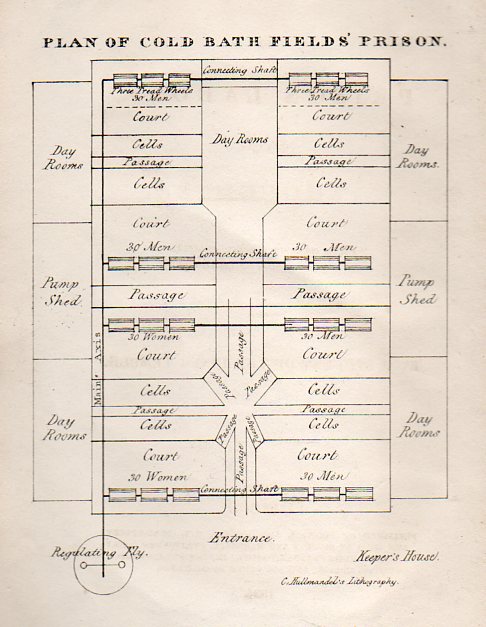
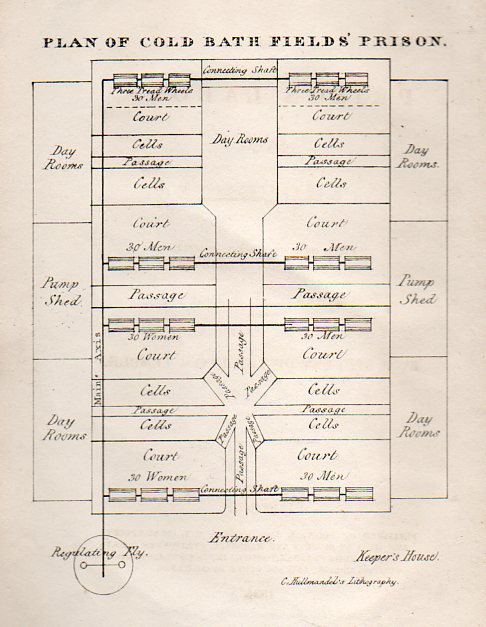
    Looking through some of the books here at home today I found Thoughts on Prison Labor, etc etc…by a Student of the Inner Temple1, a book on prison and punishment, published anonymously in London in 1824. What struck me right away was the plan of the Cold Bath Fields Prison, and the unusual dark line that ran along the left side of the image, connecting a “regulating fly” to this:
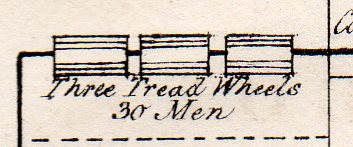
    Treadwheel999

    “tread wheels” are just what they sound like.  They were  used as a means of punishment and control, keeping the prison population busy and occupied.  In general, the tread wheel was used in many prisons, and even though there were hundreds of people working on them int he course of a day employing thousands and thousands of steps to move the giant wheels, the large devices were connected to nothing. I guess they could have been connected to a grinder or something that would transmit the generated power into some purpose, but–at least in this case–the only thing the wheel was connected to was a fly wheel, which I assume helped govern the amount of force necessary to produce motion in the tread wheel. 

    Cold Field Baths was a prison of long standing and had been functioning for about 200 years at the time of publication of the book. For the most part the prison held low-level criminals, mostly with sentences of two years and under.  People–men, women and children–served time there for vagrancy, some felonies, misdemeanors and unresolved debt (which is where most of the children come into the picture, as the debtor often found himself imprisoned with his family). 

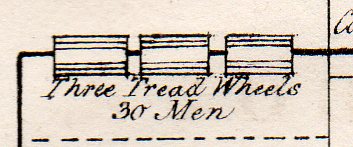
    Each of the ganged three wheels would accommodate 30 people. There were six units of three tread wheels at work, meaning that there could be 360 people working the wheels at any given time.  That’s a lot of energy produced in the pursuit of obedience.  And punishment.

    This is the detail from the frontispiece map, in full below:
    Treadwheel998

    • (There were additions to the prison performed in 1850, which greatly expanded the place.  The original prison though is still visible in the plans. See Note 2.) 

    Here’s a view of what those treadmills looked like, giving a prisoners’-eye view of the proceedings, this coming from 1864:

    File:Coldbath-fields-treadmill-mayhew-p306.jpgEvidently people would work on the tread wheel for periods of 10-15 minutes, which would explain the lines of men walking to their turns, above.  Standing and slow walking was the cool-down exercise.

  • World War I Panoramic Photograph of Power and Mistiness

    JF Ptak Science Books  Quick Post 

    Follow Me on Pinterest
      

    WWI Photos Big Pano075 

    Follow Me on Pinterest
     

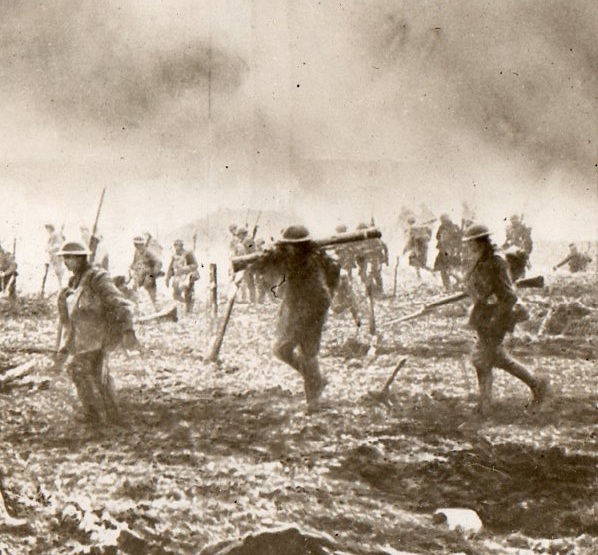
    I recall, I think, that this was the largest photograph of war printed during World War I, looking to be something on the order of 8×16 feet or so.  This photo of the photo was printed by Underwood & Underwood, and stamped “British Official Photograph”, printed sometime in 1918.  It seems that this is an actual battle scene, which was a very uncommon thing among war photographs for the Great War–more so for this group of photographs(News Photo Service)  produced by pool photographers for equal distribution among subscribing newspapers and periodicals. Actual combat photos distributed by the News Photo Service agencies were not a high priority, unless they depicted routed or retreating or being-defeated Germans–it was not a popularly-disributed subject, mainly for propagandist purposes. (The original photo is available for purchase here.)

    ·Posted by :

    ·in:


  • WWI Photos: Hope and Compassion Underground, Verdun 1917

    JF Ptak Science Books   Quick Post

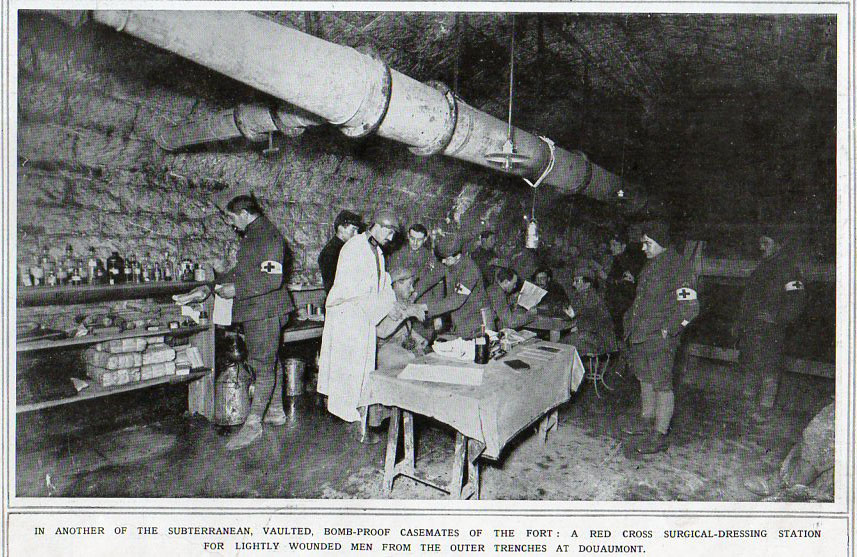
    A bit of calm, or at least a bit of a place that could not be reached by shells or bullets, was found bellow ground in the cellars of Douaumont Fort, in Verdun.  These images were made at the very end of 1916, and published in The Illustrated London News for 13 January 1917.  These images show another side of that battle, of soldiers meeting for religious services and for medical attention in the cellars (“…the subterranean, vaulted, stone-built casements, deep underground beyond possibility of penetration by the heaviest bomb”)  of one of the barrier-forts surrounding Verdun, Douaumont.

    WWI  Religion underground 2 992

    ·Posted by :

    ·in:

    —

  • Seemingly-So-But-Not: Labels on Black Soldiers,1949

    JF Ptak Science Books   Quick Post

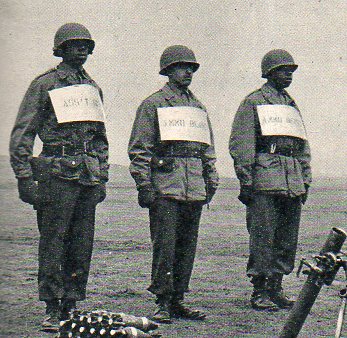
    This image stabbed me right in the eyeball.  It popped out while I was grazing in a heavy lap-busting volume of The Illustrated London News for 26 March 1949–the yearly volume resists being held in just one hand.  Anyway it was first a photo of new tanks in an American cavalry regiment; beneath that, though, was this image:

    Negro troops980

    ·Posted by :

    ·in:

    — —

  • SteamPunk Inventions, a Farce from 1853


    JF Ptak Science Books   Quick Post

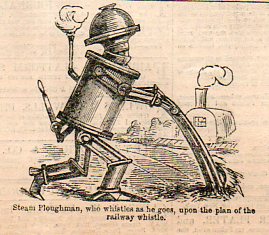
    Steampunk inventions984

    I found these images browsing through The Illustrated London News for April (date obscured) 1853.  In my experience seeing articulated, steam-driven robots in the mid-19th century is pretty unusual. There’s an earlier image (from about 1849) that shows a robot like the one pictured above, though it was actually a man in a robot suit, a person driving a machine–the image above of “the Stream Ploughman”  is clearly a stand-alone robot, as we can see through the thigh area, though it does have human attributes, like a semi-face and the capacity to whistler while it worked.

    Other posts on early robots in this blog include: Mall-Mortuary Faces on Patent Drawings of Robots, 1936-1976; The Edenless World, the First Female Robot;  Endless Eve, 1936; Durer’s Beautiful Monsters, for example.

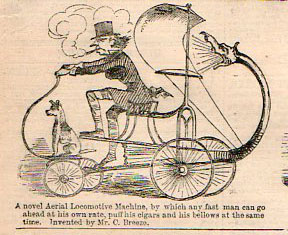
    The caption may idetify this as an airship, but there are no signs here of ho wthis thing would get aloft. And I have no idea what the dog is doing there.

    Steampunk inventions990


  • Fantastic Square(s), 1840

    JF Ptak Science Books  Post 1960

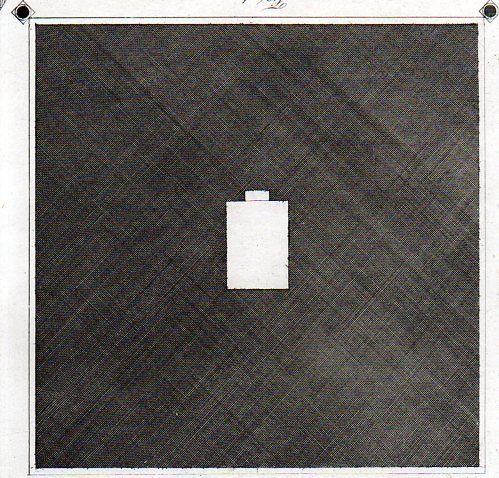
    I was shocked to investigate this seemingly magically-produced engraving under magnification–it was a small piece of inset work used to illustrate an idea within a much larger overall engraving.  The detail is about a 5% cropping of the full image:

    Square detail982

    It is a subset of this detail:

    Square detail981
    Which in turn is a detail from this beautiful work which is itself a four-by-four inch detail in a larger engraving, the footprint of an elevation of the Sepolcro di Caio Cestio, which was printed in 1840. 

    Square 983

    The craftsman who produced this engraving incised 250 lines on one side of this 4-inch-square, then proceeded to incise another 250 lines on the other–or so. This means that there are something on the order of 62,000 (or thereabouts) squares produced by the draftsman in order to make a mostly-black background for the image. 

    The plan is for the pyramidal tomb of Caius Cestius who was a monied Roman who demanded that for the disbursement of his will to be complete had to have this tombstone built to himself in a prescribed period of time–mostly very quickly.  The result has been captured by Piranessi and others–a very sharp-pointed pyramid about 130′ at its base and 145′ tall.  When finished the builders incised their victory and documented it on the side of the pyramid so:

    Opus absolutum ex testamento diebus CCCXXX, arbitratu (L.) Ponti P. f. Cla (udia tribu), Melae heredis et Pothi l(iberti). (“The work was completed, in accordance with the will, in 330 days, by
    the decision of the heir [Lucius] Pontus Mela, son of Publius of the Claudia, and Pothus, freedman”.)

    All I really wanted to comment on here though is the craftsmanship of producing this finely-lined and remarkable detail


  • Roman Military TechnoPunk

    JF Ptak Science Books   Post 1959


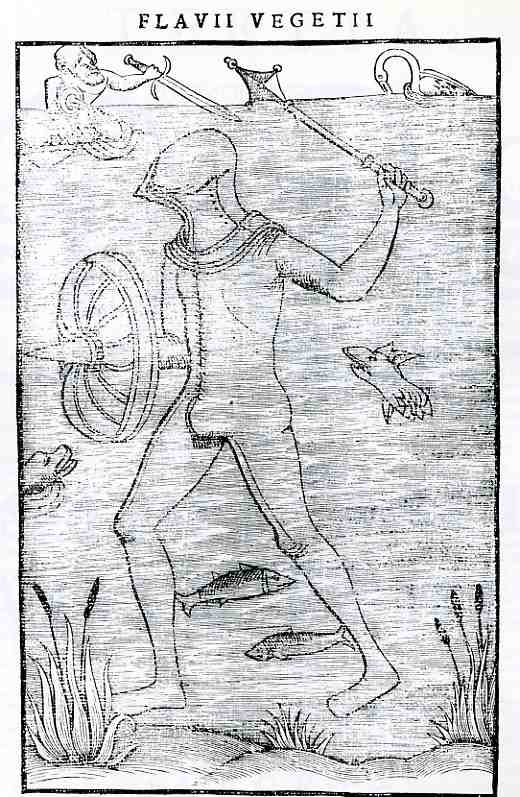
    Blog--vegetius
    The name of Flavius Vegetius is not so much popularly known today, though his influence is felt through the hands of other, more famous, writers and thinkers.  He was seen as the most adept writer on the Roman mind in warfare, and his De re militari libri quator… was his masterpiece.  It was reprinted in 1532 by Christian Wechel from sources reaching back to the original, which was written around 390 ACE, and found a wide readership not only for its authority on all things military/Roman but also for his iconic insights and aphorisms on warfare in general.  It was Machiavelli who came under his spell and who adopted some of Vegetius, who became further disseminated through the military followers of Machiavelli, and so on.

    I came to this work much more simply than all of this – I liked this image of the underwater warrior, who was somehow able to breathe while submerged.  I get the importance of this sort of undercover, guerrilla maneuver, but what I really like was the rarity of seeing a Renaissance illustration of human submarine life, which is pretty uncommon.  Also, the use of the lines to represent the underwater quality of the image—giving the woodcut an overall grey tone—is also very scarce in the history of illustration, at least before 1600.  And very neat!  One of the hallmarks of this printing of Vegetius was the liberal use of white space in many of the (119) woodcut illustrations, though it is clearly not on display in the woodcut that I’m sharing here.

    00-blog-Oct 28 vegetius939


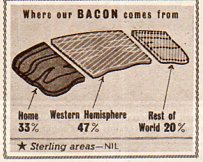
  • The Anatomy of Bacon and the Imported Food Needs of the British Family, 1949

    JF Ptak Science Books  Quick Post


    Follow Me on Pinterest
      

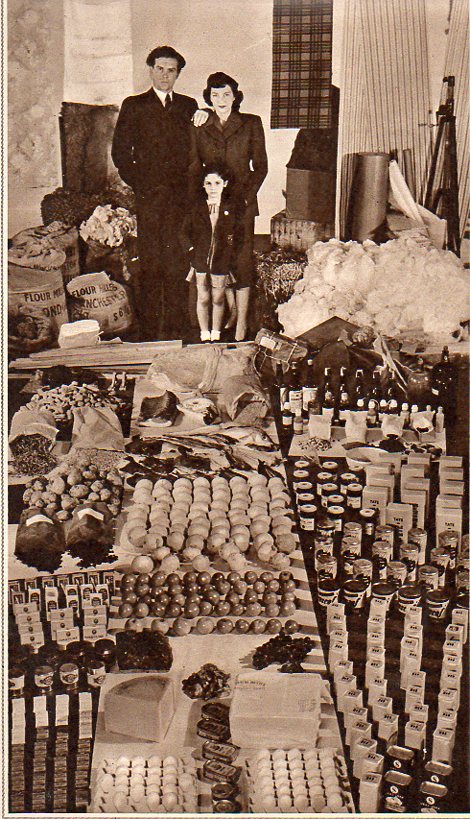
    Images displaying collective consumption over a long period of time, put together and arranged in one place to display the largeness of it all are pretty dramatic. (Like seeing a lifetime supply of butter consumed, or toothpaste used, or gasoline pumped, or sleep hours combined).  Nothing quite succeeds like excess, even when  here isn’t any–collecting discretely-used stuff used in bits and pieces over the short-term can add up to quite a lot if collected and displayed in its long-term use.  As in the case of this relatively modest consumption by “an average family of three” over a four month period in 1949. It just looks like a lot, when gathered together–more so, when you consider that this is a third of a year’s consumption, which means that if the full year was displayed it would probably encircle the family. 

    Food consumption975
    Understatement alrt: Great Britain suffered food and material shortages for years after the end of WWII, a difficult peacetime in victory.  That said, this four month assortment of food looks to be pretty spare, especially for fruits and cheese. 

    Food consumption977

    Source: The Illustrated London News, 26 March, 1949.