JF Ptak Science Books, Quick Post
Here’s a selection of nine early television spots for computers and computing…and calculating. The piece on the coming Internet (1969) to me is the most interesting:
Mid-1950’s and how engineers build computers:
A Daily History of Holes, Dots, Lines, Science, History, Math, Physics, Art, the Unintentional Absurd, Architecture, Maps, Data Visualization, Blank and Missing Things, and so on. |1.6 million words, 7500 images, 4.9 million hits| Press & appearances in The Times, Le Figaro, Mensa, The Economist, The Guardian, Discovery News, Slate, Le Monde, Sci American Blogs, Le Pont, and many other places… 5000+ total posts since 2008.
Contact johnfptak at gmail dot com
JF Ptak Science Books, Quick Post
Here’s a selection of nine early television spots for computers and computing…and calculating. The piece on the coming Internet (1969) to me is the most interesting:
Mid-1950’s and how engineers build computers:
JF Ptak Science Books Quick Post
This magnificent flying thing was perhaps among the earliest of its kind, at least according to shape, which as we can see really wasn’t quite a flying saucer,, though it was a flying disk. And a big one, at that. From the ladder that led to the major axle we can infer that the aircraft was at least 60 feet high, which made its disk apparatus a very ferris-wheel-like 40′ or 50′ in diameter. If nothing else, the patent drawings are quite pretty.
JF Ptak Science Books Quick Post
This is as beautiful as it is heavy; and it is in its way very beautiful, so I guess that also means that is is very heavy…
And speaking of heavy, this balloon doesn’t seem large enough to lift the very heavy ship-like carriage:
Another flying boat: I don’t see a power source to drive the “fans”/propellers on this one, though there is a tail for its “kite” body:
JF Ptak Science Books Post 1749 [Part of the Strange Things in the Sky department.]
The Death Ray is a long-discussed idea, extending back as far to Archimedes at least–discussed, attempted, abandoned and dismissed. But as a matter of fact, the thing was actually invented, and deployed, though not int he sense of an EM weapon, or LRAD/ultrasonic, or Teller x-ray laser, or even a Wellsian heat ray (below).

The “Death Ray” made its appearance in the 1880’s, but not in the normal sense of what we would today think of as a “weapon”–this death ray could locate the enemy hidden miles from the front, or pick out ships at sea far from shore, and so on, removing stealth capacity, making it possible for these elements to be identified as targets, and then possibly removed, though not by the ray itself.
This “death ray” was the search light. In the 1880’s when the technology of electric lighting was still in its first practicable decade, the idea of being able to focus a beam of light from a lantern source hauled on a single-mule carriage and powered by an on-board battery, small steam engine and Gramme dynamo was a spectacular. achievement.
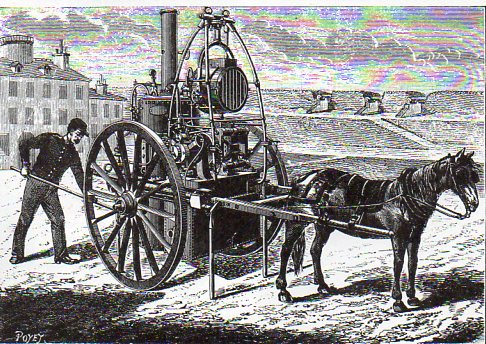
[This image appeared in the Scientific American in 1886 and features what is probably a one-foot diameter mirror, making it capable of illuminating an object up to about a mile away. Something with a three-foot diameter could work its magic on object up to four miles away.]
This defensive/offensive weapon/device was very soon afterwards made into a trickle-down appliance that was placed into commercial use almost immediately. The standard use of course would be upgrading lighthouses, but one special use was using a large mirror in a device to project an advertisement on the clouds in a city–ads in the sky.
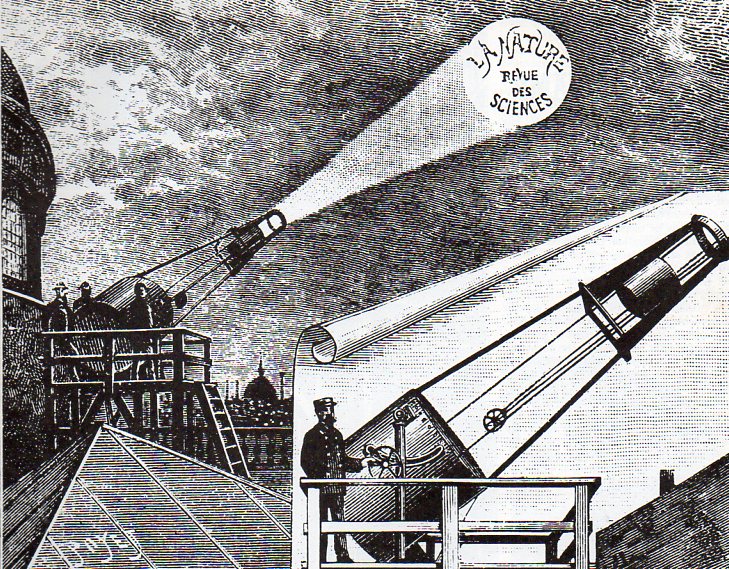 [Source, La Nature, 1894; also reprinted in Scientific American in the same year.]
Such a device was used experimentally at the Columbian Exposition in Chicago for the World’s Fair of 1893, flashing the daily attendance on the clouds. I’m not sure why the greater revenue-generating employment of this technology took another year to develop. And so “The Death Ray”, from Battlefield to Breakfast Cereal in a few short years.
JF Ptak Science Books Post 1775
 The 1895/1896 issues of Nature magazine are compliantly normal until the first weeks of 1896 when the first of a flood of articles is published about the astonishing discovery of 50-year-old Wilhelm Conrad Röntgen. The English-language popular science journal announcement of his December 28, 1895 “Ueber eine neue Art von Strahlen” (“On a New Type of Ray”), appearing 16 January 1896, began the introduction of a new state of human experience. His experiments—built upon the work of J. Plucker (1801-1868), J. W. Hittorf (1824-1914), C. F. Varley (1828-1883), E. Goldstein (1850-1931), Sir William Crookes (1832-1919), H. Hertz (1857-1894) and the odious Phil Lenard (1862-1947 and who didn’t die soon enough)—revealed as much to humans as did the experiments and inventions of Hooke and Leeuwenhoek on the invisible worlds revealed by the microscope. There are more than 150 articles on the Roentgen (and soon to be “X-“) Ray, all published within 12 months of the original announcement, almost all excitedly, trying to comprehend, elucidate, expand, verify, this new world.
 [The news of the discovery is first and most popularly reported in the January 6, 1896 London Standard: “The noise of war’s alarm should not distract attention from the marvelous triumph of science which is reported from Vienna. It is announced that Professor Routgen (sic) of the Wurzburg University has discovered a light which for the purpose
 of photography will penetrate wood, flesh, cloth, and most other organic substances. The Professor has succeeded in photographing metal weights which were in a closed wooden case, also a man’s hand which showed only the bones, the flesh being invisible”. By the end of the month the news was completely absorbed, worldwide.]
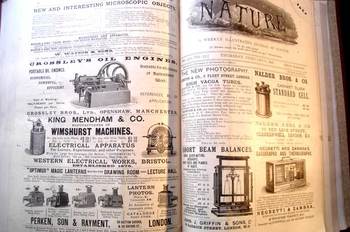
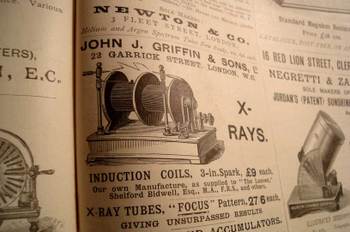
I looked at the advertising in these issues (my copies of Nature for these decades generally have the original paper wrappers for the weeklies, complete with ad copy), looking for the first time that a Roentgen machine was offered for sale to the general public. As it turns out, they popped up 12 March 1896 (once), 19 March (twice), and then about once a week for the rest of the year. A little surprising, I think, a little light to my Monday-morning quarterback’s eye—I expected more; bigger, more, splashier. But the ads are small and sedate, hardly similar to the discovery they represent.
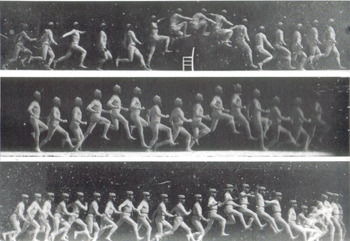 The rest of the world, the rest of the advertising world, stayed the same–the Roentgen discovery and the enormous possibilities and promises of his “new photography” lived in their own unique sphere, unencumbered by their sassy new brother. This mild response seems dimmer still when you compare it to that which greeted other (relatively) simple but still major advancements in the world of photography. Take for example Etienne Marey, who was a technoid and physician who was able to capture motion of all sorts–he was able to develop a picture so to speak of the movement of blood in the body via his instrument to calculate blood pressure, and he also created a shotgun-style camera that made the
 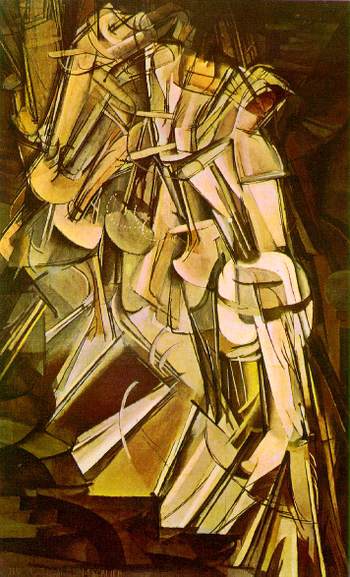 world’s first high-speed photographs of movement. And so it cane to pass that in the late 1870’s and early 1880’s people were instantly able to see what a horse looked like when it galloped or what the body did *exactly* when jumping over a chair. When you couple this with fourth-dimension material one wonders why it took several more decades to bump into these images in the art of 1907+.
(Duchamp Nude Descending series, 1915; above, Marey, 1881)
And what indeed was normal in these pages? Magic lanterns
and magi lantern slides appear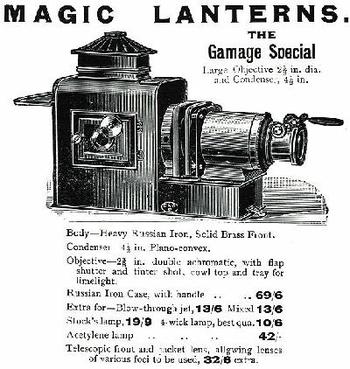 at all levels; the gorgeous Wimshurst machine gets heavily advertised; the redoubtable Negretti & Zambra advertised all manner of excellent scientific instruments (biographs, thermogrphs. Nadeer Bros. advertised a pretty standard cell, and the ancient Crossley displayed their “new” oil engines, “suitable for all classes of agricultural work”. J.H. Stewart was selling their semi-automatic electric arc lamp, while across the page was Newton & Company’s “Newtonian” arc lamps for lanterns (“self feeding and focus keeping”). Microscopes and prepared slides abound, and Thomas Bolton advertises discretely and effectively for their “living specimens for the microscope”.
The Physical Review, the American upstart in the science world advertises that its third volume was available, while its distant cousin, the Psychological Review, advertised its own third volume. Booksellers seem to take the most space, thank goodness.
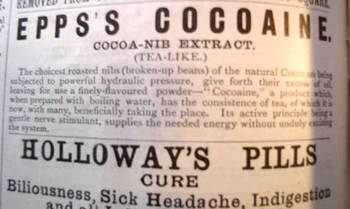 There are a few medical throwbacks: Epp’s Cocaine takes out occasional tenth-page ads for their “cocoa-nib extract, tea-like” selling its ‘gentile nerve stimulant”. Right underneath is “Holloway’s Pills”, promising to cure biliousness, sick headache, indigestion, and all (?!) internal complaints. These are brilliant simple samples of the skeleton of science in world-dominant Great Britain, in a world dominated at that time by H.A, Lorentz, Ernst Mach , Roentgen, Korteweg, de Vries, Bateson, Jean-Baptiste Perrin, Pierre Curie, Zeeman, Becquerel, Joseph Thomson, Ernest Rutherford, Marconi, Ramsay, Fitzgerald. And so on.
Nothing offered for sale here offered any significant clue to the pregnant world of modernity that was nearly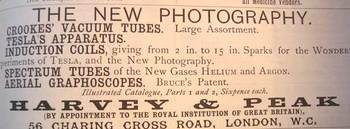 there—the world would become ‘modern” almost immediately following Roentgen, with revolutionary, epochal changes in art (in non-representational form more so than Impressionism), theater, literature, music. Just about everything changed (except politics). But there is no hint to paradigm shift hidden in the ads, just as they were with the machines selling the promise of Roentgen’s “new photography. There’s something about the fine glass, superb turning of the screw, and a perfectly oiled gear though that makes this sort of perfection seem so lonely in the world of larger change. Bertha, Roentgen’s wife, sat for 15 minutes while her husband passed his rays through her hand; she ran from the room once she saw the results, revealing her very bones and no doubt a strong sense of the
fragility of life, and the strong presence of death. Many had the same reaction to the Kandinsky’s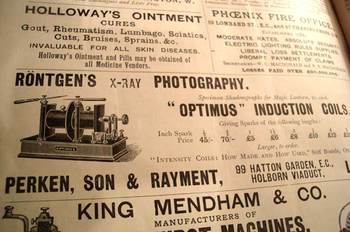 shapes and Malevich’s white circles and red rectangles and Ibsen’s drama and Einstein’s dancing dust and the rogue syncopation of jazz. It is probably a very natural reaction to try and protect established memory—but memory should be more flexible than that, I think, to keep a healthy mind.
·Posted by :
·in:
JF Ptak Science Books Post 1746
This is one of the most appealing sets of “flying” or manned aerostation patent drawings that I have seen in the USPTO collection for the 19th century. The machine is a human-powered ornithopter, applying the structure of a human against that of a bird, and outfitting the flyer accordingly to combat their human weaknesses as adapted to bird flight. Needless to say, and in spite of the beauty of the thought, this arrangement was destined to deep failure. (The patentee, Reuben Jasper Spaulding, of Rosita (“Little Rose”), Colorado (south of Pueblo), may have been the same Reuben J Spaulding who made the first gold strike on the Blue River on Colorado’s Western Slope in 1859.) Spaulding’s design is interesting also for the balloon device for getting the aero pioneer off the ground.
[Source: Google Patents (and also for the extensive annotations for the images).] I note that there was a model constructed for this patent–I’d love to see that.
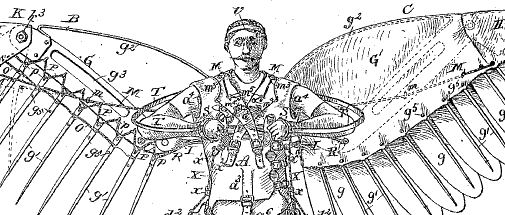
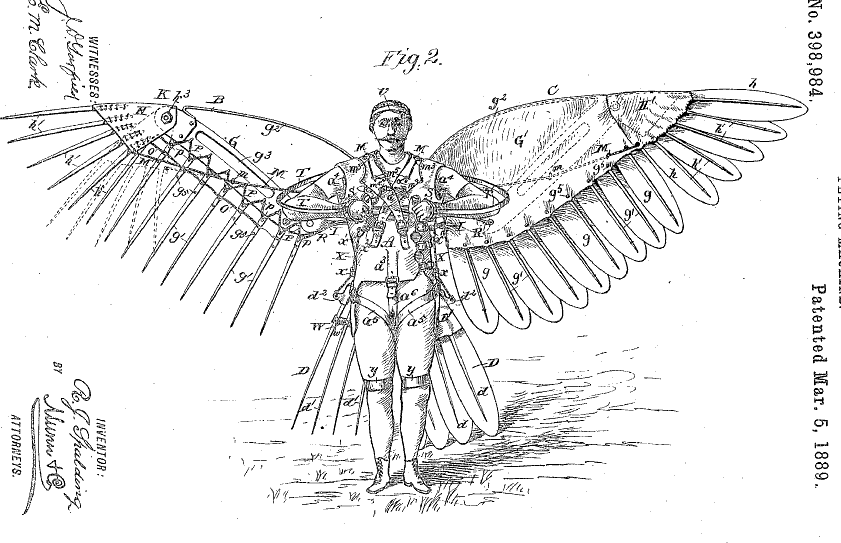
And along this same vein of ornithopter-y thought is this, another American solution to the man-bird-mechanical-flight continuum, produced a dozen years earlier–it is similar, though not nearly as glorious (at least in presentation) as the later Spaulding effort:
The work really ins’t quite as awesome as Spalding’s beautiful Lazarusian resurrection, and not as detailed, but still quite interesting:
JF Ptak Science Books Quick Post
With the beginning of the aviation age in warfare came the anti-aircraft era. In the first years of WWI opposing forces knew that aircraft would be coming but didn’t quite yet know how to deal with them. Some of the results of thinking about how to stop marauding aircraft can be seen below in a few examples of patents taken from the U.S. Patent and Trademark Office. All of the following examples employed balloons–balloons that stationary and rigged in one way or another so that a passing plane that snagged this line would cause the explosive device that moored the balloon to swing up and detonate on or near the aircraft. That means that a great many of these devices were needed to be an effective deterrent against aircraft. (I had written earlier in this blog about barrage balloons proposed for use in/around London in 1938, here. This mode of anti-aircraft balloon was static, though, and at least in this circumstance the balloons were meant to snag and not necessarily try to blow up anything caught in its cable.)
JF Ptak Science Books Quick Post
We hear daily reports referring to refining, but there are very few about fining.. But there the word was, (appropriately) stick in the title of John Petrus’ translation of Lazarus Ercker’s classic work, Fleta minor: the laws of art and nature, in knowing, judging, assaying, fining, refining, and inlarging the bodies of confin’d metals. In two parts / the first contains assays of Lazarus Erckern … in V books : originally written by him in the Teutonick language, and now translated into English ; the second contains essays on metallick words, as a dictionary to many pleasing discourses, by Sir John Pettus … Knight . (See the Richard Westfall entry at the Galileo Project on Erker, especially on how he was able to support himself. The book itself is an engineer’s delight, with applications of practical experience on all aspects of mines, mining and working with mined products. It turns out that the original work by Ercker was so useful and popular that it was still around more than a century after Ercker’s death. Oh yes–the original German editions were also among the first technical books to be supplemented by illustrations of the topics.)
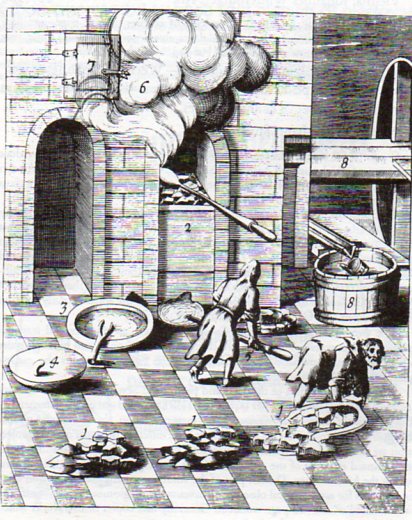
The story of iron is very old in Europe–and much older in China, older by more than another thousand years or so. In Europe, though, iron from a blast furnace that has a high carbon content and a low melting point is called cast iron, and is quite brittle and cannot be worked by a smithy; fining is the process of cooking that cast iron up to its boiling point and skimming away the carbon, thereby giving the iron a higher melting point and a great capacity to be worked by a smith. This product is called wrought iron, and it was a major step forward.
Which really does have something to do with a more popular definition of “fining”, which for the sake of simplicity would mean just to make something, well, “finer”. I can imagine an eight-year-old figuring that out when aged six. A good, no-nonsense, perhaps 400-year-old word.
·Posted by :
·in:
JF Ptak Science Books Post 1774 [Part of the Strange Things in the Sky department]
Visions of the coming of hell or the apocalypse or the end of existence or the exaltation of duration were certainly depicted in art at least during the high Medieval period and the Renaissance, though I am uncertain of ever having noticed the sky on fire or facing obliteration. Perhaps the implications of its destruction would be clear in the symbolic representation of The End, the evidence of a smoking atmosphere in an infinite hole was just implied, Dr. Pangloss at play with Mr. Leibniz over paint and canvas.
Heaven opened and stars fell in various texts, not the least of which is the Book of Revelation (6:14, KJV, “And the heaven departed as a scroll when it is rolled together; and every mountain and island were moved out of their places”). Imaging this part though was another story, especially when considering that destroying the sky was a secular event, and not driven by the great deities.
Now holes do appear in the sky in Renaissance images, but they open to allow the hand of the creator to reach through it from the nether world, or heaven, or the infinite. In the many examples of these holes that I have seen the background within the hole is entirely blank–plain white, no detail, no peek into heaven. Then again, these are holes, and not a wholesale destruction of the sky.
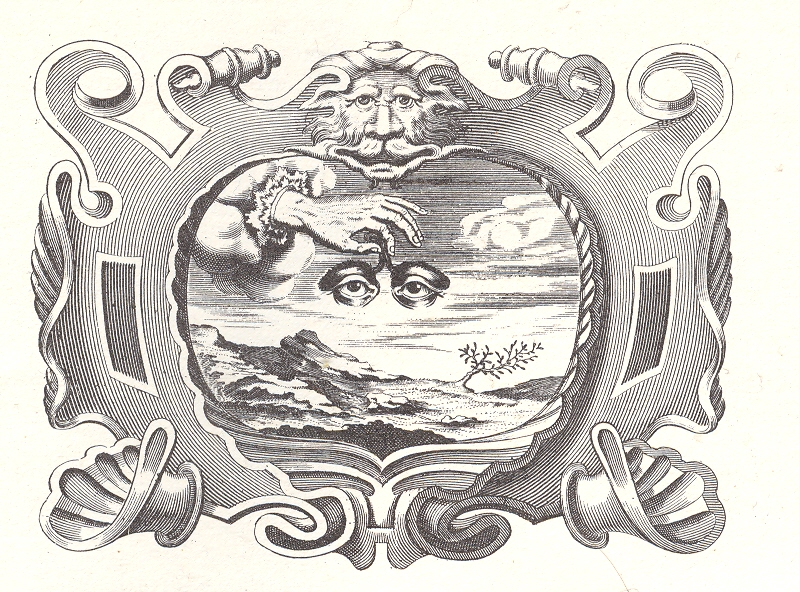
As an example I’d like to point out the work by the Jesuit Franciscus Nerrincq (1638-1712), De goddelycke voorsienigheydt, in which there are several odd eyes that burn their way through the atmosphere. Eyes/eye of the creator occur frequently in religious presentations and emblems, but not so very often as hands holding a pair of eyes. I know all of this is very heavy stuff in the history of Christian iconography and the progression of emblemata, but I’d rather deal with the images out of context here and have them stand on their own without interpretation.
Of course the answer for the modern equivalents of this blowing-up-the-sky adventure must have deep and varied roots in the sci-fi canon, though presently they remain a mystery to me. It is interesting to note that at one point in June 1945 in the Jornada del Muerto/the Dead Man’s Walk, at the Trinity site in the desert near Alamogordo, a group of scientists were placing bets as to whether or not the test explosion of the world’s first atomic weapon would set fire to the atmosphere.
In a way Tycho Brahe brought down the sky with his (naked eye) observation of a super nova on 11 November 1572. With the exception of comets and eclipses the sky had remained immutable, a perfect score of the creator’s creation, until Tycho Brahe noticed something new in Cassiopeia, something that was not a comet—a “something” that was a star. This was momentous because the night sky had been seen for centuries as being complete—a new star, the Nova of Brahe, contradicted this high belief, offering the possibilities of newness where there had not been one previously. And so too with Kepler’s new star of 1602. This wasn’t perhaps a tearing-away of the old sky, but it certainly questioned the sky that was seen.
I should also point out that perhaps a reverse of the destruction of the celestial ceiling came about when Galileo turned his telescope to the sky and found to the astonishment of nearly everyone that there was an order of magnitude more stars in the heavens than anyone had ever experienced before. This in a way collapsed the old sky with its perfect and unchanging number of stars, showing that the creator of the universe had indeed provided more stars than anyone had ever imagined, though for reasons not yet known had kept that knowledge from humanity. By 1610 Galileo had produced his fifth and most powerful telescope, allowing things to be seen one thousand times closer, using it to make enormous discoveries–discoveries so big in fact that their towering significance is a but hard to understand today in the context of early 17th century knowledge. It was all published in his fantastic Sidereus Nuncius on March 4, 1610—the extraordinary title page1 of the book proclaiming some of the great discoveries of Galileo’s adventure. One of the things that Galileo brought to the world was this entirely new sky, revealed to him through his telescope—so many stars that he could only guess (though he reckoned that there was an order of magnitude more stars than previously known “stars in myriads, which had never been seen before…and which surpasses the old, previously known, stars by ten times”). In a way Galileo introduced the sky-above-the-sky, available only to people with a special instrument to see it–the new reality.
This is what I had in my mind when I saw this unusual patent application (above and below). Just weeks before the beginning of WWI, two weeks before the assassination of Archduke Ferdinand, followed quickly by a cascade of war declarations a few days after that, came this rather footloose idea for bombing the atmosphere
J.M. Cordray came up with and patented this notion–a barrage of balloons, heavily armed balloons, sent aloft with dangerous cargo to be exploded in the atmosphere, which was supposed to initiate a chain-reaction of some sort which would end in supplying rain for the rest of us. Theoretically, anyway. The unspecified number of balloons would be sent aloft, laden with large amounts of crushed bone and concentrated sulfuric acid (to be combined to produce nitrogen), potash, water, and large amounts of crude oil for the fire’s fuel. And a candle to light it all.
It seems that the attempt to blow up a part of the sky with bone and sulphuric acid to make rain just didn’t work, though I cannot (easily) find a record of the experiment being attempted.
Mr. Cordray presented himself at the top of his patent as “J.M. Cordray/Rain Maker”.
The one thing that is for certain is that Cordray’s attempt at weather modification was quite early–it would be another three decades before pioneering work of Kurt Vonnegut’s brother, Bernard, was published (beginning in 1947, finding the ice-nucleating properties of silver iodide, AgI), which established the very real possibilities of altering the weather. This practice was employed in the U.S. military’s Operation Popeye, which used cloud seeding to prolong the rainy seasons along the areas covered by the Ho Chi Minh Trail in Vietnam from March 1967 to July 1972. This sort of weather warfare is now prohibited by international convention.
And so in a way by employing weather modification as a tool of war we’ve been able to turn the sky into a weapon, which means that this post has followed the bombing of the sky to the sky bombing us.
See an interesting article at Paleofuture on the Cold War weather modification attempts here.
Notes
1. The title page in full reads: Great and very wonderful spectacles, and offering them to the consideration of every one, but especially of philosophers and astronomers; which have been observed by Galileo Galilei … by the assistance of a perspective glass lately invented by him; namely, in the face of the moon, in innumerable fixed stars in the milky-way, in nebulous stars, but especially in four planets which revolve round Jupiter at different intervals and periods with a wonderful celerity.
·Posted by :
·in:
JF Ptak Science Books Post 1771
In the early days of aviation aerial assault must have seemed incredible–and an abomination. Hurling stones and other offensive weapons by trebuchet and catapult is one thing, and launching balls and shot from cannons and mortars is quite another–but actually having your weapon flown over an enemy’s position and dropped, remotely or via cable, must have been ab excruciating achievement, militarily speaking. To be able to direct an explosive charge over a position not reachable by an infantry (say in 1915) must’ve been a short-lived comfort on the offensive end, though the user of such a technology would also have to contend with the contrary, as the enemy would be able to do the same thing themselves.
This idea was not limited to just military purposes. Companies could now wage an advertising war war against competitors in a thee-sky’s-the-limit campaign, hoisting their ads on balloons anchored over a city, making it possible for the first time to have your message so universally read, a pre-intertubes version of smoke signals.
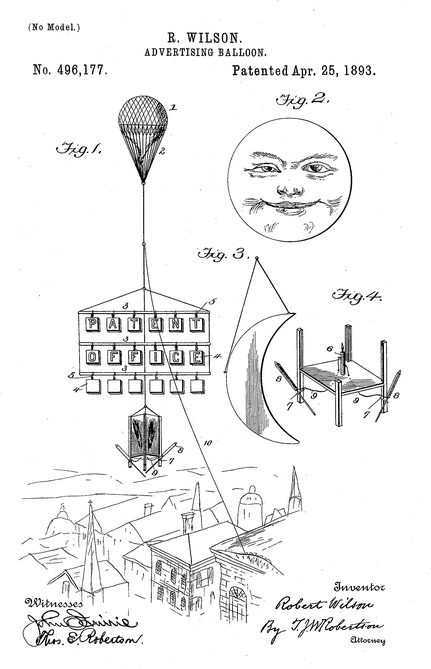 [Source: Google patents, http://www.google.com/patents/US496177?dq=balloon]
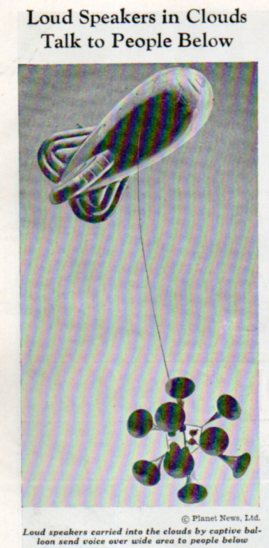
And this, seeming more on the Orwellian/1984 side, or perhaps more contemporary as an instrument of the Dear Leader in North Korea (left, from Popular Mechanics, July, 1939).
Here’s an interesting, pre-airplane, airship-delivered explosive device: floated over an enemy’s position, the chord would be pulled at the desired time to create a tear in the balloon’s top, sending the craft down, with the bomb exploding on impact:
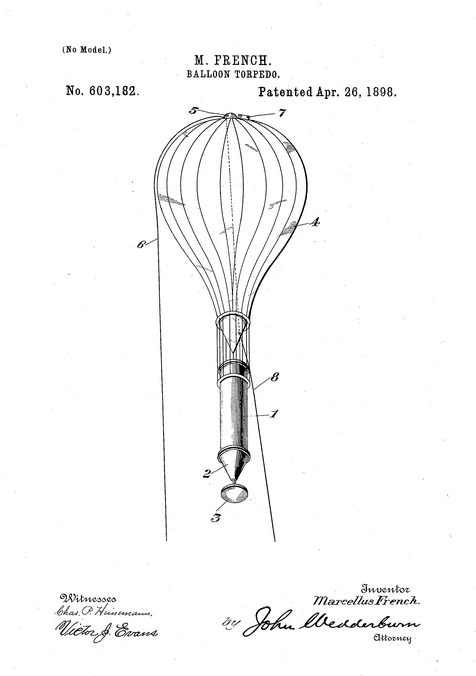 [Source: Google patents, http://www.google.com/patents/US603182?dq=balloon]
Another sort of slow death from above advertising scheme:
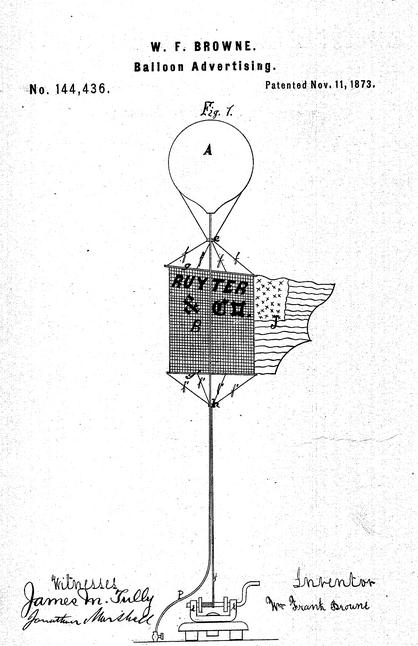
[Google patent: http://www.google.com/patents/US144436?dq=balloon]
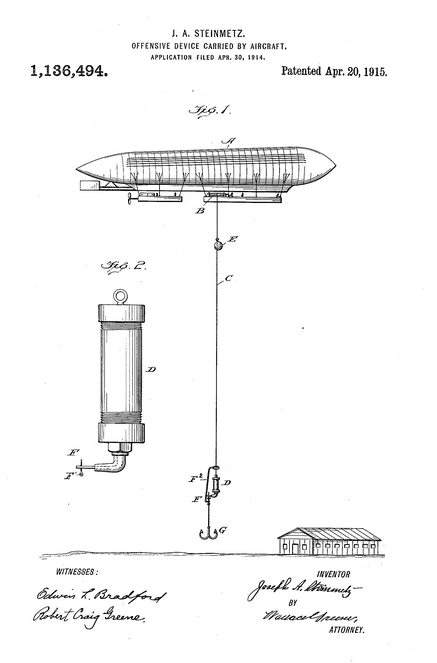
In this device patented by Steinmetz the explosive device is still actually attached to the aircraft when exploded–not a very common way of delivering your weapon. The airship would advance on the enemy, with the bomb attached to a cable just above an anchor at bottom; the anchor would grapple the target, and the bomb detonated from the gondola of the airship: