A Daily History of Holes, Dots, Lines, Science, History, Math, Physics, Art, the Unintentional Absurd, Architecture, Maps, Data Visualization, Blank and Missing Things, and so on. |1.6 million words, 7500 images, 4.9 million hits| Press & appearances in The Times, Le Figaro, Mensa, The Economist, The Guardian, Discovery News, Slate, Le Monde, Sci American Blogs, Le Pont, and many other places… 5000+ total posts since 2008.

Category: Technology, History of

  • The Family Tree of Computer Development, Part II

    JF Ptak Science Books  Quick Post

    I’ve found a supplement to an earlier computer tree that I published on this blog (here) as a part of a chronological list of (nearly every) computer manufactured from 1943 to 1990.  The new one is interesting and has its differences from its predecessor, and divides its generations of computers in terms of logic technology. It is found in a 1960 NSF pamphlet called “The Family Tree of Computer Design”, a Brief Summary of Computer Development, and I found its reference in a good book by I.B. Cohen, Howard Aiken, Portrait of a Computer Pioneer, published by MIT and available here.

    [Image source: Microsoft.]

    The earlier “Computer Tree”, from Electronic Computers Within the Ordnance Corps , by Karl Kempf. “U.S. Army Diagram”, the source of this information coming from the U.S. Army, here.

    This image is expandable.

    Computer tree

    More detailed images of the computer tree are found below:


  • The First Sightings of Great Things: the Telephone, March, 1876

    JF Ptak Science Books   Post 1845

    Bell patent close
    Besides it being the Centennial year, 1876 saw a number of major games in the history of human thinking. Sometimes the announcements or earliest public appearances of these breakthroughs didn’t get all that much attention.  As one of the major means of transferring technical and applied science info to teh general public, it is interesting to see how Scientific American reacted to such innovations.  For the thick, heavy volume for 1876, amid

    Bell patent
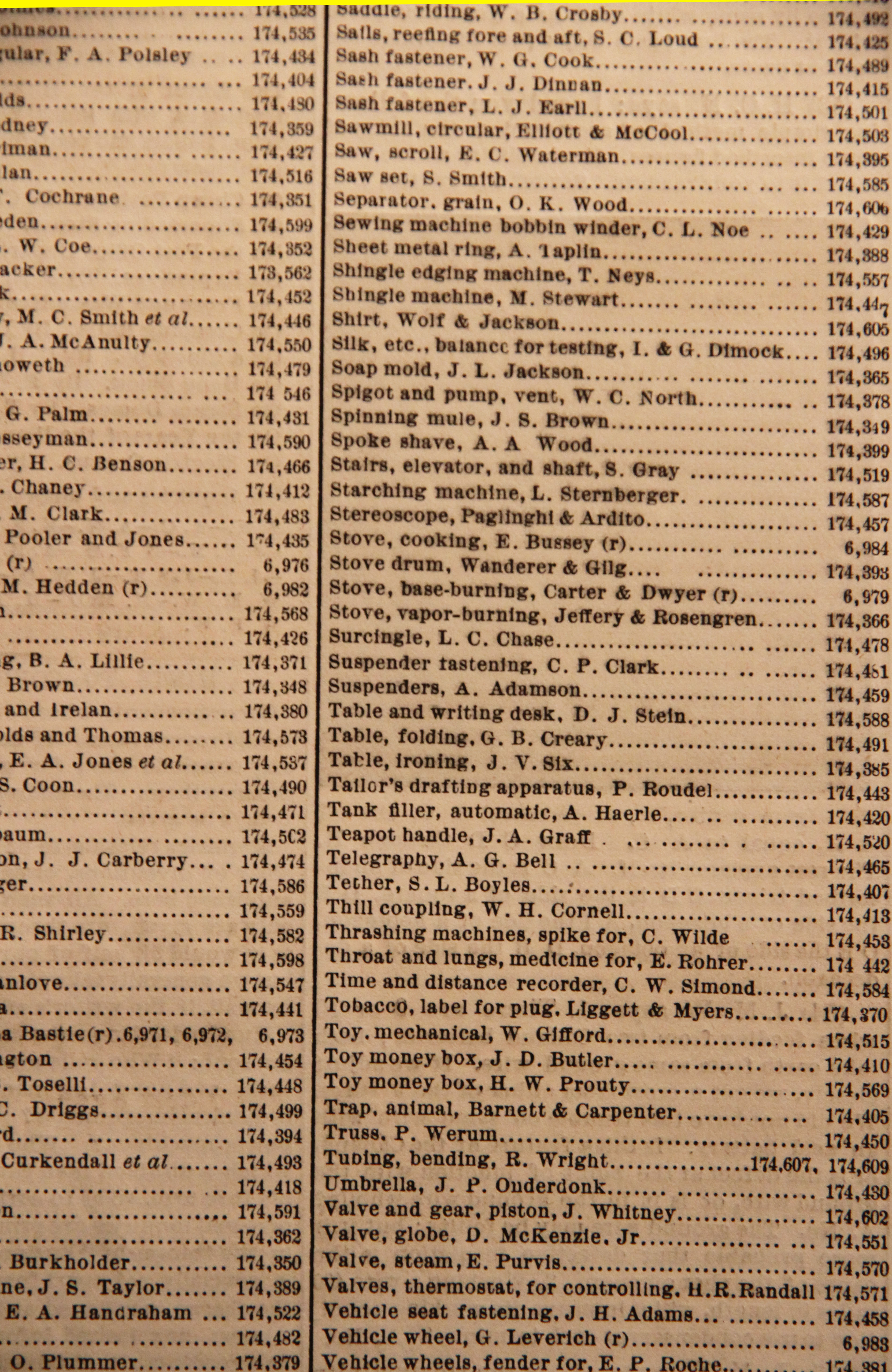
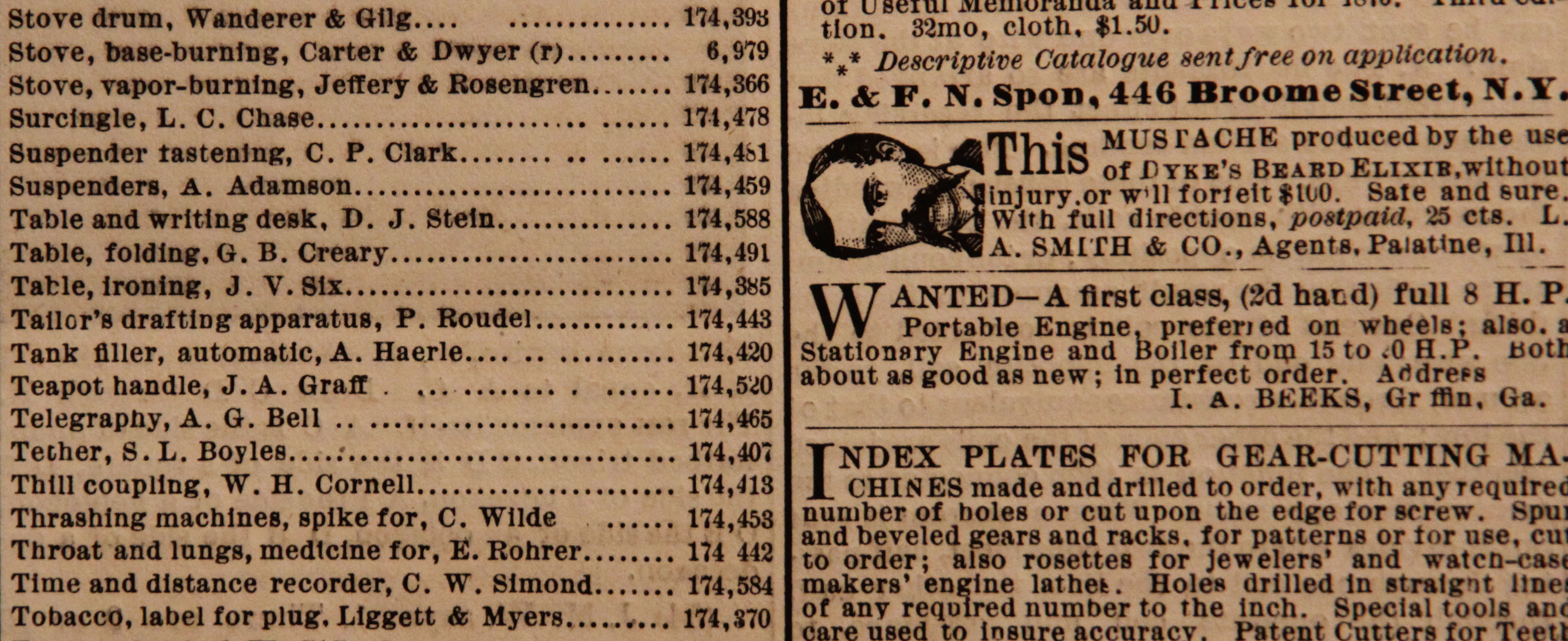
    patent announcements and articles on telegraphic fire alarms, electro-harmonic multiplex telegraphs, recording telegraphs, electro-magnetic telegraph railroad car signals, signal box telegraphs, underground telegraphs, telegraph keys and armature, acoustic telegraphs and the l;ike (though there weren’t that many reported, not really, just on the order of dozens), we find one of the most important of them all, patent # 174,465, by Alexander Graham Bell, appearing 8 April 1876.  It would be a rude resumption of being here in the future of this event to call the coverage short-sighted

     In an earlier article in the 4 March 1876 issue of SA, there appeared “The Invention of the Telephone”, by P.H. Vander Weyde, in which there is yet any mention of Mr. Bell.  There is an illustration of one of his precursors in the field, the Reuss telephone, with ample description. (This was actually Philipp Reiss, and his telephone really wouldn’t work to transmit the human voice, though did so work for music to some degree.)  Bell’s patent  would be at the Patent Office in March, and would appear as a one-line notice (among a hundred others), the patent stating it was “the method of, and apparatus for, transmitting vocal or other sounds telegraphically … by causing electrical undulations, similar in form to the vibrations of the air accompanying the said vocal or other sound”.  (The first image above is a detail; the second image a longer version, which is really only less than half of what the real-life version looks like in the tall listing.)

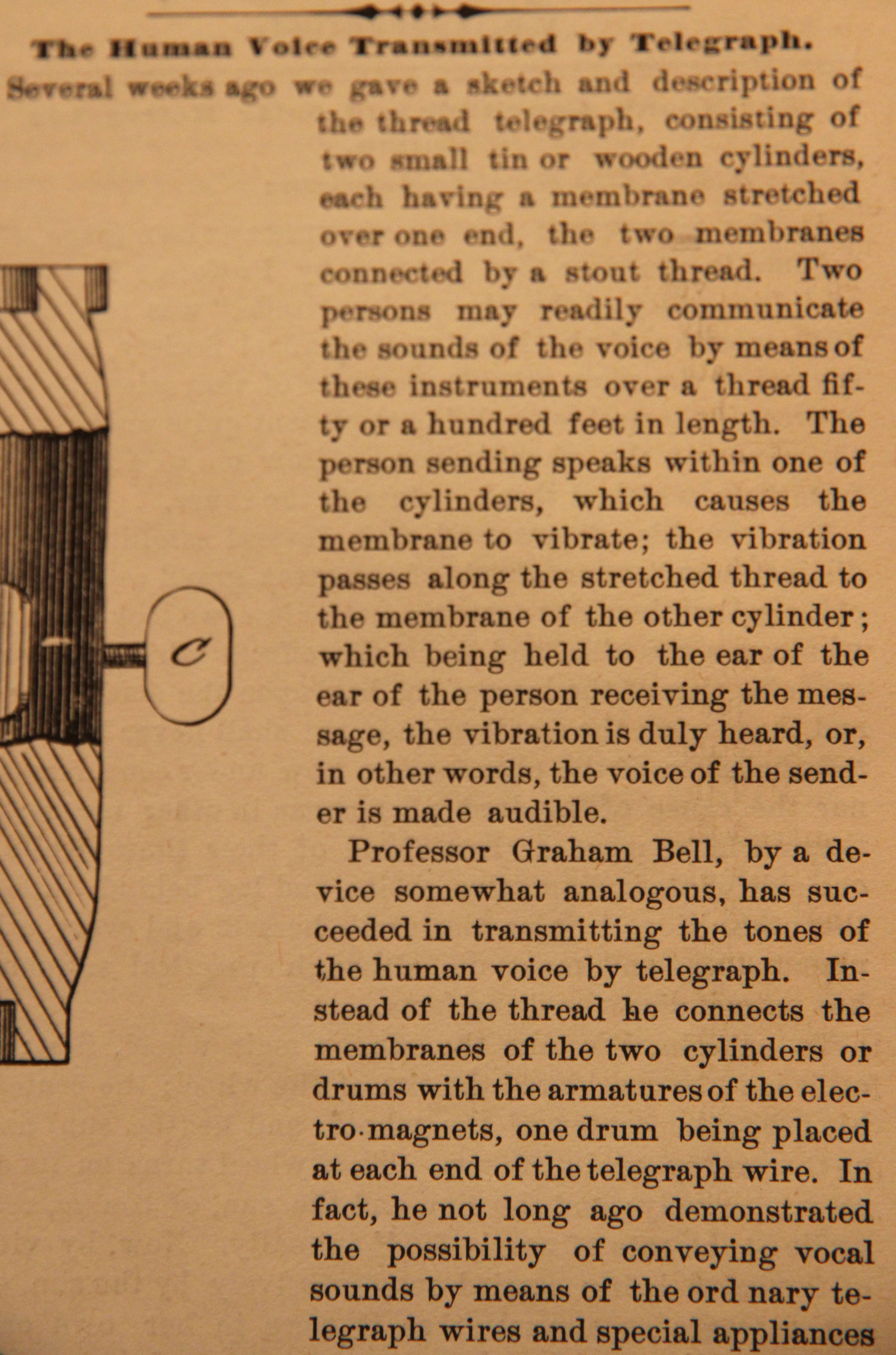
    Weeks later, Elisha Gray‘s (on 13 May) telegraphic telephone patent (175071) appears in the Scientific American, and later, on 9 September, on page 163, there is the article “The Human Voice Transmitted by Telegraph”, on the successful transmission by Graham Bell. 

    Bell human voice

    Admittedly there were a number of developments in the production of the speaking telephone at this time, though in general there seems to have been no great attention paid them in the pages of the Scientific American than pipe cutting machine improvements or improved gravel separators.  Obviously the great impact of the invention was yet to be appreciated, even in any sort of fictional way.

    The original volume of these reports is available for purchase via our blog bookstore, here.

    Some of the earliest speaking telegraph patent illsutrations follow:

    ·Posted by :

    ·in:

    —

  • Daily Dose of Dr. Odd: Blackboard Technology, 1850-1900

    JF Ptak Science Books  Quick Post

    Einstein chalkboard
    What is there not to like in a blackboard?  Doing work on a blackboard is a definite commitment, thinking done out-loud, brain squeezings that you had to stand next to and own, creativity done on the fly with plenty of room for annotations.  And so how would you accommodate an expansion of the display of thought or instruction in the 19th century?  There were evidently plenty of ways around just having a big piece of slate on a  wall, as these U.S. Patent Office application/grant drawings will show. 


  • Fitzcarraldo Deux: on France’s Monumental Overland Ship Railway, at the Break of Doom

    JF Ptak Science Books    Post 1808 

    Ship overland537
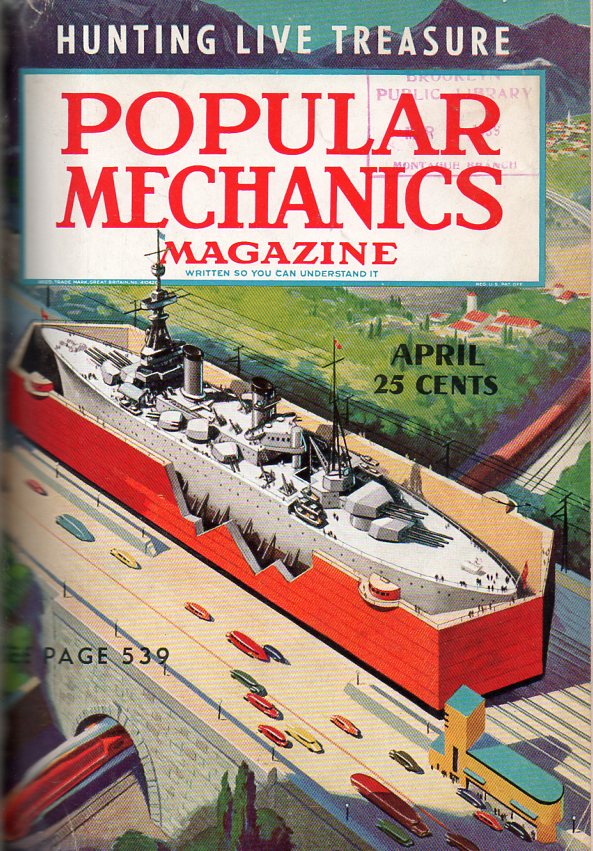
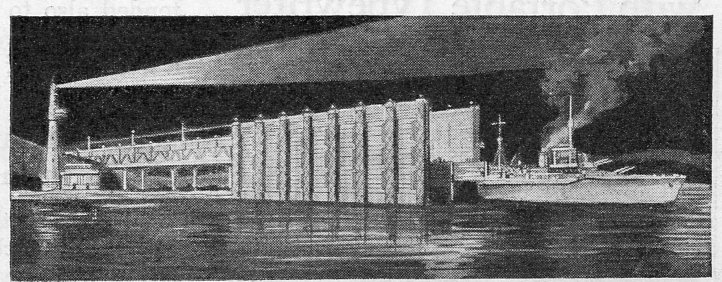
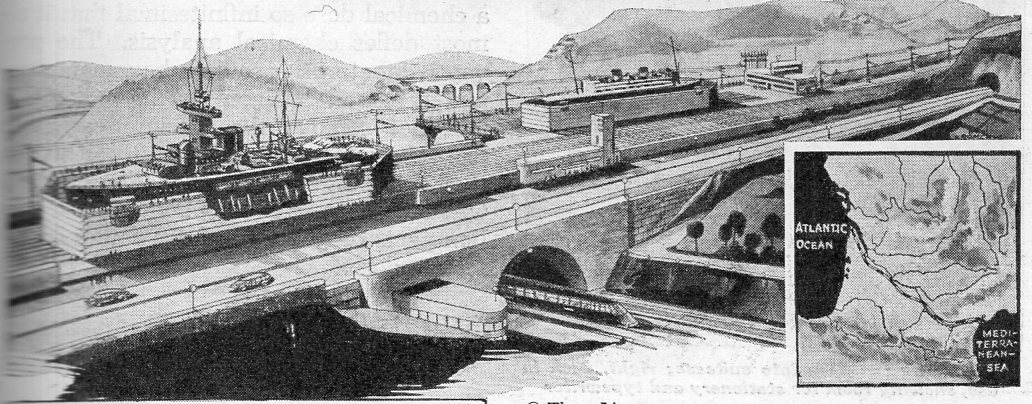
    This fantastic cover appeared in Popular Mechanics, volume 71, and showed a devotion to a monumental idea of dragging enormous ships by rail from the Atlantic Ocean to the Mediterranean Sea.  It was to be 300 miles long, and what looks like 125′ wide, connecting Port le Verdon and Beziers, putting down the 1,200-mile Bay of Biscaye/Gibraltar/Mediterranean route.

    It puts me in the mind of ponderable (and not impossible) colossi, some of which I wrote about in a short post on Werner Herzog’s film Fitzcarraldo. (It is a spill-over big, magnificent film about a would-be ice-making rubber baron bringing an opera house into the trans-Andes, trying to make his way into the dense forest in a huge rear-paddle steamboat on the Amazon to stake a claim in exploiting leased lands filled with rubber trees. See here.)

    The spirit of peace was nearly gone in Europe at this time, and the railroad line was to be guarded at 1000′-foot or so intervals by balloons which would suspend a steel net, protecting it from aerial attack.

    Ship overland540

    In one year’s time this would all be shrinkingly academic, a microbe in the plans for a greater France.  This issue was printed in June, 1939, three months away from the official start of the Second World War.  France would be attacked by Germany on 10 May, 1940, and an armistice would be signed with the aggressor five weeks later. 

    Ship overland538
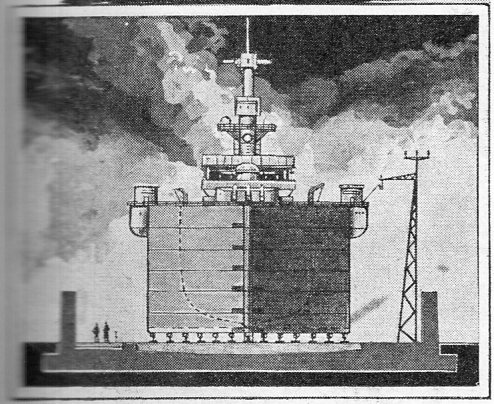
    It is a little painful to look at the color image from the cover, with an enormous battleship hosted within a turreted mobile structure perhaps 100′ wide, lumbering along on eight sets of railroad lines.  Not only that, but this absolutely enormous mobile situation was crossing over another railroad, atop a very, very substantial stone bridge. 

    Ship overland539

    And as I said, a year later, France was conquered, and another Maginot Line was never built.


  • The Intestinal String Polisher in the Curled Hair Dept.–Armour Meats, 1917

    JF Ptak Science Books   Post 1826

    The following impressions are a result of reading the Armour & Company’s hard-sell-we’re-really-really-clean promotional pamphlet, Seeing Armour’s. (I’m not sure why there is a plural possessive in the title, which is lopped off in the photo below–the pamphlet is actually splayed out here, opened from the 4×7.5 oblong to show both sides of the cover, revealing both halves of  the vastness of the company’s campus).
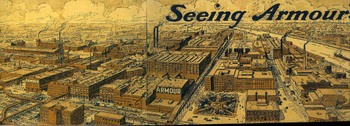
    Blogsept3_armour488


    Knowing full well The Jungle* story and the insufferable conditions in the livestock killing and processing industry, what really stopped me was this short note on one of the many elements of the company:
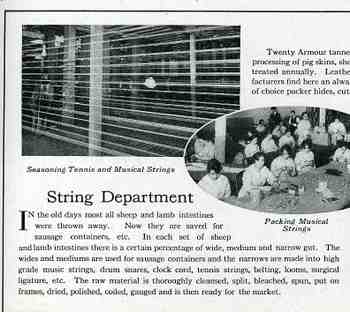
    Blogsept3_string484 the String Department.  (?)  How deflating it is to start thinking about this concept.   Yes, of course, of course there is a string department at the Amour Meat Packing Company, though they’re not making the stuff from field-grown fibers.  This string is just gut, but useful gut:  “In the old days most all sheep and lamb intestines were thrown away.  Now they are saved for sausage containers, etc.”  Et cetera?  I’m not sure if the “etc.” part is more baffling than the originality of the opening sentence (and a sentence which is probably never-before encountered).   There’s wide, medium and narrow gut, as it turns out, and it was cleansed, split, bleached, spun, put on frames, dried, polished, coiled and gauged.  (Now that’s a job title:  intestinal string polisher).

    There were a number of other expected/unexpected surprises.  The Curled Hair room was a surprise. I was expecting the soap room but didn’t expect the huge interior that it filled, with hundreds (?) of young women (all dressed in white) seated at long wide tables with mountains of soap, doing god knows what.  Oleomargarine, bullion, extract of beef, sausage, leaf lard and bacon were expected; the eggs, butter, cheese, grape juice, peanut butter, salmon and fruit syrups departments weren’t.  Armour seems to have been waging a veritable food war, with a little bit of beef/pork/sheep going into a little bit of everything. 
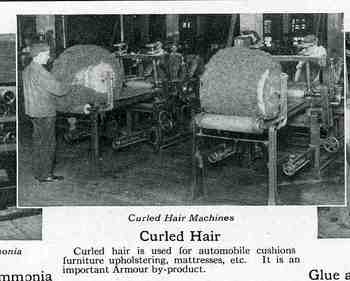
    Blogsept3_hair485

    Finally, having had just about enough of Mr. Armour, I stumbled into the stuff on the killing rooms.  Even though the description is cleaned up i the pamphlet, it still is not pretty, and sharing the photographs is just not necessary.

    20 years a vegetarian, here. 

    *Note:

    The Jungle was written by Upton Sinclair (often referred to as a “socialist” which he definitely, positively, was) in 1906.  It was basically an expose on the living and working conditions of the lower working classes, and is best remembered for bringing to vast public knowledge the grotesque conditions of the meat packing industry.  It is not possible, really, to overstate its importance, which is credited with leading to Meat Inspection Act and the Pure Food and Drug Act of 1906, which established the Food and Drug Administration.


  • Atomic Aircraft, 1946-1961

    JF Ptak Science Books    Post 1810

    Shooting Down the Nuclear Plane,  by W. Henry Lambright, (Inter-University Case Program #104, Bobbs-Merrill Co., 1964), is an interesting and nicely-documented history of an idea whose firm grasp on reality night not be terribly firm.  Of course it would be possible to prodce such a thing (at about this same time in 1961 appeared a cover for Popular Mechanics for an atomic-powered car from which two cowboys went a-hunting) if there was the collective will to do so, and there almost was.  Let’s just say then that the atomic-poweredness of our domestic defense was limited to aircraft carriers and submarines, and the atomic-powererd aircraft were left to science fiction .

    In general though it was at this time, from  about 1946 thorugh the late 1950s’, that people were thinking of refitting standard power systems with atomic energy. 

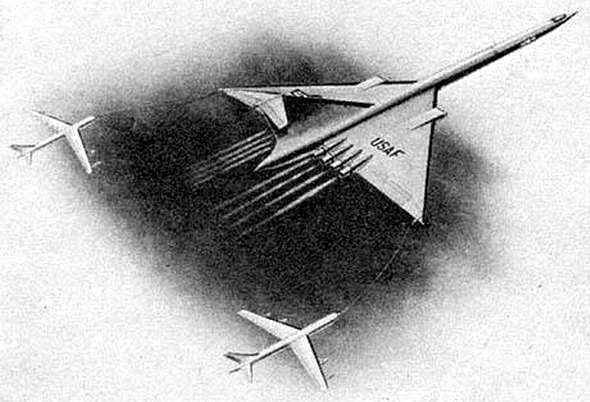
    Here are a few ideas for alternative approaches to flight, provided by the happy folks known as Atomic Energy:

    Another possibility for a nculear powered aircraft, by Northrup:

    [Source]  Another interesting design–a nuclear-powered prop plane, X-6, “derived from the Corvair B-36”:


  • Some Very Big, Sky-High Airborne Thinking, pre-WWII.

    JF Ptak Science Books  Post 1807   [Part of the History of the Future series]

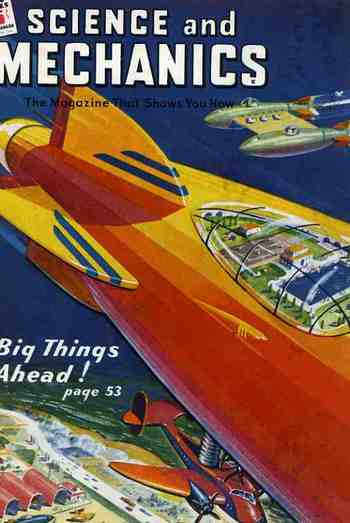
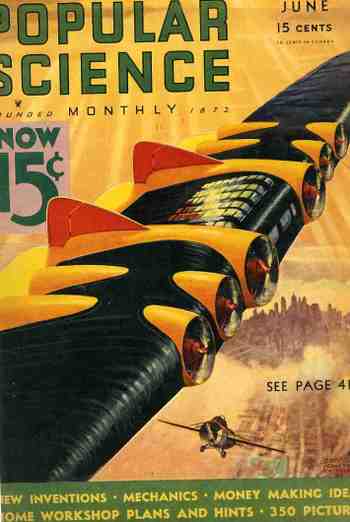
    Blogaugust_16bigflying_wing_detail3Once upon a time, engineers could do anything, especially in the first third or so of the 20th (American) century. The hopes for technological superstar were often on display in popular and illustrated magazines, though much of the times the dreams were more dreamy than they were engineering possibilities.   Some of my favorites among these hopeful projections of the future involve Big Thinking, and floating above these images of great possibilities and reluctant possibilities are thoughts on flight and of luxurious flight, or perhaps even continuous-flight-living. These three images were covers on some of the most popular of the popular sci-tech mags for this period:    Science and Mechanics, Popular Mechanics, and Popular Science Monthly. 
    Blogaugust_16bigflying_wing395

    All three of these examples show (in insets) some sort of large, encapsulated, living section that exists somewhere in the superstructure of the aircraft. The first example comes from Popular Science (15 June 1937), and depicts what I think is a large living area under a grid of 54 large glassy roofs—it is not possible for me to estimate the proportions of the craft, though I think it pales in comparison to the next two examples.

    Blogaugust_16bigflying_dirigible399

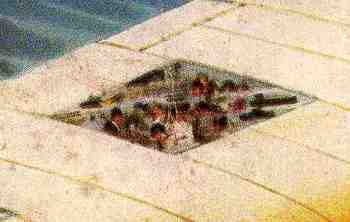
    In both instances the encapsulated areas have trees and roads. In the case of the Science and Mechanics contribution there seems to be six (?) of these large enclosures, the detail of which shows a large swimming pool, a club house, two tennis courts, and some other sporting area, all of which are surrounded by trees. Multiply this structure by six and what you’ve got is one really really big aircraft, which is somehow jet/atomic powered–in any event it is a gigantic craft and it is somehow staying aloft.

    Blogaugust_16bigflying_wing_wite_de


  • The NCC-1701, 1930: the pre-Starship Enterprise

    JF Ptak Science Books   Quick Post

    Uture plane519

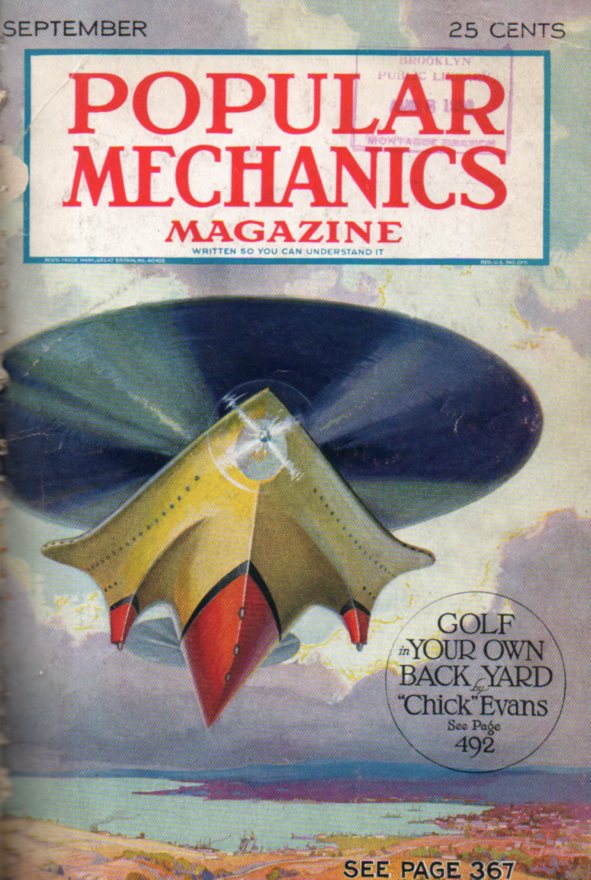
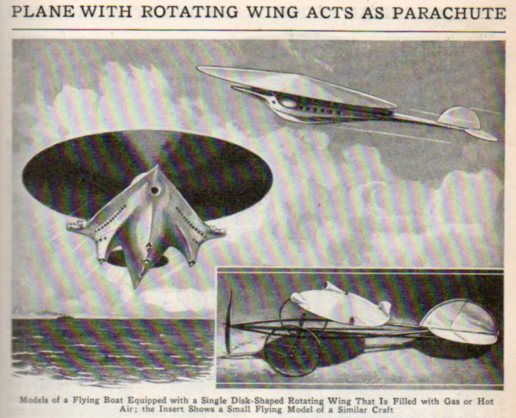
    Well, what is really was, or what this was intended to be in this memory of a possible aviation future–or naval future, as this airship was really a flying boat, an “amphibian, a dirigible, a gyrocopter ….an airplane”.   A ship, really, trying to judge the size of the thing by the position of the portholes/windows–the thing was big, and the “single wing, rotating disk-shaped affair filled with gas or hot air” was even bigger.   We read here that the disk was “turned by a gasoline engine” which was located in the center of the ship, leaving still plenty of room for “quarters” for the crew and passengers, making for what the inventor thought was an easy ascent and then, using the lifting device as a parachute, and then having a parachute-y descent, soft and simple.

    Its hard to judge the size of the machine, but it looks like there are 40-50 portholes or windows running the length of the ship, and so I’d guess that the fuselage of the craft was 150 feet long, which was about half of its overall length, making it about 300 feet overall.  The disk then could be 150-200 feet in diameter, giving it an area of close to one acre.  Big. 

    And so:

    Uture plane520


  • “The Enemy is Less than Ten Minutes from San Francisco”, 1942

    JF Ptak Science Books  Quick Post

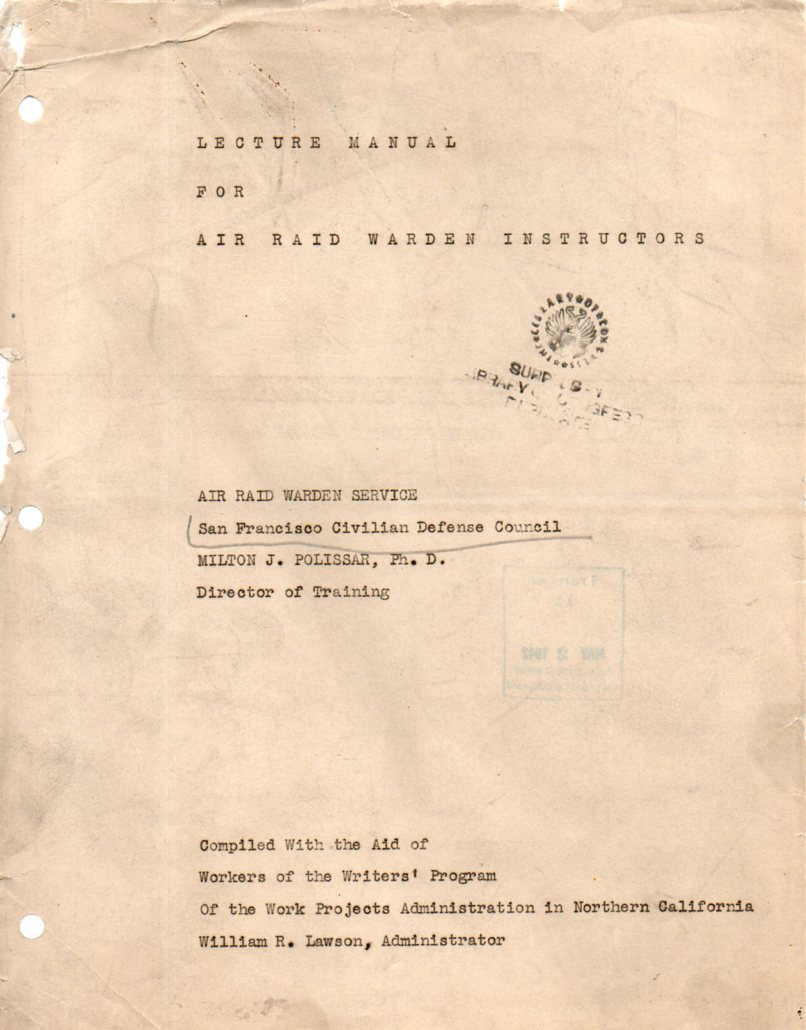
    Air warden478Lecture Manual for Air Raid Warden Instructors is in its way a remarkable document revealing some of the thinking and interpretation on the chances for the invasion of the American west coast just a few months (March 9, 1941) following Pearl Harbor.   Undertaken and published by the Workers of the Writers’ Program (‘of the Works Projects Administration in Northern California”) it was a product of one of the number of the Roosevelt administration’s social engineering programs that had a long lasting effect. 

    The first chapter, “It Can Happen Here” is more about the mechanics of responding to an enemy aerial attack than qu8estioning whether the attack might occur–the writer assumes that such an event was possible, and so precautions and preparations must be made–there is no question mark at the end of the chapter’s heading. 

    Overall I think that this was an excellent organizational effort for at least dealing with controlling the situation on the ground–providing a grid in which actions could be interpreted and responded to.  [The original is available at our blog bookstore.]


  • Addition to Inner City Rooftop Airport Design: Big, Bad, & Ugly; London, 1931

    JF Ptak Science Books    Post 1799

    London airport

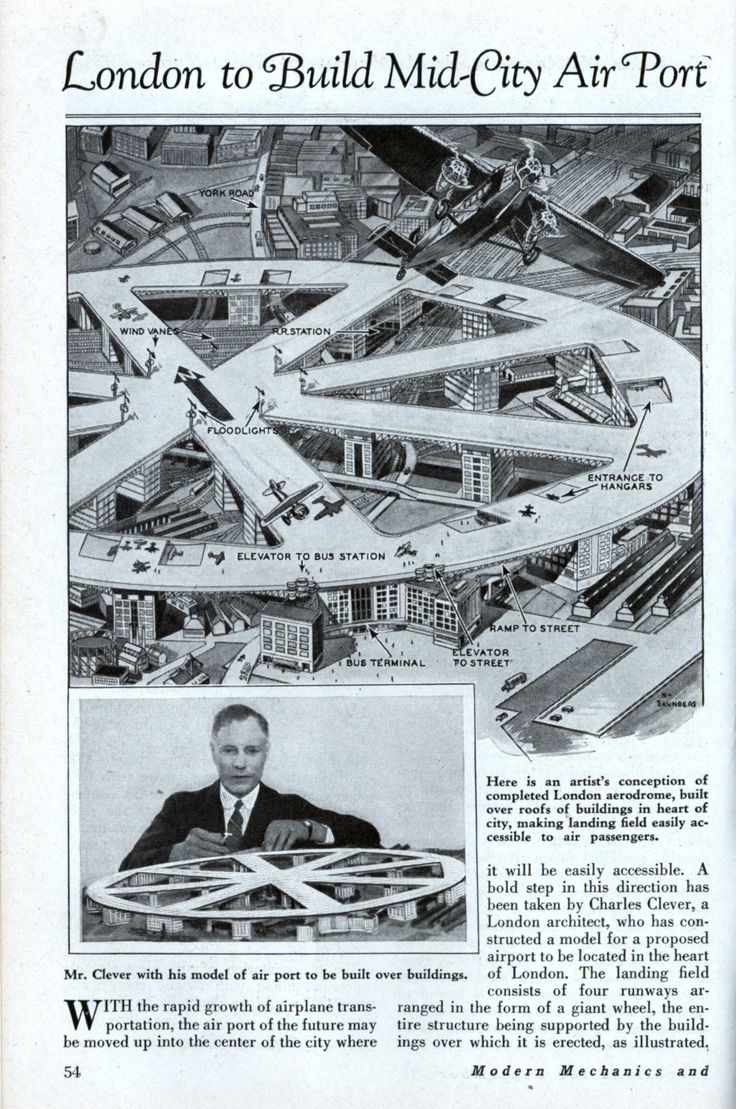
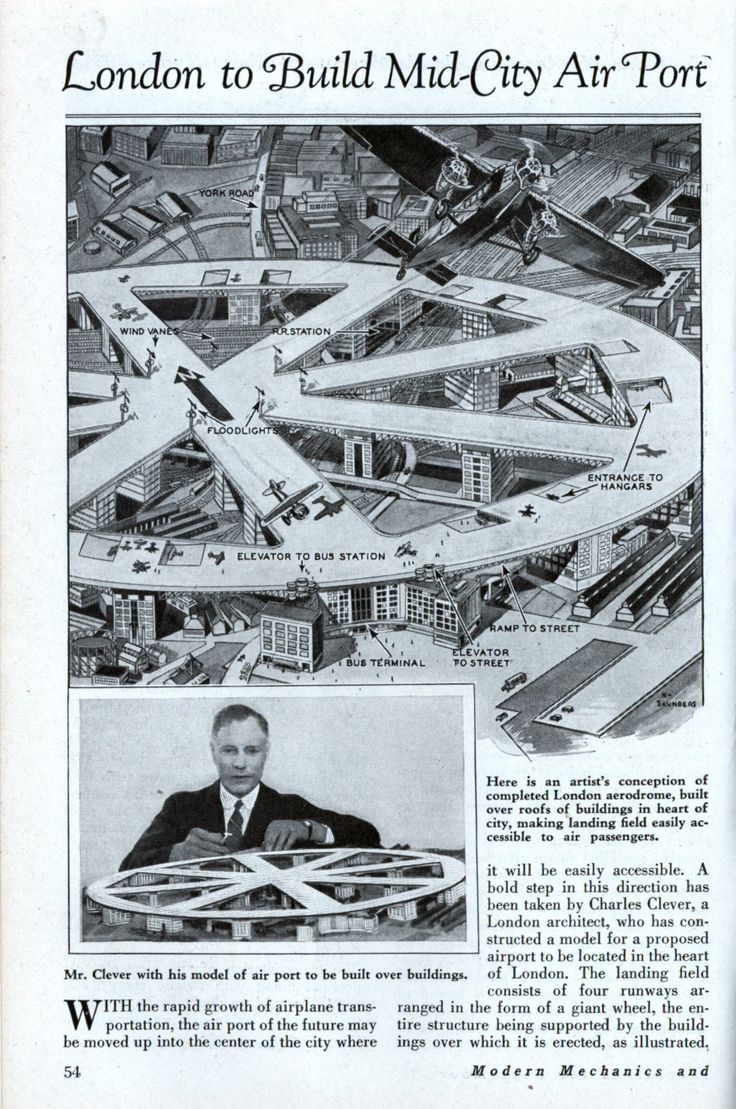
    Airportldn rooftop472[Source: Popular Mechanics, September, 1931.]

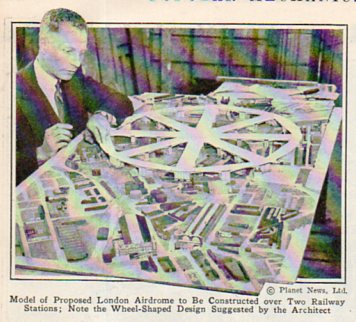
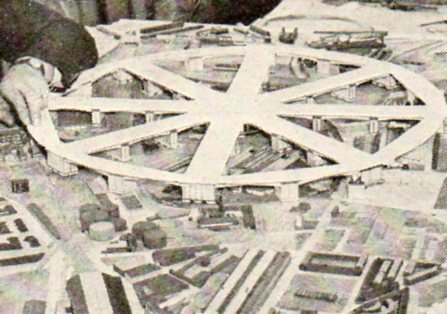
    I am not an architectural historian nor a historian of aviation, but I have looked at a lot of images relating to these fields over the past 30+ years, and so when I find something unusual it makes me pause.  One developing category in this area are rooftop/elevated inner city/downtown airports (I’ve done two earlier posts about this sort of design, including airports designed to be constructed over the Thames and Central Park NYC in Rooftop & Floating Airports -and- Rooftop Airports in a Levitating NYC, 1929  and Elevated, Rooftop Inner City Circular Airports.   I’m not at all certain about what these planners (above) were thinking except that the locations of the airports were central and would save on driving town from the hinterlands to central city–and the “central city” here was London, with the “aerodrome” hosted above King’s Cross and St. Pancras station, and might even have reached Regent’s Park, though I’m not sure.   Evidently there wasn’t much of a concern of the planes missing their runways, or coming in too low, or too fast, or just having an accident–any one of which would wind up in the lap of a busy city rather than in a field somewhere or on a large piece of ground devoid of buildings and a population (where airports are normally situated.  True, there are many airports in this country that are located in urban and suburban sprawls–there was calculated room for error and they were not located right on top of error-proof zones in the middle of a vastly populated areas. So, in the “what were they thinking” department, I clearly do not understand what they were thinking. 

    In addition to being a not-very-good-idea, it was also unwholesomely unpretty. And big.

    Airportldn rooftop473